Lead Paint Disposal Regulations: The 2026 Property Owner’s Guide to Compliance

Failing to distinguish between household hazardous waste and industrial lead debris isn’t just a technical oversight; it’s a significant financial…

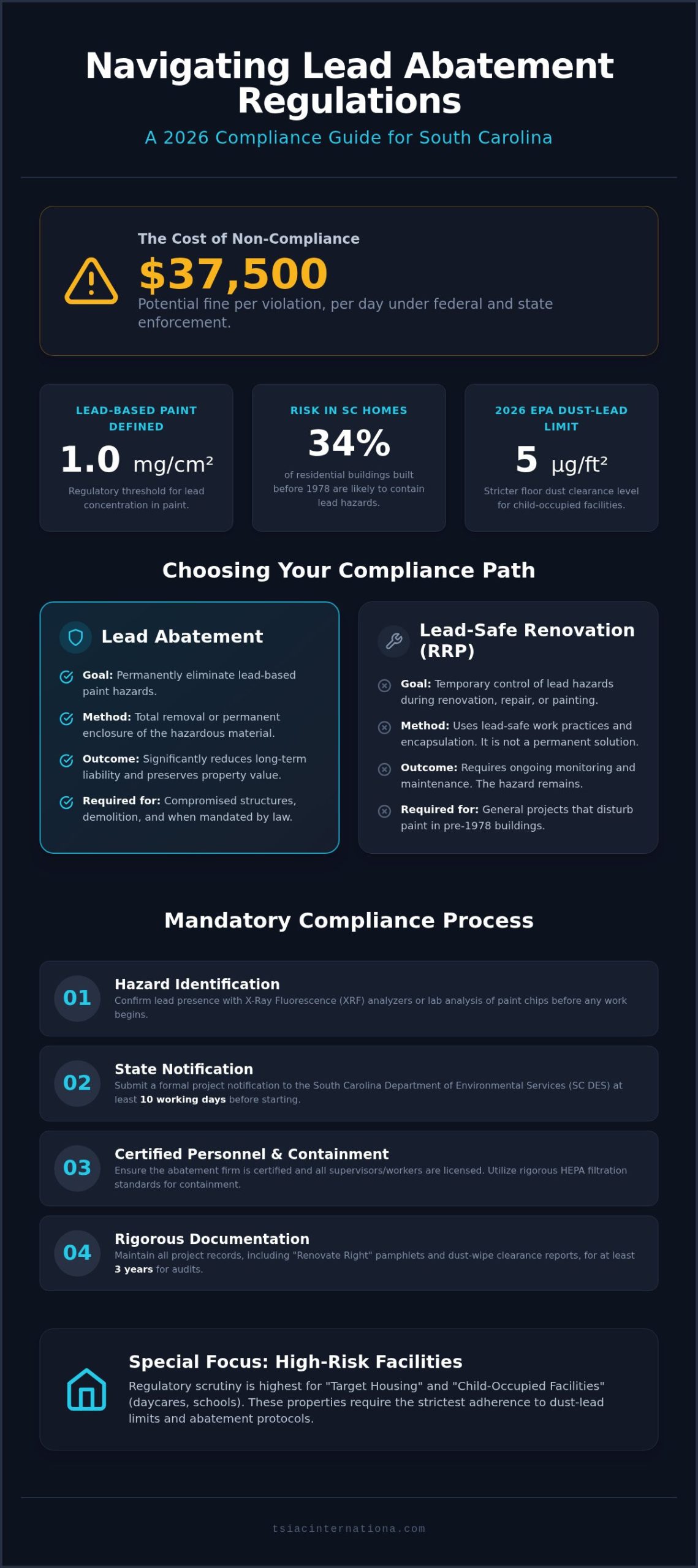
Failing to distinguish between household hazardous waste and industrial lead debris isn’t just a technical oversight; it’s a significant financial liability that can cost your business up to $41,093 per violation, per day. You’re likely feeling the pressure of the 2026 updates, where the shift to “any detectable level” for Dust-Lead Reportable Levels has made lead paint disposal regulations more stringent and technically demanding than ever before. It’s understandable to feel overwhelmed when EPA and HUD requirements overlap, leaving you uncertain about how to classify your waste or which testing protocols to implement to remain compliant.

This guide provides the technical clarity you need to manage these complex federal mandates with professional confidence. We’ll examine the specific requirements of the Resource Conservation and Recovery Act (RCRA) and the Toxic Substances Control Act (TSCA), explain how to accurately classify your waste stream based on current standards, and provide a methodical roadmap for legal disposal. By the end of this article, you’ll have a clear understanding of your compliance obligations and the necessary steps required to mitigate risk effectively.

Key Takeaways

  • Understand the distinct roles of RCRA and TSCA to ensure your project aligns with federal waste management authorities and abatement certification standards.
  • Learn how to apply the Toxicity Characteristic Leaching Procedure (TCLP) to determine if your debris exceeds the 5.0 mg/L threshold for hazardous waste classification.
  • Navigate the specific nuances of 2026 lead paint disposal regulations, including the critical differences between the “Household Waste” exemption and commercial disposal requirements.
  • Establish rigorous on-site containment protocols using 6-mil polyethylene packaging and leak-proof containers to maintain environmental safety during transport.
  • Discover how professional lead abatement services and proper documentation protect property owners from long-term legal and environmental liabilities.

Federal Framework: EPA and HUD Lead Paint Disposal Regulations

The management of lead-contaminated debris is governed by a hierarchy of federal mandates that prioritize environmental containment and public health. At the foundation sits the Resource Conservation and Recovery Act (RCRA), which serves as the primary authority for all solid and hazardous waste management in the United States. Under RCRA, any material generated during a project must be characterized to determine if it poses a toxicity risk. If lead concentrations in the waste extract exceed specific thresholds, the debris is legally classified as hazardous waste, requiring specialized handling, transport, and disposal protocols that differ significantly from standard construction waste.

While RCRA focuses on the waste itself, the Toxic Substances Control Act (TSCA) regulates the activities and professionals involved in lead-related work. TSCA Subtitle IV provides the statutory basis for the EPA’s Renovation, Repair and Painting (RRP) Rule and abatement certification requirements. Understanding the History of Lead-Based Paint Regulation is essential for property owners to recognize why these dual frameworks exist. They work in tandem to ensure that lead-based paint (LBP) waste—which includes structural components, paint chips, concentrated dust, and contaminated soil—doesn’t leach into the groundwater or re-enter the environment through improper disposal.

The 2000 EPA Policy Clarification

A pivotal shift occurred in 2000 when the EPA issued a policy clarification regarding residential lead-based paint waste. This memorandum established that LBP waste generated by homeowners or contractors in residential settings can be classified as “household waste.” This classification is a significant benefit for residential property owners because it exempts the debris from the more burdensome hazardous waste requirements of RCRA Subtitle C. It makes large-scale renovations and lead abatement projects more financially feasible by allowing debris to be disposed of in municipal solid waste landfills. However, this exemption is strictly limited to residential dwellings and doesn’t extend to commercial or industrial facilities, where lead paint disposal regulations remain much more rigid.

Key Regulatory Bodies and Their Jurisdictions

Compliance requires a multi-agency perspective. The EPA maintains oversight of the environmental discharge and the physical transport of waste across state lines. Simultaneously, the Occupational Safety and Health Administration (OSHA) enforces standards to protect workers from lead exposure during the removal and packaging phases. For federally assisted housing, the Department of Housing and Urban Development (HUD) layers additional requirements through its Lead Safe Housing Rule, which often mandates stricter clearance and disposal documentation than the EPA alone. Property owners must also verify state-specific amendments; many jurisdictions have adopted lead paint disposal regulations that are more stringent than federal baselines to address local environmental concerns.

Waste Classification: Hazardous vs. Non-Hazardous Debris

Accurate waste characterization is the technical pivot point between a standard renovation and a high-risk environmental violation. Under 2026 lead paint disposal regulations, the determination of whether debris is “hazardous” depends on the concentration of lead that can leach from the material, rather than the total lead content present in the paint itself. This distinction is vital for project budgeting and legal compliance. While residential projects benefit from certain exemptions, commercial and industrial projects must adhere to a rigid classification process to avoid the severe penalties associated with improper hazardous waste management.

The primary methodology for this classification is the Toxicity Characteristic Leaching Procedure (TCLP). This lab-based extraction process simulates the acidic conditions found in a landfill to measure how much lead might migrate into groundwater over time. If the resulting extract contains lead at or above the 5.0 mg/L threshold, the waste is legally classified as hazardous. There’s a significant difference in how different materials perform during this test. Architectural components, such as doors or window frames, often pass TCLP tests because the lead paint constitutes a small fraction of the total mass. Conversely, concentrated paint chips, scrapings, or sludge from chemical stripping almost always exceed the threshold. For a technical deep dive into these procedures, the USDA provides a detailed resource on Lead-Based Paint Waste Handling.

Some property owners attempt to rely on “knowledge of the waste” to bypass formal lab testing. This is a high-risk strategy that rarely survives regulatory scrutiny. While the EPA allows classification based on documented history or previous data, it places the full burden of proof on the generator. If a regulator discovers lead-leachable material in a municipal landfill, a lack of documentation will not mitigate the $41,093 per day penalty for misclassification. Utilizing professional lead abatement services ensures that waste is characterized through empirical data, removing the guesswork from your compliance strategy.

The TCLP Testing Process

For commercial interior gutting or industrial demolition, testing is a procedural necessity. Samples must be collected by trained personnel and analyzed by EPA-recognized laboratories. The results dictate the entire logistics chain, including the type of transport vehicle required and the final disposal facility’s permit requirements. Representative sampling is critical; a single failure in a composite sample can reclassify an entire roll-off container as hazardous waste, exponentially increasing disposal costs.

Characteristic Hazardous Waste (D008)

Waste that fails the TCLP is assigned the EPA waste code D008. This designation triggers strict management standards under RCRA. Your specific responsibilities depend on your generator status. Large Quantity Generators (LQG), who produce over 1,000 kg of hazardous waste per month, face much more rigorous reporting, training, and storage time limits than Small Quantity Generators (SQG). Misclassifying D008 waste as general construction debris is a serious offense that can lead to permanent environmental records and significant civil liabilities for the property owner.

Lead Paint Disposal Regulations: The 2026 Property Owner’s Guide to Compliance

Residential vs. Commercial Disposal Standards

The regulatory landscape for lead paint disposal regulations splits sharply based on property usage, creating two distinct compliance paths for owners. Residential properties benefit from a significant federal exemption that simplifies the waste stream, while commercial and industrial sites operate under a strictly monitored hazardous waste framework. Understanding where your project falls is the first step in avoiding the severe civil penalties associated with mismanaged lead debris. Whether you’re overseeing a simple renovation or a complex adaptive reuse project, the classification of the structure dictates every logistical decision from containment to final haul-off.

Historic building renovations and adaptive reuse projects present unique challenges because they often involve “Selective Demolition” or “Interior Gutting” of structures built long before the 1978 lead paint ban. In these scenarios, the “Household Waste” exemption applies only if the building is currently used as a single-family home or a multi-family dwelling. If that same historic structure is being converted into a commercial office or a retail space, the exemption vanishes. This shift requires a methodological approach to waste characterization, as debris that was once considered “household” suddenly becomes potential D008 hazardous waste the moment the property’s primary function changes.

Residential Renovation and Repair (RRP) Rule

For homes and child-occupied facilities built before 1978, the EPA’s RRP rule is the governing standard. It triggers specific on-site management protocols whenever a project disturbs more than 6 square feet of interior space or 20 square feet of exterior surface. Contractors must be EPA-certified and follow rigorous containment procedures. All waste, including dust and paint chips, must be collected and sealed in 6-mil polyethylene bags or leak-proof containers before being moved. Because of the 2000 EPA policy clarification, this residential debris can typically be sent to municipal solid waste landfills, though it’s essential to verify that the local facility accepts lead-contaminated materials.

Commercial and Industrial Demolition Requirements

Commercial projects face much higher regulatory scrutiny because they don’t enjoy the household waste safety net. Every commercial “Structural Demolition” or “Lead Abatement” project requires a mandatory hazardous waste determination before a single pound of debris leaves the site. This process involves the TCLP testing discussed in previous sections to ensure the waste doesn’t exceed the 5.0 mg/L threshold. In regions like South Carolina, specialized hazardous material abatement protocols are often required to meet both federal and state-specific environmental standards. Compliance in this sector requires an EPA ID number for tracking waste from “cradle to grave,” and all transport must be handled by licensed hazardous waste haulers who provide a formal manifest for your records.

Practical Compliance: Containment, Transport, and Documentation

Practical execution of lead paint disposal regulations requires more than just a theoretical understanding of the law; it demands a disciplined approach to physical site management. Once lead-based paint debris is generated, it must be isolated immediately to prevent cross-contamination of non-hazardous waste streams. This process begins with the establishment of a designated containment area. This zone should be clearly demarcated and protected from environmental factors like wind and rain that could spread lead-contaminated dust across the project site.

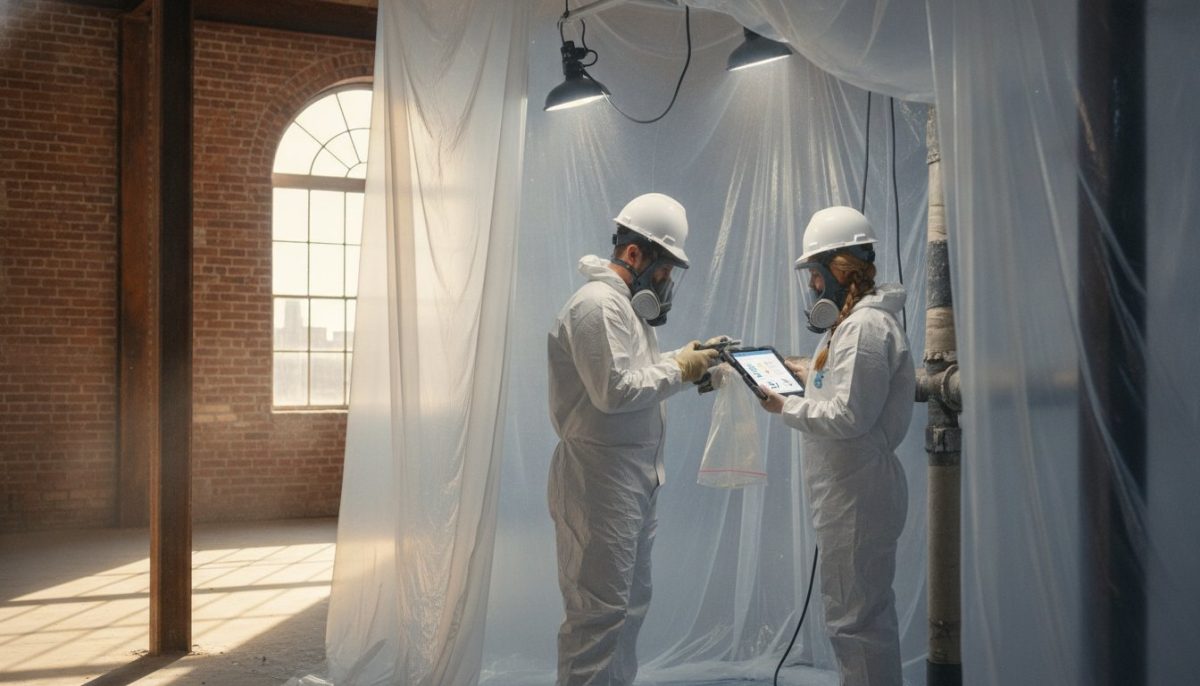
Packaging is your next critical line of defense. All lead debris, ranging from large architectural components to fine paint scrapings, must be secured in 6-mil polyethylene bags or rigid, leak-proof containers. These materials are specifically designed to withstand the rigors of handling and transport without puncturing. For commercial projects, the Department of Transportation (DOT) mandates specific vehicle labeling and placarding if the load meets hazardous waste thresholds. Every container must be sealed with industrial-grade adhesive to ensure a vacuum-tight environment during transit. If you require assistance with these complex logistical requirements, our team provides expert lead abatement services to ensure your site remains fully compliant.

On-Site Storage and Management

Temporary storage of lead waste on-site is a period of high vulnerability. To prevent lead dust migration, storage areas should be located away from high-traffic zones and ventilation intakes. If the waste is classified as hazardous, containers must be labeled with the date accumulation started and the specific EPA waste code, such as D008. Security is equally important. Hazardous waste storage must be locked or under constant supervision to prevent unauthorized access or accidental disturbance by site personnel who aren’t trained in lead safety protocols. This methodical approach ensures that the “any detectable level” standard for lead dust is maintained throughout the project’s duration.

The Waste Manifest System

The “Paper Trail” is your primary defense during a regulatory audit. For hazardous lead waste, you must utilize the Uniform Hazardous Waste Manifest system. This document tracks the debris from the moment it leaves your property (the generator) until it reaches a permitted Treatment, Storage, and Disposal Facility (TSDF). Each party in the chain, including the generator, the transporter, and the facility operator, must sign the manifest. Under federal law, property owners are required to retain these records, along with all TCLP lab results and disposal receipts, for at least three years. Maintaining this documentation is the only way to prove that you’ve fulfilled your “cradle-to-grave” responsibility under RCRA.

Ensuring Compliance Through Professional Abatement

The complexity of 2026 lead paint disposal regulations makes professional abatement a logistical necessity rather than an optional service. While property owners are ultimately responsible for the waste generated on their sites, partnering with a certified lead abatement contractor allows for the systematic transfer of operational risk. These professionals bring a level of technical precision that goes beyond simple removal. They manage the entire lifecycle of the waste, from the initial characterization via TCLP testing to the final verification of site clearance. This methodical approach ensures that every gram of lead debris is accounted for, packaged correctly, and transported to a facility permitted to handle hazardous materials.

Final site clearance is the most critical phase of any lead-related project. It involves rigorous dust-lead action level testing to confirm that the environment is safe for re-occupancy or subsequent construction phases. For 2026, these thresholds have been lowered to 5 µg/ft² for floors and 40 µg/ft² for window sills. Achieving these levels requires industrial-grade HEPA vacuuming and wet-cleaning protocols that standard janitorial or construction crews cannot provide. Professional verification provides the empirical data needed to close out permits and protect the property owner from future claims of environmental negligence.

Risk Mitigation for Property Owners

Hiring licensed abatement professionals is a strategic move to mitigate long-term environmental liability. These experts utilize specialized equipment, including negative-pressure air machines and high-efficiency particulate air (HEPA) filtration, to ensure that lead dust doesn’t migrate to adjacent areas. This level of containment is vital for maintaining compliance with OSHA and EPA standards simultaneously. For those managing multi-faceted industrial or commercial sites, seeking hazardous material abatement in South Carolina provides a streamlined path through both regional and federal mandates, ensuring that complex contamination profiles are handled with professional discipline.

Comprehensive Site Remediation

Lead abatement rarely exists in a vacuum. Most large-scale renovation or demolition projects involve multiple hazardous materials that require coordinated handling. Streamlining your project by combining lead removal with asbestos removal in South Carolina reduces mobilization costs and prevents conflicting waste streams from complicating your compliance documentation. This integrated approach is especially critical during the execution of commercial interior gutting services, where structural elements and finishes must be stripped while maintaining strict environmental controls. Ensure your project meets all lead paint disposal regulations by contacting TSIAC International today.

Securing Your Project’s Regulatory Future

Mastering the 2026 updates requires more than just awareness; it demands a methodical commitment to site safety and precise waste characterization. By implementing rigorous TCLP testing and maintaining a meticulous waste manifest system, property owners can transform a high-risk liability into a controlled, predictable work stream. Adhering to modern lead paint disposal regulations isn’t merely a legal obligation. It’s a critical component of responsible asset management and long-term environmental stewardship.

With over 15 years of hazardous material experience, TSIAC International provides the technical precision required for complex abatement projects. We’re fully licensed and insured for national operations, providing the comprehensive documentation and compliance reporting necessary to withstand any regulatory audit. Our team handles the difficult technical challenges so you can maintain focus on your broader project goals.

Consult with our lead abatement experts for regulatory-compliant disposal and ensure your site meets every federal standard. Protecting your property and the surrounding community is a manageable objective when you have a partner who prioritizes technical accuracy and unwavering reliability.

Frequently Asked Questions

Can I dispose of lead-based paint waste in a regular dumpster?

You cannot dispose of lead-based paint waste in a regular dumpster if the project is commercial or industrial. While residential debris often falls under the “Household Waste” exemption, municipal landfills have specific policies regarding lead-contaminated materials. Mixing lead waste with general construction debris in a standard container without prior authorization can lead to rejected loads and environmental fines.

What is the TCLP test, and when is it required for lead paint?

The Toxicity Characteristic Leaching Procedure (TCLP) is a laboratory analysis used to determine the mobility of organic and inorganic analytes present in liquid, solid, and multiphasic wastes. It’s mandatory for commercial and industrial projects to identify if the lead concentration in the extract meets or exceeds 5.0 mg/L. This test ensures that waste is correctly classified before it enters the disposal stream.

Are there different regulations for residential vs. commercial lead paint disposal?

Residential lead paint disposal regulations are generally less restrictive due to the EPA’s 2000 policy clarification, which classifies residential debris as household waste. Commercial and industrial projects don’t receive this exemption. They must undergo formal hazardous waste determination and follow strict RCRA Subtitle C management standards, including cradle-to-grave tracking and specialized transport.

How long must I keep records of lead paint waste disposal?

You must retain all records related to lead paint waste disposal for a minimum of three years. This documentation includes laboratory TCLP results, waste manifests, and disposal receipts from the treatment facility. Maintaining these files is a critical component of your legal defense during regulatory audits or environmental inspections.

Do I need a special permit to transport lead-contaminated debris?

A special permit or EPA Identification Number is required to transport lead-contaminated debris if it’s classified as hazardous waste. Transporters must adhere to Department of Transportation (DOT) regulations, which include specific vehicle placarding and the use of a Uniform Hazardous Waste Manifest. Residential waste typically doesn’t require these permits, but commercial debris almost always does.

What happens if a property owner violates lead paint disposal regulations?

Violating lead paint disposal regulations can result in civil penalties of up to $41,093 per violation, per day from the EPA. Additionally, HUD violations can reach $21,039 per instance. Beyond financial impact, property owners may face long-term environmental liability, legal injunctions, and mandatory remediation orders that can significantly delay project completion.

Is lead-contaminated soil treated differently than architectural debris?

Lead-contaminated soil is treated differently than architectural debris and is often subject to separate remediation standards. While structural components might pass a TCLP test due to their mass, soil often concentrates lead particles and may require specialized excavation and disposal at a hazardous waste facility. Soil management protocols focus on preventing airborne dust and groundwater leaching.

How does the EPA define a “hazardous” level of lead in waste?

The EPA defines lead waste as hazardous if the TCLP extract contains lead at a concentration of 5.0 mg/L or higher. This waste is assigned the D008 characteristic hazardous waste code. It’s important to note that this threshold applies to the leachable lead found in the lab extract, not the total lead concentration of the solid material.

Asbestos Abatement Third Party Air Monitoring: The Essential Safety & Compliance Guide

If a contractor is permitted to certify the quality of their own hazardous material removal, the objectivity of your safety data is compromised….

If a contractor is permitted to certify the quality of their own hazardous material removal, the objectivity of your safety data is compromised. Relying on the same entity for both execution and validation creates a conflict of interest that your legal and physical safety cannot afford. Prioritizing asbestos abatement third party air monitoring is the only way to ensure that the work meets rigorous safety standards without bias. This process serves as a necessary barrier against the risks associated with the 40,000 annual asbestos-related deaths in the U.S., providing an evidence-based “clean bill of health” for your property.

It’s natural to feel overwhelmed by complex OSHA requirements or the fear of future exposure lawsuits. You deserve the peace of mind that comes from knowing the air is safe to breathe. This article will teach you why independent oversight is the most reliable insurance policy for any abatement project. We’ll detail how third-party experts document compliance with the 0.01 f/cc clearance standard, protecting your liability and ensuring every technical parameter is met with disciplined precision.

Key Takeaways

  • Understand the critical distinction between the removal contractor and the independent environmental professional who provides objective, unbiased oversight.
  • Learn the technical differences between PCM and TEM sampling methods and why accredited laboratory analysis is non-negotiable for valid results.
  • Discover why asbestos abatement third party air monitoring must be a continuous, multi-phase process to ensure safety from project start to final clearance.
  • Identify the specific OSHA and EPA documentation requirements that transform air monitoring data into a robust legal shield against future liability.
  • Gain insights into how professional abatement teams coordinate with independent monitors to maintain project timelines without compromising safety protocols.

What is Third Party Air Monitoring in Asbestos Abatement?

Third-party air monitoring is the systematic oversight of a remediation site by an Independent Environmental Professional (IEP). This individual functions as a neutral observer, ensuring that the physical asbestos abatement process remains within strict safety parameters. There’s a fundamental difference between the abatement team, who performs the labor, and the monitor, who conducts the scientific testing. One handles the hazard; the other validates the environment. This separation of duties is the cornerstone of modern industrial hygiene.

When a removal contractor is permitted to monitor their own air, it’s essentially “grading their own homework.” This practice creates a dangerous lack of accountability. If a containment barrier fails or microscopic fibers escape, a contractor focused on project completion might overlook the breach to avoid delays. An independent monitor has no such incentive. Their primary responsibility is to protect the building occupants and provide an unbiased record of the air quality. By employing an industrial hygienist, property owners ensure that the data driving safety decisions is accurate and untainted by commercial pressure.

The Legal and Ethical Necessity of Independence

The conflict of interest inherent in self-monitoring is why many jurisdictions and insurance providers now mandate separation between the removal and testing entities. For example, in New York, it’s a legal requirement that the abatement contractor and the air monitoring company remain separate business entities. From a liability standpoint, having a third-party record is vital. If a property owner faces a future lawsuit regarding exposure, these independent records serve as an objective legal shield. It proves that the asbestos removal south carolina or elsewhere followed every established protocol. Many insurance policies will not cover a claim unless asbestos abatement third party air monitoring was utilized to verify the final clearance.

Core Responsibilities of the Air Monitor

A professional monitor’s work begins long before the first material is disturbed. They establish a “clean” baseline by sampling the air before work starts to understand the ambient conditions. During the project, they perform daily sampling inside and outside the work area to ensure the containment remains effective. Their role also includes rigorous visual inspections of critical barriers and HEPA filtration systems. They look for physical defects, such as tape failures or punctures in the poly sheeting, before they lead to air contamination. Finally, the monitor issues the formal clearance report. This document contains the laboratory results required to prove the space is safe for re-entry. Without asbestos abatement third party air monitoring, this final “clean bill of health” lacks the necessary credibility for full regulatory compliance.

The Science of Air Sampling: PCM vs. TEM Methods

The technical execution of asbestos abatement third party air monitoring relies on high-volume air pumps and specialized filter cassettes. These pumps draw a measured volume of air through a filter, capturing microscopic particulates for analysis. The resulting data is expressed in fibers per cubic centimeter (f/cc), which is the standard metric used to determine if a space meets safety requirements. It’s vital that the laboratory performing the analysis holds accreditation through the National Voluntary Laboratory Accreditation Program (NVLAP) or the American Industrial Hygiene Association (AIHA). This ensures the results are legally defensible and scientifically accurate.

Accuracy in these measurements is the only way to verify that a site remains below the 0.1 f/cc Permissible Exposure Limit (PEL) established by OSHA’s asbestos standard. During active removal, the monitor must also account for the excursion limit, which is 1.0 f/cc averaged over a 30-minute sampling period. If you’re managing a complex project, reviewing a guide on asbestos removal south carolina can help you understand how these technical parameters fit into a broader regulatory strategy.

PCM (Phase Contrast Microscopy): The Industry Standard

Phase Contrast Microscopy (PCM) is the most common tool for daily monitoring. It uses a standard light microscope to count fibers that meet specific dimensional criteria, usually those longer than five microns with a 3:1 length-to-width ratio. Its primary advantage is speed. A monitor can often provide results on-site or within a few hours, allowing work to continue without interruption. However, PCM has a significant limitation: it cannot distinguish between asbestos and other fibers like fiberglass, gypsum, or organic dust. It simply counts everything that meets the size criteria. Despite this, PCM remains the standard for demonstrating daily compliance during active removal phases.

TEM (Transmission Electron Microscopy): The Gold Standard

Transmission Electron Microscopy (TEM) represents the gold standard of environmental testing. TEM uses an electron beam to view fibers at magnifications exceeding 20,000 times, allowing for the identification of individual asbestos fibrils. Unlike PCM, TEM can identify the specific mineral signature of asbestos, distinguishing it from harmless materials. It also detects much smaller fibers that are invisible under a light microscope. Under the Asbestos Hazard Emergency Response Act (AHERA), TEM is often mandatory for final clearance in school buildings and high-occupancy commercial spaces. While the cost is higher and the turnaround time is longer due to the need for a specialized laboratory, the level of certainty it provides is absolute.

Asbestos Abatement Third Party Air Monitoring: The Essential Safety & Compliance Guide

The Three Critical Phases of Asbestos Air Monitoring

Effective asbestos abatement third party air monitoring isn’t a single event; it’s a continuous lifecycle that spans the entire duration of a project. The monitor works in tandem with the asbestos removal south carolina team to ensure that engineering controls remain intact. This collaboration provides the real-time data necessary to prevent fiber release episodes that could jeopardize the health of occupants in adjacent areas. Meticulous documentation at every stage is required to demonstrate full compliance with EPA asbestos regulations and protect the property owner from future liability.

Phase 1: Background and Pre-Abatement Sampling

Before any hazardous material is disturbed, the monitor must establish a baseline of the existing air quality. This involves placing sampling pumps in and around the proposed work area to determine the ambient fiber count. During this phase, the industrial hygienist also verifies that the containment area is properly sealed and that the negative pressure machines are functioning at the required flow rates. Background sampling serves as the definitive benchmark against which all subsequent air quality tests are measured.

Phase 2: Daily Area and Perimeter Monitoring

Once the removal begins, the focus shifts to containment integrity. The monitor places pumps at the perimeter of the work zone and near the decontamination unit to ensure zero leakage into “clean” areas of the building. This daily asbestos abatement third party air monitoring protects both the workers inside the enclosure and any occupants remaining in the building. If a “spike” in fiber counts is detected, the monitor has the authority to trigger immediate work stoppage protocols. The removal team must then identify the source of the leak and re-seal the containment before activities can resume.

Phase 3: Final Clearance Testing

The final phase is the most rigorous and determines when a space can be safely re-occupied. After the abatement team completes their final cleaning, the monitor performs “aggressive” air sampling. This technique involves using leaf blowers or fans to stir up any settled dust, ensuring that no microscopic fibers remain on surfaces. To pass, the air must test at or below the clearance standard of 0.01 f/cc. You cannot dismantle the containment barriers or turn off the negative air machines until the formal clearance report is received and signed by the independent professional. This document is your proof that the environment is restored to a safe, breathable condition.

Regulatory Compliance and Protecting Against Liability

Adhering to federal and state mandates is a complex undertaking that requires a dual focus on worker safety and environmental protection. OSHA standards primarily govern the health of the technicians performing the work, while EPA regulations focus on the impact the project has on the surrounding environment and public. Utilizing asbestos abatement third party air monitoring serves as the vital link between these two regulatory bodies. It provides an objective data set that proves your project remained within the legal limits of both agencies, effectively creating a “legal shield” against future litigation. Without this independent verification, a property owner is left vulnerable to claims of negligence that can arise decades after the work is finished.

The integrity of this legal shield depends entirely on a flawless “Chain of Custody.” This technical protocol tracks every air sample from the moment the filter is placed in the pump until the final analysis is recorded at the laboratory. If this chain is broken or poorly documented, the results may be ruled inadmissible in court. Professional monitors ensure that every sample is sealed, signed, and logged with precision. This level of detail is necessary because state-specific requirements often exceed federal standards. For instance, certain municipalities require more frequent sampling or lower clearance thresholds than the national baseline, making a local expert’s oversight indispensable.

The Role of AHERA and NESHAP Regulations

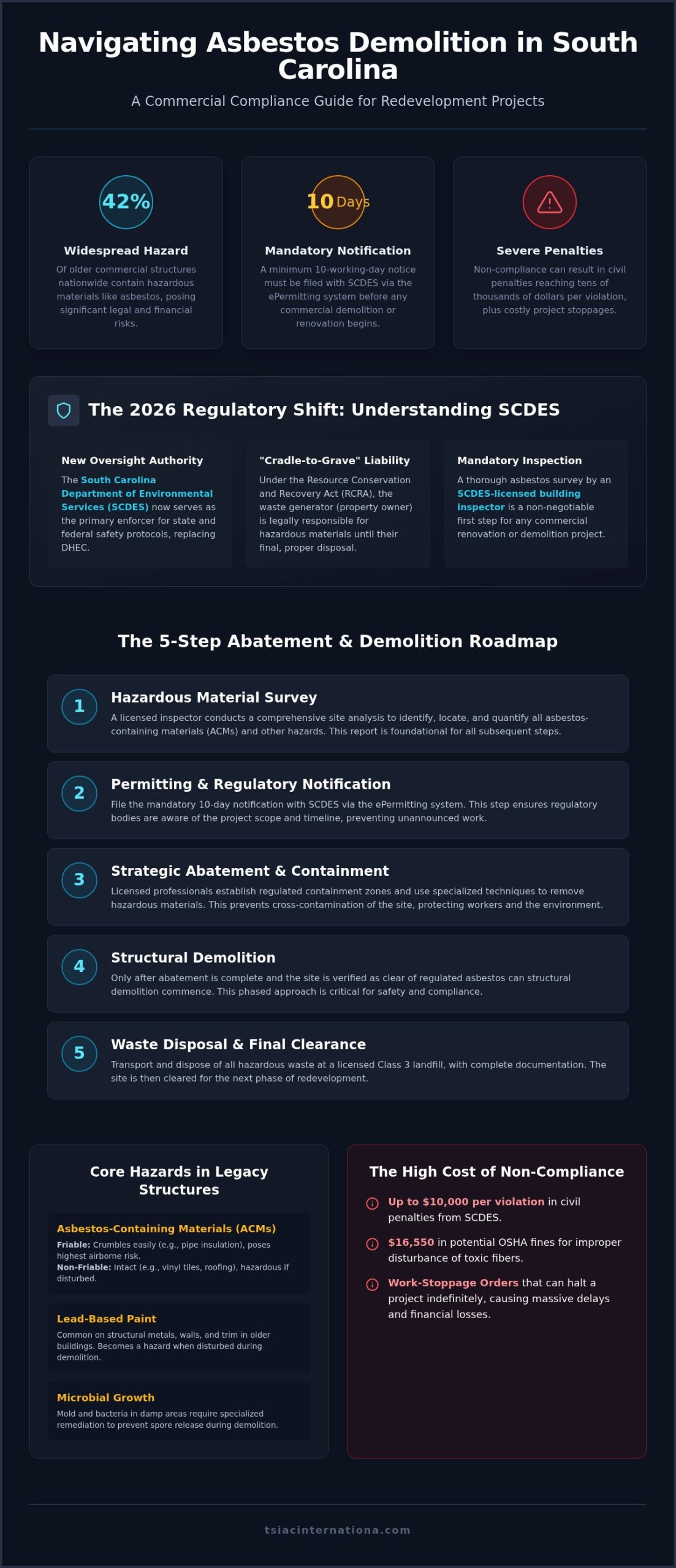
Federal laws like the Asbestos Hazard Emergency Response Act (AHERA) and the National Emission Standards for Hazardous Air Pollutants (NESHAP) dictate strict protocols for schools and commercial renovations. These regulations mandate the use of “Accredited Inspectors” and “Project Monitors” for specific types of work. Regulators often audit hazardous material abatement south carolina projects to ensure these protocols are followed. Failure to produce third-party monitoring logs during an unannounced inspection can lead to immediate work stoppages and significant financial penalties.

Close-out Documentation: The Project Record

The conclusion of a project should result in a comprehensive “Abatement Close-out Binder.” This document is the ultimate proof of a successful project. It should contain all laboratory results, the monitor’s daily logs, visual inspection certifications, and the final clearance report. It’s a best practice for property owners to keep these records for at least 30 years. This duration aligns with OSHA’s long-term record-keeping requirements for exposure data. Before hiring, you should always verify that your monitor holds current certifications and that their laboratory is NVLAP accredited to ensure the data is beyond reproach.

If you’re planning a renovation that involves hazardous materials, don’t leave your compliance to chance. Contact the experts at TSIAC International to discuss how our hazardous material abatement south carolina services can integrate with independent monitoring to protect your property and your future.

Coordinating with Your Abatement Contractor

Successful remediation requires disciplined coordination between the abatement team and the independent monitor. While their roles are distinct, their schedules must be perfectly aligned to maintain project momentum. Utilizing asbestos abatement third party air monitoring ensures that every phase of the project is validated by an objective expert. This partnership doesn’t just satisfy regulatory requirements; it creates a culture of accountability where safety is the primary metric of success. When these teams communicate effectively, the property owner benefits from a streamlined process that avoids costly delays.

To maintain the ethical independence discussed earlier, the property owner, architect, or General Contractor should contract the monitor directly. This ensures the monitoring firm’s loyalty remains with the client rather than the abatement contractor. Contractual separation is a fundamental safeguard against biased results. It’s a standard industry practice that protects the integrity of the final clearance report. When the monitoring team is independent, their data stands as an unassailable record of environmental safety.

Ensuring a Seamless Workflow

A professional team like TSIAC International understands that the monitor must be present during critical containment builds. This prevents bottlenecks during the demolition process south carolina, where abatement phases often dictate the overall timeline. Clear communication channels allow for rapid responses if a sampling pump malfunctions or if a containment barrier needs immediate repair. If a discrepancy arises between the removal team’s observations and the monitor’s data, a methodological approach is required. The teams must pause, investigate the technical cause, and implement a solution based on the monitor’s findings. This firmed-up hierarchy is what keeps a site safe and compliant.

Choosing the Right Partner for Your Project

When selecting a contractor, ask about their experience working with independent environmental professionals. A reputable firm like tsiac international charleston welcomes asbestos abatement third party air monitoring because it validates their high standards of workmanship. Before the project begins, use this final checklist to ensure a successful, compliant removal:

  • Verify the monitor’s current state licensing and NVLAP laboratory accreditation.
  • Confirm the abatement contractor has a designated liaison for the monitoring team.
  • Ensure the project schedule accounts for the time needed for lab analysis and final clearance.
  • Review the communication plan for “spike” detections or emergency work stoppages.

By following these steps, you ensure that your project meets every safety benchmark. The result is a clean bill of health for your building and the peace of mind that comes from knowing the air is safe to breathe. Professional oversight isn’t a project hurdle; it’s the only objective insurance policy that proves the work was done correctly.

Ensuring Long-Term Safety Through Independent Verification

Implementing asbestos abatement third party air monitoring is more than a regulatory box to check; it’s the foundation of a safe, habitable environment. By maintaining a strict separation between the removal team and the testing professional, you ensure that the data remains objective and beyond reproach. This disciplined approach protects your health and provides the legal documentation necessary to shield property owners from future liability. As we’ve detailed, the combination of technical precision in the lab and rigorous oversight on-site is what creates a truly secure project environment.

When you partner with a firm that respects this separation of duties, you gain the benefit of 15+ years of hazardous material experience. Our team at TSIAC International prioritizes expert coordination with independent environmental professionals to keep your project on schedule while adhering to the highest safety benchmarks. We provide comprehensive close-out documentation for every project, ensuring you have a permanent record of compliance and successful remediation. We don’t just clear the air; we provide the evidence that it’s safe.

Don’t leave your environmental safety to chance or unverified claims. Contact TSIAC International for a Professional Abatement Quote and take the first step toward a secure, asbestos-free property. We’re ready to help you navigate these technical challenges with precision and reliability.

Frequently Asked Questions

Is third-party air monitoring required by law for all asbestos removal?

Legal requirements for independent oversight vary by jurisdiction and the specific nature of the project. While federal OSHA standards mandate monitoring for worker safety, the Asbestos Hazard Emergency Response Act (AHERA) specifically requires it for school buildings. In some regions, such as New York State, it’s a legal mandate that the abatement contractor and the monitoring firm remain separate entities. Regardless of local laws, asbestos abatement third party air monitoring is considered an industry best practice for any commercial or high-risk residential project.

How much does asbestos air monitoring typically cost?

Industry rates for daily air monitoring services generally range from $600 to $1,200 per day for standard projects. For large-scale industrial sites or complex commercial buildings, these costs can increase to between $1,000 and $5,000 depending on the number of samples required. These fees are paid directly to the independent environmental professional to maintain their objectivity. This investment serves as a critical insurance policy against future legal claims and ensures the environment is truly safe for re-entry.

Can my asbestos removal contractor also perform the air testing?

While some jurisdictions may technically allow a contractor to perform their own testing, this practice creates a significant conflict of interest. Relying on a removal team to validate their own work compromises the integrity of the safety data. Professional standards dictate that asbestos abatement third party air monitoring should be conducted by a firm with no financial ties to the abatement company. This ensures that the results are unbiased, scientifically accurate, and legally defensible in the event of a future audit or lawsuit.

What is the difference between PCM and TEM air sampling?

The primary difference lies in the level of detail and the technology used for analysis. Phase Contrast Microscopy (PCM) is a fast, cost-effective method that counts all fibers meeting specific size criteria but cannot distinguish asbestos from other materials. Transmission Electron Microscopy (TEM) is the gold standard, using electron beams to identify the specific mineral signature of asbestos. TEM is often required for final clearances in schools and high-occupancy buildings where absolute scientific certainty is a priority.

How long does it take to get asbestos air test results back?

Turnaround times are largely determined by the analysis method chosen for the project. PCM results can often be provided on-site or within a few hours, allowing the project to proceed without significant downtime. TEM analysis requires a specialized laboratory environment, which typically results in a 24 to 48-hour waiting period. It’s essential to factor these timelines into your project schedule to ensure the containment remains intact until the final clearance report confirms the area is safe.

What happens if the final air clearance test fails?

A failed clearance test indicates that the fiber count remains above the 0.01 f/cc threshold, requiring an immediate response. The abatement contractor must perform a secondary “wet cleaning” and HEPA vacuuming of the entire containment area to remove any residual microscopic fibers. The independent monitor will then conduct another visual inspection and a new round of aggressive air sampling. The containment barriers must remain in place and the negative air machines must continue running until a passing result is achieved.

Do I need to leave the building during asbestos air monitoring?

Occupancy requirements depend on the project’s scope and the location of the work zone. While occupants don’t always need to vacate the entire building, they must remain completely clear of the containment area and its immediate perimeter. For projects involving the HVAC system or large-scale structural demolition, it’s often safer and more efficient to vacate the affected floors. Your project monitor will establish clear “exclusion zones” to ensure that no unauthorized individuals are exposed to potential fiber release episodes.

How do I find a qualified third-party air monitoring company?

You should prioritize firms that employ certified industrial hygienists and utilize laboratories with NVLAP or AIHA accreditation. These credentials ensure that the technicians follow standardized protocols and that the laboratory results are accurate. Your abatement contractor can often provide a list of independent environmental professionals they’ve worked with successfully in the past. Always verify that the monitoring firm carries its own professional liability insurance and holds all necessary state licenses for environmental testing.

Post-Demolition Site Inspection Checklist: The 2026 Professional Guide

A demolition project isn’t finished when the structures are leveled; it’s finished when the legal and physical liabilities are fully extinguished….

A demolition project isn’t finished when the structures are leveled; it’s finished when the legal and physical liabilities are fully extinguished. Many site managers realize too late that a cleared lot can still hide environmental hazards or stabilization failures that stall new construction for months. Utilizing a rigorous post-demolition site inspection checklist is the only way to ensure your site meets the 2026 technical standards for safety and structural integrity.

We understand the pressure of navigating complex regulatory frameworks, especially with OSHA’s 2026 enforcement focus and serious violation penalties reaching up to $16,550 per occurrence. This guide will help you master the technical requirements for site clearance and ensure a seamless transition to your next project phase. You’ll gain a methodical framework for verifying hazardous material abatement, assessing soil stability, and finalizing the documentation needed for a successful regulatory sign-off. We’ll examine the specific protocols required to mitigate future claims and maintain the high standards of safety that your stakeholders expect.

Key Takeaways

  • Implement a methodical site audit framework to identify and mitigate latent environmental and physical liabilities before concluding your project.
  • Master the technical criteria within our comprehensive post-demolition site inspection checklist to ensure 100% debris removal and utility capping integrity.
  • Navigate complex 2026 environmental standards with specialized protocols for asbestos-containing materials and lead-based paint clearance testing.
  • Streamline your regulatory closeout by compiling the precise waste manifests and documentation required for official building department sign-off.
  • Establish a safe and stable foundation for future development through rigorous site stabilization and final grading requirements.

The Critical Role of Post-Demolition Site Inspections

The completion of a physical teardown marks the beginning of the most critical phase of any redevelopment project: the technical site audit. In professional practice, a post-demolition inspection isn’t a casual walkthrough; it’s a rigorous verification process designed to confirm that every technical parameter of the project scope has been satisfied. This transition phase is where long-term liability is either successfully managed or dangerously ignored. Utilizing a robust post-demolition site inspection checklist serves as the primary mechanism for this verification, ensuring the ground is physically and legally prepared for the next stage of development. For a broader Demolition overview, the industry recognizes that modern site clearance requires systematic planning and meticulous closeout procedures to be considered complete.

Insurance providers and regulatory bodies increasingly demand high-resolution documentation of site conditions before new permits are issued. Inadequate inspections often lead to “latent defect” claims years after a project ends, which can be catastrophic for a firm’s reputation and bottom line. By maintaining methodological site verification, contractors protect their insurance premium profiles and demonstrate a commitment to safety. This professional oversight is non-negotiable for specialized tasks such as asbestos abatement or lead remediation. Without a certified closeout, hazardous particles could remain on-site, creating environmental liabilities that are far more expensive to fix after new construction begins.

Protecting Future Structural Integrity

A cleared surface can be deceptive. A professional inspection focuses heavily on identifying subsurface voids or disturbed soil conditions caused by the removal of deep footings or underground storage tanks. If foundation remnants are left in the ground, they create “hard spots” that lead to uneven settling for new structures. Our protocols also include assessing the impact of heavy machinery on adjacent buildings. Vibrations from high-reach excavators or concrete breakers can cause hairline fractures in neighboring walls that might only become visible weeks after the equipment has left the site.

Safety and Liability Mitigation

The primary goal of a post-demolition audit is to eliminate physical hazards for subsequent construction crews. Sharp rebar, unstable slopes, or improperly capped utilities represent significant risks that can lead to costly delays. With OSHA’s 2026 enforcement focus, serious violations now carry penalties of up to $16,550 per violation. Ensuring the site meets all national occupational safety standards is a matter of financial survival. Establishing a clear paper trail through a detailed checklist provides property owners with the necessary protection against future claims. This documentation acts as a definitive record that the site was handed over in a compliant, stable, and hazard-free state.

Essential Structural and Surface Inspection Criteria

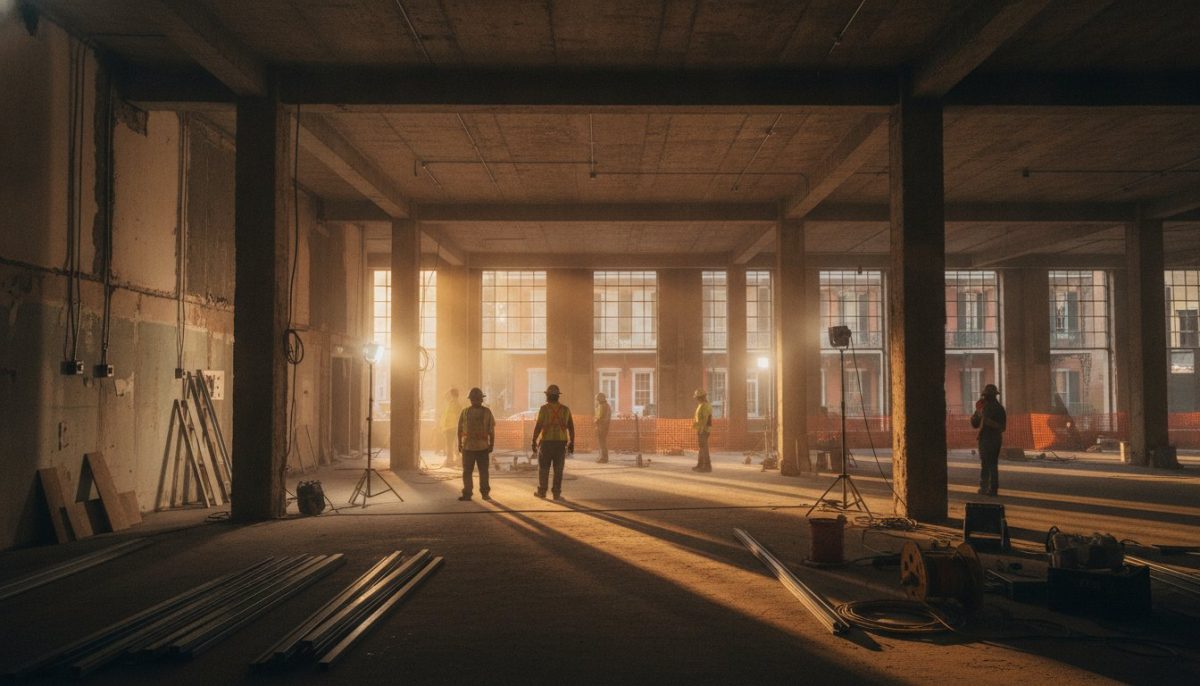
Technical accuracy is the hallmark of a professional closeout. Once the heavy machinery is demobilized, the site must undergo a rigorous surface evaluation to confirm 100% debris removal across the entire footprint. This isn’t merely about aesthetics; it’s about ensuring no foreign materials interfere with subsequent excavation or grading. In projects involving interior gut-outs, inspectors must verify selective demolition boundaries with surgical precision. This involves checking that load-bearing elements remain undisturbed and that all non-structural components have been extracted according to the engineering plan. If you’re overseeing a large-scale renovation, our experts provide specialized selective demolition and interior gutting to ensure these boundaries are maintained flawlessly.

Concrete removal sites require specialized attention during the final walk-through. It’s common for fractured aggregate or jagged rebar leftovers to remain partially buried, posing a risk to future foundation work. A comprehensive post-demolition site inspection checklist includes a “grid-sweep” of these areas to ensure the soil is clean of structural remnants. This level of detail prevents mechanical damage to new construction equipment and avoids the high costs of secondary clearing once the primary contractor has left the site. Detailed visual confirmation ensures the site’s surface is truly prepared for the next phase of development.

Subsurface and Foundation Verification

The inspection must extend below the visible surface to be considered complete. Professionals must confirm the complete removal of footings, pilings, and grade beams as specified in the permit. Leaving these elements in place can cause catastrophic settlement issues for new buildings. Additionally, the inspector should look for signs of abandoned underground storage tanks (USTs) that may have been missed during pre-demolition surveys. Evidence of soil saturation or unexpected drainage patterns often indicates disturbed earth that requires stabilization before the site is declared ready for development.

Utility and Infrastructure Closeout

Safety is the primary driver when verifying utility termination points. Every water, gas, and electrical line must be safely secured and capped at the property line or the point of connection. Adherence to OSHA demolition standards ensures that these terminations are not only physically sound but also properly documented for future crews. Sewer and storm drain connections must be protected with debris covers to prevent siltation or blockages during the interim period. We recommend creating a digital map documenting the exact GPS coordinates of all remaining underground services to prevent accidental strikes during the next phase of construction.

Post-Demolition Site Inspection Checklist: The 2026 Professional Guide

Environmental Clearance and Hazardous Material Verification

Environmental clearance represents the most legally sensitive portion of the site audit. While structural debris is visible, hazardous particulates often remain invisible to the naked eye. A rigorous post-demolition site inspection checklist must prioritize a final visual inspection for suspected asbestos-containing materials (ACM) that may have been uncovered during the final stages of structural dismantling. Lead-based paint dust clearance is equally vital, requiring specialized surface testing to ensure that the soil and surrounding structures haven’t been contaminated by airborne lead particles. Failing to identify these hazards at the closeout stage can lead to significant environmental claims during the subsequent construction phase.

Industrial demolition projects demand even higher levels of scrutiny. Soil testing for chemical contaminants is standard procedure to identify potential leaks from old machinery, processing lines, or underground storage tanks. We look for hydrocarbons, heavy metals, or volatile organic compounds that may have migrated into the soil over decades of operation. Particulate matter verification and continuous air quality monitoring provide the empirical data necessary to prove that the demolition process didn’t release harmful toxins into the local environment. These steps aren’t just safety measures; they’re essential components of a robust risk management strategy that protects your long-term interests.

Asbestos Abatement Closeout

Closing out an asbestos project requires more than just hauling away bags of waste. You must review air clearance reports from independent laboratories to confirm that fiber counts are below the strict regulatory thresholds. Verification of the integrity of containment areas post-removal ensures that no cross-contamination occurred during the process. Following established asbestos removal protocols is the only way to secure the documentation needed for legal protection. We verify that all seals, filters, and negative pressure systems functioned correctly until the final clearance was issued, providing a definitive record of compliance.

Lead and Mold Remediation Verification

Lead dust is a persistent hazard that requires meticulous cleanup and verification. Our team confirms the removal of all lead-contaminated debris and conducts wipe tests on remaining surfaces to meet 2026 safety standards. In selective demolition or interior gutting projects, we also inspect for residual mold growth that could compromise the air quality of the new building. Referencing our guide on hazardous material abatement provides property owners with the detailed remediation standards required for a successful site handover. This methodical approach ensures that the transition to new construction is not delayed by unforeseen environmental discoveries, making the post-demolition site inspection checklist an indispensable tool for project completion.

The administrative closeout is the final hurdle in transforming a demolition site into a development-ready asset. While the physical work is complete, the legal transfer of the property requires a meticulous compilation of data. A professional post-demolition site inspection checklist ensures that every manifest, permit, and certificate is organized for local building department review. This documentation is not just a formality; it’s a critical defense against future litigation and a mandatory requirement for securing new construction permits.

Municipalities like Houston or Fresno have specific fee structures for inspections and permit resolutions, often requiring a final sign-off before a project is considered legally closed. In Santa Rosa, for instance, a reinspection fee of $170.34 per hour underscores the financial importance of getting the documentation right the first time. Failing to close out an active permit can lead to building code enforcement cases, which carry significantly higher costs and can stall new development for months. Professional oversight ensures that these bureaucratic requirements are met with the same precision as the physical demolition itself.

Waste Manifests and Recycling Records

Modern development often hinges on sustainability metrics. Tracking debris through the entire demolition process is necessary to secure green building certifications like LEED. The EPA estimates that the United States generates over 600 million tons of C&D debris annually, yet the overall diversion rate remains around 76%. Documenting your specific recycling percentages for wood, metal, and plastic is essential for compliance with local diversion ordinances that are becoming increasingly strict in 2026.

While concrete and asphalt see recovery rates exceeding 95%, materials like wood and drywall often fall below 25% in national averages. Providing proof of proper disposal for specialized concrete removal or hazardous material abatement is mandatory for a successful closeout. These records protect the property owner by proving that all regulated materials were handled at licensed facilities. If you require expert management of these complex material streams, our team offers comprehensive recycling services and structural demolition to ensure your project meets all environmental and diversion targets.

Regulatory Sign-Offs and Permits

The final step involves coordinating with municipal inspectors for a site walk-through. This visit verifies that the site matches the submitted plans and that all safety protocols were maintained throughout the project lifecycle. Obtaining the official certificate of completion is the definitive signal that the property is ready for its next use. We recommend maintaining a permanent digital archive of all inspection photos, soil logs, and manifest receipts. This archive serves as the ultimate paper trail should any questions arise regarding the site’s history or environmental status years down the line.

Transitioning from Site Clearance to New Development Readiness

The final phase of a project involves transforming a vacant footprint into a secure, stabilized asset. A common oversight in many projects is the failure to address site conditions between the end of demolition and the start of new construction. Using a comprehensive post-demolition site inspection checklist ensures that the lot doesn’t become a liability due to erosion or unauthorized access. This readiness phase requires a shift from destruction to preservation, protecting the site’s environmental integrity and the owner’s investment during the interim period.

Final grading is a primary requirement for both safety and drainage. The site must be contoured to prevent water pooling, which can destabilize the soil or lead to mosquito breeding grounds. Proper drainage prevents runoff from impacting neighboring properties or public infrastructure. Establishing security protocols is equally essential. A cleared lot is often an attractive nuisance; perimeter fencing and signage must be inspected to ensure they meet local safety ordinances and mitigate the risk of trespasser injury. These steps ensure the site remains a controlled environment until the next phase of development begins.

Site Stabilization and Erosion Control

Effective stabilization prevents the loss of topsoil and protects local waterways from siltation. Installing silt fences and hay bales is a standard requirement under national storm water regulations, especially if the site will remain vacant for an extended period. For dust mitigation, we recommend applying hydroseeding or a temporary gravel cover. These measures ensure the site remains compliant with EPA standards and avoids the fines associated with particulate matter pollution or improper runoff management. Meticulous erosion control is a signature of a professionally managed site closeout.

Professional Handover Protocols

The transition is completed through a formal handover to the follow-on construction team. This involves a final walk-through with the project owner to verify that every item on the post-demolition site inspection checklist has been addressed. If the project involves a partial renovation rather than a total teardown, we define the exact scope of commercial interior gutting to ensure the structural shell is ready for new mechanical, electrical, and plumbing installations. This methodical approach guarantees that the incoming team inherits a site that is clean, safe, and fully documented.

For expert demolition and abatement services that prioritize technical precision and regulatory compliance, contact TSIAC International today. Our team ensures your site is perfectly prepared for its next chapter.

Securing Your Project’s Future Through Methodological Site Audits

A cleared lot is only as valuable as the documentation and physical stability supporting it. By prioritizing technical precision in utility capping and subsurface verification, you eliminate the latent risks that often derail future construction schedules. Adhering to a rigorous post-demolition site inspection checklist ensures that every environmental liability, from asbestos particulates to lead dust, is fully mitigated and legally documented. This systematic approach transforms a high-risk demolition site into a secure foundation for your next development.

TSIAC International brings over 15 years of abatement expertise to every project site. We utilize methodological site verification protocols and comprehensive hazardous material remediation to guarantee your property meets the highest safety standards. Don’t leave your regulatory compliance to chance. Partner with TSIAC International for your next demolition project to ensure a seamless transition from site clearance to new development. We look forward to helping you build on a clean, safe, and fully compliant foundation.

Frequently Asked Questions

What is the primary goal of a post-demolition site inspection?

The primary goal is to establish a definitive record that the site is physically safe, environmentally remediated, and legally prepared for its next use. This process identifies any latent hazards, such as unstable soil or uncapped utilities, that could cause structural failures or safety incidents during new construction. It serves as the final barrier against future liability by confirming that all project specifications and regulatory mandates have been met with methodical precision.

How long does a typical site inspection take after structural removal?

A standard commercial site walk-through typically requires two to four hours of active field time. However, the duration varies based on the site’s complexity and the presence of specialized environmental concerns. Industrial facilities with extensive subsurface footprints or those requiring multi-point soil sampling may necessitate a full day of observation. This timeframe ensures the inspector can meticulously verify every technical parameter without rushing the safety-critical evaluation of the property.

Who is responsible for conducting the final site inspection?

Responsibility for the final audit is shared between the demolition contractor, independent environmental laboratories, and the local building authority. The contractor verifies the physical scope of work, while third-party consultants provide the objective data needed for asbestos or lead clearance. Finally, a municipal inspector performs a site visit to grant the official regulatory sign-off. This multi-layered approach ensures that no single party can overlook potential safety or compliance issues.

What happens if hazardous materials are found during the final inspection?

If suspected hazardous materials appear during the final audit, the area must be secured and all activity halted. A specialized remediation team will then execute a focused abatement plan to remove the contaminant. This discovery triggers a revision of the post-demolition site inspection checklist to include new clearance testing and updated disposal manifests. Once the area is verified clean by an independent laboratory, the final inspection process can resume for the entire site.

Do I need a separate inspection for interior gutting projects?

Interior gutting projects require a dedicated inspection focused on the structural shell and internal environmental conditions. Unlike total teardowns, these audits must verify that load-bearing walls remain intact and that all non-structural debris has been extracted. Inspectors also conduct air quality tests to confirm that the interior environment is free from hazardous dust before new mechanical or electrical crews begin work. This ensures a safe transition for the renovation phase.

What documentation is required to prove a site is environmentally clean?

Proving a site is environmentally clean requires a comprehensive package of empirical data. This includes air clearance reports from independent labs, hazardous waste manifests from licensed disposal facilities, and certified soil analysis results. These documents provide the legal paper trail necessary to defend against future environmental claims. Maintaining these records as part of your post-demolition site inspection checklist is essential for securing new construction permits and demonstrating full regulatory compliance to stakeholders.

Can I start new construction immediately after the inspection is passed?

Passing the inspection is the technical green light, but you cannot legally break ground on new construction until the municipal authority issues the final certificate of completion or a new building permit. The inspection report serves as the primary evidence needed for this administrative approval. Once the building department processes the documentation and closes out the demolition permit, the site is officially transitioned to the new development phase under its respective permits.

How does site stabilization affect the final inspection process?

Site stabilization is a critical component of the final inspection because it ensures the lot remains safe and compliant while vacant. Inspectors evaluate erosion control measures, such as silt fences and hydroseeding, to prevent sediment runoff into public storm drains. Proper grading is also verified to ensure water doesn’t pool on the site. If these stabilization measures are inadequate, the inspector may withhold the final sign-off until the site meets all environmental safety standards.

Commercial Mold Remediation & Interior Demolition Services: The 2026 Professional Guide

A commercial gut-out is never just about removing drywall; it’s a high-stakes management of hidden environmental liabilities that can instantly…

A commercial gut-out is never just about removing drywall; it’s a high-stakes management of hidden environmental liabilities that can instantly compromise a project’s timeline. Utilizing professional commercial interior demolition services requires a disciplined, technical approach to ensure that undiscovered mold doesn’t lead to staggering regulatory fines or the cross-contamination of clean building wings. You’re likely aware that handling hazardous materials demands more than just brute force. It requires a partner who understands that safety and structural integrity are non-negotiable benchmarks of a successful renovation project.

This professional guide explores how to seamlessly integrate expert mold abatement with demolition workflows to protect your physical assets and ensure total compliance with the updated 2026 OSHA standards. You’ll discover how a unified methodology secures a clean structural shell ready for tenant improvements while avoiding the delays typical of multi-contractor handoffs. We’ll detail the precise steps required to navigate rising landfill tipping fees and execute a safe, medically-sound interior demolition project from start to finish. By the end of this guide, you’ll have a clear roadmap for maintaining project velocity without sacrificing environmental safety.

Key Takeaways

  • Distinguish between superficial mold removal and the methodological remediation protocols required for permanent structural and environmental safety.
  • Understand the technical deployment of engineering controls, such as infrared site assessments and 6-mil polyethylene containment, to isolate hazardous zones.
  • Discover how professional commercial interior demolition services integrate abatement to streamline project timelines and ensure a clean structural shell.
  • Evaluate the financial impact of contamination levels and material types to avoid the recurring costs of low-bid remediation failures.
  • Ensure total compliance with updated 2026 OSHA and EPA standards through a disciplined, single-source approach to hazardous material handling.

Commercial Mold Removal vs. Remediation: Understanding the Difference

The distinction between mold removal and remediation isn’t merely a matter of terminology; it’s a fundamental difference in technical methodology. In a commercial context, “removal” often refers to the superficial cleaning of visible growth. This approach is frequently a temporary fix that ignores the fungal ecology thriving beneath the surface. True remediation is a permanent structural and environmental correction protocol. It focuses on identifying the moisture source, neutralizing the colony, and ensuring the building’s atmosphere remains within safe parameters. When planning commercial interior demolition services, failing to recognize this difference can lead to the rapid recurrence of contamination once the new finishes are installed.

Commercial interiors demand significantly more rigorous standards than residential properties due to their scale and complexity. High-occupancy buildings utilize intricate HVAC and plumbing systems that can serve as superhighways for fungal spores. A successful protocol involves professional mold remediation, which addresses the underlying moisture source rather than just the visible growth. In large-scale structures, the fungal ecology often integrates into the building’s mechanical heartbeat, requiring a specialized understanding of air pressure and moisture dynamics that residential cleaners simply don’t possess.

Why Surface Removal Fails in Commercial Settings

Surface cleaning fails because mold isn’t just a surface stain. Fungi grow through hyphae, microscopic root-like structures that penetrate deep into porous structural materials like drywall, ceiling tiles, and masonry. If you only wipe the surface, these roots remain viable. During the execution of commercial interior demolition services, the act of tearing down contaminated walls without proper abatement can aerosolize millions of spores. This creates a massive cross-contamination event. Beyond the physical risks, “cosmetic” fixes in tenant-occupied spaces carry heavy legal implications. Property managers who mask mold issues rather than remediating them face significant liability if occupants develop health complications due to poor indoor air quality.

The Liability of Microbial Growth

The OSHA General Duty Clause requires employers to provide a workplace free from recognized hazards that cause or are likely to cause death or serious physical harm. This includes maintaining acceptable indoor air quality. Unaddressed microbial growth doesn’t just threaten health; it actively devalues commercial assets. Insurance providers are increasingly restrictive regarding mold coverage, often excluding “gradual” damage caused by poor maintenance. Microbial volatile organic compounds (mVOCs) are the pungent chemical byproducts of active fungal metabolism that serve as a primary indicator of hidden growth and a direct threat to workplace safety. Addressing these issues through a disciplined remediation plan is the only way to protect both the occupants and the long-term valuation of the property.

The Professional Abatement Protocol for Commercial Structures

Effective remediation begins with precise data. We utilize infrared thermography and comprehensive moisture mapping to identify thermal anomalies indicative of hidden water intrusion. This diagnostic phase is critical for commercial interior demolition services because it prevents the accidental disturbance of active colonies during the gut-out phase. By visualizing the extent of the moisture plume behind masonry or within wall cavities, we define a containment perimeter that is based on physical evidence rather than guesswork. This methodological approach ensures that the abatement strategy is surgical, targeting only the affected structural members while preserving the integrity of clean zones.

Once the perimeter is established, we implement engineering controls to isolate the work area. This involves the installation of 6-mil polyethylene containment barriers and the deployment of high-volume HEPA filtration systems. The EPA’s guidance on Mold Remediation in Schools and Commercial Buildings serves as a baseline, but high-stakes commercial projects often require even more stringent protocols to protect high-value assets and sensitive occupants. For complex projects, partnering with a firm that provides integrated abatement and demolition solutions ensures that every technical requirement is met without project delays.

Containment and Negative Air Systems

In large-volume commercial halls, the calculation of Air Changes per Hour (ACH) is a technical necessity. We typically target a minimum of 4 ACH to ensure that any aerosolized spores are captured by HEPA-filtered air scrubbers. To verify the integrity of these barriers, we use digital pressure manometers that provide real-time monitoring of the negative air pressure. This constant pressure differential ensures that air only flows into the work zone, effectively preventing cross-contamination into active business wings or adjacent tenant spaces. It’s a disciplined process that maintains a sterile boundary throughout the demolition sequence.

Eliminating the Moisture Source

Remediation is a temporary fix if the underlying moisture source isn’t permanently neutralized. Our teams investigate building envelope failures, leaking window flashings, and HVAC condensate issues that often serve as the root cause of microbial growth. Structural drying must precede any final remediation sign-off to ensure that remaining materials don’t support future colonies. It’s often necessary to address hazardous material abatement south carolina as part of a total site plan when dealing with older industrial or commercial assets. Final clearance is only achieved through independent third-party air quality testing, providing the objective documentation required for regulatory compliance and property valuation protection.

Commercial Mold Remediation & Interior Demolition Services: The 2026 Professional Guide

Evaluating Costs and Business Continuity in Mold Remediation

Evaluating the financial impact of mold requires a deep dive into site-specific variables. The primary cost drivers in any commercial project include the accessibility of the affected area, the specific contamination level, and the material type of the substrate. For instance, remediating mold on non-porous structural steel is a vastly different technical challenge than extracting it from high-density insulation or porous masonry. Adhering to the EPA Mold Remediation Guidelines ensures that these variables are managed through established protocols, protecting the owner from the hidden expense of “re-remediation.” This secondary cost arises when low-bid contractors fail to implement proper containment, leading to cross-contamination that necessitates a second, more expensive cleanup.

Integrating these protocols with commercial interior demolition services allows for a more streamlined budget. By addressing the hazardous materials during the gut-out phase, you eliminate the need for separate mobilizations. This unified approach also simplifies the process of navigating commercial insurance claims; documented, professional abatement provides the forensic evidence required by adjusters to justify the scope of work for microbial and water damage. It’s a matter of technical precision that protects the bottom line.

Minimizing Operational Disruption

Facility managers often fear that remediation means a total building shutdown. It’s possible to maintain business continuity through phased execution and strategic containment. We utilize after-hours execution protocols for high-occupancy office environments to ensure that the loudest and most intrusive phases of the gut-out occur when the building is empty. Strategic containment allows for partial building occupancy, keeping your revenue streams active. Clear tenant communication frameworks are essential during this time. They manage liability and perception by providing factual data about the safety of the engineering controls in place.

The ROI of Structural Integrity

The long-term value of a property depends on the health of its structural shell. Metal framing and concrete are not immune to microbial degradation; persistent moisture and fungal growth can lead to oxidation and surface pitting. Professional abatement protects these core assets, ensuring they are ready for the subsequent reconstruction phase without lingering odors or structural weaknesses. This methodical precision prevents long-term litigation by providing a documented, certified clearance that the space is safe for re-occupancy. It’s an investment in the building’s future marketability and safety.

Integrating Mold Abatement with Commercial Interior Demolition Services

Efficiency in a renovation project is often lost at the handoff between environmental specialists and demolition crews. When these services are siloed, the project timeline suffers from redundant mobilizations and conflicting safety protocols. Integrating these disciplines ensures that commercial interior demolition services are executed with the same level of environmental control used during initial abatement. This synergy allows for the seamless removal of mold-impacted drywall, acoustic ceilings, and flooring within a single, controlled flow. By treating the gut-out as an extension of the remediation protocol, we eliminate the risk of re-contaminating a clean site during the heavy removal phase.

The technical advantage of single-source contracting for commercial interior gutting services lies in the continuity of engineering controls. One team manages the containment, the negative air systems, and the debris load-out. This reduces the liability for the property owner and ensures that no hazardous materials are inadvertently left behind or spread through the facility’s common areas. It’s a disciplined approach that maintains project velocity while adhering to strict environmental standards.

Selective Demolition for Contaminated Areas

Selective demolition requires a surgical approach to structural removal. It isn’t about total destruction; it’s about the targeted extraction of specific components while maintaining the building’s structural shell. In contaminated environments, this means removing metal framing or heavy debris under strict containment. This process ensures that the remaining structure is a “clean slate” ready for new tenant improvements. It requires a disciplined crew that understands how to manage structural loads while working within the constraints of environmental barriers. We focus on isolating contaminated structural wings to prevent the migration of debris into unaffected areas of the building.

Preparing the Shell for Reconstruction

Preparing a building for its next phase involves stripping the interior down to the studs or structural concrete. Once the porous materials are removed, we focus on the non-porous members. We often apply antimicrobial encapsulates to these surfaces to provide a secondary layer of protection against future growth. Coordination is vital here. We align our efforts with the broader demolition process south carolina to guarantee a seamless transition to the build-back phase. If you’re managing a complex renovation, you need a partner who views environmental safety and structural removal as a single, unified mission. Consult with our technical experts to secure your project’s structural integrity.

TSIAC International: National Expertise in Abatement and Demolition

TSIAC International stands as a definitive authority in the sector, leveraging over 15 years of specialized experience in high-stakes structural removal. While many firms operate within narrow regional boundaries, our national mobilization capabilities allow us to execute large-scale commercial contracts across the country with consistent technical precision. We don’t just provide commercial interior demolition services; we deliver a comprehensive environmental solution that integrates hazardous material abatement with structural gutting. Our internal protocols are designed to exceed both OSHA and IICRC requirements, ensuring that every site is managed with the discipline required for complex, high-risk environments. This commitment to excellence provides property owners with a reliable partner capable of handling the most demanding architectural and environmental challenges.

Our approach is defined by a rigorous adherence to safety and a deep understanding of structural dynamics. Whether we’re working in a high-rise office complex or a sprawling industrial facility, we deploy specialized equipment and highly trained crews who prioritize site stability. By managing the entire lifecycle of the demolition and abatement process, we eliminate the communication gaps that often lead to project delays. This single-source responsibility ensures that the project’s velocity remains high while the environmental footprint remains strictly controlled.

Recycling Debris: A Sustainable Remediation Approach

In an era where environmental stewardship is a core business requirement, we’ve refined a sustainable approach to remediation that goes beyond simple disposal. We meticulously sort materials like wood, metal, and plastic from remediation sites to maximize resource recovery. This allows our clients to align their demolition projects with corporate ESG and sustainability goals without compromising on safety. We manage this sorting process while strictly adhering to hazardous waste protocols, ensuring that contaminated debris is handled with the same care as the clean structural members we salvage. It’s a disciplined method that reduces landfill impact and supports a circular economy in the construction industry.

The TSIAC Advantage: Precision and Safety

The expertise we’ve demonstrated in tsiac international charleston serves as the technical blueprint for our national commercial projects. Our crews are highly trained specialists who are comfortable operating heavy machinery within the tight constraints of hazardous environments. By providing direct, hands-on project management, we ensure business continuity and offer our partners total regulatory peace of mind. Choosing TSIAC for your commercial interior demolition services means securing a partner who understands that the final result is only as good as the safety protocols used to achieve it. We don’t just clear a space; we prepare it for its next phase of life with absolute methodological accuracy.

Securing Your Structural Assets for the Future

Integrating technical mold abatement with professional commercial interior demolition services isn’t just a safety requirement; it’s a strategic move to preserve your property’s value. Moving beyond superficial removal ensures that hidden microbial threats are neutralized before reconstruction begins. Adopting IICRC S520 compliant remediation protocols protects you from the long-term liability of failed inspections and cross-contamination. This unified approach effectively eliminates the costly delays associated with multi-contractor handoffs, ensuring your project remains on schedule.

TSIAC International offers 15+ years of specialized industry experience and national mobilization for large-scale commercial projects. We provide the technical precision required for high-stakes environments. We don’t just clear debris; we deliver a medically sound structural shell ready for your next phase of development. Protect your business continuity and maintain full regulatory compliance by choosing a partner who views environmental safety as a non-negotiable benchmark. Your project’s success starts with a clean, safe foundation.

Request a Professional Abatement & Demolition Consultation

Frequently Asked Questions

How long does a commercial mold remediation project typically take?

The duration of a project depends on the scale of contamination and the complexity of the structure, typically ranging from three to seven days for standard remediation. Larger projects involving comprehensive commercial interior demolition services may require several weeks to complete the full gut-out, structural drying, and final clearance testing. We provide a definitive project schedule following the initial moisture mapping and infrared site assessment phase.

Will our business need to shut down during the mold removal and demolition process?

Business operations can often continue through phased execution and the implementation of strict engineering controls. We utilize negative air pressure and 6-mil polyethylene barriers to isolate the work zone from occupied areas. This prevents the migration of spores into active business wings, allowing for partial building occupancy without compromising the safety or health of your employees and tenants.

Does commercial insurance typically cover mold remediation and abatement?

Insurance coverage is generally determined by the “proximate cause” of the mold growth. Policies typically cover remediation if the damage resulted from a sudden, covered event, such as a burst pipe or fire suppression system failure. Gradual moisture intrusion or humidity issues are often excluded unless your policy includes a specific environmental or microbial endorsement. You should consult with an insurance specialist to verify your specific coverage limits.

What certifications should a professional commercial mold contractor hold?

A reputable contractor must hold IICRC S520 certification for professional mold remediation and adhere to OSHA 40-hour HAZWOPER standards for hazardous material handling. These certifications ensure that the crew understands the technical requirements for containment and personal protective equipment. It is also essential to verify that the contractor has specific experience in structural demolition to ensure building stability throughout the process.

How do you ensure mold doesn’t return after the interior demolition is complete?

Permanent prevention is achieved by eliminating the moisture source and ensuring the structural shell is completely dry before reconstruction. We use antimicrobial encapsulates on non-porous structural members to provide a secondary layer of protection. By removing all porous organic materials during the demolition phase, we eliminate the food sources required for fungal growth, ensuring the environment remains sterile for the build-back phase.

Can mold remediation be combined with asbestos or lead abatement in one project?

Combining multiple abatement services into a single project is a highly efficient strategy for older commercial assets. This single-source approach reduces mobilization costs and ensures a unified safety plan for all hazardous materials. Integrating these protocols with commercial interior demolition services allows one team to manage every environmental liability, which streamlines the project timeline and simplifies regulatory documentation for the property owner.

What is the difference between air sampling and surface sampling for commercial mold?

Air sampling measures the concentration of fungal spores within the building’s atmosphere, while surface sampling identifies specific colonies on physical substrates like masonry or wood. We utilize both methods to establish an accurate baseline and to verify final clearance. Air sampling is particularly critical for identifying hidden growth that may be circulating through the HVAC system or across different building wings.

Is it safe to recycle materials that have been removed from a mold-impacted area?

Only non-porous materials, such as structural steel, metal framing, and concrete, can be safely recycled after undergoing a rigorous decontamination protocol. Porous materials like drywall, insulation, and ceiling tiles absorb moisture and fungal hyphae, making them unfit for recovery. We prioritize the recycling of decontaminated metals and masonry to support corporate sustainability goals while ensuring all contaminated debris is disposed of according to EPA hazardous waste standards.

2026 House Demolition Cost Guide: Structural Removal and Site Clearance

Did you know that debris disposal and environmental compliance can account for up to 50% of your total project expenses? Many property owners view…

Did you know that debris disposal and environmental compliance can account for up to 50% of your total project expenses? Many property owners view structural removal as a straightforward mechanical task, yet the true house demolition cost charleston sc is driven by a complex landscape of municipal regulations and hazardous material protocols. It’s frustrating to face unpredictable budget spikes because of an overlooked environmental inspection or a sudden landfill surcharge.

This guide provides a professional breakdown of the technical variables and legal requirements that define a modern site clearance project. You’ll learn how to navigate the specific permit fees for the City of Charleston and Charleston County, manage mandatory state notification periods, and account for the logistics of private waste hauling. We’ll map out a clear path from initial site evaluation to a clean, build-ready lot, ensuring your project remains controlled, compliant, and predictable. By understanding the methodology behind structural removal, you can transform a complex liability into a stabilized asset ready for development.

Key Takeaways

  • Understand the technical scope of structural demolition and how square footage dictates machine mobilization and labor requirements.
  • Analyze how material density and regional disposal surcharges influence the total house demolition cost charleston sc.
  • Identify the mandatory hazardous material protocols, including asbestos and lead abatement, required to maintain legal compliance.
  • Navigate the complexities of municipal permitting and utility coordination to ensure a seamless transition to a build-ready lot.
  • Evaluate how strategic material recovery and recycling services can mitigate project expenses and environmental impact.

Primary Factors Influencing National House Demolition Costs

Structural demolition is the systematic removal of all building components down to the foundation. It’s a technical process that requires methodical planning and heavy machinery. For property owners assessing the house demolition cost charleston sc, the first variable is always the total square footage. Larger footprints demand more machine hours and higher fuel consumption. It’s not just about the surface area; the height of the structure and its proximity to neighboring buildings dictate the level of precision required. If a home sits close to a property line, we can’t use standard gravity-based methods. We must implement controlled techniques to protect adjacent assets and prevent structural vibration damage.

The foundation type also plays a critical role in the total debris volume. A house built on a crawl space produces a different waste profile than one with a massive concrete slab. Concrete removal is a specialized task because of the material’s weight and density. Dense materials require more heavy-lift cycles and specialized attachments, which increases the time spent on site. Every extra ton of material recovered or moved adds to the logistical complexity of the project.

Structure Material and Complexity

Material composition is a primary driver of operational expenses. Wood-frame houses are generally faster to dismantle than masonry or brick structures. Brick and stone require higher-impact machinery and result in significantly more tonnage. Multi-story residential teardowns introduce vertical risks that require high-reach excavators and specialized safety protocols to manage falling debris safely. Secondary structures, such as detached garages or sheds, also impact the budget. These additions require extra mobilization and increase the total volume of waste that must be hauled from the site.

Site Accessibility and Mobilization

Logistical constraints often dictate the final project budget. Narrow lot access is a common challenge in high-density or historic areas. If a lot cannot accommodate a full-sized excavator, we must utilize smaller, less efficient equipment. This shift inevitably extends the project timeline. Mobilization fees cover the technical challenge of transporting heavy machinery and dumpsters to your location. In tight-quarter environments, we often coordinate specialized traffic control or temporary staging areas. These operational overheads are essential for maintaining safety and regulatory compliance throughout the site clearance process.

Cost Breakdown by Square Footage and Construction Material

Establishing a baseline for residential removal requires a granular look at local market data. While national averages for a 2,000-square-foot home often fall between $8,000 and $20,000, calculating the house demolition cost charleston sc involves specific regional variables. These include local landfill tipping fees and the density of the primary construction materials. Wood-frame structures are generally the most cost-effective to dismantle because they’re lighter and easier to process. In contrast, masonry, brick, and reinforced concrete structures require higher-impact machinery and result in significantly more tonnage. Since debris disposal can account for 30% to 50% of your total project expenses, the weight of your building materials is a primary driver of the final invoice.

There’s a distinct economy of scale in professional demolition. Mobilizing a 30-ton excavator and transporting a fleet of dumpsters involves fixed costs that don’t change based on the building’s size. Consequently, larger homes often see a lower cost-per-square-foot than smaller cottages. Property owners should also account for exterior hardscaping. Removing a large concrete driveway or a retaining wall adds substantial weight to the debris pile. Our structural demolition services provide a comprehensive evaluation of these factors, ensuring the estimate reflects the true volume of material leaving the site.

Standard Residential Pricing Tiers

Small single-story cottages under 1,500 square feet are often the quickest projects, but their per-foot price is pushed upward by mobilization fees. Mid-sized family homes between 2,500 and 4,000 square feet represent the industry standard, where machine efficiency and debris hauling reach a balanced rhythm. Luxury estates present a different challenge. These properties frequently feature complex architectural steel, reinforced foundations, or high-end masonry that require more machine hours and specialized attachments to process safely.

Selective vs. Total Structural Demolition

It’s a common misconception that removing part of a house is cheaper than a total teardown. Selective demolition often costs more per square foot because it replaces heavy machinery with precision labor. We must implement temporary shoring and manual dismantling techniques to maintain the structural integrity of the remaining sections. This process is highly technical and requires a disciplined approach to safety. Before choosing between a full clearing or an interior gut-out, reviewing official Asbestos Information is a critical step. Hidden hazardous materials often dictate whether a structure can be mechanically demolished or if it requires a manual, abatement-led approach to prevent environmental contamination.

The Financial Impact of Asbestos and Hazardous Material Abatement

Hazardous material surveys are a mandatory pre-demolition expense that property owners cannot ignore. In South Carolina, state regulations require a licensed inspector to evaluate any structure before mechanical demolition begins. This step is critical because the presence of asbestos-containing materials (ACM) fundamentally changes the project’s waste profile. Once identified, ACM transforms standard construction debris into “regulated waste.” This classification prevents the use of local C&D landfills and necessitates disposal at specialized hazardous waste facilities. When calculating the total house demolition cost charleston sc, the distinction between friable and non-friable asbestos is a primary budget driver. Friable materials, which can be crumbled by hand, pose the highest risk and require the most expensive containment protocols.

Managing these risks involves more than just physical removal. Specialized contractors must establish negative air pressure environments and use high-efficiency particulate air (HEPA) filtration to ensure no fibers escape the work zone. The cost of labor is driven by the need for full personal protective equipment (PPE) and rigorous decontamination procedures. Adhering to the Sustainable Management of Construction and Demolition Materials framework ensures that hazardous elements are diverted from the general waste stream, protecting both the environment and the property owner from significant legal liabilities. Failure to comply with these EPA and OSHA standards can result in fines that far exceed the cost of professional abatement.

Asbestos Abatement Service Fees

Service fees for abatement are determined by the volume and type of material. Removing popcorn ceilings, vinyl floor tiles, or thermal system insulation on pipes requires different levels of labor intensity. A standard residential asbestos survey generally costs between $400 and $1,200, but the subsequent removal for extensive contamination can range from $12,000 to $30,000. Additionally, legally required air clearance testing, which typically costs $200 to $600, must be performed after removal to certify the site is safe for the demolition crew to enter.

Lead-Based Paint and Mold Remediation

Structures built before 1978 are presumed to contain lead-based paint unless testing proves otherwise. Handling lead-contaminated wood and drywall requires specific work practices to prevent dust migration. In cases of fire or water damage, mold remediation often overlaps with the demolition phase. These biological hazards must be neutralized before the structure is mechanically dismantled to protect the health of the operators and the surrounding community. For a comprehensive breakdown of these regulatory hurdles, refer to our Hazardous Material Abatement Guide.

Hidden Costs: Permitting, Utility Disconnects, and Debris Management

Many property owners mistakenly categorize permitting and site preparation as minor line items. In reality, these administrative and environmental safeguards are critical components of the house demolition cost charleston sc. For instance, the City of Charleston requires a $150 residential permit fee plus a $1 state surcharge, while Charleston County charges a $50 fee. Beyond the application costs, you must account for the professional time required to secure structural engineering sign-offs and hazardous material reports. These documents aren’t just paperwork; they’re the technical foundation of a safe, compliant project that protects you from future liability.

Utility coordination is another frequently underestimated phase. You can’t begin structural removal until every service line is properly terminated. This involves securing “cut-and-cap” certifications from providers like Dominion Energy and the Charleston Water System. If these disconnects aren’t synchronized with your equipment mobilization, you’ll face expensive standby fees for idle machinery. We also implement environmental safeguards like silt fences, dust suppression systems, and track-out mats to prevent sediment runoff. These measures are essential to protect the surrounding infrastructure and avoid municipal fines during the site clearance process.

The Permitting and Approval Process

The path to a build-ready lot follows a strict methodological sequence. First, you must secure a structural survey and a comprehensive hazardous material report to identify potential risks. Second, you’ll submit detailed site plans to the local building department to ensure the demolition doesn’t impact public rights-of-way or protected historic districts. Finally, you must obtain utility clearances to ensure all energy and water sources are neutralized. For a deeper look at these requirements, see our The Demolition Process Guide.

Debris Management and Hauling Logistics

Managing the physical waste is often the most significant logistical hurdle. A standard 2,000-square-foot house teardown can generate hundreds of tons of material, requiring a dozen or more high-capacity dumpsters. In Charleston County, the Bees Ferry Road Landfill doesn’t accept construction and demolition (C&D) waste from private haulers. This forces contractors to use private facilities, which carry higher tipping fees and involve longer haul distances. Fuel surcharges and transportation time can quickly inflate a quote if the site isn’t managed with precision. Our team specializes in optimizing these logistics to maintain a predictable budget for your structural demolition project.

Strategic Demolition: Maximizing Value Through Professional Site Clearance

Strategic demolition is more than the mechanical destruction of a structure; it’s the professional transition of a liability into a stabilized asset. When evaluating the house demolition cost charleston sc, property owners must consider the long-term value of a site that is truly build-ready. A professional abatement-first approach is the only way to insulate yourself from the legal and financial liabilities associated with improper hazardous waste disposal. While some low-cost providers might suggest cutting corners, the resulting environmental fines and soil contamination can permanently devalue your property. By prioritizing technical precision and environmental compliance, you ensure the land remains viable for future development without the shadow of regulatory non-compliance.

A clean, build-ready lot requires the total removal of all underground infrastructure. This includes extracting the entire foundation and any buried utility lines that could interfere with future construction. Simply clearing the surface isn’t enough. We focus on soil compaction and precise grading to prevent drainage issues and settling. This methodical approach to site clearance eliminates the hidden obstacles that often plague new building projects. Choosing a contractor based on their safety record and documented environmental protocols is the most effective way to protect your investment throughout the demolition lifecycle.

Material Recycling and Disposal Strategies

Modern demolition techniques prioritize the recovery of high-value materials to mitigate overall project expenses. Recovering copper, aluminum, and steel from a residential structure can provide significant offsets to labor costs. We categorize debris into “clean” streams, separating wood and plastic to divert them from expensive landfill disposal. On-site concrete crushing is another advanced strategy we employ. By turning old foundations into reusable road base or structural fill, we reduce transportation costs and environmental impact simultaneously. This focus on the recycling services model transforms waste management from a pure expense into a strategic recovery process.

The Professional Advantage with TSIAC International

TSIAC International brings over 15 years of specialized experience to complex structural removal and abatement projects. We understand that every site presents unique technical challenges, from historic district restrictions to tight-quarter urban environments. Our commitment to environmental responsibility means we maximize high-yield recycling on every project, ensuring that your site is cleared with the highest level of professional integrity. We believe that fixed-price structural contracts provide the best financial security for our partners, eliminating the risk of budget creep during the execution phase. To ensure your project starts with a clear, technical roadmap, Request a professional site evaluation from TSIAC International today.

Transitioning Your Property for Future Development

Mastering structural removal requires a shift from viewing the project as a simple teardown to seeing it as a technical environmental challenge. The actual house demolition cost charleston sc is anchored in regulatory compliance and precise material recovery. By addressing asbestos abatement and municipal permitting early, you eliminate the threat of sudden budget spikes and legal liabilities. A build-ready lot is the result of methodical planning and disciplined execution rather than mere machine hours.

TSIAC International provides the technical expertise needed to navigate these complexities with total confidence. With over 15 years of industry experience and specialized certifications in asbestos and lead abatement, we handle the high-risk variables so you don’t have to. Our fixed-price structural contracts ensure your project stays on budget from the initial evaluation to the final grade. Secure your project’s success with a professional demolition quote from TSIAC International. We’re ready to help you clear the path for your next major investment with unwavering reliability and professional precision.

Frequently Asked Questions

What is the average cost to demolish a house in 2026?

The average house demolition cost charleston sc for a residence with a basement is approximately $12,200. Most projects fall within a typical range of $7,875 to $16,525 depending on the building’s material density and total footprint. Nationally, costs fluctuate between $4 and $10 per square foot based on regional fuel prices and private landfill tipping fees.

How does asbestos removal affect the total demolition timeline and budget?

Asbestos abatement adds both financial and chronological weight to a project because South Carolina requires a 10-day notification to SCDHEC before work begins. Extensive removal can cost between $12,000 and $30,000, with an additional $200 to $600 for mandatory air clearance testing. This process transforms standard debris into regulated waste, which requires specialized hauling and disposal at certified facilities.

Do I need a permit to demolish a residential structure on my own property?

Yes, you must secure a permit from the correct local authority before any structural removal begins. The City of Charleston charges a $150 fee plus a $1 state surcharge, while Charleston County requires a $50 permit. These approvals are only granted after you provide a hazardous material survey and certifications for utility disconnections.

Is it cheaper to burn a house or demolish it mechanically?

Mechanical demolition is the only viable method for controlled, compliant site clearance in residential areas. Burning a structure is strictly regulated by the EPA and SCDHEC and is generally prohibited in urban zones due to air quality and public safety risks. Mechanical removal allows for systematic material recovery and ensures the lot is left in a build-ready condition with stabilized soil.

What is the difference between selective demolition and total teardown costs?

Selective demolition generally carries a higher cost per square foot than a total teardown. This technical process requires precision manual labor, temporary shoring, and protective measures to maintain the integrity of the remaining structure. A total teardown utilizes heavy machinery to clear the entire site quickly, making it more efficient for full-site redevelopments where manual dismantling isn’t required.

Can I save money by removing the interior of the house myself?

Attempting DIY interior gutting rarely provides significant savings and introduces substantial liability to the property owner. You risk exposure to legacy materials like asbestos or lead paint, which require professional containment and PPE. Additionally, professional contractors still face fixed mobilization costs for the heavy machinery needed to remove the structural shell, regardless of the interior’s state.

How long does the typical residential demolition process take from start to finish?

A standard residential project typically spans two to four weeks to account for all administrative and technical phases. This includes the mandatory 10-day state notification period, municipal permitting, and utility disconnections. The physical house demolition cost charleston sc also accounts for three to five days of machine time and debris hauling, followed by final site grading.

Are there additional fees for removing a concrete foundation or basement?

Yes, concrete foundations and basements increase the project’s total tonnage and labor intensity. Concrete removal is a specialized task because the material’s weight significantly impacts private landfill tipping fees. Removing a basement also requires extra excavation time and necessitates additional fill dirt and compaction to ensure the lot is stable for future building projects.

Friable vs. Non-Friable Asbestos: Understanding the Risks and Abatement Standards in 2026

A single hand-squeeze can be the difference between a routine renovation and a federal regulatory nightmare. While many property owners understand…

A single hand-squeeze can be the difference between a routine renovation and a federal regulatory nightmare. While many property owners understand that asbestos is hazardous, the technical distinction of friable vs non-friable asbestos determines your entire abatement strategy, your legal liability, and the safety of every occupant in the building. As of June 2026, with oral arguments for the chrysotile ban reaching the U.S. Court of Appeals, the margin for error has never been thinner. You likely already recognize that one wrong move during demolition can release microscopic fibers, leading to severe health risks or fines that start at $10,000 per violation in certain jurisdictions.

It’s frustrating to manage complex projects when EPA and OSHA regulations feel like a moving target. This article provides the clarity you need to distinguish between stable materials and those that crumble under slight pressure, ensuring your project remains compliant with NESHAP standards. We’ll examine the specific physical properties of these materials, the latest 2026 regulatory updates, and the methodical steps required for safe structural demolition and abatement. By the end, you’ll have a clear roadmap for identifying when a durable material becomes a high-risk liability and how to integrate professional removal into your project timeline with absolute precision.

Key Takeaways

  • Recognize the legal and physical distinctions of friable vs non-friable asbestos to accurately assess inhalation risks and liability before starting any demolition work.
  • Identify where hazardous materials hide in mid-century structures, from high-risk spray-on insulation to durable but potentially dangerous floor tiles.
  • Detect the specific environmental and mechanical factors that cause stable materials to degrade into regulated airborne hazards.
  • Navigate the 2026 hierarchy of controls and OSHA work classifications to ensure your project meets the latest federal safety and containment standards.
  • Implement a professional abatement strategy that prioritizes occupant safety and regulatory compliance without compromising the structural integrity of your facility.

Defining Friable vs. Non-Friable Asbestos Classifications

The distinction between friable vs non-friable asbestos is the cornerstone of hazardous material management. According to the EPA, any material containing more than 1% Asbestos is classified as friable if it can be crumbled, pulverized, or reduced to powder by hand pressure when dry. This isn’t just a physical description; it’s a legal classification that triggers specific regulatory oversight and determines the intensity of safety protocols required during a project.

In non-friable materials, the asbestos fibers are locked within a stable matrix, such as cement, bitumen, or vinyl. This binder prevents the fibers from becoming airborne during normal use. Friable materials, however, lack this structural integrity. They often served as thermal insulation or acoustic treatments where a loose, airy texture was desired. Because the fibers aren’t bound, they remain in a state of high readiness to suspend in the air at the slightest disturbance.

Legal implications are immediate upon identification. NESHAP (National Emission Standards for Hazardous Air Pollutants) regulations depend heavily on this distinction. If a material is friable, it’s automatically categorized as Regulated Asbestos-Containing Material (RACM). This status mandates a 10-working-day notification to relevant air pollution control agencies before any demolition begins. Failing to correctly identify these materials can lead to significant legal liabilities and project delays.

The Hand-Pressure Test: A Regulatory Standard

Field inspectors utilize a standardized hand-pressure test to assess friability. While it sounds simple, it requires professional judgment to determine if the material is truly breaking down or just surface-shedding. You shouldn’t attempt this test yourself. Disturbing suspected material without proper containment can immediately contaminate an entire floor. Laboratory verification remains the gold standard, as field tests can be subjective depending on the inspector’s experience and the material’s current moisture content.

Why Fiber Release Potential Dictates Safety Protocols

The risk isn’t the material itself, but its active potential for fiber release. Friable fibers have an aerodynamic diameter that allows them to bypass human respiratory defenses and settle deep in lung tissue. In a dormant state, non-friable asbestos is relatively stable. Once it’s categorized as friable, the safety protocols shift from simple monitoring to full-scale containment. This includes negative air pressure and HEPA filtration to prevent microscopic fibers from migrating through a structure during Selective Demolition or Interior Gutting.

Common Materials and Where They Hide in Structures

Identifying friable vs non-friable asbestos in a facility requires looking beyond the surface and understanding the manufacturing intent of mid-century building components. Engineers prioritized asbestos for its thermal resistance and tensile strength, leading to its integration into thousands of products. In commercial and industrial settings, these materials are often categorized by how they were applied: either as a loose, porous coating or as a dense, structural element. This distinction determines whether the material is inherently dangerous or if it only poses a risk upon mechanical disturbance.

High-Risk Friable Asbestos-Containing Materials (ACMs)

Friable materials are often found in areas requiring high-performance thermal or acoustic management. Thermal System Insulation (TSI) is one of the most common high-risk sources. This includes pipe wrap, boiler lagging, and block insulation, which were designed to be lightweight and efficient. These materials are often so fragile that they can’t be touched without releasing fibers into the air. Sprayed-on fireproofing on steel beams and acoustic ‘popcorn’ ceiling textures are similarly hazardous. Another critical concern is loose-fill vermiculite insulation. While vermiculite itself isn’t asbestos, much of the vermiculite used in the 20th century was contaminated with tremolite asbestos, making it an inherently friable and dangerous material to disturb.

Durable Non-Friable Asbestos: Category I and II

Non-friable materials are classified based on their likelihood of releasing fibers during renovation or demolition. Category I non-friable materials are generally considered the most stable. These include gaskets, packings, resilient floor coverings like 9×9 vinyl tiles, and asphalt roofing products. The asbestos fibers are locked within a flexible bitumen or vinyl matrix, making them less likely to become airborne unless they’re ground, sanded, or burned.

Category II non-friable materials, such as asbestos-cement (transite) siding, shingles, and corrugated panels, present a higher risk profile. These products use a rigid cement binder that is prone to shattering. During selective demolition, Category II materials are far more likely to be crushed or broken, which can immediately transition them from a stable state to a regulated friable hazard. Understanding this transition is vital for maintaining compliance with the NESHAP standards that govern the 2026 regulatory environment. Proper identification during the pre-demolition survey prevents accidental exposure and the heavy fines associated with improper handling of these brittle components.

Friable vs. Non-Friable Asbestos: Understanding the Risks and Abatement Standards in 2026

The Danger of Degradation: When Non-Friable Becomes Friable

The safety profile of asbestos-containing materials isn’t static. While a vinyl floor tile or a cement siding panel might start its lifecycle as a stable, non-friable product, environmental and mechanical stressors can rapidly compromise that stability. Understanding the transition of friable vs non-friable asbestos is critical for property owners who assume that “non-friable” means “no risk.” In reality, time and physical force act as catalysts that liberate once-bound fibers, turning a durable material into a significant inhalation hazard. This transformation turns a manageable asset into a legal and health liability that requires professional intervention.

Mechanical Damage and Weathering Effects

Environmental degradation is a silent but potent factor in fiber release. In exterior applications, such as transite siding or corrugated roofing, prolonged UV exposure and moisture infiltration gradually erode the cementitious binder. Over decades, this weathering makes the material brittle. What was once a solid panel can become a chalky substrate that sheds fibers during a heavy storm. When conducting selective demolition, the impact of mechanical force is even more immediate. High-speed grinding, sanding, or sawing of non-friable materials doesn’t just remove the material; it pulverizes the matrix. This mechanical action reduces the asbestos-containing material to a fine dust that meets the legal definition of friable. Even the vibration from heavy machinery operating nearby can be enough to dislodge fibers from aged, weathered ACMs that are already on the verge of structural failure.

The RACM Threshold: When the Law Changes

The legal landscape shifts once a material is disturbed or degraded. Under NESHAP (National Emission Standards for Hazardous Air Pollutants), materials are classified as Regulated Asbestos-Containing Material (RACM) if they’ve become friable or if they have a high probability of becoming friable during demolition or renovation. This classification isn’t just academic; it dictates the entire scope of a project’s safety requirements. The threshold for mandatory abatement and notification is strictly defined. If a project involves disturbing more than 160 square feet or 260 linear feet of RACM, federal law requires specific containment and disposal procedures. During complex interior gutting projects, contractors often treat all non-friable materials as friable by default. This “worst-case” approach ensures that if a tile shatters or a gasket is scraped away, the project remains in full compliance with safety standards, preventing the accidental creation of a hazardous environment.

Regulatory Compliance and Abatement Requirements in 2026

The operational framework for any remediation project is dictated by the initial classification of friable vs non-friable asbestos. Once a material is identified as friable, or if a non-friable material will be subjected to mechanical force, the regulatory burden increases significantly. OSHA and the EPA maintain a strict hierarchy of controls that prioritizes the total containment of fibers at the source. In the 2026 regulatory environment, the Permissible Exposure Limit (PEL) remains at 0.1 fibers per cubic centimeter, a standard that requires methodical precision to maintain. Achieving this level of safety during structural removal involves a combination of wet methods, HEPA vacuuming, and specialized air filtration systems designed to capture particles as small as 0.3 microns.

OSHA further refines these requirements through work classifications. Class I work involves the removal of friable asbestos-containing materials (ACMs), such as thermal system insulation or sprayed-on fireproofing. This is the most stringent category, requiring the highest level of personal protective equipment and engineering controls. Class II work covers the removal of non-friable ACMs like floor tiles or roofing. While the risks are lower, the moment these materials are shattered or ground, they effectively transition into a Class I scenario. This is why professional oversight is essential to ensure that a simple floor removal doesn’t accidentally trigger a high-risk airborne event.

Containment and Negative Pressure Requirements

For high-risk projects, contractors must establish a regulated area using critical barriers. These are typically double layers of six-mil polyethylene sheeting that isolate the work zone from the rest of the facility. Negative air machines equipped with HEPA filters are then used to create a pressure differential. This ensures that air only flows into the work area, never out, preventing microscopic fibers from migrating to clean zones. Following these rigorous protocols for hazardous material abatement is the only way to guarantee occupant safety and maintain legal compliance during large-scale renovations.

Disposal and Manifesting: The Legal Trail

The management of asbestos waste is as heavily regulated as its removal. Friable waste must be saturated with a wetting agent, double-bagged in leak-tight containers, and labeled with specific warning notifications before leaving the site. Non-friable waste, while often allowed in specialized construction and demolition landfills, still requires careful manifesting to document its final destination. This “Chain of Custody” is a critical document for property owners. It serves as permanent proof that the material was handled according to federal law, protecting the owner from future environmental litigation or “legacy” liability claims. After the physical removal is complete, independent air monitoring and clearance testing are performed to verify that the environment is safe for re-entry.

If your facility requires a certified survey or professional remediation to address these risks, contact our team today for expert asbestos abatement services tailored to your structural requirements.

Professional Hazardous Material Abatement Strategies

Successfully managing the risks associated with friable vs non-friable asbestos requires a transition from theoretical knowledge to tactical execution. For property owners, the objective is rarely just the removal of hazardous materials; it’s the safe preparation of a site for its next phase of utility. A professional surgical approach ensures that asbestos-containing materials (ACMs) are extracted without compromising the structural integrity of the building. This level of precision is vital during selective demolition, where the goal is to strip away hazards while preserving the facility’s core assets. By integrating asbestos removal directly into the broader demolition plan, contractors can synchronize schedules, reduce mobilization costs, and eliminate the communication gaps that often lead to accidental exposure.

Property owners often face uncertainty regarding remediation costs, which can fluctuate depending on the material’s state and the required containment levels. Engaging a contractor who offers a fixed-price contract for total hazardous material remediation provides a layer of financial stability. This approach accounts for the complexities of containment, specialized labor, and the rigorous disposal protocols required by 2026 standards. It transforms a volatile variable into a manageable line item, allowing for more accurate project budgeting and comprehensive risk assessment.

Why DIY Remediation is a Liability Nightmare

Attempting to handle asbestos without professional certification is a significant legal and health gamble. A single “Fiber Release Episode” caused by improper handling can saturate a residential or commercial HVAC system with microscopic fibers, leading to astronomical decontamination costs. Beyond the immediate health risks, the legal penalties are severe. In jurisdictions like New York, failure to conduct a certified survey or improper disposal can result in fines starting at $10,000 per violation. These incidents also create a permanent mark on property records, complicating future real estate disclosures and potentially devaluing the asset during a sale.

The TSIAC Approach to Safe Structural Remediation

With over 15 years of experience in high-stakes commercial interior gutting, our methodology prioritizes both technical accuracy and environmental responsibility. We don’t just remove waste; we implement recycling practices even within hazardous material zones to meet modern sustainability targets. For example, in states like California, current mandates require at least 65% of construction and demolition waste to be recycled. Our team ensures that every phase of the demolition process meets or exceeds federal safety standards. Whether dealing with friable vs non-friable asbestos, we provide a disciplined, methodical solution that protects your investment and ensures the long-term safety of the building’s occupants.

Securing Your Structural Assets through Methodical Abatement

The distinction between friable vs non-friable asbestos is more than a technicality; it’s a fundamental requirement for legal compliance and occupant safety in 2026. As we’ve explored, the transition from a stable material to a regulated hazard can happen rapidly through mechanical force or environmental weathering. Failing to account for this shift during a renovation or demolition project leads to significant liability and health risks. By prioritizing a surgical approach to removal and adhering to the latest NESHAP standards, you ensure that your facility remains a safe and valuable asset.

Managing these high-stakes projects requires a partner with deep technical expertise and a commitment to precision. With over 15 years of specialized abatement experience, TSIAC International provides the stability and reliability needed for complex structural challenges. We’re fully licensed and insured for high-hazard projects, and we provide comprehensive regulatory compliance documentation for every site. Secure Your Property with Professional Abatement Services from TSIAC International and move forward with your project with absolute confidence.

Frequently Asked Questions

Can I tell if asbestos is friable just by looking at it?

Visual inspection alone is insufficient to confirm friability or the presence of asbestos. While certain materials like spray on fireproofing are typically friable, others require a standardized hand pressure test performed by a certified inspector. Professional laboratory analysis remains the only definitive method to verify a material’s composition and its current state of physical degradation.

Is non-friable asbestos safe to leave in my home or building?

Non-friable asbestos is generally considered safe to leave in place if it remains in good condition and is not disturbed. As long as the binder matrix remains intact, the fibers are locked away and cannot become airborne. You must monitor these materials for signs of water damage or mechanical wear that could cause them to transition into a friable state.

What happens if I accidentally break a non-friable asbestos tile?

Breaking a non-friable tile can immediately release microscopic fibers into your breathing zone. When the material shatters, the fractured edges expose fibers that were previously encapsulated in the binder. You should immediately isolate the area, deactivate HVAC systems, and contact a professional for decontamination to prevent the spread of hazardous dust throughout the facility.

Does the EPA require removal of non-friable asbestos before demolition?

The EPA’s NESHAP regulations mandate the removal of Regulated Asbestos-Containing Material (RACM) before any demolition begins. This classification includes all friable asbestos and Category II non-friable materials that are likely to be pulverized by heavy machinery. Category I materials may occasionally remain if they won’t be subjected to grinding, sanding, or burning during the process.

How much does the cost of removal differ between friable and non-friable materials?

Removal costs for friable materials are significantly higher because of the advanced containment protocols required. Friable abatement necessitates full negative pressure enclosures and decontamination units to manage the high risk of fiber release. Non-friable removal is often less resource intensive, provided the material can be extracted without compromising its structural integrity.

What is the ‘wet method’ in asbestos abatement and why is it used?

The wet method involves saturating hazardous materials with amended water to prevent fibers from becoming airborne. This is a critical safety practice used in both friable vs non-friable asbestos abatement. The moisture increases the weight of the fibers, ensuring they settle on the floor rather than remaining buoyant in the air where they could be inhaled.

How long does the air stay contaminated after friable asbestos is disturbed?

Microscopic asbestos fibers can remain suspended in the air for 48 to 72 hours after a significant disturbance. Because these fibers are extremely light, even minor air currents from a ventilation system can keep them buoyant for days. This is why professional HEPA air filtration and independent clearance testing are mandatory before a space is cleared for re-entry.

Are there different types of asbestos fibers in friable vs. non-friable materials?

Both material categories can contain the same types of asbestos fibers, such as chrysotile or amosite. The distinction between friable vs non-friable asbestos lies entirely in the material’s structural matrix and binder, not the mineral type itself. For example, chrysotile is commonly found in both soft pipe insulation and hard vinyl floor tiles, presenting different risks based on how easily the material crumbles.

Demolition Waste Management Plan: The 2026 Professional Guide

The United States generates over 600 million tons of construction and demolition debris every year, a volume more than double the nation’s municipal…

The United States generates over 600 million tons of construction and demolition debris every year, a volume more than double the nation’s municipal solid waste output. For project managers, this massive scale translates into aggressive regulatory oversight and landfill fees that can quickly erode project margins. You’re likely familiar with the stress of potential permit rejections or the technical complexities of handling hazardous materials like asbestos and lead. It’s a high-stakes environment where incomplete paperwork leads to costly delays.

A professional demolition waste management plan serves as your primary defense against these operational risks. This guide details how to master 2026 compliance standards, including India’s new Extended Producer Responsibility framework and California’s 65% diversion mandates. We’ll show you how to transform waste from a liability into a controlled logistics process. You’ll learn to implement precise material separation and hazardous waste protocols that satisfy both environmental inspectors and your financial objectives. By the end of this article, you’ll have a clear methodology for creating a streamlined, permit-ready plan that ensures safety and efficiency on every site.

Key Takeaways

  • Learn how a professional-grade demolition waste management plan balances environmental stewardship with strict regulatory compliance to protect your project’s financial margins.
  • Define clear diversion targets and establish accountability protocols to ensure every ton of debris is tracked and reported according to 2026 standards.
  • Discover the methodology for integrating asbestos and lead abatement into your waste timeline to prevent cross-contamination and permit delays.
  • Master the pre-demolition audit process to identify salvageable assets and design site layouts that facilitate efficient, zone-based material segregation.
  • Understand the operational advantages of a unified strategy where structural removal and recycling services are managed through a single, seamless workflow.

What is a Demolition Waste Management Plan (DWMP)?

A demolition waste management plan is a technical roadmap that dictates how every fragment of debris is handled, sorted, and processed. By 2026 standards, this document is no longer an optional addendum but a foundational requirement for industrial and commercial projects. It outlines the lifecycle of debris from the moment of structural detachment to final recovery or disposal. This level of planning ensures that the site remains under total control, preventing the chaotic accumulation of materials that often leads to project delays.

The plan’s structure is built on three core pillars. Environmental stewardship focuses on maximizing material diversion through specialized recycling services. Regulatory compliance ensures the project meets all municipal and federal safety standards, protecting the owner from liability. Finally, cost-efficiency addresses the bottom line by optimizing logistics to avoid the escalating expenses of landfill disposal. A professional demolition waste management plan transforms waste from a project byproduct into a manageable resource stream.

Modern approvals require more than a simple “haul-to-landfill” mindset. Municipalities now demand proof that contractors are actively reducing waste streams before they’ll issue a permit. A well-constructed plan serves as the primary evidence needed to secure these approvals; it demonstrates that the contractor possesses the technical discipline required to manage complex debris fields without compromising public safety or environmental integrity.

The Legal and Regulatory Framework

Federal EPA guidelines provide a baseline for hazardous waste, but state-specific mandates often govern the daily operations of a site. It’s vital to differentiate between various construction and demolition materials to ensure they reach the correct facilities. For example, the demolition process in South Carolina requires specific documentation for non-hazardous C&D waste to satisfy local landfill regulations. These classifications dictate whether materials like concrete, brick, or wood can be recycled or if they require specialized containment under Subtitle C of the Resource Conservation and Recovery Act (RCRA).

Benefits of a Strategic Waste Plan

Implementing a strategic approach yields benefits that extend far beyond simple compliance. A demolition waste management plan provides the following advantages:

  • Reduction in tipping fees: High-volume recycling of metals and concrete significantly lowers disposal costs compared to mixed-waste landfilling.
  • Enhanced site safety: Methodical sorting prevents the accumulation of loose debris; this reduces trip hazards and fire risks for the ground crew.
  • LEED certification: A rigorous waste plan is an essential component for developers seeking points in the Materials and Resources category for sustainable building.

By treating waste management as a logistical challenge rather than a cleanup task, project managers can maintain tighter schedules and more predictable budgets.

Core Components of a Compliant Waste Management Strategy

A compliant strategy begins with a technical audit of the structure before the first machine arrives on site. It isn’t enough to simply list materials; you must quantify them. Successful managers perform a structural breakdown, quantifying concrete volume, steel tonnage, and board footage of lumber. According to the Core Components of a Compliant Waste Management Strategy, effective planning requires a granular understanding of every material present in the building envelope. This methodical inventory allows for the establishment of a 75% diversion goal for non-hazardous debris, which is a common benchmark for 2026 industrial projects.

The demolition waste management plan must explicitly name the Waste Management Coordinator. This individual manages the manifest system, oversees on-site sorting, and ensures that all authorized disposal and recycling facilities meet environmental standards. Without a designated authority, on-site sorting often fails, leading to contaminated loads and rejected deliveries at recycling centers. Clear accountability is the only way to maintain the project’s pulse and prevent administrative bottlenecks during the municipal approval phase.

Diversion Goals and Waste Streams

Setting realistic targets requires an analysis of building composition. A concrete-heavy warehouse offers different recovery potential than a wood-framed commercial office. You must categorize waste into source-separated or commingled streams. Source-separated waste involves on-site sorting into dedicated containers for wood, metal, and masonry. While this requires more site space, it drastically reduces tipping fees. Commingled waste is faster to load but often incurs higher processing fees at recovery facilities. Prioritizing high-value materials like non-ferrous metals or structural timber isn’t just an environmental choice; it’s a financial one that offsets the cost of more difficult-to-recycle debris.

Documentation and Manifest Tracking

Cradle-to-grave tracking is the industry standard for 2026. Every load leaving the site must be documented via a daily waste log to ensure audit readiness. Hauling tickets must include the material type, weight, date, and the specific destination facility. A final disposal certificate from the receiving facility closes the loop, providing the legal verification needed for municipal approvals. To ensure your project meets these rigorous standards, it’s often beneficial to review the specific requirements of the demolition process in South Carolina, where regional mandates dictate the precision of waste tracking logs. The technical precision of these documents is non-negotiable for any professional demolition waste management plan.

Demolition Waste Management Plan: The 2026 Professional Guide

Managing Hazardous Materials within Your Waste Plan

A demolition waste management plan fails if it treats toxic substances as an afterthought. Hazardous materials aren’t just an environmental concern; they’re a legal bottleneck that can halt a project indefinitely if not managed with technical precision. Your strategy must account for the identification and removal of lead-based paint, PCB-containing ballasts, and mercury switches long before the first structural impact occurs. Failure to segregate these materials results in the contamination of entire debris piles, turning recyclable concrete into expensive hazardous waste.

Integrating specialized services like asbestos removal in South Carolina into the broader project timeline is essential for maintaining site momentum. This integration requires a phased approach where abatement teams clear specific zones before general demolition crews enter. To ensure the safety of the surrounding environment and ground personnel, the plan must include provisions for third-party air monitoring and final clearance testing. These independent verifications provide the documented proof of safety required by municipal inspectors and insurance providers.

Asbestos and Lead Abatement Integration

Hazardous materials must be cleared before general demolition begins to prevent the release of microscopic fibers or toxic dust. The handling protocols differ significantly based on the material’s state. Friable asbestos, which can be crumbled by hand, requires full negative-pressure enclosures, while non-friable materials like floor tiles may follow different containment rules. Property owners should consult a comprehensive hazardous material abatement guide to understand the verification requirements necessary to move from the abatement phase to structural removal. This transition is a critical milestone in any 2026 waste strategy.

Hazardous Waste Disposal Logistics

Selecting the correct destination for toxic debris is a matter of liability protection. You must utilize certified Subtitle C landfills designed specifically for hazardous waste containment. These facilities require rigorous documentation, including specialized waste profiles and transport manifests. The Sustainable Management of Construction and Demolition Materials framework emphasizes that proper labeling and double-bagging are non-negotiable for risk mitigation. Using professional abatement contractors ensures that your demolition waste management plan adheres to these containment standards, protecting you from the long-term legal risks associated with improper disposal. Methodical logistics in this phase prevent the cross-contamination of your high-value recycling streams.

Steps to Execute a Successful Material Diversion Program

Execution is the phase where a demolition waste management plan transitions from a compliance document to a live logistical operation. Success hinges on a rigorous pre-demolition audit that identifies the building’s structural DNA. This audit classifies materials into three distinct categories: salvageable assets for resale, recyclable debris for processing, and landfill-bound waste. By quantifying these streams before the first machine enters the site, you establish a baseline for the final reconciliation of weight receipts and recycling certificates.

Site layout planning serves as the physical manifestation of your diversion goals. You must designate specific zones for wood, metal, and concrete to prevent the commingling of materials. Worker training is equally critical; even a minor amount of drywall contamination can cause a recycling center to reject an entire load of clean lumber. Methodical logistics coordination ensures that containers are hauled on a “just-in-time” schedule. This prevents debris accumulation from compromising site safety or blocking access for selective demolition equipment.

On-Site Sorting vs. Off-Site Separation

Choosing between on-site and off-site sorting depends largely on the site footprint and labor availability. Source-separation on-site is the most effective way to maximize the value of scrap metal and clean masonry, as it avoids the processing surcharges associated with commingled loads. However, on tight urban job sites, you may be forced to use commingled containers and rely on secondary sorting facilities. This challenge is particularly prevalent during commercial interior gutting services, where space is limited and material variety is high. Preventing cross-contamination in these environments requires disciplined oversight and a clear understanding of the receiving facility’s acceptance criteria.

Salvage and Adaptive Reuse

A sophisticated program prioritizes the recovery of architectural elements like hardwood flooring, heavy timbers, and ornate fixtures. Selective demolition allows for the careful extraction of these high-value components before the main structural removal begins. Deconstruction is the surgical alternative to traditional demolition, focusing on the manual disassembly of building components to preserve their structural integrity for future use. This approach not only supports environmental goals but also provides potential tax benefits through material donation. To optimize your next project’s diversion rates, consider partnering with a team experienced in commercial interior gutting services to manage the complexities of on-site separation.

The final step in a successful program is reconciliation. This involves comparing your initial estimates against the actual weight tickets and recycling certificates. This data provides the empirical proof of compliance required by municipal authorities and serves as a performance benchmark for future project planning.

Professional Oversight with TSIAC International

TSIAC International brings a 15-year legacy of methodical execution to every project site. We don’t just clear debris; we manage a complex resource stream with the technical precision required by 2026 industrial standards. A professional demolition waste management plan designed by our team integrates every technical variable from the initial structural analysis to the final recycling certificates. This comprehensive oversight ensures that structural demolition and abatement protocols work in tandem rather than as conflicting phases. We maintain total control over the site environment to protect both project timelines and owner liability.

Our commitment to environmental responsibility is reflected in our robust recycling services. We prioritize the recovery of metals, wood, and masonry to minimize landfill impact and reduce overall project costs. By maintaining control over the entire waste timeline, we provide our partners with the technical precision needed to avoid the administrative bottlenecks of permit rejections. We don’t promise results we can’t deliver; we provide a disciplined framework that meets every safety and regulatory benchmark currently in force.

The TSIAC Strategic Advantage

We provide full-service capabilities that bridge the gap between hazardous material handling and structural removal. Our documentation is designed to satisfy the most rigorous municipal permit requirements and LEED certification data needs. We focus on maximizing project speed without compromising the integrity of the waste diversion process. This dual focus allows us to handle complex tasks like concrete removal and selective demolition with the same level of methodical oversight as a full-scale structural teardown. Our reporting provides the “cradle-to-grave” transparency that modern auditors demand.

Getting Started with Your 2026 Project

Initiating a successful project requires an early and accurate waste audit during the pre-demolition phase. We assist property owners and developers in identifying potential salvage assets and hazardous risks before they become operational liabilities. Whether you’re managing a complex commercial interior or a large-scale industrial facility, our solutions are customized to the specific structural requirements of your site. Our team handles the logistical heavy lifting to ensure your demolition waste management plan is both permit-ready and cost-effective. Contact our team for a comprehensive project assessment to establish a professional foundation for your next demolition project.

Mastering Your 2026 Debris Strategy

Success on a modern site isn’t accidental. It’s the result of a disciplined approach that treats every structural component as a logistical data point. A professional-grade demolition waste management plan is the only way to navigate the evolving 2026 regulatory landscape while protecting your project’s bottom line. By prioritizing early hazardous material detection and disciplined material separation, you transform potential liabilities into a streamlined, cost-efficient process that satisfies both municipal inspectors and financial stakeholders.

With over 15 years of industry experience, TSIAC International provides the methodical oversight necessary for complex projects. Our team consists of licensed asbestos and lead abatement specialists who ensure your site remains compliant with the newest 2026 environmental standards. We integrate structural removal and recycling services into a single, seamless operation that maximizes material recovery and site safety. Partner with TSIAC International for expert demolition waste management to ensure your next project is executed with technical precision and unwavering reliability. We’re ready to help you build a safer, more sustainable project foundation.

Frequently Asked Questions

What is the minimum diversion rate required for a demolition waste management plan?

Minimum diversion rates are determined by local and state jurisdictions rather than a single federal standard. For example, California’s CALGreen mandate requires a minimum 65% diversion of non-hazardous debris for most projects. Your demolition waste management plan must align with these specific regional requirements to ensure your permit is not rejected during the application phase.

Does a waste management plan include asbestos and lead paint?

Yes, hazardous materials like asbestos and lead-based paint are essential elements of a professional waste strategy. These substances require specialized abatement protocols and must be transported to certified Subtitle C landfills. Identifying these toxins during your initial audit prevents the contamination of recyclable material streams, which would otherwise result in significant disposal surcharges and legal liabilities.

How do I track waste for LEED certification in 2026?

Tracking for LEED certification requires the meticulous collection of weight tickets and recycling certificates for every load that leaves the site. You must calculate the total percentage of diverted material compared to the total waste generated by weight or volume. Modern digital tracking logs are now the industry standard for providing the transparency and “cradle-to-grave” documentation required by USGBC auditors.

Can I reuse demolition debris on the same job site?

You can reuse specific materials such as crushed concrete, brick, or stone as on-site fill or road base if they meet structural engineering requirements. This practice is a highly effective way to reduce transportation costs and landfill fees. Any material reused in this manner should be quantified and recorded in your plan to count toward your overall diversion goals.

What are the penalties for not having a demolition waste management plan?

The most immediate penalty is usually the denial of necessary demolition permits, which can halt project timelines before they begin. In states with strict environmental mandates, such as Massachusetts or California, failing to maintain a compliant plan can lead to substantial daily fines or stop-work orders. These administrative penalties often exceed the cost of implementing a professional waste strategy from the outset.

How do I choose between on-site sorting and commingled recycling?

Base your decision on site acreage and the potential value of your debris. On-site sorting is ideal for large sites where you can separate high-value scrap metal and clean timber to avoid processing surcharges. Commingled recycling is a more practical solution for restricted urban sites where space for multiple containers is unavailable, though it often involves higher fees at the recovery facility.

Who is responsible for maintaining the waste manifest during demolition?

The designated Waste Management Coordinator is responsible for the accuracy and maintenance of the waste manifest. This individual, typically provided by the demolition contractor, ensures that every hauling ticket is recorded and matched with a final disposal certificate. This disciplined chain of custody is vital for satisfying municipal audits and ensuring the project meets all 2026 regulatory benchmarks.

Gutting a Bathroom for Renovation: The Professional Guide to a Clean Slate

Did you know that 32% of homeowners exceed their original renovation budget, often because of the “surprises” lurking behind their bathroom walls?…

Did you know that 32% of homeowners exceed their original renovation budget, often because of the “surprises” lurking behind their bathroom walls? Gutting a bathroom for renovation is far more than a simple demolition task; it’s a surgical procedure that requires technical precision to avoid structural damage. You likely feel the weight of uncertainty, worrying about the location of live wires or the hidden presence of hazardous materials like asbestos in your vintage tile and insulation.

We understand that a successful remodel depends entirely on the quality and safety of the foundation you leave behind. This guide provides a methodical, professional approach to stripping your space to the studs while ensuring your home remains a controlled, hazard-free environment. You’ll learn how to navigate the 2026 EPA lead-safe standards, manage debris according to modern recycling mandates, and prepare a perfectly clean shell ready for your new plumbing and electrical upgrades. By following a disciplined workflow, you can move from a cluttered, outdated room to a verified clean slate with total confidence.

Key Takeaways

  • Learn how to perform a comprehensive pre-demolition assessment to map utility lines and prevent accidental damage to your home’s vital systems.
  • Discover the methodology of selective demolition, a surgical approach that protects structural integrity by following a disciplined, top-down removal sequence.
  • Identify the high-risk areas for asbestos and lead paint to ensure your project complies with current safety regulations when gutting a bathroom for renovation.
  • Understand professional debris management protocols, including how to sort materials on-site to meet strict recycling mandates and reduce environmental impact.
  • Master the final inspection process to verify the structural shell is free of dust and damage, providing a stable foundation for the next phase of construction.

Pre-Demolition Assessment: Preparing for a Safe Gut-Out

Before the first hammer strike, we must establish a clear definition of the project scope. Gutting a bathroom for renovation isn’t merely removing outdated fixtures; it’s the systematic stripping of the space down to its structural shell. This high-precision Demolition process involves removing all finished surfaces, including tile, drywall, and flooring, to expose the underlying studs, joists, and subflooring. This methodical approach allows for a full inspection of the building’s skeleton and ensures that any underlying rot or structural fatigue is addressed before new materials are installed.

Mapping the anatomy of the room is the foundation of a safe gut-out. You must identify the exact locations of water supply lines, waste pipes, and electrical conduits hidden behind the walls. Securing the work zone is equally vital. We use heavy-duty polyethylene sheeting to create a airtight dust containment barrier, preventing fine particulates from migrating to the rest of the residence. Floor protection, such as reinforced cardboard or adhesive films, must be laid along the entire path to the exit to manage debris transport without damaging existing finishes in the home.

Utility Shut-Off and Safety Protocols

Isolating the workspace from the home’s vital systems is a non-negotiable safety step. Start by shutting off the main water supply and draining the lines to prevent high-pressure bursts during pipe removal. Identify the dedicated bathroom circuits at the breaker panel and switch them to the off position. Use a non-contact voltage tester to verify every outlet, switch, and light fixture is dead; don’t assume the labels on the panel are accurate. Once fixtures are removed, cap the water supply lines with temporary compression fittings to prevent accidental leaks. This creates a controlled environment where the physical work can proceed without the risk of electrical shock or water damage.

Structural Integrity and Load-Bearing Walls

When gutting a bathroom for renovation, identifying load-bearing walls is critical for the home’s stability. Look for walls that run perpendicular to the floor joists or those that sit directly above another wall in the basement or crawlspace. While most interior bathroom walls are partition walls, removing any vertical stud without verifying the load path is a significant risk. If your design requires removing a wall to expand the footprint, you must install temporary shoring to support the ceiling weight. We recommend consulting a structural engineer if there’s any doubt about a wall’s role in the home’s structural integrity. Removing a load-bearing element without professional oversight can lead to sagging ceilings or even catastrophic structural failure.

The Selective Demolition Process: A Step-by-Step Guide

Selective demolition is the disciplined alternative to the chaotic “smash-and-grab” approach often seen in amateur projects. It involves the surgical extraction of specific components to preserve the home’s structural integrity while clearing the way for new mechanicals. When gutting a bathroom for renovation, we follow a strict top-down order of operations. This sequence prevents heavy debris from accumulating on top of active work areas and minimizes the risk of ceiling collapses or floor overloads. We start with light fixtures and medicine cabinets, followed by the ceiling material, before moving to the wall surfaces and finally the floor.

This methodical approach ensures that the selective demolition phase remains controlled. By removing layers in reverse order of their installation, you avoid damaging the underlying studs or neighboring rooms. The goal is a clean, level surface where every square inch of the room’s skeleton is visible and accessible for the next phase of the project.

Removing Fixtures and Finishes

Extracting heavy fixtures requires technical precision rather than brute force. Cast iron tubs, which can weigh over 300 pounds, often require multiple technicians or strategic cutting with a reciprocating saw to remove safely. It’s vital to protect adjacent rooms from vibration and debris impact by using thick moving blankets and temporary plywood barriers at the doorway. If you are working with high-value vintage fixtures, take the time to disconnect them carefully to allow for resale or donation. Once the vanity, toilet, and tub are removed, you can begin the process of stripping the wall and floor surfaces without obstruction.

Stripping to the Studs and Subfloor

After the fixtures are cleared, the focus shifts to removing drywall, plaster, and tile backer board. This stage generates the highest volume of airborne particulates, making asbestos safety a top priority for older homes. Use wet-scraping techniques and HEPA-filtered vacuums to suppress dust while stripping the walls to the bare studs. Once the subfloor is exposed, conduct a rigorous inspection for rot or water damage. Look for dark staining or soft spots, particularly around the toilet flange and shower drain, as these structural issues are much easier to fix during the phase of gutting a bathroom for renovation than after the new finishes are installed. Finally, pull every remaining nail and screw from the studs to ensure a perfectly flush surface for the new drywall.

Gutting a Bathroom for Renovation: The Professional Guide to a Clean Slate

Managing Hidden Hazards: Asbestos and Lead Abatement

Gutting a bathroom for renovation in a property built before 1990 introduces technical challenges that extend beyond simple demolition. Older structures often harbor hazardous materials that remain stable until they’re disturbed by mechanical force. Identifying these risks during the pre-demolition phase is a critical safety requirement. Attempting to strip a bathroom without a professional assessment can lead to the release of microscopic fibers and toxic dust, contaminating the entire residence and creating long-term health liabilities for the occupants.

The legal landscape regarding these materials is strictly regulated. For instance, the EPA’s January 2026 updates have established more rigorous standards for lead-based paint, introducing the “Dust-Lead Reportable Level (DLRL)” to replace older hazard standards. If you’re managing a project in the Southeast, partnering with asbestos removal South Carolina experts ensures that your gut-out complies with these specific federal and state-level safety mandates. Professional intervention is the only way to guarantee a truly clean slate for your renovation.

Identifying Asbestos and Lead Paint

Asbestos was widely utilized in bathroom construction for its thermal resistance and durability. It’s most frequently found in vinyl floor tiles, the black mastic adhesive used for flooring, and the insulation surrounding vintage plumbing lines. Lead-based paint is equally pervasive in homes built before 1978, often hidden under multiple layers of modern latex coatings. While hardware store test kits are available, they lack the precision of professional X-ray fluorescence (XRF) testing. A professional inspection identifies these hazards with scientific accuracy, preventing the accidental disturbance of toxic substances during the process of gutting a bathroom for renovation.

The Abatement and Remediation Process

When hazardous materials are detected, the site must be transitioned into a controlled abatement zone. This involves establishing negative air pressure using HEPA-filtered air scrubbers and sealing all vents to prevent cross-contamination. Technicians must use specialized Personal Protective Equipment (PPE) and follow documented decontamination protocols. Disposal is a highly regulated phase; toxic materials must be separated from standard debris recycling streams and transported to licensed hazardous waste landfills. Following abatement, the site must pass a clearance test, ensuring that lead dust levels meet the new 2026 DLAL standard of 5 µg/ft² for floors before the renovation crew can safely return to the workspace.

Debris Management and Material Recycling

A single bathroom gut-out generates a disproportionate volume of waste relative to its square footage. In 2018, the United States produced over 600 million tons of construction and demolition (C&D) debris, which was more than double the country’s municipal solid waste output. When gutting a bathroom for renovation, the sheer weight of tile, mortar, and cast iron can quickly overwhelm a standard residential waste plan. A professional approach moves beyond the simple “dumpster-only” model, utilizing a systematic sorting process to maximize material recovery and environmental compliance.

Professional demolition process South Carolina services prioritize the diversion of materials from landfills. This involves identifying recyclable assets such as copper piping, brass valves, and steel tubs before they’re mixed with general debris. By categorizing waste on-site into wood, metal, masonry, and plastics, we meet the increasingly strict regulatory standards seen across the country. For example, California’s CALGreen code requires a 65% diversion rate, while Los Angeles County increased its recycling mandate for mixed C&D to 70% as of August 19, 2024. Following these protocols isn’t just a legal necessity; it’s a core component of a disciplined work site.

Sorting and Hauling Debris

Setting up a multi-stream waste management system on-site is essential for operational efficiency. Scrap metal from plumbing fixtures and copper lines represents high-value material that shouldn’t be discarded. We separate these from non-recyclable C&D waste, such as contaminated drywall or composite materials. This disciplined sorting reduces the environmental footprint and complies with local ordinances that ban specific materials, like concrete or clean gypsum wallboard, from landfills. Once the materials are categorized, they’re hauled to specialized facilities that can process mixed debris into reusable aggregate or raw industrial feedstocks.

Sustainable Demolition Practices

Selective deconstruction allows for the recovery of high-quality materials that still hold value. Whether it’s salvaging vintage brick or protecting old-growth wood framing, our method focuses on preservation where possible. TSIAC remains committed to environmental responsibility, ensuring that every gut-out follows a rigorous disposal protocol that exceeds baseline requirements. We don’t just clear the space; we manage the lifecycle of every material removed to ensure the project remains sustainable from start to finish. Ready to clear your space with a professional, eco-conscious team? Contact TSIAC for expert interior gutting services.

Preparing the Shell for the Next Phase

The final stage of gutting a bathroom for renovation is arguably the most critical for the success of the build team. Once the fixtures and finishes are removed, the space must undergo a rigorous structural audit. This is the first time in decades that the home’s skeleton is fully visible, offering a unique window to identify issues that could compromise the new installation. We examine every vertical stud for plumbness and every floor joist for level. Any signs of past leaks, such as wood rot or fungal growth, must be addressed now. A professional gut-out ensures that these “hidden” problems don’t become expensive change orders three weeks into the tiling phase.

A clean slate is more than an empty room; it’s a workspace optimized for technical precision. When you transition from professional interior gutting services to the reconstruction phase, the quality of the demolition dictates the speed of the renovation. A disciplined site reduces the friction between trades, allowing plumbers and electricians to begin their rough-ins without navigating debris or hazardous remnants. This methodical preparation is an investment that pays dividends in the final fit and finish of the room.

Final Cleaning and Inspection

Precision in the final cleaning phase prevents downstream failures. We don’t just sweep the floor; we pull every individual nail, staple, and screw from the studs and subfloor. Protruding fasteners are the primary cause of uneven drywall and squeaky floors. Following the removal of fasteners, we use HEPA-rated industrial vacuums to clear the wall cavities and joist bays of fine particulates. This step is vital because trapped dust can migrate later, contaminating new paint finishes or clogging high-efficiency ventilation fans. Finally, we document the “as-is” condition of the shell, providing the build team with a verified, hazard-free foundation.

Handing Off to the Renovation Team

A surgical gut-out provides the incoming general contractor with a clear roadmap for the project. By exposing the exact routing of existing vent stacks and supply lines, we eliminate the guesswork that often leads to project delays. This level of transparency allows for more accurate bidding and scheduling from subcontractors. Providing a clean, safe environment for plumbers and electricians isn’t just a courtesy; it’s a safety requirement that ensures your project remains compliant with local building codes. When gutting a bathroom for renovation, the goal is to hand over a site where the only remaining task is the creation of the new space, free from the physical and legal liabilities of the old one.

Securing Your Foundation for a Successful Remodel

A successful bathroom transformation depends entirely on the precision of the initial teardown. By prioritizing utility mapping, selective demolition, and rigorous hazard identification, you eliminate the structural and legal risks that often derail residential projects. Gutting a bathroom for renovation is a technical process that demands a clean, level shell ready for the next generation of plumbing and electrical systems. When you strip the space to its studs with a methodical approach, you provide your construction team with the best possible starting point.

With over 15 years of demolition and abatement expertise, TSIAC International delivers the technical control your home requires. Our certified asbestos and lead abatement specialists ensure your site meets the latest 2026 safety standards. We maintain a deep commitment to environmental responsibility by recycling wood, metal, and plastic from every project. Contact TSIAC International for a professional interior gut-out quote to secure a hazard-free foundation for your renovation. Your vision doesn’t have to be compromised by hidden hazards; start your project with total confidence.

Frequently Asked Questions

Do I need a permit for gutting a bathroom for renovation?

Most municipalities require a building permit for gutting a bathroom for renovation if the project involves structural changes or rerouting mechanical systems. In many regions, permit costs range from $50 to over $450 depending on the scope of work. Unpermitted work can void your homeowners’ insurance and complicate future property sales. You should always verify local building codes before starting any demolition to ensure your project remains compliant with current safety regulations.

How long does it take to gut a bathroom to the studs?

A professional crew can typically strip a standard bathroom to the studs in one to three business days. This timeline accounts for utility isolation, fixture extraction, and the systematic removal of wall and floor surfaces. Projects involving heavy cast iron tubs or thick mortar-set tile floors often require additional labor hours. Factors like debris transport distance and site accessibility also influence the total duration. It’s a fast but intensive process.

What is the difference between demolition and gutting?

Demolition is a broad term for the destruction of any structure, while gutting refers specifically to the surgical removal of all interior finishes to expose the structural skeleton. Gutting focuses on preservation. It involves a disciplined top-down approach rather than the indiscriminate destruction often associated with general structural demolition. This surgical method protects the building’s shell while providing a clean, stable foundation for new construction and mechanical installations.

Can I stay in my house while the bathroom is being gutted?

You can generally remain in your home during the process, provided you have access to a secondary functional bathroom. Professional crews use heavy-duty polyethylene sheeting and negative air pressure systems to prevent dust from migrating into living areas. However, the noise levels and utility shut-offs required for a safe gut-out can be disruptive. If your project involves extensive asbestos or lead abatement, you might need to vacate the property during the remediation phase.

How do I know if my bathroom has asbestos before I start?

Visual inspection is insufficient for identifying asbestos fibers in materials like mastic, tile, or insulation. If your home was built before 1990, you should assume hazardous materials are present until a professional X-ray fluorescence (XRF) test or laboratory analysis proves otherwise. In Colorado, buildings of any age must be inspected for asbestos before renovation. Professional testing provides the scientific data needed to determine if specialized abatement protocols are legally required for gutting a bathroom for renovation.

What tools are essential for a professional interior gut-out?

Essential tools include heavy-duty pry bars, reciprocating saws for cutting through pipes, and non-contact voltage testers for electrical safety. A HEPA-rated industrial vacuum is critical for managing fine dust and particulates during the removal of drywall and plaster. For floor stripping, floor scrapers and rotary hammers are often necessary to remove hardened thinset or mortar beds. Using the correct mechanical tools ensures the demolition is precise rather than destructive. Safety gear is mandatory.

Is it worth hiring a pro for a small bathroom gut-out?

Hiring a professional is often safer and more efficient even for smaller spaces due to the technical risks of utility damage and hazardous material exposure. Professionals manage the entire lifecycle. This includes debris recycling and regulatory compliance. A pro-grade gut-out provides a perfectly level and plumb shell, which reduces the time and labor costs for your incoming tiling and plumbing contractors. It’s an investment in the quality of the final result.

How do I dispose of old bathroom fixtures and tile?

Old fixtures and tile should be sorted on-site into specific waste streams like masonry, metal, and wood. Many regions now mandate high diversion rates, such as California’s 65% requirement for construction and demolition waste. Metal fixtures can often be recycled at scrap yards, while tile and concrete are crushed for use as aggregate. Professional demolition services handle this logistical burden by transporting materials to licensed C&D recycling facilities rather than local landfills.

Asbestos Survey for Demolition: The 2026 Property Owner’s Guide to Compliance

Did you know that in 2026, failing to conduct a certified asbestos survey for demolition in jurisdictions like New York can result in immediate fines…

Did you know that in 2026, failing to conduct a certified asbestos survey for demolition in jurisdictions like New York can result in immediate fines starting at $10,000 per violation? With approximately 40,000 Americans dying from asbestos-related diseases annually, regulatory scrutiny has never been more intense. Most property owners view these requirements as a complex hurdle that threatens to trigger hidden costs or stall project timelines. It’s a valid concern, especially when navigating the intricate technical standards set by NESHAP and OSHA.

This guide serves as your professional blueprint for compliance and safety. You’ll gain a clear understanding of the legal landscape following the EPA’s 2024 chrysotile ban and the current 0.1 fibers per cubic centimeter exposure limits. We’ll walk through the technical methodology of a proper inspection and demonstrate how a thorough asbestos survey for demolition mitigates financial risks before structural work begins. By the end, you’ll have a precise roadmap to manage your project with the methodical accuracy that high-stakes demolition demands.

Key Takeaways

  • Understand why a specialized asbestos survey for demolition is an intrusive, non-negotiable prerequisite for any structural removal project.
  • Learn how to navigate federal NESHAP standards, including the critical 10-day notification window required before site activity begins.
  • Identify the technical differences between friable and non-friable materials to better anticipate abatement costs and containment requirements.
  • Discover the rigorous sampling protocols, such as PLM and TEM laboratory analysis, used to verify hazardous materials within homogeneous areas.
  • Gain a strategic roadmap for transitioning from your survey report to a controlled abatement work plan involving negative air pressure and HEPA filtration.

Defining the Asbestos Survey for Demolition: A Prerequisite for Structural Removal

An asbestos survey for demolition isn’t a cursory visual inspection or a simple walk-through. It is a methodical, intrusive protocol designed to identify every potential trace of asbestos-containing material (ACM) before a structure is disturbed. Unlike a standard management survey, which aims to manage ACM in-place for daily occupancy, a demolition survey is exhaustive. It assumes the building will be destroyed, meaning the surveyor must access areas that are typically sealed or hidden from view. This technical baseline is required by federal law for almost all commercial structures, regardless of the building’s age or perceived condition.

The primary differentiator in this process is the requirement for destructive testing. Surveyors don’t just look at surfaces; they physically penetrate wall cavities, lift sub-flooring, and open up pipe chases to find “legacy” asbestos. These materials were often used in structural components that were never intended to be exposed during the building’s operational life. By identifying these risks early, property owners can accurately plan for Asbestos Abatement and Structural Demolition without facing the chaos of a mid-project discovery. Understanding these asbestos abatement procedures is vital because the resulting survey report serves as the technical foundation for the entire safety and containment strategy on the site.

Total Demolition vs. Selective Demolition Surveys

The scope of your asbestos survey for demolition depends entirely on your project’s final objective. For a total structural removal, the survey must be comprehensive, covering every load-bearing element and foundation component. However, if your project involves Selective Demolition or Interior Gutting, the survey might focus only on the specific zones scheduled for disturbance. It’s a common mistake to assume that sampling only visible areas is sufficient for a permit. Regulatory bodies require proof that even the “unseen” materials behind non-structural elements have been tested. If a surveyor can’t reach a specific area, it must be presumed hazardous until proven otherwise during the demolition process.

The Legal Liability of the Property Owner

Under federal NESHAP regulations, the “Owner or Operator” of a demolition project holds the primary legal responsibility for environmental compliance. This means you are personally liable for the presence of hazardous materials on your site. Proceeding without a certified asbestos survey for demolition is a high-risk gamble. In New York State, for instance, fines for such violations start at $10,000 and can quickly exceed $25,000 per day. A professional, documented survey acts as a legal shield. It proves you’ve exercised due diligence and followed the methodological precision required to protect workers and the surrounding community. This documentation is your primary defense against future litigation and the heavy financial penalties associated with non-compliance.

The National Emission Standards for Hazardous Air Pollutants, commonly known as NESHAP, forms the backbone of environmental compliance for any structural removal project. These Federal NESHAP Regulations are designed to eliminate the release of toxic fibers into the atmosphere during building teardowns. While the EPA manages these broad environmental rules, OSHA focuses on the immediate safety and respiratory protection of the workers on your site. This intersection of authority means that a single oversight can trigger multiple investigations from different federal and state agencies simultaneously. Understanding these requirements isn’t just about following the law; it’s about establishing a disciplined workflow that protects your assets and the community from the risks of airborne hazardous materials.

NESHAP Notification Requirements

A critical component of these regulations is the 10-day notification requirement. You must submit an official notice to the designated state or local agency at least 10 working days before any demolition activity begins. This period allows regulators to review the project scope and the results of your asbestos survey for demolition. It’s a hard legal deadline that applies to all commercial projects. Even if your building is confirmed to be asbestos-free, the notification remains a mandatory step for obtaining legal demolition permits.

Accreditation and Inspector Qualifications

Federal standards require a licensed, third-party asbestos inspector to perform these technical assessments. You shouldn’t rely on uncertified contractors or general demolition crews for this specialized data. When vetting a partner, verify their state-level certifications and professional history in hazardous environments. For regional specifics, review our guide on hazardous material abatement in South Carolina. Securing a partner experienced in Asbestos Abatement ensures your project moves forward without regulatory friction or hidden legal liabilities.

Asbestos Survey for Demolition: The 2026 Property Owner’s Guide to Compliance

The Technical Methodology of a Pre-Demolition Asbestos Inspection

A professional asbestos survey for demolition follows a rigid, phase-based methodology to ensure no hazardous material is overlooked. It begins with the identification of Homogeneous Areas (HAs). These are groups of materials that appear uniform in color, texture, and date of application. By categorizing the structure into these HAs, inspectors apply statistical sampling methods that provide a high degree of confidence in the final results. This systematic approach is essential because it prevents the accidental disturbance of fibers, ensuring worker safety from asbestos hazards throughout the project lifecycle.

Step 1: Planning and Document Review

The process starts in the office, not on the site. Inspectors meticulously review original blueprints and previous renovation records to identify components likely to contain asbestos, such as thermal system insulation or fireproofing. This phase is also when we establish a comprehensive safety plan to protect the inspection team during the intrusive sampling phase. We coordinate closely with the demolition process in South Carolina to ensure site access doesn’t compromise structural integrity or safety protocols. Proper planning at this stage prevents delays once field work begins.

Step 2: Intrusive Sampling and Laboratory Analysis

Fieldwork involves physically collecting bulk samples from across the site. Inspectors use specialized techniques to sample roofing materials, floor mastics, and wall cavities, often requiring small penetrations into the building’s envelope. These samples undergo Polarized Light Microscopy (PLM) to confirm fiber content and type. In cases where PLM results are inconclusive for non-friable materials, Transmission Electron Microscopy (TEM) provides a more detailed analysis. It’s vital to remember that Regulated Asbestos-Containing Material (RACM) is defined as any material containing more than 1% asbestos.

Once sampling is complete, the inspector quantifies the total volume of RACM. This data is compiled into a final report that serves as the primary reference for the demolition team. It details the location, condition, and friability of all identified materials. This report doesn’t just check a regulatory box; it provides the specific data needed to design a safe, cost-effective abatement plan. By quantifying these risks upfront, property owners avoid the extreme costs of emergency shutdowns and hazardous waste mismanagement. A thorough asbestos survey for demolition is the only way to ensure the site is truly ready for heavy machinery.

Evaluating Material Risks: Friable vs. Non-Friable Asbestos in Demolition

The physical state of asbestos-containing material (ACM) determines the complexity and cost of your project. An asbestos survey for demolition categorizes these materials into two primary groups: friable and non-friable. Friable ACM, such as thermal pipe insulation or spray-applied fireproofing, is highly hazardous because it can be reduced to powder by simple hand pressure. This characteristic makes it prone to releasing millions of microscopic fibers into the air with the slightest disturbance. These materials require the highest level of containment and professional oversight to prevent environmental contamination.

Non-friable materials are further divided into Category I and Category II. Category I includes resilient floor coverings, gaskets, and asphalt roofing products. Category II covers more rigid items like transite siding or cement pipes. While these are safer in their intact state, they require strict monitoring during site preparation. Accurate classification prevents expensive disposal errors and ensures your site remains compliant with environmental standards. If these materials are handled improperly, they can quickly transition from a managed risk to a legal liability.

The Danger of Mechanical Disturbance

Mechanical demolition creates a unique set of risks for non-friable materials. When heavy machinery like excavators or wrecking balls impact a structure, they exert forces far beyond simple hand pressure. This mechanical action can shatter non-friable Category II materials, effectively reclassifying them as Regulated Asbestos-Containing Material (RACM). Once a material is crushed, ground, or pulverized, it is legally and physically friable. It’s a common mistake to assume that “hard” asbestos products don’t require removal before the building comes down.

This reality necessitates a full Asbestos Abatement phase before structural impact occurs. If your survey identifies other hazards, such as lead-based paint on structural steel, you should integrate Lead Abatement into this pre-demolition window. Handling these hazards simultaneously is a hallmark of a well-organized site, preventing the cross-contamination of debris piles and protecting the safety of everyone involved. To ensure your site meets these rigorous standards, partner with a team experienced in Asbestos Abatement for complex structural projects.

Cost Implications of Material Classification

The volume and type of RACM identified in your report directly dictate the total asbestos removal South Carolina budget. Friable materials require more intensive containment, such as full poly-sheeting and specialized decontamination units, which increases labor and equipment costs. Non-friable materials that remain intact can sometimes be disposed of as non-hazardous construction debris, provided they aren’t subjected to mechanical grinding or sanding during the removal process.

Mismatched classification leads to massive financial penalties at the landfill. If hazardous ACM is found in a “clean” debris load, the entire shipment may be rejected, or you could face emergency environmental remediation fines. A methodical asbestos survey for demolition provides the technical data needed to segregate waste streams effectively. By accurately identifying these materials before the first excavator arrives, you protect your project from the volatile costs of regulatory non-compliance and hazardous waste mismanagement.

Professional Abatement and Structural Demolition: Executing a Safe Project Site

The transition from a technical report to a live project site requires disciplined execution. Once the asbestos survey for demolition identifies the presence of hazardous fibers, the primary focus shifts to containment. We establish regulated work areas using high-efficiency particulate air (HEPA) filtration and negative air pressure systems. These technical measures ensure that microscopic fibers remain trapped within the work zone, preventing any release into the surrounding environment. It’s a methodical process where every seal and filtration unit is inspected to maintain the site’s integrity before any structural demolition begins.

Safe structural removal is only possible when the hazardous materials are fully sequestered or removed. Following the abatement work plan, our teams proceed with the physical dismantling of the structure. We don’t just clear the site; we manage it with a commitment to environmental responsibility. This includes active Recycling Services where we sort wood, metal, and plastic to divert as much material as possible from landfills. This approach ensures that the end of your building’s lifecycle is handled with the same professional care as its initial construction.

From Abatement to Debris Management

A successful project doesn’t end when the asbestos is removed. A post-abatement clearance inspection is mandatory to verify that the site is safe for the next phase of work. Once the air is cleared and the containment is struck, the building is ready for clean structural removal. This sequence allows for more effective commercial interior gutting services, as crews can work without the burden of respiratory hazards. Sorting and recycling these materials at the source reduces the project’s environmental footprint and can often lower disposal costs.

Choosing a Partner for Comprehensive Demolition and Abatement

Managing multiple contractors for abatement and demolition often leads to communication gaps and scheduling delays. Choosing a single-source partner for both Asbestos Abatement and Structural Demolition streamlines the workflow and ensures that the safety protocols established during the survey are maintained through the final site clearing. Our 15-year TSIAC International Charleston track record demonstrates our ability to handle complex, high-stakes projects with unwavering reliability.

The success of your structural removal project depends on the accuracy of the initial data. Don’t risk heavy EPA fines or project shutdowns by cutting corners on the preliminary phase. Ensure your project starts with a compliant, expert asbestos survey for demolition to protect your financial interests and the safety of your workers. Contact our team today to discuss your project’s specific requirements and secure a partner who prioritizes methodological precision from the first walkthrough to the final debris removal.

Securing Your Project’s Financial and Environmental Future

Executing a successful structural removal in 2026 requires more than heavy machinery; it demands a disciplined adherence to environmental protocols and technical accuracy. By prioritizing a comprehensive asbestos survey for demolition, you eliminate the risk of catastrophic EPA fines and ensure that every hazardous fiber is accounted for before site activity begins. We’ve explored how intrusive sampling and strict NESHAP compliance form the defensive perimeter around your project’s timeline and budget. These steps aren’t merely regulatory hurdles but are the foundation of a safe, high-performance work environment.

TSIAC International brings over 15 years of industry expertise to every site, offering integrated Asbestos Abatement and Structural Demolition solutions. Our commitment to certified environmental responsibility and Recycling Services ensures that your project meets the highest standards of sustainability while mitigating all legal liabilities. Don’t leave your site’s safety to chance. Contact TSIAC International for a Professional Asbestos Survey & Demolition Quote and move forward with the confidence of a partner who understands the complexities of hazardous material management.

Frequently Asked Questions

Is an asbestos survey required for buildings built after the 1980s ban?

Yes, an inspection is mandatory regardless of the building’s age. Many property owners mistakenly believe the 1980s marked the end of asbestos use, but the EPA didn’t finalize the ban on chrysotile asbestos until March 2024. Regulators require a certified asbestos survey for demolition to confirm that no legacy materials or imported products are present in the structure before any disturbance occurs.

How long does a pre-demolition asbestos survey typically take to complete?

Completion time varies by building scale and complexity. A standard commercial inspection usually requires 1 to 2 days of onsite field work, followed by 3 to 5 business days for laboratory processing of bulk samples using PLM or TEM analysis. Complex industrial facilities with extensive mechanical systems often require a longer duration for thorough intrusive sampling and data compilation.

Can I perform my own asbestos sampling to save on survey costs?

You cannot legally perform your own sampling for a commercial project. Federal NESHAP and OSHA regulations mandate that a licensed, third-party inspector conducts the asbestos survey for demolition. This ensures the technical precision of the samples and maintains a legal chain of custody for laboratory results, which is a prerequisite for obtaining demolition permits.

What is the difference between a renovation survey and a demolition survey?

The primary difference is the level of physical intrusion and scope. A renovation survey only assesses materials in the specific work zone, but a demolition survey is exhaustive. It involves destructive testing to reach materials behind walls, under floors, and within structural components that will be completely disturbed during a total structural removal.

What happens if a demolition starts and hidden asbestos is discovered later?

All site activity must cease immediately if suspected ACM is found mid-demolition. You’re required to stabilize the area to prevent fiber release and notify the appropriate environmental agencies. This situation often triggers stop-work orders and significant emergency remediation costs that could’ve been avoided with a methodical pre-demolition inspection and abatement plan.

Do residential single-family homes require an asbestos survey for demolition?

Requirements for residential homes vary by local jurisdiction. While federal NESHAP rules often exempt single-family dwellings, many cities and counties require a certified survey before they’ll issue a demolition permit. You should always verify local building codes to avoid administrative fines and potential rejections from waste disposal facilities.

How much does an asbestos survey for demolition cost on average?

Costs fluctuate based on the structure’s size and the total number of samples needed for laboratory verification. In 2026, a residential asbestos survey for demolition typically costs between $250 and $800. Commercial inspections often start around $550 for basic coverage but increase based on the technical complexity and square footage of the facility being assessed.

Are there specific notification requirements for lead paint during demolition?

Lead paint requires its own set of rigorous safety protocols and waste characterization. While it doesn’t always trigger a 10-day NESHAP notice like asbestos, OSHA requires contractors to implement lead-safe work practices to protect the crew. If your survey identifies lead-based paint, the demolition plan must include specific worker respiratory protection and appropriate disposal of lead-contaminated debris.

Hiring Insured Demolition Contractors: A Guide to Risk Mitigation in 2026

In a high-stakes structural project, a Certificate of Insurance isn’t just a formality; it’s the primary mechanism for transferring multi-million…

In a high-stakes structural project, a Certificate of Insurance isn’t just a formality; it’s the primary mechanism for transferring multi-million dollar structural and environmental risks away from the property owner. You likely recognize that demolition carries inherent physical risks, yet the anxiety of “hidden” liabilities like asbestos or a sudden site injury can be paralyzing when you’re reviewing technical jargon. Hiring vetted, insured demolition contractors is the only way to ensure that site accidents or unforeseen environmental issues don’t lead to catastrophic third-party claims against your assets.

We understand the complexity of verifying specialized coverages for services like asbestos abatement or interior gutting. This guide provides a clear framework to protect your interests, ranging from understanding general liability limits to managing the specific debris recovery mandates now required in 2026. With California Senate Bill 291 significantly increasing penalties for workers’ compensation violations this year, verifying coverage is more critical than ever. You’ll gain a comprehensive checklist to verify a contractor’s standing and confirm their policies meet the latest federal safety standards. This article provides the technical confidence needed to manage your project with total financial protection and methodological precision.

Key Takeaways

  • Identify the specific insurance layers, such as Commercial General Liability and Workers’ Compensation, required to shield your property from third-party lawsuits and site injuries.
  • Learn why hiring professional insured demolition contractors is the primary strategy for transferring multi-million dollar environmental and structural risks away from your balance sheet.
  • Understand the technical process for requesting and verifying a Certificate of Insurance (COI) directly through a contractor’s agent to ensure active coverage.
  • Discover the critical importance of checking the “Description of Operations” for exclusions that could leave you liable for asbestos, lead, or mold remediation costs.
  • Recognize how integrated abatement and recycling services streamline regulatory compliance while avoiding the high-stakes penalties associated with uninsured operations.

Beyond the Basics: Why ‘Insured’ is the Critical Filter for Demolition

An insured contractor isn’t merely a business with a generic policy; they’re professionals carrying specific coverage designed to indemnify the client against physical and environmental damages. In the context of 2026, where regulatory oversight is intensifying and civil penalties are rising, selecting insured demolition contractors represents the first line of defense in a comprehensive risk management strategy. While many believe that “bonded” or “licensed” status provides total protection, these are administrative prerequisites rather than financial safeguards. Insurance serves as your financial firewall, ensuring that the high-stakes risks inherent in structural removal don’t default to your balance sheet.

Modern Demolition involves complex mechanical processes and the management of hazardous materials. Without verified insurance, any deviation from the project plan could lead to catastrophic litigation. As of January 2026, California Senate Bill 291 has significantly increased penalties for workers’ compensation violations, making it even more dangerous to hire under-insured teams. A truly insured contractor provides peace of mind that every phase of the project, from interior gutting to concrete removal, is backed by a carrier that understands the specific hazards of the trade.

The Legal Reality of Property Owner Liability

Property owners often face vicarious liability during high-risk projects. If an incident occurs on-site and the contractor’s coverage is insufficient, the legal responsibility often shifts upward to the entity that hired them. It’s a harsh reality that a lack of proper contractor insurance can trigger exclusions in your own commercial property policy, leaving you without a safety net when you need it most. While following OSHA standards is mandatory for site safety, even strict compliance doesn’t prevent third-party claims. Having insured demolition contractors on-site ensures that the burden of proof and the financial weight of a claim remain with the professional executing the work.

The Difference Between General and Specialty Demolition Insurance

You’ve got to look beyond the surface of a Certificate of Insurance. Many “artisan contractor” policies explicitly exclude structural wrecking, which can lead to a total denial of claims during a major incident. A professional policy must include “XCU” coverage, which stands for Explosion, Collapse, and Underground hazards. These specific protections are essential for tasks like selective demolition or structural removal where underground utilities or adjacent structures are present. You should always verify that the policy specifically names “Demolition” as a covered class of work rather than a generic “Construction” label. This technical distinction is what separates a standard service provider from a high-compliance partner capable of managing complex environmental and structural challenges.

The Essential Coverage Layers for Professional Demolition

A robust insurance portfolio is non-negotiable for high-risk structural work. While basic coverage might seem sufficient on paper, professional insured demolition contractors utilize a multi-layered approach to insulate clients from diverse financial threats. This structure starts with Commercial General Liability (CGL) but must extend far beyond it to address the specific physical and environmental hazards of a modern project site. Relying on a contractor with only a single layer of protection is a strategy that leaves your assets vulnerable to the “tail risk” of large-scale projects.

Commercial General Liability provides the foundational defense against third-party bodily injury and property damage. If a falling beam damages an adjacent building or an unauthorized individual is injured on-site, this policy absorbs the legal and settlement costs. For complex urban projects, an Excess Umbrella policy is often required to provide additional limits above the standard CGL cap. Furthermore, Commercial Auto insurance is vital for the heavy machinery and haulers involved in recycling services and debris transport. This ensures that any accident occurring during the transit of heavy concrete or salvaged materials doesn’t create a legal vacuum for the property owner.

Pollution Liability and Hazardous Materials

Standard CGL policies almost always contain an “Absolute Pollution Exclusion,” which means they won’t pay for damages related to the release of hazardous substances. For projects involving asbestos abatement or lead removal, a dedicated Pollution Liability policy is mandatory. An uninsured asbestos release during interior gutting can lead to massive fines and long-term health litigation that could bankrupt a project owner. Specialty insurance covers containment failures, improper disposal, and even transit-related pollution incidents. This coverage is the only way to manage the environmental liabilities inherent in older structures and ensures that the contractor, not the client, remains responsible for environmental compliance.

Workers’ Compensation: Your Shield Against Personal Injury Lawsuits

Workers’ Compensation isn’t just a benefit for the crew; it’s a critical shield for the property owner. If a contractor’s employee is injured and the firm lacks coverage, the property owner can often be held liable for medical expenses and lost wages under vicarious liability. As of January 1, 2026, California Senate Bill 291 has increased penalties for workers’ compensation violations, highlighting the aggressive regulatory stance on compliance. When vetting insured demolition contractors, you should ask for their Experience Modifier Rate (EMR). An EMR below 1.0 indicates a safety record better than the industry average, serving as a reliable indicator that the team follows OSHA demolition standards and maintains a disciplined work environment.

Hiring Insured Demolition Contractors: A Guide to Risk Mitigation in 2026

The Financial Reality: Why Uninsured Demolition is a High-Stakes Gamble

The decision to bypass insured demolition contractors in favor of a lower bid often results in a massive financial liability that far outweighs any initial savings. While a budget contractor might offer a quote that’s significantly lower than the market average, the cost of a single structural failure or an environmental breach can easily reach seven figures. In the professional demolition sector, insurance isn’t just an administrative expense; it’s a validation of solvency. If a contractor can’t secure coverage, it’s usually because their risk profile is too high for underwriters to touch. You aren’t just paying for the work; you’re paying for the certainty that the work won’t bankrupt your project.

Municipalities and lenders are increasingly vigilant about these requirements. A missing or expired Certificate of Insurance often triggers an immediate “Stop Work Order” from local building departments. These delays aren’t just administrative nuisances. They disrupt financing draws and push back subsequent phases like metal framing or drywall installation. Most commercial lenders won’t release a single dollar of construction funding unless they have a verified COI on file. This makes insurance a prerequisite for project momentum, not just a safety net.

The Hidden Costs of the ‘Cheaper’ Bid

Choosing an uninsured firm exposes you to mechanic’s liens if the contractor causes damage they can’t afford to fix. If an uninsured crew damages a neighbor’s foundation through excessive vibration, the neighbor’s legal team will look to the property owner for restitution. You’ll be forced to pay for your own legal defense and potentially settle claims that should’ve been covered by a contractor’s policy. Additionally, improper handling during asbestos abatement or lead removal creates long-term environmental liabilities. The “Chain of Custody” for debris is equally critical. If your contractor engages in illegal dumping to save costs, the environmental fines follow the waste back to the property of origin, regardless of who actually transported it.

Insurance as a Proxy for Operational Safety

High insurance premiums are a direct reflection of a contractor’s safety record. Firms that prioritize disciplined site management and adhere to the standards set by the National Demolition Association benefit from lower rates, which they pass on to clients. There’s a strong correlation between comprehensive coverage and project completion rates. At TSIAC International, we view safety protocols as a primary cost-saving measure. By maintaining rigorous standards for selective demolition and concrete removal, we keep our insurance costs stable and ensure that our clients never face the financial fallout of an uninsured incident. Professionalism in this industry is measured by the ability to manage risk before the first wall is breached. Hiring insured demolition contractors is the only way to ensure your project meets the technical and financial standards required in 2026.

How to Verify a Demolition Contractor’s Insurance (Step-by-Step)

Hiring insured demolition contractors requires a methodical verification process that extends beyond a simple visual inspection of a document. A paper Certificate of Insurance (COI) can be easily altered or may have lapsed since its printing. To ensure your project is truly protected, you must request a current COI sent directly from the contractor’s insurance agent. This direct line of communication eliminates the risk of fraud and confirms that the policies are active and in good standing. Once you receive the document, your first technical check should be the “Description of Operations” box. This section often contains specific project exclusions that could invalidate coverage for high-risk activities like asbestos abatement or structural removal.

The financial strength of the insurance carrier is just as important as the policy limits themselves. You should verify the “AM Best” rating of every insurer listed on the certificate. Professional standards generally require a rating of “A-” or better. A policy from a low-rated or unrated carrier may not have the reserves necessary to pay out a multi-million dollar claim following a major site incident. If you require a project partner that provides transparent, high-limit coverage for complex structural work, contact our team for asbestos abatement and selective demolition services.

Red Flags to Watch for on a COI

Vigilance during the document review phase can prevent future litigation. You should be wary of any certificate that shows expired dates or includes vague “to be renewed” promises. If the policy limits don’t match the scale of the structural risk, the contractor is likely under-insured for your specific needs. Look closely for handwritten modifications, inconsistent fonts, or blurry scans. These are often indicators of potential fraud or attempts to hide a policy that has been canceled due to non-payment or excessive claims. A disciplined contractor will always provide clear, professional documentation that withstands technical scrutiny.

The Role of the ‘Additional Insured’ Endorsement

Simply being listed as a “Certificate Holder” at the bottom of the COI provides no legal protection; it only ensures you’re notified if the policy is canceled. To achieve total financial protection, you must be named as an “Additional Insured” on a primary and non-contributory basis. This specific language ensures that the contractor’s insurance pays first in the event of a claim, protecting your own commercial policy from being triggered. Additionally, verify that a “Waiver of Subrogation” is in place for workers’ compensation. This prevents the contractor’s insurance company from suing you to recover costs they paid out for an injured worker, effectively closing a common legal loophole in high-risk construction projects.

TSIAC International: Setting the Standard for Insured Demolition

TSIAC International maintains a 15-year track record defined by high-compliance structural and selective demolition. We understand that in 2026, property owners require more than a verbal promise of safety; they need verifiable proof of protection. As premier insured demolition contractors, we provide full Certificates of Insurance (COIs) and comprehensive safety records upfront. This transparency allows our clients to audit our coverage and verify our high AM Best ratings before the project begins. Our commitment to the demolition process integrates advanced environmental recycling with technical precision, ensuring every project meets the strictest local and federal mandates.

Beyond simple structural removal, our expertise extends to specialized lead abatement and mold remediation. These services require the specific pollution liability coverage that many general contractors lack. By integrating these abatement services directly into the demolition phase, we eliminate the need for multiple vendors and significantly reduce the risk of cross-contamination. This integrated approach ensures that your site is not only cleared but also environmentally sound and ready for the next phase of development, whether that involves metal framing or new painting services.

Why Our Safety Record Lowers Your Project Risk

Our safety record stems from a disciplined approach to hazardous material abatement. We’ve invested heavily in specialized machinery and continuous training for our personnel to prevent the ‘incident-based’ claims that plague under-insured firms. This level of preparation is why we can execute commercial interior gutting with surgical precision, effectively neutralizing risks before they escalate. Whether we’re performing selective demolition or large-scale concrete removal, our goal is to protect your assets through methodological accuracy and rendenless reliability. We don’t just manage a site; we control every variable to ensure a zero-incident environment.

Request a Fully Insured Quote Today

Securing a professional partner shouldn’t be a gamble. We provide direct access to our project managers for the immediate verification of all insurance and bonding requirements. Our customized demolition plans prioritize site safety and material recovery, ensuring your project aligns with 2026 sustainability standards and local recycling ordinances. We handle the technical complexities so you can focus on the broader goals of your development. Contact TSIAC International for a professional, insured demolition estimate and experience the peace of mind that comes with industry-leading risk mitigation and technical excellence.

Securing Your Assets for the Future of Demolition

Managing a structural project in 2026 requires a disciplined approach to risk transfer and regulatory compliance. You’ve seen how specific policy layers like pollution liability and workers’ compensation act as a financial firewall against catastrophic third-party claims. By prioritizing insured demolition contractors, you ensure that every technical challenge, from selective demolition to lead abatement, is backed by the stability of A+ rated insurance carriers. Verifying a Certificate of Insurance isn’t just a step in the procurement process; it’s the final safeguard for your property’s value and long-term solvency.

With over 15 years of industry experience, TSIAC International provides the comprehensive pollution and abatement coverage necessary to navigate today’s stringent safety landscape. We provide the technical confidence needed to handle complex interior gutting and hazardous material removal with absolute precision. Our team is ready to deliver the transparent documentation and professional performance your project demands. Request a Fully Insured Demolition Quote from TSIAC International today to ensure your next project is built on a foundation of safety and reliability.

Frequently Asked Questions

What is the minimum insurance a demolition contractor should have?

A professional contractor must carry Commercial General Liability (CGL), Workers’ Compensation, and Commercial Auto insurance as a baseline. For projects involving structural removal or hazardous materials, they also need Pollution Liability and often an Excess Umbrella policy. These layers ensure that physical damages, site injuries, and environmental breaches don’t result in personal liability for the property owner.

Does general liability cover asbestos removal?

No, standard Commercial General Liability policies almost always include an “Absolute Pollution Exclusion” clause. This specifically removes coverage for any damages or injuries related to hazardous substances. To protect against the risks of asbestos or lead abatement, the contractor must carry a separate Pollution Liability policy that specifically names these materials as covered hazards.

What happens if a demolition contractor gets injured on my property?

If the contractor lacks Workers’ Compensation, the property owner can be held legally responsible for medical expenses and lost wages through vicarious liability. This risk is particularly high in 2026 due to increased statutory penalties for insurance violations. Hiring insured demolition contractors with active Workers’ Comp ensures the contractor’s insurance carrier handles the claim, shielding your assets from personal injury lawsuits.

Why is ‘Additional Insured’ status important for a property owner?

Naming the property owner as an “Additional Insured” on a primary and non-contributory basis ensures the contractor’s policy pays first in the event of a claim. This status prevents a contractor’s insurer from seeking reimbursement from your own insurance policy. It effectively isolates your commercial or personal coverage from being triggered by project-related incidents, preserving your claims history and policy limits.

Can I use my own home insurance for a demolition project?

Standard homeowner or commercial property policies generally exclude coverage for major structural changes or professional demolition services. These policies are designed for occupancy risks, not the technical hazards associated with structural wrecking or interior gutting. Relying on your own policy for a demolition project often leads to a total denial of claims and can even result in the cancellation of your coverage.

How do I know if a contractor’s insurance is actually valid?

You must request a Certificate of Insurance (COI) sent directly from the contractor’s insurance broker to your email. This direct verification ensures the document is authentic and that the policy hasn’t lapsed due to non-payment. Once received, verify the “Description of Operations” to confirm that insured demolition contractors are actually covered for the specific class of work they’re performing on your site.

What is pollution liability insurance in demolition?

Pollution liability insurance covers the costs associated with the accidental release of hazardous materials like asbestos, lead, or mold during demolition. It pays for environmental remediation, site cleanup, and legal defense if a containment failure occurs. This specialty coverage is essential because the financial fallout of an environmental breach often exceeds the limits of standard liability policies.

Do demolition contractors need to be bonded as well as insured?

Yes, because insurance and bonding serve two distinct functions in risk mitigation. Insurance covers physical damage and bodily injury, while a bond is a financial guarantee that the contractor will complete the project according to the contract. Bonds also ensure that all material suppliers and subcontractors are paid, preventing mechanic’s liens from being filed against your property by third parties.