
Selling a House with Known Asbestos: A 2026 Guide to Disclosure, Value, and Remediation

Did you know that properties with identified hazardous materials typically sell for 10% to 25% less than comparable homes on the market? If you’re…

Did you know that properties with identified hazardous materials typically sell for 10% to 25% less than comparable homes on the market? If you’re selling a house with known asbestos, that statistic might feel like a direct hit to your home equity. It’s understandable to worry about a deal falling through during the inspection phase or to feel paralyzed by the conflicting maze of state and federal disclosure requirements. You need a clear path toward a smooth closing that doesn’t leave you vulnerable to future legal liabilities.

This 2026 guide provides the technical clarity you need to manage your property’s value and navigate the remediation process with confidence. You’ll learn how to distinguish between mandatory legal disclosures and optional repairs while weighing the ROI of professional abatement against an “as-is” cash sale. We will break down the current regulatory environment, explain how specialized containment preserves your home’s integrity, and show you why a “clean bill of health” from a certified expert can restore up to 8% of your property’s resale value. By the end of this article, you’ll have a disciplined strategy to transform a significant liability into a documented safety feature.

Key Takeaways

  • Understand why asbestos is classified as a “material fact” and how transparent disclosure protects you from future legal repercussions.
  • Learn how selling a house with known asbestos affects buyer psychology and how to navigate appraisal hurdles for FHA or VA loans.
  • Compare the financial trade-offs between selling “as-is” to cash investors and investing in professional abatement to maximize your final sale price.
  • Follow the methodological steps of certified remediation, including specialized containment and negative air pressure protocols that ensure home safety.
  • Discover how professional abatement documentation acts as a “clean bill of health” to satisfy strict legal and financial requirements during closing.

Owning a home built before 1980 often means living with legacy building materials. While it isn’t illegal to occupy a property containing these substances, the legal landscape shifts the moment you enter a real estate transaction. In the context of real estate hazardous materials, a material fact is any information regarding a property’s condition that could reasonably influence a buyer’s decision to purchase or affect the final valuation of the asset. When selling a house with known asbestos, you’re dealing with a material fact that requires a disciplined, fact-based approach to disclosure.

The physical state of the material determines the level of risk and the resulting impact on the sale. Non-friable asbestos, such as that found in intact floor tiles or exterior siding, is bound within a solid matrix and typically poses minimal risk if left undisturbed. Conversely, friable asbestos is easily crumbled by hand pressure, which releases microscopic fibers into the air. Understanding this distinction is critical because U.S. asbestos regulations and safety protocols prioritize the management of friable materials due to their immediate inhalation risk.

The Consequences of Non-Disclosure

Selling a house with known asbestos requires absolute transparency to avoid long-term legal exposure. If a seller fails to disclose the presence of these materials, they may be held liable for latent defects, which are flaws not discoverable through a standard surface-level inspection. Lawsuits can arise years after the closing date if a buyer discovers the material during a renovation and can prove the seller had prior knowledge. Beyond the courtroom, an undisclosed discovery during a buyer’s inspection often leads to immediate deal termination, as it shatters the professional trust required to finalize a high-value transaction.

Federal EPA Guidelines for Residential Properties

Federal law doesn’t currently mandate asbestos removal before a private residential sale. The legal framework mirrors the principles of the Residential Lead-Based Paint Hazard Reduction Act, emphasizing that buyers have a right to be informed about environmental hazards. Although federal disclosure laws are less stringent than state-level mandates, the EPA maintains strict oversight on how these materials are handled and disposed of during any remediation process. The EPA dictates that ignorance is not a defense if the material is clearly visible or if previous records indicate its presence. Professional abatement ensures these standards are met, providing the documentation needed to prove the home was handled with technical precision.

Financial Impact: How Asbestos Affects Property Value and Sale Speed

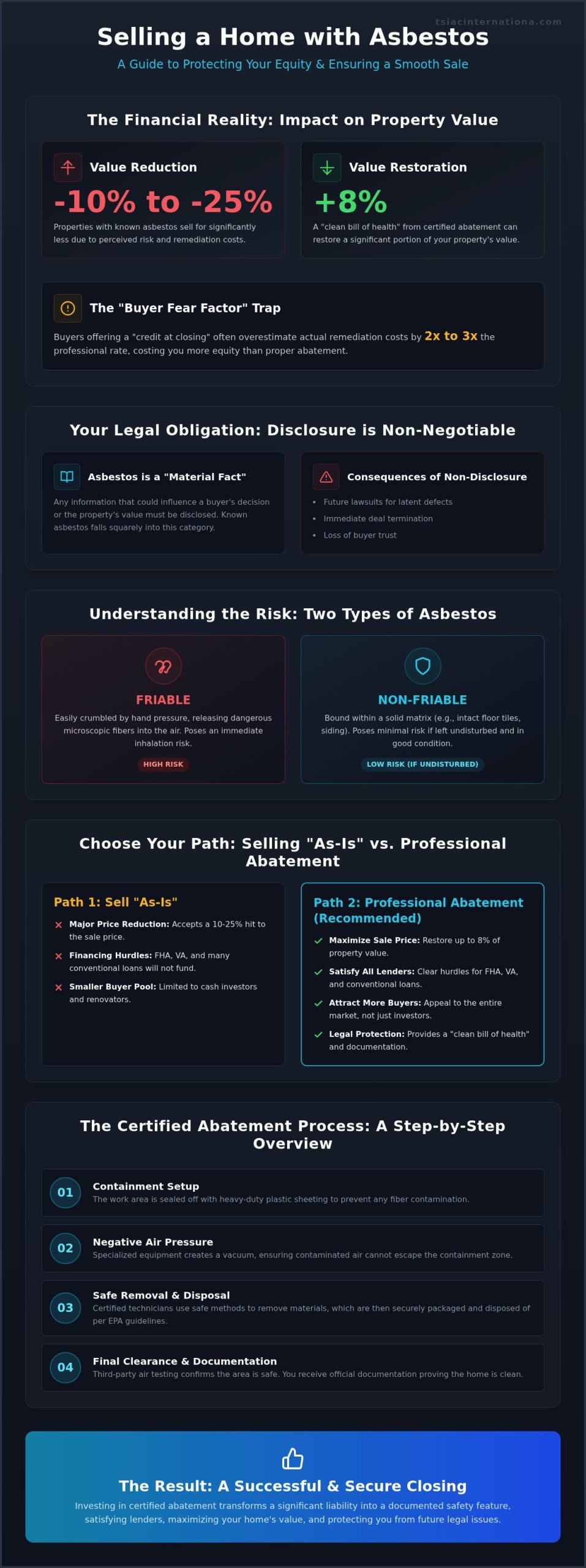
When selling a house with known asbestos, you aren’t just selling a physical structure; you’re managing a buyer’s perception of risk. The “fear factor” associated with hazardous materials often triggers aggressive price negotiations that far exceed the actual cost of remediation. Industry data from 2026 indicates that properties with identified asbestos issues typically sell for 10% to 25% less than comparable homes. This steep discount represents a “risk premium” that buyers demand to compensate for the perceived health hazards and the perceived complexity of future renovations.

Many sellers attempt to bypass this by offering a “credit at closing” to avoid the logistics of abatement. This strategy is frequently a financial trap. Buyers, often fueled by anxiety and worst-case scenarios, tend to overestimate remediation costs by double or triple the professional rate. By failing to provide a “clean bill of health” before listing, you’re likely leaving significant equity on the table. A property that lingers on the market due to these concerns quickly becomes “stale,” leading to further price erosions as buyers wonder why the home hasn’t sold.

The Mortgageability Factor

Financing is the most common point of failure for these transactions. Government-backed loans, including FHA, VA, and USDA products, maintain rigorous safety standards. If an appraiser identifies damaged or friable asbestos, they will likely categorize it as a mandatory repair item, meaning the loan cannot fund until the hazard is removed. Conventional lenders also exercise caution; an underwriter who perceives a liability can halt a closing at the eleventh hour. This creates a volatile environment where a deal can collapse just days before the scheduled move-in date.

Impact on Home Equity and ROI

Investing in professional asbestos abatement acts as a surgical strike to protect your home equity. While the initial investment requires capital, providing documentation of completed, certified work can add back 3% to 8% in resale value. This proactive approach effectively eliminates the 10-25% “asbestos discount” that savvy buyers and investors use as leverage. By removing the hazard, you broaden your pool of potential buyers to include those using strict government financing, ensuring a more competitive bidding environment and a faster path to closing.

Strategy: Professional Abatement vs. Selling the Property As-Is

Selling a house with known asbestos presents a critical fork in the road for any property owner. You must decide whether to absorb the cost of remediation upfront or accept a significant reduction in your final sale price. This choice isn’t merely about convenience; it’s a financial calculation based on your timeline, available capital, and the specific buyer profile you intend to target. Choosing the wrong path can lead to months of stagnation on the market or a closing that leaves tens of thousands of dollars in equity on the table.

An “as-is” sale is a transaction where the seller refuses to perform any repairs or remediation, transferring the burden of the hazard to the buyer. While this offers the fastest exit, it’s rarely the most profitable. Professional investors and “cash for houses” entities are the primary buyers in this category. They don’t view asbestos as a deal-breaker, but they do view it as a massive negotiation lever. In 2026, savvy investors typically deduct double the projected cost of abatement from their offers to account for their own overhead and the inherent risk of managing hazardous materials.

Pros and Cons of Selling As-Is

The primary advantage of an as-is sale is the speed of the transaction. You avoid the logistics of specialized containment and the out-of-pocket expenses of professional services. However, the drawbacks are substantial. Your buyer pool shrinks to a small fraction of the market, as traditional families and those using government-backed financing are effectively excluded. Even in an as-is sale, disclosure is a non-negotiable legal requirement. You aren’t selling the house without the problem; you’re selling the problem at a steep discount.

The Competitive Advantage of Remediation

Proactive remediation transforms the narrative of your property. Instead of a “problem house,” your home becomes a “certified safe” asset. Providing a “Clean Bill of Health” certificate from a licensed expert removes the psychological barrier for health-conscious families and satisfies the rigorous requirements of lenders. This documentation acts as a surgical strike against the “asbestos discount,” allowing you to list at full market value. Understanding the technical value of this process, as detailed in our guide to Hazardous Material Abatement in South Carolina, demonstrates why professional intervention is often the most logical path to maximizing ROI. When you remove the hazard, you regain control of the negotiation. Selling a house with known asbestos becomes much simpler when you can prove the material is no longer a factor.
Selling a House with Known Asbestos: A 2026 Guide to Disclosure, Value, and Remediation

The Step-by-Step Process of Professional Asbestos Abatement

Selling a house with known asbestos requires more than a simple disclosure; it demands a documented, methodological removal process that eliminates physical risk and legal liability. Professional abatement is a multi-stage operation designed to isolate hazardous fibers from the rest of the property. This surgical approach ensures that while specific areas are being remediated, the air quality of the surrounding environment remains uncompromised. Following a rigid technical sequence is the only way to provide the “clean bill of health” that 2026 buyers expect.

  • Phase 1: Professional Testing and Air Quality Sampling. Certified technicians conduct baseline air monitoring and bulk material sampling to map the exact location and concentration of the material.
  • Phase 2: Containment and Negative Air Pressure Setup. The work area is sealed with 6-mil polyethylene sheeting, and high-efficiency particulate air (HEPA) filtration units create negative pressure to prevent fiber migration.
  • Phase 3: Surgical Removal and HEPA Vacuuming. Technicians use wet-removal methods to keep fibers heavy and non-airborne, followed by a double-pass HEPA vacuuming of all surfaces.
  • Phase 4: Regulatory Disposal and Final Clearance Testing. All waste is double-bagged and labeled for hazardous transport, followed by a final air clearance test to prove the area is safe for re-occupancy.

Containment and Safety Protocols

Containment is the most critical phase of the process. Professionals use specialized air locks and decontamination chambers to ensure that technicians don’t track microscopic dust into the living areas of your home. They wear full-body personal protective equipment (PPE) and dual-cartridge respirators. Attempting a DIY removal is a health disaster and a legal liability. In 2026, a botched self-removal can lead to property condemnation or permanent loss of home equity if cross-contamination is detected during a buyer’s inspection.

Disposal and Documentation

The final step in selling a house with known asbestos involves securing a chain-of-custody for the waste and obtaining a Clearance Certificate. This document is a technical guarantee that the air quality meets EPA standards. Your Realtor needs this certificate to satisfy the buyer’s attorney and the mortgage underwriter. With over 15 years of industry experience, TSIAC International brings a disciplined approach to asbestos removal, ensuring every project meets strict regulatory compliance.

If you’re preparing your property for the market, you can schedule a technical consultation to review your remediation options and secure your closing date.

Why Certified Abatement is the Key to a Successful Closing

Selling a house with known asbestos often feels like a defensive maneuver; however, certified abatement transforms the property narrative from one of liability to one of proactive maintenance. This transition is essential for a smooth transaction. When you provide a clearance certificate, you replace a buyer’s fear with technical certainty. The “problem house” label disappears, replaced by the status of a “renovated home” that meets modern safety standards. This psychological shift is often the difference between a deal that collapses during the inspection and one that proceeds to a successful closing.

Professional documentation serves as a critical bridge between the seller, the buyer’s attorney, and the mortgage underwriter. Even the strictest legal counsel cannot argue with third-party air clearance results and documented chains of custody for hazardous waste. By providing these records upfront, you significantly reduce the risk of post-sale litigation. Buyers who are fully informed and provided with proof of remediation have little ground to claim latent defects years after the title has transferred. This methodological approach protects your financial interests long after the moving trucks have left the driveway.

Partnering with TSIAC International

TSIAC International brings over 15 years of industry experience to every residential project. We understand that real estate transactions operate on tight, non-negotiable deadlines. Our team coordinates specialized containment and removal with surgical precision, ensuring that the remediation process doesn’t delay your closing date. We prioritize environmental responsibility through material recycling and fegyelmezett waste management. Our goal isn’t just to remove a hazard; it’s to provide the technical foundation for a secure property transfer. We function as a responsible partner, ensuring all work meets rigorous regulatory compliance standards.

Moving Forward with Confidence

The path from discovering a hazard to finalizing a sale requires a disciplined strategy. You’ve moved from identifying the material fact to weighing the ROI of abatement and executing a professional removal plan. This process ensures you maximize your final sale price while eliminating future legal exposure. It’s clear that TSIAC International is the gold standard for abatement, providing the reliability and safety certifications necessary for a complex real estate market. Don’t let legacy materials compromise your home equity. Secure your property’s value with a professional assessment and a clear plan for remediation. Contact our team today to schedule a technical consultation and take the first step toward a clean, compliant closing.

Successfully selling a house with known asbestos requires shifting your perspective from viewing the material as a deal-breaker to managing it as a technical requirement. You’ve seen how transparent disclosure prevents future lawsuits and how proactive remediation can recover up to 25% of your home’s market value by removing the “risk premium” buyers demand. By providing a certified “clean bill of health,” you effectively remove the financing hurdles that often stall government-backed loans and broaden your pool of potential offers.

Navigating these regulatory complexities doesn’t have to be a solo effort. With over 15 years of industry experience, TSIAC International provides the specialized containment and full disposal documentation required for a smooth residential or commercial closing. Our national team handles every phase of the process with methodological precision, ensuring your property is market-ready and legally protected. You can Get a Professional Abatement Quote from TSIAC International to secure your home equity today. Taking this disciplined step now ensures you close the deal with confidence and complete peace of mind.

Frequently Asked Questions

Do I have to remove asbestos before selling my house in 2026?

No federal mandate requires the removal of asbestos before a private residential sale in 2026. The EPA recommends leaving intact, non-friable materials undisturbed if they aren’t at risk of damage. However, while removal isn’t legally required, you must comply with state-specific disclosure laws. Many sellers choose professional abatement to avoid the 10% to 25% price reduction typically demanded by buyers who discover hazardous materials during the inspection phase of the transaction.

How much does asbestos removal typically decrease home value?

The presence of the material, rather than its removal, is what impacts your equity. Properties with known issues often see value drops between 10% and 25% due to buyer risk aversion. Conversely, providing documentation of professional abatement can restore your home’s full market value and may even add a 3% to 8% premium. This documentation proves the property is safe for occupancy and eliminates the “fear factor” that drives aggressive price negotiations.

Can a buyer back out of a contract if asbestos is found?

Most standard real estate contracts include an inspection contingency that allows buyers to withdraw if hazardous materials are discovered. If you’re selling a house with known asbestos and didn’t disclose it, the buyer has significant legal leverage to terminate the deal and reclaim their earnest money. Transparency is the only way to prevent these last-minute collapses. Disclosing the material early or providing a clearance certificate ensures the buyer remains committed through the closing.

Is it better to give a repair credit or remove the asbestos myself?

Giving a repair credit is often the most expensive option because buyers typically overestimate remediation costs by 200% or more. Performing the work yourself is a major health and legal risk; DIY removal often leads to cross-contamination and failed air clearance tests. Professional abatement is the most cost-effective path. It provides the necessary regulatory documentation that satisfies lenders and attorneys, ensuring the transaction remains on schedule without inflated price concessions.

Will a standard home inspection always find asbestos?

A standard home inspection is a visual assessment and doesn’t include laboratory testing for hazardous materials. While an inspector might identify suspicious insulation or floor tiles, they cannot confirm the presence of fibers without a specialized assessment. If your home was built before 1980, savvy buyers in 2026 will often hire a certified technician to perform bulk sampling. Proactive testing before listing allows you to control the narrative and manage the remediation process.

Can I sell a house with asbestos to a regular buyer using a mortgage?

You can sell to buyers using conventional mortgages if the asbestos is intact and non-friable. However, government-backed loans like FHA or VA have much stricter safety protocols. If an appraiser identifies damaged or crumbling material, they will likely require professional remediation before the loan can fund. This requirement can delay or kill a deal. Completing the abatement before the appraisal ensures the property meets all federal safety standards for standard financing.

What documents do I need to prove asbestos was safely removed?

You need a comprehensive documentation packet to satisfy legal and financial requirements. This includes the initial inspection report, the air clearance certificate issued by a third-party laboratory, and the hazardous waste manifest proving safe disposal. These documents serve as a “clean bill of health” for the property. TSIAC International provides full regulatory compliance documentation for every project, ensuring that your realtor and the buyer’s attorney have the technical proof required for a smooth closing.

How long does the professional asbestos abatement process take?

Most residential abatement projects are completed within two to five business days. The timeline depends on the scope of the containment area and the volume of material being removed. This includes the setup of negative air pressure systems, the surgical removal of the material, and the final 24-hour waiting period for air clearance testing. Our team coordinates with your real estate timeline to ensure these safety protocols don’t interfere with your scheduled closing date.
The Financial Impact of Lead Paint on Commercial Property Value

For any commercial asset built before 1978, lead paint isn’t just a maintenance line item; it’s a latent lien that quietly erodes your equity every…

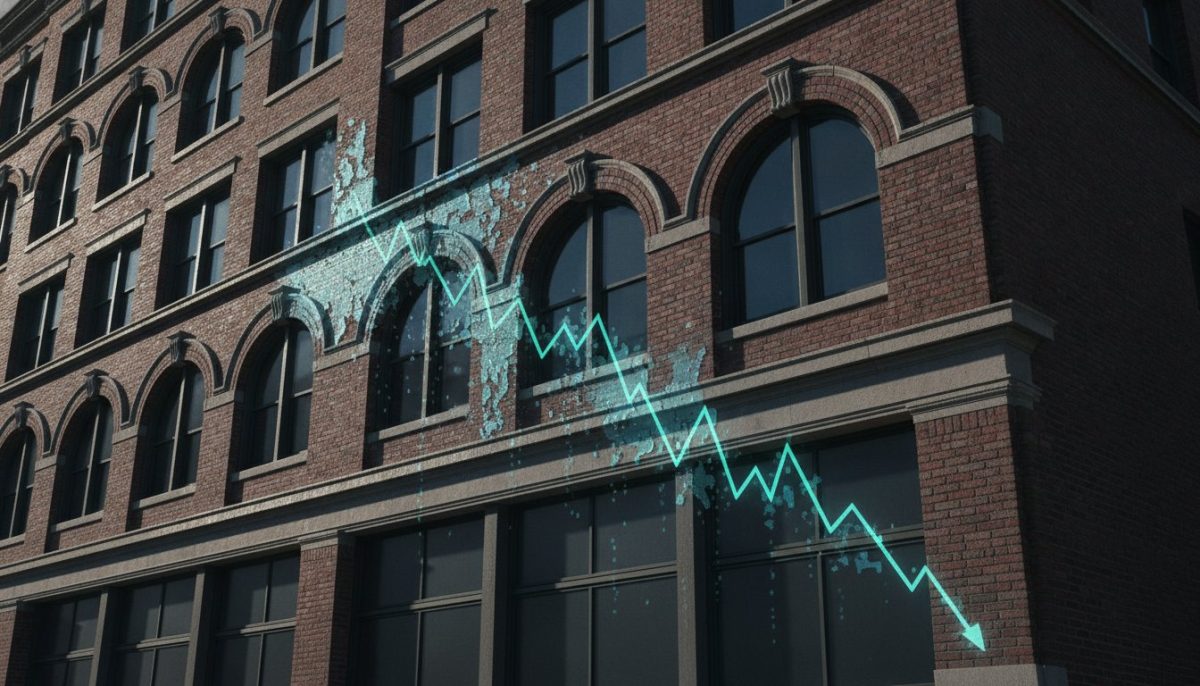
For any commercial asset built before 1978, lead paint isn’t just a maintenance line item; it’s a latent lien that quietly erodes your equity every year it remains on the structure. This hidden liability often surfaces at the worst possible moment, such as during a high-stakes appraisal or a critical refinancing window. The impact of lead paint on commercial property value is profound, as it triggers stringent OSHA worker safety protocols and increasingly aggressive EPA enforcement. You likely feel the weight of these regulations when planning renovations or managing tenant health risks, especially with the stricter 2026 dust-lead hazard standards now in full effect.

It’s understandable to view hazardous material remediation as a drain on capital, but the reality is that ignoring it often costs more in lost marketability and financing hurdles. This guide clarifies how lead-based paint acts as a hidden liability on your balance sheet and how professional abatement restores commercial asset value. We’ll provide a technical framework for choosing between encapsulation and full abatement, explain the latest regulatory shifts and heightened enforcement measures, and outline a strategy to ensure your property remains a liquid, high-performing asset.

Key Takeaways

  • Identify why lead paint acts as a latent financial liability that triggers the “stigma effect” and reduces the pool of qualified institutional buyers.
  • Analyze the direct impact of lead paint on commercial property value through the lens of lender requirements and the necessity of Phase I Environmental Site Assessments.
  • Compare the long-term ROI of permanent abatement against the temporary, depreciating nature of interim encapsulation strategies.
  • Utilize the 10-day inspection window and comprehensive disclosure documentation as strategic leverage during acquisition or price negotiations.
  • Understand how professional-grade containment and HEPA filtration protect your balance sheet from the liabilities associated with improper hazardous material disturbance.

The Hidden Cost of Lead Paint: How It Impacts Commercial Asset Valuation

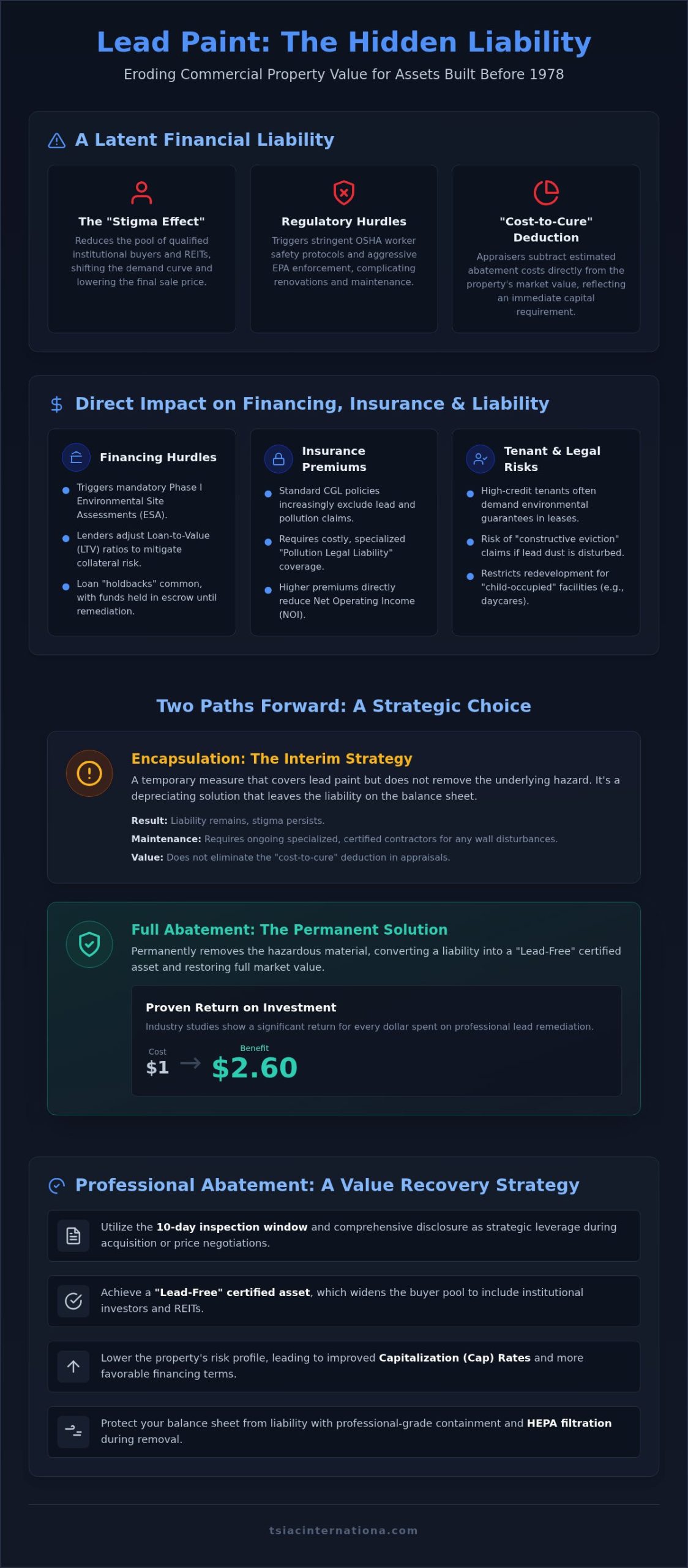
In the context of commercial real estate, lead paint functions as a latent financial liability. It isn’t merely a surface-level defect; it represents a quantifiable risk that directly influences the impact of lead paint on commercial property value. For structures built before 1978, the presence of Lead-Based Paint in the United States is a primary concern for institutional investors. This age threshold signals a potential for hidden costs that can derail a transaction during the due diligence phase. When hazardous materials are identified, the property’s “as-is” value is immediately adjusted downward to account for the specialized handling required during any future disturbance.

Owners must also contend with the “stigma effect.” This phenomenon reduces the pool of potential buyers to those specifically equipped to manage environmental hazards. Many institutional funds and Real Estate Investment Trusts (REITs) have strict environmental mandates that preclude them from bidding on assets with known contaminants. When the buyer pool shrinks, the demand curve shifts, often resulting in a lower final sale price. Appraisers typically apply a “cost-to-cure” deduction, subtracting the total estimated abatement expenses from the property’s market value to reflect the immediate capital requirement.

Lead Paint as a Capital Expenditure Liability

Unlike standard cosmetic wear, lead paint requires specialized handling under OSHA and EPA guidelines. This distinction transforms a routine repaint into a significant capital expenditure. In a Highest and Best Use (HBU) analysis, the presence of lead can restrict certain redevelopment options, particularly if the intended use involves “child-occupied” facilities like daycares or private schools. Lead-Based Paint Stigma is defined as the intangible loss in property value resulting from the public’s perception of risk and the increased administrative burden associated with managing hazardous materials.

The ROI of Professional Abatement

Investing in full lead abatement converts a hazardous liability into a “Lead-Free” certified asset. This transition has a measurable effect on the capitalization rate (Cap Rate). By removing the environmental risk, you lower the property’s risk profile, which leads to more favorable financing terms and lower liability insurance premiums. Research indicates that remediation generates a significant return, with some industry studies showing a $2.60 benefit for every $1 spent on removal. Professional abatement also eliminates the cycle of expensive, specialized maintenance. You no longer need to hire certified contractors for every minor wall repair or tenant improvement, leading to substantial long-term savings in operational expenses. This shift significantly improves the overall impact of lead paint on commercial property value by enhancing marketability and asset liquidity.

Valuation Depreciation: Financing, Insurance, and Liability Risks

Commercial lenders prioritize risk mitigation above all else. When a property contains lead, it often triggers a Phase I Environmental Site Assessment (ESA). If lead is confirmed, the impact of lead paint on commercial property value manifests through adjusted Loan-to-Value (LTV) ratios. Banks view unmanaged lead as a threat to their collateral. This often results in “holdback” agreements where a portion of the loan remains in escrow until remediation is complete. Institutional investors typically steer clear of assets with unresolved environmental issues to avoid the administrative and legal burdens associated with environmental hazards in commercial real estate.

Standard Commercial General Liability (CGL) policies increasingly exclude lead and pollution claims. Property owners must often secure specific “Pollution Legal Liability” coverage, which adds a recurring expense to the operating budget. These higher premiums directly reduce the Net Operating Income (NOI). Beyond insurance, lead hazards affect tenant quality. High-credit tenants often require environmental guarantees before signing long-term leases. If lead dust is disturbed during minor repairs, tenants can claim “constructive eviction,” arguing that the space is no longer safe for occupancy. This leads to costly legal battles and unexpected vacancies.

The Role of Environmental Due Diligence in Commercial Lending

Lenders use the Phase I ESA to determine if a Phase II investigation is necessary. If lead paint is found, it can significantly lower the appraised value. This depreciation isn’t just about the cost of removal; it’s about the increased risk premium lenders charge. For owners looking to exit, these hurdles can break a deal during the final stages of the 10-day inspection window. Sophisticated buyers use these findings to negotiate aggressive price reductions that far exceed the actual cost of remediation.

Legal and Civil Liability Exposure

Compliance with OSHA Title 29 CFR 1926.62 is non-negotiable for any commercial renovation involving lead. Failure to follow these standards leads to catastrophic fines. As of January 12, 2026, the maximum civil penalty for EPA violations increased to $46,989 per violation per day. These financial penalties can quickly eclipse the cost of a professional lead abatement project, further worsening the negative impact of lead paint on commercial property value. Commercial landlords have a non-delegable duty of care to ensure that third-party contractors and tenants are not exposed to hazardous lead dust during structural modifications.

Abatement vs. Encapsulation: Strategies for Maximizing Property ROI

Property owners must distinguish between managing a hazard and eliminating it. Encapsulation, often categorized as an interim control, involves applying a specialized coating over lead-based paint to prevent the release of toxic dust. While this method offers a lower initial capital outlay, it functions as deferred maintenance rather than a permanent solution. Conversely, full abatement involves the physical removal of the contaminant. This “gold standard” approach is the only way to secure a “Certificate of Lead-Free” status, which fundamentally changes the impact of lead paint on commercial property value by removing the asset from the hazardous material registry. When an appraiser sees a permanent clearance report, the environmental risk premium is removed from the valuation model.

The strategic choice between surgical removal and a total interior gutting depends on the building’s future lifecycle. Surgical abatement targets specific high-friction components like window sills, door frames, or stair treads. Total gutting is often more efficient for properties undergoing major repositioning or adaptive reuse. By combining lead removal with structural demolition, owners can streamline project timelines and significantly reduce mobilization costs. This integrated approach ensures that the building shell is entirely clean before new construction begins, preventing the cross-contamination that often occurs with less rigorous methods.

Encapsulation: The Hidden Costs of Deferred Maintenance

Encapsulation requires a rigorous, long-term monitoring and maintenance program to remain compliant. If the coating fails due to moisture infiltration or physical impact, the owner faces immediate emergency remediation costs and potential tenant lawsuits. This strategy often complicates future commercial interior gutting services. When lead is encapsulated rather than removed, any subsequent renovation will still trigger expensive hazardous material protocols. The presence of lead beneath “safe” layers continues to act as a drag on the property’s capitalization rate because sophisticated buyers discount the price to account for future removal requirements.

Professional Removal: Permanent Liability Elimination

Professional abatement utilizes mechanical stripping, chemical solvents, or component replacement to achieve permanent clearance. Each method must adhere to the latest federal lead paint hazard standards for dust-lead levels, which were significantly tightened in 2026. Unlike encapsulation, this process generates a permanent paper trail of hazardous waste disposal and post-abatement clearance testing. For owners in the Southeast, integrating these services with hazardous material abatement south carolina ensures that the asset meets both state and federal compliance thresholds. This proactive stance eliminates the negative impact of lead paint on commercial property value by transforming a “tainted” asset into a premium, lead-free facility that attracts institutional-grade tenants.

The Financial Impact of Lead Paint on Commercial Property Value

Due Diligence and Compliance: Navigating the Lead Disclosure Rule

During commercial acquisitions, the 10-day inspection window provides the buyer with critical leverage. This specific period allows for technical testing that can uncover hidden environmental liabilities before the contract becomes binding. Understanding the impact of lead paint on commercial property value during this phase is essential for accurate price discovery. Buyers often utilize certified lead inspectors to conduct XRF (X-ray fluorescence) testing, which provides immediate, non-destructive results. It’s vital to distinguish these inspectors from abatement contractors; the former provides the raw data, while the latter executes the remediation strategy. This separation of roles ensures an unbiased assessment of the asset’s condition.

Documentation is the primary defense against future litigation. Sellers who provide comprehensive lead records, including previous inspection reports and clearance certifications, often maintain higher closing prices because they eliminate buyer uncertainty. Conversely, a lack of transparency during due diligence can lead to aggressive price re-negotiations or deal termination. State regulations often impose stricter requirements than federal laws, especially in jurisdictions like New York or South Carolina, where active enforcement phases for older buildings are now standard operating procedure.

Using Lead Findings as a Negotiation Tool

If lead paint is detected, the buyer can structure a remediation contingency within the sales contract. This process involves calculating a “credit at closing” based on verified professional abatement estimates. A sophisticated buyer won’t just ask for a generic price reduction; they’ll demand a post-abatement clearance report as a condition for closing. This documentation ensures the asset is delivered without the “stigma effect” discussed earlier, protecting the new owner’s future resale value and exit strategy. It transforms a potential deal-breaker into a manageable capital improvement project.

The Lead-Based Paint Disclosure Rule for Commercial Assets

While federal disclosure rules primarily target residential units, they apply to commercial assets during “commercial-to-residential” conversions or for child-occupied facilities within a commercial structure. Property managers must maintain meticulous records of all lead-related activities to mitigate long-term litigation risk. In 2026, the financial risk of non-compliance is higher than ever, with EPA audits becoming more frequent for mixed-use developments and industrial-to-loft repositioning projects. Proper documentation isn’t just a legal requirement; it’s a value-preservation strategy that maintains the property’s marketability.

Ensuring your due diligence is backed by technical precision is the only way to protect your investment from hidden environmental costs. You can secure your asset’s future by partnering with a specialist for lead abatement services that meet the highest regulatory standards.

Professional Abatement as a Value Recovery Strategy

General contractors often treat lead as a secondary concern, but in a commercial setting, this lack of specialization creates massive liability. Professional abatement requires sophisticated engineering controls, including full-scale HEPA containment and high-volume negative air pressure systems. These systems prevent toxic dust from migrating into HVAC units or common areas. Without these controls, the impact of lead paint on commercial property value shifts from a manageable project to an environmental catastrophe that can trigger building-wide closures and aggressive EPA audits. Using a certified specialist ensures that the work meets the rigorous 2026 dust-lead hazard standards from the start.

Many pre-1978 structures present multiple hazards simultaneously. It’s common to find lead-based coatings on structural steel that also features asbestos insulation or fireproofing. Coordinating these efforts is vital for maintaining project timelines and avoiding redundant mobilization costs. Owners should look for a partner capable of managing asbestos removal south carolina alongside lead protocols. TSIAC International leverages over 15 years of field experience to provide the rigorous compliance documentation necessary to secure a “Lead-Safe” certification, which effectively restores the property’s marketability and appraisal value.

Expertise in Complex Commercial Environments

Managing abatement in an occupied facility requires a level of tactical planning that standard renovation firms don’t possess. We utilize surgical precision to isolate work zones, ensuring that tenant operations continue without exposure risks. This precision is especially critical during selective demolition, where structural integrity and hazardous material containment must be balanced perfectly. Our logistics team handles large-scale debris management with a focus on environmental recycling, diverting significant percentages of metal and wood from landfills to align with modern ESG (Environmental, Social, and Governance) standards and reduce disposal fees.

Next Steps for Commercial Property Owners

The first step in value recovery is a comprehensive hazardous material audit. For owners with large portfolios, we recommend developing a multi-year abatement plan that prioritizes high-friction areas while spreading capital expenditures over several fiscal cycles. This proactive approach prevents the impact of lead paint on commercial property value from becoming a bottleneck during future asset liquidations or refinancing windows. If you’re ready to clear the environmental liability from your balance sheet, Contact TSIAC International for a professional lead abatement consultation to begin your asset restoration project.

Restoring Asset Liquidity Through Strategic Remediation

Proactive management of hazardous materials is no longer optional in the current regulatory landscape. Lead paint acts as a persistent drag on your balance sheet; it complicates everything from initial financing to the final exit strategy. Understanding the long-term impact of lead paint on commercial property value is the first step toward reclaiming your asset’s full market potential. By choosing permanent abatement over temporary encapsulation, you eliminate the “stigma effect” and ensure your property meets the highest institutional standards for safety and compliance.

TSIAC International utilizes 15+ years of hazardous material expertise to provide the technical precision required for complex commercial environments. Our OSHA and EPA compliant processes are backed by comprehensive disposal documentation, giving you the certainty needed for successful property transactions. Don’t let hidden contaminants dictate your property’s worth. Secure Your Asset Value with Professional Lead Abatement and position your commercial portfolio for sustainable growth and long-term security.

Frequently Asked Questions

How much does lead paint reduce the appraisal value of a commercial building?

Appraisers typically apply a “cost-to-cure” deduction, subtracting the total estimated abatement expenses from the property’s market value. Beyond these direct costs, the “stigma effect” can further depress the valuation by 5% to 15% depending on the buyer pool’s risk tolerance. The negative impact of lead paint on commercial property value is most severe when it limits the asset’s “Highest and Best Use,” such as preventing a conversion into a school or medical facility.

Is lead paint abatement required by law for commercial properties?

Federal law doesn’t mandate abatement for all commercial structures, but it is required for “child-occupied facilities” like daycares and schools. However, OSHA regulations mandate strict safety protocols if the paint is disturbed during any renovation or maintenance activity. Local laws, such as New York City’s Local Law 31, impose much stricter testing and remediation deadlines. Many owners choose professional abatement to eliminate the recurring costs of mandatory inspections and potential civil liability.

Can lead paint impact my ability to get a commercial mortgage?

Yes, lead paint significantly complicates the lending process. Most institutional lenders require a Phase I Environmental Site Assessment (ESA) before approving a loan. If lead is identified, the bank may require a Phase II audit or a “holdback” in escrow to cover the estimated remediation costs. The presence of hazardous materials often results in lower Loan-to-Value (LTV) ratios because lenders view unmanaged lead as a threat to the collateral’s liquidity.

What is the difference between lead encapsulation and lead abatement?

Encapsulation is a temporary “interim control” that seals lead paint under a specialized coating to prevent dust release; it requires ongoing monitoring and periodic re-application. Abatement is a permanent solution involving the physical removal or replacement of lead-contaminated components. While encapsulation is cheaper initially, abatement is the only method that secures a “Lead-Free” certification. This permanent status positively shifts the impact of lead paint on commercial property value by removing the asset from hazardous registries.

How long does the lead abatement process take for a 10,000 sq. ft. office building?

A 10,000 square foot project typically requires 7 to 14 business days, depending on the architectural complexity and the removal method chosen. Mechanical stripping is often faster than chemical solvents but requires more intensive HEPA containment. This timeline includes the initial site preparation, negative air pressure setup, the physical removal process, and the mandatory 2026 dust-lead clearance testing required before the building can be safely re-occupied by tenants.

Does lead paint affect insurance premiums for commercial property owners?

Lead paint frequently leads to higher insurance costs because standard Commercial General Liability (CGL) policies often exclude pollution and lead-related claims. Owners must typically purchase a separate “Pollution Legal Liability” policy to protect against tenant health claims and environmental litigation. These additional premiums reduce the building’s Net Operating Income (NOI). Remediation can lower these recurring costs by removing the specific risk profile that insurers use to calculate high-risk premiums.

What happens if I discover lead paint during a commercial renovation?

You must immediately halt work and implement OSHA-mandated lead safety protocols under Title 29 CFR 1926.62. Discovering lead mid-project often causes significant delays and budget overruns if the general contractor isn’t certified for hazardous material handling. You’ll need to hire a specialist to establish HEPA containment and negative air pressure zones. Failure to follow these steps can result in catastrophic EPA fines of up to $46,989 per violation per day.

Can I perform lead abatement with my own maintenance crew?

Most commercial property owners shouldn’t use in-house crews unless those employees have specific EPA RRP certification and medical surveillance programs in place. OSHA requires specialized training, fit-testing for respirators, and air monitoring that standard maintenance teams lack. Improper removal by uncertified staff creates massive liability risks and often results in cross-contamination. This can permanently damage the property’s marketability and appraisal value while exposing the owner to severe regulatory penalties.