Lead Abatement Certification: The 2026 Comprehensive Regulatory & Compliance Guide

In 2023, the EPA finalized enforcement actions that resulted in $1,185,000 in civil penalties for lead-based paint violations. This figure highlights…

In 2023, the EPA finalized enforcement actions that resulted in $1,185,000 in civil penalties for lead-based paint violations. This figure highlights a critical reality for contractors and site managers; the cost of a compliance error far outweighs the investment in proper training. It’s common to feel overwhelmed by the technical overlap between RRP standards and the more stringent lead abatement certification requirements. You likely recognize that a single oversight in documentation or on-site protocol can lead to project shutdowns and significant environmental liability.

This 2026 comprehensive guide ensures you master the complexities of lead abatement certification to keep your projects aligned with the latest federal safety standards. By following this technical roadmap, you’ll protect your workers and eliminate the risk of heavy fines or legal challenges. We’ll examine the updated regulatory framework, provide a clear checklist for verifying contractor credentials, and outline the precise engineering controls required for successful, safe project completion without unnecessary delays.

Key Takeaways

  • Navigate the complex regulatory landscape of EPA and HUD standards to maintain absolute compliance in hazardous environments.
  • Differentiate between temporary RRP activities and permanent elimination to ensure you hold the correct lead abatement certification for your specific project intent.
  • Master the hierarchical structure of specialized abatement roles to optimize project safety and technical execution from workers to designers.
  • Establish a rigorous documentation “paper trail” that protects your assets and ensures long-term liability mitigation through meticulous record-keeping.
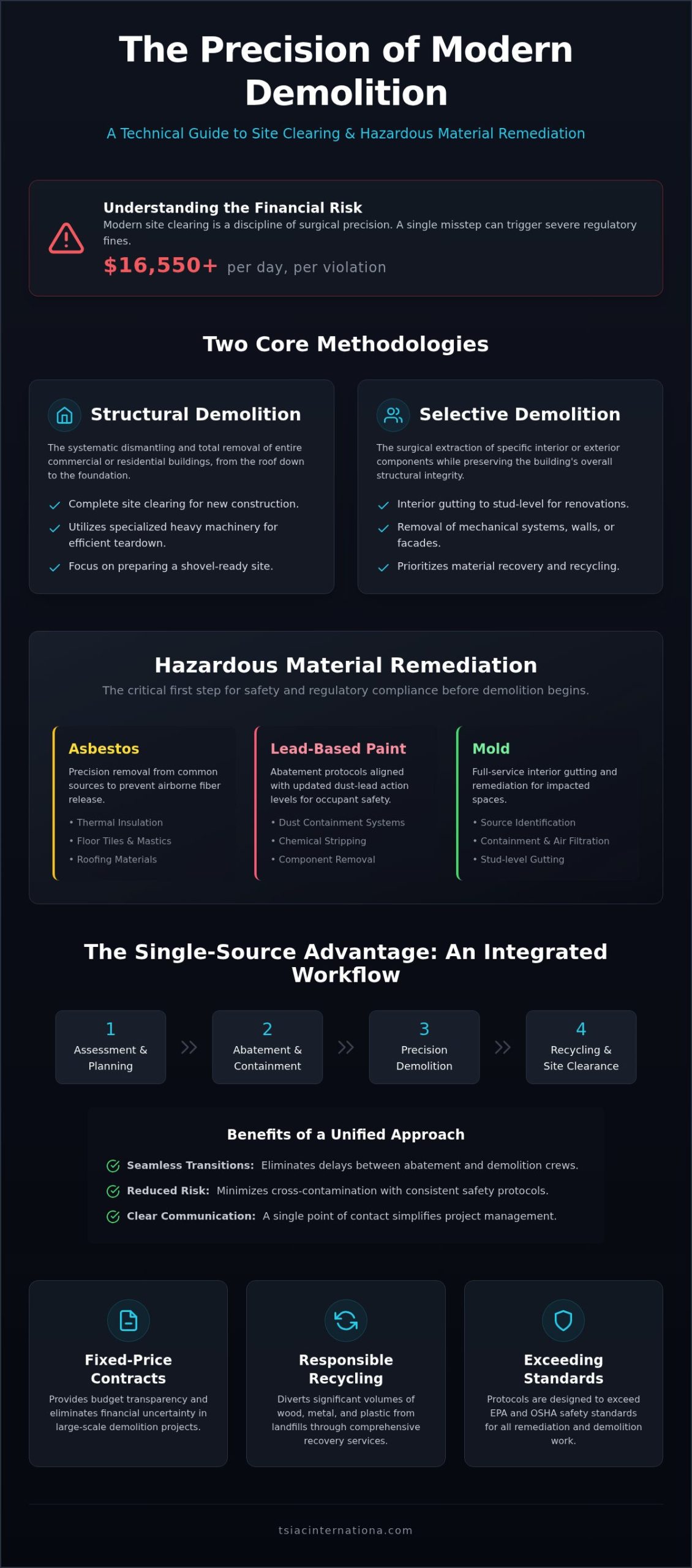
  • Streamline complex site management by leveraging integrated contractors who combine structural demolition with professional lead mitigation and debris disposal.

What is Lead Abatement Certification?

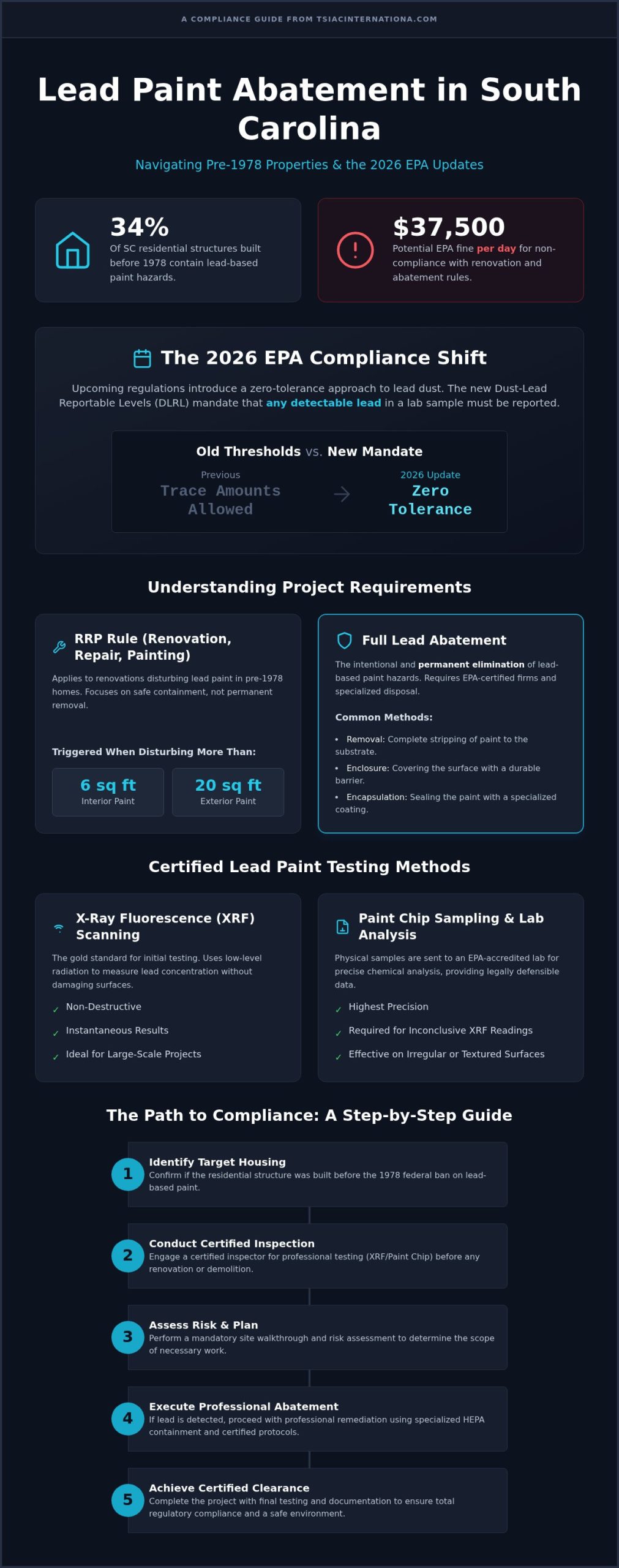
Lead abatement certification is a specialized, legally mandated credential that authorizes professionals to identify and permanently eliminate lead-based paint hazards. Unlike standard renovation tasks, this certification falls under strict federal and state oversight. The Environmental Protection Agency (EPA) and the Department of Housing and Urban Development (HUD) established the Lead-Based Paint Activities (LBPA) standards to ensure that high-risk projects don’t result in environmental contamination or public health crises. For any work performed in “target housing” (built before 1978) or “child-occupied facilities,” possessing a valid lead abatement certification is a non-negotiable legal requirement.

The regulatory framework draws a sharp line between a “certified firm” and “certified individuals.” A firm must register with the appropriate agency to legally bid on and contract for abatement projects. However, the firm’s registration doesn’t grant workers the right to perform the labor. Every supervisor and worker on the job site must hold their own individual certifications, earned through accredited training and, for supervisors, passing a third-party state or federal exam. Lead abatement focuses on long-term elimination rather than temporary repair, which is why the technical requirements are significantly more rigorous than those found in standard RRP (Renovation, Repair, and Painting) protocols.

The Legal Necessity for Property Owners

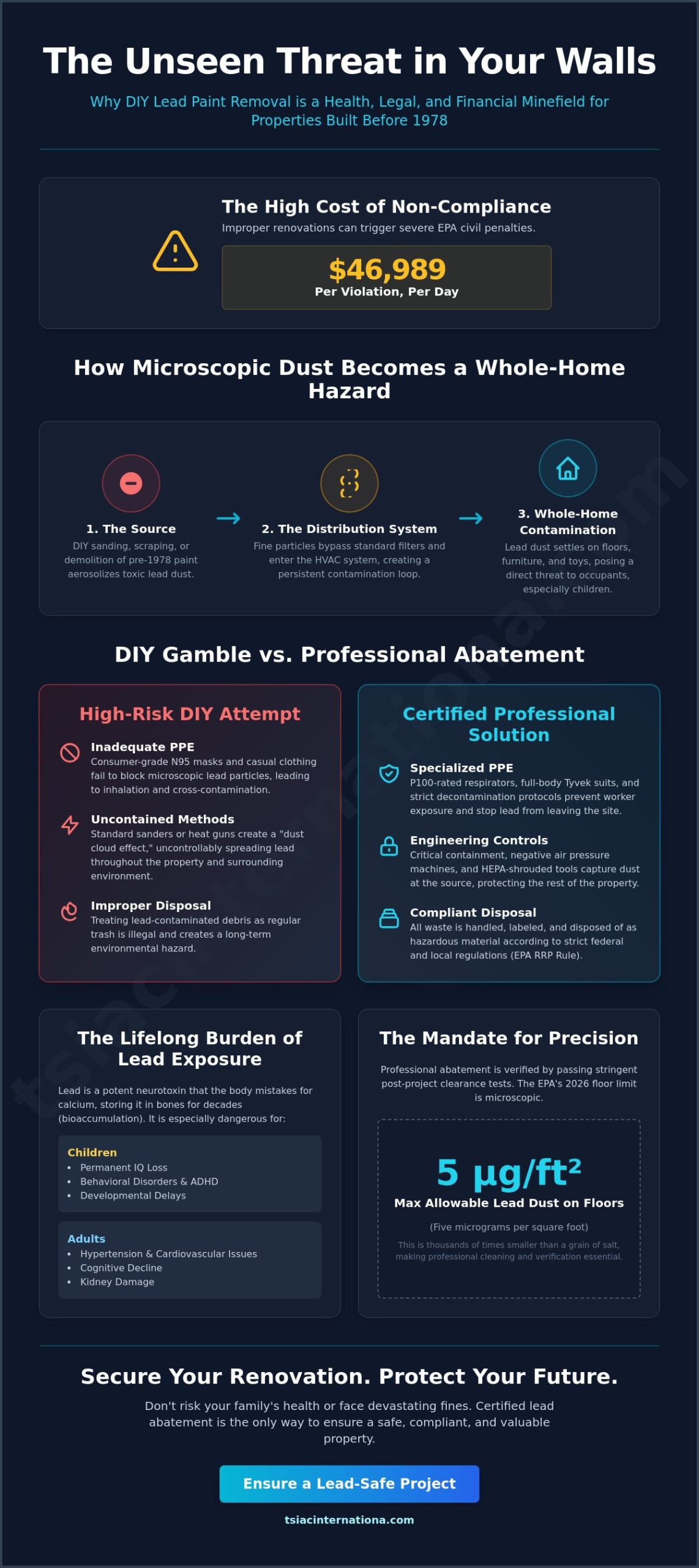
The Toxic Substances Control Act (TSCA) Section 402 provides the statutory authority for these regulations. For property owners in 2026, the risks of non-compliance are severe. The EPA has adjusted civil penalties for inflation, and unauthorized abatement work can now result in fines exceeding $46,192 per violation per day. Beyond these criminal and civil liabilities, certification status significantly impacts the financial health of an asset. Real estate data indicates that properties with certified lead-free status or documented professional abatement maintain higher valuations and enjoy lower liability insurance premiums. Most commercial insurers now require proof of lead abatement certification from contractors before they’ll provide coverage for projects involving pre-1978 structures.

Key Regulatory Bodies and Oversight

Navigating the jurisdictional landscape requires identifying who holds authority over your specific project site. The oversight structure generally follows these three pillars:

  • EPA-Authorized State Programs: Currently, 39 states manage their own lead programs. These state-run systems must meet or exceed federal standards but often have unique reporting forms and fee structures.
  • Federal EPA Oversight: In the remaining 11 states and on most tribal lands, the EPA directly manages the certification and enforcement process.
  • OSHA Compliance: While the EPA focuses on environmental outcomes, OSHA enforces 29 CFR 1926.62 to protect the workers. This includes mandatory blood-lead level monitoring and specific respiratory protection protocols that must be integrated into the abatement plan.

It’s the owner’s responsibility to verify that their chosen contractor’s credentials align with the specific requirements of the local jurisdiction. Failure to do so doesn’t just halt the project; it creates a chain of liability that can compromise the entire investment.

The Five Core Disciplines of Individual Certification

A compliant lead abatement project functions like a precision engineering operation. It relies on a tiered hierarchy of certified professionals, each possessing a distinct scope of authority and technical responsibility. Under the 2026 regulatory framework, individual lead abatement certification is not a generic credential but a discipline-specific authorization. This structure ensures that from the initial site assessment to the final clearance testing, every phase is managed by a qualified expert. Higher-level disciplines, including Supervisors, Inspectors, and Risk Assessors, must pass a mandatory third-party competency exam administered by the EPA or an authorized state program after completing their initial training.

The hierarchy begins with the field personnel and ascends to the strategic planners. Each role has specific prerequisites. For instance, a Lead Abatement Worker requires a basic 16-hour initial course, while a Project Designer often needs a bachelor’s degree in engineering or architecture along with specialized lead training. Professionals must strictly adhere to EPA lead certification requirements to maintain their legal standing and ensure site safety. Failure to maintain these credentials can result in project shutdowns and significant civil penalties.

The Evaluators: Inspectors and Risk Assessors

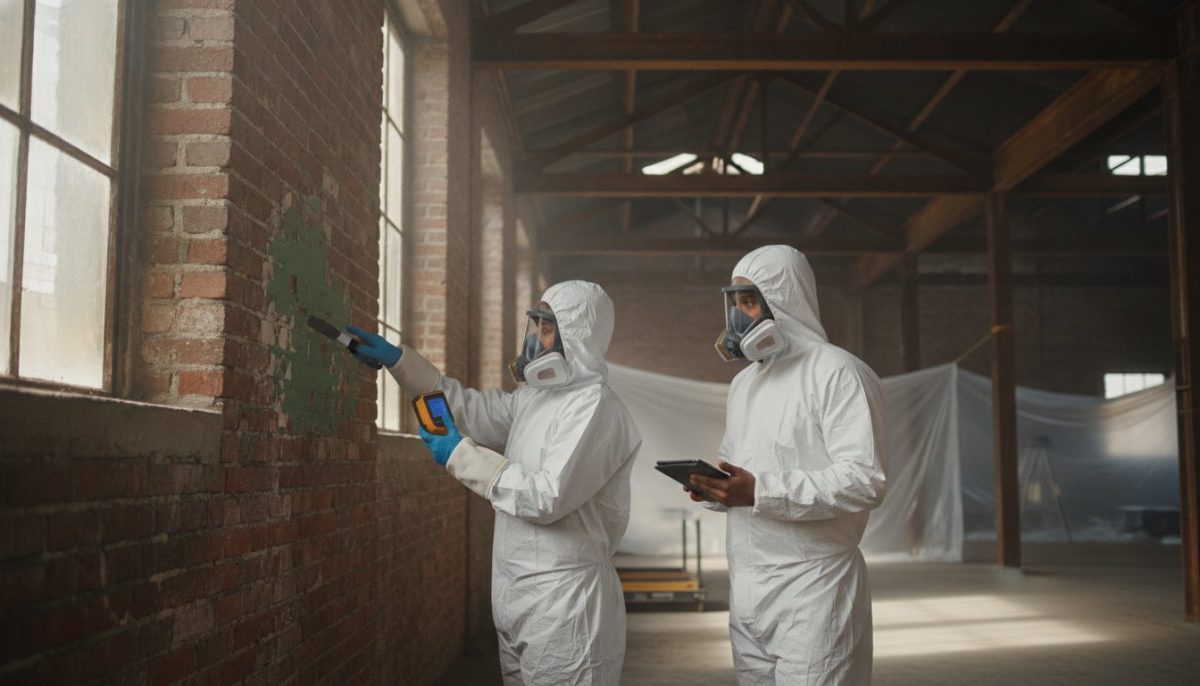
Lead Inspectors focus on the technical identification of lead-based paint. They conduct surface-by-surface investigations using X-ray fluorescence (XRF) analyzers to determine exactly where lead is present. Their work is purely diagnostic. Risk Assessors take this a step further by evaluating the severity of the hazards found. They determine if the lead is currently a threat through dust and soil sampling, eventually recommending specific interim controls or full abatement measures. These two roles must remain independent of the abatement contractor. This separation of duties prevents conflicts of interest and ensures that the professional who identifies the hazard is not the same person profiting from its removal.

The Executors: Supervisors, Workers, and Designers

The execution team turns the assessment into action. The Abatement Supervisor acts as the site manager, overseeing all daily activities and ensuring the crew follows the Occupant Protection Plan. They are responsible for the technical integrity of the containment systems. Abatement Workers are the technicians who perform the actual removal, encapsulation, or replacement of lead-contaminated materials. For large-scale industrial projects or housing complexes with more than 10 units, a Project Designer is required. They draft the blueprints and technical specifications that govern the entire process. When managing complex industrial sites, securing a partner with specialized technical expertise ensures long-term structural integrity and regulatory compliance. Every lead abatement certification within this group must be renewed every three years to stay current with evolving safety technologies.

Lead Abatement Certification: The 2026 Comprehensive Regulatory & Compliance Guide

Abatement vs. RRP: Understanding the Critical Difference

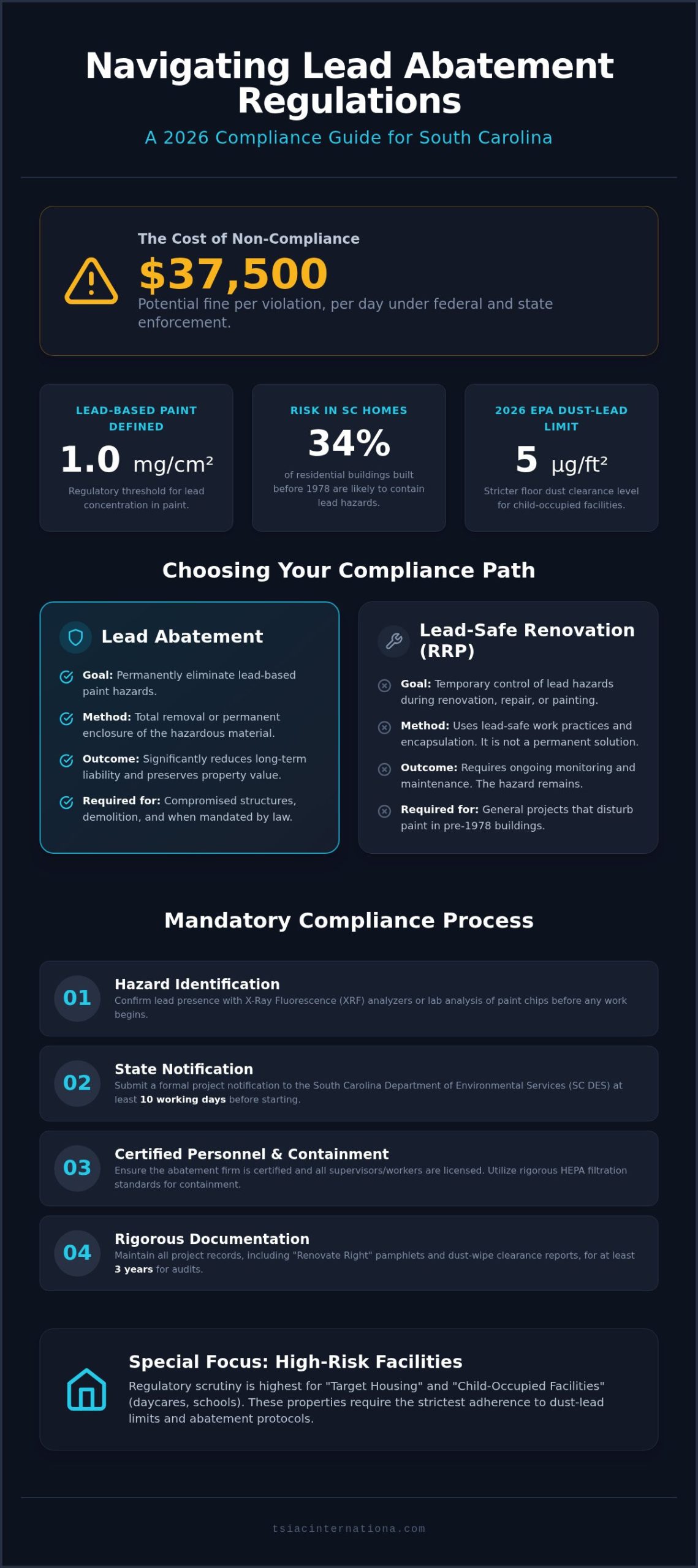
Distinguishing between Renovation, Repair, and Painting (RRP) and lead abatement isn’t just a technicality; it’s a legal boundary that defines project liability and safety protocols. The EPA defines RRP as work performed for compensation that disturbs painted surfaces in pre-1978 housing or child-occupied facilities. Abatement, however, refers to activities specifically designed to permanently eliminate lead-based paint hazards. Federal regulations require that abatement measures remain effective for at least 20 years, a standard that demands significantly more rigorous engineering controls and documentation.

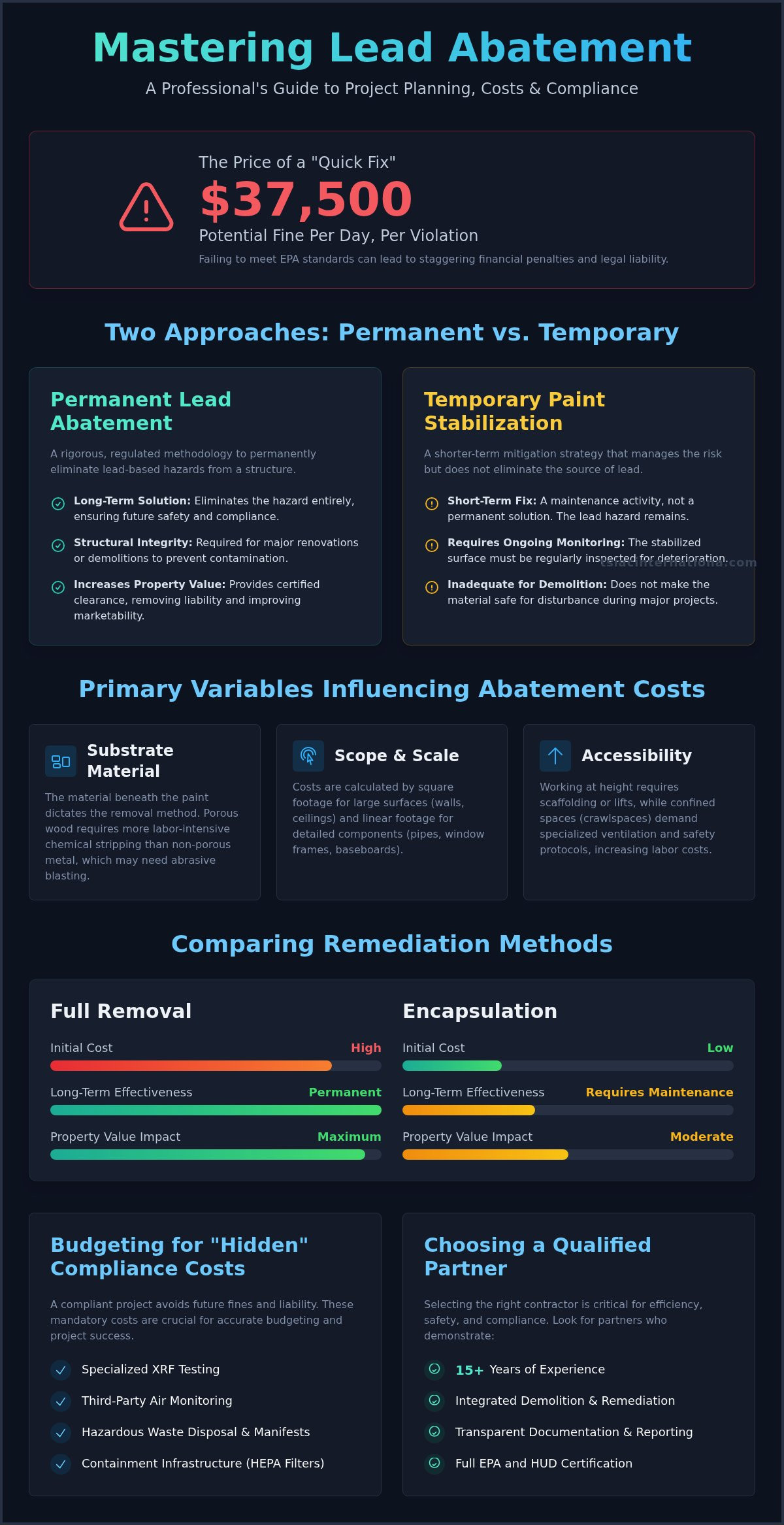
The “Intent Rule” serves as the primary legal differentiator for contractors. If the project’s purpose is to improve, maintain, or remodel a structure, RRP rules apply. If the documented intent is to eliminate lead hazards, the project falls under abatement protocols. Selecting an RRP-certified firm for a project intended as lead removal constitutes a major compliance failure. This mistake can lead to federal fines exceeding $37,500 per day per violation. Professionals must obtain an EPA Lead Abatement Certification to legally conduct these permanent hazard reductions.

When is Abatement Mandatory?

Abatement isn’t always optional. It becomes a legal requirement in several high-stakes scenarios:

  • Court-Ordered Interventions: When a child is identified with an elevated blood lead level (BLL), local health departments often issue orders for immediate, permanent lead removal.
  • HUD-Funded Projects: Most projects receiving over $25,000 in federal assistance for lead hazard reduction must follow strict abatement standards.
  • Structural Removals: If the primary goal of a demolition or component removal is to address a lead hazard, it’s classified as abatement rather than standard construction.

The Scope of Work Comparison

Compliance Management and Liability Mitigation

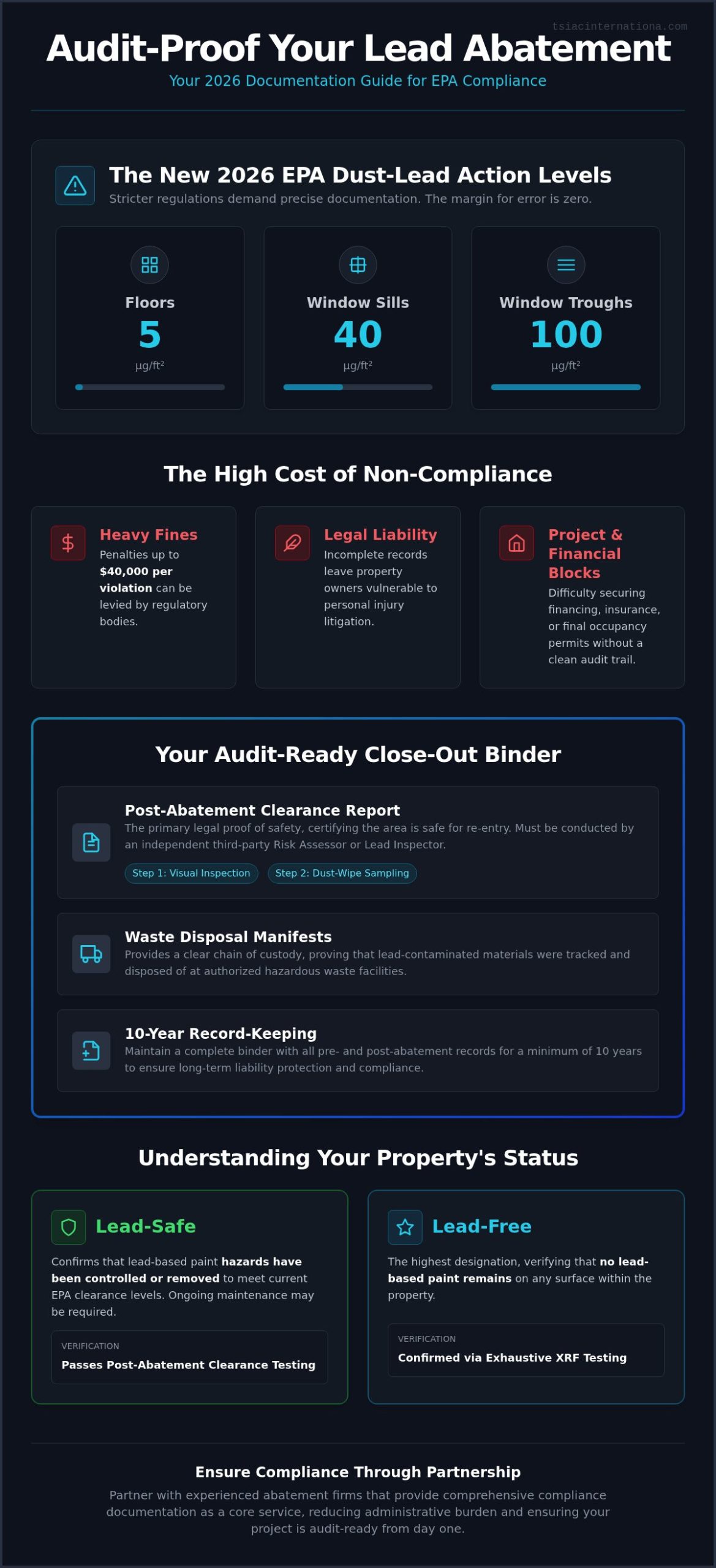
Effective risk management in lead remediation requires more than technical skill; it demands a rigorous administrative protocol. For firms holding a lead abatement certification, the “paper trail” serves as a primary legal shield. Under EPA Title IV of the Toxic Substances Control Act (TSCA), certified firms must maintain detailed records for a minimum of three years. These records include occupant protection plans, onsite lead-safe work practice documentation, and final clearance reports that prove the project adhered to federal standards throughout its lifecycle.

Property owners shouldn’t take a contractor’s word regarding their credentials. Verification is a mandatory due diligence step. The EPA maintains the “Lead-Safe Certified Firms” database, a searchable registry that allows owners to confirm a company’s standing in real-time. This verification process prevents the engagement of expired or fraudulent certificates. Using an unverified contractor can immediately invalidate environmental insurance claims and trigger secondary audits from municipal building departments.

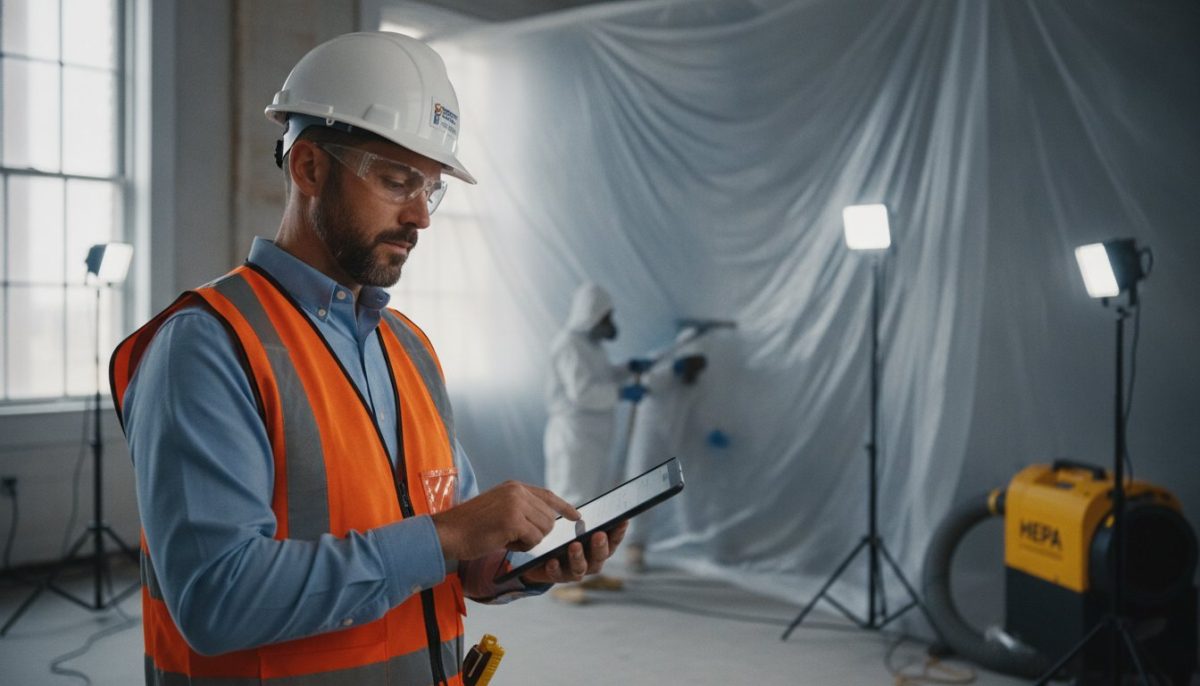
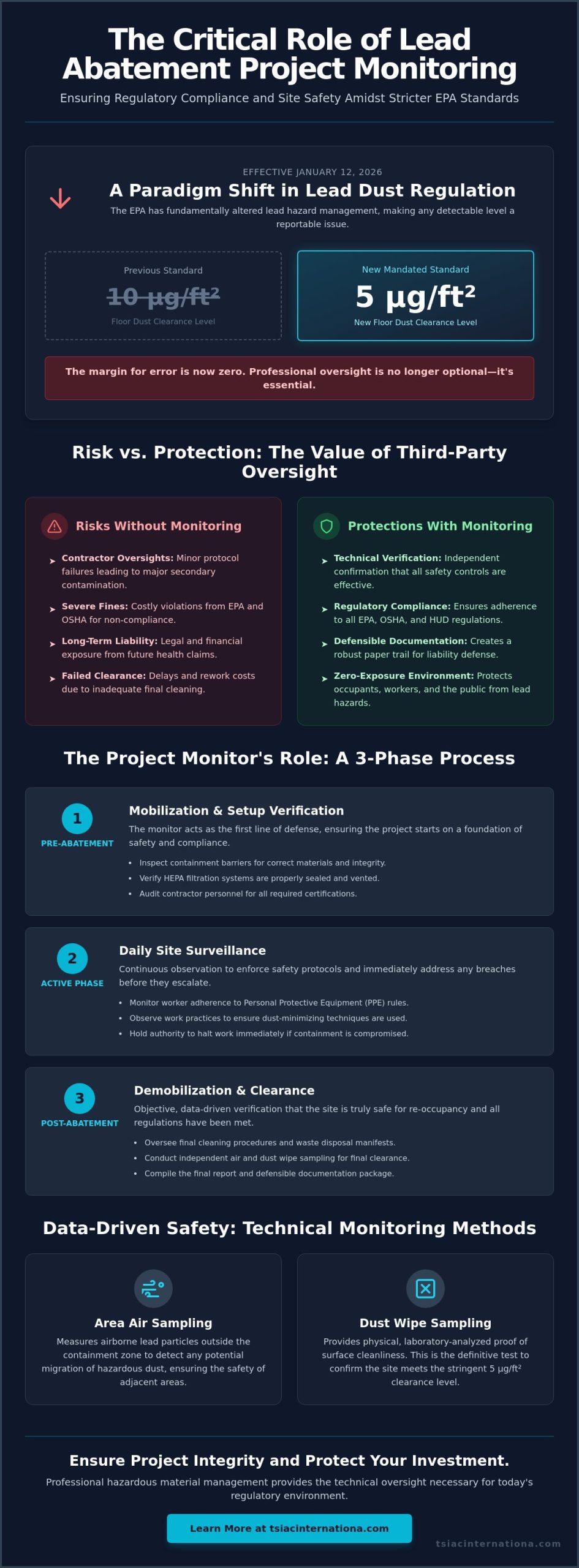
Occupant protection plans act as the primary defense against third-party liability. These documents outline the specific engineering controls, such as HEPA-filtered negative air machines and physical barriers, used to isolate the work area. The process concludes with post-abatement clearance testing. A third-party Lead Inspector or Risk Assessor must perform dust wipe sampling to prove lead levels fall below the 2024 EPA hazard standards, which require levels lower than 10 µg/ft² for floors and 100 µg/ft² for window sills.

Insurance and Bonding for Certified Projects

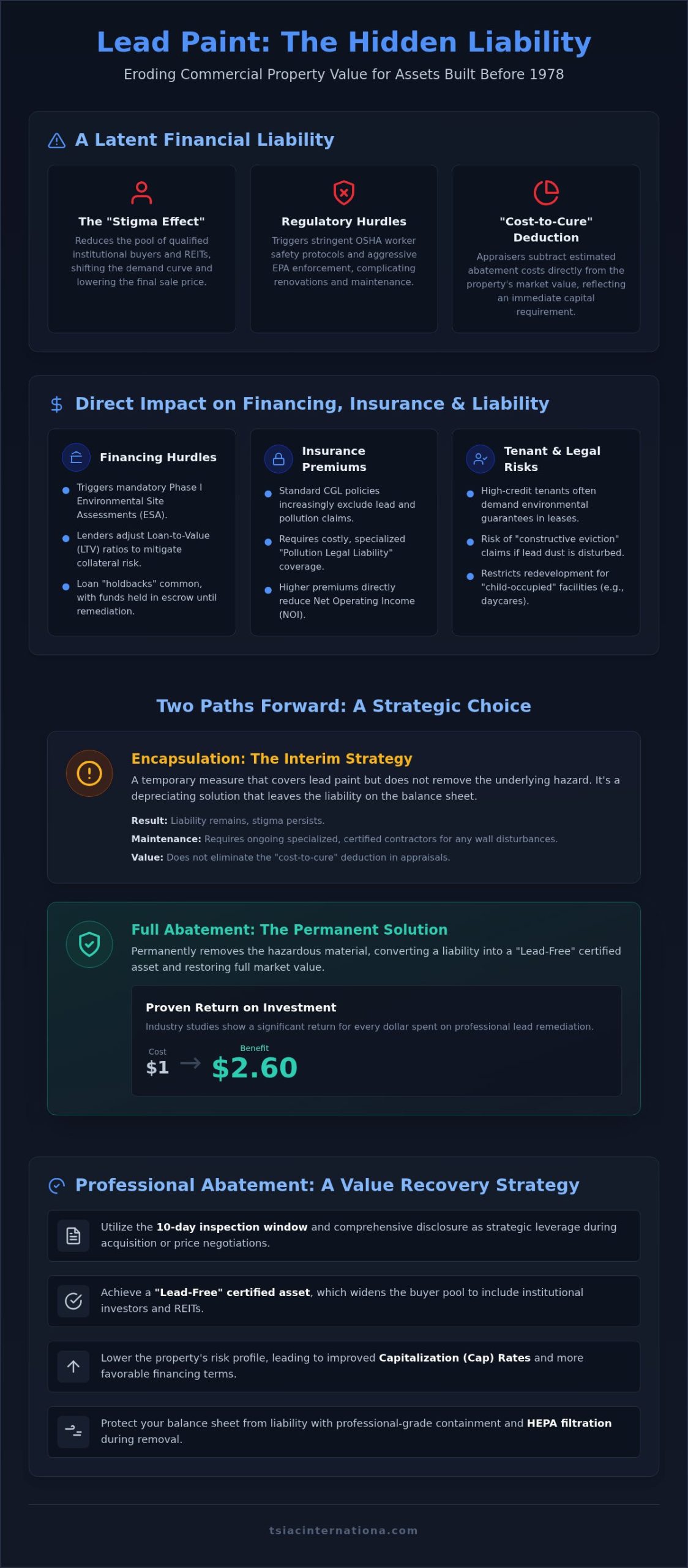
Standard General Liability (GL) policies typically contain a “Total Pollution Exclusion” clause. This means they won’t cover damages related to lead dust or toxic exposure. Certified firms must carry Pollution Legal Liability (PLL) coverage to bridge this gap. Before signing a contract, verify that the firm’s bond specifically covers hazardous material remediation. Without this specific language, the bond is often useless for environmental claims involving lead-based paint activities.

The Risks of Non-Certified Work

The financial penalties for non-compliance are severe. As of early 2024, and continuing into 2026, the EPA has adjusted civil penalties for inflation, reaching upwards of $46,102 per violation, per day. Operating without a valid lead abatement certification doesn’t just invite fines; it endangers the long-term viability of the asset. Lead dust contamination can lead to permanent structural occupancy bans if the site fails to meet safety thresholds during a post-work audit. Property owners are subject to a strict liability standard where they’re held legally responsible for lead-related injuries regardless of their intent or level of direct involvement in the work.

Ensure your project meets every regulatory benchmark by partnering with a team that prioritizes complex industrial safety solutions.

Hiring a Certified Partner for Integrated Projects

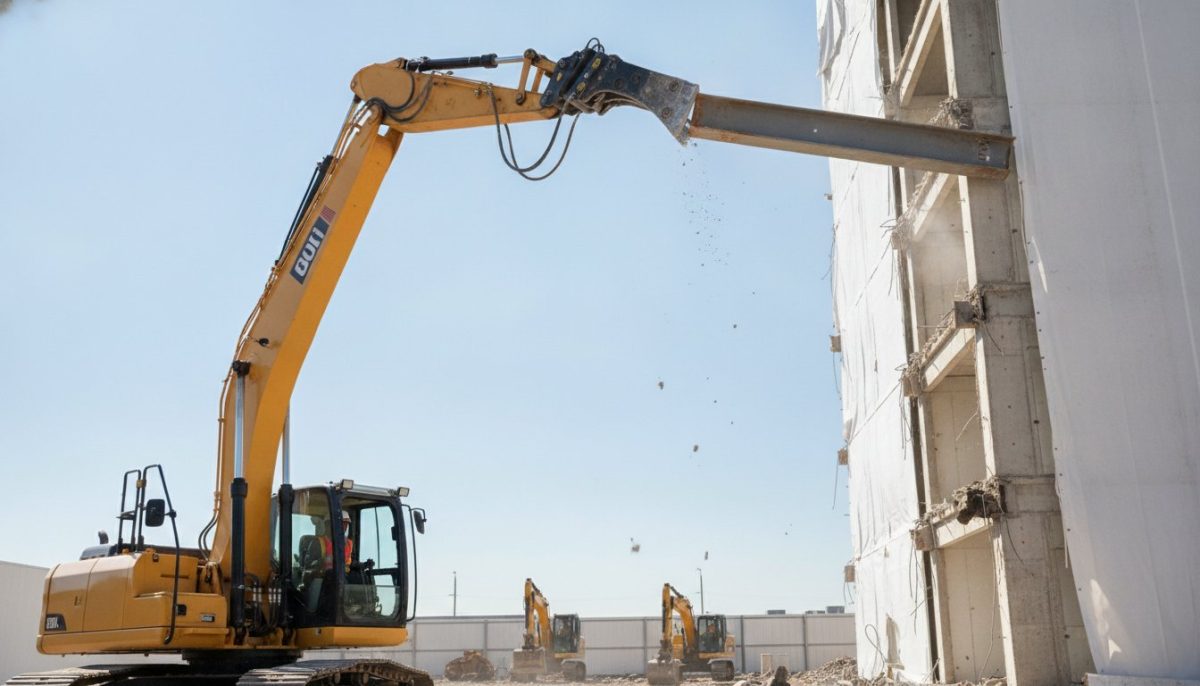
Choosing a single-source contractor for complex redevelopment projects provides a distinct advantage in risk mitigation. When one entity manages both structural demolition and lead removal, the potential for cross-contamination between phases drops significantly. This integrated approach ensures that lead abatement certification standards are maintained throughout the entire project lifecycle, rather than being treated as a disconnected task. Project timelines often shrink by 15% to 20% when a single team handles the specialized permitting and hazardous material logistics simultaneously.

Integrated certification simplifies debris management, which is a critical bottleneck in 2026 industrial projects. A certified partner coordinates the segregation of hazardous waste from recyclable materials right at the source. This precision allows for higher recovery rates of clean steel and masonry, reducing the volume of material sent to specialized landfills. Environmental responsibility isn’t just about compliance; it’s about the technical ability to separate toxins from valuable assets with engineering accuracy.

Vetting Your Hazardous Material Contractor

A reliable contractor must demonstrate more than just a valid license. You need to verify their internal safety protocols and their history of handling projects with similar technical demands. Use this checklist to evaluate potential partners:

  • Confirm the firm holds a current EPA Lead-Safe Certified Firm status and state-specific credentials.
  • Verify individual worker certifications and specialized training for high-reach or confined space operations.
  • Review the Experience Modification Rate (EMR). A score below 1.0 indicates a superior safety record compared to industry averages.
  • Inspect OSHA 300 logs from the last three years to identify patterns in site safety management.

For more localized insights into regional requirements, consult the Hazardous Material Abatement in South Carolina: The 2026 Property Owner’s Guide.

The TSIAC International Approach

TSIAC International operates with a focus on engineering precision and total regulatory transparency. We don’t just clear a site; we manage the complex intersection of structural integrity and chemical safety. Our teams excel in difficult environments, such as high-rise interior gutting and the removal of lead-impacted industrial frameworks where traditional methods fail. We treat every project as a technical challenge that requires a controlled, data-driven solution.

Our methodology ensures that every gram of hazardous material is accounted for, from initial testing to final disposal manifests. We provide clients with the confidence that their liability is managed through rigorous documentation and expert execution. Discover why we are considered TSIAC International: The Gold Standard in Demolition & Abatement by reviewing our history of successful, high-stakes project delivery.

To initiate a certified lead abatement project, start by securing a comprehensive hazardous material survey. Once the scope is defined, contact our technical team to discuss an integrated demolition and abatement strategy tailored to your facility’s specific structural requirements.

Securing Industrial Integrity Under 2026 Lead Standards

Navigating the 2026 regulatory landscape requires more than just basic awareness; it demands a technical mastery of the five core disciplines. Understanding the legal boundary between simple RRP work and full-scale abatement protects your organization from the liability risks inherent in hazardous material handling. A valid lead abatement certification isn’t just a permit. It’s a verified commitment to public safety and structural integrity that shields your assets from litigation and ensures every phase of the project meets strict engineering requirements.

TSIAC International brings over 15 years of hazardous material remediation experience to every project site. We operate as a fully licensed and insured partner specifically equipped for large-scale commercial abatement where technical precision is non-negotiable. Our team implements comprehensive environmental recycling protocols on every site to ensure 100% compliance with evolving EPA and state mandates. We specialize in complex environments where standard solutions often fail, providing the engineering-grade accuracy your infrastructure requires to remain safe and functional.

Secure your project’s safety today. Contact TSIAC International for a Certified Abatement Quote and ensure your facility meets the highest industrial standards. We look forward to solving your most difficult environmental challenges with the precision your business deserves.

Frequently Asked Questions

How long does a lead abatement certification last before it expires?

Lead abatement certification remains valid for 3 years under federal EPA regulations. You must complete a 1-day refresher training course before this 36-month window closes to maintain your legal standing. If your credentials lapse, you’re required to retake the full 32-hour initial training program to regain your professional status.

Can a general contractor perform lead abatement if they have an RRP certification?

A general contractor holding only an RRP certificate cannot legally perform lead abatement. RRP protocols cover renovation and painting where lead is disturbed, but abatement involves the permanent elimination of hazards as defined by 40 CFR Part 745. This specialized work requires a specific lead abatement certification and more rigorous engineering controls than standard renovation projects.

What is the difference between lead-safe work and lead abatement?

Lead-safe work focuses on interim controls and dust containment during standard remodeling, while lead abatement involves the permanent removal of lead-based paint hazards. Federal standards require abatement solutions to provide at least a 20-year guarantee of safety through methods like encapsulation or replacement. Lead-safe practices don’t eliminate the source of the lead; they only manage the risk during active construction.

Are there federal grants available to help cover the cost of certified lead abatement?

The U.S. Department of Housing and Urban Development (HUD) manages the Lead Hazard Reduction Grant Program to assist with these expenses. In 2023, HUD allocated 165 million dollars to various state and local agencies to fund lead remediation in low-income residential units. Property owners should contact their municipal housing department to access these specific federal funds for their projects.

What happens if I discover lead-based paint after a project has already started?

You must halt all construction activities immediately to prevent the spread of toxic dust. Federal law requires a certified inspector to test the material if the building was constructed before 1978. If tests confirm lead concentrations at or above 1.0 mg/cm2, you’re legally obligated to hire a team with a lead abatement certification to safely manage the site and protect occupants.

Does every worker on a lead project need to be individually certified?

Every individual performing abatement tasks must hold a personal EPA or state-issued certificate as a worker or supervisor. Unlike RRP projects where one certified person can oversee uncertified laborers, abatement rules require 100% of the on-site team to complete accredited 16-hour or 32-hour training courses. This ensures technical precision and strict adherence to safety protocols across the entire workforce.

How can I verify if my abatement contractor is currently EPA-certified?

You can verify a firm’s credentials using the EPA’s official “Locate Certified Renovation and Abatement Firms” search tool. Always demand to see the contractor’s firm certification and the individual photo ID cards of every worker on the job site. Cross-referencing these documents against the 2024 federal registry ensures your project meets all regulatory requirements and safety standards.

Safe Lead Paint Removal: The 2026 Professional Guide to Abatement

By 2026, an estimated 31 million residential units across the United States still contain hazardous legacy coatings, proving that lead isn’t just a…

By 2026, an estimated 31 million residential units across the United States still contain hazardous legacy coatings, proving that lead isn’t just a historical footnote but a modern structural challenge. For facility managers and property owners, the mandate for safe lead paint removal has shifted from a recommendation to a rigorous technical requirement. You’re likely grappling with the high stakes of lead dust migration and the confusing regulatory gap between standard RRP protocols and permanent abatement. It’s a complex environment where one oversight can lead to significant health liabilities or EPA enforcement actions.

This guide delivers the engineering precision and technical protocols required to master lead-based paint elimination in both commercial and residential sectors. We’ve compiled the latest 2026 safety standards to help you secure a lead-free environment while maintaining the structural integrity of your assets. You’ll gain a clear roadmap covering advanced site containment, chemical versus mechanical stripping methods, and the final clearance testing necessary for full regulatory compliance. We’ll move beyond the basics to ensure your project meets the highest industrial benchmarks for safety and efficiency.

Key Takeaways

  • Identify structural hazards in pre-1978 buildings by recognizing physical signs like “alligatoring” and understanding the specific risks of microscopic lead dust.
  • Learn how to establish a “Critical Barrier” containment zone using 6-mil poly sheeting to prevent the spread of hazardous particles during the abatement process.
  • Master the technical protocols for safe lead paint removal through professional wet scraping and sanding techniques that minimize environmental contamination.
  • Discover why standard shop vacuums fail and how industrial HEPA-filtered ventilation systems bridge the “containment gap” that DIY methods cannot address.
  • Implement the rigorous “HEPA-Sandwich” cleaning method and follow strict hazardous waste disposal standards to ensure a site meets professional clearance verification.

Understanding Lead-Based Paint Risks and Regulatory Standards

Lead-based paint is a systemic structural hazard present in approximately 34 million housing units built before the 1978 federal ban. While intact paint layers pose minimal immediate risk, the hazard becomes active during any process involving safe lead paint removal or structural modification. The primary danger lies in the science of lead dust. Microscopic particles, often smaller than 10 microns, are light enough to remain airborne for extended periods and small enough to bypass standard respiratory filtration. These particles settle into carpets, ductwork, and porous surfaces, creating a long-term toxic legacy that standard industrial cleaning cannot easily remediate.

Regulatory oversight is tightening to address these persistent risks. The EPA Renovation, Repair, and Painting (RRP) Rule sets the standard for any work that disturbs lead-based paint in “target housing” or child-occupied facilities. Looking toward 2026, the EPA is expected to implement even more stringent dust-settled clearance levels to match updated health data. It’s vital to distinguish between lead renovation, which manages lead during general construction, and professional abatement. While renovation is a temporary measure, specialized lead abatement techniques are designed to permanently eliminate lead hazards for a minimum of 20 years through removal, encapsulation, or enclosure.

The Health Implications of Improper Removal

Lead exposure causes irreversible neurological damage that compromises the central nervous system. In children, even low-level exposure leads to permanent IQ loss and behavioral disorders. Adults aren’t immune; they often experience chronic hypertension and significant renal impairment following prolonged exposure. Using dry sanding, power grinding without HEPA attachments, or heat guns operating above 1,100°F is hazardous because these methods aerosolize heavy metals into a breathable vapor. Lead-based paint poisoning is a preventable environmental hazard.

Legal Liability for Property Managers and Contractors

Liability in the industrial and residential sectors is absolute. Federal mandates require all firms performing safe lead paint removal to be EPA-certified and to follow rigorous work-practice standards. Documentation is the cornerstone of legal protection; contractors must maintain detailed records of on-site inspections, occupant notifications, and post-work cleaning verifications for at least three years. The financial consequences of negligence are severe. The EPA currently issues civil penalties that can exceed $46,000 per violation, per day. Beyond government fines, property managers face massive litigation risks if a failure in containment leads to environmental contamination or documented health issues among tenants.

Identifying and Testing for Lead Hazards

Precise identification is the cornerstone of safe lead paint removal. Professionals focus on high-risk architectural elements where lead-based coatings were historically prevalent. These include window sashes, door frames, and exterior trim components. You can often spot lead degradation by “alligatoring,” a specific pattern of rectangular cracking that resembles reptile skin. While these visual cues are helpful, they’re only the first step in a technical assessment.

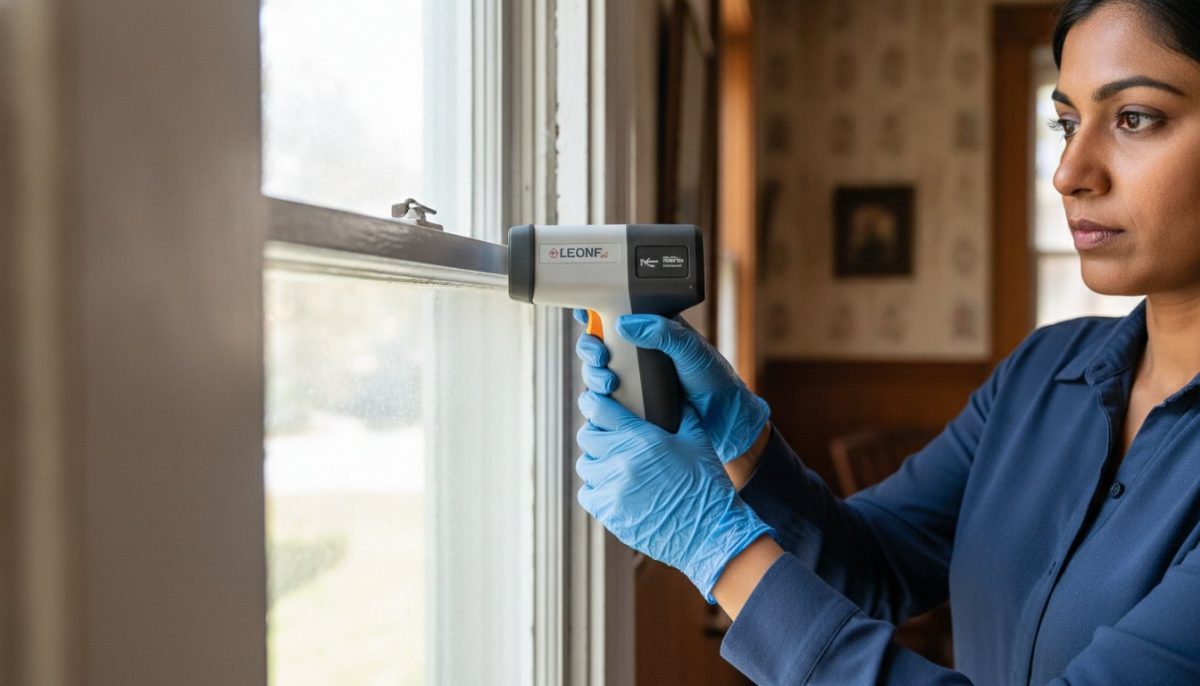
Relying solely on visual inspection is a liability. Modern industrial standards require non-destructive testing using X-Ray Fluorescence (XRF) technology. XRF analyzers provide immediate, accurate readings of lead concentration in milligrams per square centimeter without damaging the substrate. This data ensures compliance with EPA lead-safe work practices, which dictate the necessary safety protocols based on lead levels. Without this empirical data, the risk of accidental exposure during demolition increases by over 40 percent.

Professional Inspection vs. Home Test Kits

DIY chemical swab kits often yield false negatives, especially on surfaces with multiple layers of over-painting. A certified Risk Assessor provides a deeper level of scrutiny by identifying microscopic lead-contaminated dust that swabs miss. We develop a comprehensive lead hazard map before any site mobilization. This map tracks every contaminated surface, allowing for a surgical approach to removal rather than a broad, high-risk demolition strategy.

Pre-Removals Environmental Baselines

Establishing environmental baselines is a non-negotiable step for professional contractors. We collect soil samples and interior dust wipes to document lead levels before work begins. This protects property owners from liability and ensures the cleanup is effective. Specific attention is paid to “friction surfaces,” such as window tracks and door headers, where mechanical movement grinds paint into fine, inhalable dust. Effective safe lead paint removal must be integrated into a wider hazardous material abatement strategy to manage all site risks simultaneously. If your project involves complex structural elements or high-altitude surfaces, consulting with a specialized technical partner ensures the highest safety standards are met.

Safe Lead Paint Removal: The 2026 Professional Guide to Abatement

Professional Abatement vs. DIY: Evaluating the Risks

Homeowners often underestimate the technical precision required for safe lead paint removal. While a DIY approach might seem cost-effective, it frequently creates a “containment gap.” Standard 6-mil plastic sheeting often fails because DIYers don’t establish negative air pressure zones. Without this pressure differential, microscopic lead particles migrate through HVAC vents and door gaps, settling in carpets and upholstery. Professional teams utilize industrial HEPA-filtered ventilation systems that capture 99.97% of particles as small as 0.3 microns. Standard shop vacuums lack these specialized seals; they essentially act as lead dust distributors, blowing toxic particles back into the room through the exhaust.

Labor expertise is another critical factor in project success. Certified professionals undergo rigorous training on lead-safe work practices to ensure every phase of the project meets HUD lead paint safety standards. This technical knowledge protects long-term property value. A certified lead-free status can increase a property’s marketability by 5% to 10% in older urban markets where buyers prioritize health safety. Conversely, a botched DIY attempt that results in soil or structural contamination can lead to massive remediation costs and legal liabilities during a sale.

The Dangers of Traditional Paint Removal Methods

Traditional methods like power sanding without HEPA shrouds are strictly prohibited. These tools create clouds of inhalable dust that remain airborne for hours. High-temperature heat guns exceeding 1,100 degrees Fahrenheit are equally dangerous because they vaporize lead, creating toxic fumes that bypass standard respirators. Open-flame burning is the most hazardous technique; it poses a direct fire risk and can permanently contaminate structural substrates, making future remediation nearly impossible. Professionals use chemical strippers or low-heat infrared technology to avoid these toxic thresholds.

Why Commercial Projects Demand Professional Oversight

Commercial environments require scaling safety protocols to protect hundreds of occupants simultaneously. Managing commercial interior gutting involves more than just demolition; it requires precise hazardous material management integrated into the structural timeline. In multi-tenant buildings, a single error in containment can lead to health risks for neighboring businesses. Professional oversight ensures safe lead paint removal while maintaining structural integrity, especially when stripping historical building components where the substrate is fragile and irreplaceable. Expert contractors provide the engineering precision needed to handle these “impossible” sites where standard methods fail.

Industry-Standard Methods for Safe Lead Removal

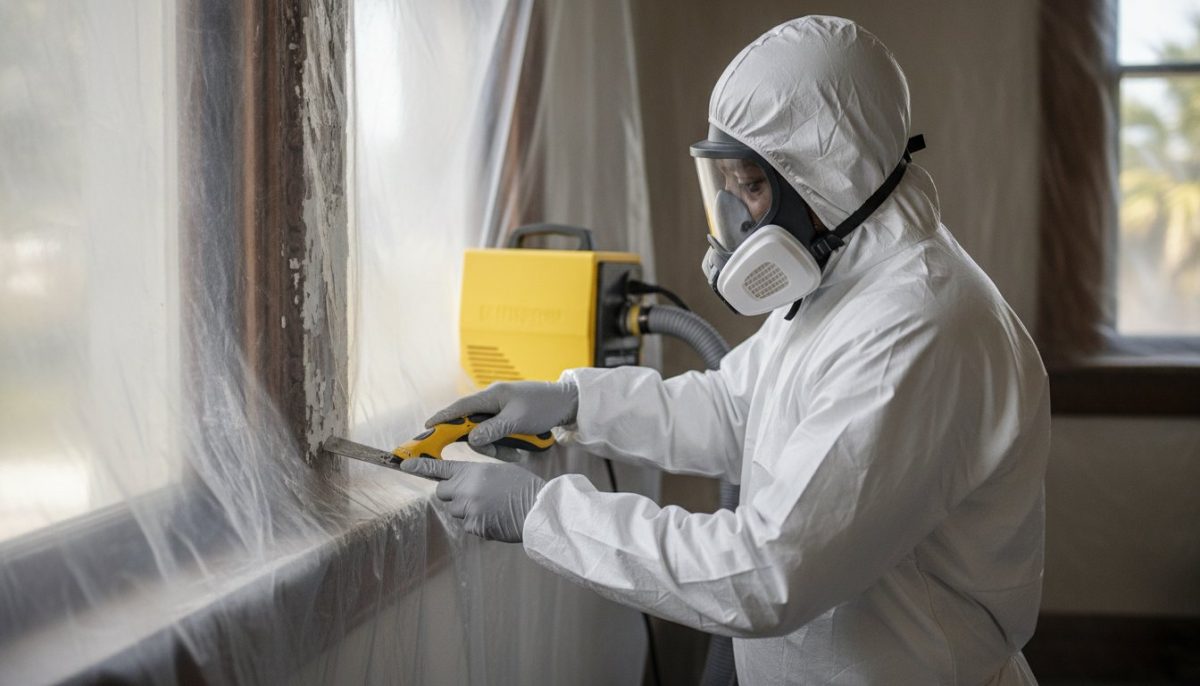
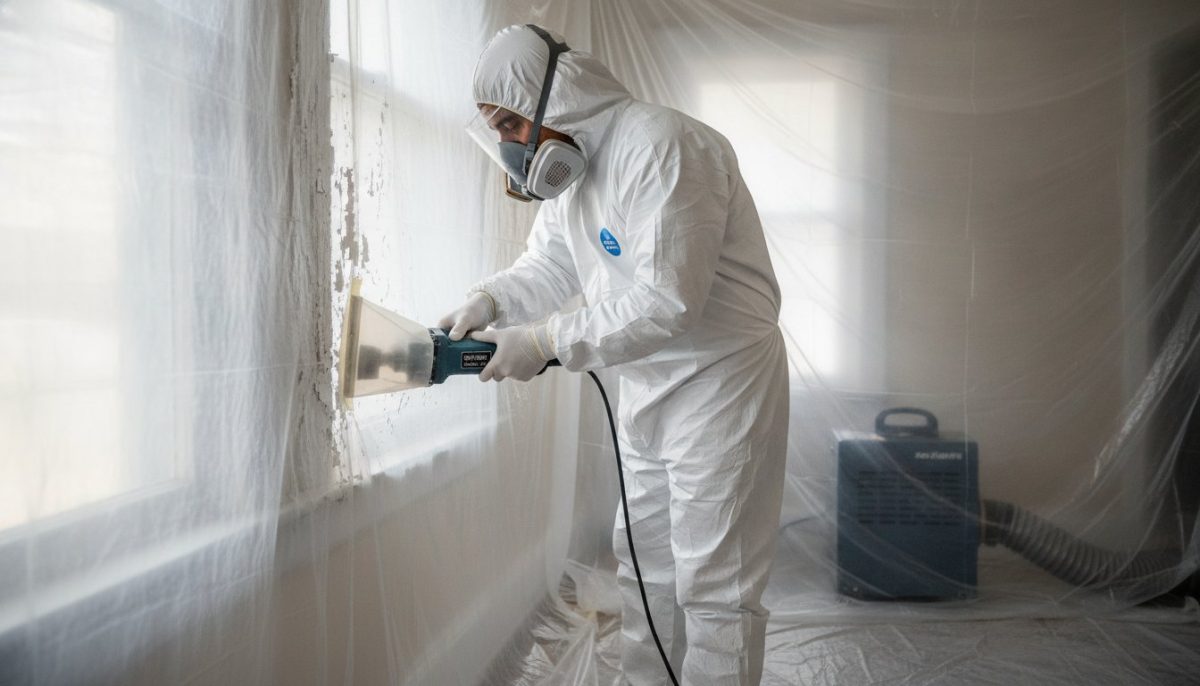
Achieving safe lead paint removal starts with a rigid “Critical Barrier” containment zone. Technicians seal all HVAC vents, windows, and doors with 6-mil polyethylene sheeting. This isn’t just a suggestion; it’s a technical requirement to prevent lead dust from migrating into non-work areas. We prioritize wet scraping and wet sanding over dry methods. Keeping surfaces damp reduces airborne lead concentrations by roughly 90%, ensuring the environment stays within OSHA’s permissible exposure limits. This moisture-rich approach traps particles before they become respirable, protecting both the workers and the facility’s future occupants.

We choose chemical stripping agents based on the specific substrate. Caustic agents effectively dissolve thick layers on masonry but require careful neutralization to prevent surface degradation. For delicate surfaces, solvent-based or bio-based strippers offer a safer alternative without compromising the underlying material. If removal poses a structural risk or is cost-prohibitive, we utilize encapsulation or enclosure. These methods use specialized polymers or physical barriers to isolate lead, providing a long-term solution without the high-impact disruption of full stripping.

The Negative Air Pressure Protocol

The Negative Air Pressure Protocol relies on HEPA air scrubbers to create a constant vacuum effect within the containment. We don’t just turn the machines on and hope for the best. We use digital manometers to monitor the containment 24/7. A consistent reading of -0.02 inches of water column pressure is our benchmark. This pressure differential ensures that air always moves from clean areas into the work zone, never the other way. It’s the most reliable way to prevent cross-contamination in adjacent rooms or common areas.

Substrate-Specific Removal Strategies

Substrate-specific strategies are essential for safe lead paint removal on industrial sites. Porous materials like brick require needle guns or vacuum-shrouded grinders to pull lead from the deep grain of the masonry. On structural steel, we focus on removing the lead while preparing the surface for new protective coatings. This level of detail is critical during selective demolition processes where we must strip lead from specific joints or beams before cutting occurs. We don’t leave safety to chance when dealing with heavy metal contaminants.

If your facility requires high-level abatement and technical precision, contact our specialists for a professional consultation.

Post-Removal Cleanup and Clearance Verification

Successful safe lead paint removal requires a rigorous decontamination phase that goes beyond standard construction cleaning. The industry standard remains the “HEPA-Sandwich” protocol. This three-stage process involves a thorough HEPA vacuuming of all surfaces, followed by a wet-wipe down using a lead-specific detergent, and a final HEPA vacuuming once surfaces are dry. This sequence prevents microscopic dust from becoming airborne or settling back into porous materials after the primary abatement is finished. Professionals don’t just clear the visible debris; they eliminate the invisible particulates that pose the greatest health risks.

Decontamination and Waste Management

Workers must undergo a strict decontamination sequence before leaving the containment area. This includes removing disposable suits and respirators in a designated “dirty room” to prevent cross-contamination of clean zones. All lead-contaminated debris, including used PPE and plastic sheeting, is classified as hazardous material. To meet safety standards, all waste must be double-bagged in 6-mil polyethylene bags that are goose-neck sealed and clearly labeled for transport to a licensed hazardous waste landfill. This 6-mil thickness is mandatory because it provides the puncture resistance necessary to contain toxic particulates during transit and disposal.

Clearance testing is the final gatekeeper of a project’s success. Once cleaning is complete, a third-party environmental professional must conduct a formal evaluation. This isn’t a visual inspection alone. Technicians collect dust wipe samples from floors, windowsills, and window troughs, which are then sent to a laboratory for analysis. In 2021, the EPA tightened dust-lead clearance levels to 10 micrograms per square foot (µg/ft²) for floors and 100 µg/ft² for windowsills. A final report and a lead-safe certificate are issued only after lab results confirm the site meets these stringent safety thresholds.

Ensuring Long-Term Safety and Maintenance

If lead was encapsulated rather than fully removed, property owners must implement a recurring monitoring schedule. Check these surfaces every 6 to 12 months for signs of peeling, cracking, or impact damage. Integrating these inspections into regular building maintenance plans prevents future exposure risks. For complex projects requiring high-level technical precision and safe lead paint removal, partnering with TSIAC International for certified abatement oversight ensures that every stage of the process meets federal compliance. This methodical approach guarantees that a building remains a safe environment for its occupants long after the contractors have left the site.

Securing Your Property’s Future with 2026 Safety Standards

Ensuring lead safety requires a technical approach that prioritizes long-term structural integrity and occupant health. By 2026, regulatory standards for safe lead paint removal have shifted toward more rigorous containment and verification protocols. You’ve learned that superficial testing isn’t enough. True safety depends on identifying hazards through XRF technology and executing abatement through specialized mechanical or chemical methods. Industry data shows that professional intervention eliminates the high contamination risks associated with improper DIY attempts. These specialized processes are vital for maintaining compliance with current EPA regulations and protecting your investment.

TSIAC International brings over 15 years of hazardous material expertise to every project. As an EPA Lead-Safe Certified Firm, we implement comprehensive environmental containment protocols that exceed standard safety requirements. We don’t just clear the surface; we ensure your environment meets every legal and health benchmark established for 2026. Our team handles the complex logistics so you can focus on your property’s long-term value. Don’t leave your safety to chance. Contact TSIAC International for a Professional Lead Abatement Consultation and secure a lead-free environment today. Your commitment to proper abatement ensures a safer space for everyone involved.

Frequently Asked Questions

Is it ever safe to remove lead paint myself?

No, it’s generally unsafe and often illegal for non-certified individuals to perform lead abatement. EPA RRP regulations mandate professional certification for any project disturbing more than 6 square feet of interior lead-based paint. Attempting safe lead paint removal without industrial-grade HEPA filtration and negative pressure systems often leads to 100% contamination of the building’s HVAC system.

How much does professional lead paint removal typically cost?

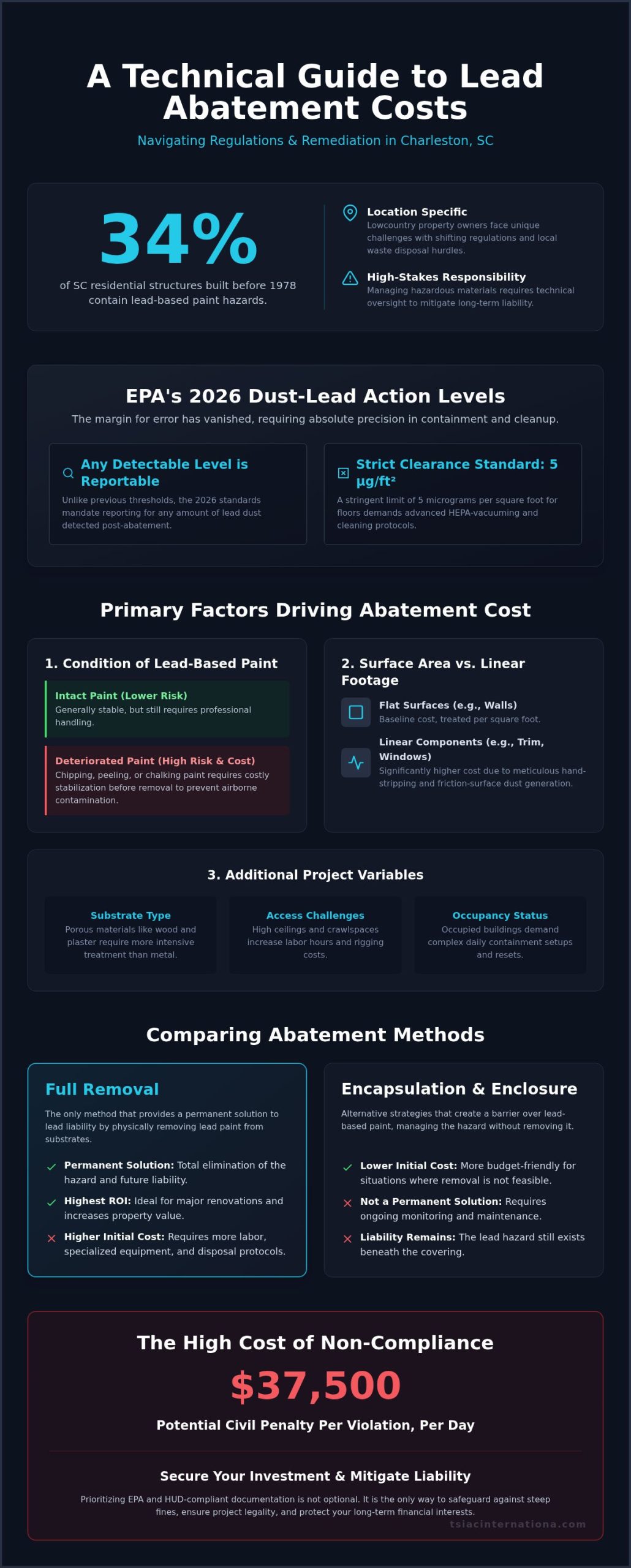
National industry data indicates that professional abatement costs range between $8 and $15 per square foot. For a standard 1,500 square foot residential structure, the total expense often reaches $12,000 to $22,000. These figures fluctuate based on the chosen methodology, such as chemical stripping or mechanical abrasion; they also depend on the necessity for specialized containment structures.

What is the difference between lead encapsulation and lead removal?

Lead encapsulation seals the hazard behind a specialized polymer coating, while removal physically eliminates the lead-based material from the substrate. Encapsulants are specific products that must meet ASTM E1795 standards to guarantee a 20-year lifespan. Removal remains the only permanent solution for long-term structural integrity; it eliminates future liability during property transfers or commercial audits.

How long does the lead abatement process take for a standard property?

A standard 2,000 square foot property requires approximately 10 to 15 business days for complete abatement. This timeline includes the initial 24-hour setup of containment barriers and the final 48-hour period for dust clearance testing. Complex industrial sites or high-rise structures often require additional time for specialized access equipment and multi-stage decontamination zones.

Can I stay in my home or building during lead paint removal?

Occupants shouldn’t remain in the building while active abatement is underway. EPA guidelines require residents to stay out of the work zone until a third-party inspector confirms lead-dust levels are below 10 micrograms per square foot. In 95% of professional projects, this necessitates a temporary relocation of 5 to 10 days to ensure zero exposure to toxic particulates.

What happens if lead paint is found during a commercial demolition project?

Discovery of lead paint during demolition triggers an immediate work stoppage under OSHA Standard 1926.62. The project manager must implement a written compliance program and conduct air monitoring to protect workers. Failure to follow these 1993 federal regulations can result in fines exceeding $15,000 per violation and significant project delays.

Are there specific grants or tax credits for lead abatement in 2026?

The HUD Lead Hazard Reduction Grant Program continues to provide funding, with $403 million distributed to local jurisdictions in the most recent fiscal cycle. For 2026, many states offer a $1,500 to $3,000 tax credit per unit for owners who achieve lead-free certification. You’ll need to verify specific local programs through your municipal housing department’s 2026 budget documents.

What are the disposal requirements for lead-contaminated debris?

Lead-contaminated debris must be disposed of according to RCRA Subtitle C requirements if it fails a TCLP test. Contractors must seal all waste in 6-mil polyethylene bags and transport it to a licensed hazardous waste facility. This process ensures that safe lead paint removal doesn’t result in groundwater contamination or long-term environmental damage at the landfill site.

Professional Lead Paint Removal Service: The Complete Guide to Safe Abatement

Did you know that 24 million housing units across the United States still contain significant lead-based paint hazards according to the latest CDC…

Did you know that 24 million housing units across the United States still contain significant lead-based paint hazards according to the latest CDC reports? It’s a sobering reality for property owners who recognize that lead exposure isn’t just a regulatory hurdle but a genuine threat to neurological health. You’re likely concerned about the safety of your family or tenants, and you’ve probably felt overwhelmed by the conflicting information surrounding EPA Lead-Safe Certification versus full structural abatement. We understand that managing a high-stakes renovation requires more than just a quick fix; it demands engineering precision and a transparent approach to hazardous material handling.

In this guide, you’ll learn exactly what to expect from a professional lead paint removal service, from the initial XRF testing to the final clearance report. We’ll demystify the 2010 EPA RRP Rule and explain how to avoid the hidden costs often associated with 40 CFR Part 745 waste disposal requirements. Our technical breakdown ensures you can achieve a lead-free environment without derailing your construction schedule. We’ll examine the specific equipment used in HEPA-filtered vacuum systems and the chemical stripping agents that keep your site compliant and safe.

Key Takeaways

  • Understand the critical differences between temporary lead management and permanent abatement to ensure long-term structural safety and regulatory compliance.
  • Discover the advanced engineering behind safe containment, including the use of negative air machines and wet-scrape techniques to neutralize toxic airborne dust.
  • Evaluate the long-term ROI of full lead extraction versus encapsulation to maximize property value and achieve a certified lead-free status.
  • Learn how a professional lead paint removal service executes a rigorous multi-stage process, from initial site assessment to secure hazardous waste disposal.
  • Identify why complex structural demolition and hazardous material remediation require a partner capable of managing the most challenging technical environments with engineering precision.

Understanding Lead Paint Removal Service vs. Abatement

A professional lead paint removal service involves the technical extraction of toxic lead-based pigments from structural substrates. It isn’t a simple cosmetic upgrade; it’s a critical environmental remediation process. Prior to the federal ban in 1978, lead was added to paint to increase durability and speed up drying times. In Charleston, where a large percentage of the housing stock predates this regulation, property owners must assume that any building older than 45 years contains hazardous materials until a certified inspection proves otherwise.

Property managers must distinguish between permanent abatement and interim controls. Abatement involves strategies designed to eliminate lead hazards for a minimum of 20 years. This includes specific lead abatement methods like component replacement, enclosure behind specialized barriers, or complete mechanical removal. Interim controls are temporary management techniques. They include specialized cleaning and localized repairs that require periodic re-evaluation to ensure the lead remains contained. Choosing the right path depends on the long-term goals for the structure and the current state of the coatings.

The danger of lead paint is highest when it’s disturbed. Sanding, grinding, or heat-gunning lead surfaces without industrial-grade containment releases microscopic dust into the environment. This dust is easily inhaled or ingested. It’s far more hazardous to perform an amateur removal than to leave intact lead paint alone. Professionals use HEPA-filtered vacuum systems that capture 99.97% of particles as small as 0.3 microns, preventing the cross-contamination of living spaces during a lead paint removal service.

The Legal Landscape: EPA RRP Rule

The EPA Renovation, Repair, and Painting (RRP) Rule, which took full effect on April 22, 2010, dictates how contractors must handle lead-based paint. There’s a sharp legal distinction between an RRP-certified renovator and a licensed abatement professional. RRP certification allows a contractor to perform work that might disturb lead while following lead-safe practices. Abatement professionals are specifically licensed to permanently remove the hazard. Property owners who hire uncertified labor risk federal fines that can exceed $40,000 per day, per violation, depending on the severity of the non-compliance.

Visual Signs of Lead Paint Failure

Identifying failing lead paint requires looking for “alligatoring,” which is a distinct pattern of deep, square-shaped cracking that looks like reptile skin. This occurs because lead-based coatings lose their elasticity over decades. You should also inspect friction zones; these are areas like window tracks and door headers where surfaces rub together. This friction creates fine, toxic dust even if the paint appears to be in good condition. Lead is often buried. A wall might have ten layers of safe latex paint, but the original lead layer from 1965 remains hazardous if the surface is punctured or sanded during a remodel. Utilizing a professional lead paint removal service is the only way to ensure these hidden layers are managed safely.

The Technical Science of Safe Lead Abatement

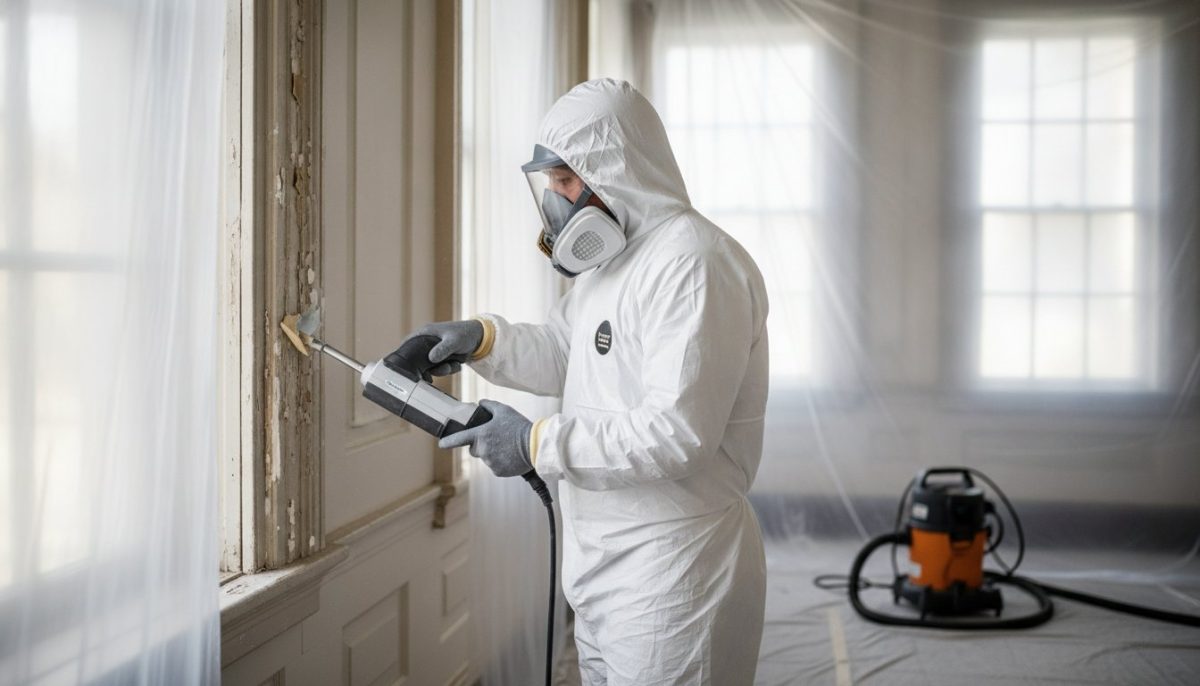
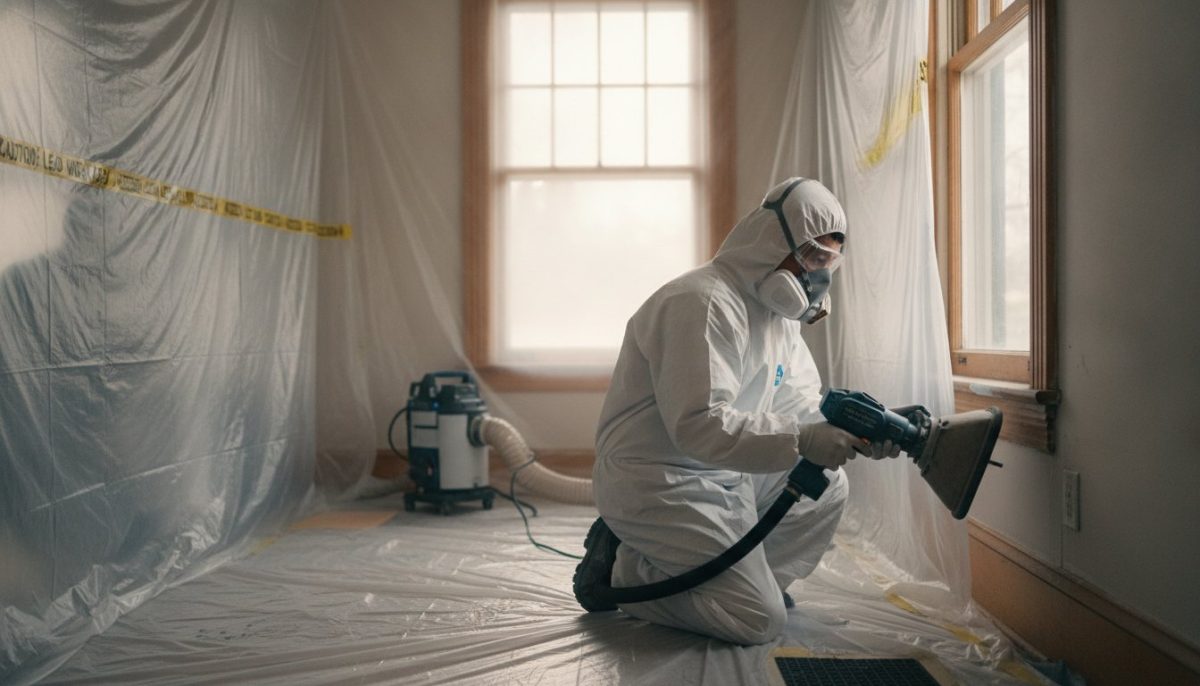
Professional lead abatement requires more than basic construction skills; it demands a rigorous engineering approach to particle physics and airflow management. When a lead paint removal service operates in Charleston, the primary objective is the total immobilization of lead-contaminated dust. This process begins with containment engineering. Technicians install 6-mil polyethylene plastic sheeting to seal all openings, including windows, doors, and HVAC vents. We use reinforced tape to ensure these seals withstand the pressure changes caused by negative air machines. These machines pull air through HEPA filters, creating a vacuum that prevents microscopic particles from escaping the work zone into clean areas of the property.

Methods of removal are selected based on the substrate and the thickness of the paint layers. Wet scraping and wet sanding are the industry standards for minimizing dust. By applying a fine mist of water to the surface before agitation, we increase the mass of the paint chips and dust, causing them to fall directly onto the plastic sheeting rather than becoming airborne. This technical precision is vital because lead dust particles as small as 0.3 microns can remain suspended in the air for days, posing a severe inhalation risk to occupants.

Standard shop-vacuums are strictly prohibited and dangerous for this work. They lack the filtration necessary to trap lead dust and often exhaust fine particles back into the room, effectively turning a localized problem into a building-wide contamination. True HEPA vacuums are required, featuring filters certified to capture 99.97% of all particles sized 0.3 microns or larger. Chemical stripping offers an alternative for intricate historic moldings found in Charleston. We utilize caustic pastes for heavy accumulations, though these require a subsequent neutralizing wash to stabilize the pH of the wood. Solvent-based strippers are reserved for specific finishes, provided the work area maintains high-volume air exchange. Adhering to EPA’s Lead Regulations ensures that every technical choice meets federal safety mandates and protects the long-term value of the structure.

Specialized Equipment for Hazardous Removal

Precision in lead abatement relies on high-tier hardware. Negative pressure environments are maintained using industrial air scrubbers that cycle the room’s air volume at least six times per hour. Workers must wear N100 or P100 respirators and disposable Tyvek suits to prevent cross-contamination. On-site detection has evolved with XRF (X-ray fluorescence) technology. These handheld analyzers provide instant, non-destructive readings of lead concentrations in milligrams per square centimeter, allowing our team to identify specific hazards without waiting for laboratory results.

Clearance Testing and Verification

The final phase of any technical lead paint removal service involves rigorous verification. We employ third-party industrial hygienists to conduct independent dust wipe sampling. This ensures there is no conflict of interest during the safety certification. Current standards are becoming increasingly strict; the 2026 EPA clearance levels require floor lead-dust levels to be below 10 micrograms per square foot. Visual inspections are conducted under high-intensity lighting to ensure no microscopic debris remains on any surface. Only after these laboratory results confirm a “lead-safe” status is the containment disassembled and the site returned to the owner.

Abatement vs. Encapsulation: Which is Right for You?

Selecting a professional lead paint removal service requires a technical evaluation of the building’s substrate and your long-term financial goals. Encapsulation is a management strategy that uses specialized “lead-lock” coatings. These aren’t standard paints; they are elastomeric polymers designed to bond with lead-based layers and prevent the release of toxic dust. While encapsulation costs roughly 30% to 50% less than full removal, it’s a temporary fix. Property owners must conduct visual inspections every 12 months to ensure the membrane hasn’t cracked or peeled. If the underlying surface is damp or decaying, encapsulation will fail within 2 to 3 years.

Full abatement provides a permanent solution by stripping the lead or replacing the contaminated components entirely. This path offers a superior return on investment. In the Charleston real estate market, properties certified as “lead-free” see a 5% to 8% increase in valuation compared to those merely labeled “lead-safe.” Removing the hazard eliminates the need for recurring inspections and removes the risk of future toxic torts. From a technical standpoint, full removal allows for a thorough assessment of the structural integrity of the wood or steel that lead paint often hides.

The DIY trap is a significant risk for Charleston residents. Retail lead test kits, often priced under $15, have a documented failure rate of up to 60% on certain types of industrial primers. These kits frequently yield false negatives on red or orange lead-based pigments. Relying on a faulty test leads to homeowners dry-sanding surfaces, which aerosolizes lead dust and contaminates the entire HVAC system. Professional teams use X-ray fluorescence (XRF) analyzers that provide 99% accuracy without damaging the historic finish.

Commercial vs. Residential Lead Strategies

Commercial projects often involve heavy-duty lead-coated steel and industrial infrastructure. These sites require strict adherence to OSHA lead exposure standards to protect workers during abrasive blasting or torch cutting. Residential historic preservation focuses on a different set of priorities. We prioritize architectural integrity, using low-temperature heat plates and chemical peel pastes to lift lead layers from 150-year-old moldings. For multi-family housing, federal law mandates specific tenant protections; failing to meet these can result in civil penalties exceeding $16,000 per violation.

Managing the #1 Objection: Cost

The upfront price of a lead paint removal service is often the primary concern for property managers. However, the landscape of liability is shifting. By 2026, new federal grant programs are expected to allocate $340 million for lead hazard reduction in historic districts. These credits can often offset 40% of the total project cost. We also find that a “demolition-first” approach is frequently more cost-effective for major renovations. Instead of stripping paint from old windows or doors, replacing the entire unit with modern, energy-efficient alternatives eliminates the lead hazard and reduces labor hours by 25%. This strategy prevents future medical liabilities and ensures the building meets modern safety codes immediately.

The Lead Abatement Process: From Testing to Disposal

The technical execution of a lead abatement project requires more than just labor; it demands an engineered approach to site safety. We begin every project with a rigorous site assessment to identify every surface containing lead-based pigments. In Charleston’s historic properties, this often involves testing multiple layers of paint applied over the last 150 years. We use XRF (X-ray fluorescence) technology to map lead concentrations without damaging the underlying substrate. This data allows us to create a surgical removal plan that minimizes dust and protects the building’s structural integrity.

Containment is the most critical phase. We seal all HVAC vents, windows, and doors using 6-mil fire-retardant polyethylene sheeting. Our teams establish negative air pressure within the work area, utilizing HEPA-filtered air scrubbers that cycle the air at least six times per hour. This prevents cross-contamination into non-work areas of the structure. Execution involves specialized methods like wet-scraping or HEPA-shrouded power tool cleaning. We never use open-flame burning or high-heat stripping, as temperatures above 1,100 degrees Fahrenheit can vaporize lead and create a severe inhalation hazard.

Once the surfaces are clean, we conduct a final clearance. This isn’t a simple visual check; it’s a scientific verification. We perform dust-wipe sampling on floors, window sills, and troughs. These samples are sent to an accredited laboratory to ensure lead levels are below the 10 micrograms per square foot limit set by the EPA in January 2021. Only after receiving a passing report do we dismantle the containment and allow other trades to re-enter the space. This disciplined approach ensures our lead paint removal service meets the highest safety benchmarks in the industry.

Hazardous Waste and Environmental Responsibility

TSIAC International treats every ounce of debris as a potential environmental liability. We separate lead-contaminated waste from standard demolition materials to reduce the volume sent to specialized landfills. Every barrel is labeled and tracked via a formal manifest system. This chain of custody ensures that 100% of toxic materials reach a licensed hazardous waste facility. We don’t just clear your building; we protect the local Charleston ecosystem by strictly following DHEC regulations for hazardous waste transport.

Coordinating with Other Renovation Phases

Lead abatement is a critical path item that must occur before any interior gut-out or structural modification begins. We coordinate directly with general contractors to schedule selective demolition around our containment zones. This prevents trade overlap and ensures that unprotected workers don’t enter high-risk areas. By finishing the lead paint removal service first, we provide a clean, safe site that allows subsequent trades to work without specialized PPE or the fear of contamination. Our project managers ensure that safety compliance is maintained site-wide during these complex transitions.

Ensure your renovation project stays on schedule and meets all safety regulations by partnering with experts who understand the complexities of hazardous material handling. Contact TSIAC International today for a technical consultation on your abatement needs.

Why TSIAC International is the Standard for Lead Abatement

TSIAC International brings 15 years of technical mastery to the South Carolina Lowcountry. We don’t just scrape surfaces; we execute high-stakes hazardous remediation and structural demolition with engineering-grade precision. Our team manages complex projects across Charleston and the broader region, ensuring every site meets stringent EPA and OSHA standards. We maintain comprehensive licensing and multi-million dollar insurance policies specifically designed for large-scale commercial and government contracts. This level of protection is vital for municipal projects where liability management is just as important as the physical work.

Our dual expertise sets us apart from standard contractors. Most firms specialize in either abatement or demolition, but we’ve integrated both disciplines into a singular, streamlined workflow. Choosing a professional lead paint removal service requires more than a basic license. It demands a partner who understands how hazardous materials interact with structural integrity. When we strip lead-based coatings, we’re already prepared for the structural tear-downs or renovations that follow. This eliminates the communication gaps that often occur between separate vendors, saving our clients an average of 14 days on their project timelines. Our track record includes over 400 successful projects across South Carolina, ranging from historic residential restorations to massive industrial decommissionings.

Our Approach to Complex Site Challenges

Handling lead on “impossible” sites is where our engineering background becomes most apparent. We’ve managed abatement on industrial high-rises and 100-foot-tall water towers where standard access methods fail. The TSIAC guarantee isn’t a marketing slogan; it’s a commitment to engineering-grade precision in every containment system we build. We prioritize sustainability by focusing on material recovery. In a 2023 industrial project in North Charleston, our recycling focus successfully diverted 12 tons of steel from specialized landfills. By separating lead-contaminated layers from clean structural components, we significantly reduce total project waste and disposal fees for our clients.

Get Started with a Professional Assessment

Every project begins with a site-specific lead management plan. We don’t believe in generic estimates. Our team conducts a thorough assessment to identify the exact depth of contamination and the structural integrity of the substrate. This allows us to offer a fixed-price contract, providing you with financial certainty from day one. You won’t find hidden surcharges for disposal or equipment in our agreements. We provide the clarity and technical data needed to move your project forward safely. For comprehensive guidance on managing all types of contaminants during your renovation, our hazardous material abatement South Carolina guide offers essential regulatory insights and cost-saving strategies. It’s time to secure your facility’s safety with a partner who understands the high stakes of hazardous remediation.

Contact TSIAC International for a Professional Lead Abatement Quote

Ensure Total Site Safety with Professional Abatement

Managing hazardous materials isn’t just about compliance; it’s about protecting your assets and the people who occupy them. Effective lead abatement demands more than a superficial coat of paint. It requires a systematic approach that separates permanent removal from temporary fixes. TSIAC International brings over 15 years of industry experience to every project, ensuring that technical science guides every step. We’re fully licensed for both asbestos and lead abatement, which means your site meets all regulatory standards. Our expertise extends into structural and selective demolition, allowing us to handle complex environments where others might hesitate. For property owners managing multiple contaminant types, understanding the broader scope of hazardous material abatement in South Carolina ensures comprehensive compliance and cost control across your entire project. Choosing a professional lead paint removal service ensures that toxic particles are contained and disposed of according to strict safety protocols. You don’t have to navigate these technical challenges alone. Our team provides the engineering precision needed to transform high-risk sites into safe, usable spaces.

Secure Your Site with TSIAC International’s Lead Abatement Services

We’re ready to help you build a safer future for your facility.

Frequently Asked Questions

Is lead paint removal service required by law for my pre-1978 home?

Federal law doesn’t strictly mandate lead paint removal for private homeowners, but the EPA’s 2008 RRP Rule requires a certified lead paint removal service for any renovation disturbing more than 6 square feet of interior paint. South Carolina DHEC Regulation 61-86.1 governs these activities to prevent environmental contamination. If you’re a landlord, you must address lead hazards identified during inspections to comply with the federal Lead Disclosure Rule.

How much does professional lead paint removal cost per square foot?

Professional lead abatement typically costs between $8 and $15 per square foot, depending on the substrate condition and the chosen removal method. A 1,500 square foot Charleston residence might see total project costs ranging from $12,000 to $22,500. These figures include specialized HEPA filtration equipment and the technical labor required to maintain negative air pressure during the stripping process.

Can I stay in my home while lead paint is being removed?

Residents shouldn’t remain in the work zone while active abatement is underway to avoid exposure to lead dust. The EPA recommends vacating the property if the project involves extensive structural components or interior surfaces. We establish 6-mil polyethylene barriers to isolate work areas; this ensures the rest of the structure remains uncontaminated while our technicians execute the removal protocol.

What is the difference between lead-safe and lead-free?

A lead-safe designation means lead paint is present but has been stabilized or encapsulated to prevent dust migration. Lead-free status requires the total physical removal of all lead-based materials, verified by an XRF analyzer reading below 1.0 mg/cm². Achieving lead-free status involves more intensive mechanical or chemical stripping but provides a permanent solution that eliminates future disclosure requirements under federal law.

How do I know if the contractor I hire is EPA RRP certified?

You can verify a contractor’s credentials by requesting their EPA Lead-Safe Certified Firm logo and certificate number. The EPA maintains a public database where you can search for firms authorized under the 2008 Renovation, Repair, and Painting Rule. Our technicians carry individual renovator certificates to prove they’ve completed the required 8-hour training course and passed the proficiency exam for safe lead handling.

What happens if lead paint is found during a commercial demolition project?

Work must cease immediately if lead-based paint is discovered during demolition to comply with OSHA 29 CFR 1926.62 standards. The project manager must initiate a lead compliance plan, which includes air monitoring and personal protective equipment for all site personnel. We implement wet-misting techniques and specialized containment to prevent the release of lead-laden particulates into the surrounding Charleston environment during structural dismantling.

Does lead paint removal include the disposal of the debris?

Comprehensive lead paint removal service includes the collection, transport, and disposal of all contaminated debris according to RCRA Subtitle C or D regulations. We package waste in 6-mil plastic bags and transport it to a licensed facility capable of handling hazardous materials. Proper documentation and a chain of custody are provided to ensure your project meets all environmental compliance standards for the South Carolina region.

How long does a typical lead abatement project take to complete?

A standard residential lead abatement project usually takes between 7 and 14 days to complete from setup to final clearance testing. Large commercial structures or complex architectural details in historic Charleston properties may extend this timeline by 5 to 10 additional days. Our engineering approach prioritizes a logical sequence of containment, removal, and HEPA vacuuming to ensure the site passes a dust wipe analysis on the first attempt.