
According to EPA enforcement reports from 2023, non-compliance with hazardous material regulations resulted in over $25 million in civil penalties across the construction sector. You likely understand that managing a property containing asbestos, lead, or mold is more than a logistical hurdle; it’s a significant liability that affects both your conscience and your balance sheet. The anxiety over potential health risks for your tenants or the threat of a sudden OSHA audit is a reality for owners dealing with infrastructure built before 1980.
We’re here to provide clarity. This guide focuses on the critical steps for finding a trustworthy abatement contractor who prioritizes engineering precision over cutting corners. You’ll learn how to secure a certified-clean site while ensuring your property remains fully compliant with evolving 2026 safety standards. We’ll examine the specific certifications required for modern projects, the red flags often hidden in technical quotes, and the essential documentation needed to facilitate a seamless transition to the demolition phase.
Key Takeaways
- Learn to verify non-negotiable credentials, such as state-specific licensing and bonding, to ensure your project meets 2026 regulatory standards.
- Discover the critical steps for finding a trustworthy abatement contractor who prioritizes controlled containment and remediation over simple material removal.
- Understand how to analyze project quotes to identify red flags, such as suspiciously low bids that may indicate dangerous safety shortcuts or illegal disposal.
- Identify the essential physical safety measures, including polyethylene containment barriers and air filtration, required for a compliant and hazard-free job site.
- Explore the benefits of integrated remediation services that combine hazardous material removal with complex structural demolition for maximum project efficiency.
The High Stakes of Finding a Trustworthy Abatement Contractor
Managing a property in 2026 requires more than just aesthetic maintenance; it demands a rigorous approach to environmental safety. When hazardous materials like asbestos or lead-based paint are discovered, the situation shifts from a standard renovation to a high-stakes engineering challenge. Many owners mistake abatement for simple demolition. In reality, it’s a meticulously controlled containment and remediation process. Finding a trustworthy abatement contractor is the only way to ensure these toxins don’t migrate from a localized area into the building’s entire HVAC system.
General contractors often possess broad construction knowledge, but they’re legally and technically insufficient for hazardous material handling. They lack the specialized HEPA-filtered vacuum systems, negative air pressure machines, and decontamination chambers required by OSHA Part 1926.1101. Relying on an uncertified team creates a legal liability shift. Under federal “cradle-to-grave” statutes, the property owner remains responsible for improper hazardous waste disposal, even if a third party performed the work. If a contractor dumps asbestos-containing material in a standard landfill, the EPA can hold the owner liable for the entire cleanup cost. Physical risks are equally daunting. Improper handling leads to secondary contamination, where microscopic particles settle in carpets and ductwork, creating long-term health hazards for every future occupant.
Abatement vs. Remediation: Understanding the Difference
While people use the terms interchangeably, they represent distinct technical protocols. Asbestos abatement focuses on the total removal or permanent encapsulation of fibers. Lead remediation involves stabilizing or removing lead-based paint to prevent dust inhalation. Mold mitigation centers on structural drying and spore removal. The scope of work changes based on the specific hazardous material identified because each substance reacts differently to disturbance. Abatement is a highly regulated engineering control process designed to isolate and eliminate hazardous materials while preventing environmental cross-contamination. Following established Asbestos abatement procedures ensures that microscopic fibers don’t become airborne during the removal phase.
The Consequences of Cutting Corners
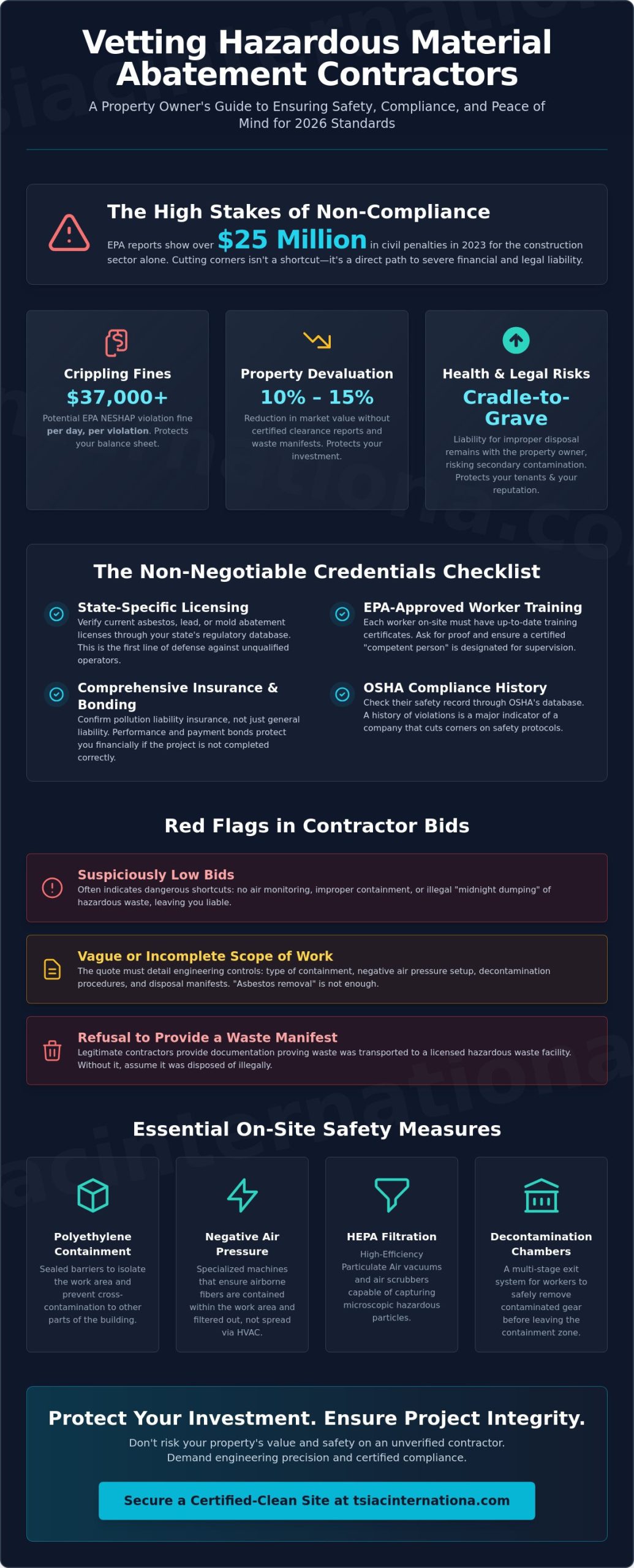
The financial impact of hiring an unqualified crew is often immediate and severe. EPA civil penalties for National Emission Standards for Hazardous Air Pollutants (NESHAP) violations can exceed $37,000 per day. Beyond fines, a failed air clearance test can halt a multi-million dollar renovation for weeks. If a Post-Abatement Air Clearance (PAAC) doesn’t meet the 0.01 fibers per cubic centimeter threshold, the contractor must re-clean the entire site at the owner’s expense. Long-term property value also suffers. Without a certified waste manifest and a final clearance report, prospective buyers or lenders will likely view the asset as a “distressed” property, often leading to a 10% to 15% reduction in market valuation. Finding a trustworthy abatement contractor protects the physical structure and the financial equity of the investment.
The Credentials Checklist: Non-Negotiables for 2026
Success in hazardous material removal depends on technical precision and legal adherence. When you’re finding a trustworthy abatement contractor, your first task involves auditing their professional credentials. State-specific licensing is the foundation of this process. Every legitimate firm must hold a current license specifically for asbestos or lead abatement, which you can verify through state regulatory databases. These licenses confirm the contractor understands the 2026 protocols for containment and disposal. Identifying these specific documents is the most reliable way of finding a trustworthy abatement contractor who respects both your budget and your health.
Worker safety and site supervision are equally critical. Each person on your property must possess up-to-date, EPA-approved training certificates. This ensures they follow OSHA’s Asbestos Standard for the Construction Industry, which mandates specific work practices and the presence of a “competent person” to oversee high-risk tasks. Without these certifications, you risk both legal liability and environmental contamination. Bonding requirements also provide a financial safety net. A performance bond ensures the project reaches completion, while a payment bond guarantees that all subcontractors and material suppliers receive their dues, preventing mechanics’ liens on your property.
Verifying Insurance and Bonding
Don’t accept a verbal confirmation of insurance. You need a Certificate of Insurance (COI) that specifically lists “Pollution Liability.” Standard general liability policies often contain “Total Pollution Exclusions,” meaning they won’t cover a spill or fiber release. It’s better to choose an “Occurrence-Based” policy over a “Claims-Made” policy. Occurrence-based coverage protects you even if a claim is filed years after the work ends, provided the incident happened during the policy period. Always request direct verification from the insurance carrier to confirm the policy is active and paid in full.
Modern Compliance Documentation
A project’s paper trail is as important as the physical removal. For commercial renovations, NESHAP (National Emission Standards for Hazardous Air Pollutants) requires a 10-day notification to the EPA before work begins. Once the project concludes, you must receive a Waste Shipment Record (WSR) or disposal manifest. This document proves the hazardous waste reached a licensed landfill. Finally, never accept a project as “complete” without a clearance letter from an independent, third-party laboratory. This lab should perform aggressive air sampling to confirm the area is safe for re-occupancy. If you need a partner who prioritizes these complex technical requirements, focus on firms with a proven track record in high-stakes environments.
Vetting the Bid: Comparing Quotes Beyond the Bottom Line
Selecting a partner based solely on the lowest price often leads to catastrophic failure. In the abatement industry, an unusually low bid usually indicates that a contractor is cutting corners on labor protection or bypassing legal disposal fees. Finding a trustworthy abatement contractor requires a forensic look at the line items within a proposal. If a quote lacks specific costs for 6-mil polyethylene sheeting, HEPA-filtered negative air machines, or specialized decontamination units, the contractor likely intends to skip these critical safety layers.
A professional Scope of Work must be granular. It should specify a minimum of four air changes per hour within the containment zone to maintain negative pressure. This isn’t just a suggestion; it’s a technical requirement to prevent hazardous fibers or particles from migrating to clean areas of the property. You should also demand an equipment list that includes HEPA vacuums certified to capture 99.97% of particles down to 0.3 microns. Without these tools, the contractor is simply moving dust around your building rather than removing it.
Questions to Ask During the Site Walk-Through
During the initial inspection, watch how the contractor evaluates the structural layout. Ask these specific questions to gauge their technical competence:
- How will you establish negative pressure and contain the work area? Look for mentions of manometer monitoring and physical barriers.
- What is your specific plan for the safe transport of hazardous materials? They must describe a path that avoids high-traffic zones.
- Who is the independent lab performing the final air clearance testing? A trustworthy firm never tests their own work; they use a third-party laboratory to ensure total transparency.
Analyzing the Disposal Plan
The liability for hazardous waste remains with the property owner until it reaches its final destination. You must confirm the contractor uses certified hazardous waste landfills and provides a waste shipment record for every load. All debris must be double-bagged in 6-mil bags, goose-neck sealed with duct tape, and labeled according to federal EPA and OSHA standards. For projects involving Hazardous Material Abatement in South Carolina, contractors must also adhere to specific DHEC regulations regarding transport manifests.
Finally, evaluate the proposed timeline. Professional abatement requires meticulous setup and mandatory settling periods for airborne dust. A contractor promising to finish a 1,000-square-foot lead or asbestos project in a single day is likely ignoring the 24-hour waiting period often required before final air clearance testing can begin. Precision takes time, and speed shouldn’t come at the expense of your structural integrity or health.
Red Flags and Industry Warning Signs
Finding a trustworthy abatement contractor requires a critical eye for technical compliance and safety protocols. Professional hazardous material removal is a highly regulated field where shortcuts lead to legal liability and health crises. If a contractor suggests skipping the permitting process to expedite the timeline or reduce costs, they’re signaling a disregard for state and federal law. In South Carolina, for example, DHEC regulations mandate specific notification periods before any regulated asbestos-containing material is disturbed. Bypassing these steps can result in five-figure fines for the property owner. For residents in the region who value this same level of regulatory adherence and professional integrity in other essential services, the Cremation Society of South Carolina – Westville Funerals provides dependable support for families during difficult times.
Visual inspections of active job sites often reveal a contractor’s true standards. You should look for specific engineering controls and safety measures, including:
- Containment Barriers: Professional sites utilize 6-mil polyethylene sheeting to create airtight seals. If you see thin, household-grade plastic or gaps in the taping, the containment is compromised.
- Negative Air Pressure Monitors: These digital devices are mandatory. They ensure that air flows into the work zone and through HEPA filters, preventing contaminated dust from escaping into clean areas of the building.
- PPE Compliance: Workers must wear appropriate Personal Protective Equipment, including N100 or P100 respirators and disposable suits. Seeing workers in standard dust masks or street clothes is a definitive sign of an amateur operation.
Identifying the “Solar Cowboy” Equivalent in Abatement
The abatement industry has its share of “Solar Cowboys,” contractors who lack a permanent physical office or a verifiable track record in complex industrial environments. These operators often apply high-pressure sales tactics, demanding the full project amount upfront. A legitimate firm will tie final payment to a successful third-party air clearance test. Furthermore, look closely at the contract. If it doesn’t specify the exact EPA-approved landfill for disposal, you risk being held responsible for illegal dumping. Transparency in the waste manifest process is the hallmark of a professional partner.
The Danger of DIY or Unlicensed Labor
Attempting to save money through DIY methods or unlicensed labor is a high-risk gamble. Improper removal techniques aerosolize microscopic fibers, which stay suspended in the air for up to 72 hours. Once these fibers enter an HVAC system or settle into porous furniture, the site becomes effectively uninhabitable. Cleaning a cross-contaminated site is significantly more expensive than a standard removal, often increasing remediation costs by 400% or more. Before starting any structural changes, it’s vital to understand The Demolition Process in South Carolina to ensure every safety hurdle is cleared.
Ensure your property meets the highest safety standards by choosing a partner with proven technical expertise. Contact TSIA C International for a professional site assessment today.
The TSIAC International Standard: Integrity in Remediation
TSIAC International brings over 15 years of specialized experience to complex structural and selective demolition projects. Since 2009, our team has refined a methodology that prioritizes technical precision over marketing slogans. Finding a trustworthy abatement contractor requires looking past surface-level promises to examine a firm’s operational history and regulatory compliance record. We provide transparent reporting for every client. This ensures that every milligram of hazardous material is documented from the moment of removal to its final disposal. Our crews are trained to manage difficult locations where standard equipment fails, often utilizing industrial rope access or custom-engineered scaffolding to reach contaminated areas safely.
Why an Integrated Approach Saves Time and Money
Most property owners hire separate crews for abatement and demolition. This often leads to a cycle of delays and finger-pointing where one team stalls the other. These inefficiencies can increase project costs by 15% or more. TSIAC eliminates this friction by handling hazardous material removal and structural gutting simultaneously. We streamline the permitting process for total structural removals, which reduces the administrative burden on the property owner. For those managing assets in the Southeast, understanding Asbestos Removal in South Carolina is critical for staying within the 2026 legal frameworks. Our integrated model ensures that safety protocols and structural integrity move in lockstep, preventing the “blame game” that plagues traditional construction sites.
Environmental Stewardship and Recycling
Environmental responsibility is a logistical requirement in modern remediation, not just a preference. We implement debris recycling programs that sort metal, wood, and plastic directly on-site. This systematic approach reduces landfill impact by up to 70% on major industrial demolition projects. To prevent cross-contamination, we use rigid safety protocols that isolate non-hazardous materials from contaminated zones before they leave the site. This level of control protects the environment and the client’s legal standing. Finding a trustworthy abatement contractor means choosing a partner who values long-term safety over short-term shortcuts. Partnering with TSIAC means choosing a safer, cleaner, and more efficient project completion. We don’t just clear a site; we engineer a solution that meets the highest industrial standards for safety and sustainability.
Securing Your Property’s Future with Precision Remediation
Protecting your investment requires more than a casual search. It demands a technical audit of every potential partner. You’ve seen that finding a trustworthy abatement contractor in 2026 hinges on verifying full compliance with EPA and OSHA regulations. A low bid often masks a lack of comprehensive pollution liability insurance, which leaves your assets exposed to unnecessary risk. By prioritizing a credentials-first approach, you ensure that remediation is a controlled engineering process rather than a liability.
TSIAC International leverages 15+ years of industry experience to handle complex remediation in high-stakes environments. We don’t offer empty promises; we deliver documented safety and structural integrity. Our team maintains strict adherence to federal protocols to ensure your project remains on schedule and within regulatory bounds. When the stakes involve hazardous materials, professional precision is the only acceptable metric for success. You deserve a partner who navigates these technical challenges with calm authority and proven expertise.
Contact TSIAC International for a Professional Abatement Quote
Taking the right steps today prevents costly structural and legal failures tomorrow. Your property deserves the highest standard of technical excellence and a partner who delivers on every commitment.
Frequently Asked Questions
How do I check if an abatement contractor is licensed?
You verify an abatement contractor’s license by searching the official state environmental agency database or the EPA’s Lead-Safe firm registry. Every certified professional holds a unique credential number that’s verifiable online. You should request a copy of the firm’s current 2026 certification and cross-reference it with the Department of Labor’s active list to ensure compliance and safety.
Is it safe to stay in the building during asbestos or lead abatement?
It’s not safe to remain in the immediate work zone during active asbestos or lead abatement processes. EPA guidelines require occupants to vacate the area until third-party air clearance testing proves fiber levels are below 0.01 per cubic centimeter. Professionals establish sealed containment zones using 6-mil polyethylene sheeting to protect the remaining 95 percent of the building from cross-contamination.
What is the difference between a standard demolition and abatement?
Standard demolition involves the mechanical destruction of structures, but abatement is the precise process of isolating and removing hazardous pollutants. Abatement uses negative air machines and HEPA filtration to capture microscopic particles that traditional demolition would release into the environment. This technical approach protects both the structural integrity and the health of future occupants through engineering controls.
How much does professional abatement cost compared to DIY?
Professional abatement involves higher upfront costs than DIY, but it eliminates the risk of legal penalties that reach $37,500 per day for environmental violations. Industry reports from 2024 indicate that professional asbestos removal typically ranges from $1,500 to $3,000 for small residential projects. DIY attempts often lead to 100 percent contamination of the HVAC system, causing much higher long-term remediation expenses.
What documents should I receive after the abatement is finished?
You must receive a comprehensive close-out binder containing the waste disposal manifest, daily work logs, and independent air clearance certificates. The waste manifest is a critical legal document signed by the licensed landfill, proving the hazardous material reached its destination. Finding a trustworthy abatement contractor guarantees you get these records to protect your property’s resale value and legal standing.
Can a general contractor handle lead paint removal?
A general contractor can only handle lead paint removal if they hold a valid EPA RRP certification and employ workers trained in lead-safe practices. Without this specific 2026 accreditation, they lack the technical equipment to manage toxic dust. Finding a trustworthy abatement contractor is vital because they follow the 40-hour HAZWOPER standards required for high-risk environmental work and hazardous waste operations.
What happens if a contractor is caught improperly disposing of hazardous waste?
Contractors caught improperly disposing of hazardous waste face heavy civil fines, license revocation, and potential jail time under the Resource Conservation and Recovery Act. The EPA can levy penalties up to $70,117 per violation for each day the non-compliance continues. Property owners might also be held liable for cleanup costs if the contractor’s disposal chain isn’t documented and verified.
How long does the average abatement project take?
The average residential abatement project takes between 3 and 5 days to complete from initial containment to final clearance. Industrial sites or complex structural projects often require 15 to 20 days due to the scale of the containment systems. Each phase is strictly timed, including a mandatory 24-hour settling period before the final air quality samples are collected for laboratory analysis.
