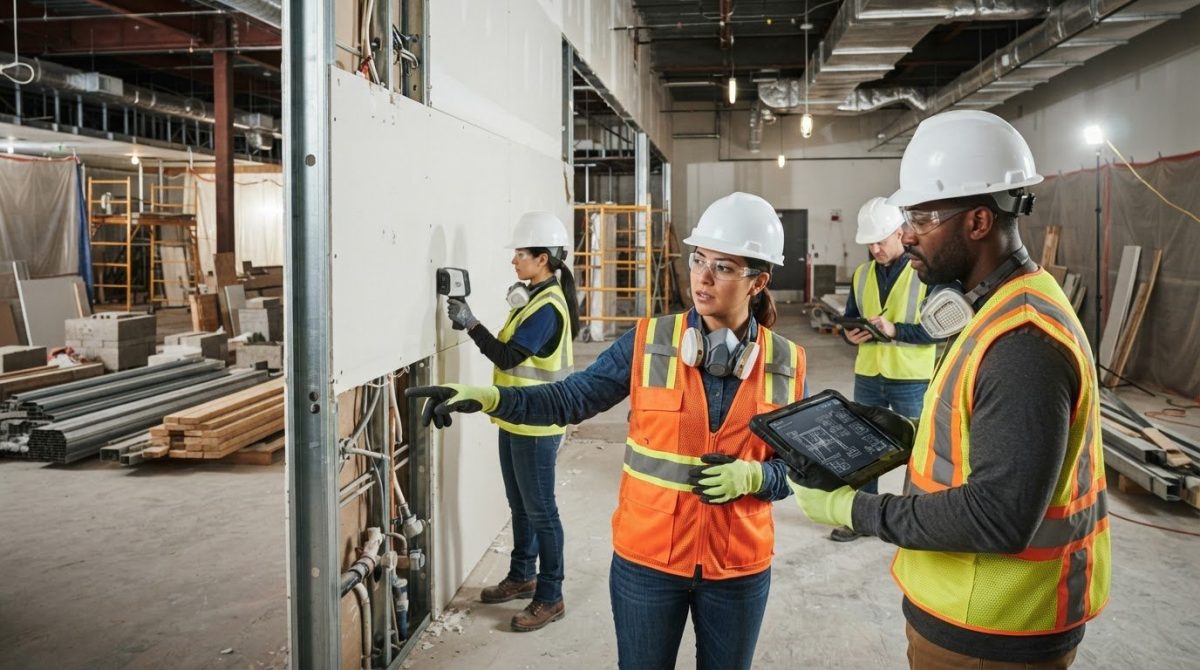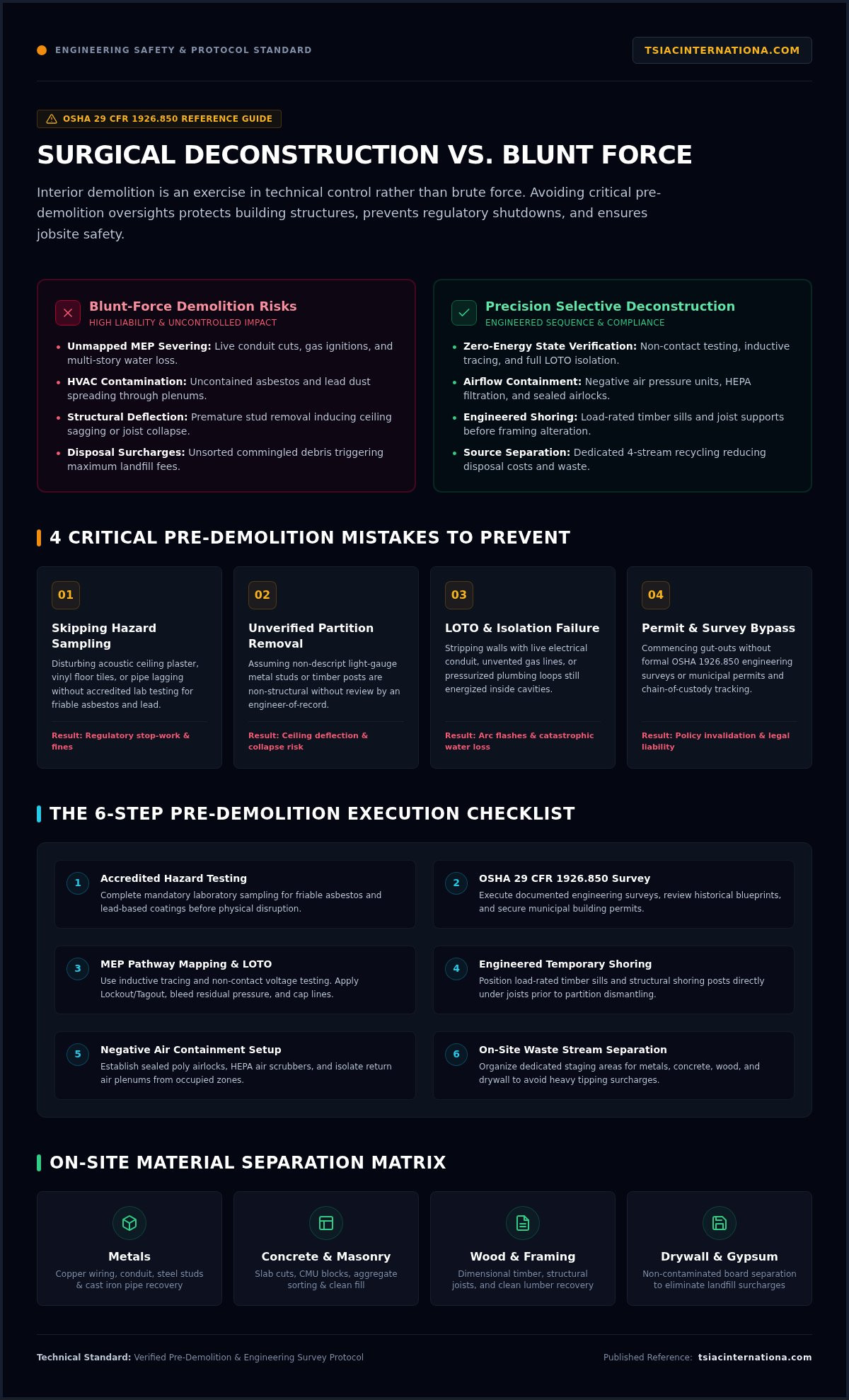
A sound demolition method can still fall behind if utility shutdowns, hazardous-material controls, and structural sequencing are not coordinated. Commercial structural demolition projects, like other commercial demolition work, require a scope that distinguishes full structural removal from selective demolition and interior gutting. It must also identify materials and structures that need to remain.
Concerns about hidden asbestos or lead, site safety, schedule disruption, and damage to adjacent areas are best addressed in the project plan. A clear scope defines responsibilities, sequences decommissioning and abatement where needed, and prepares the site for the next phase. TSIAC International brings more than 15 years of industry experience in structural and selective demolition, interior gutting, and asbestos and lead abatement.
This article explains how these scopes differ, how hazardous-material work and decommissioning fit into a demolition plan, and why sequencing matters. It also covers how material recovery can support site management. Use these considerations to define a practical scope before work begins and understand how a demolition and abatement partner can support project delivery.
Key Takeaways
- Separate structural demolition, selective removal, and decommissioning in the project scope to clarify what will be removed and what must remain.
- Plan hazard assessment, site preparation, demolition, and documentation as connected phases, adapting the sequence to building conditions and project requirements.
- Compare full structural removal with selective demolition by the extent of removal, retained elements, and intended site condition.
- Define project boundaries, access, structural information, known material concerns, adjacent operations, and debris handling before mobilization.
- Coordinate demolition with asbestos and lead abatement to support organized project delivery; TSIAC International brings more than 15 years of industry experience.
What Commercial Structural Demolition Involves, and Where Decommissioning Fits
Structural demolition is the planned removal of a building or specified structural components to achieve a defined site condition while accounting for elements that must remain. The scope may cover an entire structure or selected structural sections. When planning commercial structural demolition charleston sc work, start by defining the required removal and what must be retained, rather than relying on a general project label.
Demolition covers different methods and processes, as outlined in this overview of Demolition. Available drawings and structural information help the team understand load paths, connections, and interfaces with retained areas. Use these details to set work boundaries and plan for the specific building. Sites and scopes differ, so the method and sequence should reflect the actual conditions.
How commercial demolition differs from interior gutting
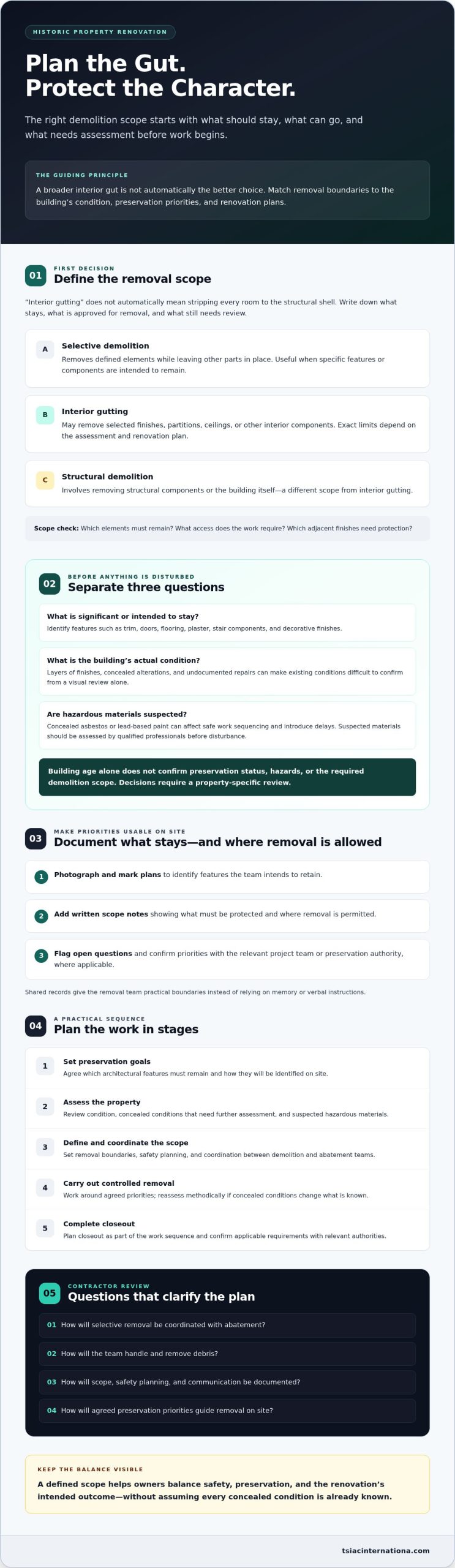
Structural demolition removes load-bearing or other structural elements within the agreed scope. Interior gutting strips finishes, fixtures, and other nonstructural components while retaining the building shell. Removing a partition is not the same as altering a structural wall or frame. Review drawings and identify retained components to set precise limits. For more on interior removal, see this guide to commercial interior gutting services.
Clear boundaries let teams distinguish interior work from structural removal before field activities begin. They also identify components that must remain undisturbed and clarify how demolition work meets retained spaces.
What industrial decommissioning contributes to the project
Decommissioning means taking a facility or its systems out of operation; demolition is the physical removal of a building or structural components. If equipment or industrial processes are present, planning may coordinate shutdown, isolation, and equipment removal with demolition. These activities are related but distinct, and not every commercial project involves industrial systems.
The scopes intersect when equipment removal or system isolation affects access, work limits, or sequencing. Define responsibilities and handoffs to avoid gaps in the plan. The required work depends on the intended site condition, whether that means removing a structure, retaining part of it, or stripping the interior while leaving the shell in place.
How Decommissioning, Hazard Controls, and Demolition Work in Sequence
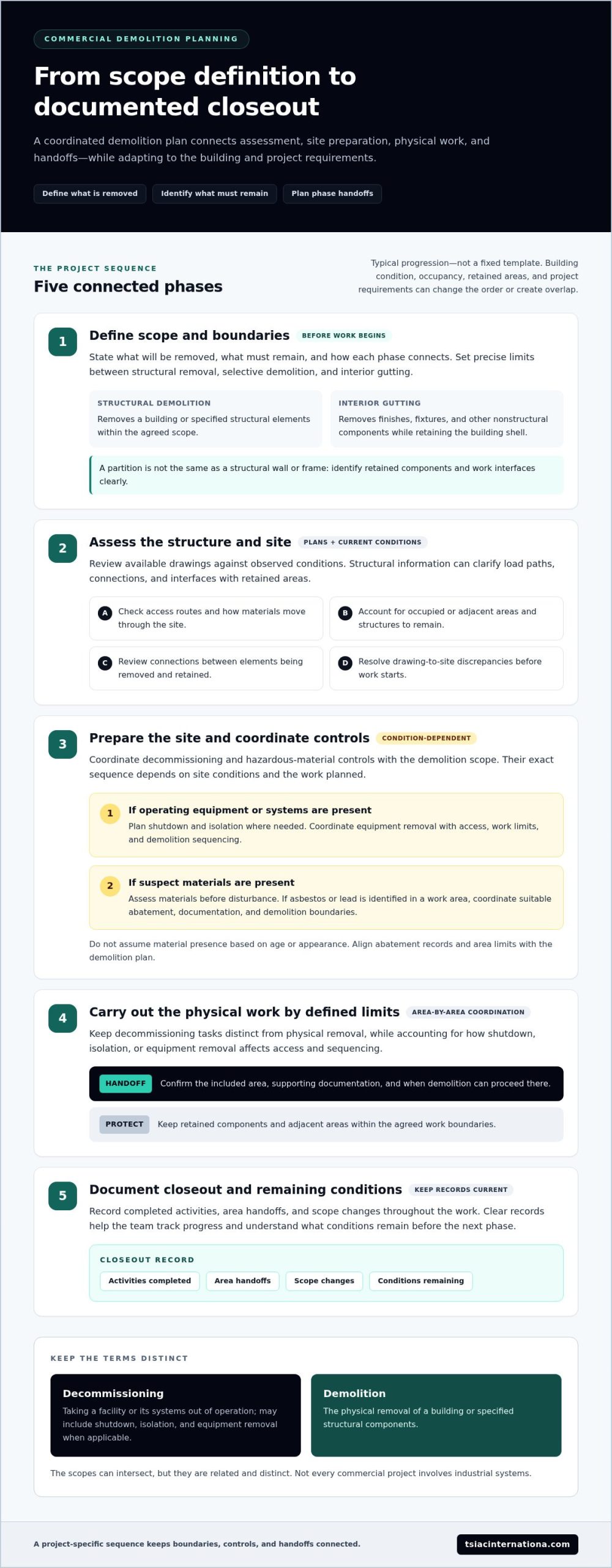
A coordinated project typically moves from scope definition to assessment, site preparation, physical work, and closeout documentation. This sequence helps teams manage handoffs between decommissioning, hazardous-material controls, and demolition. It is not a fixed template: building condition, occupancy, retained areas, and project requirements can affect the order or overlap of activities.
Before work begins, define what will be removed, what must remain, and how each phase connects to the next. If a facility has operating equipment or systems, shutdown and isolation planning may need to come before equipment removal and demolition. Keep decommissioning tasks distinct from physical removal while accounting for their effect on access and work boundaries.
Assess the structure, site conditions, and project boundaries
Review available plans against current site conditions. Access routes, occupied or adjacent areas, and retained structures can influence where work proceeds and how materials move through the site. Structural connections between removed and retained elements may also affect demolition limits and sequencing. Base the assessment on the building and planned work rather than applying a one-size-fits-all rule.
Early reviews can reveal differences between drawings and observed conditions. Resolve those discrepancies before work begins to give the team a clearer basis for sequencing and reduce the risk of unexpected constraints changing the scope in the field.
Coordinate hazardous-material abatement with demolition
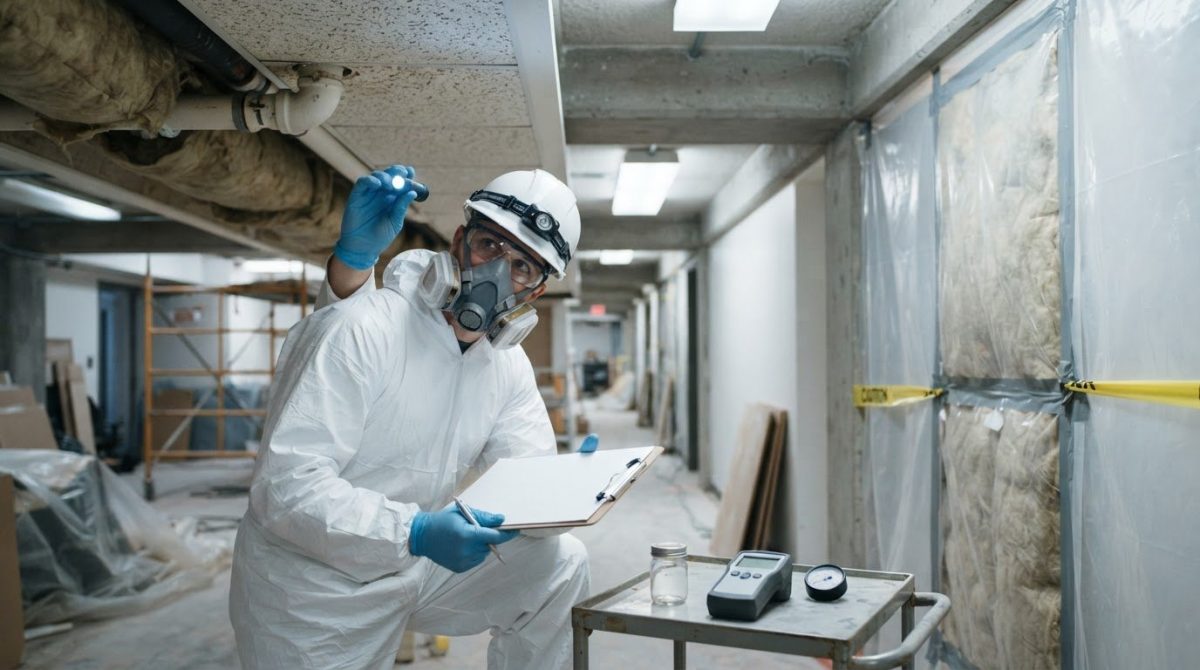
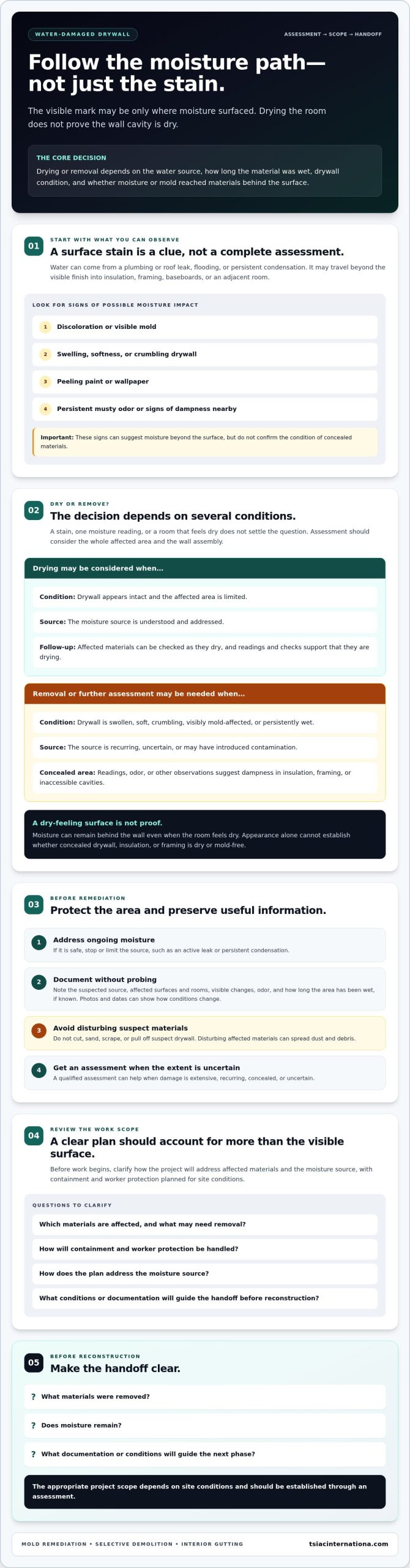
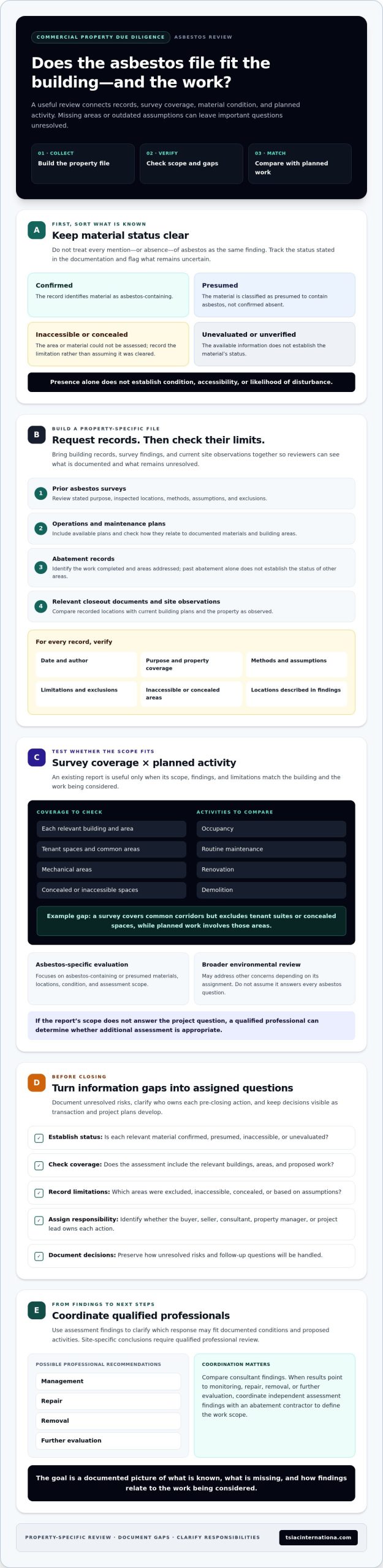
Do not disturb suspect materials based on assumption alone. Assessing materials before disturbance helps identify potential exposure risks and plan appropriate controls. If assessment identifies asbestos or lead in a work area, coordinate suitable abatement, documentation, and demolition boundaries in the project plan. Establish material presence through assessment rather than assuming it based on a building’s age or appearance.
Align abatement records and work limits with the demolition plan. The team needs to know which areas are included, what documentation supports the handoff, and when demolition can proceed in each area. TSIAC’s hazardous material abatement guide offers additional planning context. OSHA’s demolition safety resources also provide guidance on demolition planning and hazard controls.
Document completed activities, area handoffs, and scope changes throughout the work. Clear records help the project team track progress and understand what conditions remain before the next phase begins.
Structural Demolition vs. Selective Demolition: Compare Scope and Site Outcomes
Structural and selective demolition serve different project objectives. Structural demolition removes a building or a defined portion of its structural system; selective demolition removes specified elements while preserving components identified for retention. Neither approach is inherently safer, faster, or less disruptive. Choose the scope according to project objectives, site conditions, and technical assessment.
| Scope factor | Structural demolition | Selective demolition |
|---|---|---|
| Removal extent | A building or defined structural components are removed. | Specified elements or areas are removed within set limits. |
| Retained elements | May leave few or no above-grade building components, depending on the scope. | Identified structural or architectural components remain in place. |
| Intended site condition | The designated structure or portion is cleared for the next project phase. | The property remains partly intact, often to support renovation or phased work. |
When full structural removal aligns with project objectives
Full structural removal suits a project when the defined outcome is to remove the existing building rather than retain its shell or selected structural elements. Planning still needs to account for site access, removal boundaries, material handling, and debris management. The scope ends at the agreed demolition outcome; it does not automatically include subsequent construction or redevelopment.
The National Demolition Association provides industry resources on demolition practices and coordination. For each project, the method and sequence must fit the specific structure and site conditions.
When selective demolition preserves parts of a building
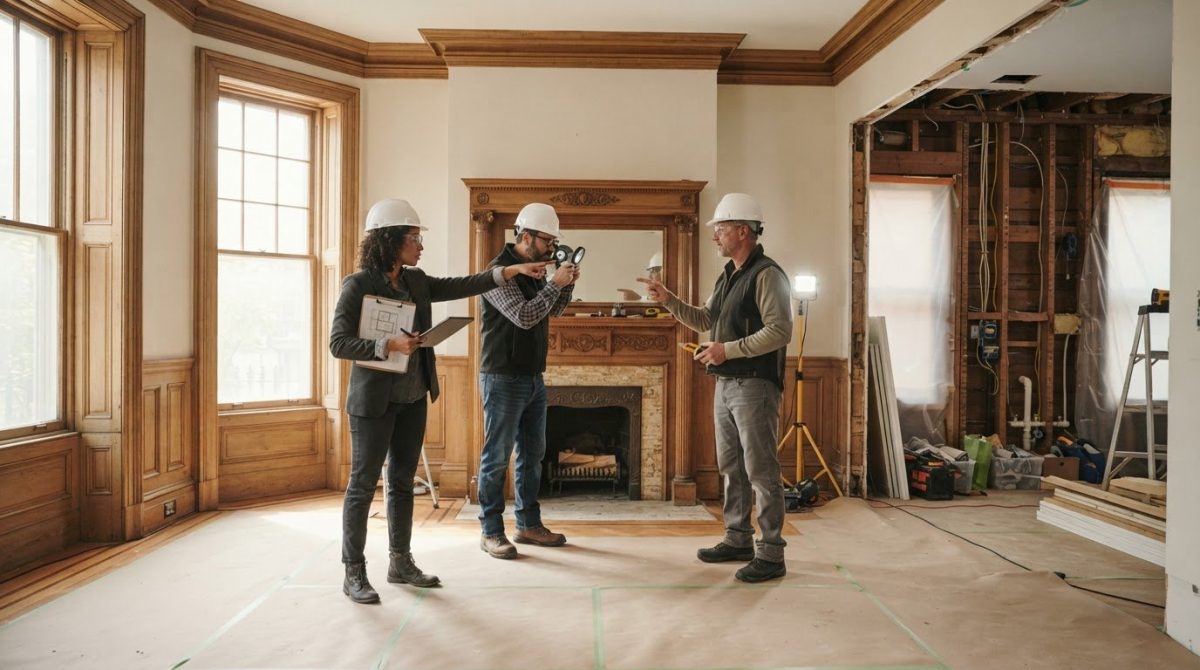
Selective demolition can support renovation or phased property work when only defined areas or components need removal. For example, a project may require removing one section while adjacent spaces or structural elements remain. Identify retained components and interfaces between work areas so removal activities can be planned around preservation requirements. Do not assume that limited removal is automatically less disruptive; clear boundaries are essential.
Review retained elements alongside removal limits to clarify the intended site condition and work sequence. TSIAC provides guidance on the demolition process and safety for additional context. Whether the project calls for full removal or selective work, a precise scope gives the team a shared basis for planning and delivery.
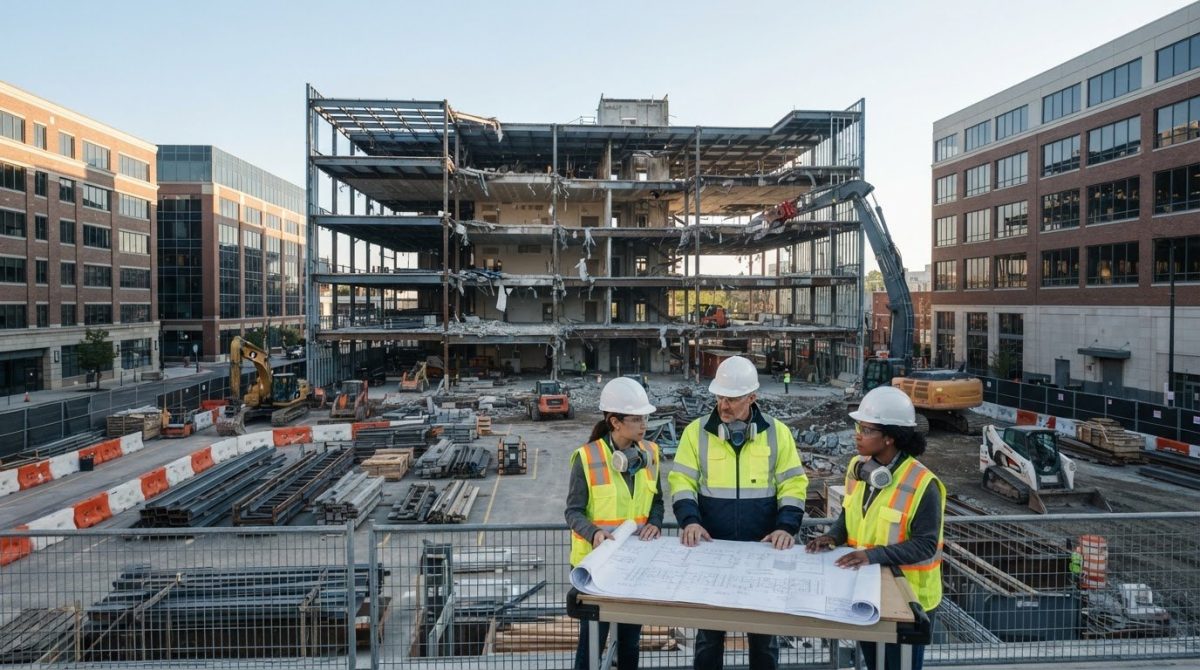
Plan a Commercial Demolition Scope Before Mobilization
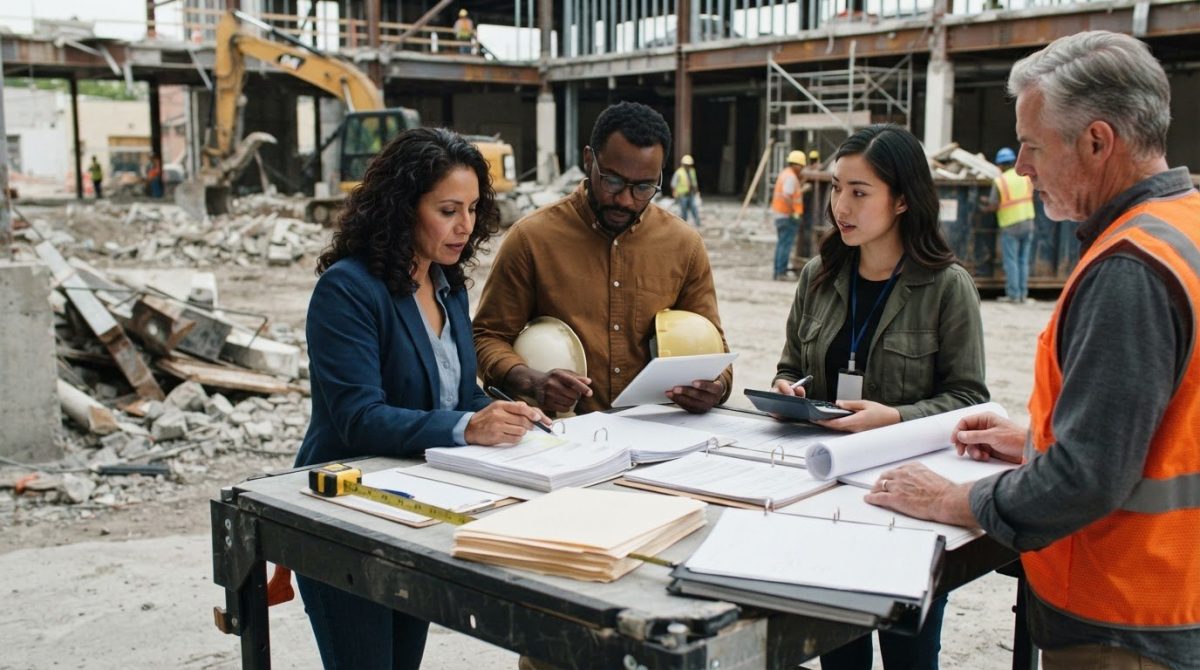
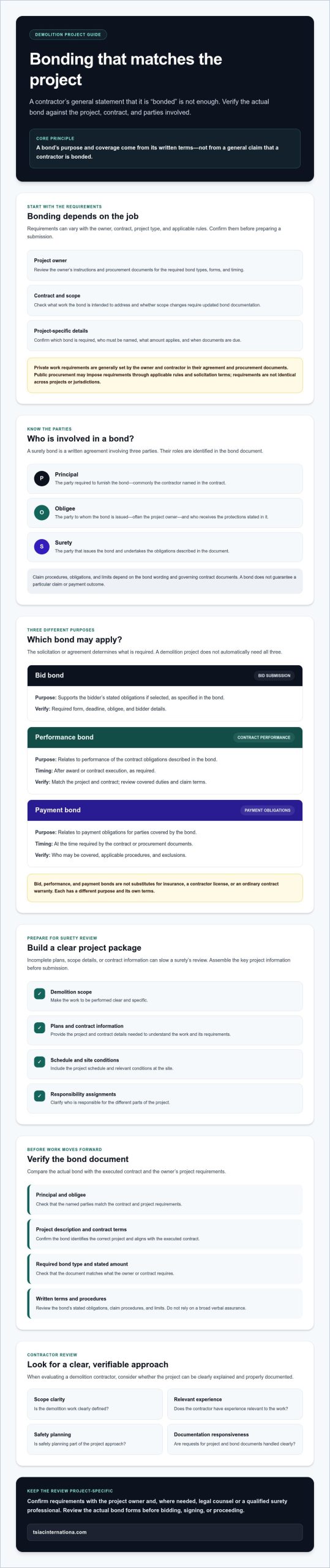
A clear pre-mobilization scope turns project objectives into work limits, responsibilities, and field coordination points. Before activities begin, the owner, general contractor, and demolition team need a shared understanding of what will be removed, what will remain, how crews and materials will access the site, and what documentation will guide the work. Clarifying these details helps prevent gaps between the planned scope and actual site conditions.
Define scope, interfaces, and project responsibilities
Start by recording the intended site condition and marking removal limits against available structural information and site plans. Identify retained components, adjacent operations, access routes, and interfaces with other work areas. If demolition meets a shared wall, retained section, or occupied area, define how that boundary will be communicated and managed.
Set clear communication points among the owner, general contractor, demolition team, and other site teams. Establish who distributes current drawings, communicates changed conditions, coordinates access, and documents scope decisions. Sequence the work using available plans and documented site conditions, with a process for addressing discrepancies before they affect work boundaries.
Include safety, documentation, and material recovery
Planning should account for site controls, known material concerns, hazard assessment and abatement coordination, and the project records needed for work handoffs. Relevant documents may include scope drawings, site access information, hazard or abatement records, and notes on retained areas. The documentation set will vary by project; the goal is to make responsibilities and work limits clear to everyone involved.
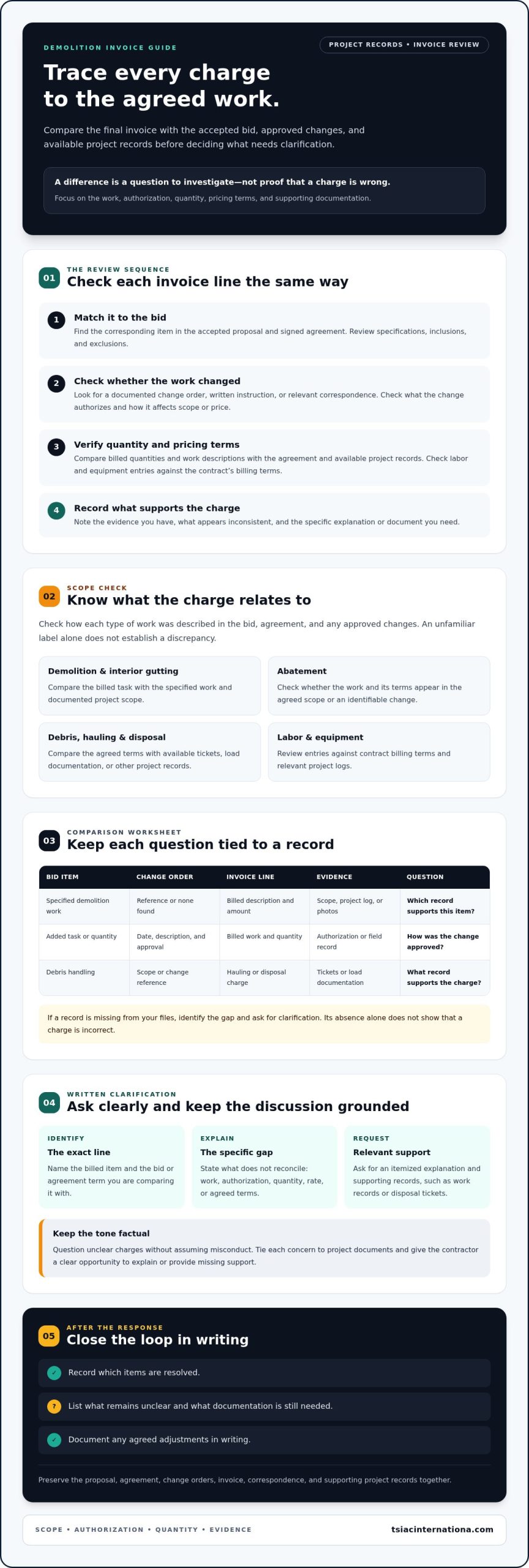
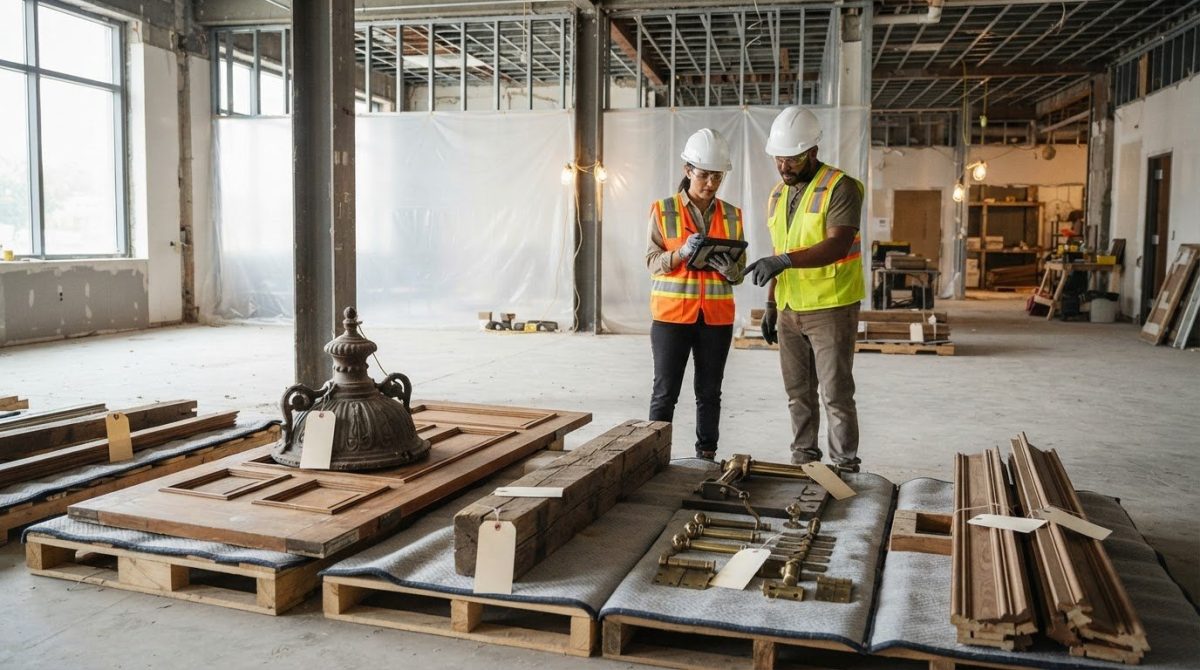
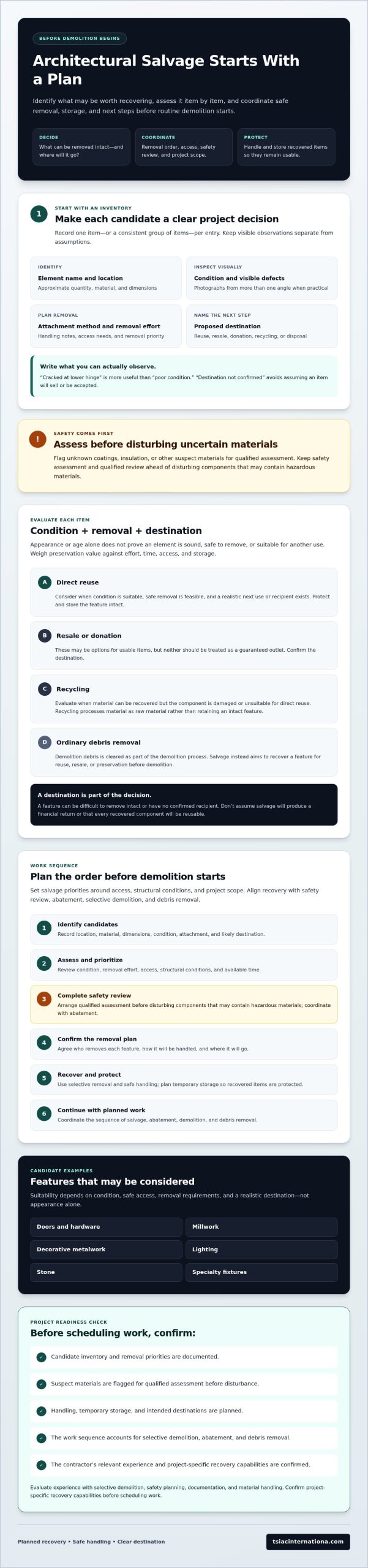
Include debris handling in the scope. Identify how materials will be separated, staged, and moved through the site. Sorting recoverable wood, metal, and plastic can support material recovery and keep those streams distinct from debris designated for disposal. TSIAC provides guidance on demolition debris recycling as part of its demolition process resource.
Before mobilization, align the scope, site access, adjacent operations, hazard controls, communication responsibilities, and debris plan. TSIAC International brings more than 15 years of industry experience across structural and selective demolition, abatement, and material recovery. Discuss your commercial demolition scope with TSIAC.
How TSIAC Coordinates Commercial Demolition and Abatement
Commercial demolition scopes can involve connected workstreams, but each project has its own requirements. TSIAC International provides structural and selective demolition, asbestos and lead abatement, interior gutting, and debris recycling. When a project includes both demolition and abatement, defining how the activities relate helps establish clear work boundaries, sequencing, and handoffs.
Connect demolition, abatement, and debris management
TSIAC coordinates demolition and abatement as parts of a project-specific scope. For example, if assessment identifies asbestos- or lead-containing materials within a planned removal area, the work plan can coordinate abatement boundaries and documentation with the demolition limits. The relevant services depend on the building, materials identified, and intended site condition. A project does not automatically require both types of abatement or a particular demolition approach.
Material handling also affects how work areas are organized. TSIAC implements recycling practices for materials such as wood, metal, and plastic on project sites. Planning for sorting and handling can keep recoverable streams distinct from other debris and clarify how materials move through the work area. Recovery practices are part of the site plan, not a substitute for defining the demolition scope.
Move from project objectives to a defined scope
To develop a workable scope, the project team needs a clear picture of the intended outcome and site conditions. Useful planning information includes:
- Which structures or components will be removed, and which must remain.
- Available drawings, known material concerns, and relevant assessment or abatement records.
- Site access, adjacent operations, and interfaces with other work areas.
- Debris handling needs and the responsibilities of the owner, general contractor, and project teams.
With these elements defined, sequencing can reflect actual project conditions rather than assumptions. TSIAC serves commercial clients, general contractors, and government agencies, bringing demolition and abatement experience to scopes that require coordinated planning. This gives the team a clearer basis for setting work limits, communicating handoffs, and managing material recovery as part of project delivery.
Discuss your commercial demolition project with TSIAC to begin defining the scope around your project objectives and site conditions.
Set the Scope Before Demolition Begins
Commercial structural demolition requires more than defining what will come down. A workable scope distinguishes structural removal from selective demolition and interior gutting, identifies what must remain, and coordinates decommissioning and hazard controls with the work sequence. Assessing site conditions and material concerns before disturbance helps teams plan boundaries, responsibilities, and documentation around the project.
Start by defining the intended site condition, clarifying interfaces with adjacent operations, and including debris handling in the scope. TSIAC International brings more than 15 years of industry experience in structural demolition and asbestos and lead abatement. Its recycling practices also recover materials such as wood, metal, and plastic on project sites.
A clearly defined scope gives the project team a sound basis for coordination from planning through site delivery. Discuss your commercial demolition project with TSIAC and take the next step toward a carefully planned approach.
Frequently Asked Questions
What is commercial structural demolition?
Commercial structural demolition is the planned removal of a commercial building or specified structural components. The scope defines what comes out, what must remain, and the intended condition of the site after the work. It may include full building removal or removal of structural sections, depending on project objectives and site conditions. Planning accounts for structural information, work boundaries, adjacent areas, hazard controls, and debris handling.
What is the difference between structural demolition and selective demolition?
Structural demolition removes a building or defined structural elements, while selective demolition removes specified components and preserves identified parts of the structure. A project may require removing an entire building or taking out a defined area while retaining adjacent spaces. The right scope depends on the intended site outcome and technical assessment. Neither approach is automatically safer, faster, or less disruptive; conditions and work limits matter.
How does industrial decommissioning relate to demolition?
Industrial decommissioning takes a facility or its systems out of operation, while demolition physically removes the building or structural components. Where equipment or industrial processes are present, project planning may coordinate shutdown, isolation, and equipment removal with demolition activities. These scopes can affect one another through access, sequencing, and work boundaries, but they remain distinct. Not every commercial demolition project includes industrial equipment or decommissioning tasks.
Does a commercial demolition project require hazardous-material abatement?
Not every project requires abatement. The presence of hazardous materials must be determined through appropriate assessment rather than assumption. If asbestos or lead is identified within the work area, the project plan can coordinate suitable abatement, documentation, and demolition boundaries. Assess suspect materials before disturbance so potential hazards can be addressed in the work plan. TSIAC International provides asbestos and lead abatement alongside demolition services.
How is a commercial demolition project planned?
Planning begins by defining the project objective, removal limits, retained elements, and intended site condition. Teams review available structural information, site access, adjacent operations, known material concerns, and debris handling needs. The owner, general contractor, and project teams clarify responsibilities, communication points, and required documentation. The sequence is project-specific and can change with building condition, occupancy, assessment findings, and the relationship between demolition and any decommissioning or abatement work.
Can demolition materials be recycled?
Yes. Suitable demolition materials can be sorted for recovery rather than treated as a single debris stream. TSIAC International implements recycling practices for materials such as wood, metal, and plastic on project sites. The handling plan can identify how these materials will be separated, staged, and moved. What can be recovered depends on the materials and site conditions, so include sorting and debris management in the defined scope.