How to Justify Demolition Costs to a Board: A Strategic Guide for Project Managers

The lowest bid on a structural demolition project is frequently the most expensive line item a company will ever face. When a board of directors sees…

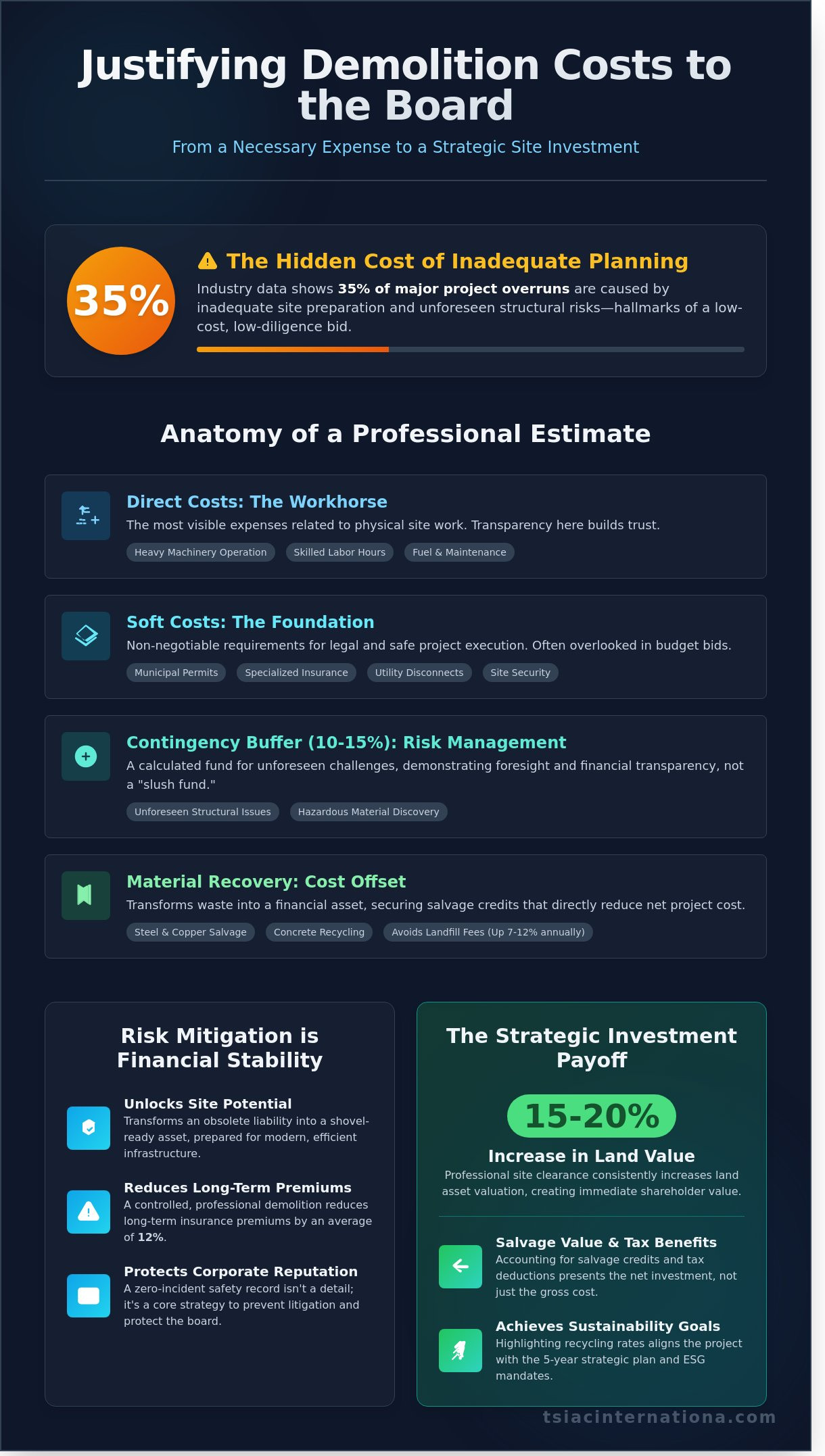
The lowest bid on a structural demolition project is frequently the most expensive line item a company will ever face. When a board of directors sees a high-value estimate, their immediate instinct is to cut costs, yet industry data from 2023 indicates that 35% of major project overruns are caused by inadequate site preparation and unforeseen structural risks. You understand that technical factors like hazardous material abatement and precision structural stabilization aren’t optional extras. They’re the foundation of site safety and long-term asset protection.

Learning how to justify demolition costs to a board requires moving beyond technical jargon and focusing on risk-adjusted investment. We’ll show you how to transform a complex engineering estimate into a persuasive case that secures full budget approval and builds confidence in your chosen contractor. This guide provides a clear framework for quantifying the value of specialized expertise and explains how to present compliance costs as essential insurance against future litigation. You’ll gain the tools to lead a board through the technical logic of a project with the same precision we bring to the job site.

Key Takeaways

  • Shift the board’s perspective from immediate expense to long-term strategic investment by focusing on asset value and liability reduction.
  • Discover how to break down complex estimates into transparent direct and soft costs to eliminate budget surprises for stakeholders.
  • Learn how to justify demolition costs to a board by positioning safety and hazardous material mitigation as the primary drivers of financial stability.
  • Use a data-driven comparative analysis to demonstrate why site clearing is often more cost-effective than the hidden expenses of adaptive reuse.
  • Implement a professional framework to present the net investment, accounting for salvage value and tax benefits to secure final approval.

Framing Demolition as a Strategic Investment Rather Than an Expense

Demolition justification is the technical process of aligning structural removal costs with long-term property valuation and the systematic reduction of environmental liabilities. Project managers often struggle with how to justify demolition costs to a board because they present the project as a singular financial drain. A professional approach requires shifting the narrative from a “cost-center” mindset to a “site-readiness” mindset. This ensures that the board views the removal of a 30-year-old industrial structure not as a loss of assets, but as the critical first step in preparing the ground for a revenue-generating facility.

Boards evaluate major projects through the lens of Total Cost of Ownership (TCO). An initial low bid price often masks the risks of structural instability or unforeseen hazardous material discovery. By utilizing a cost-benefit analysis framework, you can demonstrate that a controlled, professional demolition reduces long-term insurance premiums by an average of 12% and prevents the 25% cost overruns typically seen in poorly planned “budget” removals. High-precision demolition unlocks the site’s potential, allowing for modern, efficient infrastructure that meets current environmental standards.

Identifying Board-Level Priorities

Boards distinguish strictly between capital expenditure (CapEx) and operational expenditure (OpEx). Demolition usually qualifies as CapEx when it’s the precursor to new construction. You’ve got to align the project with the organization’s current five-year strategic plan. If the 2024-2029 goals focus on sustainability, highlight the percentage of materials that will be recycled rather than landfilled. Safety is the primary non-negotiable value for any board. Presenting a contractor’s zero-incident safety record isn’t just a detail; it’s a risk mitigation strategy that protects the board’s corporate reputation and prevents litigation.

The Psychology of Budget Approval

Technical transparency is the foundation of trust with stakeholders. Don’t gloss over high-risk line items like specialized high-reach equipment or asbestos abatement. Instead, provide data-driven production rates, such as the specific tonnage of debris processed per shift, to justify the project timeline. Industry data from 2023 indicates that projects lacking this level of detail face approval delays 40% more often than those with granular data. Use case studies to illustrate the financial impact of failed projects where “cheap” contractors left sites contaminated or structurally unsound, costing companies millions in remedial work.

  • Focus on the transition from “obsolete liability” to “shovel-ready asset.”
  • Use concrete production metrics to back up every dollar requested.
  • Highlight the 15% to 20% increase in land value following professional site clearance.

Decoding the Components of a Professional Demolition Estimate

Boards often view demolition as a destructive expense rather than a preparatory investment. To understand how to justify demolition costs to a board, you’ve got to dismantle the estimate into its core technical layers. A professional bid isn’t just a bottom-line figure; it’s a breakdown of logistical precision and risk mitigation.

Direct costs are the most visible drivers. These include heavy machinery operation, skilled labor hours, and fuel consumption. However, it’s the soft costs that frequently catch board members off guard. Municipal permits, specialized insurance premiums, and utility disconnects are non-negotiable requirements for legal and safe execution. If these aren’t clearly articulated, the board might perceive the estimate as inflated rather than comprehensive.

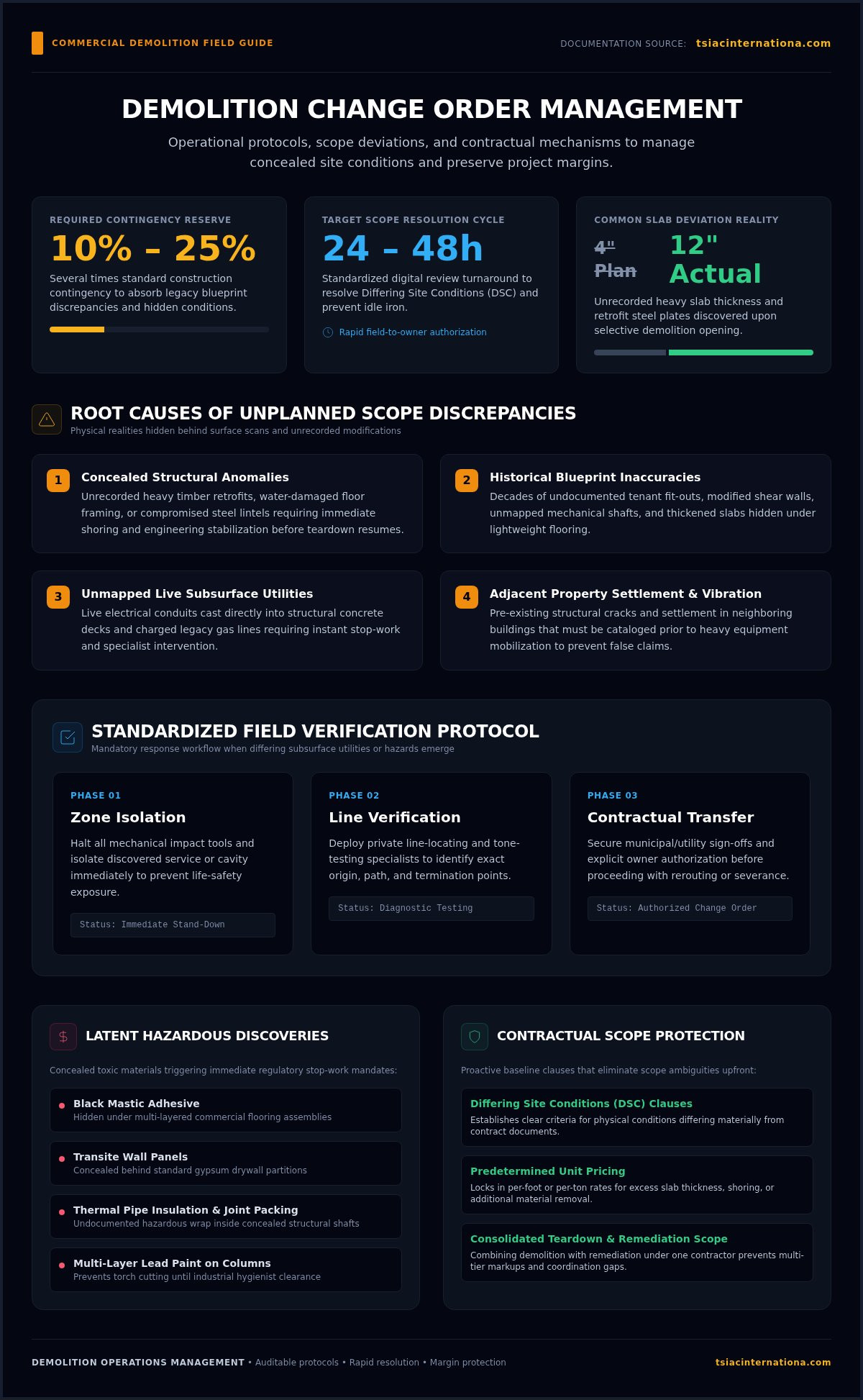
A responsible estimate also includes a 10% to 15% contingency buffer. This isn’t a “slush fund.” It’s a calculated risk management tool designed to handle unforeseen structural anomalies or the discovery of hazardous materials. Presenting this buffer demonstrates a commitment to financial transparency. It shows the board you’ve planned for reality, not just the best-case scenario.

The Economics of Material Recovery and Recycling

Material recovery transforms waste into a financial asset. By separating steel, copper, and concrete at the source, contractors can secure salvage credits that directly reduce the net project cost. Landfill tipping fees in many metropolitan areas have increased by 7% to 12% annually since 2021. Recycling bypasses these rising costs while fulfilling Environmental, Social, and Governance (ESG) mandates. Boards value these metrics because they align fiscal responsibility with modern corporate sustainability goals. It’s a rare opportunity where the “green” choice is also the most cost-effective one.

Selective vs. Structural Demolition Costs

Total knockdown is often cheaper per square foot because it allows for aggressive, high-volume machinery use. However, when a project requires commercial interior gutting services, the labor intensity increases. This “surgical” approach involves manually removing components to protect the building’s structural integrity or preserve specific architectural features. This precision requires more man-hours and smaller, specialized equipment. You can explain to the board that this higher upfront labor cost prevents millions in potential structural damage or the need for total reconstruction. Balancing these structural concerns with renovation goals is essential for long-term asset value. If you’re managing a complex site, consulting with a technical demolition partner early in the planning phase ensures your estimate remains accurate and defensible.

How to Justify Demolition Costs to a Board: A Strategic Guide for Project Managers

Risk Mitigation: The Board’s Primary Value Driver

Risk is the board’s main concern. They don’t want surprises; they want certainty. When you’re explaining how to justify demolition costs to a board, you must lead with risk management. Hazardous materials represent the primary cause of budget inflation, often increasing project costs by 15% to 30% if discovered mid-demolition. Upfront testing isn’t a luxury. It’s a financial shield that prevents work stoppages and emergency remediation fees.

The “Cost of Inaction” is a powerful metric for any project manager. A vacant, degrading building isn’t a neutral asset; it’s a growing liability. Consider these specific risks that accumulate every month a decision is delayed:

  • Structural Degradation: Water ingress can compromise structural integrity within 12 months, making eventual demolition more dangerous and expensive.
  • Security Threats: Squatters and vandalism increase premises liability. A single injury on-site can lead to litigation costs exceeding the price of the demolition itself.
  • Regulatory Fines: Local municipalities often issue “demolition by neglect” citations. In some jurisdictions, these daily fines can reach thousands of dollars.

Justifying Hazardous Material Abatement

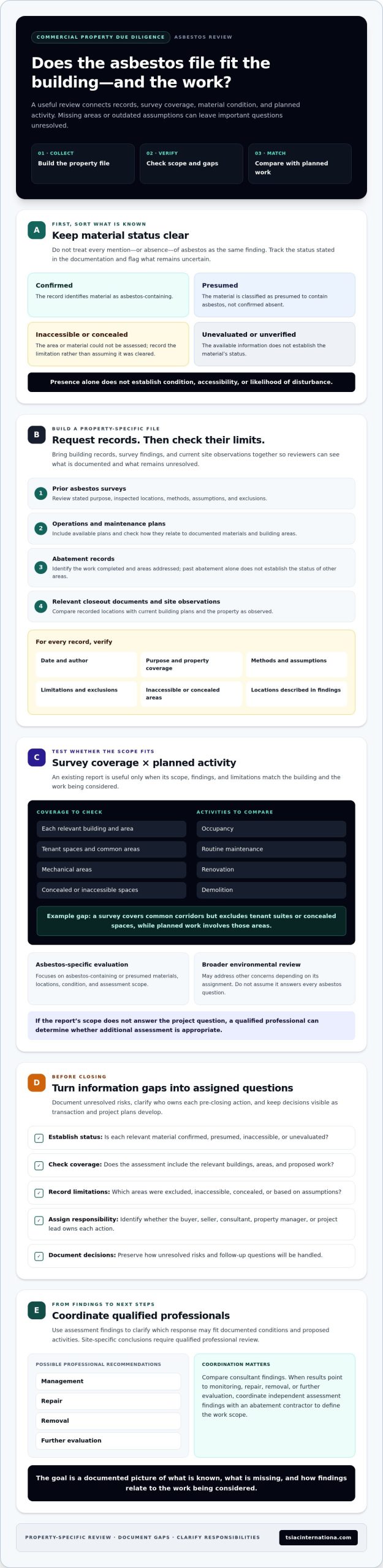
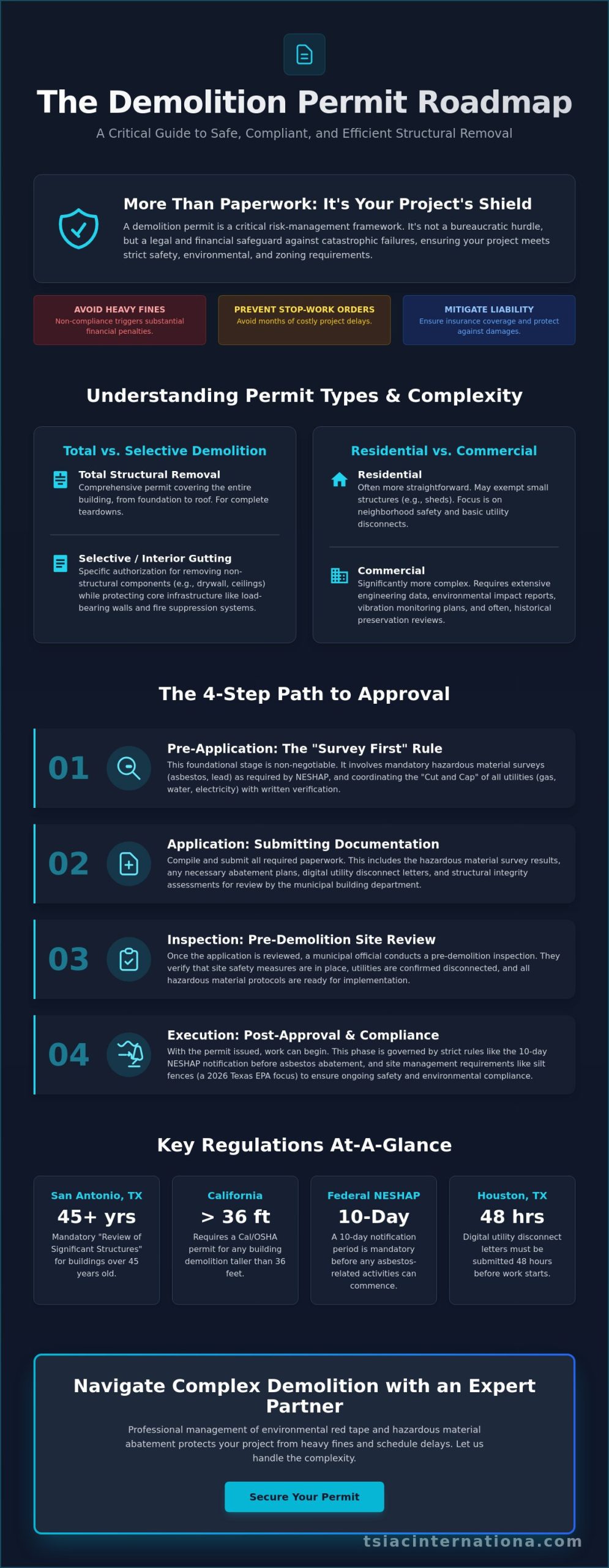
Professional hazardous material abatement serves as a long-term liability shield for the organization. Under EPA National Emission Standards for Hazardous Air Pollutants (NESHAP), owners are responsible for asbestos presence regardless of who performs the work. Non-compliance isn’t just a project delay; it’s a federal offense. As of 2024, OSHA’s maximum penalty for “willful” violations has risen to $161,323 per violation. Specialized containment and professional removal are fixed necessities because they prevent these catastrophic financial and reputational hits. Understanding how to justify demolition costs to a board involves shifting the focus from “spending” to “protecting” the organization’s balance sheet through strict regulatory adherence.

Insurance and Liability Transfer

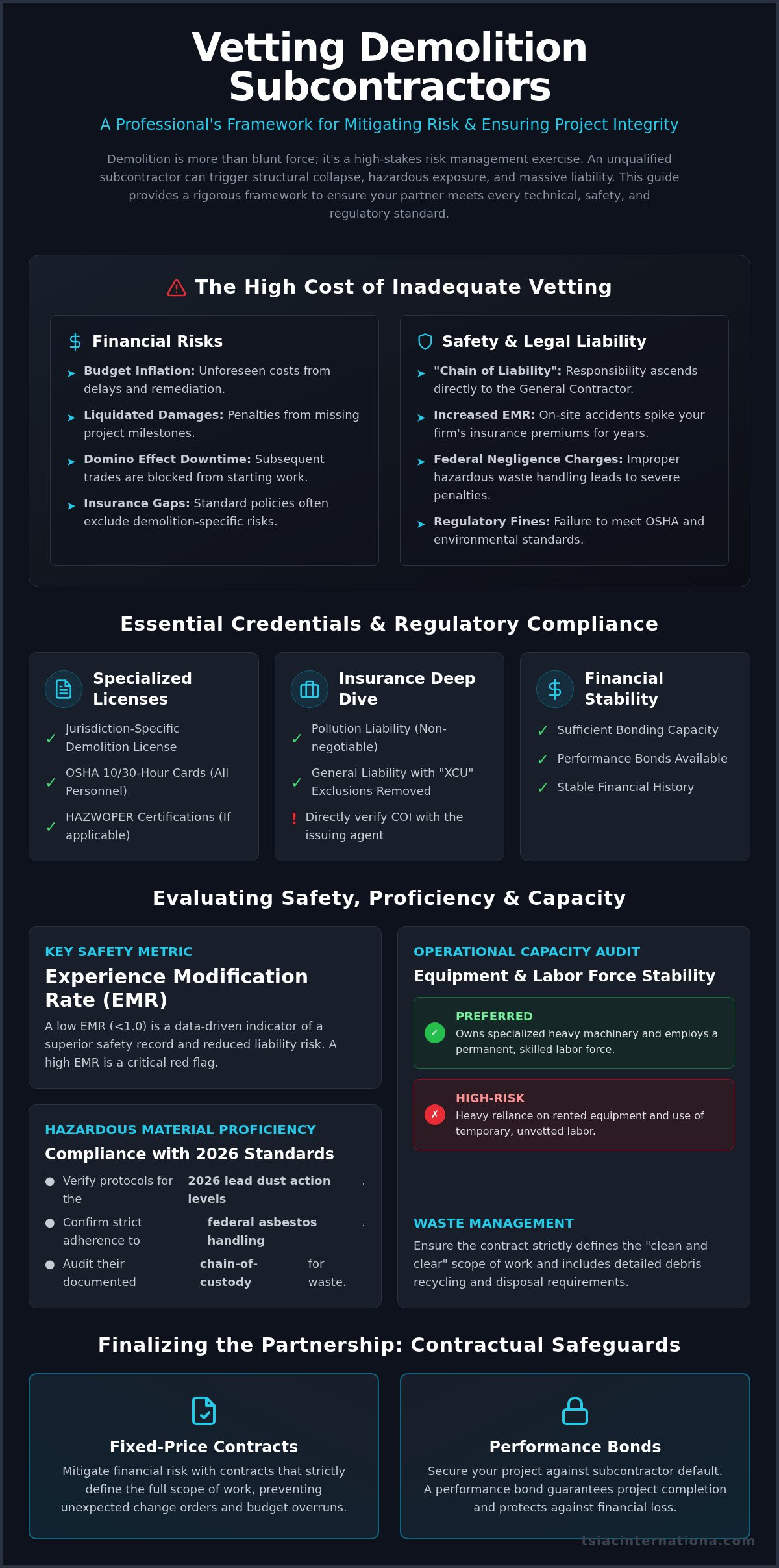
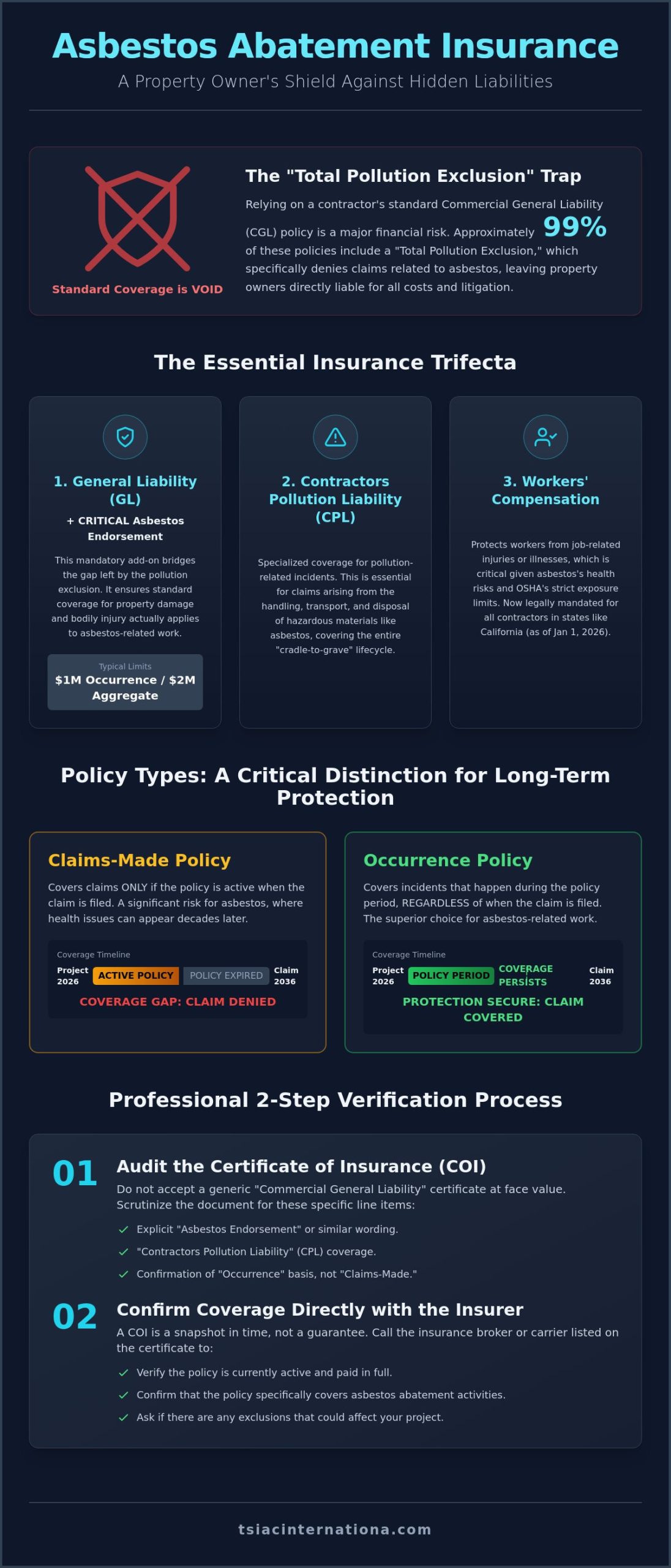
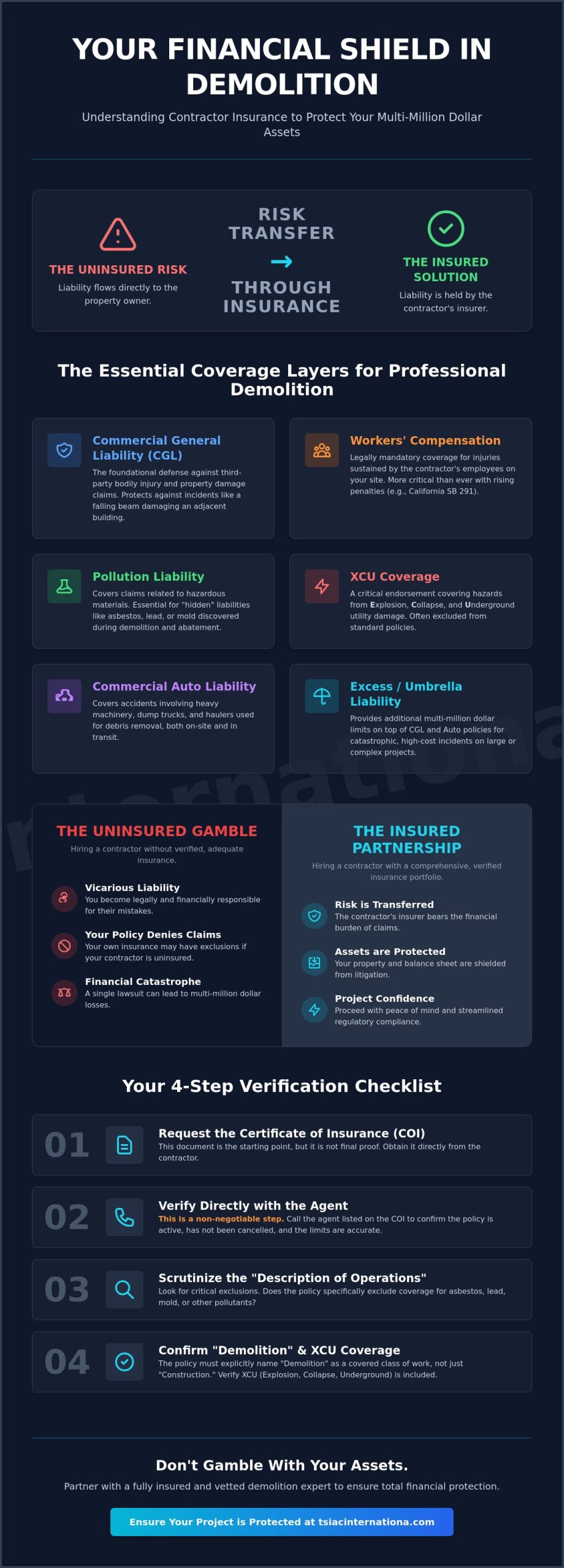
A high-bonded contractor acts as an external safety net. When you hire a firm with robust insurance, you’re transferring the project’s inherent risks away from the board’s accounts. Ensure the contract includes “pollution liability” coverage. This specific policy covers damages resulting from the release of hazardous materials, which standard general liability often excludes. By selecting a contractor with a low Experience Modification Rate (EMR), typically below 1.0, the organization can often negotiate lower site-specific insurance premiums. This technical approach proves that the demolition budget isn’t just paying for destruction; it’s purchasing a clean, risk-free slate for future development.

Comparative Analysis: Demolition vs. Adaptive Reuse Costs

Boards often default to adaptive reuse because it feels like a conservative preservation of capital. However, the financial reality usually favors a clean slate. Maintaining a derelict 50,000-square-foot industrial warehouse can cost upwards of $2.50 per square foot annually just for basic security, structural stabilization, and liability insurance. When you present your case, you’ve got to address the “Hidden Sunk Cost” fallacy. Retrofitting a structure built before 1980 frequently uncovers hazardous materials like asbestos or lead; these remediation efforts can inflate renovation budgets by 15% to 30% before a single structural improvement begins. This unpredictability is a primary reason why project managers must learn how to justify demolition costs to a board through transparent risk modeling.

Modern, energy-efficient new construction offers a superior ROI compared to retrofitting. New builds typically achieve LEED or similar certifications that reduce operational energy costs by 20% to 35% compared to legacy systems. A new facility isn’t just a structure; it’s a high-performance asset with a reset depreciation clock. By clearing the site, you eliminate the compromises of “working around” old load-bearing walls or outdated floor loads that limit modern machinery placement.

Quantifying the Cost of Delay

Holding a non-productive asset is a direct drain on corporate liquidity. Daily holding costs include property taxes, utility stand-by fees, and 24/7 security to prevent trespassing. In metropolitan areas, these costs often exceed $1,200 per day for mid-sized industrial sites. Inflation adds another layer of financial risk. According to the Turner Building Cost Index, construction costs in the specialized industrial sector rose by approximately 8% in 2022. Delaying demolition for twelve months doesn’t just stall the project; it makes the eventual build significantly more expensive due to rising labor and material costs.

Visualizing the Post-Demolition ROI

Boards respond to clarity and visual evidence. Use 3D site renderings to transform a “dilapidated liability” into a “ready-to-build asset” in their minds. A clear timeline shows that while demolition takes 4 to 10 weeks, it accelerates the total project delivery by removing the technical hurdles of working within an old shell. It provides a predictable path to revenue that stakeholders can track with precision. Site-readiness is the primary hurdle to project financing.

Once the site is cleared and graded, the risk profile drops, making the project more attractive to Tier 1 lenders and institutional investors. Understanding how to justify demolition costs to a board requires shifting the focus from the cost of destruction to the value of a prepared foundation.

Partner with technical experts for complex site preparation to ensure your project stays on schedule and under budget.

Presenting the Final Proposal: A Board-Ready Framework

Your objective is to transform a complex technical project into a clear financial and strategic decision. When you explain how to justify demolition costs to a board, you must shift the focus from spending money to protecting equity and safety. Use this four-step framework to secure approval without unnecessary friction.

  • Step 1: Lead with the “Why” (Safety and Strategy). Safety isn’t a line item; it’s a liability shield. Highlight how removing a derelict structure eliminates 100% of the ongoing maintenance costs and legal risks associated with aging assets.
  • Step 2: Present the “Net Cost.” Don’t just show the gross bid. Calculate the total cost minus salvage credits for steel or copper and any identified tax benefits. This presents the actual impact on the company balance sheet rather than an inflated headline figure.
  • Step 3: Address the “What Ifs” (Risk and Contingency). Boards hate surprises. Proactively define a 10% to 15% contingency plan for unforeseen structural or environmental variables. Addressing these risks early builds trust in your management capabilities.
  • Step 4: The Selection Criteria. Prove that your chosen contractor represents the lowest risk, not just the lowest price. Boards prioritize continuity and reputation over marginal savings that could lead to litigation or delays.

Why Experience Minimizes Change Orders

A 15-year veteran firm like TSIAC International identifies structural weaknesses or hazardous materials before they trigger expensive delays. Change orders in demolition often stem from poor site assessment. Relying on a fixed-price structural demolition contract provides the budget certainty boards demand. A documented demolition process ensures that schedule adherence is measured against clear milestones, keeping the project on track for the next phase of development. This level of engineering precision prevents the 20% to 30% cost overruns common with less experienced crews.

The Final Close: Moving to Action

Distill your proposal into three specific decisions: approving the safety-first methodology, authorizing the net budget, and confirming the project timeline. You need to provide a clear roadmap for the immediate future to maintain momentum. In the first 30 days, focus on permitting and site mobilization. By day 60, structural dismantling should be 50% complete. Within 90 days, the site will be cleared, graded, and ready for inspection. This clear timeline reduces the board’s anxiety regarding project stagnation. If you’re ready to secure a professional, data-backed proposal, request a comprehensive board-ready estimate from TSIAC International to ensure your project starts with total transparency and technical authority.

Securing Board Approval Through Strategic Precision

Success in the boardroom depends on shifting the narrative from a simple expense to a calculated investment in site potential. By highlighting how professional structural removal mitigates long-term liability, you provide the clarity stakeholders need to move forward. Knowing how to justify demolition costs to a board involves presenting a framework that prioritizes safety, environmental compliance, and future-proofing the asset. TSIAC International supports this process with 15+ years of structural removal expertise, ensuring every phase of the project remains under strict control.

Our team provides full-service hazardous material abatement and containment, removing the burden of environmental risk from your proposal. We also implement a comprehensive material recycling program for wood, metal, and plastic, which aligns your project with corporate sustainability goals. These technical advantages turn a standard quote into a strategic plan that addresses the board’s primary concerns regarding safety and efficiency. Don’t present a budget when you can present a solution backed by engineering precision.

Get a Board-Ready Demolition Strategy and Quote from TSIAC International

Your path to a cleared, high-value site is ready for its first professional step.

Frequently Asked Questions

How do you explain asbestos removal costs to a board?

Asbestos removal is a non-negotiable legal requirement under OSHA 29 CFR 1926.1101 and EPA NESHAP regulations. Failure to mitigate these hazardous materials leads to federal fines exceeding $15,000 per violation per day. Board members must view this as a critical risk mitigation strategy that protects the organization from long term litigation and worker health claims. Proper abatement ensures the site meets all safety standards before structural work begins.

What is the typical ROI on building demolition for a developer?

ROI on building demolition is calculated by the immediate elimination of holding costs, which often consume 2% to 5% of a property’s value annually in taxes and security. Clearing an obsolete structure increases land liquidity and can lead to a 20% increase in land value once the site is pad-ready. This financial upside is a critical factor when learning how to justify demolition costs to a board focused on asset performance.

Can we reduce demolition costs through on-site material recycling?

On-site material recycling can reduce total project expenditures by up to 30% by eliminating haul-off fees and the need for imported backfill. Crushing concrete and masonry into aggregate on the job site saves between $10 and $25 per ton compared to purchasing virgin materials. This process also decreases heavy vehicle traffic by 40 percent, which lowers the project’s carbon footprint. It effectively transforms waste into a functional construction asset.

Is selective demolition always cheaper than total structural demolition?

Selective demolition is frequently more expensive per square foot because it requires specialized shoring and 50% more labor hours for precision work. While total demolition uses heavy machinery for rapid clearing, selective projects rely on manual labor and expert structural engineers to protect remaining assets. A 2022 industry study showed that intricate interior gutting takes twice as long as a full site clearing. Decision makers should choose based on architectural goals.

How should we handle unexpected site conditions in our approved budget?

Handle unexpected conditions by utilizing a pre-approved contingency fund, typically set at 10% to 15% of the total project budget. When underground storage tanks or unstable soil are discovered, the project manager must present a revised risk matrix. Addressing these issues immediately prevents compounding delays that could increase costs by 1% for every week the project stalls. Proactive planning ensures transparency and maintains the board’s confidence in the management team.

What are the risks of choosing the lowest bidder for a commercial demolition?

Choosing the lowest bidder often results in hidden costs that can exceed the highest bid by 25% due to poor execution and change orders. Low-cost contractors may lack adequate pollution liability insurance or a high Experience Modification Rate below 1.0. This exposes the board to vicarious liability if a safety incident occurs. Professional demolition requires technical precision and robust safety protocols that bargain-rate firms cannot consistently provide.

How does demolition impact our organization’s ESG or sustainability goals?

Modern demolition practices can divert up to 90% of debris from landfills, which directly supports LEED certification and corporate ESG metrics. By documenting the recovery of steel, copper, and concrete, a project manager demonstrates environmental stewardship through measurable data. This provides a quantifiable way of how to justify demolition costs to a board that prioritizes sustainable investment. It turns a destructive process into a verifiable environmental and social gain.

What happens to our liability if we delay a necessary demolition?

Delaying a necessary demolition exposes the organization to trespassing lawsuits and rising insurance premiums, which can jump by 15% annually for derelict structures. Buildings left idle are prone to fire, mold, and structural collapse, creating a hazardous environment for the public. Under the Attractive Nuisance doctrine, boards are legally responsible for injuries to unauthorized persons on the site. Immediate action is a defensive financial and legal necessity.

Demolition Site Safety: The Comprehensive Guide to Risk Management in 2026

Recent 2024 industry audits reveal that nearly 60% of demolition accidents stem from unforeseen structural instabilities that could’ve been mitigated…

Recent 2024 industry audits reveal that nearly 60% of demolition accidents stem from unforeseen structural instabilities that could’ve been mitigated during the pre-planning phase. You’re likely aware that maintaining demolition site safety requires more than just wearing hard hats; it demands a disciplined, engineering-first approach to risk. It’s natural to feel concerned about the 2026 regulatory shifts or the hidden costs of hazardous material abatement. We’ve seen how even a minor oversight in asbestos containment can halt a multi-million dollar project for 30 days or more.

This guide will help you master the critical safety protocols and specialized abatement strategies needed to ensure a zero-accident project. You’ll gain the technical clarity required to navigate complex legal requirements and manage debris with maximum efficiency. We’ll break down the precise monitoring technologies and risk management frameworks that professional site managers use to maintain total control over even the most challenging urban teardowns.

Key Takeaways

  • Establish a legal and technical bedrock by defining the 2026 standards for engineering surveys and the critical role of the competent person.
  • Avoid project delays by mastering specialized abatement strategies and equipment requirements for managing hazardous materials like asbestos and lead.
  • Execute complex selective demolition with surgical precision to ensure the structural integrity of the building envelope remains uncompromised.
  • Adopt the non-negotiable 2026 PPE requirements and specialized training protocols essential for maintaining demolition site safety in high-hazard environments.
  • Complete the safety lifecycle by integrating on-site material sorting and environmental remediation into your post-demolition workflow.

The Foundation of Demolition Safety: Pre-Project Planning and Engineering Surveys

Effective demolition site safety begins months before the first excavator arrives on site. As of January 2026, the industry standard for a “competent person” conducting an engineering survey has evolved. This role now requires a minimum of 10 years of structural field experience or a Professional Engineering (PE) license with a focus on forensic load analysis. This expert doesn’t just look at walls; they calculate the residual strength of a decaying structure. This survey serves as the legal bedrock for the entire project. Without a signed, dated, and stamped engineering report, any incident becomes an indefensible liability. In South Carolina, where coastal conditions accelerate structural degradation, this document is the only shield against the unpredictable nature of weakened materials.

Preparation requirements differ significantly between residential and commercial environments. Residential projects in Charleston often deal with balloon framing or 19th-century timber rot. Commercial sites, however, involve complex challenges like post-tensioned concrete slabs and massive HVAC systems that weigh upwards of 15,000 pounds. We rely heavily on historical building data to predict how these structures will behave. For buildings in the Lowcountry constructed before 1950, we look for “Charleston Grey” brick compositions or tabby concrete foundations. These materials have unique compression limits. Understanding these historical nuances allows us to execute a Demolition process overview that accounts for the specific structural DNA of the coastal South.

The Engineering Survey: More Than a Walkthrough

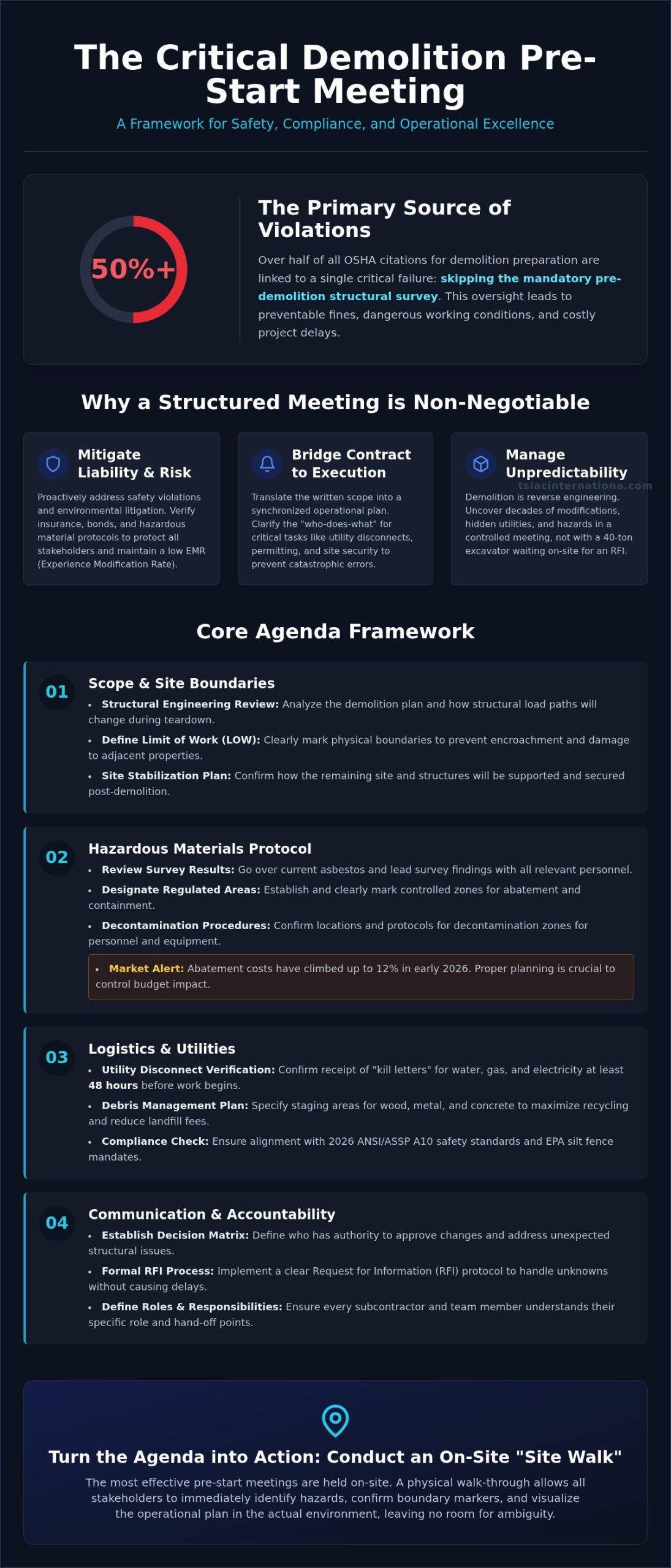
A written engineering survey isn’t a formality; it’s a tactical map. We mandate that every survey includes these 5 critical components:

  • A comprehensive assessment of floor load capacities to prevent “pancaking” during debris accumulation.
  • A detailed map of load-bearing versus non-load-bearing partitions.
  • A 3D vibration impact study for adjacent structures within a 50-foot radius.
  • A hazardous material inventory, specifically targeting 20th-century lead and asbestos.
  • A structural stability analysis of all stairwells and egress routes.

Assessing the impact of heavy machinery on upper floors is a precise science. A 25-ton high-reach excavator exerts immense ground pressure. If we’re placing smaller 5-ton skid steers on a second-story slab, we calculate the dead load plus the dynamic force of the machine’s movement. In aging Lowcountry structures, we often find “unknown-unknowns,” such as hidden cisterns or unrecorded 1920s-era structural modifications. These anomalies can cause a 30% drop in expected load capacity, making forensic planning vital.

Utility Disconnection and Infrastructure Isolation

Securing a site means total isolation from the municipal grid. We follow the “Call Before You Dig” (811) protocol, which received a significant digital update in March 2026. This update now requires 3D GPS tagging for all underground utility strikes, ensuring that gas, electric, and water lines are mapped with 2-inch precision. We don’t just trust the maps; we use ground-penetrating radar to verify them. Securing these lines prevents flash fires or localized flooding that can stall a project for 60 days or more.

Coordination with local providers like Dominion Energy and the Charleston Water System is the final step in isolation. In Myrtle Beach, we work closely with Santee Cooper to ensure high-voltage lines are de-energized and grounded. It’s not enough to turn off a switch. We require physical disconnection and visual verification of “air gaps” in the service lines. This rigorous approach to utility management ensures that when the demolition begins, the only energy on the site is the energy we’ve brought with us. It’s a disciplined, engineering-first mindset that keeps our crews safe and our clients’ reputations intact.

Managing Invisible Killers: Asbestos, Lead, and Hazardous Material Abatement

Hazardous material management represents the primary cause for 65% of all demolition project delays in South Carolina. When a crew encounters unexpected friable asbestos or lead-based pigments, the site must stop immediately to prevent environmental contamination. These “invisible killers” don’t just threaten worker health; they invite litigation and regulatory fines that can exceed $16,131 per violation per day under current 2024 inflation-adjusted figures. At TSIAC International, we recognize that demolition site safety begins with identifying these risks long before the first excavator arrives on site. We treat every structure built before 1980 as a high-risk environment requiring surgical precision rather than blunt force.

Effective abatement requires specialized equipment that goes far beyond standard construction gear. We utilize industrial-grade negative air machines and high-capacity HEPA filtration systems to ensure that toxic particles remain trapped. Every project we undertake involves a task-specific Job Hazard Analysis (JHA). This document isn’t a mere formality; it’s a technical requirement under OSHA demolition safety standards that dictates exactly how we handle toxic substances. While “standard” demolition firms might rely on basic dust masks, our complex execution involves full-face respirators and real-time air monitoring to verify that containment holds. We don’t guess at safety; we measure it with calibrated sensors.

Containment Strategies for Toxic Dust and Fibers

By 2026, the industry standard for HEPA filtration will mandate a 99.97% capture rate for particles as small as 0.3 microns. We’ve already implemented these benchmarks across our Charleston operations. We establish negative pressure environments to ensure air only flows into the work zone, never out toward the public. Our teams use wet-method techniques, which have been proven to reduce respirable crystalline silica drift by 85%. Before leaving the “hot zone,” every worker passes through a three-stage decontamination unit. This process prevents the “take-home” lead and asbestos exposure that often affects workers’ families and the surrounding community.

Regulatory Compliance: OSHA and EPA Standards

Navigating the overlap between OSHA Subpart T and EPA NESHAP regulations requires a dedicated compliance officer and meticulous record-keeping. We maintain rigorous documentation for the legal disposal of hazardous waste, tracking every cubic yard from the job site to a certified Class 3 landfill. It’s a complex process that demands engineering precision. The current legal threshold for lead-based paint disturbance is defined as a concentration of lead equal to or exceeding 1.0 milligram per square centimeter or 0.5 percent by weight. Failing to meet these metrics puts your project and our reputation at risk. If you’re planning a complex tear-down, our team provides the technical expertise needed to keep your site compliant and your timeline intact.

We approach hazardous materials with a disciplined mindset. Our experience in industrial alpinism and steel structure work allows us to access and abate materials in “impossible” locations where others would fail. We don’t just clear the site; we provide a clean slate for future construction. This commitment to detail ensures that the legacy of an old building doesn’t become a liability for the new one. Our word is a guarantee of quality, backed by years of successful, accident-free completions in the most challenging environments.

Structural Integrity Hazards in Selective and Interior Demolition

Selective demolition isn’t a blunt force activity. It’s a calculated, surgical process where we remove specific portions of a building while preserving the primary structure. This is particularly vital in Charleston’s historic district, where 85% of our projects involve buildings over 60 years old. Maintaining the building’s envelope, or its exterior shell, requires a deep understanding of load paths. If you remove a partition wall that’s been incorrectly modified into a load-bearing element over decades, you risk an unplanned collapse. To mitigate this, our engineers follow OSHA’s guide to preparatory operations to conduct a thorough structural survey before any tool touches the site. This ensures we identify every structural dependency, from gravity loads to lateral bracing, before the gutting begins.

We use temporary shoring and bracing systems to support adjacent structures and floors above the work zone. In 2023, 15% of demolition site safety incidents nationwide were linked to premature structural failure. We prevent this by installing hydraulic shores that can handle 20,000 pounds of vertical pressure. This level of support is non-negotiable when we’re stripping an interior down to its studs. Our team treats every structural component as “active” until a professional engineer confirms it’s safe for removal.

The Risks of Surgical Removal: Maintaining Stability

Surgical removal demands a strict sequence. We start from the top and work down to prevent floor overloads from accumulated debris. For example, when we remove 500 square feet of acoustic ceiling and metal framing, we clear the material immediately. This keeps the live load on the slab below 50 pounds per square foot. In Charleston, we monitor vibration levels using digital seismographs. We keep peak particle velocity below 0.5 inches per second to protect the fragile masonry of neighboring historic properties. This precision ensures that demolition site safety extends beyond our property lines to the community’s architectural heritage.

Heavy Machinery Safety and Mechanical Hazards

Operating heavy machinery inside a building shell introduces mechanical hazards. We define safe operating zones for skid steers and mini-excavators with high-visibility floor markings. Every operator follows the blind spot rule; they don’t move the equipment until they’ve made eye contact with ground crews. Communication happens via noise-canceling headsets, not hand signals that can be misinterpreted. We also use 360-degree camera systems on our shears to eliminate blind spots. This technology reduced our near-miss incidents by 22% in the last fiscal year. Preventing tip-overs on uneven debris piles requires constant slab assessment. We never exceed 75% of a floor’s rated capacity when positioning equipment. Our crews check the floor’s integrity every four hours during active machine use to account for any shifting loads.

Precision and patience are the hallmarks of our interior work. By combining engineering data with rigorous on-site protocols, we manage the “impossible” locations that other firms avoid. Our commitment to stability isn’t just about following the law; it’s about protecting the lives of our crew and the integrity of Charleston’s skyline.

The Human Element: PPE, Training, and Emergency Response

Demolition site safety relies on the intersection of advanced technology and human discipline. While heavy machinery performs the bulk of the labor, the integrity of the project depends on the individual professional’s readiness. By 2026, the standard PPE kit for demolition has evolved beyond basic gear to include high-visibility Class 3 apparel with integrated fall protection d-rings and impact-rated eyewear that exceeds ANSI Z87.1+ standards. Every technician on a Charleston job site must treat their gear as their primary line of defense against the unpredictable nature of structural dismantling.

Generic construction training often fails in demolition because it treats structures as stable entities. Demolition requires a deep understanding of stored energy and shifting loads. According to OSHA 1926 Subpart T, specialized training is mandatory; however, we push beyond these basics. Our teams undergo 40 hours of demolition-specific hazard recognition annually. This training addresses the psychology of the routine, a state where experienced workers may lose focus during repetitive debris clearing. We counter this by rotating tasks every 120 minutes to maintain peak cognitive vigilance and prevent fatigue-related errors.

Daily “Toolbox Talks” serve as the tactical anchor for each shift. These aren’t generic safety lectures. They’re 10-minute briefings focused on the specific hazards of the day, such as a compromised load-bearing beam identified during the previous shift or high-wind warnings affecting crane operations. This ensures that 100% of the crew understands the immediate environment before a single tool is engaged. This localized approach is why our demolition site safety records consistently outperform industry averages in South Carolina.

Beyond the Hard Hat: Specialized PPE for Abatement

Working with hazardous materials requires engineering precision. We mandate annual respirator fit-testing for all workers handling asbestos or lead, ensuring a seal that filters 99.97% of airborne particulates. Footwear must meet ASTM F2413-18 standards for puncture resistance to protect against jagged rebar and concrete shards. In high-decibel environments, such as concrete crushing operations exceeding 90 decibels, we implement dual-layer hearing protection to prevent long-term auditory damage and maintain clear radio communication channels.

Developing a Site-Specific Emergency Action Plan (EAP)

A static exit map is useless on a site where walls disappear daily. Our EAPs feature dynamic exit routes that project managers update every 24 hours as the building’s footprint changes. We maintain on-site trauma kits capable of treating severe hemorrhages within 180 seconds of an incident, regardless of how remote the site is. For metal cutting tasks, we strictly enforce NFPA 241 standards, maintaining a 35-foot fire-safe perimeter and a dedicated fire watch for 60 minutes after the last spark falls. This level of detail is a core component of our demolition site safety protocols.

Ensure your next project meets the highest standards of professional execution. Contact our technical experts to discuss your site-specific safety requirements today.

Post-Demolition Safety: Debris Management and Environmental Remediation

Safety doesn’t end when the structure falls. The transition from active destruction to environmental remediation marks the most critical phase of a project’s lifecycle. At TSIAC International, we view this stage as a technical discipline where precision prevents future liability. Managing a site’s footprint requires a systematic approach to debris, ensuring that every cubic yard of material is accounted for, categorized, and processed. This rigorous methodology transforms a hazardous demolition zone into a stable, build-ready foundation for Charleston’s next generation of infrastructure.

Effective demolition site safety during the cleanup phase hinges on the controlled movement of materials. Leaving mixed debris piles creates unstable terrain and fire hazards. By implementing on-site sorting, we reduce the volume of waste sent to landfills by up to 85% on average. Recycling wood, metal, and plastic isn’t just an environmental choice; it’s a risk management strategy. It removes sharp edges and combustible materials from the site immediately, which lowers the probability of puncture wounds or structural collapses in debris mounds. This process also eliminates the long-term liability associated with improper waste disposal, protecting the property owner from future environmental litigation.

Safe Sorting: Recycling Debris Without Injury

Mechanical sorting represents our primary defense against ergonomic injuries. Using hydraulic grapples and magnetic separators reduces the need for manual handling by approximately 70%. This shift directly correlates to a decrease in back strains and strike-by incidents. We pay specific attention to “hidden” rebar and jagged steel fragments that often lurk beneath the surface of concrete piles. These elements pose significant puncture risks to both personnel and heavy equipment tires. Our teams adhere to the TSIAC 2026 recycling standards to ensure every material stream is processed with technical accuracy. This protocol ensures that 95% of ferrous metals are recovered safely, preventing them from becoming long-term hazards for future site occupants.

  • Metal Recovery: We utilize high-powered magnets to extract structural steel and rebar, preventing manual handling of sharp edges.
  • Concrete Crushing: On-site crushing turns slabs into reusable aggregate, reducing the number of heavy truck trips by 40%.
  • Timber Segregation: Wood is separated to prevent the accumulation of combustible biomass within mixed debris piles.

Final Site Clearance and Certification

A site is only truly safe when empirical data confirms it. We perform post-abatement air clearance testing within a strict 24 to 48-hour window following project completion. This process verifies that no microscopic particulates remain in the atmosphere. For sites with a history of industrial chemical use, soil remediation becomes the priority. We conduct rigorous soil analysis to detect heavy metals or hydrocarbons, ensuring the land meets every Charleston safety regulation. This engineering-led approach guarantees the location is fully certified for re-entry. If you require this level of precision for more confined spaces, see how TSIAC handles complex Commercial Interior Gutting Projects where debris management requires even higher levels of logistical control.

Finalizing a build-ready status means the next contractor can break ground without discovering buried surprises. Our final demolition site safety audit includes a comprehensive sweep of the perimeter and a review of all disposal manifests. This level of transparency and technical rigor is what defines our role as a partner in Charleston’s development. We don’t just clear the land; we secure its future through disciplined remediation and verified safety standards.

Securing Your Project’s Future with Engineering Precision

Achieving total demolition site safety requires more than just following basic protocols; it demands a rigorous engineering approach and a commitment to modern standards. Successful projects in 2026 depend on exhaustive pre-project surveys and the precise management of structural integrity. Handling hazardous substances like lead and asbestos requires specialized expertise to prevent long-term liability. Effective debris management isn’t just a final step. It’s a core component of environmental remediation that ensures compliance with the latest recycling mandates.

TSIA C International brings over 15 years of accident-free structural removal experience to every site. Our team consists of certified asbestos and lead abatement specialists who understand the complexities of high-risk environments. We’re dedicated to meeting 2026 environmental recycling standards on every project we undertake. We handle the technical challenges so you can focus on the next phase of development. Our disciplined approach guarantees that even the most difficult locations are managed with absolute control.

Partner with TSIAC International for a Safe, Compliant Demolition Project

Your project deserves the stability and precision that only seasoned experts can provide.

Frequently Asked Questions

What is the most common safety hazard on a demolition site?

Unplanned structural collapse represents the most significant risk to workers on any project. According to Bureau of Labor Statistics data from 2022, falls from heights and being struck by falling objects account for over 35% of site fatalities. Maintaining high standards for demolition site safety requires constant monitoring of structural stability as each section is removed. We mitigate these risks through precise load-bearing calculations and sequence planning.

How does an engineering survey differ from a standard building inspection?

An engineering survey focuses on structural integrity and the possibility of unplanned collapse, whereas a standard inspection evaluates building code compliance or cosmetic condition. OSHA regulation 1926.850(a) mandates this survey before any demolition begins. It’s a technical analysis of the framing, floors, and walls to ensure the structure won’t fail prematurely. Our engineers document the 100% load-path of the building to prevent accidents during the teardown process.

Are there specific OSHA standards just for demolition?

OSHA maintains a dedicated set of regulations for the industry under 29 CFR Part 1926 Subpart T. These 10 specific sections cover everything from preparatory operations to mechanical demolition and debris removal. Unlike general construction rules, Subpart T requires a written engineering survey and specific protocols for wall and floor openings. We adhere to these 1926 standards to ensure every Charleston project meets federal legal requirements.

What is the “competent person” requirement in demolition safety?

A competent person is an individual capable of identifying existing hazards who has the legal authority to stop work immediately to correct them. Under OSHA 1926.32(f), this isn’t just a title; it requires specific training and technical knowledge of structural mechanics. Our site leads possess at least 10 years of field experience. They perform daily inspections to ensure demolition site safety protocols remain active and effective throughout the work shift.

How do you safely manage asbestos during a full structural demolition?

We manage asbestos by conducting a comprehensive NESHAP-compliant survey and completing full abatement before any structural demolition starts. EPA regulations require that all Friable Asbestos-Containing Material is removed if it exceeds 160 square feet or 260 linear feet. Our team seals the work area with 6-mil poly sheeting and maintains negative air pressure. We don’t allow structural impact until a third-party lab confirms clearance via TEM testing.

What should be included in a demolition fire prevention plan?

A demolition fire prevention plan must include a designated fire watch and a 24-hour emergency contact list. OSHA 1926.150 requires at least one fire extinguisher with a 2A rating for every 3,000 square feet of protected building area. The plan specifies that standpipes must be maintained in operable condition up to one floor below the demolition level. We also enforce a strict 35-foot clearance for all hot work like torch cutting.

Can I perform my own demolition safety inspection?

You can’t legally perform your own safety inspection because OSHA 1926.850(a) requires a qualified person to conduct a written engineering survey. This individual must have the technical expertise to evaluate structural loads and potential for spontaneous collapse. Relying on an untrained eye increases the risk of catastrophic failure by 50% or more. Our licensed engineers provide the necessary documentation to ensure your Charleston project stays compliant and safe.

How does selective demolition impact the safety of the remaining structure?

Selective demolition creates localized stress points that can compromise the 100% load-bearing capacity of the remaining structure if not managed correctly. We use temporary shoring and bracing systems to support these diverted loads. Engineering data shows that 25% of structural failures in renovations occur because workers removed a secondary support beam without proper reinforcement. We treat every cut as a surgical procedure to protect the building’s long-term stability.