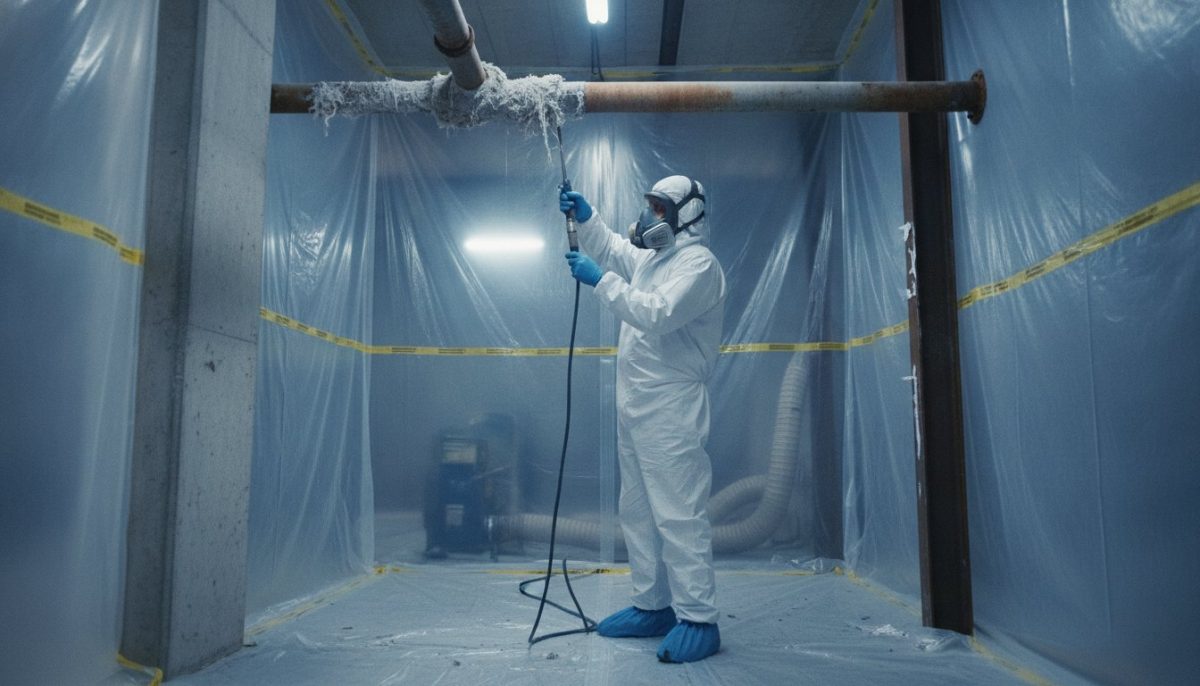
Demolition Permit Process: The Comprehensive 2026 Regulatory Guide

A demolition permit is not a bureaucratic hurdle to clear; it’s a critical risk-management framework that protects your project from catastrophic…

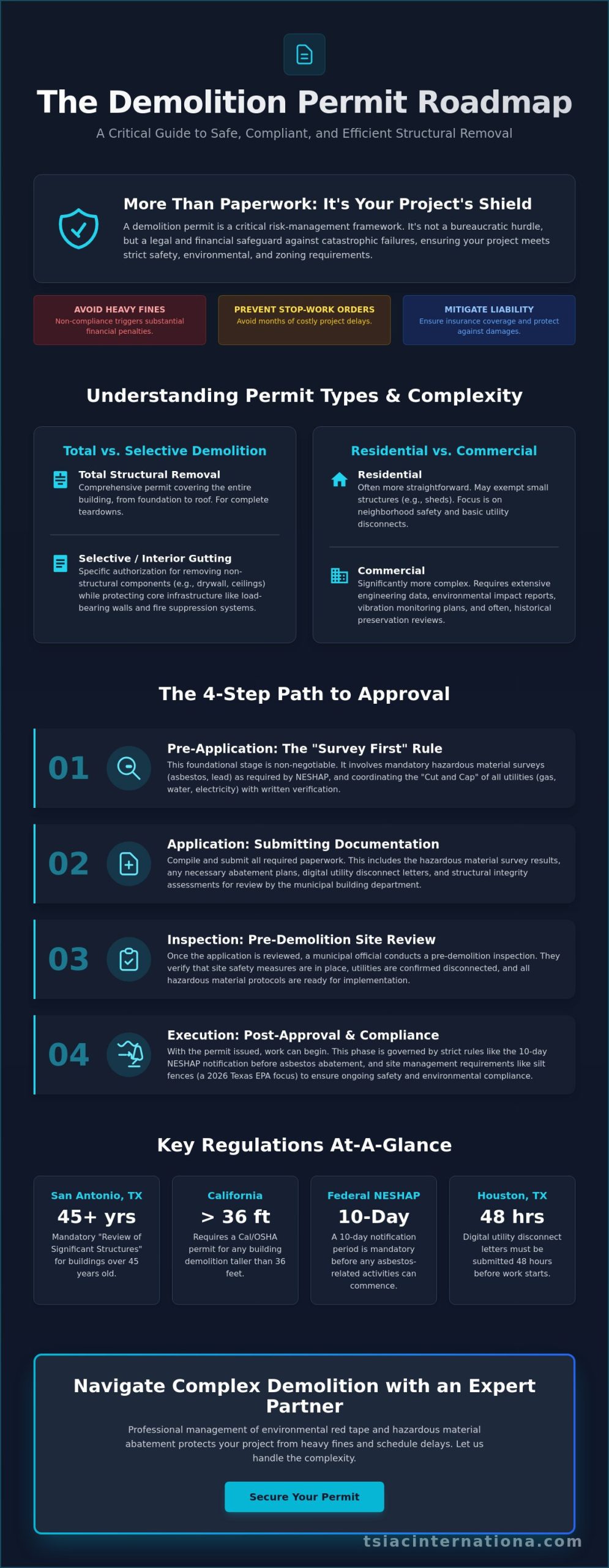
A demolition permit is not a bureaucratic hurdle to clear; it’s a critical risk-management framework that protects your project from catastrophic legal and financial failure. You’re likely concerned that paperwork errors or missed asbestos testing requirements will trigger heavy fines or halt your schedule entirely. In an era where San Antonio requires reviews for 45-year-old structures and California mandates Cal/OSHA permits for any building over 36 feet, mastering the demolition permit process is essential for operational continuity.

We understand that managing environmental obligations while balancing tight deadlines feels overwhelming. This comprehensive guide provides a clear roadmap for permit approval, from securing digital utility disconnect letters to passing final inspections. You’ll learn how to handle hazardous material surveys and identify a contractor who manages technical red tape with methodical precision. We’ll break down the 10-day NESHAP notification rules and specific 2026 Texas EPA focuses like silt fence requirements to ensure your structural removal remains safe and legal.

Key Takeaways

  • Understand why a permit is a critical risk-management tool rather than just a document, protecting your project from legal and environmental liability.
  • Learn why hazardous material surveys are the non-negotiable first step for any compliant structural removal and how they dictate your timeline.
  • Master the demolition permit process by identifying the specific documentation required for utility disconnects and structural integrity assessments.
  • Prepare for the pre-demolition inspection by knowing exactly what municipal officials look for before the first hammer swings.
  • Discover how professional management of environmental red tape and hazardous material abatement protects your project from heavy fines and schedule delays.

What is a Demolition Permit and Why is it Legally Mandatory?

A demolition permit serves as the primary legal gateway for any structural removal project. It’s a formal authorization issued by a municipal building department that confirms your project meets specific safety, environmental, and zoning requirements. Without this document, the demolition permit process cannot legally commence. The permit acts as a safeguard, ensuring that the planned activity won’t compromise public health, damage neighboring properties, or cause irreparable environmental harm through improper waste disposal.

This regulatory requirement represents a convergence of federal, state, and local mandates. While local zoning boards manage land use, the EPA sets standards for hazardous material containment, and OSHA governs worker safety during the teardown. For a foundational look at these requirements, you can review this demolition process overview which highlights the necessity of pre-demolition safety checks and utility disconnections. The permit process forces a methodical review of these factors before the first machine arrives on site.

Proceeding without a permit is a high-stakes gamble that rarely pays off. Municipalities have the authority to issue immediate “Stop Work” orders, which can freeze a project for months and trigger substantial administrative fines. Beyond these penalties, the lack of a permit creates massive civil liability. If a neighboring structure is damaged or an environmental leak occurs on an unpermitted site, insurance providers frequently deny coverage. This leaves the property owner personally responsible for all damages and legal fees.

Total vs. Selective Demolition Permits

Total structural removal requires a comprehensive permit that covers the entire footprint of the building from the roof to the foundation. However, projects focusing on Selective Demolition or Interior Gutting also require specific authorizations. For commercial tenant improvements, interior gutting permits are essential to ensure that fire suppression systems, load-bearing walls, and shared utility lines remain intact. These permits focus on protecting the building’s core infrastructure while allowing for the precise removal of non-structural components like drywall and acoustic ceilings.

The Difference Between Residential and Commercial Permitting

The complexity of the demolition permit process scales with the size and use of the structure. Residential permits are often straightforward, sometimes exempting small structures like sheds or non-structural fences. In contrast, commercial projects demand extensive engineering data, vibration monitoring plans, and detailed environmental impact reports. Historical preservation is another critical factor. In cities like San Antonio, any structure over 45 years old undergoes a mandatory “Review of Significant Structures,” which can significantly extend the approval timeline compared to a standard residential teardown.

Pre-Application Requirements: Hazardous Materials and Site Safety

Successful project management begins long before the first excavator arrives. The demolition permit process requires several technical prerequisites that serve as the foundation for a legal teardown. Foremost among these is the “Survey First” rule. In 2026, federal NESHAP regulations mandate a comprehensive asbestos and lead survey for all commercial, industrial, and institutional buildings. This isn’t a suggestion; it’s a mandatory filing requirement. If hazardous materials are detected, a specialized abatement plan must be approved before the demolition permit is even considered.

Coordinating with utility providers represents another critical pre-application hurdle. You’ll need to manage the “Cut and Cap” process for water, gas, and electricity. Many jurisdictions, following a model similar to the municipal demolition permit process, require written verification from each utility company that services have been safely terminated at the property line. This prevents catastrophic accidents, such as gas explosions or water main breaks, during the structural removal phase. In Houston, for example, these disconnect letters must be submitted digitally 48 hours before any physical work starts.

Asbestos and Lead Abatement Documentation

A certified building inspector must perform the initial hazardous material survey to identify regulated materials. This documentation is vital because it links your abatement strategy directly to the permit application. You must provide proof of safe containment and disposal protocols to satisfy municipal health departments. For regional compliance, reviewing a dedicated asbestos removal south carolina guide can clarify the specific SCDES and LLR licensing requirements needed for a successful submission.

Environmental and Waste Management Plans

The 2026 regulatory landscape places a heavy emphasis on sustainability and site containment. Modern permits often require a debris recycling plan that documents the diversion of metal, wood, and concrete from landfills. The EPA has also increased its focus on erosion and sediment control. You must implement silt fences and runoff barriers to prevent debris from entering city sewers. Handling specialized components like acoustic ceilings or metal framing requires specific disposal manifests. Integrating these elements into a cohesive site safety plan protects the community and ensures your project remains compliant. Partnering with a specialist in asbestos abatement can help manage these complex environmental filings with technical precision.

Demolition Permit Process: The Comprehensive 2026 Regulatory Guide

The Step-by-Step Demolition Permit Application Process

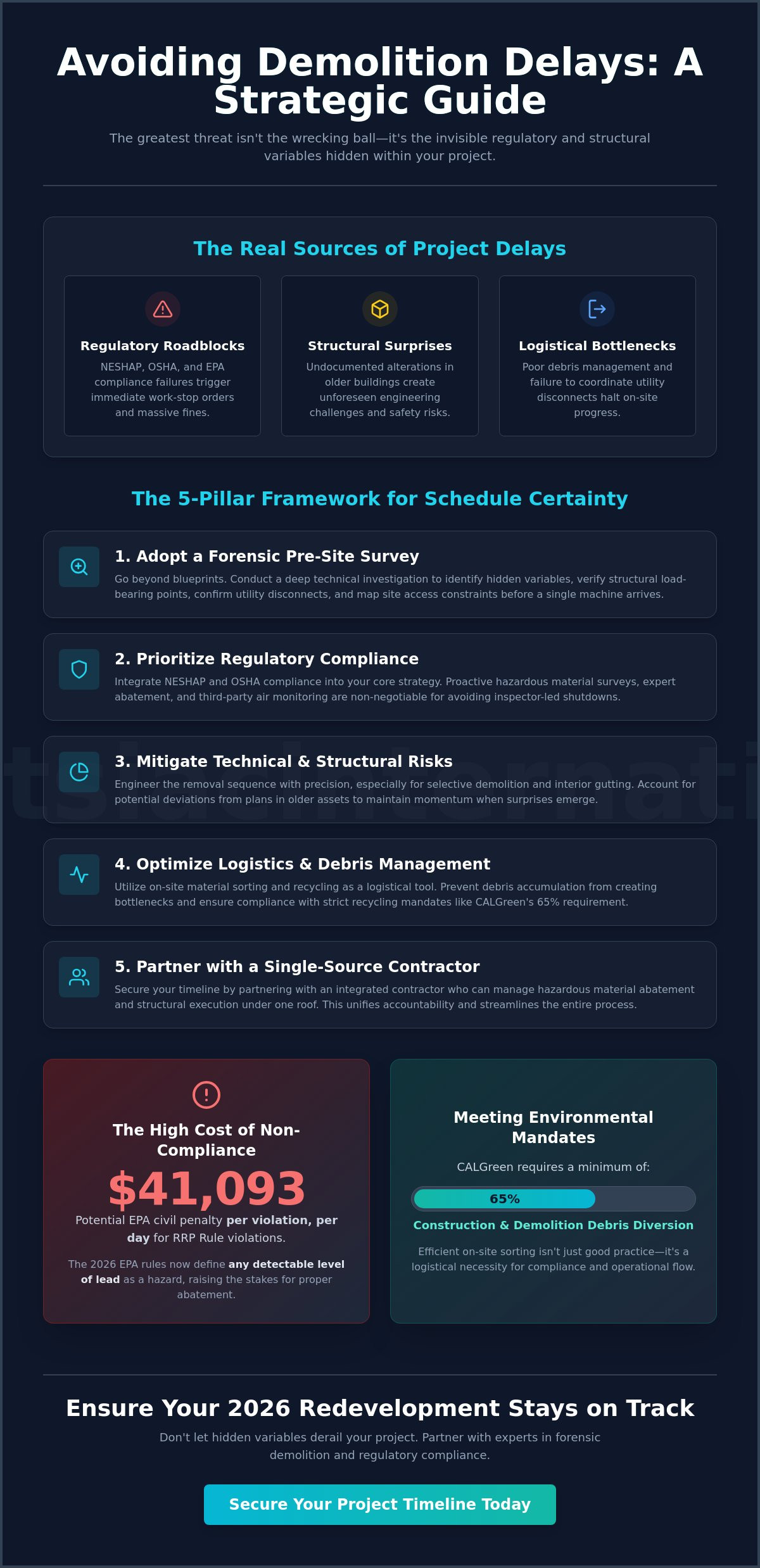
The demolition permit process requires more than just filling out a form; it demands a meticulously organized technical dossier. Once you’ve completed the pre-application surveys and hazardous material assessments, the formal application sequence begins. This methodical approach ensures that every structural, environmental, and safety risk is mitigated before the first piece of equipment enters the site boundary. A fragmented application is the leading cause of project delays, making a disciplined submission strategy essential.

  • Step 1: Structural Integrity Analysis. A qualified professional must analyze the building’s current state, identifying load-bearing elements and potential collapse zones that could impact safety.
  • Step 2: Documentation Collection. You must gather all verified utility disconnect letters and environmental clearances, including the mandatory 10-day NESHAP notification receipts.
  • Step 3: Packet Compilation. Assemble site maps, abatement plans, and contractor licenses into a single, cohesive technical submission.
  • Step 4: Municipal Review. The application moves through various city departments, where officials scrutinize the plans for compliance with local and federal codes.
  • Step 5: Issuance and Posting. Once approved, the permit must be prominently displayed on-site to avoid immediate work stoppages during unannounced field inspections.

Compiling the Technical Documentation Packet

Your application’s success hinges on the precision of your site plans. These drawings must accurately show property lines, setbacks, and the proximity of adjacent structures that could be affected by vibration or falling debris. For projects involving Selective Demolition, the role of a structural engineer is vital. They provide the necessary calculations to verify that the remaining portions of the building will stay stable during interior gutting. Additionally, you’ll need to provide proof of high-limit liability insurance and workers’ compensation. Professional contractors follow the safety and ethical guidelines established by the National Demolition Association to ensure every phase of the application meets these stringent municipal standards.

Navigating the Review and Revisions Phase

Don’t expect immediate approval for complex commercial projects. The review phase involves coordination between the Fire Department, Planning Commission, and Health Department. Rejections often stem from minor clerical errors or missing details in the waste management plan. While residential permits might clear in a few days, commercial applications frequently face a review period of several weeks. Anticipating these delays and responding to municipal comments with technical accuracy is the only way to maintain your project schedule. If your plan is rejected, address the specific code violations cited by the reviewer immediately to restart the clock on your approval timeline.

Post-Approval: Execution, Inspections, and Compliance

Receiving the permit is a major milestone, but the active phase of the demolition permit process requires continuous regulatory adherence. Before structural removal begins, a municipal official typically conducts a “Pre-Demo” inspection. They verify that the site is secured, silt fences are correctly installed, and utility terminations are verified. This visit ensures that the safety plans submitted during the application phase are physically implemented on the ground. Skipping this step or starting work before the inspector signs off can lead to immediate permit revocation.

Safe material handling is paramount, especially regarding hazardous substances. You must adhere to rigorous hazardous material abatement south carolina standards to prevent site contamination and worker exposure. Dust control and noise ordinances are not just courtesy; they’re legal requirements. In 2026, many cities require active water misting systems to suppress particulates during the teardown of large structures. Failure to manage debris or noise can lead to work stoppages and fines that far exceed the cost of proper mitigation equipment.

On-Site Compliance During the Structural Removal

Inspectors can arrive unannounced at any time. You must keep the physical permit and all safety documentation, including recent asbestos air monitoring results, accessible on-site. Managing the waste stream is equally critical. You are responsible for tracking recycling percentages and maintaining landfill manifests for every load of debris that leaves the site. Understanding the broader demolition process south carolina helps align your daily operations with these strict permit conditions and ensures your waste diversion goals are met.

Closing the Permit: Final Inspections and Sign-Off

The final phase involves a post-demolition site visit. Officials verify that all foundations are removed and utilities are permanently capped below grade. You’ll need to submit a final recycling report documenting that you met the mandated diversion rates for materials like concrete and metal. A properly closed permit is essential; failing to secure a “Certificate of Completion” can block future building permits for new construction on that parcel. It’s the final legal proof that the land is safe and ready for its next use.

Protect your investment and ensure a clean legal hand-off by partnering with experts in structural demolition and environmental compliance.

Why Professional Contractors are Essential for Permit Management

Navigating the demolition permit process requires more than digital tools; it demands a deep understanding of physical site conditions that software simply cannot detect. A professional contractor brings technical expertise to the table, identifying hidden hazardous materials and structural vulnerabilities during the initial survey phase. This foresight prevents the discovery of unmapped asbestos or lead during active teardowns, which would otherwise trigger immediate work stoppages and costly emergency abatement. By integrating these technical assessments into the permit application, a qualified firm ensures that the project’s regulatory foundation is as solid as its execution plan.

Established relationships with municipal departments serve as a significant advantage for property owners. Experienced contractors understand the specific documentation preferences of local fire marshals, planning commissions, and environmental reviewers. This familiarity doesn’t just reduce clerical errors; it often expedites the review period because officials trust the methodology and safety track record of the applicant. Furthermore, a professional partner provides comprehensive liability protection. They carry the high-limit insurance and specialized pollution riders necessary to shield the property owner from the financial fallout of accidental damage or environmental non-compliance.

The Risks of DIY Permitting for Commercial Projects

Attempting to manage a commercial permit without specialized support is a high-risk strategy. Minor paperwork errors, such as failing to submit a digital utility disconnect letter within the mandated 48-hour window, can derail a multimillion-dollar development schedule. The risks extend beyond financial loss; improper handling of regulated materials like asbestos or lead can lead to criminal liability and permanent debarment from future municipal projects. It’s why general contractors almost exclusively partner with specialized firms. They recognize that the technical red tape surrounding structural removal is best handled by those who live in that specialized environment every day.

TSIAC International: Your Partner in Compliant Demolition

With over 15 years of experience, TSIAC International provides the disciplined, safety-first approach required for modern regulatory environments. We’ve mastered the complexities of commercial interior gutting services and total structural removals, ensuring every permit condition is met with methodological precision. Our team handles the entire lifecycle of the demolition permit process, from the initial hazardous material survey to the final site cleanup and recycling manifest submission. We don’t just provide a service; we act as a responsible partner that manages the technical red tape so you can focus on the next phase of your development. Our word is a guarantee of quality and compliance in even the most extreme working conditions.

Don’t let regulatory hurdles delay your progress. Contact TSIAC International today for a professional consultation on your demolition project.

Securing Project Success Through Regulatory Precision

Navigating the demolition permit process in 2026 requires a disciplined approach to technical documentation and environmental safety. By prioritizing comprehensive asbestos surveys and coordinating utility disconnections early, you mitigate the risks of schedule delays and heavy municipal fines. A successful teardown isn’t just about structural removal; it’s about the methodical management of red tape that ensures your site is legally cleared for future development.

TSIAC International brings over 15 years of industry experience to every project, providing specialized asbestos and lead abatement certification alongside a comprehensive material recycling program. We handle the complexities of municipal reviews and on-site compliance so you can focus on your broader construction goals. Our team acts as a responsible partner, ensuring that every technical requirement is met with unwavering reliability and professional oversight.

Request a Professional Demolition and Abatement Quote from TSIAC International today. Let’s move your project forward with the confidence that comes from professional, safety-first execution.

Frequently Asked Questions

How long does the demolition permit process typically take in 2026?

The timeline for the demolition permit process depends on the project’s scale and local municipal efficiency. While residential permits may clear in five to ten business days, commercial applications often take several weeks due to complex inter-departmental reviews. You must also account for the mandatory 10-working-day federal NESHAP notification period required for all regulated structures before physical work begins.

Can I get a demolition permit if there is asbestos in the building?

You can obtain a permit for a building containing asbestos, but approval is contingent upon a certified abatement plan. Municipalities require documented proof that all hazardous materials will be professionally removed and disposed of before the main structural teardown begins. This sequence prevents the release of dangerous fibers into the environment and protects the safety of the surrounding community.

Do I need a separate permit for interior gutting vs. full structural removal?

Most jurisdictions distinguish between total structural removal and selective demolition. Interior gutting usually requires a renovation or selective demolition permit rather than a full teardown authorization. These permits focus on maintaining the integrity of load-bearing elements and shared utility systems while allowing for the removal of non-structural components like drywall and acoustic ceilings.

What happens if I start a demolition project without a permit?

Proceeding without a permit results in an immediate Stop Work order and significant administrative penalties. Beyond the fines, you assume total civil liability for any accidents or environmental contamination that occurs on an unpermitted site. Many municipalities also bar non-compliant owners from receiving future building permits for a specific period, delaying new construction indefinitely.

Are there specific recycling requirements for demolition debris?

Modern regulatory standards in 2026 place a heavy emphasis on material diversion. Many cities now mandate that a specific percentage of debris, such as concrete, metal, and clean wood, be sent to certified recycling centers rather than landfills. You’re typically required to submit a final waste management report and landfill manifests to close the permit successfully and avoid compliance fines.

Is a utility disconnect letter required before applying for a permit?

A verified utility disconnect letter is a mandatory prerequisite in most urban jurisdictions. You must provide written or digital confirmation from the electric, gas, and water providers stating that services have been safely terminated at the property line. This step is critical for preventing gas explosions or water main breaks during the structural removal phase of the demolition permit process.

How much does a demolition permit cost for a commercial property?

Commercial permit fees are determined by the local building department and vary based on the structure’s square footage or the total project valuation. These administrative costs are separate from the contractor’s service fees and are paid directly to the municipality. You should consult your local building department’s current fee schedule to determine the exact filing costs for your specific parcel.

Does a demolition permit expire if the work isn’t started immediately?

Demolition permits are not indefinite and typically expire if work doesn’t commence within six months of issuance. If a project is halted for more than 180 days, the permit may become void, requiring a new application and additional fees. Always check the specific expiration terms printed on your approved permit documentation to ensure your authorization remains active during project delays.

Asbestos Disposal Regulations: A 2026 Guide to Federal Compliance

Did you know that 1.3 million American workers remain at risk of asbestos exposure even as the EPA moves toward a total ban of chrysotile by 2037?…

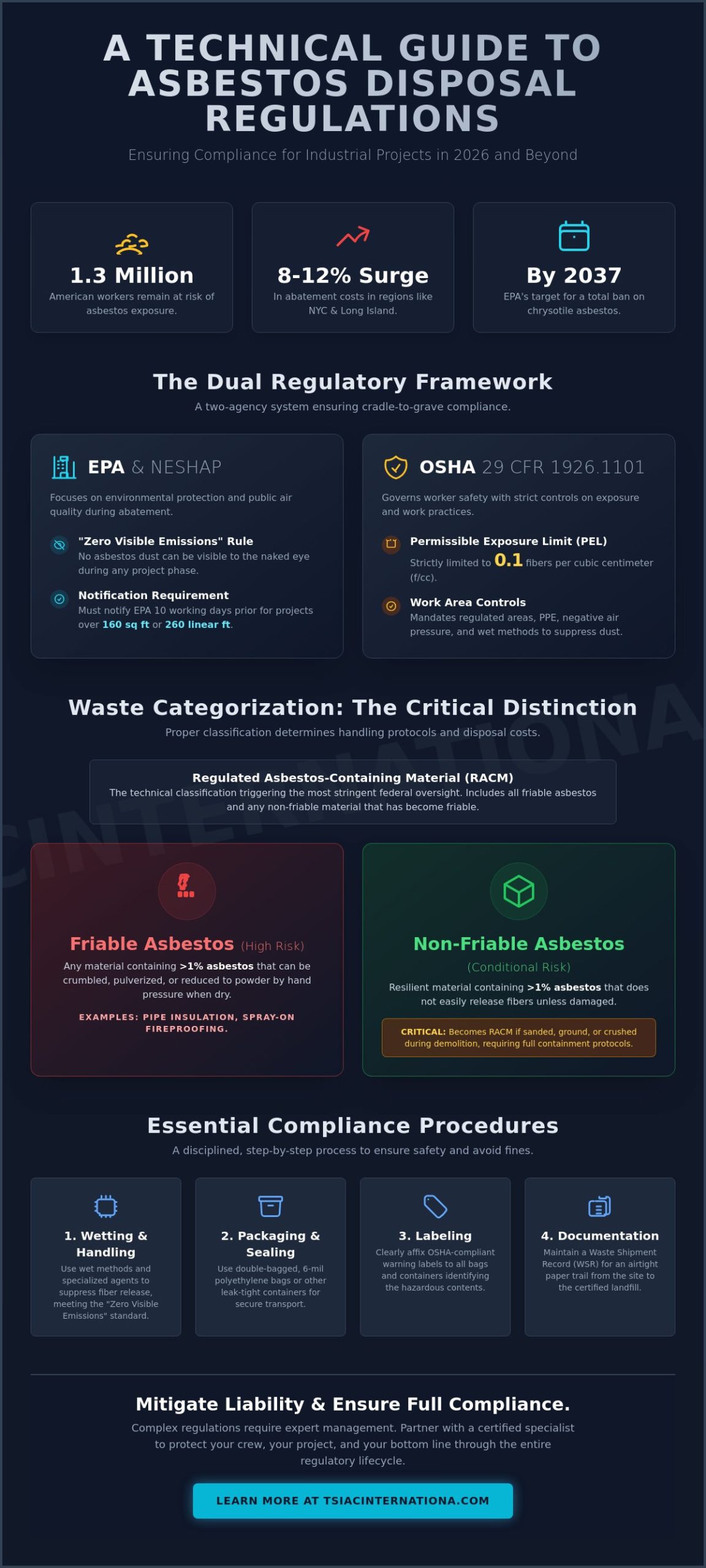
Did you know that 1.3 million American workers remain at risk of asbestos exposure even as the EPA moves toward a total ban of chrysotile by 2037? You likely feel the weight of shifting asbestos disposal regulations, especially as abatement costs in regions like Long Island and NYC have surged by 8% to 12% in early 2026. It’s a logistical challenge to manage complex industrial projects while fearing heavy EPA or OSHA fines for a single compliance oversight. We recognize that protecting your crew while maintaining project profitability requires precise technical control and a disciplined approach to safety.

This guide provides the clarity you need to ensure every phase of your demolition or abatement project remains legally sound. You’ll gain a clear understanding of NESHAP requirements and the specific documentation needed to satisfy federal inspectors. We’ll also examine the critical distinction between friable and non-friable materials, clarify the 0.1 fiber per cubic centimeter OSHA exposure limit, and explain how the 1% threshold for asbestos-containing materials impacts your disposal strategy in 2026.

Key Takeaways

  • Understand how EPA NESHAP and OSHA standards create a dual layer of compliance for your abatement project.
  • Master the critical distinctions between friable and non-friable waste to ensure your site follows current asbestos disposal regulations and avoids costly containment errors.
  • Learn the technical standards for sealing hazardous waste, including the industry-standard use of double-bagged 6-mil polyethylene.
  • Identify the essential components of a Waste Shipment Record (WSR) to maintain an airtight paper trail for regulatory audits.
  • Discover how partnering with a certified specialist mitigates long-term liability through expert management of the entire regulatory lifecycle.

Understanding the Federal Framework for Asbestos Disposal

Compliance in high-stakes demolition isn’t a suggestion; it’s a technical requirement. The Federal Framework for Asbestos Disposal is built on a foundation of overlapping jurisdictions between the EPA and OSHA. While the EPA focuses on the environmental legacy of hazardous materials, OSHA enforces the immediate safety of the workforce. Together, these agencies ensure that the “cradle-to-grave” management mandated by the Toxic Substances Control Act (TSCA) is strictly followed from the moment a structure is surveyed until the waste reaches a certified landfill.

State-level agencies often adopt these federal rules as a baseline. However, many jurisdictions, such as California or New York, impose significantly stricter local disposal bans or lower reporting thresholds. In California, for example, notification is required for as little as 100 square feet of material. Failing to account for these regional nuances can lead to project delays and severe financial penalties. It’s critical to realize that asbestos disposal regulations require a proactive approach to site management and legal documentation.

The Role of the EPA and NESHAP in 2026

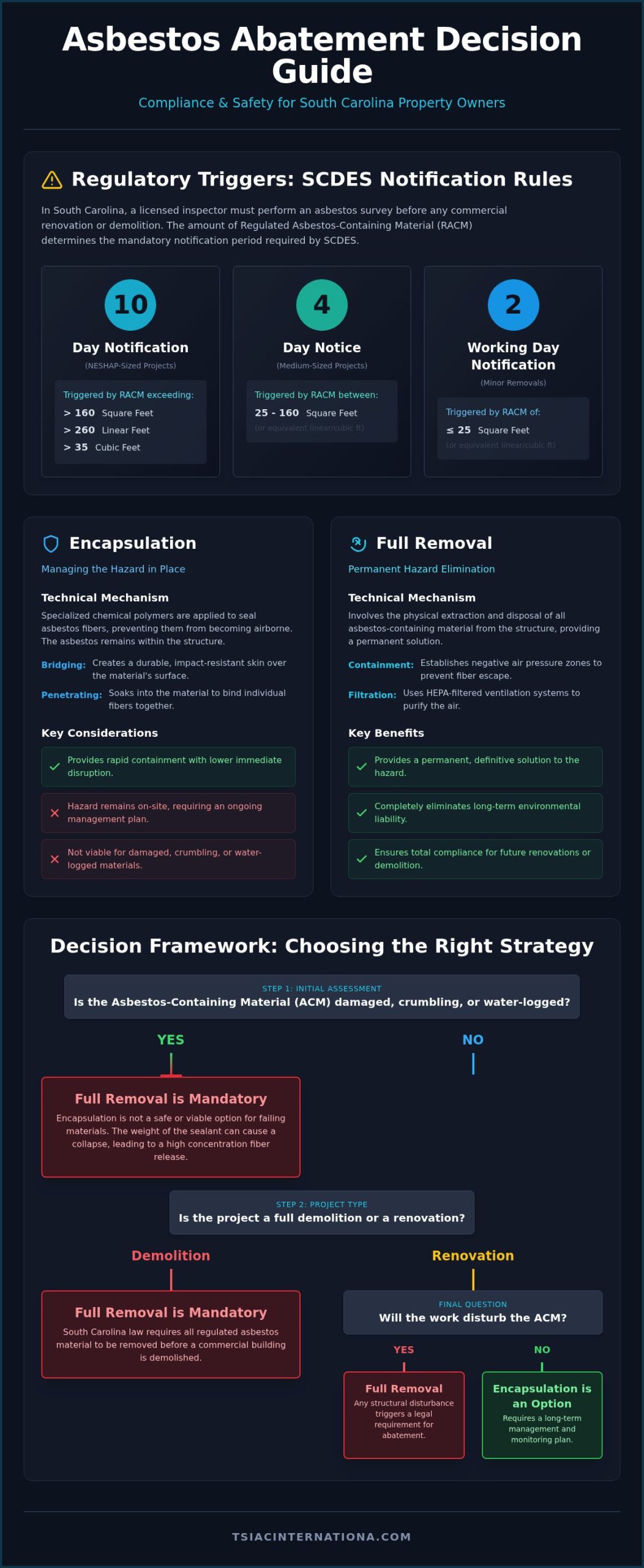
The National Emission Standards for Hazardous Air Pollutants (NESHAP) serves as the federal standard for air quality during abatement. Its primary mandate is the “zero visible emissions” rule. This means that during every stage of stripping, handling, and wetting, no dust can be visible to the naked eye. For projects involving more than 160 square feet or 260 linear feet of asbestos, you must submit a formal notification to the EPA at least 10 working days before work commences. This notification is a legal prerequisite that triggers potential site inspections and is the first step in the asbestos disposal regulations compliance chain.

OSHA Standards for Worker and Public Safety

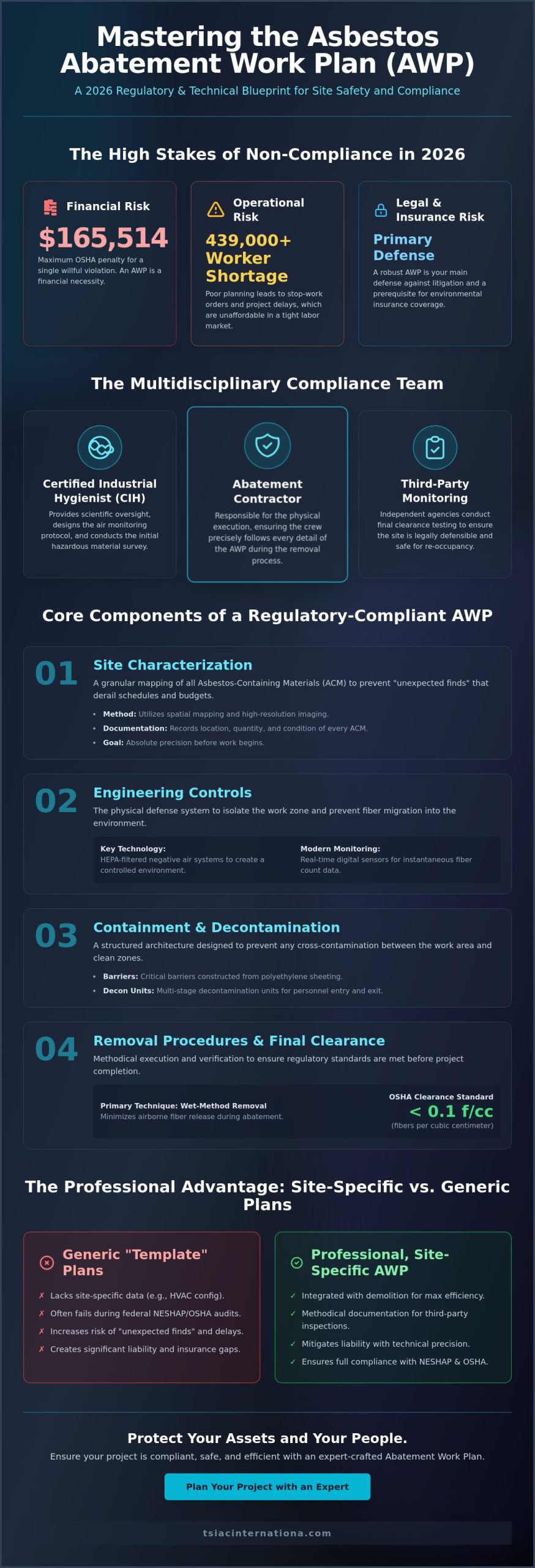
Worker safety is governed by OSHA Standard 29 CFR 1926.1101. This regulation requires the establishment of regulated areas where access is restricted to trained personnel wearing specialized personal protective equipment (PPE). These safety standards aren’t just about health; they dictate the physical handling of the waste. For example, the requirement for negative air pressure and HEPA filtration ensures that fibers stay within the work zone. OSHA’s 0.1 fiber per cubic centimeter exposure limit forces contractors to use wet methods, which directly influences how the resulting waste is saturated and packaged for transport.

Waste Categorization: Friable vs. Non-Friable Asbestos

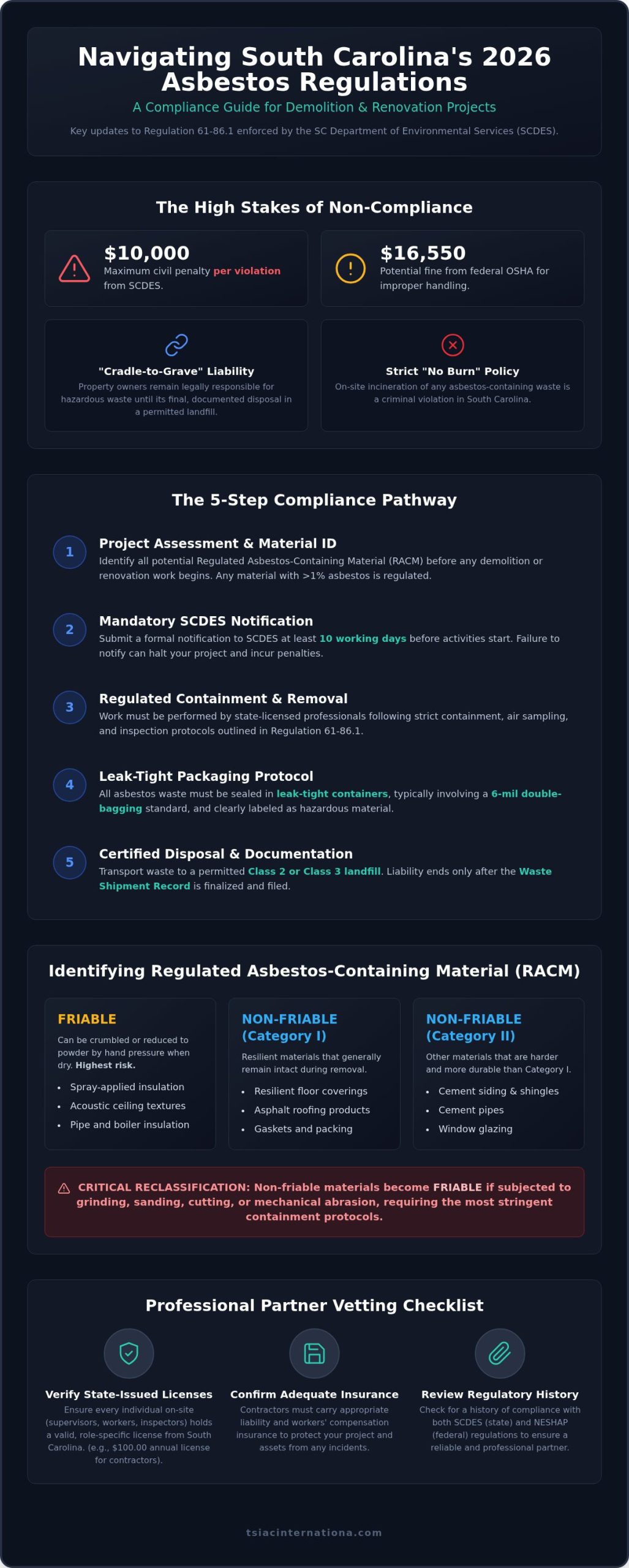
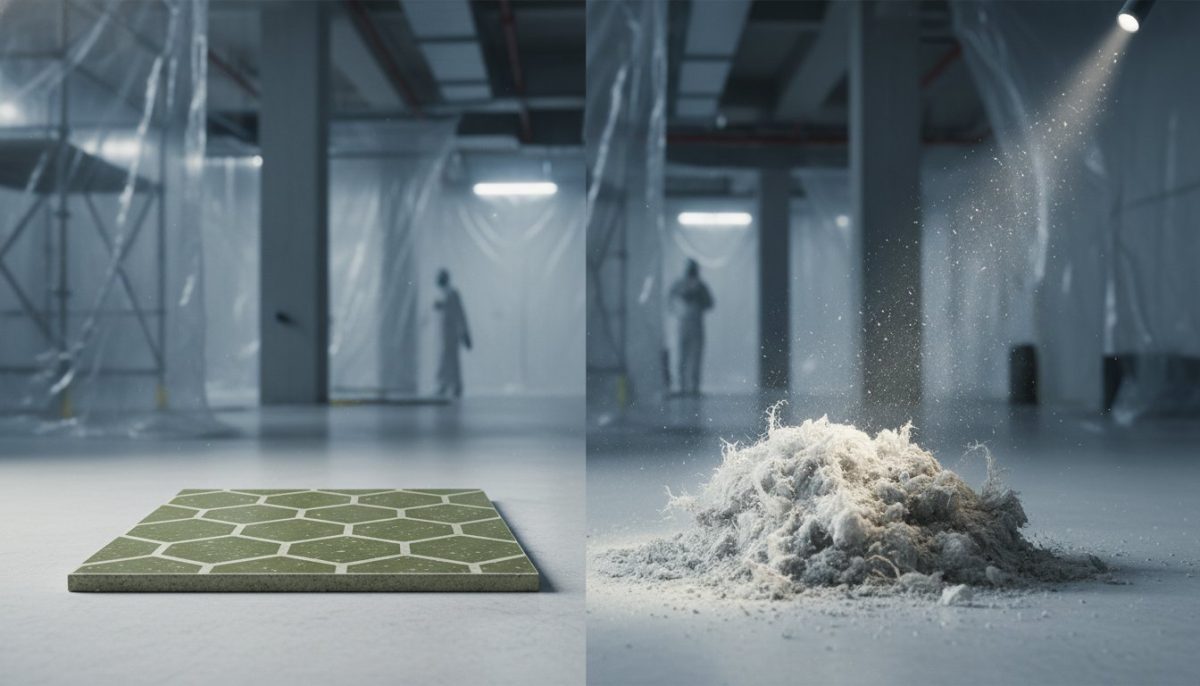
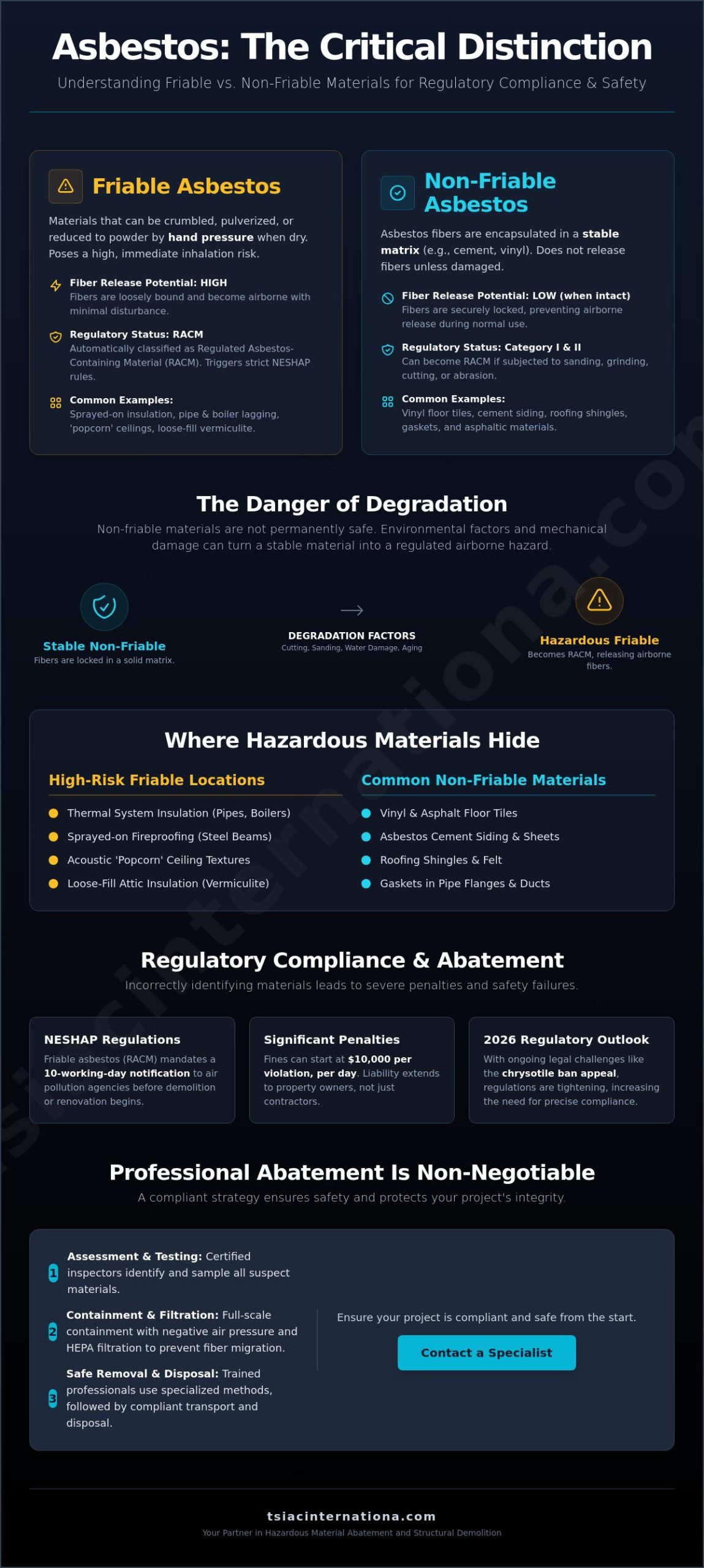
Effective site management starts with accurate material classification. Under current asbestos disposal regulations, the distinction between friable and non-friable materials determines the level of containment and the complexity of the disposal path. Friable asbestos is any material containing more than 1% asbestos that can be crumbled, pulverized, or reduced to powder by hand pressure when dry. This category represents the highest risk because fibers become airborne with minimal disturbance. Project managers must recognize that the physical state of the material, not just its chemical composition, dictates the legal handling requirements.

Non-friable materials are more resilient, but they aren’t exempt from scrutiny. They’re divided into two distinct categories based on their durability. The technical challenge lies in ensuring these materials don’t change state during the work process. If a non-friable material is subjected to sanding, grinding, or mechanical crushing, it’s legally “converted” into a regulated material. This shift immediately escalates the required safety protocols and disposal costs. Maintaining the integrity of the material during selective demolition is often the most cost-effective way to manage compliance.

Regulated Asbestos-Containing Material (RACM)

Regulated Asbestos-Containing Material (RACM) is the technical classification that triggers the most stringent federal oversight. This includes all friable asbestos and any non-friable material that has become friable through mechanical force. Common examples of RACM found on industrial sites include pipe insulation, thermal system components, and spray-on fireproofing. The EPA’s 1% rule remains the definitive threshold; any material exceeding this limit must be handled as hazardous waste. Because RACM has a high probability of releasing fibers, it requires specialized wetting agents and double-containment before it leaves the site.

Category I and II Non-Friable Classifications

Category I non-friable materials include resilient floor coverings, gaskets, and asphalt roofing products. These materials are generally flexible and unlikely to release fibers unless they’re severely weathered or mechanically abraded. Category II materials are more problematic. This group includes asbestos-cement products like transite siding and corrugated sheets. These are brittle by nature. While they start as non-friable, they’re highly susceptible to shattering during a gut-out or structural takedown. If Category II materials are likely to be broken or reduced to powder during the project, NESHAP requires them to be treated with the same rigor as RACM to prevent environmental contamination.

Asbestos Disposal Regulations: A 2026 Guide to Federal Compliance

Regulatory Requirements for Asbestos Transport and Landfills

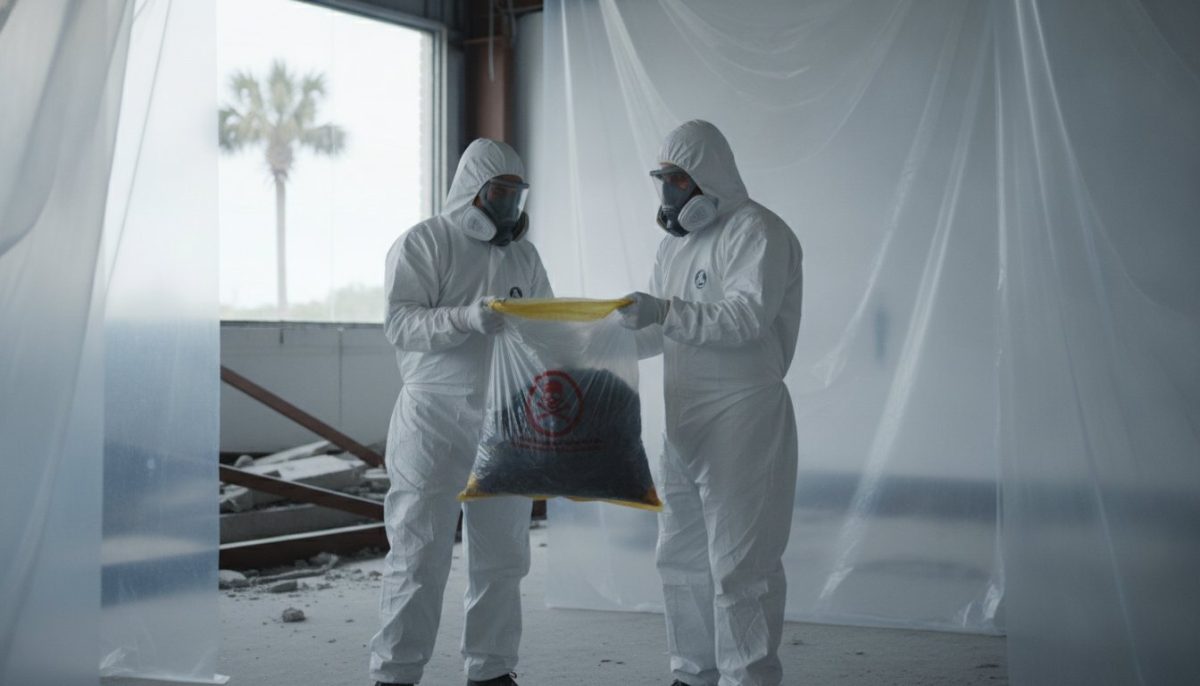
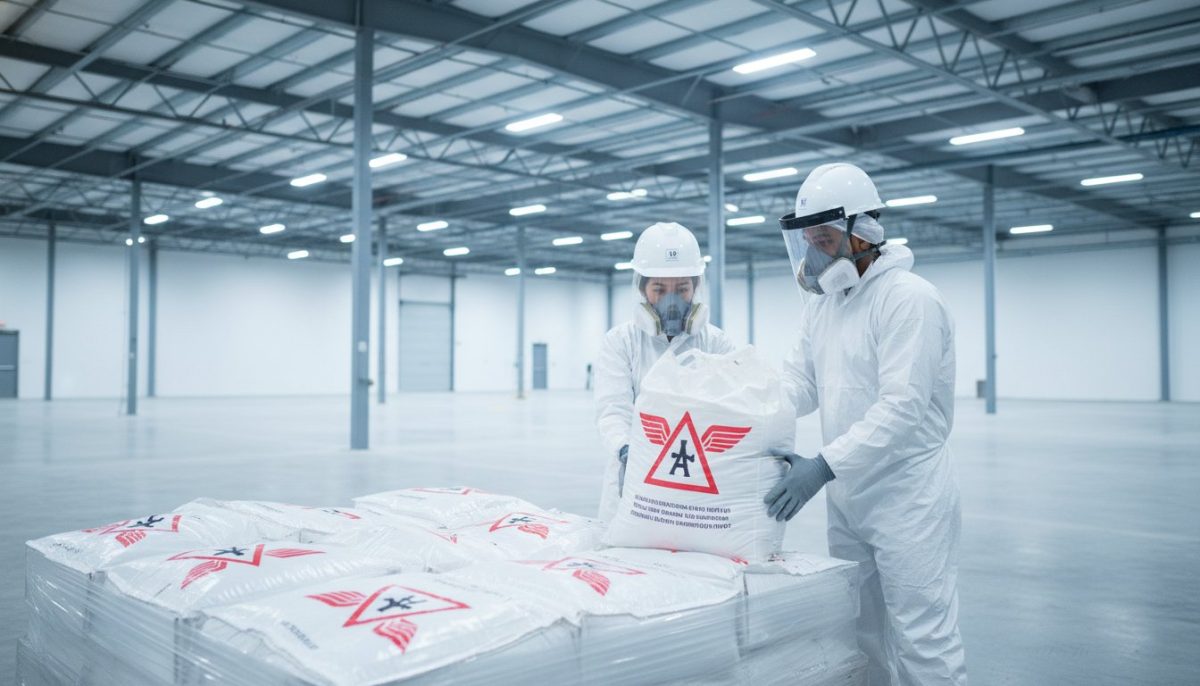
Once material is classified as Regulated Asbestos-Containing Material (RACM), the focus shifts from identification to immobilization. The Regulatory Requirements for Asbestos Transport mandate that all waste remains in a leak-tight state from the point of origin to the final disposal facility. This process begins with thorough saturation using amended water to ensure no fibers become airborne during movement. You can’t simply throw debris into a container; it must be sealed while wet to satisfy the zero-visible-emissions mandate. Industry standards and asbestos disposal regulations in 2026 require double-bagging in 6-mil polyethylene bags as the primary containment method. Each bag must be individually sealed, typically using a gooseneck tie and heavy-duty tape, to prevent any accidental breach during transit.

The logistics of transport are equally governed by strict marking requirements. Any vehicle carrying asbestos waste must display visible hazard warning signs that communicate the presence of carcinogenic materials to the public and emergency responders. These signs must be removed only after the waste has been offloaded at a permitted facility. Modern compliance also involves tracking the material’s weight and volume precisely. With 2026 disposal costs ranging from $10 to $50 per cubic yard, accurate measurement is essential for both legal reporting and project management.

Proper Containment and Labeling Protocols

Every container leaving your site must bear OSHA-compliant warning labels that clearly state the health hazards involved. Labeling must include the generator’s name and the specific location where the waste was produced. When dealing with oversized debris, such as structural steel or large sections of concrete from concrete removal projects that cannot fit into standard bags, the material must be wrapped in two layers of 6-mil plastic sheeting and sealed with reinforced tape. This ensures that even bulky items meet the leak-tight standard required by asbestos disposal regulations. Failure to label correctly is a common reason for citations during roadside inspections.

Selecting an EPA-Approved Disposal Site

Not every landfill is legally allowed to accept asbestos. You must verify a facility’s permit status before the first truck leaves the site. Authorized landfills are required by federal law to provide immediate burial of the waste or cover it with at least six inches of non-asbestos material at the end of each operating day. This prevents wind dispersion and long-term environmental exposure. Illegal dumping or using an unauthorized facility carries severe legal consequences, including criminal charges and massive EPA fines. Using a disciplined contractor ensures that the final destination of your waste is as secure as the abatement process itself.

Compliance Documentation: The Paper Trail of Abatement

In any regulatory audit, the absence of a paper trail is legally equivalent to a failure of safety. While previous sections detailed the physical handling of hazardous materials, the administrative phase of asbestos disposal regulations is what protects property owners from long-term liability. The Waste Shipment Record (WSR) acts as the primary tracking mechanism. It documents the material’s journey from the project site to the disposal facility. Federal law holds the waste generator, often the building owner, strictly liable for the material until it’s buried. This means you must receive a signed copy of the manifest from the landfill operator within 35 days of the waste leaving your site. If that document doesn’t arrive within 45 days, you’re required by law to file an Exception Report with the EPA to explain the discrepancy.

Digital tracking has become the standard in 2026 to prevent these administrative gaps. Real-time GPS logging and electronic manifests provide an immutable record of transit times and disposal coordinates. This level of transparency is essential for high-stakes projects where the risk of litigation is high. We ensure that every document is cross-referenced with site logs to provide a complete audit package upon completion. Fulfilling these requirements isn’t just about paperwork; it’s about providing definitive proof that your project met every federal threshold for environmental protection.

Waste Shipment Records (WSR) and Manifests

A compliant federal WSR must contain specific data points: the name and address of the generator, the estimated quantity of asbestos-containing material, and the name of the transporter. It also requires the landfill’s permit number and a signature from each party in the chain of custody. If the waste isn’t delivered as scheduled, the Exception Report process triggers a formal investigation. This prevents unauthorized dumping and ensures that hazardous fibers don’t end up in municipal waste streams. Modern digital manifests now allow for instant verification, reducing the risk of lost physical records during long-term storage.

Notification Requirements for Demolition Projects

Documentation begins long before the first wall is breached. NESHAP requires a “Notice of Demolition or Renovation” to be filed at least 10 working days before any structural activity begins. This rule applies to all demolition projects, even if the initial survey indicates no asbestos is present. Filing this notice correctly requires precise technical data regarding the building’s age, use, and structural components. For those operating in the Southeast, understanding the demolition process south carolina is vital for navigating regional reporting quirks. Accuracy here prevents automatic stop-work orders and immediate fines.

Secure your project’s legal standing by partnering with experts who prioritize meticulous record-keeping. Contact us today for professional asbestos abatement services that guarantee a transparent paper trail.

Professional Abatement: Ensuring Full Regulatory Compliance with TSIAC International

Managing the complexities of asbestos disposal regulations requires more than just physical labor; it demands a disciplined, engineering-based approach to risk management. Property owners face significant legal exposure if hazardous materials aren’t handled with surgical precision. At TSIAC International, we act as a responsible partner by managing the entire regulatory lifecycle. This process begins with the initial 10-day NESHAP notification and extends through the final verification of burial at a permitted landfill. By centralizing these tasks, we provide the technical expertise and legal indemnification necessary to protect your assets from the threat of strict liability and federal oversight.

Our methodology is built on the principle of total control. We don’t just clear a site; we provide a transparent, documented process that stands up to the most rigorous audits. This includes the deployment of advanced HEPA filtration systems and the implementation of negative pressure enclosures that exceed the standard 0.1 fiber per cubic centimeter OSHA limit. Our commitment to environmental responsibility is reflected in our integrated recycling services, where we separate non-hazardous debris from contaminated waste to reduce the environmental footprint of your project while maintaining full compliance.

Why Certified Contractors are Legally Essential

Hiring uncertified or cut-rate contractors introduces the risk of “vicarious liability” for the property owner. If a contractor violates asbestos disposal regulations, the building owner is often held equally responsible for the resulting fines and remediation costs. Professional air monitoring is the only way to validate the success of the containment strategies discussed earlier. This data provides an empirical record that the work area was safe for re-occupancy or subsequent structural work. For a deeper look at local requirements, consult our hazardous material abatement south carolina guide to understand how regional enforcement impacts your project.

Integrating Abatement with Structural Demolition

There’s a distinct operational advantage to using a single contractor for both abatement and structural demolition. When these services are fragmented, communication gaps can lead to the accidental disturbance of overlooked hazardous materials during the structural phase. We ensure that every square foot of RACM is cleared and documented before any heavy machinery arrives for structural removal. This integrated approach is particularly vital during commercial interior gutting services, where selective demolition must occur in tight proximity to potentially friable materials. By coordinating these phases, we eliminate redundant mobilization costs and ensure that the transition from hazardous remediation to structural clearing is seamless and safe.

Adhering to the 2026 landscape of asbestos disposal regulations requires more than just a surface-level checklist. It demands a technical commitment to zero-visible-emissions and an airtight documentation process that survives federal scrutiny. You’ve seen how precise material categorization and the 35-day manifest window are critical for preventing property owner liability. By integrating these safety protocols directly into your structural demolition timeline, you eliminate the fragmentation that often leads to compliance failures and project delays.

TSIAC International brings 15+ years of hazardous material remediation experience to every site. We provide full regulatory compliance documentation for every project, ensuring your paper trail is as solid as our technical execution. Our certified experts manage both demolition and abatement to streamline your workflow and mitigate risk. Ensure your project is 100% compliant—Contact TSIAC International for expert abatement today. We’re ready to provide the engineering precision your next project deserves.

Frequently Asked Questions

Can I dispose of asbestos in my regular household trash?

No, you cannot dispose of asbestos in regular household trash under any circumstances. Federal law classifies asbestos as a hazardous air pollutant that requires specialized handling and containment. Mixing these materials with municipal waste puts sanitation workers at risk and can lead to immediate EPA enforcement actions. All waste must be saturated and transported to a landfill specifically permitted to accept hazardous materials.

What is the penalty for violating asbestos disposal regulations?

Penalties for violating asbestos disposal regulations are severe, with civil fines often exceeding $37,500 per day for each violation. Beyond financial costs, the EPA and Department of Justice can pursue criminal charges for intentional mismanagement. These penalties apply to the building owner, the contractor, and the transporter. Maintaining a clear paper trail is the only way to mitigate this level of legal risk.

How much asbestos can I legally remove myself without a license?

There’s no safe threshold that allows unlicensed individuals to remove asbestos in a commercial or industrial setting. While NESHAP reporting triggers at 160 square feet, any amount of disturbance requires specialized containment and training. OSHA regulations apply as soon as a single employee is exposed to the material. Attempting self-removal without certification exposes the property owner to strict liability and potential health lawsuits.

Does the EPA require a specific type of bag for asbestos disposal?

The EPA requires waste to be sealed in leak-tight containers, and the industry standard is double-bagging in 6-mil polyethylene bags. Each bag must be individually sealed using a gooseneck tie and heavy-duty duct tape. If the debris is too large for bags, it must be wrapped in two layers of 6-mil plastic sheeting. Proper labeling with the generator’s name and location is a mandatory federal requirement.

What happens if I find asbestos during a demolition project?

You must stop all structural work immediately and restrict access to the affected area. Finding unidentified material during a project requires a new inspection by a certified professional to confirm the asbestos content. If the quantity exceeds 160 square feet, you must update your 10-day EPA notification. Proceeding without a revised plan violates federal air quality standards and can result in a permanent stop-work order.

How long must I keep records of asbestos disposal?

Federal law requires you to maintain Waste Shipment Records (WSR) for at least 2 years following the disposal date. However, most legal experts recommend keeping these documents for the life of the property or at least 30 years. This longer duration covers the typical latency period for asbestos-related diseases. Having these records ready is your primary defense against future long-term liability claims.

Are there different disposal regulations for commercial vs. residential properties?

Yes, federal NESHAP rules primarily target commercial, industrial, and residential buildings with more than four units. Single-family homes are generally exempt from EPA notification, though they must still follow local landfill rules. Regardless of the property type, OSHA standards apply if you hire any outside contractors or employees to perform the work. Every site must meet the zero-visible-emissions standard.

Can asbestos materials be recycled instead of landfilled?

Asbestos materials cannot be recycled and must be disposed of in a permitted landfill. The indestructible nature of the fibers makes them a permanent contaminant in standard recycling streams for concrete or metal. Attempting to recycle ACM is a major violation of asbestos disposal regulations. Proper remediation involves total removal and permanent burial to ensure the fibers never enter the environment again.

Federal Asbestos Inspection Requirements: A 2026 Compliance Guide

A single willful violation of OSHA asbestos standards can now result in penalties reaching $161,323. With an estimated 1.3 million workers still…

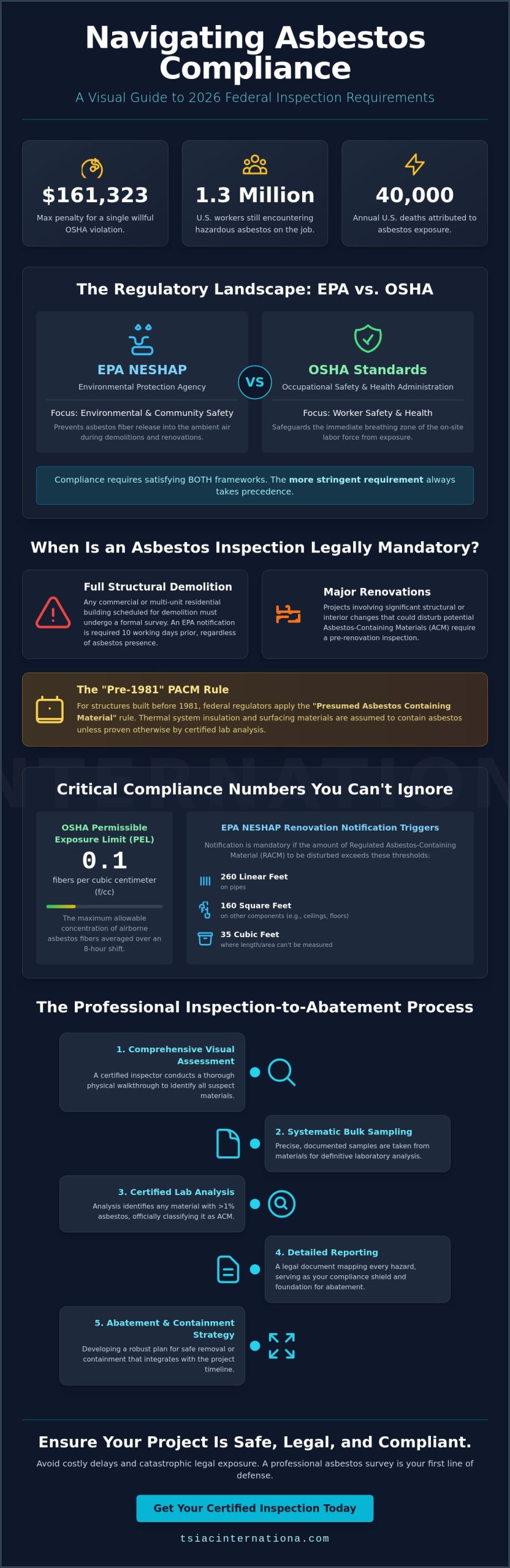
A single willful violation of OSHA asbestos standards can now result in penalties reaching $161,323. With an estimated 1.3 million workers still encountering hazardous materials on the job, federal agencies have intensified their oversight of asbestos inspection requirements as of April 2026. You likely feel the pressure of these escalating risks, especially when the lines between EPA NESHAP mandates and OSHA safety protocols seem to blur during a high-stakes renovation. It’s a complex environment where a single oversight leads to indefinite project delays or catastrophic legal exposure.

We’ll provide the technical clarity you need to maintain absolute control over your site’s compliance. This guide details the specific trigger events for inspections, the current status of the EPA’s chrysotile ban amid 2025 legal challenges, and the precise OSHA permissible exposure limit of 0.1 fibers per cubic centimeter. You’ll gain a professional roadmap that moves your project from initial sampling to final abatement with engineering precision, ensuring every structural modification remains safe, legal, and fully documented.

Key Takeaways

  • Understand why professional certification is mandatory and how the “Presumed Asbestos Containing Material” rule impacts any structure built before 1981.
  • Differentiate between EPA NESHAP regulations for environmental protection and OSHA standards for worker safety to avoid overlapping liability.
  • Identify the specific trigger events, such as full structural demolition or interior renovations, that make meeting federal asbestos inspection requirements a legal necessity.
  • Learn the technical phases of a professional survey, from comprehensive visual assessments to the precise bulk sampling of suspect materials.
  • Discover how to transition from inspection findings to a robust containment and abatement strategy that integrates seamlessly with your broader demolition timeline.

Understanding Federal Asbestos Inspection Requirements in 2026

Federal law mandates that any commercial or multi-unit residential building scheduled for demolition or major renovation must undergo a formal survey. Adhering to Asbestos and the law (United States) standards is not a suggestion; it is a structural necessity for project viability. You cannot rely on “DIY” sampling kits or visual guesses. These methods lack the legal standing required to protect your organization from EPA or OSHA enforcement. A certified inspection provides a definitive inventory of hazardous materials, preventing the accidental release of fibers that contributes to the 40,000 annual deaths recorded in the U.S. as of early 2026.

For structures built before 1981, federal regulators apply the “Presumed Asbestos Containing Material” (PACM) rule. This regulation assumes that thermal system insulation and surfacing materials contain asbestos unless proven otherwise through certified laboratory analysis. In the current 2026 regulatory climate, “legacy” asbestos remains a primary concern for infrastructure projects. Ignoring these asbestos inspection requirements before disturbing older surfaces is considered a willful violation, potentially triggering the maximum OSHA penalty of $161,323 per occurrence.

The Role of Certified Asbestos Inspectors

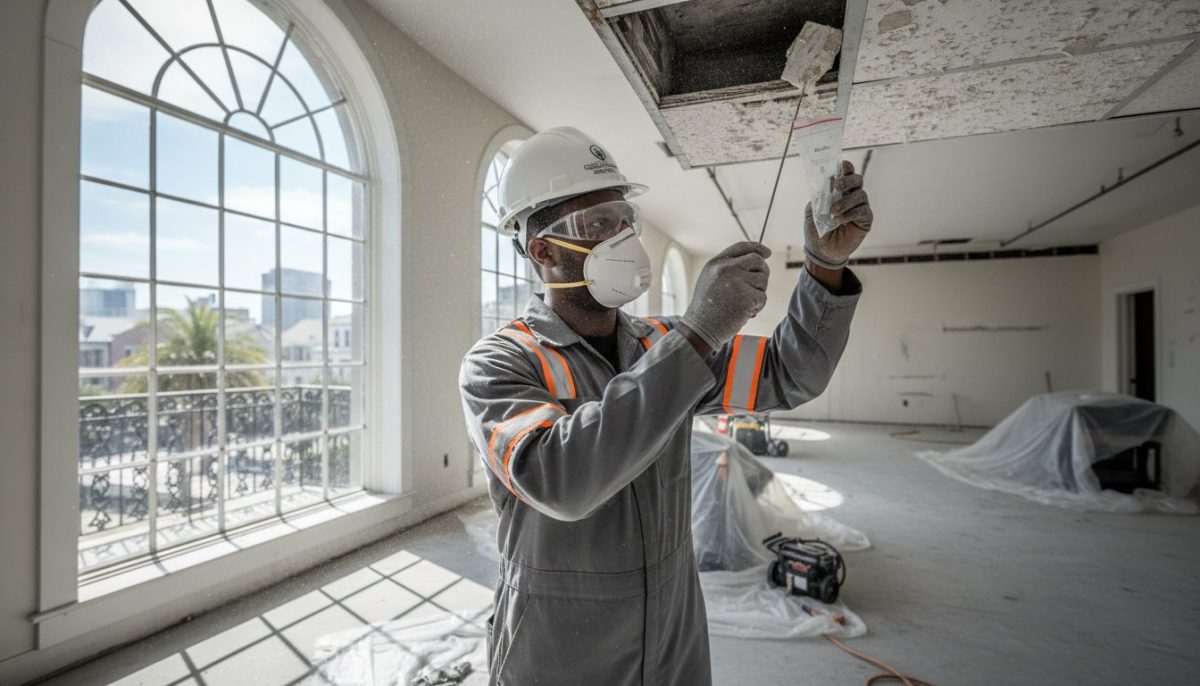
Inspectors must hold specific state and federal licenses, which typically require annual refresher courses to stay current with 2026 safety protocols. An independent, third-party assessment is critical to ensure an objective report that avoids conflicts of interest. A thorough inspection involves a physical walkthrough, systematic bulk sampling, and a detailed report that maps every hazard. This document serves as your legal shield and the foundation for any subsequent abatement plan.

Identifying Asbestos-Containing Materials (ACM)

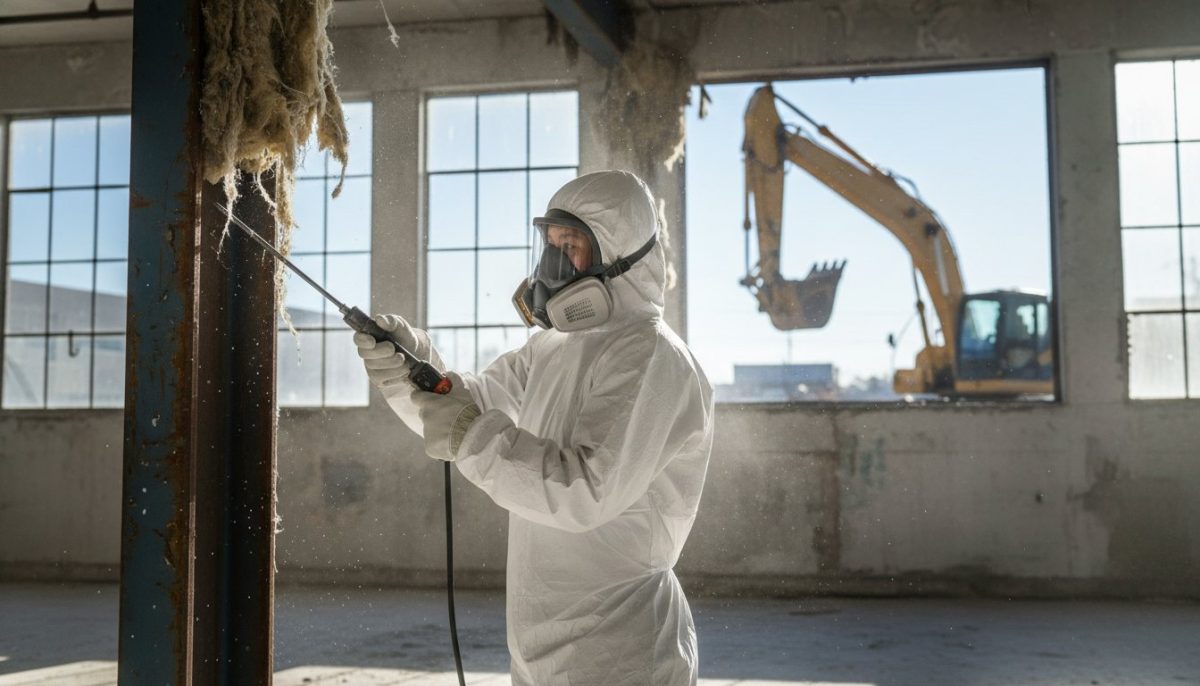
Asbestos-containing material is defined as any material containing more than 1% asbestos. These minerals are frequently found in pipe insulation, floor tiles, roofing felts, and transite siding. We distinguish between friable materials, which can be crumbled by hand pressure, and non-friable materials. Friable materials pose the highest risk because they release airborne fibers with minimal disturbance. Non-friable materials like vinyl flooring or cement pipes are more stable, but they still require professional handling during demolition to prevent them from becoming friable and hazardous.

The Regulatory Landscape: EPA NESHAP vs. OSHA Standards

Compliance isn’t about choosing between EPA or OSHA rules; it’s about satisfying both frameworks simultaneously. The Environmental Protection Agency (EPA) manages the National Emission Standards for Hazardous Air Pollutants (NESHAP), which focuses on preventing fiber release into the ambient air during structural changes. Conversely, the Occupational Safety and Health Administration (OSHA) enforces standard 1926.1101 to safeguard workers on-site. While the EPA’s asbestos inspection requirements are designed to protect the community, OSHA’s rules focus on the immediate breathing zone of the labor force. If a conflict arises between the two, the more stringent requirement always takes precedence.

Regulated Asbestos-Containing Material (RACM) is a critical technical category that triggers specific federal actions. This includes friable asbestos or non-friable materials that have become or will likely become crumbled, pulverized, or reduced to powder during demolition. Detailed guidance on these classifications can be found within the EPA Asbestos Laws and Regulations. Failing to identify RACM through a certified survey before work begins is a primary cause of project shutdowns and legal liability.

EPA NESHAP Notification Requirements

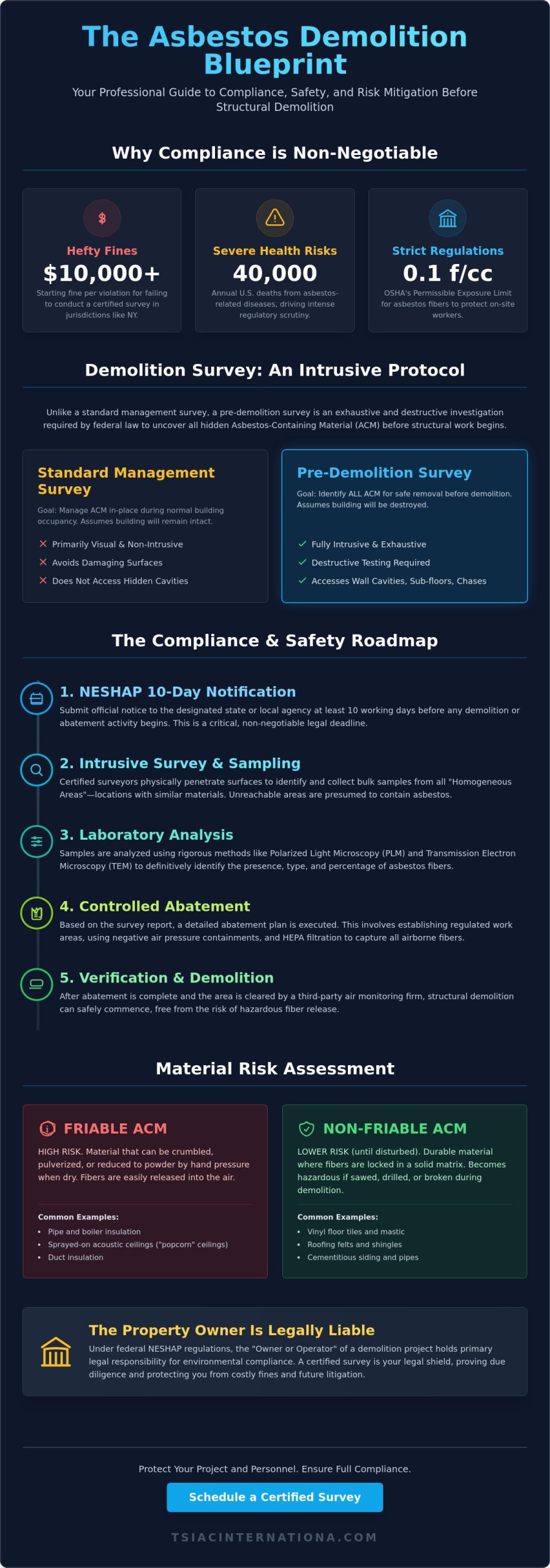
Project managers must submit a formal notification to the EPA at least 10 working days before any demolition begins, regardless of whether asbestos is present. For renovations, notification is mandatory if the amount of RACM exceeds 260 linear feet on pipes, 160 square feet on other building components, or 35 cubic feet. Proceeding without a valid inspection report and the subsequent notification is a violation of the Clean Air Act, which carries heavy daily fines. It’s much cheaper to inspect than to litigate.

OSHA Exposure Assessment Protocols

OSHA requires an initial exposure assessment to determine if fiber levels will exceed the Permissible Exposure Limit (PEL) of 0.1 fibers per cubic centimeter. This assessment must be performed by a “competent person” before work starts for Class I, II, or III asbestos tasks. Continuous air monitoring is often necessary to ensure safety protocols remain effective throughout the project’s duration. Employers must maintain these records for 30 years to mitigate long-term liability. Ensuring your project follows these precise safety and compliance protocols is the only way to guarantee both worker health and legal security.

Federal Asbestos Inspection Requirements: A 2026 Compliance Guide

Trigger Events: When is an Inspection Legally Mandatory?

Legal obligations for property owners often surface when they least expect them. While many understand that a total building teardown requires a survey, asbestos inspection requirements also apply to any activity that disturbs potential hazardous materials. This includes planned renovations, structural repairs after a flood, or the transfer of industrial assets. In the current 2026 regulatory environment, the EPA and OSHA view any failure to inspect as a significant liability risk. Emergency situations, such as a localized fire or structural collapse, don’t waive these rules; they actually heighten the need for immediate, professional sampling to protect first responders and recovery crews.

Real estate transactions for older commercial facilities often hinge on these findings. A clear inspection report ensures that the buyer isn’t inheriting millions in “legacy” asbestos liabilities. Similarly, tenant improvements that involve stripping a space back to its core are primary triggers for federal oversight. We’ve seen projects stall for months because a buyer’s due diligence team discovered unmapped hazardous materials that should’ve been identified during the initial property assessment.

Renovation vs. Demolition Requirements

The line between a renovation and a demolition is often thinner than owners realize. Even if you aren’t leveling the building, “selective demolition”—removing specific structural elements like load-bearing walls or HVAC systems—mandates a thorough survey. This is particularly relevant when planning commercial interior gutting services, as these projects frequently encounter hidden insulation or flooring adhesives. According to OSHA Asbestos Standards, any disturbance of suspected materials must be preceded by a negative exposure assessment or a certified inspection to confirm the absence of fibers.

Commercial vs. Residential Exemptions

Federal NESHAP regulations generally apply to all commercial, industrial, and public buildings. However, residential properties are subject to the “four-unit rule.” This means that a single-family home or a small apartment building with four or fewer units is typically exempt from NESHAP, though local ordinances may still apply. For any facility with five or more units, or any commercial space regardless of its square footage, the exemptions disappear. In 2026, state-specific variations often exceed these federal baselines, requiring inspections for even minor plumbing repairs in public spaces. It’s a mistake to assume a building’s size protects you from federal asbestos inspection requirements.

How a Professional Asbestos Inspection is Conducted

A professional survey follows a rigid, four-phase technical protocol to ensure all asbestos inspection requirements are met with engineering precision. This isn’t a cursory walkthrough; it’s a structural audit. Phase 1 initiates with a comprehensive visual assessment where inspectors cross-reference building blueprints with historical construction data to identify high-probability zones. During Phase 2, the inspector performs bulk sampling. This involves extracting physical pieces of suspect materials, such as thermal insulation or floor backing, using both destructive and non-destructive methods depending on the planned project scope.

Phase 3 moves the process into a controlled environment for laboratory analysis. The standard method is Polarized Light Microscopy (PLM), which identifies fiber types and concentrations. If results are inconclusive or if the material is non-friable and organically bound, more advanced testing may be required. Finally, Phase 4 concludes with the delivery of a certified report. This document identifies the presence of hazards and serves as the foundation for an Asbestos Management Plan, which is legally required for ongoing facility operations or as a precursor to any structural disturbance.

Sampling Strategies and Lab Analysis

Reliability in sampling depends on the “Rule of Three.” Federal guidelines typically require at least three samples for each homogenous area of surfacing material to account for variations in material composition. For complex samples like vinyl floor tiles or dust, Transmission Electron Microscopy (TEM) provides higher accuracy by detecting smaller fibers that PLM might miss. We only utilize laboratories that maintain accreditation through the National Voluntary Laboratory Accreditation Program (NVLAP). This ensures that the data used to make your safety decisions is backed by rigorous quality control and federal oversight.

Interpreting the Final Inspection Report

The final report is more than a simple “yes or no” document. It includes a “Condition and Potential for Damage” assessment for every identified hazard. This classification helps you prioritize which materials need immediate attention and which can be managed in place. The report provides a precise map of confirmed ACM locations and total quantities. You’ll use these specific measurements to obtain accurate, fixed-price quotes for hazardous material abatement south carolina. If you’re ready to move from analysis to action, you can contact our technical team to review your report and develop a compliant abatement strategy.

From Inspection to Abatement: The TSIAC International Approach

A technical report is only as valuable as the execution strategy it informs. At TSIAC International, we transform raw inspection data into a surgical containment plan that prioritizes site safety and project continuity. Once asbestos inspection requirements are satisfied and hazardous materials are identified, our engineering team designs a multi-stage abatement protocol. This strategy accounts for the specific fiber concentrations and material friability noted in the lab results, ensuring that Class I and Class II work zones are isolated with medical-grade precision before a single structural element is disturbed.

Our methodology integrates these findings directly into the broader demolition process south carolina. By identifying hazards early, we prevent the “discovery delays” that often plague industrial renovations. We also maintain a strict commitment to environmental stewardship. During the abatement and selective demolition phases, we meticulously separate wood, metal, and plastic components to maximize recycling potential. This disciplined sorting process reduces landfill waste and ensures that only contaminated materials are disposed of at specialized hazardous waste facilities.

Strategic Abatement Planning

Efficiency in hazardous material removal requires more than just equipment; it requires foresight. With over 15 years of experience in complex industrial environments, we’ve refined a process that minimizes project downtime by synchronizing abatement with selective demolition. This synergy allows us to clear specific zones for structural work while safely maintaining containment in others. Every stage of our work is backed by professional documentation, concluding with final clearance testing. We perform rigorous air sampling to confirm fiber levels are well below the 0.1 f/cc threshold before the site is officially handed back to the owner.

Your Next Steps for Compliance

Securing your project’s future starts with professional due diligence. If you’re planning a demolition or renovation for a property built before the late 1980s, you must secure the required regulatory permits and submit federal notifications at least 10 days before work begins. Waiting until the machinery is on-site to address asbestos inspection requirements is a recipe for heavy fines and legal complications. Our team provides the technical expertise needed to navigate these rules with engineering accuracy. Contact TSIAC International for a professional asbestos consultation to ensure your next project remains safe, legal, and on schedule.

Securing Your Project’s Future Through Technical Compliance

Adhering to federal asbestos inspection requirements is more than a legal formality; it’s a critical component of professional risk management. By identifying hazardous materials before structural work begins, you eliminate the threat of sudden project shutdowns and protect your workforce from the 0.1 fibers per cubic centimeter exposure limit. A certified survey provides the engineering data necessary to move from a site assessment to a successful, liability-free abatement process without the fear of unexpected hazardous findings.

TSIAC International brings 15+ years of hazardous material remediation experience to every site, ensuring full compliance with EPA and OSHA 2026 standards. Whether you’re managing a total structural demolition or a complex selective gut-out, our technical team provides the stability and precision your assets deserve. We handle the documentation, the containment, and the final clearance testing so you can focus on the next phase of development. Contact TSIAC International for Expert Asbestos Abatement Services and ensure your project stays on schedule and fully compliant. We’re ready to find solutions for even your most challenging locations.

Frequently Asked Questions

What is the “10-day rule” for asbestos inspections and demolition?

The EPA NESHAP regulation requires building owners to notify their regional or state environmental agency at least 10 working days before starting a demolition or renovation. This period allows regulators to review your inspection report and potentially visit the site. You must submit this notification even if your asbestos inspection requirements were met and no hazardous materials were found during the survey.

Can I use a previous inspection report if it is more than a year old?

While federal regulations don’t set a hard expiration date, a report is only valid if it remains “thorough” and reflects the building’s current state. If any structural changes or minor renovations occurred since the last assessment, the previous data is legally insufficient. Most commercial lenders and insurance providers require a new survey every 12 months to ensure all potential liabilities are documented before work begins.

What happens if asbestos is found during a project that was already started?

You must stop all work immediately and evacuate the affected area to prevent further fiber release. The project site should be sealed off while a certified professional conducts an emergency assessment. You are required to notify the EPA or local health department of the discovery. Resuming work before a new abatement plan is approved and the area is cleared can result in willful violation penalties exceeding $161,000.

Do newer buildings (post-1990) still require an asbestos inspection?

Yes, federal law requires a thorough inspection regardless of the building’s construction date. Although use decreased, asbestos wasn’t fully banned in all construction materials during the 1990s. The EPA only finalized the ban on chrysotile asbestos in March 2024, with some phase-out deadlines extending to 2037. This means even relatively modern structures can contain hazardous gaskets, roofing materials, or floor adhesives that must be identified.

What is the difference between friable and non-friable asbestos in a report?

Friable asbestos is any material that can be crumbled or reduced to powder by hand pressure, such as old pipe insulation. These materials release dangerous fibers with almost no effort. Non-friable asbestos, like vinyl floor tiles, is bound in a hard matrix and is less hazardous. However, if non-friable material is crushed, sanded, or broken during demolition, it’s reclassified as friable and must be handled as a major hazard.

How much does a typical commercial asbestos inspection cost?

Commercial inspection costs as of April 2026 typically range from $0.10 to $0.30 per square foot. For a large-scale project like a 100,000-square-foot warehouse, owners should budget between $10,000 and $30,000 for a comprehensive survey. Smaller projects often follow the national average of $483, with individual sample fees ranging from $75 to $150. These costs vary based on building complexity and the number of samples required.

Can one company perform both the inspection and the abatement?

It’s legally permitted in many jurisdictions, but it often creates a conflict of interest that increases your liability. Using an independent third party for the initial survey and final clearance testing ensures the data is objective and accurate. This separation of duties protects the owner by providing unbiased verification that the site is truly safe for re-occupancy or demolition after the abatement team finishes their work.

What are the penalties for failing to conduct a required asbestos inspection?

Failing to meet asbestos inspection requirements can lead to severe financial and legal consequences. As of January 2026, OSHA can levy fines up to $161,323 for willful violations. The EPA also issues daily fines for Clean Air Act violations, which can quickly exceed the total cost of the renovation project. Beyond fines, owners face significant litigation risks if workers or the public are exposed to unmapped hazardous fibers.

Demolition Permits in Charleston SC: A 2026 Regulatory Reference Guide

In 2025, approximately 42% of commercial demolition projects across various jurisdictions faced immediate stop-work orders because of misaligned…

In 2025, approximately 42% of commercial demolition projects across various jurisdictions faced immediate stop-work orders because of misaligned municipal codes and environmental agency mandates. You recognize that a structural teardown involves far more than heavy machinery and site clearing. It’s a high-stakes engineering sequence where a single missing signature or an overlooked hazardous material survey can trigger regulatory fines exceeding $10,000 per day. Securing demolition permits charleston sc requires a disciplined approach to navigating both local zoning and broader regulatory frameworks to avoid these costly setbacks.

At TSIAC International, we provide the technical clarity you need to master these complexities through a professional engineering lens. This reference guide outlines the exact 2026 documentation requirements, the critical role of asbestos abatement in the approval timeline, and a precise roadmap for your submittal sequence. By following this framework, you’ll eliminate the administrative friction that leads to project delays and ensure your site remains compliant from the first inspection to final debris removal. You’ll gain a thorough understanding of how to manage hazardous material compliance while maintaining the structural integrity of the surrounding environment.

Key Takeaways

  • Understand the critical legal distinctions between total structural removal and selective interior permits to ensure your project aligns with 2026 regulatory definitions.
  • Identify mandatory NESHAP requirements and the essential role of certified asbestos surveys in the pre-application environmental phase.
  • Master the structural engineering roadmap required to efficiently secure demolition permits charleston sc while maintaining rigorous safety standards.
  • Learn how to coordinate essential utility “kill letters” and manage complex pedestrian safety plans to avoid logistical delays in high-density areas.
  • Discover how leveraging 15+ years of professional compliance expertise can streamline the entire permitting and hazardous material abatement lifecycle.

A demolition permit represents a formal legal authorization issued by the City of Charleston’s Building Inspection Division. This document is not a mere administrative formality; it serves as the primary mechanism for ensuring that structural removal adheres to established safety standards and municipal zoning laws. For any property owner, securing demolition permits charleston sc is the first step in a high-stakes technical operation. The demolition process requires a controlled approach to mitigate risks associated with hazardous materials, utility disruptions, and structural instability. In 2026, the legal framework surrounding these permits has tightened to reflect modern safety requirements. Proceeding without valid authorization results in immediate stop-work orders and administrative penalties that often exceed $1,200 per day. Beyond financial loss, unauthorized work can lead to the permanent revocation of future building privileges on the site.

Structural vs. Selective Demolition Permits

Project managers must distinguish between total structural demolition and selective clearing. A total demolition permit covers the complete removal of a building down to the grade level. Conversely, selective permits are necessary for renovation projects that involve stripping internal components without altering the external structure. This distinction is critical when engaging commercial interior gutting services. These specialized services require permits that specifically detail how load-bearing elements will be protected. In Charleston, approximately 38% of residential permits issued in the historic district are for selective demolition, requiring a higher level of engineering oversight to preserve the integrity of the surrounding urban fabric.

The Role of the Registered Contractor

Most jurisdictions within the Charleston area mandate that a licensed and registered contractor pulls the permit. This regulation ensures that the individual overseeing the work possesses the technical competence to manage complex machinery and high-risk environments. The approval process involves several key requirements:

  • Verification of a valid South Carolina contractor’s license with the appropriate classification.
  • Submission of current general liability insurance and workers’ compensation certificates.
  • Proof of a performance bond, often ranging from $5,000 to $25,000 for residential projects.

Upon permit issuance, the legal liability for site safety and regulatory compliance shifts from the property owner to the contractor. This shift protects the owner from direct litigation related to onsite accidents or environmental violations. It’s a system designed to place responsibility in the hands of professionals who understand the engineering precision required for safe structural removal. When a contractor signs the permit, they’re legally affirming that the project will meet all 2026 safety codes and environmental disposal regulations.

Environmental Prerequisites: Asbestos and Hazardous Material Inspections

Before heavy machinery arrives at a job site, environmental safety protocols dictate the project schedule. The National Emission Standards for Hazardous Air Pollutants (NESHAP) mandate that every facility, including residential structures destined for demolition, undergoes a thorough inspection for Asbestos-Containing Materials (ACM). You can’t bypass this step. In Charleston, a South Carolina licensed asbestos inspector must conduct a comprehensive survey to identify any regulated materials. This technical data forms the necessary foundation for following the City of Charleston Demolition Permit Guidelines. Skipping this or using an uncertified inspector results in immediate project halts and potential fines that often exceed $10,000 per violation day.

Hazardous material abatement isn’t just a safety measure; it’s a critical path item in your project management. Identifying friable asbestos early allows for controlled removal, preventing the release of microscopic fibers into the dense residential neighborhoods of the Lowcountry. This phase requires precise coordination between environmental consultants and the demolition crew to ensure the site remains stable throughout the transition.

The Link Between Abatement and Approval

Regulatory bodies require a “Notification of Demolition” filed with the South Carolina Department of Health and Environmental Control (DHEC) at least 10 working days before any structural work begins. This document proves that hazardous materials were either absent or professionally removed. Building departments won’t issue demolition permits charleston sc until they receive a clearance letter or a signed-off notification from the abatement contractor. For a deeper look at the technical requirements and 2026 safety standards, consult this asbestos removal South Carolina guide. Abatement typically adds 7 to 14 days to the pre-demolition phase, so it’s vital to factor this into your equipment scheduling.

Lead Paint and Mold Remediation Standards

Structures built before 1978 carry a high probability of containing lead-based paint. While federal rules focus heavily on occupied renovations, total demolition requires specific containment strategies to prevent lead dust from contaminating the local soil and groundwater. In our humid coastal climate, mold remediation often coincides with interior gutting permits. You’ll need to maintain rigorous Waste Shipment Records (WSRs) to prove that all toxic debris reached a licensed Subtitle D landfill. If you’re dealing with a complex site or a “impossible” location, securing expert technical oversight ensures these environmental hurdles don’t derail your timeline. Professional documentation is your only defense against future liability claims. Obtaining demolition permits charleston sc depends entirely on your ability to prove the site is clean and safe for the next phase of construction.

The Roadmap to Securing a Demolition Permit in 2026

Securing demolition permits charleston sc requires a sequence of technical milestones that ensure public safety and environmental compliance. Every project begins with a rigorous site assessment. Structural engineers must evaluate the building’s stability to determine the safest method of deconstruction, especially when dealing with historic or compromised residential structures. This phase prevents unforeseen collapses and protects adjacent properties in Charleston’s dense urban corridors.

Following the structural review, environmental surveys are mandatory. In 2026, South Carolina Department of Environmental Services (SCDES) regulations demand strict asbestos and lead-based paint inspections before any heavy machinery arrives on-site. If hazardous materials are identified, you must secure abatement clearances from certified professionals. Simultaneously, coordination with utility providers like Dominion Energy and Charleston Water System is vital. You’ll need “kill letters” to certify that electrical, gas, and water lines have been safely capped at the street level to prevent fire or flooding during the teardown.

Once these prerequisites are met, developers submit their formal packet through the City of Charleston’s official permit application portal. This submission must include a comprehensive site management plan detailing traffic control, noise mitigation, and dust suppression strategies. After the physical teardown is complete, a final site inspection by a municipal official is required to close the permit, ensuring the lot is stabilized and ready for its next use.

Essential Documentation for Application

Standard applications require detailed site plans that clearly distinguish between structures slated for removal and those remaining, such as protected grand oaks or neighboring boundary walls. For removals exceeding 5,000 square feet of land disturbance, the city mandates specific erosion and sediment control plans to prevent silt runoff into local marshlands. Sustainable projects also benefit from a recycling and debris management plan, which tracks the diversion of concrete, steel, and timber from regional landfills.

Timeline and Fee Expectations

Processing times for demolition permits charleston sc typically range from 14 to 21 business days for residential projects. Commercial applications often take 30 to 45 days due to the complexity of engineering reviews. Permit fees are calculated based on the total square footage and the estimated value of the work. Base fees often start at $100, with incremental costs added per $1,000 of project value. For a detailed breakdown of financial requirements, consult the cost of demolition Charleston SC guide to ensure your budget aligns with 2026 market rates and municipal schedules.

Common Permitting Hurdles: Utility Coordination and Site Safety

Securing demolition permits charleston sc requires more than just filling out a form; it involves a coordinated effort between municipal departments and private utility providers. In high-density areas like the French Quarter or South of Broad, the City of Charleston requires a detailed pedestrian and traffic safety plan. This plan must outline how you’ll maintain a 5-foot clear path for foot traffic or manage lane closures for heavy equipment. Projects involving structures older than 50 years often trigger a mandatory review by the Board of Architectural Review (BAR). This process can add 30 to 45 days to your timeline. You’re also required to provide a 10-day written notice to neighbors before work begins to ensure transparency and maintain community relations.

Developing a robust traffic management plan is a specialized skill. For examples of how expert consultants handle these logistics, you can check out ML Traffic Engineers Pty Ltd, a firm specializing in traffic engineering and transport planning.

The Utility Disconnection Checklist

You can’t swing a sledgehammer until every utility provider issues a formal “kill letter.” This document confirms that services like natural gas from Dominion Energy or water from Charleston Water System are physically capped at the main. For properties in West Ashley or James Island, you must also provide proof of septic tank abandonment or sewer line capping, certified by a licensed plumber. Before any excavation begins, South Carolina law requires a 72-hour notice to the 811 “Call Before You Dig” system to prevent catastrophic damage to underground infrastructure. Managing these demolition permits charleston sc requirements early prevents costly work stoppages and safety hazards.

Site Protection and Debris Management

Site security is a non-negotiable safety requirement in the Lowcountry. Contractors must install 6-foot chain-link fencing around the entire perimeter to prevent unauthorized access. Noise ordinances in Charleston generally restrict heavy work to between 7:00 AM and 7:00 PM on weekdays. Efficient site clearing relies on the strategic use of concrete removal Charleston SC services. This ensures that heavy foundations and driveways are processed and hauled away according to the city’s strict debris management protocols. Proper signage must be visible at all entry points to warn the public of active demolition zones.

If you’re ready to start your residential project with engineering precision, contact our technical team for a comprehensive site assessment.

Professional Compliance Management with TSIAC International

Securing demolition permits charleston sc involves more than filling out forms; it requires a deep understanding of municipal codes and environmental mandates. TSIAC International leverages over 15 years of operational experience to manage the entire project lifecycle, from the initial site survey to final permit closure. Our team coordinates directly with the City of Charleston Building Inspections Division and the South Carolina Department of Health and Environmental Control (DHEC) to ensure every regulatory hurdle is cleared before the first machine arrives on site.

Safety isn’t a secondary consideration in our workflow. We operate under strict adherence to OSHA 29 CFR 1926 standards for demolition and EPA guidelines for hazardous material handling. This technical rigor prevents the costly delays and legal liabilities that often plague residential projects. As part of our commitment to sustainable development, we integrate environmental recycling into our permit closure process. We typically divert up to 85% of structural debris from landfills by sorting concrete, metals, and timber for reuse, meeting the highest standards of modern urban renewal.

Why Specialized Contractors are Essential

Attempting a DIY approach to permitting or hiring uncertified labor carries extreme financial risk. In the Charleston area, fines for improper asbestos abatement or unauthorized structural removal can exceed $10,000 per violation. TSIAC provides an integrated solution where abatement and structural removal happen under a single umbrella of liability. You can review our specific technical standards and safety protocols in our demolition process South Carolina guide, which outlines the engineering precision we bring to every job site.

Next Steps for Your Project

The path to a clean site starts with a professional assessment. Our engineers evaluate structural integrity, utility disconnect requirements, and potential environmental hazards to build a roadmap for your project. We provide a transparent, fixed-price contract that covers every phase of the work, including:

  • Comprehensive hazardous material surveys and DHEC notifications.
  • Securing all necessary municipal demolition permits charleston sc.
  • Full site clearing and debris management with documented recycling rates.
  • Final site stabilization and permit sign-off.

Don’t leave your property’s future to chance. Consult with TSIAC International for Expert Compliance to ensure your residential demolition is handled with the engineering accuracy it deserves.

Mastering the 2026 Charleston Permitting Landscape

Navigating the technical landscape of demolition permits charleston sc requires a disciplined approach to 2026 regulations. Success depends on rigorous asbestos inspections and strategic utility coordination before any physical work begins. These steps aren’t just administrative hurdles; they’re the bedrock of site safety and legal protection for your property.

TSIAC International brings 15+ years of hazardous material expertise to every project, ensuring that complex environmental challenges don’t stall your progress. We provide comprehensive fixed-price structural removal contracts that offer financial certainty in an unpredictable industry. Our integrated asbestos and lead abatement services streamline the transition from a hazardous structure to a clean, build-ready site. We’ve mastered the logistical nuances of Charleston’s 2026 standards, allowing us to manage your project with engineering precision and unwavering reliability.

Partner with TSIAC International for Seamless Demolition Permitting

Let’s secure your project’s future with the professional oversight and technical excellence it deserves.

Frequently Asked Questions

Do I need a permit for interior demolition if the exterior remains unchanged?

You need a permit for interior demolition if you’re altering structural components, plumbing, or electrical systems, even if the exterior remains untouched. The City of Charleston Building Inspections Division mandates these permits to ensure the building’s structural integrity isn’t compromised. For projects exceeding 200 square feet of interior renovation, specific trade permits are required alongside the general filing to maintain safety standards throughout the demolition process.

How long does it typically take to get a demolition permit approved in 2026?

Obtaining demolition permits Charleston SC residents require typically takes 15 to 30 business days in 2026. This timeline accounts for the increased volume of residential redevelopment projects and the mandatory 10 day notification period for DHEC. If your property is located within the Old and Historic District, the Board of Architectural Review process can extend this duration by 45 to 60 additional days due to mandatory public hearings and architectural assessments.

Can I pull a demolition permit as a homeowner, or do I need a contractor?

You can pull a demolition permit as a homeowner if the property is your primary residence for the next 24 months under the SC Residential Builder’s Commission exemption. However, hiring a licensed contractor is safer because they carry the $500,000 general liability insurance and workers’ compensation required for high risk work. Professional oversight ensures compliance with the 2021 International Residential Code, reducing the risk of legal complications or safety failures on your site.

What happens if asbestos is found after the demolition permit is already issued?

You must immediately stop all work and notify the South Carolina Department of Health and Environmental Control (DHEC) if asbestos is discovered after permit issuance. Regulation 61-86.1 requires a new inspection by a licensed consultant to assess the 1 percent threshold of asbestos containing material. You’ll need to revise your permit and hire a certified abatement team to remove the hazardous materials before the City of Charleston Building Department allows any further demolition to proceed.

Is a separate permit required for concrete slab and foundation removal?

A separate permit is often required for concrete slab and foundation removal if the work involves disturbing more than 2,500 square feet of land. This falls under the City of Charleston’s Stormwater Management requirements to prevent soil erosion and drainage issues. You must submit a grading plan showing how the 4 inch thick slab removal will affect the lot’s elevation and ensure proper backfilling with engineered soil to meet local 95 percent compaction standards.

What utilities must be disconnected before a demolition permit is granted?

You must disconnect water, sewer, natural gas, and electricity services before the demolition permits Charleston SC requires are officially granted. Charleston Water System requires a capped sewer inspection, while Dominion Energy must provide a “kill letter” confirming the 120/240V lines and gas meters are safely removed. You’ll need to present these four specific clearance documents to the permit office to prove the site is safe for heavy machinery and prevent accidental utility ruptures.

Are there specific permits for removing hazardous materials like lead or mold?

Specific permits aren’t required for lead or mold, but you must follow EPA RRP Rule protocols if the home was built before 1978. Contractors must be Lead-Safe Certified and use HEPA vacuum systems to contain dust containing more than 0.5 percent lead by weight. For mold, South Carolina doesn’t mandate a specific permit, but OSHA 1910.134 standards require workers to use N95 respirators if the affected area exceeds 10 square feet of contaminated surface.

How does the historic preservation status of a building affect the permit?

Historic preservation status adds significant complexity to the process, as any building over 50 years old or within the BAR districts requires a Certificate of Appropriateness. The Board of Architectural Review evaluates the 7 criteria for demolition, including the building’s architectural significance and its contribution to the 1670 city plan. You must provide a structural engineer’s report proving the building is beyond repair, or the city will likely deny the permit to protect heritage.