
A single willful violation of OSHA asbestos standards can now result in penalties reaching $161,323. With an estimated 1.3 million workers still encountering hazardous materials on the job, federal agencies have intensified their oversight of asbestos inspection requirements as of April 2026. You likely feel the pressure of these escalating risks, especially when the lines between EPA NESHAP mandates and OSHA safety protocols seem to blur during a high-stakes renovation. It’s a complex environment where a single oversight leads to indefinite project delays or catastrophic legal exposure.
We’ll provide the technical clarity you need to maintain absolute control over your site’s compliance. This guide details the specific trigger events for inspections, the current status of the EPA’s chrysotile ban amid 2025 legal challenges, and the precise OSHA permissible exposure limit of 0.1 fibers per cubic centimeter. You’ll gain a professional roadmap that moves your project from initial sampling to final abatement with engineering precision, ensuring every structural modification remains safe, legal, and fully documented.
Key Takeaways
- Understand why professional certification is mandatory and how the “Presumed Asbestos Containing Material” rule impacts any structure built before 1981.
- Differentiate between EPA NESHAP regulations for environmental protection and OSHA standards for worker safety to avoid overlapping liability.
- Identify the specific trigger events, such as full structural demolition or interior renovations, that make meeting federal asbestos inspection requirements a legal necessity.
- Learn the technical phases of a professional survey, from comprehensive visual assessments to the precise bulk sampling of suspect materials.
- Discover how to transition from inspection findings to a robust containment and abatement strategy that integrates seamlessly with your broader demolition timeline.
Understanding Federal Asbestos Inspection Requirements in 2026
Federal law mandates that any commercial or multi-unit residential building scheduled for demolition or major renovation must undergo a formal survey. Adhering to Asbestos and the law (United States) standards is not a suggestion; it is a structural necessity for project viability. You cannot rely on “DIY” sampling kits or visual guesses. These methods lack the legal standing required to protect your organization from EPA or OSHA enforcement. A certified inspection provides a definitive inventory of hazardous materials, preventing the accidental release of fibers that contributes to the 40,000 annual deaths recorded in the U.S. as of early 2026.
For structures built before 1981, federal regulators apply the “Presumed Asbestos Containing Material” (PACM) rule. This regulation assumes that thermal system insulation and surfacing materials contain asbestos unless proven otherwise through certified laboratory analysis. In the current 2026 regulatory climate, “legacy” asbestos remains a primary concern for infrastructure projects. Ignoring these asbestos inspection requirements before disturbing older surfaces is considered a willful violation, potentially triggering the maximum OSHA penalty of $161,323 per occurrence.
The Role of Certified Asbestos Inspectors
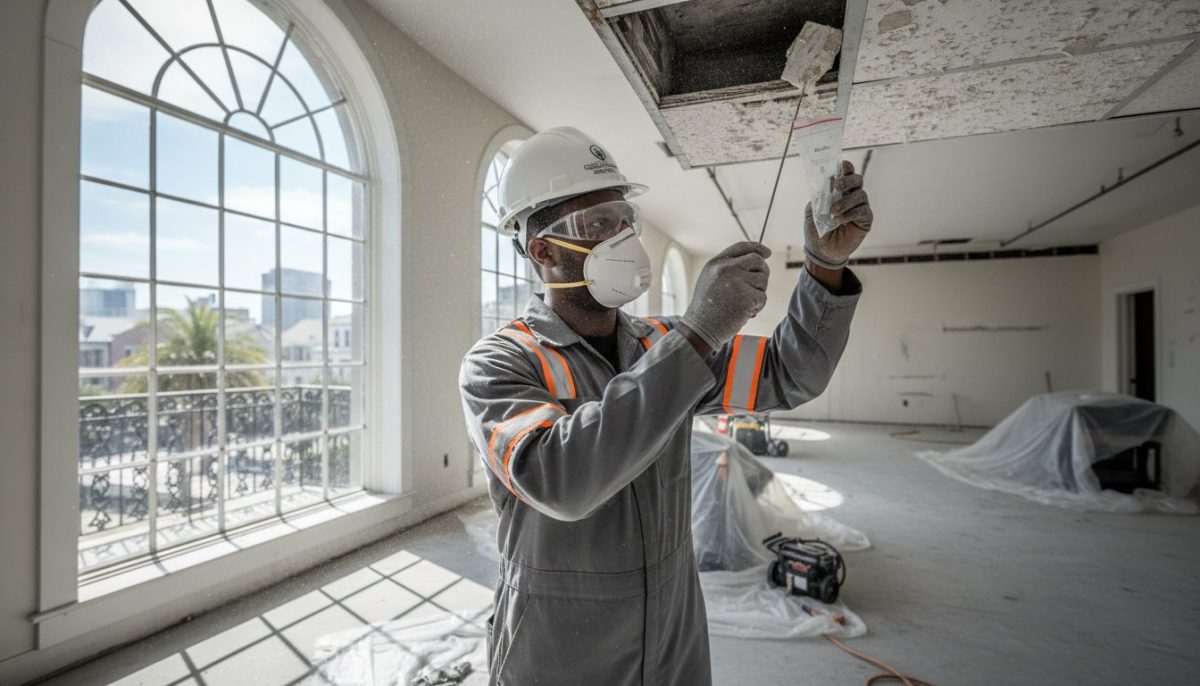
Inspectors must hold specific state and federal licenses, which typically require annual refresher courses to stay current with 2026 safety protocols. An independent, third-party assessment is critical to ensure an objective report that avoids conflicts of interest. A thorough inspection involves a physical walkthrough, systematic bulk sampling, and a detailed report that maps every hazard. This document serves as your legal shield and the foundation for any subsequent abatement plan.
Identifying Asbestos-Containing Materials (ACM)
Asbestos-containing material is defined as any material containing more than 1% asbestos. These minerals are frequently found in pipe insulation, floor tiles, roofing felts, and transite siding. We distinguish between friable materials, which can be crumbled by hand pressure, and non-friable materials. Friable materials pose the highest risk because they release airborne fibers with minimal disturbance. Non-friable materials like vinyl flooring or cement pipes are more stable, but they still require professional handling during demolition to prevent them from becoming friable and hazardous.
The Regulatory Landscape: EPA NESHAP vs. OSHA Standards
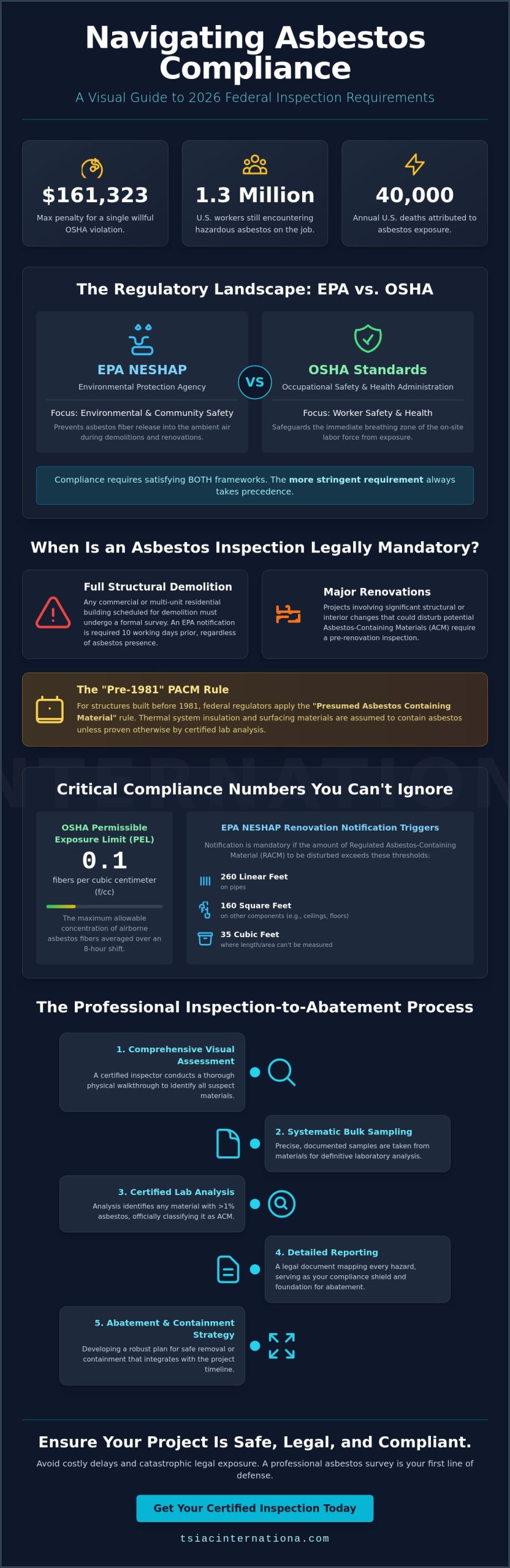
Compliance isn’t about choosing between EPA or OSHA rules; it’s about satisfying both frameworks simultaneously. The Environmental Protection Agency (EPA) manages the National Emission Standards for Hazardous Air Pollutants (NESHAP), which focuses on preventing fiber release into the ambient air during structural changes. Conversely, the Occupational Safety and Health Administration (OSHA) enforces standard 1926.1101 to safeguard workers on-site. While the EPA’s asbestos inspection requirements are designed to protect the community, OSHA’s rules focus on the immediate breathing zone of the labor force. If a conflict arises between the two, the more stringent requirement always takes precedence.
Regulated Asbestos-Containing Material (RACM) is a critical technical category that triggers specific federal actions. This includes friable asbestos or non-friable materials that have become or will likely become crumbled, pulverized, or reduced to powder during demolition. Detailed guidance on these classifications can be found within the EPA Asbestos Laws and Regulations. Failing to identify RACM through a certified survey before work begins is a primary cause of project shutdowns and legal liability.
EPA NESHAP Notification Requirements
Project managers must submit a formal notification to the EPA at least 10 working days before any demolition begins, regardless of whether asbestos is present. For renovations, notification is mandatory if the amount of RACM exceeds 260 linear feet on pipes, 160 square feet on other building components, or 35 cubic feet. Proceeding without a valid inspection report and the subsequent notification is a violation of the Clean Air Act, which carries heavy daily fines. It’s much cheaper to inspect than to litigate.
OSHA Exposure Assessment Protocols
OSHA requires an initial exposure assessment to determine if fiber levels will exceed the Permissible Exposure Limit (PEL) of 0.1 fibers per cubic centimeter. This assessment must be performed by a “competent person” before work starts for Class I, II, or III asbestos tasks. Continuous air monitoring is often necessary to ensure safety protocols remain effective throughout the project’s duration. Employers must maintain these records for 30 years to mitigate long-term liability. Ensuring your project follows these precise safety and compliance protocols is the only way to guarantee both worker health and legal security.
Trigger Events: When is an Inspection Legally Mandatory?
Legal obligations for property owners often surface when they least expect them. While many understand that a total building teardown requires a survey, asbestos inspection requirements also apply to any activity that disturbs potential hazardous materials. This includes planned renovations, structural repairs after a flood, or the transfer of industrial assets. In the current 2026 regulatory environment, the EPA and OSHA view any failure to inspect as a significant liability risk. Emergency situations, such as a localized fire or structural collapse, don’t waive these rules; they actually heighten the need for immediate, professional sampling to protect first responders and recovery crews.
Real estate transactions for older commercial facilities often hinge on these findings. A clear inspection report ensures that the buyer isn’t inheriting millions in “legacy” asbestos liabilities. Similarly, tenant improvements that involve stripping a space back to its core are primary triggers for federal oversight. We’ve seen projects stall for months because a buyer’s due diligence team discovered unmapped hazardous materials that should’ve been identified during the initial property assessment.
Renovation vs. Demolition Requirements
The line between a renovation and a demolition is often thinner than owners realize. Even if you aren’t leveling the building, “selective demolition”—removing specific structural elements like load-bearing walls or HVAC systems—mandates a thorough survey. This is particularly relevant when planning commercial interior gutting services, as these projects frequently encounter hidden insulation or flooring adhesives. According to OSHA Asbestos Standards, any disturbance of suspected materials must be preceded by a negative exposure assessment or a certified inspection to confirm the absence of fibers.
Commercial vs. Residential Exemptions
Federal NESHAP regulations generally apply to all commercial, industrial, and public buildings. However, residential properties are subject to the “four-unit rule.” This means that a single-family home or a small apartment building with four or fewer units is typically exempt from NESHAP, though local ordinances may still apply. For any facility with five or more units, or any commercial space regardless of its square footage, the exemptions disappear. In 2026, state-specific variations often exceed these federal baselines, requiring inspections for even minor plumbing repairs in public spaces. It’s a mistake to assume a building’s size protects you from federal asbestos inspection requirements.
How a Professional Asbestos Inspection is Conducted
A professional survey follows a rigid, four-phase technical protocol to ensure all asbestos inspection requirements are met with engineering precision. This isn’t a cursory walkthrough; it’s a structural audit. Phase 1 initiates with a comprehensive visual assessment where inspectors cross-reference building blueprints with historical construction data to identify high-probability zones. During Phase 2, the inspector performs bulk sampling. This involves extracting physical pieces of suspect materials, such as thermal insulation or floor backing, using both destructive and non-destructive methods depending on the planned project scope.
Phase 3 moves the process into a controlled environment for laboratory analysis. The standard method is Polarized Light Microscopy (PLM), which identifies fiber types and concentrations. If results are inconclusive or if the material is non-friable and organically bound, more advanced testing may be required. Finally, Phase 4 concludes with the delivery of a certified report. This document identifies the presence of hazards and serves as the foundation for an Asbestos Management Plan, which is legally required for ongoing facility operations or as a precursor to any structural disturbance.
Sampling Strategies and Lab Analysis
Reliability in sampling depends on the “Rule of Three.” Federal guidelines typically require at least three samples for each homogenous area of surfacing material to account for variations in material composition. For complex samples like vinyl floor tiles or dust, Transmission Electron Microscopy (TEM) provides higher accuracy by detecting smaller fibers that PLM might miss. We only utilize laboratories that maintain accreditation through the National Voluntary Laboratory Accreditation Program (NVLAP). This ensures that the data used to make your safety decisions is backed by rigorous quality control and federal oversight.
Interpreting the Final Inspection Report
The final report is more than a simple “yes or no” document. It includes a “Condition and Potential for Damage” assessment for every identified hazard. This classification helps you prioritize which materials need immediate attention and which can be managed in place. The report provides a precise map of confirmed ACM locations and total quantities. You’ll use these specific measurements to obtain accurate, fixed-price quotes for hazardous material abatement south carolina. If you’re ready to move from analysis to action, you can contact our technical team to review your report and develop a compliant abatement strategy.
From Inspection to Abatement: The TSIAC International Approach
A technical report is only as valuable as the execution strategy it informs. At TSIAC International, we transform raw inspection data into a surgical containment plan that prioritizes site safety and project continuity. Once asbestos inspection requirements are satisfied and hazardous materials are identified, our engineering team designs a multi-stage abatement protocol. This strategy accounts for the specific fiber concentrations and material friability noted in the lab results, ensuring that Class I and Class II work zones are isolated with medical-grade precision before a single structural element is disturbed.
Our methodology integrates these findings directly into the broader demolition process south carolina. By identifying hazards early, we prevent the “discovery delays” that often plague industrial renovations. We also maintain a strict commitment to environmental stewardship. During the abatement and selective demolition phases, we meticulously separate wood, metal, and plastic components to maximize recycling potential. This disciplined sorting process reduces landfill waste and ensures that only contaminated materials are disposed of at specialized hazardous waste facilities.
Strategic Abatement Planning
Efficiency in hazardous material removal requires more than just equipment; it requires foresight. With over 15 years of experience in complex industrial environments, we’ve refined a process that minimizes project downtime by synchronizing abatement with selective demolition. This synergy allows us to clear specific zones for structural work while safely maintaining containment in others. Every stage of our work is backed by professional documentation, concluding with final clearance testing. We perform rigorous air sampling to confirm fiber levels are well below the 0.1 f/cc threshold before the site is officially handed back to the owner.
Your Next Steps for Compliance
Securing your project’s future starts with professional due diligence. If you’re planning a demolition or renovation for a property built before the late 1980s, you must secure the required regulatory permits and submit federal notifications at least 10 days before work begins. Waiting until the machinery is on-site to address asbestos inspection requirements is a recipe for heavy fines and legal complications. Our team provides the technical expertise needed to navigate these rules with engineering accuracy. Contact TSIAC International for a professional asbestos consultation to ensure your next project remains safe, legal, and on schedule.
Securing Your Project’s Future Through Technical Compliance
Adhering to federal asbestos inspection requirements is more than a legal formality; it’s a critical component of professional risk management. By identifying hazardous materials before structural work begins, you eliminate the threat of sudden project shutdowns and protect your workforce from the 0.1 fibers per cubic centimeter exposure limit. A certified survey provides the engineering data necessary to move from a site assessment to a successful, liability-free abatement process without the fear of unexpected hazardous findings.
TSIAC International brings 15+ years of hazardous material remediation experience to every site, ensuring full compliance with EPA and OSHA 2026 standards. Whether you’re managing a total structural demolition or a complex selective gut-out, our technical team provides the stability and precision your assets deserve. We handle the documentation, the containment, and the final clearance testing so you can focus on the next phase of development. Contact TSIAC International for Expert Asbestos Abatement Services and ensure your project stays on schedule and fully compliant. We’re ready to find solutions for even your most challenging locations.
Frequently Asked Questions
What is the “10-day rule” for asbestos inspections and demolition?
The EPA NESHAP regulation requires building owners to notify their regional or state environmental agency at least 10 working days before starting a demolition or renovation. This period allows regulators to review your inspection report and potentially visit the site. You must submit this notification even if your asbestos inspection requirements were met and no hazardous materials were found during the survey.
Can I use a previous inspection report if it is more than a year old?
While federal regulations don’t set a hard expiration date, a report is only valid if it remains “thorough” and reflects the building’s current state. If any structural changes or minor renovations occurred since the last assessment, the previous data is legally insufficient. Most commercial lenders and insurance providers require a new survey every 12 months to ensure all potential liabilities are documented before work begins.
What happens if asbestos is found during a project that was already started?
You must stop all work immediately and evacuate the affected area to prevent further fiber release. The project site should be sealed off while a certified professional conducts an emergency assessment. You are required to notify the EPA or local health department of the discovery. Resuming work before a new abatement plan is approved and the area is cleared can result in willful violation penalties exceeding $161,000.
Do newer buildings (post-1990) still require an asbestos inspection?
Yes, federal law requires a thorough inspection regardless of the building’s construction date. Although use decreased, asbestos wasn’t fully banned in all construction materials during the 1990s. The EPA only finalized the ban on chrysotile asbestos in March 2024, with some phase-out deadlines extending to 2037. This means even relatively modern structures can contain hazardous gaskets, roofing materials, or floor adhesives that must be identified.
What is the difference between friable and non-friable asbestos in a report?
Friable asbestos is any material that can be crumbled or reduced to powder by hand pressure, such as old pipe insulation. These materials release dangerous fibers with almost no effort. Non-friable asbestos, like vinyl floor tiles, is bound in a hard matrix and is less hazardous. However, if non-friable material is crushed, sanded, or broken during demolition, it’s reclassified as friable and must be handled as a major hazard.
How much does a typical commercial asbestos inspection cost?
Commercial inspection costs as of April 2026 typically range from $0.10 to $0.30 per square foot. For a large-scale project like a 100,000-square-foot warehouse, owners should budget between $10,000 and $30,000 for a comprehensive survey. Smaller projects often follow the national average of $483, with individual sample fees ranging from $75 to $150. These costs vary based on building complexity and the number of samples required.
Can one company perform both the inspection and the abatement?
It’s legally permitted in many jurisdictions, but it often creates a conflict of interest that increases your liability. Using an independent third party for the initial survey and final clearance testing ensures the data is objective and accurate. This separation of duties protects the owner by providing unbiased verification that the site is truly safe for re-occupancy or demolition after the abatement team finishes their work.
What are the penalties for failing to conduct a required asbestos inspection?
Failing to meet asbestos inspection requirements can lead to severe financial and legal consequences. As of January 2026, OSHA can levy fines up to $161,323 for willful violations. The EPA also issues daily fines for Clean Air Act violations, which can quickly exceed the total cost of the renovation project. Beyond fines, owners face significant litigation risks if workers or the public are exposed to unmapped hazardous fibers.
