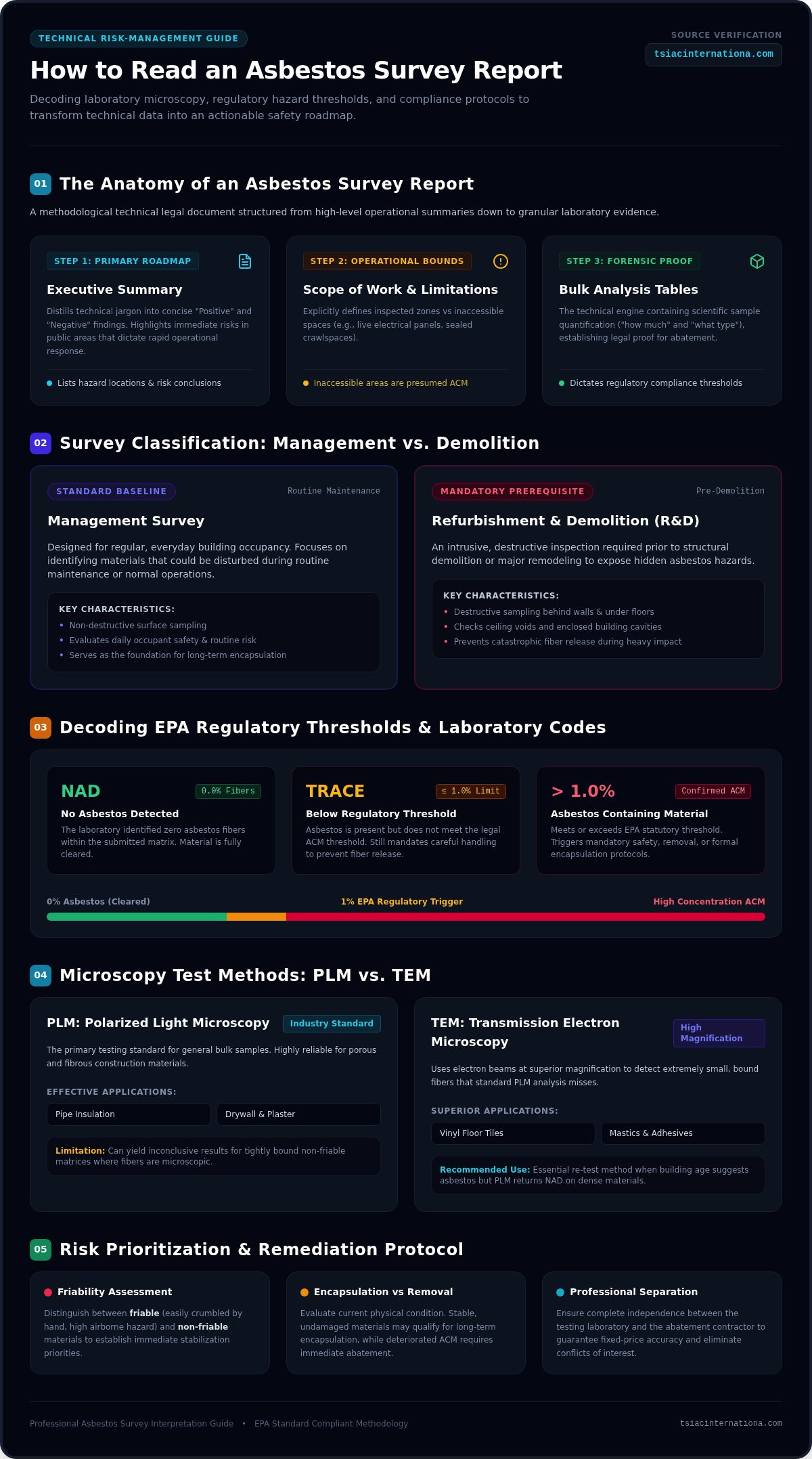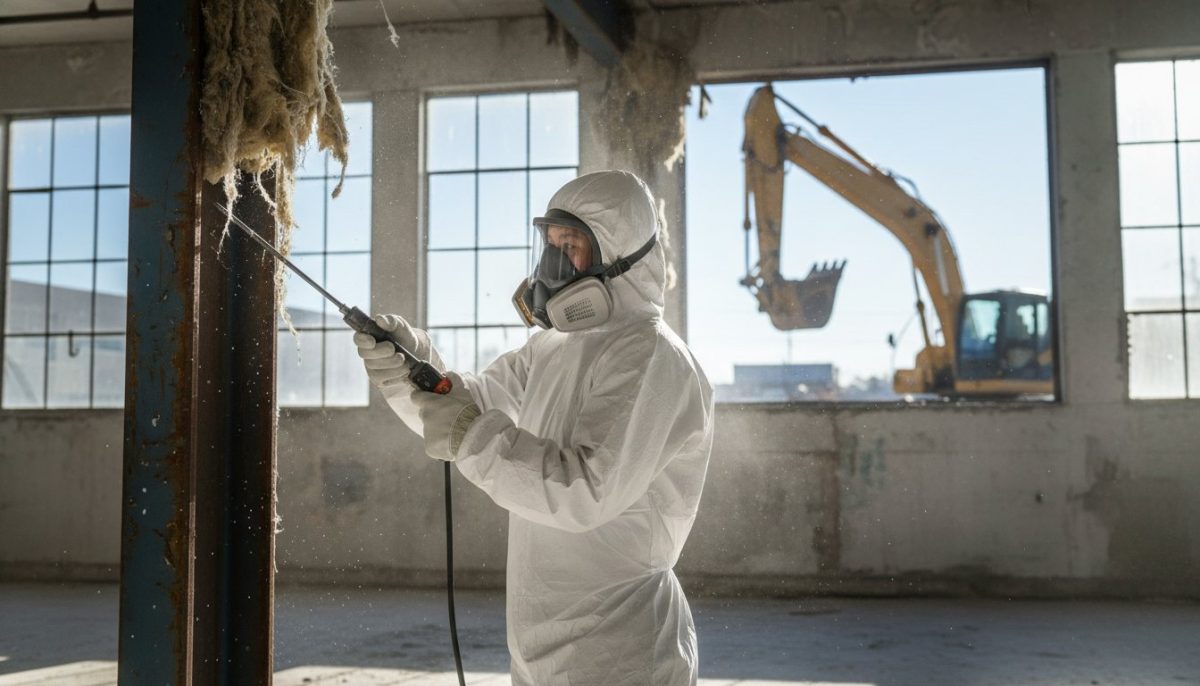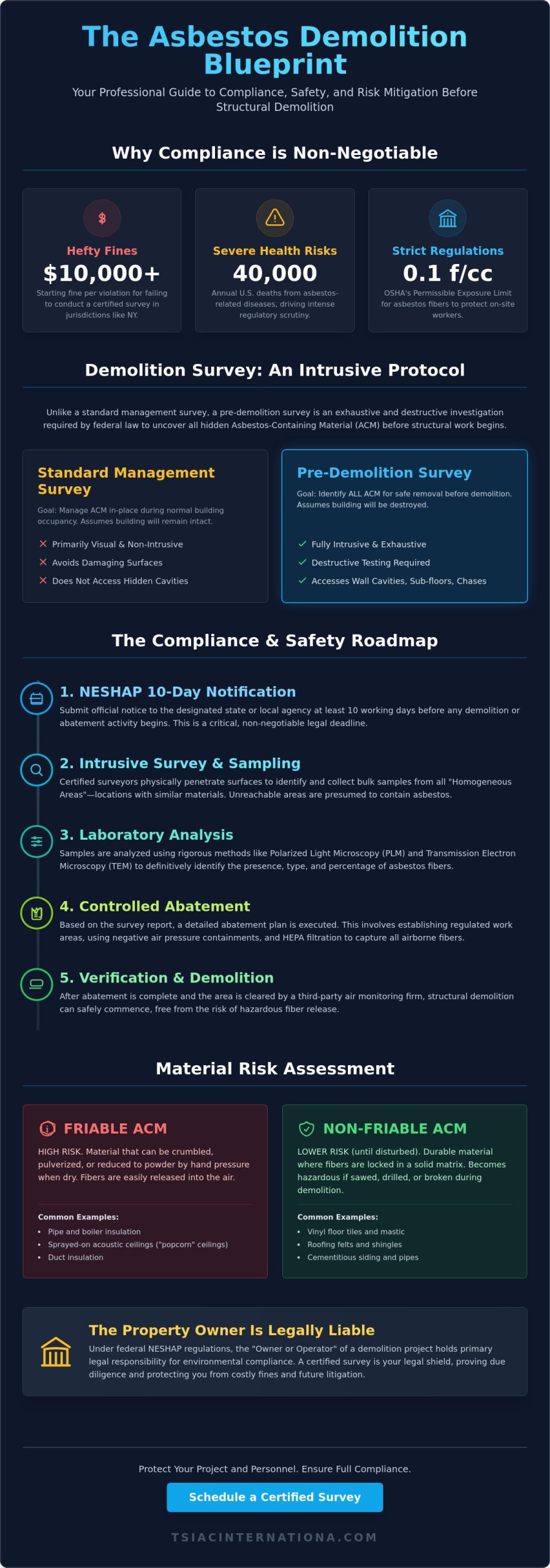
What if the asbestos survey in a property file doesn’t cover the areas your renovation will disturb? In commercial real estate due diligence for asbestos, a report is useful only when its scope, findings, and limitations match the building and the work being considered. A missing room, inaccessible material, or outdated assumption can leave buyers and project teams making decisions without a complete picture.
Due diligence should clarify whether asbestos is present and what the findings mean for the transaction. Consider them alongside plans for occupancy, renovation, or demolition and the requirements that apply to the project. Treating asbestos as a documented risk management process helps surface questions before responsibilities and project plans become difficult to change.
This 2026 checklist explains which records to request, how to review survey coverage, and how to identify information gaps. It also covers questions to raise with qualified assessment professionals, ways to compare consultant findings, and when an abatement contractor can help turn confirmed materials into a defined work scope. Use it to clarify responsibilities and establish practical next steps with the right professionals.
Key Takeaways
- Build a property-specific asbestos file, then verify each record’s date, coverage, limitations, and inaccessible areas.
- Use commercial real estate due diligence for asbestos to distinguish confirmed materials from assumed, inaccessible, or unverified conditions.
- Compare material condition and location with planned disturbance to identify where existing information may not answer project questions.
- Assign pre-closing actions to the buyer, seller, consultant, property manager, or project lead, and document decisions about unresolved risks.
- Coordinate independent assessment findings with an abatement contractor when results point to monitoring, repair, removal, or further evaluation.
Why commercial real estate asbestos due diligence belongs in the transaction plan
Asbestos information can affect how a commercial property is maintained, occupied, renovated, or demolished. For buyers and sellers, documented findings help clarify what is known and what remains uncertain before transaction terms and project plans are settled. Lenders may consider available records as part of their review, while occupants and renovation teams need relevant information to plan work and avoid disturbing materials without appropriate professional direction.
Definition: Commercial asbestos due diligence is the process of documenting building materials, their condition and accessibility, and whether planned activities could disturb them. It reviews available records and identifies gaps that may need qualified professional attention.
An asbestos-specific evaluation focuses on asbestos-containing or presumed materials, their locations and condition, and the scope of the assessment. A broader environmental review may address other concerns, depending on its assignment. Don’t assume it answers every asbestos question. For background on asbestos and its historical uses in building materials, see this Asbestos overview. Check both review scopes against the property and the transaction’s needs.
What questions should the buyer answer before closing?
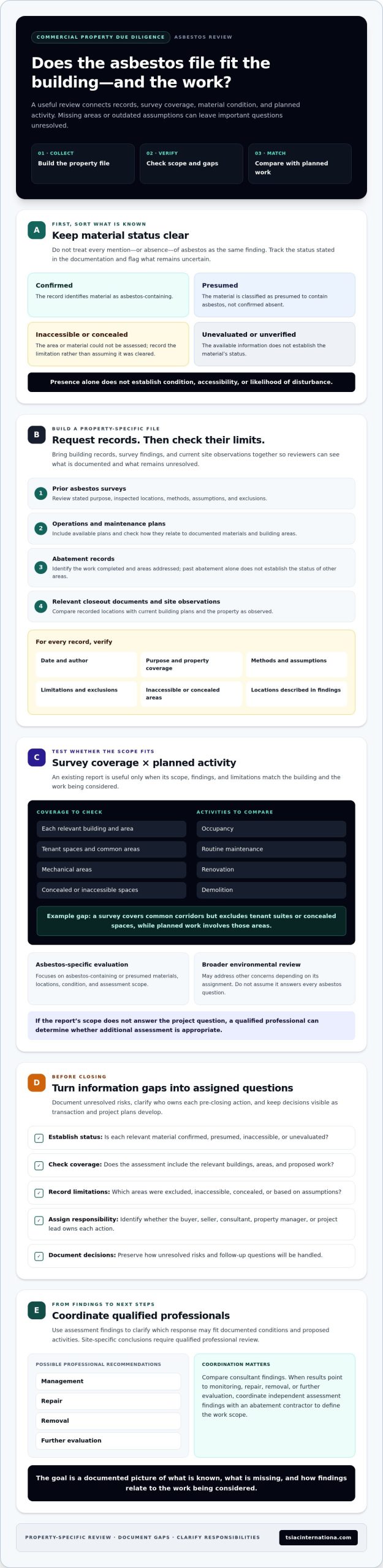
Establish whether materials are confirmed as asbestos-containing, presumed to contain asbestos, or unevaluated. Then check whether the assessment covers each relevant building and area, and note any limitations or inaccessible spaces. Finally, compare its findings with plans for occupancy, routine maintenance, renovation, or demolition. Commercial real estate due diligence for asbestos is most useful when the documentation reflects both the property’s current condition and the work being considered.
Does an asbestos finding automatically make a property unsafe?
No. Presence alone doesn’t establish a material’s condition, accessibility, or likelihood of disturbance, and it doesn’t automatically prevent a property from being occupied or acquired. Don’t label a building safe or unsafe based on a record alone. Depending on documented conditions and planned activities, qualified professionals may recommend management, repair, removal, or further evaluation. Site-specific conclusions require qualified professional review that considers the property’s actual use and proposed work.
Build an asbestos due diligence file from records, surveys, and site observations
A useful due diligence file brings building records, survey findings, and current site observations together so reviewers can see what is documented and what remains unresolved. Request prior asbestos surveys, operations and maintenance plans, abatement records, and relevant closeout documents. A record of past abatement should identify the work completed and the areas addressed. It doesn’t establish the status of other building areas by itself.
Review each document for its date, author, stated purpose, property coverage, methods, limitations, and any inaccessible or excluded areas. Compare the reported locations with current building plans, tenant spaces, mechanical areas, and the proposed work. For example, a survey covering common corridors but excluding tenant suites or concealed spaces may not answer questions about a planned tenant improvement. Requirements for renovation or demolition can also affect project planning. Consult the EPA requirements for building owners and have applicable requirements reviewed for the specific project.
How do buyers assess whether an existing asbestos survey is adequate?
Start by confirming that the report explains why it was prepared, which locations were inspected, what methods and assumptions were used, and what was excluded. Look for materials that remain inaccessible or concealed, and note whether the report classifies them as presumed or unevaluated rather than confirmed absent. Adequacy depends on the transaction and intended work. A qualified professional can determine whether additional assessment is appropriate for the planned scope.
What should the site review document?
An informal walkthrough is for recording observations, not testing materials. Don’t sample, handle, or disturb suspect material. Note visible damage, deterioration, or evidence of disturbance, along with locations that need professional follow-up. Photographs and marked-up plans can link each observation to a specific room or building component, such as a pipe run, ceiling area, or service space.
Keep a discrepancy log that turns open questions into assigned actions. For each item, record the location, the conflicting or missing information, the person responsible, and a due date. For example, if plans show a mechanical room that the survey lists as inaccessible, assign someone to confirm access and ask a qualified professional whether further evaluation is needed. This makes commercial real estate due diligence for asbestos traceable instead of dependent on informal assumptions.
When confirmed findings point to abatement, a contractor can help define the work scope in coordination with the assessment professional and property stakeholders. Learn about asbestos abatement services as a potential next step if the project requires that work.
Compare asbestos findings by condition, planned work, and assessment scope
A finding matters in context. Compare what the assessment says about each material with where it is, whether it can be accessed, and whether planned work could disturb it. A material documented in good condition in an area with no planned work presents a different planning question from damaged material in a renovation zone. This comparison helps buyers identify where the record supports a decision and where clarification is still needed.
| Finding status | Condition and location | Accessibility | Planned disturbance | Information gap to resolve |
|---|---|---|---|---|
| Confirmed asbestos-containing material | Record the documented condition and exact building component. | Note whether the material is visible or concealed. | Identify whether maintenance, renovation, or demolition affects it. | Confirm whether the assessment scope and work plan address it. |
| Assumed or presumed material | Record why it is treated as presumed and where it occurs. | Check whether access or concealment limited evaluation. | Flag any planned activity that may disturb it. | Ask a qualified professional whether further evaluation is appropriate. |
| Inaccessible or unverified area | Identify the location and what could not be assessed. | Document the access limitation. | Compare the area with design and project plans. | Assign follow-up to clarify access, assessment needs, and timing. |
Priorities can change as plans develop. Routine occupancy may call for a different response than work that opens a ceiling, alters a mechanical system, or removes building components. Applicable obligations depend on the project and jurisdiction, so verify requirements with qualified professionals. The EPA requirements for building owners provide federal guidance relevant to asbestos planning. They don’t replace project-specific review.
How should buyers interpret survey findings against renovation plans?
Overlay proposed work areas on survey drawings and mark components the report doesn’t address. For example, if a renovation includes a ceiling but the report excludes concealed spaces above it, ask the assessor to clarify whether further inspection or sampling is warranted before disturbance. Revisit the comparison when designs change, tenant requirements shift, or sequencing affects which areas are accessed first.
How can buyers compare consultant and abatement proposals?
Compare scope before comparing totals. Check locations, quantities, assumptions, exclusions, deliverables, and who is responsible for each task. Confirm whether documents distinguish assessment, abatement, disposal, and restoration responsibilities. If proposals use different quantities, access assumptions, or work boundaries, request clarification so the difference is understood rather than mistaken for equivalent scope.
In commercial real estate due diligence for asbestos, the goal is a traceable comparison, not a conclusion based on a single label. Keep findings, planned work, open questions, and responsible follow-up together so property and project teams can act on the same documented scope.
Pre-closing checklist for unresolved asbestos risks
Unresolved asbestos questions need an owner, a deadline, and a documented path to resolution. A checklist helps the buyer, seller, consultant, property manager, and project lead coordinate their work instead of relying on assumptions as closing approaches. It also gives transaction counsel a clear record of open items and decisions that may need to be addressed in the deal documents.
What belongs in the buyer’s asbestos due diligence checklist?
Use a simple sequence, and record the responsible party and target date for each step:
- Collect records. The seller or property manager provides available surveys, operations and maintenance plans, abatement records, and relevant closeout or disposal documentation. The buyer tracks what has been received.
- Review coverage. The buyer and consultant compare the report scope with the buildings, tenant spaces, and areas relevant to planned work.
- Identify gaps. List uninspected spaces, missing records, conflicting findings, and any limits on access or assessment.
- Obtain professional advice. The buyer arranges qualified professional input on whether additional assessment or other follow-up is appropriate. The project lead considers how findings may affect design and sequencing.
- Document decisions. Record the agreed action, responsible party, due date, and supporting professional recommendation for each open item.
Keep the log current as documents arrive or plans change. A complete file should make the transition from diligence to project planning clear, including which findings may require abatement and what documentation should be retained.
How should unresolved findings affect transaction planning?
Discuss unresolved findings with transaction counsel. Counsel can advise how assessment access, contingencies, responsibility allocation, and any agreed remediation should be handled in appropriate deal documents. Don’t treat a checklist as a substitute for legal or technical advice. Use it to make open questions visible and support decisions based on transaction terms and professional recommendations.
Set a written schedule that connects additional assessment, risk controls, and any agreed remediation with financing milestones, design decisions, tenant needs, and anticipated construction. If a planned work area remains unevaluated, identify whether access and professional review are needed before the design or schedule advances. This keeps asbestos diligence tied to actual transaction and project decisions.
After findings and professional recommendations are available, an abatement contractor can help define the work scope. See asbestos abatement project scope information when considering how confirmed findings and planned work may inform contractor coordination.
Plan the next step: from asbestos findings to controlled abatement work
Assessment findings don’t dictate the same response in every case. Depending on documented condition, accessibility, and planned activities, a qualified professional may recommend continued management, repair, removal, or additional evaluation. The assessment professional evaluates materials and provides findings. An abatement contractor uses confirmed information and agreed project boundaries to plan and carry out abatement work. Keep those responsibilities distinct.
In commercial real estate due diligence for asbestos, document this handoff. Give prospective contractors the relevant assessment records and work plans, then compare proposals against the same defined areas. Review the proposed containment approach, disposal documentation, schedule, coordination responsibilities, and closeout records. Clarify differences in assumptions or exclusions before selecting a scope.
What should a commercial asbestos abatement scope clarify?
Identify the materials and exact work areas using the assessment documentation, drawings, and agreed project boundaries. Confirm who is responsible for site coordination, applicable project documentation, waste handling, and closeout records. Before work is awarded, verify the contractor’s qualifications and insurance, along with requirements that apply to the specific project and jurisdiction. Don’t assume these details are identical across projects.
How can property teams prepare for work and preserve records?
Coordinate occupant communications, site access, work schedules, and interfaces with other construction trades before mobilization. Establish who communicates changes and how affected areas will be managed. After the work, retain assessment reports, project records, disposal documentation, and completion materials in the property file so future owners and project teams can understand what was addressed.
Where abatement is part of a broader interior project, sequence the work with the planned demolition and renovation scope. The commercial interior gutting guide offers additional context for planning interior work alongside other project activities.
TSIAC International provides asbestos abatement, commercial interior gutting, and selective and structural demolition. As an abatement and demolition contractor, it can be considered for implementing a defined work scope, not for providing an independent asbestos assessment. Share the relevant findings and project boundaries when seeking contractor input, and confirm project-specific qualifications and responsibilities as part of procurement.
When assessment findings and project boundaries are defined, contact TSIAC International about abatement planning to discuss the work involved.
Make asbestos findings part of a clear project plan
Sound commercial real estate due diligence for asbestos turns records and survey findings into documented decisions. Confirm that assessment coverage matches the building and planned work, distinguish verified findings from unresolved gaps, and assign each follow-up action to a responsible party with a clear timeline. Before renovation or demolition proceeds, coordinate qualified professional recommendations with the project scope and applicable requirements.
When confirmed findings call for abatement, a defined scope helps property teams align work areas, responsibilities, disposal documentation, and closeout records. TSIAC International brings over 15 years of industry experience. Its asbestos abatement services include compliance documentation and safe hazardous waste disposal.
Discuss your commercial asbestos abatement project once you have the relevant findings and project scope. A documented process and coordination with the right professionals can help your team move forward with greater clarity.
Frequently Asked Questions
Is asbestos due diligence included in a Phase I Environmental Site Assessment?
Not necessarily. A Phase I Environmental Site Assessment and an asbestos-specific building review can have different scopes, so don’t assume one includes the other. Ask the environmental professional to state whether asbestos-containing building materials were evaluated, which areas were covered, and what exclusions apply. For commercial real estate due diligence for asbestos, request a separate assessment or qualified professional guidance if the existing review doesn’t address the building materials and planned work.
Can a commercial property be purchased if asbestos-containing materials are present?
Yes, the presence of asbestos-containing materials doesn’t automatically prevent a property from being purchased or occupied. The decision depends on documented material condition, accessibility, planned activities, and the parties’ assessment of responsibilities and risk. Buyers should review findings with qualified professionals and transaction counsel, particularly if renovation or demolition is planned. The review should clarify what is known, what remains unresolved, and how the parties will address open items.
What records should a buyer request for asbestos due diligence?
Request prior asbestos surveys, operations and maintenance plans, abatement records, and relevant project closeout and disposal documentation. Check each record’s date, author, purpose, property and area coverage, limitations, and inaccessible locations. Compare the documents with current building plans and the proposed work. Record missing or conflicting information, then assign each follow-up question to a responsible party with a due date and any needed professional input.
When should asbestos materials be tested before a renovation?
Resolve questions about suspect or presumed materials before renovation work could disturb them. Compare proposed work areas with the available survey and identify materials or concealed spaces the report doesn’t address. A qualified asbestos professional should determine whether additional inspection or sampling is appropriate for the specific scope. Don’t sample, handle, or disturb suspect materials during an informal walkthrough. Revisit the assessment if design changes alter the affected areas or work sequence.
What happens if asbestos is discovered during commercial property due diligence?
First, document the finding and its location, condition, accessibility, and relationship to planned work. If work could disturb the material, coordinate with qualified professionals before proceeding in the affected area. Depending on documented conditions and plans, the appropriate next step may involve management, repair, removal, or further evaluation. Update the transaction file, assign responsibility and timing for open actions, and consult transaction counsel about how unresolved findings should be addressed in deal documents.
Does a buyer need a new asbestos survey if the seller provides one?
Not automatically. The buyer should assess whether the seller’s survey covers the relevant buildings, tenant spaces, and proposed work, and review its date, purpose, methods, assumptions, exclusions, and inaccessible areas. A report may be useful but still leave project-specific gaps. Ask a qualified professional whether it remains suitable or whether an update or additional assessment is warranted. The decision depends on the report and intended activities, not simply who commissioned it.
How do buyers compare asbestos abatement contractor proposals?
Compare proposals against the same assessment findings and defined work boundaries. Review locations and quantities, assumptions, exclusions, containment approach, disposal documentation, schedule, coordination duties, and closeout records. Confirm which party handles assessment, abatement, waste handling, and other project responsibilities. Ask contractors to explain differences in access assumptions or scope before comparing totals. Also verify project-specific qualifications, insurance, and applicable requirements rather than assuming proposal documents cover every transaction or jurisdiction.