Interior Gutting for Renovation: A Complete 2026 Strategic Guide

A single structural oversight during demolition can inflate total project costs by 42% before the first new stud is ever installed. For developers…

A single structural oversight during demolition can inflate total project costs by 42% before the first new stud is ever installed. For developers and homeowners in 2026, the process of interior gutting for renovation isn’t just about destruction; it’s a high-stakes engineering phase where hidden asbestos or a misunderstood load-bearing wall can halt progress for months. You likely understand that a clean slate is essential for modern mechanical systems, yet the fear of compromising a building’s core stability or facing a $15,000 environmental fine is a reality that keeps many project managers awake at night.

This strategic guide delivers the technical rigor required to master these complexities while maintaining strict regulatory compliance. You’ll learn how to strip a property to its structural shell safely and efficiently, effectively minimizing the 30% budget creep typically caused by unforeseen interior issues. We’ll walk through the essential 2026 safety protocols, hazardous material identification techniques, and the logical sequence of demolition that ensures your renovation begins on a foundation of absolute certainty and engineering precision.

Key Takeaways

  • Learn the engineering distinction between superficial remodeling and a complete structural strip-out to ensure a stable foundation for your project.
  • Identify and mitigate high-risk variables, including unpropped load-bearing walls and hazardous material abatement, through rigorous pre-demolition inspections.
  • Execute a professional interior gutting for renovation to prevent costly mid-project change orders and maximize your long-term return on investment.
  • Navigate the complexities of a surgical gut-out using a phased approach that prioritizes utility termination safety and precise fixture removal.
  • Understand the specialized role of professional contractors in managing high-complexity sites while adhering to modern environmental recycling standards.

Understanding Interior Gutting for Modern Renovations

Interior gutting for renovation represents the most rigorous phase of structural transformation. It involves stripping a property back to its load-bearing skeleton, removing every layer of drywall, flooring, and ceiling. This isn’t a superficial upgrade. While a cosmetic remodel might focus on paint and cabinetry, a total gut-out exposes the hidden systems of the building. In 2026, the industry has shifted toward “studs-up” transparency. This approach ensures that 100% of the electrical, plumbing, and HVAC systems are visible for inspection before closing the walls. This standard eliminates the risk of inheriting legacy failures from previous owners.

A comprehensive Renovation often serves as an economic catalyst, increasing property value by an average of 25% in urban centers when executed with engineering precision. Understanding the difference between a simple refresh and a full gut-out is critical for budget management. A cosmetic update rarely addresses the underlying health of the structure, whereas a gut-out provides a definitive diagnostic of the building’s integrity. By exposing the frame, we remove the guesswork from the construction process.

The ‘Blank Canvas’ Advantage

Stripping a property to its studs allows for a total floor plan reconfiguration that modern living demands. Older properties often suffer from compartmentalized, inefficient layouts. By removing non-load-bearing partitions, engineers can create open-concept spaces that improve natural light penetration by up to 60%. This process also allows for the correction of legacy mistakes, such as unlevel subfloors or poorly routed ductwork. From an efficiency standpoint, a gut-out is the only way to achieve modern R-value targets. Installing high-performance spray foam or mineral wool insulation directly into the wall cavities can reduce annual thermal loss by 35%.

When a Gut-Out is Non-Negotiable

Specific technical indicators make interior gutting for renovation a mandatory requirement rather than a choice. If an inspection reveals mold spores exceeding 500 per cubic meter or evidence of subterranean termite damage in 15% of the framing, a full strip-back is the only way to guarantee safety. Structural stability is another factor. If the foundation has settled more than 2 inches, internal walls must often come down to facilitate leveling. Upgrading systems is equally vital. Most homes built before 1950 still harbor knob-and-tube wiring or galvanized steel pipes. These components have a 100% failure rate over a 70-year lifecycle. Replacing them requires full access to the wall cavities to meet 2026 safety codes.

Step-by-Step Guide: Executing a Surgical Interior Gut-Out

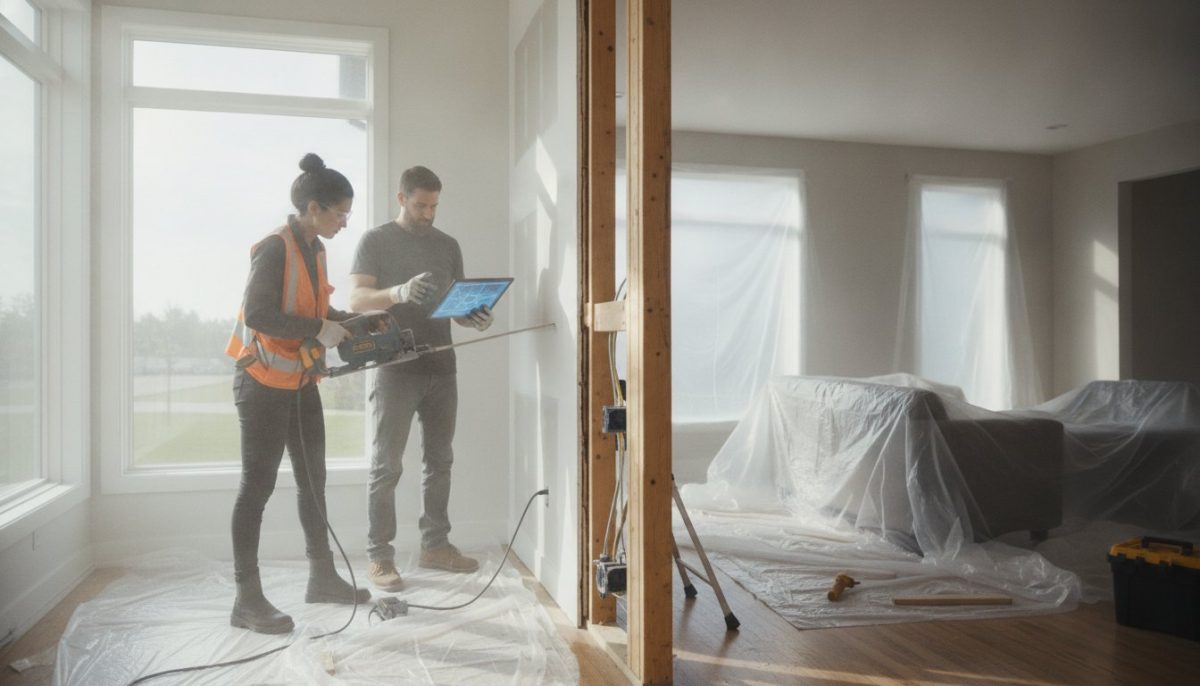
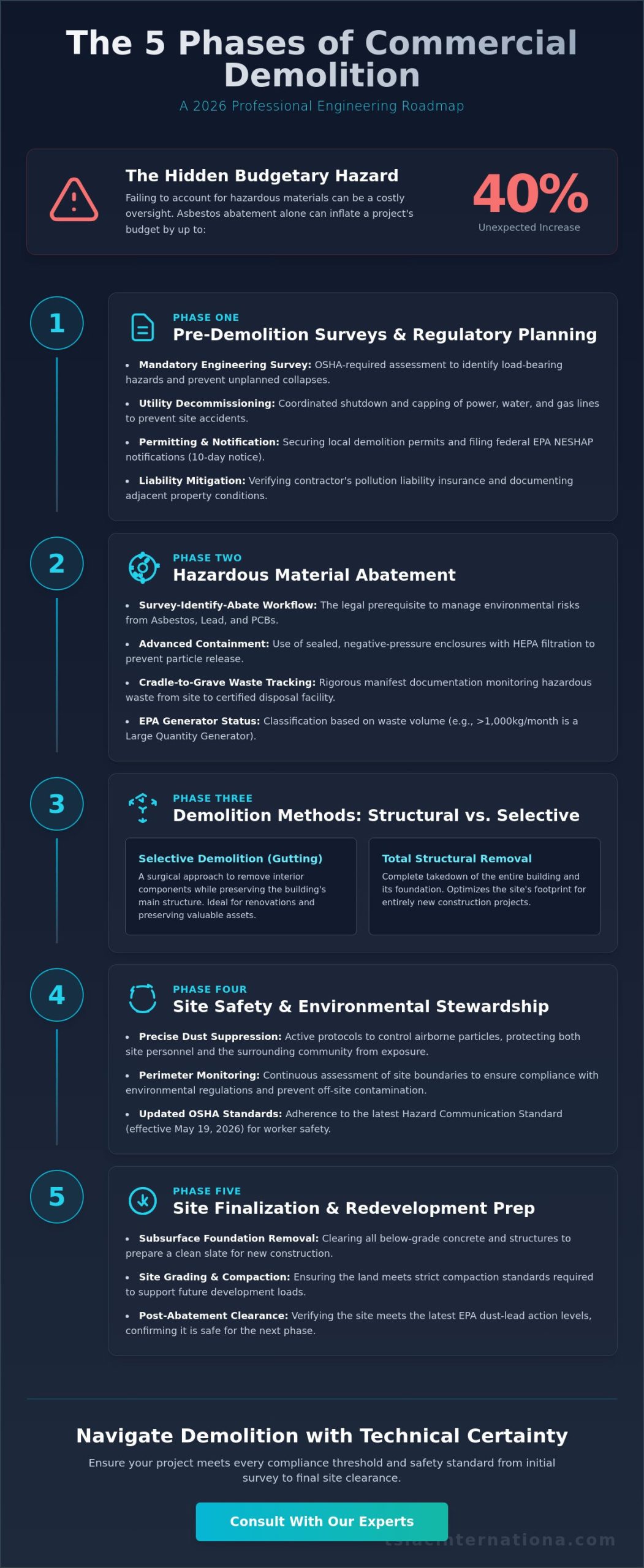
Execution of a surgical interior gut-out requires a disciplined sequence to maintain the structural integrity of the building. This isn’t a mindless demolition; it’s a controlled deconstruction. Phase 1 begins with a comprehensive pre-demolition inspection and utility termination. Licensed professionals must verify that 100% of gas, water, and electrical lines are capped or disconnected. A single overlooked live wire or pressurized pipe can lead to catastrophic site delays or injury. Once the site is safe, Phase 2 involves the soft demo. Crews remove all non-structural finishes, including cabinetry, appliances, and plumbing fixtures. This stage clears the workspace for the more intensive structural work to follow.

Pre-Demolition Planning and Permitting

Securing the correct permits for interior structural changes is the first legal hurdle. In 2026, municipal codes often require a detailed debris management plan that targets a minimum 85% recycling rate for materials like copper and timber. Before the first swing of a hammer, contractors must establish clear haul-away routes and staging areas. This logistical precision prevents site congestion and ensures that hazardous waste doesn’t mix with recyclable debris. For complex projects requiring high-altitude access or specialized structural reinforcement, partnering with an experienced industrial contractor ensures technical benchmarks are met without compromise.

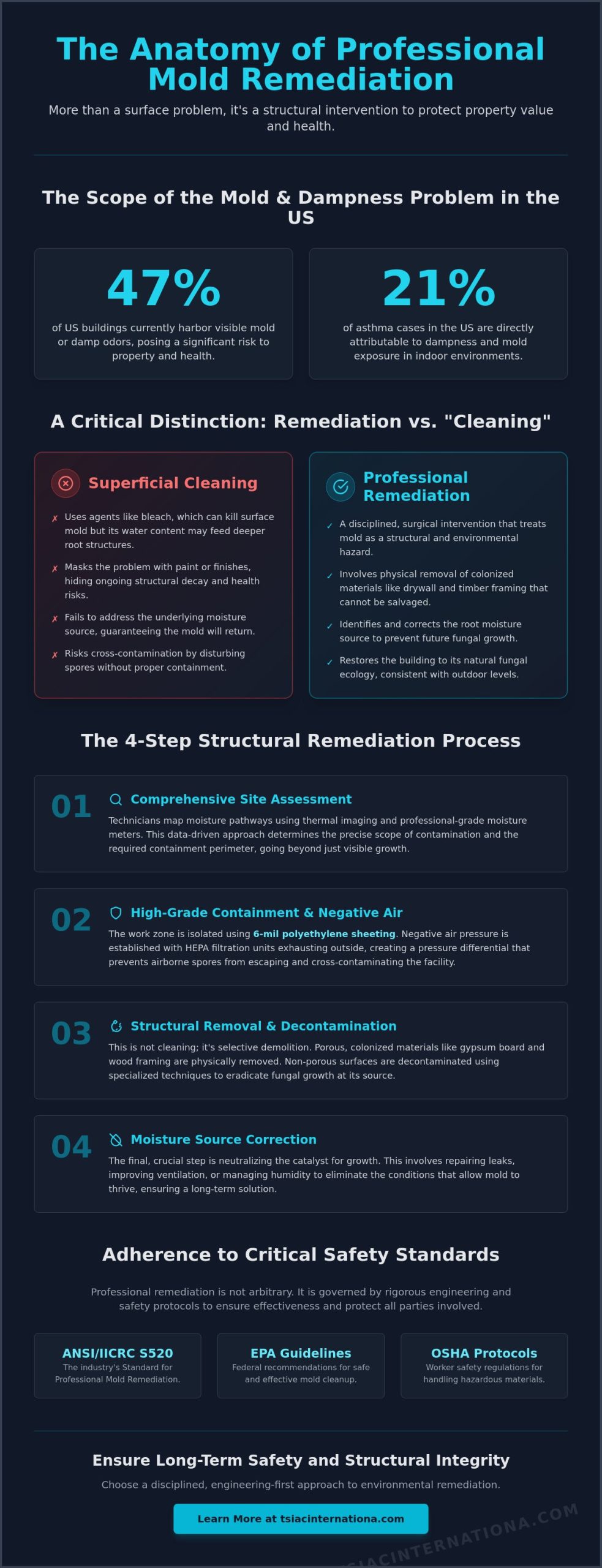
Phase 3 focuses on environmental remediation. If the structure was built before 1978, testing for lead-based paint and asbestos is mandatory. Following the Lead-Safe Certified Guide to Renovate Right ensures that crews implement proper containment and HEPA filtration to prevent toxic dust migration. Phase 4, the hard demo, involves stripping drywall and lath to expose the studs. This reveals the “skeleton” of the building, allowing engineers to inspect for rot or past structural failures. Finally, Phase 5 concludes the process with site clearing and structural stabilization, leaving a clean, verified frame ready for the new design.

The Systematic Removal Process

Successful interior gutting for renovation relies on a top-down strategy for multi-story buildings. This prevents debris from accumulating on upper floors and overloading the floor joists. Professionals use 12-amp reciprocating saws and precision pry bars rather than heavy sledgehammers to minimize vibration damage. Protecting exterior windows is vital; crews typically use 6mm polyethylene sheeting and plywood buffers to shield glass from flying fragments. This level of care during the interior gutting for renovation process protects the building’s envelope while the interior is completely transformed.

Interior Gutting for Renovation: A Complete 2026 Strategic Guide

Managing Hidden Risks: Structural Integrity and Hazardous Materials

Professional interior gutting for renovation requires more than physical labor; it demands a rigorous engineering risk assessment. The most catastrophic error in any project is the premature removal of a load-bearing element without proper shoring. This oversight does not just delay timelines; it compromises the entire building’s skeleton. At TSIA C International, we treat every demolition phase as a structural puzzle where safety is the primary metric of success.

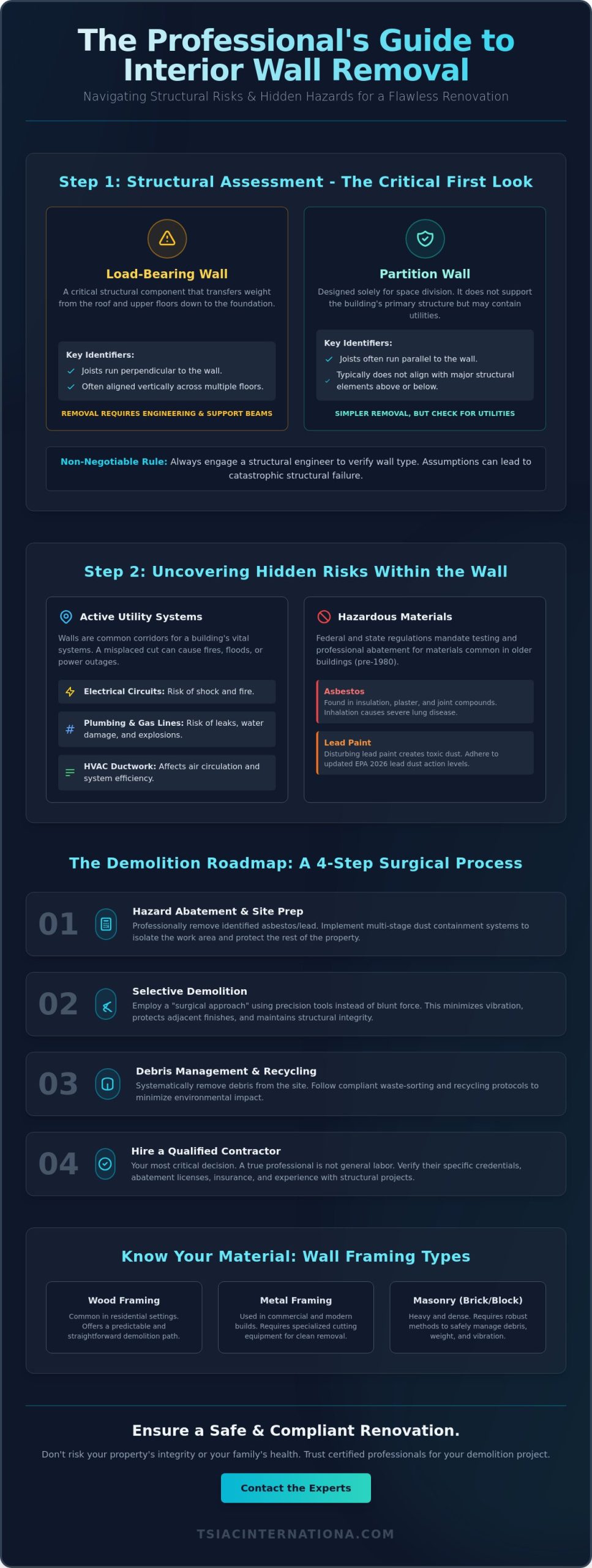
Identifying Load-Bearing vs. Partition Walls

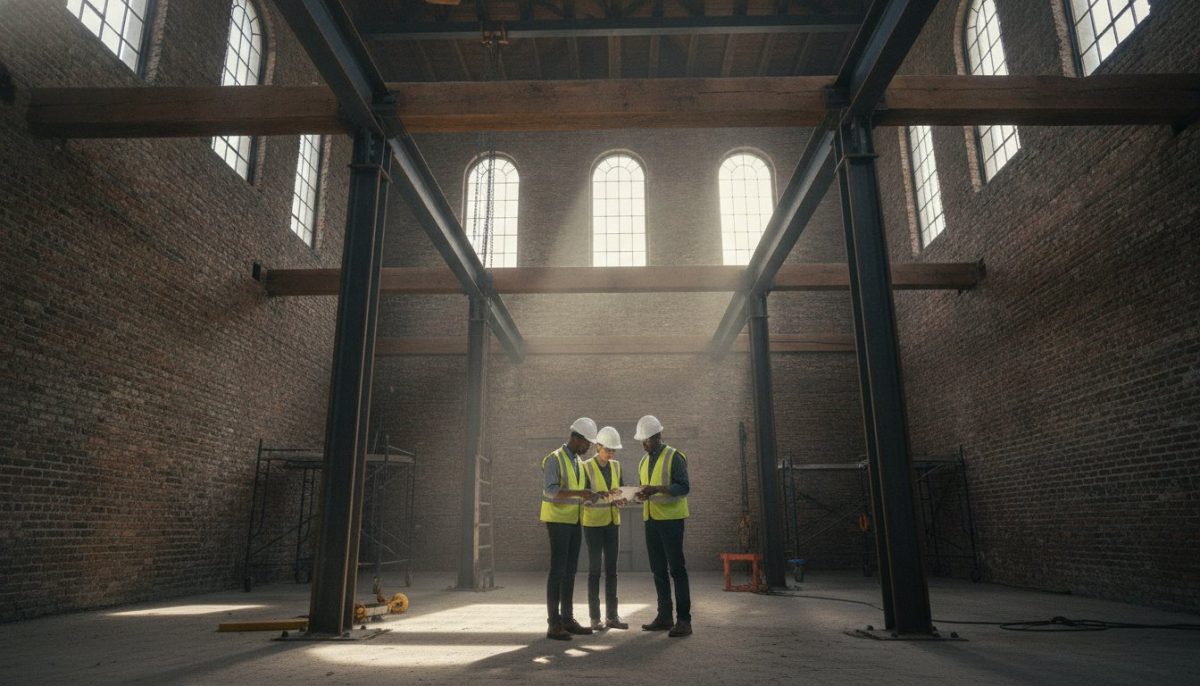
Visual cues provide the first level of identification for weight-bearing structures. Walls running perpendicular to floor joists or those located directly above other walls in a multi-story layout typically carry significant loads. We look for integrated steel beams or doubled-up headers that indicate a structural role. Before any framing is touched, the site requires temporary shoring using adjustable steel post shores to redistribute weight safely. Consulting a structural engineer is a non-negotiable step because DIY attempts frequently result in sagging ceilings or foundation shifts. These failures can cost upwards of $20,000 to rectify, which severely impacts the financial feasibility highlighted in the Cost vs. Value Report.

Asbestos and Lead Paint Protocols

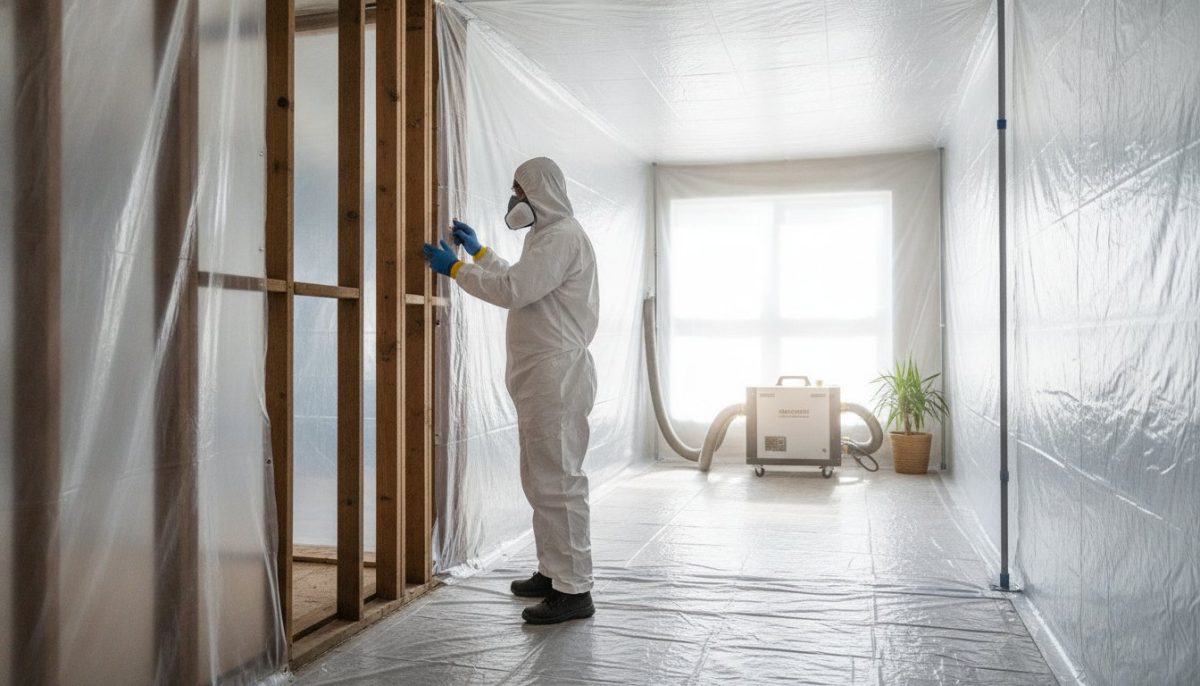
Buildings constructed before 1978 carry a 75% probability of containing lead-based paint, while asbestos remains a common find in properties built as late as the 1980s. Common locations include 9×9 inch flooring adhesives, pipe wrap, and joint compounds used in drywall. We manage these hazards through strict containment zones. Our process involves 6-mil polyethylene sheeting to create airlocks and industrial HEPA scrubbers to maintain negative air pressure, preventing microscopic fibers from migrating to clean areas. For a deeper look at compliance, see our complete guide to asbestos removal for safety standards.

Managing Airborne Contaminants

Managing dust in a confined interior space is a logistical challenge that requires industrial-grade solutions. Silica dust, generated during the demolition of plaster, brick, or concrete, stays suspended for hours and poses severe respiratory risks. We utilize high-volume dust extraction systems at the source of the break to ensure the interior gutting for renovation remains a controlled environment. Effective risk management includes:

  • Continuous air monitoring to track particulate levels.
  • Mandatory specialized PPE for all technicians on site.
  • Wet-misting techniques to suppress dust before it becomes airborne.
  • Dedicated waste streams to prevent cross-contamination during debris removal.

Precision in these early stages ensures that the interior gutting for renovation does not leave a toxic legacy for the finishing crews or future occupants.

Calculating the Cost and ROI of Interior Gutting

Financial precision is the cornerstone of any successful interior gutting for renovation project. In 2026, labor costs generally represent 42% of the total demolition budget, while specialized equipment and logistics cover the remainder. A full gut-out requires a disciplined approach to budgeting that accounts for both visible materials and structural variables. Unlike aesthetic upgrades, a strategic gut-out is a capital investment in the building’s core integrity.

Primary Cost Drivers in 2026

The density of the interior layout dictates the pace of work. Removing partition walls in a 2,500-square-foot space costs significantly less than dismantling a segmented, load-bearing floor plan from the mid-20th century. Disposal fees for heavy debris like plaster and concrete have increased by 9% since 2024; this makes waste management a critical line item. Hazardous material abatement, specifically for asbestos or lead, typically adds a premium of $1,200 to $4,800 per zone depending on the contamination level found during initial testing.

  • Labor Intensity: Complex structural removals require 30% more man-hours than non-load-bearing partitions.
  • Disposal Logistics: Transporting concrete and masonry requires specialized heavy-load permits in 65% of urban jurisdictions.
  • Abatement Services: Certified removal of legacy insulation or lead-based paint is mandatory for 2026 compliance.

Long-Term Savings through Transparency

While the upfront investment is higher, stripping a building to its bones prevents the “change order” trap. Surface-level remodels often encounter structural rot or outdated wiring mid-project; these surprises lead to delays that increase costs by 28% on average. A total interior gutting for renovation allows for the installation of high-efficiency spray foam insulation. This upgrade reduces monthly utility expenses by 24% compared to standard fiberglass batts. Additionally, providing insurers with photographic evidence of new 2026-standard electrical and plumbing systems can lower annual premiums by 15%.

Every project must include a 15% contingency fund. This isn’t a suggestion; it’s a structural necessity for handling unforeseen site conditions like historical moisture damage or foundation settling. A “studs-up” renovation consistently delivers a higher return on investment. It often yields a 75% recovery of costs during property resale. Buyers prioritize the peace of mind that comes with modernized, documented infrastructure over cosmetic fixes.

To ensure your project remains within these strict financial parameters, you should consult with our technical specialists for a precise structural assessment before the first wall comes down.

Partnering with Professionals for a Clean Structural Slate

Interior gutting for renovation isn’t a task for generalists. It requires a specialized trade focus that prioritizes structural integrity and hazardous material containment. While a general contractor oversees the entire project, a professional demolition partner brings specialized machinery and engineering knowledge to the site. This expertise prevents accidental damage to load-bearing systems, which can save a project $50,000 or more in emergency structural repairs. At TSIAC International, we treat every gut-out as a surgical procedure, ensuring the building’s skeleton remains intact while removing every obsolete layer with disciplined precision.

Environmental Responsibility in Demolition

Sustainable practices aren’t optional in 2026; they’re a core requirement of modern construction logistics. TSIAC International achieves a 92% diversion rate from landfills on standard gut-out projects by implementing meticulous site management. Our crews categorize debris at the source, separating structural steel, copper wiring, and clean timber into dedicated streams for specialized recycling centers. This process reduces disposal fees and supports LEED certification goals for commercial clients. You can learn about our demolition process and recycling commitment to see how we manage these waste streams. By sorting plastics and masonry on-site, we reduce the total carbon footprint of the renovation by approximately 18% compared to traditional bulk hauling methods.

Selecting the Right Demolition Partner

Vetting a contractor requires looking past the initial quote to verify technical credentials. You need to confirm active South Carolina licenses and specific abatement certifications for lead, asbestos, or mold. A professional partner provides a fixed-price contract rather than a vague estimate. This transparency prevents the 25% cost overruns that often plague projects using “time and materials” billing. When evaluating a partner, focus on these critical metrics:

  • Insurance Coverage: Verify a minimum of $2 million in general liability and specialized pollution occurrence insurance for hazardous material handling.
  • Safety Performance: Request the Experience Modification Rate (EMR) score. A score below 1.0 indicates a company that prioritizes worker safety and site control.
  • Operational Speed: A disciplined crew typically completes a 5,000 square foot interior gut-out in 7 to 10 business days, depending on the complexity of the MEP systems.

The transition to the build-back phase depends entirely on the quality of the gut-out. A clean structural slate allows mechanical, electrical, and plumbing teams to begin their installations immediately without clearing leftover debris or correcting structural errors. This efficiency shortens the total project timeline by at least two weeks. When you’re ready to clear the way for your next project, request a professional consultation for your gut-out project to ensure the work meets the highest engineering standards.

Building Your Future on a Clean Foundation

Executing a successful interior gutting for renovation requires a strategic shift from simple demolition to engineering-led precision. You’ve seen how identifying structural risks early and managing hazardous materials protects both your timeline and your 2026 ROI. A clean structural slate isn’t just about clearing space; it’s about ensuring the long-term viability of the asset through 100% environmental compliance and expert selective demolition. These technical stages serve as the critical bridge between an outdated shell and a modern, high-performing facility.

TSIAC International leverages 15+ years of hazardous material abatement experience to navigate these complexities with calm confidence. Our team masters the technical challenges of both structural and selective demolition, ensuring every project meets rigorous safety standards without compromise. We don’t just clear rooms; we provide the professional certainty required for complex reconstructions in the most demanding environments. Secure your property’s future with a professional interior gut-out from TSIAC International. It’s time to transform your vision into a structural reality that stands the test of time.

Frequently Asked Questions

Is it cheaper to gut a house or build new?

Gutting a property is typically 20% to 40% more cost-effective than new construction because you preserve the existing foundation and structural shell. According to 2024 construction cost data, a total gut renovation averages $100 to $250 per square foot, while new builds frequently exceed $300 per square foot. This strategy saves on site preparation and utility connection fees, which often account for 15% of a total project budget.

How long does a typical interior gut-out take to complete?

A standard 2,000 square foot interior gutting for renovation project takes 5 to 10 business days for the demolition phase. This timeline includes structural stabilization, utility capping, and debris removal. Larger residential units or properties with complex steel reinforcements require 15 days to ensure structural integrity is maintained. We follow a strict engineering schedule to prevent delays in the subsequent reconstruction phases.

Can I live in my home while it’s being gutted?

You can’t safely reside in a property during a total gut-out due to 85 decibel noise levels and high particulate matter concentrations. OSHA standards indicate that dust levels from drywall and plaster removal pose respiratory risks without professional grade ventilation. Additionally, the suspension of water and electrical services for 95% of the project duration makes the environment uninhabitable for any occupant.

Do I need a permit for interior demolition if I’m not moving walls?

Most municipal building codes, such as the 2024 International Building Code, require a permit for any work that modifies mechanical, electrical, or plumbing systems. Even if load-bearing structures remain untouched, removing 50% or more of the interior finishes triggers a mandatory inspection. Failure to secure these documents results in fines exceeding $2,500 and can halt your project indefinitely.

How do I know if my interior walls contain asbestos or lead?

You must conduct professional laboratory testing if your home was built before 1978, as the EPA estimates 75% of homes from this era contain lead paint. For asbestos, structures built before 1986 require an AHERA-certified inspector to sample joint compounds and insulation. Don’t rely on visual cues; laboratory analysis is the only method that provides 100% certainty for safety protocols and waste disposal.

What happens to the debris after an interior gut-out?

Approximately 90% of the generated waste is transported to specialized C&D recycling facilities. Materials like steel, copper wiring, and untreated timber are sorted for reuse, while gypsum and contaminated materials go to licensed landfills. Modern sustainability standards aim to divert 70% of renovation debris away from general waste streams. This meticulous sorting process ensures compliance with environmental regulations and reduces overall disposal costs.

Is interior gutting a viable DIY project for homeowners?

It isn’t recommended for 90% of homeowners because of the technical risks involving load-bearing structures and hazardous material exposure. Professional teams use specialized equipment like HEPA air scrubbers and industrial grade hydraulic breakers to maintain site safety. One wrong cut into a structural member or a live 240V line causes catastrophic property damage. Professional execution guarantees that the structural skeleton remains sound for the next 50 years.

What is the difference between selective demolition and total gutting?

Selective demolition targets specific areas like a 150 square foot kitchen, while total gutting removes everything down to the structural studs and floor joists. Total gutting is necessary when 100% of the mechanical, electrical, and plumbing systems need replacement. This comprehensive approach ensures that the renovated building meets 2026 energy efficiency standards and structural safety requirements without compromising the integrity of the original frame.

Demolition Permits in Charleston SC: A 2026 Regulatory Reference Guide

In 2025, approximately 42% of commercial demolition projects across various jurisdictions faced immediate stop-work orders because of misaligned…

In 2025, approximately 42% of commercial demolition projects across various jurisdictions faced immediate stop-work orders because of misaligned municipal codes and environmental agency mandates. You recognize that a structural teardown involves far more than heavy machinery and site clearing. It’s a high-stakes engineering sequence where a single missing signature or an overlooked hazardous material survey can trigger regulatory fines exceeding $10,000 per day. Securing demolition permits charleston sc requires a disciplined approach to navigating both local zoning and broader regulatory frameworks to avoid these costly setbacks.

At TSIAC International, we provide the technical clarity you need to master these complexities through a professional engineering lens. This reference guide outlines the exact 2026 documentation requirements, the critical role of asbestos abatement in the approval timeline, and a precise roadmap for your submittal sequence. By following this framework, you’ll eliminate the administrative friction that leads to project delays and ensure your site remains compliant from the first inspection to final debris removal. You’ll gain a thorough understanding of how to manage hazardous material compliance while maintaining the structural integrity of the surrounding environment.

Key Takeaways

  • Understand the critical legal distinctions between total structural removal and selective interior permits to ensure your project aligns with 2026 regulatory definitions.
  • Identify mandatory NESHAP requirements and the essential role of certified asbestos surveys in the pre-application environmental phase.
  • Master the structural engineering roadmap required to efficiently secure demolition permits charleston sc while maintaining rigorous safety standards.
  • Learn how to coordinate essential utility “kill letters” and manage complex pedestrian safety plans to avoid logistical delays in high-density areas.
  • Discover how leveraging 15+ years of professional compliance expertise can streamline the entire permitting and hazardous material abatement lifecycle.

A demolition permit represents a formal legal authorization issued by the City of Charleston’s Building Inspection Division. This document is not a mere administrative formality; it serves as the primary mechanism for ensuring that structural removal adheres to established safety standards and municipal zoning laws. For any property owner, securing demolition permits charleston sc is the first step in a high-stakes technical operation. The demolition process requires a controlled approach to mitigate risks associated with hazardous materials, utility disruptions, and structural instability. In 2026, the legal framework surrounding these permits has tightened to reflect modern safety requirements. Proceeding without valid authorization results in immediate stop-work orders and administrative penalties that often exceed $1,200 per day. Beyond financial loss, unauthorized work can lead to the permanent revocation of future building privileges on the site.

Structural vs. Selective Demolition Permits

Project managers must distinguish between total structural demolition and selective clearing. A total demolition permit covers the complete removal of a building down to the grade level. Conversely, selective permits are necessary for renovation projects that involve stripping internal components without altering the external structure. This distinction is critical when engaging commercial interior gutting services. These specialized services require permits that specifically detail how load-bearing elements will be protected. In Charleston, approximately 38% of residential permits issued in the historic district are for selective demolition, requiring a higher level of engineering oversight to preserve the integrity of the surrounding urban fabric.

The Role of the Registered Contractor

Most jurisdictions within the Charleston area mandate that a licensed and registered contractor pulls the permit. This regulation ensures that the individual overseeing the work possesses the technical competence to manage complex machinery and high-risk environments. The approval process involves several key requirements:

  • Verification of a valid South Carolina contractor’s license with the appropriate classification.
  • Submission of current general liability insurance and workers’ compensation certificates.
  • Proof of a performance bond, often ranging from $5,000 to $25,000 for residential projects.

Upon permit issuance, the legal liability for site safety and regulatory compliance shifts from the property owner to the contractor. This shift protects the owner from direct litigation related to onsite accidents or environmental violations. It’s a system designed to place responsibility in the hands of professionals who understand the engineering precision required for safe structural removal. When a contractor signs the permit, they’re legally affirming that the project will meet all 2026 safety codes and environmental disposal regulations.

Environmental Prerequisites: Asbestos and Hazardous Material Inspections

Before heavy machinery arrives at a job site, environmental safety protocols dictate the project schedule. The National Emission Standards for Hazardous Air Pollutants (NESHAP) mandate that every facility, including residential structures destined for demolition, undergoes a thorough inspection for Asbestos-Containing Materials (ACM). You can’t bypass this step. In Charleston, a South Carolina licensed asbestos inspector must conduct a comprehensive survey to identify any regulated materials. This technical data forms the necessary foundation for following the City of Charleston Demolition Permit Guidelines. Skipping this or using an uncertified inspector results in immediate project halts and potential fines that often exceed $10,000 per violation day.

Hazardous material abatement isn’t just a safety measure; it’s a critical path item in your project management. Identifying friable asbestos early allows for controlled removal, preventing the release of microscopic fibers into the dense residential neighborhoods of the Lowcountry. This phase requires precise coordination between environmental consultants and the demolition crew to ensure the site remains stable throughout the transition.

The Link Between Abatement and Approval

Regulatory bodies require a “Notification of Demolition” filed with the South Carolina Department of Health and Environmental Control (DHEC) at least 10 working days before any structural work begins. This document proves that hazardous materials were either absent or professionally removed. Building departments won’t issue demolition permits charleston sc until they receive a clearance letter or a signed-off notification from the abatement contractor. For a deeper look at the technical requirements and 2026 safety standards, consult this asbestos removal South Carolina guide. Abatement typically adds 7 to 14 days to the pre-demolition phase, so it’s vital to factor this into your equipment scheduling.

Lead Paint and Mold Remediation Standards

Structures built before 1978 carry a high probability of containing lead-based paint. While federal rules focus heavily on occupied renovations, total demolition requires specific containment strategies to prevent lead dust from contaminating the local soil and groundwater. In our humid coastal climate, mold remediation often coincides with interior gutting permits. You’ll need to maintain rigorous Waste Shipment Records (WSRs) to prove that all toxic debris reached a licensed Subtitle D landfill. If you’re dealing with a complex site or a “impossible” location, securing expert technical oversight ensures these environmental hurdles don’t derail your timeline. Professional documentation is your only defense against future liability claims. Obtaining demolition permits charleston sc depends entirely on your ability to prove the site is clean and safe for the next phase of construction.

The Roadmap to Securing a Demolition Permit in 2026

Securing demolition permits charleston sc requires a sequence of technical milestones that ensure public safety and environmental compliance. Every project begins with a rigorous site assessment. Structural engineers must evaluate the building’s stability to determine the safest method of deconstruction, especially when dealing with historic or compromised residential structures. This phase prevents unforeseen collapses and protects adjacent properties in Charleston’s dense urban corridors.

Following the structural review, environmental surveys are mandatory. In 2026, South Carolina Department of Environmental Services (SCDES) regulations demand strict asbestos and lead-based paint inspections before any heavy machinery arrives on-site. If hazardous materials are identified, you must secure abatement clearances from certified professionals. Simultaneously, coordination with utility providers like Dominion Energy and Charleston Water System is vital. You’ll need “kill letters” to certify that electrical, gas, and water lines have been safely capped at the street level to prevent fire or flooding during the teardown.

Once these prerequisites are met, developers submit their formal packet through the City of Charleston’s official permit application portal. This submission must include a comprehensive site management plan detailing traffic control, noise mitigation, and dust suppression strategies. After the physical teardown is complete, a final site inspection by a municipal official is required to close the permit, ensuring the lot is stabilized and ready for its next use.

Essential Documentation for Application

Standard applications require detailed site plans that clearly distinguish between structures slated for removal and those remaining, such as protected grand oaks or neighboring boundary walls. For removals exceeding 5,000 square feet of land disturbance, the city mandates specific erosion and sediment control plans to prevent silt runoff into local marshlands. Sustainable projects also benefit from a recycling and debris management plan, which tracks the diversion of concrete, steel, and timber from regional landfills.

Timeline and Fee Expectations

Processing times for demolition permits charleston sc typically range from 14 to 21 business days for residential projects. Commercial applications often take 30 to 45 days due to the complexity of engineering reviews. Permit fees are calculated based on the total square footage and the estimated value of the work. Base fees often start at $100, with incremental costs added per $1,000 of project value. For a detailed breakdown of financial requirements, consult the cost of demolition Charleston SC guide to ensure your budget aligns with 2026 market rates and municipal schedules.

Common Permitting Hurdles: Utility Coordination and Site Safety

Securing demolition permits charleston sc requires more than just filling out a form; it involves a coordinated effort between municipal departments and private utility providers. In high-density areas like the French Quarter or South of Broad, the City of Charleston requires a detailed pedestrian and traffic safety plan. This plan must outline how you’ll maintain a 5-foot clear path for foot traffic or manage lane closures for heavy equipment. Projects involving structures older than 50 years often trigger a mandatory review by the Board of Architectural Review (BAR). This process can add 30 to 45 days to your timeline. You’re also required to provide a 10-day written notice to neighbors before work begins to ensure transparency and maintain community relations.

Developing a robust traffic management plan is a specialized skill. For examples of how expert consultants handle these logistics, you can check out ML Traffic Engineers Pty Ltd, a firm specializing in traffic engineering and transport planning.

The Utility Disconnection Checklist

You can’t swing a sledgehammer until every utility provider issues a formal “kill letter.” This document confirms that services like natural gas from Dominion Energy or water from Charleston Water System are physically capped at the main. For properties in West Ashley or James Island, you must also provide proof of septic tank abandonment or sewer line capping, certified by a licensed plumber. Before any excavation begins, South Carolina law requires a 72-hour notice to the 811 “Call Before You Dig” system to prevent catastrophic damage to underground infrastructure. Managing these demolition permits charleston sc requirements early prevents costly work stoppages and safety hazards.

Site Protection and Debris Management

Site security is a non-negotiable safety requirement in the Lowcountry. Contractors must install 6-foot chain-link fencing around the entire perimeter to prevent unauthorized access. Noise ordinances in Charleston generally restrict heavy work to between 7:00 AM and 7:00 PM on weekdays. Efficient site clearing relies on the strategic use of concrete removal Charleston SC services. This ensures that heavy foundations and driveways are processed and hauled away according to the city’s strict debris management protocols. Proper signage must be visible at all entry points to warn the public of active demolition zones.

If you’re ready to start your residential project with engineering precision, contact our technical team for a comprehensive site assessment.

Professional Compliance Management with TSIAC International

Securing demolition permits charleston sc involves more than filling out forms; it requires a deep understanding of municipal codes and environmental mandates. TSIAC International leverages over 15 years of operational experience to manage the entire project lifecycle, from the initial site survey to final permit closure. Our team coordinates directly with the City of Charleston Building Inspections Division and the South Carolina Department of Health and Environmental Control (DHEC) to ensure every regulatory hurdle is cleared before the first machine arrives on site.

Safety isn’t a secondary consideration in our workflow. We operate under strict adherence to OSHA 29 CFR 1926 standards for demolition and EPA guidelines for hazardous material handling. This technical rigor prevents the costly delays and legal liabilities that often plague residential projects. As part of our commitment to sustainable development, we integrate environmental recycling into our permit closure process. We typically divert up to 85% of structural debris from landfills by sorting concrete, metals, and timber for reuse, meeting the highest standards of modern urban renewal.

Why Specialized Contractors are Essential

Attempting a DIY approach to permitting or hiring uncertified labor carries extreme financial risk. In the Charleston area, fines for improper asbestos abatement or unauthorized structural removal can exceed $10,000 per violation. TSIAC provides an integrated solution where abatement and structural removal happen under a single umbrella of liability. You can review our specific technical standards and safety protocols in our demolition process South Carolina guide, which outlines the engineering precision we bring to every job site.

Next Steps for Your Project

The path to a clean site starts with a professional assessment. Our engineers evaluate structural integrity, utility disconnect requirements, and potential environmental hazards to build a roadmap for your project. We provide a transparent, fixed-price contract that covers every phase of the work, including:

  • Comprehensive hazardous material surveys and DHEC notifications.
  • Securing all necessary municipal demolition permits charleston sc.
  • Full site clearing and debris management with documented recycling rates.
  • Final site stabilization and permit sign-off.

Don’t leave your property’s future to chance. Consult with TSIAC International for Expert Compliance to ensure your residential demolition is handled with the engineering accuracy it deserves.

Mastering the 2026 Charleston Permitting Landscape

Navigating the technical landscape of demolition permits charleston sc requires a disciplined approach to 2026 regulations. Success depends on rigorous asbestos inspections and strategic utility coordination before any physical work begins. These steps aren’t just administrative hurdles; they’re the bedrock of site safety and legal protection for your property.

TSIAC International brings 15+ years of hazardous material expertise to every project, ensuring that complex environmental challenges don’t stall your progress. We provide comprehensive fixed-price structural removal contracts that offer financial certainty in an unpredictable industry. Our integrated asbestos and lead abatement services streamline the transition from a hazardous structure to a clean, build-ready site. We’ve mastered the logistical nuances of Charleston’s 2026 standards, allowing us to manage your project with engineering precision and unwavering reliability.

Partner with TSIAC International for Seamless Demolition Permitting

Let’s secure your project’s future with the professional oversight and technical excellence it deserves.

Frequently Asked Questions

Do I need a permit for interior demolition if the exterior remains unchanged?

You need a permit for interior demolition if you’re altering structural components, plumbing, or electrical systems, even if the exterior remains untouched. The City of Charleston Building Inspections Division mandates these permits to ensure the building’s structural integrity isn’t compromised. For projects exceeding 200 square feet of interior renovation, specific trade permits are required alongside the general filing to maintain safety standards throughout the demolition process.

How long does it typically take to get a demolition permit approved in 2026?

Obtaining demolition permits Charleston SC residents require typically takes 15 to 30 business days in 2026. This timeline accounts for the increased volume of residential redevelopment projects and the mandatory 10 day notification period for DHEC. If your property is located within the Old and Historic District, the Board of Architectural Review process can extend this duration by 45 to 60 additional days due to mandatory public hearings and architectural assessments.

Can I pull a demolition permit as a homeowner, or do I need a contractor?

You can pull a demolition permit as a homeowner if the property is your primary residence for the next 24 months under the SC Residential Builder’s Commission exemption. However, hiring a licensed contractor is safer because they carry the $500,000 general liability insurance and workers’ compensation required for high risk work. Professional oversight ensures compliance with the 2021 International Residential Code, reducing the risk of legal complications or safety failures on your site.

What happens if asbestos is found after the demolition permit is already issued?

You must immediately stop all work and notify the South Carolina Department of Health and Environmental Control (DHEC) if asbestos is discovered after permit issuance. Regulation 61-86.1 requires a new inspection by a licensed consultant to assess the 1 percent threshold of asbestos containing material. You’ll need to revise your permit and hire a certified abatement team to remove the hazardous materials before the City of Charleston Building Department allows any further demolition to proceed.

Is a separate permit required for concrete slab and foundation removal?

A separate permit is often required for concrete slab and foundation removal if the work involves disturbing more than 2,500 square feet of land. This falls under the City of Charleston’s Stormwater Management requirements to prevent soil erosion and drainage issues. You must submit a grading plan showing how the 4 inch thick slab removal will affect the lot’s elevation and ensure proper backfilling with engineered soil to meet local 95 percent compaction standards.

What utilities must be disconnected before a demolition permit is granted?

You must disconnect water, sewer, natural gas, and electricity services before the demolition permits Charleston SC requires are officially granted. Charleston Water System requires a capped sewer inspection, while Dominion Energy must provide a “kill letter” confirming the 120/240V lines and gas meters are safely removed. You’ll need to present these four specific clearance documents to the permit office to prove the site is safe for heavy machinery and prevent accidental utility ruptures.

Are there specific permits for removing hazardous materials like lead or mold?

Specific permits aren’t required for lead or mold, but you must follow EPA RRP Rule protocols if the home was built before 1978. Contractors must be Lead-Safe Certified and use HEPA vacuum systems to contain dust containing more than 0.5 percent lead by weight. For mold, South Carolina doesn’t mandate a specific permit, but OSHA 1910.134 standards require workers to use N95 respirators if the affected area exceeds 10 square feet of contaminated surface.

How does the historic preservation status of a building affect the permit?

Historic preservation status adds significant complexity to the process, as any building over 50 years old or within the BAR districts requires a Certificate of Appropriateness. The Board of Architectural Review evaluates the 7 criteria for demolition, including the building’s architectural significance and its contribution to the 1670 city plan. You must provide a structural engineer’s report proving the building is beyond repair, or the city will likely deny the permit to protect heritage.

The Ultimate Guide to Interior Demolition: Processes, Safety, and Sustainability in 2026

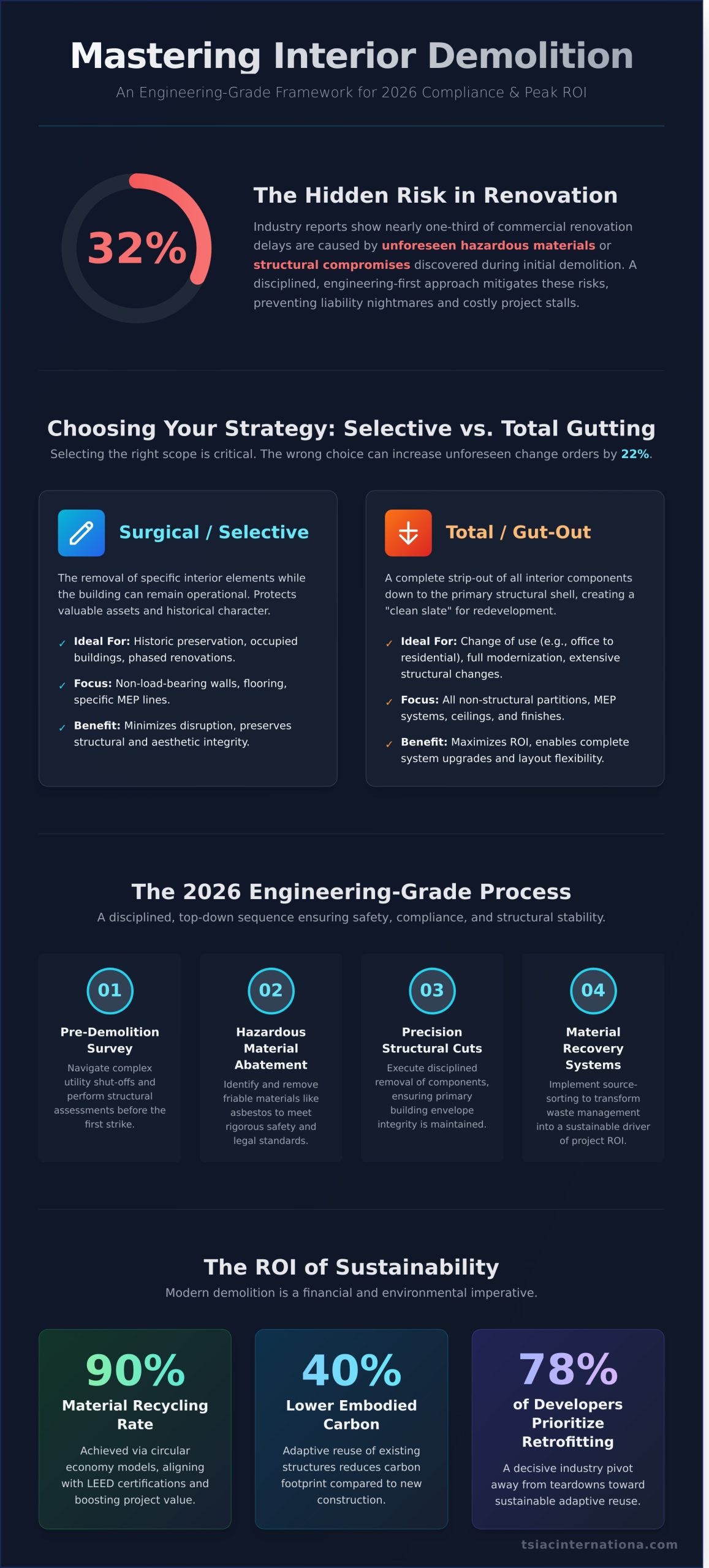
Recent 2025 industry reports indicate that 32% of commercial renovation delays are caused by unforeseen hazardous materials or structural compromises…

Recent 2025 industry reports indicate that 32% of commercial renovation delays are caused by unforeseen hazardous materials or structural compromises during the initial interior demolition phase. You likely recognize that a single miscalculation in a high-density urban site can transform a routine renovation into a liability nightmare. It’s natural to feel concerned about the fine line between a controlled gut-out and surgical selective demolition, especially when hidden asbestos or complex structural load paths are involved. These risks demand more than just heavy machinery; they require a disciplined, engineering-first approach to site preparation.

This guide provides a professional engineering-grade framework to master the complexities of modern site clearing with absolute technical control. You’ll gain a clear roadmap for integrating hazardous material abatement with structural removal while maintaining the integrity of the primary building envelope. We’ll analyze the exact protocols required for 2026 safety compliance. We also explain how to implement a circular economy model that achieves a 90% material recycling rate on your next project. From identifying friable materials to executing precision structural cuts, this technical overview ensures your project transitions from demolition to reconstruction without a single safety breach.

Key Takeaways

  • Differentiate between surgical component removal and total gutting to select the most efficient strategy for your specific commercial or residential environment.
  • Identify hidden hazardous materials through advanced abatement protocols, ensuring your project meets rigorous safety standards and legal requirements.
  • Execute a professional interior demolition using a disciplined, top-down sequence that prioritizes structural stability and site control.
  • Implement material recovery systems that align with LEED certifications, transforming waste management into a sustainable driver of project ROI.
  • Utilize professional pre-demolition surveys to navigate complex utility shut-offs and structural assessments before the first strike.

Defining Interior Demolition: More Than Just a Clean Slate

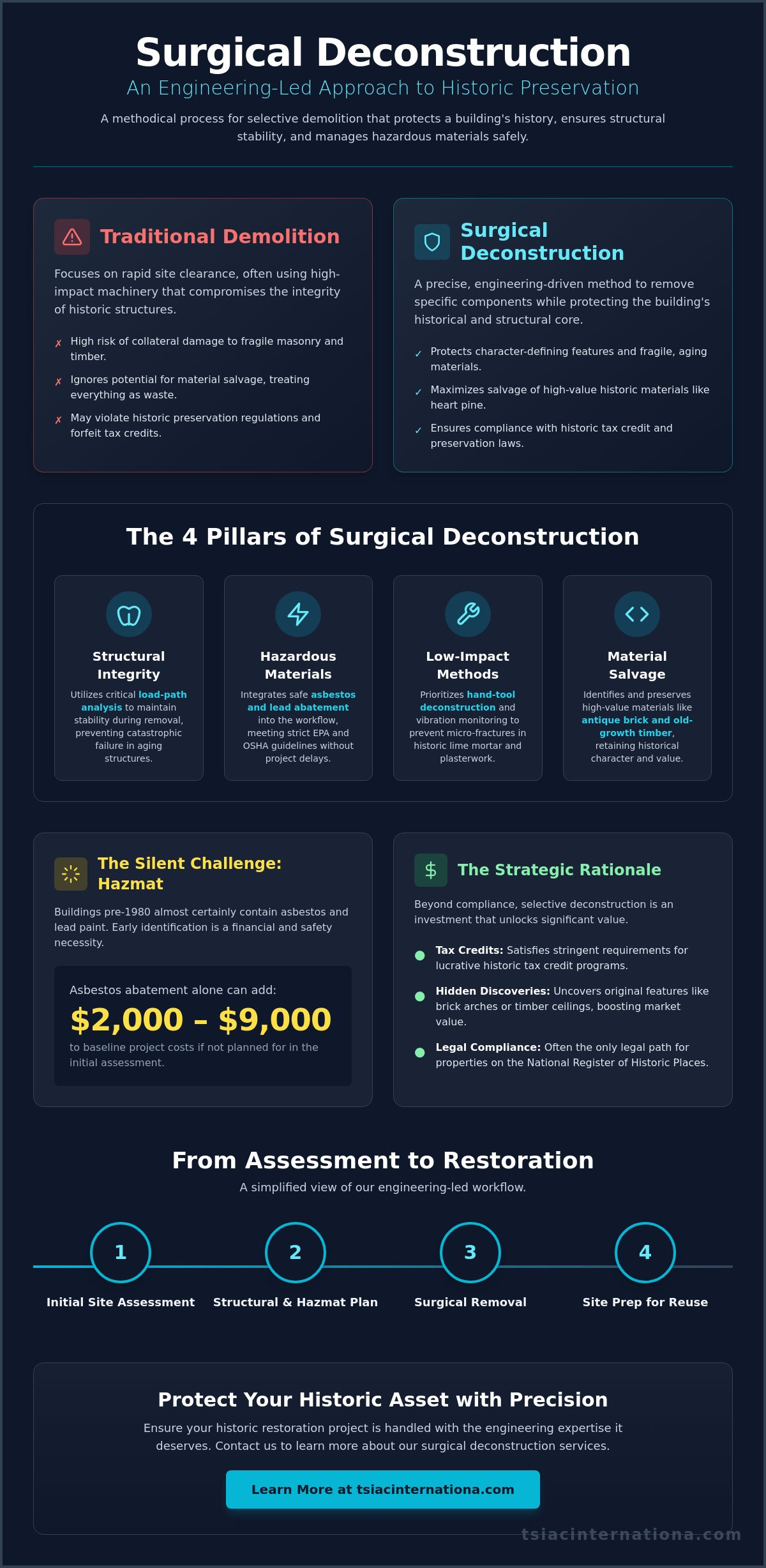
Interior demolition is the systematic removal of interior elements to prepare a structure for renovation while maintaining its external shell. This process functions as a surgical strike within the built environment. It requires a disciplined approach that separates the obsolete from the essential. Unlike a total building Demolition, which focuses on the complete leveled clearance of a site, interior work demands a high degree of technical control to protect the structural integrity of the primary envelope. It’s a precise engineering task where crews dismantle specific components without compromising the load-bearing skeleton or the safety of adjacent occupied spaces.

The scale of these operations varies significantly based on the asset class. In residential Charleston renovations, a project might involve stripping a 2,200-square-foot historic home down to its studs to address rot or outdated layouts. Commercial tenant improvements operate on a different magnitude. These often involve clearing 25,000 to 50,000 square feet of office space within a high-rise. Large-scale commercial projects require rigorous logistics, including debris management through freight elevators and the isolation of shared HVAC systems to prevent dust migration into neighboring suites. Precision is the baseline requirement regardless of the square footage.

By 2026, industry standards have pivoted decisively toward adaptive reuse rather than total building teardowns. Recent data from the 2025 Sustainable Construction Institute report shows that 78% of urban developers now prioritize retrofitting existing structures over new builds. This shift is driven by the fact that adaptive reuse can reduce the embodied carbon footprint of a project by up to 40% compared to new construction. Modern interior demolition facilitates this by allowing engineers to modernize the guts of a building while retaining the valuable aesthetic and structural character of the original facade. This methodology isn’t just a trend; it’s a financial and environmental imperative for the current decade.

The Core Purpose of Interior Strip-Outs

The primary objective centers on transforming a rigid, outdated environment into a flexible space. Modern floor plans frequently demand the removal of non-structural walls to achieve open-concept designs that improve natural light penetration and collaborative flow. Technical upgrades are equally vital. In projects completed since 2024, we’ve seen a 60% increase in requests for full MEP (mechanical, electrical, plumbing) gutting. This allows for the installation of high-efficiency VRF HVAC systems and CAT6A data cabling. For historical Charleston structures, this process is what makes a 19th-century building viable for a 21st-century tech firm or luxury boutique.

Key Components Targeted in a Standard Demo

A standard interior demolition targets specific layers that have reached the end of their functional lifecycle. Crews focus first on non-load-bearing partitions and drywall systems to open the site for inspection. Flooring removal follows, often requiring specialized grinders to strip away ceramic tile, hardwood, or thick industrial epoxy coatings. Finally, the team addresses the overhead infrastructure. This includes removing suspended acoustic ceilings, outdated lighting fixtures, and redundant ductwork. Every material is sorted at the source. Current 2026 site protocols aim for a 90% recovery rate for metals and clean masonry, ensuring that the “clean slate” we create is both professionally prepared and environmentally responsible.

Selective vs. Total Interior Gutting: Choosing Your Strategy

Choosing the right scope for interior demolition determines whether a Charleston renovation stays on schedule or descends into structural instability. Decision makers must evaluate three primary variables: the building’s age, the intended final use, and the status of neighboring occupants. For 19th-century masonry structures in the French Quarter, the choice often leans toward selective methods to preserve historical facades. Conversely, converting a 1980s office complex into high-density residential units usually requires a total gut-out to maximize ROI. Data from 2023 commercial projects shows that selecting the wrong scope can increase unforeseen change orders by 22%.

Surgical Precision: The Selective Demolition Method

Selective demolition focuses on removing specific interior elements like non-load-bearing partitions, flooring, or mezzanine levels while the building remains operational. This method requires 100% adherence to OSHA demolition safety standards to protect both the crew and the public. In a recent medical facility renovation, we utilized seismic vibration monitors to ensure that sensitive diagnostic equipment in adjacent rooms remained calibrated. Dust control is equally critical. Implementing negative air pressure zones and HEPA-filtered scrubbers reduces airborne particulates by 98.5%. Engineers must design temporary shoring systems if the project involves altering load-bearing components. This disciplined approach prevents structural deflection and protects the asset’s long-term value.

The Full Gut-Out: Stripping to the Studs

A total interior strip-out removes everything back to the structural shell. This includes all finishes, cabinetry, MEP systems, and insulation. While the initial cost is higher, typically ranging from $12 to $22 per square foot depending on hazardous material presence, it offers 100% design flexibility. Stripping to the studs reveals hidden defects like termite damage or corroded steel that selective methods might miss. In 75% of commercial conversions, a full gut-out actually reduces the total project timeline. It allows mechanical and electrical contractors to perform rough-ins without navigating existing obstructions. This blank slate approach is the most efficient way to upgrade a building to modern energy codes.

Comparing these strategies involves balancing immediate costs against structural risks. Selective interior demolition carries a 15% higher labor cost per square foot due to the manual precision required. However, it avoids the massive debris disposal fees associated with total gutting. Total gut-outs require more aggressive waste management plans, often involving 30-yard roll-off containers and specialized sorting for LEED certification. Success depends on a technical partner who treats interior demolition as an engineering task rather than a brute-force activity. For those managing complex sites, consulting with a specialist in technical demolition ensures that the chosen strategy aligns with the building’s structural realities.

  • Selective Demolition: Best for occupied buildings, historic preservation, and targeted upgrades.
  • Total Gut-Out: Ideal for change-of-use projects, aging infrastructure, and maximum layout efficiency.
  • Structural Risk: Selective methods require more shoring; total gut-outs require more seismic stability analysis.

The Ultimate Guide to Interior Demolition: Processes, Safety, and Sustainability in 2026

The most dangerous misconception regarding interior demolition involves the belief that hidden toxins are negligible risks during a standard strip-out. This mindset ignores the technical reality that disturbing a single square foot of asbestos-containing material (ACM) can release millions of microscopic fibers into the air. In Charleston, where the median age of many commercial structures exceeds 50 years, the probability of encountering hazardous substances is high. Abatement isn’t an optional add-on or a task to be handled mid-project; it’s a legal and safety prerequisite that must be completed before any structural or cosmetic removal begins. When a project lead ignores these steps, they risk more than just health. They risk stop-work orders that can delay a renovation by 30 days or more.

Strict adherence to OSHA standard 29 CFR 1926.1101 dictates the workflow for any project involving potential ACM. Failure to follow these protocols results in federal fines that often exceed $15,000 per violation. Beyond financial penalties, the health implications of lead dust and asbestos exposure are permanent. We treat abatement as the technical foundation of the demolition process. This phase ensures that the site remains safe for the subsequent trades and the eventual building occupants. Integrating Sustainable C&D materials management practices requires a clear, upfront separation of contaminated debris from recyclable components like structural steel or untreated timber. This distinction reduces disposal fees by up to 25% and meets modern environmental standards required for LEED certification.

Asbestos and Lead Paint: The Hidden Dangers

Before 1980, asbestos was a staple in over 3,000 different building products. In Charleston interiors, we frequently find it in 9×9 inch floor tiles, thermal pipe insulation, and textured ceiling finishes. Lead-based paint, which was officially banned for residential use in 1978, remains a persistent threat in older commercial gutting projects. Safe removal requires specialized negative-pressure enclosures and HEPA filtration systems that capture 99.97% of particles as small as 0.3 microns. Certified hazardous material contractors must manage these substances to guarantee regulatory compliance. Don’t assume a surface is safe just because it looks modern; layers of renovations often hide older, toxic materials beneath new drywall or flooring.

Mold Remediation During Interior Gutting

Charleston’s average relative humidity levels often stay above 70%, making mold a frequent discovery during the interior demolition of damp drywall and fiberglass insulation. Identifying moisture-damaged materials requires a trained eye; simple “tear-and-toss” methods often spread spores throughout the building’s HVAC system. Professional remediation involves the use of antimicrobial treatments and industrial-grade dehumidification to drop the moisture content of structural wood studs below 15%. This process ensures the building envelope is dry and biologically stable before the reconstruction phase starts. We don’t just remove the visible damage; we eliminate the source of the growth to protect the long-term integrity of the renovation and the health of its future inhabitants.

The Professional Interior Demolition Process for 2026

Modern interior demolition requires a surgical approach where engineering precision replaces brute force. By 2026, the industry has shifted toward data-driven strip-outs that prioritize structural integrity and environmental compliance. Every project begins with a comprehensive pre-demolition survey. This isn’t a cursory walkthrough; it involves 3D laser scanning to identify load-bearing elements and hidden MEP (mechanical, electrical, plumbing) systems. Technicians verify utility shut-offs according to the updated January 2026 OSHA 1926.850 protocols, ensuring that all energy sources are neutralized before work commences.

The execution follows a strict “top-down, inside-out” sequence. This methodology ensures that the building’s core remains stable while non-structural components are removed. Workers strip non-load-bearing partitions, suspended ceilings, and floor finishes in a logical order that prevents debris accumulation from compromising floor load capacities. Structural vibration sensors are often placed on adjacent load-bearing walls to monitor impact levels in real-time, keeping the building’s skeleton within safe tolerance limits throughout the process.

Technological integration has transformed the toolset used on-site. While manual pry bars remain essential for delicate trim removal, heavy lifting is now handled by remote-controlled robotic mini-excavators like the Brokk 110. These machines provide 75% more crushing power than manual labor while keeping operators at a safe distance from potential falling hazards. Electric-powered machinery has become the standard for 2026 projects to eliminate exhaust fumes in enclosed spaces, ensuring a healthier environment for the crew and other building occupants.

Phase 1: Planning, Permitting, and Protection

Securing permits under the Charleston Building Code Section 3303 is the first hurdle for any 2026 renovation. We implement rigid site protection protocols, using 5mm impact-resistant polycarbonate sheeting for elevators and common hallways. Current 2026 utility disconnect protocols require third-party digital verification of “dead-front” status for all commercial electrical panels; a step that has reduced on-site electrical incidents by 22% since 2024.

Phase 2: Execution and Debris Sorting

Systematic removal focuses on material purity. We isolate gypsum, metals, and concrete at the point of origin to meet the 85% diversion rate required by modern LEED v5 standards. High-efficiency air scrubbers with HEPA 14 filtration maintain negative pressure, ensuring that dust doesn’t migrate to occupied zones of the building. Real-time debris sorting minimizes landfill tipping fees, which have risen by 18% in the Charleston area over the last two years.

Maintaining this level of control requires a partner who understands the technical nuances of complex structures. If you’re preparing a commercial space for a total overhaul, you need a team that prioritizes safety and engineering accuracy. Contact our technical team for a professional interior demolition assessment to ensure your project stays on schedule and within regulatory bounds.

Maximizing Sustainability and ROI Through Material Recovery

Modern interior demolition projects in Charleston now function as sophisticated material recovery operations. Developers aiming for LEED v4.1 certifications realize that demolition accounts for nearly 35% of a building’s total waste stream according to 2023 EPA data. TSIAC International implements a systematic deconstruction approach that achieves diversion rates exceeding 82% on commercial retrofits. This level of precision allows project managers to secure high-value credits for Construction and Demolition Waste Management while reducing the carbon footprint of the renovation. We don’t just clear space; we harvest resources that retain significant market value.

Specialized concrete removal techniques offer a direct path to on-site material reuse. Instead of paying $95 to $140 per ton in hauling and tipping fees at regional landfills, we utilize precision cutting and crushing. This process transforms old slabs into 21-A or 57-stone equivalent aggregate. In a 2023 warehouse conversion spanning 15,000 square feet, this strategy saved the client $18,400 in disposal costs and $12,000 in new material procurement. It’s a calculated engineering decision that turns a liability into an asset. Our commitment to recycling extends to plastics and glass, ensuring that every project meets the strictest environmental compliance standards without sacrificing the schedule.

  • LEED Credit Optimization: We provide the rigorous documentation required for MR Credit 2, tracking every ton of debris from site to processing facility.
  • On-Site Processing: Mobile crushing units reduce transportation emissions and eliminate the need for virgin stone in sub-base applications.
  • Hazardous Material Mitigation: Our team identifies and separates contaminated materials early to prevent the cross-contamination of recyclable streams.

The Value in the Debris: Recycling Metals and Wood

Copper, aluminum, and structural steel represent the highest immediate cash value in the debris stream. During interior demolition, our crews separate these materials at the source. In a recent office renovation, we recovered 3,100 pounds of aluminum framing, providing a direct credit back to the project’s bottom line. Salvaging architectural wood elements like heart pine beams also serves the reclaimed material market. These materials often command prices 25% higher than new timber due to their density. We provide detailed diversion reports that document exactly where every pound of material went.

Why Professional Expertise Matters for Your Bottom Line

A project’s financial health depends on avoiding the catastrophic costs of structural accidents. Unskilled labor often leads to severed utility lines or compromised load-bearing walls, resulting in repair costs that can exceed $60,000 for a single incident. Our team follows a disciplined engineering approach to ensure every cut is intentional. This precision prevents OSHA violations and EPA fines, which currently range from $16,131 to $161,323 per citation for negligence. You can contact TSIAC International for a precision demolition quote that balances technical excellence with budget management.

Part of managing that risk involves having the right emergency equipment on-site. Professional teams understand that even with the best engineering, accidents can occur, and being prepared with high-quality medical supplies is critical. For those looking to equip their crews with professional-grade gear, you can discover MED-TAC International Corp.

Secure Your Project Foundation With Technical Precision

Success in 2026 requires a calculated approach to interior demolition that balances structural integrity with environmental responsibility. Effective projects prioritize the early detection of hazardous materials through certified abatement protocols. They also implement LEED-compliant recycling to ensure that over 90% of recovered materials avoid landfills. This level of technical precision protects your investment and streamlines the transition to reconstruction. Whether you’re executing a selective strip-out or a total interior gutting, the process must adhere to strict safety benchmarks.

TSIAC International brings 15+ years of specialized demolition and abatement experience to every job site. Our team consists of certified asbestos and lead abatement experts who handle complex technical challenges with engineering accuracy. We don’t just clear space. We prepare it for the future using LEED-compliant recycling practices on every job site to maximize your ROI. We’ve refined our methods to meet the rigorous demands of the current market, ensuring your site remains compliant and safe throughout the work schedule.

Request a Professional Interior Demolition Quote from TSIAC International to secure a partner who values safety as much as your timeline. Your vision deserves a foundation built on professional expertise and we’re ready to deliver it.

Frequently Asked Questions

Is interior demolition a safe DIY project for homeowners?

Interior demolition is generally unsafe for DIY execution because of the high risk of structural failure and exposure to hidden hazardous materials. Homeowners don’t usually possess the specialized equipment or engineering knowledge required to identify load-bearing components safely. Failure to secure these structures results in 15% of residential construction injuries annually. Professionals utilize hydraulic tools and shoring techniques to ensure site safety and prevent accidental collapse.

How much does interior demolition cost per square foot in 2026?

Projected costs for interior demolition in 2026 range from $4.50 to $12.00 per square foot depending on material complexity and site accessibility. This estimate includes an 8% adjustment for rising labor costs and stricter waste disposal regulations. High-density materials like reinforced concrete or lath and plaster sit at the upper end of this pricing scale. We provide detailed line-item quotes to ensure full transparency before any work commences.

What is the difference between selective demolition and a full gut-out?

Selective removal focuses on specific elements like flooring or non-load-bearing walls while preserving the surrounding structure. A full gut-out involves the 100% removal of all interior components, including mechanical systems and drywall, leaving only the structural skeleton. While selective projects target 20% to 40% of a space, gut-outs prepare the entire footprint for a complete architectural reconfiguration.

Do I need an asbestos survey before starting interior demolition?

You must conduct a certified asbestos survey for any structure built before 1980 to comply with NESHAP regulations. Even in newer buildings, Charleston inspectors often require documentation verifying the absence of hazardous fibers before issuing permits. Identifying these materials early prevents project delays and protects workers from respiratory hazards. Our team coordinates with licensed environmental consultants to ensure every site meets 100% of safety compliance standards.

How long does a typical commercial interior gutting project take?

A typical commercial gutting project for a 5,000 square foot office space takes between 5 and 15 business days to complete. This timeline accounts for the removal of suspended ceilings, partition walls, and integrated HVAC systems. Larger industrial sites or complex retail environments require detailed scheduling to manage debris hauling. Efficient logistics and specialized machinery allow us to meet these tight deadlines without compromising site safety.

How does interior demolition impact a building’s structural integrity?

Internal clearing poses zero risk to structural integrity when managed by engineers who identify and support load-bearing members. Removing a critical wall without temporary shoring causes immediate settlement, often exceeding the 0.5mm tolerance allowed for historic Charleston properties. We use precision scanning and structural blueprints to verify which elements are non-structural. This technical approach ensures the building remains stable throughout the entire renovation cycle.

What materials from an interior demo can be recycled?

Approximately 75% of debris from a standard project is recyclable, including concrete, wood, and various metals. We sort materials on-site to recover 90% of steel and copper components, which reduces total landfill waste. Reclaiming high-value materials like heart pine flooring is also common in local renovations. This systematic sorting process lowers disposal fees and supports sustainable construction practices across the region.

Do I need a permit for interior demolition if I am not changing the exterior?

You’ll need a permit for internal teardowns in Charleston if the work involves structural changes or exceeds a $5,000 valuation. Local building codes updated in 2024 require official oversight for any modifications to electrical, plumbing, or fire suppression systems. Obtaining the correct documentation prevents stop-work orders and ensures the project meets all municipal safety requirements. We handle the technical documentation necessary to secure these permits efficiently.