Professional Concrete Removal and Disposal: The 2026 Industrial Guide

Industrial waste data from the EPA in 2023 reveals that construction and demolition debris accounts for 600 million tons annually, a figure more than…

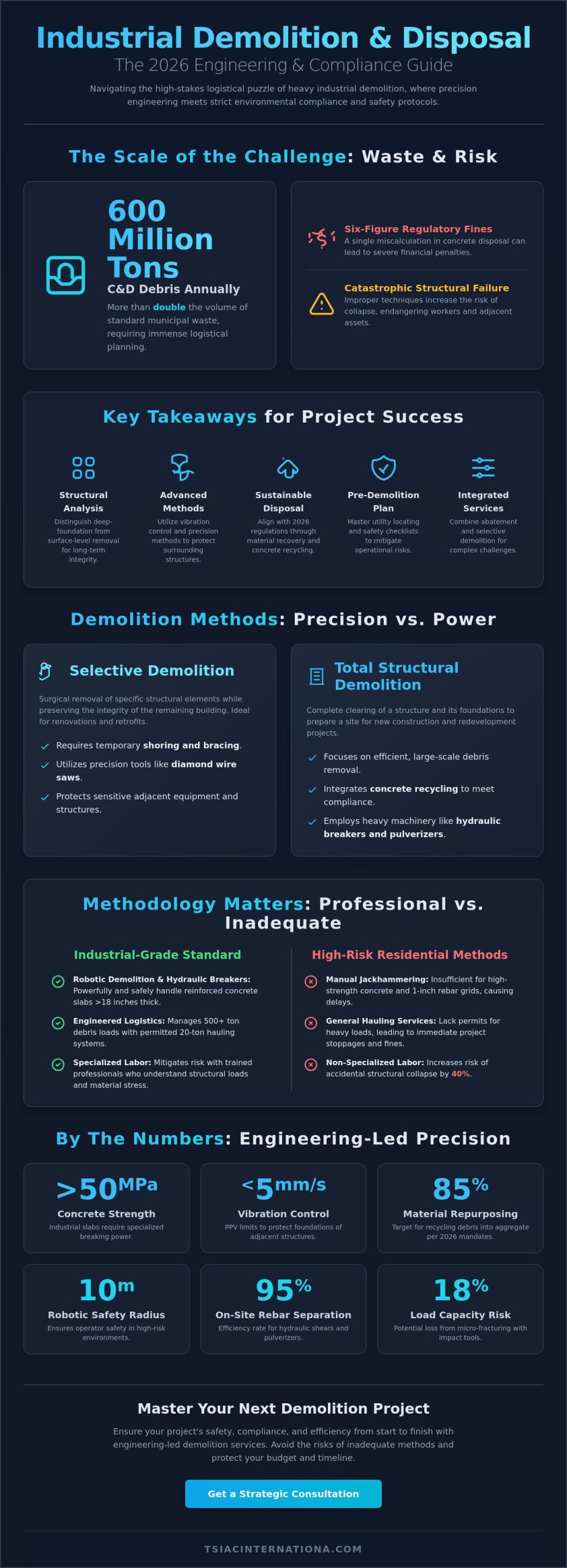
Industrial waste data from the EPA in 2023 reveals that construction and demolition debris accounts for 600 million tons annually, a figure more than double the volume of standard municipal waste. You likely recognize that managing a project of this magnitude isn’t just about brute force; it’s a high-stakes logistical puzzle where a single miscalculation in concrete removal and disposal can lead to six-figure regulatory fines or catastrophic structural failure. We understand the pressure of balancing tight deadlines with the rigid requirements of environmental laws and the hidden dangers of legacy materials like lead or asbestos.

This 2026 industrial guide provides the engineering precision needed to master complex demolition without compromising safety or your operational budget. You’ll gain a clear understanding of specialized removal methods that protect adjacent assets while ensuring every ton of debris meets current compliance standards. We’ll detail specific demolition techniques, hazardous material protocols, and the logistical frameworks required for efficient hauling to ensure your site remains safe and remains fully documented throughout the project lifecycle.

Key Takeaways

  • Understand the critical engineering distinctions between surface-level clearing and deep-foundation structural removal to ensure long-term project integrity.
  • Explore advanced mechanical methods and vibration control protocols designed to protect sensitive industrial environments and surrounding urban structures.
  • Implement sustainable strategies for professional concrete removal and disposal that align with 2026 regulatory standards and material recovery mandates.
  • Master the essential pre-demolition checklist, including utility locating and safety protocols, to mitigate operational risks and ensure site compliance.
  • Discover the advantages of integrated abatement and selective demolition services for managing complex structural challenges in high-stakes environments.

The Logistics and Engineering of Professional Concrete Removal and Disposal

Professional concrete removal and disposal is a managed structural demolition process that requires engineering precision. It’s not a simple clearing task. Industrial projects often involve deep-foundation structural removal where slabs exceed 18 inches in thickness. Before any equipment arrives, engineers must perform a structural integrity assessment to identify load-bearing points. A single cubic yard of concrete weighs approximately 4,000 pounds. This means a standard industrial floor removal can generate 500 tons of debris within 48 hours. Managing this volume requires a logistics plan that accounts for weight-bearing limits of site access roads and the sequencing of heavy machinery.

Site safety remains the primary driver of logistics. When dealing with reinforced concrete, the presence of high-tension rebar adds a layer of complexity to the removal phase. Specialists must calculate the potential for structural shifts during the extraction process. Every pound of material moved must be tracked to ensure the site remains balanced and safe for operators and adjacent structures. This level of planning distinguishes industrial-grade execution from basic demolition services.

Structural vs. Selective Concrete Demolition

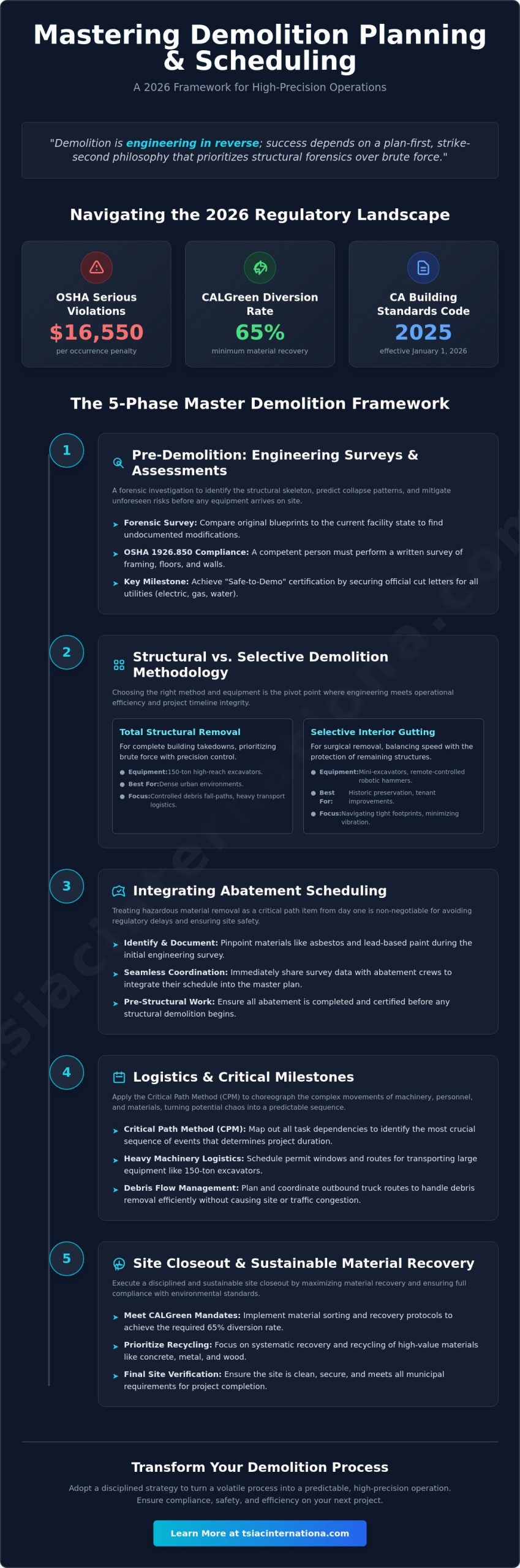
Selective demolition focuses on surgical removal for renovations. This process relies on temporary shoring and bracing to maintain the stability of the remaining structure while specific sections are cut away. In contrast, total structural removal involves the complete clearing of a site for redevelopment. During these phases, Concrete recycling methods are integrated into the workflow to reduce landfill impact. Current standards aim to repurpose at least 85% of demolished material into high-quality aggregate for new construction projects. This sustainable approach reduces transportation costs and meets 2026 environmental compliance mandates.

Why Residential Methods Fail on Industrial Project Sites

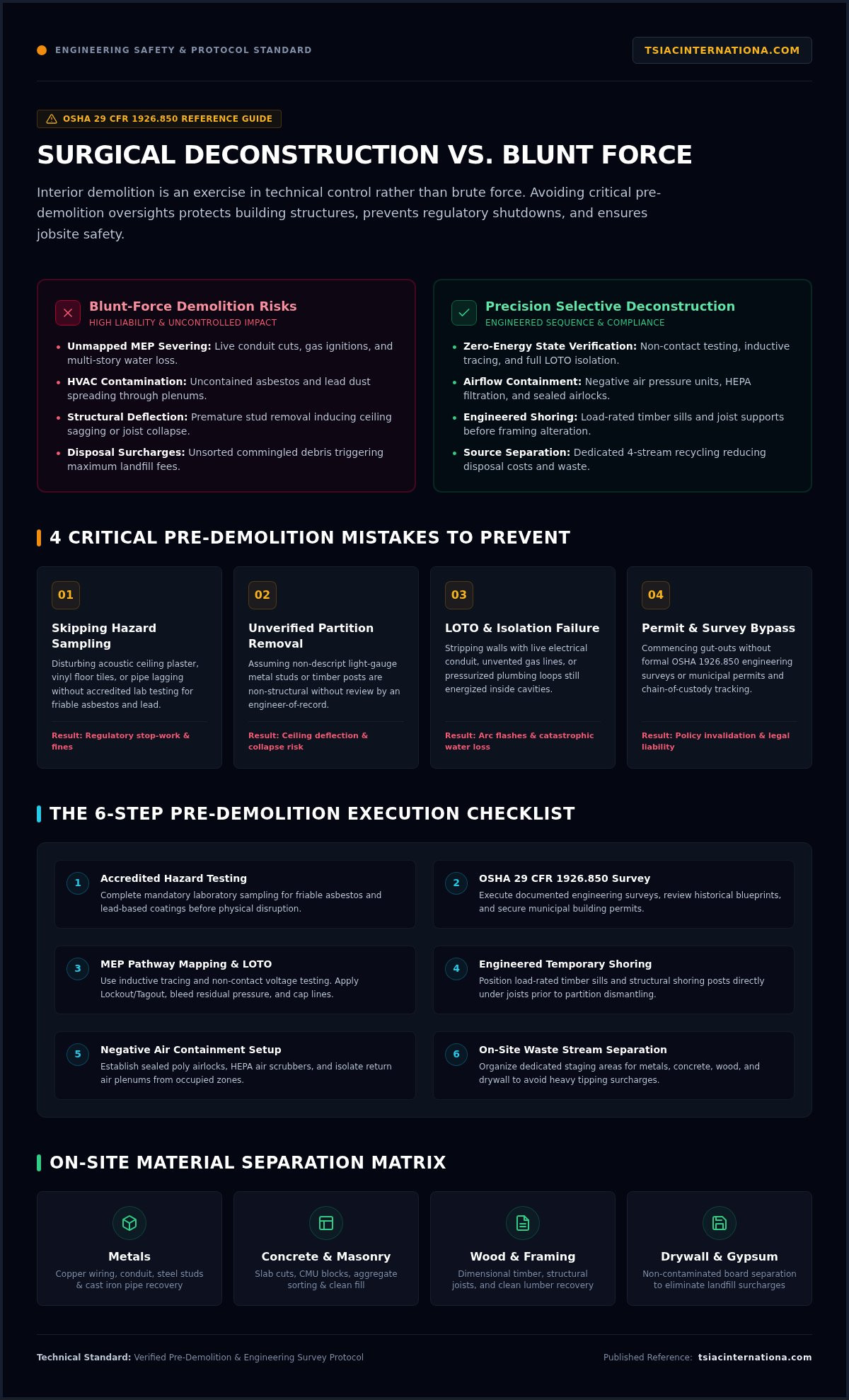
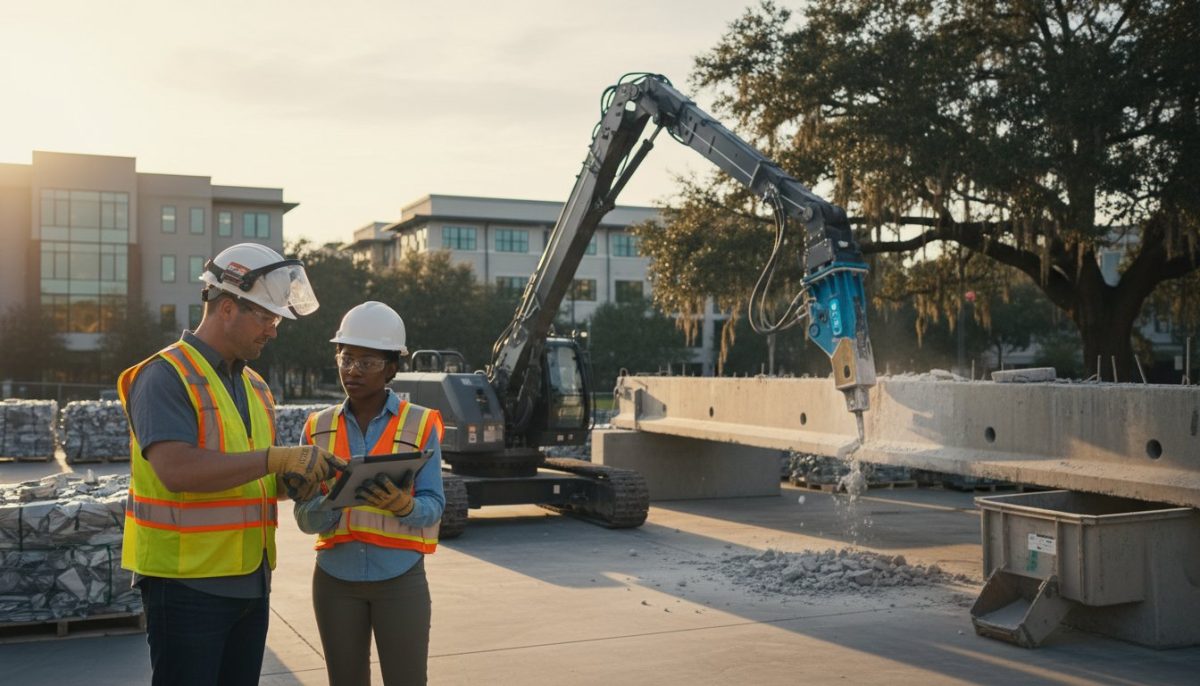
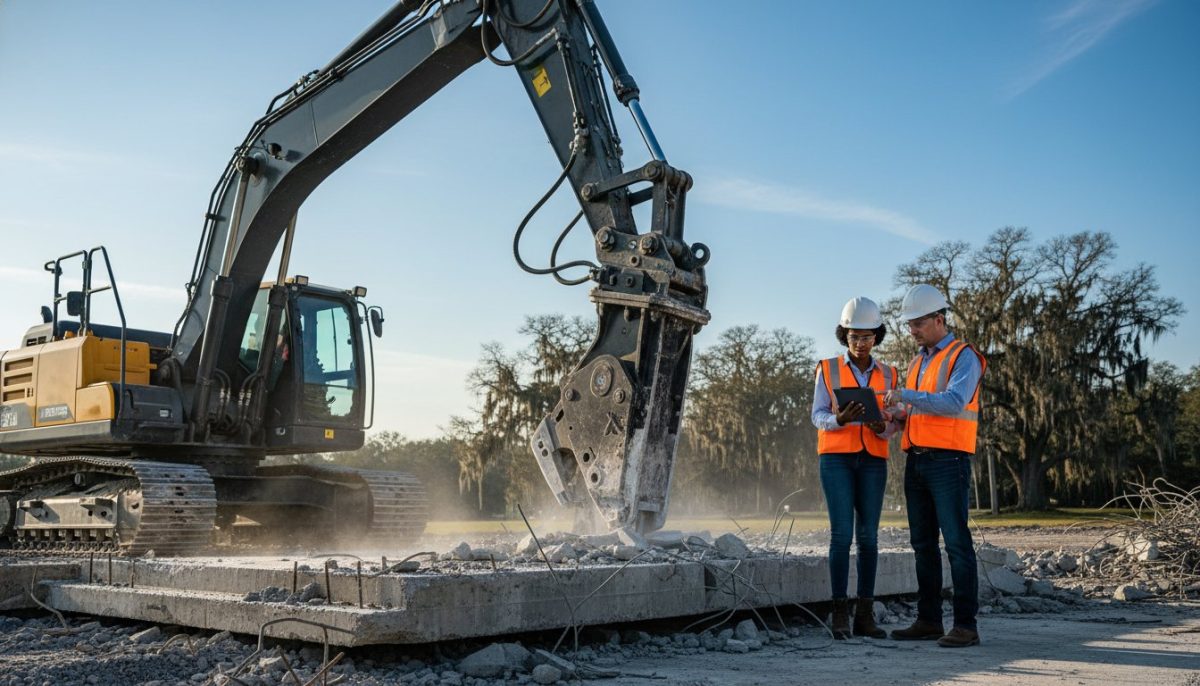
Standard jackhammering is insufficient for high-output industrial demolition. While a manual tool works for a thin driveway, it can’t handle reinforced slabs with 1-inch rebar grids. Industrial sites require robotic demolition units or diamond wire sawing to maintain the project schedule. General hauling services often lack the permits for 20-ton loads, which leads to immediate project delays. Using non-specialized labor for complex concrete tasks increases the risk of accidental structural collapse by 40% according to historical site safety data. Professional teams use high-pressure hydraulic breakers and specialized heavy debris management systems to ensure every stage of concrete removal and disposal remains under total control. This technical rigor ensures that the project moves from demolition to the next phase of construction without unforeseen structural failures or safety incidents.

Advanced Techniques in Structural and Selective Demolition

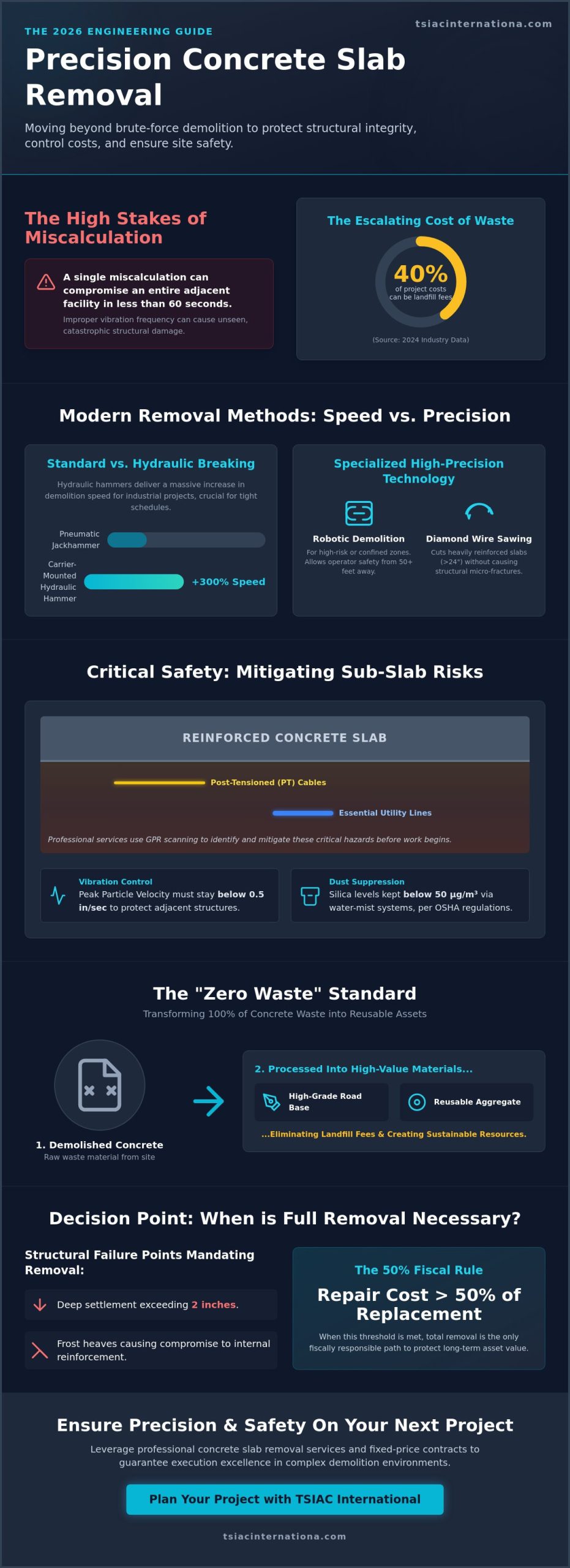
Modern concrete removal and disposal requires a shift from traditional blunt-force methods to engineering-led precision. In 2026, the industry prioritizes structural integrity and environmental stability above all else. Vibration control is a critical requirement in urban industrial zones, where peak particle velocity (PPV) must often be maintained below 5mm/s to protect the foundations of adjacent historical or sensitive structures. Selecting the correct machinery depends on the concrete’s compressive strength, which frequently exceeds 50 MPa in industrial slabs, and the specific density of the internal reinforcement. Precision cutting techniques are essential to prevent micro-fracturing; these invisible cracks can reduce the load-bearing capacity of remaining permanent structures by as much as 18% if handled with standard impact tools.

Robotic Demolition and Heavy Machinery Applications

Remote-controlled robotic breakers allow operators to maintain a 10-meter safety radius in high-risk environments like chemical processing plants or unstable mezzanines. These compact machines deliver the hitting power of an excavator five times their size while fitting through standard 80cm doorways. For large-scale projects, excavators equipped with hydraulic shears and pulverizers achieve a 95% separation rate of steel rebar from concrete on-site. This level of efficiency is vital for meeting federal standards regarding the Sustainable Management of C&D Materials, turning debris into recyclable aggregate. High-reach demolition equipment now extends to 60 meters, enabling controlled, top-down dismantling that keeps the work zone footprint minimal.

Precision Surgical Removal and Slab Sawing

Diamond wire sawing is the primary solution for removing heavily reinforced sections thicker than 1000mm. By looping a diamond-impregnated cable around a bridge pier or foundation block, technicians execute clean cuts through any depth of concrete without inducing any vibration. This method is silent and produces no dust when water-cooled. For horizontal and vertical surfaces, flat sawing and wall sawing provide the linear accuracy needed for new elevator shafts or utility trenches. Core drilling remains the standard for structural testing and utility integration, creating clean apertures from 10mm to 1200mm in diameter. These surgical methods ensure that the primary structure’s health remains uncompromised during complex modifications. If your facility requires this level of technical oversight, partnering with a specialized industrial contractor ensures that even the most difficult removals are executed with engineering-grade accuracy.

The selection of these advanced techniques directly impacts the total timeline of concrete removal and disposal. By utilizing precision tools, contractors reduce the need for secondary patching and structural reinforcement, lowering the total project cost by an average of 12% compared to traditional jackhammering methods. Every cut is planned with CAD-level detail to ensure that the removal process supports the long-term viability of the industrial site.

Professional Concrete Removal and Disposal: The 2026 Industrial Guide

Environmental Compliance and Concrete Debris Management

By 2026, the regulatory framework for concrete removal and disposal has shifted from simple waste management to a rigorous circular economy model. Landfill tipping fees in major industrial corridors have increased by an average of 15% since 2024, making the burial of inert debris the most expensive and least sustainable option for commercial developers. Modern environmental mandates now require a minimum 75% diversion rate for construction and demolition (C&D) materials on projects exceeding 5,000 square feet. This shift necessitates a sophisticated logistical chain that begins during the initial demolition process south carolina contractors must follow to ensure site-level separation.

Adhering to OSHA demolition standards is a prerequisite for safe debris handling and transport. These standards dictate how piles are staged to prevent collapses and how dust suppression systems must operate during load-out. Effective management moves material from the demolition face to a designated sorting zone, where primary crushing often occurs before the debris ever leaves the property. This reduces the volume of loads and optimizes transport costs, which is vital for maintaining project margins in high-scale industrial redevelopments.

Concrete Recycling and Material Recovery Systems

Modern recycling facilities utilize multi-stage crushing and screening plants to transform old slabs into high-quality recycled concrete aggregate (RCA). Magnetic separators pull rebar and embedded steel from the mix with 99% efficiency, allowing these metals to be sold as scrap, which often offsets the cost of the concrete removal and disposal process. For projects pursuing LEED v5 certification, contractors must provide verified weight tickets and processing manifests. These documents prove that the recovered material has been diverted from landfills, directly contributing to Materials and Resources credits. Using RCA as a sub-base for new parking lots or structural fill represents the peak of engineering efficiency in 2026.

Handling Hazardous Materials in Concrete Structures

Older industrial assets often hide environmental liabilities within their masonry. Lead-based paint coatings, common on concrete surfaces in facilities built before 1978, require specialized stabilization before removal to prevent soil contamination. Additionally, asbestos-containing materials (ACM) are frequently found in expansion joints and moisture barriers. If these materials are present, property owners must follow the protocols outlined in hazardous material abatement south carolina before mechanical demolition begins. Failure to identify these risks leads to stop-work orders and significant fines from state environmental agencies. Precise testing and documented remediation are the only ways to maintain compliance and project momentum.

Planning Your Project: Safety Standards and Regulatory Requirements

Executing professional concrete removal and disposal requires more than just heavy machinery. It demands a rigorous preliminary assessment to mitigate structural risks and environmental hazards. Property managers should start with a comprehensive pre-demolition checklist. This document must include structural load-bearing analysis, hazardous material surveys for lead or asbestos, and a clear site access plan. A critical step involves contacting local utility locating services. In most regions, calling 811 at least 48 hours before any excavation or slab removal is a legal mandate. Striking an unidentified high-pressure gas line or an electrical conduit can cause catastrophic site failures and immediate project shutdowns.

Establishing a secure safety perimeter is the next priority. This zone prevents unauthorized personnel from entering high-risk areas where falling debris or flying fragments are common. We also focus on dust mitigation. Uncontrolled concrete dust isn’t just a nuisance; it’s a major health hazard that can lead to permanent respiratory damage. Improper disposal or “fly-tipping” carries severe legal liabilities. In 2024, some municipalities increased fines for illegal dumping to over $25,000 per occurrence. Property owners remain legally responsible for their waste until it reaches a certified facility, making professional documentation essential.

Occupational Safety and Site Containment Strategies

Modern safety standards emphasize the total containment of respirable crystalline silica. We implement OSHA-compliant Table 1 methods for all projects. This involves using integrated water delivery systems for wet-cutting or HEPA-filtered vacuum attachments that maintain a 99.97% filtration efficiency. Technicians wear fit-tested P100 respirators and high-impact PPE at all times. For projects in high-density areas, we deploy acoustic barriers. These shields help keep noise levels below the standard 85-decibel threshold, ensuring the project doesn’t violate local noise ordinances or disrupt neighboring businesses.

Navigating Permits and Disposal Documentation

Structural demolition typically requires a specific permit from the municipal building department. This process ensures the work won’t compromise the integrity of the surrounding infrastructure. A professional contractor manages the “chain of custody” for all waste. This involves tracking every ton of debris through recycling manifests. These documents prove that the concrete was processed at a licensed facility rather than dumped illegally. It’s also vital to verify that your contractor maintains at least $2 million in general liability insurance and comprehensive bonding. This protection is your primary defense against property damage claims or site accidents. For complex industrial projects that require this level of precision, you can consult with our technical specialists today.

Strategic Concrete Solutions with TSIAC International

TSIAC International operates at the intersection of engineering precision and industrial grit. They specialize in high-stakes environments where standard demolition methods fall short. By positioning themselves as a leader in selective structural demolition, the company addresses the technical needs of 2026 industrial standards. Their team manages the entire lifecycle of concrete removal and disposal, ensuring that structural integrity remains uncompromised in adjacent areas. This specialized focus allows clients to repurpose existing facilities without the risks associated with broad-scale vibration or structural failure.

Environmental stewardship isn’t just a compliance checkbox for TSIAC; it’s a core operational pillar. The company prioritizes the onsite sorting of materials to maximize recycling potential. By crushing concrete for reuse as aggregate or base material, they significantly reduce the carbon footprint of industrial projects. This commitment helps clients meet strict sustainability mandates while lowering the total volume of waste destined for landfills.

The TSIAC Approach to Complex Concrete Challenges

With over 15 years of operational experience, TSIAC International has developed a reputation for solving site constraints that others label impossible. They utilize advanced mechanical methods and precision cutting to work within tight urban footprints or active industrial plants. One of their primary advantages is the use of fixed-price structural demolition contracts. These agreements provide absolute budget certainty, eliminating the 15% to 20% cost overruns often seen in the demolition industry due to poor planning or scope creep. Clients benefit from a single-source provider that handles gutting, structural removal, and technical debris management under one unified management structure.

Integrated Abatement and Structural Removal

Managing hazardous materials alongside structural demolition is a logistical hurdle that frequently delays industrial timelines. TSIAC International removes this friction by offering integrated services. Handling abatement and demolition under a single contract reduces project risk by centralizing liability and communication. It’s especially critical when dealing with asbestos removal south carolina regulations, where strict state-specific protocols must be followed during the concrete removal and disposal process.

Synchronizing remediation and removal accelerates the project schedule by up to 30% compared to using separate contractors. There’s no downtime spent waiting for a third-party abatement team to clear a site before the demolition crews can enter. This seamless transition ensures that the project moves from the hazardous material phase to structural clearing without delay. It’s a disciplined, engineering-first strategy that protects both the workforce and the client’s bottom line.

Precision and safety are the foundations of every successful industrial teardown. Consult with TSIAC International for your next concrete removal project.

Advancing Your Infrastructure with Engineering Precision

Successful industrial projects in 2026 demand more than simple demolition; they require a calculated approach to concrete removal and disposal that integrates structural engineering with environmental stewardship. Industry data indicates that selective demolition techniques can reduce site waste by 40% when compared to standard clearing methods. TSIAC International applies over 15 years of structural demolition and abatement expertise to manage these complexities. We prioritize sustainability by executing comprehensive recycling of wood, metal, and plastic on every job site. This engineering-first mindset is particularly critical for selective demolition during complex commercial renovations where structural integrity is non-negotiable. You’re looking for a partner who treats safety as a technical requirement, not just a checklist. We’ve mastered the logistics of difficult locations to ensure your project meets all regulatory standards without delay. Precision in execution is the only way to safeguard your investment.

Request a Professional Concrete Removal Quote from TSIAC International

Your project deserves a foundation built on professional excellence and technical reliability.

Frequently Asked Questions

How much does professional concrete removal and disposal cost in 2026?

Professional concrete removal and disposal costs typically range between $3.50 and $12.00 per square foot depending on reinforcement density and site accessibility. According to the 2025 Construction Cost Index, labor and fuel expenses account for 45% of this total. Complex industrial projects involving reinforced foundations require specialized machinery, which increases the baseline fee due to higher maintenance overheads and specialized disposal permits required by local authorities.

What is the difference between concrete removal and concrete recycling?

Concrete removal involves the physical extraction of material from a site, while recycling processes that waste into reusable aggregate for new construction. Statistics from the Construction & Demolition Recycling Association show that 85% of removed concrete is now diverted from landfills. We utilize mobile crushing units to transform debris into Grade A sub-base material, which effectively reduces raw material procurement costs for subsequent industrial phases.

Do I need a permit for concrete removal on my commercial property?

Commercial concrete projects almost always require a demolition or site alteration permit issued by the local building authority. Requirements vary by municipality, but 90% of urban jurisdictions mandate a structural stability report before work commences. Failure to secure these documents can result in fines exceeding $5,000 per day and immediate work stoppages, compromising project timelines and the legal standing of the property owner.

Can concrete containing lead paint or asbestos be recycled?

Concrete containing lead-based paint or asbestos fibers can’t be recycled and must be treated as hazardous waste. EPA Regulation 40 CFR Part 745 dictates that such materials require specialized containment and disposal at certified hazardous waste landfills. Our teams implement rigorous testing protocols to identify contaminants, ensuring that 100% of hazardous debris is handled through documented chain-of-custody procedures rather than standard recycling streams.

How long does it typically take to remove a large concrete slab or foundation?

Removing a 5,000 square foot industrial slab typically requires 3 to 5 business days using standard hydraulic breakers. Heavy foundations with deep footings extend this timeline by 40% due to the increased volume of material and required precision near existing utilities. We utilize detailed project scheduling to ensure every phase, from initial saw cutting to final site clearance, meets the engineered deadline without compromising structural integrity.

What is robotic demolition, and when is it necessary for concrete projects?

Robotic demolition involves remote-controlled machines that execute high-precision breaking in confined or hazardous environments. This technology is necessary when floor load capacities are limited or when vibration sensitivity reaches levels below 2.0 mm/s. By removing the operator from the immediate impact zone, we reduce workplace injury risks by 65% while maintaining a higher output than manual pneumatic tools can achieve in the same timeframe.

How do I ensure my concrete removal project is environmentally compliant?

Compliance is ensured by adhering to ISO 14001 standards and maintaining a comprehensive Waste Management Plan. Current regulations require tracking 100% of debris from the point of origin to the final disposal site. We provide clients with digital manifests and recycling certificates that verify the sustainable handling of all materials, which is essential for projects seeking LEED certification or meeting municipal green building codes in 2026.

What are the risks of DIY concrete removal for large structures?

DIY removal of large structures carries a 30% higher risk of accidental utility strikes and structural collapse compared to professional execution. Without industrial-grade equipment, operators often face prolonged exposure to crystalline silica dust, which exceeds OSHA permissible exposure limits within 15 minutes of dry cutting. Professional intervention guarantees that vibration control and dust suppression systems are active, protecting both the workforce and the surrounding infrastructure from damage.

Asbestos Abatement Services: The 2026 Professional Buying Guide

In 2024, approximately 18% of large scale industrial renovations were halted by regulatory bodies because of inadequate initial site surveys. You…

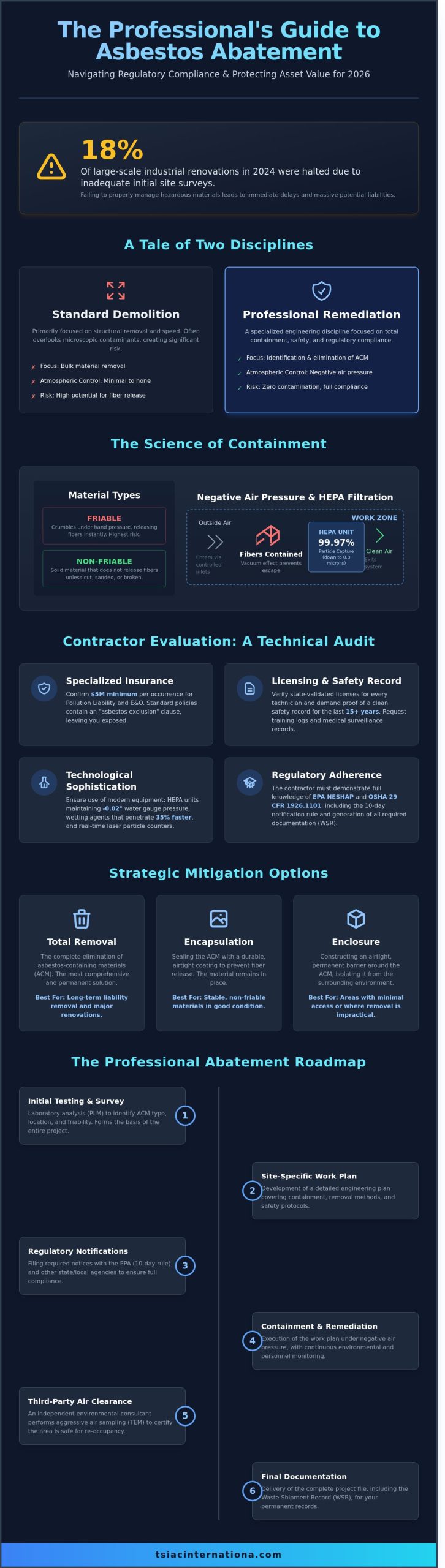
In 2024, approximately 18% of large scale industrial renovations were halted by regulatory bodies because of inadequate initial site surveys. You likely understand that discovering hazardous materials mid-project is a professional nightmare that triggers immediate delays and massive potential liabilities. Selecting the right asbestos abatement services is no longer just a safety requirement; it’s a critical strategic decision for your property’s 2026 valuation and legal standing.

We agree that the confusion surrounding varying technical quotes and complex remediation methodologies often leads to decision paralysis. This guide provides the engineering precision you need to evaluate contractors and secure full regulatory documentation for your permanent records. We’ll break down the specific criteria for hiring specialized teams, ensuring you achieve zero contamination while maintaining a 100% predictable workflow for your next renovation phase.

Key Takeaways

  • Understand the critical regulatory distinctions between standard demolition and hazardous material remediation to ensure total site safety and compliance.
  • Learn how to evaluate professional asbestos abatement services by verifying specialized insurance, bonding, and advanced technical monitoring capabilities.
  • Discover the long-term ROI and safety implications of choosing between total removal, encapsulation, and enclosure for your specific facility needs.
  • Master the professional procurement roadmap, from initial laboratory testing to the development of site-specific work plans and regulatory notifications.
  • Explore the operational advantages of an integrated approach that combines hazardous material remediation with expert structural demolition for seamless project delivery.

Defining Professional Asbestos Abatement Services in 2026

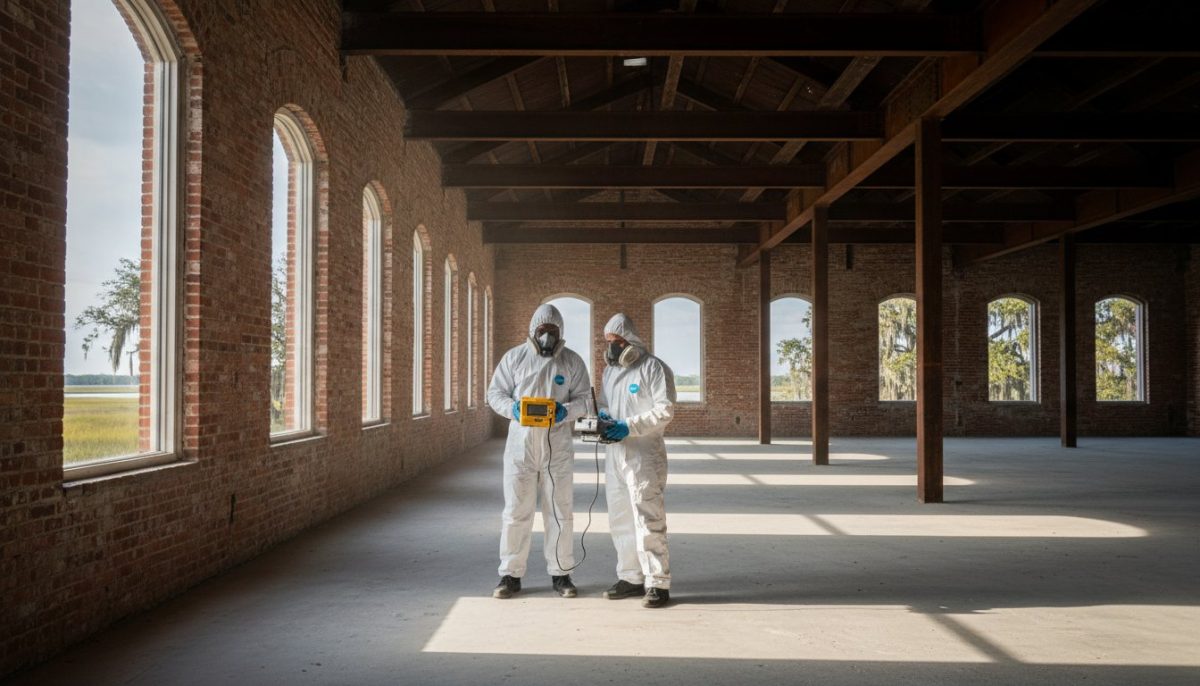
Professional asbestos abatement services represent a specialized engineering discipline rather than a simple demolition task. This process involves the meticulous identification, containment, and elimination of asbestos-containing materials (ACM) to prevent the release of microscopic fibers. While standard demolition focuses on structural removal, remediation protocols prioritize atmospheric control and environmental safety. By 2026, the industry has shifted toward total elimination of even trace exposures following the EPA’s 2024 final rule on chrysotile asbestos. This transition ensures that property values remain intact during structural renovations. Failing to follow Asbestos abatement procedures can lead to legal liabilities and permanent contamination of a building’s internal systems.

The Science of Containment and Remediation

Professionals categorize materials as either friable or non-friable. Friable materials pose the highest risk because they crumble under hand pressure, releasing fibers instantly. Modern remediation relies on the physics of negative air pressure. We use high-efficiency particulate air (HEPA) filtration systems that capture 99.97% of particles as small as 0.3 microns. These systems create a vacuum that prevents fibers from escaping the work zone. Attempting DIY removal isn’t just dangerous; it’s a violation of federal safety statutes. Unqualified individuals lack the specialized equipment required to maintain these critical pressure differentials.

Regulatory Framework: EPA and OSHA Standards

Compliance in 2026 is anchored in EPA NESHAP and OSHA standards. The EPA requires a 10-day notification before any activity disturbs more than 160 square feet of ACM. OSHA worker safety requirements under 29 CFR 1926.1101 protect the property owner from significant liability. If a worker isn’t properly protected, the owner shares the legal responsibility for long-term health claims. Every project must generate a rigorous paper trail. This includes the initial site survey, air clearance reports, and the final Waste Shipment Record (WSR). These documents prove the hazardous material reached a licensed landfill safely.

Engaging asbestos abatement services ensures that every technical step meets these 2026 benchmarks. It’s about protecting the structural integrity of the asset while maintaining a zero-exposure environment for occupants. Professional firms provide the engineering precision needed to handle “impossible” locations, such as high-rise elevator shafts or complex industrial boiler rooms, where standard methods often fail.

Key Criteria for Evaluating an Abatement Contractor

Selecting a partner for asbestos abatement services requires a rigorous technical audit. You aren’t just hiring a contractor; you’re managing a high-stakes environmental liability. Professional firms carry specialized Pollution Liability and Errors and Omissions (E&O) insurance with minimum limits of $5 million per occurrence. Standard general liability policies usually contain an “asbestos exclusion” clause, leaving the asset owner exposed to massive litigation risks if a fiber release occurs. Every technician must hold a state-validated license, and a dedicated project safety officer should oversee the site to ensure 100% compliance with OSHA 29 CFR 1926.1101.

Certifications and Insurance: Non-Negotiable Assets

Verification of credentials goes beyond viewing a certificate. You must confirm that the contractor’s bonding capacity matches the project scale. A firm with a 15-year history of clean safety records provides more security than a startup with lower premiums. This level of oversight mirrors the stringent protocols found in the University of Oregon’s asbestos program, which emphasizes continuous monitoring and documented compliance as the baseline for safety. Demand to see the last 24 months of worker training logs and medical surveillance records before signing any contract.

Technological Sophistication in Remediation

Modern asbestos abatement services rely on precision engineering. High-performance HEPA filtration units must maintain a negative pressure of at least -0.02 inches of water gauge within the work area. We use advanced wetting agents that penetrate porous materials 35% faster than standard water, significantly reducing the risk of airborne friability. Digital manometers and laser-based particle counters provide real-time data, allowing supervisors to adjust ventilation instantly. This technological edge is why many industrial clients seek specialized engineering solutions for complex structural environments.

  • Disposal Transparency: The contractor must provide a completed Waste Shipment Record (WSR) signed by the receiving landfill within 35 days of waste removal. This document is your only legal proof of proper disposal.
  • Structural Experience: Review past project performance in similar environments, such as high-rise HVAC systems or industrial boiler rooms. A contractor who understands the specific load-bearing constraints of your facility will avoid accidental damage.
  • Constant Supervision: A certified supervisor must remain on-site at all times. They manage the “dirty room” protocols and ensure no worker exits the containment area without following a 3-stage decontamination process.
  • On-site Monitoring: Independent third-party air monitoring should occur daily. This ensures that fiber counts remain below the permissible exposure limit of 0.1 fibers per cubic centimeter of air.

Strategic Mitigation: Removal vs. Encapsulation vs. Enclosure

Facility managers often mistake asbestos remediation for a single-track process. It isn’t. Professional asbestos abatement services require a calculated choice between removal, encapsulation, or enclosure. Each path carries distinct engineering requirements, cost structures, and long-term liability profiles. The U.S. Environmental Protection Agency (EPA) on asbestos confirms that management-in-place is a viable strategy if the material is in good condition, yet the decision must align with the building’s 10-year master plan. By 2026, property valuation trends show that “asbestos-free” certifications can increase asset liquidity by 15% compared to buildings with managed-in-place contaminants.

When to Choose Full Asbestos Removal

Total removal stands as the only permanent resolution for property owners seeking to eliminate long-term regulatory risk. If your 2026 capital improvement plan involves structural changes, removal is usually the only logical path. This strategy becomes vital when integrated with commercial interior gutting services. During a full interior demolition, hidden Asbestos-Containing Material (ACM) is almost certainly disturbed. Removing it before the main crew arrives prevents project shutdowns that can cost $5,000 or more per day in liquidated damages. It’s the most expensive upfront option, but it secures a “clean” status that simplifies future insurance renewals and real estate transactions.

Encapsulation and Enclosure: Tactical Alternatives

Encapsulation involves sealing fibers with a specialized chemical bond, typically a high-solids polymer penetrant or bridging mastic. This prevents fiber release without the disruption of physical extraction. Enclosure, conversely, requires building airtight mechanical barriers around the ACM, such as permanent impact-resistant panels or sheet metal jackets. These methods offer a 40% to 60% reduction in initial costs compared to full removal.

These aren’t “set and forget” solutions. They demand a rigorous Operations and Maintenance (O&M) program. Facility managers must conduct documented inspections every 6 to 12 months to ensure the barriers remain intact. Deferred maintenance on encapsulated materials often leads to air quality failures during routine building vibrations or minor plumbing repairs. If you don’t have the internal infrastructure to manage long-term monitoring, the initial savings of encapsulation will eventually be erased by the costs of specialized compliance audits.

The Professional Abatement Workflow: A Procurement Roadmap

Procuring professional asbestos abatement services requires a structured sequence to mitigate liability and ensure structural integrity. The 2026 standard for industrial safety dictates a five-stage engineering protocol that prioritizes containment and objective verification.

  • Initial Survey and Laboratory Analysis: Certified inspectors collect bulk samples from suspicious materials. These samples undergo polarized light microscopy (PLM) at NVLAP-accredited laboratories to determine fiber concentration.
  • Regulatory Compliance and Planning: Contractors must file a 10-day NESHAP notification with environmental agencies before disturbing more than 160 square feet of regulated material. The site-specific work plan outlines the exact methodology for extraction.
  • Containment and Decontamination: Crews build airtight barriers using 6-mil fire-retardant polyethylene. A three-stage decontamination unit provides a controlled transition for personnel and equipment.
  • Precision Removal: Technicians use wet-removal methods to keep fibers from becoming airborne. All waste is double-bagged in labeled, 6-mil poly bags and sealed with a gooseneck tie.
  • Final Clearance: The project concludes only after air samples meet the EPA AHERA standard of less than 0.01 fibers per cubic centimeter.

Pre-Project Planning and Site Preparation

Site preparation is a logistical exercise in risk isolation. Professional crews begin by de-energizing electrical circuits and executing a 100% HVAC shutdown. All supply and return vents are sealed with critical barriers to prevent cross-contamination. This phase includes a pre-work walkthrough with facility managers to confirm that 100% of fire suppression systems remain operational but protected. Clear communication with stakeholders is vital; we provide a 48-hour mobilization notice to all adjacent occupants to maintain site transparency and safety.

The Final Clearance: Ensuring a Clean Bill of Health

Independent verification is the only way to guarantee safety. A third-party industrial hygienist must conduct the final air monitoring to avoid conflicts of interest. While PCM testing is common for many commercial sites, TEM (Transmission Electron Microscopy) is the gold standard for 2026 high-occupancy environments because it identifies asbestos fibers as small as 0.01 microns. Your final close-out package should include waste shipment records (WSR), worker certifications, daily pressure logs, and the lab-certified clearance report. This document acts as your permanent legal defense against future environmental claims.

For projects requiring this level of technical precision and documented safety, partner with our expert asbestos abatement services team.

TSIAC International: The Gold Standard in Hazardous Remediation

TSIAC International brings over 15 years of disciplined experience to high-stakes hazardous material projects. We don’t just remove waste; we engineer solutions for the most complex abatement challenges. Our technical precision makes us the primary choice for government agencies and commercial enterprises requiring absolute compliance. We maintain a 100% project completion rate on sites with high structural risk or environmental sensitivity, ensuring that every phase of the remediation meets rigorous federal and state standards.

Unmatched Expertise in Complex Environments

Managing remediation in occupied buildings requires more than just standard PPE. It demands a “no-compromise” safety culture. We’ve successfully executed asbestos abatement services in sensitive structural shells where integrity was compromised, ensuring zero cross-contamination. Our track record spans 500+ residential projects and heavy industrial facilities where precision is non-negotiable. This rigorous approach reduces your project’s risk profile, preventing costly regulatory delays or long-term health liabilities that arise from substandard work.

Seamless Integration with Demolition Services

Efficiency isn’t just about speed; it’s about a unified workflow. Our integrated model combines abatement with structural demolition for seamless project delivery. Using a single contractor eliminates the communication gaps that often plague multi-vendor sites. By consolidating these services, we’ve helped clients reduce mobilization costs by an average of 18% through shared logistics, equipment, and on-site management teams.

  • Rigorous waste management protocols that prioritize recycling and environmental stewardship.
  • Unified project management for both hazardous material abatement and site clearing.
  • Strict adherence to NESHAP and OSHA standards, providing detailed documentation for every cubic yard of waste removed.
  • Advanced containment technology that allows for continued operation in adjacent building wings.

Our commitment to environmental stewardship isn’t a secondary goal. It’s a core component of our technical execution. We implement waste management protocols that prioritize recycling, often diverting up to 85% of non-hazardous debris from landfills during integrated projects. This level of detail is why technical directors at government and commercial agencies prefer our partnership. We provide the documentation, safety data, and engineering precision required for high-security and high-liability environments. Our team handles the heavy lifting, from initial site assessment to final waste disposal, adhering to the strictest environmental standards. Contact TSIAC International today for a professional project consultation to secure your site’s future with asbestos abatement services you can trust.

Securing Your Infrastructure for 2026 and Beyond

Navigating the complexities of hazardous material remediation requires more than just standard compliance; it demands a technical partnership rooted in engineering precision. By 2026, the distinction between simple removal and strategic encapsulation will define the lifecycle of your industrial assets. Selecting a contractor based on rigorous procurement roadmaps ensures your project stays on schedule and within regulatory bounds. Success depends on moving from reactive fixes to proactive, expert led management strategies.

TSIAC International brings 15+ years of hazardous material experience to every site, specializing in the difficult locations that others often avoid. We’re fully licensed and insured for high liability remediation, providing a layer of financial and operational security for your facility. Our team delivers comprehensive close-out documentation for every project, ensuring your records are audit ready and transparent. When you prioritize long term structural integrity, choosing professional asbestos abatement services becomes a vital investment in your property’s future. Secure your property with TSIAC International’s professional abatement services.

Let’s build a safer environment through engineering excellence and unwavering reliability.

Frequently Asked Questions

What is the average cost of asbestos abatement services in 2026?

Average costs for asbestos abatement services in 2026 range from $15 to $35 per square foot. A standard 1,500 square foot residential project typically requires a budget between $4,500 and $9,000 for full remediation. These figures include labor, specialized filtration equipment, and disposal fees. Costs have risen 8% since 2024 because of stricter landfill regulations and updated safety requirements.

How long does a typical asbestos removal project take to complete?

A typical asbestos removal project takes 2 to 5 days to complete for standard residential or small commercial properties. Larger industrial sites or complex structural removals often extend to 14 days. The timeline accounts for site preparation, the actual removal process, and the final 24 hour air clearance testing period. We ensure every phase meets engineering precision to prevent project delays.

Can I stay in my building during the asbestos abatement process?

You can’t stay in the immediate work area or any connected zones while abatement is active. Safety protocols require the establishment of negative pressure enclosures that prevent fiber migration to clean areas. While some large facilities allow partial occupancy in separate wings, residential projects usually require a total evacuation for the 72 hour duration of the high risk phases. It’s the only way to ensure 100% safety.

What is the difference between an asbestos inspection and an abatement service?

An asbestos inspection identifies the presence and location of hazardous materials, while an abatement service involves the physical removal or encapsulation of those substances. Inspectors use polarized light microscopy to confirm fiber types in a laboratory setting. Abatement teams follow these technical reports to execute a remediation plan using HEPA filtration and specialized containment barriers to secure the site.

How do I know if my building needs asbestos abatement before a renovation?

You’ll need a professional survey if your building was constructed before 1980, as 90% of structures from that era contain asbestos in floor tiles or pipe insulation. OSHA regulation 1910.1001 mandates an inspection before any renovation that might disturb structural components. If your 2026 renovation plan involves cutting into walls or ceilings, a certified technician must pull samples for laboratory verification first.

What certifications should I look for in an asbestos removal company?

Look for contractors holding EPA Model Accreditation Plan (MAP) certification and a valid state asbestos contractor license. Every on site supervisor should possess an OSHA 40 hour HAZWOPER certification to prove they’re trained for hazardous waste operations. Verification of these credentials through the state database ensures the team follows the 2026 safety standards for asbestos abatement services and maintains high professional integrity.

What happens to the asbestos waste after it is removed from my property?

Asbestos waste is sealed in double layers of 6 mil polyethylene bags and transported to a licensed Type I hazardous waste landfill. Each shipment requires a Waste Shipment Record (WSR) that tracks the material from your property to the final disposal cell. These specialized facilities bury the sealed containers under 6 inches of non asbestos material within 24 hours of arrival to prevent fiber release.

Is lead paint removal usually included in asbestos abatement services?

Lead paint removal isn’t standard in a basic asbestos contract, though many firms offer it as a separate, specialized service. While both involve hazardous materials, they require different chemical strippers and containment protocols under EPA RRP rules. You should request a combined environmental remediation quote if your pre 1978 building requires both lead and asbestos mitigation to streamline the project timeline effectively.

Demolition Site Safety: The Comprehensive Guide to Risk Management in 2026

Recent 2024 industry audits reveal that nearly 60% of demolition accidents stem from unforeseen structural instabilities that could’ve been mitigated…

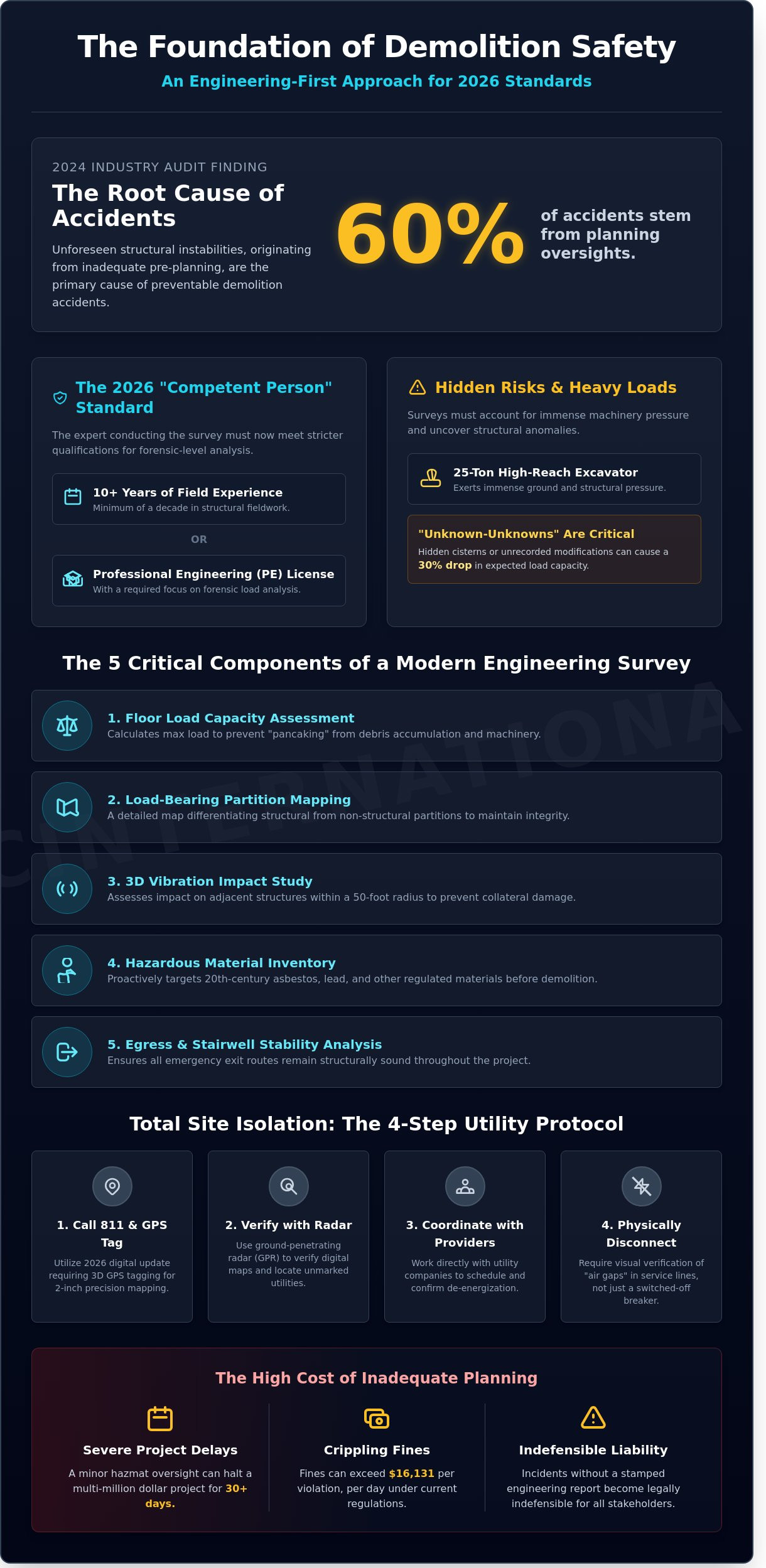
Recent 2024 industry audits reveal that nearly 60% of demolition accidents stem from unforeseen structural instabilities that could’ve been mitigated during the pre-planning phase. You’re likely aware that maintaining demolition site safety requires more than just wearing hard hats; it demands a disciplined, engineering-first approach to risk. It’s natural to feel concerned about the 2026 regulatory shifts or the hidden costs of hazardous material abatement. We’ve seen how even a minor oversight in asbestos containment can halt a multi-million dollar project for 30 days or more.

This guide will help you master the critical safety protocols and specialized abatement strategies needed to ensure a zero-accident project. You’ll gain the technical clarity required to navigate complex legal requirements and manage debris with maximum efficiency. We’ll break down the precise monitoring technologies and risk management frameworks that professional site managers use to maintain total control over even the most challenging urban teardowns.

Key Takeaways

  • Establish a legal and technical bedrock by defining the 2026 standards for engineering surveys and the critical role of the competent person.
  • Avoid project delays by mastering specialized abatement strategies and equipment requirements for managing hazardous materials like asbestos and lead.
  • Execute complex selective demolition with surgical precision to ensure the structural integrity of the building envelope remains uncompromised.
  • Adopt the non-negotiable 2026 PPE requirements and specialized training protocols essential for maintaining demolition site safety in high-hazard environments.
  • Complete the safety lifecycle by integrating on-site material sorting and environmental remediation into your post-demolition workflow.

The Foundation of Demolition Safety: Pre-Project Planning and Engineering Surveys

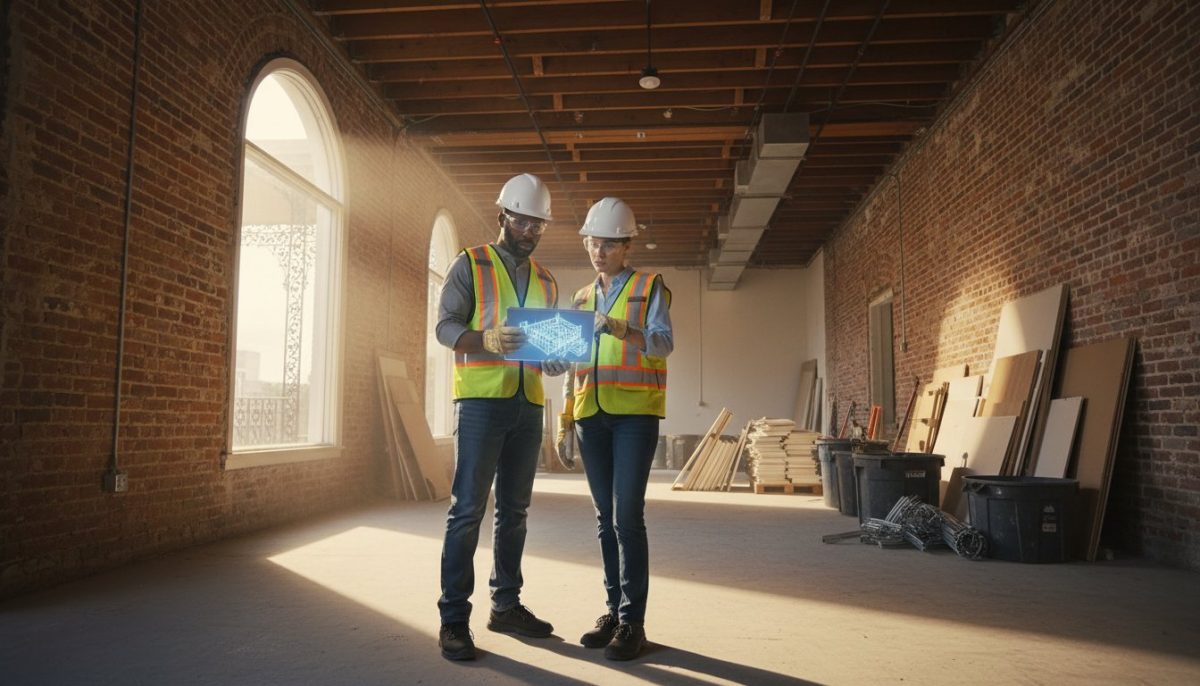
Effective demolition site safety begins months before the first excavator arrives on site. As of January 2026, the industry standard for a “competent person” conducting an engineering survey has evolved. This role now requires a minimum of 10 years of structural field experience or a Professional Engineering (PE) license with a focus on forensic load analysis. This expert doesn’t just look at walls; they calculate the residual strength of a decaying structure. This survey serves as the legal bedrock for the entire project. Without a signed, dated, and stamped engineering report, any incident becomes an indefensible liability. In South Carolina, where coastal conditions accelerate structural degradation, this document is the only shield against the unpredictable nature of weakened materials.

Preparation requirements differ significantly between residential and commercial environments. Residential projects in Charleston often deal with balloon framing or 19th-century timber rot. Commercial sites, however, involve complex challenges like post-tensioned concrete slabs and massive HVAC systems that weigh upwards of 15,000 pounds. We rely heavily on historical building data to predict how these structures will behave. For buildings in the Lowcountry constructed before 1950, we look for “Charleston Grey” brick compositions or tabby concrete foundations. These materials have unique compression limits. Understanding these historical nuances allows us to execute a Demolition process overview that accounts for the specific structural DNA of the coastal South.

The Engineering Survey: More Than a Walkthrough

A written engineering survey isn’t a formality; it’s a tactical map. We mandate that every survey includes these 5 critical components:

  • A comprehensive assessment of floor load capacities to prevent “pancaking” during debris accumulation.
  • A detailed map of load-bearing versus non-load-bearing partitions.
  • A 3D vibration impact study for adjacent structures within a 50-foot radius.
  • A hazardous material inventory, specifically targeting 20th-century lead and asbestos.
  • A structural stability analysis of all stairwells and egress routes.

Assessing the impact of heavy machinery on upper floors is a precise science. A 25-ton high-reach excavator exerts immense ground pressure. If we’re placing smaller 5-ton skid steers on a second-story slab, we calculate the dead load plus the dynamic force of the machine’s movement. In aging Lowcountry structures, we often find “unknown-unknowns,” such as hidden cisterns or unrecorded 1920s-era structural modifications. These anomalies can cause a 30% drop in expected load capacity, making forensic planning vital.

Utility Disconnection and Infrastructure Isolation

Securing a site means total isolation from the municipal grid. We follow the “Call Before You Dig” (811) protocol, which received a significant digital update in March 2026. This update now requires 3D GPS tagging for all underground utility strikes, ensuring that gas, electric, and water lines are mapped with 2-inch precision. We don’t just trust the maps; we use ground-penetrating radar to verify them. Securing these lines prevents flash fires or localized flooding that can stall a project for 60 days or more.

Coordination with local providers like Dominion Energy and the Charleston Water System is the final step in isolation. In Myrtle Beach, we work closely with Santee Cooper to ensure high-voltage lines are de-energized and grounded. It’s not enough to turn off a switch. We require physical disconnection and visual verification of “air gaps” in the service lines. This rigorous approach to utility management ensures that when the demolition begins, the only energy on the site is the energy we’ve brought with us. It’s a disciplined, engineering-first mindset that keeps our crews safe and our clients’ reputations intact.

Managing Invisible Killers: Asbestos, Lead, and Hazardous Material Abatement

Hazardous material management represents the primary cause for 65% of all demolition project delays in South Carolina. When a crew encounters unexpected friable asbestos or lead-based pigments, the site must stop immediately to prevent environmental contamination. These “invisible killers” don’t just threaten worker health; they invite litigation and regulatory fines that can exceed $16,131 per violation per day under current 2024 inflation-adjusted figures. At TSIAC International, we recognize that demolition site safety begins with identifying these risks long before the first excavator arrives on site. We treat every structure built before 1980 as a high-risk environment requiring surgical precision rather than blunt force.

Effective abatement requires specialized equipment that goes far beyond standard construction gear. We utilize industrial-grade negative air machines and high-capacity HEPA filtration systems to ensure that toxic particles remain trapped. Every project we undertake involves a task-specific Job Hazard Analysis (JHA). This document isn’t a mere formality; it’s a technical requirement under OSHA demolition safety standards that dictates exactly how we handle toxic substances. While “standard” demolition firms might rely on basic dust masks, our complex execution involves full-face respirators and real-time air monitoring to verify that containment holds. We don’t guess at safety; we measure it with calibrated sensors.

Containment Strategies for Toxic Dust and Fibers

By 2026, the industry standard for HEPA filtration will mandate a 99.97% capture rate for particles as small as 0.3 microns. We’ve already implemented these benchmarks across our Charleston operations. We establish negative pressure environments to ensure air only flows into the work zone, never out toward the public. Our teams use wet-method techniques, which have been proven to reduce respirable crystalline silica drift by 85%. Before leaving the “hot zone,” every worker passes through a three-stage decontamination unit. This process prevents the “take-home” lead and asbestos exposure that often affects workers’ families and the surrounding community.

Regulatory Compliance: OSHA and EPA Standards

Navigating the overlap between OSHA Subpart T and EPA NESHAP regulations requires a dedicated compliance officer and meticulous record-keeping. We maintain rigorous documentation for the legal disposal of hazardous waste, tracking every cubic yard from the job site to a certified Class 3 landfill. It’s a complex process that demands engineering precision. The current legal threshold for lead-based paint disturbance is defined as a concentration of lead equal to or exceeding 1.0 milligram per square centimeter or 0.5 percent by weight. Failing to meet these metrics puts your project and our reputation at risk. If you’re planning a complex tear-down, our team provides the technical expertise needed to keep your site compliant and your timeline intact.

We approach hazardous materials with a disciplined mindset. Our experience in industrial alpinism and steel structure work allows us to access and abate materials in “impossible” locations where others would fail. We don’t just clear the site; we provide a clean slate for future construction. This commitment to detail ensures that the legacy of an old building doesn’t become a liability for the new one. Our word is a guarantee of quality, backed by years of successful, accident-free completions in the most challenging environments.

Structural Integrity Hazards in Selective and Interior Demolition

Selective demolition isn’t a blunt force activity. It’s a calculated, surgical process where we remove specific portions of a building while preserving the primary structure. This is particularly vital in Charleston’s historic district, where 85% of our projects involve buildings over 60 years old. Maintaining the building’s envelope, or its exterior shell, requires a deep understanding of load paths. If you remove a partition wall that’s been incorrectly modified into a load-bearing element over decades, you risk an unplanned collapse. To mitigate this, our engineers follow OSHA’s guide to preparatory operations to conduct a thorough structural survey before any tool touches the site. This ensures we identify every structural dependency, from gravity loads to lateral bracing, before the gutting begins.

We use temporary shoring and bracing systems to support adjacent structures and floors above the work zone. In 2023, 15% of demolition site safety incidents nationwide were linked to premature structural failure. We prevent this by installing hydraulic shores that can handle 20,000 pounds of vertical pressure. This level of support is non-negotiable when we’re stripping an interior down to its studs. Our team treats every structural component as “active” until a professional engineer confirms it’s safe for removal.

The Risks of Surgical Removal: Maintaining Stability

Surgical removal demands a strict sequence. We start from the top and work down to prevent floor overloads from accumulated debris. For example, when we remove 500 square feet of acoustic ceiling and metal framing, we clear the material immediately. This keeps the live load on the slab below 50 pounds per square foot. In Charleston, we monitor vibration levels using digital seismographs. We keep peak particle velocity below 0.5 inches per second to protect the fragile masonry of neighboring historic properties. This precision ensures that demolition site safety extends beyond our property lines to the community’s architectural heritage.

Heavy Machinery Safety and Mechanical Hazards

Operating heavy machinery inside a building shell introduces mechanical hazards. We define safe operating zones for skid steers and mini-excavators with high-visibility floor markings. Every operator follows the blind spot rule; they don’t move the equipment until they’ve made eye contact with ground crews. Communication happens via noise-canceling headsets, not hand signals that can be misinterpreted. We also use 360-degree camera systems on our shears to eliminate blind spots. This technology reduced our near-miss incidents by 22% in the last fiscal year. Preventing tip-overs on uneven debris piles requires constant slab assessment. We never exceed 75% of a floor’s rated capacity when positioning equipment. Our crews check the floor’s integrity every four hours during active machine use to account for any shifting loads.

Precision and patience are the hallmarks of our interior work. By combining engineering data with rigorous on-site protocols, we manage the “impossible” locations that other firms avoid. Our commitment to stability isn’t just about following the law; it’s about protecting the lives of our crew and the integrity of Charleston’s skyline.

The Human Element: PPE, Training, and Emergency Response

Demolition site safety relies on the intersection of advanced technology and human discipline. While heavy machinery performs the bulk of the labor, the integrity of the project depends on the individual professional’s readiness. By 2026, the standard PPE kit for demolition has evolved beyond basic gear to include high-visibility Class 3 apparel with integrated fall protection d-rings and impact-rated eyewear that exceeds ANSI Z87.1+ standards. Every technician on a Charleston job site must treat their gear as their primary line of defense against the unpredictable nature of structural dismantling.

Generic construction training often fails in demolition because it treats structures as stable entities. Demolition requires a deep understanding of stored energy and shifting loads. According to OSHA 1926 Subpart T, specialized training is mandatory; however, we push beyond these basics. Our teams undergo 40 hours of demolition-specific hazard recognition annually. This training addresses the psychology of the routine, a state where experienced workers may lose focus during repetitive debris clearing. We counter this by rotating tasks every 120 minutes to maintain peak cognitive vigilance and prevent fatigue-related errors.

Daily “Toolbox Talks” serve as the tactical anchor for each shift. These aren’t generic safety lectures. They’re 10-minute briefings focused on the specific hazards of the day, such as a compromised load-bearing beam identified during the previous shift or high-wind warnings affecting crane operations. This ensures that 100% of the crew understands the immediate environment before a single tool is engaged. This localized approach is why our demolition site safety records consistently outperform industry averages in South Carolina.

Beyond the Hard Hat: Specialized PPE for Abatement

Working with hazardous materials requires engineering precision. We mandate annual respirator fit-testing for all workers handling asbestos or lead, ensuring a seal that filters 99.97% of airborne particulates. Footwear must meet ASTM F2413-18 standards for puncture resistance to protect against jagged rebar and concrete shards. In high-decibel environments, such as concrete crushing operations exceeding 90 decibels, we implement dual-layer hearing protection to prevent long-term auditory damage and maintain clear radio communication channels.

Developing a Site-Specific Emergency Action Plan (EAP)

A static exit map is useless on a site where walls disappear daily. Our EAPs feature dynamic exit routes that project managers update every 24 hours as the building’s footprint changes. We maintain on-site trauma kits capable of treating severe hemorrhages within 180 seconds of an incident, regardless of how remote the site is. For metal cutting tasks, we strictly enforce NFPA 241 standards, maintaining a 35-foot fire-safe perimeter and a dedicated fire watch for 60 minutes after the last spark falls. This level of detail is a core component of our demolition site safety protocols.

Ensure your next project meets the highest standards of professional execution. Contact our technical experts to discuss your site-specific safety requirements today.

Post-Demolition Safety: Debris Management and Environmental Remediation

Safety doesn’t end when the structure falls. The transition from active destruction to environmental remediation marks the most critical phase of a project’s lifecycle. At TSIAC International, we view this stage as a technical discipline where precision prevents future liability. Managing a site’s footprint requires a systematic approach to debris, ensuring that every cubic yard of material is accounted for, categorized, and processed. This rigorous methodology transforms a hazardous demolition zone into a stable, build-ready foundation for Charleston’s next generation of infrastructure.

Effective demolition site safety during the cleanup phase hinges on the controlled movement of materials. Leaving mixed debris piles creates unstable terrain and fire hazards. By implementing on-site sorting, we reduce the volume of waste sent to landfills by up to 85% on average. Recycling wood, metal, and plastic isn’t just an environmental choice; it’s a risk management strategy. It removes sharp edges and combustible materials from the site immediately, which lowers the probability of puncture wounds or structural collapses in debris mounds. This process also eliminates the long-term liability associated with improper waste disposal, protecting the property owner from future environmental litigation.

Safe Sorting: Recycling Debris Without Injury

Mechanical sorting represents our primary defense against ergonomic injuries. Using hydraulic grapples and magnetic separators reduces the need for manual handling by approximately 70%. This shift directly correlates to a decrease in back strains and strike-by incidents. We pay specific attention to “hidden” rebar and jagged steel fragments that often lurk beneath the surface of concrete piles. These elements pose significant puncture risks to both personnel and heavy equipment tires. Our teams adhere to the TSIAC 2026 recycling standards to ensure every material stream is processed with technical accuracy. This protocol ensures that 95% of ferrous metals are recovered safely, preventing them from becoming long-term hazards for future site occupants.

  • Metal Recovery: We utilize high-powered magnets to extract structural steel and rebar, preventing manual handling of sharp edges.
  • Concrete Crushing: On-site crushing turns slabs into reusable aggregate, reducing the number of heavy truck trips by 40%.
  • Timber Segregation: Wood is separated to prevent the accumulation of combustible biomass within mixed debris piles.

Final Site Clearance and Certification

A site is only truly safe when empirical data confirms it. We perform post-abatement air clearance testing within a strict 24 to 48-hour window following project completion. This process verifies that no microscopic particulates remain in the atmosphere. For sites with a history of industrial chemical use, soil remediation becomes the priority. We conduct rigorous soil analysis to detect heavy metals or hydrocarbons, ensuring the land meets every Charleston safety regulation. This engineering-led approach guarantees the location is fully certified for re-entry. If you require this level of precision for more confined spaces, see how TSIAC handles complex Commercial Interior Gutting Projects where debris management requires even higher levels of logistical control.

Finalizing a build-ready status means the next contractor can break ground without discovering buried surprises. Our final demolition site safety audit includes a comprehensive sweep of the perimeter and a review of all disposal manifests. This level of transparency and technical rigor is what defines our role as a partner in Charleston’s development. We don’t just clear the land; we secure its future through disciplined remediation and verified safety standards.

Securing Your Project’s Future with Engineering Precision

Achieving total demolition site safety requires more than just following basic protocols; it demands a rigorous engineering approach and a commitment to modern standards. Successful projects in 2026 depend on exhaustive pre-project surveys and the precise management of structural integrity. Handling hazardous substances like lead and asbestos requires specialized expertise to prevent long-term liability. Effective debris management isn’t just a final step. It’s a core component of environmental remediation that ensures compliance with the latest recycling mandates.

TSIA C International brings over 15 years of accident-free structural removal experience to every site. Our team consists of certified asbestos and lead abatement specialists who understand the complexities of high-risk environments. We’re dedicated to meeting 2026 environmental recycling standards on every project we undertake. We handle the technical challenges so you can focus on the next phase of development. Our disciplined approach guarantees that even the most difficult locations are managed with absolute control.

Partner with TSIAC International for a Safe, Compliant Demolition Project

Your project deserves the stability and precision that only seasoned experts can provide.

Frequently Asked Questions

What is the most common safety hazard on a demolition site?

Unplanned structural collapse represents the most significant risk to workers on any project. According to Bureau of Labor Statistics data from 2022, falls from heights and being struck by falling objects account for over 35% of site fatalities. Maintaining high standards for demolition site safety requires constant monitoring of structural stability as each section is removed. We mitigate these risks through precise load-bearing calculations and sequence planning.

How does an engineering survey differ from a standard building inspection?

An engineering survey focuses on structural integrity and the possibility of unplanned collapse, whereas a standard inspection evaluates building code compliance or cosmetic condition. OSHA regulation 1926.850(a) mandates this survey before any demolition begins. It’s a technical analysis of the framing, floors, and walls to ensure the structure won’t fail prematurely. Our engineers document the 100% load-path of the building to prevent accidents during the teardown process.

Are there specific OSHA standards just for demolition?

OSHA maintains a dedicated set of regulations for the industry under 29 CFR Part 1926 Subpart T. These 10 specific sections cover everything from preparatory operations to mechanical demolition and debris removal. Unlike general construction rules, Subpart T requires a written engineering survey and specific protocols for wall and floor openings. We adhere to these 1926 standards to ensure every Charleston project meets federal legal requirements.

What is the “competent person” requirement in demolition safety?

A competent person is an individual capable of identifying existing hazards who has the legal authority to stop work immediately to correct them. Under OSHA 1926.32(f), this isn’t just a title; it requires specific training and technical knowledge of structural mechanics. Our site leads possess at least 10 years of field experience. They perform daily inspections to ensure demolition site safety protocols remain active and effective throughout the work shift.

How do you safely manage asbestos during a full structural demolition?

We manage asbestos by conducting a comprehensive NESHAP-compliant survey and completing full abatement before any structural demolition starts. EPA regulations require that all Friable Asbestos-Containing Material is removed if it exceeds 160 square feet or 260 linear feet. Our team seals the work area with 6-mil poly sheeting and maintains negative air pressure. We don’t allow structural impact until a third-party lab confirms clearance via TEM testing.

What should be included in a demolition fire prevention plan?

A demolition fire prevention plan must include a designated fire watch and a 24-hour emergency contact list. OSHA 1926.150 requires at least one fire extinguisher with a 2A rating for every 3,000 square feet of protected building area. The plan specifies that standpipes must be maintained in operable condition up to one floor below the demolition level. We also enforce a strict 35-foot clearance for all hot work like torch cutting.

Can I perform my own demolition safety inspection?

You can’t legally perform your own safety inspection because OSHA 1926.850(a) requires a qualified person to conduct a written engineering survey. This individual must have the technical expertise to evaluate structural loads and potential for spontaneous collapse. Relying on an untrained eye increases the risk of catastrophic failure by 50% or more. Our licensed engineers provide the necessary documentation to ensure your Charleston project stays compliant and safe.

How does selective demolition impact the safety of the remaining structure?

Selective demolition creates localized stress points that can compromise the 100% load-bearing capacity of the remaining structure if not managed correctly. We use temporary shoring and bracing systems to support these diverted loads. Engineering data shows that 25% of structural failures in renovations occur because workers removed a secondary support beam without proper reinforcement. We treat every cut as a surgical procedure to protect the building’s long-term stability.

The Ultimate Guide to Interior Demolition: Processes, Safety, and Sustainability in 2026

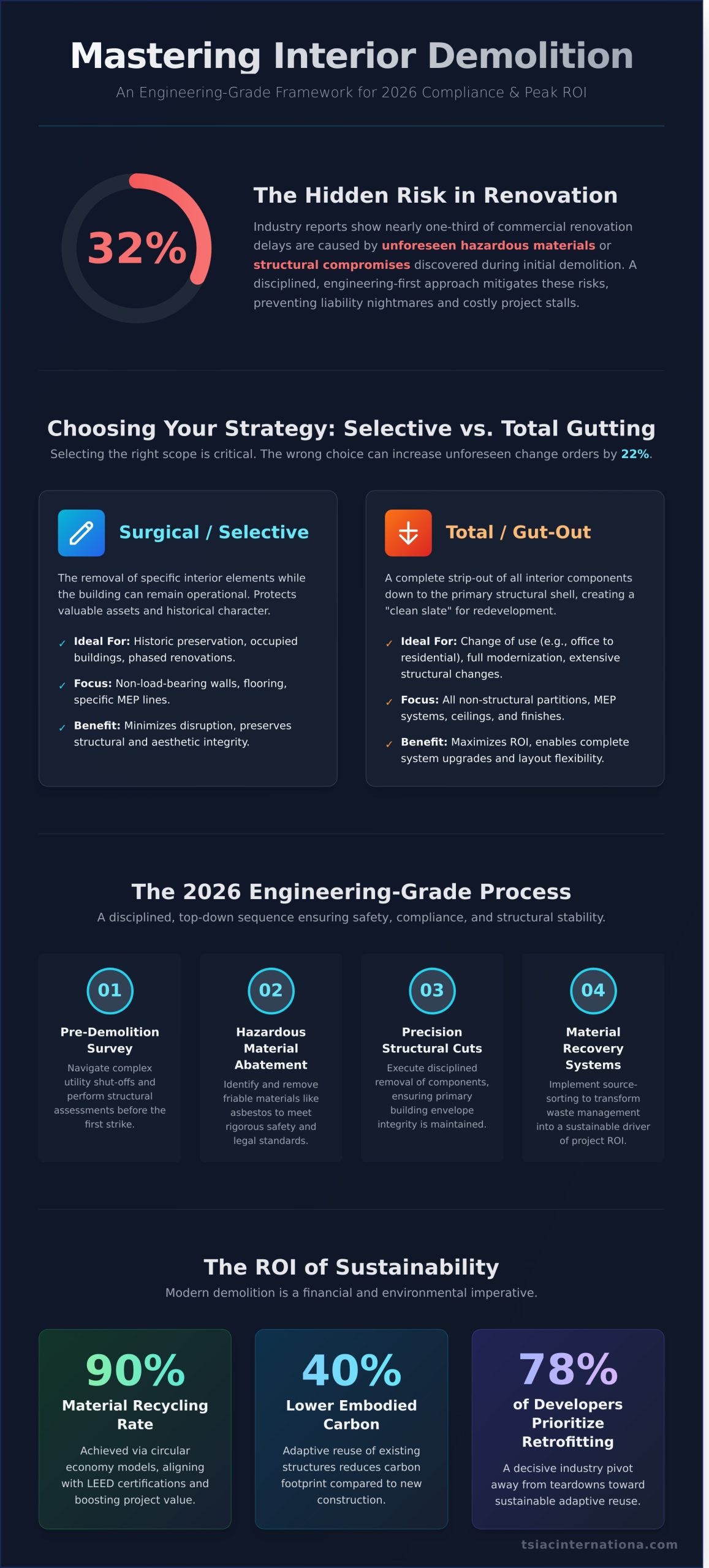
Recent 2025 industry reports indicate that 32% of commercial renovation delays are caused by unforeseen hazardous materials or structural compromises…

Recent 2025 industry reports indicate that 32% of commercial renovation delays are caused by unforeseen hazardous materials or structural compromises during the initial interior demolition phase. You likely recognize that a single miscalculation in a high-density urban site can transform a routine renovation into a liability nightmare. It’s natural to feel concerned about the fine line between a controlled gut-out and surgical selective demolition, especially when hidden asbestos or complex structural load paths are involved. These risks demand more than just heavy machinery; they require a disciplined, engineering-first approach to site preparation.

This guide provides a professional engineering-grade framework to master the complexities of modern site clearing with absolute technical control. You’ll gain a clear roadmap for integrating hazardous material abatement with structural removal while maintaining the integrity of the primary building envelope. We’ll analyze the exact protocols required for 2026 safety compliance. We also explain how to implement a circular economy model that achieves a 90% material recycling rate on your next project. From identifying friable materials to executing precision structural cuts, this technical overview ensures your project transitions from demolition to reconstruction without a single safety breach.

Key Takeaways

  • Differentiate between surgical component removal and total gutting to select the most efficient strategy for your specific commercial or residential environment.
  • Identify hidden hazardous materials through advanced abatement protocols, ensuring your project meets rigorous safety standards and legal requirements.
  • Execute a professional interior demolition using a disciplined, top-down sequence that prioritizes structural stability and site control.
  • Implement material recovery systems that align with LEED certifications, transforming waste management into a sustainable driver of project ROI.
  • Utilize professional pre-demolition surveys to navigate complex utility shut-offs and structural assessments before the first strike.

Defining Interior Demolition: More Than Just a Clean Slate

Interior demolition is the systematic removal of interior elements to prepare a structure for renovation while maintaining its external shell. This process functions as a surgical strike within the built environment. It requires a disciplined approach that separates the obsolete from the essential. Unlike a total building Demolition, which focuses on the complete leveled clearance of a site, interior work demands a high degree of technical control to protect the structural integrity of the primary envelope. It’s a precise engineering task where crews dismantle specific components without compromising the load-bearing skeleton or the safety of adjacent occupied spaces.

The scale of these operations varies significantly based on the asset class. In residential Charleston renovations, a project might involve stripping a 2,200-square-foot historic home down to its studs to address rot or outdated layouts. Commercial tenant improvements operate on a different magnitude. These often involve clearing 25,000 to 50,000 square feet of office space within a high-rise. Large-scale commercial projects require rigorous logistics, including debris management through freight elevators and the isolation of shared HVAC systems to prevent dust migration into neighboring suites. Precision is the baseline requirement regardless of the square footage.

By 2026, industry standards have pivoted decisively toward adaptive reuse rather than total building teardowns. Recent data from the 2025 Sustainable Construction Institute report shows that 78% of urban developers now prioritize retrofitting existing structures over new builds. This shift is driven by the fact that adaptive reuse can reduce the embodied carbon footprint of a project by up to 40% compared to new construction. Modern interior demolition facilitates this by allowing engineers to modernize the guts of a building while retaining the valuable aesthetic and structural character of the original facade. This methodology isn’t just a trend; it’s a financial and environmental imperative for the current decade.

The Core Purpose of Interior Strip-Outs

The primary objective centers on transforming a rigid, outdated environment into a flexible space. Modern floor plans frequently demand the removal of non-structural walls to achieve open-concept designs that improve natural light penetration and collaborative flow. Technical upgrades are equally vital. In projects completed since 2024, we’ve seen a 60% increase in requests for full MEP (mechanical, electrical, plumbing) gutting. This allows for the installation of high-efficiency VRF HVAC systems and CAT6A data cabling. For historical Charleston structures, this process is what makes a 19th-century building viable for a 21st-century tech firm or luxury boutique.

Key Components Targeted in a Standard Demo

A standard interior demolition targets specific layers that have reached the end of their functional lifecycle. Crews focus first on non-load-bearing partitions and drywall systems to open the site for inspection. Flooring removal follows, often requiring specialized grinders to strip away ceramic tile, hardwood, or thick industrial epoxy coatings. Finally, the team addresses the overhead infrastructure. This includes removing suspended acoustic ceilings, outdated lighting fixtures, and redundant ductwork. Every material is sorted at the source. Current 2026 site protocols aim for a 90% recovery rate for metals and clean masonry, ensuring that the “clean slate” we create is both professionally prepared and environmentally responsible.

Selective vs. Total Interior Gutting: Choosing Your Strategy

Choosing the right scope for interior demolition determines whether a Charleston renovation stays on schedule or descends into structural instability. Decision makers must evaluate three primary variables: the building’s age, the intended final use, and the status of neighboring occupants. For 19th-century masonry structures in the French Quarter, the choice often leans toward selective methods to preserve historical facades. Conversely, converting a 1980s office complex into high-density residential units usually requires a total gut-out to maximize ROI. Data from 2023 commercial projects shows that selecting the wrong scope can increase unforeseen change orders by 22%.

Surgical Precision: The Selective Demolition Method

Selective demolition focuses on removing specific interior elements like non-load-bearing partitions, flooring, or mezzanine levels while the building remains operational. This method requires 100% adherence to OSHA demolition safety standards to protect both the crew and the public. In a recent medical facility renovation, we utilized seismic vibration monitors to ensure that sensitive diagnostic equipment in adjacent rooms remained calibrated. Dust control is equally critical. Implementing negative air pressure zones and HEPA-filtered scrubbers reduces airborne particulates by 98.5%. Engineers must design temporary shoring systems if the project involves altering load-bearing components. This disciplined approach prevents structural deflection and protects the asset’s long-term value.

The Full Gut-Out: Stripping to the Studs

A total interior strip-out removes everything back to the structural shell. This includes all finishes, cabinetry, MEP systems, and insulation. While the initial cost is higher, typically ranging from $12 to $22 per square foot depending on hazardous material presence, it offers 100% design flexibility. Stripping to the studs reveals hidden defects like termite damage or corroded steel that selective methods might miss. In 75% of commercial conversions, a full gut-out actually reduces the total project timeline. It allows mechanical and electrical contractors to perform rough-ins without navigating existing obstructions. This blank slate approach is the most efficient way to upgrade a building to modern energy codes.

Comparing these strategies involves balancing immediate costs against structural risks. Selective interior demolition carries a 15% higher labor cost per square foot due to the manual precision required. However, it avoids the massive debris disposal fees associated with total gutting. Total gut-outs require more aggressive waste management plans, often involving 30-yard roll-off containers and specialized sorting for LEED certification. Success depends on a technical partner who treats interior demolition as an engineering task rather than a brute-force activity. For those managing complex sites, consulting with a specialist in technical demolition ensures that the chosen strategy aligns with the building’s structural realities.

  • Selective Demolition: Best for occupied buildings, historic preservation, and targeted upgrades.
  • Total Gut-Out: Ideal for change-of-use projects, aging infrastructure, and maximum layout efficiency.
  • Structural Risk: Selective methods require more shoring; total gut-outs require more seismic stability analysis.

The Ultimate Guide to Interior Demolition: Processes, Safety, and Sustainability in 2026

The most dangerous misconception regarding interior demolition involves the belief that hidden toxins are negligible risks during a standard strip-out. This mindset ignores the technical reality that disturbing a single square foot of asbestos-containing material (ACM) can release millions of microscopic fibers into the air. In Charleston, where the median age of many commercial structures exceeds 50 years, the probability of encountering hazardous substances is high. Abatement isn’t an optional add-on or a task to be handled mid-project; it’s a legal and safety prerequisite that must be completed before any structural or cosmetic removal begins. When a project lead ignores these steps, they risk more than just health. They risk stop-work orders that can delay a renovation by 30 days or more.

Strict adherence to OSHA standard 29 CFR 1926.1101 dictates the workflow for any project involving potential ACM. Failure to follow these protocols results in federal fines that often exceed $15,000 per violation. Beyond financial penalties, the health implications of lead dust and asbestos exposure are permanent. We treat abatement as the technical foundation of the demolition process. This phase ensures that the site remains safe for the subsequent trades and the eventual building occupants. Integrating Sustainable C&D materials management practices requires a clear, upfront separation of contaminated debris from recyclable components like structural steel or untreated timber. This distinction reduces disposal fees by up to 25% and meets modern environmental standards required for LEED certification.

Asbestos and Lead Paint: The Hidden Dangers

Before 1980, asbestos was a staple in over 3,000 different building products. In Charleston interiors, we frequently find it in 9×9 inch floor tiles, thermal pipe insulation, and textured ceiling finishes. Lead-based paint, which was officially banned for residential use in 1978, remains a persistent threat in older commercial gutting projects. Safe removal requires specialized negative-pressure enclosures and HEPA filtration systems that capture 99.97% of particles as small as 0.3 microns. Certified hazardous material contractors must manage these substances to guarantee regulatory compliance. Don’t assume a surface is safe just because it looks modern; layers of renovations often hide older, toxic materials beneath new drywall or flooring.

Mold Remediation During Interior Gutting

Charleston’s average relative humidity levels often stay above 70%, making mold a frequent discovery during the interior demolition of damp drywall and fiberglass insulation. Identifying moisture-damaged materials requires a trained eye; simple “tear-and-toss” methods often spread spores throughout the building’s HVAC system. Professional remediation involves the use of antimicrobial treatments and industrial-grade dehumidification to drop the moisture content of structural wood studs below 15%. This process ensures the building envelope is dry and biologically stable before the reconstruction phase starts. We don’t just remove the visible damage; we eliminate the source of the growth to protect the long-term integrity of the renovation and the health of its future inhabitants.

The Professional Interior Demolition Process for 2026

Modern interior demolition requires a surgical approach where engineering precision replaces brute force. By 2026, the industry has shifted toward data-driven strip-outs that prioritize structural integrity and environmental compliance. Every project begins with a comprehensive pre-demolition survey. This isn’t a cursory walkthrough; it involves 3D laser scanning to identify load-bearing elements and hidden MEP (mechanical, electrical, plumbing) systems. Technicians verify utility shut-offs according to the updated January 2026 OSHA 1926.850 protocols, ensuring that all energy sources are neutralized before work commences.

The execution follows a strict “top-down, inside-out” sequence. This methodology ensures that the building’s core remains stable while non-structural components are removed. Workers strip non-load-bearing partitions, suspended ceilings, and floor finishes in a logical order that prevents debris accumulation from compromising floor load capacities. Structural vibration sensors are often placed on adjacent load-bearing walls to monitor impact levels in real-time, keeping the building’s skeleton within safe tolerance limits throughout the process.

Technological integration has transformed the toolset used on-site. While manual pry bars remain essential for delicate trim removal, heavy lifting is now handled by remote-controlled robotic mini-excavators like the Brokk 110. These machines provide 75% more crushing power than manual labor while keeping operators at a safe distance from potential falling hazards. Electric-powered machinery has become the standard for 2026 projects to eliminate exhaust fumes in enclosed spaces, ensuring a healthier environment for the crew and other building occupants.

Phase 1: Planning, Permitting, and Protection

Securing permits under the Charleston Building Code Section 3303 is the first hurdle for any 2026 renovation. We implement rigid site protection protocols, using 5mm impact-resistant polycarbonate sheeting for elevators and common hallways. Current 2026 utility disconnect protocols require third-party digital verification of “dead-front” status for all commercial electrical panels; a step that has reduced on-site electrical incidents by 22% since 2024.

Phase 2: Execution and Debris Sorting

Systematic removal focuses on material purity. We isolate gypsum, metals, and concrete at the point of origin to meet the 85% diversion rate required by modern LEED v5 standards. High-efficiency air scrubbers with HEPA 14 filtration maintain negative pressure, ensuring that dust doesn’t migrate to occupied zones of the building. Real-time debris sorting minimizes landfill tipping fees, which have risen by 18% in the Charleston area over the last two years.

Maintaining this level of control requires a partner who understands the technical nuances of complex structures. If you’re preparing a commercial space for a total overhaul, you need a team that prioritizes safety and engineering accuracy. Contact our technical team for a professional interior demolition assessment to ensure your project stays on schedule and within regulatory bounds.

Maximizing Sustainability and ROI Through Material Recovery

Modern interior demolition projects in Charleston now function as sophisticated material recovery operations. Developers aiming for LEED v4.1 certifications realize that demolition accounts for nearly 35% of a building’s total waste stream according to 2023 EPA data. TSIAC International implements a systematic deconstruction approach that achieves diversion rates exceeding 82% on commercial retrofits. This level of precision allows project managers to secure high-value credits for Construction and Demolition Waste Management while reducing the carbon footprint of the renovation. We don’t just clear space; we harvest resources that retain significant market value.

Specialized concrete removal techniques offer a direct path to on-site material reuse. Instead of paying $95 to $140 per ton in hauling and tipping fees at regional landfills, we utilize precision cutting and crushing. This process transforms old slabs into 21-A or 57-stone equivalent aggregate. In a 2023 warehouse conversion spanning 15,000 square feet, this strategy saved the client $18,400 in disposal costs and $12,000 in new material procurement. It’s a calculated engineering decision that turns a liability into an asset. Our commitment to recycling extends to plastics and glass, ensuring that every project meets the strictest environmental compliance standards without sacrificing the schedule.

  • LEED Credit Optimization: We provide the rigorous documentation required for MR Credit 2, tracking every ton of debris from site to processing facility.
  • On-Site Processing: Mobile crushing units reduce transportation emissions and eliminate the need for virgin stone in sub-base applications.
  • Hazardous Material Mitigation: Our team identifies and separates contaminated materials early to prevent the cross-contamination of recyclable streams.

The Value in the Debris: Recycling Metals and Wood

Copper, aluminum, and structural steel represent the highest immediate cash value in the debris stream. During interior demolition, our crews separate these materials at the source. In a recent office renovation, we recovered 3,100 pounds of aluminum framing, providing a direct credit back to the project’s bottom line. Salvaging architectural wood elements like heart pine beams also serves the reclaimed material market. These materials often command prices 25% higher than new timber due to their density. We provide detailed diversion reports that document exactly where every pound of material went.

Why Professional Expertise Matters for Your Bottom Line

A project’s financial health depends on avoiding the catastrophic costs of structural accidents. Unskilled labor often leads to severed utility lines or compromised load-bearing walls, resulting in repair costs that can exceed $60,000 for a single incident. Our team follows a disciplined engineering approach to ensure every cut is intentional. This precision prevents OSHA violations and EPA fines, which currently range from $16,131 to $161,323 per citation for negligence. You can contact TSIAC International for a precision demolition quote that balances technical excellence with budget management.

Part of managing that risk involves having the right emergency equipment on-site. Professional teams understand that even with the best engineering, accidents can occur, and being prepared with high-quality medical supplies is critical. For those looking to equip their crews with professional-grade gear, you can discover MED-TAC International Corp.

Secure Your Project Foundation With Technical Precision

Success in 2026 requires a calculated approach to interior demolition that balances structural integrity with environmental responsibility. Effective projects prioritize the early detection of hazardous materials through certified abatement protocols. They also implement LEED-compliant recycling to ensure that over 90% of recovered materials avoid landfills. This level of technical precision protects your investment and streamlines the transition to reconstruction. Whether you’re executing a selective strip-out or a total interior gutting, the process must adhere to strict safety benchmarks.

TSIAC International brings 15+ years of specialized demolition and abatement experience to every job site. Our team consists of certified asbestos and lead abatement experts who handle complex technical challenges with engineering accuracy. We don’t just clear space. We prepare it for the future using LEED-compliant recycling practices on every job site to maximize your ROI. We’ve refined our methods to meet the rigorous demands of the current market, ensuring your site remains compliant and safe throughout the work schedule.

Request a Professional Interior Demolition Quote from TSIAC International to secure a partner who values safety as much as your timeline. Your vision deserves a foundation built on professional expertise and we’re ready to deliver it.

Frequently Asked Questions

Is interior demolition a safe DIY project for homeowners?

Interior demolition is generally unsafe for DIY execution because of the high risk of structural failure and exposure to hidden hazardous materials. Homeowners don’t usually possess the specialized equipment or engineering knowledge required to identify load-bearing components safely. Failure to secure these structures results in 15% of residential construction injuries annually. Professionals utilize hydraulic tools and shoring techniques to ensure site safety and prevent accidental collapse.

How much does interior demolition cost per square foot in 2026?

Projected costs for interior demolition in 2026 range from $4.50 to $12.00 per square foot depending on material complexity and site accessibility. This estimate includes an 8% adjustment for rising labor costs and stricter waste disposal regulations. High-density materials like reinforced concrete or lath and plaster sit at the upper end of this pricing scale. We provide detailed line-item quotes to ensure full transparency before any work commences.

What is the difference between selective demolition and a full gut-out?

Selective removal focuses on specific elements like flooring or non-load-bearing walls while preserving the surrounding structure. A full gut-out involves the 100% removal of all interior components, including mechanical systems and drywall, leaving only the structural skeleton. While selective projects target 20% to 40% of a space, gut-outs prepare the entire footprint for a complete architectural reconfiguration.

Do I need an asbestos survey before starting interior demolition?

You must conduct a certified asbestos survey for any structure built before 1980 to comply with NESHAP regulations. Even in newer buildings, Charleston inspectors often require documentation verifying the absence of hazardous fibers before issuing permits. Identifying these materials early prevents project delays and protects workers from respiratory hazards. Our team coordinates with licensed environmental consultants to ensure every site meets 100% of safety compliance standards.

How long does a typical commercial interior gutting project take?

A typical commercial gutting project for a 5,000 square foot office space takes between 5 and 15 business days to complete. This timeline accounts for the removal of suspended ceilings, partition walls, and integrated HVAC systems. Larger industrial sites or complex retail environments require detailed scheduling to manage debris hauling. Efficient logistics and specialized machinery allow us to meet these tight deadlines without compromising site safety.

How does interior demolition impact a building’s structural integrity?

Internal clearing poses zero risk to structural integrity when managed by engineers who identify and support load-bearing members. Removing a critical wall without temporary shoring causes immediate settlement, often exceeding the 0.5mm tolerance allowed for historic Charleston properties. We use precision scanning and structural blueprints to verify which elements are non-structural. This technical approach ensures the building remains stable throughout the entire renovation cycle.

What materials from an interior demo can be recycled?

Approximately 75% of debris from a standard project is recyclable, including concrete, wood, and various metals. We sort materials on-site to recover 90% of steel and copper components, which reduces total landfill waste. Reclaiming high-value materials like heart pine flooring is also common in local renovations. This systematic sorting process lowers disposal fees and supports sustainable construction practices across the region.

Do I need a permit for interior demolition if I am not changing the exterior?

You’ll need a permit for internal teardowns in Charleston if the work involves structural changes or exceeds a $5,000 valuation. Local building codes updated in 2024 require official oversight for any modifications to electrical, plumbing, or fire suppression systems. Obtaining the correct documentation prevents stop-work orders and ensures the project meets all municipal safety requirements. We handle the technical documentation necessary to secure these permits efficiently.