
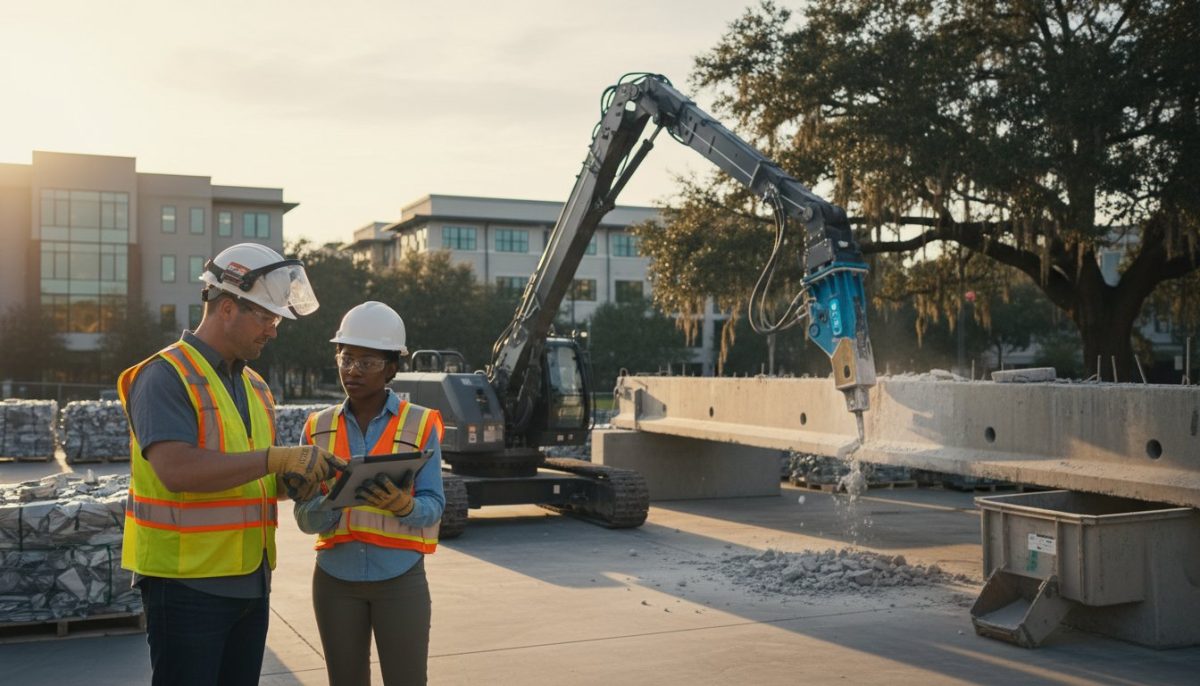
A single miscalculation in vibration frequency during demolition can compromise the structural integrity of an entire adjacent facility in less than sixty seconds. You likely recognize that clearing a complex site involves far more than brute force. It requires a surgical approach to avoid unforeseen structural damage and the escalating landfill fees that, according to 2024 industry data, now account for up to 40% of total demolition project costs. Securing high-tier concrete slab removal services is no longer just about clearing space; it’s about protecting the long-term viability of your next build and ensuring zero damage to sub-slab utilities.
By engaging with our 2026 Engineering Guide, you’ll master the technical requirements, safety protocols, and recycling standards necessary for professional execution. We’ve designed this resource to help you ensure your site is cleared safely and with maximum efficiency. We’ll examine the specific methodologies for precision vibration control, the latest regulatory compliance frameworks, and the logistics of transforming 100% of your concrete waste into high-grade reusable aggregate to meet modern sustainability mandates.
Key Takeaways
- Distinguish between basic demolition and the engineered removal strategies required for complex commercial and industrial structural projects.
- Evaluate the efficiency of advanced technical methods, including robotic demolition and hydraulic breaking, for high-risk or confined work zones.
- Identify and mitigate critical sub-slab hazards such as post-tensioned (PT) cables and essential utility lines to maintain site safety.
- Adopt sustainable “Zero Waste” disposal standards by learning how to sort and repurpose crushed concrete into high-quality road base or aggregate.
- Understand how to leverage professional concrete slab removal services and fixed-price contracts to ensure precision in complex demolition environments.
Defining Professional Concrete Slab Removal Services
Professional concrete slab removal services represent a strategic shift from brute-force demolition toward precision engineering. While basic breaking relies on high-impact force that can damage neighboring structures, an engineered approach prioritizes the integrity of the entire site. To understand the complexity involved, one must first establish the fundamentals: What is a Concrete Slab? It’s a critical structural element that distributes loads across the ground or a supporting frame. In industrial environments, removing these elements requires sophisticated vibration mitigation to protect sensitive machinery and precision-cut edges to ensure seamless transitions for new pours.
Specialized contractors utilize diamond-tipped sawing and hydraulic bursting to manage energy transfer during the extraction. This level of control prevents micro-fracturing in adjacent structures that often goes unnoticed until years later. For 2026 projects, maintaining site safety standards means managing crystalline silica dust through HEPA-filtered vacuum systems and ensuring sub-grade protection to avoid soil compaction issues. It’s about maintaining a controlled environment where the demolition doesn’t compromise the future build.
When to Replace vs. Remove Concrete
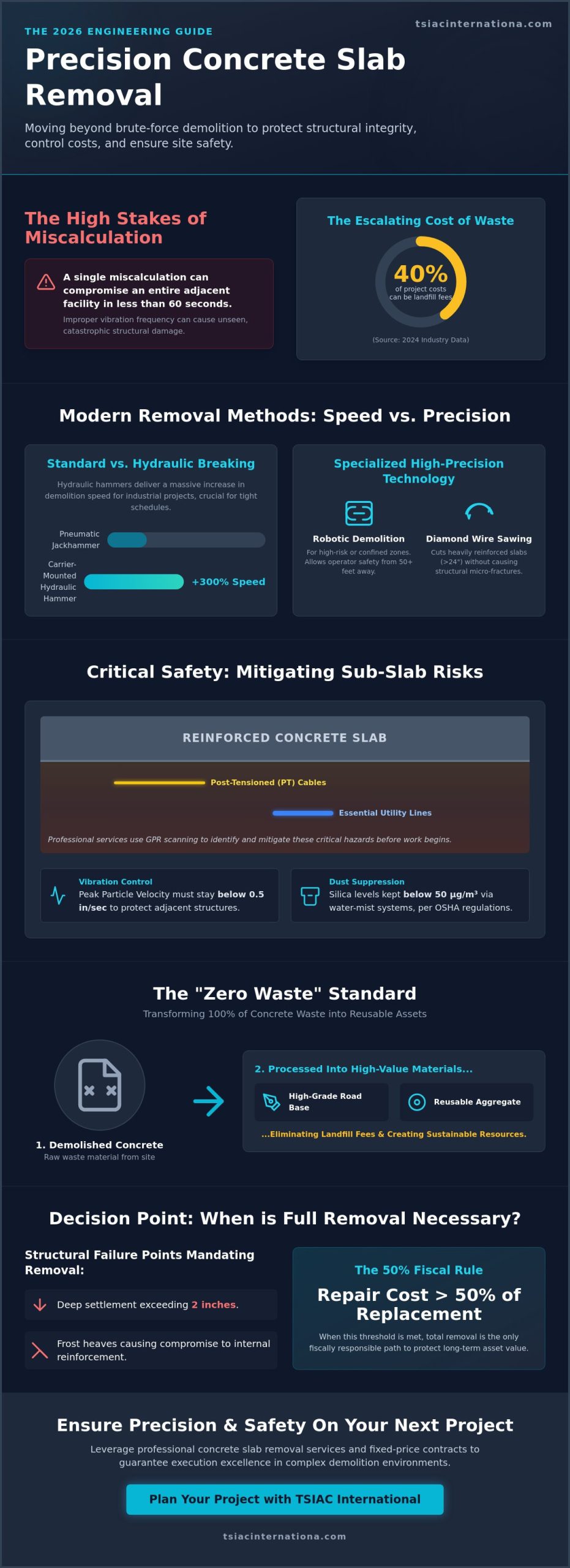
Engineers evaluate structural failure points such as deep settlement exceeding 2 inches or frost heaves that have compromised the internal reinforcement mesh. While slab-jacking offers a temporary fix for minor sinking, it cannot restore the structural capacity of a shattered slab. Structural slab failure is the point where repair costs exceed 50% of replacement. At this threshold, total removal becomes the only fiscally responsible path for facilities managers who need to maintain long-term asset value.
The Scope of Modern Removal Projects
Project scale varies from residential driveway excavations to 100,000-square-foot warehouse floor replacements. Interior gutting projects often involve reinforced slabs where weight-bearing columns must remain undisturbed, requiring surgical precision. Understanding the broader demolition process south carolina firms follow is vital for coordinating waste logistics and site preparation. Whether it’s a high-precision cleanroom or a heavy-duty loading dock, modern concrete slab removal services provide the technical discipline necessary for the next phase of construction. Every square foot removed is a calculated step toward a fresh, stable foundation.
Industrial Equipment and Removal Methods
Modern concrete slab removal services have evolved beyond simple destruction to focus on engineering precision. While traditional pneumatic jackhammering remains effective for residential walkways or spaces under 150 square feet, industrial projects require hydraulic breaking systems. A carrier-mounted hydraulic hammer delivers up to 1,500 blows per minute, achieving a 300% increase in demolition speed compared to manual methods. This efficiency is vital for maintaining tight 2026 construction schedules.
For high-risk environments or confined subterranean levels, robotic demolition units provide a safer alternative. These remote-controlled machines allow operators to stand 50 feet away from potential fall zones or structural hazards. When dealing with heavily reinforced slabs thicker than 24 inches, diamond wire sawing becomes the primary choice. This method uses a pulley system and diamond-beaded wire to cut through steel-heavy concrete without generating the micro-fractures often caused by percussive tools. It’s the most reliable way to ensure the remaining slab edges stay structurally sound.
Heavy Machinery for Large-Scale Clearance
Large clearance operations rely on a combination of skid steers and compact excavators. These machines utilize specialized attachments like hydraulic shears and pulverizers to break material into manageable sizes for hauling. To protect adjacent structures, engineers implement vibration control measures, monitoring peak particle velocity to ensure it remains below 0.5 inches per second. Dust suppression is equally critical for compliance. Integrated water-mist systems keep respirable silica levels below the OSHA limit of 50 micrograms per cubic meter. This focus on site safety aligns with the EPA Guidelines for C&D Materials, ensuring that demolished concrete is properly sorted for recycling rather than filling local landfills.
Selective Demolition Techniques
Selective demolition involves the surgical removal of specific slab sections to access utilities or install new footings. This approach ensures the building’s structural shell stays intact while allowing for modern upgrades. Slab-cutting technology, utilizing walk-behind saws with 30-inch blades, creates clean expansion joints and borders that prevent cracks from migrating to preserved areas. These precision methods are often integrated into broader commercial interior gutting services where asset protection is the priority. If you’re planning a complex renovation, our team can help you evaluate your structural requirements to determine the most efficient removal path.
Critical Safety: Structural Integrity and Sub-Slab Risks
Professional concrete slab removal services require more than brute force; they demand a surgical understanding of the slab’s internal composition. In modern construction, post-tensioned (PT) cables present the most significant life-safety risk. These high-strength steel strands are often stressed to approximately 33,000 pounds of force. Accidentally severing a PT cable during demolition results in an explosive release of energy, potentially causing catastrophic injury or compromising the structural stability of the entire building. Professional crews utilize Ground-Penetrating Radar (GPR) as a non-negotiable prerequisite. By employing high-frequency 1600 MHz antennas, technicians map the precise depth and orientation of cables and conduits before the first impact occurs.
The #1 objection to professional intervention is the perceived cost-saving of DIY removal. However, unguided demolition often leads to foundational damage that costs 5 to 10 times more to remediate than the initial removal. Manual jackhammering without vibration monitoring can send shockwaves through the soil, causing settlement in adjacent footings or cracking in load-bearing walls. It’s a risk that professional concrete slab removal services mitigate through engineering-led planning and site-specific risk assessments.
Hazardous Material Awareness
Older industrial and commercial slabs often hide legacy contaminants. Mastics used for floor tiles before 1980 frequently contain chrysotile asbestos, while industrial coatings applied before 1978 may have high lead concentrations. Disturbing these materials without containment creates an inhalation hazard for everyone on-site. It’s vital to secure hazardous material abatement south carolina protocols before the demolition phase begins to ensure compliance with EPA and OSHA standards. We prioritize these inspections to protect both the environment and the workers.
Vibration and Noise Mitigation
Protecting neighboring structures is a technical requirement, not a courtesy. Technicians use Peak Particle Velocity (PPV) sensors to monitor vibrations in real-time. If levels exceed 0.5 inches per second near sensitive masonry, operations halt immediately to adjust the methodology. For commercial tenant improvements, scheduling demolition during off-peak hours, typically 10:00 PM to 6:00 AM, minimizes the impact on business continuity. This ensures that high-decibel activities don’t disrupt sensitive laboratory equipment or data centers located in adjacent suites.
Environmental Responsibility: Disposal and Recycling
Modern engineering demands more than just demolition; it requires a circular economy approach. Professional concrete slab removal services now prioritize a ‘Zero Waste’ objective, where 95% of extracted materials are diverted from landfills. This process starts with meticulous sorting at the source. Technicians separate clean concrete from contaminants like vapor barriers and reinforcement steel to ensure the purity of the secondary product. It’s a logistical challenge that requires discipline, but it ensures that demolition debris becomes a resource rather than a liability.
Once sorted, the concrete doesn’t sit in a waste pile. High-impact crushers break the slabs into various fractions to create recycled concrete aggregate (RCA). In 2025, industry data showed that using RCA as a road base reduces virgin aggregate mining by 40%. It also slashes project carbon footprints by minimizing the transport of new materials to the site. Every ton of recycled concrete saves roughly 1,300 gallons of water that would otherwise be used in mining and processing virgin stone. This systematic reuse is the backbone of sustainable infrastructure development.
Managing Demolition Debris
Logistics dictate whether sorting happens on-site or at a specialized facility. On-site crushing works best for projects exceeding 5,000 square feet because it eliminates hundreds of heavy truck trips. Recovering metal reinforcements is a critical financial and environmental step; rebar is extracted using magnetic separators and sent to secondary markets for smelting. Closed-loop concrete recycling is the process of using old slabs as new structural fill. This ensures that the material cycle remains within the construction ecosystem without requiring external inputs or additional transport costs.
Compliance and Permitting
Handling debris involves strict adherence to local environmental regulations. Commercial demolition contracts now mandate a Waste Management Plan (WMP) that tracks every ton of material from the site to its final destination. This documentation is vital for securing LEED certification credits, specifically under the Material and Resources (MR) category. Projects achieving 75% diversion can earn up to two points toward their final rating. If hazardous materials like lead-based coatings are present, crews must follow EPA-mandated disposal protocols and maintain a chain-of-custody manifest for 30 years. This level of precision protects the client from future liability while upholding global sustainability standards.
Planning Your Project with TSIAC International
TSIAC International manages concrete slab removal services through a lens of engineering precision. Since 2009, the firm has specialized in fixed-price structural demolition contracts. This model eliminates the financial volatility often associated with site work. By conducting exhaustive pre-demolition surveys, TSIAC identifies hidden variables like sub-slab utilities or unexpected reinforcement densities before the first hammer drops. The team prioritizes environmental stewardship, ensuring that 90% of concrete debris is diverted from landfills through on-site crushing or certified recycling streams. This approach guarantees that your project adheres to both budgetary constraints and modern sustainability mandates.
Why Experience Matters in Concrete Removal
Removing industrial slabs within active manufacturing plants requires more than just heavy machinery. It demands a surgical approach to vibration control and dust mitigation. TSIAC’s history includes complex projects where 12-inch reinforced slabs were removed while adjacent production lines remained operational. Operating as a single-source provider for both hazardous material abatement and demolition streamlines the project schedule. You won’t have to coordinate between separate contractors for asbestos tile removal and structural slab work. This integrated methodology is part of the TSIAC International Charleston standard, which emphasizes safety in high-risk environments. Their 15 years of field experience allows them to solve logistical puzzles in “impossible” locations where traditional equipment cannot reach.
Requesting a Professional Estimate
Accuracy in a quote depends on technical data. When you contact TSIAC, provide specific details including slab thickness, the presence of post-tension cables, and current site access dimensions. Mobilization typically occurs within 10 to 14 business days of contract execution, depending on the complexity of the utility disconnects required. For example, a standard 5,000-square-foot industrial slab removal often reaches completion in 5 to 7 working days. To prepare your site for the crew, follow these steps:
- Clear all movable equipment and debris from the work zone.
- Verify that all sub-slab electrical and plumbing lines are locked out and tagged out.
- Ensure there is a designated area for debris load-out and heavy equipment staging.
- Review the structural drawings to confirm the location of load-bearing footings.
A well-prepared site prevents delays and ensures the safety of the demolition team. Contact TSIAC International for a professional site evaluation to begin the engineering assessment of your facility and secure a fixed-price proposal for your concrete slab removal services.
Securing Structural Integrity for Your Next Project Phase
Successful concrete slab removal services require more than just heavy machinery. It’s a technical discipline where structural integrity meets environmental stewardship. In 2026, project success hinges on mitigating sub-slab risks and ensuring that hazardous materials like lead or asbestos are managed by fully licensed professionals. TSIAC International brings over 15 years of selective demolition expertise to every site. We don’t just clear the ground; we protect the future of your build through engineering precision. Our commitment to sustainability is backed by data, as we consistently achieve a 90% or higher material diversion rate through on-site recycling. This approach reduces landfill waste and optimizes project logistics. Whether you’re dealing with complex industrial foundations or sensitive structural retrofits, you need a partner who views every challenge as a solvable equation. Our team specializes in navigating impossible locations where others hesitate. Let’s ensure your site is prepared for its next phase with the highest safety standards in the industry.
Request a Fixed-Price Concrete Removal Quote from TSIAC International
Your project deserves the reliability and precision that only a seasoned engineering partner can provide.
Frequently Asked Questions
How much does professional concrete slab removal cost per square foot?
Professional concrete slab removal costs typically range from $2 to $6 per square foot based on 2024 industry benchmarks. This price fluctuates depending on the slab’s thickness and whether it contains steel reinforcement like rebar. For a standard 4-inch thick residential slab, you’ll likely pay on the lower end of that scale. Thicker industrial slabs require heavier machinery, which increases the total project expenditure.
Can I remove a concrete slab myself with a rented jackhammer?
You can remove a concrete slab yourself, though it’s rarely efficient for areas exceeding 100 square feet. Renting a 60-pound jackhammer costs roughly $100 per day, but manual labor often leads to uneven debris sizes. Professional concrete slab removal services use hydraulic breakers that complete the work 70% faster than manual methods. Improper technique also risks damaging underground utilities buried less than 12 inches deep.
How do you check for post-tension cables before breaking concrete?
Technicians use Ground Penetrating Radar (GPR) to locate post-tension cables before any demolition begins. This non-destructive testing method provides real-time data on cable depth and spacing with 98% accuracy. If GPR isn’t sufficient, X-ray imaging offers a clearer view of the internal structure. Identifying these cables is critical because a snapped post-tension strand releases enough energy to cause catastrophic structural failure.
What happens to the concrete debris after it is removed from the site?
Concrete debris is hauled to specialized recycling centers where it’s crushed into various grades of aggregate. The EPA reports that recycling concrete saves approximately 300 million tons of natural resources annually. This crushed material often finds a second life as a sub-base for new roads or parking lots. Utilizing professional concrete slab removal services ensures that 95% of your waste material is diverted from landfills into sustainable construction cycles.
How long does it take to remove a standard 20×20 concrete driveway?
A professional crew typically removes a standard 20×20 driveway in 6 to 10 hours. This timeline includes the initial breaking, loading the debris into a 20-yard dumpster, and final site clearing. If the concrete is more than 6 inches thick or features heavy mesh reinforcement, the process might require a second day. Efficient logistics and high-capacity machinery are the primary factors in meeting these tight schedules.
Is a permit required for concrete slab removal on a private property?
Permit requirements depend on your local building department, but 85% of urban areas mandate a demolition permit for any slab larger than 200 square feet. You’ll need to submit a site plan that shows where the debris will go and how you’ll protect neighboring properties. Fines for unpermitted work often exceed $1,000 in major metropolitan areas. Always check your city’s municipal code before starting any heavy demolition work.
What are the risks of removing concrete near an existing foundation?
The biggest risks include structural settlement and damage to the foundation’s waterproofing membrane. Vibrations from heavy machinery can travel through the soil and create hairline fractures in adjacent walls as small as 0.5 millimeters. Engineering standards suggest maintaining a 24-inch buffer zone where only hand tools are used to prevent impact damage. Careful planning ensures the soil remains stable and the existing structure’s integrity stays intact.
