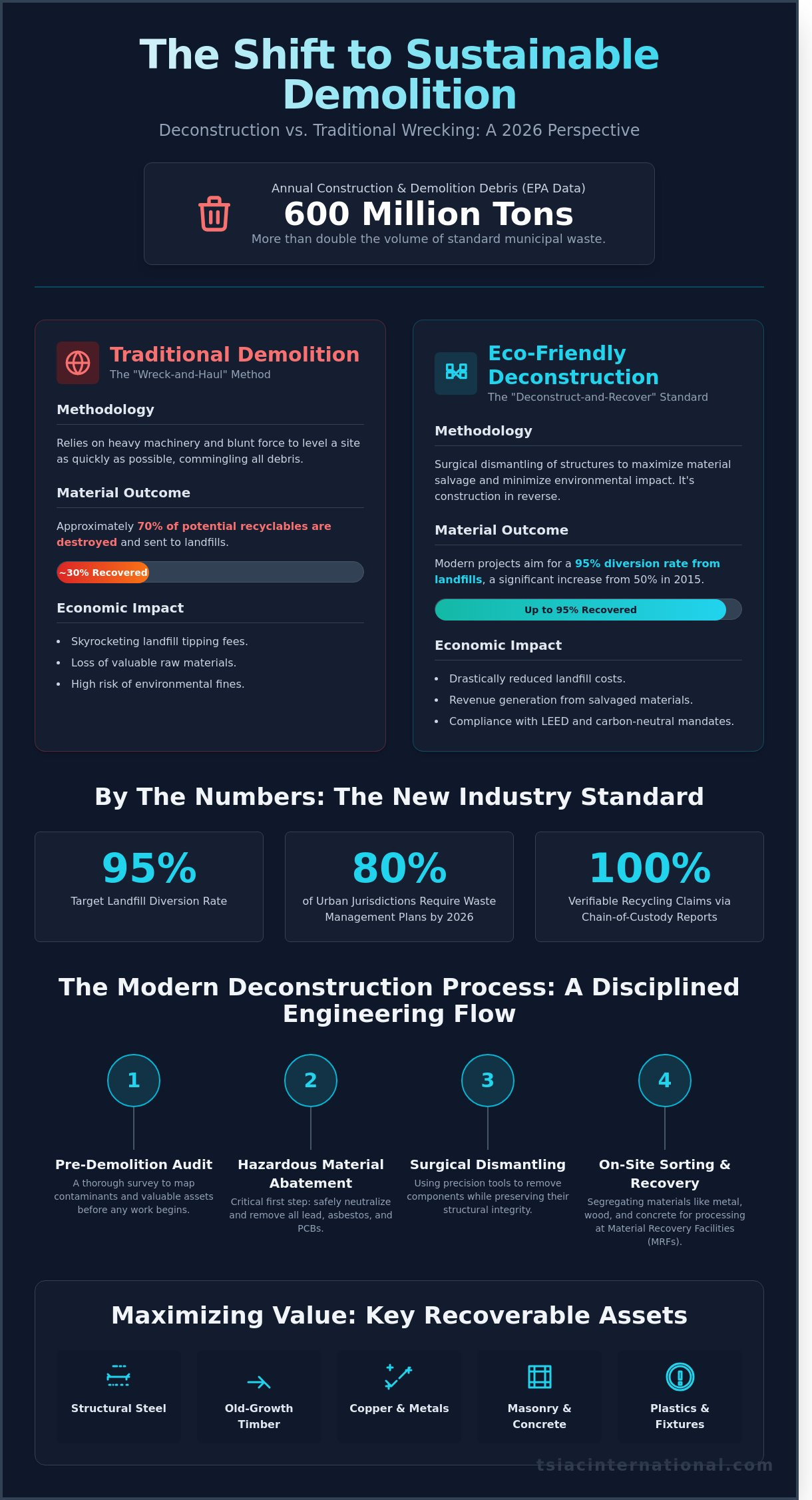
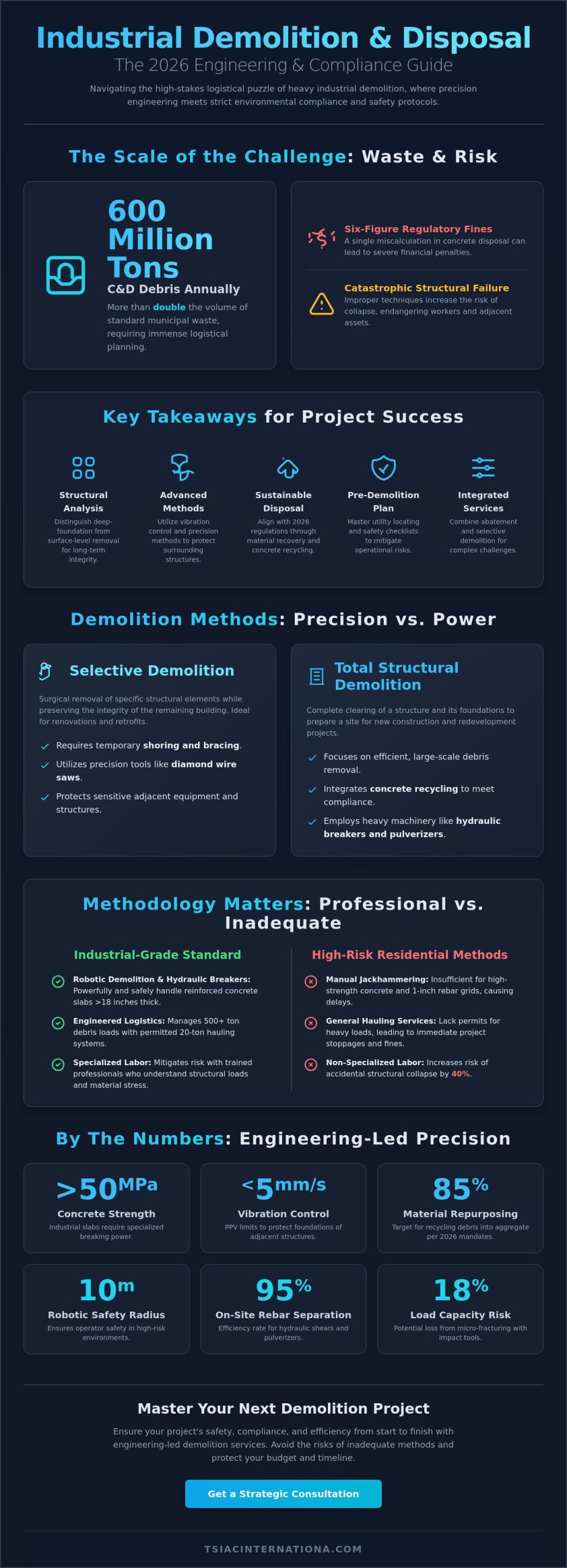
Industrial waste data from the EPA in 2023 reveals that construction and demolition debris accounts for 600 million tons annually, a figure more than double the volume of standard municipal waste. You likely recognize that managing a project of this magnitude isn’t just about brute force; it’s a high-stakes logistical puzzle where a single miscalculation in concrete removal and disposal can lead to six-figure regulatory fines or catastrophic structural failure. We understand the pressure of balancing tight deadlines with the rigid requirements of environmental laws and the hidden dangers of legacy materials like lead or asbestos.
This 2026 industrial guide provides the engineering precision needed to master complex demolition without compromising safety or your operational budget. You’ll gain a clear understanding of specialized removal methods that protect adjacent assets while ensuring every ton of debris meets current compliance standards. We’ll detail specific demolition techniques, hazardous material protocols, and the logistical frameworks required for efficient hauling to ensure your site remains safe and remains fully documented throughout the project lifecycle.
Key Takeaways
- Understand the critical engineering distinctions between surface-level clearing and deep-foundation structural removal to ensure long-term project integrity.
- Explore advanced mechanical methods and vibration control protocols designed to protect sensitive industrial environments and surrounding urban structures.
- Implement sustainable strategies for professional concrete removal and disposal that align with 2026 regulatory standards and material recovery mandates.
- Master the essential pre-demolition checklist, including utility locating and safety protocols, to mitigate operational risks and ensure site compliance.
- Discover the advantages of integrated abatement and selective demolition services for managing complex structural challenges in high-stakes environments.
The Logistics and Engineering of Professional Concrete Removal and Disposal
Professional concrete removal and disposal is a managed structural demolition process that requires engineering precision. It’s not a simple clearing task. Industrial projects often involve deep-foundation structural removal where slabs exceed 18 inches in thickness. Before any equipment arrives, engineers must perform a structural integrity assessment to identify load-bearing points. A single cubic yard of concrete weighs approximately 4,000 pounds. This means a standard industrial floor removal can generate 500 tons of debris within 48 hours. Managing this volume requires a logistics plan that accounts for weight-bearing limits of site access roads and the sequencing of heavy machinery.
Site safety remains the primary driver of logistics. When dealing with reinforced concrete, the presence of high-tension rebar adds a layer of complexity to the removal phase. Specialists must calculate the potential for structural shifts during the extraction process. Every pound of material moved must be tracked to ensure the site remains balanced and safe for operators and adjacent structures. This level of planning distinguishes industrial-grade execution from basic demolition services.
Structural vs. Selective Concrete Demolition
Selective demolition focuses on surgical removal for renovations. This process relies on temporary shoring and bracing to maintain the stability of the remaining structure while specific sections are cut away. In contrast, total structural removal involves the complete clearing of a site for redevelopment. During these phases, Concrete recycling methods are integrated into the workflow to reduce landfill impact. Current standards aim to repurpose at least 85% of demolished material into high-quality aggregate for new construction projects. This sustainable approach reduces transportation costs and meets 2026 environmental compliance mandates.
Why Residential Methods Fail on Industrial Project Sites
Standard jackhammering is insufficient for high-output industrial demolition. While a manual tool works for a thin driveway, it can’t handle reinforced slabs with 1-inch rebar grids. Industrial sites require robotic demolition units or diamond wire sawing to maintain the project schedule. General hauling services often lack the permits for 20-ton loads, which leads to immediate project delays. Using non-specialized labor for complex concrete tasks increases the risk of accidental structural collapse by 40% according to historical site safety data. Professional teams use high-pressure hydraulic breakers and specialized heavy debris management systems to ensure every stage of concrete removal and disposal remains under total control. This technical rigor ensures that the project moves from demolition to the next phase of construction without unforeseen structural failures or safety incidents.
Advanced Techniques in Structural and Selective Demolition
Modern concrete removal and disposal requires a shift from traditional blunt-force methods to engineering-led precision. In 2026, the industry prioritizes structural integrity and environmental stability above all else. Vibration control is a critical requirement in urban industrial zones, where peak particle velocity (PPV) must often be maintained below 5mm/s to protect the foundations of adjacent historical or sensitive structures. Selecting the correct machinery depends on the concrete’s compressive strength, which frequently exceeds 50 MPa in industrial slabs, and the specific density of the internal reinforcement. Precision cutting techniques are essential to prevent micro-fracturing; these invisible cracks can reduce the load-bearing capacity of remaining permanent structures by as much as 18% if handled with standard impact tools.
Robotic Demolition and Heavy Machinery Applications
Remote-controlled robotic breakers allow operators to maintain a 10-meter safety radius in high-risk environments like chemical processing plants or unstable mezzanines. These compact machines deliver the hitting power of an excavator five times their size while fitting through standard 80cm doorways. For large-scale projects, excavators equipped with hydraulic shears and pulverizers achieve a 95% separation rate of steel rebar from concrete on-site. This level of efficiency is vital for meeting federal standards regarding the Sustainable Management of C&D Materials, turning debris into recyclable aggregate. High-reach demolition equipment now extends to 60 meters, enabling controlled, top-down dismantling that keeps the work zone footprint minimal.
Precision Surgical Removal and Slab Sawing
Diamond wire sawing is the primary solution for removing heavily reinforced sections thicker than 1000mm. By looping a diamond-impregnated cable around a bridge pier or foundation block, technicians execute clean cuts through any depth of concrete without inducing any vibration. This method is silent and produces no dust when water-cooled. For horizontal and vertical surfaces, flat sawing and wall sawing provide the linear accuracy needed for new elevator shafts or utility trenches. Core drilling remains the standard for structural testing and utility integration, creating clean apertures from 10mm to 1200mm in diameter. These surgical methods ensure that the primary structure’s health remains uncompromised during complex modifications. If your facility requires this level of technical oversight, partnering with a specialized industrial contractor ensures that even the most difficult removals are executed with engineering-grade accuracy.
The selection of these advanced techniques directly impacts the total timeline of concrete removal and disposal. By utilizing precision tools, contractors reduce the need for secondary patching and structural reinforcement, lowering the total project cost by an average of 12% compared to traditional jackhammering methods. Every cut is planned with CAD-level detail to ensure that the removal process supports the long-term viability of the industrial site.
Environmental Compliance and Concrete Debris Management
By 2026, the regulatory framework for concrete removal and disposal has shifted from simple waste management to a rigorous circular economy model. Landfill tipping fees in major industrial corridors have increased by an average of 15% since 2024, making the burial of inert debris the most expensive and least sustainable option for commercial developers. Modern environmental mandates now require a minimum 75% diversion rate for construction and demolition (C&D) materials on projects exceeding 5,000 square feet. This shift necessitates a sophisticated logistical chain that begins during the initial demolition process south carolina contractors must follow to ensure site-level separation.
Adhering to OSHA demolition standards is a prerequisite for safe debris handling and transport. These standards dictate how piles are staged to prevent collapses and how dust suppression systems must operate during load-out. Effective management moves material from the demolition face to a designated sorting zone, where primary crushing often occurs before the debris ever leaves the property. This reduces the volume of loads and optimizes transport costs, which is vital for maintaining project margins in high-scale industrial redevelopments.
Concrete Recycling and Material Recovery Systems
Modern recycling facilities utilize multi-stage crushing and screening plants to transform old slabs into high-quality recycled concrete aggregate (RCA). Magnetic separators pull rebar and embedded steel from the mix with 99% efficiency, allowing these metals to be sold as scrap, which often offsets the cost of the concrete removal and disposal process. For projects pursuing LEED v5 certification, contractors must provide verified weight tickets and processing manifests. These documents prove that the recovered material has been diverted from landfills, directly contributing to Materials and Resources credits. Using RCA as a sub-base for new parking lots or structural fill represents the peak of engineering efficiency in 2026.
Handling Hazardous Materials in Concrete Structures
Older industrial assets often hide environmental liabilities within their masonry. Lead-based paint coatings, common on concrete surfaces in facilities built before 1978, require specialized stabilization before removal to prevent soil contamination. Additionally, asbestos-containing materials (ACM) are frequently found in expansion joints and moisture barriers. If these materials are present, property owners must follow the protocols outlined in hazardous material abatement south carolina before mechanical demolition begins. Failure to identify these risks leads to stop-work orders and significant fines from state environmental agencies. Precise testing and documented remediation are the only ways to maintain compliance and project momentum.
Planning Your Project: Safety Standards and Regulatory Requirements
Executing professional concrete removal and disposal requires more than just heavy machinery. It demands a rigorous preliminary assessment to mitigate structural risks and environmental hazards. Property managers should start with a comprehensive pre-demolition checklist. This document must include structural load-bearing analysis, hazardous material surveys for lead or asbestos, and a clear site access plan. A critical step involves contacting local utility locating services. In most regions, calling 811 at least 48 hours before any excavation or slab removal is a legal mandate. Striking an unidentified high-pressure gas line or an electrical conduit can cause catastrophic site failures and immediate project shutdowns.
Establishing a secure safety perimeter is the next priority. This zone prevents unauthorized personnel from entering high-risk areas where falling debris or flying fragments are common. We also focus on dust mitigation. Uncontrolled concrete dust isn’t just a nuisance; it’s a major health hazard that can lead to permanent respiratory damage. Improper disposal or “fly-tipping” carries severe legal liabilities. In 2024, some municipalities increased fines for illegal dumping to over $25,000 per occurrence. Property owners remain legally responsible for their waste until it reaches a certified facility, making professional documentation essential.
Occupational Safety and Site Containment Strategies
Modern safety standards emphasize the total containment of respirable crystalline silica. We implement OSHA-compliant Table 1 methods for all projects. This involves using integrated water delivery systems for wet-cutting or HEPA-filtered vacuum attachments that maintain a 99.97% filtration efficiency. Technicians wear fit-tested P100 respirators and high-impact PPE at all times. For projects in high-density areas, we deploy acoustic barriers. These shields help keep noise levels below the standard 85-decibel threshold, ensuring the project doesn’t violate local noise ordinances or disrupt neighboring businesses.
Navigating Permits and Disposal Documentation
Structural demolition typically requires a specific permit from the municipal building department. This process ensures the work won’t compromise the integrity of the surrounding infrastructure. A professional contractor manages the “chain of custody” for all waste. This involves tracking every ton of debris through recycling manifests. These documents prove that the concrete was processed at a licensed facility rather than dumped illegally. It’s also vital to verify that your contractor maintains at least $2 million in general liability insurance and comprehensive bonding. This protection is your primary defense against property damage claims or site accidents. For complex industrial projects that require this level of precision, you can consult with our technical specialists today.
Strategic Concrete Solutions with TSIAC International
TSIAC International operates at the intersection of engineering precision and industrial grit. They specialize in high-stakes environments where standard demolition methods fall short. By positioning themselves as a leader in selective structural demolition, the company addresses the technical needs of 2026 industrial standards. Their team manages the entire lifecycle of concrete removal and disposal, ensuring that structural integrity remains uncompromised in adjacent areas. This specialized focus allows clients to repurpose existing facilities without the risks associated with broad-scale vibration or structural failure.
Environmental stewardship isn’t just a compliance checkbox for TSIAC; it’s a core operational pillar. The company prioritizes the onsite sorting of materials to maximize recycling potential. By crushing concrete for reuse as aggregate or base material, they significantly reduce the carbon footprint of industrial projects. This commitment helps clients meet strict sustainability mandates while lowering the total volume of waste destined for landfills.
The TSIAC Approach to Complex Concrete Challenges
With over 15 years of operational experience, TSIAC International has developed a reputation for solving site constraints that others label impossible. They utilize advanced mechanical methods and precision cutting to work within tight urban footprints or active industrial plants. One of their primary advantages is the use of fixed-price structural demolition contracts. These agreements provide absolute budget certainty, eliminating the 15% to 20% cost overruns often seen in the demolition industry due to poor planning or scope creep. Clients benefit from a single-source provider that handles gutting, structural removal, and technical debris management under one unified management structure.
Integrated Abatement and Structural Removal
Managing hazardous materials alongside structural demolition is a logistical hurdle that frequently delays industrial timelines. TSIAC International removes this friction by offering integrated services. Handling abatement and demolition under a single contract reduces project risk by centralizing liability and communication. It’s especially critical when dealing with asbestos removal south carolina regulations, where strict state-specific protocols must be followed during the concrete removal and disposal process.
Synchronizing remediation and removal accelerates the project schedule by up to 30% compared to using separate contractors. There’s no downtime spent waiting for a third-party abatement team to clear a site before the demolition crews can enter. This seamless transition ensures that the project moves from the hazardous material phase to structural clearing without delay. It’s a disciplined, engineering-first strategy that protects both the workforce and the client’s bottom line.
Precision and safety are the foundations of every successful industrial teardown. Consult with TSIAC International for your next concrete removal project.
Advancing Your Infrastructure with Engineering Precision
Successful industrial projects in 2026 demand more than simple demolition; they require a calculated approach to concrete removal and disposal that integrates structural engineering with environmental stewardship. Industry data indicates that selective demolition techniques can reduce site waste by 40% when compared to standard clearing methods. TSIAC International applies over 15 years of structural demolition and abatement expertise to manage these complexities. We prioritize sustainability by executing comprehensive recycling of wood, metal, and plastic on every job site. This engineering-first mindset is particularly critical for selective demolition during complex commercial renovations where structural integrity is non-negotiable. You’re looking for a partner who treats safety as a technical requirement, not just a checklist. We’ve mastered the logistics of difficult locations to ensure your project meets all regulatory standards without delay. Precision in execution is the only way to safeguard your investment.
Request a Professional Concrete Removal Quote from TSIAC International
Your project deserves a foundation built on professional excellence and technical reliability.
Frequently Asked Questions
How much does professional concrete removal and disposal cost in 2026?
Professional concrete removal and disposal costs typically range between $3.50 and $12.00 per square foot depending on reinforcement density and site accessibility. According to the 2025 Construction Cost Index, labor and fuel expenses account for 45% of this total. Complex industrial projects involving reinforced foundations require specialized machinery, which increases the baseline fee due to higher maintenance overheads and specialized disposal permits required by local authorities.
What is the difference between concrete removal and concrete recycling?
Concrete removal involves the physical extraction of material from a site, while recycling processes that waste into reusable aggregate for new construction. Statistics from the Construction & Demolition Recycling Association show that 85% of removed concrete is now diverted from landfills. We utilize mobile crushing units to transform debris into Grade A sub-base material, which effectively reduces raw material procurement costs for subsequent industrial phases.
Do I need a permit for concrete removal on my commercial property?
Commercial concrete projects almost always require a demolition or site alteration permit issued by the local building authority. Requirements vary by municipality, but 90% of urban jurisdictions mandate a structural stability report before work commences. Failure to secure these documents can result in fines exceeding $5,000 per day and immediate work stoppages, compromising project timelines and the legal standing of the property owner.
Can concrete containing lead paint or asbestos be recycled?
Concrete containing lead-based paint or asbestos fibers can’t be recycled and must be treated as hazardous waste. EPA Regulation 40 CFR Part 745 dictates that such materials require specialized containment and disposal at certified hazardous waste landfills. Our teams implement rigorous testing protocols to identify contaminants, ensuring that 100% of hazardous debris is handled through documented chain-of-custody procedures rather than standard recycling streams.
How long does it typically take to remove a large concrete slab or foundation?
Removing a 5,000 square foot industrial slab typically requires 3 to 5 business days using standard hydraulic breakers. Heavy foundations with deep footings extend this timeline by 40% due to the increased volume of material and required precision near existing utilities. We utilize detailed project scheduling to ensure every phase, from initial saw cutting to final site clearance, meets the engineered deadline without compromising structural integrity.
What is robotic demolition, and when is it necessary for concrete projects?
Robotic demolition involves remote-controlled machines that execute high-precision breaking in confined or hazardous environments. This technology is necessary when floor load capacities are limited or when vibration sensitivity reaches levels below 2.0 mm/s. By removing the operator from the immediate impact zone, we reduce workplace injury risks by 65% while maintaining a higher output than manual pneumatic tools can achieve in the same timeframe.
How do I ensure my concrete removal project is environmentally compliant?
Compliance is ensured by adhering to ISO 14001 standards and maintaining a comprehensive Waste Management Plan. Current regulations require tracking 100% of debris from the point of origin to the final disposal site. We provide clients with digital manifests and recycling certificates that verify the sustainable handling of all materials, which is essential for projects seeking LEED certification or meeting municipal green building codes in 2026.
What are the risks of DIY concrete removal for large structures?
DIY removal of large structures carries a 30% higher risk of accidental utility strikes and structural collapse compared to professional execution. Without industrial-grade equipment, operators often face prolonged exposure to crystalline silica dust, which exceeds OSHA permissible exposure limits within 15 minutes of dry cutting. Professional intervention guarantees that vibration control and dust suppression systems are active, protecting both the workforce and the surrounding infrastructure from damage.