How to Justify Demolition Costs to a Board: A Strategic Guide for Project Managers

The lowest bid on a structural demolition project is frequently the most expensive line item a company will ever face. When a board of directors sees…

The lowest bid on a structural demolition project is frequently the most expensive line item a company will ever face. When a board of directors sees a high-value estimate, their immediate instinct is to cut costs, yet industry data from 2023 indicates that 35% of major project overruns are caused by inadequate site preparation and unforeseen structural risks. You understand that technical factors like hazardous material abatement and precision structural stabilization aren’t optional extras. They’re the foundation of site safety and long-term asset protection.

Learning how to justify demolition costs to a board requires moving beyond technical jargon and focusing on risk-adjusted investment. We’ll show you how to transform a complex engineering estimate into a persuasive case that secures full budget approval and builds confidence in your chosen contractor. This guide provides a clear framework for quantifying the value of specialized expertise and explains how to present compliance costs as essential insurance against future litigation. You’ll gain the tools to lead a board through the technical logic of a project with the same precision we bring to the job site.

Key Takeaways

  • Shift the board’s perspective from immediate expense to long-term strategic investment by focusing on asset value and liability reduction.
  • Discover how to break down complex estimates into transparent direct and soft costs to eliminate budget surprises for stakeholders.
  • Learn how to justify demolition costs to a board by positioning safety and hazardous material mitigation as the primary drivers of financial stability.
  • Use a data-driven comparative analysis to demonstrate why site clearing is often more cost-effective than the hidden expenses of adaptive reuse.
  • Implement a professional framework to present the net investment, accounting for salvage value and tax benefits to secure final approval.

Framing Demolition as a Strategic Investment Rather Than an Expense

Demolition justification is the technical process of aligning structural removal costs with long-term property valuation and the systematic reduction of environmental liabilities. Project managers often struggle with how to justify demolition costs to a board because they present the project as a singular financial drain. A professional approach requires shifting the narrative from a “cost-center” mindset to a “site-readiness” mindset. This ensures that the board views the removal of a 30-year-old industrial structure not as a loss of assets, but as the critical first step in preparing the ground for a revenue-generating facility.

Boards evaluate major projects through the lens of Total Cost of Ownership (TCO). An initial low bid price often masks the risks of structural instability or unforeseen hazardous material discovery. By utilizing a cost-benefit analysis framework, you can demonstrate that a controlled, professional demolition reduces long-term insurance premiums by an average of 12% and prevents the 25% cost overruns typically seen in poorly planned “budget” removals. High-precision demolition unlocks the site’s potential, allowing for modern, efficient infrastructure that meets current environmental standards.

Identifying Board-Level Priorities

Boards distinguish strictly between capital expenditure (CapEx) and operational expenditure (OpEx). Demolition usually qualifies as CapEx when it’s the precursor to new construction. You’ve got to align the project with the organization’s current five-year strategic plan. If the 2024-2029 goals focus on sustainability, highlight the percentage of materials that will be recycled rather than landfilled. Safety is the primary non-negotiable value for any board. Presenting a contractor’s zero-incident safety record isn’t just a detail; it’s a risk mitigation strategy that protects the board’s corporate reputation and prevents litigation.

The Psychology of Budget Approval

Technical transparency is the foundation of trust with stakeholders. Don’t gloss over high-risk line items like specialized high-reach equipment or asbestos abatement. Instead, provide data-driven production rates, such as the specific tonnage of debris processed per shift, to justify the project timeline. Industry data from 2023 indicates that projects lacking this level of detail face approval delays 40% more often than those with granular data. Use case studies to illustrate the financial impact of failed projects where “cheap” contractors left sites contaminated or structurally unsound, costing companies millions in remedial work.

  • Focus on the transition from “obsolete liability” to “shovel-ready asset.”
  • Use concrete production metrics to back up every dollar requested.
  • Highlight the 15% to 20% increase in land value following professional site clearance.

Decoding the Components of a Professional Demolition Estimate

Boards often view demolition as a destructive expense rather than a preparatory investment. To understand how to justify demolition costs to a board, you’ve got to dismantle the estimate into its core technical layers. A professional bid isn’t just a bottom-line figure; it’s a breakdown of logistical precision and risk mitigation.

Direct costs are the most visible drivers. These include heavy machinery operation, skilled labor hours, and fuel consumption. However, it’s the soft costs that frequently catch board members off guard. Municipal permits, specialized insurance premiums, and utility disconnects are non-negotiable requirements for legal and safe execution. If these aren’t clearly articulated, the board might perceive the estimate as inflated rather than comprehensive.

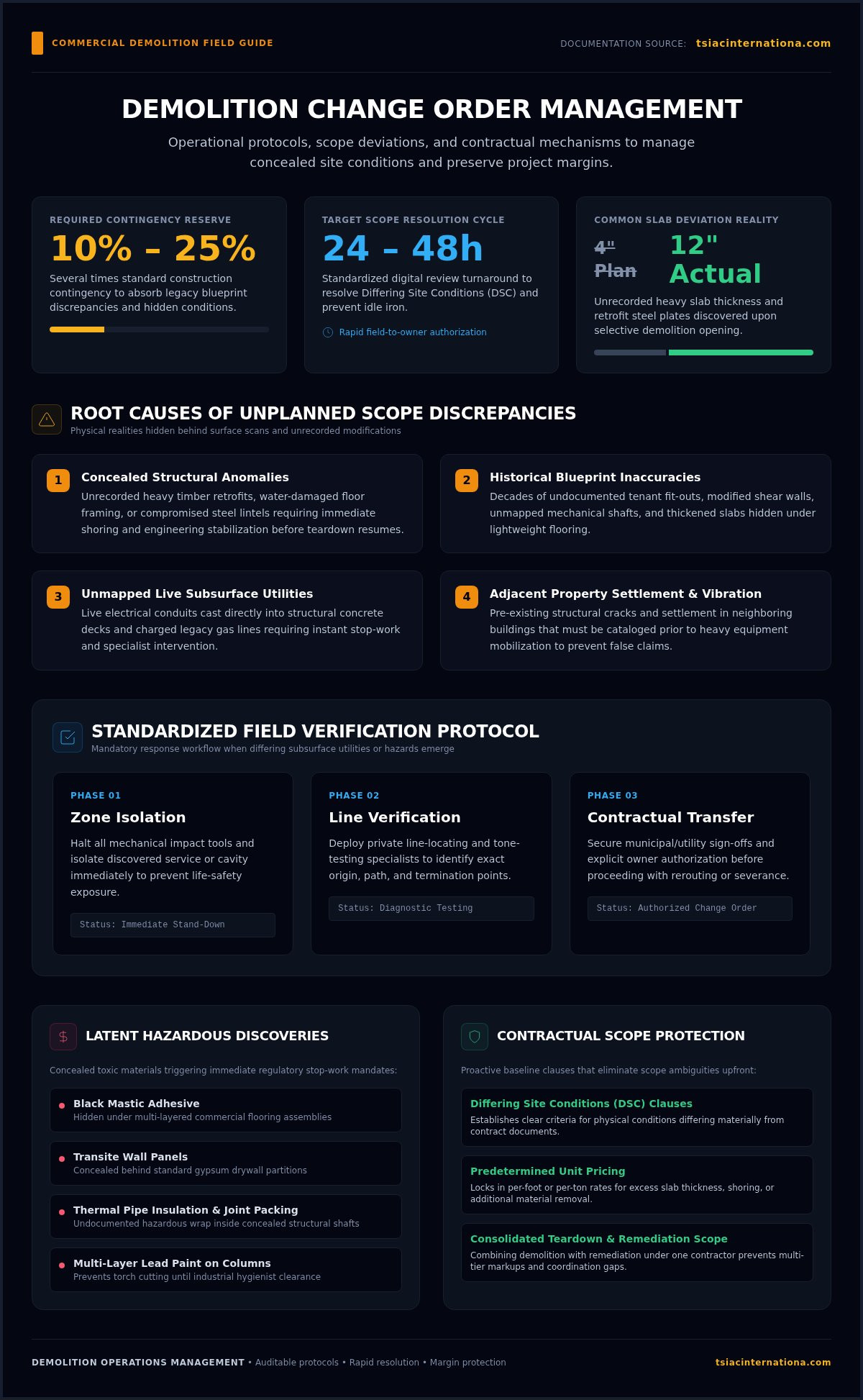
A responsible estimate also includes a 10% to 15% contingency buffer. This isn’t a “slush fund.” It’s a calculated risk management tool designed to handle unforeseen structural anomalies or the discovery of hazardous materials. Presenting this buffer demonstrates a commitment to financial transparency. It shows the board you’ve planned for reality, not just the best-case scenario.

The Economics of Material Recovery and Recycling

Material recovery transforms waste into a financial asset. By separating steel, copper, and concrete at the source, contractors can secure salvage credits that directly reduce the net project cost. Landfill tipping fees in many metropolitan areas have increased by 7% to 12% annually since 2021. Recycling bypasses these rising costs while fulfilling Environmental, Social, and Governance (ESG) mandates. Boards value these metrics because they align fiscal responsibility with modern corporate sustainability goals. It’s a rare opportunity where the “green” choice is also the most cost-effective one.

Selective vs. Structural Demolition Costs

Total knockdown is often cheaper per square foot because it allows for aggressive, high-volume machinery use. However, when a project requires commercial interior gutting services, the labor intensity increases. This “surgical” approach involves manually removing components to protect the building’s structural integrity or preserve specific architectural features. This precision requires more man-hours and smaller, specialized equipment. You can explain to the board that this higher upfront labor cost prevents millions in potential structural damage or the need for total reconstruction. Balancing these structural concerns with renovation goals is essential for long-term asset value. If you’re managing a complex site, consulting with a technical demolition partner early in the planning phase ensures your estimate remains accurate and defensible.

How to Justify Demolition Costs to a Board: A Strategic Guide for Project Managers

Risk Mitigation: The Board’s Primary Value Driver

Risk is the board’s main concern. They don’t want surprises; they want certainty. When you’re explaining how to justify demolition costs to a board, you must lead with risk management. Hazardous materials represent the primary cause of budget inflation, often increasing project costs by 15% to 30% if discovered mid-demolition. Upfront testing isn’t a luxury. It’s a financial shield that prevents work stoppages and emergency remediation fees.

The “Cost of Inaction” is a powerful metric for any project manager. A vacant, degrading building isn’t a neutral asset; it’s a growing liability. Consider these specific risks that accumulate every month a decision is delayed:

  • Structural Degradation: Water ingress can compromise structural integrity within 12 months, making eventual demolition more dangerous and expensive.
  • Security Threats: Squatters and vandalism increase premises liability. A single injury on-site can lead to litigation costs exceeding the price of the demolition itself.
  • Regulatory Fines: Local municipalities often issue “demolition by neglect” citations. In some jurisdictions, these daily fines can reach thousands of dollars.

Justifying Hazardous Material Abatement

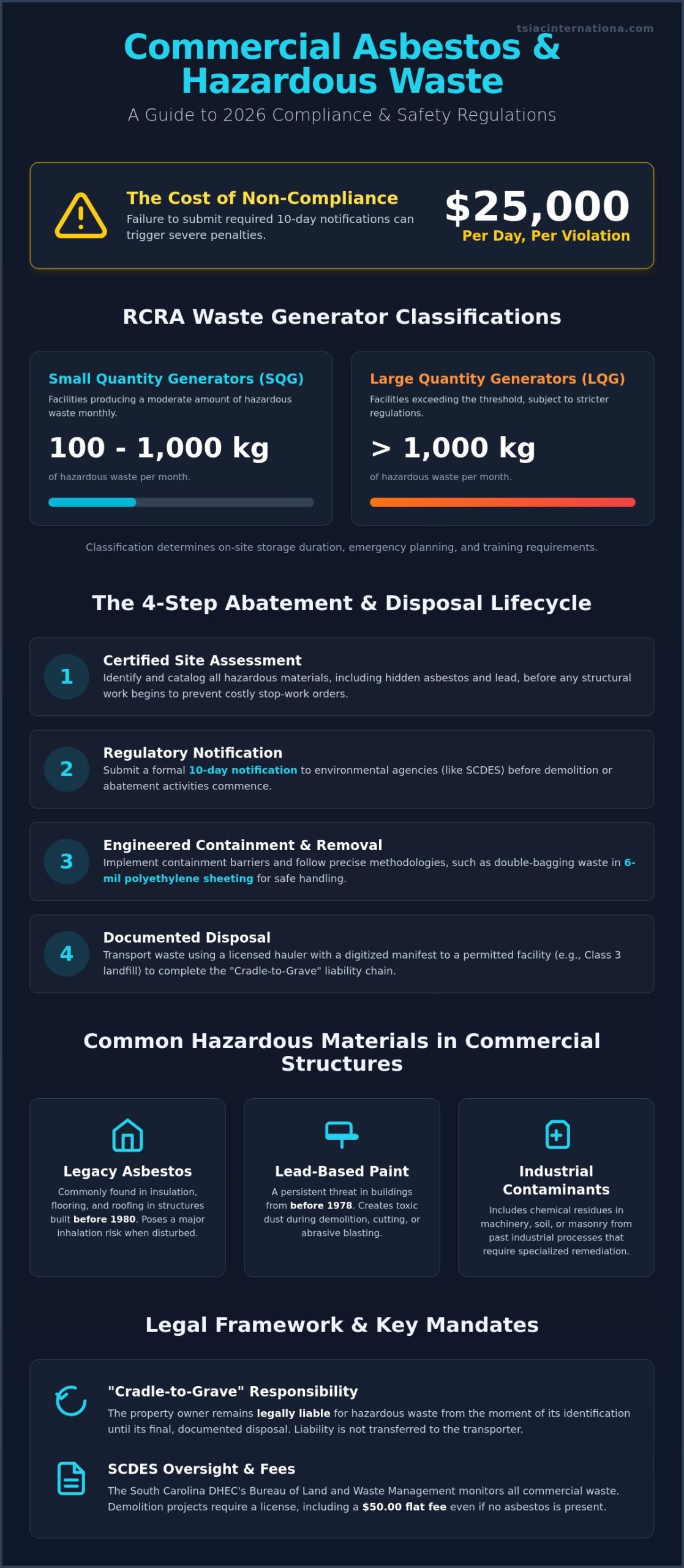
Professional hazardous material abatement serves as a long-term liability shield for the organization. Under EPA National Emission Standards for Hazardous Air Pollutants (NESHAP), owners are responsible for asbestos presence regardless of who performs the work. Non-compliance isn’t just a project delay; it’s a federal offense. As of 2024, OSHA’s maximum penalty for “willful” violations has risen to $161,323 per violation. Specialized containment and professional removal are fixed necessities because they prevent these catastrophic financial and reputational hits. Understanding how to justify demolition costs to a board involves shifting the focus from “spending” to “protecting” the organization’s balance sheet through strict regulatory adherence.

Insurance and Liability Transfer

A high-bonded contractor acts as an external safety net. When you hire a firm with robust insurance, you’re transferring the project’s inherent risks away from the board’s accounts. Ensure the contract includes “pollution liability” coverage. This specific policy covers damages resulting from the release of hazardous materials, which standard general liability often excludes. By selecting a contractor with a low Experience Modification Rate (EMR), typically below 1.0, the organization can often negotiate lower site-specific insurance premiums. This technical approach proves that the demolition budget isn’t just paying for destruction; it’s purchasing a clean, risk-free slate for future development.

Comparative Analysis: Demolition vs. Adaptive Reuse Costs

Boards often default to adaptive reuse because it feels like a conservative preservation of capital. However, the financial reality usually favors a clean slate. Maintaining a derelict 50,000-square-foot industrial warehouse can cost upwards of $2.50 per square foot annually just for basic security, structural stabilization, and liability insurance. When you present your case, you’ve got to address the “Hidden Sunk Cost” fallacy. Retrofitting a structure built before 1980 frequently uncovers hazardous materials like asbestos or lead; these remediation efforts can inflate renovation budgets by 15% to 30% before a single structural improvement begins. This unpredictability is a primary reason why project managers must learn how to justify demolition costs to a board through transparent risk modeling.

Modern, energy-efficient new construction offers a superior ROI compared to retrofitting. New builds typically achieve LEED or similar certifications that reduce operational energy costs by 20% to 35% compared to legacy systems. A new facility isn’t just a structure; it’s a high-performance asset with a reset depreciation clock. By clearing the site, you eliminate the compromises of “working around” old load-bearing walls or outdated floor loads that limit modern machinery placement.

Quantifying the Cost of Delay

Holding a non-productive asset is a direct drain on corporate liquidity. Daily holding costs include property taxes, utility stand-by fees, and 24/7 security to prevent trespassing. In metropolitan areas, these costs often exceed $1,200 per day for mid-sized industrial sites. Inflation adds another layer of financial risk. According to the Turner Building Cost Index, construction costs in the specialized industrial sector rose by approximately 8% in 2022. Delaying demolition for twelve months doesn’t just stall the project; it makes the eventual build significantly more expensive due to rising labor and material costs.

Visualizing the Post-Demolition ROI

Boards respond to clarity and visual evidence. Use 3D site renderings to transform a “dilapidated liability” into a “ready-to-build asset” in their minds. A clear timeline shows that while demolition takes 4 to 10 weeks, it accelerates the total project delivery by removing the technical hurdles of working within an old shell. It provides a predictable path to revenue that stakeholders can track with precision. Site-readiness is the primary hurdle to project financing.

Once the site is cleared and graded, the risk profile drops, making the project more attractive to Tier 1 lenders and institutional investors. Understanding how to justify demolition costs to a board requires shifting the focus from the cost of destruction to the value of a prepared foundation.

Partner with technical experts for complex site preparation to ensure your project stays on schedule and under budget.

Presenting the Final Proposal: A Board-Ready Framework

Your objective is to transform a complex technical project into a clear financial and strategic decision. When you explain how to justify demolition costs to a board, you must shift the focus from spending money to protecting equity and safety. Use this four-step framework to secure approval without unnecessary friction.

  • Step 1: Lead with the “Why” (Safety and Strategy). Safety isn’t a line item; it’s a liability shield. Highlight how removing a derelict structure eliminates 100% of the ongoing maintenance costs and legal risks associated with aging assets.
  • Step 2: Present the “Net Cost.” Don’t just show the gross bid. Calculate the total cost minus salvage credits for steel or copper and any identified tax benefits. This presents the actual impact on the company balance sheet rather than an inflated headline figure.
  • Step 3: Address the “What Ifs” (Risk and Contingency). Boards hate surprises. Proactively define a 10% to 15% contingency plan for unforeseen structural or environmental variables. Addressing these risks early builds trust in your management capabilities.
  • Step 4: The Selection Criteria. Prove that your chosen contractor represents the lowest risk, not just the lowest price. Boards prioritize continuity and reputation over marginal savings that could lead to litigation or delays.

Why Experience Minimizes Change Orders

A 15-year veteran firm like TSIAC International identifies structural weaknesses or hazardous materials before they trigger expensive delays. Change orders in demolition often stem from poor site assessment. Relying on a fixed-price structural demolition contract provides the budget certainty boards demand. A documented demolition process ensures that schedule adherence is measured against clear milestones, keeping the project on track for the next phase of development. This level of engineering precision prevents the 20% to 30% cost overruns common with less experienced crews.

The Final Close: Moving to Action

Distill your proposal into three specific decisions: approving the safety-first methodology, authorizing the net budget, and confirming the project timeline. You need to provide a clear roadmap for the immediate future to maintain momentum. In the first 30 days, focus on permitting and site mobilization. By day 60, structural dismantling should be 50% complete. Within 90 days, the site will be cleared, graded, and ready for inspection. This clear timeline reduces the board’s anxiety regarding project stagnation. If you’re ready to secure a professional, data-backed proposal, request a comprehensive board-ready estimate from TSIAC International to ensure your project starts with total transparency and technical authority.

Securing Board Approval Through Strategic Precision

Success in the boardroom depends on shifting the narrative from a simple expense to a calculated investment in site potential. By highlighting how professional structural removal mitigates long-term liability, you provide the clarity stakeholders need to move forward. Knowing how to justify demolition costs to a board involves presenting a framework that prioritizes safety, environmental compliance, and future-proofing the asset. TSIAC International supports this process with 15+ years of structural removal expertise, ensuring every phase of the project remains under strict control.

Our team provides full-service hazardous material abatement and containment, removing the burden of environmental risk from your proposal. We also implement a comprehensive material recycling program for wood, metal, and plastic, which aligns your project with corporate sustainability goals. These technical advantages turn a standard quote into a strategic plan that addresses the board’s primary concerns regarding safety and efficiency. Don’t present a budget when you can present a solution backed by engineering precision.

Get a Board-Ready Demolition Strategy and Quote from TSIAC International

Your path to a cleared, high-value site is ready for its first professional step.

Frequently Asked Questions

How do you explain asbestos removal costs to a board?

Asbestos removal is a non-negotiable legal requirement under OSHA 29 CFR 1926.1101 and EPA NESHAP regulations. Failure to mitigate these hazardous materials leads to federal fines exceeding $15,000 per violation per day. Board members must view this as a critical risk mitigation strategy that protects the organization from long term litigation and worker health claims. Proper abatement ensures the site meets all safety standards before structural work begins.

What is the typical ROI on building demolition for a developer?

ROI on building demolition is calculated by the immediate elimination of holding costs, which often consume 2% to 5% of a property’s value annually in taxes and security. Clearing an obsolete structure increases land liquidity and can lead to a 20% increase in land value once the site is pad-ready. This financial upside is a critical factor when learning how to justify demolition costs to a board focused on asset performance.

Can we reduce demolition costs through on-site material recycling?

On-site material recycling can reduce total project expenditures by up to 30% by eliminating haul-off fees and the need for imported backfill. Crushing concrete and masonry into aggregate on the job site saves between $10 and $25 per ton compared to purchasing virgin materials. This process also decreases heavy vehicle traffic by 40 percent, which lowers the project’s carbon footprint. It effectively transforms waste into a functional construction asset.

Is selective demolition always cheaper than total structural demolition?

Selective demolition is frequently more expensive per square foot because it requires specialized shoring and 50% more labor hours for precision work. While total demolition uses heavy machinery for rapid clearing, selective projects rely on manual labor and expert structural engineers to protect remaining assets. A 2022 industry study showed that intricate interior gutting takes twice as long as a full site clearing. Decision makers should choose based on architectural goals.

How should we handle unexpected site conditions in our approved budget?

Handle unexpected conditions by utilizing a pre-approved contingency fund, typically set at 10% to 15% of the total project budget. When underground storage tanks or unstable soil are discovered, the project manager must present a revised risk matrix. Addressing these issues immediately prevents compounding delays that could increase costs by 1% for every week the project stalls. Proactive planning ensures transparency and maintains the board’s confidence in the management team.

What are the risks of choosing the lowest bidder for a commercial demolition?

Choosing the lowest bidder often results in hidden costs that can exceed the highest bid by 25% due to poor execution and change orders. Low-cost contractors may lack adequate pollution liability insurance or a high Experience Modification Rate below 1.0. This exposes the board to vicarious liability if a safety incident occurs. Professional demolition requires technical precision and robust safety protocols that bargain-rate firms cannot consistently provide.

How does demolition impact our organization’s ESG or sustainability goals?

Modern demolition practices can divert up to 90% of debris from landfills, which directly supports LEED certification and corporate ESG metrics. By documenting the recovery of steel, copper, and concrete, a project manager demonstrates environmental stewardship through measurable data. This provides a quantifiable way of how to justify demolition costs to a board that prioritizes sustainable investment. It turns a destructive process into a verifiable environmental and social gain.

What happens to our liability if we delay a necessary demolition?

Delaying a necessary demolition exposes the organization to trespassing lawsuits and rising insurance premiums, which can jump by 15% annually for derelict structures. Buildings left idle are prone to fire, mold, and structural collapse, creating a hazardous environment for the public. Under the Attractive Nuisance doctrine, boards are legally responsible for injuries to unauthorized persons on the site. Immediate action is a defensive financial and legal necessity.

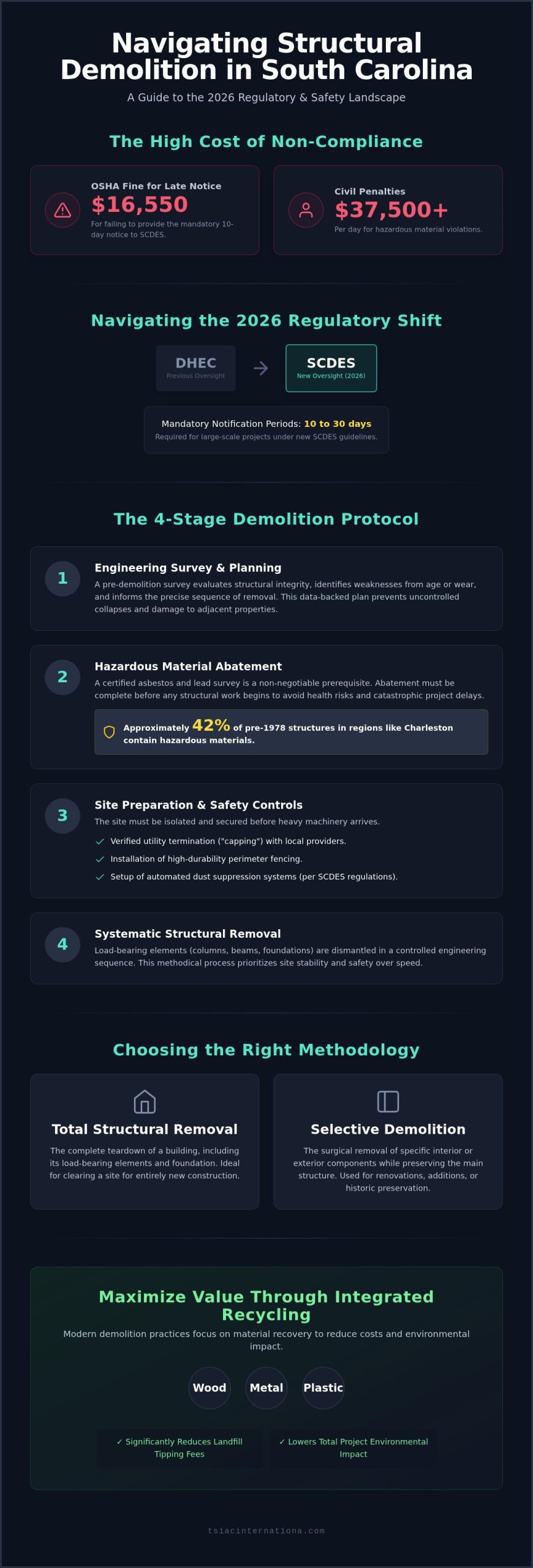
Choosing a Structural Demolition Company: The 2026 Procurement Guide

The difference between a cleared site and a million-dollar liability often rests on a single structural calculation. In 2024, industry data indicated…

The difference between a cleared site and a million-dollar liability often rests on a single structural calculation. In 2024, industry data indicated that 42% of urban demolition projects experienced delays or cost overruns due to unforeseen hazardous materials or structural instability in adjacent foundations. You understand that hiring a structural demolition company is a decision that impacts your project’s bottom line and your organization’s legal standing under OSHA and EPA regulations. A single oversight in the dismantling of a load-bearing element can jeopardize months of planning and millions in capital investment.

This 2026 procurement guide is designed to help you master the complexities of large-scale dismantling with an engineering-first approach. You’ll learn how to evaluate technical expertise, manage abatement protocols, and ensure your site is handed over with 100% regulatory compliance. We will break down the essential contractor selection criteria, the latest safety technologies for 2026, and the specific documentation required to move from demolition to new construction without a single day of lost time.

Key Takeaways

  • Distinguish between simple wrecking and engineered structural removal to ensure the systematic safety of load-bearing building elements.
  • Discover the specialized 2026 equipment fleet, including robotic units and high-reach excavators, necessary for high-precision technical removal.
  • Understand why a top-tier structural demolition company must integrate hazardous material abatement to mitigate the high cost of discovery delays.
  • Identify the critical safety metrics and insurance coverages, such as EMR and pollution liability, that separate professional contractors from the rest.
  • Explore how a partner with over 15 years of experience can optimize your project through high recycling rates and specialized site solutions.

What is Structural Demolition and Why Does it Require Engineering Precision?

Structural demolition is the systematic and sequenced removal of load-bearing elements within a building or industrial facility. It’s a far cry from the “wrecking” methods of the past. In 2026, the industry has shifted toward engineered structural removal, which treats the deconstruction process as the literal reverse of the construction phase. To understand What is Structural Demolition in a professional context, one must view it through the lens of physics and structural mechanics. A specialized structural demolition company no longer relies on brute force; instead, they utilize high-precision tools and calculated sequences to dismantle complex assets.

The role of structural engineers is paramount in modern procurement. Before a single piece of concrete is crushed, engineers conduct comprehensive pre-demolition surveys and stability analyses. These assessments identify the primary load paths and potential points of failure. Data from the 2025 Global Construction Safety Initiative shows that projects utilizing a documented engineering-first methodology saw a 32% decrease in site incidents compared to those using traditional demolition tactics. For high-stakes projects, such as dismantling a 15-story office block or a heavy industrial plant, this precision isn’t optional. It’s the only way to protect surrounding infrastructure and human life.

The Mechanics of Controlled Structural Collapse

Engineers must calculate how load paths are altered every time a support beam or load-bearing wall is removed. This involves “pre-weakening” structures, a delicate process where specific members are notched or cut to ensure they fail in a predictable direction. It’s a high-wire act that requires constant monitoring to ensure worker safety isn’t compromised during the transition. Structural integrity in a controlled collapse is the state where a building remains stable and predictable throughout every phase of its planned failure.

Total vs. Selective Structural Demolition

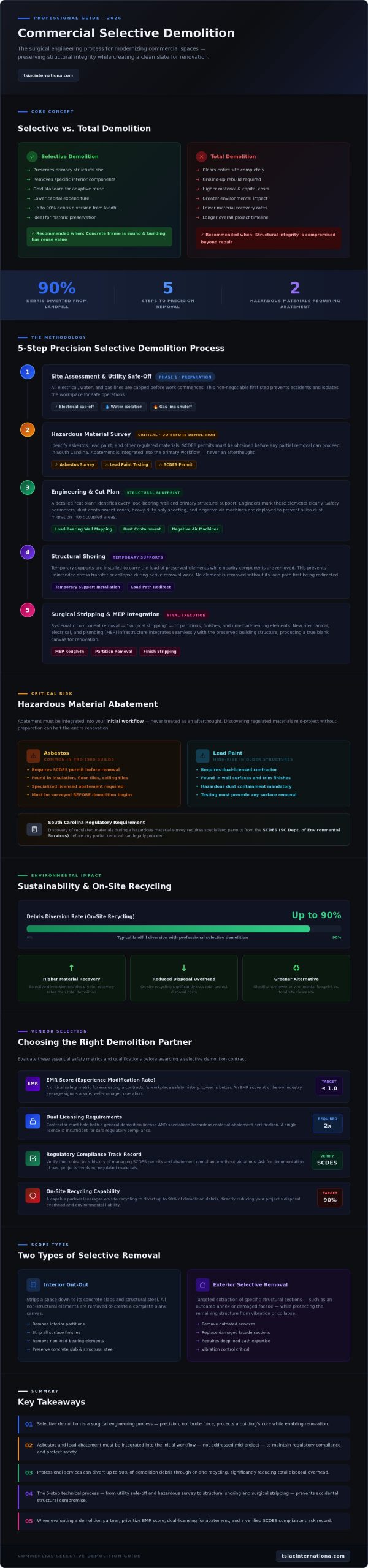
Choosing between total and selective removal depends on the 2026 redevelopment goals for the site. Total removal is the standard for complete site clearing, but selective demolition is where a structural demolition company truly proves its worth. This involves removing specific wings or internal frameworks while preserving the main structure for adaptive reuse. The technical challenges are significant. Maintaining utility continuity in adjacent active structures requires a surgical touch. For example, during a 2024 renovation of a data center, contractors had to remove a 40-ton cooling tower platform while the servers below remained 100% operational, requiring real-time vibration monitoring at 2-millisecond intervals.

  • Load Path Mapping: Identifying how weight transfers through the frame.
  • Vibration Control: Using sensors to protect sensitive equipment in adjacent buildings.
  • Sequence Planning: A step-by-step blueprint that dictates the order of every cut.

A fegyelmezett, mérnöki szemléletmód ensures that even the most “impossible” locations are handled with unwavering reliability. This technical rigor defines the difference between a simple contractor and a true structural partner.

Technical Requirements: Heavy Machinery and Specialized Equipment

The 2026 equipment fleet represents a shift from brute force toward surgical precision. A professional structural demolition company no longer relies solely on gravity and impact; instead, it utilizes a sophisticated array of high-reach excavators and remote-controlled robotic units. This technological evolution is driven by the need for 100% vibration control and noise mitigation in dense urban environments. Modern fleets now feature hydraulic shears and concrete processors that pulverize reinforced concrete while simultaneously separating rebar, achieving a 95% material recovery rate on-site.

Reliability in this sector is directly proportional to a firm’s maintenance protocols. When evaluating a structural demolition company, request digital maintenance logs for their primary assets. Top-tier providers maintain a 98% equipment uptime rate by adhering to strict manufacturer service intervals. Furthermore, the 2026 industry standard has moved toward sustainability. Approximately 40% of new machinery acquisitions in the sector are now electric or low-emission hybrid models, which are essential for projects requiring LEED certification or compliance with municipal “green zone” regulations.

Choosing a partner with the right technical assets ensures that complex structural removals don’t compromise the integrity of adjacent properties. You can consult with our technical team to review equipment specifications for your upcoming project.

High-Reach Excavators for Tall Structures

Dismantling structures exceeding 10 stories requires ultra-high-reach (UHR) excavators equipped with telescopic booms. These machines allow for the systematic deconstruction of a building from the top down while the operator remains at a safe distance on the ground. This methodology is a core requirement under OSHA demolition safety standards, as it eliminates the need for workers to be stationed on unstable upper floors. Precision attachments on these machines minimize falling debris and reduce site dust by 75% through integrated high-pressure misting systems.

Robotic and Specialized Interior Equipment

Hazardous or structurally compromised interior zones demand the use of remote-controlled demolition robots. These units, such as the Brokk series, provide the power of a small excavator with a footprint that fits through a standard doorway. Engineering teams must calculate floor-loading capacities carefully; these robots are specifically designed to operate within the 500 kg/m2 limits common in commercial office structures. Deploying this specialized technology significantly accelerates the commercial interior gutting services timeline, often reducing the labor schedule by 30% compared to manual methods. This approach ensures that the primary structural elements remain untouched while secondary partitions are removed with surgical accuracy.

Choosing a Structural Demolition Company: The 2026 Procurement Guide

Integrated Abatement: Managing Asbestos, Lead, and Hazardous Materials

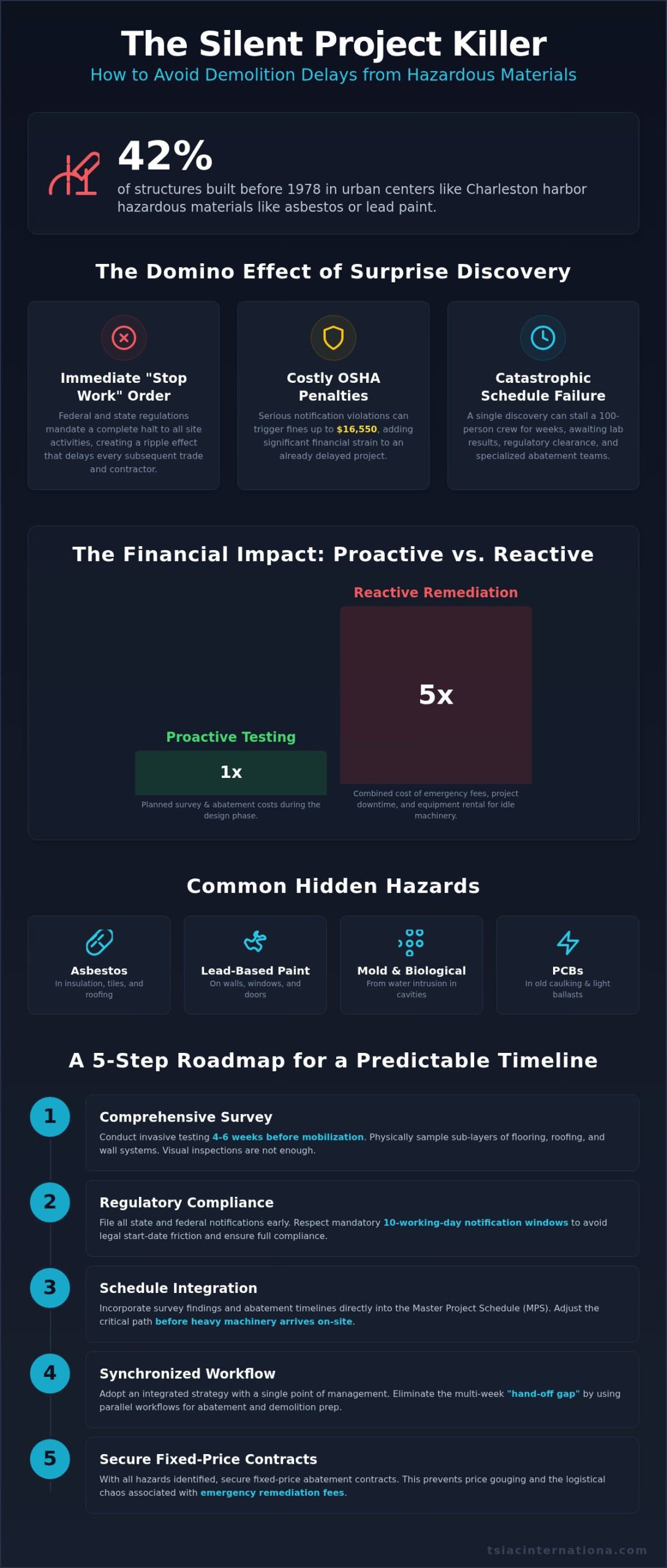
Selecting a structural demolition company that offers integrated abatement isn’t just a convenience; it’s a critical risk-management strategy for 2026. When remediation is siloed from the main demolition scope, projects often suffer from “discovery delays.” These interruptions occur when unidentified hazardous materials are found mid-operation, typically forcing a 15 to 20 day work stoppage while a separate contractor is vetted and mobilized. By choosing a partner that manages these risks internally, property owners eliminate the friction between separate vendors and ensure the schedule remains intact.

Compliance hinges on a rigorous documentation trail that satisfies both OSHA and EPA mandates. This process begins with a comprehensive pre-demolition survey and concludes with final clearance testing. Every phase must adhere to federal hazardous materials regulations to avoid six-figure fines or long-term legal liabilities. A professional structural demolition company maintains a dedicated compliance officer to oversee these filings, ensuring that every gram of lead or asbestos is tracked from the site to a licensed disposal facility through signed waste manifests.

The documentation requirements for a standard industrial project include:

  • Pre-Demolition Survey: A detailed map of all regulated materials.
  • Abatement Plan: Engineering controls and containment strategies.
  • Air Monitoring Logs: Daily records of air quality during removal.
  • Disposal Manifests: Proof of legal deposit at a certified landfill.

Asbestos Abatement in Structural Removal

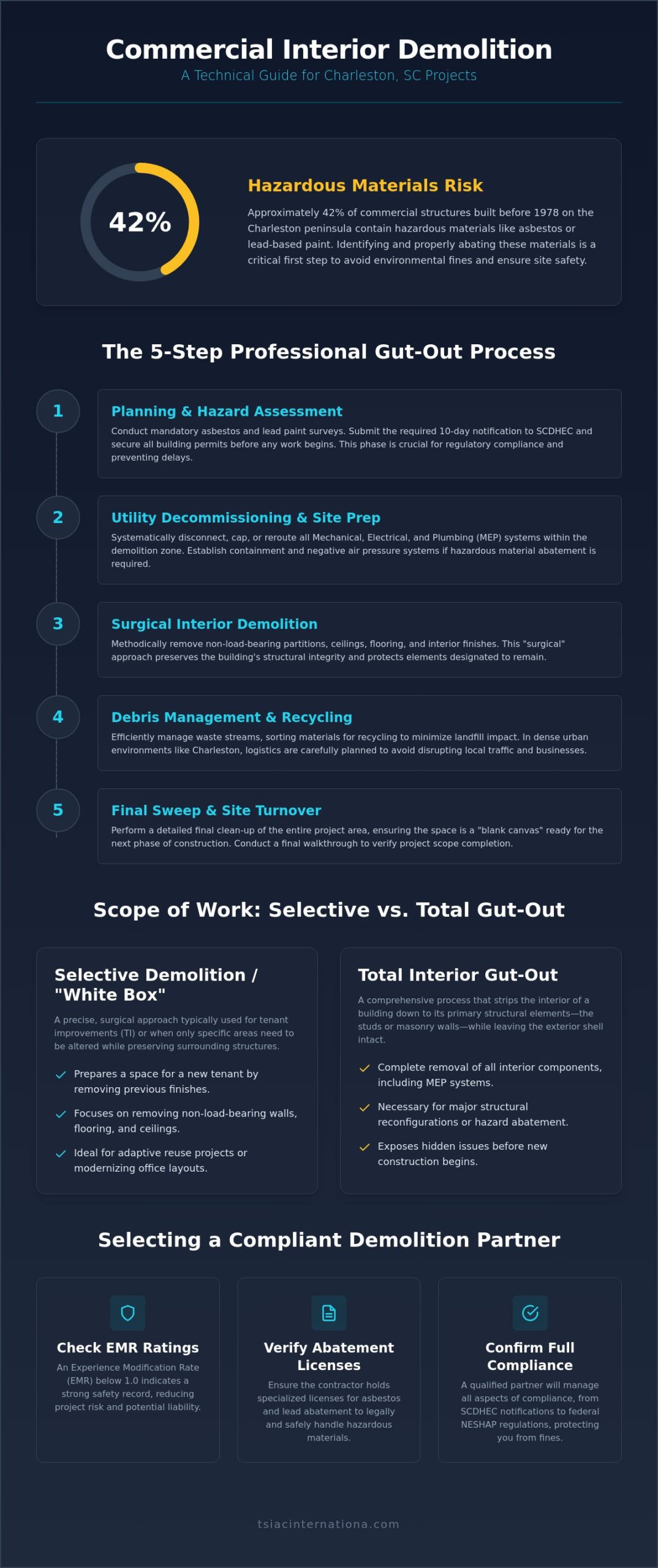
Structural components often contain both friable materials, like pipe insulation that crumbles under slight pressure, and non-friable materials, such as floor tiles or roofing mastics. During large-scale demolition, preventing fiber release requires advanced containment strategies, including negative air pressure zones and HEPA filtration systems. For a deeper look at regional compliance, consult the asbestos removal in South Carolina guide, which outlines the rigorous standards required for safe removal in the Southeast. Precision here is non-negotiable; even a minor breach in containment can contaminate an entire city block.

Lead Paint and Mold Remediation

Industrial structures built before 1978 frequently feature lead-coated steel. Dismantling these frames requires specialized torch-cutting techniques to prevent lead vapor inhalation. Similarly, buildings with a history of water intrusion or long-term vacancy require immediate mold remediation to protect worker health and surrounding air quality. Proper hazardous material abatement is a prerequisite for successful property redevelopment. It ensures the site is truly “clean” for the next phase of construction, protecting the developer’s reputation and the safety of future occupants.

How to Evaluate a Structural Demolition Company: A Selection Checklist

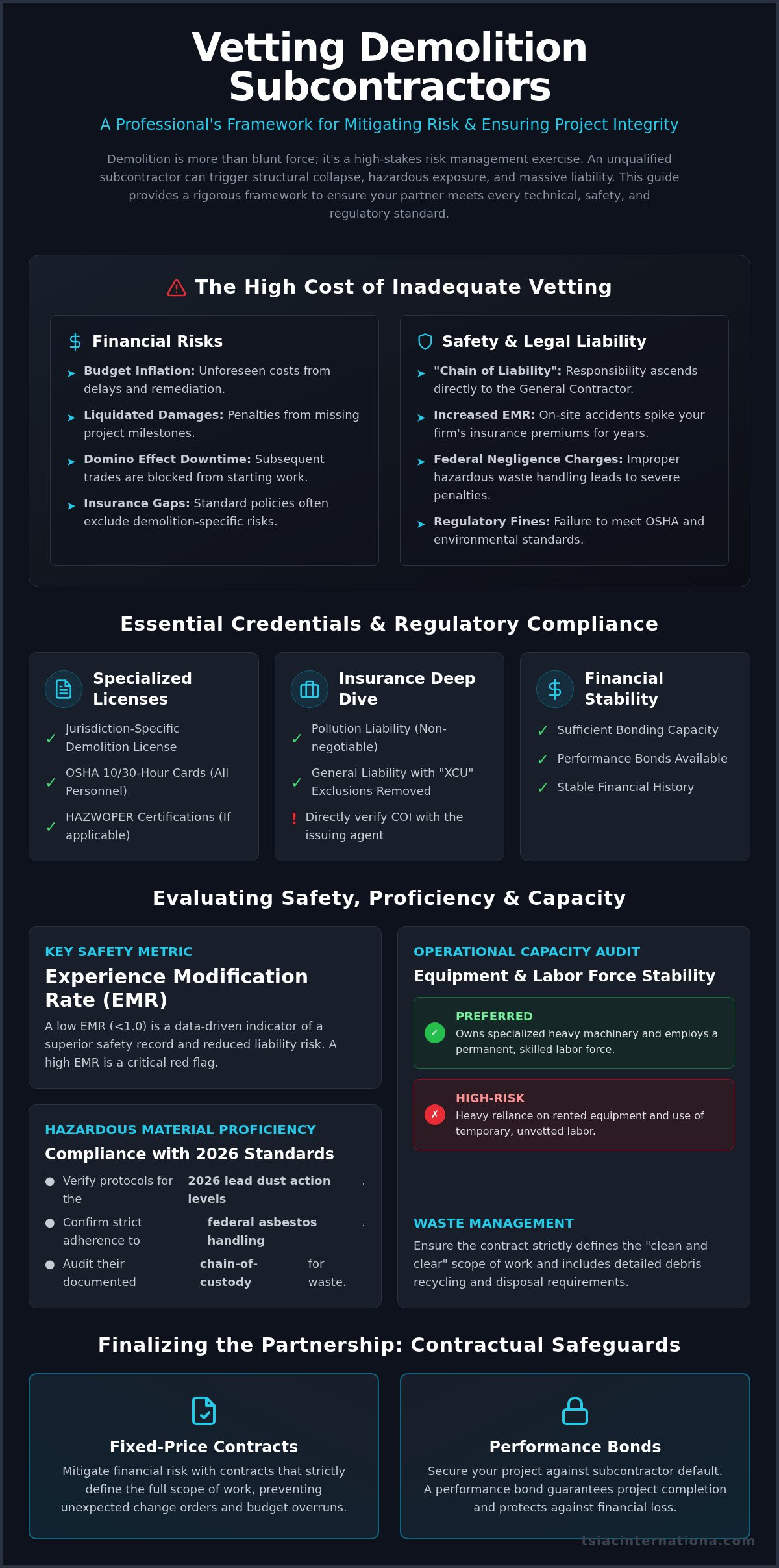
Selecting a structural demolition company requires a data-driven approach to mitigate long-term liability. Procurement officers in 2026 prioritize the Experience Modification Rate (EMR) because it tracks safety performance over a three-year rolling period. This metric isn’t just a number; it’s a reflection of a firm’s operational discipline. Beyond safety, you must verify the financial depth of a contractor through their bonding capacity. For projects exceeding $2 million, a firm’s ability to secure performance and payment bonds proves they possess the liquidity and track record required by treasury-listed sureties.

Comprehensive insurance coverage acts as the final barrier between a project’s success and a legal catastrophe. You should demand pollution liability to cover potential hazardous material releases, along with professional liability for engineering oversights in the demolition plan. We recommend an umbrella policy of at least $10 million for complex structural projects. Ensure all policies come from carriers with an A.M. Best rating of A- or higher to guarantee financial stability if a claim arises. A partner’s environmental commitment also impacts your bottom line, as high recovery rates for steel and copper can offset total project costs.

Safety Records and Compliance History

Review the contractor’s OSHA 300A logs from the previous five years to identify trends in recordable incidents or recurring violations. A reputable structural demolition company provides a Site-Specific Safety Plan (SSSP) that details crane lift paths, utility disconnects, and fall protection protocols for every unique structure. An EMR score is a numerical calculation that compares a company’s annual worker’s compensation claims to other businesses of similar size in the same industry, serving as a primary filter for contractor pre-qualification. If a firm’s EMR exceeds 1.0, they’re statistically riskier than their peers and may be ineligible for federal contracts.

Debris Management and Recycling Practices

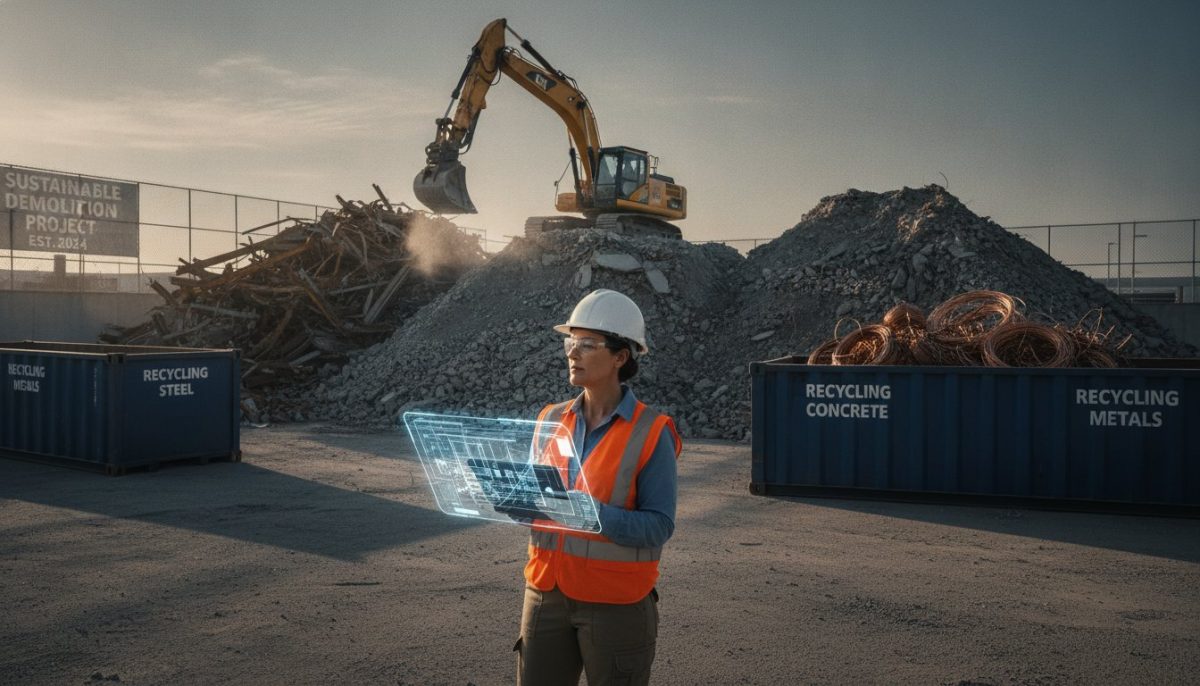
Modern demolition focuses on resource recovery rather than simple destruction. Top-tier firms currently achieve 94% waste diversion by sorting wood, rebar, and non-ferrous metals on-site. Utilizing mobile impact crushers to process concrete into Grade 3 aggregate for on-site backfill reduces truck traffic by 35% and significantly lowers material procurement costs. Understanding the demolition process from a waste-diversion perspective ensures your project meets 2026 LEED standards and local environmental mandates. This technical approach transforms waste into a reusable asset, reflecting a fegyelmezett, engineering-led methodology.

Ready to discuss the technical requirements of your next project? Contact our engineering team for a comprehensive consultation.

Partnering with TSIAC International for Safe, Efficient Project Completion

Selecting a structural demolition company requires more than a cursory review of equipment lists; it demands a partner with proven technical depth and a history of precision. TSIAC International brings over 15 years of experience to complex structural removal projects across the industrial and commercial sectors. We’ve refined a comprehensive service model that spans from surgical interior gutting to the total removal of high-rise facilities. Our team understands that demolition is the first step of a larger lifecycle, and our role is to clear the path for future development without delay or incident.

Financial predictability is a cornerstone of our operational philosophy. To provide clients with 2026 budgetary certainty, we offer fixed-price contract options that mitigate the risks of mid-project cost fluctuations. This transparency extends to our environmental impact. We consistently achieve recycling rates exceeding 92% for concrete, rebar, and structural steel, ensuring that project waste is diverted from landfills and repurposed within the circular economy. Our commitment to these metrics provides our partners with documented proof of their sustainability goals.

The TSIAC Engineering-First Philosophy

We approach every site with an engineering-first mindset, prioritizing structural stability through every phase of the teardown. Before heavy machinery arrives, our engineers conduct exhaustive load-bearing analyses to prevent uncontrolled collapses. Our teams manage the gold standard in demolition by integrating technical expertise with advanced safety protocols. In a 2024 project involving a compromised urban industrial site, we utilized sequential bracing and high-reach shears to complete a total removal within a strict 45-day window. This technical precision allowed the client to maintain their redevelopment schedule despite the site’s initial instability.

Next Steps: Requesting a Comprehensive Site Analysis

Initiating a partnership with a structural demolition company starts with a detailed Request for Proposal (RFP). To ensure an accurate quote, your RFP should include the following data points:

  • Current structural blueprints and previous renovation records.
  • Phase I and Phase II environmental site assessments.
  • Specific site access restrictions or noise ordinances for the 2026 calendar year.
  • Utility disconnect certifications and hazardous material surveys.

Our project management team provides preliminary structural assessments and site surveys within 72 hours of receiving your inquiry. We offer national consultations to address complex logistical challenges, ensuring that your project begins with a clear, data-driven strategy. Contact our headquarters today to schedule a site visit and secure your project’s place on our 2026 execution calendar.

Securing Your Project’s Future with 2026 Procurement Standards

Selecting a structural demolition company requires a shift from simple site clearing to complex engineering management. Modern industrial projects demand 100% adherence to safety protocols and the seamless integration of specialized abatement for materials like asbestos and lead. Success in 2026 depends on high-tier technical machinery and a firm’s ability to navigate hazardous environments without compromising the integrity of surrounding infrastructure.

TSIAC International brings over 15 years of industry experience to every site; ensuring that every structural challenge meets rigorous engineering standards. Our team implements comprehensive environmental recycling practices to divert maximum waste from landfills while maintaining specialized hazardous material containment expertise. We don’t just clear land; we provide the technical precision needed for the most difficult locations and specialized solutions that other firms avoid. Your project’s safety and efficiency depend on this level of professional oversight.

Request a Professional Structural Demolition Consultation from TSIAC International

Your next development starts with a safe and calculated demolition strategy that protects your investment and the environment.

Frequently Asked Questions

What is the difference between structural demolition and selective demolition?

Structural demolition removes the entire load-bearing framework of a building, whereas selective demolition targets specific interior or exterior elements while preserving the main shell. Structural projects require heavy machinery and precise engineering calculations to manage load distribution safely during the teardown. Selective demolition occurs in 75% of renovation projects to update utilities or aesthetics without compromising the foundation or structural integrity of the property.

How much does structural demolition typically cost in 2026?

Commercial structural demolition costs in 2026 average between $8 and $15 per square foot. Total budgets depend on building height, material complexity, and site accessibility. A 50,000 square foot steel-framed facility typically requires a procurement investment of $400,000 to $750,000. These 2026 price points include labor, heavy equipment mobilization, and basic debris management. Specialized high-reach equipment may add 12% to the final cost.

Does a structural demolition company handle asbestos and lead removal?

A professional structural demolition company ensures hazardous material abatement is completed before mechanical teardown begins. While some firms handle this in-house, 65% of contractors partner with licensed environmental remediation specialists. All removal must comply with the 2025 EPA and OSHA safety protocols for lead and asbestos to prevent site contamination. We recommend verifying that the abatement team has at least 10 years of industrial experience.

What permits are required for a building demolition project?

You must obtain a specific demolition permit from the local building department and a certified utility disconnect seal before work starts. Projects exceeding 10,000 square feet require a dust control plan and a noise mitigation permit. In 2026, most municipalities enforce a 30 day notice period to verify that all gas, water, and electrical lines are capped. Failure to secure these documents can result in fines exceeding $5,000 per day.

How long does the structural demolition process take for a commercial building?

Demolishing a standard five story commercial building takes 4 to 8 weeks from site mobilization to final clearing. The first 14 days focus on interior soft stripping and hazardous material removal. Mechanical demolition follows, typically progressing at a rate of 2,500 square feet per day depending on the reinforcement density of the concrete or steel. Site restoration and foundation removal add another 10 days to the total project timeline.

Is it possible to recycle materials from a demolished building?

You can recover 90% of materials from a demolished building through systematic deconstruction and on-site sorting. Steel beams and copper wiring have the highest salvage value in the 2026 market. Concrete is often crushed into 2 inch aggregate for new road bases or foundation fill. This process reduces total project waste by 15 tons on average for mid-sized structures and supports corporate sustainability goals.

What safety precautions are taken during structural demolition?

Safety protocols include 100% perimeter fencing, vibration monitoring sensors, and strict exclusion zones for all personnel. Every structural demolition company implements a site-specific safety plan that addresses fall protection and structural stability during the teardown. Engineers perform daily inspections to ensure the remaining framework doesn’t collapse unexpectedly. These measures have reduced on-site accidents by 22% in the industrial sector since 2023.

How do I know if a structural demolition company is properly insured?

Verify a company’s status by requesting a Certificate of Insurance (COI) showing at least $5 million in general liability and $2 million in workers’ compensation. Ensure the policy specifically covers “XCU” (Explosion, Collapse, and Underground) hazards. A reputable firm provides these documents within 24 hours of a request to prove they’re covered for high-risk operations. We suggest checking the insurer’s AM Best rating to ensure it’s A- or higher.

Interior Gutting for Renovation: A Complete 2026 Strategic Guide

A single structural oversight during demolition can inflate total project costs by 42% before the first new stud is ever installed. For developers…

A single structural oversight during demolition can inflate total project costs by 42% before the first new stud is ever installed. For developers and homeowners in 2026, the process of interior gutting for renovation isn’t just about destruction; it’s a high-stakes engineering phase where hidden asbestos or a misunderstood load-bearing wall can halt progress for months. You likely understand that a clean slate is essential for modern mechanical systems, yet the fear of compromising a building’s core stability or facing a $15,000 environmental fine is a reality that keeps many project managers awake at night.

This strategic guide delivers the technical rigor required to master these complexities while maintaining strict regulatory compliance. You’ll learn how to strip a property to its structural shell safely and efficiently, effectively minimizing the 30% budget creep typically caused by unforeseen interior issues. We’ll walk through the essential 2026 safety protocols, hazardous material identification techniques, and the logical sequence of demolition that ensures your renovation begins on a foundation of absolute certainty and engineering precision.

Key Takeaways

  • Learn the engineering distinction between superficial remodeling and a complete structural strip-out to ensure a stable foundation for your project.
  • Identify and mitigate high-risk variables, including unpropped load-bearing walls and hazardous material abatement, through rigorous pre-demolition inspections.
  • Execute a professional interior gutting for renovation to prevent costly mid-project change orders and maximize your long-term return on investment.
  • Navigate the complexities of a surgical gut-out using a phased approach that prioritizes utility termination safety and precise fixture removal.
  • Understand the specialized role of professional contractors in managing high-complexity sites while adhering to modern environmental recycling standards.

Understanding Interior Gutting for Modern Renovations

Interior gutting for renovation represents the most rigorous phase of structural transformation. It involves stripping a property back to its load-bearing skeleton, removing every layer of drywall, flooring, and ceiling. This isn’t a superficial upgrade. While a cosmetic remodel might focus on paint and cabinetry, a total gut-out exposes the hidden systems of the building. In 2026, the industry has shifted toward “studs-up” transparency. This approach ensures that 100% of the electrical, plumbing, and HVAC systems are visible for inspection before closing the walls. This standard eliminates the risk of inheriting legacy failures from previous owners.

A comprehensive Renovation often serves as an economic catalyst, increasing property value by an average of 25% in urban centers when executed with engineering precision. Understanding the difference between a simple refresh and a full gut-out is critical for budget management. A cosmetic update rarely addresses the underlying health of the structure, whereas a gut-out provides a definitive diagnostic of the building’s integrity. By exposing the frame, we remove the guesswork from the construction process.

The ‘Blank Canvas’ Advantage

Stripping a property to its studs allows for a total floor plan reconfiguration that modern living demands. Older properties often suffer from compartmentalized, inefficient layouts. By removing non-load-bearing partitions, engineers can create open-concept spaces that improve natural light penetration by up to 60%. This process also allows for the correction of legacy mistakes, such as unlevel subfloors or poorly routed ductwork. From an efficiency standpoint, a gut-out is the only way to achieve modern R-value targets. Installing high-performance spray foam or mineral wool insulation directly into the wall cavities can reduce annual thermal loss by 35%.

When a Gut-Out is Non-Negotiable

Specific technical indicators make interior gutting for renovation a mandatory requirement rather than a choice. If an inspection reveals mold spores exceeding 500 per cubic meter or evidence of subterranean termite damage in 15% of the framing, a full strip-back is the only way to guarantee safety. Structural stability is another factor. If the foundation has settled more than 2 inches, internal walls must often come down to facilitate leveling. Upgrading systems is equally vital. Most homes built before 1950 still harbor knob-and-tube wiring or galvanized steel pipes. These components have a 100% failure rate over a 70-year lifecycle. Replacing them requires full access to the wall cavities to meet 2026 safety codes.

Step-by-Step Guide: Executing a Surgical Interior Gut-Out

Execution of a surgical interior gut-out requires a disciplined sequence to maintain the structural integrity of the building. This isn’t a mindless demolition; it’s a controlled deconstruction. Phase 1 begins with a comprehensive pre-demolition inspection and utility termination. Licensed professionals must verify that 100% of gas, water, and electrical lines are capped or disconnected. A single overlooked live wire or pressurized pipe can lead to catastrophic site delays or injury. Once the site is safe, Phase 2 involves the soft demo. Crews remove all non-structural finishes, including cabinetry, appliances, and plumbing fixtures. This stage clears the workspace for the more intensive structural work to follow.

Pre-Demolition Planning and Permitting

Securing the correct permits for interior structural changes is the first legal hurdle. In 2026, municipal codes often require a detailed debris management plan that targets a minimum 85% recycling rate for materials like copper and timber. Before the first swing of a hammer, contractors must establish clear haul-away routes and staging areas. This logistical precision prevents site congestion and ensures that hazardous waste doesn’t mix with recyclable debris. For complex projects requiring high-altitude access or specialized structural reinforcement, partnering with an experienced industrial contractor ensures technical benchmarks are met without compromise.

Phase 3 focuses on environmental remediation. If the structure was built before 1978, testing for lead-based paint and asbestos is mandatory. Following the Lead-Safe Certified Guide to Renovate Right ensures that crews implement proper containment and HEPA filtration to prevent toxic dust migration. Phase 4, the hard demo, involves stripping drywall and lath to expose the studs. This reveals the “skeleton” of the building, allowing engineers to inspect for rot or past structural failures. Finally, Phase 5 concludes the process with site clearing and structural stabilization, leaving a clean, verified frame ready for the new design.

The Systematic Removal Process

Successful interior gutting for renovation relies on a top-down strategy for multi-story buildings. This prevents debris from accumulating on upper floors and overloading the floor joists. Professionals use 12-amp reciprocating saws and precision pry bars rather than heavy sledgehammers to minimize vibration damage. Protecting exterior windows is vital; crews typically use 6mm polyethylene sheeting and plywood buffers to shield glass from flying fragments. This level of care during the interior gutting for renovation process protects the building’s envelope while the interior is completely transformed.

Interior Gutting for Renovation: A Complete 2026 Strategic Guide

Managing Hidden Risks: Structural Integrity and Hazardous Materials

Professional interior gutting for renovation requires more than physical labor; it demands a rigorous engineering risk assessment. The most catastrophic error in any project is the premature removal of a load-bearing element without proper shoring. This oversight does not just delay timelines; it compromises the entire building’s skeleton. At TSIA C International, we treat every demolition phase as a structural puzzle where safety is the primary metric of success.

Identifying Load-Bearing vs. Partition Walls

Visual cues provide the first level of identification for weight-bearing structures. Walls running perpendicular to floor joists or those located directly above other walls in a multi-story layout typically carry significant loads. We look for integrated steel beams or doubled-up headers that indicate a structural role. Before any framing is touched, the site requires temporary shoring using adjustable steel post shores to redistribute weight safely. Consulting a structural engineer is a non-negotiable step because DIY attempts frequently result in sagging ceilings or foundation shifts. These failures can cost upwards of $20,000 to rectify, which severely impacts the financial feasibility highlighted in the Cost vs. Value Report.

Asbestos and Lead Paint Protocols

Buildings constructed before 1978 carry a 75% probability of containing lead-based paint, while asbestos remains a common find in properties built as late as the 1980s. Common locations include 9×9 inch flooring adhesives, pipe wrap, and joint compounds used in drywall. We manage these hazards through strict containment zones. Our process involves 6-mil polyethylene sheeting to create airlocks and industrial HEPA scrubbers to maintain negative air pressure, preventing microscopic fibers from migrating to clean areas. For a deeper look at compliance, see our complete guide to asbestos removal for safety standards.

Managing Airborne Contaminants

Managing dust in a confined interior space is a logistical challenge that requires industrial-grade solutions. Silica dust, generated during the demolition of plaster, brick, or concrete, stays suspended for hours and poses severe respiratory risks. We utilize high-volume dust extraction systems at the source of the break to ensure the interior gutting for renovation remains a controlled environment. Effective risk management includes:

  • Continuous air monitoring to track particulate levels.
  • Mandatory specialized PPE for all technicians on site.
  • Wet-misting techniques to suppress dust before it becomes airborne.
  • Dedicated waste streams to prevent cross-contamination during debris removal.

Precision in these early stages ensures that the interior gutting for renovation does not leave a toxic legacy for the finishing crews or future occupants.

Calculating the Cost and ROI of Interior Gutting

Financial precision is the cornerstone of any successful interior gutting for renovation project. In 2026, labor costs generally represent 42% of the total demolition budget, while specialized equipment and logistics cover the remainder. A full gut-out requires a disciplined approach to budgeting that accounts for both visible materials and structural variables. Unlike aesthetic upgrades, a strategic gut-out is a capital investment in the building’s core integrity.

Primary Cost Drivers in 2026

The density of the interior layout dictates the pace of work. Removing partition walls in a 2,500-square-foot space costs significantly less than dismantling a segmented, load-bearing floor plan from the mid-20th century. Disposal fees for heavy debris like plaster and concrete have increased by 9% since 2024; this makes waste management a critical line item. Hazardous material abatement, specifically for asbestos or lead, typically adds a premium of $1,200 to $4,800 per zone depending on the contamination level found during initial testing.

  • Labor Intensity: Complex structural removals require 30% more man-hours than non-load-bearing partitions.
  • Disposal Logistics: Transporting concrete and masonry requires specialized heavy-load permits in 65% of urban jurisdictions.
  • Abatement Services: Certified removal of legacy insulation or lead-based paint is mandatory for 2026 compliance.

Long-Term Savings through Transparency

While the upfront investment is higher, stripping a building to its bones prevents the “change order” trap. Surface-level remodels often encounter structural rot or outdated wiring mid-project; these surprises lead to delays that increase costs by 28% on average. A total interior gutting for renovation allows for the installation of high-efficiency spray foam insulation. This upgrade reduces monthly utility expenses by 24% compared to standard fiberglass batts. Additionally, providing insurers with photographic evidence of new 2026-standard electrical and plumbing systems can lower annual premiums by 15%.

Every project must include a 15% contingency fund. This isn’t a suggestion; it’s a structural necessity for handling unforeseen site conditions like historical moisture damage or foundation settling. A “studs-up” renovation consistently delivers a higher return on investment. It often yields a 75% recovery of costs during property resale. Buyers prioritize the peace of mind that comes with modernized, documented infrastructure over cosmetic fixes.

To ensure your project remains within these strict financial parameters, you should consult with our technical specialists for a precise structural assessment before the first wall comes down.

Partnering with Professionals for a Clean Structural Slate

Interior gutting for renovation isn’t a task for generalists. It requires a specialized trade focus that prioritizes structural integrity and hazardous material containment. While a general contractor oversees the entire project, a professional demolition partner brings specialized machinery and engineering knowledge to the site. This expertise prevents accidental damage to load-bearing systems, which can save a project $50,000 or more in emergency structural repairs. At TSIAC International, we treat every gut-out as a surgical procedure, ensuring the building’s skeleton remains intact while removing every obsolete layer with disciplined precision.

Environmental Responsibility in Demolition

Sustainable practices aren’t optional in 2026; they’re a core requirement of modern construction logistics. TSIAC International achieves a 92% diversion rate from landfills on standard gut-out projects by implementing meticulous site management. Our crews categorize debris at the source, separating structural steel, copper wiring, and clean timber into dedicated streams for specialized recycling centers. This process reduces disposal fees and supports LEED certification goals for commercial clients. You can learn about our demolition process and recycling commitment to see how we manage these waste streams. By sorting plastics and masonry on-site, we reduce the total carbon footprint of the renovation by approximately 18% compared to traditional bulk hauling methods.

Selecting the Right Demolition Partner

Vetting a contractor requires looking past the initial quote to verify technical credentials. You need to confirm active South Carolina licenses and specific abatement certifications for lead, asbestos, or mold. A professional partner provides a fixed-price contract rather than a vague estimate. This transparency prevents the 25% cost overruns that often plague projects using “time and materials” billing. When evaluating a partner, focus on these critical metrics:

  • Insurance Coverage: Verify a minimum of $2 million in general liability and specialized pollution occurrence insurance for hazardous material handling.
  • Safety Performance: Request the Experience Modification Rate (EMR) score. A score below 1.0 indicates a company that prioritizes worker safety and site control.
  • Operational Speed: A disciplined crew typically completes a 5,000 square foot interior gut-out in 7 to 10 business days, depending on the complexity of the MEP systems.

The transition to the build-back phase depends entirely on the quality of the gut-out. A clean structural slate allows mechanical, electrical, and plumbing teams to begin their installations immediately without clearing leftover debris or correcting structural errors. This efficiency shortens the total project timeline by at least two weeks. When you’re ready to clear the way for your next project, request a professional consultation for your gut-out project to ensure the work meets the highest engineering standards.

Building Your Future on a Clean Foundation

Executing a successful interior gutting for renovation requires a strategic shift from simple demolition to engineering-led precision. You’ve seen how identifying structural risks early and managing hazardous materials protects both your timeline and your 2026 ROI. A clean structural slate isn’t just about clearing space; it’s about ensuring the long-term viability of the asset through 100% environmental compliance and expert selective demolition. These technical stages serve as the critical bridge between an outdated shell and a modern, high-performing facility.

TSIAC International leverages 15+ years of hazardous material abatement experience to navigate these complexities with calm confidence. Our team masters the technical challenges of both structural and selective demolition, ensuring every project meets rigorous safety standards without compromise. We don’t just clear rooms; we provide the professional certainty required for complex reconstructions in the most demanding environments. Secure your property’s future with a professional interior gut-out from TSIAC International. It’s time to transform your vision into a structural reality that stands the test of time.

Frequently Asked Questions

Is it cheaper to gut a house or build new?

Gutting a property is typically 20% to 40% more cost-effective than new construction because you preserve the existing foundation and structural shell. According to 2024 construction cost data, a total gut renovation averages $100 to $250 per square foot, while new builds frequently exceed $300 per square foot. This strategy saves on site preparation and utility connection fees, which often account for 15% of a total project budget.

How long does a typical interior gut-out take to complete?

A standard 2,000 square foot interior gutting for renovation project takes 5 to 10 business days for the demolition phase. This timeline includes structural stabilization, utility capping, and debris removal. Larger residential units or properties with complex steel reinforcements require 15 days to ensure structural integrity is maintained. We follow a strict engineering schedule to prevent delays in the subsequent reconstruction phases.

Can I live in my home while it’s being gutted?

You can’t safely reside in a property during a total gut-out due to 85 decibel noise levels and high particulate matter concentrations. OSHA standards indicate that dust levels from drywall and plaster removal pose respiratory risks without professional grade ventilation. Additionally, the suspension of water and electrical services for 95% of the project duration makes the environment uninhabitable for any occupant.

Do I need a permit for interior demolition if I’m not moving walls?

Most municipal building codes, such as the 2024 International Building Code, require a permit for any work that modifies mechanical, electrical, or plumbing systems. Even if load-bearing structures remain untouched, removing 50% or more of the interior finishes triggers a mandatory inspection. Failure to secure these documents results in fines exceeding $2,500 and can halt your project indefinitely.

How do I know if my interior walls contain asbestos or lead?

You must conduct professional laboratory testing if your home was built before 1978, as the EPA estimates 75% of homes from this era contain lead paint. For asbestos, structures built before 1986 require an AHERA-certified inspector to sample joint compounds and insulation. Don’t rely on visual cues; laboratory analysis is the only method that provides 100% certainty for safety protocols and waste disposal.

What happens to the debris after an interior gut-out?

Approximately 90% of the generated waste is transported to specialized C&D recycling facilities. Materials like steel, copper wiring, and untreated timber are sorted for reuse, while gypsum and contaminated materials go to licensed landfills. Modern sustainability standards aim to divert 70% of renovation debris away from general waste streams. This meticulous sorting process ensures compliance with environmental regulations and reduces overall disposal costs.

Is interior gutting a viable DIY project for homeowners?

It isn’t recommended for 90% of homeowners because of the technical risks involving load-bearing structures and hazardous material exposure. Professional teams use specialized equipment like HEPA air scrubbers and industrial grade hydraulic breakers to maintain site safety. One wrong cut into a structural member or a live 240V line causes catastrophic property damage. Professional execution guarantees that the structural skeleton remains sound for the next 50 years.

What is the difference between selective demolition and total gutting?

Selective demolition targets specific areas like a 150 square foot kitchen, while total gutting removes everything down to the structural studs and floor joists. Total gutting is necessary when 100% of the mechanical, electrical, and plumbing systems need replacement. This comprehensive approach ensures that the renovated building meets 2026 energy efficiency standards and structural safety requirements without compromising the integrity of the original frame.

Demolition Debris Recycling in SC: A Guide to Sustainable Material Management

Did you know that nearly 30% of South Carolina’s total waste stream originates from construction and demolition sites, yet up to 75% of those…

Did you know that nearly 30% of South Carolina’s total waste stream originates from construction and demolition sites, yet up to 75% of those materials never need to reach a landfill? Most project managers accept high landfill tipping fees as an unavoidable cost of doing business. You’re likely balancing the pressure of tight deadlines with the complexity of on-site material sorting and the 2024 South Carolina Department of Environmental Services (SCDES) regulatory updates. It’s a technical challenge that demands engineering precision rather than just a basic disposal plan, especially when dealing with specialized structures or difficult sites.

Implementing a structured approach to demolition debris recycling sc isn’t just an environmental choice; it’s a strategic financial decision. This guide shows you how professional material recovery practices can slash your project overhead by 15% or more while ensuring 100% compliance with state mandates. We’ll examine the technical processes for recovering concrete, steel, and asphalt to transform your waste management into a streamlined, sustainable asset that strengthens your corporate reputation through measurable, audited results.

Key Takeaways

  • Understand South Carolina’s specific C&D regulatory standards to ensure full project compliance while contributing to the diversion of significant industrial waste from landfills.
  • Identify high-value recovery streams, such as ferrous metals and masonry, and learn how on-site crushing can transform debris into cost-saving fill material.
  • Learn how stringent safety protocols for asbestos and lead contamination are vital to protecting the value and feasibility of your **demolition debris recycling sc** efforts.
  • Evaluate the operational advantages of source separation versus commingled recycling to determine the most efficient material management strategy for your site.
  • Discover how an integrated approach combining professional abatement with structural demolition ensures a seamless, safe, and environmentally responsible project outcome.

Demolition Debris Recycling in South Carolina: Standards and Benefits

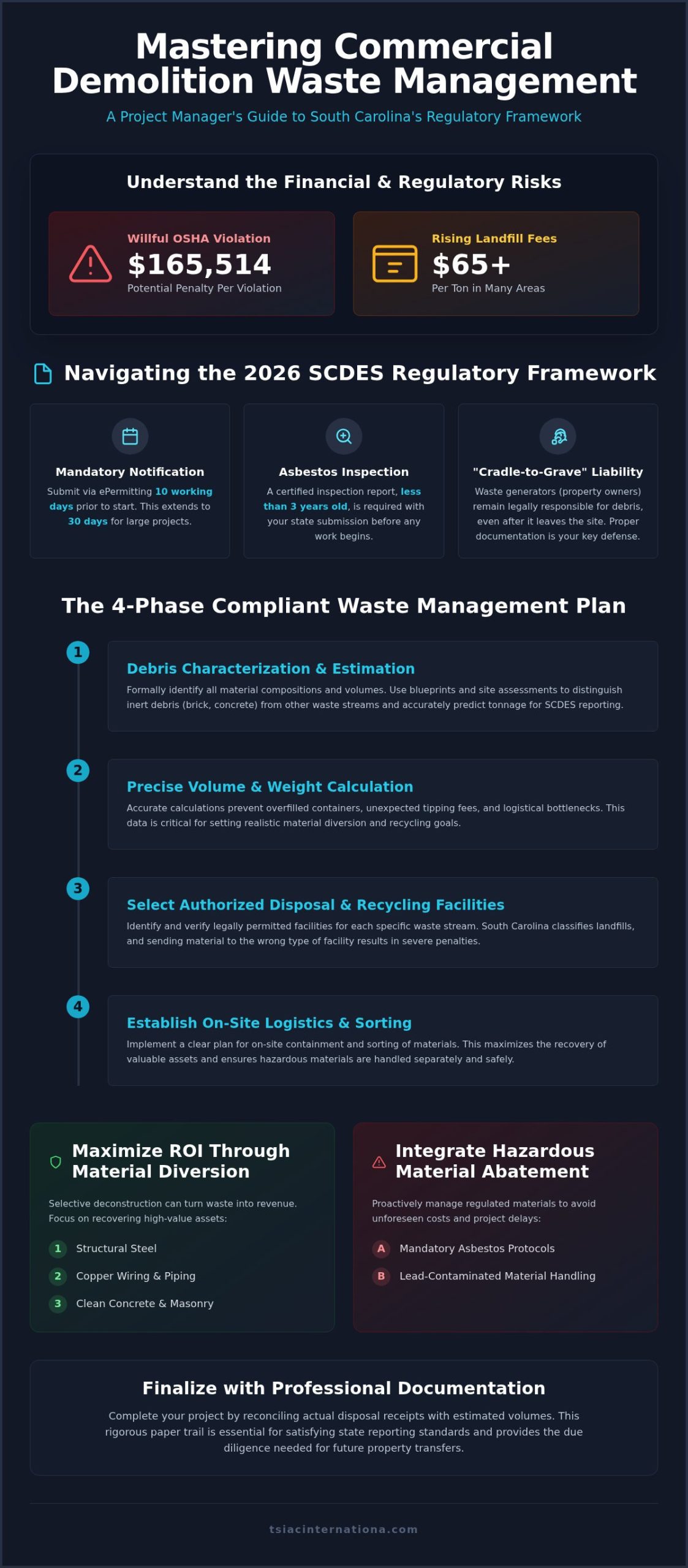
South Carolina’s regulatory environment for waste management underwent a significant transition on July 1, 2024, when the South Carolina Department of Environmental Services (SCDES) assumed oversight of the state’s material recovery frameworks. This change reflects a growing urgency to address the 600 million tons of construction and demolition waste generated annually across the United States. Managing these volumes requires more than simple disposal; it demands a disciplined engineering approach to resource recovery. Proper demolition debris recycling sc protocols ensure that structural components are diverted from Class 2 landfills, preserving local airspace and reducing the environmental footprint of large-scale industrial projects.

What Qualifies as C&D Debris in SC?

The SCDES defines construction and demolition (C&D) debris as solid waste resulting from the construction, remodeling, repair, or demolition of structures and roads. It’s a specific classification that excludes municipal household waste and hazardous substances. To maintain site safety and regulatory compliance, contractors must distinguish between "inert" materials and restricted waste. Common components eligible for recovery include:

  • Structural steel, rebar, and miscellaneous metals
  • Portland cement concrete and masonry units
  • Brick, stone, and clean soil
  • Glass and asphalt shingles
  • Untreated wood and clearing debris

Inert debris, such as cured concrete and brick, is treated as a priority in the recycling stream. These materials don’t decompose or produce leachate, making them ideal for crushing into high-quality aggregate. Using recycled concrete as a stabilized sub-base for new pavement is a standard practice that meets rigorous load-bearing specifications.

The Economic Case for Material Recovery

Financial performance in the construction sector is tied directly to waste efficiency. Tipping fees at South Carolina landfills typically range from $35 to $60 per ton, depending on the county and material type. By contrast, demolition debris recycling sc facilities often provide lower intake rates for clean, pre-sorted loads. Projects that implement rigorous onsite sorting can reduce their total waste management costs by 18% to 24%.

Beyond immediate savings, sustainable material management opens doors to federal tax incentives and LEED v4.1 credits. Achieving a 50% diversion rate for non-hazardous debris earns points that increase the long-term valuation of a property. It’s a strategy that transforms a liability into a logistical asset.

By the 2026 fiscal cycle, the ROI of debris recycling will be defined by a 22% average reduction in raw material procurement costs through the systematic onsite processing of reclaimed aggregates.

Primary Recyclable Materials in Structural and Selective Demolition

Effective demolition debris recycling sc depends on the precise identification and separation of waste streams at the source. The South Carolina Department of Health and Environmental Control (SCDHEC) estimates that construction and demolition debris makes up approximately 25% of the state’s total waste. Managing these materials requires a disciplined engineering approach to maximize recovery rates and maintain site safety. Success isn’t found in bulk disposal; it’s found in the systematic extraction of secondary raw materials.

  • Concrete and Masonry: Operators crush these materials into 1.5-inch or 3-inch aggregate for use as on-site fill or stabilized road base.
  • Ferrous and Non-Ferrous Metals: This stream includes structural I-beams, rebar, and specialized alloys that command the highest market prices.
  • Untreated Wood and Lumber: Clean timber, often comprising 15% of a building’s mass, is ground into mulch or utilized for industrial biomass fuel.
  • Gypsum Wallboard and Plastics: Specialized processing facilities in the Southeast now accept clean drywall for manufacturing new feedstock, provided it’s free of lead-based paint and adhesives.

High-Value Metal Recovery

Metals represent the most profitable component of any structural teardown. Structural steel, copper piping, and aluminum wiring maintain high scrap value even during market shifts. During the 2023 fiscal year, scrap steel prices averaged between $380 and $440 per ton. Technical teams achieve maximum purity by extracting these materials before general demolition begins. This selective approach prevents cross-contamination and ensures the highest possible return. Timing the sale based on London Metal Exchange (LME) data ensures the project’s financial stability and offsets total project costs.

Aggregate Recycling: Concrete and Brick

On-site mobile crushing units eliminate the need for hundreds of heavy vehicle trips. This process transforms old foundations into high-quality fill that meets SCDOT Standard Specifications for Highway Construction. Utilizing 1,000 tons of recycled concrete on-site can save a project over $18,000 in hauling and disposal fees. It also reduces carbon emissions by roughly 42% compared to importing virgin stone. For projects involving complex industrial execution, on-site recycling provides a logistical advantage that keeps tight schedules on track. It’s a method that turns a waste liability into a structural asset.

Demolition Debris Recycling in SC: A Guide to Sustainable Material Management

Safety dictates the entire project lifecycle. You can’t achieve efficient demolition debris recycling sc if hazardous contaminants infiltrate the waste stream. A single fragment of asbestos-containing material (ACM) can render an entire 30-yard roll-off container unrecyclable, forcing the entire load into a specialized landfill at three times the standard tipping fee. We prioritize the stabilization of the site before any mechanical demolition occurs. This isn’t just a safety preference; it’s a structural necessity for material recovery.

The South Carolina Department of Health and Environmental Control (SCDHEC) enforces strict protocols regarding waste commingling. Mixing hazardous waste with clean masonry or steel triggers civil penalties that often reach $10,000 per day per violation. Protecting the integrity of the recycling stream requires rigorous isolation of lead-based paint and asbestos. If these materials aren’t stripped first, the resulting dust contaminates the aggregate, making it useless for future construction applications.

Pre-Demolition Abatement Requirements

South Carolina law requires a certified asbestos building inspection for all public and commercial renovations or demolitions. This mandate applies regardless of the structure’s age. If the project involves more than 160 square feet of surface area or 260 linear feet of pipe insulation, you must submit a notification to SCDHEC at least 10 working days before work starts. Safe containment ensures friable fibers don’t settle on clean concrete or steel. For detailed procedures, consult our Asbestos Removal in South Carolina: A Complete Guide.

Handling Lead-Contaminated Debris

Structures built before 1978 carry a high probability of lead-based paint. We utilize X-Ray Fluorescence (XRF) analyzers to identify lead concentrations in wood and masonry. If lead levels exceed 1.0 mg/cm², the material is classified as hazardous and requires specialized disposal at a Subtitle C landfill. Selective gutting allows us to strip contaminated architectural elements manually. This process protects workers from inhaling toxic dust and keeps the bulk of the masonry clean for demolition debris recycling sc.

Worker safety remains the primary focus during these phases. We implement several protocols to ensure a clean site:

  • XRF Testing: Rapid on-site analysis of all painted surfaces.
  • HEPA Filtration: Using high-efficiency vacuums during selective gutting to capture 99.97% of particles.
  • Segregated Storage: Placing lead-impacted wood in sealed, 6-mil poly-lined containers to prevent leaching.
  • Worker Decontamination: Mandatory wash stations to prevent the spread of lead dust outside the hot zone.

Best Practices for Job Site Material Management

Efficient demolition debris recycling sc requires a disciplined approach to onsite logistics. It’s not just about disposal; it’s about material recovery through engineering precision. Successful projects treat the job site as a processing facility where every movement is calculated to prevent cross-contamination. This level of control ensures that 95% of extracted steel and 80% of concrete aggregates remain viable for secondary markets. Without a structured flow, valuable materials quickly turn into expensive liabilities.

Source Separation Strategies

Maximizing material value starts at the point of removal. We recommend setting up designated 10×10 foot drop zones for specific material types, such as ferrous metals, clean concrete, and untreated timber. Crews receive 15-minute technical briefings to distinguish between clean loads and contaminated debris, ensuring that gypsum or hazardous insulation doesn’t compromise a 40-yard container of recyclable brick. For complex structures, use hydraulic shears and high-reach excavators for surgical material extraction. This mechanical precision allows operators to pull structural steel directly from the frame, maintaining high purity levels that command better rebates at SC processing centers.

The Logistics of Debris Hauling

Choosing the right equipment determines the project’s bottom line. While 20-yard roll-off containers offer flexibility on tight urban sites in Charleston or Greenville, high-capacity 100-yard trailers are 30% more cost-effective for large-scale industrial clearances. Every haul must be directed to a facility verified by the 2024 SC DHEC list of permitted C&D recycling centers. Developing a rigorous Debris Management Plan becomes a critical legal safeguard by 2026, as South Carolina regulatory bodies will require documented proof of 75% material diversion for all commercial permits exceeding 5,000 square feet. This documentation provides the data trail necessary for municipal audits and environmental compliance certifications.

Maintaining strict site protocols is the only way to guarantee safety and profitability during complex teardowns. For projects requiring this level of technical oversight, partner with a team that provides reliable demolition solutions tailored to South Carolina’s regulatory environment.

Rigorous tracking is the final pillar of professional material management. Digital manifests should record the weight, material type, and destination facility for every load leaving the site. This data isn’t just for internal review; it’s the primary evidence used during state-level environmental audits. By maintaining a transparent chain of custody, contractors prove their commitment to demolition debris recycling sc while protecting the client from potential liability issues associated with illegal dumping or improper waste handling.

Implementing Large-Scale Material Recovery with TSIAC International

Executing a successful strategy for demolition debris recycling sc requires more than just brute force; it demands a disciplined, integrated approach. TSIAC International brings over 15 years of specialized experience to structural and selective demolition projects across the region. By combining hazardous material abatement with material recovery, project timelines are condensed and operational risks are mitigated. This technical synergy ensures that site remediation and recycling efforts occur simultaneously, which reduces downtime for developers and general contractors. Every job site operates under a strict mandate for environmental responsibility, treating waste not as a burden but as a recoverable asset.

The company relies on professional-grade heavy machinery and expert crews trained in precise dismantling techniques. This mechanical advantage allows for the clean separation of materials at the source, which is critical for maintaining the purity of recycled aggregates. Whether the project involves a high-rise structure or a specialized industrial facility, the focus remains on engineering a solution that maximizes material life cycles.

A Comprehensive Service Suite

TSIAC International manages everything from complex interior gutting to total structural removal with engineering precision. Their teams are equipped to handle the removal of over 20 distinct material categories, ensuring that hazardous substances like asbestos or lead-based paint are remediated before the main demolition begins. Every project adheres to national-standard safety protocols, maintaining a zero-incident culture. This rigorous methodology allows for the recovery of high-value materials, such as structural steel and clean concrete, that meet strict industry specifications for reuse in new construction projects.

Partnering for Sustainability

Developers in South Carolina face increasing pressure to meet LEED certification and local environmental mandates. TSIAC provides the transparent reporting necessary to document diversion rates and material destinations for project stakeholders. By maximizing demolition debris recycling sc, clients frequently see a reduction in landfill tipping fees by 30% or more. The firm’s commitment to sustainability is backed by data, providing a clear audit trail for every ton of material processed. This level of transparency ensures that environmental goals are met with verifiable results rather than vague promises.

Contact TSIAC International for a customized demolition and recycling quote to ensure your next project is handled with technical expertise and professional reliability.

Advancing Your Next Project with Sustainable Material Recovery

Effective management of structural waste isn’t just a regulatory checkbox; it’s a strategic advantage for any South Carolina job site. By segregating concrete, steel, and timber, projects can redirect up to 75% of waste materials away from local landfills. This process demands rigorous adherence to safety protocols, especially when dealing with hazardous substances. Our team maintains comprehensive Asbestos and Lead Abatement Certification to ensure every site meets DHEC standards without costly delays.

Implementing a robust strategy for demolition debris recycling sc requires technical precision and heavy-duty logistics. TSIAC International brings over 15 years of industry experience to the field, specializing in complex structural removals that require engineering accuracy. We’ve successfully managed large-scale recoveries across the Southeast, proving that efficiency and environmental responsibility work together. You deserve a partner who prioritizes safety and professional reliability on every square foot of the site.

Request a Professional Demolition Quote from TSIAC International to secure a partner with a proven track record in high-stakes material management. We’re ready to bring our technical expertise to your project today.

Frequently Asked Questions

What exactly is considered construction and demolition (C&D) debris?

Construction and demolition debris consists of waste materials generated during the renovation, repair, or destruction of structures and roads. This category includes heavy materials like concrete, steel, wood, and asphalt, alongside finishing components such as drywall and carpeting. The EPA reported that the United States generated 600 million tons of C&D debris in 2018, which is double the amount of municipal solid waste produced annually across the country.

Is recycling demolition debris actually cheaper than taking it to a landfill?

Recycling is often more cost-effective because it avoids high tipping fees and generates revenue from salvaged materials. In South Carolina, landfill fees average $45 per ton, while demolition debris recycling sc facilities frequently offer lower rates for sorted loads. You’ll reduce transportation costs by processing concrete on-site into aggregate, which saves approximately $15 per ton in haul-away expenses and new material purchases for the next phase.

Can I recycle wood that has been painted with lead-based paint?

You can’t recycle wood contaminated with lead-based paint because it’s classified as hazardous waste under federal safety standards. Materials painted before 1978 are subject to strict SCDHEC disposal protocols to prevent environmental contamination. These items must be separated and transported to a Subtitle D landfill, as recycling facilities won’t accept any wood that tests positive for lead concentrations exceeding 5,000 parts per million during initial screening.

How much of a building can typically be recycled during demolition?

A standard industrial project can achieve a diversion rate of 75% to 90% when using deconstruction techniques instead of traditional wrecking. Metals like steel and copper have a 100% recovery rate, while clean concrete is crushed into usable road base. Implementing a demolition debris recycling sc strategy ensures that only about 15% of the total building mass, primarily insulation and mixed plastics, ends up in a landfill at the project’s conclusion.

What are the South Carolina regulations for disposing of unrecyclable debris?

Unrecyclable materials must be managed according to SCDHEC Regulation 61-107.19, which governs solid waste management. This law requires that all non-recoverable C&D waste goes to a permitted Class 2 or Class 3 landfill. Site managers must keep disposal manifests for at least 3 years to prove compliance during state inspections, ensuring that no hazardous substances enter the local groundwater systems or violate the structural integrity of the disposal site.

Do I need a special permit to recycle concrete on my project site?

You’ll need a General Permit for Crushing and Grinding from the SCDHEC Bureau of Air Quality if your equipment exceeds certain capacities. Specifically, any portable crusher processing more than 150 tons of material per hour requires a formal registration. We manage these permits to ensure dust control measures meet the 20% opacity limit required by state law, maintaining site safety and legal standing throughout the crushing operation.

How does asbestos abatement affect the overall recycling timeline?

Asbestos abatement typically adds 14 days to your project schedule due to mandatory regulatory waiting periods. South Carolina law requires a 10-working-day notification to SCDHEC before any disturbance of regulated asbestos-containing material begins. Once the 48-hour post-abatement air clearance testing is finished, the remaining structure can be safely processed for recycling without the risk of contaminating the clean debris streams with hazardous fibers.

What materials are currently banned from South Carolina C&D landfills?

South Carolina law prohibits the disposal of 5 specific categories of waste in C&D landfills, including whole tires and lead-acid batteries. You can’t dispose of liquid waste, hazardous chemicals, or regulated asbestos-containing material in these facilities. These bans, enforced under Regulation 61-107.19, protect the environment and prevent toxic leaching into the surrounding soil. All banned items must be diverted to specialized processing centers, and if you need to manage scrap tires, you can find out more about recycling solutions.

The Power of Precision: A Guide to Demolition Heavy Machinery in SC

According to 2023 industry data from the Construction and Demolition Recycling Association, approximately 35% of structural removal projects in the…

According to 2023 industry data from the Construction and Demolition Recycling Association, approximately 35% of structural removal projects in the Southeast experience significant delays due to improper selection of demolition heavy machinery sc. It’s a sobering reality for project managers who know that a single day of downtime can result in over $12,000 in lost revenue and overhead. You’re likely familiar with the tension of balancing tight deadlines against the rigid demands of environmental compliance and site safety.

This guide explores how the strategic deployment of high-spec machinery transforms these complex challenges into predictable, high-performance results. We’ll show you how professional operation can ensure your project meets the 75% material recycling threshold required for many LEED certifications while maintaining a zero-incident safety record. We’ll examine specific technical capabilities of modern excavators and shears, providing a clear roadmap for selecting the right tools for your next structural removal.

Key Takeaways

  • Understand how South Carolina’s diverse terrain necessitates a transition from manual labor to machine-driven precision for complex structural removals.
  • Explore the technical capabilities of high-reach excavators and specialized attachments designed for the surgical deconstruction of multi-story buildings.
  • Learn how strict adherence to OSHA standards and state-specific environmental regulations ensures site safety and hazardous material containment.
  • Discover how the strategic deployment of advanced demolition heavy machinery sc optimizes project efficiency while transforming structural waste into recyclable aggregate.

The Role of Heavy Machinery in Modern SC Demolition

The transition from manual labor to machine-driven precision represents a fundamental shift in the construction industry. Before 1980, a significant portion of site clearing relied on sheer force and high-risk manual labor. Today, the deployment of demolition heavy machinery sc has transformed the process into a disciplined engineering exercise. In South Carolina, the diverse geography dictates the fleet requirements. A project in the Lowcountry’s soft, sandy soil requires low-ground-pressure tracks to prevent sinking, while a site with older, reinforced concrete foundations demands high-torque hydraulic breakers. Using the correct heavy equipment ensures that a 12,000 square foot industrial facility can be cleared in under 5 days. This efficiency reduces project timelines by 35% compared to outdated methods.

Economic viability depends on the synchronization of machinery and logistics. When a fleet is properly matched to the site’s scale, idle time drops to less than 8%. This precision isn’t just about speed; it’s about the controlled management of energy. By utilizing specialized excavators, we can isolate structural loads during the dismantling phase. This prevents unplanned collapses and ensures the safety of everyone on site. The modern approach treats every building as a puzzle to be disassembled rather than a target to be destroyed. This level of control is why demolition heavy machinery sc is the backbone of safe urban redevelopment.

  • Hydraulic shears cut through steel beams in seconds, replacing dangerous oxy-fuel torches.
  • High-reach excavators allow for top-down demolition, protecting adjacent historic structures in urban centers like Charleston or other coastal communities.
  • GPS-integrated loaders optimize debris movement, cutting fuel consumption by 18% per project.
  • Remote-controlled demolition robots handle hazardous material removal without putting operators at risk.

Beyond the Wrecking Ball: The Engineering Shift

By 2026, the traditional wrecking ball has effectively become a museum piece. Modern contractors favor hydraulic processors and high-reach excavators for their superior control. These machines provide 360-degree rotation and interchangeable attachments, allowing for surgical precision. We often perform selective interior gutting where the exterior facade remains untouched while 100% of the internal structural components are removed. This balance of raw power and delicate handling is essential for preserving South Carolina’s architectural heritage during urban renewal projects.

The Environmental Advantage of Modern Fleets

Modern fleets do more than break concrete; they function as mobile sorting centers. High-efficiency engines manufactured after 2022 meet stringent Tier 4 and Tier 5 standards, reducing nitrogen oxide emissions by 90%. Machine-assisted sorting allows us to achieve recycling rates exceeding 92% for metals, wood, and concrete. This capability turns potential waste into reusable aggregate and scrap, which can save clients an average of $14,500 in landfill fees on mid-sized commercial jobs. Integrated misting systems on 2026-era machinery also suppress 85% of airborne dust, protecting the air quality of surrounding neighborhoods.

Essential Fleet Components for Structural Removal

Successful projects across South Carolina rely on a tiered equipment strategy. The 30-ton hydraulic excavator serves as the primary tool for most industrial sites. These machines provide the breakout force required to dismantle reinforced concrete foundations. Using advanced demolition heavy machinery sc, contractors ensure that site clearance stays on schedule even when encountering unforeseen sub-grade obstacles. Modern excavators in our fleet feature 360-degree rotation and quick-coupler systems, allowing operators to switch between hydraulic shears and concrete pulverizers in less than 10 minutes. This versatility reduces idle time and keeps the project flow continuous.

High-Reach Excavators: Reaching New Heights Safely

When a project involves a five-story building in Charleston or a coastal hotel in Myrtle Beach, high-reach excavators become mandatory. These machines feature modular boom sections that extend up to 90 feet. This height allows the operator to dismantle the structure from the top down without placing the machine on a dangerous debris pile. Stability is maintained through an expandable undercarriage and 15-ton counterweights. Safety remains the primary objective. By keeping the operator cabin 65 feet away from the drop zone, we mitigate the risks associated with unpredictable structural collapses. Adherence to OSHA Demolition Standards ensures that every high-reach operation follows strict engineering surveys and collapse-zone protocols. The integration of 30-degree tilting cabs also reduces operator fatigue, which is a critical factor during high-precision dismantling tasks.

Small-Scale Machinery for Selective Demolition

Urban density in South Carolina often requires a surgical approach. In 2023, 42% of our interior projects involved historic preservation where structural integrity was the priority. Electric-powered mini-loaders are essential here. They produce zero emissions, making them ideal for hazardous material abatement in confined spaces. Precision is non-negotiable when working inside 19th-century brick structures. Skid steers provide the agility needed for rapid floor removal and interior gutting. These compact units navigate 36-inch doorways while maintaining a 2,900-pound rated operating capacity.

  • Precision Movement: Rubber-tracked mini-excavators prevent floor damage in sensitive historic zones.
  • Hazardous Abatement: Remote-controlled demolition robots allow for safe lead and asbestos removal in areas too unstable for human entry.
  • Interior Gutting: High-torque skid steers can clear 5,000 square feet of interior space in a single 8-hour shift.

Effective debris management closes the loop on site clearing. Articulated haulers, such as the 25-ton capacity models, move material across uneven terrain far faster than standard road trucks. Low ground pressure tires protect the soil during site clearing, preventing compaction issues for future builders. This logistical speed ensures that site preparation for new construction begins 18% sooner than projects relying on manual sorting. Efficiency starts with selecting the right demolition heavy machinery sc for the specific load-bearing requirements of the structure. If you’re planning a complex teardown, you can review our technical capabilities to see how we manage these logistics with engineering precision.

Site clearing isn’t just about destruction; it’s about the systematic recovery of materials. Our articulated haulers transport sorted concrete to on-site crushers, where it’s repurposed as structural fill. This process diverts up to 85% of demolition waste from South Carolina landfills. Every machine in the fleet is chosen for its ability to contribute to this circular economy while maintaining the highest safety ratings in the industry.

Specialized Attachments: The ‘Teeth’ of the Operation

The efficiency of demolition heavy machinery sc depends entirely on the tool at the end of the boom. A 100,000-pound excavator is merely a mobile power source until it’s equipped with the specific attachment required for the structural material at hand. These tools provide the mechanical advantage necessary to convert a standing structure into manageable, sorted waste streams. Precision in attachment selection reduces project timelines by 15% and ensures that safety protocols meet the rigorous standards set by the National Demolition Association for technical dismantling.

Our fleet utilizes four primary categories of high-performance attachments to handle South Carolina’s diverse industrial and commercial landscapes. Hydraulic breakers deliver up to 12,000 ft-lbs of impact energy to fracture 5,000 PSI reinforced concrete foundations. For delicate sorting, hydraulic grapples and thumbs provide the dexterity of a human hand on a massive scale. These grapples allow operators to separate wood, plastic, and copper wiring with 98% accuracy, which is vital for projects aiming for LEED certification or strict environmental compliance.

Hydraulic Shears and Steel Processing

Steel-framed industrial warehouses require the raw cutting force of hydraulic shears. These attachments function like industrial-grade scissors, capable of slicing through 36-inch wide-flange I-beams in a single cycle. We utilize shears equipped with 360-degree continuous rotation. This mechanical flexibility allows operators to approach complex structural nodes from any angle without repositioning the entire excavator. It’s a critical capability when working in tight urban footprints where space is limited to a 20-foot radius.

Maximizing the value of scrap metal is a core component of our cost-management strategy. By processing steel to mill-ready lengths on-site, we increase the scrap yield value by approximately 22% compared to hauling oversized beams. The selection of the shear depends on the steel grade; A36 structural steel requires different blade geometry than the high-strength, low-alloy steels often found in bridge supports or heavy industrial machinery bases. Our operators match the tool’s closing force to the material’s tensile strength to prevent equipment fatigue and ensure clean, rapid cuts.

Concrete Pulverizers and On-Site Crushing

Concrete processing involves a two-stage approach to ensure the material is ready for reuse. Primary pulverizers are designed for the initial takedown, featuring a wide jaw opening that can grab and crush reinforced concrete columns still in their vertical position. Secondary pulverizers, often referred to as “processors,” are used on the ground. These tools feature a specialized tooth configuration designed to pulverize chunks of concrete into 3-inch minus aggregate while simultaneously stripping away every inch of embedded rebar.

Separating rebar from the concrete matrix is essential for creating clean recycling streams. Once the steel is extracted via integrated magnets or manual sorting after the pulverizer has done its work, the remaining concrete becomes a valuable resource rather than a waste product. By crushing concrete into usable fill on-site, we’ve helped clients reduce hauling costs by up to $15,000 on mid-sized commercial projects. This approach eliminates the need for hundreds of dump truck trips, reducing the carbon footprint of the demolition heavy machinery sc operation while providing the site with a stable base for future construction. We monitor the jaw pressure constantly to ensure the aggregate meets specific compaction requirements for backfill, turning yesterday’s walls into tomorrow’s foundation.

Safety, Compliance, and Operator Expertise in South Carolina

Demolition demands more than raw power; it requires a disciplined adherence to rigorous safety protocols and engineering standards. At TSIAC International, we recognize that operating demolition heavy machinery sc involves managing immense kinetic energy in volatile environments. Our operations align strictly with OSHA 29 CFR 1926.850, which mandates a comprehensive engineering survey by a qualified person before any structural dismantling begins. This document guides our choice of machinery and the sequence of debris removal to prevent premature collapses.

Every workday at a TSIAC site commences with a 15-minute safety briefing at 7:00 AM. During these sessions, the site supervisor reviews the day’s specific hazards, such as live utility lines or structural weaknesses identified in the pre-demolition report. Operators then perform a 12-point machine inspection. They check hydraulic hose integrity, track tension, and the locking pins on attachments like shears or pulverizers. We don’t permit a machine to move until the operator signs off on the daily inspection log, ensuring 100% equipment readiness before the first strike.

Navigating SC Regulatory Requirements

South Carolina’s coastal and urban landscapes, from Charleston’s historic districts to Myrtle Beach’s tourism hubs, require specialized permitting. We manage all municipal clearances, including noise ordinances and vibration monitoring plans required for work near historic structures. Our teams strictly follow DHEC Regulation 61-86.1 for asbestos and lead-based paint abatement. We implement 2024-standard stormwater management plans, using silt fences and sediment basins to prevent runoff from entering local waterways during the clearing process.

The Human Factor: Training and Precision

A machine’s efficiency is limited by the skill of the person in the cab. Our high-reach excavator pilots complete 500 hours of advanced simulator training before operating on live sites. This training focuses on center-of-gravity management during vertical reaches exceeding 60 feet. We use encrypted 2-way radio technology to maintain constant contact between operators and ground spotters. These spotters maintain a 50-foot exclusion zone, using hand signals and verbal cues to guide the pilot through tight maneuvers where visibility is obstructed.

Technical precision extends to how we handle hazardous materials found during the dismantling process. If our demolition heavy machinery sc uncovers underground storage tanks or contaminated soil, we pause operations immediately to follow South Carolina Department of Health and Environmental Control (DHEC) containment protocols. This methodical approach has allowed us to maintain a 0.76 Experience Modification Rate (EMR), significantly lower than the industry average of 1.0. We don’t take shortcuts because the integrity of the project and the safety of the public depend on our professional discipline.

Our commitment to safety ensures that every project is completed without avoidable delays or legal complications. We provide the technical documentation and safety records necessary to satisfy both corporate stakeholders and government regulators. If you require a partner who prioritizes risk mitigation alongside high-performance execution, contact our demolition specialists today to discuss your site requirements.

The TSIAC Fleet: Precision Engineering for Every Project

TSIAC International maintains a rigorous standard for its equipment, allocating 15% of annual capital expenditure toward fleet modernization. We operate a diverse array of Tier 4 Final compliant units, which effectively reduces nitrogen oxide emissions by 90% compared to legacy models. This commitment to modern demolition heavy machinery sc ensures that our operations meet the strictest environmental regulations while delivering the mechanical reliability required for high-stakes structural removal. We track every machine’s performance through telematics, allowing our engineers to monitor fuel efficiency and hydraulic pressure in real-time across South Carolina job sites.

Our project managers don’t believe in a universal approach to equipment deployment. We analyze the specific structural load and site constraints before a single machine leaves our yard. For a 60,000-square-foot commercial industrial park, we utilize 35-ton high-reach excavators equipped with hydraulic shears capable of cutting through reinforced steel beams. Conversely, residential contracts often require a lighter touch. We deploy compact track loaders and mini-excavators with a 40-inch width to navigate tight property lines without damaging existing landscaping or utility infrastructure. This surgical approach minimizes vibration and noise pollution for surrounding residents.

The integration of advanced technology separates our fleet from standard rental-grade equipment. We utilize:

  • Integrated GPS Grade Control: This allows our operators to achieve 2-centimeter accuracy during site clearing and foundation removal.
  • Load-Sensing Hydraulics: These systems automatically adjust engine power to match the resistance of the material, reducing fuel consumption by 18% on average.
  • Dust Suppression Systems: High-pressure water misters are mounted directly to the demolition attachments to neutralize particulate matter at the source.

In October 2023, we demonstrated the power of this specialized fleet during a complex gut-out of a 120-year-old historic structure in downtown Charleston. The project required the removal of 25 tons of internal debris without disturbing the original masonry shell. Because the street access was limited to 10 feet, we utilized remote-controlled robotic demolition units. These machines provided the power of a traditional skid steer but possessed a footprint small enough to fit through a standard doorway. By using these specialized tools, we completed the interior strip-out three days ahead of schedule while maintaining 100% vibration compliance.

Custom Solutions for Complex Sites

We specialize in “impossible” locations where traditional demolition heavy machinery sc cannot reach. Our team utilizes custom-engineered rigging and small-footprint gear to handle vertical demolition in dense urban corridors. We combine our certified hazardous material abatement expertise with heavy structural power, ensuring that lead or asbestos is safely contained before the primary structure is dismantled. This dual-phase capability allows for a seamless transition from environmental remediation to mechanical removal, providing our clients with a single point of accountability for selective demolition projects.

Start Your SC Demolition Project with TSIAC

Our bidding process is rooted in engineering data. We provide fixed-price contracts for structural removal based on detailed 3D site scans and material weight estimates. For commercial interior gutting, our consultation process involves a 48-hour turnaround for site assessment and logistical planning. We don’t guess; we calculate. If your project requires precision, safety, and a fleet that can handle the most demanding technical challenges, we’re ready to deploy. Contact TSIAC International for a professional fleet assessment to secure a partner who treats demolition as a disciplined engineering task rather than a simple teardown.

Secure Your Project’s Success with Proven Technical Expertise

Successful site clearing in South Carolina depends on a calculated synergy between advanced fleet components and rigorous safety protocols. Selecting the right demolition heavy machinery sc is critical for maintaining structural control while navigating complex site constraints. TSIAC International brings 15+ years of industry experience to every job site, ensuring that every shear cut and bucket sweep meets the highest engineering standards. We don’t just clear land; we execute a controlled engineering process designed to protect your assets and the environment.

Our team maintains full DHEC and OSHA compliance to protect both personnel and property during high-risk operations. We specialize in complex structural removal and hazardous material abatement, providing a comprehensive solution for even the most challenging environments. You don’t have to manage these technical risks alone when you have a partner committed to precision and reliability. We’re ready to deploy our specialized fleet to ensure your next project stays on schedule and within budget.

Request a Quote for Your Next SC Demolition Project

We look forward to bringing our technical precision to your job site soon.

Frequently Asked Questions

What is the most common heavy machine used in demolition?

The hydraulic excavator is the most common heavy machine used in structural demolition. These versatile units handle 85% of our primary structural tasks because they accept various specialized attachments like shears, hammers, and grapples. We utilize 20-ton to 50-ton models to ensure we maintain maximum control over the collapse of the structure. This precision is vital for maintaining the structural integrity of adjacent buildings during complex urban projects.

How much does it cost to hire a demolition company with heavy machinery in SC?

Hiring a company with professional demolition heavy machinery sc typically costs between $5 and $15 per square foot depending on the material complexity. A standard 2,000-square-foot residential structure often requires a budget of $10,000 for a full tear-down and site clearing. Commercial projects involve higher variables, so we provide detailed line-item estimates based on 48-hour site assessments to ensure total financial transparency.

Can heavy machinery be used for selective interior demolition?

Heavy machinery is essential for selective interior demolition when we utilize specialized compact equipment. We deploy electric mini-excavators that fit through standard 36-inch door openings to remove concrete slabs or internal walls without compromising the main structure. These machines reduce manual labor hours by 60% while maintaining the surgical precision required for historical preservation or retail fit-outs. It’s a faster way to handle heavy debris in confined spaces.

Does TSIAC International provide their own machinery for projects?

TSIAC International maintains a 100% company-owned fleet of over 45 specialized units to ensure project continuity. We don’t rely on third-party rental schedules, which allows us to mobilize to a job site within 24 hours of permit approval. Owning our equipment means every machine undergoes a 50-point safety inspection by our in-house mechanics before it arrives at your location. This guarantees that our technical standards are met on every site.

How does heavy machinery help with asbestos and lead abatement?

Heavy machinery streamlines asbestos and lead abatement by utilizing sealed cabs with high-efficiency particulate air (HEPA) filtration systems. These systems capture 99.97% of airborne contaminants, protecting our operators during the removal of hazardous materials. Using specialized grapples allows us to handle contaminated debris in bulk. This reduces manual handling risks and accelerates the disposal process by 40% compared to traditional hand-stripping methods.

What safety measures are taken when using high-reach excavators in urban areas?

We establish a strict exclusion zone measuring 1.5 times the height of the building when operating high-reach excavators in dense urban environments. Our operators use onboard 360-degree cameras and stability monitoring sensors to prevent structural overreach. We’ve completed 100% of our high-reach projects without a single incident by following these rigid engineering protocols. Constant radio contact with ground-level spotters ensures the site remains secure at all times.

How do you prevent dust and debris from spreading during machine operation?

We utilize integrated high-pressure misting systems mounted directly on our demolition heavy machinery sc to suppress dust at the source. These systems use 500-gallon pressurized tanks to create a fine water curtain that traps 90% of airborne particles before they leave the immediate work zone. For high-wind days, we deploy additional oscillating water cannons. This approach ensures we meet all local environmental air quality standards without exception.

Is it better to rent machinery or hire a full-service contractor like TSIAC?

Hiring a full-service contractor like TSIAC is better because it eliminates the $2 million liability risk associated with operating heavy equipment. Renting requires you to manage permits, transportation, and specialized labor, which often increases total project costs by 25%. We provide a turnkey solution where our engineers manage every technical detail. You get the benefit of our experience and our specialized fleet without the logistical burden of equipment management.