Cost Savings from Demolition Recycling in South Carolina: 2026 Strategic Guide

Did you know that construction and demolition debris nationwide now accounts for more than twice the total amount of municipal solid waste? Across…

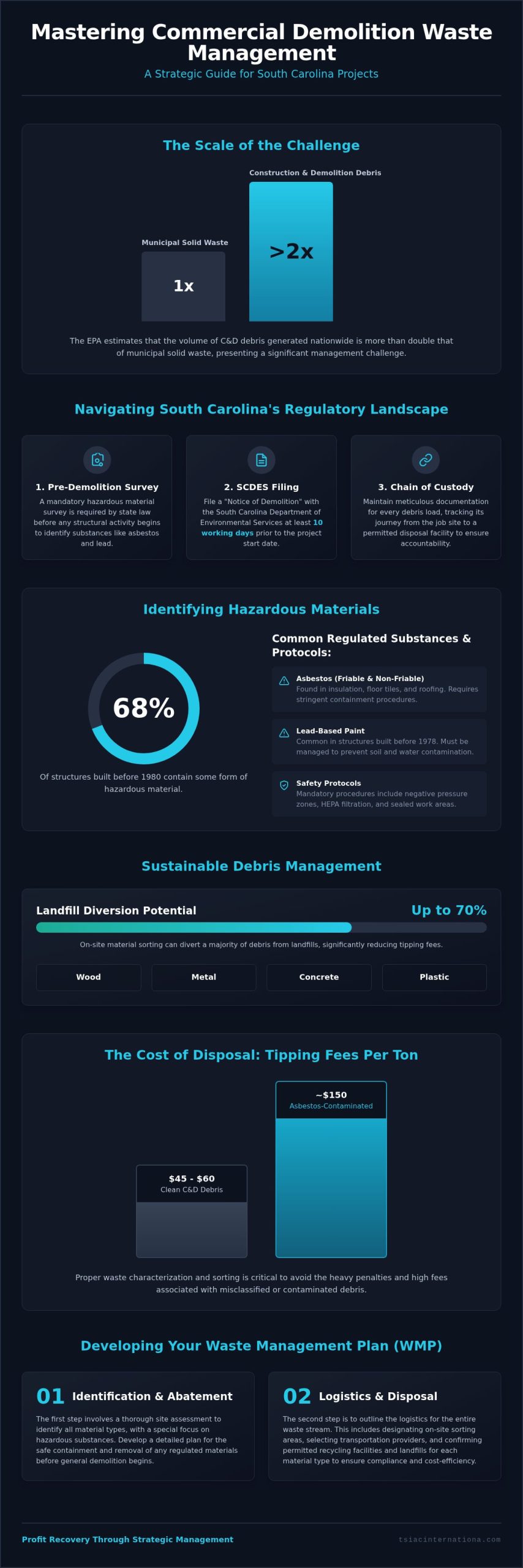
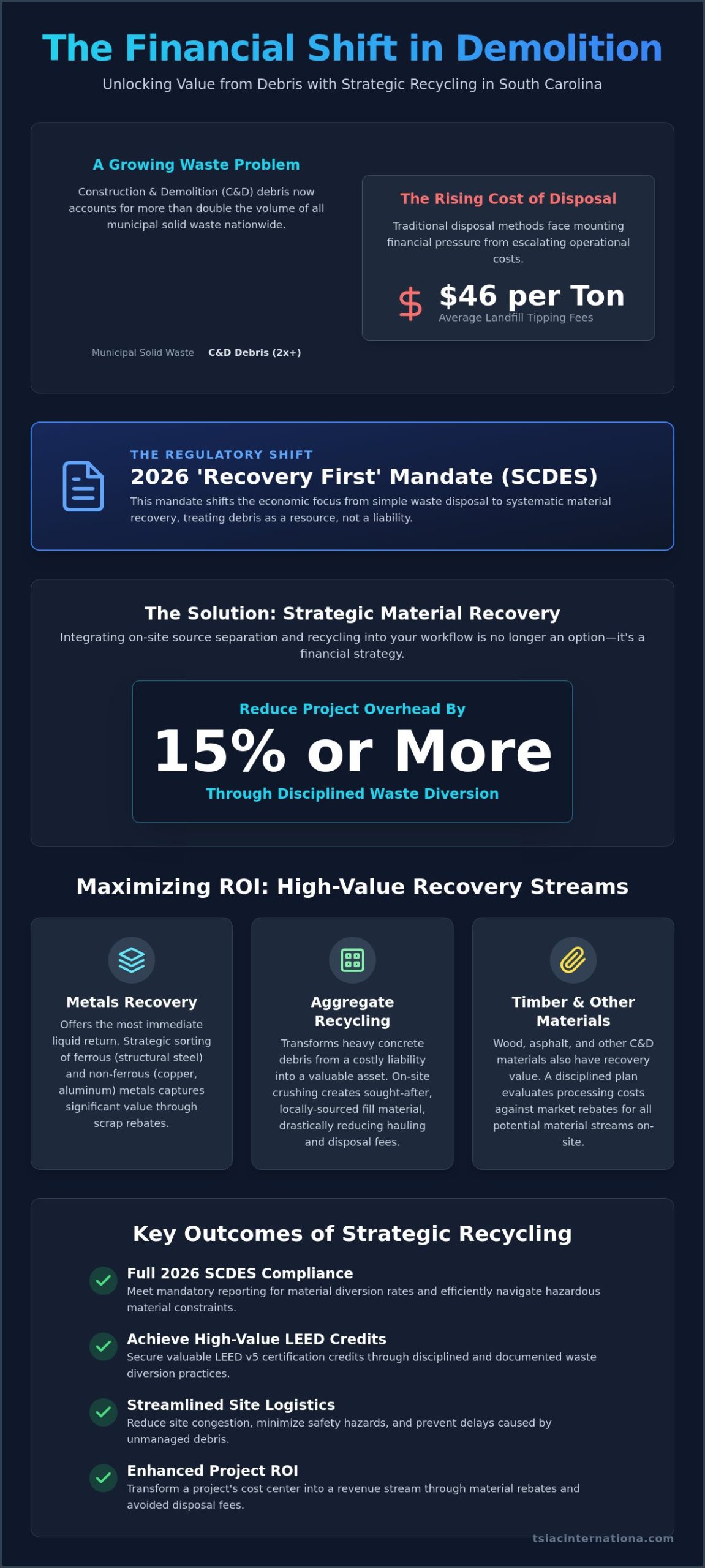
Did you know that construction and demolition debris nationwide now accounts for more than twice the total amount of municipal solid waste? Across South Carolina, where many older commercial structures contain hazardous materials like asbestos or lead, the financial burden of traditional disposal is reaching a critical breaking point. As landfill tipping fees in various regions across the state hit $46 per ton, industry leaders are shifting their focus toward the substantial cost savings from demolition recycling south carolina offers. It’s no longer just an environmental choice. It’s a calculated financial strategy to protect your project margins against rising operational costs.

You’ve likely noticed that the 2026 South Carolina Department of Environmental Services (SCDES) regulations have added layers of technical complexity to every site teardown. We understand that navigating these audits while managing logistical debris delays can feel like a constant strain on your resources. This strategic guide will demonstrate how professional material recovery can reduce your South Carolina project overhead by 15% or more this year. We’ll examine the technical methods for on-site sorting, the path to full 2026 environmental compliance, and how to secure high-value LEED certification credits through disciplined waste diversion.

In addition to site-specific tactics, firms can achieve long-term success by building modern, effective organizations, a process facilitated by the direct management support of StrategyForge Partners.

Key Takeaways

  • Understand how the 2026 ‘Recovery First’ mandate shifts the economic focus from simple waste disposal to systematic material recovery for maximum project ROI.
  • Identify high-value recovery streams, including structural steel and clean concrete, to offset rising landfill tipping fees through strategic material rebates.
  • Achieve measurable cost savings from demolition recycling south carolina by integrating source separation into your operational workflow to reduce overhead by 15% or more.
  • Ensure full compliance with 2026 SC DES regulations by implementing mandatory reporting for material diversion rates and navigating hazardous material constraints efficiently.
  • Leverage single-source expertise for abatement and structural demolition to streamline site logistics and minimize delays caused by unmanaged debris.

Understanding the Economics of Demolition Recycling in South Carolina

Demolition recycling is the systematic process of recovering construction and demolition (C&D) materials for reuse, repurposing, or financial rebate. In 2026, the South Carolina Department of Environmental Services (SCDES) has solidified a ‘Recovery First’ mandate, signaling a definitive departure from traditional “smash and haul” methods. This regulatory shift forces a transition from disposal-based project planning to a circular-economy model where debris is viewed as a resource rather than a liability. The primary economic drivers behind this change are the avoidance of escalating tipping fees and the capture of significant scrap metal revenue. By prioritizing material recovery, contractors can realize measurable cost savings from demolition recycling south carolina while maintaining full compliance with state mandates.

This evolution in the sector reflects a broader understanding of a Demolition Waste Overview, which categorizes debris not as trash, but as a collection of materials with distinct market values. A well-executed recovery plan ensures that high-value components are extracted before they’re contaminated by mixed-waste streams. This disciplined approach requires technical precision but results in a leaner, more profitable project lifecycle.

The True Cost of Landfill Disposal in 2026

Landfill tipping fees for Class II and III facilities have reached $46 per ton in counties like York and Horry. When you factor in fuel surcharges and the logistical strain of hauling debris to remote landfills, the total cost of disposal often exceeds initial budget projections. Beyond the direct invoice, unmanaged site debris creates hidden costs through site congestion and increased safety hazards. A cluttered footprint slows down heavy equipment and complicates the operational workflow, leading to labor inefficiencies that further erode project profitability. Managing these variables is essential for any firm looking to achieve cost savings from demolition recycling south carolina.

Recycling as a Revenue Stream: Beyond Waste Management

Modern demolition treats structures as inventory for asset recovery. Recovering structural steel, copper piping, and clean concrete transforms a project’s cost center into a potential revenue stream. This approach significantly boosts project ROI through material rebates, tax incentives, and the acquisition of LEED v5 diversion credits. The 2026 market demand for recycled construction aggregates remains high, as developers increasingly seek locally sourced, crushed concrete to replace expensive virgin fill material. By integrating these recovery strategies, the demolition process becomes a value-added phase of the construction cycle rather than a sunk cost.

The principle of asset recovery also applies to the disposal of old site vehicles and heavy machinery. To see how professional liquidation services handle these specific assets in other regions, you can check out Cash For Junk Cars Michigan.

Maximizing ROI Through High-Value Material Recovery

Achieving significant cost savings from demolition recycling south carolina requires a disciplined focus on high-value material streams. We categorize these assets into three primary groups: metals, aggregates, and timber. While traditional disposal treats these as a singular mixed-waste burden, a strategic recovery plan evaluates the processing costs against potential market rebates. This technical assessment is the foundation of project profitability. It ensures that the demolition phase acts as a recovery operation rather than a simple clearing task.

Ferrous and Non-Ferrous Metal Recovery

Metal recovery offers the most immediate liquid return on any commercial site. Structural steel, copper wiring, and aluminum framing carry distinct market values that fluctuate based on global demand. Success depends on timing the market for maximum scrap rebates and using specialized equipment, such as hydraulic shears or magnets, to accelerate extraction. According to the C&D Recycling Association, metal remains one of the most economically viable materials for recovery due to its infinite recyclability. Proper sorting ensures that non-ferrous metals, which command higher prices, aren’t lost in bulk steel shipments.

Aggregate Recycling: Turning Concrete into Fill

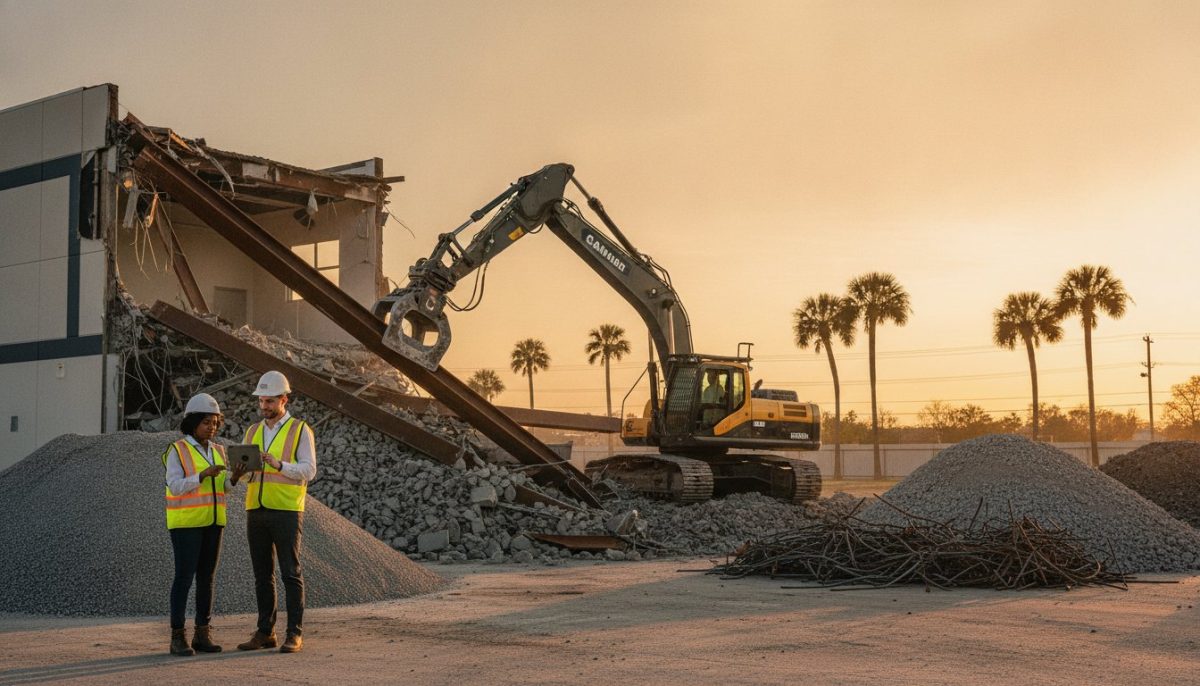
Concrete removal is often the heaviest line item in a demolition budget. On-site crushing transforms this liability into an asset. By processing concrete into structural fill or road base directly on the project site, you eliminate the $46 per ton tipping fee and the cost of hauling new aggregate. This double-sided financial benefit is a cornerstone of professional cost savings from demolition recycling south carolina. Maintaining aggregate purity is critical for meeting 2026 South Carolina construction standards. We ensure that rebar and contaminants are removed during the crushing phase to guarantee structural integrity for future builds.

In South Carolina’s 2026 commercial sector, there’s also a growing demand for reclaimed heart pine and historic timber. These materials often fetch prices far exceeding their value as mulch or fuel. Selective deconstruction allows for the preservation of these elements, turning what would be waste into a premium architectural product. Understanding these technical nuances is a key part of the demolition process in South Carolina, where material recovery is prioritized to maximize project margins.

The South Carolina Department of Environmental Services (SCDES) has implemented a higher level of technical scrutiny for 2026. This oversight requires a formal notification at least 10 working days before any demolition activity begins. Beyond simple notification, the state now demands mandatory reporting of material diversion rates for commercial projects. If you fail to document exactly where your debris is processed, you risk heavy fines and immediate project stoppages. Achieving cost savings from demolition recycling south carolina isn’t just about sorting materials; it’s about proving your compliance through every phase of the project lifecycle.

The Impact of Asbestos and Lead on Recycling Feasibility

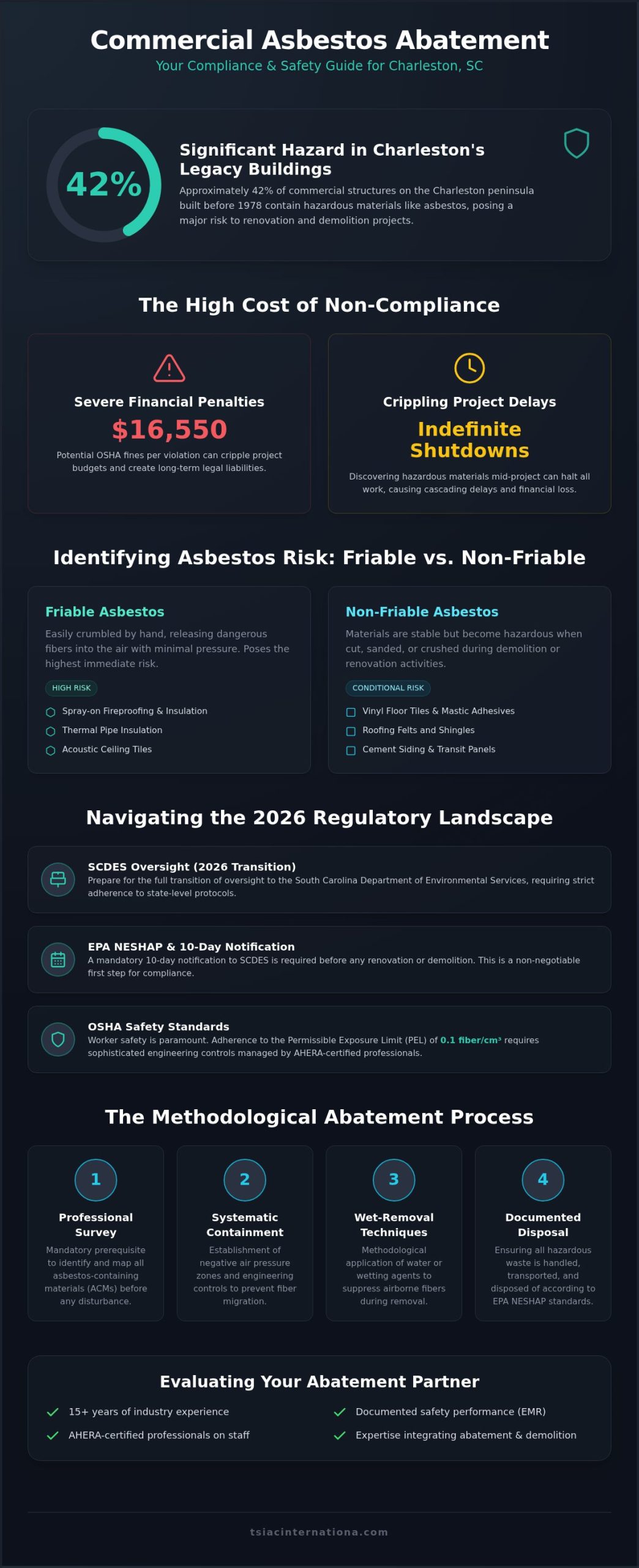
Approximately 42% of commercial structures built before 1978 in the Charleston peninsula contain hazardous materials. These substances represent the single greatest threat to your recovery margins. If asbestos fibers or lead paint contaminate a debris pile, the entire load is reclassified as hazardous waste. This technical failure increases disposal fees from the standard $46 per ton to as much as $150 per ton. Professional asbestos removal in South Carolina is the only way to ensure material purity. By isolating these contaminants before structural demolition begins, you protect the value of your underlying assets. Effective hazardous material abatement in South Carolina transforms a high-risk site into a source of clean, recyclable materials that can be diverted from landfills.

2026 Documentation and Audit Readiness

State-level environmental audits are now a standard reality for commercial sites in South Carolina. You must maintain a rigorous chain of custody for all materials leaving the site to satisfy SCDES inspectors. This process depends on obtaining certified scale tickets from authorized South Carolina facilities. These tickets serve as the primary evidence for your diversion reports and LEED certification applications. Without this verified paper trail, your recycling efforts won’t be recognized by regulators or insurance carriers. We recommend maintaining a centralized digital tracking system to manage these records in real time. This level of audit readiness protects your project from the financial consequences of non-compliance and ensures you capture the full cost savings from demolition recycling south carolina through accurate reporting.

  • Notification Compliance: Ensure the 10-day SCDES window is strictly followed to avoid startup delays.
  • Material Classification: Clearly separate ‘Contaminated’ from ‘Clean’ streams at the point of origin.
  • Scale Ticket Verification: Confirm all tickets include the material type, weight, and destination facility license number.

Cost Savings from Demolition Recycling in South Carolina: 2026 Strategic Guide

Operational Workflow: How to Implement On-Site Material Sorting

Executing a high-yield recovery plan requires a definitive departure from traditional disposal-centric demolition. To realize the full cost savings from demolition recycling south carolina, you must implement a structured operational sequence that prioritizes source separation. This method involves sorting materials at the point of generation rather than at a remote facility. It’s the most cost-effective approach because it prevents clean materials from becoming contaminated by mixed debris, which would otherwise trigger the full $46 per ton landfill rate. A well-organized site layout with dedicated zones for concrete, metal, and timber ensures that the demolition process in South Carolina remains both efficient and profitable.

Phase 1: Pre-Demolition Material Audits

The workflow begins long before the first machine arrives on site. Our technical teams conduct a thorough site walk-through to estimate the total material tonnage and identify high-value assets. This data forms the basis of a site-specific Waste Management Plan (WMP), which is essential for 2026 SCDES compliance. During this phase, we also secure necessary permits for on-site crushing or sorting operations. By quantifying the expected volume of structural steel and aggregate before work starts, we can align logistical schedules with market rebate peaks, ensuring that no value is left on the site floor.

Phase 2: Surgical Selective Demolition

Surgical deconstruction is the next critical step. We utilize commercial interior gutting services to harvest architectural elements, copper piping, and wiring before structural demolition commences. This interior-first approach prevents the cross-contamination of clean wood and metal with drywall or insulation. Managing the logistics of multi-bin sorting on tight commercial project sites requires disciplined coordination. We deploy specialized crews to maintain these separation zones, ensuring all site workflows align with 2026 South Carolina safety standards. This rigorous approach minimizes the risk of sharp debris hazards while maximizing the purity of your recycled streams.

Safety remains the cornerstone of every recovery operation. Sorting crews are trained in specific protocols for handling heavy ferrous materials and sharp aluminum framing to prevent workplace injuries. By maintaining a clean and organized site through source separation, you naturally reduce the “hidden costs” of site congestion and safety incidents. If you’re ready to optimize your site logistics for maximum recovery, learn more about our integrated demolition process today.

  • Source Separation: Dedicated bins for metal, wood, and concrete to avoid mixed-waste fees.
  • Surgical Gutting: Removing high-value non-ferrous metals before structural collapse.
  • Logistical Flow: Clearly marked zones to ensure heavy equipment can move without obstructing sorting efforts.

Partnering with TSIAC International for Strategic Cost Recovery

TSIAC International stands as the premier partner for complex recovery projects across the state. We provide a single-source solution that integrates asbestos abatement and structural demolition under one technical management team. This unified approach eliminates the logistical friction often found when multiple contractors handle different phases of site clearing. By controlling the entire process, we prevent hazardous cross-contamination, ensuring that your debris remains a clean, rebate-eligible asset. This operational control is the most reliable way to secure cost savings from demolition recycling south carolina while maintaining aggressive project timelines.

The TSIAC Advantage: 15 Years of Precision

With over 15 years of industry experience, our methodology is built on technical precision and measurable results. We don’t just clear sites; we engineer recovery streams. Our projects consistently achieve a material diversion rate of 75% or higher, significantly exceeding the 2026 state requirements. This high performance translates directly into lower waste management line items and increased scrap rebates for our clients. In recent South Carolina commercial projects, this disciplined focus on recycling has proven to reduce overall project overhead by 15% or more. Our experience allows for faster site turnover because we manage the debris flow with methodological accuracy, preventing the bottlenecks that plague less experienced crews.

Our specialized recycling fleet is a key technological advantage. We deploy mobile crushing units that transform concrete into usable fill right on your property, eliminating the need for expensive hauling and new aggregate purchases. This on-site capability is essential for maximizing cost savings from demolition recycling south carolina in high-density areas like Charleston or Greenville. During our initial budget audit, we analyze your structure’s composition to provide a realistic estimate of ferrous and non-ferrous recovery potential. This transparency allows stakeholders to plan for rebates rather than just expenses, turning the demolition phase into a recovery operation.

Securing Your 2026 Project Compliance

Compliance in 2026 requires more than just good intentions; it requires a bulletproof paper trail. We manage the complete ‘Chain of Custody’ for every ton of material that leaves your site. Our team provides the certified scale tickets and diversion reports necessary to withstand SCDES environmental audits and secure LEED v5 credits. This professional documentation is your best defense against potential fines and project stoppages. We invite you to schedule a consultation with our technical experts to audit your 2026 project budget and identify untapped recovery opportunities. Partner with TSIAC International for expert material recovery and ensure your next project is both compliant and cost-effective.

Optimizing Your 2026 Demolition Strategy for Maximum Recovery

The 2026 landscape for South Carolina demolition requires a transition from traditional waste management to a disciplined asset recovery model. By prioritizing on-site sorting and high-value metal extraction, you can protect your margins from rising landfill fees. Maintaining material purity through expert abatement remains the only way to ensure your debris streams stay eligible for rebates rather than becoming hazardous liabilities. As the SCDES increases its technical oversight, your documentation and diversion rates will define your project’s financial success.

TSIAC International brings 15+ years of South Carolina industry experience to every site, ensuring 100% SC DES regulatory compliance and precise execution. Our certified asbestos and lead abatement specialists work to unlock the full potential of your site’s materials while realizing measurable cost savings from demolition recycling south carolina. We focus on technical accuracy to ensure that every project meets the highest standards of safety and efficiency.

Don’t let unmanaged debris erode your project ROI. We’re ready to help you navigate these complex requirements with methodological accuracy and proven reliability. Request a Professional Material Recovery Audit from TSIAC International today to secure your project’s financial and environmental future. We look forward to helping you achieve a cleaner, more profitable site turnover.

Frequently Asked Questions

Is demolition recycling mandatory in South Carolina for 2026?

While state law doesn’t mandate a specific recycling percentage for every private project, the 2026 SCDES “Recovery First” guidelines require formal notification and detailed reporting for commercial demolition. Many municipalities now require proof of material diversion before they’ll close out building permits. This means that while it’s not a universal mandate, the regulatory framework makes high-value material recovery a practical necessity for modern commercial compliance.

How much can I save on project costs by recycling C&D debris?

You can typically reduce your total waste management overhead by 15% or more through a disciplined recovery plan. This is achieved by avoiding the standard $46 per ton tipping fees at Class II or III landfills and capturing rebates for scrap metals. Achieving cost savings from demolition recycling south carolina is most effective when you also crush concrete on-site, as it eliminates the expense of purchasing and hauling new structural fill.

What materials from a commercial demolition site have the highest rebate value?

Non-ferrous metals like copper wiring, brass fittings, and aluminum framing consistently offer the highest per-ton rebate values. Structural steel also provides significant returns due to the high volume found in commercial skeletons. Beyond metals, historic materials such as Charleston Grey brick or heart pine beams command premium prices in the reclamation market. These architectural elements often fetch prices that far exceed their value as simple mulch or fuel.

Can I recycle metal framing that has been painted with lead-based paint?

Yes, but the lead-based paint must be professionally abated or the material must be handled by a specialized facility equipped for hazardous coating recovery. If lead is not properly managed before structural demolition, the entire metal stream can be reclassified as hazardous waste. This technical failure increases disposal costs to as much as $150 per ton and prevents you from capturing any scrap metal rebates for the project.

What is the difference between a Class II and Class III landfill in South Carolina?

Class II landfills are specifically permitted for construction and demolition debris, such as concrete, brick, and wood. Class III landfills are designed for municipal solid waste and feature more complex liner systems to handle household trash. Tipping fees are generally higher at Class III facilities. Sorting your debris ensures that recyclable materials are diverted, leaving only non-recyclable waste for the more expensive, higher-tier disposal sites.

How does the 2026 SC DES track recycling rates for commercial projects?

The SCDES tracks diversion through mandatory reporting requirements and the verification of certified scale tickets. Contractors must maintain a detailed log of all materials leaving the site, including their destination and weight. This documentation is reviewed during state-level environmental audits to ensure the project aligns with the 2026 reporting standards. Failure to maintain these records can lead to significant fines or the suspension of demolition permits.

Does recycling demolition debris increase the project timeline?

Strategic material recovery may add initial time to the deconstruction phase, but it often accelerates the total site turnover. By implementing source separation, you reduce site congestion and logistical bottlenecks caused by unmanaged debris piles. A cleaner site allows heavy equipment to operate with more precision. This methodological approach prevents the common delays associated with disorganized, mixed-waste demolition projects that often struggle with landfill scheduling.

What documentation do I need to prove compliance with South Carolina recycling laws?

You must maintain a comprehensive chain of custody that includes SCDES notification forms, certified scale tickets from authorized recycling facilities, and a final diversion report. These documents must clearly show the material type, tonnage, and the facility license number. This paper trail is essential for realizing cost savings from demolition recycling south carolina through tax incentives or securing the necessary credits for LEED v5 certification.

Licensed Demolition Contractor in South Carolina: 2026 Regulatory & Safety Guide

With OSHA serious violation penalties reaching $16,550 per item in 2026, a single oversight on a job site can jeopardize your entire project’s…

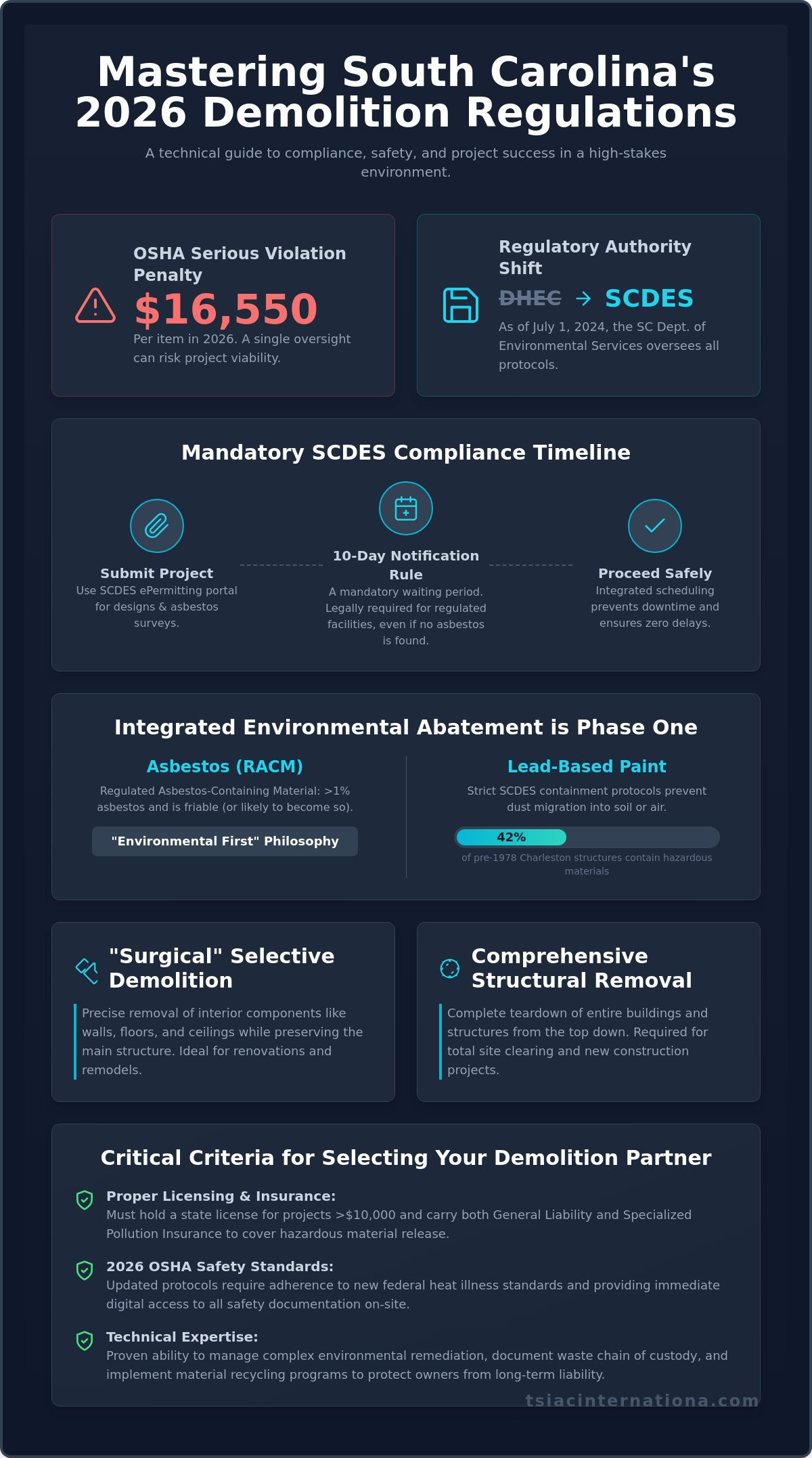
With OSHA serious violation penalties reaching $16,550 per item in 2026, a single oversight on a job site can jeopardize your entire project’s financial viability. In this high-stakes environment, hiring a licensed demolition contractor south carolina is no longer just about structural removal. It’s about managing a rigorous regulatory framework where technical precision is the only safeguard against litigation and heavy fines.

You likely understand that the margin for error in South Carolina is razor-thin, especially with the South Carolina Department of Environmental Services (SCDES) now overseeing strict asbestos protocols and mandatory 10-day notification rules. It’s natural to feel concerned about the complexity of debris disposal laws or the risk of hidden hazardous materials in older structures. We’ve developed this guide to provide the technical clarity you need to master the state’s 2026 demolition regulations, ensuring your site remains compliant and safe. We’ll examine the latest licensing requirements, mandatory safety standards, and the specific environmental protocols necessary for a successful, incident-free project.

Key Takeaways

  • Understand the mandatory transition from DHEC to SCDES and how new 2026 licensing requirements impact your project’s legal compliance and planning.
  • Learn why a licensed demolition contractor south carolina must integrate asbestos and lead abatement into the initial project phase to avoid 10-day notification delays.
  • Discover the operational differences between “surgical” selective demolition for interior renovations and comprehensive structural removal for complete site clearing.
  • Master the 2026 OSHA site safety updates, including new federal heat illness standards and the requirement for immediate digital access to safety documentation.
  • Identify the critical criteria for selecting a demolition partner with the technical expertise to manage complex environmental remediation and material recycling.

Licensing and Regulatory Standards for South Carolina Demolition

In South Carolina, the legal definition of a licensed demolition contractor south carolina is governed by strict state statutes that distinguish between general construction and specialized structural removal. As of July 1, 2024, the South Carolina Department of Environmental Services (SCDES) assumed all regulatory functions from the former DHEC. This administrative shift means that every project involving structural demolition or hazardous material abatement must now adhere to updated SCDES protocols. While private residential properties with four or fewer units are often exempt from specific asbestos regulations unless they’re being cleared for commercial development, all other structures are classified as “regulated facilities.”

The technical complexity of modern demolition methods and safety necessitates more than just physical force. By 2026, industry standards have evolved to require verified general liability and specialized pollution insurance. Standard liability policies often exclude damages related to hazardous material release. For a project to be truly compliant, the contractor must carry coverage that specifically addresses the environmental risks associated with asbestos, lead, and other regulated materials. This methodical approach to risk management is what separates professional firms from general labor crews.

The 10-Day Notification Rule and ePermitting

The SCDES enforces a mandatory 10-day notification rule for any demolition or renovation involving regulated asbestos-containing materials (RACM). This isn’t a suggestion; it’s a hard legal requirement that applies even if no asbestos is present in a regulated facility. Licensed contractors use the SCDES ePermitting portal to submit project designs and asbestos survey data. Managing these timelines is critical. A failure to account for this waiting period can halt a multi-million dollar development, leading to logistical bottlenecks and potential fines of up to $16,550 for serious OSHA violations. Professional contractors integrate this window into the master project schedule to ensure zero downtime.

License Classifications and Liability Protection

Selecting a contractor based on general labor credentials rather than specialized demolition classifications is a high-risk strategy. In South Carolina, commercial projects exceeding $10,000 require a state license issued by the Contractor’s Licensing Board. These credentials ensure the firm possesses the technical knowledge to manage structural stability and environmental containment. Hiring a licensed demolition contractor south carolina with integrated abatement expertise provides a shield against environmental lawsuits. It ensures that the chain of custody for hazardous waste is documented, protecting the property owner from long-term liability under state and federal environmental laws. For developers who require deeper due diligence or verification of corporate histories beyond standard licensing, International Investigative Group offers expert investigative services to help mitigate these high-stakes project risks. We verify every standing with state boards to maintain total transparency and technical precision.

Integrated Asbestos and Lead Abatement in Demolition

Treating demolition and environmental remediation as separate, sequential silos is a logistical error that frequently leads to regulatory friction and cost overruns. A professional licensed demolition contractor south carolina must approach these tasks as a single, integrated operation. If a project manager waits until heavy equipment is on site to address hazardous materials, they’ve already compromised the project’s safety profile and timeline. In South Carolina, the transition to SCDES oversight has reinforced the necessity of identifying Regulated Asbestos-Containing Materials (RACM) well before the first wall is breached. This includes any material that contains more than 1% asbestos and is friable or has a high probability of becoming friable during the wrecking process.

Structural integrity and environmental safety are inextricably linked. Statistics indicate that approximately 42% of pre-1978 structures in the Charleston peninsula contain hazardous materials, making lead-based paint remediation a primary concern. The SCDES requires strict adherence to containment protocols to prevent lead dust from migrating into the surrounding soil or air. We treat these contaminants as the first phase of the physical teardown. This “Environmental First” philosophy ensures that structural removal can proceed without the threat of stop-work orders or environmental litigation. By unifying these workflows, we eliminate the communication gaps that often exist between separate abatement and demolition crews.

The Abatement Process: Containment and Removal

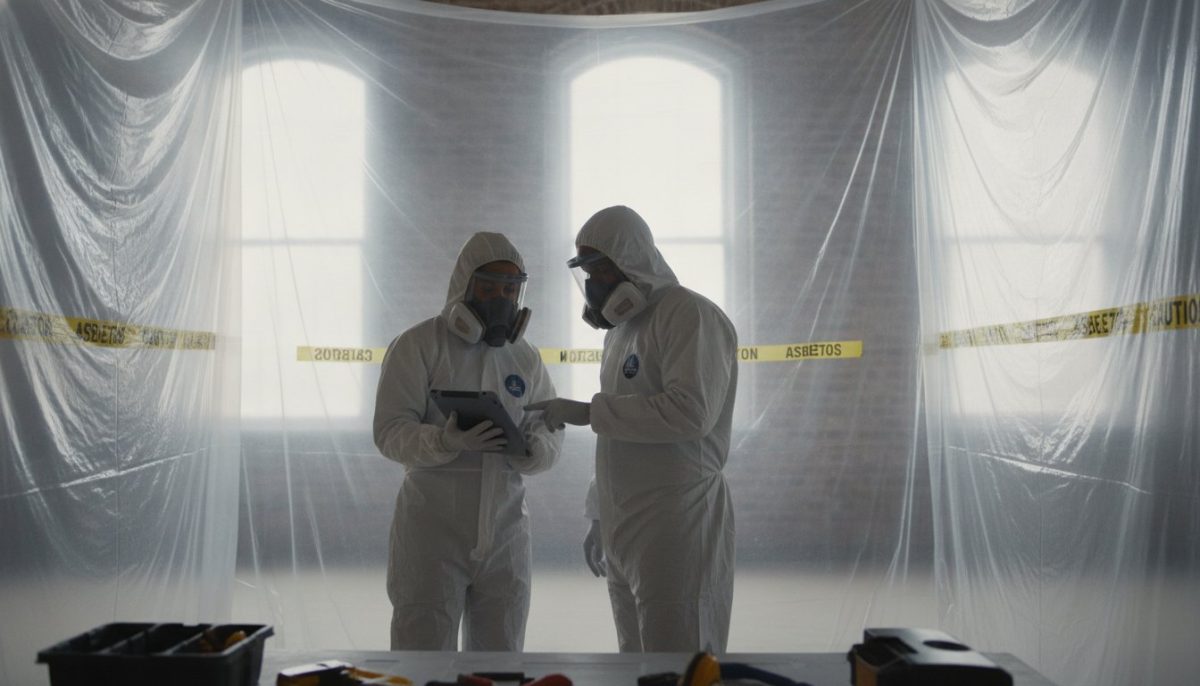
Effective abatement requires the establishment of rigorous containment barriers. We utilize negative pressure zones and industrial-grade HEPA filtration to ensure that interior gutting or structural disturbances don’t release toxic fibers into the atmosphere. Site personnel follow strict decontamination protocols, including the use of multi-stage airlocks and specialized PPE. These procedures align with OSHA demolition safety standards to protect both the workforce and the public. For a deeper analysis of these technical requirements, read our specialized guide on asbestos removal in South Carolina.

Safe Disposal and Toxic Waste Management

The responsibility for hazardous material doesn’t end once it’s removed from the building. State-mandated transport protocols require that all toxic debris be double-bagged, labeled, and hauled by licensed transporters to designated landfills. A transparent chain of custody is your best legal defense. It provides a verifiable paper trail that confirms the material was handled and disposed of in accordance with SCDES regulations. Our framework for hazardous material abatement in South Carolina prioritizes this documentation to protect property owners from future liability. If you’re planning a complex renovation, partnering with a firm that offers an integrated abatement and demolition solution is the most efficient way to maintain compliance.

Evaluating Demolition Methods: Structural vs. Selective

Choosing between total structural removal and selective “surgical” demolition is a decision that dictates the project’s technical requirements and regulatory path. A licensed demolition contractor south carolina provides the necessary expertise to evaluate site conditions and determine which method aligns with the redevelopment’s return on investment. While structural demolition clears the path for entirely new construction, selective demolition allows for the preservation of valuable architectural elements and structural skeletons. Each approach requires a distinct set of machinery and a unique risk management profile to ensure site safety.

The technical mastery of these methods is what separates professional firms from general contractors. Structural projects involve high-reach excavators and hydraulic shears, whereas selective work often requires robotic breakers and precision hand tools. Regardless of the scope, the objective remains the same: a controlled removal process that prioritizes environmental compliance and structural stability. We approach every site with methodological precision, ensuring that the physical execution matches the engineered demolition plan.

When to Choose Structural Demolition

Structural demolition involves the total removal of a building down to the soil. This method is typically chosen when a structure’s integrity is compromised or when the site’s redevelopment value necessitates a complete clearing. In South Carolina, fixed-price structural contracts are often the most efficient way to manage total building removal and debris management. Site preparation involves meticulous utility disconnects for water, gas, and electricity, along with the establishment of perimeter security. We manage the entire footprint, ensuring the foundation and all subterranean concrete are removed to create a clean site ready for immediate redevelopment.

The Precision of Selective Demolition

Selective demolition is a surgical approach used for renovations and remodeling. It involves the strategic removal of specific building wings or sections while maintaining the structural stability of the remaining edifice. This method is common in commercial tenant improvements where interior gutting is required to strip a space back to its studs. Our teams specialize in removing acoustic ceilings, metal framing, and drywall without disturbing load-bearing members or active building systems.

This precision work is essential for office upgrades where the goal is modernization rather than replacement. We utilize specialized equipment for concrete removal in confined spaces, minimizing vibration and dust. This technical accuracy ensures that the renovation phase can begin immediately after the demolition is complete, without the need for structural repairs caused by imprecise removal techniques. If you’re managing a complex interior renovation, a licensed demolition contractor south carolina with experience in selective gut-outs is vital for protecting the building’s long-term value.

Licensed Demolition Contractor in South Carolina: 2026 Regulatory & Safety Guide

Site Safety and Environmental Responsibility in 2026

OSHA Region 4, which includes South Carolina, currently records some of the highest violation rates in the nation, with programmed construction inspections increasing by approximately 8% year-over-year. This heightened enforcement landscape requires a licensed demolition contractor south carolina to implement more than just basic safety gear. It requires a comprehensive Safety Management System (SMS) that incorporates the 2026 federal heat illness prevention standards and real-time digital documentation of all safety training. Technical precision on the job site is the only way to avoid the increased penalties for serious violations, which now reach $16,550 per item.

Our “Environmental First” approach treats every demolition site as a controlled environment where community impact is strictly managed. We utilize industrial water misting systems for dust suppression and seismic monitors to track vibration levels, ensuring that the wrecking process doesn’t compromise the structural integrity of adjacent properties. Managing noise and air quality isn’t just about being a good neighbor; it’s a regulatory necessity in South Carolina’s increasingly dense urban corridors. For a detailed breakdown of these operational phases, you can review our guide on the demolition process in South Carolina.

Recycling and Debris Management Strategies

Effective debris management starts with source separation. Instead of co-mingling waste, we sort wood, metal, and plastic directly on the job site. This methodology significantly reduces the volume of material sent to South Carolina landfills and supports regional sustainability goals. Metal recovery, in particular, offers a dual benefit by diverting tons of waste from the environment and potentially lowering total project fees through material scrap value. We coordinate the logistics of hauling these materials to specialized recycling centers, ensuring that every load is documented for your project’s environmental records.

Site Stabilization and Post-Demolition Care

The final phase of any project is site stabilization. Once the structural elements and foundations are removed, the site must be graded and stabilized to prevent soil erosion. We implement SCDES-compliant erosion control measures, such as silt fencing and sediment basins, to protect local watersheds. Our goal is to deliver a site that is entirely “build-ready,” allowing the next phase of development to proceed without the need for additional clearing or environmental remediation. This methodical transition from demolition to stabilization is a hallmark of a professional firm.

With a clean, build-ready site, the focus shifts to redevelopment and selecting the right commercial tenants or ventures; for those looking to capitalize on prime real estate, the opportunity to Own a Russo’s New York Pizzeria & Italian Franchise – Pizza Franchise Opportunity offers a proven model for success in a newly prepared location.

Secure your project’s compliance by partnering with a licensed demolition contractor south carolina that prioritizes environmental precision and technical safety. Contact TSIAC International today to discuss your site safety and recycling strategy.

Choosing TSIAC International for Your South Carolina Project

Selecting a partner for your structural or selective removal project requires a focus on proven technical performance and regulatory mastery. TSIAC International brings over 15 years of industry experience to every job site, serving as a premier licensed demolition contractor south carolina. Our history isn’t just defined by the buildings we’ve removed; it’s defined by the complex environmental challenges we’ve successfully mitigated for homeowners, general contractors, and government agencies alike. We understand that in 2026, the success of a project is measured by its safety record and its unwavering adherence to the evolving SCDES and OSHA standards.

The TSIAC Advantage: Safety and Experience

Our integrated model is a direct response to the inefficiencies of traditional demolition. By combining asbestos and lead abatement with structural removal, we provide a one-stop solution that eliminates the logistical delays common when managing multiple vendors. This approach ensures that the 10-day SCDES notification window and hazardous material disposal are handled within a single, cohesive project plan. Whether we’re performing a delicate interior gut-out for a residential remodel or a large-scale commercial structural removal, our focus remains on technical precision and environmental responsibility. We manage all regulatory paperwork, providing you with a transparent chain of custody and the peace of mind that comes from professional compliance management.

Get Started with a Professional Assessment

The first step toward a successful project is a thorough professional assessment. We don’t believe in generic estimates. Instead, we provide fixed-price structural or selective demolition quotes based on concrete site data. During our initial evaluation, we conduct a comprehensive site safety and hazardous material survey to identify potential risks before work begins. This methodical preparation allows us to account for debris management, recycling strategies, and site stabilization from day one. It’s this level of detail that has established TSIAC International as a leader in the region’s demolition and abatement sector.

Our commitment to safe, efficient, and environmentally responsible project completion means we’re more than just a contractor; we’re a partner in your site’s future. By choosing a licensed demolition contractor south carolina with a deep understanding of local environmental laws, you’re investing in the long-term viability of your property. We’ve optimized our workflows to ensure that your site is cleared, stabilized, and ready for its next phase of development without unnecessary downtime or regulatory risk.

Securing the Future of Your South Carolina Development Site

Mastering South Carolina’s 2026 demolition landscape requires more than heavy machinery; it demands a deep understanding of environmental law and site safety protocols. The transition to SCDES oversight and updated OSHA standards means that technical compliance is now a cornerstone of project success. By prioritizing an integrated model of abatement and removal, you ensure that your site is stabilized and ready for immediate redevelopment without the risk of hidden liabilities. The precision of a licensed demolition contractor south carolina is your best defense against regulatory friction and project delays.

TSIAC International provides the certainty of 15+ years of industry experience and specialized expertise in SCDES regulatory compliance. We’re fully licensed and insured for both structural removal and hazardous material abatement, ensuring that every project meets the highest professional standards. Our methodological approach ensures that your site is cleared and stabilized with technical accuracy and environmental integrity.

Request a Professional Demolition and Abatement Quote from TSIAC International to begin your project with a foundation of safety and expertise. We’re ready to help you achieve a compliant and successful site transformation.

Frequently Asked Questions

Do I need an asbestos survey before demolition in South Carolina?

Yes, a professional asbestos survey is mandatory for all regulated facilities in South Carolina before any structural removal or renovation begins. The South Carolina Department of Environmental Services (SCDES) requires this inspection to identify Regulated Asbestos-Containing Materials (RACM) that could become friable during the wrecking process. Even if you believe your building is clear of hazardous materials, a certified inspector must document the findings to ensure legal compliance.

How long does it take to get a demolition permit from SCDES?

The timeline for a demolition permit is primarily governed by the mandatory 10-day notification period required by the SCDES. This waiting period begins once your notification is successfully submitted through the state’s ePermitting portal. You should also account for additional administrative processing times at the local county or municipal level, which can vary depending on the specific jurisdiction of your project site.

What is the difference between structural and selective demolition?

Structural demolition involves the total removal of an entire building down to the soil, including the foundation and all subterranean concrete. Selective demolition is a precision-based “surgical” method used to remove specific wings, interior sections, or architectural elements while leaving the rest of the structure intact. We often utilize selective methods for interior gutting projects where a commercial space is stripped back to its studs for renovation.

Can I perform my own asbestos removal on a residential property in SC?

While South Carolina law may permit homeowners to perform work on their primary single-family residence, we strongly advise against DIY asbestos removal. Handling toxic fibers without industrial HEPA filtration, negative pressure containment, and specialized PPE poses severe health risks to the occupants and the surrounding community. Furthermore, if the residential property is being demolished for commercial development, it must be handled by a licensed demolition contractor south carolina.

How much does commercial demolition cost per square foot in 2026?

Commercial demolition costs are determined by several technical variables, including the structure’s height, construction materials, and the presence of hazardous contaminants. Factors like site accessibility and the proximity of adjacent buildings also influence the final budget. We provide fixed-price structural contracts that incorporate debris management and environmental remediation to ensure you have a predictable financial framework for your redevelopment project.

What materials are typically recycled during a demolition project?

Professional demolition projects prioritize the recovery of structural steel, aluminum, copper wiring, and untreated wood through source separation. Concrete and masonry debris are frequently crushed on-site or at specialized facilities to be repurposed as aggregate for new construction. This methodical recycling process reduces landfill volume and supports regional environmental goals while potentially lowering total project fees through material recovery credits.

Does a demolition contractor handle utility disconnects?

A professional contractor coordinates the safe capping and verification of all utility lines, including water, gas, electricity, and sewer, before any physical removal begins. While the property owner typically initiates the service termination request with the providers, we ensure that the disconnects are physically secured at the project perimeter. This verification is a critical safety step that prevents accidental strikes and protects municipal infrastructure during the demolition process.

Why is a 10-day notification required even if no asbestos is found?

The 10-day notification rule is an administrative safeguard that allows SCDES officials the opportunity to review your asbestos survey and perform a site inspection if necessary. This period ensures that all environmental protocols are verified and that the state has a record of the structural removal. It provides a transparent window for regulatory oversight, ensuring that every licensed demolition contractor south carolina adheres to the same safety and environmental standards.

Demolition Debris Recycling in SC: A Guide to Sustainable Material Management

Did you know that nearly 30% of South Carolina’s total waste stream originates from construction and demolition sites, yet up to 75% of those…

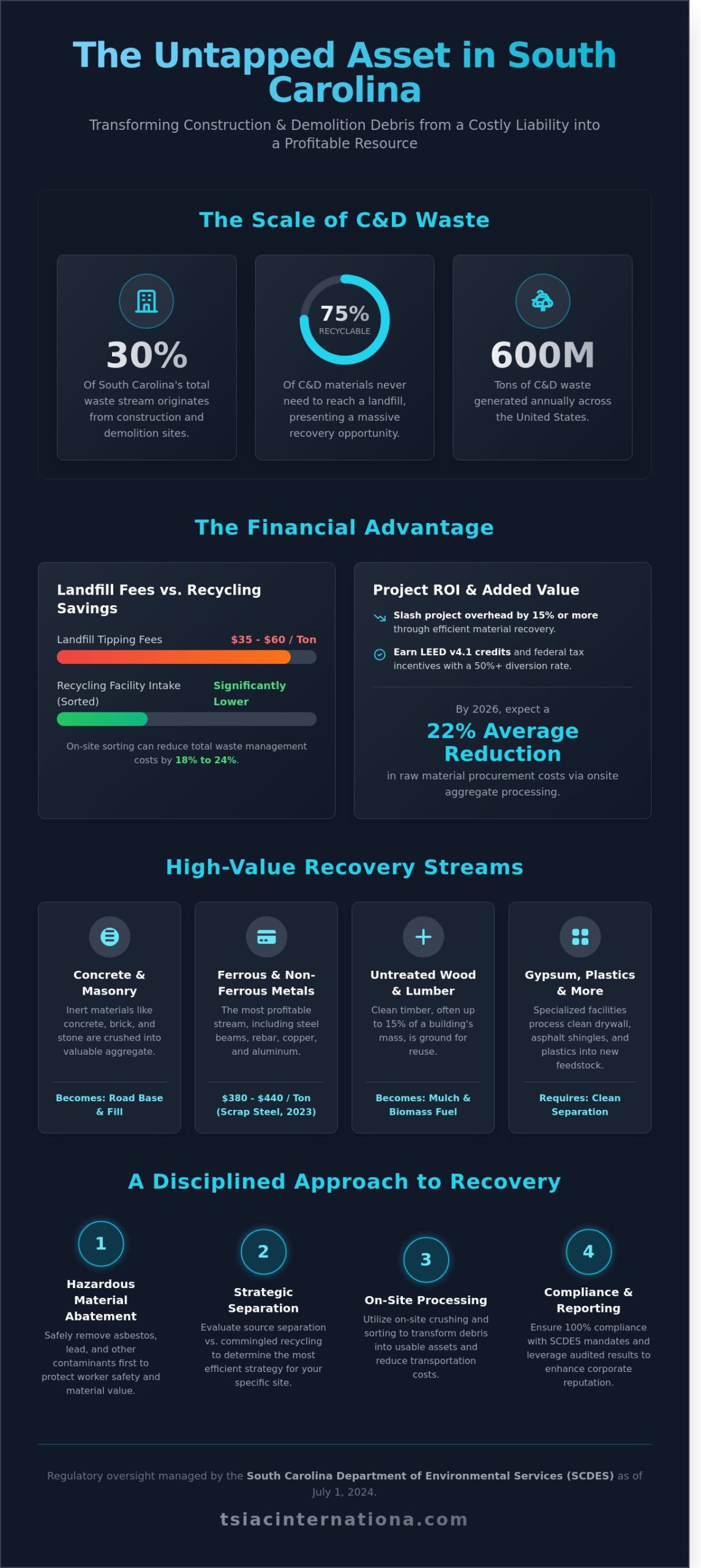
Did you know that nearly 30% of South Carolina’s total waste stream originates from construction and demolition sites, yet up to 75% of those materials never need to reach a landfill? Most project managers accept high landfill tipping fees as an unavoidable cost of doing business. You’re likely balancing the pressure of tight deadlines with the complexity of on-site material sorting and the 2024 South Carolina Department of Environmental Services (SCDES) regulatory updates. It’s a technical challenge that demands engineering precision rather than just a basic disposal plan, especially when dealing with specialized structures or difficult sites.

Implementing a structured approach to demolition debris recycling sc isn’t just an environmental choice; it’s a strategic financial decision. This guide shows you how professional material recovery practices can slash your project overhead by 15% or more while ensuring 100% compliance with state mandates. We’ll examine the technical processes for recovering concrete, steel, and asphalt to transform your waste management into a streamlined, sustainable asset that strengthens your corporate reputation through measurable, audited results.

Key Takeaways

  • Understand South Carolina’s specific C&D regulatory standards to ensure full project compliance while contributing to the diversion of significant industrial waste from landfills.
  • Identify high-value recovery streams, such as ferrous metals and masonry, and learn how on-site crushing can transform debris into cost-saving fill material.
  • Learn how stringent safety protocols for asbestos and lead contamination are vital to protecting the value and feasibility of your **demolition debris recycling sc** efforts.
  • Evaluate the operational advantages of source separation versus commingled recycling to determine the most efficient material management strategy for your site.
  • Discover how an integrated approach combining professional abatement with structural demolition ensures a seamless, safe, and environmentally responsible project outcome.

Demolition Debris Recycling in South Carolina: Standards and Benefits

South Carolina’s regulatory environment for waste management underwent a significant transition on July 1, 2024, when the South Carolina Department of Environmental Services (SCDES) assumed oversight of the state’s material recovery frameworks. This change reflects a growing urgency to address the 600 million tons of construction and demolition waste generated annually across the United States. Managing these volumes requires more than simple disposal; it demands a disciplined engineering approach to resource recovery. Proper demolition debris recycling sc protocols ensure that structural components are diverted from Class 2 landfills, preserving local airspace and reducing the environmental footprint of large-scale industrial projects.

What Qualifies as C&D Debris in SC?

The SCDES defines construction and demolition (C&D) debris as solid waste resulting from the construction, remodeling, repair, or demolition of structures and roads. It’s a specific classification that excludes municipal household waste and hazardous substances. To maintain site safety and regulatory compliance, contractors must distinguish between "inert" materials and restricted waste. Common components eligible for recovery include:

  • Structural steel, rebar, and miscellaneous metals
  • Portland cement concrete and masonry units
  • Brick, stone, and clean soil
  • Glass and asphalt shingles
  • Untreated wood and clearing debris

Inert debris, such as cured concrete and brick, is treated as a priority in the recycling stream. These materials don’t decompose or produce leachate, making them ideal for crushing into high-quality aggregate. Using recycled concrete as a stabilized sub-base for new pavement is a standard practice that meets rigorous load-bearing specifications.

The Economic Case for Material Recovery

Financial performance in the construction sector is tied directly to waste efficiency. Tipping fees at South Carolina landfills typically range from $35 to $60 per ton, depending on the county and material type. By contrast, demolition debris recycling sc facilities often provide lower intake rates for clean, pre-sorted loads. Projects that implement rigorous onsite sorting can reduce their total waste management costs by 18% to 24%.

Beyond immediate savings, sustainable material management opens doors to federal tax incentives and LEED v4.1 credits. Achieving a 50% diversion rate for non-hazardous debris earns points that increase the long-term valuation of a property. It’s a strategy that transforms a liability into a logistical asset.

By the 2026 fiscal cycle, the ROI of debris recycling will be defined by a 22% average reduction in raw material procurement costs through the systematic onsite processing of reclaimed aggregates.

Primary Recyclable Materials in Structural and Selective Demolition

Effective demolition debris recycling sc depends on the precise identification and separation of waste streams at the source. The South Carolina Department of Health and Environmental Control (SCDHEC) estimates that construction and demolition debris makes up approximately 25% of the state’s total waste. Managing these materials requires a disciplined engineering approach to maximize recovery rates and maintain site safety. Success isn’t found in bulk disposal; it’s found in the systematic extraction of secondary raw materials.

  • Concrete and Masonry: Operators crush these materials into 1.5-inch or 3-inch aggregate for use as on-site fill or stabilized road base.
  • Ferrous and Non-Ferrous Metals: This stream includes structural I-beams, rebar, and specialized alloys that command the highest market prices.
  • Untreated Wood and Lumber: Clean timber, often comprising 15% of a building’s mass, is ground into mulch or utilized for industrial biomass fuel.
  • Gypsum Wallboard and Plastics: Specialized processing facilities in the Southeast now accept clean drywall for manufacturing new feedstock, provided it’s free of lead-based paint and adhesives.

High-Value Metal Recovery

Metals represent the most profitable component of any structural teardown. Structural steel, copper piping, and aluminum wiring maintain high scrap value even during market shifts. During the 2023 fiscal year, scrap steel prices averaged between $380 and $440 per ton. Technical teams achieve maximum purity by extracting these materials before general demolition begins. This selective approach prevents cross-contamination and ensures the highest possible return. Timing the sale based on London Metal Exchange (LME) data ensures the project’s financial stability and offsets total project costs.

Aggregate Recycling: Concrete and Brick

On-site mobile crushing units eliminate the need for hundreds of heavy vehicle trips. This process transforms old foundations into high-quality fill that meets SCDOT Standard Specifications for Highway Construction. Utilizing 1,000 tons of recycled concrete on-site can save a project over $18,000 in hauling and disposal fees. It also reduces carbon emissions by roughly 42% compared to importing virgin stone. For projects involving complex industrial execution, on-site recycling provides a logistical advantage that keeps tight schedules on track. It’s a method that turns a waste liability into a structural asset.

Demolition Debris Recycling in SC: A Guide to Sustainable Material Management

Safety dictates the entire project lifecycle. You can’t achieve efficient demolition debris recycling sc if hazardous contaminants infiltrate the waste stream. A single fragment of asbestos-containing material (ACM) can render an entire 30-yard roll-off container unrecyclable, forcing the entire load into a specialized landfill at three times the standard tipping fee. We prioritize the stabilization of the site before any mechanical demolition occurs. This isn’t just a safety preference; it’s a structural necessity for material recovery.

The South Carolina Department of Health and Environmental Control (SCDHEC) enforces strict protocols regarding waste commingling. Mixing hazardous waste with clean masonry or steel triggers civil penalties that often reach $10,000 per day per violation. Protecting the integrity of the recycling stream requires rigorous isolation of lead-based paint and asbestos. If these materials aren’t stripped first, the resulting dust contaminates the aggregate, making it useless for future construction applications.

Pre-Demolition Abatement Requirements

South Carolina law requires a certified asbestos building inspection for all public and commercial renovations or demolitions. This mandate applies regardless of the structure’s age. If the project involves more than 160 square feet of surface area or 260 linear feet of pipe insulation, you must submit a notification to SCDHEC at least 10 working days before work starts. Safe containment ensures friable fibers don’t settle on clean concrete or steel. For detailed procedures, consult our Asbestos Removal in South Carolina: A Complete Guide.

Handling Lead-Contaminated Debris

Structures built before 1978 carry a high probability of lead-based paint. We utilize X-Ray Fluorescence (XRF) analyzers to identify lead concentrations in wood and masonry. If lead levels exceed 1.0 mg/cm², the material is classified as hazardous and requires specialized disposal at a Subtitle C landfill. Selective gutting allows us to strip contaminated architectural elements manually. This process protects workers from inhaling toxic dust and keeps the bulk of the masonry clean for demolition debris recycling sc.

Worker safety remains the primary focus during these phases. We implement several protocols to ensure a clean site:

  • XRF Testing: Rapid on-site analysis of all painted surfaces.
  • HEPA Filtration: Using high-efficiency vacuums during selective gutting to capture 99.97% of particles.
  • Segregated Storage: Placing lead-impacted wood in sealed, 6-mil poly-lined containers to prevent leaching.
  • Worker Decontamination: Mandatory wash stations to prevent the spread of lead dust outside the hot zone.

Best Practices for Job Site Material Management

Efficient demolition debris recycling sc requires a disciplined approach to onsite logistics. It’s not just about disposal; it’s about material recovery through engineering precision. Successful projects treat the job site as a processing facility where every movement is calculated to prevent cross-contamination. This level of control ensures that 95% of extracted steel and 80% of concrete aggregates remain viable for secondary markets. Without a structured flow, valuable materials quickly turn into expensive liabilities.

Source Separation Strategies

Maximizing material value starts at the point of removal. We recommend setting up designated 10×10 foot drop zones for specific material types, such as ferrous metals, clean concrete, and untreated timber. Crews receive 15-minute technical briefings to distinguish between clean loads and contaminated debris, ensuring that gypsum or hazardous insulation doesn’t compromise a 40-yard container of recyclable brick. For complex structures, use hydraulic shears and high-reach excavators for surgical material extraction. This mechanical precision allows operators to pull structural steel directly from the frame, maintaining high purity levels that command better rebates at SC processing centers.

The Logistics of Debris Hauling

Choosing the right equipment determines the project’s bottom line. While 20-yard roll-off containers offer flexibility on tight urban sites in Charleston or Greenville, high-capacity 100-yard trailers are 30% more cost-effective for large-scale industrial clearances. Every haul must be directed to a facility verified by the 2024 SC DHEC list of permitted C&D recycling centers. Developing a rigorous Debris Management Plan becomes a critical legal safeguard by 2026, as South Carolina regulatory bodies will require documented proof of 75% material diversion for all commercial permits exceeding 5,000 square feet. This documentation provides the data trail necessary for municipal audits and environmental compliance certifications.

Maintaining strict site protocols is the only way to guarantee safety and profitability during complex teardowns. For projects requiring this level of technical oversight, partner with a team that provides reliable demolition solutions tailored to South Carolina’s regulatory environment.

Rigorous tracking is the final pillar of professional material management. Digital manifests should record the weight, material type, and destination facility for every load leaving the site. This data isn’t just for internal review; it’s the primary evidence used during state-level environmental audits. By maintaining a transparent chain of custody, contractors prove their commitment to demolition debris recycling sc while protecting the client from potential liability issues associated with illegal dumping or improper waste handling.

Implementing Large-Scale Material Recovery with TSIAC International

Executing a successful strategy for demolition debris recycling sc requires more than just brute force; it demands a disciplined, integrated approach. TSIAC International brings over 15 years of specialized experience to structural and selective demolition projects across the region. By combining hazardous material abatement with material recovery, project timelines are condensed and operational risks are mitigated. This technical synergy ensures that site remediation and recycling efforts occur simultaneously, which reduces downtime for developers and general contractors. Every job site operates under a strict mandate for environmental responsibility, treating waste not as a burden but as a recoverable asset.

The company relies on professional-grade heavy machinery and expert crews trained in precise dismantling techniques. This mechanical advantage allows for the clean separation of materials at the source, which is critical for maintaining the purity of recycled aggregates. Whether the project involves a high-rise structure or a specialized industrial facility, the focus remains on engineering a solution that maximizes material life cycles.

A Comprehensive Service Suite

TSIAC International manages everything from complex interior gutting to total structural removal with engineering precision. Their teams are equipped to handle the removal of over 20 distinct material categories, ensuring that hazardous substances like asbestos or lead-based paint are remediated before the main demolition begins. Every project adheres to national-standard safety protocols, maintaining a zero-incident culture. This rigorous methodology allows for the recovery of high-value materials, such as structural steel and clean concrete, that meet strict industry specifications for reuse in new construction projects.

Partnering for Sustainability

Developers in South Carolina face increasing pressure to meet LEED certification and local environmental mandates. TSIAC provides the transparent reporting necessary to document diversion rates and material destinations for project stakeholders. By maximizing demolition debris recycling sc, clients frequently see a reduction in landfill tipping fees by 30% or more. The firm’s commitment to sustainability is backed by data, providing a clear audit trail for every ton of material processed. This level of transparency ensures that environmental goals are met with verifiable results rather than vague promises.

Contact TSIAC International for a customized demolition and recycling quote to ensure your next project is handled with technical expertise and professional reliability.

Advancing Your Next Project with Sustainable Material Recovery

Effective management of structural waste isn’t just a regulatory checkbox; it’s a strategic advantage for any South Carolina job site. By segregating concrete, steel, and timber, projects can redirect up to 75% of waste materials away from local landfills. This process demands rigorous adherence to safety protocols, especially when dealing with hazardous substances. Our team maintains comprehensive Asbestos and Lead Abatement Certification to ensure every site meets DHEC standards without costly delays.

Implementing a robust strategy for demolition debris recycling sc requires technical precision and heavy-duty logistics. TSIAC International brings over 15 years of industry experience to the field, specializing in complex structural removals that require engineering accuracy. We’ve successfully managed large-scale recoveries across the Southeast, proving that efficiency and environmental responsibility work together. You deserve a partner who prioritizes safety and professional reliability on every square foot of the site.

Request a Professional Demolition Quote from TSIAC International to secure a partner with a proven track record in high-stakes material management. We’re ready to bring our technical expertise to your project today.

Frequently Asked Questions

What exactly is considered construction and demolition (C&D) debris?

Construction and demolition debris consists of waste materials generated during the renovation, repair, or destruction of structures and roads. This category includes heavy materials like concrete, steel, wood, and asphalt, alongside finishing components such as drywall and carpeting. The EPA reported that the United States generated 600 million tons of C&D debris in 2018, which is double the amount of municipal solid waste produced annually across the country.

Is recycling demolition debris actually cheaper than taking it to a landfill?

Recycling is often more cost-effective because it avoids high tipping fees and generates revenue from salvaged materials. In South Carolina, landfill fees average $45 per ton, while demolition debris recycling sc facilities frequently offer lower rates for sorted loads. You’ll reduce transportation costs by processing concrete on-site into aggregate, which saves approximately $15 per ton in haul-away expenses and new material purchases for the next phase.

Can I recycle wood that has been painted with lead-based paint?

You can’t recycle wood contaminated with lead-based paint because it’s classified as hazardous waste under federal safety standards. Materials painted before 1978 are subject to strict SCDHEC disposal protocols to prevent environmental contamination. These items must be separated and transported to a Subtitle D landfill, as recycling facilities won’t accept any wood that tests positive for lead concentrations exceeding 5,000 parts per million during initial screening.

How much of a building can typically be recycled during demolition?

A standard industrial project can achieve a diversion rate of 75% to 90% when using deconstruction techniques instead of traditional wrecking. Metals like steel and copper have a 100% recovery rate, while clean concrete is crushed into usable road base. Implementing a demolition debris recycling sc strategy ensures that only about 15% of the total building mass, primarily insulation and mixed plastics, ends up in a landfill at the project’s conclusion.

What are the South Carolina regulations for disposing of unrecyclable debris?

Unrecyclable materials must be managed according to SCDHEC Regulation 61-107.19, which governs solid waste management. This law requires that all non-recoverable C&D waste goes to a permitted Class 2 or Class 3 landfill. Site managers must keep disposal manifests for at least 3 years to prove compliance during state inspections, ensuring that no hazardous substances enter the local groundwater systems or violate the structural integrity of the disposal site.

Do I need a special permit to recycle concrete on my project site?

You’ll need a General Permit for Crushing and Grinding from the SCDHEC Bureau of Air Quality if your equipment exceeds certain capacities. Specifically, any portable crusher processing more than 150 tons of material per hour requires a formal registration. We manage these permits to ensure dust control measures meet the 20% opacity limit required by state law, maintaining site safety and legal standing throughout the crushing operation.

How does asbestos abatement affect the overall recycling timeline?

Asbestos abatement typically adds 14 days to your project schedule due to mandatory regulatory waiting periods. South Carolina law requires a 10-working-day notification to SCDHEC before any disturbance of regulated asbestos-containing material begins. Once the 48-hour post-abatement air clearance testing is finished, the remaining structure can be safely processed for recycling without the risk of contaminating the clean debris streams with hazardous fibers.

What materials are currently banned from South Carolina C&D landfills?

South Carolina law prohibits the disposal of 5 specific categories of waste in C&D landfills, including whole tires and lead-acid batteries. You can’t dispose of liquid waste, hazardous chemicals, or regulated asbestos-containing material in these facilities. These bans, enforced under Regulation 61-107.19, protect the environment and prevent toxic leaching into the surrounding soil. All banned items must be diverted to specialized processing centers, and if you need to manage scrap tires, you can find out more about recycling solutions.