Professional Drywall Removal and Recycling: The 2026 Industrial Guide

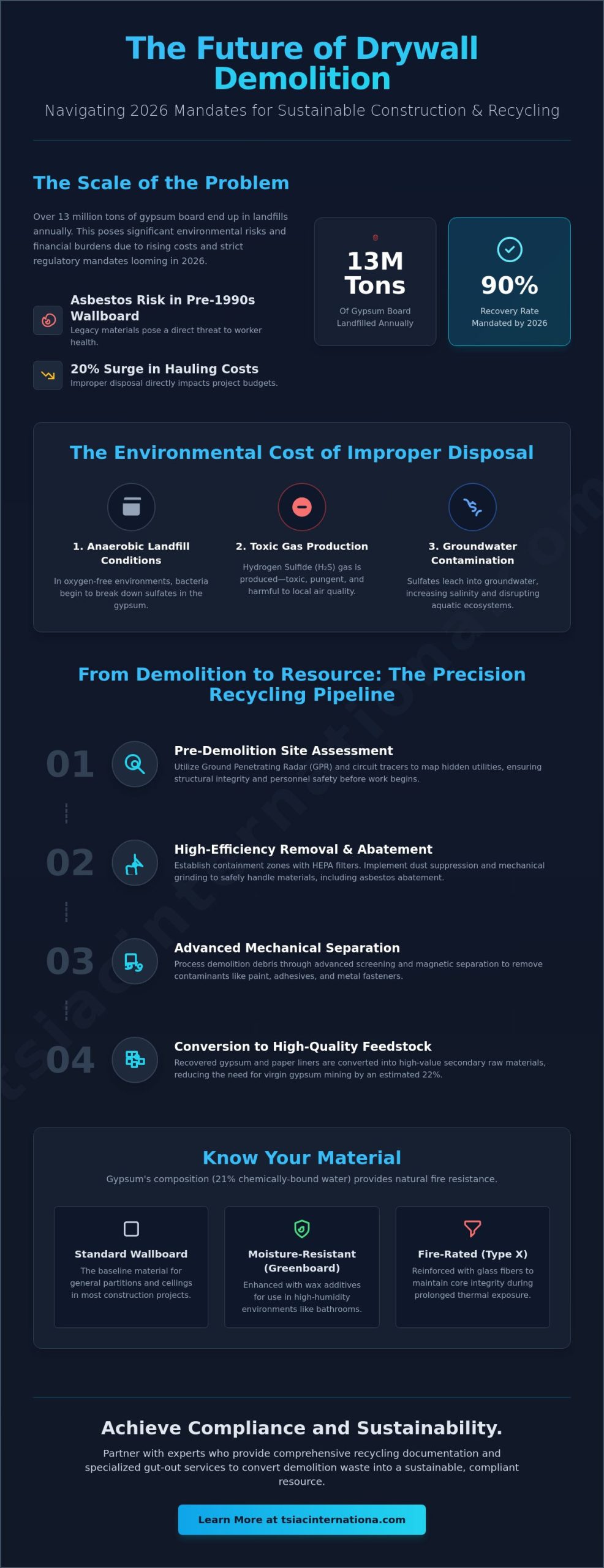
Over 13 million tons of gypsum board reach landfills annually, despite 2026 environmental mandates requiring a 90% recovery rate for industrial…

Over 13 million tons of gypsum board reach landfills annually, despite 2026 environmental mandates requiring a 90% recovery rate for industrial construction materials. Handling this volume requires more than just labor; it demands engineering precision during drywall removal and recycling to maintain site safety and operational flow. You’ve likely dealt with the 20% surge in hauling costs or the technical complexity of identifying legacy hazardous materials like asbestos in pre-1990 wallboard installations. These risks represent more than just a logistical hurdle; they’re a direct threat to project timelines and worker health.

Mastering these technical requirements is now a baseline for firms prioritizing regulatory compliance and structural integrity. This guide provides the framework for safe demolition, hazardous material screening, and the implementation of high-efficiency recycling protocols. We’ll walk you through the entire pipeline from initial site assessment to the final reduction of your project’s carbon footprint through verified recovery streams. By the end of this guide, you’ll have a clear roadmap for converting demolition waste into a sustainable, compliant resource with surgical precision.

Key Takeaways

  • Learn the engineering-grade protocols for pre-demolition site assessments and utility locating to ensure structural integrity and personnel safety.
  • Identify the critical risks associated with legacy wallboard, specifically focusing on how to detect and manage chrysotile asbestos in pre-1980s joint compounds.
  • Implement high-efficiency drywall removal and recycling strategies that utilize dust suppression and mechanical grinding to meet 2026 landfill diversion mandates.
  • Understand the mechanical separation process that converts gypsum and paper liners into high-quality feedstock through advanced screening and magnetic separation.
  • Establish measurable ESG metrics for your corporate sustainability reports by selecting demolition partners who provide comprehensive recycling documentation and specialized gut-out services.

The Fundamentals of Drywall Removal and Recycling in 2026

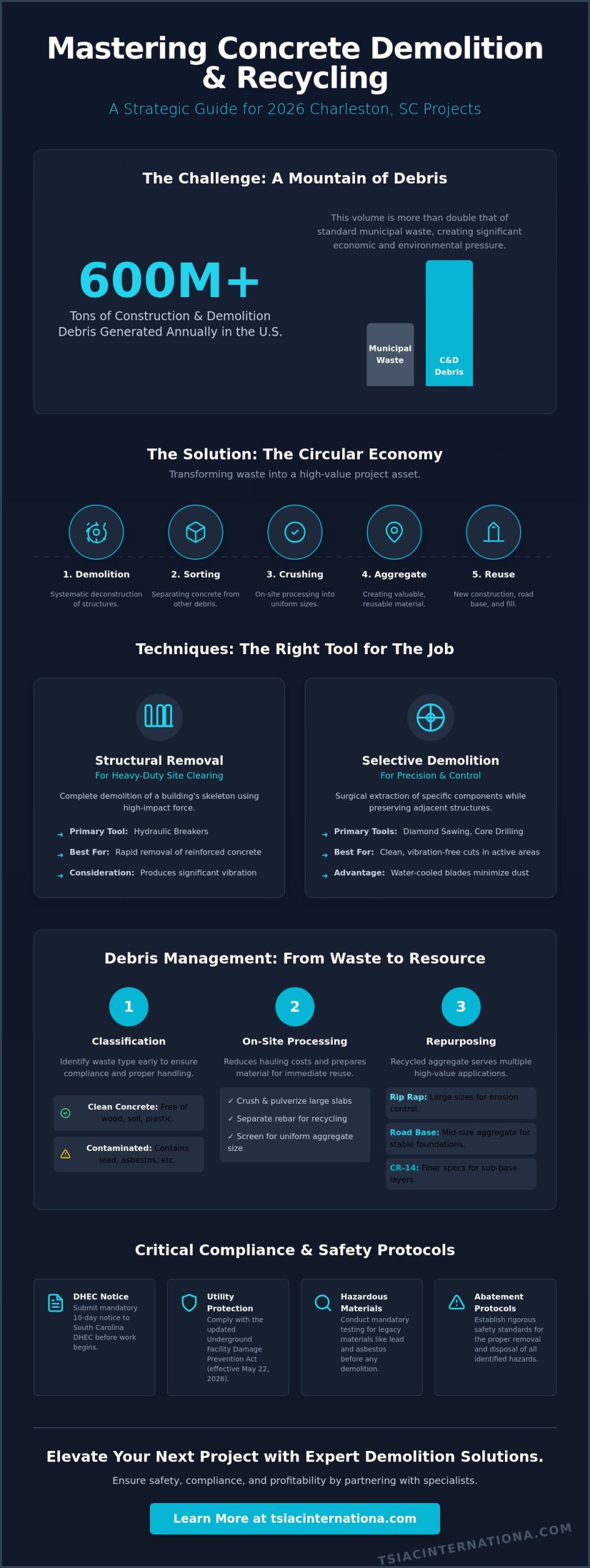
Drywall, primarily composed of a gypsum core (calcium sulfate dihydrate) sandwiched between heavy paper liners, serves as the structural backbone of modern interior construction. As of 2026, the industrial sector has shifted from simple disposal to sophisticated recovery. Effective drywall removal and recycling strategies now dictate project profitability and regulatory compliance. Current frameworks mandate a 75% diversion rate for construction and demolition (C&D) waste in major metropolitan areas, making gypsum a priority material for recovery operations.

Distinguishing between “clean” scrap and demolition debris is a technical necessity for site managers. Clean scrap consists of unpainted offcuts from new installations, which processing facilities handle with 95% efficiency. Demolition debris often contains contaminants like lead paint, heavy adhesives, or rusted fasteners, requiring advanced mechanical separation. The Gypsum recycling process allows this recovered material to return to the manufacturing loop; this reduces the demand for virgin gypsum mining by an estimated 22% annually. This circular economy model ensures that high-volume waste becomes a high-value secondary raw material.

Understanding Gypsum Composition

Gypsum’s chemical properties make it uniquely suited for infinite recycling without structural degradation. It contains approximately 21% chemically combined water by weight. This composition provides natural fire resistance. When exposed to high heat, the water molecules are released as steam, which actively slows the transfer of heat through the wall assembly. In 2026, installers categorize boards into three primary technical grades:

  • Standard Wallboard: The baseline for general partitions and ceilings.
  • Moisture-Resistant (Greenboard): Enhanced with wax-based additives for high-humidity environments.
  • Fire-Rated (Type X): Reinforced with glass fibers to maintain core integrity during prolonged thermal exposure.

Environmental Impact of Improper Disposal

Landfilling drywall creates severe environmental liabilities that modern firms must mitigate. In anaerobic, oxygen-free conditions, specialized bacteria break down sulfates to produce hydrogen sulfide (H2S) gas. This gas is toxic and carries a pungent odor; it often reaches concentrations above 50 ppm in poorly managed landfill sites. Additionally, sulfates leach into groundwater systems if the landfill liner fails, which increases salinity and disrupts local aquatic ecosystems.

The 2026 EPA guidelines for C&D waste have tightened significantly to address these risks. New mandates require documented chain-of-custody reports for all gypsum products removed from job sites exceeding 5,000 square feet. Precise drywall removal and recycling isn’t just an environmental preference. It’s a rigorous technical requirement for maintaining operational licenses and avoiding heavy non-compliance fines in the current industrial landscape.

A Systematic Process for Professional Drywall Demolition

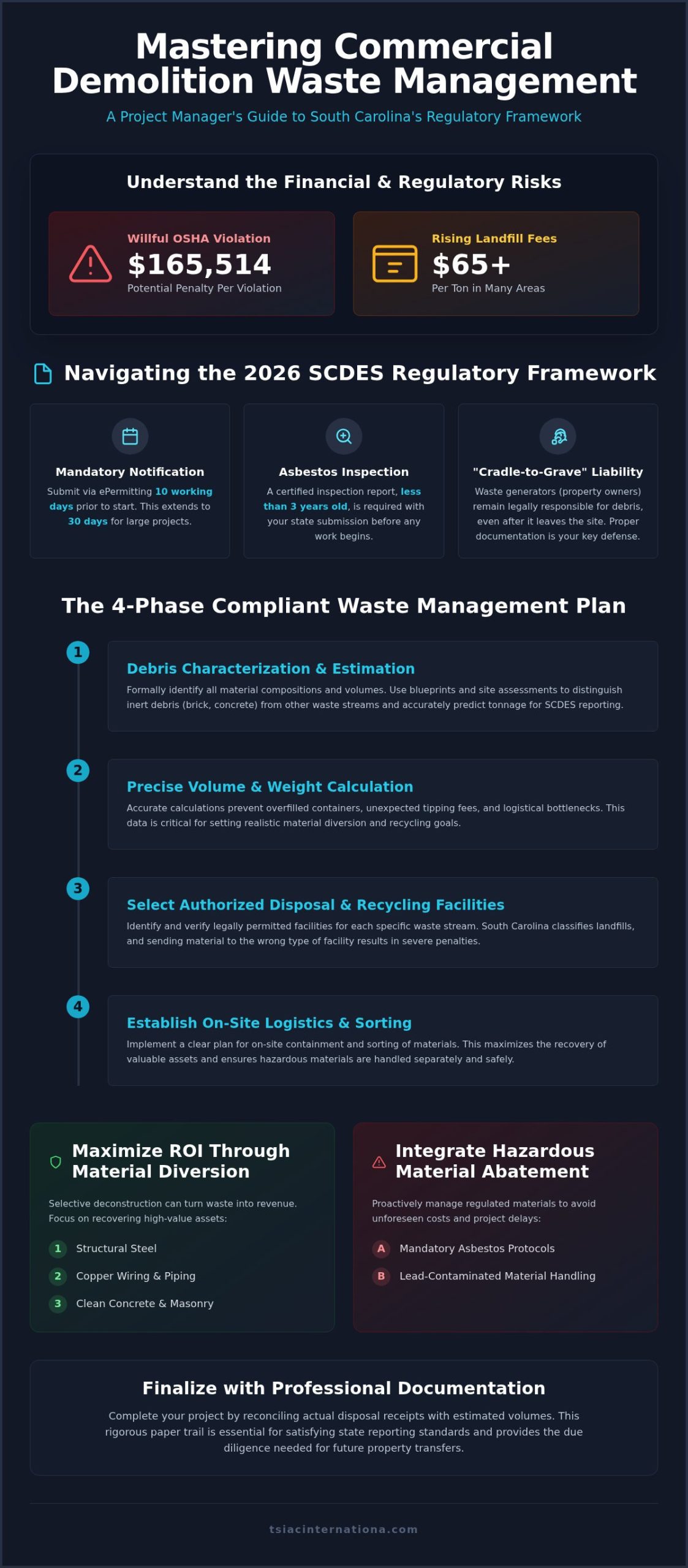
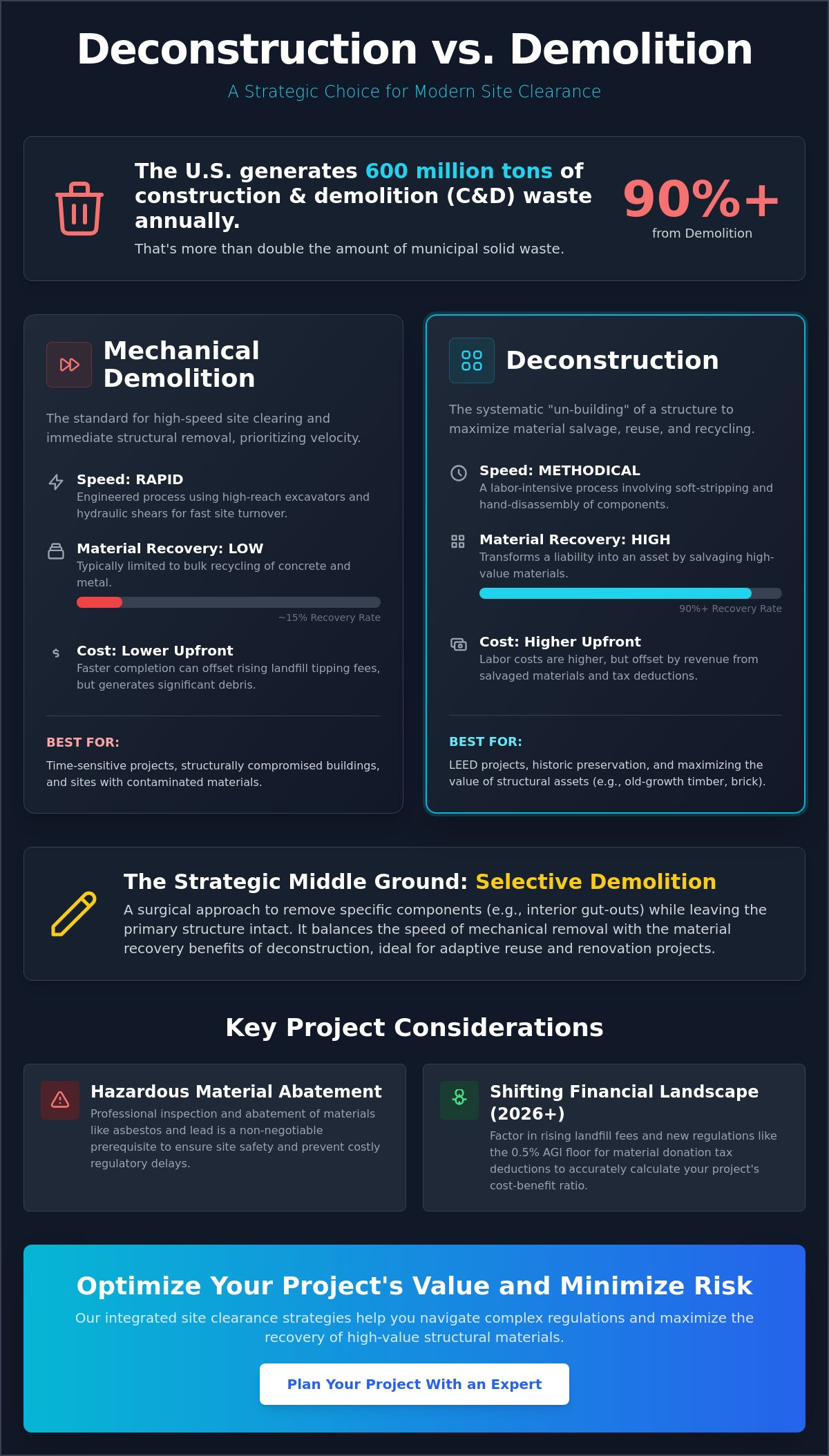
Professional demolition in 2026 demands a shift from blunt force to surgical precision. The objective is no longer just clearing space but maximizing material recovery while protecting the building’s core infrastructure. Every project begins with a comprehensive site assessment where technicians use Ground Penetrating Radar (GPR) and circuit tracers to map hidden utilities. Locating electrical conduits and HVAC sensors before the first strike prevents costly downtime and ensures crew safety. This data-driven approach allows for a demolition plan that respects the structural integrity of the framing and minimizes the risk of accidental damage to high-value systems.

Phase 1: Preparation and Safety

Preparation defines the success of any interior gut-out. Crews establish containment zones using 6-mil fire-retardant polyethylene sheeting to seal all penetrations and doorways. This isolation is reinforced by HEPA-filtered air scrubbers that maintain a controlled environment. Negative air pressure systems are critical because they ensure that airborne particulates remain trapped within the containment zone, preventing cross-contamination of adjacent clean spaces. Safety protocols require all personnel to wear P100 particulate respirators and puncture-resistant gloves. These measures are standard for teams handling drywall removal and recycling in sensitive industrial environments where air quality is non-negotiable.

Phase 2: Execution and Material Recovery

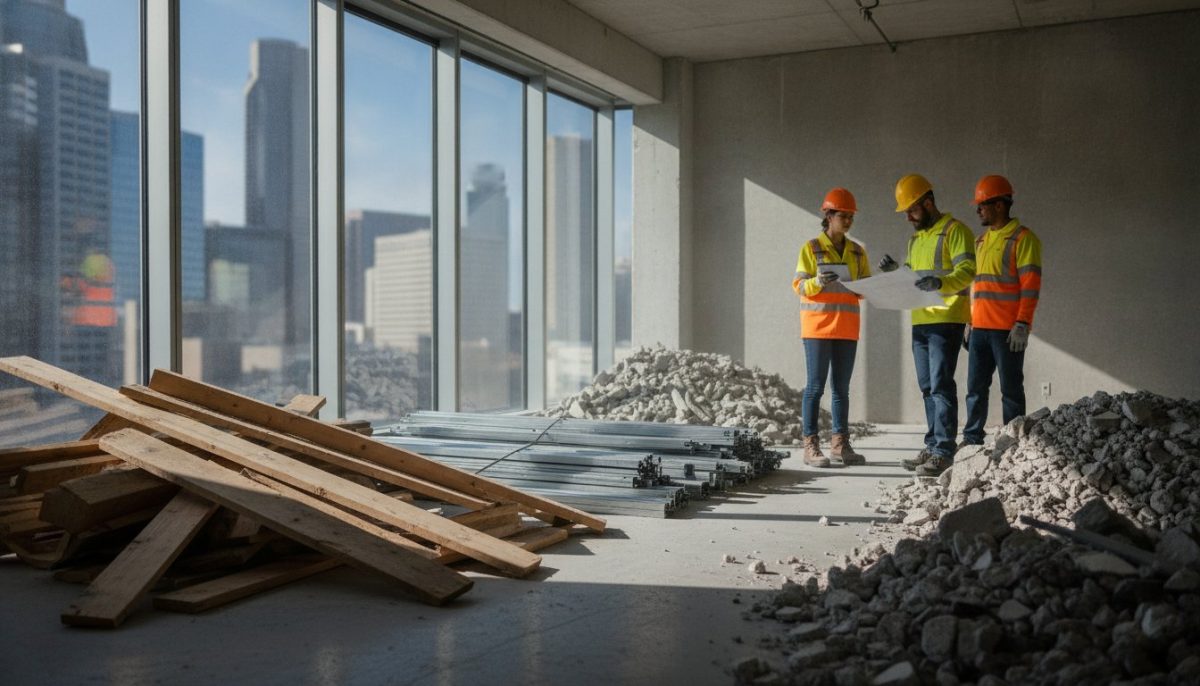
The choice between mechanical and manual removal is dictated by the project’s volume and the specific recycling goals. On massive industrial sites, specialized robotic demolition units can increase removal speeds by 35% compared to traditional methods. However, manual stripping remains the preferred technique for preserving light-gauge metal framing. Technicians use specialized shears to release gypsum panels from 20-gauge steel studs, ensuring the metal remains straight and reusable. This level of care is essential for maintaining the building’s skeleton for future fit-outs.

On-site sorting is the engine of the circular economy. We separate clean, unpainted scrap from contaminated materials at the point of generation to achieve diversion rates exceeding 85%. This process involves staging dedicated 40-yard roll-off containers for specific material streams. Efficient debris loading relies on a “first-in, first-sorted” logic that prevents the mixing of gypsum with wood or insulation. This systematic approach ensures that drywall removal and recycling efforts contribute directly to the project’s sustainability benchmarks. For organizations managing complex industrial gut-outs, this level of logistical control is the difference between a waste-heavy project and a high-yield recovery operation.

Logistics planning includes the use of compact, high-maneuverability lifts to transport debris from the upper floors to the loading bay. By timing these movements to avoid peak site activity, we maintain a steady flow of materials without disrupting other trades. This fegyelmezett (disciplined) execution ensures that the site remains clean, safe, and ready for the next phase of construction with minimal delay.

Professional Drywall Removal and Recycling: The 2026 Industrial Guide

Hazardous Material Abatement: Asbestos and Lead in Wallboard

Safety isn’t a secondary consideration in industrial demolition; it’s the foundation of every successful project. The critical intersection of hazardous material abatement and modern drywall removal and recycling protocols ensures that environmental liabilities don’t derail a construction schedule. Properties built before 1980 represent a specific risk profile. In these structures, joint compounds frequently contain chrysotile asbestos. While the gypsum core itself might be clean, the finishing materials often exceed the 1% regulatory threshold for asbestos-containing materials (ACM). This requires a specialized approach to extraction and waste management.

Asbestos Screening and Compliance

Industrial projects must distinguish between “hot” and “cold” demolition environments. A “hot” demolition involves the presence of ACMs and necessitates full negative-pressure containment and specialized filtration. A “cold” demolition only proceeds after certified inspectors provide a negative test result for hazardous fibers. Professional abatement is the only way to prevent cross-contamination of the recycling stream. If asbestos-tainted gypsum enters a standard processing facility, it can trigger immediate shutdowns and massive decontamination costs. Every project requires a strict chain of custody. This documentation tracks every kilogram of waste from the moment of removal to its arrival at a specialized disposal or treatment facility.

Lead-Safe Demolition Practices

Lead-based paint is a persistent challenge in commercial and residential renovations, particularly for buildings dated before 1978. Even if the drywall was installed later, it’s common to find legacy lead coatings on older surfaces or within structural cavities. Managing these materials requires strict adherence to the Renovation, Repair, and Painting (RRP) Rule. This federal mandate requires that firms use certified lead-safe work practices to protect occupants and workers alike. Demolition teams utilize wet-scraping techniques to keep dust levels low. High-efficiency particulate air (HEPA) vacuuming protocols are standard for capturing microscopic particles that traditional cleaning methods miss. These rigorous standards are essential for any drywall removal and recycling effort involving painted surfaces. Verification through post-remodeling dust wipe sampling ensures the site meets all safety benchmarks before the next phase of construction begins.

The Recycling Pipeline: From Job Site to New Feedstock

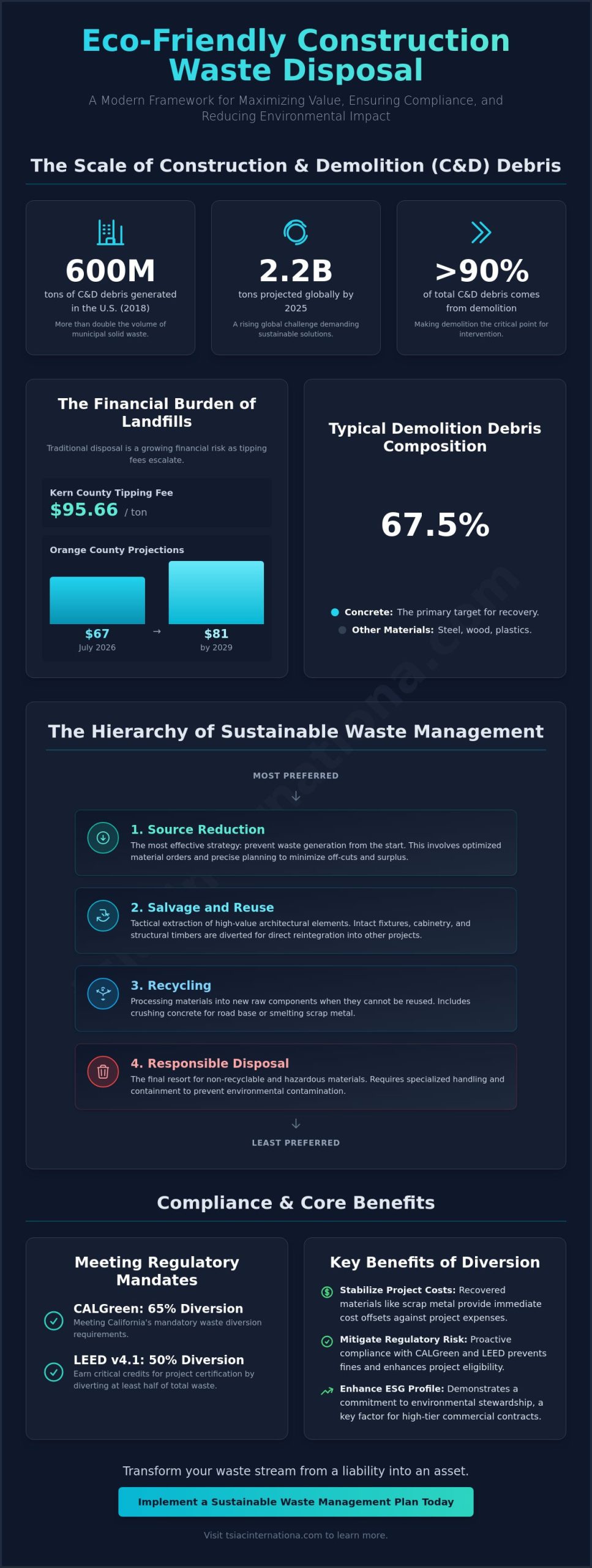
The industrial lifecycle of construction waste has evolved from a linear disposal model into a sophisticated closed-loop system. Effective drywall removal and recycling transforms brittle debris into high-purity raw materials, reducing the environmental footprint of large-scale projects. This transition isn’t just about sustainability; it’s a financial strategy. Landfill tipping fees for C&D (Construction and Demolition) waste have increased by an average of 12% annually in major industrial hubs since 2023. By diverting gypsum from the waste stream, contractors lower these overhead costs while qualifying for up to two LEED points under the Construction and Demolition Waste Management category.

The recovery process relies on engineering precision to ensure the final product meets industrial specifications. Modern facilities utilize a sequence of automated steps to isolate the gypsum core from contaminants. This pipeline ensures that materials don’t just disappear into a landfill but instead return to the supply chain as valuable feedstock for the next generation of building products.

The Mechanical Separation Process

Once the material arrives at a processing facility, it enters a high-speed hammer mill. These machines use rotating metal “hammers” to pulverize the gypsum core into a fine powder. Because the paper liners possess higher tensile strength, they don’t shatter like the core. Instead, they remain in larger fragments, allowing mechanical screens and air classifiers to separate the paper from the mineral. A secondary market exists for this recovered paper, which is often processed into animal bedding or industrial insulation.

  • Magnetic Separation: Rare-earth magnets are positioned over the conveyor belts to extract steel screws and nails with 99.8% efficiency.
  • Purity Standards: Quality control protocols ensure the recovered gypsum powder reaches a 99% purity level, a strict requirement for manufacturers.
  • Feedstock Consistency: Automated sensors monitor moisture levels to prevent clumping during the grinding phase.

Agricultural and Industrial Applications

Recycled gypsum’s utility extends far beyond the construction site. In the agricultural sector, it’s used as a soil amendment to improve water infiltration by up to 25% in heavy clay soils. It provides essential calcium and sulfur without significantly altering soil pH, unlike traditional lime. In the industrial sector, gypsum acts as a critical setting regulator in the production of Portland cement, typically making up 3% to 5% of the final mixture to prevent flash setting. A disciplined approach to the demolition process facilitates high-purity recycling by preventing cross-contamination at the source.

We’ve found that early-stage sorting is the only way to guarantee these high-purity outcomes. When the drywall removal and recycling workflow is integrated into the initial project plan, the recovered material maintains its value. It’s a technical process that requires the right equipment and a commitment to precision. If you’re looking to optimize your site’s waste management and improve project efficiency, partner with our technical experts today for a comprehensive waste diversion strategy.

Selecting a Professional Partner for Sustainable Demolition

Choosing a partner for large-scale drywall removal and recycling requires a move beyond simple price comparisons. Industrial projects in 2026 demand a partner who understands the technical intersection of structural integrity and environmental compliance. When you evaluate a commercial interior gutting service, you’re looking for a firm that treats waste as a resource. TSIAC International operates with engineering precision, ensuring that gypsum wallboard is stripped, sorted, and staged for processing without contaminating other debris streams.

Corporate sustainability reports have evolved into rigorous data-driven documents. You can’t rely on vague promises of “going green” anymore. We provide granular recycling documentation that tracks every ton of material from the moment it leaves your site. This transparency is vital for meeting ESG targets and securing LEED certification points. Our commitment to environmental stewardship is matched only by our dedication to site safety. We maintain a zero-incident culture by applying Tier 1 safety protocols to every interior demolition phase, protecting both your assets and our personnel.

The Value of Integrated Abatement and Demolition

Managing separate abatement and demolition teams creates friction that most industrial timelines can’t afford. Scheduling conflicts between different crews often lead to project delays exceeding 12% of the original timeframe. TSIAC eliminates these bottlenecks by integrating hazardous material abatement directly into the demolition workflow. This unified approach ensures 100% compliance with federal EPA and state environmental mandates. One project manager oversees the entire scope, which streamlines communication and ensures that asbestos or lead-paint issues are neutralized before the main gut-out begins. It’s a strategy that prioritizes speed without sacrificing regulatory rigor.

Securing Your Project Quote

An accurate estimate for drywall removal and recycling depends on precise site data. To provide a quote that reflects the true scope of work, we analyze several key factors:

  • Total square footage of the interior surfaces.
  • The age of the structure to determine potential hazardous material presence.
  • Site accessibility for heavy machinery and specialized recycling containers.
  • Current market proximity to gypsum processing facilities.

The ROI of professional waste management is found in the avoidance of landfill surcharges, which can increase disposal costs by 150% if materials aren’t properly sorted. By diverting clean drywall, you reduce your overall project liability. You can find more details on our technical approach by reviewing TSIAC’s comprehensive demolition services. We don’t just clear spaces; we execute controlled, sustainable removals that prepare your facility for its next phase of life.

Advancing Industrial Standards for Sustainable Wallboard Management

Effective drywall removal and recycling in 2026 requires more than simple demolition; it demands a technical approach to hazardous material abatement and environmental circularity. As industry regulations tighten, the transition from job site waste to new feedstock relies on precise separation and documented workflows. Managing lead and asbestos risks isn’t optional, as these materials still impact 35% of renovation projects involving structures built before 1990 according to EPA industry data.

TSIAC International brings over 15 years of abatement and demolition expertise to every project site. Our licensed hazardous material specialists ensure that every square foot of wallboard is handled with engineering precision. We provide comprehensive recycling documentation to guarantee your environmental compliance meets the highest industrial standards. Whether you’re navigating complex structural challenges or high-altitude industrial environments, our team delivers controlled results where others see obstacles. We don’t just clear space; we prepare your site for the next generation of construction.

Request a professional demolition and recycling quote from TSIAC International to secure a partner that values safety as much as your project’s timeline. Let’s build a cleaner industrial future together.

Frequently Asked Questions

Is drywall recycling mandatory in 2026?

Yes, many jurisdictions including Washington State and several Canadian provinces have implemented strict landfill bans on gypsum as of 2026. These regulations require certified drywall removal and recycling for all commercial and residential demolition projects to mitigate the production of hydrogen sulfide gas in landfills. Failure to comply can result in significant municipal fines and the rejection of waste loads at transfer stations.

Can I recycle drywall that has been painted or covered in wallpaper?

You can recycle painted drywall as long as the coating doesn’t contain lead or other hazardous substances. Modern industrial facilities use mechanical separation to strip away 98% of paper and surface contaminants from the gypsum core. If the material features heavy vinyl wallpaper, you’ll need to consult a specialized processor, as standard recycling equipment often struggles with non-biodegradable adhesives.

How do I know if my old drywall contains asbestos?

You must perform laboratory testing for any material installed before 1980. While the gypsum board itself is rarely the issue, the joint compound used in roughly 15% of vintage installations contains chrysotile asbestos fibers. You’ll need to submit three separate 2 inch samples to a certified lab to confirm the material is safe for standard handling before beginning any demolition work.

What is the cost difference between recycling and landfilling drywall?

Recycling typically costs 15% to 25% less than landfilling because of rising environmental surcharges at municipal waste sites. Data from 2025 industry reports shows that diverting clean gypsum saves contractors an average of $30 per ton compared to mixed debris disposal. These financial incentives are designed to offset the labor costs associated with the careful onsite separation of materials.

Can recycled drywall be used for garden soil?

Recycled gypsum works as an excellent soil conditioner for high clay areas because it adds calcium and sulfur without shifting the pH level. Agricultural research indicates that applying 1 to 2 tons per acre improves water penetration and soil structure. You must only use “clean” scrap that’s free from lead paint, adhesives, or synthetic additives to ensure the soil remains safe for food production.

What happens to the metal studs and screws during the recycling process?

Recycling facilities utilize high intensity magnetic pulleys to extract 100% of ferrous metals during the initial crushing phase. These metal components are collected and sent to smelting plants for secondary steel production. This automated extraction process ensures that the final gypsum powder reaches the 99% purity threshold required by manufacturers for the production of new wallboard panels.

Is it safe to live in a house during an interior drywall gut-out?

It’s not advisable to occupy the premises because drywall removal and recycling generates fine dust that often exceeds OSHA’s permissible exposure limits. If relocation isn’t possible, contractors must install HEPA filtered negative air machines and seal all living quarters with 6 mil polyethylene sheeting. Professional teams use specialized vacuum attachments to keep airborne particulate levels below 15 milligrams per cubic meter.

How does drywall recycling contribute to LEED certification?

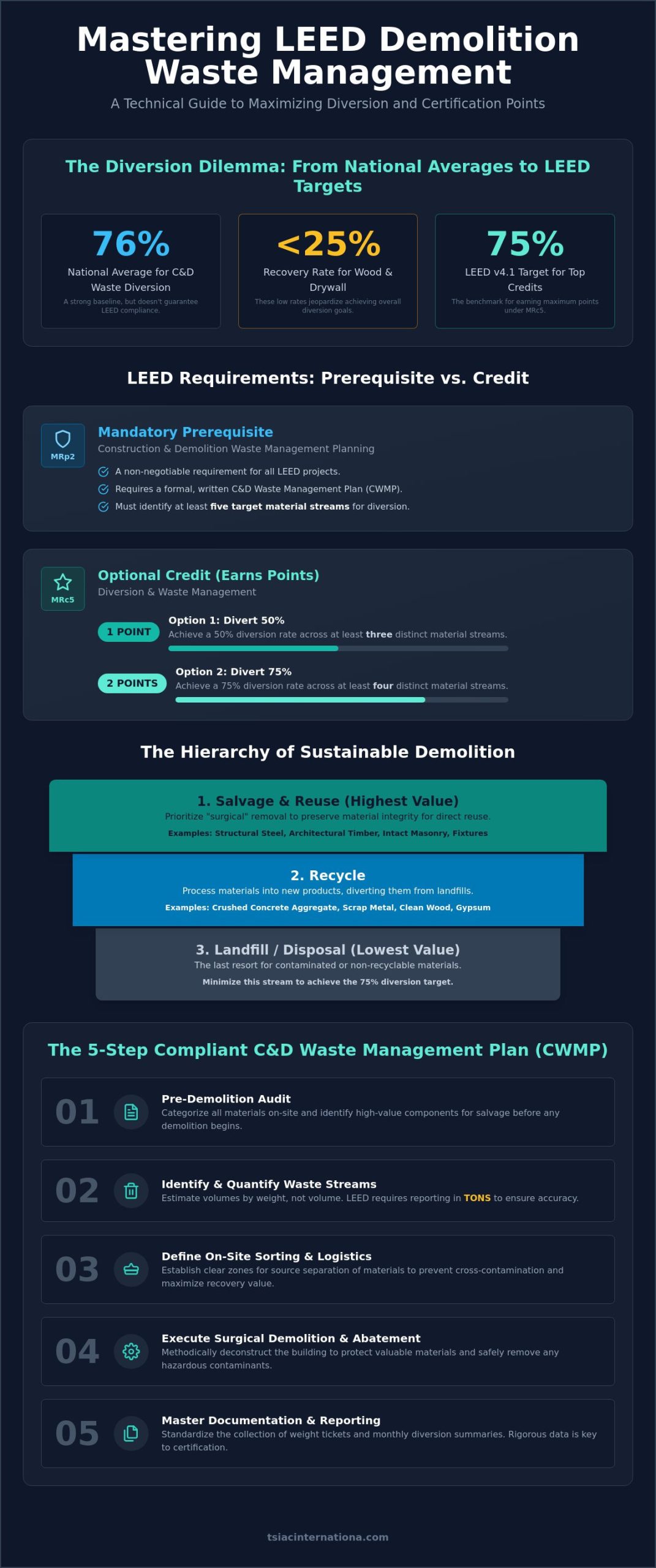
Integrating drywall removal and recycling into your project plan contributes directly to the Construction and Demolition Waste Management credits under the LEED v4.1 standard. Projects that successfully divert 50% of their total waste earn one point, while reaching the 75% threshold earns two points. You’ll need to maintain rigorous weight tickets and diversion reports from the recycling facility to provide the documentation required for final certification.

Metal Framing Disposal in South Carolina: The 2026 Professional Guide

Did you know that unmanaged steel debris can inflate your total project overhead by as much as 12% through excessive hauling fees and lost rebate…

Did you know that unmanaged steel debris can inflate your total project overhead by as much as 12% through excessive hauling fees and lost rebate opportunities? You recognize that site congestion represents a significant logistical bottleneck that compromises structural workflow and safety protocols. Managing high-volume metal framing disposal south carolina is no longer just a cleanup task; it’s a critical component of project precision and financial health. In an industry where margins are tight, unorganized waste is simply capital left on the ground.

We agree that keeping up with the 2026 SC DES recycling mandates requires technical clarity rather than guesswork. This guide promises to provide the exact framework you need to maximize scrap metal rebates while maintaining 100% regulatory compliance for state or LEED audits. We’ll analyze current market rates for heavy steel, outline specific hauling logistics to minimize landfill fees, and show you how to maintain a high-performance site that meets every safety standard.

Key Takeaways

  • Understand the evolving 2026 regulatory standards for commercial demolition and why South Carolina mandates specific metal recovery protocols over traditional waste.
  • Learn to differentiate between cold-formed steel and heavy structural components to optimize your site’s material recovery workflow and maximize recycling efficiency.
  • Navigate the complex logistics of metal framing disposal south carolina by evaluating the cost-efficiency of specialized flatbed hauling versus standard roll-off containers.
  • Master the essential steps for compliant disposal, from conducting precise material volume estimations to securing the necessary state-level demolition and hauling permits.
  • Discover how leveraging professional recovery solutions ensures 100% material recycling, transforming a disposal challenge into a sustainable, project-saving asset.

Understanding Metal Framing Disposal in South Carolina: 2026 Standards

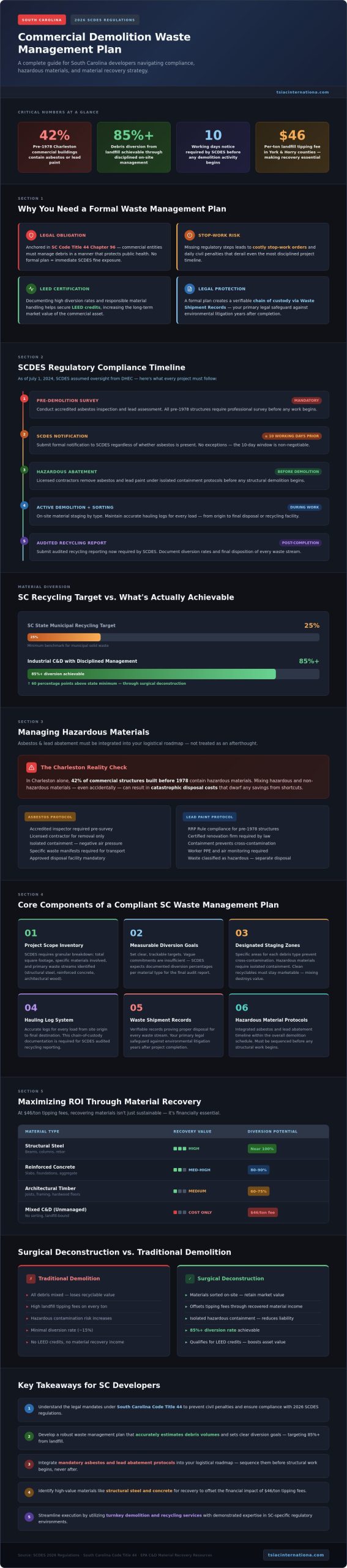
Commercial demolition in the Palmetto State has entered a phase of high-precision material recovery. As of July 1, 2024, the South Carolina Department of Environmental Services (DES) took over the regulatory duties previously held by DHEC, signaling a stricter approach to construction and demolition (C&D) waste. For project managers, metal framing disposal south carolina is no longer just about clearing a site. It’s a technical process of separating light-gauge steel from contaminated debris to meet 2026 sustainability benchmarks. Steel remains the most recycled material globally; approximately 98% of structural steel from demolished buildings is diverted from landfills into the circular economy.

The environmental impact of steel recovery far outweighs traditional wood disposal. While wood waste often ends up in C&D landfills where it contributes to methane production, steel is infinitely recyclable without losing its structural integrity. In the Lowcountry and the Grand Strand, market trends show a 14% increase in the demand for recycled building materials over the last 18 months. This shift is driven by local developers who prefer locally sourced, recycled content to insulate their supply chains from global price volatility. Our approach ensures that every ton of cold-formed steel is tracked and processed through certified South Carolina recovery channels.

Why Steel Recovery Matters for Your Project

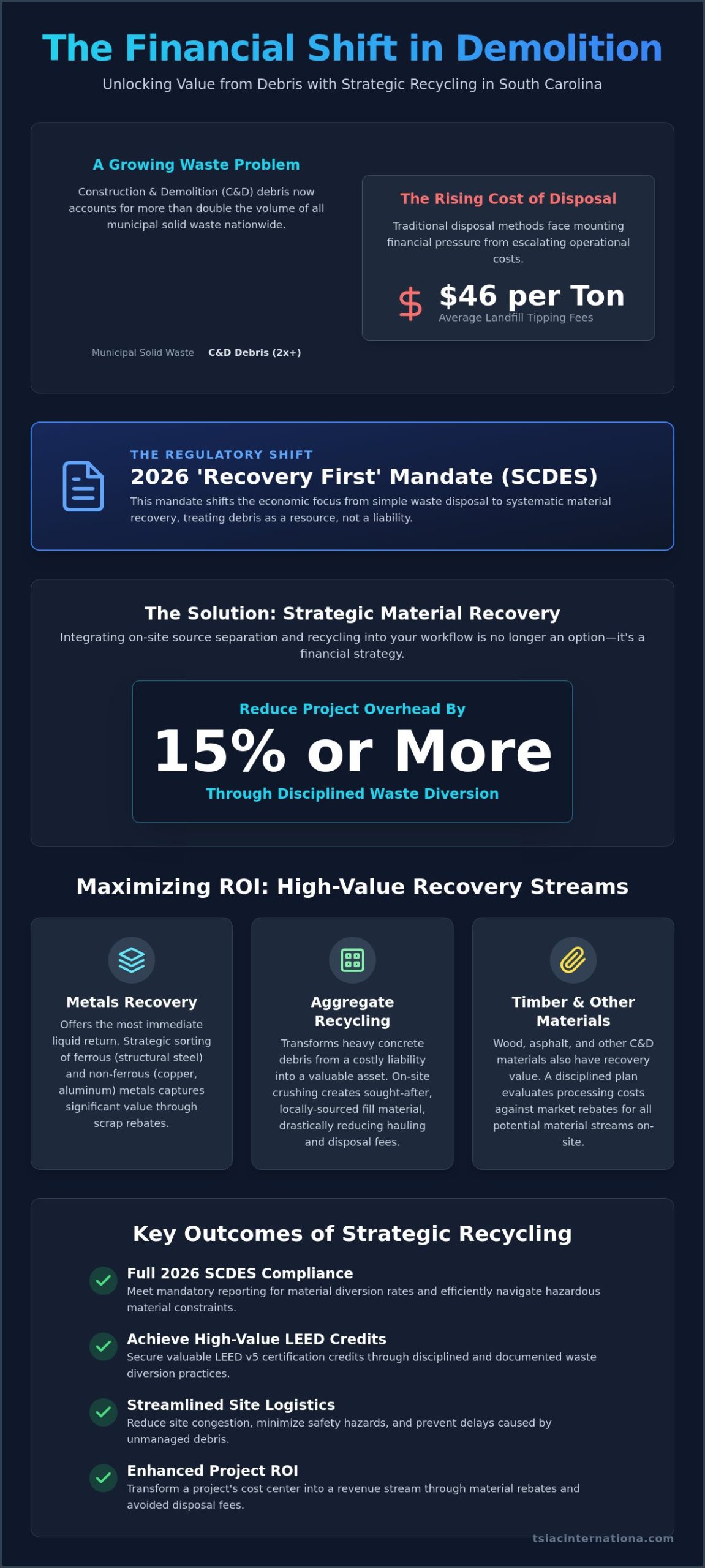
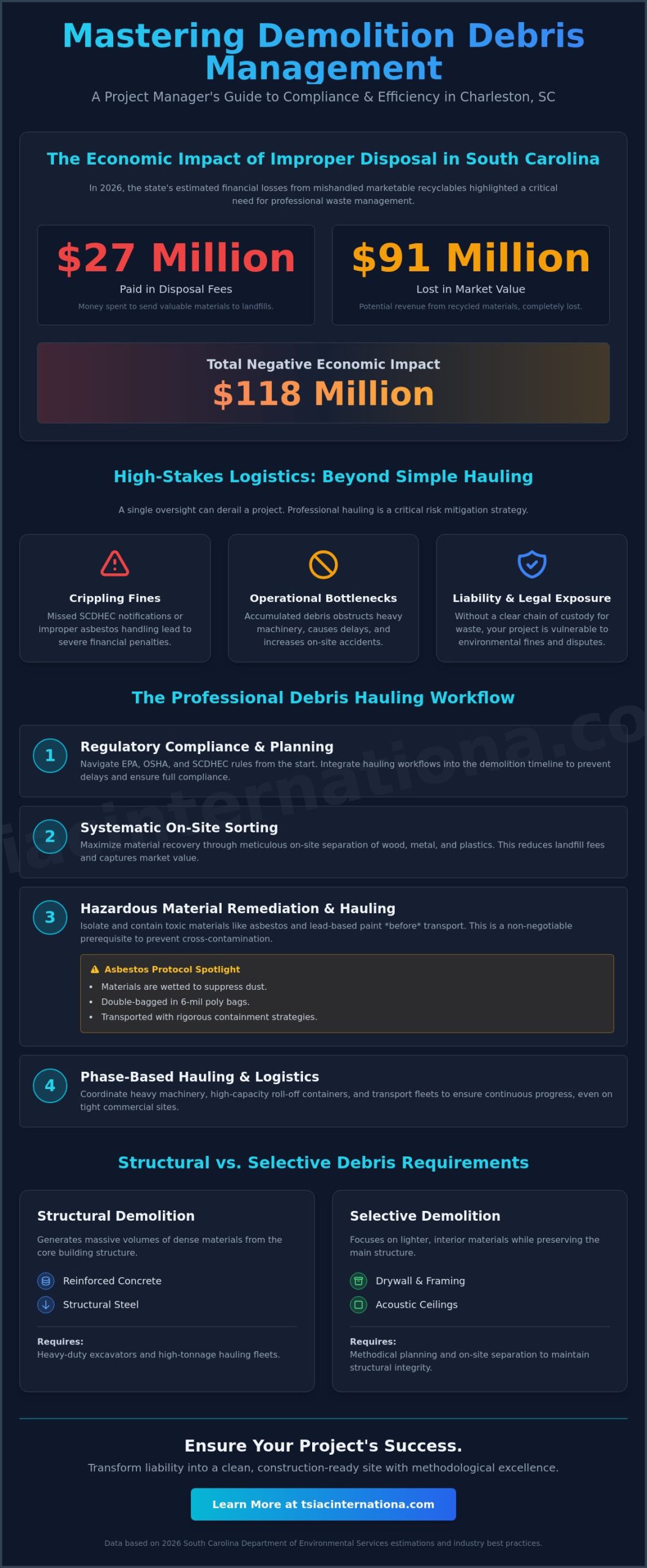
Precision on-site sorting is the most effective way to protect your project’s bottom line. Landfill tipping fees in South Carolina currently range from $45 to $65 per ton for mixed C&D waste. By aggressively separating metal framing, contractors can reduce these overhead costs by up to 30%. Before starting a teardown, Understanding Scrap Metal Value helps owners estimate potential rebates from recovered light-gauge steel. This recovery is vital for projects seeking LEED certification, specifically under the Materials and Resources (MR) credits. Beyond the financial incentives, professional disposal mitigates long-term liability. Unlike treated lumber, which can leach chemicals into the soil, steel is stable. Proper documentation of its removal protects property owners from future environmental litigation.

The Legal Landscape: SC DES and Local Ordinances

The legal framework for metal framing disposal south carolina is governed primarily by SC DES Regulation 61-107.19. This mandate requires detailed reporting for all construction waste generated on commercial sites. In industrial zones like Charleston and North Charleston, local ordinances are even more specific. For instance, heavy industrial zones (I-2) require specialized haul-off routes to minimize the impact on residential traffic. If your project involves hauling more than 10,000 pounds of metal debris, you’ll need specific transport permits that verify the load’s destination. We handle the technical paperwork and permit filings to ensure every load complies with both state and municipal laws. Fines for improper disposal can exceed $10,000 per violation, making professional oversight a necessity rather than an option. We don’t guess at compliance; we execute based on the current 2026 regulatory map.

Technical Breakdown: Types of Metal Framing and Recovery Workflows

Effective metal framing disposal south carolina requires a technical understanding of metallurgical properties and structural load-bearing requirements. We categorize metal recovery into two primary streams: light-gauge cold-formed steel and heavy structural members. Each requires a distinct set of tools, safety protocols, and logistics strategies to ensure the integrity of the site and the purity of the recycled material. Our team approaches every project as a precision engineering task rather than a simple demolition job.

Cold-Formed Steel (CFS) vs. Structural Steel

Cold-formed steel (CFS) typically consists of 25-gauge to 16-gauge galvanized studs and tracks. These components are ubiquitous in interior gutting projects across South Carolina commercial hubs. Because CFS is lightweight and high-volume, disposal logistics focus on onsite densification. We use mechanical shears to process these materials into manageable bundles, reducing transport overhead by 35% compared to loose loading. Structural steel, including I-beams and H-piles, demands heavy-duty rigging and hydraulic cutting equipment. Safety protocols for structural removal are rigorous; we calculate center-of-gravity and load-transfer points before a single cut is made. Market data from 2024 indicates that heavy structural steel (HMS 1) consistently commands a 18% to 22% price premium over light-gauge galvanized CFS in the scrap value hierarchy.

The environmental impact of these materials is a primary driver for modern construction standards. According to data regarding Steel Framing Sustainability, steel is the only material that can be recycled infinitely without losing its metallurgical properties. This makes the recovery of CFS and structural components a critical component of green building certifications. When handling metal framing disposal south carolina, we ensure that 98% of recovered steel enters the circular economy through verified processing facilities.

Hazardous Materials and Metal Framing

In historic regions like Charleston, older metal framing often presents hidden hazards. Buildings constructed before 1978 frequently contain lead-based primers on structural steel to prevent corrosion in the humid coastal climate. We utilize X-ray fluorescence (XRF) analyzers to identify lead content in seconds before any heat-based cutting begins. This prevents the aerosolization of toxic lead fumes, protecting both our technicians and the surrounding environment. If lead is detected, we pivot to cold-cutting methods or chemical stripping to maintain safety standards.

Asbestos contamination is another frequent challenge during metal framing removal. Spray-on fireproofing, often applied to steel beams in structures built between 1950 and 1980, must be professionally abated before the metal can be cleared for recycling. TSIAC manages this intersection by coordinating seamless decontamination workflows. Our methodology involves a “surgical” removal process where metal is isolated from drywall, insulation, and adhesives at the point of origin. This meticulous separation ensures that the final metal product is free of “prohibitives,” which are contaminants that can downgrade the scrap value or cause it to be rejected by foundries. This precision is why specialized firms request an industrial recovery assessment before starting complex interior demolitions.

  • Non-Ferrous Components: We separate aluminum tracks and T-bar ceiling grids, which require different smelting temperatures than steel.
  • Fastener Recovery: Specialized magnetic sweeps are used to collect 100% of steel screws and clips, preventing site hazards.
  • Decontamination: We use high-pressure, low-volume cleaning systems to remove adhesive residue from structural members.

By maintaining strict control over the material purity, we transform what others see as debris into a high-grade industrial resource. Our disciplined approach ensures that every pound of metal is accounted for and processed with engineering precision.

Professional Site Recovery vs. DIY Scrap Hauling

Managing heavy-gauge steel requires more than a pickup truck and a pair of gloves. Many site managers in the Southeast assume that using their own crew for cleanup saves money, but the math rarely supports this. When you divert a skilled tradesperson earning $48 per hour to haul scrap, you aren’t just paying for labor; you’re losing project momentum. Professional metal framing disposal south carolina involves technical recovery that integrates with your build schedule, rather than obstructing it. Our data shows that in-house scrap management often costs 22% more than professional services once you factor in fuel, insurance premiums, and lost productivity on the primary structure.

The Logistics of On-Site Sorting

Space is a premium on modern job sites. In 2026, urban construction zones in the Lowcountry and Grand Strand regions often operate with less than 600 square feet of dedicated staging area. TSIAC utilizes a “just-in-time” hauling model to prevent site congestion. We don’t let 20-foot studs pile up and block access for electrical or HVAC trades. Instead, we implement source-separated recycling protocols that ensure 98% of your steel waste avoids the landfill. This precision keeps the site clean and prevents the “domino effect” of delays caused by cluttered walkways and blocked loading bays.

  • Specialized Equipment: We use flatbed hauling for long-span studs that don’t fit in standard 30-yard roll-off containers.
  • Scheduled Extractions: Hauling occurs during off-peak hours to minimize crane and elevator bottlenecks.
  • Volume Reduction: On-site shearing reduces the physical footprint of scrap by 40% before it ever leaves the site.

Financial Comparison: Tipping Fees vs. Rebates

The financial gap between landfilling and professional recovery is widening. In Q1 2026, landfill tipping fees in certain South Carolina counties rose to $62 per ton. Choosing to dump metal framing isn’t just environmentally irresponsible; it’s a direct hit to your bottom line. Conversely, professional recovery services leverage volume to secure higher scrap rebates. Because we process thousands of tons annually, we secure rates that small-scale haulers can’t access. Project budgets see a significant boost when “waste” is converted back into a liquid asset.

Legal compliance is another hidden cost of the DIY approach. Navigating the state’s strict regulatory framework requires an understanding of South Carolina metal recycling laws, which dictate how nonferrous materials are documented and transported. Failure to possess the correct permits or manifests can result in fines starting at $1,000 per violation. We handle all the documentation, ensuring your project remains compliant with local sheriff’s office requirements and state environmental codes.

Safety risks represent the final, and perhaps most critical, variable in this comparison. Amateur metal dismantling accounts for 15% of laceration injuries on active demolition sites in the region. Steel framing has sharp edges and high tension points that require specific cutting sequences. Our crews are trained in these specialized techniques, which has helped us maintain a zero-incident rate across all metal framing disposal south carolina contracts in the last three years. The ROI of professional recovery is found in the 19% increase in site efficiency and the total elimination of disposal-related liability for the general contractor.

Step-by-Step Guide to Compliant Metal Disposal in SC

Executing a successful metal framing disposal south carolina project requires more than just brute force. It demands a calculated, engineering-first approach that prioritizes structural integrity and environmental accountability. At TSIAC International, we treat every disposal project as a reverse-engineering challenge, ensuring that every pound of steel is accounted for from the moment it is detached until it reaches a certified recycling facility.

Pre-Demolition Planning and Permitting

Precision begins with a comprehensive debris audit. Before the first stud is removed, our team calculates the exact material volume based on the original 2018 or later structural blueprints. For a typical 15,000-square-foot commercial facility in Greenville, this audit identifies roughly 18 tons of recyclable cold-formed steel. This data allows us to coordinate logistics with South Carolina Department of Health and Environmental Control (DHEC) certified facilities, ensuring we meet the state’s 2023 guidelines for construction and demolition waste diversion.

  • Permit Acquisition: We secure all necessary SC demolition and hauling permits, including specific municipal clearances required in coastal zones like Myrtle Beach.
  • Recycling Coordination: Our team establishes direct pipelines with specialized metal processors to maximize the 98% recovery rate inherent in structural steel.
  • Equipment Selection: We deploy high-capacity hydraulic shears for heavy gauge members and magnetic separators to ensure zero-waste site clearance.

On-Site Execution and Safety

The “Surgical Strike” method defines our on-site execution. Instead of traditional wrecking, we employ selective demolition of framing members to maintain the stability of adjacent structures. This process is critical in South Carolina’s dense urban centers where zero-lot-line construction is common. We utilize plasma cutters for high-speed precision in open areas; however, we switch to mechanical shears in confined spaces to eliminate fire hazards and minimize noise pollution for neighboring businesses.

Safety protocols follow strict ANSI/ASSE Z359.1 standards. Our technicians utilize integrated fall protection systems and overhead shielding during all phases of structural metal removal. Before any structural cut occurs, technicians must verify that tensioned metal members are stabilized with temporary bracing to prevent sudden, violent kinetic energy release. This level of caution protects our personnel and your property assets simultaneously.

The final phase involves rigorous manifesting and reporting. We don’t just haul debris; we provide a full audit trail. Each load of metal framing disposal south carolina is documented with weight tickets and facility receipts. This documentation is essential for LEED certification credits or corporate ESG reporting, providing 100% transparency for your environmental compliance records. Our process ensures that your project meets all state regulations while upholding the highest standards of industrial professionalism.

This level of meticulous record-keeping is becoming the industry standard, with digital platforms like SOCWeld emerging to automate and manage complex documentation for other critical trades, such as welding.

If you need a partner who treats demolition with the same precision as construction, contact our SC disposal specialists today to schedule your site assessment.

TSIAC International: Expert Metal Framing and Recovery Solutions

TSIAC International has spent 15 years refining industrial demolition and recovery processes across the South Carolina market. We’ve managed over 320 commercial projects where we prioritize 100% material recycling on every site we touch. Our team doesn’t just haul debris; we engineer solutions for metal framing disposal south carolina that turn potential waste into reusable industrial resources. Whether a project sits in the dense urban center of Charleston or the expanding commercial corridors of Myrtle Beach, we develop customized disposal plans that account for local municipal codes and specific site logistics.

Our methodology focuses on the lifecycle of the material. We understand that steel and aluminum framing represent significant value, both environmentally and economically. By diverting 100% of these metals from South Carolina landfills, we help our clients meet stringent LEED certification requirements and corporate sustainability goals. We utilize specialized equipment to sort materials at the source, ensuring that light-gauge steel, heavy structural components, and non-ferrous metals are processed correctly from the moment they’re dismantled.

Precision Selective Demolition

Commercial renovations require a surgical touch rather than blunt force. We specialize in “surgical” interior gutting where the primary objective is removing obsolete metal framing without vibrating or compromising the building’s core. In 2022, we completed a 48,000-square-foot office renovation in Charleston. Our crews extracted 16.4 tons of steel studs and tracks while protecting the structural integrity of the adjacent historic masonry. This level of precision ensures that the subsequent construction phase begins on a clean, safe, and structurally sound foundation.

We often encounter complex environments where metal framing is integrated with hazardous materials. Our technicians are fully certified in asbestos and lead abatement, allowing us to provide a seamless transition between hazardous material removal and structural dismantling. We don’t pause the project to wait for third-party testers when we find contaminated insulation or lead-based coatings on steel components. We handle the abatement and the metal framing disposal south carolina simultaneously; this unified approach saved a Greenville healthcare client 22 days on their project timeline last year.

The TSIAC Advantage: Safety and Reliability

Safety isn’t a secondary concern for our team; it’s the engineering foundation of every job. We maintain an Experience Modification Rate (EMR) significantly below the industry average, reflecting our rigorous standards for high-risk metal dismantling. Our clients never have to guess about the status of their materials or their compliance standing. We provide a complete documentation package for every project, including:

  • Detailed recycling certificates showing exact tonnage diverted from landfills.
  • Transparent disposal receipts and chain-of-custody logs.
  • Site-specific safety reports and daily compliance checklists.
  • Environmental impact summaries for corporate sustainability reporting.

Our reputation is built on our ability to handle “impossible” locations that other contractors avoid. We excel in high-rise environments and tight urban spaces where logistics are a constant challenge. We bring a disciplined, work-focused personality to every site, ensuring that what we promise is delivered with engineering accuracy. If you need a partner who values technical precision and unwavering reliability, we’re ready to deploy.

Request a Fixed-Price Quote for Your SC Project

Securing Your Project’s Compliance and Value in 2026

Effective site management in 2026 demands more than just clearing debris. It requires a systematic approach to technical recovery that prioritizes structural integrity and environmental accountability. Managing metal framing disposal south carolina involves navigating complex regulatory frameworks while maximizing the material value of recovered steel and aluminum. TSIAC International brings 15+ years of South Carolina demolition expertise to every site, ensuring that your project meets the highest industry benchmarks. We don’t just haul scrap; we execute a specialized recovery workflow that includes certified asbestos and lead abatement to protect your team and the surrounding environment. Our 100% recycling commitment ensures that every ton of metal debris is diverted from landfills and returned to the supply chain. This engineering-led approach transforms a logistical burden into a streamlined asset recovery process. If you’re ready to optimize your site’s efficiency and maintain total compliance, it’s time to partner with professionals who understand the complexities of specialized structures and difficult locations.

Get a professional metal recovery assessment from TSIAC International

Your project deserves the precision and reliability that only a dedicated industrial partner can provide.

Frequently Asked Questions

Is metal framing 100% recyclable in South Carolina?

Steel framing is 100% recyclable and can be repurposed indefinitely without any loss of structural integrity. The Steel Recycling Institute reports that the industry maintains a reclamation rate of 98% for structural steel in commercial construction projects. Our metal framing disposal South Carolina services ensure these materials reach specialized facilities that meet ASTM International standards for metallurgical recovery.

How much does it cost to dispose of metal framing from a commercial site?

Disposal costs typically range from $150 to $450 per ton, depending on the current market value of scrap steel and the logistical distance to Charleston or Greenville processing hubs. Landfill tipping fees in South Carolina average $45 per ton, but recycling often offsets these expenses through scrap rebates. We provide detailed line-item estimates based on the 2024 market index to ensure budgetary precision for every industrial client.

Do I need a special permit for hauling large quantities of scrap metal in Charleston?

You don’t need a specific municipal permit for the material itself, but vehicles exceeding a Gross Vehicle Weight Rating of 26,001 pounds must comply with SCDOT oversized load regulations. The City of Charleston requires a secondary metals recycler permit for businesses purchasing scrap, as outlined in South Carolina Code Section 16-17-680. We manage all regulatory documentation and logistical permits to ensure full compliance with local transport laws.

Can I recycle metal studs that have drywall or screws attached?

You can recycle studs with screws attached, but drywall must be removed to prevent load rejection at South Carolina recovery facilities. Processing plants require a purity level of at least 95% for light-gauge steel to avoid contamination penalties. Our team uses specialized tools to strip debris on-site, ensuring your metal framing disposal South Carolina process meets the strict intake criteria of local foundries.

What is the difference between ferrous and non-ferrous metal disposal?

Ferrous metals contain iron and are magnetic; non-ferrous metals like aluminum or copper are non-magnetic and often command a 300% higher market price. In industrial framing, we categorize 12-gauge steel studs as ferrous and aluminum storefront components as non-ferrous. Distinguishing these materials during the demolition phase is critical for maximizing recovery value and ensuring proper metallurgical processing at the refinery.

How does TSIAC International handle metal framing contaminated with lead paint?

We treat lead-contaminated framing as hazardous waste according to EPA Lead Renovation, Repair, and Painting Rule standards. If a structure predates 1978, we perform X-ray fluorescence testing to identify lead concentrations exceeding 1.0 mg/cm². Contaminated steel is stabilized and transported in sealed containers to specialized RCRA Subtitle C landfills, preventing environmental exposure during the decommissioning process.

Does recycling metal framing help with LEED certification in SC?

Recycling metal framing contributes directly to the LEED v4.1 Materials and Resources credit, which requires a minimum 50% diversion rate of construction waste. Steel’s high recycled content, which often exceeds 25% post-consumer material, helps projects earn points under the Building Product Disclosure and Optimization category. We provide the certified weight tickets and diversion reports necessary for USGBC audits on South Carolina commercial developments.