
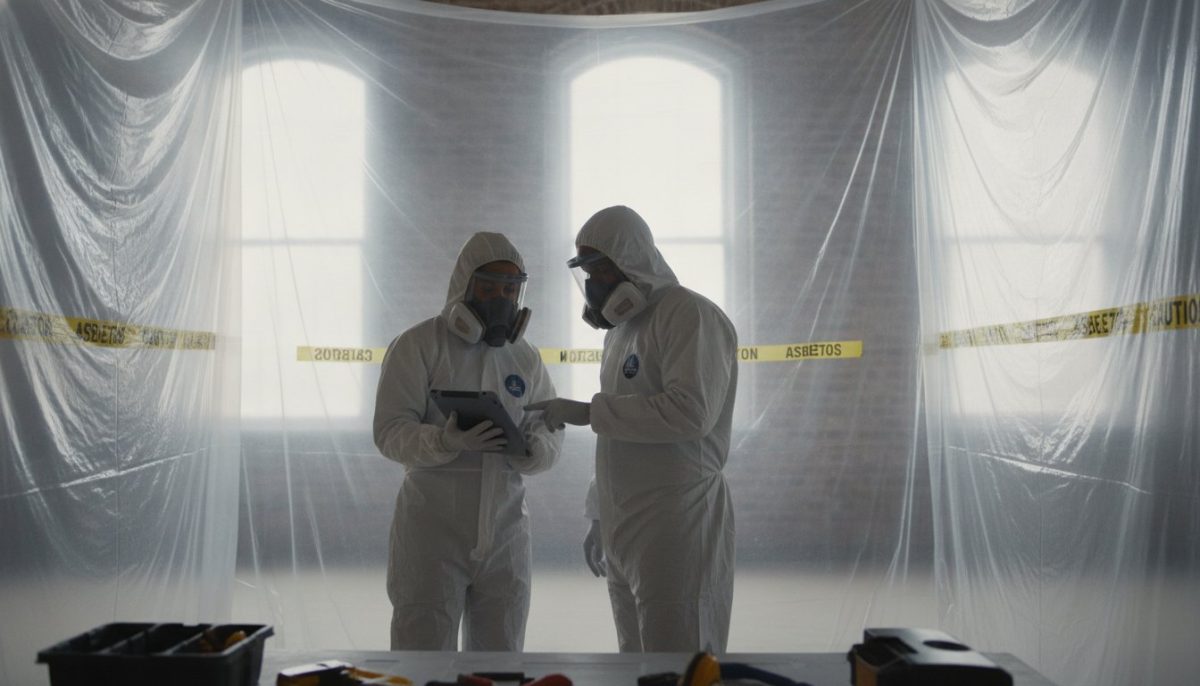
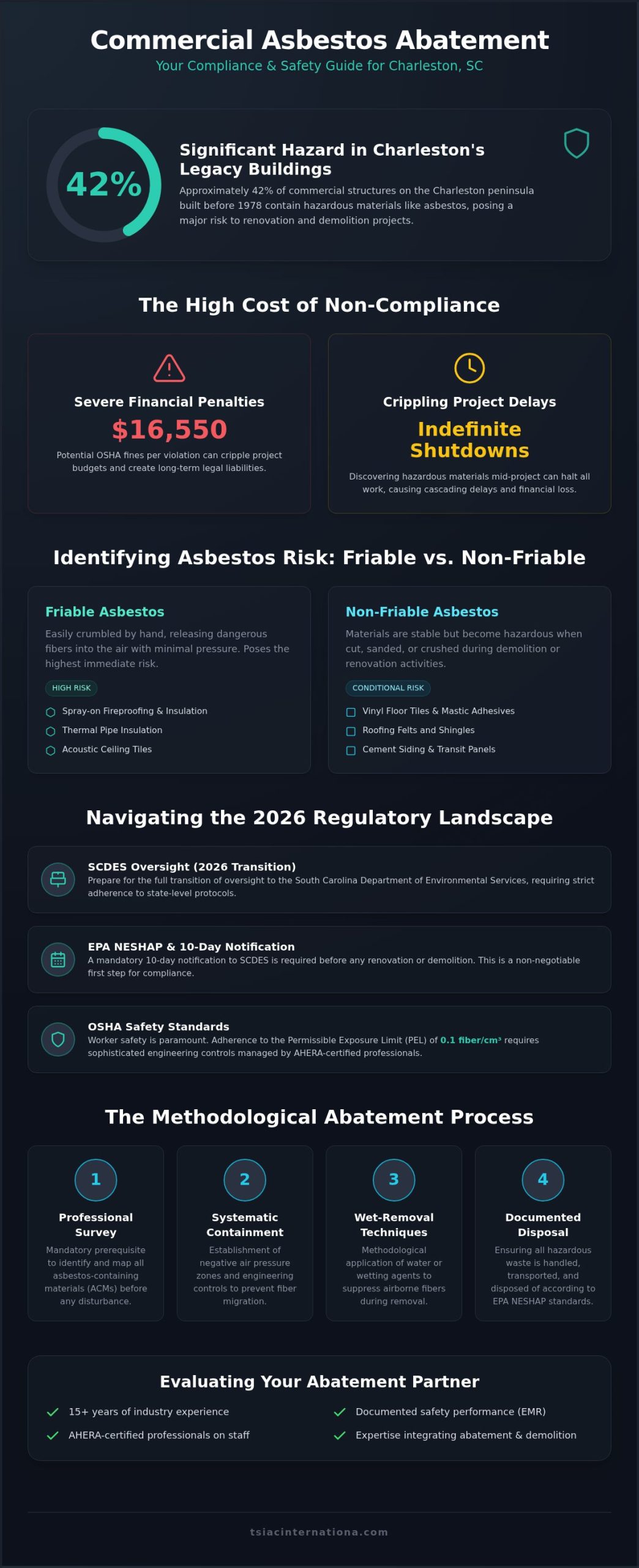
Approximately 42% of commercial structures built before 1978 on the Charleston peninsula contain hazardous materials like asbestos. If you’re managing a renovation or demolition, discovering these materials isn’t just a safety concern; it’s a significant threat to your project timeline and budget. We understand that the transition of oversight to the South Carolina Department of Environmental Services (SCDES) and the strict 10-day notification requirements create a high-pressure environment for property owners. Managing commercial asbestos abatement charleston sc requires more than just removal. It demands a methodical approach to ensure that hazardous discoveries don’t lead to $16,550 OSHA fines or indefinite site shutdowns.
This guide provides the professional standards you need to maintain full EPA and OSHA compliance while keeping your project on schedule. You’ll learn how to integrate remediation into complex demolition phases and ensure documented, safe disposal of all hazardous waste. We’ll break down the 2026 regulatory landscape, from mandatory survey protocols to the specific licensing requirements necessary for a secure, legal operation.
Key Takeaways
- Master the 2026 transition to SCDES oversight and the specific engineering controls required for compliant commercial asbestos abatement charleston sc.
- Differentiate between friable and non-friable materials to accurately assess risk levels and containment requirements for complex structural components.
- Evaluate potential partners based on technical depth, including 15+ years of industry experience and documented safety performance metrics like the Experience Modification Rate.
- Streamline your renovation schedule by integrating selective demolition with abatement to eliminate redundant coordination and prevent hidden project costs.
- Implement methodological wet-removal techniques and negative air pressure zones to ensure adherence to EPA NESHAP standards and documented safe waste disposal.
The Critical Role of Commercial Asbestos Abatement in Charleston, SC
Commercial abatement is far more than a specialized cleaning service; it is the systematic containment and removal of asbestos-containing materials (ACMs) within a controlled environment. In the context of large-scale structural operations, this process ensures that hazardous fibers don’t migrate through a facility during renovation or demolition. When managing commercial asbestos abatement charleston sc, the primary objective is to isolate these materials before they can be disturbed, protecting both the workers on-site and the future occupants of the building. This methodological approach is essential for maintaining the structural integrity of the facility while addressing hidden environmental liabilities.
Distinguishing between friable and non-friable asbestos is a critical step in the planning phase. Friable materials, such as spray-on fireproofing or thermal pipe insulation, can be easily crumbled by hand pressure, making them highly susceptible to releasing airborne fibers. Non-friable materials, like floor tiles or roofing felts, are more stable but become dangerous the moment they are cut, sanded, or crushed during a selective demolition. Failing to identify these materials early often leads to costly project shutdowns. When hazardous materials are discovered mid-renovation, the resulting delays can cascade through a construction schedule, causing significant financial losses and regulatory scrutiny.
Identifying Asbestos in Commercial Infrastructure
Commercial buildings constructed during the postwar boom through the late 1970s frequently utilized Asbestos for its superior fire resistance and insulating properties. It’s common to find these minerals in thermal system insulation, acoustic ceiling tiles, and fireproofing materials. Even in modern Charleston facilities, original components like mastic adhesives or transit panels may remain hidden behind newer finishes. Because of these risks, a professional survey is a mandatory prerequisite for any interior gut-out or structural modification. These surveys provide the technical roadmap needed to execute a safe removal without compromising the building’s core systems.
The Cost of Non-Compliance in Hazardous Remediation
The legal and financial repercussions of failing to follow SCDES or OSHA protocols are severe. Violations can trigger substantial fines and lead to long-term legal liabilities if building occupants or employees are exposed to airborne fibers. Beyond the immediate financial impact, the damage to a company’s reputation and the risk of litigation can be devastating. Commercial property owners hold a non-delegable duty of care to ensure that all ACMs are identified and remediated before any activity that could disturb hazardous fibers occurs. This responsibility demands a partner who understands the intersection of regulatory compliance and high-stakes project management.
Navigating the Regulatory Landscape and Safety Standards
Regulatory compliance in 2026 is governed by a strict interplay between federal mandates and state oversight. The EPA’s National Emission Standards for Hazardous Air Pollutants (NESHAP) dictates the procedural requirements for any facility undergoing renovation or demolition. This includes the mandatory 10-day notification to the South Carolina Department of Environmental Services (SCDES), a critical step that cannot be bypassed. For any project involving commercial asbestos abatement charleston sc, adherence to these timelines and work practice standards is the first line of defense against legal exposure and heavy civil penalties.
Worker safety and site containment are managed through OSHA asbestos regulations, which establish the Permissible Exposure Limit (PEL) at 0.1 fiber per cubic centimeter of air over an eight-hour time-weighted average. Meeting these standards isn’t just about wearing masks. It requires sophisticated engineering controls and personal protective equipment that only AHERA-certified professionals can properly design and oversee. These experts ensure that the project design accounts for the specific structural challenges of the building while maintaining a safe environment for all personnel on-site.
A rigorous “paper trail” serves as your primary protection against future liability. Documentation should be viewed as a strategic asset, providing proof that every microgram of hazardous material was handled according to the law. This level of detail is especially important in Charleston’s commercial sector, where property transfers and tenant improvements often trigger deep environmental audits. Maintaining a comprehensive record of the remediation process ensures that your “duty of care” is fully documented and defensible. If you’re planning a complex project, it’s wise to consult with a specialist in selective demolition to ensure these regulatory requirements are integrated into your broader construction schedule.
Compliance Documentation and Close-Out Reports
A professional close-out report is the final deliverable of a successful abatement project. This dossier must include Waste Shipment Records (WSR) that track the chain of custody from the job site to the approved landfill. It also contains daily work logs, employee certifications, and, most importantly, air clearance testing results. These tests, conducted by an independent third party, verify that the air quality meets safety standards before any containment barriers are removed and the site is turned back over to the owner.
Safety Protocols for Occupied Commercial Buildings
Performing abatement in multi-tenant facilities requires a high degree of technical precision to avoid disrupting ongoing business operations. We utilize advanced HEPA filtration and negative air pressure zones to prevent any cross-contamination. Communication is equally vital; building occupants must be notified of the work schedule and the safety measures in place. By focusing on minimal vibration and noise during the removal of non-friable materials, we ensure that the remediation process remains invisible to the rest of the facility.
How to Evaluate a Partner for Commercial Asbestos Abatement in Charleston, SC
Selecting a contractor for commercial asbestos abatement charleston sc requires a rigorous vetting process that extends beyond a simple price comparison. Because hazardous material remediation often intersects with complex structural work, a firm’s technical depth is the most reliable indicator of project success. We recommend prioritizing partners with at least 15 years of industry experience. This level of longevity ensures the team has encountered a wide variety of structural configurations and knows how to manage the unforeseen challenges that typically arise during large-scale interior gut-outs.
Insurance and liability protection are equally critical. You should always review a contractor’s safety record and their Experience Modification Rate (EMR). A low EMR indicates a history of safe operations, which directly translates to lower risk and potentially lower insurance premiums for the property owner. Furthermore, verifying that the firm holds current certifications for both asbestos and lead abatement is non-negotiable. Adherence to the EPA’s Asbestos Worker Protection Rule ensures that the workforce is protected and that the project remains in full legal compliance with federal and state mandates.
Financial predictability is another hallmark of a professional partner. In a sector where hidden costs can quickly derail a budget, the ability to provide fixed-price structural demolition and abatement contracts is a significant advantage. This model forces the contractor to conduct a more thorough initial assessment, providing you with a reliable baseline for your project’s total cost. It eliminates the “low-ball” bidding tactics that often lead to expensive change orders later in the process.
Technical Capabilities and Equipment
A contractor’s machinery and equipment inventory speaks volumes about their operational readiness. Firms that own their heavy machinery and specialized containment systems can mobilize more rapidly than those relying on third-party rentals. This is vital for commercial sites in Charleston where tight renovation windows are the norm. You must also distinguish between companies that only handle minor remediation and those capable of managing a full structural demolition or a comprehensive interior gutting project.
References and Commercial Case Studies
Past performance in similar industrial or commercial environments is the best predictor of future results. Reviewing case studies of previous commercial asbestos abatement charleston sc projects allows you to see how the contractor managed site logistics and regulatory documentation. For projects involving tenant improvements, it’s helpful to read a strategic guide to interior demolition to understand how abatement fits into the broader gutting process. When speaking with references, ask specific questions about their adherence to the initial timeline and how they handled the discovery of unexpected hazardous materials.
The Methodological Abatement and Disposal Process
Executing a successful commercial asbestos abatement charleston sc project requires a disciplined, multi-phase technical approach. We don’t view remediation as a standalone task but as a high-precision engineering operation. The process begins with Phase 1: the establishment of rigorous engineering controls. This involves sealing the work area with critical barriers and utilizing high-capacity HEPA air scrubbers to create negative air pressure zones. These zones ensure that any liberated fibers remain trapped within the containment area, preventing cross-contamination of the rest of the facility.
Phase 2 moves into the actual removal using wet-method techniques. By applying specialized wetting agents to the asbestos-containing materials, we minimize the potential for airborne fiber release at the source. This is followed by Phase 3, which focuses on HEPA filtration and a multi-stage decontamination of the site. Every surface within the containment is meticulously cleaned and vacuumed. Finally, Phase 4 involves the systematic disposal of hazardous waste in accordance with SCDES standards, coupled with the strategic recovery of non-hazardous debris to maximize site efficiency.
Containment and Air Quality Monitoring
Containment integrity is the foundation of site safety. We utilize 3-stage decontamination units that provide a physical transition zone for personnel, ensuring no fibers leave the regulated area on clothing or equipment. Throughout the project, negative pressure recorders provide a continuous, documented log of the vacuum levels within the containment. This data is supplemented by perimeter air monitoring. By constantly sampling the air outside the critical barriers, we provide real-time verification that the containment is functioning exactly as designed, protecting both the workers and the public.
Environmental Responsibility and Material Recycling
A significant gap in many hazardous remediation plans is the failure to address the environmental impact of the remaining debris. We prioritize environmental responsibility by sorting all non-asbestos materials during the selective demolition phase. This allows for the recovery and recycling of wood, metal, and plastic, significantly reducing the volume of waste sent to South Carolina landfills. For a deeper look at how these practices integrate with large-scale projects, you can read our guide on the demolition process in South Carolina. This sustainable approach doesn’t just benefit the environment; it often lowers project disposal fees by diverting heavy materials away from toxic waste streams.
Effective hazardous material management requires a partner who treats environmental safety with the same precision as structural demolition. If you’re ready to secure your site with professional-grade remediation, contact us for a technical consultation on your next commercial project.
Strategic Project Management with TSIAC International
Strategic project management in the hazardous material sector requires a seamless transition between abatement and structural removal. When executing commercial asbestos abatement charleston sc, the highest risks often occur at the interfaces between different trade contractors. By integrating these services into a single operation, TSIAC International provides a single point of accountability that eliminates coordination gaps. This methodology ensures that safety protocols remain consistent from the initial containment setup through the final structural clearance, protecting the project timeline from the delays typically caused by fragmented sub-contracting.
Our expertise in selective demolition is particularly valuable for complex commercial tenant improvements. Whether you’re gutting a retail space on the Charleston peninsula or renovating a multi-story office complex, we understand how to isolate hazardous materials without compromising the building’s core systems. This technical precision allows us to perform high-stakes work in industrial environments where operational continuity is paramount. We don’t just remove materials; we manage the entire site environment to ensure that every phase of the remediation is safe, efficient, and environmentally responsible.
Fixed-Price Predictability for Large-Scale Projects
Budget creep is one of the most common pains in large-scale commercial renovations. To address this, we offer fixed-price structural demolition and abatement contracts that provide absolute financial predictability for our partners. These comprehensive fee structures include everything from site preparation and engineering controls to final debris management and recycling. This approach forces a disciplined assessment of the project scope from day one, ensuring that there are no hidden costs or surprise change orders. For property owners and developers, this level of transparency is why we are considered the TSIAC International Charleston gold standard in the industry.
A Partner for General Contractors and Government Agencies
Navigating the specific requirements of government contracts and large-scale industrial projects demands a partner who understands the nuances of 2026 regulatory standards. We have over 15 years of experience meeting the rigorous documentation and safety milestones required by general contractors and public agencies. Our team is disciplined in maintaining the necessary “paper trail” of compliance, from SCDES notifications to waste shipment records. By hitting every project milestone with methodological accuracy, we keep the subsequent construction phases on schedule and ensure the site is ready for its next life cycle. If your facility requires expert intervention, contact TSIAC International for a commercial project consultation to discuss your specific structural and remediation needs.
Securing Your Commercial Asset Through Methodological Abatement
Successful remediation in 2026 requires more than just removal; it demands a fusion of regulatory precision and structural expertise. We’ve explored how early identification, rigorous documentation, and integrated demolition schedules protect your project from the cascading costs of non-compliance. Navigating the requirements for commercial asbestos abatement charleston sc is a high-stakes operation that leaves no room for methodological errors. By prioritizing a partner with over 15 years of specialized industry experience, you ensure that your facility meets every SCDES and OSHA standard while maintaining a commitment to material recycling and site safety.
Securing comprehensive liability and compliance documentation is the final step in protecting your investment and ensuring long-term peace of mind. Our team is ready to deliver the technical precision and budget predictability your project deserves. You can take the first step toward a safe and efficient site transformation today. Request a Fixed-Price Quote for Commercial Abatement and move forward with the confidence that your project is under expert control.
Frequently Asked Questions
What is the difference between asbestos abatement and asbestos removal?
Abatement is a comprehensive set of procedures designed to control fiber release, whereas removal is the specific physical extraction of the material. Abatement may include encapsulation or enclosure if removal is not structurally feasible. In most commercial asbestos abatement charleston sc projects, removal is the preferred method to eliminate the hazard permanently before a renovation begins.
How long does a commercial asbestos abatement project typically take?
The duration of a project varies based on the total square footage and the friability of the materials; however, most commercial phases take between one and three weeks. This timeline must account for the mandatory 10-day SCDES notification period before any work begins. Efficient contractors minimize downtime by coordinating mobilization with the expiration of this legal waiting period.
Is it necessary to close the entire building during commercial abatement?
It’s not usually necessary to close an entire facility if the work area can be effectively isolated using critical barriers and negative air pressure. We frequently perform remediation in occupied multi-tenant buildings by establishing secure zones that prevent fiber migration. This allows businesses in other parts of the building to continue operations without safety risks or significant noise disruptions.
What are the common asbestos-containing materials found in commercial buildings?
Common materials include spray-on fireproofing on steel beams, vinyl floor tiles, mastic adhesives, and thermal system insulation on boilers or pipes. You might also find asbestos in acoustic ceiling tiles and certain roofing components. Identifying these materials through a professional survey is the only way to confirm their presence before structural work commences.
How much does commercial asbestos abatement cost in 2026?
Costs for remediation are determined by several technical factors, including the volume of material, its location, and whether it is friable or non-friable. Accessibility and the required level of containment also influence the final project budget. We provide fixed-price contracts to ensure that owners have a predictable cost structure without the risk of mid-project fee increases.
How do I know if my commercial property requires an asbestos survey?
Any commercial property in Charleston scheduled for renovation or demolition requires an asbestos survey by a licensed building inspector. This is a legal mandate under South Carolina Regulation 61-86.1. Even if the building is relatively modern, the inspector must verify the site is clear of hazardous materials before the SCDES will issue the necessary permits.
What documentation should I receive after the abatement is complete?
Upon completion, you should receive a comprehensive close-out report that serves as your legal record of compliance. This dossier includes independent air clearance testing results, which prove the area is safe for re-occupancy. It also contains waste shipment records (WSR) that document the safe disposal of toxic materials at a licensed facility.
Can asbestos abatement be performed alongside structural demolition?
Yes, performing abatement alongside structural demolition is a highly efficient strategy for large-scale redevelopments. This integrated approach allows for better coordination between the removal of hazardous materials and the gutting of the building’s interior. It eliminates the need for multiple contractors and ensures a single point of accountability for the entire site’s safety and schedule.
