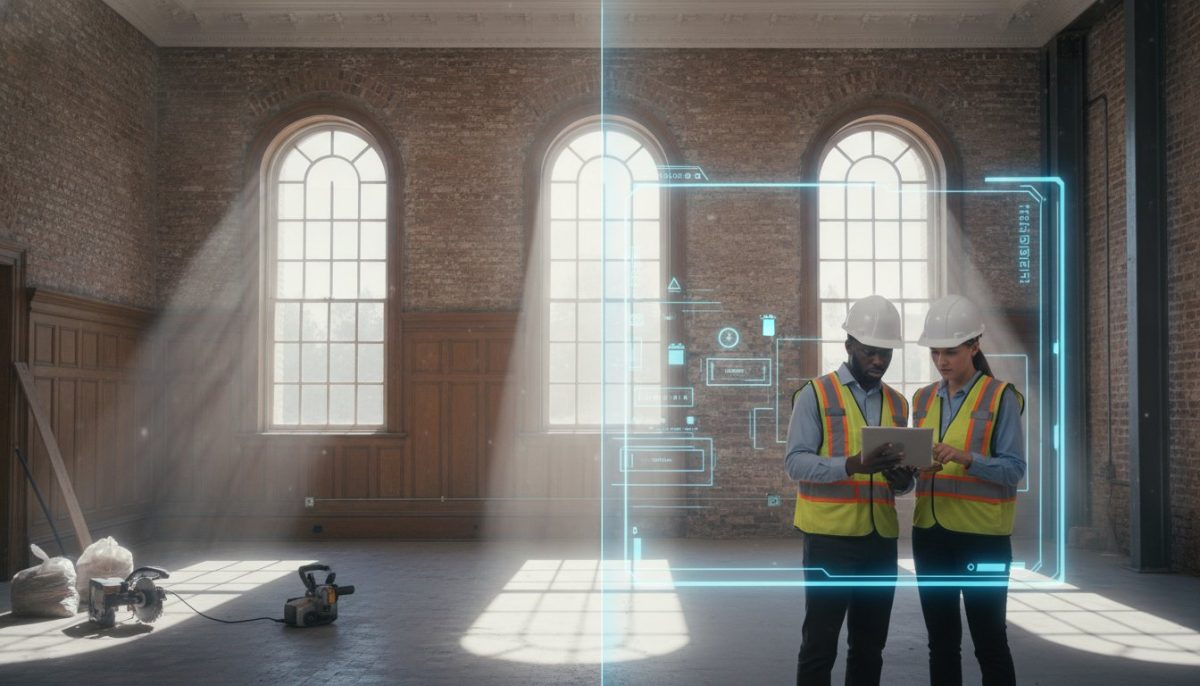
In complex architectural environments, the most successful demolition projects are defined by what remains standing, not just what is removed. You likely recognize that stripping a commercial interior or modifying a load-bearing layout is a high-stakes engineering challenge where a single error can trigger structural failure or expose hidden environmental hazards. Navigating commercial selective demolition requires a level of technical discipline that treats every cut as a surgical procedure rather than a blunt-force task.
It’s natural to feel concerned about managing debris in occupied buildings or uncovering legacy contaminants in older structures, particularly those built before 1978, which often contain hazardous materials. This guide will help you master these complexities, from understanding structural preservation techniques to navigating the latest 2026 safety and compliance requirements. We will provide a clear framework for the selective process, ensuring you have the knowledge to choose a precision contractor who can maintain site safety and structural integrity without disrupting your broader operational goals.
Key Takeaways
- Learn to distinguish between basic interior gutting and complex structural removals to ensure your project preserves the building’s core assets.
- Understand the engineering requirements for pre-demolition surveys and the essential “cut and cap” protocols for maintaining MEP services during construction.
- Discover how commercial selective demolition charleston sc offers superior long-term ROI by reducing new material costs and preserving existing foundations.
- Master the 2026 compliance landscape for asbestos abatement and lead paint safety to avoid regulatory delays and mitigate environmental liability.
- Identify the specific insurance requirements and technical certifications necessary to select a contractor capable of high-precision structural work.
What is Selective Demolition? Defining the Surgical Approach
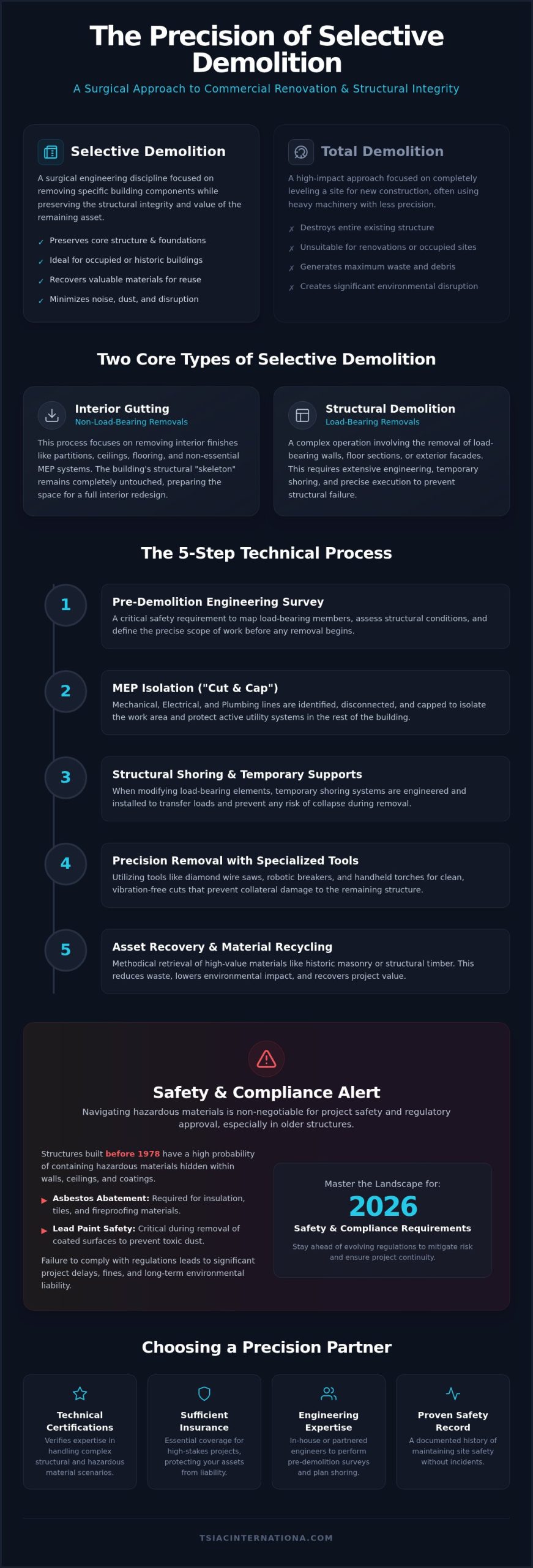
Selective demolition isn’t about destruction; it’s an engineering discipline focused on the strategic removal of specific building components while maintaining the integrity of the remaining structure. Unlike traditional Demolition Methods that rely on high-impact machinery to level a site, selective work employs a surgical approach. This method is essential for historic preservation in the Lowcountry, where the goal is often to modernize a building’s utility while protecting its architectural heritage.
When planning commercial selective demolition charleston sc, project managers must distinguish between interior gutting and structural selective demolition. Interior gutting focuses on non-load-bearing elements like partitions and finishes. Structural selective demolition involves removing load-bearing walls, floor sections, or exterior facades. This requires temporary shoring and precise engineering calculations to prevent accidental collapse. It’s a high-stakes process where technical accuracy determines the safety of the entire site.
Key Components of a Selective Project
Success depends on identifying the boundary between structural and non-structural elements. Engineers verify load paths before any physical work begins to ensure the building remains stable. Another critical phase involves Mechanical, Electrical, and Plumbing (MEP) separations. This “cut and cap” process ensures that utilities serving the rest of the building remain operational while the target area is safely isolated.
Asset recovery also plays a significant role. Architectural salvage allows for the retrieval of high-value materials, such as historic masonry or structural timber, which can be reused or recycled. This methodical retrieval is a hallmark of professional selective demolition. It turns potential waste into recoverable value and reduces the environmental footprint of the project.
Why Modern Renovations Require Selective Expertise
Modern commercial redevelopment often occurs in occupied environments where total demolition is impossible. Precision is required to minimize noise, vibration, and dust that could disrupt neighboring tenants. This level of control is exactly why businesses prioritize experienced providers of commercial selective demolition charleston sc when working in active retail or office spaces. Preserving the existing building envelope is also a core strategy for achieving LEED certification and improving overall energy efficiency.
For many projects, commercial interior gutting services serve as the crucial first phase. Clearing out non-essential interior finishes gives contractors a clear view of the structural skeleton. This allows for safer and more accurate selective removals later. This staged approach ensures that every phase of the renovation is controlled and aligned with the final architectural vision.
The Technical Process: Maintaining Structural Integrity During Removal
Before a single wall is breached, a comprehensive pre-demolition engineering survey must be completed. This is not a mere formality; it is a critical safety requirement to identify the structural condition of the building and the precise location of load-bearing members. When performing commercial selective demolition charleston sc, this survey dictates the entire project scope. Following the structural assessment, the focus shifts to utility management. All mechanical, electrical, and plumbing lines must be identified, disconnected, and capped. This ensures that the work area is isolated while protecting the utility systems of the remaining structure.
The sequence of operations follows a rigorous logic, typically employing a top-down or outside-in approach to ensure stability. Precision is achieved through specialized equipment that prioritizes control over impact. Diamond wire saws allow for clean cuts through reinforced concrete without the damaging vibrations of traditional percussive tools. Robotic breakers provide high-powered removal in tight spaces, while handheld torches are used for surgical steel cuts. These tools allow for a level of control that prevents collateral damage to preserved building sections.
Structural Shoring and Temporary Supports
Modifying load-bearing walls or beams requires active shoring to prevent structural collapse. Shoring systems transfer the building’s weight to temporary supports, allowing for the safe removal of original elements. During this phase, technicians monitor vibration and seismic activity to protect adjacent structures. If you are planning a complex renovation, consult with specialists in structural demolition to ensure these supports are engineered correctly. Temporary bracing remains in place until new framing is fully integrated and the load path is restored.
Step-by-Step Selective Workflow
The workflow follows a four-phase methodology to maintain site control. Phase 1 begins with a hazardous material survey and the abatement of asbestos or lead paint. Compliance with OSHA Demolition Safety Standards is mandatory during this stage. Phase 2 involves an interior soft-strip, where non-structural elements like carpeting and drywall are removed to reveal the building’s skeleton.
Phase 3 focuses on structural modifications and MEP isolation through precision cutting. This is where the most technical removals occur. Finally, Phase 4 concludes with debris sorting and site clearance. We prioritize on-site recycling for wood, metal, and plastic to streamline waste management. This systematic approach ensures the site is ready for following construction trades without residual hazards or structural instability.
Selective vs. Total Demolition: A Cost and Efficiency Comparison
Choosing between total and selective removal is a strategic financial decision that impacts every subsequent phase of construction. Total demolition is often perceived as the faster option, but it’s a high-tonnage approach that eliminates existing structural equity. In contrast, commercial selective demolition charleston sc requires more skilled labor per hour because technicians must work around active systems and preserved structural members. While the upfront labor costs are higher, the long-term ROI is substantial. Preserved foundations and structural shells save months of site preparation and significantly reduce the budget for new raw materials.
Timelines also differ based on project goals. Total demolition is a linear process of destruction. Selective demolition is a non-linear integration into the renovation schedule. While the physical removal might take longer due to the precision required, it allows following trades to begin work sooner in preserved areas. Waste diversion is the final efficiency piece. By separating wood, metal, and plastic on-site, contractors avoid the high tipping fees at regional facilities like the Berkeley County Landfill, where mixed debris costs reach $100 per ton.
When to Choose Selective Over Total Removal
There are three primary scenarios where selective removal is the only logical path. First, historic buildings with protected facades or unique architectural features require surgical precision to meet local preservation standards. Second, commercial tenant improvements often necessitate that the structural shell remain intact while the interior is completely reimagined. Finally, residential remodels where only a specific wing is being updated require isolation to keep the rest of the home habitable and structurally sound.
Environmental and Economic Benefits of Recycling
A disciplined approach to debris management turns waste into a resource. Recovering wood, metal, and plastic significantly reduces landfill impact and lowers project costs. Scrap metal recovery is particularly valuable in large-scale commercial projects, often offsetting a portion of the labor expenses. This aligns with the broader demolition process in South Carolina, which emphasizes material lifecycle management. When handling older structures, it’s vital to follow EPA Asbestos Regulations to ensure that recyclable materials aren’t contaminated by hazardous particulates, protecting both the environment and the project’s bottom line.
Safety and Compliance: Navigating Hazardous Materials and Regulations
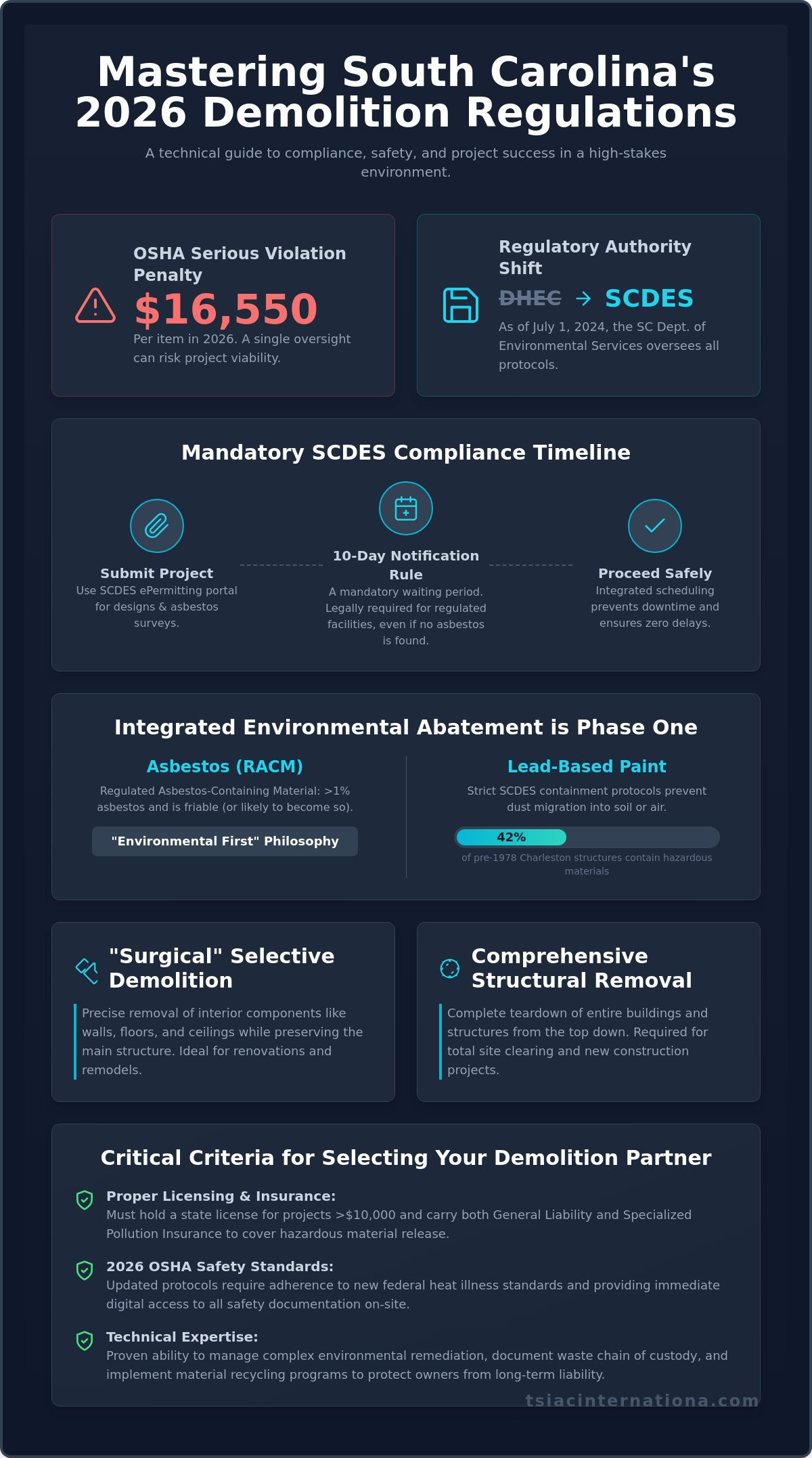
Safety in demolition is a matter of rigorous technical compliance rather than a simple set of guidelines. For projects involving commercial selective demolition charleston sc, testing for asbestos and lead paint is a non-negotiable prerequisite. Within the historic Charleston peninsula, approximately 42% of structures built before 1978 contain these legacy contaminants. Identifying these materials before physical work begins prevents the accidental release of toxic fibers into the building’s ventilation system. Proper waste manifesting and disposal documentation are equally critical. They provide a legal paper trail that proves compliance with state and federal environmental laws, protecting property owners from long-term liability.
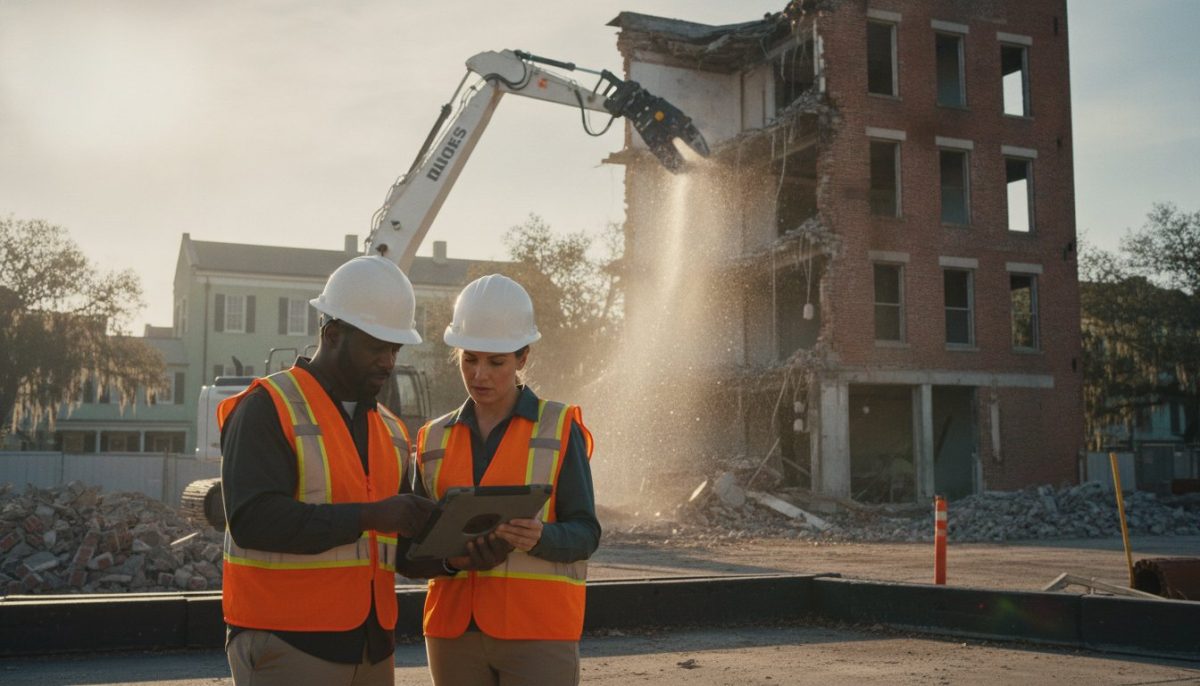
OSHA standards for crystalline silica dust control require active mitigation during concrete cutting and masonry removal. This involves integrated water-delivery systems or high-efficiency vacuum shrouds to capture dust at the source. Worker protection extends beyond respiratory safety to include specialized PPE and continuous site monitoring. Failure to manage these microscopic hazards can lead to severe health risks and significant regulatory fines. If your project involves complex contaminants, partner with experts in asbestos and lead abatement to secure your site and ensure total regulatory compliance.
Integrating Asbestos and Lead Abatement
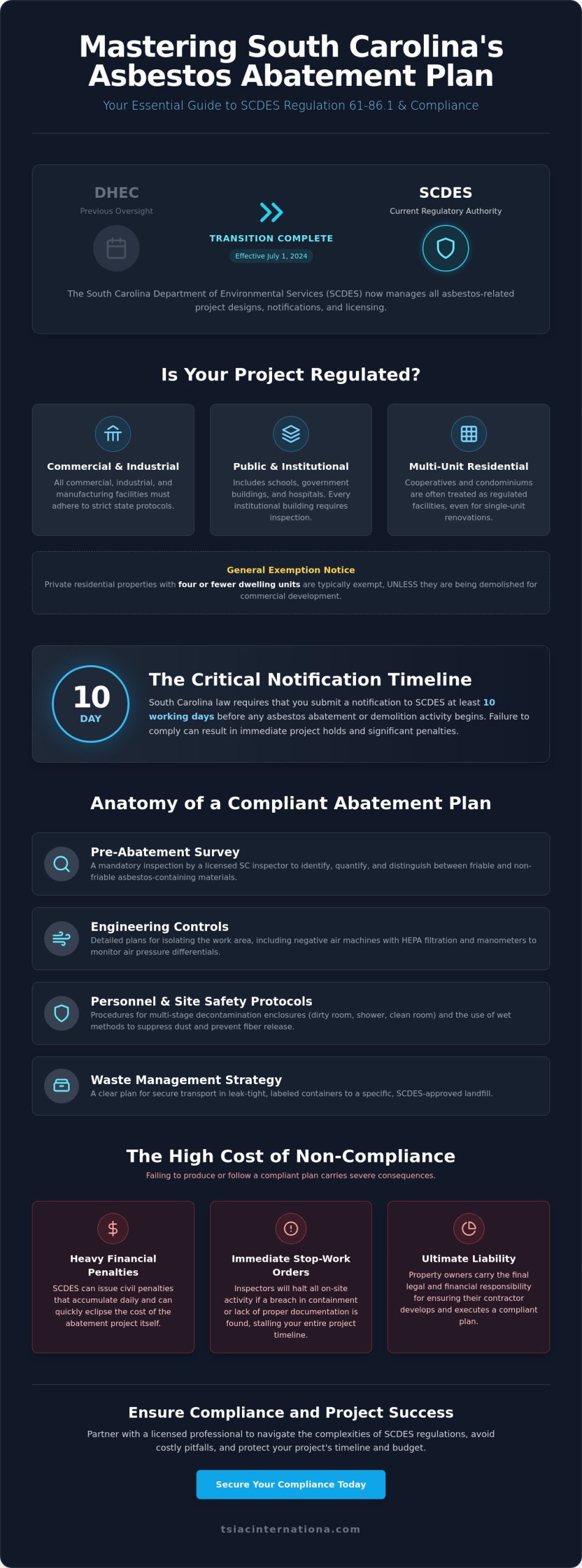
Abatement must be fully integrated into the project timeline, occurring before any structural or interior removals. This ensures that the work area is decontaminated and safe for general trades. Following asbestos removal in South Carolina protocols requires the use of specialized containment barriers. Negative air machines equipped with HEPA filtration are essential to maintain a pressure differential. This setup ensures that air only flows into the containment zone and never into the surrounding building environment.
Dust and Noise Mitigation in Occupied Buildings
Working in occupied commercial environments requires a “clean zone” strategy. Polyethylene barriers and adhesive floor protection prevent dust migration to active office or retail spaces. Scheduling high-impact noise work, such as robotic breaking or steel cutting, during off-peak hours minimizes the disruption to neighboring tenants. For a deeper look at managing these environmental risks, consult the hazardous material abatement in South Carolina guide. These methods allow for a seamless transition between demolition and reconstruction without compromising the health or comfort of building occupants.
Choosing a Precision Partner for Selective Projects
Selecting a contractor for commercial selective demolition charleston sc is a technical decision that impacts the structural safety and environmental compliance of your entire project. You should prioritize firms with a proven track record in “cut and cap” MEP services. This ensures that electrical and plumbing systems are isolated with surgical accuracy, preventing accidental outages in preserved building sections. Verify that the contractor carries specialized insurance and bonding that explicitly covers structural modifications and hazardous material abatement. Standard general liability policies often contain exclusions for these high-risk activities, leaving property owners vulnerable to significant financial exposure.
A contractor’s fleet serves as a primary indicator of their technical capability. Precision projects cannot be executed with standard excavators and wrecking balls alone. Look for a partner who utilizes diamond wire saws, robotic breakers, and advanced HEPA filtration systems. Their commitment to environmental responsibility is another critical factor. A disciplined contractor will implement on-site debris sorting to divert wood, metal, and plastic from local landfills. This practice supports sustainability goals and controls project costs by minimizing expensive tipping fees at regional facilities.
The TSIAC Advantage in Precision Demolition
TSIAC International brings over 15 years of industry experience to complex structural removals and abatement projects. Our methodology allows us to handle both the physical demolition and the hazardous remediation of asbestos or lead under a single, unified contract. This integrated approach eliminates the coordination gaps that often occur between separate demolition and abatement firms. We maintain a strict commitment to on-site recycling, ensuring that wood, metal, and plastic are recovered on every site we manage. This technical discipline ensures that your project remains safe, compliant, and cost-effective from the initial survey to final clearance.
Next Steps: Planning Your Selective Project
Successful selective projects begin with meticulous planning and clear documentation. You should request a comprehensive site survey to identify all structural constraints and environmental hazards before work commences. This survey forms the basis of a precision quote that accounts for every technical requirement of the removal. Clear project scope documentation is essential to prevent structural accidents and ensure all following trades are aligned with the building’s modified layout. If you are ready to begin your renovation, Consult with TSIAC International for your next selective project to ensure your project is handled with the surgical precision it requires.
Mastering the Technical Demands of Selective Removal
Success in commercial selective demolition charleston sc depends on moving beyond simple destruction toward a methodology of surgical precision. You’ve seen how integrating structural shoring, meticulous utility capping, and rigorous hazardous material containment protects both your building’s integrity and your legal interests. These technical layers ensure that your renovation proceeds without the catastrophic risks of structural failure or environmental contamination. By prioritizing engineering-led removal, you secure a higher return on investment while maintaining the architectural value of your property.
TSIAC International provides over 15 years of abatement and demolition expertise to every project. We maintain strict EPA and OSHA compliant safety protocols and a comprehensive debris recycling program to ensure your site remains clean and efficient. Our team is ready to help you navigate the complexities of selective work with the technical discipline your asset deserves.
Request a Precision Selective Demolition Quote from TSIAC International to begin your project with a partner who values technical accuracy as much as you do. We look forward to securing the future of your structure through methodical, expert-led execution.
Frequently Asked Questions
What is the difference between selective demolition and total demolition?
Selective demolition involves the surgical removal of specific building components while preserving the main structural shell and foundation. Total demolition is a complete knockdown where the entire structure is leveled to grade. While total demolition is a linear process of destruction, selective work is an engineering-led discipline that integrates with the renovation phase. This allows property owners to retain structural equity and reduce the volume of new materials required for reconstruction.
Do I need a permit for selective interior demolition?
Yes, most commercial projects in Charleston require a demolition permit. For example, the City of Charleston charges fees ranging from $200 to $1,000 for commercial projects, plus a $40 application fee. If the structure is over 50 years old, you’ll also need approval from the Design Review Board. It’s essential to secure these approvals before any physical work begins to avoid stop-work orders or significant regulatory fines.
How much does selective demolition typically cost compared to a full knockdown?
Selective projects typically involve higher labor costs per hour due to the precision and specialized equipment required. However, they often yield a higher long-term ROI by preserving existing structural assets and foundations. You’ll also see a reduction in disposal fees by diverting materials from landfills. While a full knockdown is faster, the strategic nature of commercial selective demolition charleston sc often results in a more cost-effective renovation by lowering new construction expenses.
How do you handle asbestos or lead paint discovered during selective demolition?
If hazardous materials are discovered, work must stop immediately to allow for professional testing and abatement. We implement specialized containment strategies using HEPA filtration and negative air machines to prevent cross-contamination. All regulated asbestos-containing materials must be removed by state-licensed contractors before demolition continues. This process ensures that toxic fibers or lead dust aren’t released into the building’s ventilation system or the surrounding environment, protecting both workers and future occupants.
Can selective demolition be performed while the building is still occupied?
Yes, we can perform selective removals in occupied environments by establishing clean zones with polyethylene barriers. These barriers prevent dust migration into active retail or office spaces. We also schedule high-impact noise activities, like concrete cutting or steel removal, during off-peak hours to minimize disruption to tenants. Continuous communication with building management ensures that the project progresses without compromising the daily operations or comfort of the building’s current residents.
What materials can be recycled during a selective demolition project?
We prioritize the on-site sorting and recovery of wood, metal, plastic, and concrete. Scrap metal is particularly valuable in commercial projects and can often offset a portion of the project’s labor costs. By recovering these materials, we significantly reduce the volume of waste sent to regional landfills like the Berkeley County facility. This commitment to recycling supports sustainability goals and helps manage project costs by avoiding high tipping fees for mixed construction debris.
How long does a typical commercial selective demolition project take?
The timeline for a selective project depends on the structural complexity and the total square footage involved. A standard interior gutting might take two to four weeks, while complex structural modifications can extend to several months. The pre-demolition survey and utility cut and cap phase are critical early steps that dictate the overall schedule. While the precision required takes more time than a total knockdown, it allows following construction trades to begin work sooner.
What safety measures are taken to protect the remaining structure?
We use structural shoring and temporary bracing to support the building’s load while specific members are removed. Engineers perform pre-demolition surveys to identify load-bearing elements and ensure the building’s stability throughout the process. We also monitor vibrations to prevent damage to preserved facades or adjacent properties. These methodical safety measures ensure that the structural integrity of the remaining building is never compromised during high-precision commercial selective demolition charleston sc projects.