Did you know that approximately 42% of commercial structures built before 1978 in the Charleston peninsula contain hazardous materials like asbestos? For a general contractor, these hidden fibers aren’t just a health risk. They’re a massive financial and legal liability waiting to derail your project. You’ve likely felt the pressure of tightening oversight and the fear of a surprise discovery that brings work to a grinding halt. This asbestos guide for general contractors south carolina provides the technical roadmap you need to master the 2026 SCDES regulations and keep your job site moving. We’ll clarify the transition from DHEC to SCDES oversight and outline the specific notification thresholds required to avoid civil penalties of up to $10,000 per violation. By the end of this guide, you’ll understand how to secure the necessary permits, manage disposal costs that can reach $150 per ton, and protect your firm from the $16,550 OSHA fines that follow improper disturbance. We’re moving beyond simple safety checklists to provide a disciplined strategy for structural compliance and liability management.
Key Takeaways
- Navigate the administrative transition from DHEC to the SCDES Bureau of Air Quality to ensure all permits and inspections meet current 2026 standards.
- Consult this asbestos guide for general contractors south carolina to master the mandatory 10-working-day notification timeline and the documentation required to avoid significant regulatory fines.
- Establish clear operational boundaries between the general contractor and the abatement partner to manage site containment and licensing verification effectively.
- Recognize the Waste Shipment Record (WSR) as a critical tool for documenting compliant disposal at SCDES-approved facilities and protecting your firm from future liability.
- Integrate professional structural removal with specialized abatement to maintain project schedules while managing the high costs of hazardous waste handling.
Understanding SCDES Regulations for South Carolina General Contractors
The regulatory environment in South Carolina has undergone a significant transformation. As of 2026, the South Carolina Department of Environmental Services (SCDES) Bureau of Air Quality oversees all asbestos management protocols. For firms seeking a reliable asbestos guide for general contractors south carolina, understanding this administrative shift is the first step in avoiding project shutdowns. The legal framework establishes that general contractors share joint liability with property owners. If a violation occurs, the state doesn’t just look at the deed holder; they hold the party directing the work equally responsible for compliance failures.
Compliance hinges on the identification of Regulated Asbestos-Containing Material (RACM). In a commercial context, this includes any material containing more than 1% asbestos that has become friable or has a high probability of becoming friable during demolition. While federal NESHAP standards provide a baseline, South Carolina often enforces stricter state-specific requirements regarding notification and disposal. Ignorance of these nuances can lead to civil penalties reaching $10,000 per violation. It’s a risk that no disciplined contractor should take.
The Shift from DHEC to SCDES in 2026
The transition from the Department of Health and Environmental Control (DHEC) to the newly formed SCDES has caught many firms off guard. All permit applications, project notifications, and air monitoring reports must now be filed through the SCDES Bureau of Air Quality. Using legacy DHEC forms is a common mistake that leads to immediate administrative rejection and costly project delays. The 2026 standards prioritize digital tracking and more rigorous verification of disposal manifests, requiring a methodical approach to paperwork that matches the technical precision required on-site.
Identifying Regulated Facilities
Almost every structure outside of a single private residence with four or fewer units falls under SCDES jurisdiction. This includes commercial and industrial buildings, public structures, and large-scale residential complexes. A frequent misconception is that selective demolition or interior gutting projects are exempt from full-site surveys. This is false. Even if you’re only removing a single wall, SCDES requires a licensed inspector to verify the absence of ACM before any physical disturbance begins. As a general contractor, your role is to verify the existence of a valid, comprehensive asbestos survey before mobilizing heavy machinery. Failing to do so places your entire firm at risk of OSHA citations and long-term legal exposure.
The 2026 Asbestos Inspection and Notification Process
The technical execution of a project begins long before the first excavator arrives on site. In South Carolina, the pre-construction phase is governed by a rigid timeline of inspections and notifications that general contractors must manage with precision. Failure to adhere to the 10-working-day notification period is one of the most common causes of regulatory intervention. This mandatory wait period applies to all NESHAP-level projects, defined as those involving more than 160 square feet, 260 linear feet, or 35 cubic feet of asbestos-containing material. Starting work even a single day early can result in OSHA penalties of up to $16,550 per violation. This isn’t just a safety precaution; it’s a legal buffer that allows the SCDES Bureau of Air Quality to review your plan and potentially inspect the site.
For smaller projects between 25 and 160 square feet, a four-day notification is required. Regardless of the project size, the SCDES Asbestos Renovation/Demolition Notification Form must be submitted and a copy kept on-site at all times. This document serves as your primary proof of compliance during a surprise site audit. Managing these timelines while coordinating multiple subcontractors is a complex balancing act. Partnering with a specialist for asbestos abatement allows you to delegate the technical documentation and regulatory liaison work to experts who handle these filings daily.
The Comprehensive Asbestos Survey
A professional asbestos guide for general contractors south carolina must emphasize that a visual assessment is legally insufficient. You’re required to engage a South Carolina Licensed Asbestos Building Inspector (LABI) to conduct a thorough, destructive survey. This process involves taking physical samples of materials like floor tile, joint compound, and thermal system insulation. The inspector differentiates between friable materials, which can be crumbled by hand pressure, and non-friable materials. This distinction determines your containment requirements and disposal costs. Integrating these survey results into your initial demolition debris management plan ensures that hazardous materials are identified before they contaminate your recycling streams.
Notification Timelines and Deadlines
Calculating the 10-day wait period requires attention to detail. The clock starts the day the SCDES receives a complete and accurate notification; it doesn’t include weekends or state holidays. If your project scope changes, you must submit a “Revision” to the existing notification. However, if the project location or the scheduled start date changes significantly, a new notification and a new 10-day wait period may be required. In 2026, the fastest path to permit approval is through the SCDES digital filing portal. This system provides an immediate timestamp and reduces the risk of administrative delays common with hard-copy submissions.
Emergency demolitions are the only exception to these timelines, but the criteria are exceptionally narrow. An emergency is typically defined as a structural failure or an imminent threat to public safety. To bypass the 10-day rule, you must provide a written order from a local government official or a structural engineer’s report documenting the hazard. Without this documentation, any immediate demolition will be treated as a willful violation of state law.
Managing Abatement on Site: GC vs. Abatement Contractor
Clear role definition is the foundation of a safe South Carolina job site. While the abatement contractor physically executes the removal, the general contractor maintains ultimate site control. The abatement team “owns” the negative pressure containment zone, but you must verify they hold current SCDES licensing for both the firm and the individual supervisors. This section of our asbestos guide for general contractors south carolina highlights that joint liability means a subcontractor’s failure is your failure. Integrating lead abatement protocols alongside asbestos removal is often necessary in pre-1978 structures, requiring a unified approach to hazardous waste management. You don’t want to find out during an audit that your abatement partner’s certifications expired during the administrative transition to SCDES oversight.
Effective coordination prevents the “surprise discovery” delays mentioned earlier. You must establish strict protocols for trade entry. No other trades should work adjacent to a containment zone unless the structural integrity is fully understood and the barrier is verified. This disciplined management keeps the project on schedule and prevents accidental exposure to non-abatement personnel. It’s your responsibility to ensure that the abatement zone is clearly marked and that all site workers understand the “no-entry” boundaries. This prevents the cross-contamination that often leads to massive liability claims and site-wide cleanup costs that can bankrupt a project’s contingency fund.
Containment and Air Monitoring
The general contractor’s primary oversight duty involves third-party air monitoring. You shouldn’t rely solely on the abatement contractor’s internal sensors. Independent verification provides an objective record that the air remained clear outside the containment area throughout the project duration. Once removal is complete, wait for the final clearance report. This document is your legal proof that the area is safe for re-entry. It protects your firm from future litigation and ensures that subsequent trades, like drywall or electrical teams, aren’t entering a contaminated environment. Proper containment isn’t just about plastic sheeting; it’s about maintaining constant negative air pressure and documented air exchanges that meet 2026 standards.
Selective Demolition Strategies
Modern renovation often requires surgical precision rather than blunt force. Selective demolition allows you to preserve structural components while removing hazardous materials. This requires close coordination between your interior gutting teams and the abatement specialists. For a deeper look at planning these phases, see our Commercial Interior Gutting Services guide. By sequencing the “soft demo” after the abatement is cleared, you minimize the risk of disturbing hidden ACM. This methodical approach ensures the rebuild starts on a clean, compliant foundation without the risk of cross-contamination. We focus on protecting the structural integrity of the building while ensuring every fiber of regulated material is accounted for and removed.
Disposal, Documentation, and Liability Protection
The job isn’t done when the bags are sealed. The Waste Shipment Record (WSR) is the most critical document in this asbestos guide for general contractors south carolina. It serves as your primary defense against “cradle-to-grave” liability. Under South Carolina law, the generator of the waste remains responsible for it indefinitely. If that material is found improperly disposed of years from now, the state will track the documentation back to the source. You must verify that your abatement partner uses only SCDES-approved landfills permitted to accept hazardous waste. Relying on a verbal confirmation is a professional risk you can’t afford to take.
Record keeping is a long-term commitment. While SCDES requires specific project documentation, OSHA standards often mandate that exposure records be kept for 30 years. For a general contractor, maintaining a project-specific compliance folder for several decades is the industry gold standard. This folder should contain the initial survey, the SCDES notification, air clearance reports, and the final signed WSRs. This methodical approach to paperwork ensures that if a legal challenge arises decades later, your firm has the physical proof of a compliant project.
Chain of Custody Protocols
Tracking ACM requires a rigorous chain of custody from the moment it’s bagged until it reaches the landfill. Every container must be labeled and logged. As the general contractor, you shouldn’t just trust the hauler’s word. Review and sign off on all waste manifests before the truck leaves the site. A common mistake is “commingling” hazardous and non-hazardous debris. If even a small amount of ACM contaminates a standard 40-yard roll-off, the entire load is reclassified. This mistake can spike your disposal fees from the standard $46 per ton to as high as $150 per ton, destroying your project’s profit margins.
Recycling and Environmental Responsibility
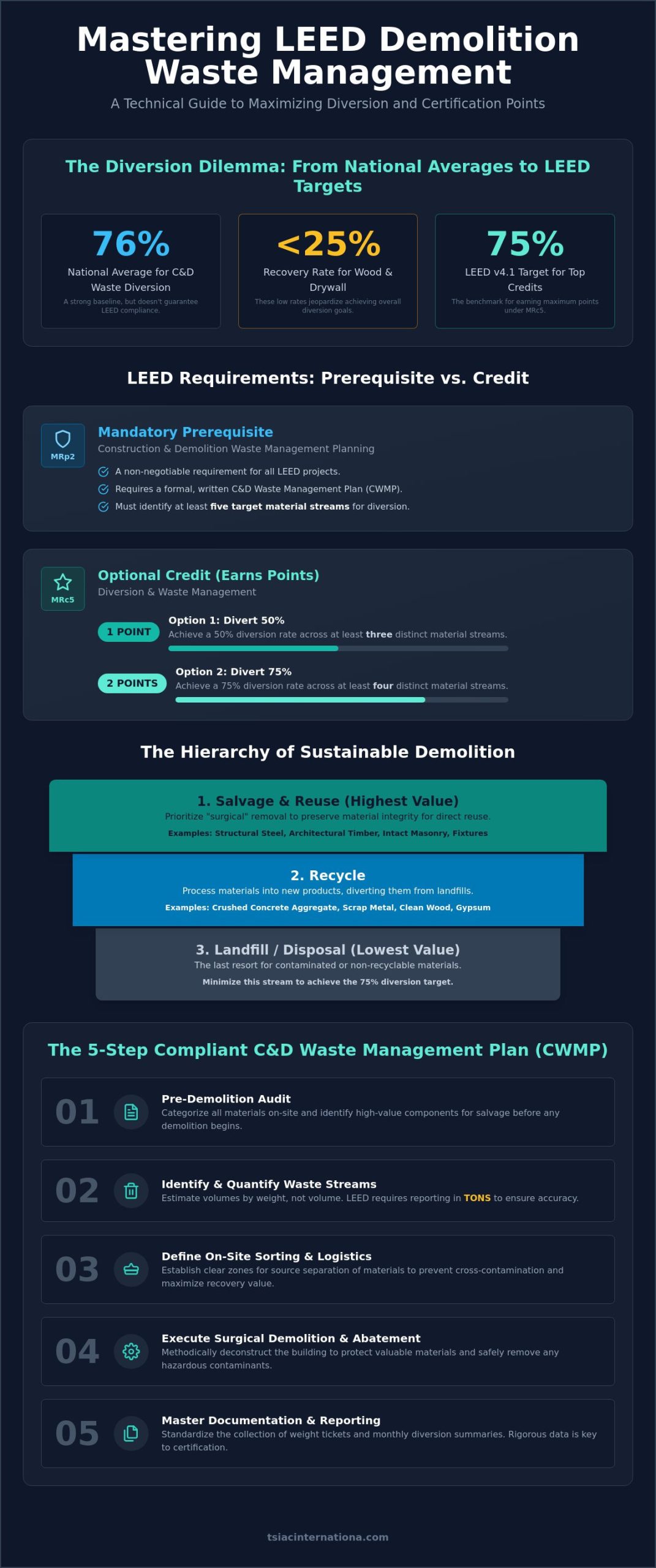
Sustainable demolition is a financial strategy that requires disciplined sorting. By separating wood, metal, and plastic in safe demolition zones, you reduce the volume of debris sent to expensive hazardous waste facilities. This improves project ROI and helps meet environmental targets. For a deeper analysis of managing these workflows, consult our guide on The Demolition Process in South Carolina. Proper sorting ensures that only truly hazardous materials incur the highest disposal rates, while recyclable materials are diverted to standard streams.
If you need a partner to manage these complex recycling and abatement services, our team provides the documentation precision and technical expertise required for large-scale structural projects.
Partnering with TSIAC International for SC Compliance
Managing the administrative complexities of 2026 requires more than a standard subcontractor. It demands a technical partner who understands the high stakes of structural removal. Since our founding in 2008, TSIAC International has focused on solving the regulatory headaches that often stall large-scale commercial projects. This asbestos guide for general contractors south carolina has provided the regulatory framework, but the physical execution of these standards is where we excel. We bridge the gap between heavy demolition and delicate hazardous material removal, ensuring that every fiber is accounted for and every permit is filed with precision.
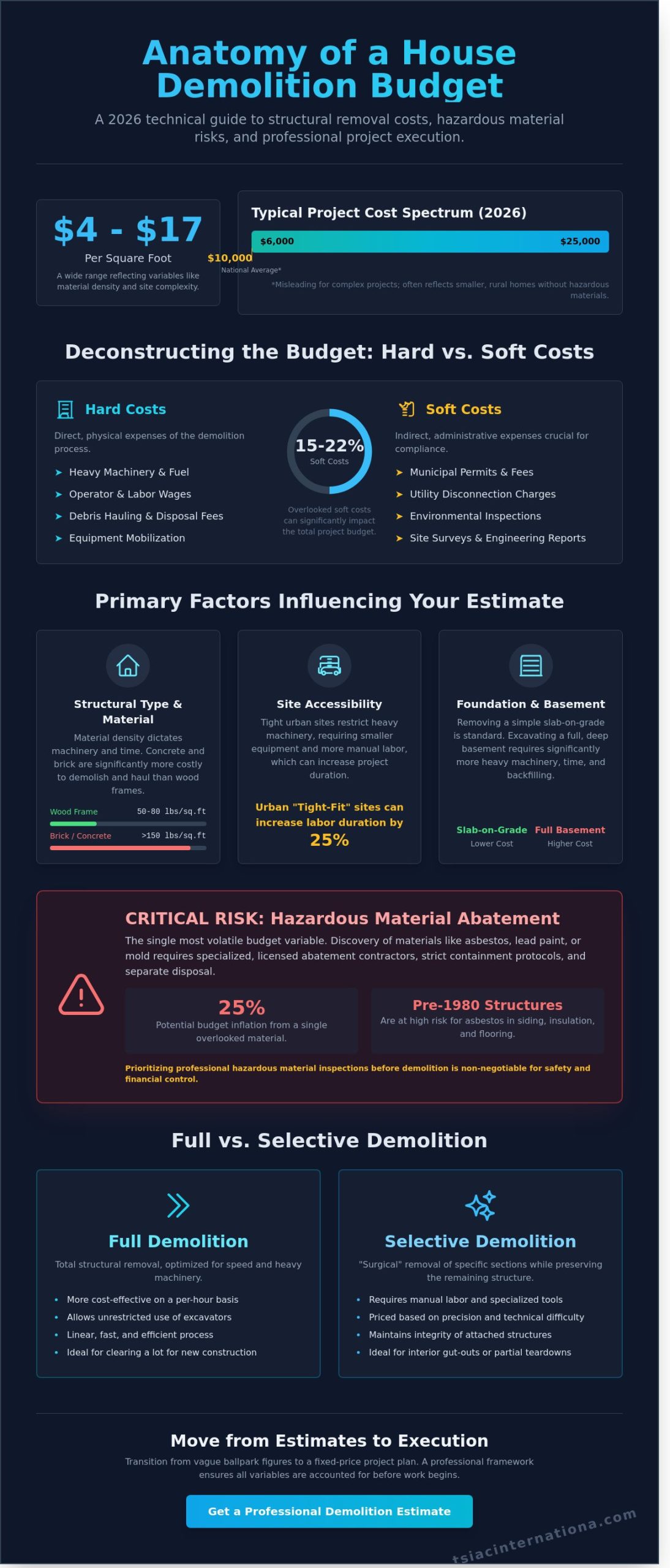
Financial predictability is a cornerstone of our service model. We understand that general contractors operate on thin margins, especially when surprise hazardous materials are discovered. Our fixed-price contracts provide the budgetary stability you need to move forward without fear of escalating costs. By integrating our 15 years of industry experience into your pre-construction planning, we identify potential liabilities before they become project-stopping crises. Our team manages the entire process, from the initial SCDES notification to the final air clearance, allowing your staff to focus on the rebuild rather than the cleanup.
Expertise in Structural and Selective Demolition
Our capabilities extend beyond simple removal. We specialize in both total structural demolition and surgical selective demolition. Whether you’re gutting a commercial interior for a modern renovation or leveling an industrial complex, our teams use heavy machinery and specialized tools to maintain site integrity. GCs frequently rely on our Hazardous Material Abatement in South Carolina expertise to handle the most challenging environments. We don’t just remove waste; we manage the site safety and environmental recycling protocols that define a professional 21st-century demolition project.
The TSIAC Advantage for GCs
The TSIAC advantage lies in our methodical approach to documentation and scheduling. We provide SCDES-compliant paperwork for every phase of the project, ensuring your compliance folder is audit-ready at all times. Our crews are trained to integrate seamlessly with your existing project timeline, preventing the abatement phase from becoming a bottleneck. We treat every job site with the same level of discipline, regardless of scale, ensuring that safety and reliability are never compromised. When you’re ready to secure your site’s compliance, Contact TSIAC International for a comprehensive abatement quote. Our team is prepared to provide the technical precision and regulatory expertise your South Carolina project demands.
Securing Compliance and Mitigating Risk in 2026
Mastering the modern regulatory landscape requires a shift from reactive problem-solving to proactive liability management. This asbestos guide for general contractors south carolina has detailed the critical transition to SCDES oversight and the non-negotiable 10-day notification period that protects your project from massive civil penalties. By maintaining a disciplined chain of custody and securing air clearance reports, you don’t just ensure safety. You create a permanent legal shield for your firm’s future.
The technical complexity of structural removal demands a partner with proven expertise in both demolition and hazardous material handling. With over 15 years of industry experience, TSIAC International provides the SCDES-licensed abatement specialists and comprehensive recycling protocols necessary for large-scale compliance. We manage the administrative and physical challenges of toxic waste so you can focus on the rebuild. Partner with TSIAC International for your next South Carolina demolition project to ensure your job site remains efficient and secure. Your project’s success depends on professional precision.
Frequently Asked Questions
Do I need an asbestos survey for a South Carolina demolition if the building is new?
Yes, you must conduct a professional asbestos survey regardless of the structure’s construction date. SCDES regulations don’t provide an automatic exemption for newer buildings. Even if a facility was built after the 1970s, a licensed inspector must verify the absence of asbestos-containing materials before any demolition or renovation begins. Skipping this step is a common regulatory failure that leads to immediate work stoppages and administrative penalties.
What are the fines for violating SCDES asbestos regulations in 2026?
Violations of state asbestos regulations can result in civil penalties of up to $10,000 per violation. Additionally, starting work before the mandatory 10-day notification period has passed can trigger OSHA fines of up to $16,550 per violation. These financial risks underscore why this asbestos guide for general contractors south carolina emphasizes rigid adherence to filing timelines and documentation protocols to protect your project’s bottom line.
Can a General Contractor remove asbestos-containing floor tiles in SC?
No, all asbestos abatement activities must be performed by contractors and personnel specifically licensed by SCDES. Even non-friable materials like floor tiles require specialized handling if they’ll be disturbed during demolition. A general contractor without an abatement license cannot legally remove these materials. Attempting to do so voids residential exemptions and exposes your firm to significant legal liability and environmental cleanup costs.
How long does the SCDES asbestos permit approval process take?
The approval process is governed by mandatory notification periods rather than a traditional permit review time. For NESHAP-level projects, you must submit written notification at least 10 working days before work begins. Smaller projects between 25 and 160 square feet require a four-day notification. Using the SCDES digital filing portal is the most efficient way to ensure your timestamp is recorded accurately to avoid scheduling delays.
What is the difference between friable and non-friable asbestos in a demolition project?
Friable asbestos refers to materials that can be crumbled or reduced to powder by hand pressure when dry, posing a high risk of fiber release. Non-friable materials, such as floor tiles or roofing, are bound in a solid matrix. However, if non-friable material is subjected to grinding, sanding, or mechanical demolition, it’s reclassified as friable. This distinction determines the level of containment and the specific removal techniques required on-site.
Is lead paint abatement required alongside asbestos removal in South Carolina?
While they’re governed by different sets of regulations, lead paint and asbestos are frequently found in the same structural components. If your building was constructed before 1978, you’ll likely need to manage both hazards simultaneously. Integrated abatement ensures that toxic lead dust doesn’t contaminate the site while you’re focused on asbestos containment. We recommend a unified hazardous material strategy to maintain safety and simplify your waste shipment records.
Who is responsible for air monitoring during an abatement project?
The general contractor is responsible for ensuring that third-party air monitoring is conducted by an independent laboratory. Relying on the abatement contractor’s internal monitoring creates a conflict of interest and leaves you vulnerable during litigation. Independent air monitoring provides the objective data needed to prove the site was safe for re-entry. This documentation is a vital component of the asbestos guide for general contractors south carolina for long-term liability protection.
What documentation must a GC keep on the job site for SCDES inspectors?
You must keep a copy of the SCDES Asbestos Renovation/Demolition Notification Form and the comprehensive asbestos survey report on-site at all times. Additionally, you should maintain copies of the abatement contractor’s licenses and the daily project logs. Once disposal begins, keep the initial Waste Shipment Records available. These documents prove you’re operating within the law during surprise inspections and help you avoid costly work stoppages.