The lowest abatement estimate can carry the highest whole-project cost. Calculating ROI on hazardous material abatement means looking beyond the initial scope price to consider how the work affects renovation sequencing, schedule disruption, waste handling, and exposure to risk. These factors can be difficult to quantify, but leaving them out can make a capital-budget comparison incomplete.
It’s reasonable to scrutinize upfront costs, especially when potential delays and downstream impacts are uncertain. A defensible estimate makes that uncertainty visible and compares feasible approaches on consistent terms. The goal is a project-specific decision, not a promise that abatement will produce a particular return.
This guide explains how to compare abatement costs with potential project savings, avoided disruption, and risk reduction. You’ll learn how to define the project baseline, account for schedule and disposal considerations, and assess suitable options without reducing the decision to price alone. With more than 15 years of experience in demolition and abatement, TSIAC International understands why coordinated scope, sequencing, and documented work matter when building an estimate stakeholders can evaluate.
Key Takeaways
- Separate direct abatement investment from measurable project benefits and avoided costs to make the financial case easier to review.
- Use a consistent ROI formula and include assessment, containment, labor, disposal, documentation, and coordination in the investment estimate.
- When calculating ROI on hazardous material abatement, compare only feasible approaches and account for schedule, access, disposal, and future maintenance assumptions.
- Record the evidence, baseline, time horizon, and calculation date, then test how changes in key assumptions affect the result.
- Translate the preferred scenario into a defined scope and sequence, coordinating abatement with demolition or renovation work.
Why Calculate ROI on Hazardous Material Abatement?
Abatement is often reviewed as a line-item expense, while decisions about schedule, access, and sequencing affect the wider project. A useful return-on-investment estimate makes those connections visible. It helps owners assess the financial implications of feasible approaches, but it doesn’t determine whether a hazard exists or replace technical judgment.
Abatement ROI is the relationship between the project value created or protected by abatement and the investment required to complete the defined work. To keep the estimate clear, separate its financial categories:
- Direct investment: Assessment, containment, labor, disposal, documentation, and coordination costs associated with the defined scope.
- Measurable benefits: Project outcomes that can be supported by evidence, such as reduced rework or a more workable demolition sequence.
- Avoided costs: Potential expenses associated with disruption, restricted access, or changes to planned work. Treat these as estimates, not guaranteed savings.
Risk reduction deserves careful treatment. Better control of hazardous materials can reduce exposure to project and worker hazards, but that benefit shouldn’t automatically be converted into a dollar saving. Any financial estimate needs a stated basis, such as documented schedule assumptions or a defined contingency scenario. Background on hazardous materials and waste categories is available in Understanding Hazardous Waste.
What ROI can, and cannot, tell a project owner
ROI supports budgeting and comparison between technically and legally feasible options. It can clarify how scope and sequencing affect the project’s financial case. It cannot identify hazardous materials, set the appropriate control method, or decide which obligations apply. Those questions depend on the project’s technical assessment and applicable requirements. A positive estimate doesn’t authorize an unsafe approach, and a negative estimate doesn’t cancel a safety or legal obligation.
Keep the financial model separate from scope decisions: first establish the material, work area, and appropriate controls; then evaluate the financial consequences of feasible scenarios. This makes assumptions easier to review and prevents a spreadsheet from being mistaken for a hazard assessment.
Which project decisions benefit from an ROI estimate?
Renovation and demolition planning can use ROI analysis to assess how abatement scope fits with access, work sequencing, and the broader schedule. During property acquisition, an estimate can help frame anticipated abatement work within due diligence and capital planning. Owners, general contractors, agency representatives, and budget approvers may all need a clear rationale for the proposed scope and its relationship to the project plan.
The hazardous material abatement guide discusses jurisdiction-specific considerations. Use the relevant context to frame the work, then keep the ROI estimate specific to the property, intended project, and assumptions being evaluated. This makes the financial discussion more useful without allowing projected savings to override safety decisions.
How to Build an ROI Model for Hazardous Material Abatement
A useful ROI model turns a project plan into comparable financial inputs. It starts with a defined, technically appropriate abatement scope, then compares the investment with benefits supported by project records or explicit assumptions. The calculation should clarify decisions, not make uncertain outcomes look precise.
ROI estimates depend on transparent, project-specific assumptions that stakeholders can review and revise.
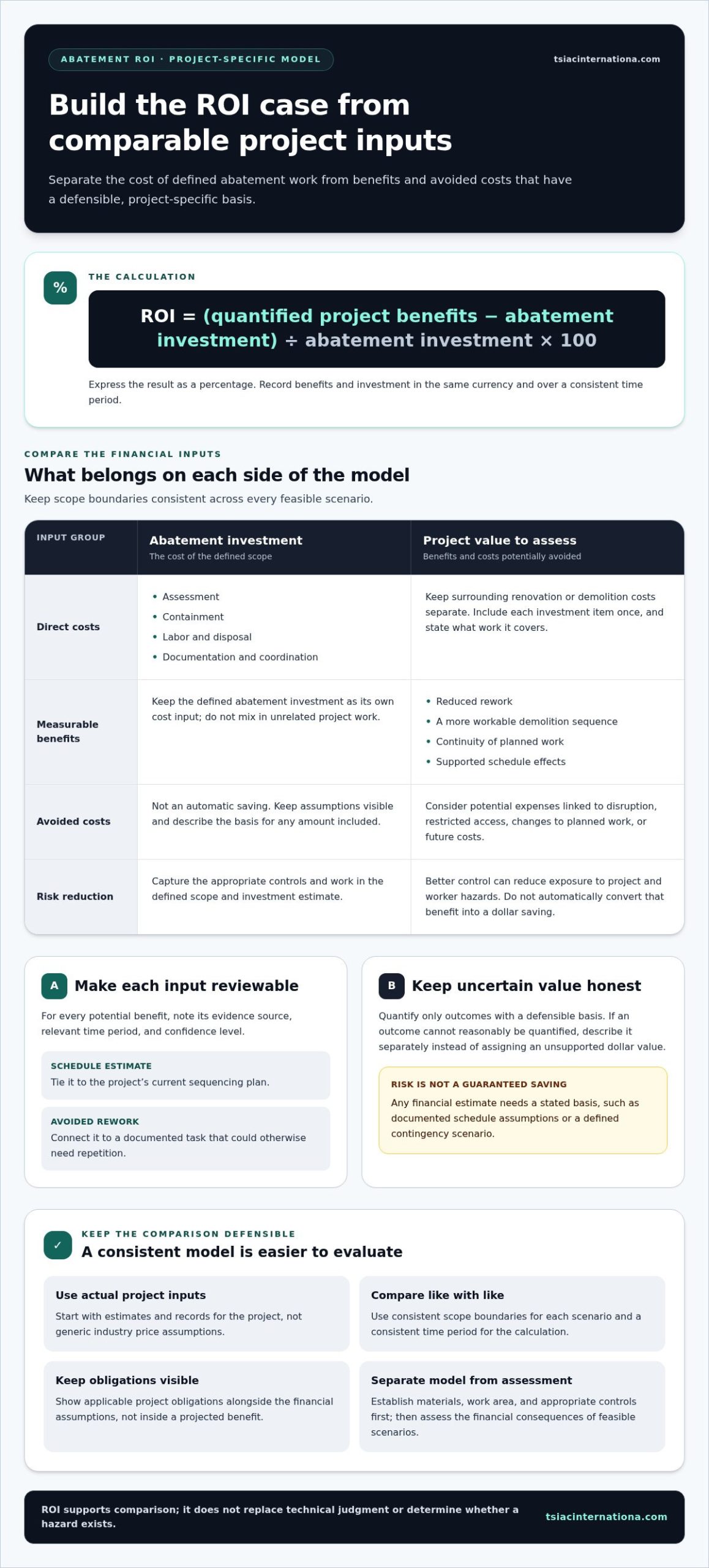
Formula: ROI = (quantified project benefits − abatement investment) ÷ abatement investment × 100. The result is expressed as a percentage. Recording benefits and investment in the same currency and over a consistent time period makes the comparison more meaningful.
Gather project-specific cost and benefit inputs
Start with estimates and records for the actual project rather than generic industry price assumptions. Keep abatement investment separate from the surrounding renovation or demolition budget so the calculation doesn’t attribute unrelated work to the abatement decision. Use consistent scope boundaries across every scenario being compared.
- Investment inputs: Assessment, containment, labor, disposal, documentation, and project coordination. Include each item once and state what work it covers.
- Potential benefit inputs: Schedule effects, avoided rework, continuity of planned work, and reduced exposure to future costs. Quantify only what has a defensible basis.
For each potential benefit, record its evidence source, relevant time period, and confidence level. A schedule estimate might rely on the project’s current sequencing plan; an avoided-rework estimate might be tied to a documented task that otherwise could require repetition. If an outcome can’t be reasonably quantified, describe it separately rather than assigning it an unsupported dollar value. The EPA Guidelines on Hazardous Waste Cleanups provide context on cleanup processes and regulatory frameworks. Keep applicable project obligations visible alongside, not inside, a financial benefit assumption.
Calculate net benefit and test assumptions
After assembling the inputs, subtract the abatement investment from quantified benefits to find net project benefit. Divide that result by the investment and multiply by 100. A positive percentage indicates that quantified benefits exceed the defined investment under the stated assumptions. It doesn’t establish that an approach is technically suitable or settle safety and compliance responsibilities.
Use a worksheet with rows for each input, its source, time period, and confidence. For example, list a documented schedule benefit once, rather than counting the same delay avoidance under both “continuity” and “avoided disruption.” Then test the model by adjusting uncertain assumptions, such as the projected duration of a schedule impact, while leaving documented costs unchanged. This shows decision-makers which assumptions drive the result and how sensitive it is.
For project-specific estimates, TSIAC International’s asbestos and lead abatement work can be considered alongside demolition sequencing, with compliance documentation and safe disposal incorporated into scope planning. Coordinating these elements helps keep model inputs connected to the work being evaluated.
Compare Abatement Scenarios Without Overlooking Project Risk
A single estimate can hide important trade-offs. Compare alternatives only after the project’s technical assessment and applicable requirements establish which scopes and sequences are feasible. A lower initial investment isn’t automatically the better option if it restricts access, complicates later work, or relies on maintenance assumptions the project can’t support.
Use the same project boundary and time horizon for each option. A simple comparison matrix can make the differences visible:
Scenario: Planned abatement before renovation or demolition. Compare: Upfront investment, planned work sequence, access available afterward, disposal needs, and any continuing maintenance assumptions.
Scenario: A documented discovery or delay during planned work. Compare: Credible schedule effects, affected work areas, possible resequencing, and disruption assumptions supported by project records.
Scenario: A technically appropriate alternative control or sequence. Compare: Scope investment, access implications, disposal requirements, future maintenance, and how the approach fits the next project phase.
These are planning scenarios, not predictions. Don’t treat postponing required abatement or using inadequate controls as a cost-saving option. Calculating ROI on hazardous material abatement is useful only within the boundaries of safe, technically appropriate work and applicable obligations.
Compare planned work with reactive project scenarios
Model planned work against a credible discovery or delay scenario, using project-specific evidence such as the current schedule, affected work packages, and documented sequencing dependencies. Include only disruption effects that can be explained, and state the assumptions behind them. A scenario estimates potential financial exposure; it doesn’t establish that a delay or loss will occur, or that abatement will prevent it.
Compare feasible abatement approaches and sequencing
Removal, enclosure, or encapsulation may be considered only where appropriate to the material, condition, site, and applicable requirements. Compare what each feasible approach means for downstream access, future renovation, disposal, and maintenance, not just the initial scope. Specialist assessment and applicable rules set the boundaries for the financial comparison; the ROI model doesn’t select a control method.
For each scenario, document the evidence source and mark uncertain assumptions clearly. For example, distinguish an established work sequence from a possible schedule effect, and avoid counting the same disruption under multiple benefit categories. This helps reviewers see which differences are supported by the project record and which remain estimates.
The abatement safety and regulatory guide addresses jurisdiction-specific considerations and shouldn’t be treated as a nationwide requirements summary. Keep each scenario grounded in the project’s own location, assessment, disposal assumptions, and planned work. A disciplined comparison shows where cost, access, schedule, and continuing responsibilities differ without presenting uncertainty as guaranteed savings.
Calculate ROI Step by Step, Then Stress-Test the Result
A calculation is only as useful as its boundaries and inputs. Before entering figures, define the property area, planned work, comparison period, and project activities included. Keep the estimate focused on the abatement decision, rather than blending in unrelated renovation or demolition costs.
Follow a repeatable calculation sequence
Use the same sequence for each scenario so stakeholders can see how the result was developed and update it as project information changes.
- Set the baseline. Record the current project plan, abatement scope, schedule assumptions, time horizon, and calculation date.
- List the investment. Enter project-specific estimates for the defined abatement work, separating each included cost from related construction activities.
- List potential benefits. Add only benefits supported by project evidence, such as a documented schedule effect or avoided rework. Identify each source and whether the input is an estimate or a recorded fact.
- Calculate the result. Subtract the abatement investment from quantified benefits to find net benefit, then divide by investment and express the result as a percentage.
- Document exclusions. Note indirect effects that remain qualitative, along with assumptions that are outside the project boundary.
Hypothetical structure: If a project team identifies Benefit A and Benefit B, its quantified benefit total is A + B. Net benefit is (A + B) − the defined abatement investment. ROI is that net benefit divided by the investment, multiplied by 100. These labels are placeholders, not prices, savings estimates, or benchmarks. Include the calculation date and evidence sources so readers know which project version the result reflects.
Use sensitivity analysis to communicate uncertainty
Some inputs, particularly potential schedule or disruption effects, may depend on assumptions rather than confirmed outcomes. Ask project stakeholders to establish evidence-based conservative, expected, and higher-impact values for those inputs. Keep the abatement scope and other documented figures consistent, then recalculate each scenario. Don’t widen a range simply to make an option look more favorable.
Sensitivity analysis makes an ROI estimate more decision-useful by showing how its result changes when uncertain, evidence-based assumptions change. Compare the results and identify which assumptions move them most. If the ROI shifts substantially when one schedule assumption changes, flag that input for closer review instead of presenting a single percentage as conclusive. Safety and applicable requirements remain outside this sensitivity test; they aren’t adjustable financial assumptions.
When abatement intersects with interior demolition, the commercial interior gutting considerations can help frame how work areas and sequencing interact. For project-specific planning, TSIAC International’s abatement and interior gutting services can help keep the defined scope and project assumptions connected.
Turn the ROI Estimate Into a Practical Abatement Plan
An ROI estimate becomes useful when it informs a defined scope and a workable project sequence. Translate the preferred scenario into a decision brief that explains what work is included, how it fits with renovation or demolition, and which assumptions shaped the financial result. The brief should support approval and coordination, not treat the calculated return as a substitute for technical findings or applicable requirements.
Make the estimate usable for owners and project teams
Keep the decision brief concise enough for budget review, but detailed enough for project teams to act on. Include the scope, investment categories, quantified benefits, exclusions, time horizon, and uncertainty range. Identify the source of each technical finding and financial assumption so reviewers can trace how the recommendation was developed and update it if project conditions change.
Then connect the approved scope to the project schedule. Identify the work areas involved, relevant sequencing assumptions, and how abatement relates to renovation, selective demolition, or structural demolition. This gives owners, general contractors, and other stakeholders a common reference for planning. It also helps prevent a financial model from becoming detached from field scope, access needs, or disposal planning.
What TSIAC brings to hazardous material abatement projects
TSIAC International provides asbestos and lead abatement, compliance documentation, and safe hazardous-waste disposal. With over 15 years of industry experience, the company works with homeowners, general contractors, and government agencies nationally. Its demolition services can be coordinated with hazardous-material work so the abatement scope and planned demolition sequence are considered together. Project documentation helps make the defined work and its basis visible to stakeholders, without promising a particular financial outcome.
Recycling practices on project sites apply to wood, metal, and plastic, not hazardous waste. Keeping those material streams distinct supports clear planning and avoids counting hazardous-waste handling as recycling in the business case. The estimate should reflect project-specific scope and assumptions rather than treating one project’s financial result as a universal benchmark.
Before approval, review the brief with the people responsible for the technical scope, project schedule, budget, and execution. Confirm that the selected scenario remains consistent with current project information, and record any changes to assumptions or scope as the plan develops. This creates a decision trail stakeholders can revisit if sequencing or site conditions change.
If you’re assessing an upcoming project, TSIAC International’s hazardous material abatement and demolition services can be part of your project planning. Align the scope, documentation, and work sequence with the estimate your team is reviewing.
Make the Next Project Decision With Confidence
A sound estimate should remain useful after budget approval. Treat it as a working decision record: identify who owns each key assumption, note what project changes would prompt a review, and keep later revisions traceable to their source. If scope, access, or sequencing changes, update the relevant inputs rather than relying on a return estimate built for an earlier plan.
This discipline keeps calculating ROI on hazardous material abatement tied to the project as it actually develops. It also gives stakeholders a clear way to revisit the decision without mistaking an estimate for a guaranteed outcome or a substitute for technical judgment.
TSIAC International brings demolition and abatement experience to project planning, with compliance documentation and safe disposal considered as part of the work. The company also recycles suitable wood, metal, and plastic on project sites, keeping those materials distinct from hazardous waste.
Discuss your hazardous material abatement project with TSIAC International to take the next step with a clear, project-specific plan.
Frequently Asked Questions
Is ROI the same as payback period?
No. ROI and payback period answer different questions. ROI compares net benefit with the investment across a stated scope and time horizon; payback estimates when cumulative benefits would equal the initial investment. A project team may compare options using ROI even if benefits arrive unevenly or include uncertain schedule effects, making a single payback date difficult to support. State the period and assumptions, and report payback only when the timing of benefits is credible.
Can hazardous material abatement have a negative calculated ROI?
Yes. A model can show that the financial benefits it can quantify don’t exceed the investment, especially if indirect or uncertain benefits are left out. That result describes the limits of the financial case, not whether the work should proceed. Review it alongside project risks and applicable safety and legal obligations. For instance, an owner might record a negative ROI while still needing to address required controls before planned work can continue.
Does a positive ROI prove that an abatement plan is safe or compliant?
No. ROI is a financial decision aid, not a technical assessment or compliance determination. A favorable result doesn’t show that the selected scope or controls are suitable for the material and site. Qualified project professionals must address technical findings, worker protection, applicable requirements, documentation, and disposal practices separately. Keep financial assumptions distinct from safety findings, and don’t use an attractive return calculation to justify inadequate controls or bypass necessary review.
How should a project team handle benefits that cannot be assigned a reliable dollar value?
Keep them visible as qualitative benefits instead of assigning unsupported monetary values. For example, a team might describe clearer coordination between abatement and renovation trades, then explain how that improves planning without claiming a specific financial saving. Record why each benefit matters and what evidence supports it. If useful, show qualitative considerations in a separate decision column so reviewers can weigh them without folding speculation into the ROI calculation.
Can a property owner calculate abatement ROI before final project scope is known?
Yes, as a preliminary estimate clearly marked provisional. For calculating ROI on hazardous material abatement at an early stage, distinguish current assessment findings from assumptions that still need resolution. For example, identify affected areas that remain under review rather than treating their scope as final. Revisit the calculation when the work boundary, schedule, disposal plan, and related renovation or demolition activities are better defined.
How often should an abatement ROI estimate be updated?
Update it whenever a material assumption changes, such as the defined work area, planned sequence, schedule, disposal approach, or project estimate. After completion, compare projected inputs with actual project records where available, noting which assumptions held and which changed. Keep dated versions rather than overwriting the original estimate. That record helps stakeholders understand how the financial case evolved and gives the team a more grounded starting point for future planning.