House Demolition Cost Estimator: A 2026 Contractor’s Guide to Project Budgeting

A house demolition isn’t just the final act of a structure; it’s the first high-stakes engineering phase of your new development where a single…

A house demolition isn’t just the final act of a structure; it’s the first high-stakes engineering phase of your new development where a single overlooked hazardous material can inflate your budget by 25% before the first excavator arrives. You likely recognize that precision in the planning phase is the only way to prevent a project from spiraling into a financial liability. Utilizing a professional house demolition cost estimator is essential for identifying the technical variables that generic quotes often overlook, from structural integrity concerns to complex site access requirements.

We understand the frustration of navigating opaque permit regulations and the genuine fear of discovering asbestos during the stripping phase. This guide provides the technical clarity you need to master demolition budgeting by breaking down structural removal, hazardous abatement, and material recovery strategies. You’ll gain a clear understanding of 2026 cost-per-square-foot variables, a checklist for vetting contractor quotes with engineering rigor, and specific methods to reduce your bottom line through systematic recycling.

Key Takeaways

  • Establish a realistic 2026 budget baseline by identifying why standard national averages often fail to account for complex structural demands.
  • Leverage a professional house demolition cost estimator approach to calculate how square footage and site accessibility impact debris volume and machinery deployment.
  • Mitigate financial and safety risks by prioritizing hazardous material inspections, a critical step for ensuring compliance in pre-1980 structures.
  • Master operational logistics by navigating local permit fees and environmental protection mandates to prevent unforeseen project delays and fines.
  • Transition from vague ballpark estimates to fixed-price execution by applying a rigorous framework for vetting experienced demolition contractors.

Understanding the Baseline: National House Demolition Cost Averages in 2026

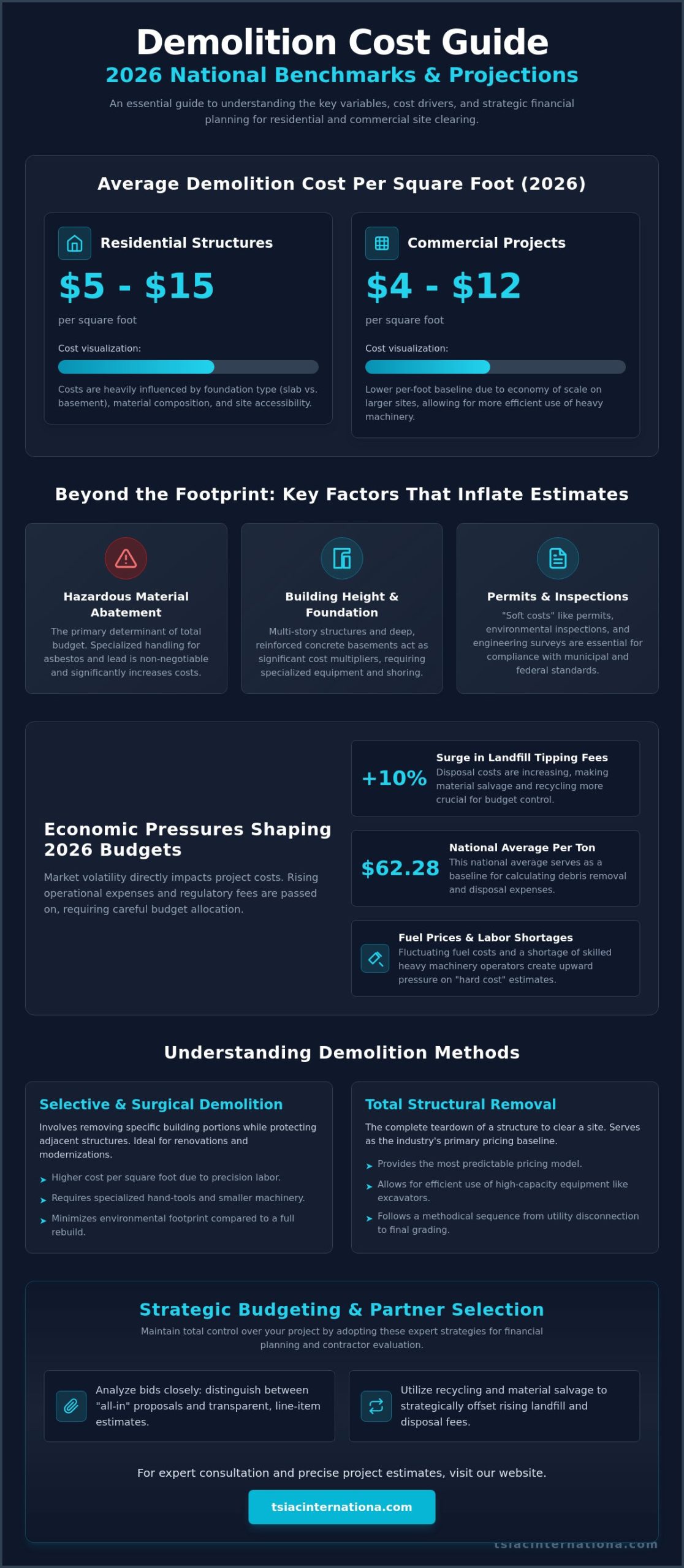
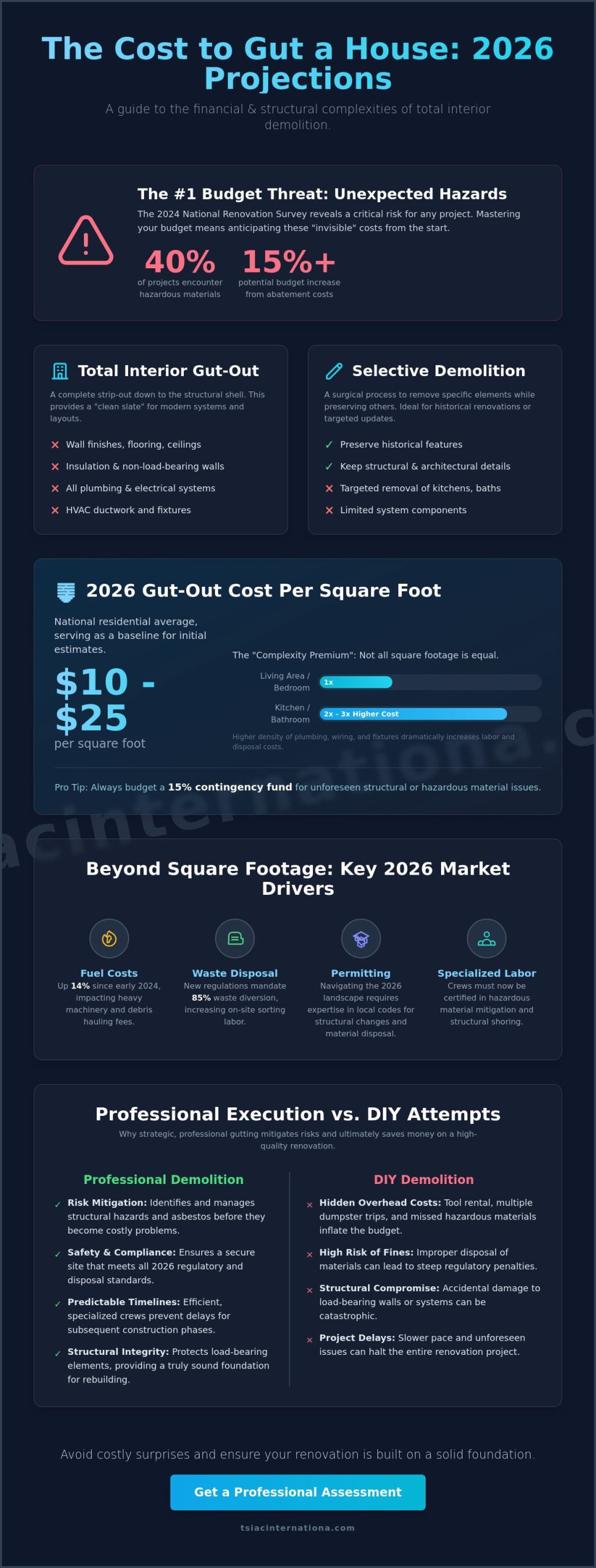
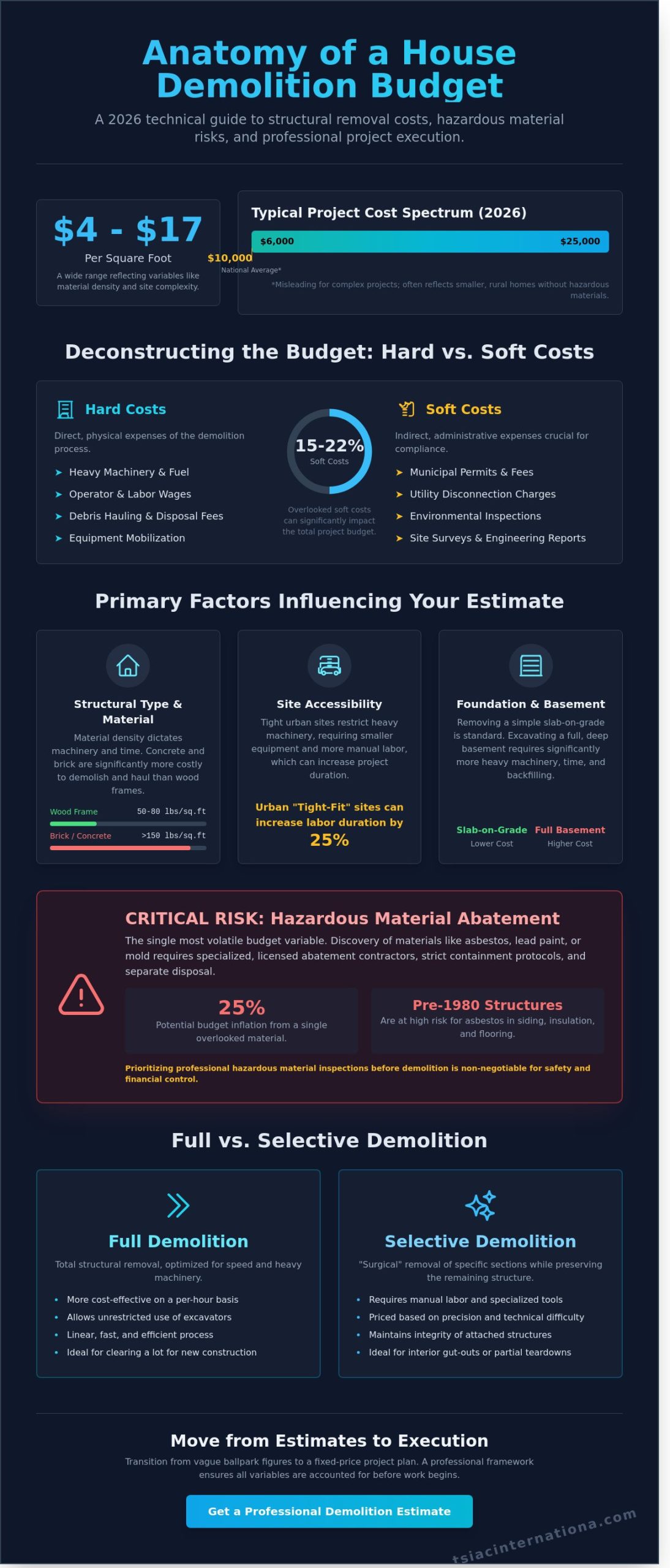
Budgeting for residential tear-downs in 2026 requires a data-driven approach that moves beyond simple guesswork. A reliable house demolition cost estimator typically places the standard range for residential projects between $6,000 and $25,000. While industry reports often cite a national average of $10,000, this figure is frequently misleading for complex structures. The average reflects smaller, single-story homes in rural areas and doesn’t account for the technical challenges found in modern urban environments or high-density residential zones.

Contractors and engineers generally utilize a cost-per-square-foot metric ranging from $4 to $17. This broad window exists because demolition isn’t just about destruction; it’s about the controlled management of materials and risks. Relying solely on square footage is a common mistake. A 1,500-square-foot home with asbestos siding or a reinforced concrete foundation will always command a higher price than a larger wood-frame structure with easy site access. Precision in the Demolition process involves analyzing the specific composition of the building before any machinery is deployed.

To build a realistic budget, you must distinguish between hard costs and soft costs. Hard costs include the visible elements of the job: heavy machinery rental, fuel, operator labor, and the significant expense of debris hauling and tipping fees. Soft costs often catch owners off guard, encompassing municipal permits, utility disconnect fees, and mandatory environmental inspections. In 2026, these administrative and preparatory steps can represent 15% to 22% of the total project expenditure.

Full vs. Selective Demolition Costs

Total structural removal is often more cost-effective on a per-hour basis because it allows for the unrestricted use of heavy excavators and high-capacity loaders. The process is linear and fast. Selective demolition, however, requires a “surgical” approach to maintain the structural integrity of remaining sections or neighboring properties. Because this work involves manual labor and specialized bracing, selective demolition project fees are calculated based on precision requirements and the technical difficulty of the separation, rather than volume alone.

The Role of Structural Type in Your Estimate

Material density is a primary driver of your final house demolition cost estimator results. Wood frame houses are the least expensive to dismantle, whereas brick, masonry, or stone structures require specialized hydraulic breakers and more time to process. Multi-story homes introduce a “height premium” because they require high-reach equipment and stricter safety perimeters to manage falling debris. Finally, don’t overlook the foundation. Removing a simple slab-on-grade is a standard task, but excavating a deep basement requires heavy machinery and significant backfilling to leave the site in a safe, buildable condition.

Primary Structural Variables Influencing Your Demolition Estimate

The total square footage of a building is the primary metric used by any professional house demolition cost estimator, but the calculation is rarely a simple linear progression. A 2,500-square-foot residence produces significantly more waste than its footprint suggests because of the vertical volume of walls, roofing systems, and internal fixtures. Contractors calculate debris weight based on material density; for instance, a standard wood-frame house weighs approximately 50 to 80 pounds per square foot, while a brick or concrete structure can exceed 150 pounds per square foot.

Site accessibility dictates the type of heavy machinery a team can deploy. In urban “tight-fit” environments, where structures sit within 10 feet of neighboring properties, contractors can’t use 20-ton excavators with large reach. These constraints require smaller, less efficient equipment or specialized attachments, which can increase labor duration by 25%. Conversely, open rural properties allow for high-speed mechanical demolition and the staging of multiple hauling trucks, which optimizes the project’s daily throughput. Prior to any structural impact, the law requires specific preparatory operations to be completed, including engineering surveys and the formal capping of gas, water, and sewer lines.

Machinery and Labor Allocation

Mechanical demolition is the most cost-effective path for most residential projects. Standard hourly rates for a primary excavator operator and the machine itself typically range from $150 to $275, depending on the region and fuel surcharges. If a client chooses manual deconstruction to salvage high-value materials like old-growth timber or architectural stone, labor hours can triple compared to mechanical methods. Final site preparation and grade-out, which involves backfilling the foundation hole and leveling the soil to a 1% to 2% slope for drainage, usually requires an additional 8 to 16 hours of skid-steer operation.

Debris Management and Hauling Logistics

Estimating waste volume involves converting the structural mass into cubic yardage. A common industry rule of thumb suggests that a demolished house occupies three to four times its original standing volume before it’s compacted in a container. Tipping fees at local landfills represent a major portion of the budget; these fees are governed by municipal waste regulations and can vary from $40 to $100 per ton. Debris volume directly dictates the number of 40-yard roll-off containers required to clear the site efficiently. Effective logistics planning ensures that trucks are cycled out as they’re filled, preventing idle time for the heavy equipment operators on-site.

Managing these variables requires a disciplined approach to site logistics and safety. For those managing high-risk or technically demanding sites, partnering with a complex execution specialist provides the engineering oversight necessary to maintain budget stability throughout the project lifecycle.

House Demolition Cost Estimator: A 2026 Contractor’s Guide to Project Budgeting

Hazardous Material Abatement: The Critical Variable in Safety and Budgeting

For structures built before 1980, environmental testing isn’t just a recommendation; it’s a legal mandate that dictates the entire project’s financial trajectory. When utilizing a house demolition cost estimator, the presence of toxic substances often represents the largest gap between an initial quote and the final invoice. Federal NESHAP regulations require a thorough inspection before any activity disturbs the structural integrity of a building. Skipping this step to save a few hundred dollars on a professional survey is a high-risk gamble. While a certified inspection might cost between $400 and $1,500 for a standard residential property, the EPA can levy fines exceeding $37,500 per day for non-compliance. Professional contractors prioritize these surveys to establish a baseline for safety and to prevent the accidental release of toxins into the local atmosphere.

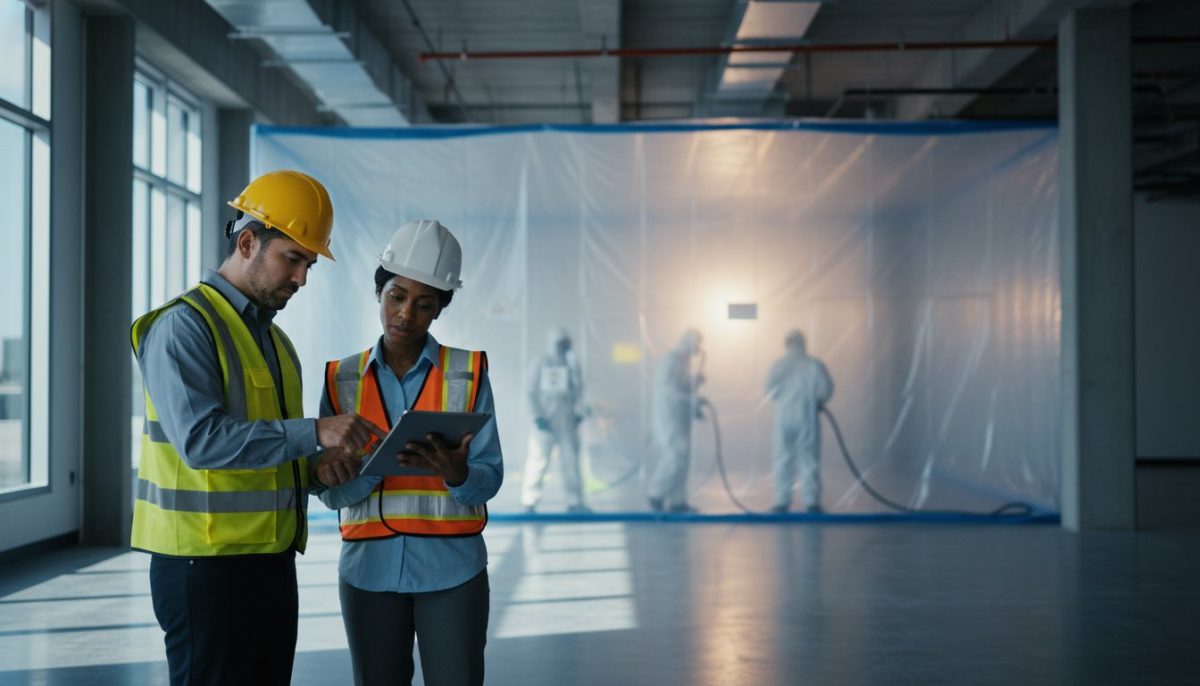
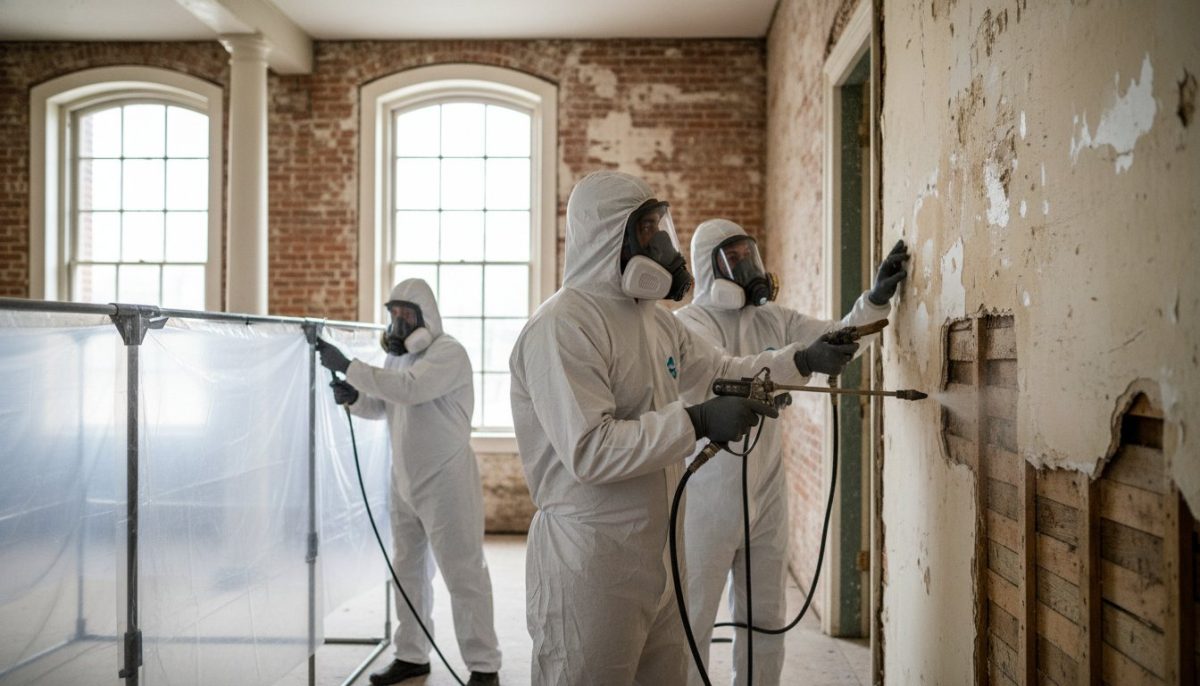
Effective Hazardous material abatement requires sophisticated containment strategies that significantly influence labor costs. Contractors must implement negative air pressure environments and physical barriers using 6-mil polyethylene sheeting to prevent cross-contamination. These technical requirements mean that abatement teams work at a slower, more methodical pace than standard demolition crews. By integrating these specialized workflows early into the demolition process, project managers can avoid the 14-day mandatory notification delays and unexpected work stoppages that occur when materials are discovered mid-teardown.

Asbestos and Lead Mitigation Costs

Budgeting for asbestos removal depends on whether the material is friable or non-friable. Costs are typically calculated by the linear foot for pipe insulation or by the square foot for floor tiles and siding. Lead-based paint stabilization adds another layer of complexity, requiring HEPA-filtered vacuum systems and specialized chemical strippers to prevent dust migration. Beyond labor, owners must account for disposal surcharges. Hazardous waste cannot go to standard C&D landfills; it requires transport to lined facilities equipped to handle toxic containment, which often doubles or triples the standard tipping fees per ton.

Mold Remediation and Soil Contamination

Properties with a history of water intrusion or long-term vacancy often require comprehensive hazardous material abatement for mold spores before mechanical demolition begins. This ensures the safety of the heavy equipment operators and the surrounding neighborhood. Furthermore, if the house demolition cost estimator reveals the presence of underground storage tanks (USTs), soil testing becomes a priority. Discovering a leaking oil tank can trigger mandatory state reporting and expensive soil excavation. Regulatory reporting fees for environmental compliance documentation are fixed costs that must be factored into the 2026 project budget to ensure the site is legally cleared for future redevelopment.

Operational Logistics and Site-Specific Estimation Factors

Precision in demolition requires more than heavy machinery. It demands a meticulous house demolition cost estimator that accounts for administrative and environmental variables. Permit fees aren’t static. In 2024, municipal building departments in urban centers often require 15 to 30 days for plan review, with fees scaling based on square footage. These permits generally range from $400 to $2,000 depending on the local jurisdiction’s fee schedule and the complexity of the utility disconnects.

Environmental protection mandates like silt fencing and erosion control usually add $1,500 to $3,500 to a standard residential project. These aren’t optional extras; they’re legal requirements to prevent sediment runoff into local storm systems. Professional contractors also carry high-limit general liability and workers’ compensation insurance. This coverage protects the property owner from liability if structural failures occur. Bonding provides a financial guarantee that the site will be cleared according to the contract specifications, representing a vital layer of security for the investment.

Material Recovery and Recycling Strategies

Smart contractors use a house demolition cost estimator to calculate the “Recycling Credit.” By sorting materials like structural steel, copper piping, and timber on-site, you reduce landfill tipping fees. Landfill costs averaged $55 per ton in the United States in 2023. Diverting 70% of waste through on-site sorting can save thousands in hauling expenses. Concrete crushing is another efficiency. Instead of hauling away old foundations, we crush the masonry to create 21A or 57 stone for on-site backfill, eliminating the cost of purchasing new aggregate.

Site Stabilization and Post-Demo Cleanup

The project isn’t finished when the walls fall. Site stabilization involves importing clean fill dirt, which costs between $15 and $40 per cubic yard depending on the haul distance. Proper grading ensures water flows away from neighboring structures. We apply seed and straw to prevent soil loss, meeting local 2026 environmental standards for stabilized ground cover. Final administrative steps include a post-demolition inspection to close out the permit and release any held bonds. These technical steps ensure the lot is build-ready and legally compliant.

For projects requiring high-precision execution and specialized technical oversight, consult with our team at TSIA C International for professional demolition logistics.

Moving from Estimates to Execution: The Professional Demolition Framework

Transitioning from a digital house demolition cost estimator to a physical job site requires a shift from theoretical numbers to operational precision. You need to vet a demolition contractor based on their specific fleet of high-reach excavators and specialized attachments rather than just their price point. Experience in structural engineering is non-negotiable. A “ballpark” estimate serves as a preliminary guide, but it lacks the legal weight of a fixed-price structural contract. This contract binds the provider to the agreed-upon figure, protecting your capital from the volatility of material markets or labor shortages. A detailed scope of work (SOW) acts as your primary defense against change orders. It should explicitly define every task from slab removal to utility capping. Without this granularity, projects often see cost overruns of 15% to 20% due to “unforeseen” site conditions. Prioritizing a firm with a documented safety record ensures that liability remains managed and site incidents don’t derail your 2026 development schedule.

Reviewing the Demolition Bid

Low-ball estimates often signal missing line items. If a bid arrives 25% lower than the industry average, check for the exclusion of permit fees, site stabilization, or debris hauling. A professional bid must define hazardous material contingencies, particularly for asbestos or lead paint discovered during the tear-down process. You must verify that the contract requires the provision of disposal receipts and recycling manifests. These documents prove that waste reached a licensed facility, shielding you from environmental fines that can exceed $10,000 per violation in many jurisdictions. Don’t accept verbal assurances; ensure every disposal site is named in the document.

Finalizing Your Demolition Timeline

Project duration directly dictates your overhead. Every day a 30-ton excavator sits idle can cost upwards of $1,500 in rental and standby fees. You must schedule municipal inspections in alignment with your work phases to prevent these bottlenecks. While a house demolition cost estimator provides a baseline, the actual timeline depends on the synchronization of crew shifts and equipment transport. A well-sequenced demolition plan reduces total overhead by eliminating overlapping labor costs and minimizing the duration of onsite machinery rentals.

Securing Your 2026 Site Preparation Strategy

Navigating the complexities of a 2026 demolition project requires more than a simple house demolition cost estimator. It demands a technical understanding of structural integrity and environmental compliance. Successful budgeting hinges on identifying hazardous materials early and accounting for site-specific logistics that impact the final balance sheet. TSIAC International brings over 15 years of experience in structural demolition and abatement to your project site. We apply engineering precision to every assessment, ensuring that hidden variables don’t derail your timeline. Our process includes comprehensive hazardous material remediation and a dedicated commitment to material recycling, which aligns your project with modern environmental responsibilities. We manage the transition from initial estimate to final site clearance with disciplined, professional execution. You can rely on our technical expertise to handle the most challenging structural environments with absolute control. Let’s transform your site into a clean slate for future development.

Get a professional fixed-price demolition estimate from TSIAC International and ensure your project starts on a foundation of professional reliability.

Frequently Asked Questions

How much does it cost to demolish a 2,000-square-foot house in 2026?

Demolishing a 2,000-square-foot house in 2026 typically costs between $8,000 and $30,000 depending on regional labor rates and material disposal fees. This calculation assumes a standard wood frame structure with a concrete slab foundation. You should use a house demolition cost estimator to account for local 2026 landfill taxes and equipment mobilization fees that vary significantly by state.

Structural complexity and site accessibility also influence the final price. If the property is located in a dense urban area, specialized debris management might increase the total expenditure by 15 percent.

Is it cheaper to deconstruct a house or demolish it mechanically?

Mechanical demolition is significantly cheaper than deconstruction, often costing 50 percent less in upfront labor expenses. While deconstruction involves hand-stripping materials to preserve their integrity, mechanical methods use hydraulic excavators to clear a site in 2 to 5 days. Deconstruction can take 2 weeks or longer, though it may provide tax benefits through salvaged material donations.

Choosing mechanical demolition ensures a faster project turnaround. This method focuses on efficiency and safety, allowing the site to be prepared for new construction within a strictly defined timeline.

Does the presence of asbestos always double the demolition cost?

Asbestos abatement doesn’t always double the total demolition cost, but it typically adds $2,000 to $5,000 to the project budget. Federal EPA regulations require certified contractors to handle materials like transite siding or popcorn ceilings before structural teardown begins. In a 2024 industry report, abatement represented approximately 15 percent to 25 percent of the total project expenditure for older homes.

Professional surveys are essential to identify these risks early. Proper handling ensures the safety of the crew and prevents legal liabilities that arise from improper hazardous waste disposal.

Can I save money by doing the interior gutting myself?

You can save between $500 and $2,000 by performing interior gutting yourself, provided you focus on non-structural elements like cabinets and flooring. This approach reduces the contractor’s labor hours and total debris volume. You must ensure all utilities are disconnected and verify that you aren’t disturbing hazardous materials like lead paint during the process.

DIY gutting requires careful planning to avoid damaging load-bearing walls. While it lowers the initial quote, the time investment and tool rental costs should be weighed against professional efficiency.

What permits are required before a house demolition can begin?

You must secure a demolition permit from your local building department and obtain utility disconnect sign-offs from gas, water, and electric providers. Most municipalities also require an asbestos survey and a rodent abatement certificate before work starts. Failure to obtain these 3 primary documents can result in fines exceeding $1,000 per day of unauthorized activity.

Permit fees vary by jurisdiction, usually ranging from $200 to $1,000. Ensuring all paperwork is filed correctly prevents project delays and maintains compliance with local safety ordinances.

How do material recycling programs affect my final demolition bill?

Material recycling programs can reduce your final bill by 20 percent to 40 percent by diverting heavy waste like concrete and steel from high-cost landfills. Many modern projects achieve a 75 percent recycling rate for structural components. Contractors who utilize a house demolition cost estimator often factor in these rebates or lower tipping fees at specialized recycling facilities.

Recycling isn’t just environmentally responsible; it’s a strategic financial decision. Reclaiming materials like timber or brick can sometimes offset the costs of specialized hauling equipment.

What happens to the cost if underground tanks are found during demolition?

Finding an undisclosed underground storage tank typically adds $1,000 to $4,000 to your budget for professional extraction and soil testing. If the tank has leaked, environmental remediation costs can escalate quickly depending on the level of soil contamination. Contractors must follow state environmental protocols to ensure the site is cleared for future residential construction.

Pre-demolition site assessments help mitigate these surprises. Identifying tanks early allows for accurate budgeting and prevents the sudden suspension of work during the mechanical teardown phase.

How long does the typical residential demolition process take from start to finish?

The entire residential demolition process usually takes 2 to 4 weeks from the initial permit application to the final site clearance. The physical teardown and debris removal typically occupy only 3 to 5 working days. Delays often occur during the utility capping phase or if unexpected hazardous materials require specialized handling procedures.

Efficient scheduling is key to maintaining this timeline. A well-organized contractor manages the coordination between inspectors, utility companies, and waste haulers to ensure the project stays on track.

Asbestos Abatement Cost in Charleston, SC: 2026 Professional Pricing Guide

Did you know that 75% of Charleston structures built before 1981 still house hazardous minerals that can halt a renovation in its tracks? When you’re…

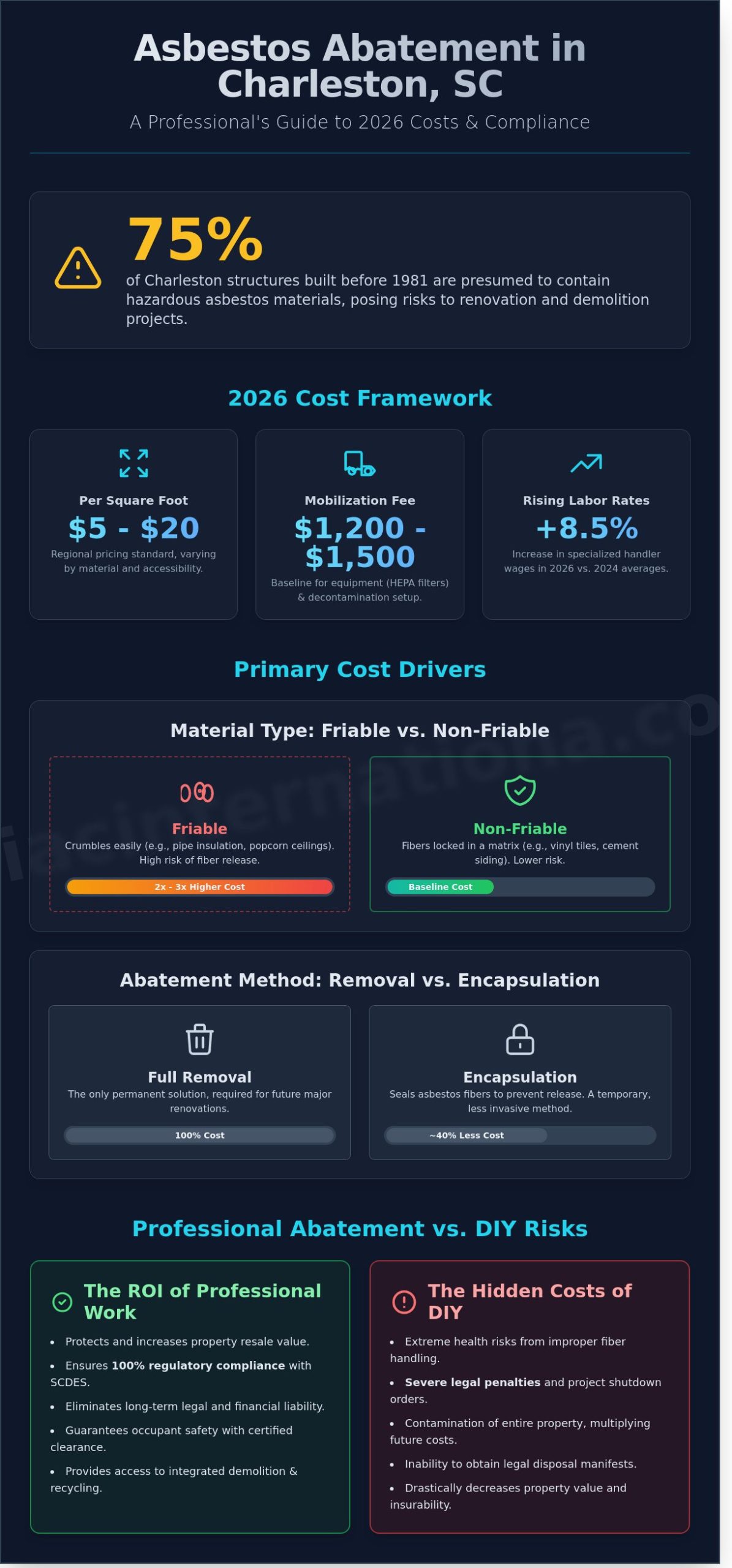
Did you know that 75% of Charleston structures built before 1981 still house hazardous minerals that can halt a renovation in its tracks? When you’re managing a historic property or a mid-century commercial site, understanding the asbestos abatement cost charleston sc becomes a matter of structural integrity and legal liability. You likely recognize that cutting corners on environmental remediation isn’t an option when the South Carolina Department of Environmental Services (SCDES) mandates strict oversight for every square foot disturbed. It’s frustrating to face a demolition deadline while worrying about hidden line items or air quality failures that could endanger your occupants.

We agree that professional transparency is the only way to manage industrial risks effectively. This guide delivers a professional decision-making framework designed to help you secure a predictable cost estimate while maintaining 100% regulatory compliance. We’ll examine current 2026 pricing trends for residential and commercial projects, explain the mandatory SCDES notification protocols, and outline the specific steps required to transition from a contaminated site to a cleared workspace ready for your next phase of construction.

Key Takeaways

  • Establish a realistic budget by understanding the $5 to $20 per square foot regional pricing standard and why mobilization fees are a necessary baseline for safety.
  • Learn how technical factors like material friability and structural accessibility create significant variations in your professional remediation estimate.
  • Ensure full regulatory compliance by navigating SCDES licensing protocols and the mandatory role of independent air monitoring for final site clearance.
  • Analyze the comprehensive asbestos abatement cost charleston sc to see how certified removal protects property resale value and eliminates the liability of DIY mistakes.
  • Explore how integrated abatement and debris recycling strategies from industry veterans can streamline complex projects while maintaining environmental responsibility.

Calculating Asbestos Abatement Cost in Charleston, SC: 2026 Framework

Estimating the asbestos abatement cost charleston sc requires a technical understanding of current market conditions and local regulatory compliance. Regional remediation projects in 2026 typically command pricing between $5 and $20 per square foot, depending on the material’s friability and accessibility. For small-scale interventions, professional contractors establish a baseline minimum mobilization fee ranging from $1,200 to $1,500. This initial charge covers the deployment of specialized HEPA filtration equipment and the setup of physical decontamination units. This framework accounts for 2026 labor rates, where specialized hazardous material handlers in the Lowcountry earn 8.5% more than 2024 averages due to increased certification requirements and rising insurance premiums.

Before initiating a project, owners should consult a comprehensive overview of asbestos to understand why strict safety protocols drive these underlying costs. Categorizing the project by scope is essential for budget accuracy. Residential projects often involve smaller volumes but higher labor intensity per square foot. Commercial projects benefit from economies of scale but face more rigorous air monitoring standards. It’s a matter of engineering precision to ensure total containment, regardless of the building’s age or size.

The Baseline: What Influences the Initial Quote?

Square footage is the primary metric for initial estimates, yet the total volume of material remains the secondary driver of disposal fees. Encapsulation, which involves sealing the fibers to prevent release, generally costs 40% less than full removal. However, full removal is the only permanent solution for structural longevity and future renovations. Project duration directly impacts overhead; site monitoring and negative air pressure maintenance must continue 24 hours a day until a third-party laboratory confirms final air clearance.

Fixed-Price vs. Variable Remediation Contracts

Professional contractors prioritize transparent, line-item estimates to ensure fiscal predictability for the client. Fixed-price contracts for structural demolition and abatement provide the most security for large-scale budgets. These agreements usually include a 10% contingency clause to address hidden materials discovered behind wall cavities or within subflooring. Using a asbestos abatement cost charleston sc model that emphasizes fixed pricing prevents budget creep during the execution phase. Detailed quotes allow project managers to track exactly where capital is allocated, from specialized PPE to legal disposal manifests at approved hazardous waste facilities. We don’t believe in hidden fees, only technical accuracy.

Primary Technical Cost Drivers: Material Type and Accessibility

Charleston’s diverse inventory of historic and industrial properties means that a single flat rate for remediation doesn’t exist. The total asbestos abatement cost charleston sc depends on the physical state of the material and how difficult it’s to reach. Professional teams categorize these projects based on technical risk factors that dictate the level of equipment and labor hours required for safe completion.

Friable vs. Non-Friable Asbestos Costs

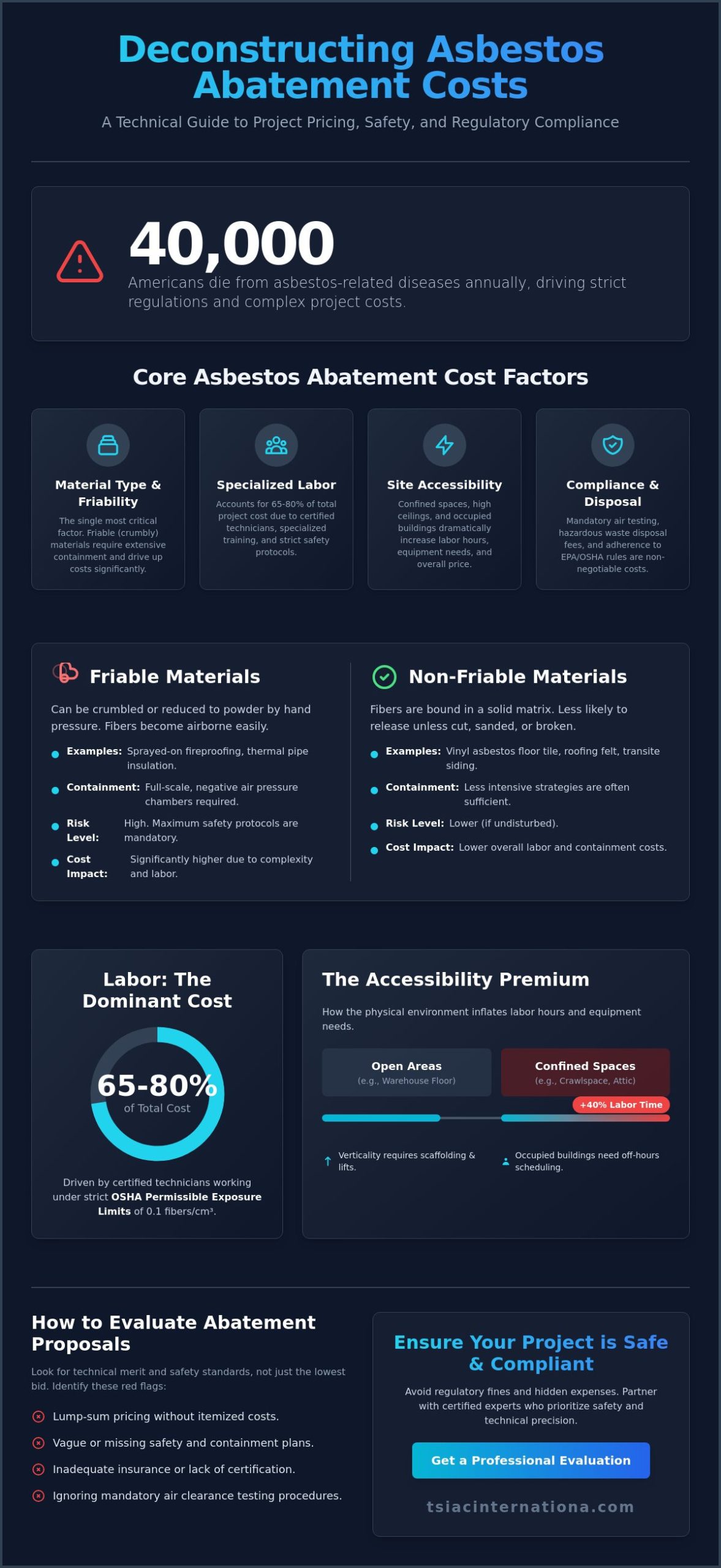
The distinction between friable and non-friable materials is the most significant price factor in any project. Friable asbestos, such as popcorn ceilings or thermal pipe insulation, crumbles easily into a fine powder. This fragility increases the Asbestos Exposure and Cancer Risk for everyone in the vicinity, necessitating rigorous containment. Conversely, non-friable materials like vinyl floor tiles or cement siding keep fibers locked within a solid matrix. Because friable materials require 100% airtight seals and advanced filtration, they typically cost 2 to 3 times more per square foot to remove than non-friable alternatives.

Site Logistics and Containment Requirements

Logistical complexity often dictates the final invoice more than the volume of material itself. Removing asbestos from a cramped 1920s attic crawlspace involves higher labor costs than an open-plan warehouse. Our technical teams must factor in several critical components:

  • Negative Pressure Enclosures: We build custom plastic barriers and use industrial blowers to ensure no fibers escape the work zone.
  • HEPA Filtration: Systems must achieve a 99.97% efficiency rating and maintain at least 4 air changes every hour.
  • Decontamination Units: Multi-stage shower systems for personnel are mandatory for high-risk friable projects.
  • Structural Integrity: If a building has over 12% moisture damage or existing rot, we must install temporary shoring to protect the abatement team.

Height adds another layer of expense. Projects involving multi-story industrial facades or ceilings over 15 feet require specialized scaffolding or scissor lifts. These mechanical requirements increase the asbestos abatement cost charleston sc due to the additional equipment rental and the slower pace of work at elevation. When dealing with complex structural challenges, engineering precision is the only way to ensure both safety and budget stability. We don’t guess on safety; we calculate every variable before the first seal is placed.

Regulatory Compliance and Disposal Fees in South Carolina

Compliance isn’t optional. It’s a foundational cost driver in any professional project. In South Carolina, the 2026 regulatory landscape dictates that every abatement action follows a rigid sequence of notifications and inspections. Adhering to South Carolina Department of Environmental Services (SCDES) regulations ensures that every project meets the current safety benchmarks. These mandates require specialized personnel, including licensed supervisors and air samplers, whose credentials must be verified before work begins. Their expertise adds a layer of precision that protects the property owner from future liabilities.

Professional air monitoring serves as the final gatekeeper for project clearance. An independent third-party consultant must conduct aggressive air clearance testing to confirm the area is safe for re-occupancy. This process typically adds $500 to $1,500 to the total bill. While it’s an additional expense, it provides the “Chain of Custody” documentation required by insurance providers and legal entities. This paperwork proves that the hazardous material was handled, transported, and disposed of according to federal and state law, shielding the owner from the $25,000 per-day fines associated with improper handling.

Permitting and Notification Requirements

State law requires a mandatory 10-day notification period for any renovation or demolition involving more than 160 square feet of asbestos-containing material. This waiting period is non-negotiable and impacts the project timeline. Administrative fees for these notifications generally range from $50 to $1,000. Skipping these steps is a financial disaster; the asbestos abatement cost charleston sc is always lower than the cost of an EPA enforcement action. Fines for non-compliance in the Charleston region have historically reached five figures for single-family residential violations.

Hazardous Waste Transportation and Landfill Fees

Asbestos cannot go to a standard municipal landfill. It requires specialized transportation in leak-tight, 6-mil poly-lined containers. Landfill “tipping fees” for hazardous waste are significantly higher than standard debris, often costing between $75 and $150 per ton. Since Charleston has limited local options for hazardous waste disposal, hauling costs often include long-distance transport to regional facilities like those in Pinewood. These logistics account for approximately 15% to 25% of the total asbestos abatement cost charleston sc, depending on the volume of waste generated during the removal phase.

The ROI of Professional Abatement vs. Hidden DIY Risks

Choosing a $50 home test kit or following online forum advice to “just wet it down” creates a dangerous false economy. While the initial asbestos abatement cost charleston sc might seem high, the long term financial exposure of DIY errors is immense. Improper handling leads to secondary contamination; this often forces a 400% increase in remediation costs later when microscopic fibers settle into HVAC systems and porous materials. Professional intervention utilizes HEPA-filtered negative pressure zones to ensure the hazard is removed, not relocated.

Liability and Property Value Preservation

A certified abatement letter serves as a critical legal shield for any asset owner. In the 2026 Charleston real estate market, residential properties lacking professional clearance documentation often see a 12% to 15% reduction in final offer prices. For commercial transactions, lenders require a Phase I Environmental Site Assessment before releasing funds. Professional documentation acts as an insurance safeguard. It prevents the $250,000 legal claims that typically arise from cross-contamination of neighboring properties or future occupant exposure. A “certified clean” status isn’t just a safety metric; it’s a value multiplier for your investment.

Efficiency in Selective and Structural Demolition

Professional project management integrates asbestos removal directly with the interior gutting phase. This coordination reduces the total construction timeline by an average of 14 days compared to fragmented, multi-contractor schedules. In historic Charleston renovations, surgical removal of pipe lagging or floor mastic is 30% more cost-effective than total structural demolition. Expert teams identify which materials require full containment and which can be managed via localized methods. This precision prevents the stop-work orders that occur when uncertified crews accidentally disturb hidden hazardous materials during a standard renovation. We treat abatement as an engineering task, ensuring your site is sterile and ready for the next phase of construction without delay.

Safe project execution requires more than just masks and water; it demands technical precision and documented compliance. Consult with our specialists to secure your property’s value through professional abatement.

TSIAC International: Integrated Abatement and Demolition Solutions

TSIAC International brings 15 years of technical field experience to South Carolina’s complex industrial and residential landscapes. Since 2009, we’ve managed high-stakes projects ranging from historic downtown Charleston renovations to large-scale industrial sites. Our operational model focuses on eliminating the financial uncertainty often associated with hazardous material removal. We provide fixed-price contracts that lock in your budget from day one. This transparency ensures the asbestos abatement cost charleston sc property owners expect remains stable throughout the project lifecycle.

Our integrated approach allows for a seamless transition from hazardous material removal to structural or selective demolition. By managing both phases, we eliminate the scheduling gaps and communication breakdowns that occur when hiring multiple subcontractors. We don’t just clear the site; we prepare it for its next phase of life with engineering precision. This unified workflow reduces overhead and ensures that safety protocols remain consistent from the first glove touch to the final debris haul.

The TSIAC Advantage: Safety and Sustainability

Environmental stewardship is a core pillar of our operations. We implement aggressive debris sorting protocols that divert wood, metal, and plastic from local landfills. These recycling practices help stabilize the asbestos abatement cost charleston sc clients face by lowering the fees associated with hazardous waste transport. Our team maintains rigorous safety standards and holds all necessary South Carolina certifications. We’ve built a track record of reliability with a diverse portfolio, including:

  • Private homeowners requiring residential safety clearances for renovations.
  • General contractors managing multi-phase commercial developments.
  • Government agencies overseeing municipal infrastructure and school district projects.

Next Steps: Requesting Your Professional Site Assessment

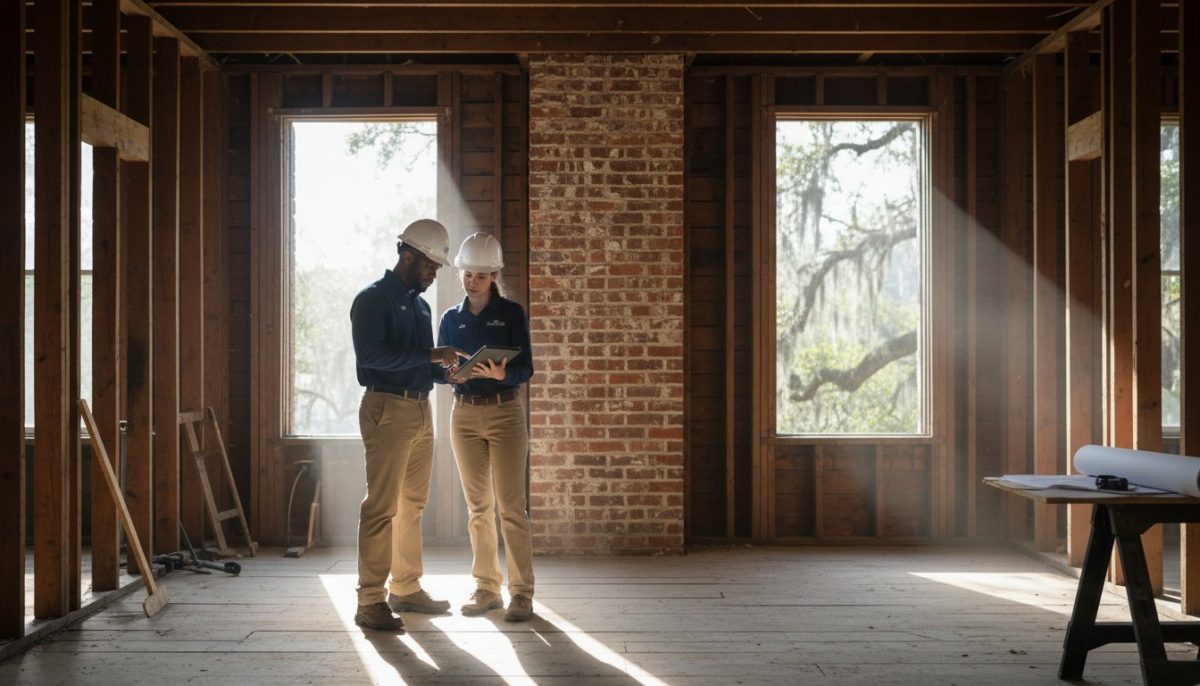
Preparing for an abatement project requires specific documentation. Please have your building’s age records and any existing environmental survey reports ready for our initial consultation. We manage the entire regulatory burden for you. Our team handles the mandatory SCDES 10-day notifications and secures all necessary local permits to ensure full legal compliance. We specialize in “impossible” locations and technical challenges that other firms avoid. Secure your project timeline with professional asbestos abatement from TSIAC International to ensure your site is safe, compliant, and ready for its next chapter.

Secure Your Charleston Property for 2026 and Beyond

Managing the asbestos abatement cost charleston sc property owners face requires a technical approach that prioritizes long term structural integrity. Our 2026 framework highlights that material type and site accessibility are the two primary drivers of project budgets. While DIY methods might seem cost effective, they frequently lead to 100% contamination of ventilation systems. This can increase remediation expenses by 500% or more. Professional intervention by SCDES licensed experts ensures every project meets strict EPA standards. TSIAC International brings 15+ years of industrial experience to every job site, handling the complex accessibility challenges that smaller firms often avoid. We’ve refined our technical processes to balance rigorous safety with engineering precision. You don’t have to navigate these regulatory complexities or disposal fees on your own. Our team provides the stability and technical expertise needed to protect your investment and your health.

Request a Professional Abatement Quote from TSIAC International

Your property’s safety is a measurable asset that begins with a single, expert assessment from a partner you can trust.

Frequently Asked Questions

How much does it cost to remove asbestos from a 1,500 sq. ft. home in South Carolina?

Removing asbestos from a 1,500 square foot residence in South Carolina typically costs between $10,500 and $31,500 based on 2026 market projections. This estimate assumes a standard rate of $7 to $21 per square foot for common materials like flooring or popcorn ceilings. Total expenses fluctuate based on the friability of the material and the complexity of the containment zones required to meet SCDHEC safety protocols.

Does insurance typically cover the cost of asbestos abatement?

Standard homeowners insurance policies in South Carolina usually exclude asbestos abatement costs unless the fibers were released by a covered peril like a fire or a sudden pipe burst. Most policies issued by major carriers contain specific pollution exclusions that categorize asbestos as a hazardous contaminant. You should verify your specific policy endorsements; only 12 percent of standard residential plans include environmental remediation riders for elective renovations.

Is it cheaper to encapsulate asbestos or remove it entirely?

Encapsulation is 25 to 40 percent cheaper than full extraction because it avoids high disposal fees and intensive labor requirements. It’s a viable technical solution for non-friable materials that remain in good physical condition. However, full removal eliminates future liability and potential property value decreases. Choosing the right method depends on your long-term renovation plans and the 10-year maintenance schedule for the sealant.

What is the average cost for asbestos testing before abatement starts?

Professional asbestos testing in the Charleston area averages $450 to $850 for a standard residential assessment. This price includes a physical inspection by a licensed technician and laboratory analysis of 3 to 5 samples using Polarized Light Microscopy. Getting an accurate survey is the first step in determining the overall asbestos abatement cost charleston sc homeowners will face before starting a structural renovation.

How do South Carolina disposal fees impact the total project price?

Disposal fees contribute approximately 12 to 18 percent of the total project invoice due to strict SCDHEC waste manifest requirements. Hazardous waste landfills in South Carolina charge specific tipping fees that range from $65 to $110 per ton for asbestos-containing material. These costs include specialized double-bagging materials and the logistics of transporting hazardous cargo to a permitted Class 3 landfill facility.

Can I stay in my home during the asbestos removal process?

Residents shouldn’t remain in the home while active abatement is occurring within the living space for safety reasons. Technicians establish negative pressure enclosures and decontamination units that restrict access to the work zone for 24 to 72 hours. While exterior removals might allow you to stay inside, internal projects require a clearance certificate from a third-party air monitor before the site is safe for re-entry.

What happens if I ignore asbestos during a renovation?

Ignoring asbestos during a renovation can lead to civil penalties of up to $10,000 per day from South Carolina regulatory agencies. Beyond legal risks, disturbing materials like pipe insulation or floor tiles releases microscopic fibers that cause permanent respiratory damage. If a contractor discovers undocumented asbestos, they’ll stop work immediately, which often increases the asbestos abatement cost charleston sc projects incur due to emergency mobilization fees.

How long does a typical asbestos abatement project take to complete?

A standard residential abatement project takes 3 to 5 business days to complete from initial setup to final air clearance. The first day involves sealing the area with 6-mil polyethylene sheeting and installing HEPA filtration units to create a controlled environment. Removal and cleaning occupy the middle days, while the final 24 hours are reserved for mandatory air quality testing and laboratory verification of the results.