Licensed Asbestos Abatement Company: A Guide to Professional Remediation

On June 12, 2023, a commercial redevelopment project in Chicago ground to a sudden halt when a secondary inspection revealed friable…

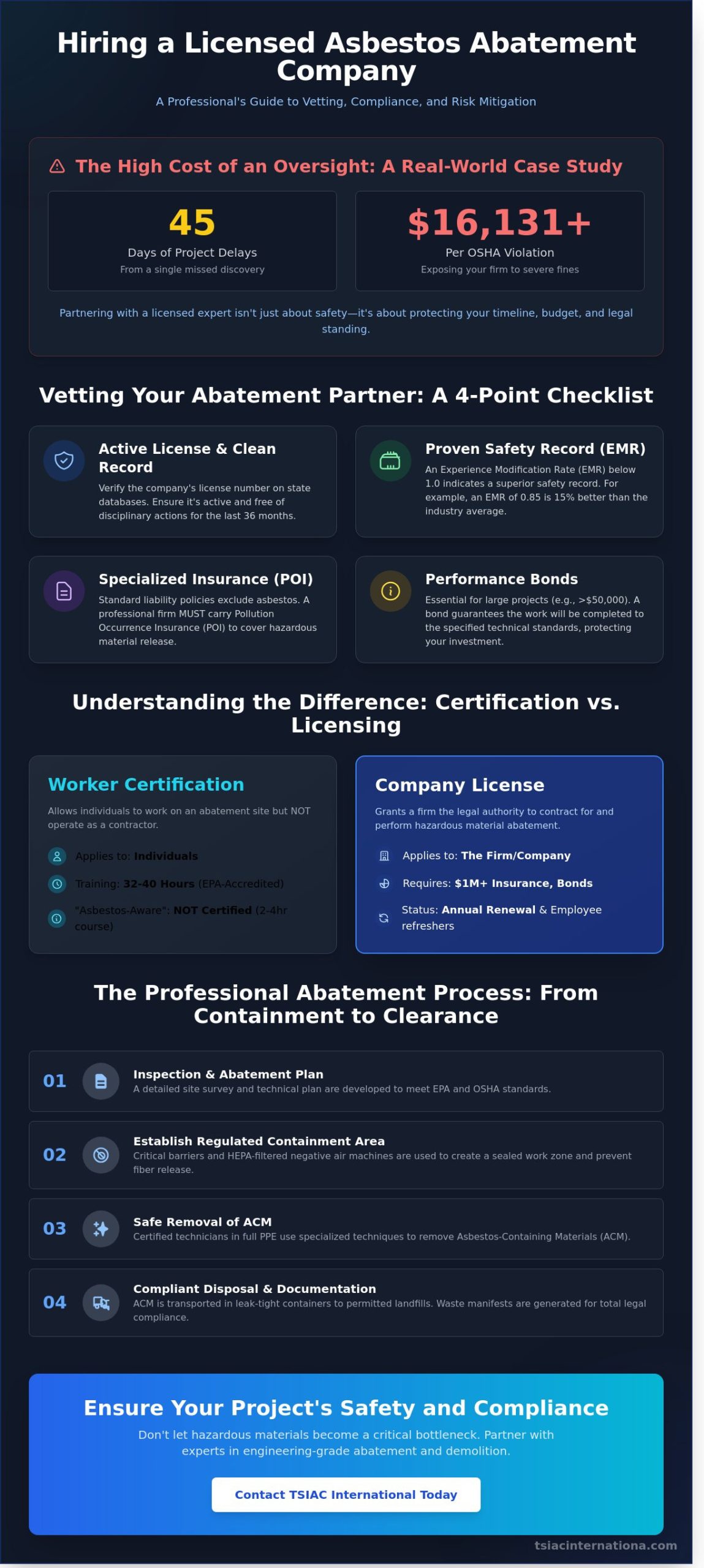
On June 12, 2023, a commercial redevelopment project in Chicago ground to a sudden halt when a secondary inspection revealed friable asbestos-containing materials that were missed during the initial site survey. This single oversight triggered 45 days of project delays and exposed the firm to OSHA fines that can reach $16,131 per violation. You recognize that encountering hazardous materials isn’t just a safety concern; it’s a critical bottleneck that threatens your project timeline and legal standing. Partnering with a licensed asbestos abatement company is the only way to mitigate these liabilities through disciplined technical execution and rigorous safety protocols.

This guide provides the professional framework you need to identify, vet, and hire a remediation partner capable of managing complex hazardous risks with engineering precision. You’ll learn how to verify essential certifications and ensure your project receives the full legal documentation, such as waste manifests, required for total regulatory compliance. We’ll outline the specific protocols that turn a hazardous discovery into a controlled, documented process. This ensures a seamless transition to your next construction phase without the shadow of future liability or health concerns hanging over your site.

Key Takeaways

  • Understand the critical distinction between general contractors and specialized hazardous material experts to ensure your project meets all federal and state safety standards.
  • Learn how to verify active credentials and specialized Pollution Occurrence Insurance (POI) when hiring a licensed asbestos abatement company to mitigate long-term liability.
  • Discover the technical requirements of a professional abatement plan, including the establishment of regulated containment areas and the use of negative air pressure.
  • Move beyond simple cost estimates by learning how to evaluate comprehensive project proposals based on a contractor’s specific experience with complex hazardous materials.
  • Identify how integrating hazardous material abatement with structural demolition can streamline complex projects and ensure engineering-grade precision.

What is a Licensed Asbestos Abatement Company?

A licensed asbestos abatement company operates as a highly specialized technical entity, distinct from standard construction firms. These organizations hold specific authorizations from state and federal agencies to identify, contain, and remove hazardous mineral fibers. While a general contractor focuses on structural integrity or aesthetics, a hazardous material specialist manages microscopic risks that threaten public health. The distinction is critical because disturbing asbestos without controlled environments leads to friable fibers entering the air, where they remain suspended for hours.

Understanding What is Asbestos Abatement involves recognizing the rigorous protocols required to prevent fiber release. Many firms claim to be “asbestos-aware,” which often indicates a basic 2-hour or 4-hour awareness course. This level of training allows workers to identify potential hazards but strictly prohibits them from disturbing the material. Only a licensed asbestos abatement company possesses the legal standing and specialized equipment, such as HEPA-filtered negative air machines and decontamination units, to perform actual remediation. For commercial properties and residential buildings with more than four units, federal law mandates the use of these licensed professionals to ensure compliance and safety.

The Legal Framework: EPA and OSHA Standards

The EPA governs the National Emission Standards for Hazardous Air Pollutants (NESHAP), which was established under the Clean Air Act in 1970. NESHAP requires that any facility undergoing renovation or demolition be inspected for asbestos-containing materials (ACM). OSHA further categorizes risks into four distinct levels. Class I work involves the removal of thermal system insulation and surfacing materials, representing the highest risk. Class II involves removing miscellaneous ACM like floor tiles or roofing. The EPA also strictly regulates the disposal of ACM, requiring it to be transported in leak-tight containers to specific landfills permitted to accept hazardous waste.

Certification vs. Licensing: Understanding the Difference

Individual worker certification and company-level licensing serve different functions. A worker must complete an EPA-accredited training program, often lasting 32 to 40 hours, to earn an individual certificate. This doesn’t allow them to operate as a contractor. A company-level license requires the firm to carry specific environmental liability insurance, often with limits of $1 million or more, and to maintain a bond. State registries, such as those managed by the Department of Labor or Environmental Quality, track these licenses. In states like New York or California, a firm must renew its license annually and prove its employees have maintained their current certifications through refresher courses.

Critical Indicators of a Professional Abatement Firm

Identifying a qualified partner requires more than a cursory review of a marketing brochure. A licensed asbestos abatement company must demonstrate compliance through verifiable state databases. Clients should request the company’s specific license number to confirm it remains active and free of disciplinary actions within the last 36 months. An Experience Modification Rate (EMR) below 1.0 serves as a primary benchmark for safety; a rating of 0.85, for example, indicates a safety record 15% better than the industry average. This metric directly reflects the firm’s commitment to OSHA standards and incident prevention on complex job sites. Rigorous vetting involves checking for past citations to ensure the firm maintains operational integrity under technical pressure.

Insurance and Bonding for Hazardous Materials

Standard general liability policies typically feature a total exclusion for asbestos and lead. A professional firm carries Pollution Occurrence Insurance (POI), which provides specific coverage for the sudden or gradual release of hazardous fibers during remediation. For projects exceeding $50,000, performance bonds are essential. These bonds guarantee that the work reaches completion according to the technical specifications outlined in the contract. Verifying the policy’s “per occurrence” limit ensures the coverage matches the project’s scale. It protects the asset owner from long-term liability that standard insurance simply won’t cover. Without POI, the financial risk of a fiber release falls entirely on the property owner.

Training and Personnel Qualifications

Technical proficiency relies on rigorous adherence to federal mandates. Every worker must complete an initial 40-hour EPA-approved training course, supplemented by annual 8-hour refreshers. The EPA provides detailed guidance on hiring a certified asbestos professional to ensure these standards are met. Each site requires a designated Competent Person as defined by 29 CFR 1926.1101. This individual possesses the authority to stop work if conditions deviate from the safety plan. Personnel must also undergo annual medical surveillance, including chest X-rays and pulmonary function tests, to monitor long-term health.

Quantitative respirator fit-testing is another non-negotiable requirement. It ensures that the protective equipment provides a perfect seal against microscopic fibers. These protocols aren’t optional; they’re the foundation of a controlled work environment. If you’re managing a facility with complex structural requirements, consulting with a specialized technical partner ensures your remediation plan meets these strict engineering benchmarks. Professional firms maintain detailed logs of these certifications, making them available for audit at any point during the project lifecycle. This transparency is the hallmark of a contractor that prioritizes safety over speed.

Licensed Asbestos Abatement Company: A Guide to Professional Remediation

The Professional Abatement Process: From Containment to Clearance

A licensed asbestos abatement company operates with the same technical discipline found in heavy industrial construction. The process begins with a rigorous site assessment to identify Asbestos-Containing Materials (ACM) and evaluate their friability. This data forms the basis of a formal Abatement Plan. This document isn’t just a workflow; it’s a legal requirement that outlines the specific engineering controls and safety protocols for the project. Adherence to EPA asbestos laws and regulations ensures that the project complies with the National Emission Standards for Hazardous Air Pollutants (NESHAP) to protect both workers and the public.

Engineering Controls and Site Preparation

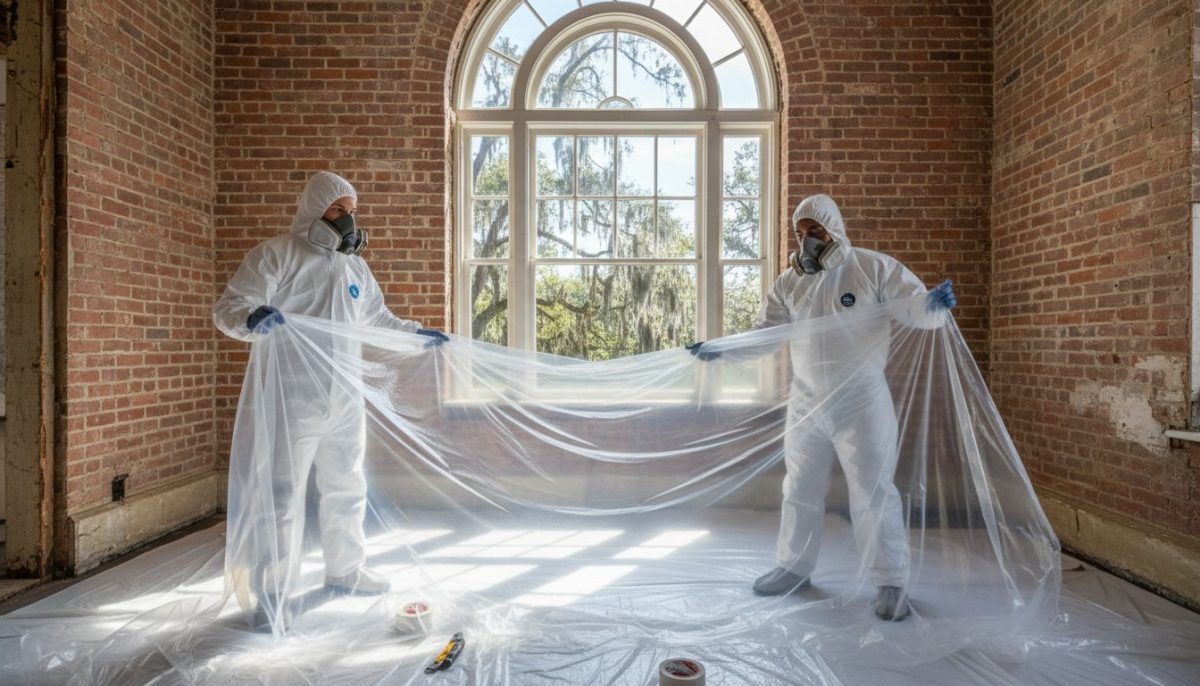
Preparation is the most critical phase of the remediation cycle. Technicians construct a regulated area using 6-mil polyethylene sheeting to create airtight critical barriers. They seal all HVAC vents and non-removable fixtures within the zone to prevent fiber migration. To maintain the integrity of the containment, teams install HEPA-filtered negative air machines. These units exhaust air out of the work area to create a pressure differential, ensuring that any air leaks move inward rather than outward. Personnel safety relies on three-stage decontamination chambers. These units consist of a “dirty room” for equipment, a shower area for personal cleaning, and a “clean room” where workers don their protective gear. This setup eliminates the risk of carrying microscopic fibers outside the work zone.

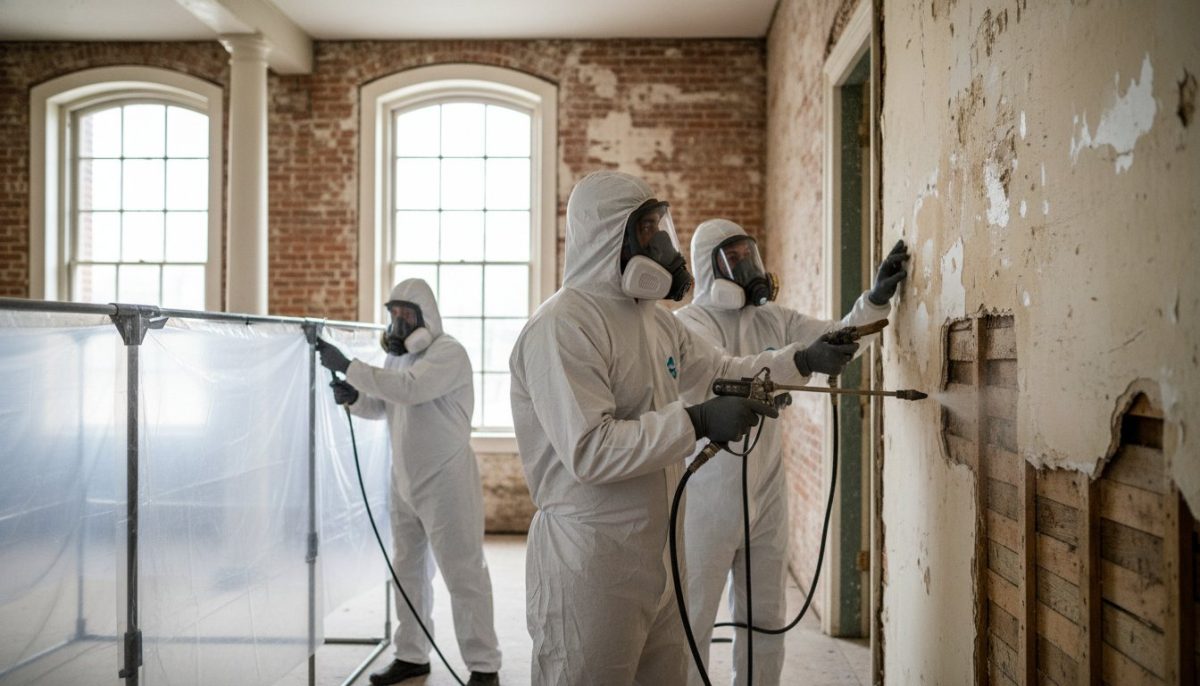
During the actual extraction, teams utilize the wet-removal method. They saturate the materials with amended water, which contains chemical wetting agents that penetrate deep into the fibers. This technique keeps the material heavy and prevents dust from becoming airborne. It’s a proven method that can reduce fiber release by more than 95% compared to dry removal techniques.

Safe Disposal and Documentation

Managing hazardous waste requires precise logistical control. All removed debris is double-bagged in leak-tight, labeled containers while still wet to prevent any dry-out during transport. A licensed asbestos abatement company manages the entire chain of custody through Waste Shipment Records (WSR). These records provide a transparent audit trail from the point of origin to a certified hazardous waste landfill. This documentation is vital for property owners to prove legal compliance and limit future liability.

The final phase involves a multi-step inspection. After a thorough HEPA-vacuuming and wet-wiping of all surfaces, an independent third-party professional conducts a visual inspection. Following this, air clearance testing is performed using Transmission Electron Microscopy (TEM) or Phase Contrast Microscopy (PCM). The containment barriers aren’t removed until the lab results confirm that fiber concentrations are below the strict thresholds required for safe re-occupancy. This objective verification guarantees that the environment is 100% safe for normal use.

How to Vet an Abatement Contractor for Your Project

Selecting a licensed asbestos abatement company requires a shift from looking at price tags to analyzing technical methodologies. A simple estimate often hides gaps in safety protocols. You need a comprehensive project proposal that outlines containment strategies, air monitoring frequencies, and specific equipment lists. This document should serve as a technical roadmap, not just a financial summary.

Contractors must demonstrate a minimum of 10 years of experience with the specific material found in your facility. Removing non-friable floor tiles is a standard procedure; however, handling degraded pipe lagging in an industrial setting involves significantly higher risk. If your project involves high-altitude structures or confined industrial basements, you must seek specialists who handle impossible locations. These firms utilize industrial rope access and specialized rigging to maintain safety where standard scaffolding fails. Always check references for projects of similar scale. A company that successfully cleared a 50,000 square foot warehouse has different logistical capabilities than one that focuses on residential basements.

Red Flags to Watch For During the Bidding Process

Bids that fall 25% or more below the industry average often indicate that the contractor is cutting corners on labor or disposal fees. Proper disposal at a certified hazardous waste landfill is expensive. If a contractor suggests shortcuts or claims that permits aren’t necessary for your specific volume, they’re exposing you to massive legal liability. A lack of transparency regarding waste disposal locations is a critical failure. A reputable licensed asbestos abatement company will name the exact facility where the material is headed.

Questions to Ask During the Interview

Ask how they manage unexpected discoveries of hazardous materials mid-project. A professional firm will have a written contingency plan for these scenarios. You should also ask: What is your protocol for an accidental breach of containment? A fast, documented response is the difference between a minor delay and a site-wide contamination event. Finally, request a sample of their final close-out documentation package. This should include air clearance results, waste manifests, and daily work logs. Without this package, you cannot prove the site is safe for re-occupancy.

For projects requiring technical precision in high-risk environments, you need a partner that understands complex infrastructure. Contact our technical team

TSIAC International: Precision in Hazardous Material Abatement

TSIAC International has spent over 15 years refining its approach to complex hazardous material remediation. As a premier licensed asbestos abatement company, we’ve executed large-scale commercial and industrial projects across the United States. Our team doesn’t just remove toxins; we engineer solutions that integrate structural integrity with environmental safety. This national reach allows us to deploy specialized crews to any location, bringing a level of technical rigor that local generalists often lack. We’ve built our reputation on the ability to handle sites that others find too difficult or technically demanding.

Our integrated approach combines abatement with structural and selective demolition, which is critical for complex retrofitting projects. By handling both the removal of hazardous materials and the physical deconstruction of a site, we provide a seamless transition for the next phase of construction. This method reduces the risk of accidental exposure during demolition, as our abatement experts are on-site to oversee every structural cut. It’s a strategy that prioritizes safety while maximizing efficiency for our partners.

Why Engineering Precision Matters in Abatement

Engineering precision is the backbone of our operations. Working in challenging environments, such as active industrial facilities or high-density urban areas, requires more than basic equipment. It demands a single-source contractor capable of managing both asbestos removal and selective demolition. This unified strategy eliminates the friction often found between separate vendors. Facility managers and developers benefit from significantly reduced downtime because our crews coordinate every phase of the project under one safety protocol. We’ve successfully managed projects involving thousands of square feet of contaminated material while keeping the structural timeline on track. Our technical expertise ensures that even the most sensitive environments remain protected throughout the process.

Partnering for Safe Project Completion

Safety is a non-negotiable metric for our firm. We provide comprehensive hazardous material abatement for diverse property types, including aging industrial plants and high-rise commercial offices. Our commitment to environmental responsibility goes beyond simple disposal. We prioritize material recycling and adhere to the strictest regulatory standards to ensure long-term liability protection for our clients. This focus on sustainable practices helps our clients meet their own environmental goals while ensuring that all hazardous waste is disposed of at certified facilities in accordance with federal law. By maintaining high site safety benchmarks, we ensure that every project concludes without incident or regulatory delay. Every project we touch is backed by a legacy of reliability and a focus on leaving the environment cleaner than we found it.

Ready to secure your site with a trusted licensed asbestos abatement company?

Contact TSIAC International for an Abatement Quote

Ensuring Long-Term Safety Through Rigorous Abatement Standards

Choosing a licensed asbestos abatement company isn’t just a regulatory requirement; it’s a critical step in protecting the structural integrity of your facility and the health of its occupants. Professional remediation relies on precise containment protocols and strict adherence to environmental safety mandates. TSIAC International brings over 15 years of industry experience to every project, ensuring that even the most complex high-risk sites are handled with engineering precision. We provide comprehensive environmental compliance documentation that meets all legal standards, giving you a clear record of safety and liability management. Our teams specialize in those difficult locations where standard methods often fail. You’ll receive a transparent, data-driven approach that prioritizes efficiency without compromising on safety benchmarks. Don’t leave your hazardous material management to chance when specialist expertise is available. We’re ready to secure your environment with the technical rigor your project demands.

Take the first step toward a safer facility today. Request a Professional Abatement Consultation to partner with a team that values precision and safety above all else.

Frequently Asked Questions

What is a licensed asbestos abatement company?

A licensed asbestos abatement company is a specialized contractor certified by state environmental agencies to manage hazardous mineral fibers safely. These firms follow strict protocols defined by OSHA 29 CFR 1926.1101 to prevent fiber release during removal. Every technician must complete EPA-accredited training, ensuring they handle friable materials with engineering controls like HEPA filtration. This technical precision protects the structural integrity of the site and the health of its future occupants.

Can any demolition contractor remove asbestos?

Standard demolition contractors can’t legally remove asbestos without specific hazardous material endorsements. A licensed asbestos abatement company must handle any material containing more than 1% asbestos to comply with federal NESHAP standards. General contractors often lack the specialized negative air pressure machines and decontamination units required for safe remediation. Engaging uncertified labor for these tasks violates safety protocols and risks cross-contaminating the entire building structure.

Is a license required by law for residential asbestos removal?

Law requires professional licensing for residential asbestos removal when the project involves significant quantities of hazardous material. The EPA’s National Emission Standards for Hazardous Air Pollutants (NESHAP) mandate professional intervention for amounts exceeding 260 linear feet or 160 square feet. While some states allow homeowners to remove small amounts themselves, it’s a high-risk activity that often leads to improper disposal and long-term environmental contamination.

How do I verify if an asbestos company is actually licensed?

You verify a firm’s credentials by requesting their license number and checking it against the state’s official regulatory database. Most state departments of labor or environmental protection maintain public registries of every licensed asbestos abatement company currently authorized to operate. You should also demand proof of occurrence-based pollution liability insurance. This specific coverage ensures the contractor can handle claims related to respiratory issues that might appear years after the project.

What happens if asbestos is removed by an unlicensed contractor?

Hiring an unlicensed contractor leads to severe health risks and substantial financial liabilities for the property owner. Improper handling can release millions of microscopic fibers into the HVAC system, making the property uninhabitable. The EPA can issue administrative fines reaching $37,500 per day for each violation of the Clean Air Act. Additionally, property owners face potential lawsuits from neighbors or workers exposed to dust during the unmonitored removal process.

How much does it cost to hire a licensed abatement company?

Costs for professional remediation depend on the material’s location and the complexity of the containment area. Data from the 2023 HomeAdvisor report indicates that residential asbestos removal typically costs between $450 and $6,000, with a national average project price of $2,135. Larger industrial projects or those requiring complex scaffolding and high-altitude access will command higher fees due to the increased technical requirements and specialized safety equipment involved.

What documents should I receive after the abatement is complete?

You’ll receive a comprehensive close-out package containing air clearance certificates and waste disposal manifests. The air clearance report, issued by a third-party industrial hygienist, proves that fiber levels are below 0.01 fibers per cubic centimeter. The waste manifest is a legal document tracking the hazardous material from your site to a certified Class I landfill. These documents are essential for future property sales and maintaining insurance compliance.

Does insurance cover the cost of asbestos abatement?

Insurance coverage for asbestos abatement depends entirely on the cause of the material’s disturbance. Most standard policies include a pollution exclusion clause that denies claims for routine maintenance or age-related deterioration. However, if a covered event like a 2024 pipe burst damages asbestos-insulated pipes, the insurer might pay for the remediation. It’s vital to check your policy’s specific endorsements regarding hazardous substance removal before starting any work.

Asbestos Abatement Cost in Charleston, SC: 2026 Professional Pricing Guide

Did you know that 75% of Charleston structures built before 1981 still house hazardous minerals that can halt a renovation in its tracks? When you’re…

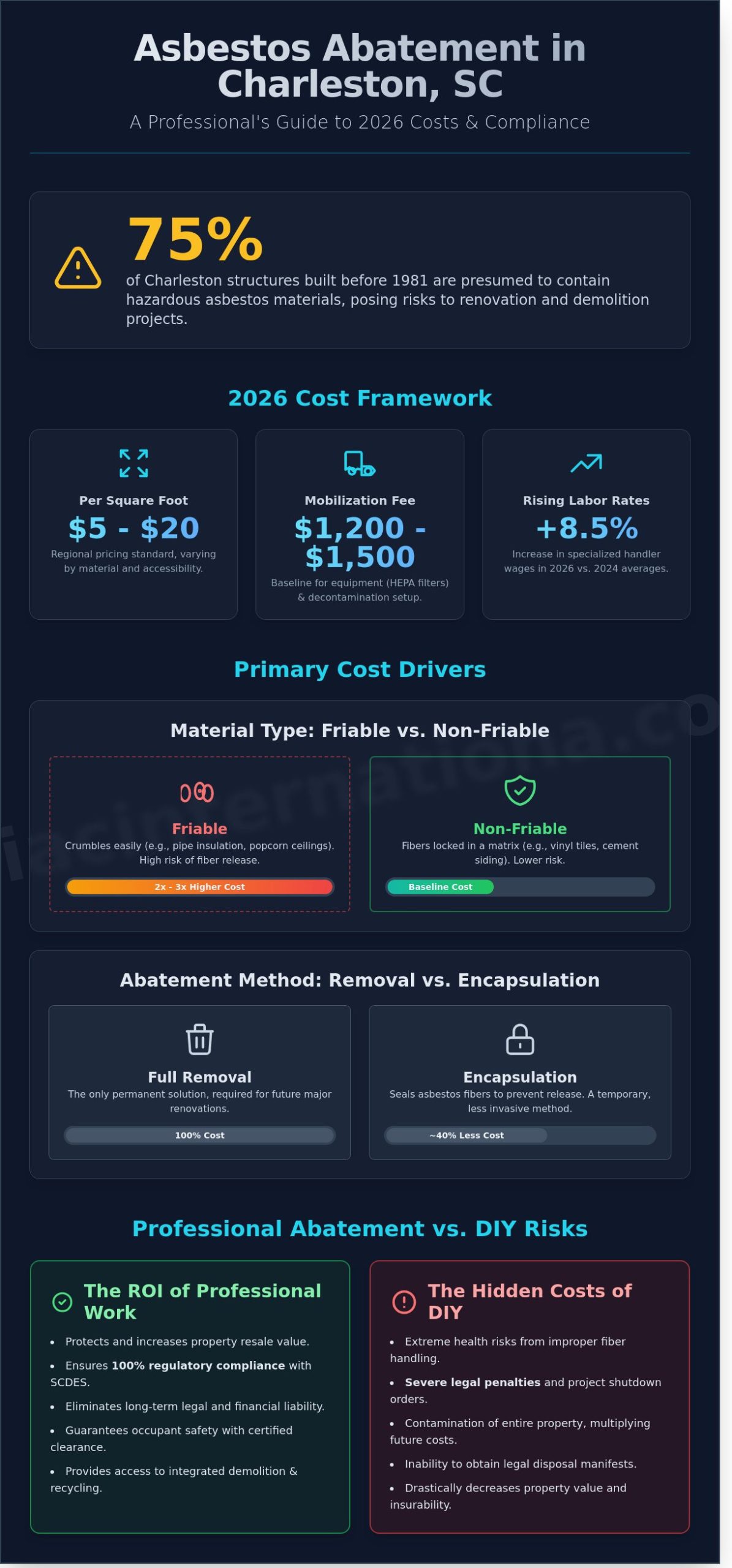
Did you know that 75% of Charleston structures built before 1981 still house hazardous minerals that can halt a renovation in its tracks? When you’re managing a historic property or a mid-century commercial site, understanding the asbestos abatement cost charleston sc becomes a matter of structural integrity and legal liability. You likely recognize that cutting corners on environmental remediation isn’t an option when the South Carolina Department of Environmental Services (SCDES) mandates strict oversight for every square foot disturbed. It’s frustrating to face a demolition deadline while worrying about hidden line items or air quality failures that could endanger your occupants.

We agree that professional transparency is the only way to manage industrial risks effectively. This guide delivers a professional decision-making framework designed to help you secure a predictable cost estimate while maintaining 100% regulatory compliance. We’ll examine current 2026 pricing trends for residential and commercial projects, explain the mandatory SCDES notification protocols, and outline the specific steps required to transition from a contaminated site to a cleared workspace ready for your next phase of construction.

Key Takeaways

  • Establish a realistic budget by understanding the $5 to $20 per square foot regional pricing standard and why mobilization fees are a necessary baseline for safety.
  • Learn how technical factors like material friability and structural accessibility create significant variations in your professional remediation estimate.
  • Ensure full regulatory compliance by navigating SCDES licensing protocols and the mandatory role of independent air monitoring for final site clearance.
  • Analyze the comprehensive asbestos abatement cost charleston sc to see how certified removal protects property resale value and eliminates the liability of DIY mistakes.
  • Explore how integrated abatement and debris recycling strategies from industry veterans can streamline complex projects while maintaining environmental responsibility.

Calculating Asbestos Abatement Cost in Charleston, SC: 2026 Framework

Estimating the asbestos abatement cost charleston sc requires a technical understanding of current market conditions and local regulatory compliance. Regional remediation projects in 2026 typically command pricing between $5 and $20 per square foot, depending on the material’s friability and accessibility. For small-scale interventions, professional contractors establish a baseline minimum mobilization fee ranging from $1,200 to $1,500. This initial charge covers the deployment of specialized HEPA filtration equipment and the setup of physical decontamination units. This framework accounts for 2026 labor rates, where specialized hazardous material handlers in the Lowcountry earn 8.5% more than 2024 averages due to increased certification requirements and rising insurance premiums.

Before initiating a project, owners should consult a comprehensive overview of asbestos to understand why strict safety protocols drive these underlying costs. Categorizing the project by scope is essential for budget accuracy. Residential projects often involve smaller volumes but higher labor intensity per square foot. Commercial projects benefit from economies of scale but face more rigorous air monitoring standards. It’s a matter of engineering precision to ensure total containment, regardless of the building’s age or size.

The Baseline: What Influences the Initial Quote?

Square footage is the primary metric for initial estimates, yet the total volume of material remains the secondary driver of disposal fees. Encapsulation, which involves sealing the fibers to prevent release, generally costs 40% less than full removal. However, full removal is the only permanent solution for structural longevity and future renovations. Project duration directly impacts overhead; site monitoring and negative air pressure maintenance must continue 24 hours a day until a third-party laboratory confirms final air clearance.

Fixed-Price vs. Variable Remediation Contracts

Professional contractors prioritize transparent, line-item estimates to ensure fiscal predictability for the client. Fixed-price contracts for structural demolition and abatement provide the most security for large-scale budgets. These agreements usually include a 10% contingency clause to address hidden materials discovered behind wall cavities or within subflooring. Using a asbestos abatement cost charleston sc model that emphasizes fixed pricing prevents budget creep during the execution phase. Detailed quotes allow project managers to track exactly where capital is allocated, from specialized PPE to legal disposal manifests at approved hazardous waste facilities. We don’t believe in hidden fees, only technical accuracy.

Primary Technical Cost Drivers: Material Type and Accessibility

Charleston’s diverse inventory of historic and industrial properties means that a single flat rate for remediation doesn’t exist. The total asbestos abatement cost charleston sc depends on the physical state of the material and how difficult it’s to reach. Professional teams categorize these projects based on technical risk factors that dictate the level of equipment and labor hours required for safe completion.

Friable vs. Non-Friable Asbestos Costs

The distinction between friable and non-friable materials is the most significant price factor in any project. Friable asbestos, such as popcorn ceilings or thermal pipe insulation, crumbles easily into a fine powder. This fragility increases the Asbestos Exposure and Cancer Risk for everyone in the vicinity, necessitating rigorous containment. Conversely, non-friable materials like vinyl floor tiles or cement siding keep fibers locked within a solid matrix. Because friable materials require 100% airtight seals and advanced filtration, they typically cost 2 to 3 times more per square foot to remove than non-friable alternatives.

Site Logistics and Containment Requirements

Logistical complexity often dictates the final invoice more than the volume of material itself. Removing asbestos from a cramped 1920s attic crawlspace involves higher labor costs than an open-plan warehouse. Our technical teams must factor in several critical components:

  • Negative Pressure Enclosures: We build custom plastic barriers and use industrial blowers to ensure no fibers escape the work zone.
  • HEPA Filtration: Systems must achieve a 99.97% efficiency rating and maintain at least 4 air changes every hour.
  • Decontamination Units: Multi-stage shower systems for personnel are mandatory for high-risk friable projects.
  • Structural Integrity: If a building has over 12% moisture damage or existing rot, we must install temporary shoring to protect the abatement team.

Height adds another layer of expense. Projects involving multi-story industrial facades or ceilings over 15 feet require specialized scaffolding or scissor lifts. These mechanical requirements increase the asbestos abatement cost charleston sc due to the additional equipment rental and the slower pace of work at elevation. When dealing with complex structural challenges, engineering precision is the only way to ensure both safety and budget stability. We don’t guess on safety; we calculate every variable before the first seal is placed.

Regulatory Compliance and Disposal Fees in South Carolina

Compliance isn’t optional. It’s a foundational cost driver in any professional project. In South Carolina, the 2026 regulatory landscape dictates that every abatement action follows a rigid sequence of notifications and inspections. Adhering to South Carolina Department of Environmental Services (SCDES) regulations ensures that every project meets the current safety benchmarks. These mandates require specialized personnel, including licensed supervisors and air samplers, whose credentials must be verified before work begins. Their expertise adds a layer of precision that protects the property owner from future liabilities.

Professional air monitoring serves as the final gatekeeper for project clearance. An independent third-party consultant must conduct aggressive air clearance testing to confirm the area is safe for re-occupancy. This process typically adds $500 to $1,500 to the total bill. While it’s an additional expense, it provides the “Chain of Custody” documentation required by insurance providers and legal entities. This paperwork proves that the hazardous material was handled, transported, and disposed of according to federal and state law, shielding the owner from the $25,000 per-day fines associated with improper handling.

Permitting and Notification Requirements

State law requires a mandatory 10-day notification period for any renovation or demolition involving more than 160 square feet of asbestos-containing material. This waiting period is non-negotiable and impacts the project timeline. Administrative fees for these notifications generally range from $50 to $1,000. Skipping these steps is a financial disaster; the asbestos abatement cost charleston sc is always lower than the cost of an EPA enforcement action. Fines for non-compliance in the Charleston region have historically reached five figures for single-family residential violations.

Hazardous Waste Transportation and Landfill Fees

Asbestos cannot go to a standard municipal landfill. It requires specialized transportation in leak-tight, 6-mil poly-lined containers. Landfill “tipping fees” for hazardous waste are significantly higher than standard debris, often costing between $75 and $150 per ton. Since Charleston has limited local options for hazardous waste disposal, hauling costs often include long-distance transport to regional facilities like those in Pinewood. These logistics account for approximately 15% to 25% of the total asbestos abatement cost charleston sc, depending on the volume of waste generated during the removal phase.

The ROI of Professional Abatement vs. Hidden DIY Risks

Choosing a $50 home test kit or following online forum advice to “just wet it down” creates a dangerous false economy. While the initial asbestos abatement cost charleston sc might seem high, the long term financial exposure of DIY errors is immense. Improper handling leads to secondary contamination; this often forces a 400% increase in remediation costs later when microscopic fibers settle into HVAC systems and porous materials. Professional intervention utilizes HEPA-filtered negative pressure zones to ensure the hazard is removed, not relocated.

Liability and Property Value Preservation

A certified abatement letter serves as a critical legal shield for any asset owner. In the 2026 Charleston real estate market, residential properties lacking professional clearance documentation often see a 12% to 15% reduction in final offer prices. For commercial transactions, lenders require a Phase I Environmental Site Assessment before releasing funds. Professional documentation acts as an insurance safeguard. It prevents the $250,000 legal claims that typically arise from cross-contamination of neighboring properties or future occupant exposure. A “certified clean” status isn’t just a safety metric; it’s a value multiplier for your investment.

Efficiency in Selective and Structural Demolition

Professional project management integrates asbestos removal directly with the interior gutting phase. This coordination reduces the total construction timeline by an average of 14 days compared to fragmented, multi-contractor schedules. In historic Charleston renovations, surgical removal of pipe lagging or floor mastic is 30% more cost-effective than total structural demolition. Expert teams identify which materials require full containment and which can be managed via localized methods. This precision prevents the stop-work orders that occur when uncertified crews accidentally disturb hidden hazardous materials during a standard renovation. We treat abatement as an engineering task, ensuring your site is sterile and ready for the next phase of construction without delay.

Safe project execution requires more than just masks and water; it demands technical precision and documented compliance. Consult with our specialists to secure your property’s value through professional abatement.

TSIAC International: Integrated Abatement and Demolition Solutions

TSIAC International brings 15 years of technical field experience to South Carolina’s complex industrial and residential landscapes. Since 2009, we’ve managed high-stakes projects ranging from historic downtown Charleston renovations to large-scale industrial sites. Our operational model focuses on eliminating the financial uncertainty often associated with hazardous material removal. We provide fixed-price contracts that lock in your budget from day one. This transparency ensures the asbestos abatement cost charleston sc property owners expect remains stable throughout the project lifecycle.

Our integrated approach allows for a seamless transition from hazardous material removal to structural or selective demolition. By managing both phases, we eliminate the scheduling gaps and communication breakdowns that occur when hiring multiple subcontractors. We don’t just clear the site; we prepare it for its next phase of life with engineering precision. This unified workflow reduces overhead and ensures that safety protocols remain consistent from the first glove touch to the final debris haul.

The TSIAC Advantage: Safety and Sustainability

Environmental stewardship is a core pillar of our operations. We implement aggressive debris sorting protocols that divert wood, metal, and plastic from local landfills. These recycling practices help stabilize the asbestos abatement cost charleston sc clients face by lowering the fees associated with hazardous waste transport. Our team maintains rigorous safety standards and holds all necessary South Carolina certifications. We’ve built a track record of reliability with a diverse portfolio, including:

  • Private homeowners requiring residential safety clearances for renovations.
  • General contractors managing multi-phase commercial developments.
  • Government agencies overseeing municipal infrastructure and school district projects.

Next Steps: Requesting Your Professional Site Assessment

Preparing for an abatement project requires specific documentation. Please have your building’s age records and any existing environmental survey reports ready for our initial consultation. We manage the entire regulatory burden for you. Our team handles the mandatory SCDES 10-day notifications and secures all necessary local permits to ensure full legal compliance. We specialize in “impossible” locations and technical challenges that other firms avoid. Secure your project timeline with professional asbestos abatement from TSIAC International to ensure your site is safe, compliant, and ready for its next chapter.

Secure Your Charleston Property for 2026 and Beyond

Managing the asbestos abatement cost charleston sc property owners face requires a technical approach that prioritizes long term structural integrity. Our 2026 framework highlights that material type and site accessibility are the two primary drivers of project budgets. While DIY methods might seem cost effective, they frequently lead to 100% contamination of ventilation systems. This can increase remediation expenses by 500% or more. Professional intervention by SCDES licensed experts ensures every project meets strict EPA standards. TSIAC International brings 15+ years of industrial experience to every job site, handling the complex accessibility challenges that smaller firms often avoid. We’ve refined our technical processes to balance rigorous safety with engineering precision. You don’t have to navigate these regulatory complexities or disposal fees on your own. Our team provides the stability and technical expertise needed to protect your investment and your health.

Request a Professional Abatement Quote from TSIAC International

Your property’s safety is a measurable asset that begins with a single, expert assessment from a partner you can trust.

Frequently Asked Questions

How much does it cost to remove asbestos from a 1,500 sq. ft. home in South Carolina?

Removing asbestos from a 1,500 square foot residence in South Carolina typically costs between $10,500 and $31,500 based on 2026 market projections. This estimate assumes a standard rate of $7 to $21 per square foot for common materials like flooring or popcorn ceilings. Total expenses fluctuate based on the friability of the material and the complexity of the containment zones required to meet SCDHEC safety protocols.

Does insurance typically cover the cost of asbestos abatement?

Standard homeowners insurance policies in South Carolina usually exclude asbestos abatement costs unless the fibers were released by a covered peril like a fire or a sudden pipe burst. Most policies issued by major carriers contain specific pollution exclusions that categorize asbestos as a hazardous contaminant. You should verify your specific policy endorsements; only 12 percent of standard residential plans include environmental remediation riders for elective renovations.

Is it cheaper to encapsulate asbestos or remove it entirely?

Encapsulation is 25 to 40 percent cheaper than full extraction because it avoids high disposal fees and intensive labor requirements. It’s a viable technical solution for non-friable materials that remain in good physical condition. However, full removal eliminates future liability and potential property value decreases. Choosing the right method depends on your long-term renovation plans and the 10-year maintenance schedule for the sealant.

What is the average cost for asbestos testing before abatement starts?

Professional asbestos testing in the Charleston area averages $450 to $850 for a standard residential assessment. This price includes a physical inspection by a licensed technician and laboratory analysis of 3 to 5 samples using Polarized Light Microscopy. Getting an accurate survey is the first step in determining the overall asbestos abatement cost charleston sc homeowners will face before starting a structural renovation.

How do South Carolina disposal fees impact the total project price?

Disposal fees contribute approximately 12 to 18 percent of the total project invoice due to strict SCDHEC waste manifest requirements. Hazardous waste landfills in South Carolina charge specific tipping fees that range from $65 to $110 per ton for asbestos-containing material. These costs include specialized double-bagging materials and the logistics of transporting hazardous cargo to a permitted Class 3 landfill facility.

Can I stay in my home during the asbestos removal process?

Residents shouldn’t remain in the home while active abatement is occurring within the living space for safety reasons. Technicians establish negative pressure enclosures and decontamination units that restrict access to the work zone for 24 to 72 hours. While exterior removals might allow you to stay inside, internal projects require a clearance certificate from a third-party air monitor before the site is safe for re-entry.

What happens if I ignore asbestos during a renovation?

Ignoring asbestos during a renovation can lead to civil penalties of up to $10,000 per day from South Carolina regulatory agencies. Beyond legal risks, disturbing materials like pipe insulation or floor tiles releases microscopic fibers that cause permanent respiratory damage. If a contractor discovers undocumented asbestos, they’ll stop work immediately, which often increases the asbestos abatement cost charleston sc projects incur due to emergency mobilization fees.

How long does a typical asbestos abatement project take to complete?

A standard residential abatement project takes 3 to 5 business days to complete from initial setup to final air clearance. The first day involves sealing the area with 6-mil polyethylene sheeting and installing HEPA filtration units to create a controlled environment. Removal and cleaning occupy the middle days, while the final 24 hours are reserved for mandatory air quality testing and laboratory verification of the results.