Licensed Asbestos Abatement Company: A Guide to Professional Remediation

On June 12, 2023, a commercial redevelopment project in Chicago ground to a sudden halt when a secondary inspection revealed friable…

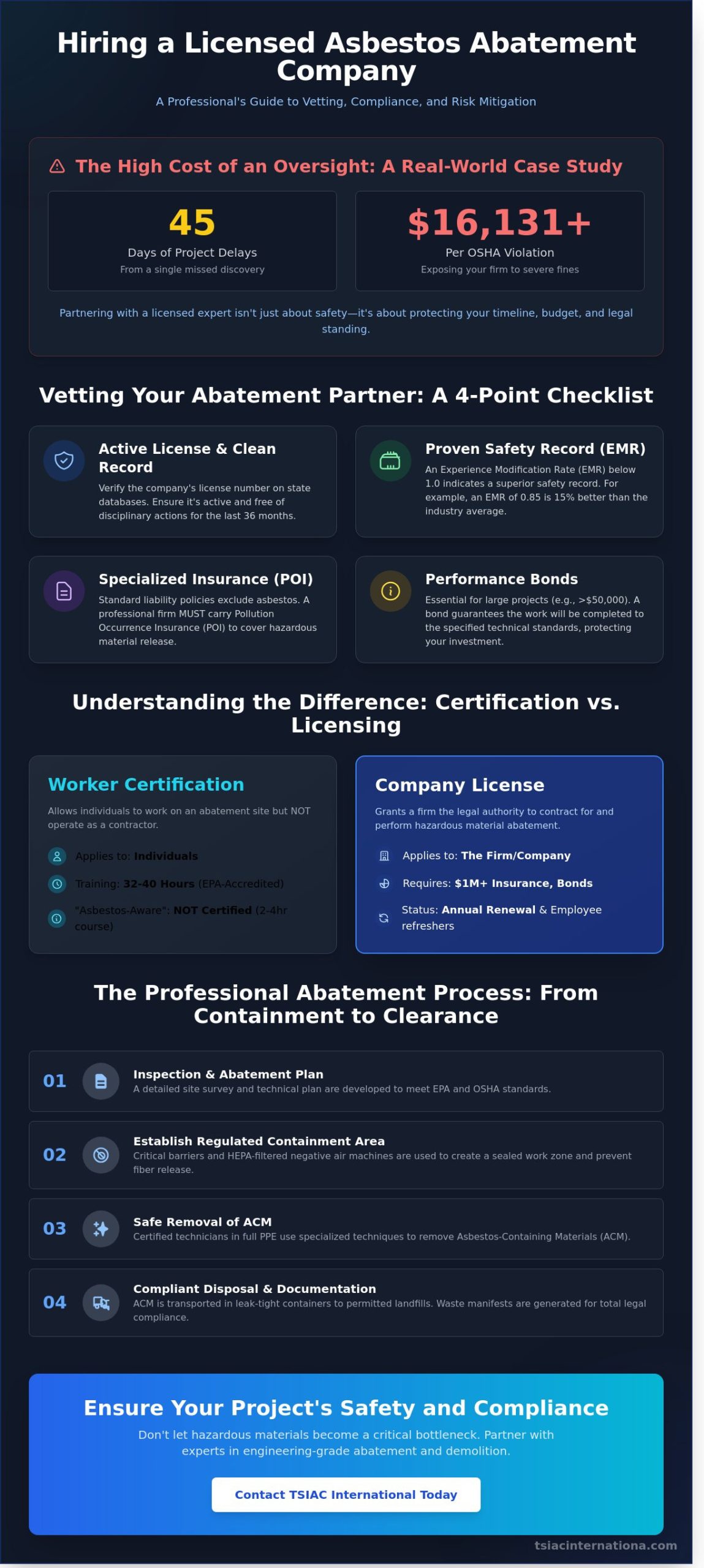
On June 12, 2023, a commercial redevelopment project in Chicago ground to a sudden halt when a secondary inspection revealed friable asbestos-containing materials that were missed during the initial site survey. This single oversight triggered 45 days of project delays and exposed the firm to OSHA fines that can reach $16,131 per violation. You recognize that encountering hazardous materials isn’t just a safety concern; it’s a critical bottleneck that threatens your project timeline and legal standing. Partnering with a licensed asbestos abatement company is the only way to mitigate these liabilities through disciplined technical execution and rigorous safety protocols.

This guide provides the professional framework you need to identify, vet, and hire a remediation partner capable of managing complex hazardous risks with engineering precision. You’ll learn how to verify essential certifications and ensure your project receives the full legal documentation, such as waste manifests, required for total regulatory compliance. We’ll outline the specific protocols that turn a hazardous discovery into a controlled, documented process. This ensures a seamless transition to your next construction phase without the shadow of future liability or health concerns hanging over your site.

Key Takeaways

  • Understand the critical distinction between general contractors and specialized hazardous material experts to ensure your project meets all federal and state safety standards.
  • Learn how to verify active credentials and specialized Pollution Occurrence Insurance (POI) when hiring a licensed asbestos abatement company to mitigate long-term liability.
  • Discover the technical requirements of a professional abatement plan, including the establishment of regulated containment areas and the use of negative air pressure.
  • Move beyond simple cost estimates by learning how to evaluate comprehensive project proposals based on a contractor’s specific experience with complex hazardous materials.
  • Identify how integrating hazardous material abatement with structural demolition can streamline complex projects and ensure engineering-grade precision.

What is a Licensed Asbestos Abatement Company?

A licensed asbestos abatement company operates as a highly specialized technical entity, distinct from standard construction firms. These organizations hold specific authorizations from state and federal agencies to identify, contain, and remove hazardous mineral fibers. While a general contractor focuses on structural integrity or aesthetics, a hazardous material specialist manages microscopic risks that threaten public health. The distinction is critical because disturbing asbestos without controlled environments leads to friable fibers entering the air, where they remain suspended for hours.

Understanding What is Asbestos Abatement involves recognizing the rigorous protocols required to prevent fiber release. Many firms claim to be “asbestos-aware,” which often indicates a basic 2-hour or 4-hour awareness course. This level of training allows workers to identify potential hazards but strictly prohibits them from disturbing the material. Only a licensed asbestos abatement company possesses the legal standing and specialized equipment, such as HEPA-filtered negative air machines and decontamination units, to perform actual remediation. For commercial properties and residential buildings with more than four units, federal law mandates the use of these licensed professionals to ensure compliance and safety.

The Legal Framework: EPA and OSHA Standards

The EPA governs the National Emission Standards for Hazardous Air Pollutants (NESHAP), which was established under the Clean Air Act in 1970. NESHAP requires that any facility undergoing renovation or demolition be inspected for asbestos-containing materials (ACM). OSHA further categorizes risks into four distinct levels. Class I work involves the removal of thermal system insulation and surfacing materials, representing the highest risk. Class II involves removing miscellaneous ACM like floor tiles or roofing. The EPA also strictly regulates the disposal of ACM, requiring it to be transported in leak-tight containers to specific landfills permitted to accept hazardous waste.

Certification vs. Licensing: Understanding the Difference

Individual worker certification and company-level licensing serve different functions. A worker must complete an EPA-accredited training program, often lasting 32 to 40 hours, to earn an individual certificate. This doesn’t allow them to operate as a contractor. A company-level license requires the firm to carry specific environmental liability insurance, often with limits of $1 million or more, and to maintain a bond. State registries, such as those managed by the Department of Labor or Environmental Quality, track these licenses. In states like New York or California, a firm must renew its license annually and prove its employees have maintained their current certifications through refresher courses.

Critical Indicators of a Professional Abatement Firm

Identifying a qualified partner requires more than a cursory review of a marketing brochure. A licensed asbestos abatement company must demonstrate compliance through verifiable state databases. Clients should request the company’s specific license number to confirm it remains active and free of disciplinary actions within the last 36 months. An Experience Modification Rate (EMR) below 1.0 serves as a primary benchmark for safety; a rating of 0.85, for example, indicates a safety record 15% better than the industry average. This metric directly reflects the firm’s commitment to OSHA standards and incident prevention on complex job sites. Rigorous vetting involves checking for past citations to ensure the firm maintains operational integrity under technical pressure.

Insurance and Bonding for Hazardous Materials

Standard general liability policies typically feature a total exclusion for asbestos and lead. A professional firm carries Pollution Occurrence Insurance (POI), which provides specific coverage for the sudden or gradual release of hazardous fibers during remediation. For projects exceeding $50,000, performance bonds are essential. These bonds guarantee that the work reaches completion according to the technical specifications outlined in the contract. Verifying the policy’s “per occurrence” limit ensures the coverage matches the project’s scale. It protects the asset owner from long-term liability that standard insurance simply won’t cover. Without POI, the financial risk of a fiber release falls entirely on the property owner.

Training and Personnel Qualifications

Technical proficiency relies on rigorous adherence to federal mandates. Every worker must complete an initial 40-hour EPA-approved training course, supplemented by annual 8-hour refreshers. The EPA provides detailed guidance on hiring a certified asbestos professional to ensure these standards are met. Each site requires a designated Competent Person as defined by 29 CFR 1926.1101. This individual possesses the authority to stop work if conditions deviate from the safety plan. Personnel must also undergo annual medical surveillance, including chest X-rays and pulmonary function tests, to monitor long-term health.

Quantitative respirator fit-testing is another non-negotiable requirement. It ensures that the protective equipment provides a perfect seal against microscopic fibers. These protocols aren’t optional; they’re the foundation of a controlled work environment. If you’re managing a facility with complex structural requirements, consulting with a specialized technical partner ensures your remediation plan meets these strict engineering benchmarks. Professional firms maintain detailed logs of these certifications, making them available for audit at any point during the project lifecycle. This transparency is the hallmark of a contractor that prioritizes safety over speed.

Licensed Asbestos Abatement Company: A Guide to Professional Remediation

The Professional Abatement Process: From Containment to Clearance

A licensed asbestos abatement company operates with the same technical discipline found in heavy industrial construction. The process begins with a rigorous site assessment to identify Asbestos-Containing Materials (ACM) and evaluate their friability. This data forms the basis of a formal Abatement Plan. This document isn’t just a workflow; it’s a legal requirement that outlines the specific engineering controls and safety protocols for the project. Adherence to EPA asbestos laws and regulations ensures that the project complies with the National Emission Standards for Hazardous Air Pollutants (NESHAP) to protect both workers and the public.

Engineering Controls and Site Preparation

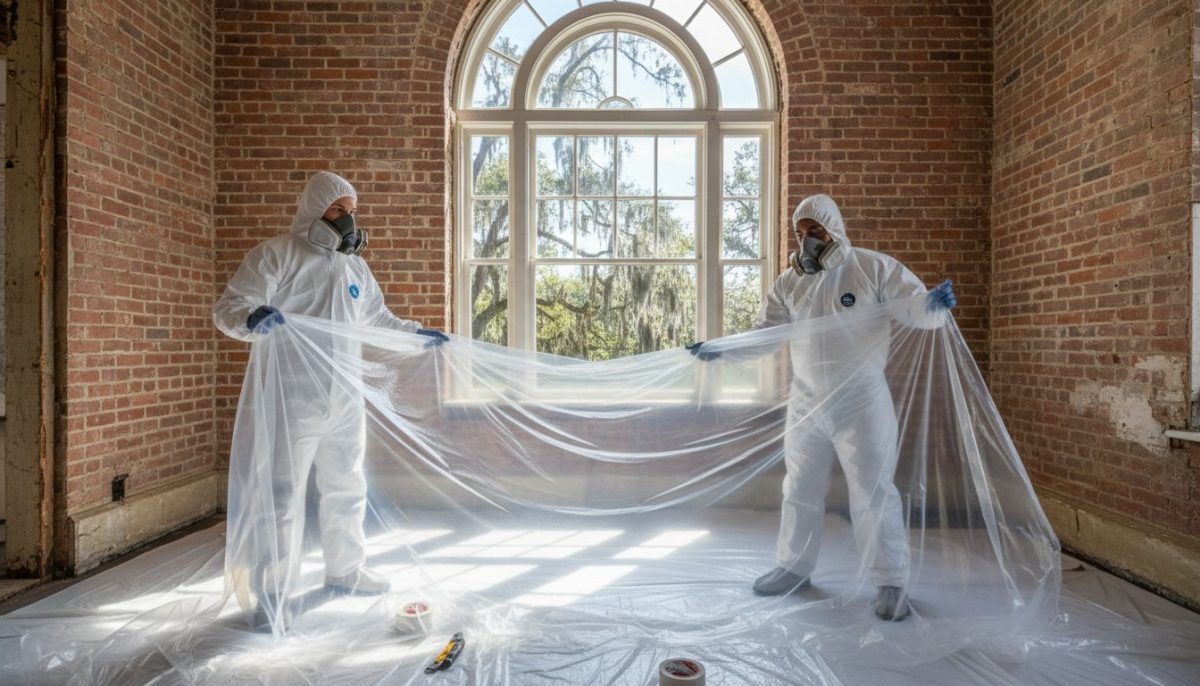
Preparation is the most critical phase of the remediation cycle. Technicians construct a regulated area using 6-mil polyethylene sheeting to create airtight critical barriers. They seal all HVAC vents and non-removable fixtures within the zone to prevent fiber migration. To maintain the integrity of the containment, teams install HEPA-filtered negative air machines. These units exhaust air out of the work area to create a pressure differential, ensuring that any air leaks move inward rather than outward. Personnel safety relies on three-stage decontamination chambers. These units consist of a “dirty room” for equipment, a shower area for personal cleaning, and a “clean room” where workers don their protective gear. This setup eliminates the risk of carrying microscopic fibers outside the work zone.

During the actual extraction, teams utilize the wet-removal method. They saturate the materials with amended water, which contains chemical wetting agents that penetrate deep into the fibers. This technique keeps the material heavy and prevents dust from becoming airborne. It’s a proven method that can reduce fiber release by more than 95% compared to dry removal techniques.

Safe Disposal and Documentation

Managing hazardous waste requires precise logistical control. All removed debris is double-bagged in leak-tight, labeled containers while still wet to prevent any dry-out during transport. A licensed asbestos abatement company manages the entire chain of custody through Waste Shipment Records (WSR). These records provide a transparent audit trail from the point of origin to a certified hazardous waste landfill. This documentation is vital for property owners to prove legal compliance and limit future liability.

The final phase involves a multi-step inspection. After a thorough HEPA-vacuuming and wet-wiping of all surfaces, an independent third-party professional conducts a visual inspection. Following this, air clearance testing is performed using Transmission Electron Microscopy (TEM) or Phase Contrast Microscopy (PCM). The containment barriers aren’t removed until the lab results confirm that fiber concentrations are below the strict thresholds required for safe re-occupancy. This objective verification guarantees that the environment is 100% safe for normal use.

How to Vet an Abatement Contractor for Your Project

Selecting a licensed asbestos abatement company requires a shift from looking at price tags to analyzing technical methodologies. A simple estimate often hides gaps in safety protocols. You need a comprehensive project proposal that outlines containment strategies, air monitoring frequencies, and specific equipment lists. This document should serve as a technical roadmap, not just a financial summary.

Contractors must demonstrate a minimum of 10 years of experience with the specific material found in your facility. Removing non-friable floor tiles is a standard procedure; however, handling degraded pipe lagging in an industrial setting involves significantly higher risk. If your project involves high-altitude structures or confined industrial basements, you must seek specialists who handle impossible locations. These firms utilize industrial rope access and specialized rigging to maintain safety where standard scaffolding fails. Always check references for projects of similar scale. A company that successfully cleared a 50,000 square foot warehouse has different logistical capabilities than one that focuses on residential basements.

Red Flags to Watch For During the Bidding Process

Bids that fall 25% or more below the industry average often indicate that the contractor is cutting corners on labor or disposal fees. Proper disposal at a certified hazardous waste landfill is expensive. If a contractor suggests shortcuts or claims that permits aren’t necessary for your specific volume, they’re exposing you to massive legal liability. A lack of transparency regarding waste disposal locations is a critical failure. A reputable licensed asbestos abatement company will name the exact facility where the material is headed.

Questions to Ask During the Interview

Ask how they manage unexpected discoveries of hazardous materials mid-project. A professional firm will have a written contingency plan for these scenarios. You should also ask: What is your protocol for an accidental breach of containment? A fast, documented response is the difference between a minor delay and a site-wide contamination event. Finally, request a sample of their final close-out documentation package. This should include air clearance results, waste manifests, and daily work logs. Without this package, you cannot prove the site is safe for re-occupancy.

For projects requiring technical precision in high-risk environments, you need a partner that understands complex infrastructure. Contact our technical team

TSIAC International: Precision in Hazardous Material Abatement

TSIAC International has spent over 15 years refining its approach to complex hazardous material remediation. As a premier licensed asbestos abatement company, we’ve executed large-scale commercial and industrial projects across the United States. Our team doesn’t just remove toxins; we engineer solutions that integrate structural integrity with environmental safety. This national reach allows us to deploy specialized crews to any location, bringing a level of technical rigor that local generalists often lack. We’ve built our reputation on the ability to handle sites that others find too difficult or technically demanding.

Our integrated approach combines abatement with structural and selective demolition, which is critical for complex retrofitting projects. By handling both the removal of hazardous materials and the physical deconstruction of a site, we provide a seamless transition for the next phase of construction. This method reduces the risk of accidental exposure during demolition, as our abatement experts are on-site to oversee every structural cut. It’s a strategy that prioritizes safety while maximizing efficiency for our partners.

Why Engineering Precision Matters in Abatement

Engineering precision is the backbone of our operations. Working in challenging environments, such as active industrial facilities or high-density urban areas, requires more than basic equipment. It demands a single-source contractor capable of managing both asbestos removal and selective demolition. This unified strategy eliminates the friction often found between separate vendors. Facility managers and developers benefit from significantly reduced downtime because our crews coordinate every phase of the project under one safety protocol. We’ve successfully managed projects involving thousands of square feet of contaminated material while keeping the structural timeline on track. Our technical expertise ensures that even the most sensitive environments remain protected throughout the process.

Partnering for Safe Project Completion

Safety is a non-negotiable metric for our firm. We provide comprehensive hazardous material abatement for diverse property types, including aging industrial plants and high-rise commercial offices. Our commitment to environmental responsibility goes beyond simple disposal. We prioritize material recycling and adhere to the strictest regulatory standards to ensure long-term liability protection for our clients. This focus on sustainable practices helps our clients meet their own environmental goals while ensuring that all hazardous waste is disposed of at certified facilities in accordance with federal law. By maintaining high site safety benchmarks, we ensure that every project concludes without incident or regulatory delay. Every project we touch is backed by a legacy of reliability and a focus on leaving the environment cleaner than we found it.

Ready to secure your site with a trusted licensed asbestos abatement company?

Contact TSIAC International for an Abatement Quote

Ensuring Long-Term Safety Through Rigorous Abatement Standards

Choosing a licensed asbestos abatement company isn’t just a regulatory requirement; it’s a critical step in protecting the structural integrity of your facility and the health of its occupants. Professional remediation relies on precise containment protocols and strict adherence to environmental safety mandates. TSIAC International brings over 15 years of industry experience to every project, ensuring that even the most complex high-risk sites are handled with engineering precision. We provide comprehensive environmental compliance documentation that meets all legal standards, giving you a clear record of safety and liability management. Our teams specialize in those difficult locations where standard methods often fail. You’ll receive a transparent, data-driven approach that prioritizes efficiency without compromising on safety benchmarks. Don’t leave your hazardous material management to chance when specialist expertise is available. We’re ready to secure your environment with the technical rigor your project demands.

Take the first step toward a safer facility today. Request a Professional Abatement Consultation to partner with a team that values precision and safety above all else.

Frequently Asked Questions

What is a licensed asbestos abatement company?

A licensed asbestos abatement company is a specialized contractor certified by state environmental agencies to manage hazardous mineral fibers safely. These firms follow strict protocols defined by OSHA 29 CFR 1926.1101 to prevent fiber release during removal. Every technician must complete EPA-accredited training, ensuring they handle friable materials with engineering controls like HEPA filtration. This technical precision protects the structural integrity of the site and the health of its future occupants.

Can any demolition contractor remove asbestos?

Standard demolition contractors can’t legally remove asbestos without specific hazardous material endorsements. A licensed asbestos abatement company must handle any material containing more than 1% asbestos to comply with federal NESHAP standards. General contractors often lack the specialized negative air pressure machines and decontamination units required for safe remediation. Engaging uncertified labor for these tasks violates safety protocols and risks cross-contaminating the entire building structure.

Is a license required by law for residential asbestos removal?

Law requires professional licensing for residential asbestos removal when the project involves significant quantities of hazardous material. The EPA’s National Emission Standards for Hazardous Air Pollutants (NESHAP) mandate professional intervention for amounts exceeding 260 linear feet or 160 square feet. While some states allow homeowners to remove small amounts themselves, it’s a high-risk activity that often leads to improper disposal and long-term environmental contamination.

How do I verify if an asbestos company is actually licensed?

You verify a firm’s credentials by requesting their license number and checking it against the state’s official regulatory database. Most state departments of labor or environmental protection maintain public registries of every licensed asbestos abatement company currently authorized to operate. You should also demand proof of occurrence-based pollution liability insurance. This specific coverage ensures the contractor can handle claims related to respiratory issues that might appear years after the project.

What happens if asbestos is removed by an unlicensed contractor?

Hiring an unlicensed contractor leads to severe health risks and substantial financial liabilities for the property owner. Improper handling can release millions of microscopic fibers into the HVAC system, making the property uninhabitable. The EPA can issue administrative fines reaching $37,500 per day for each violation of the Clean Air Act. Additionally, property owners face potential lawsuits from neighbors or workers exposed to dust during the unmonitored removal process.

How much does it cost to hire a licensed abatement company?

Costs for professional remediation depend on the material’s location and the complexity of the containment area. Data from the 2023 HomeAdvisor report indicates that residential asbestos removal typically costs between $450 and $6,000, with a national average project price of $2,135. Larger industrial projects or those requiring complex scaffolding and high-altitude access will command higher fees due to the increased technical requirements and specialized safety equipment involved.

What documents should I receive after the abatement is complete?

You’ll receive a comprehensive close-out package containing air clearance certificates and waste disposal manifests. The air clearance report, issued by a third-party industrial hygienist, proves that fiber levels are below 0.01 fibers per cubic centimeter. The waste manifest is a legal document tracking the hazardous material from your site to a certified Class I landfill. These documents are essential for future property sales and maintaining insurance compliance.

Does insurance cover the cost of asbestos abatement?

Insurance coverage for asbestos abatement depends entirely on the cause of the material’s disturbance. Most standard policies include a pollution exclusion clause that denies claims for routine maintenance or age-related deterioration. However, if a covered event like a 2024 pipe burst damages asbestos-insulated pipes, the insurer might pay for the remediation. It’s vital to check your policy’s specific endorsements regarding hazardous substance removal before starting any work.

Expert Demolition Company in Myrtle Beach: Structural & Selective Services

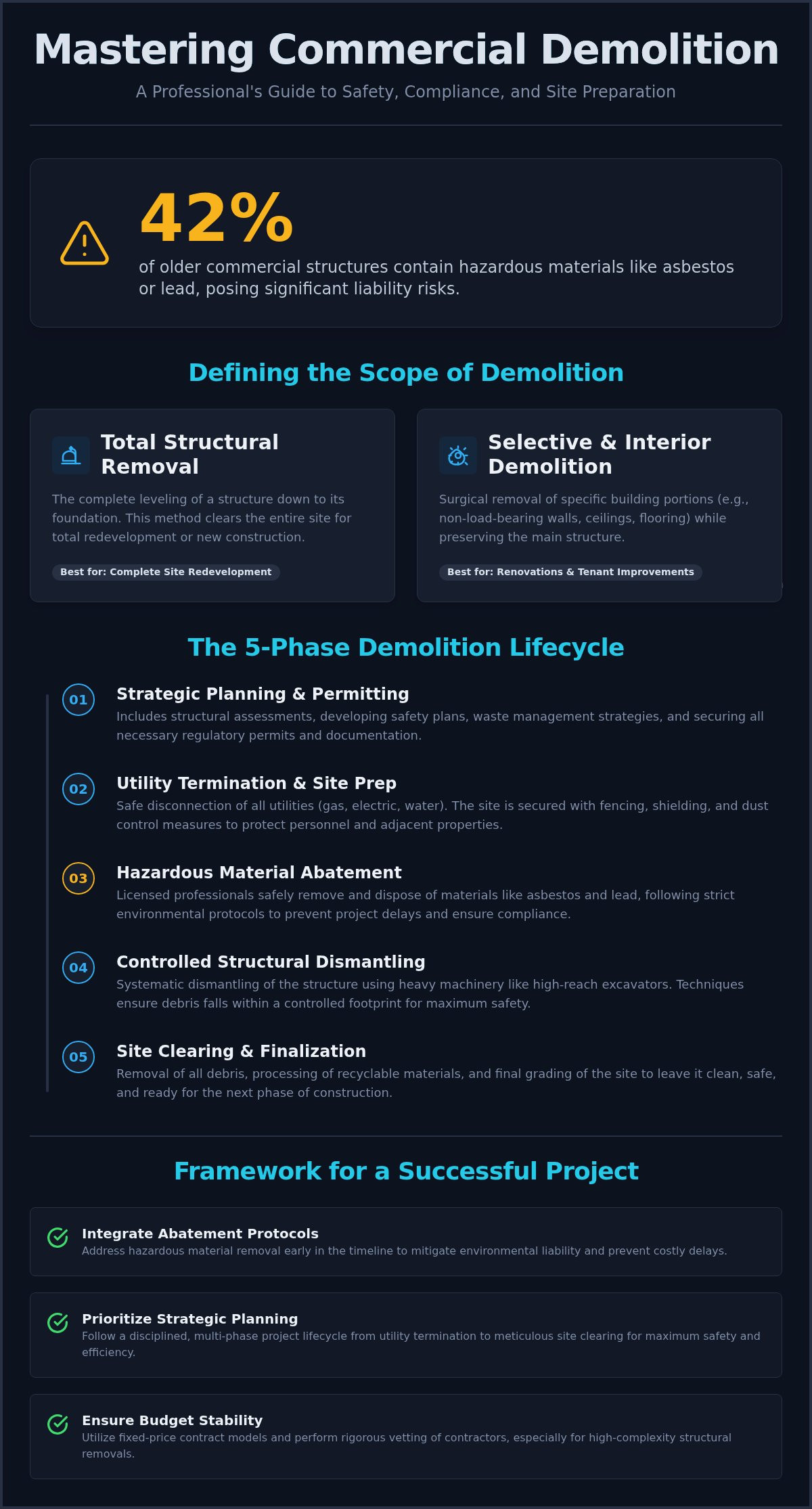
Data from the South Carolina Department of Health and Environmental Control (DHEC) shows that nearly 30% of renovation and demolition projects fail…

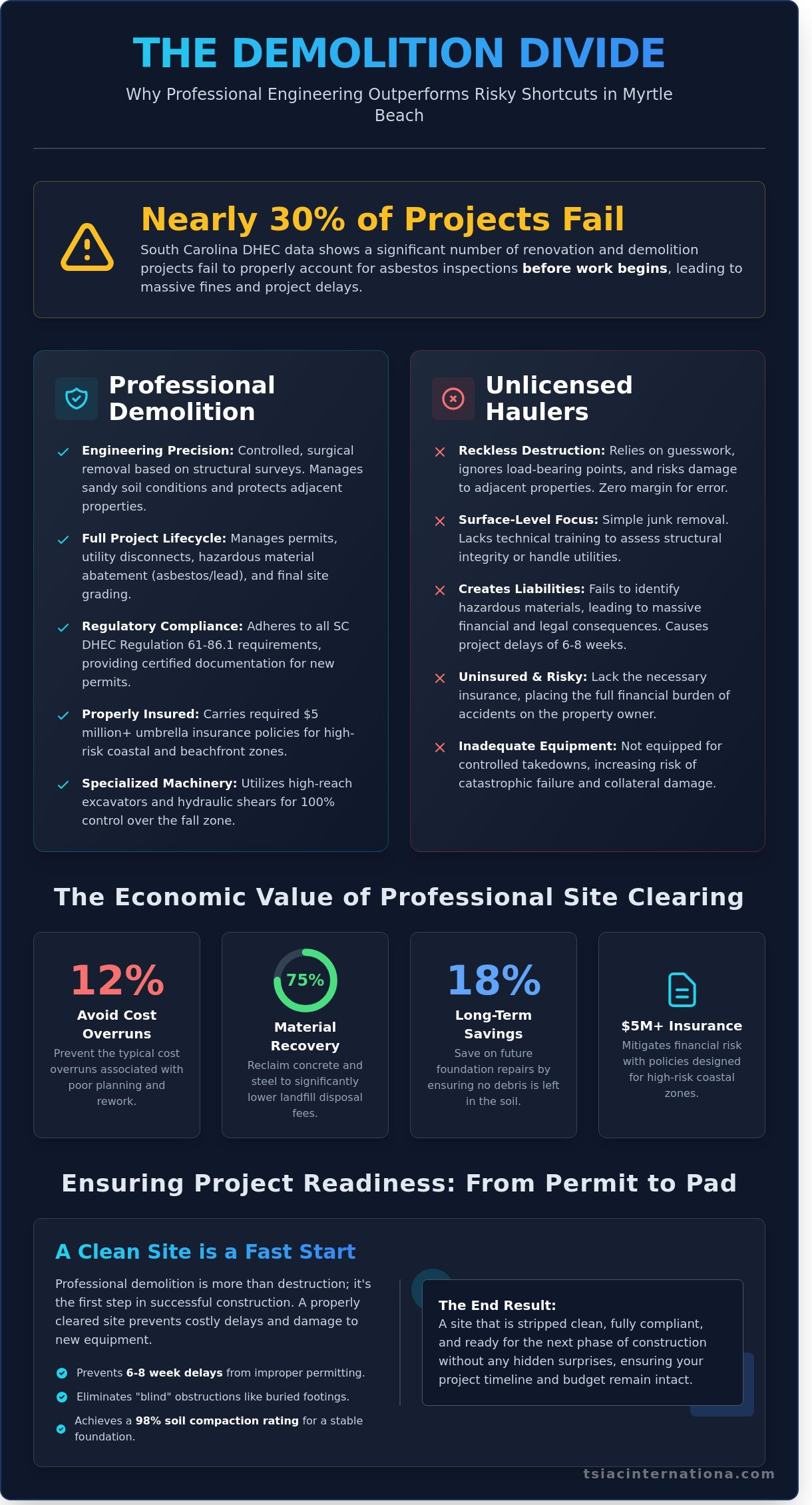
Data from the South Carolina Department of Health and Environmental Control (DHEC) shows that nearly 30% of renovation and demolition projects fail to adequately account for asbestos inspections before the first hammer swings. It’s a common concern for property owners in the Grand Strand who worry that a single oversight could lead to structural damage on an adjacent property or a massive fine for improper debris disposal. Partnering with a qualified demolition company myrtle beach is the only way to ensure these risks are managed with engineering precision rather than guesswork.

You want a site that’s stripped clean and ready for the next phase without the 12% cost overruns typically associated with poor planning. This article provides the technical clarity you need to manage your project with total regulatory transparency. We’ll detail the protocols for safe structural removal, the specific requirements of SC DHEC Regulation 61-86.1, and the methods used to identify and mitigate hazardous materials like lead or asbestos before they impact your bottom line.

Key Takeaways

  • Understand the critical distinction between professional controlled removal and simple destruction to mitigate the legal and physical risks associated with unlicensed haulers.
  • Identify whether your project requires selective gutting or total site redevelopment by consulting with a premier demolition company in Myrtle Beach.
  • Learn how to navigate the mandatory asbestos and lead abatement requirements necessary for protecting the environmental integrity of older Grand Strand properties.
  • Streamline your project timeline by mastering the specific permitting and utility inspection protocols required by the City of Myrtle Beach and Horry County.
  • Discover how leveraging a fleet of specialized heavy machinery and over 15 years of coastal experience ensures safety and engineering precision in complex structural removal.

Why a Professional Demolition Company in Myrtle Beach is Essential

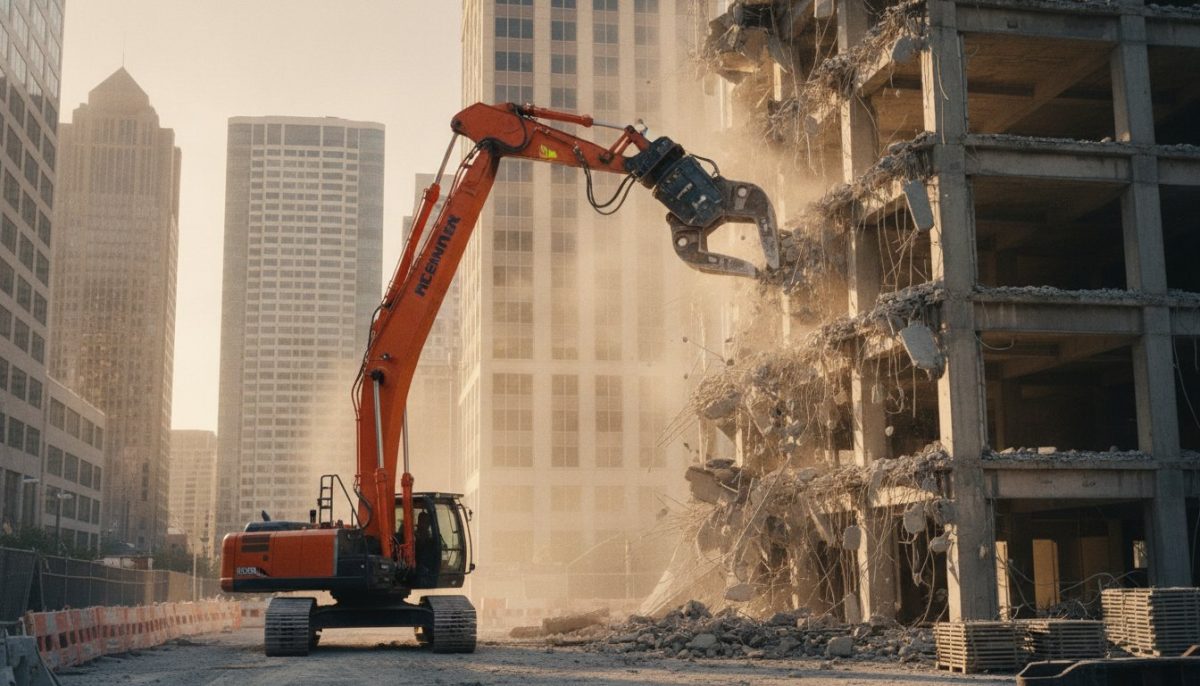
Selecting a demolition company myrtle beach involves more than hiring a crew to knock down walls; it’s a calculated engineering process. In coastal South Carolina, the difference between a controlled removal and reckless destruction determines the viability of future construction. By the first quarter of 2026, Myrtle Beach expects a 14% increase in high-density residential redevelopment projects. These sites require rigorous planning to manage unique sandy soil conditions and proximity to existing salt-weathered infrastructure. A professional approach ensures that adjacent properties remain undisturbed while the primary structure is dismantled with surgical precision.

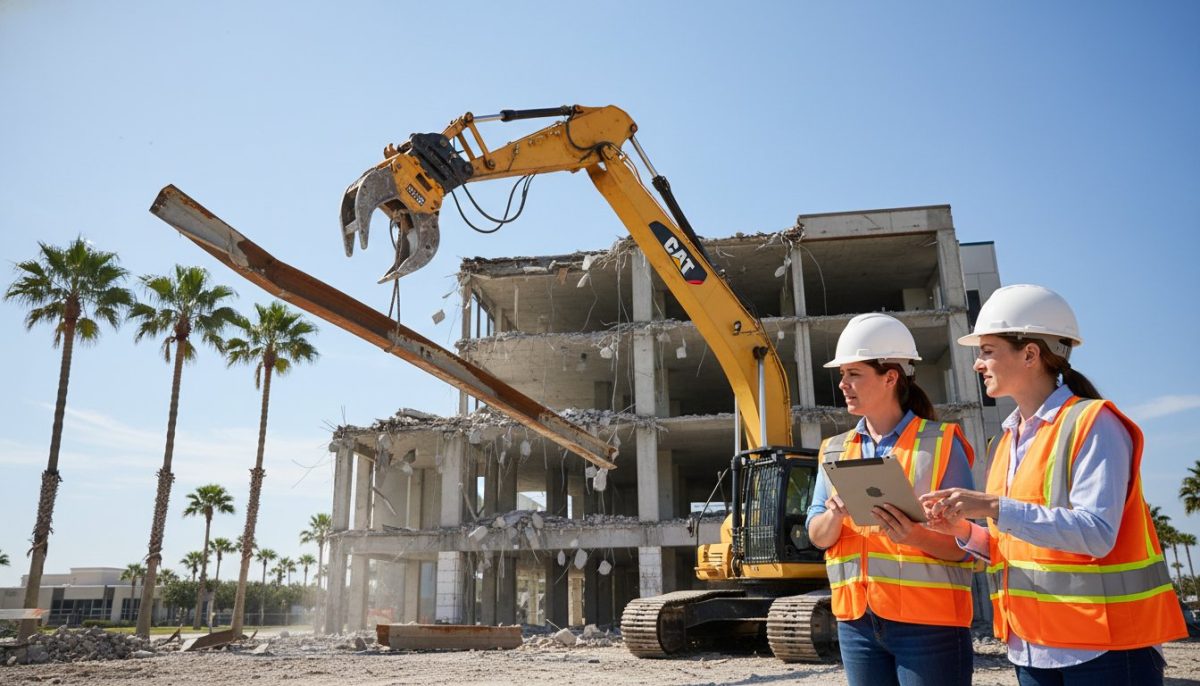
Hiring unlicensed haulers for structural tasks in coastal zones presents massive financial and legal liabilities. These entities often lack the 5 million dollar umbrella insurance policies required for high-risk maritime or beachfront zones. They don’t account for the lateral loads or the specific environmental hazards common in Horry County, such as asbestos-containing materials hidden in older motels. Professional contractors utilize specialized heavy machinery, including high-reach excavators and hydraulic shears, to maintain 100% control over the fall zone. This level of planning is vital for the 2026 development cycle, where site density will leave zero margin for error during the clearing phase.

These external liabilities are not the only financial risks; large-scale projects can also face internal threats. For developers and investors, it’s sometimes necessary to explore Corporate Investigations to address concerns like subcontractor fraud, material theft, or other forms of misconduct that can derail a project.

Understanding the various Demolition methods and techniques is critical for property owners who want to avoid the legal pitfalls of unmanaged site clearing. Whether it’s a mechanical takedown or a selective interior strip-out, the process begins with a structural survey. This survey identifies load-bearing points and hazardous materials, ensuring the project meets all SC DHEC regulations before the first machine arrives on site.

Demolition vs. Junk Removal: Understanding the Difference

Structural demolition is a precision-based engineering service focused on the controlled deconstruction of load-bearing elements. While junk haulers focus on surface-level debris, a professional demolition company myrtle beach manages the entire project lifecycle. This includes securing municipal permits, disconnecting active utilities, and performing final site grading to a 98% compaction rating. Junk removal services lack the technical training to assess structural integrity. They can’t provide the certified documentation required for new foundation permits, which often delays projects by 6 to 8 weeks when done incorrectly.

The Economic Value of Professional Site Clearing

Efficiency in debris management directly impacts the bottom line of any 2026 development project. Professional site clearing ensures that the ground is free of “blind” obstructions like buried footings or old utility lines that can break new excavation equipment. TSIA C International focuses on a high-recovery model, aiming to reclaim 75% of concrete and steel from every site. This approach significantly lowers disposal fees at the landfill. Proper clearing also prevents future foundation settling. If organic material or loose debris is left in the soil, it creates air pockets that lead to structural cracks in new builds within the first 24 months. Investing in professional clearing at the start saves an average of 18% on long-term maintenance and foundation repair costs.

Structural vs. Selective Demolition: Choosing Your Strategy

Selecting the correct removal method is the first critical decision in any redevelopment project. The choice isn’t merely about speed; it’s about the future utility of the land and the preservation of existing assets. A professional demolition company myrtle beach developers rely on must evaluate the 12-point structural integrity of a building before a single machine arrives. If the goal is a 100% site reset for a new 15,000-square-foot commercial complex, structural demolition is the standard. However, if the project involves a 1950s-era hotel along the Grand Strand that requires a modern interior while keeping its iconic facade, a selective approach is mandatory.

TSIAC International utilizes a methodology rooted in engineering precision. We don’t just “knock things down.” We analyze load-bearing capacities and vibration transfer to ensure that the 60% of a structure intended to remain stays perfectly stable. This surgical precision prevents micro-fissures in foundations and keeps neighboring properties safe. Whether you’re clearing a 0.5-acre residential lot or gutting a multi-story office building, the strategy must match the long-term architectural vision.

Complete Structural Removal for New Construction

Total structural removal involves taking a building down to the bare dirt. In Myrtle Beach, this often means managing 15-ton excavators on tight 5,000-square-foot residential lots where property lines are inches apart. The process starts with a 48-hour utility disconnect verification. We coordinate with local providers to cap gas lines and terminate electrical feeds at the street level. Safety protocols include 6-foot perimeter fencing and debris netting to contain every fragment. Our team ensures the site is 100% clear of footings and slab remnants, leaving a clean slate for the next phase of vertical construction.

Interior Gutting and Selective Stripping

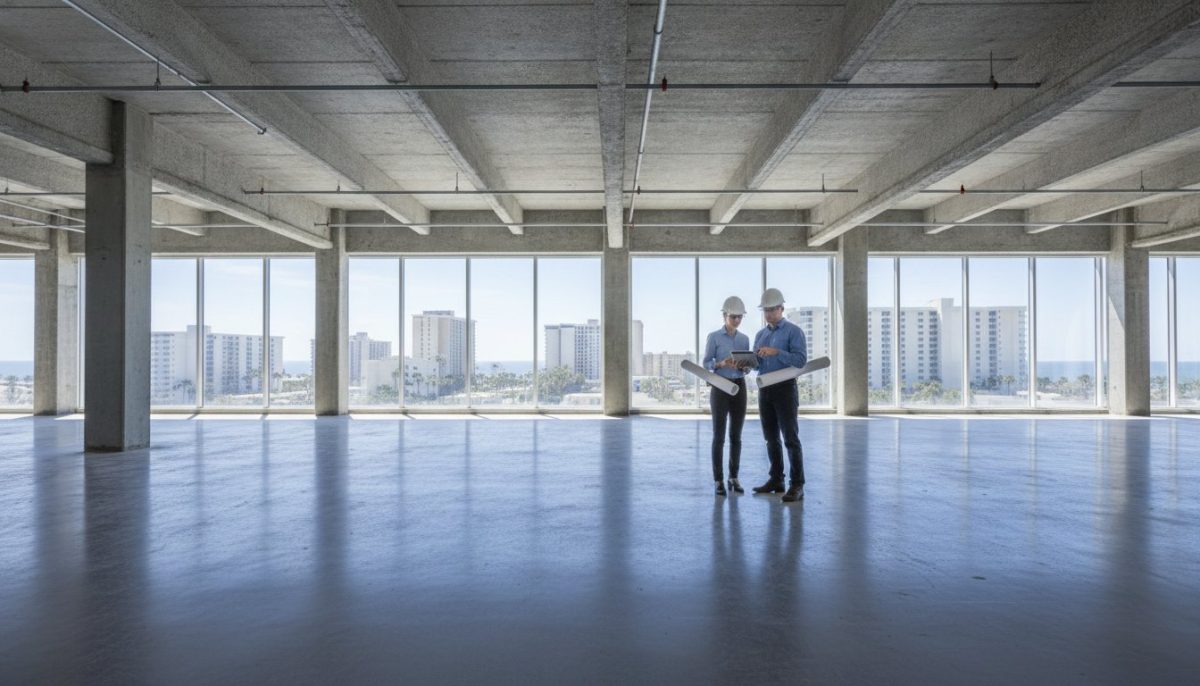
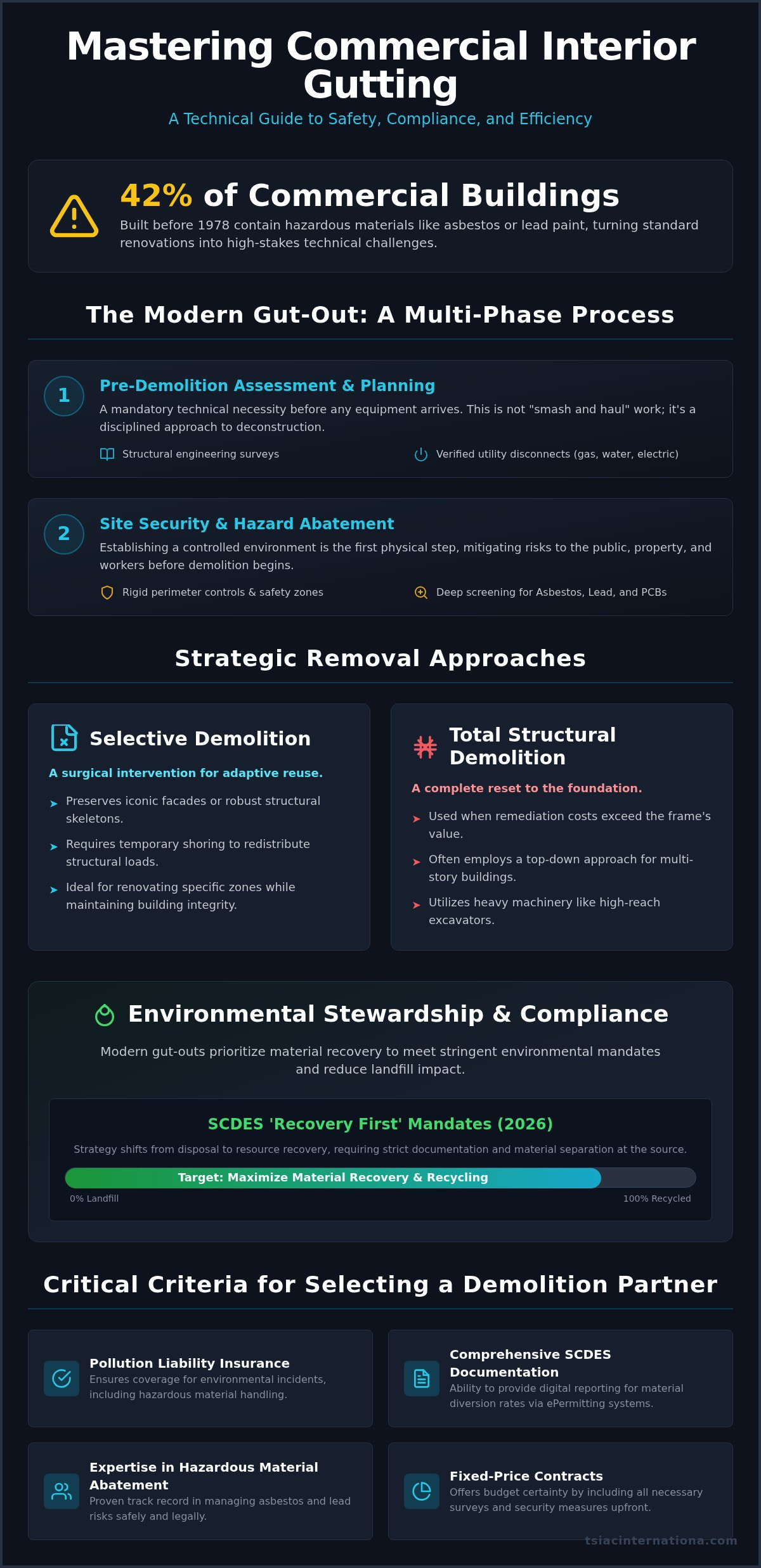
Selective stripping is the preferred choice for tenant improvements and historic renovations. This “surgical” demolition involves removing interior walls, flooring, and MEP (mechanical, electrical, plumbing) systems while leaving the building envelope intact. It’s a common requirement for 85% of commercial retail upgrades in high-traffic areas. Because these projects often happen in active business districts, we implement 99.97% efficiency HEPA air scrubbers for dust control. We also adhere to strict 85-decibel noise limits to minimize disruption to adjacent businesses.

Before any interior stripping begins, we perform a comprehensive hazardous material sweep. It’s vital to follow EPA asbestos regulations when dealing with older flooring adhesives or pipe insulation. This protects both our crew and the future occupants of the space. Removing specific sections like balconies or added wings requires temporary shoring to prevent structural shifts. Our team provides the technical oversight needed for these complex transitions, ensuring the remaining structure is ready for immediate renovation. We’ve successfully managed these delicate operations in over 200 projects across the region, maintaining a 100% safety record on structural stability.

  • Vibration Monitoring: Using seismic sensors to protect adjacent historic foundations.
  • Material Sorting: Separating concrete, steel, and wood to hit 75% recycling targets.
  • Utility Mapping: Identifying sub-slab lines before heavy machinery deployment.
  • Dust Mitigation: Utilizing high-pressure misting systems during high-reach demolition.

Choosing the right demolition company myrtle beach ensures that your project stays on a 14-day or 30-day timeline without unexpected structural failures. We focus on the engineering details so the transition from old to new is seamless and safe.

Addressing Hazardous Materials: Asbestos and Lead Abatement

The coastal climate of the Grand Strand accelerates the degradation of older building materials, making the presence of asbestos and lead paint a critical concern for any demolition company myrtle beach. Properties built between 1940 and 1980 often harbor these materials within structural components that look benign to the untrained eye. Federal law and OSHA demolition standards dictate that every commercial structure and most residential buildings undergo a certified hazardous material survey before a single wall is breached. This isn’t just a bureaucratic hurdle; it’s a fundamental safety protocol designed to prevent the release of microscopic fibers into the humid Atlantic air. Neglecting these hazards during a teardown can lead to fines exceeding $25,000 per violation from regulatory bodies.

TSIAC approaches toxic waste with engineering-grade precision. Our protocols involve 6-mil poly-containment zones and industrial HEPA air scrubbers that cycle the air 6 times per hour. We treat the disposal process as a chain-of-custody operation. Every gram of hazardous waste is tracked from the site to a licensed Subtitle D landfill. This rigorous tracking eliminates the risk of future environmental litigation for property owners. When working near the shoreline, we implement secondary containment barriers to ensure lead-laden dust never reaches the sensitive coastal water table, protecting the local ecosystem from heavy metal contamination.

The Asbestos Abatement Process in South Carolina

South Carolina DHEC Regulation 61-86.1 governs every aspect of asbestos handling in our state. Our team manages the mandatory 10-day notification period required before work begins. We distinguish between friable materials, which require full containment and saturation, and non-friable materials like transite siding or floor mastic. TSIAC provides a comprehensive close-out package including air clearance results and disposal manifests, ensuring your project remains in 100% regulatory compliance. We don’t just remove the threat; we provide the paper trail that proves the site is clean.

Safe Lead Paint Removal for Historic Renovations

Structures built before 1978 almost certainly contain lead-based paint layers. During selective demolition or historic restoration, our technicians use specialized HEPA-filtered vacuum systems and chemical stripping agents that prevent lead dust from becoming airborne. Choosing a certified demolition company myrtle beach for lead removal ensures that historic properties are handled with the specialized care they require. Professional remediation reduces your long-term liability by 40% compared to non-certified contractors. We focus on preserving the structural integrity of historic Myrtle Beach assets while removing the invisible threats that compromise occupant safety and property value.

Myrtle Beach Demolition Checklist: Permits and Regulations

Executing a safe teardown in the Grand Strand requires more than just heavy machinery; it demands a rigorous adherence to local and state legal frameworks. Compliance starts long before the first excavator arrives on-site. In South Carolina, the process is governed by a combination of municipal codes and state environmental laws that protect the public and the coastal ecosystem. A professional demolition company myrtle beach manages these administrative hurdles to prevent work-stop orders that can cost developers upwards of $2,500 per day in fines. We treat the permitting phase with the same engineering precision as the physical deconstruction.

Navigating Local Grand Strand Permitting

Securing a demolition permit in 2026 requires a comprehensive submission package to either the City of Myrtle Beach Planning Department or Horry County Code Enforcement. Applicants must provide a site plan detailing the structures to be removed, a valid 811 utility locate ticket, and proof of a capped sewer line. Neighbor notification is mandatory for any project within 150 feet of a residential structure; this notice must be delivered 10 days before mobilization. Every Myrtle Beach project requires a DHEC-certified inspection to identify regulated asbestos-containing materials (RACM) before any structural disturbance begins. For projects in the broader South Carolina region, understanding the specific requirements for demolition permits Charleston SC can provide valuable insight into the regulatory framework that applies across the state.

Utility management is the next critical step in the checklist. You can’t start work until Santee Cooper or Horry Electric provides a written “kill letter” confirming that the electrical service is physically disconnected at the pole. Similarly, the local water authority must verify that the meter has been pulled and the line is plugged at the main. These steps prevent catastrophic strikes that could endanger the crew and the surrounding neighborhood. Our team tracks these disconnects through a centralized project management system to ensure no step is overlooked.

Environmental Responsibility and Recycling

Modern demolition isn’t about creating waste; it’s about resource recovery. The Horry County Solid Waste Authority (HCSWA) has implemented stricter guidelines for 2026 regarding the disposal of construction and demolition (C&D) debris. We don’t just haul everything to the landfill. Instead, we implement a multi-stage sorting process directly on the job site. High-value materials like structural steel, copper piping, and aluminum siding are separated and sent to local scrap processors. Concrete and brick are often crushed on-site to be reused as stabilized sub-base for new parking lots or driveways.

  • Wood Salvage: Clean timber is separated for mulch or biomass fuel.
  • Metal Recovery: Steel and iron are 100% recyclable and often provide significant scrap value.
  • Concrete Crushing: On-site processing reduces transportation costs and carbon emissions.
  • Hazardous Waste: Lead-based paint and mercury switches are handled by specialized technicians.

TSIA C International maintains a strict commitment to diverting at least 70% of all project debris from local landfills. This isn’t just an environmental choice; it’s a financial one. By maximizing recycling, we often secure recycling credits that can offset total disposal costs by 12% to 15%. This efficiency allows us to provide more competitive bidding while maintaining our high safety standards. Once the site is cleared of debris, we conduct a final soil scan to ensure no contaminants remain before the final sign-off.

The final phase involves obtaining a “Certificate of Completion” from the building department. This document is essential for the transition to the construction phase, as most lenders won’t release funds for new building permits without it. We provide a full close-out binder including all disposal manifests, recycling receipts, and air clearance reports. If you’re ready to clear the way for your next project with a partner who understands the technical nuances of the Grand Strand, contact our expert demolition team today for a site evaluation.

TSIAC International: Your Trusted Grand Strand Partner

Since 2008, TSIAC International has successfully managed over 450 complex demolition and structural projects across South Carolina. We’ve built our reputation on the belief that a demolition company myrtle beach must be more than just a crew with heavy machinery. Our team operates as a specialized engineering partner, bringing 15 years of technical expertise to the unique challenges of the Grand Strand. Coastal environments demand a higher level of preparation due to salt-air corrosion, sandy soil stability issues, and strict environmental regulations. We’ve invested in a comprehensive fleet of machinery, including high-reach excavators and hydraulic shears, specifically maintained to perform in these rigorous conditions.

Security and accountability are the foundations of our business model. We provide the peace of mind that only comes from working with a fully insured and bonded contractor. Our $5 million general liability coverage and comprehensive bonding capacity ensure that every client, from private developers to municipal entities, is protected against unforeseen site variables. We don’t just clear land; we mitigate risk through disciplined project management and transparent communication.

Our Commitment to Safety and Precision

Our engineering-first mindset is the primary reason we’ve maintained a zero-incident safety record on high-risk sites. Before any equipment is mobilized, our structural specialists conduct a thorough analysis of the building’s load-bearing points. This prevents the costly site accidents that occur when contractors rely on guesswork rather than physics. Our field staff undergoes continuous training, holding active certifications in hazardous material abatement. This allows us to handle asbestos, lead, and other contaminants internally, keeping your project on a single, streamlined schedule.

  • Hazardous Material Abatement: Certified handling of lead-based paint and friable asbestos.
  • Structural Shoring: Custom-engineered support systems for selective demolition in unstable buildings.
  • Vibration Monitoring: Real-time data tracking to protect adjacent historical or sensitive structures.

In October 2022, we demonstrated this precision during a high-profile project in a restricted downtown SC corridor. The site was an “impossible location” with less than 18 inches of clearance from a neighboring 19th-century masonry building. Using specialized mini-excavators and precision hand-demolition techniques, we removed 65 tons of reinforced concrete without a single vibration-related crack appearing in the adjacent property. We completed the work 6 days ahead of the 30-day deadline, proving that technical discipline saves both time and money.

Start Your Project with TSIAC International

The consultation process at TSIAC International is designed to eliminate ambiguity. We begin with a comprehensive site walk-through to identify potential structural hurdles and environmental requirements. This data allows us to provide a fixed-price contract, ensuring the budget we agree upon is the budget you pay. We serve a wide geographic area, providing expert services to Charleston, Myrtle Beach, and the entire Lowcountry region. Whether you’re planning a full structural teardown or a surgical selective demolition, our team provides the mechanical force and engineering intelligence required for a clean site hand-off.

Efficiency in demolition is about more than just speed; it’s about preparing the ground for what comes next. By choosing a professional demolition company myrtle beach, you ensure your land is ready for immediate redevelopment without the lingering issues of buried debris or soil contamination. Our logistics team handles all permitting and waste diversion reporting, providing you with a complete paper trail for your records. We’re ready to bring our 15 years of experience to your next project.

Contact TSIAC International for a professional demolition quote to secure a partner who prioritizes your project’s safety and structural integrity from day one.

Secure the Foundation for Your Next Grand Strand Project

Successful site preparation requires more than just heavy machinery; it demands a disciplined approach to safety and regulatory compliance. Navigating the complexities of DHEC regulations for asbestos and lead abatement ensures your project stays on schedule and avoids costly legal delays. Whether you’re planning a full structural teardown or a surgical selective removal, your choice of partner determines the long-term viability of the land. TSIAC International brings 15+ years of South Carolina industry experience to every job site. As a DHEC certified leader in hazardous material handling, we manage the technical risks so you don’t have to.

We specialize in high-stakes structural removal where precision is the only acceptable standard. Choosing the right demolition company myrtle beach means prioritizing engineering accuracy over quick fixes. Our team coordinates every permit and regulation to clear the path for your next phase of construction. We’ve spent over a decade perfecting the specialized solutions required for the most challenging coastal environments. Your vision for the Grand Strand deserves a foundation built on professional excellence and technical mastery.

Get a Professional Demolition Estimate from TSIAC International

Frequently Asked Questions

Do I need a permit for demolition in Myrtle Beach?

You must obtain a demolition permit from the City of Myrtle Beach or Horry County before any structural removal begins. The 2021 International Building Code requires these permits to ensure safety and proper utility disconnects. Our team manages the filing process, which typically takes 5 to 10 business days for approval. We verify that all 4 major utility lines are capped and inspected before the first machine enters the site.

How much does it cost to demolish a house in the Grand Strand area?

Residential demolition costs in the Grand Strand typically range from $5 to $12 per square foot depending on the material composition. For a standard 2,000 square foot single-family home, owners should budget between $10,000 and $24,000. These figures include the 15% overhead for specialized equipment and debris hauling fees. As a leading demolition company in Myrtle Beach, we provide fixed-price quotes based on 3D site scans and material weight estimates.

Is an asbestos inspection required before I gut my commercial building?

South Carolina DHEC Regulation 61-86.1 mandates a thorough asbestos inspection for all commercial structures regardless of the construction date. You must submit the National Emission Standards for Hazardous Air Pollutants notification 10 working days before work starts. If our survey identifies more than 160 square feet of friable material, we implement full containment protocols. Failure to provide this documentation can result in fines exceeding $10,000 per violation day.

How long does the typical residential demolition process take?

A standard residential demolition project usually takes 3 to 5 business days to complete from mobilization to final grade. The first 24 hours involve site stabilization and interior soft-demo. Heavy structural removal occurs on day 2 and 3; then we spend 48 hours on debris clearing and site stabilization. We use 30-yard roll-off containers to maintain a 100% clean site perimeter throughout the 120-hour work window.

Can you perform demolition if my building is close to a neighbor?

We specialize in high-precision demolition for structures located within 5 feet of adjacent properties. Our engineers use vibration monitoring sensors and physical debris shielding to protect neighboring assets. We often employ selective hand-demolition or robotic breakers to maintain a 0% incident rate on tight urban lots. This controlled approach ensures that 100% of the kinetic energy stays within the project footprint without affecting nearby foundations.

What happens to the debris once the building is removed?

We transport 100% of the generated waste to SCDHEC-approved Class 2 or Class 3 landfills. Our process prioritizes sustainability by diverting approximately 65% of concrete and metal debris to local recycling centers. We provide clients with weight tickets and disposal receipts for every 20-ton load removed from the site. This documentation creates a transparent audit trail for environmental compliance and LEED certification requirements.

Does TSIAC International handle both residential and commercial projects?

TSIAC International maintains the specialized fleet and licensing required for both large-scale commercial teardowns and private residential clearings. Our portfolio includes 50,000 square foot industrial warehouses and 1,200 square foot coastal cottages. As a versatile demolition company in Myrtle Beach, we apply the same engineering rigors to a single-story gutting as we do to multi-story structural removals. We carry $5 million in general liability insurance to protect every partner.