
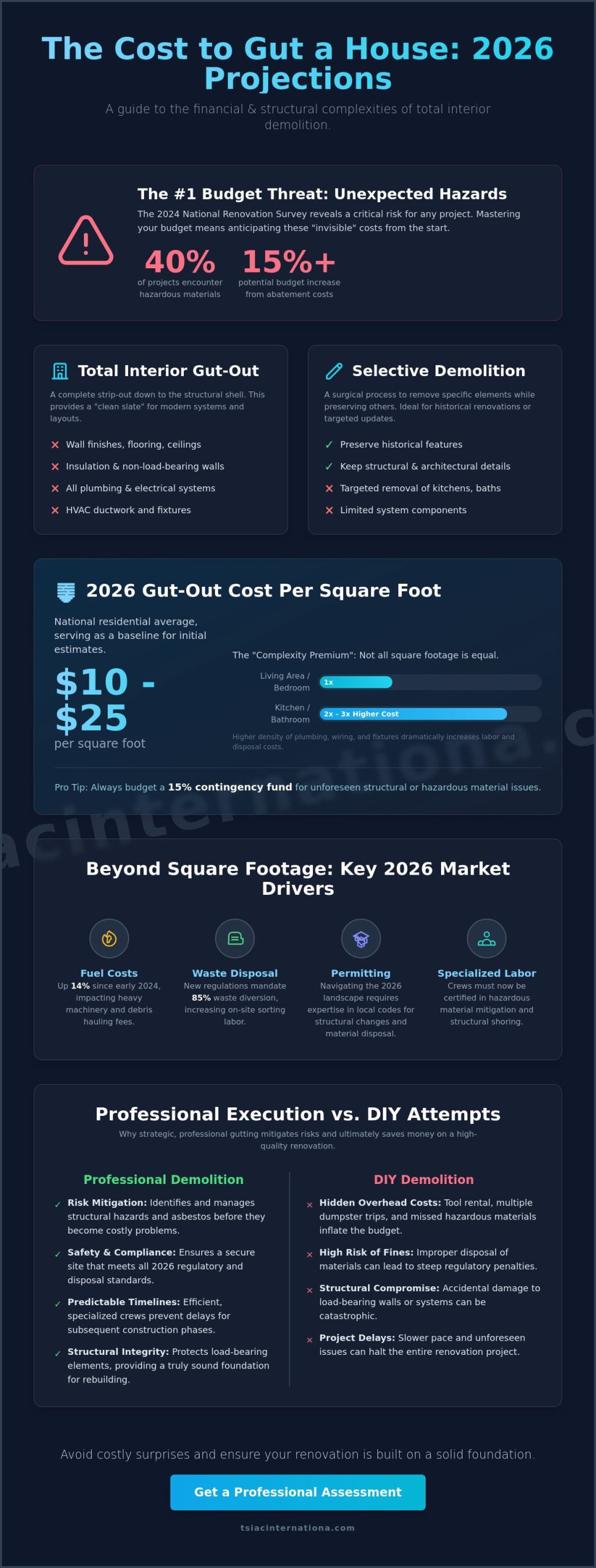
The 2024 National Renovation Survey reveals that 40% of residential demolition projects encounter unexpected hazardous materials that can inflate budgets by 15% or more overnight. You’re right to feel that a complete interior strip-out is the most reliable foundation for a high-quality renovation, yet the risk of structural compromise or steep regulatory fines often creates significant anxiety. Mastering the projected cost to gut a house 2026 is no longer about simple labor estimates; it’s about integrating technical abatement strategies with disciplined engineering precision.
You’ll gain a comprehensive understanding of the financial and structural complexities involved in preparing a property for its next phase of construction. We’ll clarify the technical differences between selective and total interior demolition to ensure your site remains a safe, clean structural shell. This guide provides the current market data and expert insights required to maintain a predictable project timeline while avoiding the common pitfalls of uncoordinated demolition work.
Key Takeaways
- Understand the critical distinction between stripping a structure to its structural shell and selective interior demolition to define your project’s technical scope accurately.
- Evaluate current market data to determine the total cost to gut a house 2026, accounting for both residential and commercial pricing variables across different square footages.
- Identify high-impact “invisible” budget drivers, such as mandatory hazardous material abatement, that are essential for maintaining safety and structural compliance.
- Master the logistical requirements of modern site management, from navigating the 2026 permitting landscape to optimizing complex waste disposal and tonnage logistics.
- Discover how professional execution mitigates the technical risks and hidden overhead costs often associated with DIY demolition attempts.
Defining the Scope: What Does It Mean to Gut a House in 2026?
Gutting a house in 2026 is a rigorous engineering process that involves stripping a building down to its essential structural shell. It’s not merely about cosmetic removal; it’s the systematic extraction of every non-load-bearing element within the perimeter walls. To understand What Does It Mean to Gut a House, one must view the property as a skeleton. This process includes the removal of all flooring, wall finishes, ceilings, insulation, plumbing fixtures, electrical wiring, and HVAC ductwork. When the work is complete, only the foundation, exterior walls, and roof support systems remain.
The cost to gut a house 2026 reflects the technical complexity of modern deconstruction. Unlike a general remodeling contractor who focuses on the aesthetic and functional rebuild, a specialized demolition contractor prioritizes structural integrity and site safety during the removal phase. They possess the heavy equipment and specialized knowledge required to handle hazardous materials and load-bearing transitions. Engaging a dedicated demolition crew ensures that the “clean slate” provided to the rebuild team is free of hidden defects or structural compromises.
Selective vs. Total Interior Demolition
Selective demolition is a surgical removal process designed to extract specific interior elements while maintaining the integrity of the surrounding structure. This approach is vital for historic preservation projects where original architectural features must remain intact. In contrast, total interior demolition is a comprehensive strip-out. By 2026, the cost-benefit analysis often favors a total gutting for older properties because it allows for the installation of high-efficiency insulation and smart-grid electrical systems that are difficult to retrofit into existing walls.
2026 Market Drivers for Demolition Pricing
Several economic factors have reshaped the demolition landscape over the last two years. Fuel costs for heavy machinery, including high-reach excavators and skid steers, have risen by 14% since early 2024, directly impacting site fees. Furthermore, environmental regulations enacted in late 2025 now require 85% of construction waste to be diverted from landfills, which has significantly increased the labor hours required for on-site material sorting.
The labor market for 2026 also shows a shift toward specialized crews. General laborers are no longer sufficient for the high-precision requirements of modern deconstruction. Today’s teams must be certified in advanced hazardous material mitigation and structural shoring. These enhanced safety standards and technical requirements are the primary drivers behind the current cost to gut a house 2026, ensuring that the project site remains a controlled, secure environment for all subsequent trades.
Cost per Square Foot: Budgeting for Your 2026 Gut-Out
Projecting the cost to gut a house 2026 requires a shift from simple square footage calculations to a more nuanced analysis of structural density. National averages for residential gutting currently fluctuate between $10 and $25 per square foot. However, these figures serve only as a baseline. A 2,500-square-foot property with an open floor plan presents fewer logistical hurdles than a smaller home divided by numerous load-bearing partitions. Labor hours increase exponentially when crews must navigate tight corners or manually carry debris through narrow hallways. For this reason, we recommend establishing a 15% contingency fund to account for unforeseen structural issues or Hazardous Materials like asbestos that often remain hidden behind drywall until demolition begins.
The complexity premium is a critical metric that many homeowners overlook. This refers to the ratio of labor hours to the volume of material removed. A high-density floor plan with many small rooms requires more manual labor and careful sorting of materials, which drives up the hourly cost. In contrast, large open spaces allow for faster movement and more efficient use of mechanical equipment. When you’re calculating your 2026 budget, don’t just look at the total area; look at the number of walls and systems that must be dismantled.
Residential Pricing by Room Type
Not every square foot carries the same price tag. Kitchens and bathrooms typically cost 2 to 3 times more to gut than bedrooms or living areas. This price spike stems from the high density of fixtures, specialized plumbing, and gas line terminations that require careful handling. Demolishing a kitchen involves disconnecting appliances and removing heavy cabinetry, which takes significantly longer than stripping a carpeted bedroom. Additionally, multi-story homes face a complexity premium. Moving debris from a third-story attic down to a dumpster adds 20% to 30% to the total labor cost compared to a single-level ranch style where we can utilize direct window chutes for disposal.
Commercial Interior Gutting Economics
Commercial projects operate on a different economic scale. Large-scale tenant improvement (TI) projects often benefit from efficiencies of scale, where the cost per square foot may decrease as the total area increases beyond 10,000 square feet. However, specialized infrastructure introduces unique costs. Removing medical gas lines in a healthcare facility or dismantling reinforced server rooms requires technical precision that standard residential crews don’t possess. For those managing large-scale renovations, reviewing our commercial interior gutting services can provide a clearer roadmap for these high-stakes environments. Precision in these settings ensures that HVAC systems and electrical risers serving other floors remain undisturbed. If you’re planning a complex project, it’s wise to consult with a structural specialist to verify your initial budget estimates.
Hidden Cost Drivers: Hazardous Materials and Structural Integrity
Budgeting for a renovation requires more than calculating square footage. The true cost to gut a house 2026 often hinges on variables hidden behind drywall and floorboards. For structures built before 1978, the likelihood of lead-based paint is approximately 69%. These factors can increase a project’s demolition budget by 50% to 100% if not identified during the initial survey. Professional abatement is a non-negotiable safety protocol. Ignoring these risks leads to severe respiratory hazards and massive legal liabilities. Improper hazardous waste disposal is a primary target for regulatory enforcement, and the financial consequences are severe.
- EPA fines for improper lead-dust containment or asbestos handling can exceed $37,500 per day per violation.
- Hazardous waste disposal at specialized landfills carries a 30% to 45% price premium over standard construction debris.
- Stop-work orders from local building departments due to non-compliance can delay projects by 4 to 12 weeks.
Asbestos and Lead Paint Remediation
In 2026, regulatory compliance requires a certified hazardous material survey before any structural demolition begins. This process involves laboratory testing of samples from floor tiles, insulation, and popcorn ceilings. If results are positive, the site must be sealed using heavy-duty polyethylene sheeting and negative air machines. These containment measures, along with specialized PPE and continuous air monitoring, represent a significant portion of permits and disposal costs for high-risk properties. You can find detailed compliance requirements in our hazardous material abatement guide to ensure your project meets current safety standards and avoids environmental contamination.
Structural Support and Load-Bearing Wall Removal
Removing interior walls often reveals structural deficiencies that weren’t visible during the initial walkthrough. Engineering fees for a structural analysis typically range from $500 to $2,500, depending on the complexity of the load-bearing systems. During the gutting process, contractors must install temporary shoring to maintain the building’s integrity. This “shell” phase often exposes issues like termite damage or wood rot, which affects roughly 25% of older homes. Addressing these structural failures immediately is essential to prevent long-term foundation shifts. Precision in this phase ensures that the cost to gut a house 2026 remains a controlled investment rather than an escalating liability. We prioritize structural stability to guarantee that the renovated frame can support modern finishes and heavy appliances.
Logistics of a Gut-Out: Permits, Disposal, and Recycling
Gutting a residence involves more than manual labor; it requires a systematic approach to legal and logistical hurdles. The 2026 regulatory environment for structural modifications has become more stringent, focusing on structural integrity and environmental impact. These administrative factors directly influence the total cost to gut a house 2026. Professional contractors manage these complexities to ensure the project remains compliant and avoids work-stop orders that can inflate budgets by 15% or more.
Logistics extend beyond the building’s footprint. Efficient site management includes the placement of 20-yard or 30-yard dumpsters, securing street occupancy permits, and managing strict tonnage limits. A typical 2,000-square-foot gut-out can generate 5 to 8 tons of debris. Professional hauling is faster and safer than DIY attempts because experts understand weight distribution and the legal requirements for securing loads. This efficiency helps stabilize the overall cost to gut a house 2026 by reducing labor hours spent on waste transit.
Permitting and Regulatory Compliance
Municipalities in 2026 require detailed filings for any interior changes involving load-bearing walls or updated utility systems. Permit fees typically range from $500 to $2,500 depending on project scope. Approval timelines often span 10 to 21 business days. Following a standardized demolition process is vital for meeting safety codes and passing inspections. Contractors must also provide a chain of custody for hazardous materials like asbestos or lead-based paint, ensuring these substances reach specialized containment facilities rather than standard landfills.
Sustainable Waste and Recycling Practices
The industry has shifted from simple trash disposal to “material recovery.” Modern 2026 building codes often mandate that at least 50% of construction and demolition waste be diverted from landfills. Professionals sort wood, metals, and masonry on-site to capitalize on recycling rebates. Copper wiring and steel beams possess significant scrap value, which contractors use to offset disposal fees for the client. This “green demolition” approach reduces the environmental footprint while keeping hauling costs predictable. By utilizing specialized sorting equipment, a project can recover materials that would otherwise be lost to a landfill, turning waste management into a value-added service.
Effective logistics management prevents project delays and protects your investment from regulatory fines. To ensure your renovation starts on a solid legal and logistical foundation, consult with our structural experts today.
Professional vs. DIY: Why Strategic Gutting Saves Money
Homeowners often view demolition as a simple way to reduce the total cost to gut a house 2026. This perspective ignores the logistical reality of industrial scale material removal. While a DIY approach eliminates professional labor fees, it introduces significant rental costs for specialized equipment like floor scrapers, HEPA filtered vacuums, and multiple 30 yard dumpsters. These expenses, combined with the loss of personal time, often negate the perceived savings. A professional crew utilizes high capacity machinery and systematic workflows to clear a standard residential structure in 72 to 96 hours. A typical homeowner, working limited hours, frequently requires 45 to 60 days to reach the same milestone.
General contractors prefer a “clean slate” provided by a professional gut out. When a site is handled by experts, the structural integrity of load bearing members is protected, and the workspace is cleared of all fasteners and debris. A messy DIY demo often leaves behind protruding nails, splintered studs, or hidden lath that forces subsequent trades to stop and clean. This adds corrective labor costs that can increase the next phase’s budget by 10% to 15%.
Safety and Risk Mitigation
Safety involves more than just wearing a hard hat; it requires rigorous engineering controls. Untrained individuals risk striking live electrical lines or pressurized gas mains. Such incidents cause immediate physical danger and potential legal fines from local municipalities. Professional contractors follow strict lockout-tagout protocols and carry comprehensive liability insurance. This coverage protects the property owner from lawsuits arising from site injuries. Homes built before 1978 often contain lead based paint or asbestos. Handling these materials without specialized abatement training can lead to environmental contamination that costs upwards of $5,000 to remediate properly.
Preparing the Site for the Next Phase
A professional gutting service delivers a “broom clean” structural shell. This precision is vital for Mechanical, Electrical, and Plumbing (MEP) rough-in readiness. When the framing is stripped clean and the subfloor is cleared of staples, the plumbing and electrical crews can work at maximum efficiency. This streamlined environment ensures the renovation stays on schedule and avoids the “cleanup surcharges” common in the industry. For those seeking a seamless transition to the construction phase, contact TSIAC International for a professional gutting consultation to ensure your cost to gut a house 2026 remains within your initial projections.
Executing a Precision Gut-Out for Your 2026 Project
Navigating the cost to gut a house 2026 demands more than a simple square footage estimate. Success hinges on identifying hidden structural risks and managing complex logistics like permit acquisition and specialized waste disposal early in the planning phase. Industry reports indicate that unforeseen hazardous material remediation can increase demolition timelines by 30% if these elements aren’t identified during the initial site survey. TSIAC International leverages 15+ years of hazardous material expertise to ensure your site is safe and ready for reconstruction. As certified Asbestos and Lead Abatement specialists, we maintain a commitment to 100% regulatory compliance on every project. Our team applies engineering precision to every interior strip-out, transforming complex sites into clean slates for your next phase. We don’t just clear spaces; we mitigate risk and protect your long-term investment through disciplined execution and technical mastery.
Request a Fixed-Price Interior Gutting Quote from TSIAC International
Your vision for a modernized space starts with a controlled, professional demolition that sets a stable foundation for the entire build.
Frequently Asked Questions
Is it cheaper to gut a house or tear it down and rebuild in 2026?
Gutting is generally 20% to 40% cheaper than a full rebuild depending on the structural integrity of the existing frame. A 2025 industry report from the National Association of Home Builders suggests that foundation and framing reuse saves approximately $50,000 to $100,000 on mid-sized projects. Rebuilding involves higher permit fees and site preparation costs that gutting avoids, making it a more efficient choice for structurally sound buildings.
How long does it typically take to gut a 2,000-square-foot house?
A full interior demolition for a 2,000-square-foot property typically requires 5 to 10 business days for a professional crew. This timeline includes debris removal and structural stabilization. If the project involves complex load-bearing wall removals or hazardous material abatement, the schedule extends by 3 to 4 days. Precise planning ensures that crews maintain site safety and regulatory compliance throughout the process.
Can you live in a house while it is being gutted?
You can’t safely reside in a home during a full gut-out due to the suspension of critical utilities and structural risks. Occupational Safety and Health Administration standards for residential demolition highlight hazards like airborne particulate matter and exposed electrical circuits. Most contractors require a 100% vacant site to maintain safety protocols and meet the projected cost to gut a house 2026 targets.
What happens if asbestos is found during the gutting process?
Work stops immediately until a certified abatement team secures the area and removes the material according to EPA regulations. Asbestos was commonly used in over 3,000 types of building materials before the 1980s. A formal survey and subsequent remediation can add 48 to 72 hours to the timeline. This process requires specialized disposal documentation to satisfy local building departments and ensure long-term safety.
Does gutting a house include removing the windows and doors?
A standard full gut-out includes the removal of all interior finishes, including windows, doors, and frames, down to the structural studs. This process allows for the installation of modern, energy-efficient units that meet 2026 building codes. Contractors typically separate these materials for recycling, as glass and wood components account for 15% of total demolition waste by weight. It’s a necessary step for achieving a high-performance building envelope.
What is the average cost per square foot for a full gut-out in 2026?
Industry data for 2026 indicates that professional interior demolition costs range from $7 to $15 per square foot. Factors such as regional labor rates and the complexity of the structure’s mechanical systems influence this range. For a standard residential project, the cost to gut a house 2026 includes labor, heavy equipment rental, and the disposal fees for approximately 10 to 15 tons of debris.
Are permits required for interior gutting if I’m not moving walls?
Most jurisdictions require a demolition permit even if the structural footprint remains unchanged. Local building departments in 85% of major metropolitan areas mandate these permits to track waste management and ensure utility caps are performed by licensed professionals. Failure to secure a permit before starting can result in stop-work orders and fines exceeding $1,000 per day. It’s essential to verify local codes before any work begins.
How do I choose a qualified demolition contractor for an interior project?
Select a contractor who provides a detailed safety plan, proof of $1 million in liability insurance, and a list of five recent references. Verify their experience with complex structural support systems and hazardous material handling. A qualified professional will conduct a pre-demolition walkthrough to identify load-bearing elements and utility shut-off points. This technical approach ensures the project remains controlled, systematic, and safe from start to finish.
