
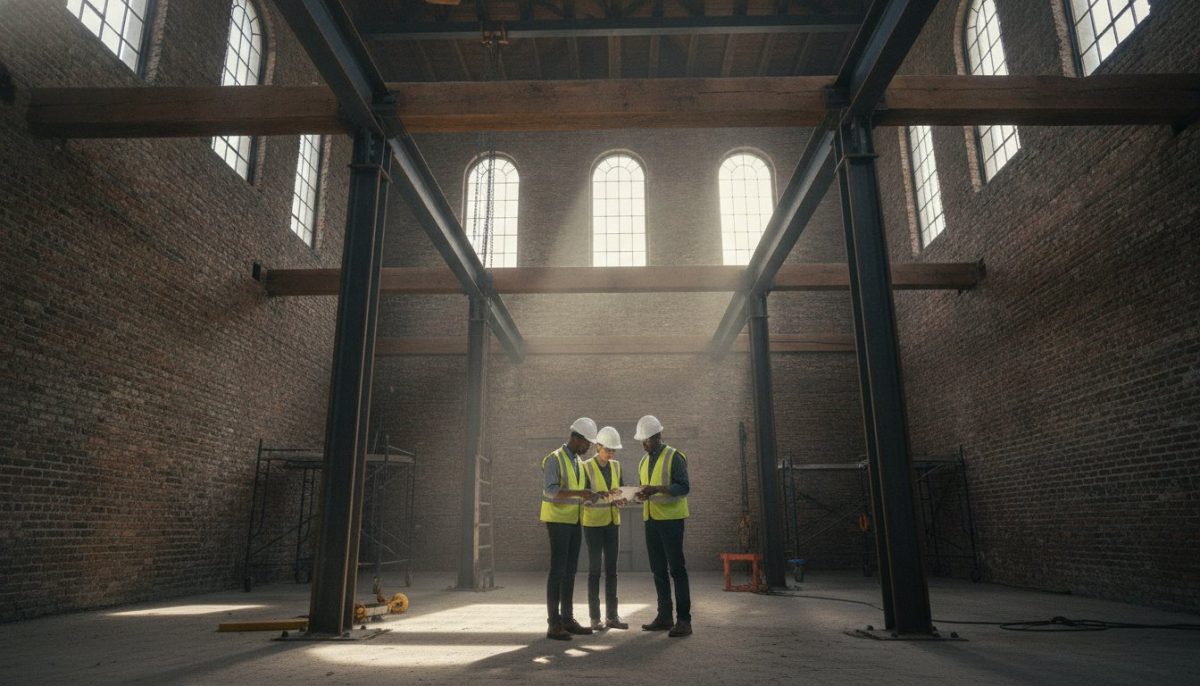
In the world of historic preservation, the most destructive tool in your arsenal isn’t a sledgehammer; it’s a lack of precision. When you’re tasked with selective demolition for historic buildings, you aren’t just removing debris. You’re performing a surgical extraction where a single miscalculation can jeopardize irreplaceable architectural features or violate strict historic tax credit requirements. It’s a high-stakes environment where the discovery of hidden asbestos or lead can stall a project indefinitely if you haven’t planned for it with methodical accuracy.
We understand that maintaining the delicate balance between modernization and preservation feels like walking a tightrope. This guide provides a clear, engineering-led roadmap for surgical deconstruction in 2026. You’ll learn how to integrate hazardous material abatement seamlessly into your workflow while ensuring absolute structural stability during the process. We’ll explore technical protocols and recent regulatory shifts, such as the tightening vote thresholds for structures over 50 years old, giving you the confidence to execute your gut-out without compromising the building’s soul.
Key Takeaways
- Learn why surgical deconstruction is the only viable method for protecting fragile masonry and aging timber frames during a restoration.
- Understand the critical role of load-path analysis in maintaining structural stability while executing selective demolition for historic buildings.
- Discover how to safely integrate asbestos and lead abatement into your timeline to meet strict preservation standards and environmental regulations.
- Identify high-value salvage materials like heart pine and antique brick to preserve the building’s historical value and architectural character.
- Gain a clear roadmap for navigating the complex regulatory requirements and tax credit constraints associated with historic site modifications.
Defining Selective Demolition in the Context of Historic Preservation
Selective demolition represents a fundamental shift from traditional wrecking ball tactics to a methodical, engineering-driven process. While standard demolition focuses on the rapid clearance of a site, selective demolition for historic buildings prioritizes the surgical removal of specific components while maintaining the structural and aesthetic integrity of the remaining shell. This approach is essential for aging structures where the materials, such as soft-fired brick or hand-hewn timber, don’t possess the resilience of modern reinforced concrete.
In many cases, these projects are driven by the need to reverse decades of demolition by neglect, where lack of maintenance has allowed non-original additions to trap moisture and accelerate decay. Owners must distinguish between standard interior gutting and selective structural removal. Interior gutting typically involves stripping finishes and non-load-bearing partitions to prepare for modernization. Selective structural removal is far more complex; it requires the careful modification of the building’s load path to facilitate adaptive reuse while satisfying the stringent requirements of historic tax credit programs.
Surgical Precision vs. Structural Removal
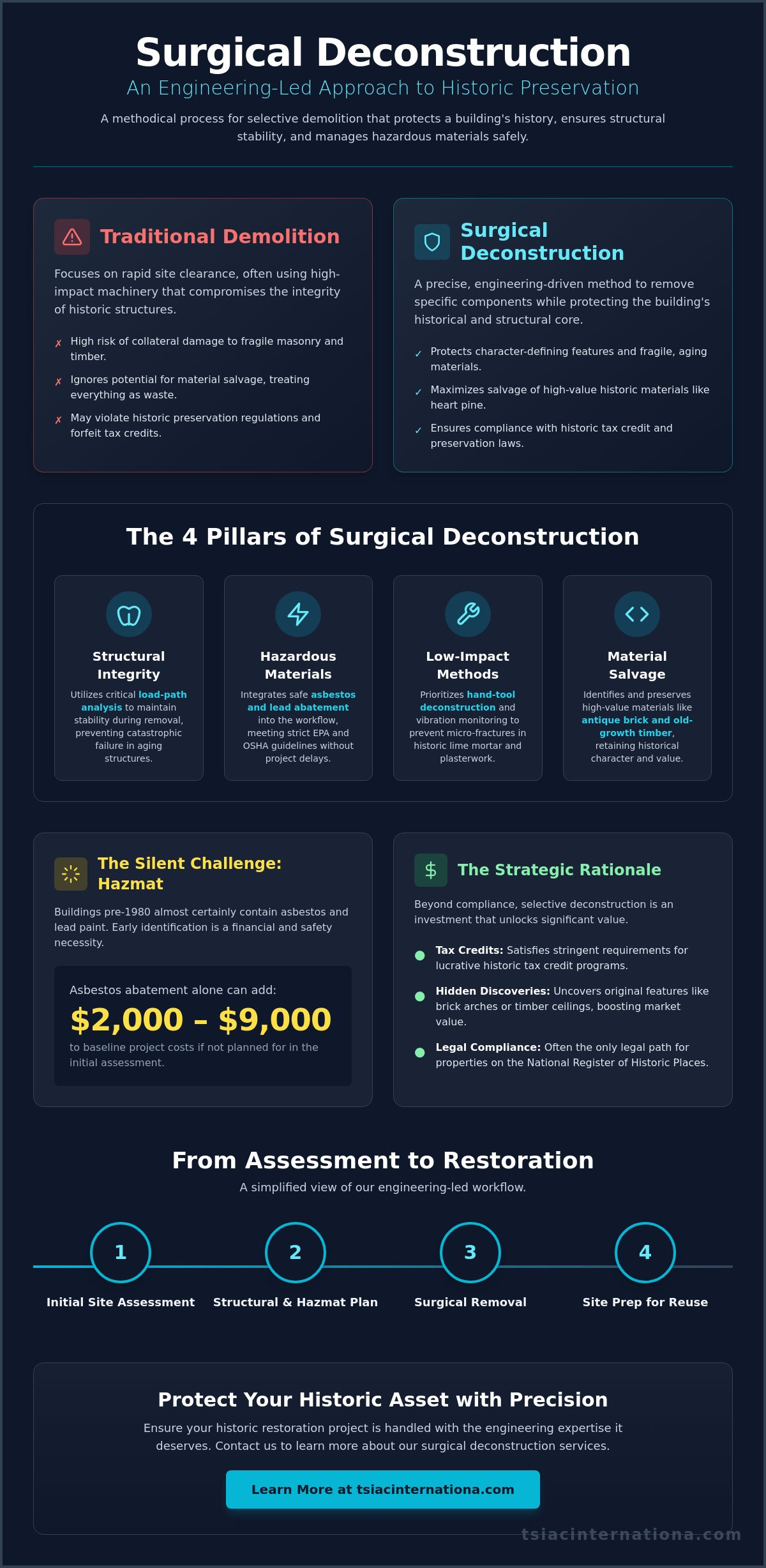
The technical execution of selective demolition relies on low-impact methods to prevent collateral damage. We prioritize hand-tool deconstruction because high-impact pneumatic tools can cause micro-fractures in historic lime mortar, leading to long-term masonry failure. On sensitive sites, we implement real-time vibration monitoring to ensure that seismic energy stays within safe thresholds for adjacent historic zones. This level of control is necessary to protect character-defining features, such as original plasterwork or ornate millwork, that must remain untouched throughout the construction phase.
The Strategic Rationale for Historic Deconstruction
For properties listed on the National Register of Historic Places, selective removal is often the only viable path forward. Federal and state regulations frequently mandate the preservation of the primary structural shell, making traditional demolition illegal. Beyond legal compliance, a rigorous cost-benefit analysis often favors preservation. While the labor-intensive nature of deconstruction carries a higher initial price point than bulk demolition, the value of the preserved structural shell and the potential for historic tax credits often outweigh the costs of total replacement.
Selective demolition serves as a powerful investigative tool. By methodically stripping away layers of 20th-century drywall and dropped ceilings, we often reveal hidden architectural gems. These discoveries, such as original brick arches or vaulted timber ceilings, can be integrated into the final design, significantly increasing the property’s market value and historical significance. It’s a process that views the building as a resource to be harvested rather than a waste product to be discarded.
Hazardous Material Abatement: The Silent Challenge of Historic Sites
Buildings constructed before 1970 are nearly certain to contain lead-based paint and asbestos. These aren’t merely environmental concerns; they are technical challenges that dictate the pace of the entire project. In the context of selective demolition for historic buildings, the goal is to extract these toxins without compromising the very architectural features you aim to preserve. Failing to account for these materials early can lead to project delays and significant budget overruns. For structures built before 1980, asbestos abatement can add between $2,000 and $9,000 to the baseline demolition costs, making early identification a financial necessity.
Proper planning involves integrating asbestos removal protocols into the initial site assessment. This ensures that the chain of custody for hazardous waste is documented from the moment of disturbance to final disposal. While federal rules finalized in March 2024 target chrysotile asbestos in specific industries, they don’t mandate the removal of existing materials in older buildings. However, the moment you begin selective demolition for historic buildings, these materials must be handled according to strict EPA and OSHA guidelines to prevent environmental contamination.
Managing Lead-Based Paint on Architectural Finishes
Lead-based paint is frequently found on ornate millwork and structural steel. We prioritize specialized chemical stripping over abrasive removal to protect the underlying substrate. Abrasive methods can destroy historic wood grain or pit delicate metalwork. During interior deconstruction, we establish negative pressure containment zones to prevent lead dust from migrating into historic voids. All work on residential historic sites must adhere to EPA RRP standards to ensure lead-safe work practices are maintained throughout the renovation.
Asbestos Abatement in Hidden Infrastructure
Asbestos is often hidden in plain sight within pipe insulation, floor tiles, and roofing mastics. Surgical removal of these asbestos-containing materials (ACM) is critical to prevent cross-contamination of wall cavities and floor joists. This requires a high degree of technical skill, as the abatement must occur without damaging adjacent historic materials. Relying on certified hazardous material abatement experts ensures that these hidden threats are neutralized with methodological precision. Many modern municipal frameworks and best practices now emphasize this careful separation of hazardous waste from salvageable historic assets.
If you’re managing a complex site with potential environmental hazards, our team can help you develop a compliant strategy for asbestos abatement that protects both your crew and the building’s integrity.
Engineering Structural Integrity During Interior Gutting
The transition from hazardous material containment to physical deconstruction requires a rigorous engineering review. In the context of selective demolition for historic buildings, the primary risk is the destabilization of the structural shell once internal support systems are disturbed. Unlike modern structures with predictable load paths, historic buildings often feature hybrid systems where masonry, timber, and early steel interact in ways that aren’t immediately apparent. We approach these projects with a focus on structural longevity, ensuring that the removal of secondary elements doesn’t compromise the primary frame.
Performing a comprehensive load-path analysis before any removal begins is mandatory. When we provide commercial interior gutting services for historic sites, our engineers evaluate how the removal of non-original partitions might affect the lateral stability of the exterior walls. This phase often reveals latent conditions. Hidden structural rot in floor joist pockets or carbonized timber from undocumented fires frequently appear during the gut-out. These discoveries require immediate shoring to prevent localized failures.
Managing Load-Bearing Masonry and Timber
Removing internal components without a strict sequence can lead to a catastrophic failure known as ‘unzipping.’ This occurs when the loss of a single support point triggers a progressive collapse of the floor or roof system. Sequential removal ensures that the load is transferred safely to temporary shoring before we extract the original member. We take extra care when removing modern subflooring to avoid scarring the historic floor joists underneath. If we encounter non-structural ‘infills’ from previous renovations, we remove them manually to ensure the primary frame remains undisturbed.
Facade Stabilization and Protection
The preservation of the exterior facade is often the central requirement of a historic project. We employ both internal and external bracing systems, depending on the site’s footprint and the fragility of the masonry. This temporary shoring must be designed to withstand wind loads while the building’s internal diaphragms are being replaced. Protection extends beyond the structural. We use custom-built enclosures to shield original millwork, ornate plaster, and stained glass from dust and impact. Throughout the selective demo phases, keeping the building weather-tight is a priority to prevent moisture from compromising the historic lime mortar or causing timber expansion.
Maintaining secure and functional entry points is a key component of facade protection; for businesses managing historic renovations, Liberty Door Repair offers specialized commercial door services to ensure that structural openings are properly maintained and secure throughout the project.
Every structural modification we perform follows a disciplined methodological approach. We don’t just clear space; we prepare a historic asset for its next century of service by stabilizing its core while removing the weight of the past.
Material Salvage: Preserving the Value of the Past
Selective demolition for historic buildings is a process of reclamation rather than disposal. It requires a fundamental shift in perspective, viewing the aging structure as an “urban mine” rich with finite resources like heart pine, old-growth timber, and hand-pressed antique brick. These materials possess a structural density and aesthetic character that modern manufacturing cannot replicate. By prioritizing recovery, we don’t just preserve architectural history; we capture tangible value that can significantly offset the costs of specialized deconstruction and improve project ROI. Properties that achieve LEED certification through such sustainable practices can see a resale value that is 10% to 31% higher than non-certified buildings, according to industry data.
Our methodology for cataloging these assets is rigorous. As we outline in our overview of the demolition process south carolina, every salvaged component is identified, inspected for structural integrity, and staged in a secure environment. This systematic inventory prevents the accidental loss or damage of high-value materials during the more intensive phases of the interior gut-out. It ensures that the building’s historical DNA is preserved, either for on-site re-integration or for the high-demand architectural salvage market.
Techniques for Non-Destructive Dismantling
Successful salvage relies on the use of specialized tools and manual precision. We utilize low-impact pry-bars and oscillating tools to extract original trim and millwork without splitting the wood grain. Historic bricks are cleaned of lime mortar and palletized immediately to maintain their integrity for future masonry repairs. For timber assets, we perform on-site de-nailing and surfacing, transforming reclaimed beams into high-value flooring or structural accents. This disciplined approach ensures that every extracted element retains its maximum functional and aesthetic value.
Environmental Responsibility and Waste Management
The environmental impact of deconstruction is a key metric in modern preservation. With the global market for construction and demolition waste management projected to reach $217 billion by 2034, efficient on-site sorting is a financial and ethical necessity. We implement strict protocols for separating metal, wood, and masonry. The U.S. steel industry already recovers over 98% of structural steel from demolition projects, and we aim to match that efficiency with all salvageable materials. Any non-salvageable hazardous debris is handled through a documented chain of custody to ensure compliance with national safety standards. This meticulous sorting reduces landfill contributions and lowers the overall carbon footprint of the renovation project.
If you want to maximize the recovery of architectural assets while meeting strict sustainability goals, explore our recycling services for your next historic preservation project.
The TSIAC Standard: Professionalism in National Historic Projects
TSIAC International brings over 15 years of high-stakes structural deconstruction experience to the most challenging preservation environments. Our professional roots as tsiac international charleston have provided us with a profound understanding of historic masonry and timber frames, which we now apply to national projects of significant scale. This background is critical when performing selective demolition for historic buildings, where the margin for error is nonexistent. We operate as a single-source contractor, managing both hazardous material abatement and structural gutting. This integration eliminates the communication gaps that often occur between separate abatement and demolition teams, ensuring a safer and more methodical workflow.
Safety is our baseline requirement, not an optional add-on. Every project is backed by a disciplined commitment to OSHA compliance and specialized training in lead and asbestos handling. We don’t just follow regulations; we set the standard for technical precision in environments where the building’s survival depends on our control. Our word is a guarantee of quality, and our word is backed by a history of successful completions in the most sensitive architectural contexts.
Surgical Execution and Project Management
We develop a Site-Specific Safety Plan (SSSP) for every historic engagement. This document acts as a technical blueprint that accounts for structural shoring, vibration limits, and hazardous material containment. Our project managers coordinate daily with architects and historic consultants to ensure that every removal aligns with the project’s broader preservation goals. In congested urban environments, we manage complex phased logistics to minimize disruption to surrounding properties and traffic, maintaining a clean and professional site footprint throughout the deconstruction process.
Why Experience Matters in Historic Abatement
Inexperienced contractors often cause irreversible damage by using high-impact tools or failing to recognize subtle load-path changes. We’ve built a proven track record with homeowners, general contractors, and government agencies by avoiding these costly errors through technical foresight. Our team understands that selective demolition for historic buildings is successful only when the structure is left in a build-ready state. This means the hazardous materials are neutralized, the structural shell is stabilized, and the site is prepared for the restoration phase to begin without technical friction.
Securing the Future of Architectural Heritage
Mastering selective demolition for historic buildings requires a rare combination of engineering discipline and respect for the past. By prioritizing load-path analysis and non-destructive dismantling techniques, you ensure that the structural shell remains stable while modernizing its core. Integrating hazardous material abatement from the start prevents regulatory delays and protects both your crew and the local environment. These methodical steps turn a high-risk demolition into a controlled restoration prerequisite that preserves the building’s soul.
With 15+ years of historic abatement experience, our team utilizes specialized non-vibratory deconstruction equipment to protect fragile masonry and aging timber. Our comprehensive environmental and safety certifications mean we handle complex technical challenges with the methodological precision your project demands. We don’t just clear space; we stabilize and prepare your building for its next century of service. Your vision for adaptive reuse deserves a partner who understands the technical weight of history and the value of every original brick.
Take the next step in your preservation journey. Request a Consultation for Your Historic Selective Demolition Project and ensure your structure is in the hands of disciplined experts.
Frequently Asked Questions
Can selective demolition be used in buildings with active historic designations?
Yes, selective demolition is frequently the only permissible method for buildings with active historic designations. This surgical approach ensures that character-defining features remain intact while modernizing the building’s utility. Regulatory bodies, such as the Historic District Commission, often mandate these precise techniques to ensure compliance with preservation tax credits and local ordinances. It prevents the loss of historical status by protecting the primary structural and aesthetic elements.
How much does selective demolition cost compared to total building removal?
Selective demolition generally carries a higher labor cost per square foot than total building removal due to the manual precision required. However, it often results in a lower total project cost by preserving the existing structural shell and high-value materials. By avoiding the expense of entirely new construction and qualifying for historic tax credits, property owners often find that the long-term ROI justifies the investment in surgical deconstruction.
What is the biggest risk when performing interior gutting on a historic building?
The primary risk during a historic interior gutting project is the accidental destabilization of the structural load path. Removing non-original partitions can sometimes reveal that they were unintentionally providing secondary support to aging floor joists. Without a prior engineering assessment, this can lead to localized collapses. Additionally, the discovery of latent moisture damage or previous structural fire damage requires immediate shoring to maintain the building’s overall integrity.
Does selective demolition require special permits for historic structures?
Most selective demolition for historic buildings requires specialized permits beyond standard demolition filings. These often include a Certificate of Appropriateness from a local Historic Preservation Board or approval from the State Historic Preservation Office (SHPO). These permits ensure that the proposed removal doesn’t negatively impact the building’s historical integrity. You should also verify if a deconstruction ordinance applies to your specific project location before beginning any physical work.
How do you handle hidden asbestos found during a selective demolition project?
If hidden asbestos is discovered, work in that specific zone must stop immediately to prevent fiber release. The area is sealed, and a certified abatement team performs a surgical extraction to neutralize the threat. This process is integrated into the selective demolition for historic buildings timeline to ensure that the hazardous material is removed without cross-contaminating historic wall cavities. We maintain a strict chain of custody for all hazardous waste disposal.
Is it possible to salvage historic brick and timber for reuse in the same project?
Salvaging historic brick and old-growth timber for on-site reuse is a hallmark of high-quality preservation. These materials are manually extracted, cleaned, and cataloged for re-integration into the new design. This practice not only maintains the building’s aesthetic continuity but also contributes to sustainability goals. Reusing original heart pine or hand-pressed brick can significantly enhance the historical authenticity and market value of the finished restoration while reducing the need for new materials.
What kind of machinery is used for selective demolition in tight historic spaces?
We utilize specialized, low-impact machinery such as electric mini-excavators and remote-controlled demolition robots for tight historic spaces. These tools provide high precision without the harmful exhaust or excessive vibrations of traditional heavy equipment. In the most sensitive areas, we rely exclusively on hand-tool deconstruction. This methodological approach prevents micro-fractures in aging masonry and protects delicate architectural finishes that must remain untouched during the process, ensuring the building’s structural shell survives the modernization.
How do you protect the exterior facade while gutting the interior?
Protecting the exterior facade involves the installation of temporary internal or external bracing systems. These structures are engineered to support the masonry shell once the internal floors or walls are removed. We also use custom-built protective enclosures for windows and ornate stonework. Maintaining a weather-tight environment is essential throughout the process to prevent moisture from compromising historic lime mortar or causing timber expansion while the building’s interior is being gutted.
