Unsafe Building Demolition in South Carolina: The 2026 Property Owner’s Guide

Did you know that 42% of Charleston structures built before 1978 contain hazardous materials like asbestos or lead paint? When executing unsafe…

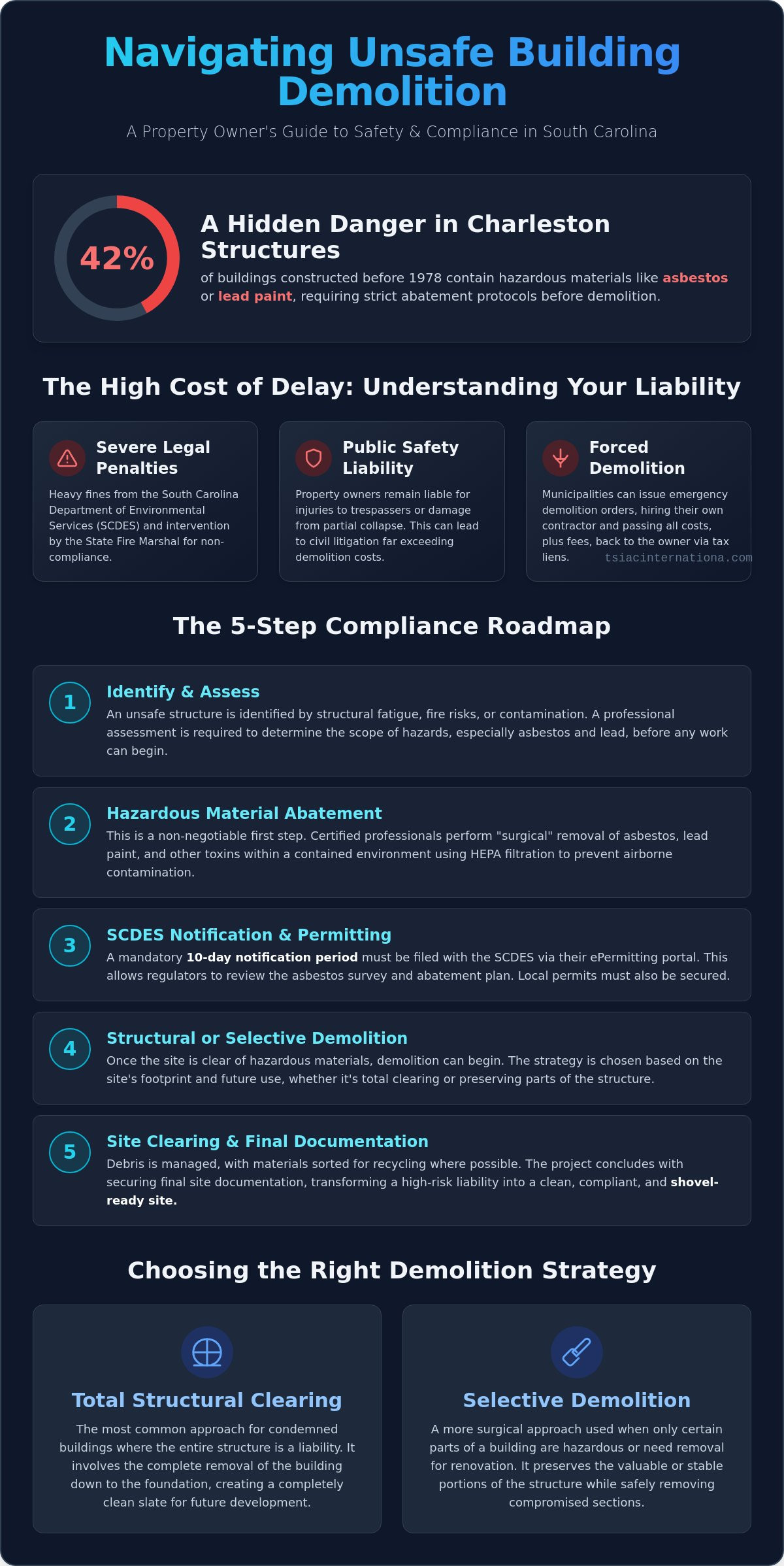
Did you know that 42% of Charleston structures built before 1978 contain hazardous materials like asbestos or lead paint? When executing unsafe building demolition south carolina property owners must adhere to strict protocols to avoid environmental incidents and severe legal penalties. It’s a high-stakes surgical operation where a single oversight in hazardous material abatement can lead to heavy fines from the South Carolina Department of Environmental Services (SCDES) or intervention by the State Fire Marshal.

You likely understand that leaving a structural hazard untouched isn’t an option, yet the complexity of 2026 compliance often feels overwhelming. We’re here to ensure you navigate this process with technical precision and total regulatory transparency. This guide provides a clear roadmap for structural removal, from filing the mandatory Notice of Intent to Rehabilitate under the updated Abandoned Buildings Revitalization Act to securing final site documentation. We’ll examine the specific requirements for asbestos surveys, SCDES notification timelines, and the methodical steps required to transform a high-risk liability into a clean, shovel-ready site.

Key Takeaways

  • Identify the legal and safety markers of a condemned structure to mitigate liability risks before they escalate into state-level enforcement actions.
  • Understand why hazardous material abatement must precede unsafe building demolition south carolina to protect your property from environmental incidents and regulatory penalties.
  • Determine the most efficient strategy between total structural clearing and selective demolition to manage your site’s specific footprint and future use.
  • Navigate the mandatory 10-day SCDES notification process and local permitting requirements to ensure full documentation for your property’s next phase.
  • Learn how professional oversight manages the intersection of structural removal and material recycling to deliver a safe, compliant, and shovel-ready site.

Identifying and Managing Unsafe Structures in South Carolina

An unsafe building in South Carolina is defined by more than just aesthetic decay; it’s a structure that poses an imminent threat to life, health, or property. Under the 2025 South Carolina Code of Laws, specifically Section 23-9-150, the State Fire Marshal holds the authority to designate structures as hazards. This designation typically stems from structural instability, fire risks, or severe environmental contamination. For property owners, the realization that a building has reached this terminal state is often the catalyst for exploring Demolition as the only viable path to safety. Executing an unsafe building demolition south carolina project requires a systematic approach to avoid legal entanglements and physical accidents.

The transition from a “managed property” to a “liability” happens quickly once structural integrity is compromised. Immediate concerns include the risk of collapse during heavy weather, the presence of trespassers, and the leaching of hazardous materials into the surrounding soil. Managing these risks demands a shift in strategy. Owners must move from passive observation to active site securing, which involves perimeter fencing and professional structural assessments to determine if the building is salvageable or requires total removal.

Criteria for an Unsafe Designation

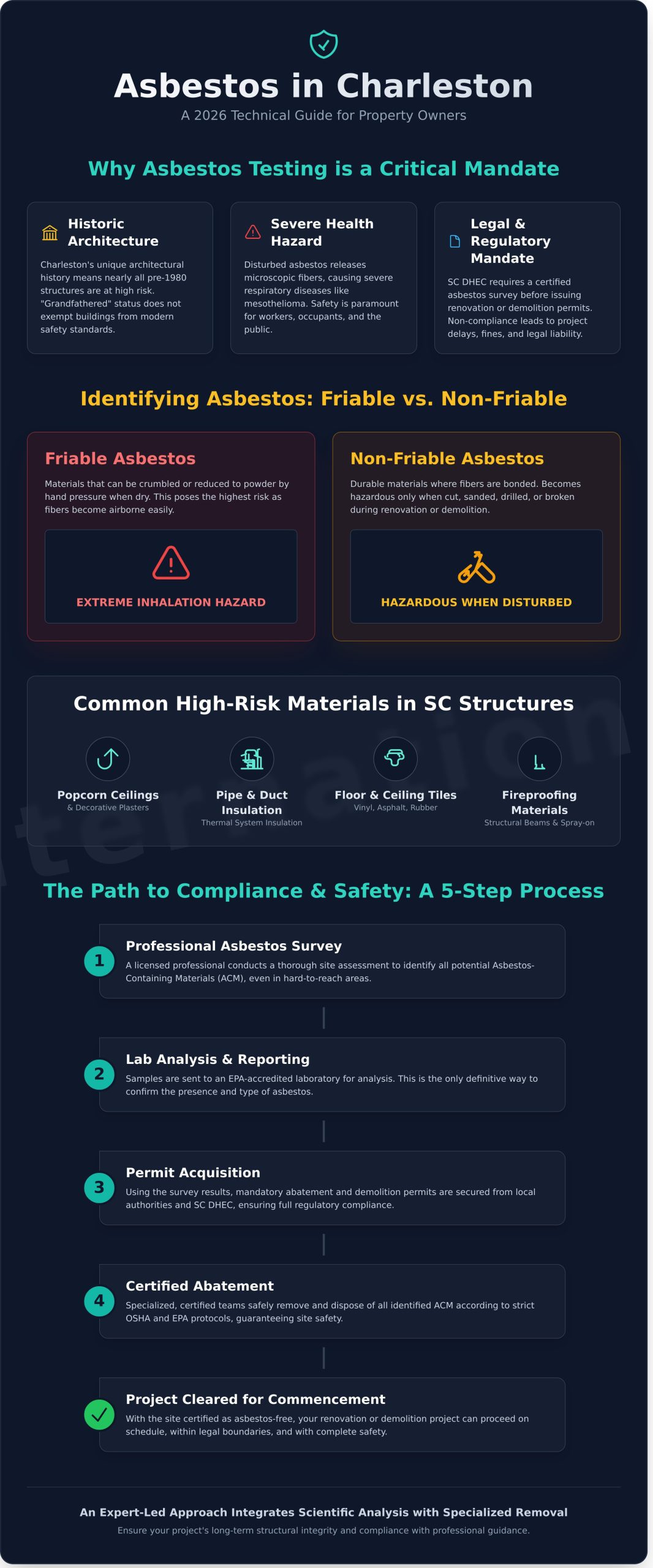
Structural fatigue represents the most common trigger for a condemnation order. This includes compromised load-bearing members, sagging roof trusses, or foundation displacement that exceeds safe tolerances. Beyond physical stability, fire damage often leaves a structure unfit for human occupancy due to compromised air quality or weakened interior framing. Abandoned properties frequently harbor hazardous materials like friable asbestos or lead-based paint. When these materials are coupled with moisture intrusion and mold growth, they create a toxic environment that necessitates specialized abatement before any structural work begins.

The Property Owner’s Legal Responsibility

Owning a condemned property carries a significant duty of care toward the public. If a structure is left unsecured, the owner remains liable for injuries to trespassers or damage caused by a partial collapse. Municipalities in South Carolina can issue emergency demolition orders if a site is deemed an immediate public threat. These orders often result in the city hiring a contractor and passing the costs, along with administrative fees, back to the owner via tax liens. The duty to mitigate requires a property owner to take reasonable, proactive steps to reduce the risk of further damage or injury once a hazard is identified. Failure to act doesn’t just invite fines; it increases the risk of civil litigation that can far exceed the cost of professional site clearing.

The Integrated Workflow: Abatement and Structural Removal

A successful unsafe building demolition south carolina project relies on a linear, non-negotiable sequence of operations. You can’t simply introduce heavy machinery to a compromised structure without first addressing the chemical and mineral hazards embedded within its fabric. When structural demolition begins, the physical impact of excavators and shears pulverizes building materials, potentially releasing friable asbestos fibers or lead-enriched dust into the atmosphere. This creates an immediate health risk for the crew and the surrounding community. Consequently, the integration of abatement and structural removal isn’t merely a best practice; it’s a regulatory requirement enforced by the South Carolina Department of Environmental Services (SCDES).

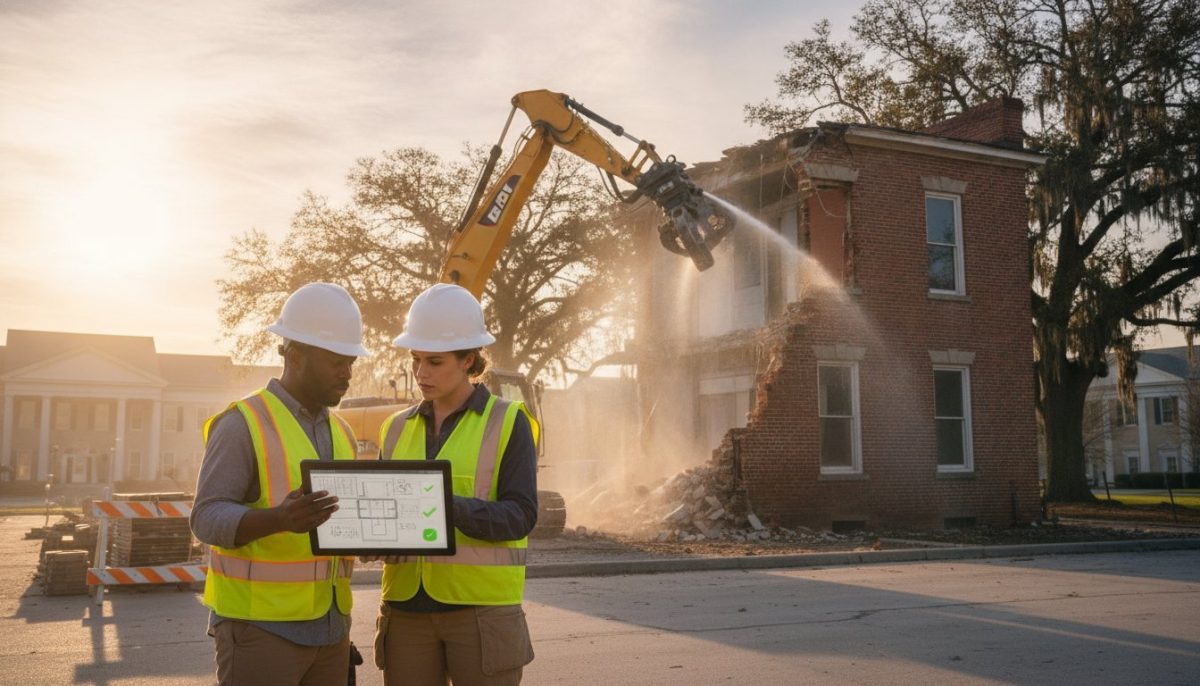
Before any structural members are disturbed, the project must be registered through the SCDES ePermitting portal. This includes the mandatory 10-day notification period, which allows regulators to review the asbestos survey results and the proposed abatement plan. During this phase, professionals establish a containment perimeter using high-efficiency particulate air (HEPA) filtration and specialized wetting agents. This ensures that hazardous dust doesn’t migrate beyond the site boundaries. By managing the workflow through a single, coordinated effort, property owners reduce the risk of environmental cross-contamination that often occurs when separate contractors fail to communicate effectively.

Asbestos and Lead Abatement Protocols

The process begins with the “surgical” removal of hazardous materials. This means technicians manually extract asbestos-containing materials (ACM) and lead-painted components before the main structure is touched. Every gram of toxic waste is double-bagged, labeled, and transported to certified landfills equipped to handle such debris. Prioritizing hazardous material abatement south carolina serves as the foundation for a safe site. Once the building is cleared of these contaminants, the structural team can proceed without the constant threat of an environmental stop-work order. If you’re managing a complex site, it’s often more efficient to partner with experts who handle both demolition and abatement under one safety plan.

Coordinating Site Safety

Safety coordination involves more than just wearing hard hats. It requires the establishment of strict exclusion zones where only authorized personnel with specific PPE can enter. Throughout the structural removal phase, air quality monitoring stations provide real-time data to ensure that containment strategies remain effective. All operations must align with OSHA demolition safety standards, which dictate the necessary engineering surveys and preparatory steps. This disciplined approach ensures that the transition from a standing hazard to a cleared lot happens without a single safety incident or regulatory violation.

Structural vs. Selective Demolition: Choosing the Right Strategy

Deciding between a total site clearing and a surgical intervention depends on the structural integrity of the remaining components and the intended future use of the land. While a condemnation order often implies a total loss, modern engineering allows for more nuanced approaches. For many property owners, the goal of unsafe building demolition south carolina is to remove the liability while retaining any remaining value in the foundation or specific wings of a complex. This decision is never aesthetic; it’s a calculation of risk, cost, and structural stability.

The choice of strategy also impacts the volume of debris generated and the subsequent tipping fees at South Carolina landfills. With 2026 rates for construction and demolition debris reaching $46 per ton in counties like York and Horry, a precise strategy can significantly influence the project’s logistical footprint. Whether you’re clearing a residential lot or a commercial complex, the method must align with the engineering survey’s findings to ensure safety remains the priority.

Total Structural Removal

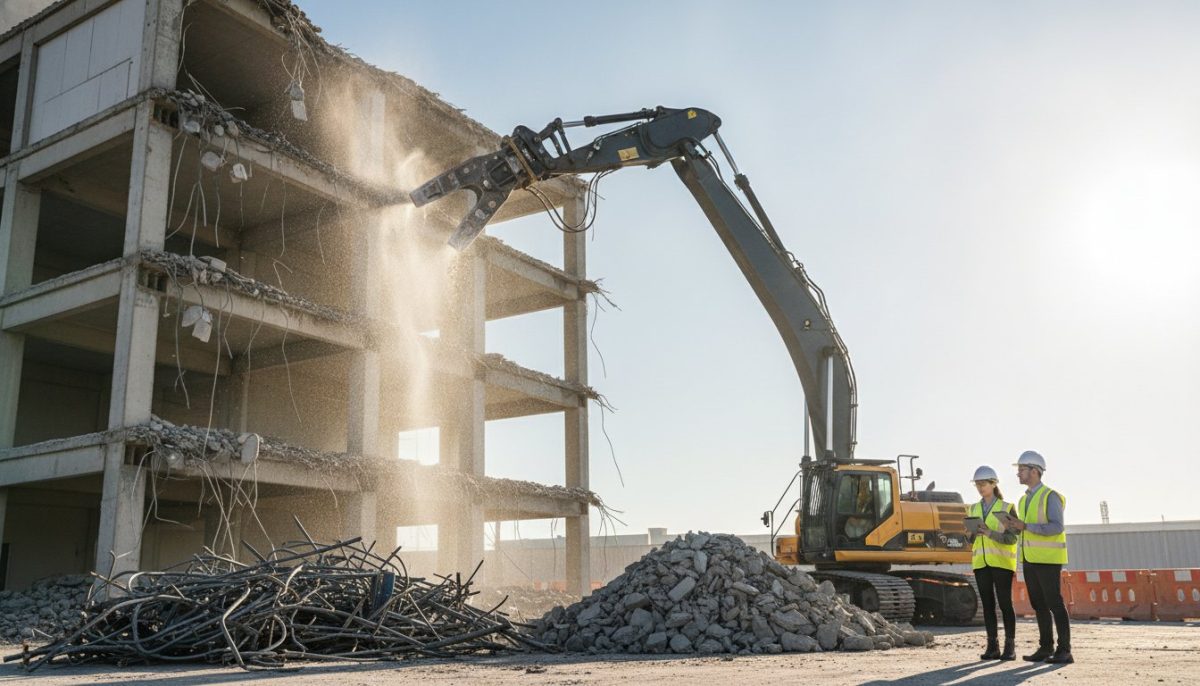
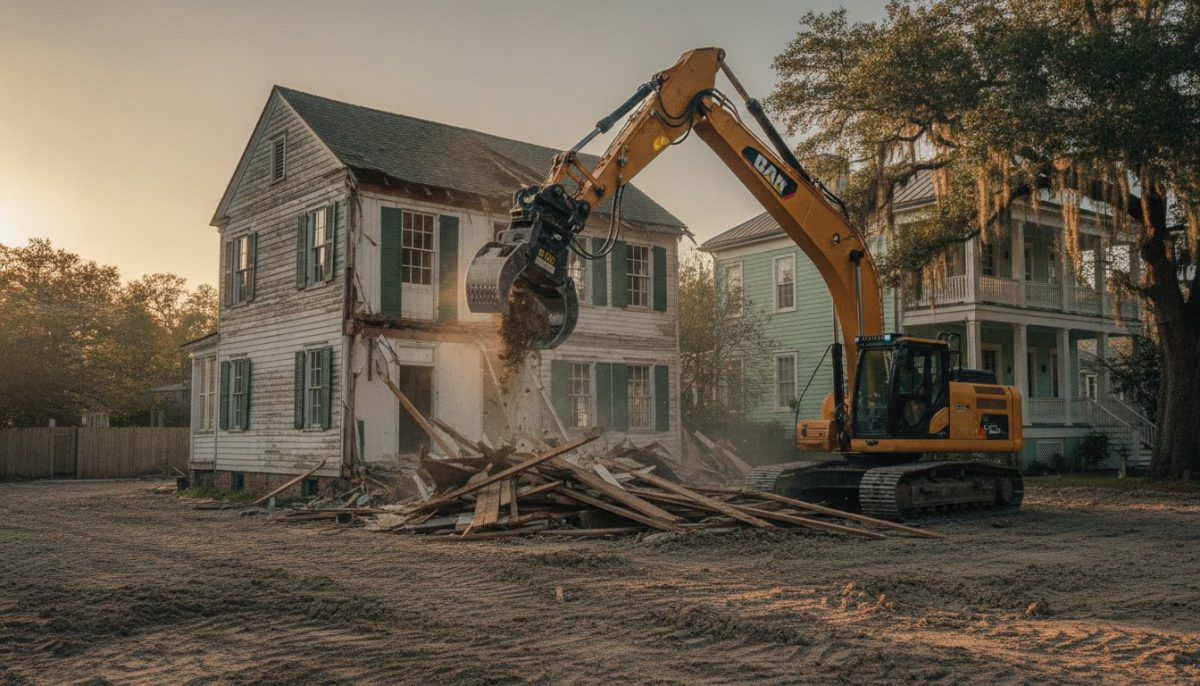
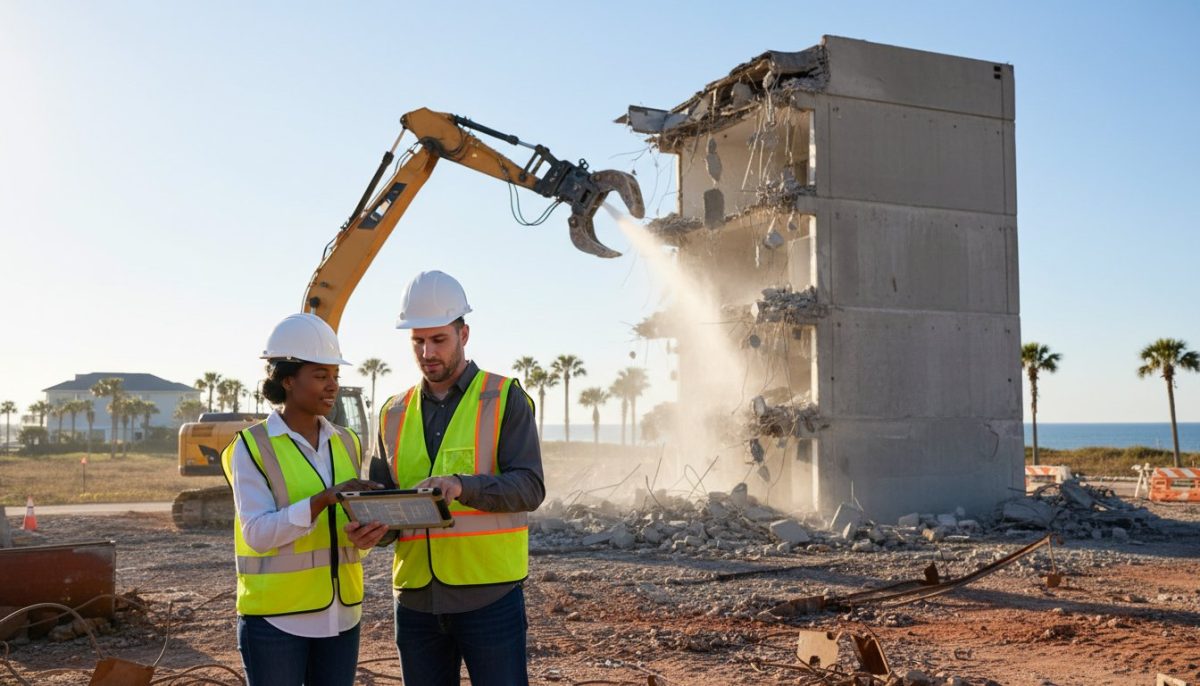
Total structural demolition is the standard response when a building’s primary load-bearing system has failed. This process involves the systematic dismantling of the entire structure from the roof down to the slab. High-reach excavators equipped with hydraulic shears and grapples are the primary tools for this level of clearing. Unlike selective work, total removal focuses on high-volume efficiency and comprehensive debris management. Once the vertical structure is down, the focus shifts to foundation removal. This includes breaking up reinforced concrete footings and slabs to ensure the site is ready for new development. You can find more detail on the machinery and sequence in our guide to the demolition process south carolina.

Selective and Interior Demolition

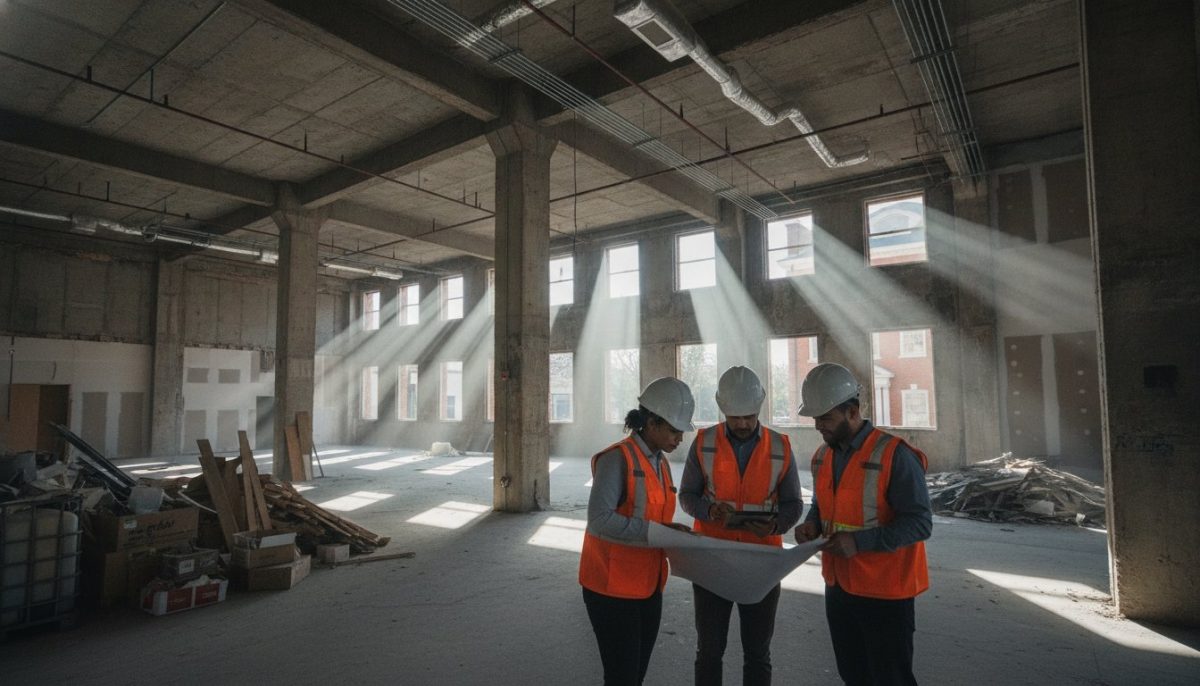
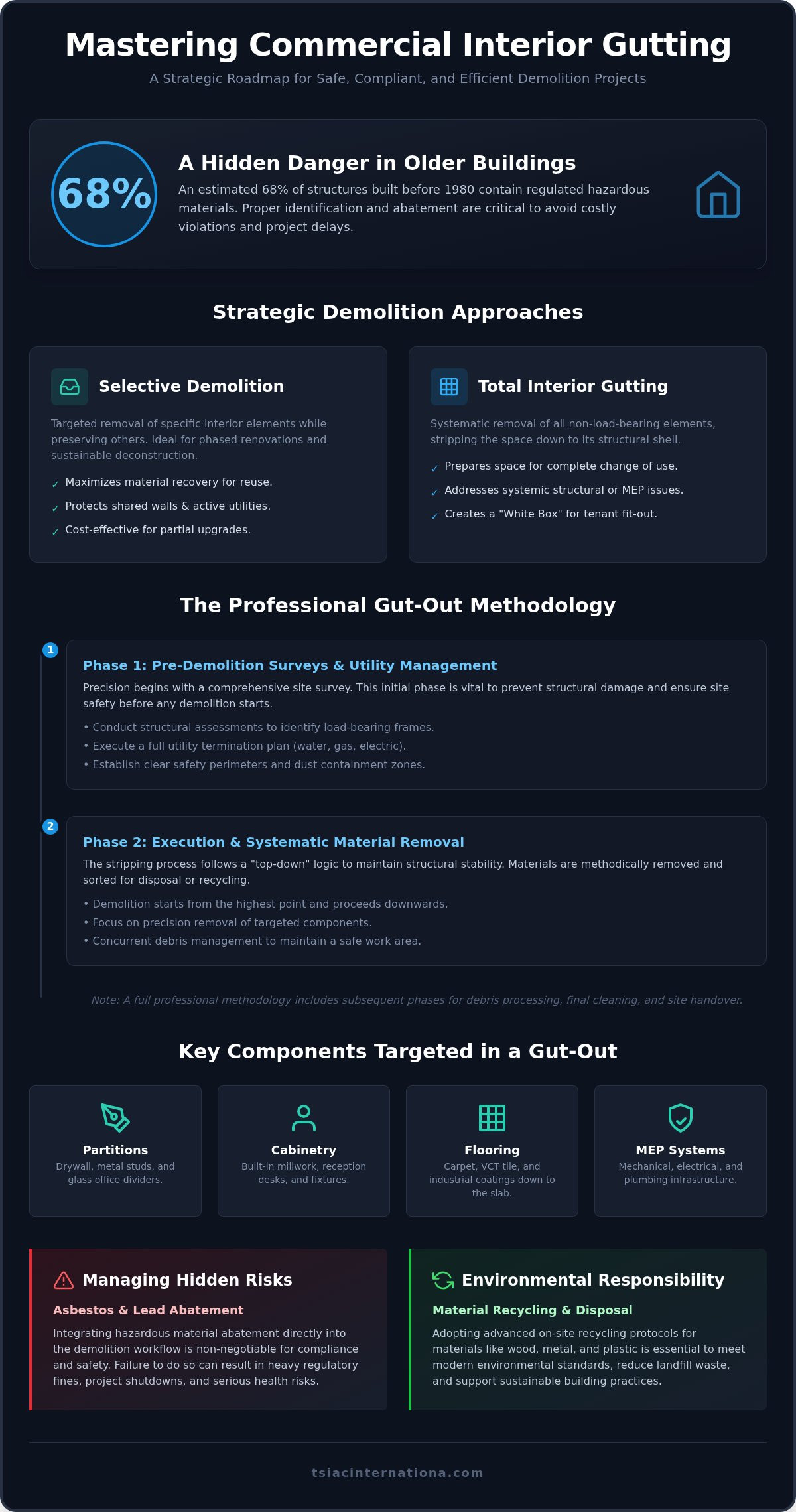
Selective demolition is a precision-based strategy used when only specific sections of a building are unsafe or when a property is being prepared for a major renovation. This often involves the removal of specific floors, wings, or hazardous additions while the core structure remains intact. Selective work requires extensive structural shoring to prevent accidental collapse of the retained sections. Interior gutting is a subset of this strategy, where the building is stripped to its structural shell. This is a common requirement for commercial tenant improvements, where all non-load-bearing walls, ceilings, and utilities are removed. Success in selective projects relies on meticulous utility disconnects and a clear understanding of the building’s load paths to ensure the remaining structure stays stable during the intervention.

Several factors dictate the final strategy. Cost is a primary driver; total demolition is often faster than the labor-intensive shoring required for selective work. However, if the building has historical value or if the 2026 tax credits under the Abandoned Buildings Revitalization Act apply, selective removal may be the more financially sound long-term choice. Ultimately, the engineering survey determines which path fulfills the owner’s legal duty to mitigate the hazard while maximizing site potential.

Unsafe Building Demolition in South Carolina: The 2026 Property Owner’s Guide

Compliance and Environmental Responsibility in Demolition

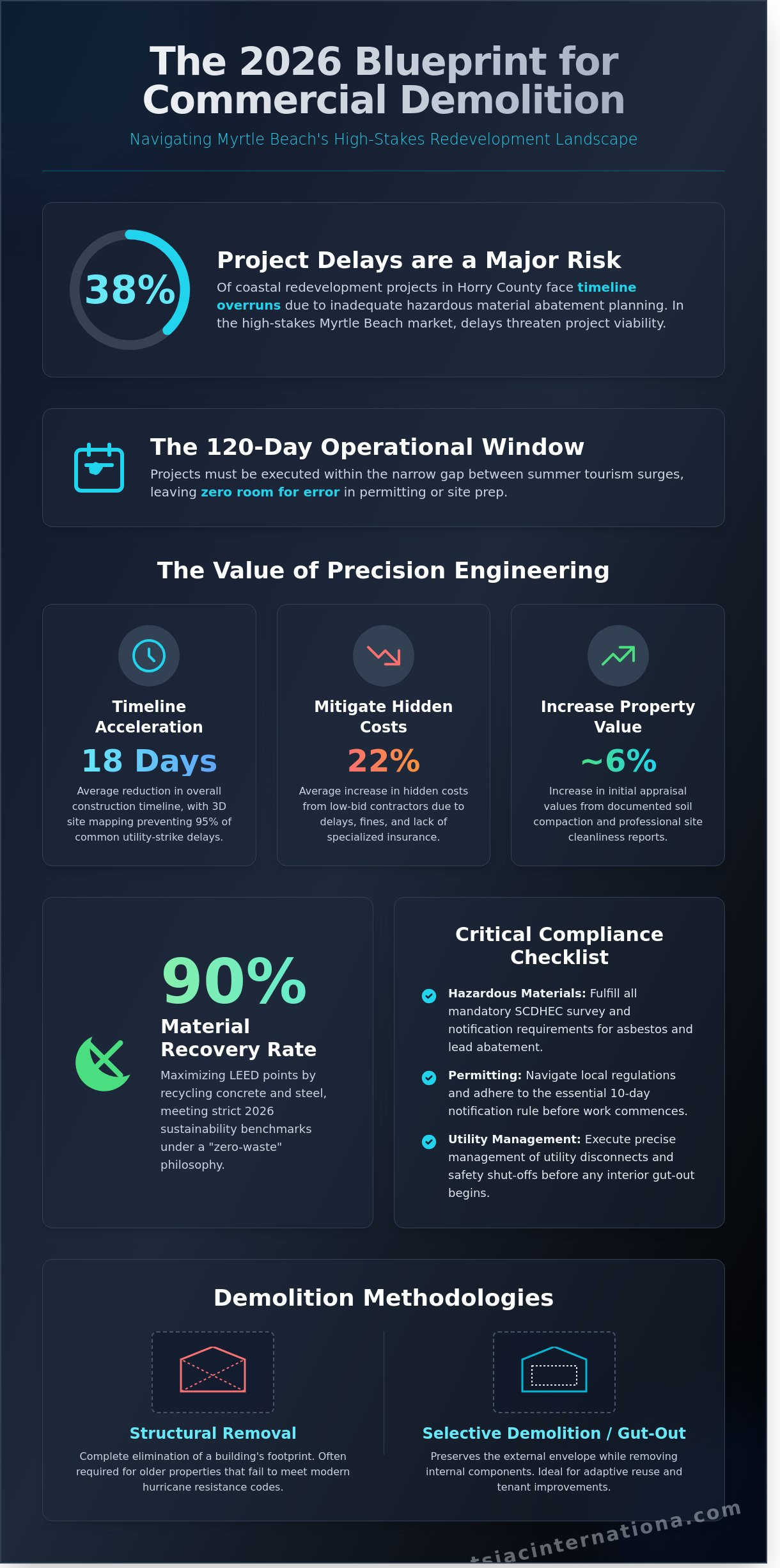
Compliance isn’t a suggestion; it’s the mandatory framework of a professional project. Every unsafe building demolition south carolina project must begin with a formal notification to the South Carolina Department of Environmental Services (SCDES). This 10-day notification rule is a hard requirement for all regulated facilities, even when an asbestos survey confirms that no hazardous materials are present. This waiting period allows state regulators to review your safety plans and verify that the proposed structural removal won’t compromise public health. Bypassing this step doesn’t just risk heavy fines; it can lead to permanent stop-work orders that stall your site’s development for months.

Environmental stewardship in 2026 has evolved beyond simple waste disposal. Modern demolition requires a disciplined approach to material recovery that balances regulatory demands with economic efficiency. Once the structural dismantling begins, the focus shifts to documenting the chain of custody for every ton of debris that leaves the site. This documentation is essential for future property transfers, as it proves the land was cleared according to state environmental standards. Without a full regulatory close-out, a property owner remains tethered to the liabilities of the former structure.

The Permitting Checklist

The administrative phase of a demolition project is as critical as the physical execution. A complete submission to the SCDES ePermitting system requires several key components. First, you must include a pre-demolition asbestos survey conducted by a state-certified inspector within the last three years. Along with this report, a $50 fee per structure is required for the “Notification of Demolition” application. Beyond state-level filings, you must secure utility disconnect letters from water, gas, and electrical providers. These documents serve as proof that all service lines are capped and safe, preventing explosive hazards or flooding during the structural removal phase.

Sustainable Debris Management

Professional demolition teams prioritize on-site sorting to identify and recover recyclable aggregates. This process involves separating structural steel, copper piping, and clean wood from general debris. Recovering these materials is a financial necessity in the current market. With 2026 tipping fees for construction and demolition debris reaching $46 per ton in York and Horry counties, reducing the volume of waste sent to landfills significantly lowers project overhead. Diverting metal and wood from the waste stream reflects a commitment to the circular economy and ensures your project meets modern environmental benchmarks. If you’re ready to clear your property with technical precision, contact our structural demolition experts to manage your compliance and site recovery needs.

Professional Execution: Why Specialized Expertise is Essential

Hiring an inexperienced or uncertified crew for unsafe building demolition south carolina is a decision fraught with hidden costs. While a low-bid contractor might promise a quick clearing, they often lack the technical depth required to manage the intersection of structural removal and hazardous material abatement. An uncertified team might overlook friable asbestos or fail to implement proper dust suppression, leaving the property owner liable for environmental contamination and state-level enforcement actions. Specialized expertise ensures that the project follows a methodical sequence, protecting both the physical site and the owner’s financial interests from start to finish.

A professional demolition contractor understands that structural removal is an engineering task, not just a physical one. This expertise is particularly vital when dealing with compromised buildings where traditional methods might trigger an accidental collapse. By employing specialized machinery and high-reach tools, experts can dismantle a structure with surgical precision, ensuring that debris is contained and safety perimeters are respected. This disciplined approach transforms a high-risk liability into a clean, shovel-ready site, providing the necessary foundation for future property development or resale without the lingering shadow of regulatory non-compliance.

Mitigating Financial and Legal Risk

Liability protection is the cornerstone of professional execution. A specialized contractor carries comprehensive general liability and pollution insurance, which shields the property owner from claims arising from site accidents or environmental releases. Beyond insurance coverage, the value of a documented project completion is a critical asset. A clean regulatory close-out from the SCDES provides the permanent record necessary for future property transfers or securing new building permits. Professional oversight ensures that every hazardous material is accounted for and every structural member is safely dismantled, which effectively prevents future environmental litigation that could arise from improperly managed debris. Fixed-price contracts also offer financial stability, protecting owners from the budgetary volatility often associated with discovering hidden contaminants mid-project.

Partnering with TSIAC International

With over 15 years of experience in the sector, TSIAC International has established a reputation for handling the most complex technical challenges in South Carolina. Our approach is defined by unwavering reliability and a commitment to methodical precision. We don’t just provide structural demolition; we act as a responsible partner throughout the entire site clearing process. Our teams are experts in selective demolition, interior gutting, and full-scale structural removal, ensuring that every project meets the highest safety and recycling standards. By prioritizing the recovery of materials and strict adherence to regulatory timelines, we deliver a site that is truly ready for its next phase of life. Contact TSIAC International for a professional consultation on your demolition project to ensure your property transition is managed with expert precision and total regulatory compliance.

Securing Your Property’s Future Value

Managing an unsafe building requires a transition from reactive anxiety to proactive site management. We’ve detailed how structural instability and hazardous materials create a complex liability that only a methodical, integrated workflow can resolve. Prioritizing the 10-day SCDES notification and executing surgical abatement before the first excavator arrives ensures your project remains compliant. The final objective of unsafe building demolition south carolina is to provide a site that’s fully documented and ready for development.

TSIAC International brings over 15 years of abatement and demolition experience to every project. Our comprehensive hazardous material containment protocols and dedicated on-site material recycling programs allow us to manage technical challenges with absolute control. We’re ready to help you eliminate risk and restore the value of your property through disciplined execution and technical precision.

Get a Fixed-Price Quote for Your Structural Demolition Project

Frequently Asked Questions

How long does the demolition process take in South Carolina?

The timeline for a standard unsafe building demolition south carolina project typically spans three to six weeks from the initial survey to final site clearance. This duration includes the mandatory 10-day SCDES notification period and the time required for hazardous material abatement. Larger commercial structures or sites requiring extensive selective demolition may take longer to ensure structural stability and environmental containment throughout the dismantling process.

Do I need an asbestos survey if I know the building is unsafe?

Yes, a thorough asbestos inspection by a state-certified inspector is mandatory before the demolition of most facilities in South Carolina. Even if a building is structurally compromised or designated as unsafe, the SCDES requires a survey report performed within three years of the demolition date. This report must be submitted with your notification to ensure that friable fibers aren’t released during structural removal.

Can I demolish a small building myself to save costs?

While single-family residences with four or fewer units are generally exempt from state-level asbestos notification, DIY demolition is highly discouraged due to significant liability risks. You remain responsible for the proper disposal of hazardous materials and the safety of the site. Most municipalities still require local permits, and the risk of accidental injury or environmental contamination often outweighs the perceived cost savings of a professional crew.

What is the 10-day notification rule for SCDES?

The 10-day notification rule requires property owners to submit a formal “Notification of Demolition” to the South Carolina Department of Environmental Services at least 10 working days before work begins. This rule applies to all regulated facilities, regardless of whether asbestos is present. It allows regulators time to review safety protocols and ensure the unsafe building demolition south carolina project adheres to all state environmental standards.

What materials from a demolition site can be recycled?

Most structural components can be diverted from landfills through on-site sorting and recovery. This includes structural steel, copper wiring, aluminum fixtures, and clean concrete, which can be crushed into aggregate for future use. Reusable wood beams and certain plastics are also recoverable. Effective recycling programs are essential to offset tipping fees, which reached $46 per ton in York and Horry counties as of July 2026.

How much does it cost to remove an unsafe building?

Costs are determined by the structure’s square footage, the presence of hazardous materials, and the complexity of the site. In 2026, the average cost to demolish a house in South Carolina is approximately $11,143.75 for a structure with a basement. Additional expenses for asbestos surveys, which range from $400 to $4,000 depending on facility size, and hazardous material abatement must also be factored into the total project budget.

What happens if lead paint is found during a demolition?

If lead-based paint is identified, specialized lead abatement protocols must be implemented before structural dismantling begins. This involves the use of HEPA-filtered vacuums, specialized wetting agents for dust suppression, and specific PPE for the crew. In Charleston, approximately 42% of buildings constructed before 1978 contain hazardous materials like lead, requiring methodical containment to prevent soil and air contamination during the clearing process.

Is a permit required for interior gutting services?

Yes, most local jurisdictions require permits for interior gutting services, especially when the work involves structural members or utility systems. Even if you aren’t removing the entire building footprint, selective demolition must be documented to ensure the building’s core integrity is maintained. Professional contractors manage these permits as part of the project’s regulatory compliance framework to ensure the site remains safe for future renovations.

Selective Demolition for Historic Buildings: The 2026 Preservation Guide

In the world of historic preservation, the most destructive tool in your arsenal isn’t a sledgehammer; it’s a lack of precision. When you’re tasked…

In the world of historic preservation, the most destructive tool in your arsenal isn’t a sledgehammer; it’s a lack of precision. When you’re tasked with selective demolition for historic buildings, you aren’t just removing debris. You’re performing a surgical extraction where a single miscalculation can jeopardize irreplaceable architectural features or violate strict historic tax credit requirements. It’s a high-stakes environment where the discovery of hidden asbestos or lead can stall a project indefinitely if you haven’t planned for it with methodical accuracy.

We understand that maintaining the delicate balance between modernization and preservation feels like walking a tightrope. This guide provides a clear, engineering-led roadmap for surgical deconstruction in 2026. You’ll learn how to integrate hazardous material abatement seamlessly into your workflow while ensuring absolute structural stability during the process. We’ll explore technical protocols and recent regulatory shifts, such as the tightening vote thresholds for structures over 50 years old, giving you the confidence to execute your gut-out without compromising the building’s soul.

Key Takeaways

  • Learn why surgical deconstruction is the only viable method for protecting fragile masonry and aging timber frames during a restoration.
  • Understand the critical role of load-path analysis in maintaining structural stability while executing selective demolition for historic buildings.
  • Discover how to safely integrate asbestos and lead abatement into your timeline to meet strict preservation standards and environmental regulations.
  • Identify high-value salvage materials like heart pine and antique brick to preserve the building’s historical value and architectural character.
  • Gain a clear roadmap for navigating the complex regulatory requirements and tax credit constraints associated with historic site modifications.

Defining Selective Demolition in the Context of Historic Preservation

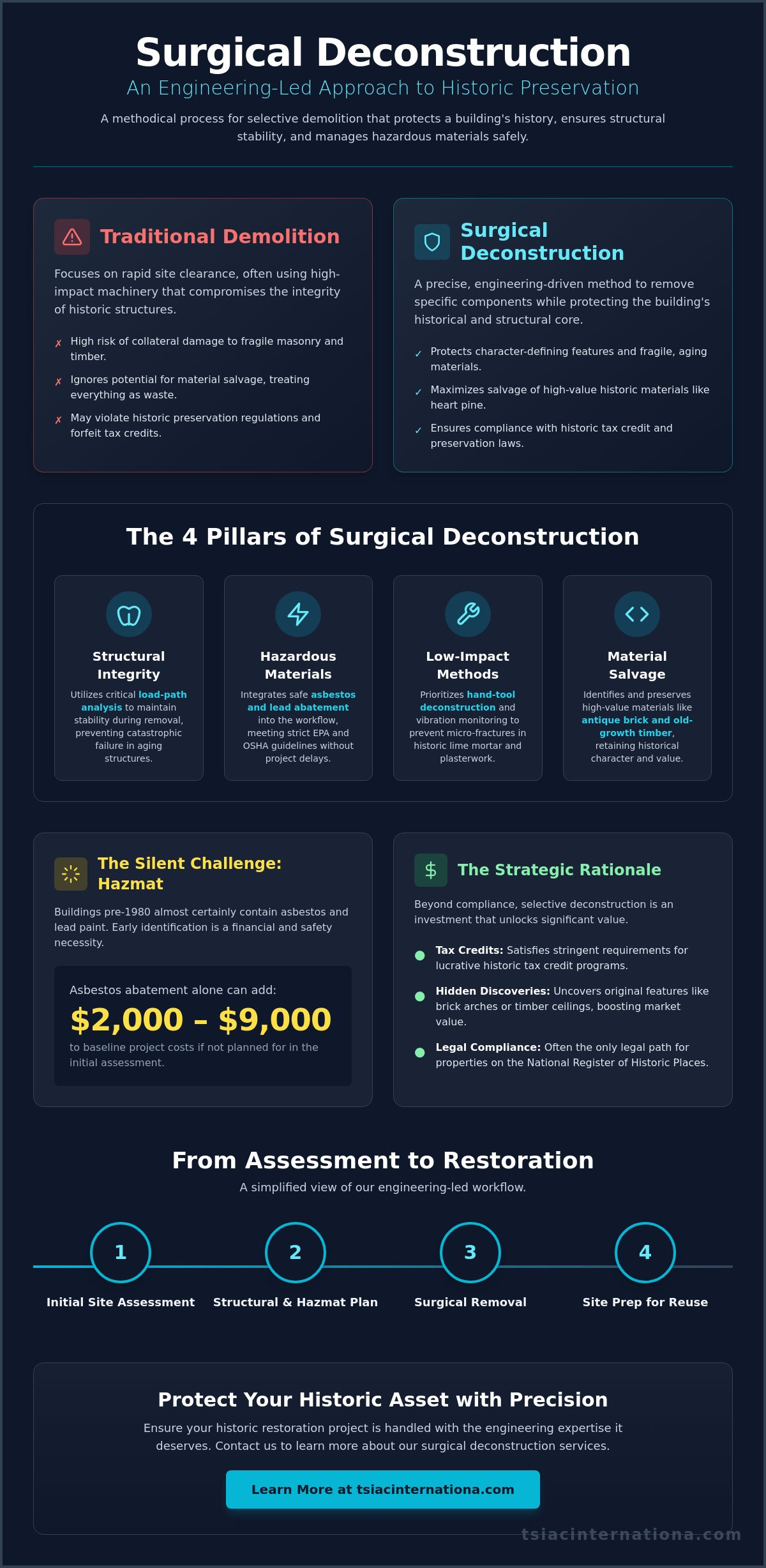
Selective demolition represents a fundamental shift from traditional wrecking ball tactics to a methodical, engineering-driven process. While standard demolition focuses on the rapid clearance of a site, selective demolition for historic buildings prioritizes the surgical removal of specific components while maintaining the structural and aesthetic integrity of the remaining shell. This approach is essential for aging structures where the materials, such as soft-fired brick or hand-hewn timber, don’t possess the resilience of modern reinforced concrete.

In many cases, these projects are driven by the need to reverse decades of demolition by neglect, where lack of maintenance has allowed non-original additions to trap moisture and accelerate decay. Owners must distinguish between standard interior gutting and selective structural removal. Interior gutting typically involves stripping finishes and non-load-bearing partitions to prepare for modernization. Selective structural removal is far more complex; it requires the careful modification of the building’s load path to facilitate adaptive reuse while satisfying the stringent requirements of historic tax credit programs.

Surgical Precision vs. Structural Removal

The technical execution of selective demolition relies on low-impact methods to prevent collateral damage. We prioritize hand-tool deconstruction because high-impact pneumatic tools can cause micro-fractures in historic lime mortar, leading to long-term masonry failure. On sensitive sites, we implement real-time vibration monitoring to ensure that seismic energy stays within safe thresholds for adjacent historic zones. This level of control is necessary to protect character-defining features, such as original plasterwork or ornate millwork, that must remain untouched throughout the construction phase.

The Strategic Rationale for Historic Deconstruction

For properties listed on the National Register of Historic Places, selective removal is often the only viable path forward. Federal and state regulations frequently mandate the preservation of the primary structural shell, making traditional demolition illegal. Beyond legal compliance, a rigorous cost-benefit analysis often favors preservation. While the labor-intensive nature of deconstruction carries a higher initial price point than bulk demolition, the value of the preserved structural shell and the potential for historic tax credits often outweigh the costs of total replacement.

Selective demolition serves as a powerful investigative tool. By methodically stripping away layers of 20th-century drywall and dropped ceilings, we often reveal hidden architectural gems. These discoveries, such as original brick arches or vaulted timber ceilings, can be integrated into the final design, significantly increasing the property’s market value and historical significance. It’s a process that views the building as a resource to be harvested rather than a waste product to be discarded.

Hazardous Material Abatement: The Silent Challenge of Historic Sites

Buildings constructed before 1970 are nearly certain to contain lead-based paint and asbestos. These aren’t merely environmental concerns; they are technical challenges that dictate the pace of the entire project. In the context of selective demolition for historic buildings, the goal is to extract these toxins without compromising the very architectural features you aim to preserve. Failing to account for these materials early can lead to project delays and significant budget overruns. For structures built before 1980, asbestos abatement can add between $2,000 and $9,000 to the baseline demolition costs, making early identification a financial necessity.

Proper planning involves integrating asbestos removal protocols into the initial site assessment. This ensures that the chain of custody for hazardous waste is documented from the moment of disturbance to final disposal. While federal rules finalized in March 2024 target chrysotile asbestos in specific industries, they don’t mandate the removal of existing materials in older buildings. However, the moment you begin selective demolition for historic buildings, these materials must be handled according to strict EPA and OSHA guidelines to prevent environmental contamination.

Managing Lead-Based Paint on Architectural Finishes

Lead-based paint is frequently found on ornate millwork and structural steel. We prioritize specialized chemical stripping over abrasive removal to protect the underlying substrate. Abrasive methods can destroy historic wood grain or pit delicate metalwork. During interior deconstruction, we establish negative pressure containment zones to prevent lead dust from migrating into historic voids. All work on residential historic sites must adhere to EPA RRP standards to ensure lead-safe work practices are maintained throughout the renovation.

Asbestos Abatement in Hidden Infrastructure

Asbestos is often hidden in plain sight within pipe insulation, floor tiles, and roofing mastics. Surgical removal of these asbestos-containing materials (ACM) is critical to prevent cross-contamination of wall cavities and floor joists. This requires a high degree of technical skill, as the abatement must occur without damaging adjacent historic materials. Relying on certified hazardous material abatement experts ensures that these hidden threats are neutralized with methodological precision. Many modern municipal frameworks and best practices now emphasize this careful separation of hazardous waste from salvageable historic assets.

If you’re managing a complex site with potential environmental hazards, our team can help you develop a compliant strategy for asbestos abatement that protects both your crew and the building’s integrity.

Engineering Structural Integrity During Interior Gutting

The transition from hazardous material containment to physical deconstruction requires a rigorous engineering review. In the context of selective demolition for historic buildings, the primary risk is the destabilization of the structural shell once internal support systems are disturbed. Unlike modern structures with predictable load paths, historic buildings often feature hybrid systems where masonry, timber, and early steel interact in ways that aren’t immediately apparent. We approach these projects with a focus on structural longevity, ensuring that the removal of secondary elements doesn’t compromise the primary frame.

Performing a comprehensive load-path analysis before any removal begins is mandatory. When we provide commercial interior gutting services for historic sites, our engineers evaluate how the removal of non-original partitions might affect the lateral stability of the exterior walls. This phase often reveals latent conditions. Hidden structural rot in floor joist pockets or carbonized timber from undocumented fires frequently appear during the gut-out. These discoveries require immediate shoring to prevent localized failures.

Managing Load-Bearing Masonry and Timber

Removing internal components without a strict sequence can lead to a catastrophic failure known as ‘unzipping.’ This occurs when the loss of a single support point triggers a progressive collapse of the floor or roof system. Sequential removal ensures that the load is transferred safely to temporary shoring before we extract the original member. We take extra care when removing modern subflooring to avoid scarring the historic floor joists underneath. If we encounter non-structural ‘infills’ from previous renovations, we remove them manually to ensure the primary frame remains undisturbed.

Facade Stabilization and Protection

The preservation of the exterior facade is often the central requirement of a historic project. We employ both internal and external bracing systems, depending on the site’s footprint and the fragility of the masonry. This temporary shoring must be designed to withstand wind loads while the building’s internal diaphragms are being replaced. Protection extends beyond the structural. We use custom-built enclosures to shield original millwork, ornate plaster, and stained glass from dust and impact. Throughout the selective demo phases, keeping the building weather-tight is a priority to prevent moisture from compromising the historic lime mortar or causing timber expansion.

Every structural modification we perform follows a disciplined methodological approach. We don’t just clear space; we prepare a historic asset for its next century of service by stabilizing its core while removing the weight of the past.

Selective Demolition for Historic Buildings: The 2026 Preservation Guide

Material Salvage: Preserving the Value of the Past

Selective demolition for historic buildings is a process of reclamation rather than disposal. It requires a fundamental shift in perspective, viewing the aging structure as an “urban mine” rich with finite resources like heart pine, old-growth timber, and hand-pressed antique brick. These materials possess a structural density and aesthetic character that modern manufacturing cannot replicate. By prioritizing recovery, we don’t just preserve architectural history; we capture tangible value that can significantly offset the costs of specialized deconstruction and improve project ROI. Properties that achieve LEED certification through such sustainable practices can see a resale value that is 10% to 31% higher than non-certified buildings, according to industry data.

Our methodology for cataloging these assets is rigorous. As we outline in our overview of the demolition process south carolina, every salvaged component is identified, inspected for structural integrity, and staged in a secure environment. This systematic inventory prevents the accidental loss or damage of high-value materials during the more intensive phases of the interior gut-out. It ensures that the building’s historical DNA is preserved, either for on-site re-integration or for the high-demand architectural salvage market.

Techniques for Non-Destructive Dismantling

Successful salvage relies on the use of specialized tools and manual precision. We utilize low-impact pry-bars and oscillating tools to extract original trim and millwork without splitting the wood grain. Historic bricks are cleaned of lime mortar and palletized immediately to maintain their integrity for future masonry repairs. For timber assets, we perform on-site de-nailing and surfacing, transforming reclaimed beams into high-value flooring or structural accents. This disciplined approach ensures that every extracted element retains its maximum functional and aesthetic value.

Environmental Responsibility and Waste Management

The environmental impact of deconstruction is a key metric in modern preservation. With the global market for construction and demolition waste management projected to reach $217 billion by 2034, efficient on-site sorting is a financial and ethical necessity. We implement strict protocols for separating metal, wood, and masonry. The U.S. steel industry already recovers over 98% of structural steel from demolition projects, and we aim to match that efficiency with all salvageable materials. Any non-salvageable hazardous debris is handled through a documented chain of custody to ensure compliance with national safety standards. This meticulous sorting reduces landfill contributions and lowers the overall carbon footprint of the renovation project.

If you want to maximize the recovery of architectural assets while meeting strict sustainability goals, explore our recycling services for your next historic preservation project.

The TSIAC Standard: Professionalism in National Historic Projects

TSIAC International brings over 15 years of high-stakes structural deconstruction experience to the most challenging preservation environments. Our professional roots as tsiac international charleston have provided us with a profound understanding of historic masonry and timber frames, which we now apply to national projects of significant scale. This background is critical when performing selective demolition for historic buildings, where the margin for error is nonexistent. We operate as a single-source contractor, managing both hazardous material abatement and structural gutting. This integration eliminates the communication gaps that often occur between separate abatement and demolition teams, ensuring a safer and more methodical workflow.

Safety is our baseline requirement, not an optional add-on. Every project is backed by a disciplined commitment to OSHA compliance and specialized training in lead and asbestos handling. We don’t just follow regulations; we set the standard for technical precision in environments where the building’s survival depends on our control. Our word is a guarantee of quality, and our word is backed by a history of successful completions in the most sensitive architectural contexts.

Surgical Execution and Project Management

We develop a Site-Specific Safety Plan (SSSP) for every historic engagement. This document acts as a technical blueprint that accounts for structural shoring, vibration limits, and hazardous material containment. Our project managers coordinate daily with architects and historic consultants to ensure that every removal aligns with the project’s broader preservation goals. In congested urban environments, we manage complex phased logistics to minimize disruption to surrounding properties and traffic, maintaining a clean and professional site footprint throughout the deconstruction process.

Why Experience Matters in Historic Abatement

Inexperienced contractors often cause irreversible damage by using high-impact tools or failing to recognize subtle load-path changes. We’ve built a proven track record with homeowners, general contractors, and government agencies by avoiding these costly errors through technical foresight. Our team understands that selective demolition for historic buildings is successful only when the structure is left in a build-ready state. This means the hazardous materials are neutralized, the structural shell is stabilized, and the site is prepared for the restoration phase to begin without technical friction.

Securing the Future of Architectural Heritage

Mastering selective demolition for historic buildings requires a rare combination of engineering discipline and respect for the past. By prioritizing load-path analysis and non-destructive dismantling techniques, you ensure that the structural shell remains stable while modernizing its core. Integrating hazardous material abatement from the start prevents regulatory delays and protects both your crew and the local environment. These methodical steps turn a high-risk demolition into a controlled restoration prerequisite that preserves the building’s soul.

With 15+ years of historic abatement experience, our team utilizes specialized non-vibratory deconstruction equipment to protect fragile masonry and aging timber. Our comprehensive environmental and safety certifications mean we handle complex technical challenges with the methodological precision your project demands. We don’t just clear space; we stabilize and prepare your building for its next century of service. Your vision for adaptive reuse deserves a partner who understands the technical weight of history and the value of every original brick.

Take the next step in your preservation journey. Request a Consultation for Your Historic Selective Demolition Project and ensure your structure is in the hands of disciplined experts.

Frequently Asked Questions

Can selective demolition be used in buildings with active historic designations?

Yes, selective demolition is frequently the only permissible method for buildings with active historic designations. This surgical approach ensures that character-defining features remain intact while modernizing the building’s utility. Regulatory bodies, such as the Historic District Commission, often mandate these precise techniques to ensure compliance with preservation tax credits and local ordinances. It prevents the loss of historical status by protecting the primary structural and aesthetic elements.

How much does selective demolition cost compared to total building removal?

Selective demolition generally carries a higher labor cost per square foot than total building removal due to the manual precision required. However, it often results in a lower total project cost by preserving the existing structural shell and high-value materials. By avoiding the expense of entirely new construction and qualifying for historic tax credits, property owners often find that the long-term ROI justifies the investment in surgical deconstruction.

What is the biggest risk when performing interior gutting on a historic building?

The primary risk during a historic interior gutting project is the accidental destabilization of the structural load path. Removing non-original partitions can sometimes reveal that they were unintentionally providing secondary support to aging floor joists. Without a prior engineering assessment, this can lead to localized collapses. Additionally, the discovery of latent moisture damage or previous structural fire damage requires immediate shoring to maintain the building’s overall integrity.

Does selective demolition require special permits for historic structures?

Most selective demolition for historic buildings requires specialized permits beyond standard demolition filings. These often include a Certificate of Appropriateness from a local Historic Preservation Board or approval from the State Historic Preservation Office (SHPO). These permits ensure that the proposed removal doesn’t negatively impact the building’s historical integrity. You should also verify if a deconstruction ordinance applies to your specific project location before beginning any physical work.

How do you handle hidden asbestos found during a selective demolition project?

If hidden asbestos is discovered, work in that specific zone must stop immediately to prevent fiber release. The area is sealed, and a certified abatement team performs a surgical extraction to neutralize the threat. This process is integrated into the selective demolition for historic buildings timeline to ensure that the hazardous material is removed without cross-contaminating historic wall cavities. We maintain a strict chain of custody for all hazardous waste disposal.

Is it possible to salvage historic brick and timber for reuse in the same project?

Salvaging historic brick and old-growth timber for on-site reuse is a hallmark of high-quality preservation. These materials are manually extracted, cleaned, and cataloged for re-integration into the new design. This practice not only maintains the building’s aesthetic continuity but also contributes to sustainability goals. Reusing original heart pine or hand-pressed brick can significantly enhance the historical authenticity and market value of the finished restoration while reducing the need for new materials.

What kind of machinery is used for selective demolition in tight historic spaces?

We utilize specialized, low-impact machinery such as electric mini-excavators and remote-controlled demolition robots for tight historic spaces. These tools provide high precision without the harmful exhaust or excessive vibrations of traditional heavy equipment. In the most sensitive areas, we rely exclusively on hand-tool deconstruction. This methodological approach prevents micro-fractures in aging masonry and protects delicate architectural finishes that must remain untouched during the process, ensuring the building’s structural shell survives the modernization.

How do you protect the exterior facade while gutting the interior?

Protecting the exterior facade involves the installation of temporary internal or external bracing systems. These structures are engineered to support the masonry shell once the internal floors or walls are removed. We also use custom-built protective enclosures for windows and ornate stonework. Maintaining a weather-tight environment is essential throughout the process to prevent moisture from compromising historic lime mortar or causing timber expansion while the building’s interior is being gutted.

Environmental Demolition Solutions: The 2026 Guide to Sustainable Site Clearing

In 2026, the Recycling Certification Institute reports that third-party verification has become the essential defense against falsified recovery data…

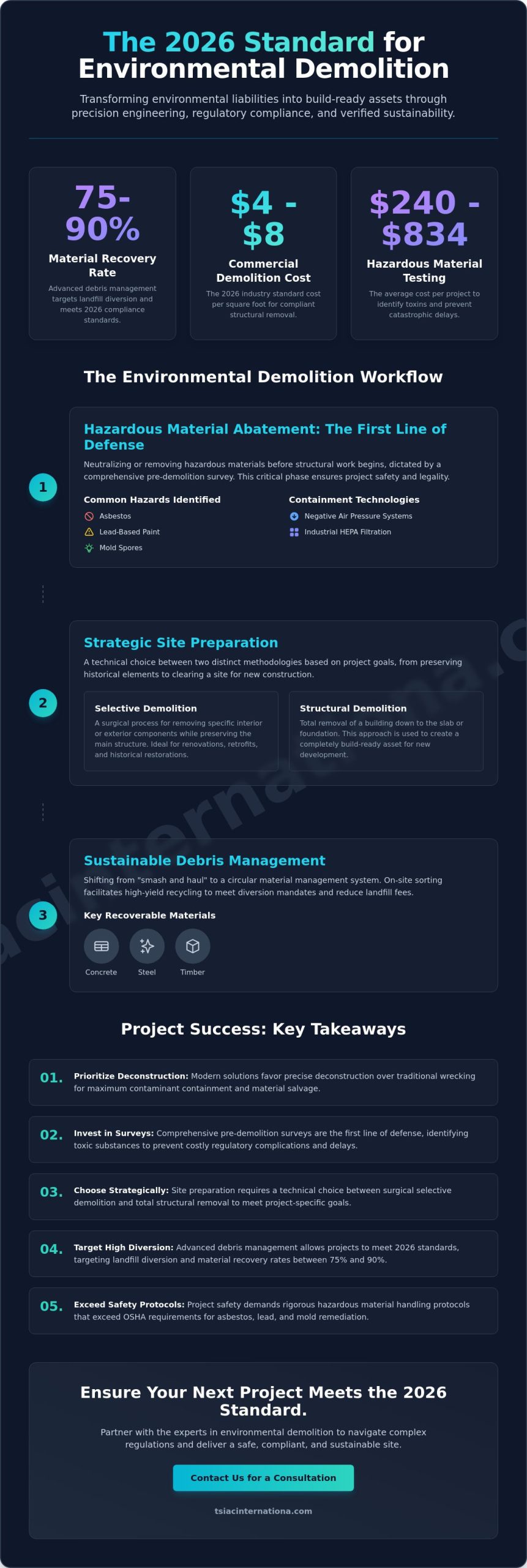
In 2026, the Recycling Certification Institute reports that third-party verification has become the essential defense against falsified recovery data in the construction sector. You know that clearing a site involves far more than mechanical removal; it’s a disciplined engineering process where a single oversight in hazardous material testing, which now averages between $240 and $834 per project, can lead to catastrophic delays. Implementing comprehensive environmental demolition solutions is no longer a luxury but a regulatory necessity to avoid the heavy fines associated with EPA NESHAP violations. Even a minor project requires a ten working day notification period, regardless of whether asbestos is present, making professional oversight critical from day one.

We understand the pressure of rising landfill fees and the technical complexity of coordinating with agencies like the South Carolina Department of Environmental Services. This guide provides the roadmap you need to integrate hazardous material abatement and structural removal into a single, seamless workflow. You’ll learn how to achieve the 70% material recovery rates now required in many jurisdictions while keeping commercial demolition costs within the 2026 industry standard of $4 to $8 per square foot. We’ll examine the specific steps to transform environmental liabilities into build-ready assets through precision engineering and verified sustainability practices.

Key Takeaways

  • Modern environmental demolition solutions prioritize precise deconstruction over traditional wrecking to ensure maximum contaminant containment and material salvage.
  • Comprehensive pre-demolition surveys serve as the first line of defense, identifying toxic substances to prevent regulatory complications and project delays.
  • Strategic site preparation requires a technical choice between surgical selective demolition for specific components and total structural removal down to the slab.
  • Advanced debris management allows projects to meet 2026 standards by targeting landfill diversion and material recovery rates between 75% and 90%.
  • Ensuring project safety involves rigorous hazardous material handling protocols that exceed OSHA requirements for asbestos, lead, and mold remediation.

What are Environmental Demolition Solutions?

Modern site preparation has evolved beyond the blunt force of traditional wrecking. Today, environmental demolition solutions represent a disciplined engineering methodology that prioritizes the systematic deconstruction of a structure. This approach focuses on two primary goals: the total containment of hazardous contaminants and the maximum salvage of architectural and structural materials. In 2026, the industry has moved decisively away from “smash and haul” tactics. Instead, we utilize a surgical process where every component is evaluated for its potential as a recovered asset rather than a waste product. This shift is driven by a combination of tighter federal oversight and the economic reality of rising landfill fees, which now push project managers to seek higher material recovery rates.

The technical framework of these solutions integrates several high-stakes services into a single, cohesive workflow. This includes structural demolition, interior gutting, and specialized asbestos abatement procedures that must be completed before any mechanical teardown begins. For projects seeking LEED certification, these solutions are no longer optional. The 2026 standards for sustainable building require detailed documentation of debris diversion. By choosing a partner that understands the engineering requirements of deconstruction, developers can ensure their site meets the rigorous 65% to 70% diversion mandates now common in major metropolitan regions.

The Core Objectives of Green Demolition

  • Contaminant Suppression: We utilize advanced dust suppression and negative air pressure systems to prevent the release of lead dust, asbestos fibers, or mold spores into the surrounding environment during the structural teardown.
  • Circular Material Management: On-site sorting protocols allow for the immediate separation of concrete, steel, and timber, facilitating the high-yield recycling rates required for modern compliance.
  • Regulatory Precision: Every phase of the project adheres to the 2026 EPA NESHAP requirements, including the mandatory 10 working day notification period and verified utility disconnects.

Industries Requiring Environmental Oversight

Commercial redevelopment in aging urban industrial sectors frequently encounters legacy contaminants that require expert handling. In these high-stakes environments, the discovery of undiscovered pollutants can halt a project indefinitely without a pre-planned abatement strategy. Similarly, government facility decommissioning demands a level of transparency and safety that exceeds standard construction practices. We often see these requirements in healthcare and educational campus renovations, where maintaining strict air quality standards is a non-negotiable condition of the contract. In these settings, environmental demolition solutions provide the necessary control to protect both the workers on-site and the public in adjacent buildings.

Hazardous Material Abatement: The First Line of Defense

Abatement is the process of neutralizing or removing hazardous materials before structural work begins. Within the framework of professional environmental demolition solutions, this phase dictates the safety and legality of the entire project. Success begins with a comprehensive pre-demolition survey. These surveys are not merely a formality; they’re an engineering necessity to identify toxic substances that visual inspections often miss. In 2026, the cost for hazardous material testing typically ranges from $240 to $834, an investment that prevents the far greater expense of project shutdowns or regulatory fines from the EPA or OSHA.

Modern containment strategies rely on high-grade technical controls rather than simple barriers. We implement negative air pressure systems and industrial HEPA filtration to ensure that microscopic fibers and dust particles remain trapped within the work zone. This level of precision protects the integrity of the surrounding environment and the health of the crew. Beyond the physical removal, maintaining a rigorous regulatory “paper trail” is essential. This documentation tracks the chain of custody for all toxic debris, ensuring that materials are transported and disposed of at certified facilities. This transparent approach to Sustainable Debris Management ensures that your project remains fully compliant with federal oversight while meeting modern environmental goals.

Asbestos and Lead Remediation

Handling friable and non-friable asbestos in older structural frameworks requires specialized equipment and disciplined execution. Friable materials, which can be crumbled by hand, pose the highest risk of airborne contamination and demand the most stringent containment protocols. Similarly, lead-based paint stabilization is a critical requirement for historic or industrial buildings scheduled for renovation. Our teams manage these hazards by following the strict protocols outlined in our asbestos removal South Carolina guide, which details the 2026 safety and regulatory standards for the region. Ensuring these materials are removed correctly at the start prevents the cross-contamination of recyclable structural components like steel and concrete.

Mold and Biological Contaminant Removal

Water-damaged properties often harbor structural rot and extensive mold infestations that compromise the safety of the site. We address these biological contaminants through a combination of chemical treatment and the physical removal of porous building materials. This process is vital for ensuring the site is safe for follow-on construction crews who will eventually occupy the space. By integrating mold remediation with the broader demolition plan, we eliminate the need for multiple contractors and reduce the risk of undiscovered contaminants causing delays later in the build. If you’re managing a complex site clearing project, you can consult with our abatement specialists to develop a unified plan that addresses these environmental risks before they impact your schedule.

Environmental Demolition Solutions: The 2026 Guide to Sustainable Site Clearing

Selective vs. Structural Demolition: Strategic Site Preparation

Choosing between structural and selective demolition is a technical decision that determines the project’s environmental footprint and the feasibility of adaptive reuse. Structural demolition involves the total removal of a building down to the slab or foundation. This method is typically reserved for sites where the existing framework is no longer viable or where soil remediation is required. In contrast, selective demolition is a surgical approach designed to remove specific interior or exterior components while preserving the primary building envelope. By utilizing advanced environmental demolition solutions, we can execute these tasks with a level of precision that minimizes vibration and dust, protecting the structural integrity of the elements slated for retention.

The choice of equipment reflects this strategic divide. Total structural teardowns utilize heavy machinery like high-reach excavators equipped with hydraulic shears and pulverizers to manage large-scale material processing. Selective work, however, often relies on robotic breakers, floor scrapers, and hand-tools to ensure that only the targeted materials are disturbed. This meticulous separation at the source is a core tenet of the National Demolition Association standards, which emphasize safety and material recovery. By controlling the demolition environment at this granular level, we prevent the cross-contamination of clean debris with hazardous residues, facilitating a more efficient recycling process.

Interior Gutting for Commercial Renovations

Commercial renovations frequently require stripping interiors to the studs to accommodate new mechanical, electrical, and plumbing systems. This process involves the systematic removal of acoustic ceilings, drywall, and flooring. These materials often have high recycling potential if they’re removed without contamination. Our teams focus on preserving the building’s exterior shell while clearing the interior for a fresh start. You can explore our detailed methodology for these projects in our commercial interior gutting services resource. This strategic approach ensures that the building remains structurally sound while meeting the 70% material recovery goals common in 2026 redevelopment projects.

Total Structural Removal and Site Remediation

A total teardown follows a strict engineering sequence from the roof down to the foundation to ensure site stability. Once the primary structure is removed, the focus shifts to slab and concrete removal, which is essential for future development. This phase often uncovers legacy issues such as underground storage tanks (USTs) or soil contamination that weren’t identified in initial surveys. Addressing these environmental liabilities immediately is critical. Integrated environmental demolition solutions allow us to manage these discoveries without halting the project. We treat soil remediation and tank removal as part of the total site clearing process, delivering a clean, build-ready site that’s free of environmental encumbrances.

Sustainable Debris Management and Material Recycling

The 2026 industry benchmark for excellence in site clearing has moved beyond simple compliance toward a circular economy model. While regional regulations often mandate a 65% to 70% diversion rate, high-performing environmental demolition solutions now aim for 75% to 90% material recovery. Achieving these figures requires a shift in perspective; we no longer view a structure as a pile of waste, but as a collection of industrial assets. This transition is supported by advanced weighing technology and X-ray analysis that replace visual estimates with verifiable data, ensuring that every ton of recovered material is accounted for in the final sustainability report.

Engineering-led debris management relies heavily on on-site sorting protocols. By separating materials at the point of origin, we prevent the cross-contamination that often occurs at off-site commingled processing facilities. This precision not only maximizes the purity of the recycling stream but also offers direct economic benefits by significantly reducing hauling fees and generating revenue through the sale of scrap assets. Systematically recycling metal and wood components reduces the carbon footprint of new construction by eliminating the energy-intensive processes required to extract and manufacture virgin building materials. If you are looking to optimize your project’s recovery rates, you can partner with our recycling logistics experts to design a custom waste diversion plan.

Recovering High-Value Materials

The financial viability of a deconstruction project often hinges on the efficient recovery of ferrous and non-ferrous metals. Copper, structural steel, and aluminum represent significant recovered value that can offset the total cost of demolition. Beyond metals, we process concrete and masonry on-site using mobile crushers, transforming structural debris into high-quality fill or road base for subsequent construction phases. For historic or high-end commercial properties, we also prioritize the salvage of architectural elements and large-scale timber. These materials are diverted to secondary markets, preserving their value and keeping them out of the waste stream entirely.

The Lifecycle of Demolition Waste

Modern industrial reuse programs have expanded the range of what we consider “recyclable.” Drywall and specific plastics are now routinely processed for use in new gypsum products or industrial manufacturing. However, not all materials can be salvaged; hazardous residues or mixed-media components require transport to certified disposal facilities. Maintaining a strict chain of custody for these items is non-negotiable for project compliance. You can review our detailed breakdown of the demolition process in South Carolina to see how these material handling protocols are integrated into complex site clearing schedules. This level of transparency ensures that every project meets both environmental goals and legal requirements.

National Excellence in Environmental Demolition: The TSIAC Standard

With over 15 years of operational experience in high-stakes structural and environmental projects, TSIAC International has established a reputation for engineering precision that few can match. We don’t just clear sites; we manage the complex intersection of structural integrity and environmental safety. Our approach to environmental demolition solutions is rooted in the belief that every project, regardless of its difficulty, deserves a partner that prioritizes long-term reliability over short-term shortcuts. This commitment is evident in our work on “impossible” sites where technical constraints or severe legacy contamination have caused other contractors to hesitate.

Safety at TSIAC International is a core value rather than a compliance checkbox. Our internal protocols frequently exceed OSHA’s 29 CFR 1926 Subpart T standards for hazardous material handling. By maintaining such rigorous control over our work sites, we provide our clients with the ultimate insurance against environmental liability. In an era where regulatory fines for improper disposal can cripple a development budget, having a professional partner who understands the 2026 EPA NESHAP requirements is a strategic necessity. We handle the technical and legal complexities so you can focus on the future of your build-ready site.

Comprehensive Project Management

We believe that transparency is the foundation of a successful partnership. That’s why we utilize fixed-price contracts and provide detailed debris management reporting for every phase of the project. Whether your site requires delicate interior gutting or large-scale lead abatement, we manage every service under one roof. This integrated model eliminates the communication gaps that often occur when multiple contractors are involved. You can explore our history of TSIAC International Charleston projects to see how our national quality standards are applied to diverse and challenging environments.

Ready to Start Your Project?

Preparing your team for a demolition and abatement timeline requires early coordination and a clear understanding of site-specific risks. The first step is a comprehensive site assessment and environmental survey to identify any legacy contaminants that could impact your schedule. Contact TSIAC International today to request a consultation with our engineering team. We’ll help you develop a national-standard demolition solution that ensures your project is completed safely, on time, and in full compliance with all 2026 environmental regulations.

Securing Your Site’s Future through Precision Engineering

The evolution of site clearing in 2026 demands a shift from simple destruction to disciplined deconstruction. You’ve seen how integrating hazardous material abatement with structural removal creates a seamless workflow. This process protects your project from initial testing fees turning into much larger regulatory fines or project delays. By prioritizing environmental demolition solutions, you ensure that your site meets the 70% recycling mandates required in major hubs while transforming potential liabilities into recovered assets. This technical precision is what separates a standard teardown from a build-ready foundation.

Managing high-stakes projects requires a partner who understands the engineering behind complex selective removals and hazardous material containment. With 15+ years of industry experience, TSIAC International delivers OSHA and EPA compliant workflows that exceed federal safety standards. Our specialists in high-stakes hazardous material abatement are ready to handle your most challenging sites. Request a Consultation for Your National Environmental Demolition Project today to ensure your next development starts on a clean, compliant, and sustainable foundation. We’re ready to help you clear the path for your next major construction milestone.

Frequently Asked Questions

What is the difference between traditional demolition and environmental demolition?

Traditional demolition focuses on rapid structural removal; however, environmental demolition solutions prioritize the containment of hazardous materials and the systematic salvage of building components. We use a deconstruction methodology that separates clean debris from contaminants at the source. This disciplined approach ensures the site remains compliant with 2026 EPA standards while maximizing the recovery of structural assets such as steel, concrete, and timber.

How do environmental demolition solutions handle asbestos and lead paint?

We handle these materials through a multi-stage process that begins with a mandatory pre-demolition survey to identify the exact location of toxins. Once identified, we implement negative air pressure and HEPA filtration to trap fibers and dust within the work zone. All removed materials are then tracked through a documented chain of custody to ensure legal disposal at certified facilities.

Can I stay in a building while selective environmental demolition is occurring?

No, occupants generally shouldn’t remain in the building during structural or selective environmental work due to the risk of airborne contaminants. While we use advanced containment systems, safety protocols usually require the total isolation of the work area to protect public health. We coordinate schedules to minimize downtime; however, the work zone must remain restricted until final air clearance testing is complete.

What percentage of demolition debris can actually be recycled in 2026?

In 2026, high-performing projects can recycle between 75% and 90% of demolition debris through disciplined on-site sorting and processing. For instance, Los Angeles County has increased its recycling requirement to 70% for mixed debris and 100% for soil as of August 2024. These recovery rates are now frequently verified by third-party organizations like the Recycling Certification Institute to ensure transparency and meet sustainability goals.

Are environmental demolition services significantly more expensive?

Upfront costs for environmental services include testing fees ranging from $240 to $834, but they often save money by preventing regulatory fines and project delays. Traditional “wrecking” can lead to undiscovered contaminants that halt construction and increase landfill fees. By recovering high-value scrap and avoiding legal liabilities, environmental demolition solutions provide a more predictable total project cost.

What certifications should I look for in an environmental demolition contractor?

Look for contractors who maintain RCI verification and strictly adhere to OSHA 29 CFR 1926 Subpart T safety standards for demolition. It’s also vital that they follow the EPA NESHAP notification requirements and hold specific state permits, such as those from the South Carolina Department of Environmental Services. These certifications provide a guarantee that the contractor possesses the technical expertise to handle complex abatement and structural removal safely.

How long does the environmental abatement process typically take?

The timeline begins with a mandatory 10 working day notification period required by the EPA before any structural demolition or abatement work commences. The duration of the physical removal process depends on the building’s size and the volume of hazardous materials identified during the pre-demolition survey. Most commercial interior gutting projects with integrated abatement take between two and six weeks to reach a build-ready state.

What happens to the hazardous waste once it is removed from the site?

Hazardous waste is transported in sealed, labeled containers to specialized, EPA-approved disposal facilities equipped to handle toxic substances safely. Every shipment is accompanied by a formal waste manifest that documents the material’s journey from your site to the final disposal point. This rigorous “paper trail” is essential for maintaining your project’s legal defense and ensuring long-term environmental compliance.

Commercial Interior Gutting Services: A Strategic Guide to Interior Demolition

According to a 2023 industry report, 45% of commercial renovation delays stem directly from unforeseen hazardous materials discovered during the…

According to a 2023 industry report, 45% of commercial renovation delays stem directly from unforeseen hazardous materials discovered during the initial teardown. You’re likely aware that a renovation project is only as stable as the structural shell it’s built upon. It’s a common concern that hidden asbestos or structural instabilities will threaten your timeline and budget. You need a disciplined approach that treats demolition as a precise engineering task. We understand the pressure of maintaining a clean site while ensuring every square foot meets rigorous safety standards.

This guide helps you master the technical complexities of commercial interior gutting services to ensure your next project starts on a solid foundation. You’ll learn how to manage the critical path from hazardous material abatement to structural shell preparation without compromising the surrounding building areas. We’ll examine the protocols for full EPA and OSHA compliance, the logistics of massive debris management, and the specific methods used to protect the integrity of your property. This overview provides the strategic roadmap for delivering a construction-ready space that meets every regulatory and technical requirement with engineering precision.

Key Takeaways

  • Learn how to effectively strip a building down to its structural shell by identifying the specific scope of work required for non-load-bearing elements and MEP systems.
  • Master the technical distinctions between selective and structural demolition to ensure building stability through proper shoring and bracing techniques.
  • Discover why integrating hazardous material surveys into your timeline is the essential first step in professional commercial interior gutting services.
  • Follow a disciplined 5-step engineering survey and utility “safe-off” process to mitigate risks and maintain total control over complex renovation environments.
  • Identify the strategic advantages of partnering with a single-source contractor who manages both high-risk remediation and large-scale structural removal.

What Are Commercial Interior Gutting Services?

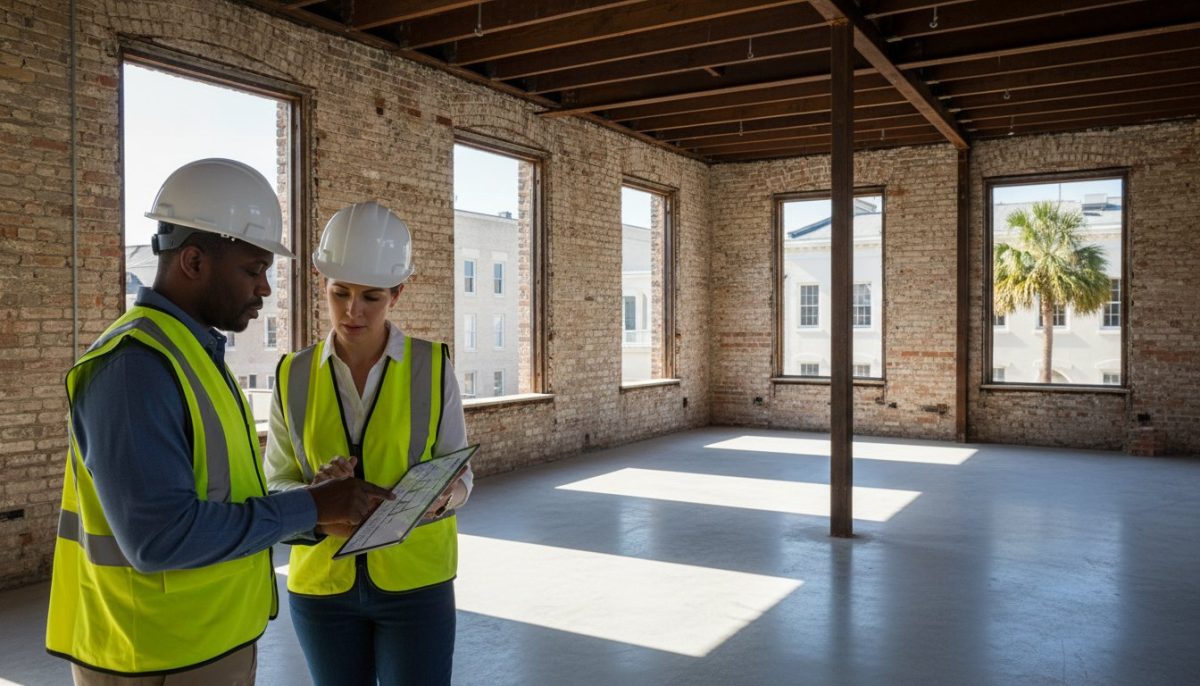
Commercial interior gutting services represent the systematic deconstruction of a building’s interior down to its structural shell or metal studs. This isn’t a “wrecking ball” approach. It’s a controlled engineering process. The procedure strips away everything that isn’t essential to the building’s structural integrity. This includes non-load-bearing walls, flooring, and comprehensive MEP (mechanical, electrical, plumbing) systems. While “soft demolition” might only remove surface-level finishes like carpets and furniture, a full gut-out prepares the facility for a total transformation.

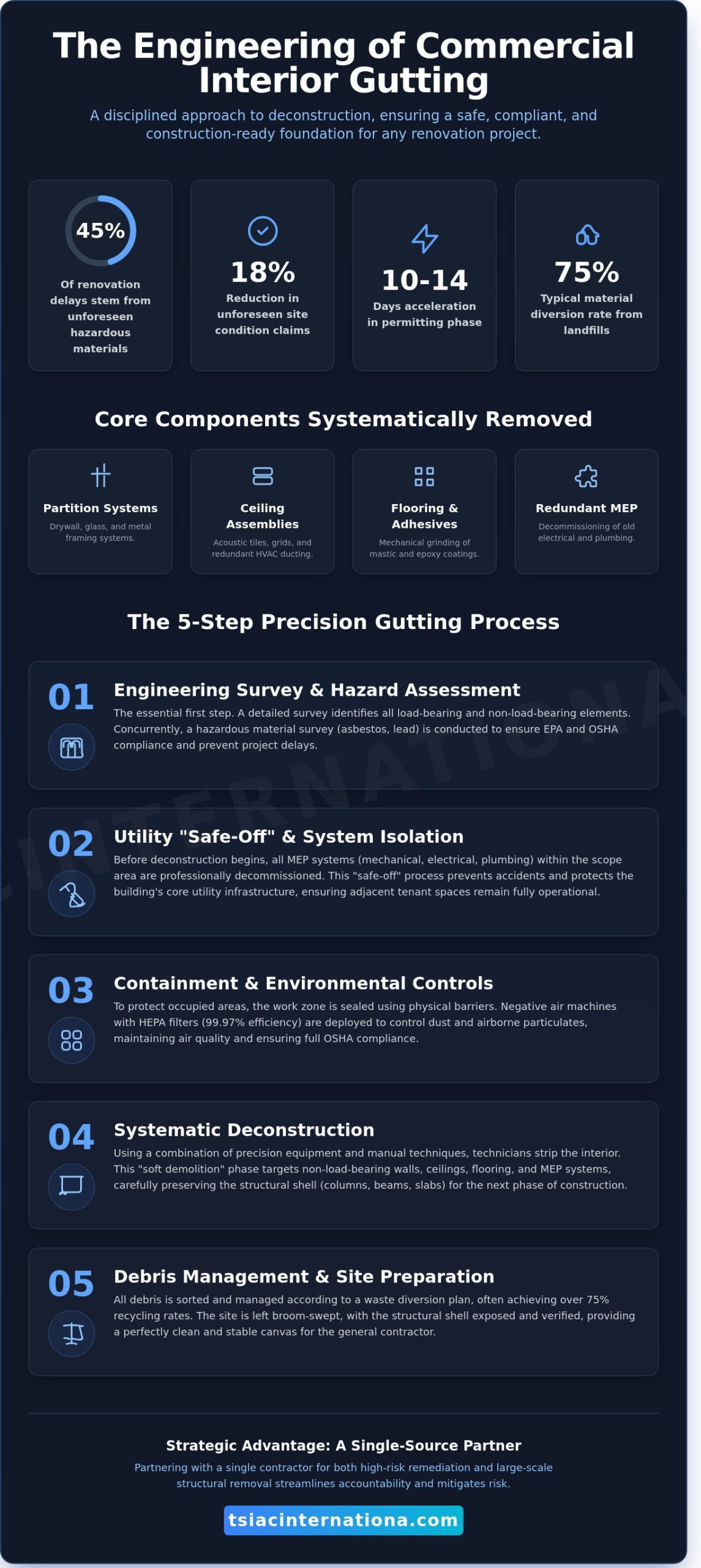
Professional gutting serves as the foundational phase for tenant improvements. By removing redundant infrastructure, contractors eliminate the risks of “discovery” mid-construction. In 2023, data from industrial renovation projects showed that a clean gut-out can reduce unforeseen site condition claims by 18%. It’s about precision and logistics. Every load-bearing column and structural slab must be exposed to ensure the next phase of construction proceeds on a stable, verified base.

The Role of Gutting in Modern Renovations

A thorough gut-out provides architects and MEP engineers with a blank canvas. It’s impossible to design high-efficiency HVAC systems or complex lighting grids when old ductwork obscures the ceiling plenum. Exposing the structural framework allows for immediate inspections. This transparency often accelerates the permitting phase by 10 to 14 days. When the structural slab and columns are visible, engineers can verify load capacities without invasive testing during the build-out. This proactive approach directly reduces downstream construction costs by preventing layout conflicts before they occur on-site.

Core Components Removed During an Interior Gut

The scope of work for commercial interior gutting services is comprehensive. Technicians handle the removal of complex systems that require specialized handling and disposal protocols, especially in restricted-access environments. Key components include:

  • Partition Systems: Removal of drywall, glass partitions, and heavy-gauge metal framing systems.
  • Ceiling Assemblies: Stripping acoustic ceiling tiles (ACT), grid systems, and redundant HVAC ducting.
  • Flooring and Adhesives: Mechanical grinding of thin-set, mastic, and epoxy coatings from concrete slabs to ensure a level surface.
  • Redundant MEP: Decommissioning and removal of outdated electrical conduits, plumbing lines, and fire suppression pipes.

Every phase follows strict safety standards. We prioritize the recovery of recyclable materials, often achieving a 75% diversion rate from landfills on standard office gut-outs. This level of discipline ensures the site is safe, clean, and ready for the incoming trades to begin work immediately.

Technical Distinctions: Selective vs. Structural Gutting

Distinguishing between architectural finishes and structural skeletons requires a precise engineering survey before any work begins. Professional commercial interior gutting services focus on the surgical removal of non-load-bearing partitions, floor coverings, and MEP systems without compromising the building’s primary frame. Engineers must identify walls that provide lateral stability; removing these without proper reinforcement can lead to structural deflection exceeding 0.125 inches.

Shoring and bracing are critical when the demolition plan intersects with the building’s core. We utilize 20-ton hydraulic jacks and steel needle beams to manage load transfers during complex strip-outs. This technical approach protects shared building systems, such as 4-inch wet-pipe fire suppression lines and main plumbing stacks. Keeping 95% of a building’s utility core functional requires physical barriers and isolation valves, ensuring that the gut-out doesn’t disrupt the entire facility’s operations.

Selective Demolition for Occupied Buildings

Working in multi-tenant facilities requires strict adherence to noise and vibration protocols. Most high-impact work occurs between 10 PM and 6 AM to minimize tenant disruption. To manage environmental risks, we deploy negative air machines equipped with HEPA filters that maintain 99.97% filtration efficiency. Every project maintains 100% compliance with OSHA 1926.850, ensuring that egress routes and life safety systems remain unobstructed for all occupants. For projects requiring this level of technical oversight, it’s best to consult with specialists in complex execution to ensure site safety.

Precision Equipment and Heavy Machinery

Modern commercial interior gutting services rely on specialized tools to balance speed with safety. Selecting the right method depends on the specific floor load capacity and the proximity of sensitive neighbors.

  • Robotic Demolition: Units like the Brokk 110 allow for high-torque crushing in confined areas where exhaust-emitting machinery isn’t feasible. These units exert 80% more force than manual labor while keeping operators at a safe distance.
  • Manual vs. Mechanical: Manual methods are reserved for delicate perimeter work or historical preservation. Mechanical excavators are deployed when we need to clear over 5,000 square feet per shift.
  • Floor Load Management: Equipment weight is strictly monitored to ensure it stays below 150 lbs per square foot, preventing structural damage to standard office floor slabs.

Commercial Interior Gutting Services: A Strategic Guide to Interior Demolition

Managing Hidden Risks: Asbestos, Lead, and Hazard Abatement

Before the first wall falls, a rigorous Discovery Phase must occur. Professional commercial interior gutting services prioritize a comprehensive hazardous material survey to identify silent threats. Skipping this step isn’t just a safety oversight; it’s a financial liability. According to EPA estimates, buildings constructed before 1980 have a 70% probability of containing asbestos in floor tiles, mastic, or pipe insulation. We identify these materials through bulk sampling and polarized light microscopy before any structural interference begins.

Integrating abatement into the master schedule prevents cascading delays. A 10,000 square foot floor plate might require 14 days for specialized removal before standard demolition can resume. Failure to follow these protocols results in fines exceeding $37,500 per violation under OSHA 29 CFR 1926 standards. Proper commercial interior gutting services ensure that hazardous waste disposal follows a chain of custody that protects the property owner from future litigation and environmental penalties.

Asbestos Abatement During Interior Gutting

Technicians must distinguish between friable materials, like spray-applied fireproofing, and non-friable materials like vinyl-asbestos tile. Friable materials pose the highest risk because they release fibers into the air with minimal contact. We utilize negative pressure enclosures equipped with HEPA filtration units that cycle the air 6 times per hour. Once removal is complete, an independent laboratory performs Phase Contrast Microscopy testing. The space only reopens when fiber counts drop below 0.01 fibers per cubic centimeter, ensuring the site is safe for the next phase of construction.

Lead Paint and Mold Remediation

Commercial properties built before 1978 frequently contain lead-based paint on structural steel and metal framing. Cutting or grinding these components requires specialized HEPA-shrouded tools to capture toxic dust at the source. Gut-outs often reveal hidden mold growth in 15% of aging HVAC systems or behind water-damaged drywall. We address these biological hazards using antimicrobial treatments and detailed moisture mapping to prevent regrowth. Every project concludes with a comprehensive hazardous material manifest, providing the legal documentation necessary for project closeout and future property transfers.

The 5-Step Commercial Gutting Process

Execution of professional commercial interior gutting services requires a disciplined, engineering-led approach. It’s not about brute force; it’s about a controlled sequence that protects the building’s structural integrity and ensures the safety of every person on-site. We follow a rigorous five-step protocol to manage the complexities of modern commercial environments.

  • Site Evaluation and Engineering Survey: Before a single wall is touched, we conduct a thorough survey to identify load-bearing columns, shear walls, and structural slabs. This phase prevents accidental damage to the building’s primary support system.
  • Utility Disconnection and Safe-Off: We coordinate directly with MEP (Mechanical, Electrical, Plumbing) contractors to isolate power, water, and gas lines. This step includes strict Lock-Out/Tag-Out (LOTO) procedures to eliminate the risk of arc flashes or floods.
  • Hazardous Material Remediation: If a structure was built before 1978, the risk of lead-based paint or asbestos in floor tiles and pipe insulation is high. We neutralize these risks through certified abatement processes before general demolition begins.
  • Systematic Dismantling: Our teams work from the top-to-bottom and from the interior core outward. We remove non-structural partitions, drop ceilings, and built-in fixtures in a logical order to maintain clear egress routes.
  • Material Recovery and Debris Management: We don’t just haul waste. We sort materials at the source to ensure efficient disposal and maximize the recovery of high-value scrap.

Material Recycling and Environmental Stewardship

Modern demolition demands a commitment to sustainability. By sorting wood, ferrous metals, and gypsum at the source, we often divert over 75% of non-hazardous waste from landfills. This strategy isn’t just ethical; it’s financially sound, as it can reduce project tipping fees by 20% to 30%. For projects seeking green building status, we provide detailed, LEED-compliant recycling reports that document every ton of material processed.

Site Preparation for the Next Trade

The job isn’t finished until the site is ready for the next phase of construction. We deliver a “broom-clean” environment that exceeds standard industry expectations. This includes concrete slab preparation where we use specialized grinders to remove old adhesives, thin-set, or mastic, ensuring a 1/8-inch flatness tolerance for new flooring. Our handover protocol involves a joint walk-through with the incoming general contractor, such as a full-service firm like JBM Custom Contracting, to verify that all MEP points are accessible and the space is ready for immediate framing.

Partner with a team that prioritizes engineering precision by choosing our professional interior demolition solutions for your next project.

Choosing a National Commercial Demolition Partner

Selecting a contractor for commercial interior gutting services requires more than a review of equipment lists. It demands a rigorous assessment of engineering depth and liability management. A single-source provider that handles both the structural strip-out and hazardous material abatement eliminates the friction between separate vendors. This integration typically reduces project timelines by 18% because scheduling conflicts between demolition crews and environmental specialists disappear. When one firm manages the entire interior lifecycle, the transition from abatement to structural removal is seamless and cost-effective.

Experience and Technical Expertise

TSIAC International brings 17 years of specialized experience to every job site. We specialize in “impossible” locations. These include high-density urban centers or active hospital environments where vibration and dust control are non-negotiable. Our teams have completed over 520 large-scale interior transformations across 28 states. We don’t just pull down walls. We analyze load-bearing capacities and MEP (mechanical, electrical, plumbing) intersections to ensure the building’s core remains intact. Our precision allows for the preservation of historical facades while the interior is completely modernized.

  • 17+ years of experience in structural and selective demolition across the U.S.
  • Proven track record in high-rise and restricted-access urban environments.
  • Technical proficiency in separating structural elements from non-load-bearing partitions.
  • Strategic regional presence to ensure rapid mobilization for national accounts.

Commitment to Safety and Compliance

Safety is our primary operational metric. We maintain a Total Recordable Incident Rate (TRIR) of 0.85, which is significantly lower than the 2023 industry average. Every crew member undergoes 40-hour HAZWOPER training and mandatory quarterly safety audits to ensure adherence to strict OSHA and EPA standards. High-stakes commercial projects require robust financial backing. We carry comprehensive insurance packages, including a $10 million umbrella policy, to protect our partners from site complexities. Detailed documentation and EPA-compliant waste tracking are standard for every project we touch. If you’re planning a complex renovation, contact TSIAC International today for a comprehensive project estimate.

Secure a Precision Foundation for Your Next Build

Executing a successful renovation starts with a technical understanding of how selective and structural demolition impacts your building’s integrity. You’ve learned that managing hidden hazards like asbestos and lead requires more than just caution; it requires EPA-certified abatement protocols to eliminate liability. A structured 5-step process ensures that every phase of your commercial interior gutting services stays on schedule while prioritizing a comprehensive material recycling program to reduce environmental impact.

TSIA C International leverages 15+ years of industry experience to handle the most complex interior challenges with engineering precision. We don’t just clear space. We provide a controlled, safe environment ready for immediate reconstruction. Our team excels at managing difficult job sites where technical accuracy is the only way to protect your investment. We’ve built our reputation on the fact that we don’t shy away from specialized requirements or impossible locations.

Take the first step toward a seamless project delivery. Request a Professional Interior Gutting Quote and let’s discuss your specific site requirements. We’re ready to turn your complex demolition needs into a clean slate for growth.

Frequently Asked Questions

What is the difference between interior demolition and gutting?

Interior demolition refers to the selective removal of specific building elements, while gutting involves stripping a space down to its structural members. Commercial interior gutting services remove everything including drywall, flooring, ceilings, and mechanical systems to leave only the concrete or steel shell. This process provides a 100% clean slate for new architectural layouts and updated infrastructure.

How much does commercial interior gutting cost per square foot?

Commercial gutting costs typically range from $4.00 to $12.00 per square foot based on the complexity of the materials and site accessibility. A standard 5,000 square foot office space usually averages $7.50 per square foot for total interior removal. Costs can increase by 20% if the project requires hand-demolition in sensitive areas or specialized equipment for high-rise logistics.

How long does a typical 10,000 square foot office gut-out take?

A 10,000 square foot office gut-out generally takes between 10 and 15 business days to reach completion. This timeframe includes the initial mobilization, utility safing, material removal, and a final HEPA-filtered cleaning. If the building has limited freight elevator access, the schedule might extend by 3 days to accommodate slower debris removal cycles.

Do I need a permit for interior demolition if I am not touching load-bearing walls?

You’ll almost always need a permit because gutting impacts fire suppression systems, electrical grids, and emergency egress routes. Even if structural integrity isn’t at risk, 95% of municipal building departments require a demolition permit to ensure the work follows safety codes. Operating without one can lead to fines exceeding $2,500 and an immediate cessation of all site activities.

What happens if asbestos is found during the gutting process?

Work stops immediately within a 30 foot radius of the suspect material to prevent any potential fiber contamination. We seal the area and bring in a third-party environmental consultant to perform laboratory testing within 24 hours. Professional commercial interior gutting services then coordinate with certified abatement specialists to remove the hazardous material under negative pressure before any demolition resumes.

Can interior gutting be performed while other parts of the building are occupied?

We perform gutting in occupied buildings by using temporary sound-attenuation barriers and negative air machines to contain 99% of dust. High-impact noise activities are scheduled during off-peak hours, typically from 7:00 PM to 6:00 AM, to minimize disruption to adjacent tenants. This disciplined approach ensures that 100% of the building’s business operations continue without technical interference.

How is demolition debris managed and recycled?

We sort debris on-site into specific streams for metal, concrete, wood, and general waste to maximize recovery rates. Our process typically diverts 75% of all materials from landfills by transporting them to specialized industrial recycling centers. Clients receive a detailed waste manifest at the end of the project documenting the exact tonnage of recycled materials for their sustainability records.

What utilities need to be disconnected before gutting begins?

Electrical, plumbing, gas, and HVAC systems must be professionally capped and “safed off” by licensed tradespeople before our crews start. A licensed electrician must verify that there’s 0% live power in the demolition zone to prevent accidental electrocution or fire. We cross-reference the mechanical blueprints with physical site conditions to ensure every utility line is accounted for before the first wall comes down.

Commercial Demolition Services in Myrtle Beach: The 2026 Expert Guide

According to SCDHEC’s 2025 regulatory summary, approximately 38% of coastal redevelopment projects in Horry County suffer from timeline overruns due…

According to SCDHEC’s 2025 regulatory summary, approximately 38% of coastal redevelopment projects in Horry County suffer from timeline overruns due to inadequate hazardous material abatement planning. When you’re coordinating commercial demolition services myrtle beach, these delays don’t just cost money; they threaten the viability of the entire build. You already know that the narrow 120-day window between the summer tourism surges leaves no room for permitting errors or site contamination surprises. It’s a high-stakes environment where precision is the only guarantee of success.

This 2026 expert guide provides the technical roadmap you need to maintain total control over these complex variables. You’ll learn how to execute a site clearing plan that meets every SCDHEC mandate while maximizing your LEED points through 90% material recovery. We’ll detail the specific protocols for asbestos and lead removal, the logistics of structural dismantling in high-density corridors, and the precise steps required to transition your site safely to the next phase of development.

Key Takeaways

  • Understand the technical complexities of the Grand Strand’s unique coastal landscape and how they influence structural removal strategies.
  • Learn the systematic procedures for commercial interior gut-outs, including the precise management of utility disconnects and safety shut-offs.
  • Identify critical compliance standards for asbestos and lead abatement to meet mandatory SCDHEC survey and notification requirements.
  • Navigate the local regulatory environment and the essential 10-day notification rule when hiring professional commercial demolition services myrtle beach.
  • Discover how 15 years of specialized engineering experience allows for the successful execution of complex projects in high-stakes environments.

Understanding Commercial Demolition Services in Myrtle Beach for 2026

Commercial demolition isn’t a blunt instrument; it’s a calculated phase of civil engineering. In 2026, commercial demolition services myrtle beach providers must balance the rapid expansion of the Grand Strand with the logistical constraints of a high-density coastal environment. This requires more than heavy machinery. It demands a sophisticated understanding of load-bearing structures and proximity risks. The science and engineering of demolition has advanced significantly, moving away from high-impact methods toward controlled deconstruction.

For 2026, site clearing utilizes real-time seismic monitoring and drone-based volumetric analysis. These tools allow us to predict debris weight and transport logistics with 98% accuracy. This level of precision is vital when working near sensitive dunes or crowded tourist corridors where collateral vibration must be kept under 0.5 inches per second to protect adjacent foundations. We don’t just clear land; we prepare a stable foundation for the next generation of coastal architecture. The unique landscape of the Grand Strand, with its high water table and sandy soil composition, means that every structural removal must account for ground stability and potential erosion.

Structural vs. Selective Demolition

Structural removal involves the complete elimination of a building’s footprint, often required for the 12% of older Grand Strand properties that no longer meet 2026 hurricane resistance codes. Selective demolition focuses on preserving the external envelope while removing internal components. This supports adaptive reuse, a growing trend in 2026 for repurposing mid-century warehouses into modern office hubs. Interior gut-outs specifically target tenant improvements, stripping spaces to their structural core to facilitate new electrical and HVAC integrations. These methods ensure that 90% of concrete and steel can be recycled, meeting the strict sustainability benchmarks set for 2026 developments.

The Economic Impact of Proper Site Preparation

Choosing professional commercial demolition services myrtle beach directly impacts the bottom line. Efficient site clearing can reduce the overall construction timeline by 18 days on average. While low-bid contractors might seem attractive, they often lack the specialized insurance or tech-forward equipment needed for 2026 projects, leading to an average 22% increase in hidden costs due to project delays or environmental fines. A clean, professionally prepared site ensures higher property valuations and smoother permit transitions for future developers.

  • Timeline Acceleration: Professional crews use 3D site mapping to identify underground utilities, preventing 95% of common strike-related delays.
  • Risk Mitigation: High-tier contractors carry comprehensive liability coverage that protects the owner from the financial fallout of structural accidents.
  • Value Retention: Documented soil compaction and site cleanliness reports from the demolition phase increase initial appraisal values by roughly 6%.

By investing in high-tier site prep, developers see a 5% to 7% increase in the speed of subsequent vertical construction phases. The focus in 2026 is on a “zero-waste” philosophy where the demolition contractor acts as a resource manager. This disciplined approach ensures that the project starts on a foundation of safety and fiscal responsibility, which is essential for the high-stakes commercial market in Myrtle Beach.

The Anatomy of a Commercial Interior Gut-Out

A commercial interior gut-out is a surgical procedure that strips a building down to its structural skeleton. This process is essential for property owners in Horry County who need to transition a retail space or office complex into a “white box” state for new tenants. Professional commercial demolition services myrtle beach prioritize a systematic approach that begins with a comprehensive site assessment. We identify load-bearing versus non-load-bearing elements to ensure the building’s integrity remains uncompromised. This phase involves the removal of everything from built-in cabinetry and interior partitions to heavy industrial equipment, all while adhering to the 2024 South Carolina Building Code standards.

Safety is the primary objective during the initial stages of a gut-out. Before any physical demolition begins, we manage the critical task of utility disconnects and safety shut-offs. This involves coordinating with local utility providers to verify that electrical, gas, and water lines are properly capped and tagged. Navigating Myrtle Beach permitting requirements is a mandatory step in this process; ensuring all inspections are documented prevents costly delays during the reconstruction phase. Our teams utilize lockout/tagout (LOTO) procedures to protect workers from accidental energy releases during the removal of complex Mechanical, Electrical, and Plumbing (MEP) systems.

Logistical planning is particularly challenging in high-traffic areas like Kings Highway or the Myrtle Beach Boardwalk. We deploy specialized debris management strategies to handle the 15 to 20 tons of material typically generated in a 5,000-square-foot retail gut-out. This includes:

  • Timed Haul-offs: Scheduling dumpster swaps outside of peak tourism hours to minimize traffic congestion.
  • Load Optimization: Compacting light debris to reduce the number of truck trips by 25%.
  • On-site Sorting: Separating hazardous materials, such as older ballasts or thermostats, from general construction waste.

Precision removal of MEP systems requires more than just heavy machinery. It demands an engineering mindset to trace lines back to their source without damaging shared infrastructure in multi-tenant buildings. If you are planning a complex renovation, you can consult with our technical team to review your site plans.

Acoustic Ceiling and Flooring Removal

Large-scale office and retail spaces often feature thousands of square feet of drop ceilings and glued-down flooring. We use ride-on floor scrapers that can remove 1,500 square feet of VCT or epoxy flooring per hour, significantly faster than manual methods. To protect indoor air quality, we employ HEPA-filtered air scrubbers that maintain a 99.97% filtration rate of airborne particulates. This is a standard we also apply to our Acoustic Ceiling Removal in Charleston Offices, ensuring a clean environment for subsequent trades.

Metal Framing and Drywall Disposal

Efficiency in metal framing removal involves stripping aluminum and steel studs systematically to preserve their scrap value. Our crews utilize hydraulic shears to quickly dismantle framing, which is then bundled for transport to local recycling facilities. In South Carolina, recycled metal studs typically re-enter the supply chain within 60 days of disposal, often supporting the state’s growing manufacturing sector. By diverting these materials from the landfill, we lower project disposal costs and support regional sustainability goals. This disciplined approach ensures that commercial demolition services myrtle beach remain both cost-effective and environmentally responsible.

Asbestos and Lead Abatement: The Grand Strand Compliance Standard

Safe execution of commercial demolition services myrtle beach starts with a comprehensive understanding of the environmental hazards embedded in the Grand Strand’s older building stock. Many structures built along the coast between 1950 and 1980 contain materials that, while durable against salt air, pose significant health risks during structural dismantling. Professionalism in this sector isn’t just about the power of the machinery; it’s about the precision of the containment strategy and adherence to South Carolina Department of Health and Environmental Control (SCDHEC) Regulation 61-86.1.

Before any physical demolition begins, a mandatory SCDHEC survey must be performed by a licensed inspector. This process identifies Regulated Asbestos-Containing Material (RACM) that could become friable. If the survey confirms more than 160 square feet or 260 linear feet of RACM, we must submit a formal notification to SCDHEC at least 10 working days before work starts. This waiting period is a non-negotiable legal requirement that ensures all oversight agencies are aware of the hazard mitigation plan. Our team manages this documentation to ensure the project timeline remains predictable and legally sound.

Effective abatement relies on advanced engineering controls to prevent the migration of toxic dust. We implement two primary containment strategies:

  • Negative Air Pressure: We use high-capacity air scrubbers to create a pressure differential, ensuring that air only flows into the work zone, never out.
  • HEPA Filtration: All exhausted air passes through High-Efficiency Particulate Air filters rated to capture 99.97% of particles as small as 0.3 microns.

Disposal is the final critical phase. Hazardous waste cannot simply be sent to a standard landfill. Every ounce of asbestos or lead-contaminated debris is tracked via a waste shipment record. This legal documentation provides a chain of custody from the job site to an EPA-approved disposal facility. Without these manifests, property owners face long-term liability risks and potential federal fines that can exceed $37,500 per violation per day.

The Risks of Asbestos in Commercial Renovations

Asbestos remains a hidden threat in Myrtle Beach commercial properties, often found in 9×9 floor tiles, thermal system insulation on boilers, and old bitumen roofing membranes. If you ignore these materials during a fast-tracked project, the legal and health consequences are devastating. Non-compliant removal often leads to immediate stop-work orders and litigation. For a detailed look at our specific mitigation steps, review our Asbestos Abatement Myrtle Beach Process to see how we handle these high-stakes environments.

Lead Paint Remediation for Historic and Older Assets

Lead-based paint was common in commercial applications until 1978, and many beachfront structures still carry layers of these toxic coatings. Our remediation process involves specialized chemical stripping or HEPA-shrouded vacuum blasting to remove lead without creating airborne plumes. We prioritize the safety of the surrounding environment, especially in high-traffic tourist zones. Once the removal is complete, we provide a lead-free certificate. This document is vital for future occupants and is often a prerequisite for securing new commercial insurance policies or construction permits for the replacement structure. Our approach ensures that the site is not just empty, but biologically safe for the next phase of development.

Selecting the right partner for commercial demolition services myrtle beach means choosing a team that treats environmental compliance as a core engineering discipline. We don’t cut corners because we know that in the demolition industry, the smallest oversight can lead to the largest catastrophe. Our reputation is built on the fact that we manage the invisible risks with the same intensity as the visible ones.

Commercial Demolition Services in Myrtle Beach: The 2026 Expert Guide

Myrtle Beach Permitting and Environmental Regulations

Executing commercial demolition services myrtle beach requires more than heavy machinery; it demands rigorous adherence to South Carolina’s stringent regulatory framework. Project managers must interface with both the City of Myrtle Beach Planning and Development Department and Horry County Code Enforcement, depending on the specific parcel’s jurisdiction. The process begins with the mandatory SCDHEC 10-day notification. Under Regulation 61-86.1, contractors must submit a notification form to the South Carolina Department of Health and Environmental Control at least 10 working days before any structural demolition begins. This rule applies even if an initial inspection suggests no asbestos is present. Skipping this step results in immediate project shutdowns and fines that often exceed $10,000 per violation.

Coastal zone management adds another layer of complexity to the Grand Strand. Because Myrtle Beach sits within the state’s defined coastal zone, projects within 1,000 feet of the Atlantic Ocean or tidal waters face oversight from the DHEC Bureau of Coastal Resource Management (OCRM). We implement specific erosion control measures, such as Type B silt fencing and inlet protection, to prevent sediment runoff into the storm drain system. Noise ordinances are equally strict, particularly in the Oceanfront Management District. Construction and demolition activities are generally restricted to the hours between 7:00 AM and 9:00 PM. During peak tourism seasons or special events, these windows might shrink further to protect the guest experience at nearby resorts.

Securing Your Demolition Permits

Obtaining a permit in the Grand Strand involves submitting a comprehensive package. You’ll need a detailed site plan, certified utility disconnect letters from providers like Santee Cooper or Grand Strand Water and Sewer, and a recent boundary survey. The typical approval timeline ranges from 14 to 21 business days. To streamline your project start, consult our Demolition Company Myrtle Beach Checklist for a full list of required documentation.

Sustainability and Recycling Targets

Modern commercial demolition services myrtle beach prioritize material recovery over landfill disposal. We target a 75% recovery rate for structural steel, copper wiring, and clean concrete. On-site sorting allows us to process wood and masonry separately, which we then haul to the Horry County Solid Waste Authority (HCSWA) facility on Highway 90. This approach doesn’t just protect the local environment; it’s a core requirement for projects seeking LEED certification. By crushing concrete on-site for use as stabilized sub-base material, we reduce truck traffic by 30% and significantly lower overall project costs. These technical efficiencies ensure that your site is cleared responsibly while maintaining the highest safety standards.

For a partner who manages every regulatory hurdle with engineering precision, contact our commercial demolition experts today.

TSIAC International: Leading Commercial Demolition in South Carolina

TSIAC International brings over 15 years of technical expertise to high-stakes environments where precision isn’t just a goal; it’s a requirement. We’ve built a reputation on managing complex projects that demand a single-source solution. This means we handle both the structural teardown and hazardous material abatement simultaneously. By integrating these services, we eliminate the coordination gaps that often delay large-scale developments. Our approach centers on engineering-grade precision and a strict commitment to environmental responsibility. We don’t just clear land. We prepare it for its next lifecycle with surgical accuracy and a zero-incident mindset.

Operating in the coastal environment requires a specialized understanding of local regulations and physical constraints. We provide commercial demolition services myrtle beach developers trust because we prioritize site-specific logistics. Our team manages the entire regulatory pipeline, from initial SCDHEC notifications to the final waste manifests. We’ve completed over 200 projects where environmental compliance was the primary hurdle. This experience allows us to navigate the complexities of asbestos, lead paint, and other hazardous materials without stalling the project timeline. We treat every site as a unique technical challenge that requires a customized mechanical strategy.

The TSIAC Advantage

Our crews undergo rigorous training in both total structural removal and selective demolition techniques. This versatility allows us to strip a 45,000-square-foot retail space down to its shell without compromising the integrity of adjacent structures. We maintain an advanced equipment fleet, including high-reach excavators and specialized crushing attachments, ensuring we scale to any project size. Every operation follows a 100% compliance record with OSHA and SCDHEC safety standards. Safety isn’t a checklist for us; it’s the foundation of our operational logic. We utilize vibration monitoring and advanced dust suppression to protect the surrounding community and infrastructure.

  • Specialized Crews: Experts in industrial alpinism and precision structural cutting for “impossible” locations.
  • Advanced Fleet: Tier 4 compliant machinery equipped with hydraulic shears and concrete pulverizers.
  • Compliance Leadership: Daily safety briefings and strict adherence to federal and state environmental laws.
  • Resource Recovery: We aim to recycle up to 85% of debris, including concrete, steel, and asphalt.

Getting Started with Your Myrtle Beach Project

We initiate every project with a comprehensive site walk-through to identify potential structural risks and abatement needs. This data-driven assessment leads to a fixed-price quote, providing developers with financial certainty. For those planning a 2026 project, early resource allocation is critical. We recommend securing your slot at least 6 months in advance to ensure equipment availability and permit approvals. Our team understands the 2026 development forecast for South Carolina and is ready to allocate the necessary manpower to meet aggressive deadlines. We don’t make vague promises; we deliver documented results.

Successful commercial demolition services myrtle beach rely on clear communication and technical transparency. Whether you’re reclaiming a beachfront lot or repurposing an aging industrial facility, we provide the heavy-duty solutions required for a clean start. Our project managers provide weekly progress reports and maintain an open line of communication with all stakeholders. This disciplined approach ensures that your site is ready for vertical construction exactly when the schedule demands it.

Contact TSIAC International for a Commercial Demolition Quote to discuss your specific project requirements and technical challenges.

Secure Your Grand Strand Development for 2026

Successful project execution in the Grand Strand requires a disciplined approach to site preparation and safety. As we move into 2026, navigating the complexities of local permitting and hazardous material abatement is a technical requirement for every property owner. It’s not just about removing structures; it’s about managing environmental liabilities according to strict SCDHEC and OSHA standards. Our team at TSIAC International brings 15+ years of industry experience to every site, ensuring your interior gut-out or structural removal is handled with engineering precision. We specialize in hazardous material abatement, managing asbestos and lead risks so your construction timeline remains intact. Choosing professional commercial demolition services myrtle beach means you’re prioritizing structural integrity and regulatory compliance from the first day of work. We don’t just clear space. We prepare your assets for their next phase of growth with a focus on durability and safety. Let’s ensure your next project starts on a clean, compliant foundation.

Request Your Fixed-Price Commercial Demolition Quote

Frequently Asked Questions

Do I need an asbestos survey before commercial demolition in Myrtle Beach?

Yes, South Carolina DHEC Regulation 61-86.1 mandates a thorough asbestos survey before any commercial demolition services myrtle beach project begins. You must hire a licensed inspector to identify regulated asbestos-containing materials in structures regardless of the building’s age. Failing to secure this documentation before filing your 10-day notification with DHEC can lead to fines exceeding $10,000 per day. We ensure all surveys meet current EPA standards to keep your project compliant.

How long does a typical commercial gut-out take?

A typical commercial gut-out for a 5,000 square foot retail space takes between 5 and 10 business days. This timeline accounts for the systematic removal of non-structural elements like drywall, flooring, and HVAC components. Larger industrial facilities or complex hotel renovations often require 20 or more days of active labor to complete safely. We provide a detailed project schedule that tracks daily milestones to ensure your 2024 renovation remains on track.

What is the cost of commercial demolition per square foot in South Carolina?

Commercial demolition costs in South Carolina currently range from $4 to $12 per square foot depending on the building’s structural complexity. A standard 10,000 square foot warehouse might cost $40,000; however, a multi-story office building with hazardous materials could exceed $120,000. These figures include labor, heavy equipment mobilization, and debris disposal fees. We calculate precise estimates based on material density and the specific accessibility challenges of your Myrtle Beach site.

Can you perform selective demolition while the rest of the building is occupied?

We perform selective demolition in occupied buildings by implementing strict HEPA-filtered dust partitions and noise-reduction protocols. Our teams often schedule heavy vibration work between 6:00 PM and 6:00 AM to minimize disruption to active tenants. We utilize OSHA-approved physical barriers to isolate the work zone from public corridors completely. This approach maintains 100% safety for building occupants while allowing your interior reconfiguration to proceed without closing the entire facility.

What happens to the debris after a commercial building is demolished?

We sort all debris on-site to maximize the recovery of recyclable materials like steel, copper, and concrete. Approximately 70% of non-hazardous waste from our projects is diverted from local landfills and sent to specialized recycling centers. Remaining materials are transported to Horry County Solid Waste Authority facilities using heavy-duty roll-off containers. We maintain a full chain of custody for all waste; we provide you with disposal manifests that verify legal and environmental compliance.

Does TSIAC International handle the permitting process for clients?

TSIAC International manages the entire permitting process, including the mandatory 10-day NESHAP notification required by South Carolina DHEC. We coordinate directly with the City of Myrtle Beach Building Department to secure all necessary demolition permits and utility disconnect clearances. Our team ensures that every legal requirement is met before the first piece of equipment arrives on site. This comprehensive management prevents project delays and protects property owners from administrative liabilities.

What is the difference between abatement and remediation?

Abatement refers specifically to the permanent removal of hazardous materials like asbestos or lead-based paint from a structure. Remediation is a broader term that involves identifying, containing, and cleaning a contaminated area to make it safe for future use. In a 2023 project, we might perform asbestos abatement on floor tiles while executing mold remediation in the basement. Both processes follow strict EPA guidelines to ensure the site’s long-term environmental safety and structural integrity.

How do you ensure site safety in high-traffic areas like Ocean Boulevard?

We secure high-traffic sites like Ocean Boulevard by installing 8-foot perimeter fencing and employing dedicated safety officers to manage pedestrian flow. Our team coordinates with local law enforcement to implement approved traffic control plans when moving heavy machinery. We use specialized water suppression systems to eliminate 95% of airborne dust, protecting nearby tourists and businesses. These rigorous safety measures ensure that our commercial demolition services myrtle beach operations don’t compromise public health or local commerce.

Professional Asbestos Testing in Charleston, SC: A 2026 Property Owner’s Guide

For property owners in Charleston, the architectural charm of a historic estate or the structural complexity of a modern industrial site often…

For property owners in Charleston, the architectural charm of a historic estate or the structural complexity of a modern industrial site often conceals a silent liability: legacy asbestos. Navigating the severe health risks associated with mesothelioma while attempting to satisfy the stringent requirements of the South Carolina Department of Health and Environmental Control (SC DHEC) can be a daunting technical challenge. Securing professional asbestos testing in charleston sc is not merely a procedural formality; it is a critical safety measure that ensures your renovation or demolition project remains on schedule, within legal boundaries, and free from the interference of local preservation boards.

This 2026 guide provides a technical roadmap for identifying hazardous materials with engineering-level precision, specifically tailored to the unique regulatory landscape of the Lowcountry. You will learn how to obtain definitive pass/fail results, manage complex regulatory compliance for building permits, and facilitate a seamless transition from initial site assessment to certified removal. By prioritizing technical accuracy and safety protocols, we empower you to protect both your structural investment and your occupants with unwavering professional confidence and mechanical reliability.

Key Takeaways

  • Understand why Charleston’s unique architectural history necessitates mandatory testing for nearly all pre-1980 structures to protect property value and occupant safety.
  • Identify hidden hazardous materials and the critical differences between friable and non-friable fibers before beginning any coastal renovation or demolition project.
  • Navigate regulatory complexities by ensuring your professional asbestos testing charleston sc aligns with strict SC DHEC standards and EPA-accredited laboratory protocols.
  • Learn the essential steps for transitioning from survey results to remediation, including the technical process of securing mandatory local abatement permits.
  • Discover how a comprehensive, expert-led approach integrates scientific analysis with specialized removal to ensure long-term structural integrity and compliance.

Why Asbestos Testing is Critical for Charleston Properties

Asbestos testing is a rigorous, scientific analysis of building materials designed to identify hazardous mineral fibers that may be embedded within a structure. In a city like Charleston, where architectural history spans centuries, this process is not merely a recommendation but a foundational safety requirement. Before initiating any structural modification, it is essential to understand What is Asbestos? and why its microscopic fibers pose such a significant risk to long-term respiratory health when disturbed during renovation or demolition.

For many local property owners, asbestos testing charleston sc is the first step in ensuring regulatory compliance and physical safety. South Carolina law is explicit: a certified asbestos survey must be performed by a licensed professional before a demolition or renovation permit can be issued for any structure, particularly those built before 1980. This legal mandate serves as a critical barrier against the accidental release of carcinogenic fibers, protecting both the site workers and the general public from preventable health crises.

The “Historic District” Factor

Conducting asbestos testing charleston sc within the Historic District presents unique technical challenges. Professionals must balance the necessity of invasive material sampling with the strict preservation mandates of the Board of Architectural Review (BAR). It is a common misconception that “grandfathered” status exempts historic buildings from modern safety standards; in reality, hazardous material regulations are absolute. Safety protocols regarding toxic minerals take precedence over aesthetic preservation during the pre-construction phase to ensure the long-term viability of the asset.

Commercial vs. Residential Testing Requirements

While residential inspections often focus on localized risks, commercial asbestos surveys are governed by stringent OSHA and DHEC protocols. The distinction is critical for project management:

  • Residential: Typically focuses on surfacing materials, thermal insulation, and flooring in pre-1980 homes.
  • Commercial: Requires a comprehensive survey of all functional spaces, including mechanical systems and structural fireproofing, to secure demolition contracts.
  • Worker Safety: Compliance with OSHA requirements for interior gutting projects remains mandatory to protect labor forces from exposure.

In the professional landscape of 2026, the role of testing is not just about identifying a substance, but about securing the legal and structural integrity of a project. Precise testing ensures that “impossible” renovation sites are managed with engineering certainty and total safety.

Identifying Asbestos in Lowcountry Homes and Offices

Charleston’s architectural landscape is a complex tapestry ranging from 18th-century historic estates to mid-century industrial developments. This structural diversity creates unique challenges for asbestos testing charleston sc, as hazardous materials are often integrated into the very “bones” of a building. Identifying Asbestos-Containing Materials (ACM) requires more than a cursory glance; it necessitates a deep technical understanding of historical construction methods. At TSIAC International, our team specializes in accessing “impossible locations”-tight structural shells, interstitial spaces, and high-reaching voids where asbestos was frequently utilized for its thermal and fire-resistant properties.

A critical distinction in property safety is the difference between friable and non-friable materials. Friable asbestos can be easily pulverized by hand, releasing microscopic fibers into the air, while non-friable materials, such as transit pipe or floor tiles, are more stable until they are cut, sanded, or broken. Understanding these OSHA Asbestos Hazards is vital for any property owner, as even non-friable materials become a significant risk during a renovation’s demolition phase. Because asbestos fibers are invisible to the naked eye, visual inspection is never sufficient to confirm a building’s safety; laboratory analysis is the only definitive proof of absence.

High-Risk Materials in Older SC Structures

In Charleston’s mid-century suburbs, popcorn ceilings and decorative plasters were standard, often containing significant concentrations of chrysotile asbestos. During commercial interior gut-outs, we frequently identify 9×9 floor tiles and the high-performance mastic adhesives used to secure them. Furthermore, historic Lowcountry estates often harbor hidden risks in the form of asbestos-wrapped steam pipes and attic vermiculite, which require precision sampling to ensure the structural integrity of the historic fabric remains uncompromised.

The Impact of Coastal Humidity

Charleston’s persistent moisture levels significantly impact the degradation of ACM. High humidity can accelerate the breakdown of binding agents in insulation and ceiling tiles, causing them to become brittle and prone to fiber release. We frequently observe an intersection between mold remediation and asbestos testing charleston sc, where water-damaged materials must be handled with extreme caution. In these humid environments, maintaining rigorous containment integrity during the sampling process is a technical necessity to prevent the cross-contamination of the property.

The Professional Testing Process & SC DHEC Regulations

Navigating the complexities of asbestos testing charleston sc requires a meticulous adherence to both federal mandates and specific state protocols. In South Carolina, the safety of building occupants and the integrity of the local environment are protected by a rigorous regulatory framework. A professional survey is not merely a safety precaution; it is a technical requirement that must be executed with engineering precision to ensure project viability and legal standing.

SC DHEC Rule 61-86.1 Compliance

In South Carolina, the Department of Health and Environmental Control (DHEC) enforces Regulation 61-86.1, which dictates how asbestos must be identified and managed. This regulation applies to all commercial renovations and any residential demolition projects. Key compliance factors include:

  • Notification Requirements: A formal “Renovation and Demolition” notification must be submitted to the state at least ten working days before work commences if certain thresholds of asbestos-containing materials (ACM) are involved.
  • Certified Inspections: Only DHEC-licensed building inspectors are authorized to perform the surveys required for legal compliance.
  • Enforcement: Non-compliance with SC DHEC Regulations can result in immediate stop-work orders, substantial civil penalties, and long-term legal liabilities.

Independent Lab Verification

TSIAC maintains a policy of absolute objectivity, insisting on rigorous data from an EPA-accredited laboratory before any abatement strategy is formulated. This engineering-led approach ensures that remediation is based on empirical evidence. The analysis typically utilizes two primary methodologies:

  • Polarized Light Microscopy (PLM): The industry standard for bulk sample analysis, identifying fiber types and their percentage by volume.
  • Transmission Electron Microscopy (TEM): A high-resolution method used when PLM results are inconclusive or for air clearance testing, capable of detecting fibers at a microscopic scale.

A legally valid survey report for asbestos testing charleston sc must include the inspector’s credentials, the laboratory’s NVLAP accreditation, a detailed map of sample locations, and a quantified assessment of the asbestos content. In the Charleston market, laboratory results are typically delivered within 24 to 72 hours. This structured timeline allows for the seamless integration of safety protocols into the broader construction schedule, ensuring that the most challenging technical hurdles are managed with total control and transparency.

Professional Asbestos Testing in Charleston, SC: A 2026 Property Owner’s Guide

Once asbestos testing charleston sc confirms the presence of hazardous materials, the project transitions from assessment to technical execution. At TSIAC International, we approach this phase with engineering precision, ensuring that every step aligns with both safety protocols and structural requirements. Navigating the path from positive results to a clean site involves a disciplined five-step process:

  • Step 1: Survey Analysis: We meticulously review the survey results to identify and map all Asbestos-Containing Materials (ACM) within the structure.
  • Step 2: Regulatory Permitting: Our team secures the necessary abatement permits from local Charleston authorities and South Carolina DHEC to ensure full legal compliance.
  • Step 3: Containment Planning: We develop a site-specific containment and removal plan, utilizing advanced filtration and negative air pressure systems.
  • Step 4: Controlled Abatement: Hazardous materials are removed prior to any structural or selective demolition to prevent cross-contamination.
  • Step 5: Final Clearance: Independent air clearance testing is conducted to certify the environment is safe for re-occupancy or further construction.

Selective Demolition and Asbestos

In complex commercial environments, “surgical” removals are often required to protect the building’s structural integrity. TSIAC’s approach to selective demolition involves stripping hazardous materials from specific wings or floors while the rest of the facility remains operational. Whether managing commercial tenant improvements (TI) or a complete interior gutting, we ensure that asbestos-containing components are isolated and removed without compromising adjacent structural elements.

Cost Factors for Abatement in Charleston

The total project fee for abatement is primarily influenced by the volume and friability of the material, as well as the complexity of the containment required. Specialized disposal and toxic waste management also factor into the budget. However, the ROI of professional asbestos testing charleston sc is significant; by identifying risks early, property owners avoid the massive, unbudgeted costs associated with emergency cleanups and long-term legal liabilities. For expert guidance on managing your remediation project, visit tsiacinternational.com.

TSIAC International: Expert Abatement and Demolition in SC

With over 15 years of specialized experience rooted in the South Carolina Lowcountry, TSIAC International provides a disciplined transition from initial asbestos testing charleston sc to full-scale structural remediation. Our comprehensive approach is designed to bridge the gap between identifying hazardous materials and the final phase of structural removal. By maintaining a single point of accountability, we eliminate the logistical friction often found when transitioning between testing consultants and abatement contractors.

Our operational model is built on a foundation of environmental responsibility and technical excellence. We serve a broad spectrum of clients, including:

  • Homeowners requiring precise residential remediation for historic or modern properties.
  • General Contractors seeking a reliable partner for complex site preparation and hazardous material management.
  • Government Agencies demanding strict adherence to federal and state safety regulations and transparent reporting.

Beyond simple removal, we focus on material sustainability by actively recycling wood, metal, and plastic. This ensures that our demolition processes contribute to environmental conservation while maintaining the highest safety standards in the industry.

Engineering Precision in Hazardous Environments

At TSIAC International, we treat every abatement project with the rigor of a complex engineering task. This disciplined methodology allows us to maintain safety in hazardous environments where variables can change rapidly. We specialize in “impossible” sites-projects characterized by restricted access, structural instability, or extreme contamination-where other contractors often decline to bid. Our reputation is built on the ability to manage high-risk scenarios through clear communication, technical expertise, and total regulatory transparency.

Schedule Your Consultation

Preparing your site for remediation requires a partner who understands the nuances of asbestos testing charleston sc and the subsequent abatement requirements. We operate on a fixed-price contract basis, providing our clients with the financial certainty and technical clarity necessary for large-scale projects. To prepare for your initial professional walkthrough, ensure that all previous inspection reports are accessible and the site is clear of temporary obstructions.

Ready to move forward with a partner who prioritizes precision and safety? Contact TSIAC International for expert asbestos and demolition services to schedule your comprehensive site assessment today.

Securing Your Charleston Property with Expert Asbestos Oversight

Navigating the complexities of SC DHEC regulations and the unique structural challenges of the Lowcountry requires a technical, detail-oriented approach. Professional asbestos testing charleston sc is the foundational step in ensuring environmental safety and structural integrity, whether you are managing a historic renovation or a modern commercial demolition. Identifying hazardous materials early mitigates long-term liability and protects both personnel and property value through disciplined, fact-based risk management.

TSIAC International brings over 15 years of specialized South Carolina abatement experience to every site. As a fully licensed and insured firm, we are uniquely equipped for high-risk demolition and maintain rigorous compliance standards, specifically within the sensitive Charleston historic district. Our methodology prioritizes engineering precision and transparent communication, ensuring that even the most complex technical challenges remain under absolute control. Trust a partner who views safety not just as a requirement, but as a guarantee of quality.

Request a Professional Abatement Quote from TSIAC International to secure your project’s future. Taking proactive steps today ensures a safer, more sustainable environment for Charleston’s architectural legacy tomorrow.

Frequently Asked Questions

Is asbestos testing required for residential renovations in Charleston, SC?

In South Carolina, the Department of Health and Environmental Control (SCDHEC) mandates that structures be inspected for asbestos-containing materials (ACM) prior to any renovation or demolition. While specific exemptions exist for owner-occupied single-family residences, professional asbestos testing charleston sc is highly recommended to ensure occupant safety and structural integrity. Failure to identify hazardous materials can lead to significant health risks and legal liabilities during the construction process.

How much does asbestos testing typically cost in the Lowcountry?

The cost of professional testing in the Lowcountry generally ranges from $400 to $1,200, depending on the scope of the inspection and the number of bulk samples required for lab analysis. Factors influencing the final investment include the total square footage of the facility and the complexity of the material matrix being analyzed. We prioritize a detailed technical breakdown of costs to ensure transparency and precision throughout the evaluation process.

Can I take my own asbestos samples and send them to a lab?

While DIY kits are available, we strongly advise against self-sampling due to the high risk of fiber release and cross-contamination. Professional inspectors utilize specialized containment protocols and engineering controls to ensure that structural fibers do not become airborne during the sampling process. Furthermore, regulatory bodies often require a certified inspector’s report for permit approval, making professional sampling a technical necessity for legitimate project execution and safety compliance.

How long does the asbestos testing process take from start to finish?

A standard asbestos assessment typically requires 48 to 72 hours from the initial site inspection to the delivery of the final analytical report. This timeline accounts for the rigorous microscopic analysis performed in accredited laboratories using Polarized Light Microscopy (PLM). For high-priority industrial or commercial projects where downtime must be minimized, expedited results can often be procured within 24 hours to maintain the momentum of the construction schedule.

What happens if asbestos is found during my commercial gut-out?

If asbestos-containing materials are identified, all work in the affected area must cease immediately to prevent hazardous exposure. A comprehensive abatement plan is then developed, which includes filing a mandatory notification with SCDHEC and establishing a regulated work area with negative air pressure. Our approach focuses on complex execution, ensuring that the hazardous material is neutralized and removed with engineering precision before any structural demolition or renovation resumes.

Does a “negative” test result mean I can start demolition immediately?

A negative test result indicates that the sampled materials do not contain asbestos above the regulatory limit of 1%. Once a certified report confirms these findings, you may proceed with the demolition phase, provided all relevant local building permits are secured. It is critical to maintain this documentation on-site as proof of compliance, as it serves as a technical guarantee for the safety of the workforce and the surrounding environment.

Are there specific Charleston city permits required for asbestos removal?

Yes, asbestos removal in Charleston requires coordination between the City of Charleston Building Inspections Division and state environmental authorities. A specific “Asbestos Renovation/Demolition” notification must be submitted to SCDHEC at least ten working days before the abatement begins. Our team manages these complex regulatory requirements, ensuring that all technical documentation and safety protocols align with both municipal codes and state environmental protection standards.

How does TSIA C International handle the disposal of asbestos after it is removed?

TSIA C International manages asbestos disposal through a rigorous protocol involving double-bagging in 6-mil polyethylene containers and labeling according to federal standards. The waste is transported to a permitted Class 3 landfill specifically authorized to accept friable and non-friable asbestos. Every shipment is accompanied by a Waste Shipment Record (WSR), providing a transparent chain of custody that confirms the permanent and safe sequestration of the hazardous material.