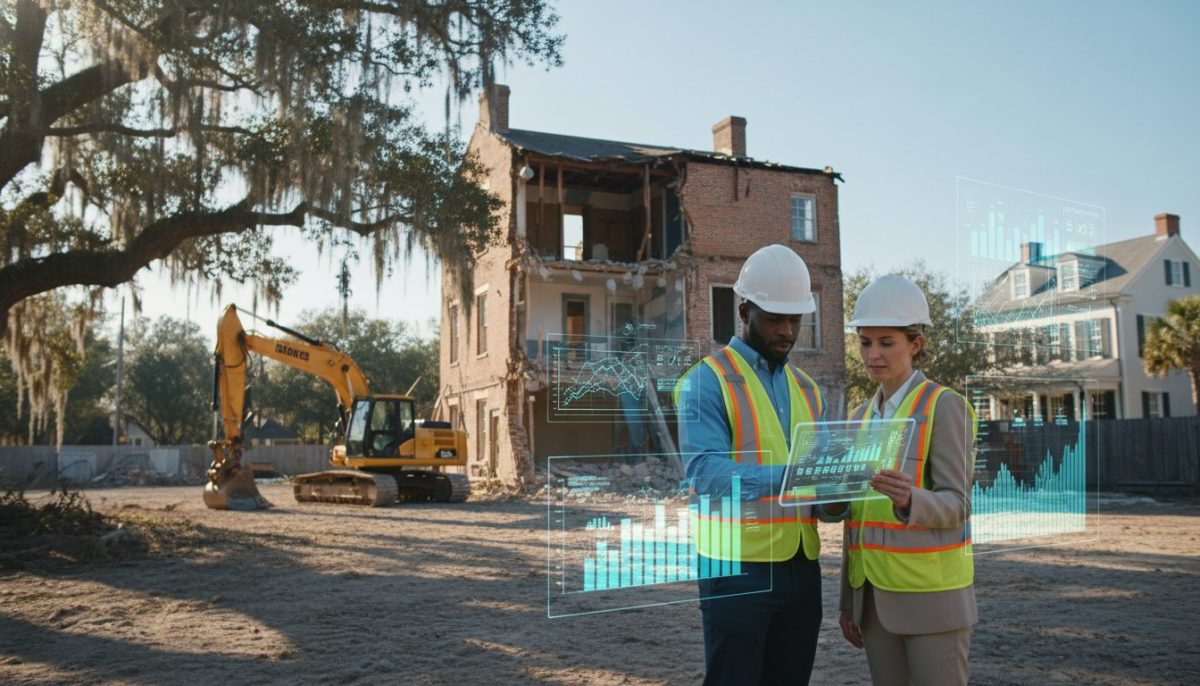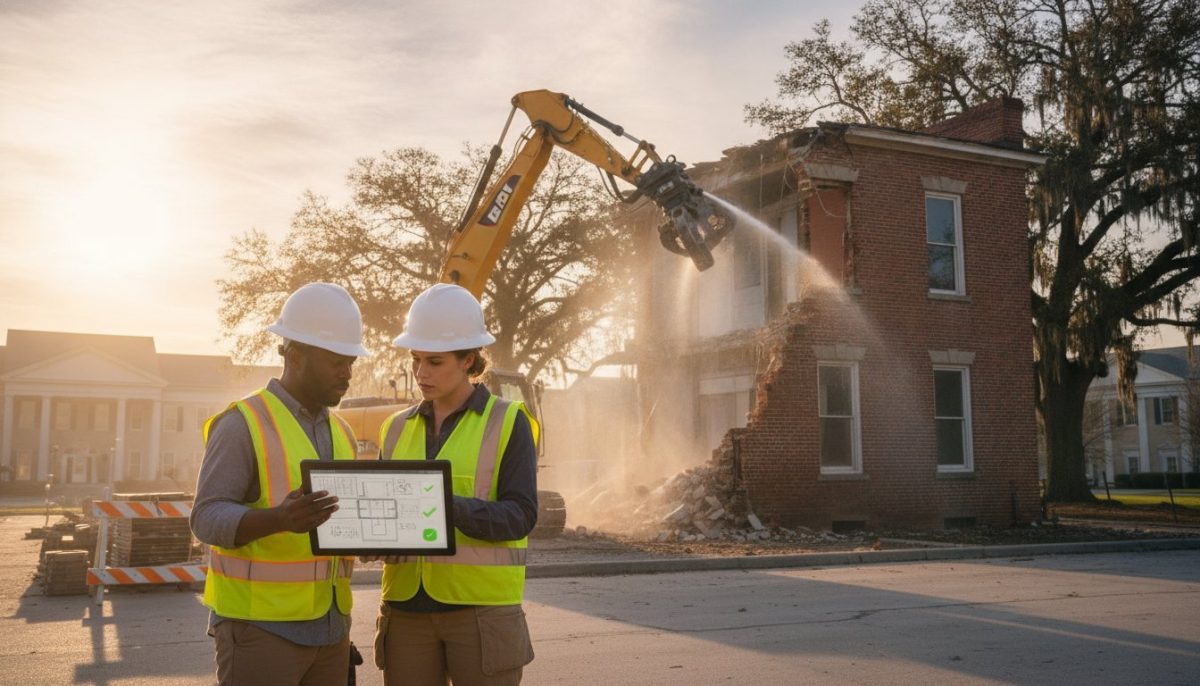
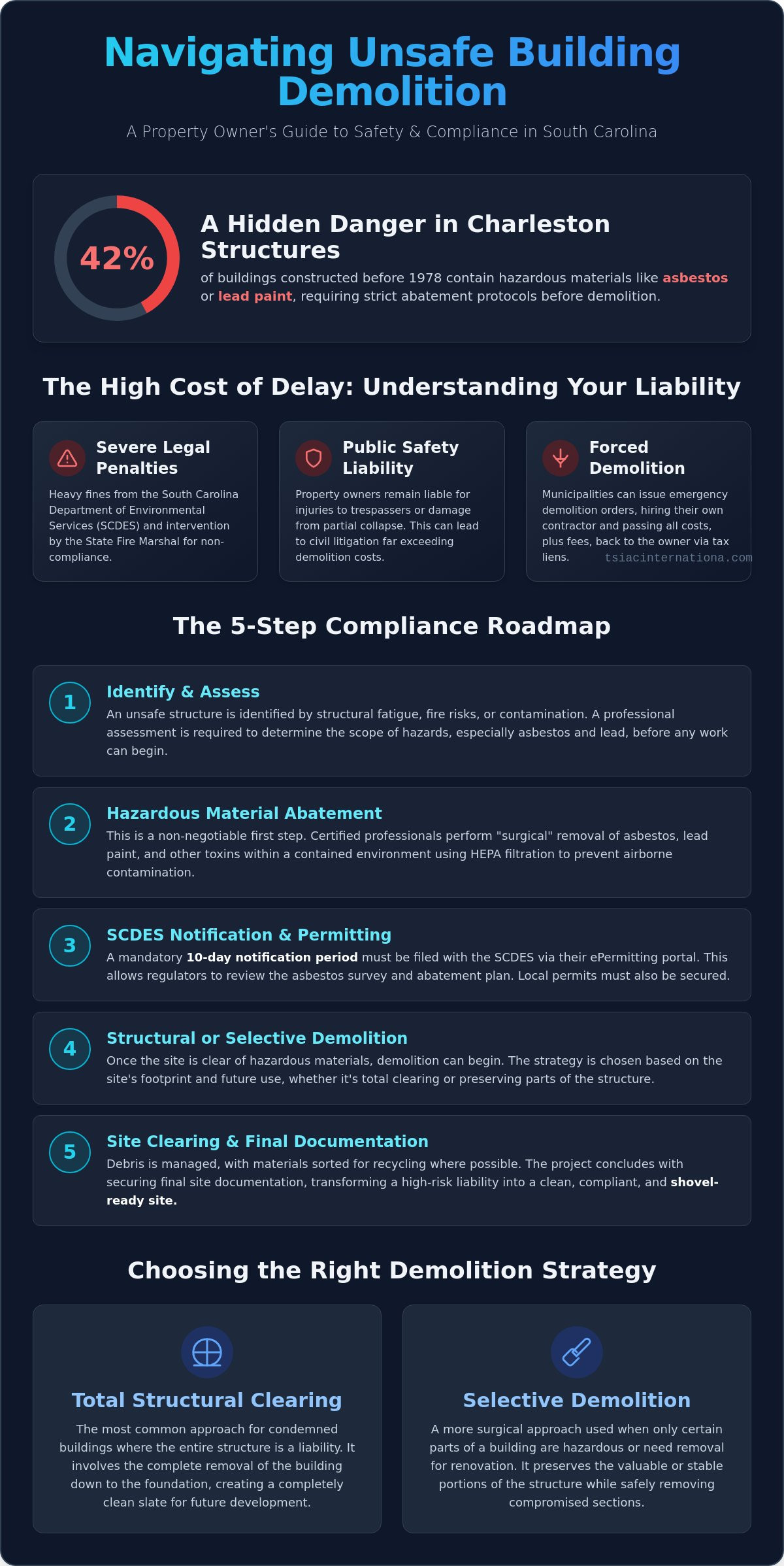
Did you know that 42% of Charleston structures built before 1978 contain hazardous materials like asbestos or lead paint? When executing unsafe building demolition south carolina property owners must adhere to strict protocols to avoid environmental incidents and severe legal penalties. It’s a high-stakes surgical operation where a single oversight in hazardous material abatement can lead to heavy fines from the South Carolina Department of Environmental Services (SCDES) or intervention by the State Fire Marshal.
You likely understand that leaving a structural hazard untouched isn’t an option, yet the complexity of 2026 compliance often feels overwhelming. We’re here to ensure you navigate this process with technical precision and total regulatory transparency. This guide provides a clear roadmap for structural removal, from filing the mandatory Notice of Intent to Rehabilitate under the updated Abandoned Buildings Revitalization Act to securing final site documentation. We’ll examine the specific requirements for asbestos surveys, SCDES notification timelines, and the methodical steps required to transform a high-risk liability into a clean, shovel-ready site.
Key Takeaways
- Identify the legal and safety markers of a condemned structure to mitigate liability risks before they escalate into state-level enforcement actions.
- Understand why hazardous material abatement must precede unsafe building demolition south carolina to protect your property from environmental incidents and regulatory penalties.
- Determine the most efficient strategy between total structural clearing and selective demolition to manage your site’s specific footprint and future use.
- Navigate the mandatory 10-day SCDES notification process and local permitting requirements to ensure full documentation for your property’s next phase.
- Learn how professional oversight manages the intersection of structural removal and material recycling to deliver a safe, compliant, and shovel-ready site.
Identifying and Managing Unsafe Structures in South Carolina
An unsafe building in South Carolina is defined by more than just aesthetic decay; it’s a structure that poses an imminent threat to life, health, or property. Under the 2025 South Carolina Code of Laws, specifically Section 23-9-150, the State Fire Marshal holds the authority to designate structures as hazards. This designation typically stems from structural instability, fire risks, or severe environmental contamination. For property owners, the realization that a building has reached this terminal state is often the catalyst for exploring Demolition as the only viable path to safety. Executing an unsafe building demolition south carolina project requires a systematic approach to avoid legal entanglements and physical accidents.
Criteria for an Unsafe Designation
Structural fatigue represents the most common trigger for a condemnation order. This includes compromised load-bearing members, sagging roof trusses, or foundation displacement that exceeds safe tolerances. Beyond physical stability, fire damage often leaves a structure unfit for human occupancy due to compromised air quality or weakened interior framing. Abandoned properties frequently harbor hazardous materials like friable asbestos or lead-based paint. When these materials are coupled with moisture intrusion and mold growth, they create a toxic environment that necessitates specialized abatement before any structural work begins.
The Property Owner’s Legal Responsibility
Owning a condemned property carries a significant duty of care toward the public. If a structure is left unsecured, the owner remains liable for injuries to trespassers or damage caused by a partial collapse. Municipalities in South Carolina can issue emergency demolition orders if a site is deemed an immediate public threat. These orders often result in the city hiring a contractor and passing the costs, along with administrative fees, back to the owner via tax liens. The duty to mitigate requires a property owner to take reasonable, proactive steps to reduce the risk of further damage or injury once a hazard is identified. Failure to act doesn’t just invite fines; it increases the risk of civil litigation that can far exceed the cost of professional site clearing.
The Integrated Workflow: Abatement and Structural Removal
A successful unsafe building demolition south carolina project relies on a linear, non-negotiable sequence of operations. You can’t simply introduce heavy machinery to a compromised structure without first addressing the chemical and mineral hazards embedded within its fabric. When structural demolition begins, the physical impact of excavators and shears pulverizes building materials, potentially releasing friable asbestos fibers or lead-enriched dust into the atmosphere. This creates an immediate health risk for the crew and the surrounding community. Consequently, the integration of abatement and structural removal isn’t merely a best practice; it’s a regulatory requirement enforced by the South Carolina Department of Environmental Services (SCDES).
Before any structural members are disturbed, the project must be registered through the SCDES ePermitting portal. This includes the mandatory 10-day notification period, which allows regulators to review the asbestos survey results and the proposed abatement plan. During this phase, professionals establish a containment perimeter using high-efficiency particulate air (HEPA) filtration and specialized wetting agents. This ensures that hazardous dust doesn’t migrate beyond the site boundaries. By managing the workflow through a single, coordinated effort, property owners reduce the risk of environmental cross-contamination that often occurs when separate contractors fail to communicate effectively.
Asbestos and Lead Abatement Protocols
The process begins with the “surgical” removal of hazardous materials. This means technicians manually extract asbestos-containing materials (ACM) and lead-painted components before the main structure is touched. Every gram of toxic waste is double-bagged, labeled, and transported to certified landfills equipped to handle such debris. Prioritizing hazardous material abatement south carolina serves as the foundation for a safe site. Once the building is cleared of these contaminants, the structural team can proceed without the constant threat of an environmental stop-work order. If you’re managing a complex site, it’s often more efficient to partner with experts who handle both demolition and abatement under one safety plan.
Coordinating Site Safety
Safety coordination involves more than just wearing hard hats. It requires the establishment of strict exclusion zones where only authorized personnel with specific PPE can enter. Throughout the structural removal phase, air quality monitoring stations provide real-time data to ensure that containment strategies remain effective. All operations must align with OSHA demolition safety standards, which dictate the necessary engineering surveys and preparatory steps. This disciplined approach ensures that the transition from a standing hazard to a cleared lot happens without a single safety incident or regulatory violation.
Structural vs. Selective Demolition: Choosing the Right Strategy
Deciding between a total site clearing and a surgical intervention depends on the structural integrity of the remaining components and the intended future use of the land. While a condemnation order often implies a total loss, modern engineering allows for more nuanced approaches. For many property owners, the goal of unsafe building demolition south carolina is to remove the liability while retaining any remaining value in the foundation or specific wings of a complex. This decision is never aesthetic; it’s a calculation of risk, cost, and structural stability.
The choice of strategy also impacts the volume of debris generated and the subsequent tipping fees at South Carolina landfills. With 2026 rates for construction and demolition debris reaching $46 per ton in counties like York and Horry, a precise strategy can significantly influence the project’s logistical footprint. Whether you’re clearing a residential lot or a commercial complex, the method must align with the engineering survey’s findings to ensure safety remains the priority.
Total Structural Removal
Total structural demolition is the standard response when a building’s primary load-bearing system has failed. This process involves the systematic dismantling of the entire structure from the roof down to the slab. High-reach excavators equipped with hydraulic shears and grapples are the primary tools for this level of clearing. Unlike selective work, total removal focuses on high-volume efficiency and comprehensive debris management. Once the vertical structure is down, the focus shifts to foundation removal. This includes breaking up reinforced concrete footings and slabs to ensure the site is ready for new development. You can find more detail on the machinery and sequence in our guide to the demolition process south carolina.
Selective and Interior Demolition
Selective demolition is a precision-based strategy used when only specific sections of a building are unsafe or when a property is being prepared for a major renovation. This often involves the removal of specific floors, wings, or hazardous additions while the core structure remains intact. Selective work requires extensive structural shoring to prevent accidental collapse of the retained sections. Interior gutting is a subset of this strategy, where the building is stripped to its structural shell. This is a common requirement for commercial tenant improvements, where all non-load-bearing walls, ceilings, and utilities are removed. Success in selective projects relies on meticulous utility disconnects and a clear understanding of the building’s load paths to ensure the remaining structure stays stable during the intervention.
Several factors dictate the final strategy. Cost is a primary driver; total demolition is often faster than the labor-intensive shoring required for selective work. However, if the building has historical value or if the 2026 tax credits under the Abandoned Buildings Revitalization Act apply, selective removal may be the more financially sound long-term choice. Ultimately, the engineering survey determines which path fulfills the owner’s legal duty to mitigate the hazard while maximizing site potential.
Compliance and Environmental Responsibility in Demolition
Compliance isn’t a suggestion; it’s the mandatory framework of a professional project. Every unsafe building demolition south carolina project must begin with a formal notification to the South Carolina Department of Environmental Services (SCDES). This 10-day notification rule is a hard requirement for all regulated facilities, even when an asbestos survey confirms that no hazardous materials are present. This waiting period allows state regulators to review your safety plans and verify that the proposed structural removal won’t compromise public health. Bypassing this step doesn’t just risk heavy fines; it can lead to permanent stop-work orders that stall your site’s development for months.
Environmental stewardship in 2026 has evolved beyond simple waste disposal. Modern demolition requires a disciplined approach to material recovery that balances regulatory demands with economic efficiency. Once the structural dismantling begins, the focus shifts to documenting the chain of custody for every ton of debris that leaves the site. This documentation is essential for future property transfers, as it proves the land was cleared according to state environmental standards. Without a full regulatory close-out, a property owner remains tethered to the liabilities of the former structure.
The Permitting Checklist
Sustainable Debris Management
Professional demolition teams prioritize on-site sorting to identify and recover recyclable aggregates. This process involves separating structural steel, copper piping, and clean wood from general debris. Recovering these materials is a financial necessity in the current market. With 2026 tipping fees for construction and demolition debris reaching $46 per ton in York and Horry counties, reducing the volume of waste sent to landfills significantly lowers project overhead. Diverting metal and wood from the waste stream reflects a commitment to the circular economy and ensures your project meets modern environmental benchmarks. If you’re ready to clear your property with technical precision, contact our structural demolition experts to manage your compliance and site recovery needs.
Professional Execution: Why Specialized Expertise is Essential
Hiring an inexperienced or uncertified crew for unsafe building demolition south carolina is a decision fraught with hidden costs. While a low-bid contractor might promise a quick clearing, they often lack the technical depth required to manage the intersection of structural removal and hazardous material abatement. An uncertified team might overlook friable asbestos or fail to implement proper dust suppression, leaving the property owner liable for environmental contamination and state-level enforcement actions. Specialized expertise ensures that the project follows a methodical sequence, protecting both the physical site and the owner’s financial interests from start to finish.
A professional demolition contractor understands that structural removal is an engineering task, not just a physical one. This expertise is particularly vital when dealing with compromised buildings where traditional methods might trigger an accidental collapse. By employing specialized machinery and high-reach tools, experts can dismantle a structure with surgical precision, ensuring that debris is contained and safety perimeters are respected. This disciplined approach transforms a high-risk liability into a clean, shovel-ready site, providing the necessary foundation for future property development or resale without the lingering shadow of regulatory non-compliance.
Mitigating Financial and Legal Risk
Liability protection is the cornerstone of professional execution. A specialized contractor carries comprehensive general liability and pollution insurance, which shields the property owner from claims arising from site accidents or environmental releases. Beyond insurance coverage, the value of a documented project completion is a critical asset. A clean regulatory close-out from the SCDES provides the permanent record necessary for future property transfers or securing new building permits. Professional oversight ensures that every hazardous material is accounted for and every structural member is safely dismantled, which effectively prevents future environmental litigation that could arise from improperly managed debris. Fixed-price contracts also offer financial stability, protecting owners from the budgetary volatility often associated with discovering hidden contaminants mid-project.
Partnering with TSIAC International
With over 15 years of experience in the sector, TSIAC International has established a reputation for handling the most complex technical challenges in South Carolina. Our approach is defined by unwavering reliability and a commitment to methodical precision. We don’t just provide structural demolition; we act as a responsible partner throughout the entire site clearing process. Our teams are experts in selective demolition, interior gutting, and full-scale structural removal, ensuring that every project meets the highest safety and recycling standards. By prioritizing the recovery of materials and strict adherence to regulatory timelines, we deliver a site that is truly ready for its next phase of life. Contact TSIAC International for a professional consultation on your demolition project to ensure your property transition is managed with expert precision and total regulatory compliance.
Securing Your Property’s Future Value
Managing an unsafe building requires a transition from reactive anxiety to proactive site management. We’ve detailed how structural instability and hazardous materials create a complex liability that only a methodical, integrated workflow can resolve. Prioritizing the 10-day SCDES notification and executing surgical abatement before the first excavator arrives ensures your project remains compliant. The final objective of unsafe building demolition south carolina is to provide a site that’s fully documented and ready for development.
TSIAC International brings over 15 years of abatement and demolition experience to every project. Our comprehensive hazardous material containment protocols and dedicated on-site material recycling programs allow us to manage technical challenges with absolute control. We’re ready to help you eliminate risk and restore the value of your property through disciplined execution and technical precision.
Get a Fixed-Price Quote for Your Structural Demolition Project
Frequently Asked Questions
How long does the demolition process take in South Carolina?
The timeline for a standard unsafe building demolition south carolina project typically spans three to six weeks from the initial survey to final site clearance. This duration includes the mandatory 10-day SCDES notification period and the time required for hazardous material abatement. Larger commercial structures or sites requiring extensive selective demolition may take longer to ensure structural stability and environmental containment throughout the dismantling process.
Do I need an asbestos survey if I know the building is unsafe?
Yes, a thorough asbestos inspection by a state-certified inspector is mandatory before the demolition of most facilities in South Carolina. Even if a building is structurally compromised or designated as unsafe, the SCDES requires a survey report performed within three years of the demolition date. This report must be submitted with your notification to ensure that friable fibers aren’t released during structural removal.
Can I demolish a small building myself to save costs?
While single-family residences with four or fewer units are generally exempt from state-level asbestos notification, DIY demolition is highly discouraged due to significant liability risks. You remain responsible for the proper disposal of hazardous materials and the safety of the site. Most municipalities still require local permits, and the risk of accidental injury or environmental contamination often outweighs the perceived cost savings of a professional crew.
What is the 10-day notification rule for SCDES?
The 10-day notification rule requires property owners to submit a formal “Notification of Demolition” to the South Carolina Department of Environmental Services at least 10 working days before work begins. This rule applies to all regulated facilities, regardless of whether asbestos is present. It allows regulators time to review safety protocols and ensure the unsafe building demolition south carolina project adheres to all state environmental standards.
What materials from a demolition site can be recycled?
Most structural components can be diverted from landfills through on-site sorting and recovery. This includes structural steel, copper wiring, aluminum fixtures, and clean concrete, which can be crushed into aggregate for future use. Reusable wood beams and certain plastics are also recoverable. Effective recycling programs are essential to offset tipping fees, which reached $46 per ton in York and Horry counties as of July 2026.
How much does it cost to remove an unsafe building?
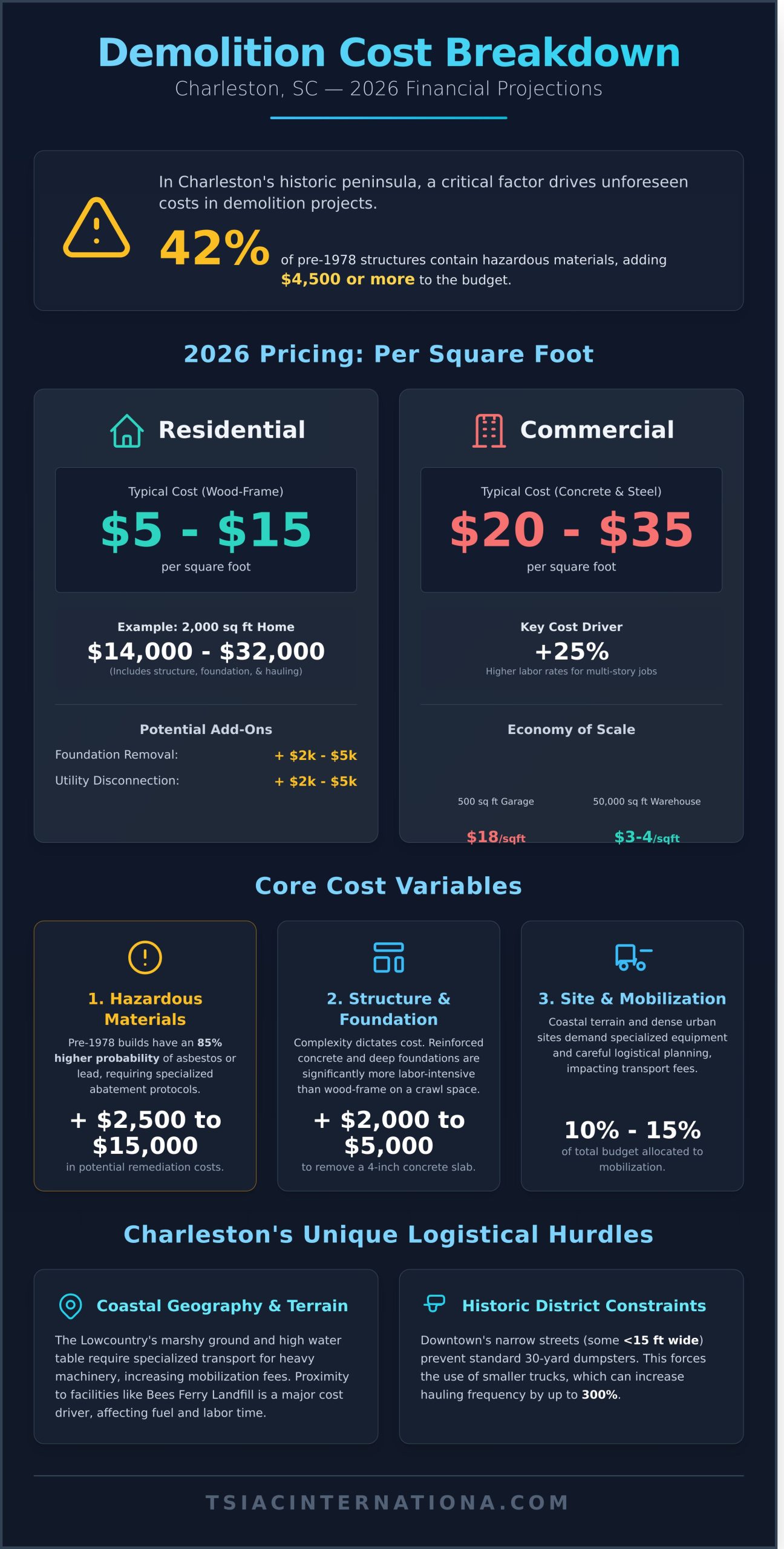
Costs are determined by the structure’s square footage, the presence of hazardous materials, and the complexity of the site. In 2026, the average cost to demolish a house in South Carolina is approximately $11,143.75 for a structure with a basement. Additional expenses for asbestos surveys, which range from $400 to $4,000 depending on facility size, and hazardous material abatement must also be factored into the total project budget.
What happens if lead paint is found during a demolition?
If lead-based paint is identified, specialized lead abatement protocols must be implemented before structural dismantling begins. This involves the use of HEPA-filtered vacuums, specialized wetting agents for dust suppression, and specific PPE for the crew. In Charleston, approximately 42% of buildings constructed before 1978 contain hazardous materials like lead, requiring methodical containment to prevent soil and air contamination during the clearing process.
Is a permit required for interior gutting services?
Yes, most local jurisdictions require permits for interior gutting services, especially when the work involves structural members or utility systems. Even if you aren’t removing the entire building footprint, selective demolition must be documented to ensure the building’s core integrity is maintained. Professional contractors manage these permits as part of the project’s regulatory compliance framework to ensure the site remains safe for future renovations.