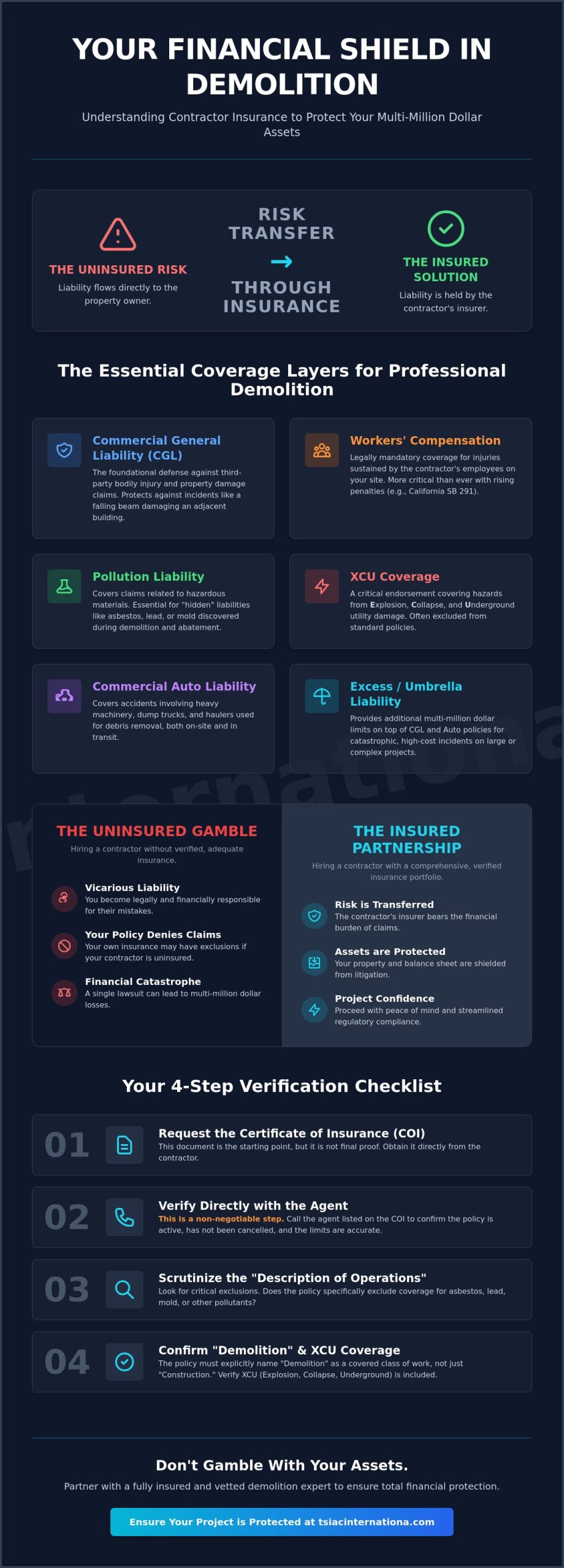
If you believe a contractor’s standard general liability policy protects you from an asbestos lawsuit, you’re leaving your property’s financial future to chance. In 2026, general liability is often a liability in itself. Standard policies almost always include a pollution exclusion that leaves property owners vulnerable. Understanding the specific asbestos abatement insurance requirements is no longer just an administrative hurdle; it’s a critical component of professional risk management. We recognize that the technical complexity of claims-made versus occurrence coverage can be daunting, particularly when the stakes involve long-term health litigation and strict environmental compliance.
This guide provides the professional clarity needed to verify that your contractor carries the exact endorsements required to shield your assets. You’ll learn how to identify gaps in coverage that standard providers often miss. We will examine the essential insurance trifecta, the implications of the EPA’s 2027 regulatory delays, and why California’s 2026 workers’ compensation mandates have shifted the legal landscape for every property owner.
Key Takeaways
- Discover why 99% of standard commercial policies fail to cover environmental hazards and how the “Total Pollution Exclusion” could leave your assets vulnerable.
- Identify the essential asbestos abatement insurance requirements, including the critical “Asbestos Endorsement” needed to bridge gaps in standard General Liability coverage.
- Learn the technical difference between “Claims-Made” and “Occurrence” policies to ensure your property remains protected against long-term health litigation.
- Follow a professional two-step verification process to audit a contractor’s Certificate of Insurance (COI) and confirm they are legally cleared for hazardous material handling.
- Understand how specialized environmental insurance ratings provide a layer of financial security that standard construction firms cannot offer.
What Are Asbestos Abatement Insurance Requirements?
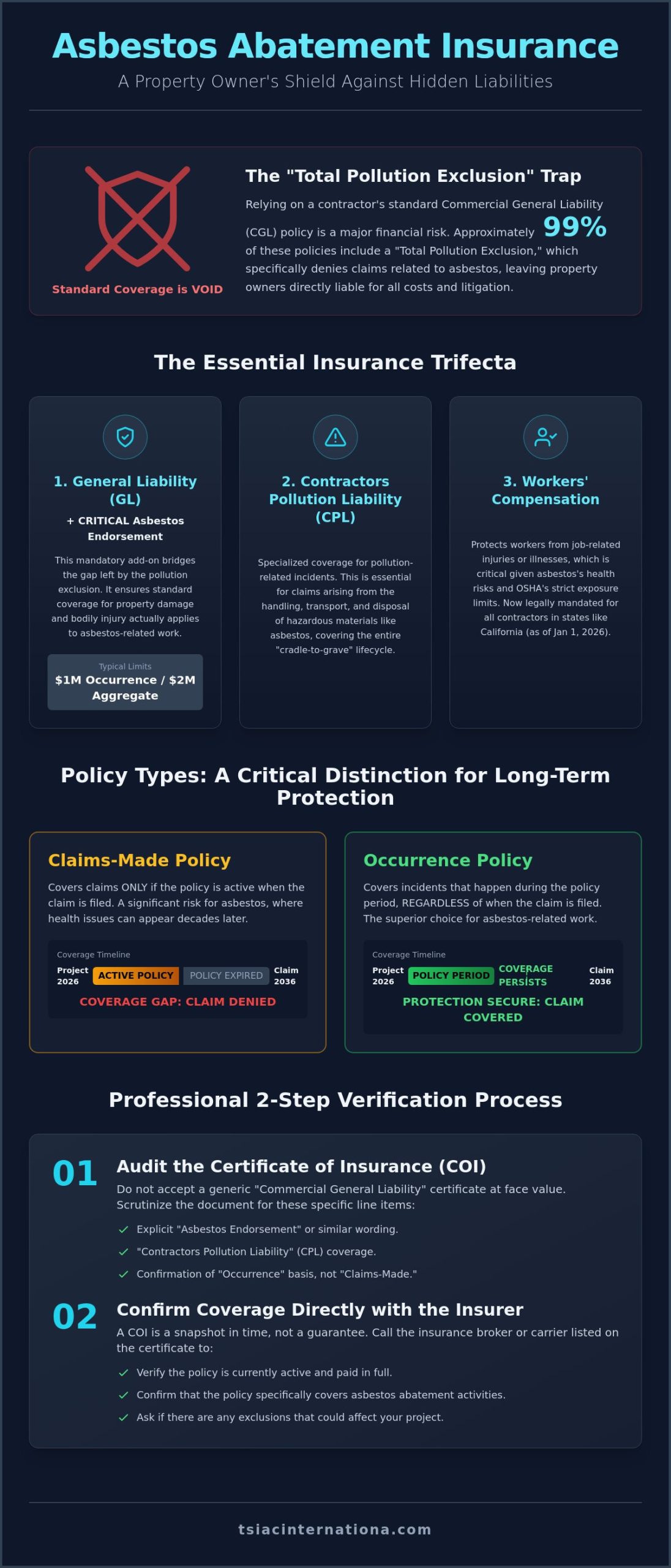
Professional asbestos abatement insurance requirements aren’t defined by a single policy. Instead, they consist of a specialized suite of coverages designed to manage the unique risks associated with handling, transporting, and disposing of hazardous minerals. For a foundational asbestos overview, one must understand that these minerals pose significant health risks when disturbed, which is why standard insurance markets treat them as high-risk exclusions. If you rely on a contractor who only carries standard commercial general liability (CGL) insurance, you’re likely unprotected. Approximately 99% of standard CGL forms contain a “Total Pollution Exclusion,” which specifically removes coverage for any claim related to the release of irritants or contaminants, including asbestos fibers.
The 2026 regulatory landscape has made these requirements even more stringent. While the EPA has delayed its Part 2 risk management rule for legacy asbestos until June 3, 2027, the focus on environmental liability has never been sharper. Property owners currently face a “non-delegable duty” regarding hazardous materials. This concept, known as vicarious liability, means you can be held legally and financially responsible for a contractor’s errors if their insurance is inadequate. If a release occurs and the contractor’s policy fails due to a pollution exclusion, the litigation will target the property owner’s assets directly.
The Legal Necessity of Hazardous Material Coverage
Remediation projects carry a high “duty of care.” This legal obligation requires property owners to ensure that hazardous materials are handled with methodological precision to prevent public exposure. Inadequate insurance doesn’t just invite lawsuits; it can lead to immediate property liens and multi-year litigation that drains corporate or personal reserves. For comprehensive strategies on shielding your wealth from these types of long-term risks, Strategic Asset Preservation, Inc offers specialized estate and financial planning. Asbestos abatement insurance serves as the primary financial shield for property owners during remediation. Without it, the financial consequences of a fiber release are borne entirely by the site owner, regardless of who performed the work.
Regulatory Bodies Influencing Insurance Standards
Several agencies dictate the minimum thresholds for coverage in 2026. OSHA maintains a strict Permissible Exposure Limit (PEL) of 0.1 fibers per cubic centimeter, and any violation can trigger massive workers’ compensation claims. Crucially, as of January 1, 2026, California law requires all licensed contractors to carry workers’ compensation insurance regardless of their employee count. Additionally, the EPA’s “cradle-to-grave” rule ensures that the property owner remains responsible for the waste until it reaches a certified landfill. Meeting the asbestos abatement insurance requirements means ensuring your contractor has the specific pollution and transport endorsements to cover this entire lifecycle. State licensing boards also mandate specific bond requirements, such as California’s $25,000 contractor’s license bond, to provide a baseline of professional accountability.
The Essential Insurance Trifecta: GL, Pollution, and Workers’ Comp
Comprehensive risk management for hazardous material removal requires three distinct pillars of coverage. While a contractor might present a standard Commercial General Liability (GL) certificate, it’s often a hollow promise without a specific “Asbestos Endorsement.” Standard GL covers property damage and bodily injury, but the “Total Pollution Exclusion” found in most policies means any claim involving asbestos fibers will be denied immediately. For property owners, verifying these specific asbestos abatement insurance requirements is the only way to ensure the $1 million per occurrence and $2 million aggregate limits actually apply to your project. This endorsement bridges the gap between standard construction risks and environmental hazards.
Beyond basic liability, Contractors Pollution Liability (CPL) and Workers’ Compensation form the remainder of the trifecta. These policies address the high-risk nature of the OSHA Asbestos Standard for Construction, which mandates rigorous engineering controls and work practices. If a contractor fails to follow these protocols, the resulting liability can be catastrophic. Partnering with a firm that maintains verified environmental coverage ensures that technical errors don’t become your financial burden. Professional Liability, also known as Errors & Omissions (E&O), adds a fourth layer of security by covering the design and consulting phase of the abatement plan, protecting you from mistakes in the initial project scope.
Contractors Pollution Liability (CPL) Explained
CPL is the “Holy Grail” of abatement insurance. Unlike standard policies, it covers both “sudden and accidental” events, such as a containment breach during a storm, and “gradual” pollution events that may take years to manifest. A professional policy must extend beyond the project site to include transit liability. This covers the risk of a spill while transporting hazardous waste to a disposal facility. Additionally, the policy must include “Clean-up Costs” coverage, which pays for the remediation of the site if an accidental release occurs during the abatement process. Without this, the cost of decontaminating a building after a mishap falls entirely on the property owner.
Workers’ Comp and the ‘Statutory Limit’
Asbestos work carries some of the highest insurance modifiers in the industry because of long-term health risks. You must verify that the contractor’s policy specifically covers “Asbestos Workers” under Class Code 5473. As of January 1, 2026, California law mandates that all licensed contractors carry this coverage regardless of their payroll size. A “Statutory” limit is required to prevent “Action Over” claims. In these scenarios, an injured worker who has exhausted their compensation benefits sues the building owner for failing to provide a safe environment. A robust Workers’ Comp policy acts as the exclusive remedy, shielding the property owner from these direct legal challenges.
Claims-Made vs. Occurrence: Protecting Your Long-Term Interests
The technical structure of a policy is just as critical as its coverage limits when evaluating asbestos abatement insurance requirements. For property owners, the choice between “Occurrence” and “Claims-Made” forms determines whether you’re protected for the next few years or the next few decades. An occurrence policy provides coverage based on when the work was performed. If a release happens during the project in 2026, the policy in place at that time handles the claim, even if the lawsuit isn’t filed until 2046. This is the gold standard for environmental work. Conversely, a claims-made policy only triggers if the policy is active at the exact moment the claim is filed. If the contractor retires or switches carriers, your protection could vanish instantly.
According to the EPA guidance for building owners, managing asbestos requires a long-term perspective because the risks don’t end when the contractor leaves the site. Relying on a claims-made structure places the property owner in a precarious position. You’re effectively tethered to the contractor’s future financial stability. If they fail to renew their “tail” coverage or go out of business, the liability for any future health claims or environmental contamination shifts directly to your balance sheet. Ensuring your contractor meets the most rigorous asbestos abatement insurance requirements means demanding an occurrence-based form for all pollution-related activities.
Navigating the Asbestos Latency Gap
Asbestos-related illnesses often have a latency period of 20 to 40 years. This massive time gap makes the occurrence form a non-negotiable requirement for professional remediation projects. A claim filed in 2045 for work completed in 2026 requires the stability of an occurrence policy to ensure funds are available for defense and settlement. The 2026 industry standard for high-stakes remediation favors Occurrence-based environmental policies because they provide a permanent solution to a risk that may not manifest for decades. If a contractor only offers claims-made coverage, you must demand a multi-year Extended Reporting Period (ERP), though this is often a more expensive and less secure alternative.
Comparing Policy Structures for Property Owners
While claims-made policies often feature lower initial premiums, the long-term cost of potential exposure far outweighs these savings. When reviewing a remediation contract, ask your broker if the policy includes a “Sunset Clause,” which can limit the timeframe for reporting claims even on occurrence forms. You should also verify the “Retroactive Date” on any claims-made policy to ensure there are no gaps between previous work and current coverage. A methodological audit of these dates is essential for maintaining a continuous chain of protection for your assets. Professional partners will always prioritize occurrence forms to provide their clients with absolute, enduring peace of mind.
Verification Checklist: How to Audit a Contractor’s COI
Auditing a contractor’s Certificate of Insurance (COI) is the final line of defense for a property owner. Simply receiving a document is not sufficient; you must verify that the policy actually meets the asbestos abatement insurance requirements necessitated by the high-risk nature of the work. Follow this methodological checklist to ensure your assets are not exposed to environmental liability.
Step 1: Demand the ACORD 25 directly from the agent. Do not accept a PDF copy sent directly from the contractor’s email. Fraudulent or altered COIs are a reality in the high-premium environmental sector. Request that the insurance broker or agent sends the form directly to your office to ensure its authenticity.
Step 2: Inspect the ‘Description of Operations’ box. This section must explicitly mention “Asbestos Abatement.” If it only lists general terms like “Demolition” or “Construction,” the pollution exclusion mentioned in previous sections will likely trigger a claim denial. The language must be precise and inclusive of the specific hazardous materials on your site.
Step 3: Verify ‘Additional Insured’ status. The property owner and the project manager should be named as additional insureds. This status grants you direct rights to the policy’s legal defense and coverage limits if a third party files a lawsuit related to the contractor’s work.
Step 4: Confirm a ‘Waiver of Subrogation.’ This prevents the contractor’s insurance carrier from “stepping into the shoes” of the contractor to sue you for recovery after they have paid out a claim. It is a vital layer of protection that keeps the financial responsibility on the professional performing the work.
Step 5: Direct Verification. Call the insurance agency listed at the top of the ACORD 25. Confirm that the policy numbers match their records, the policy is currently active, and all premiums are paid in full for the duration of your project.
Keywords to Look for on an ACORD 25
Precision in language is non-negotiable when reviewing environmental documents. Look specifically for the phrase “Asbestos/Lead Abatement included in GL and Pollution.” If you are managing a residential property, check for a “Residential Exclusion” clause. Many low-cost environmental policies only cover commercial sites, leaving homeowners completely vulnerable. You should also look for “Primary and Non-Contributory” language. This ensures the contractor’s insurance pays first before your own property insurance is ever touched in the event of a loss.
The Role of the ‘Additional Insured’ Endorsement
Being listed as an “Additional Insured” provides you with direct access to the contractor’s policy limits. You must distinguish between “Ongoing Operations” and “Completed Operations” status. Ongoing coverage protects you from mishaps while the crew is on-site, whereas completed operations coverage protects you from claims that arise after the project is finished. For more on the technical side of the process, see our guide on hazardous material abatement in South Carolina. To ensure your project is handled by a team with fully verified and transparent coverage, contact our risk management specialists for a comprehensive consultation.
Why TSIAC International Sets the Standard for Abatement Insurance
TSIAC International has spent over 15 years refining its risk management protocols to exceed industry-standard asbestos abatement insurance requirements. We maintain “A-Rated” environmental insurance specifically tailored for high-stakes projects where technical precision is mandatory. Our commitment to “Occurrence” based pollution coverage ensures that our clients don’t face the “latency gap” risks associated with cheaper, claims-made alternatives. This proactive approach to insurance isn’t just about compliance; it’s about providing a permanent legal shield for your property and assets. We understand that in the environmental sector, the quality of your contractor’s insurance is just as important as the quality of their physical work.
In regions like the Southeast, we ensure that every project adheres to the most current local and federal mandates. Our specialized guide on asbestos removal in South Carolina demonstrates our deep integration with regulatory documentation and site-specific safety plans. We provide full transparency in debris management by supplying every client with a complete waste chain-of-custody. This includes certified disposal records that prove the hazardous material was handled correctly from the moment it was disturbed until it reached its final permitted destination. This meticulous record-keeping is a hallmark of our professional methodology.
Our Professionalism in Risk Management
TSIAC International handles complex commercial interior gutting services by maintaining negative pressure environments and strict containment zones. Our history involves working alongside government agencies and large-scale general contractors who demand rigorous insurance audits and methodological accuracy. We provide detailed reporting at every stage, from the initial pre-abatement testing to the final third-party clearance. This documentation is essential for your long-term records and future property transactions. Our team doesn’t just perform the work; we manage the entire risk profile of the project to ensure your peace of mind.
Protecting Your Assets from Start to Finish
Our “Cradle-to-Grave” liability approach is designed to reduce your long-term risk profile by ensuring no gaps exist in the waste lifecycle. We prioritize recycling and environmental responsibility, diverting non-hazardous materials away from landfills whenever technically feasible. This commitment to sustainable practices complements our robust insurance profile, making us a responsible partner for any demolition or remediation project. You shouldn’t have to worry about the legal or environmental fallout of a project decades after it’s finished. Contact TSIAC International today for a comprehensive project consultation and a professional review of your site’s asbestos abatement insurance requirements.
Securing Your Property Assets Through Professional Compliance
Managing hazardous materials requires more than technical skill; it demands a methodological approach to risk management. By ensuring your contractor meets the specific asbestos abatement insurance requirements outlined in this guide, you protect your property from the financial fallout of environmental liability. A standard general liability policy is simply insufficient for this scope of work. You must verify the presence of specialized pollution endorsements and prioritize occurrence-based coverage to account for the long latency period of asbestos-related illnesses. Direct verification of the Certificate of Insurance with the issuing agent remains the most effective way to confirm your assets are truly shielded.
With over 15 years of industry experience, TSIAC International maintains fully licensed and A-rated insurance coverage. We are specialists in commercial and structural abatement, providing the technical precision and documentation needed to satisfy even the most rigorous audits. Don’t leave your long-term liability to chance. Request a Professional Abatement Quote from TSIAC International today to ensure your project is handled with the highest standards of safety and professional integrity. We look forward to helping you restore your property to a safe, compliant state.
Frequently Asked Questions
Is asbestos removal covered by my standard property insurance?
Standard property insurance policies typically do not cover asbestos removal. These policies are designed to cover sudden and accidental damage from specific perils like fire or wind; however, asbestos is almost always classified as a pollutant and falls under standard exclusions. Removal is generally only covered if the material is disturbed as a direct result of a covered peril, and even then, coverage is often limited to the necessary repairs rather than comprehensive abatement.
What is the difference between General Liability and Pollution Liability for asbestos?
General Liability (GL) covers common construction risks like slips, falls, or basic property damage, but it nearly always contains a “Total Pollution Exclusion.” Contractors Pollution Liability (CPL) is the specialized coverage required for the accidental release of hazardous fibers. While GL might cover a broken window at the job site, only CPL will cover the massive cleanup costs and medical liabilities associated with an asbestos release.
What is an ‘Additional Insured’ and why do I need to be one?
Being listed as an “Additional Insured” grants you direct rights under the contractor’s insurance policy. This status ensures that the contractor’s insurance company must defend you if a third party files a lawsuit due to the contractor’s negligence on your property. It provides a primary layer of protection that keeps your own insurance from being triggered, protecting your premiums and loss history.
Can I be sued if my asbestos contractor doesn’t have the right insurance?
You can absolutely be held liable for a contractor’s errors through the legal concept of vicarious liability. If an abatement firm lacks the proper coverage for asbestos abatement insurance requirements, any legal action or environmental cleanup costs will likely target the property owner’s assets directly. In the eyes of the law, the property owner has a non-delegable duty to ensure hazardous materials are handled safely.
What is a ‘Waiver of Subrogation’ in an abatement contract?
A Waiver of Subrogation is a provision where an insurance carrier gives up the right to seek recovery from a third party after paying a claim. In abatement, this prevents the contractor’s insurer from suing you to recoup the costs of a claim they paid out for an on-site accident. It ensures that the financial risk stays entirely with the professional performing the work and their insurance provider.
Why is ‘Occurrence’ coverage better than ‘Claims-Made’ for asbestos work?
Occurrence coverage is superior because it provides protection based on when the work was performed, not when the claim is filed. Since asbestos-related illnesses often manifest 20 to 40 years after exposure, this structure is the only way to ensure long-term security. Claims-made policies stop providing protection the moment the policy is canceled or the contractor retires, which is a major risk given the long latency period of respiratory diseases.
How much insurance coverage should an asbestos contractor have?
Minimum coverage for small projects usually starts at $1 million per occurrence and $2 million aggregate. However, for structural demolition or high-occupancy commercial buildings, property owners often require $5 million to $10 million in specialized environmental limits. These asbestos abatement insurance requirements should be scaled to the total risk profile and the potential cost of a full-building decontamination.
What happens if an asbestos contractor goes out of business after the job?
If the contractor had an occurrence-based policy, the insurance remains available for future claims even if the company no longer exists. If they utilized a claims-made policy without a multi-year extended reporting period, you’ll have no insurance protection if a claim arises years later. This is why verifying the policy structure is often more important than the contractor’s current business longevity.