

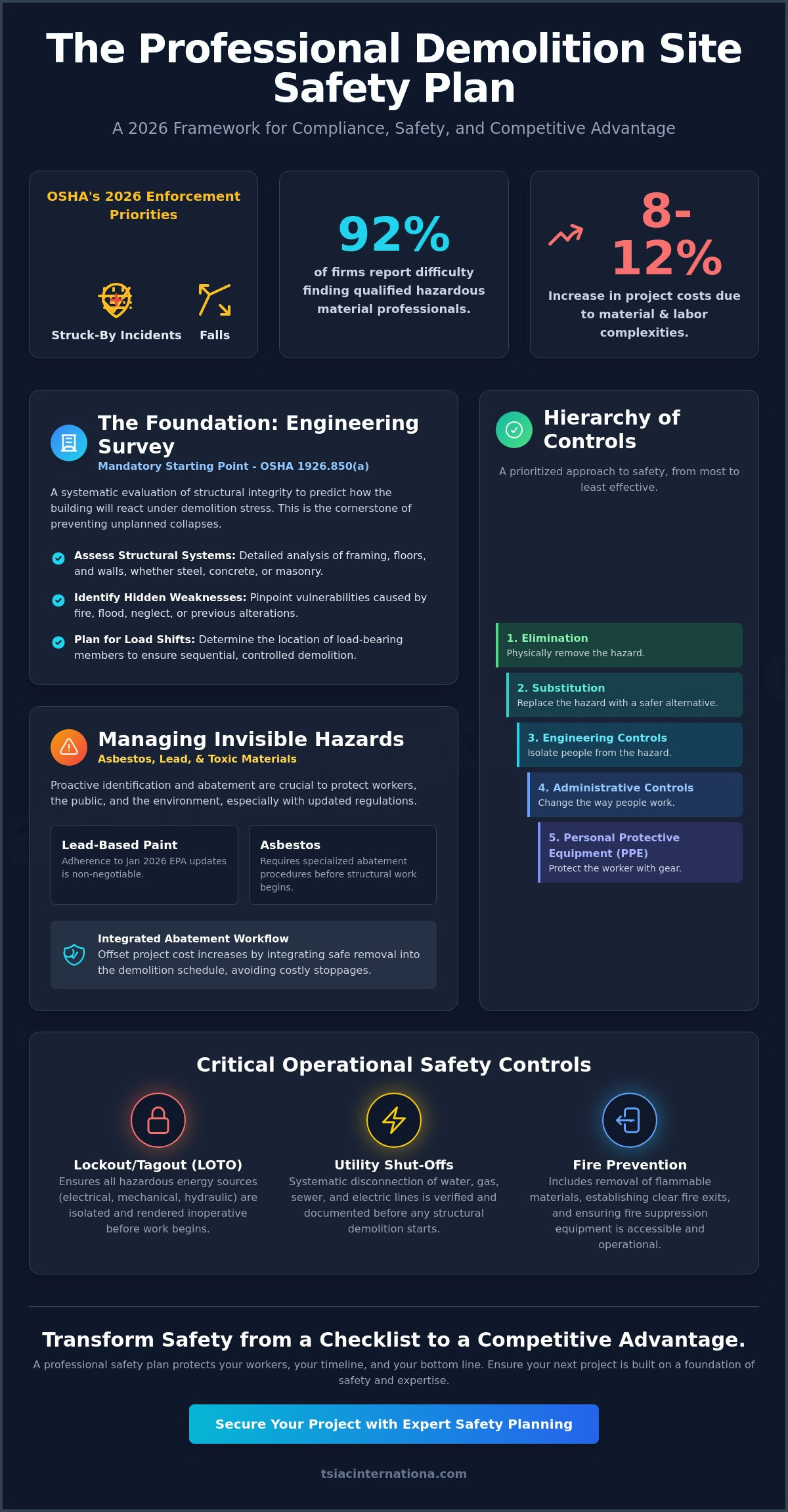
A professional demolition site safety plan is far more than a static binder sitting in a job site trailer; it’s a dynamic structural management strategy that dictates the survival of your project. You’re likely familiar with the mounting pressure of OSHA’s 2026 enforcement priorities, which now focus heavily on high-energy hazards such as struck-by incidents and falls. Managing the complexity of utility shut-offs while fearing hidden structural instabilities can make even routine projects feel like a legal and financial minefield. It’s a valid concern, especially since 92% of firms now report significant difficulty finding the qualified professionals needed to handle hazardous materials safely.
This guide provides a clear framework to master the essential components of a professional demolition site safety plan to ensure regulatory compliance, worker protection, and project efficiency. We’ll examine the critical link between engineering surveys and site stability, the impact of the January 2026 EPA lead-based paint updates, and how to integrate abatement into your workflow to offset the recent 8% to 12% increase in project costs. You’ll gain a methodical approach to risk mitigation that transforms safety from a regulatory checklist into a disciplined competitive advantage.
Key Takeaways
- Understand the regulatory framework of a professional demolition site safety plan as required by OSHA 1926 Subpart T to ensure full legal compliance.
- Learn why a comprehensive engineering survey is the mandatory starting point for identifying structural vulnerabilities in steel, concrete, and masonry systems.
- Discover how to integrate asbestos and lead abatement procedures to manage hazardous materials effectively when they appear unexpectedly during site operations.
- Master the Hierarchy of Controls and Lockout/Tagout (LOTO) protocols to maintain rigorous safety standards across all utility and fire prevention workflows.
- See how active site supervision by veteran professionals ensures that safety documentation translates into real-world protection against evolving site conditions.
What is a Demolition Site Safety Plan and Why Is It Mandatory?
A demolition site safety plan serves as a project-specific roadmap that identifies, evaluates, and controls hazards before the first piece of heavy machinery arrives on site. It isn’t a generic safety manual or a collection of standard operating procedures. Instead, it’s a technical document tailored to the unique structural and environmental variables of a specific building. While a standard construction safety plan focuses on building up, the demolition plan must account for the inherent instability of bringing a structure down. This distinction is critical for compliance with Federal OSHA 1926 Subpart T, the primary legal framework governing these high-risk operations. A thorough Demolition overview highlights that failure to account for structural integrity often leads to catastrophic results, making this plan the foundation of any successful project.
Beyond regulatory compliance, the economic value of a robust plan is undeniable. In 2026, project costs have risen by 8% to 12% due to hazardous material complexities and labor shortages. A well-executed plan prevents work stoppages and reduces insurance premiums by demonstrating a lower risk profile to underwriters. It’s a strategic asset that protects the bottom line as much as the personnel. When safety is treated as an operational priority rather than a bureaucratic hurdle, the entire project moves with greater precision and efficiency.
The Core Objectives of a Professional SSP
The primary objective is the absolute protection of the workforce from structural collapse and falling debris. High-energy hazards like struck-by and caught-in incidents are OSHA’s 2026 enforcement priorities, making rigorous planning a necessity. Additionally, the plan safeguards public health and the integrity of adjacent properties, which is vital in dense urban environments where vibration and dust can cause significant damage. Finally, it ensures environmental stewardship by establishing protocols for hazardous material containment, preventing the release of toxins into the surrounding community during the removal process.
Legal Liabilities and the Cost of Non-Compliance
Under OSHA’s ‘General Duty Clause,’ employers must provide a workplace free from recognized hazards. In the event of an incident, a documented demolition process acts as a primary legal defense, proving that the contractor exercised due diligence and followed industry standards. A rigorous demolition site safety plan also directly impacts future contract bidding. In 2026, 92% of firms struggle to find qualified hazardous material professionals, and clients increasingly use safety metrics as a filter for awarding lucrative contracts. A poor record doesn’t just invite fines; it can effectively end a company’s ability to secure bonding for future projects.
The Foundation of Safety: Engineering Surveys and Structural Analysis
The foundation of any professional demolition site safety plan is the engineering survey. This isn’t a cursory walk-through; it’s a mandatory, systematic evaluation of the building’s structural integrity required by OSHA 1926.850(a). Every project must begin with a comprehensive analysis conducted by a qualified person to determine the condition of the framing, floors, and walls. This assessment identifies if the structure has been weakened by fire, flood, or neglect. Relying on outdated blueprints is a risk no professional takes. Instead, we verify the current state of the building’s structural system, whether it’s a steel frame, reinforced concrete, or load-bearing masonry, to predict how it will react under the stress of demolition.
A OSHA Demolition Hazards Overview confirms that unplanned collapses are frequently the result of inadequate structural assessments. To mitigate this, the survey must detail the thickness of floors and the exact location of primary load-bearing members. During the execution phase, the role of the ‘Competent Person’ becomes indispensable. This individual performs ongoing structural monitoring, looking for signs of fatigue or unintended movement as the building is dismantled. If the project involves complex heavy machinery, partnering with experts in structural demolition ensures these technical assessments are integrated directly into the daily operational workflow.
Pre-Demolition Structural Assessment
Before any commercial interior gutting services begin, we must evaluate the potential for progressive collapse. This occurs when the failure of one structural element leads to the failure of adjacent members, potentially bringing down the entire building. We distinguish between load-bearing and non-load-bearing elements with surgical precision. This subsection of the demolition site safety plan also requires documented evidence of the pre-existing condition of adjacent structures. This documentation serves as a critical baseline, protecting all parties from liability regarding structural shifts that may occur during the project.
Neighboring Property and Public Right-of-Way Protection
Demolition rarely happens in a vacuum. Protecting the public and neighboring assets is a technical challenge that requires disciplined planning. We implement real-time vibration monitoring for sensitive adjacent foundations, ensuring that our impact remains within safe thresholds. Physical barriers, including sidewalk sheds, catch platforms, and high-durability debris netting, are designed to contain materials within the site boundaries. Managing dust and noise is not just about being a good neighbor; it’s a regulatory requirement. Using specialized misting systems and acoustic shielding allows us to maintain the highest safety standards without compromising the surrounding community’s health or property integrity.
Managing Invisible Hazards: Asbestos, Lead, and Toxic Materials
While structural integrity is the visible priority, the most insidious risks on a job site are often microscopic. A professional demolition site safety plan recognizes that hazardous material abatement isn’t a separate phase; it’s an integrated safety control that must be synchronized with mechanical operations. Failing to account for this intersection leads to cross-contamination, which can halt a project and trigger severe legal liabilities. Even with the most advanced 2026 surveying technology, ‘presumed hazardous materials’ (PHM) can emerge behind previously inaccessible walls or beneath floor slabs. When these materials are discovered, the plan must dictate an immediate stop-work order in the affected zone until a qualified professional can verify the substance and update the containment strategy.
Effective management of these hazards relies on the ‘Hierarchy of Controls.’ We prioritize elimination through full abatement before structural demolition begins. When total removal isn’t feasible, we employ rigorous containment protocols. These include establishing negative air pressure environments and utilizing HEPA filtration to prevent the migration of toxic particulates. Wet-method removal remains a standard for suppressing dust, but it must be managed carefully to prevent contaminated runoff. Every step of this process is documented through a strict chain-of-custody for toxic waste disposal, ensuring compliance with the Official OSHA Demolition Standards and environmental regulations.
Asbestos Abatement Integration
To maintain site safety, asbestos removal must be verified as complete before any heavy machinery disturbs the building’s core. This prevents the release of friable fibers that can travel far beyond the immediate work zone. Workers in these zones require specialized PPE, including powered air-purifying respirators (PAPR) and disposable high-durability suits. Once the abatement is finished, clearance testing protocols, such as Transmission Electron Microscopy (TEM), provide the empirical proof needed to declare a site ‘clean’ for follow-up crews. This methodical approach ensures that the demolition site safety plan protects every individual on the payroll.
Lead-Based Paint and Mold Remediation
In January 2026, the EPA updated regulations for lead-dust clearance, lowering the Dust-Lead Action Levels (DLAL) to 5 µg/ft² for floors. This change makes managing hazardous material abatement more technically demanding during mechanical shearing and torch cutting. These high-heat activities can aerosolize lead, requiring localized exhaust ventilation and constant health monitoring for workers. Similarly, mold-impacted interior gutting requires specialized air scrubbing and biocidal treatments to prevent biohazard exposure. We track the cumulative exposure of our personnel to heavy metals and biohazards, ensuring that our safety standards exceed the minimum regulatory requirements.
Operational Safety Controls: Utilities, PPE, and Fire Prevention
A disciplined demolition site safety plan operates on the Hierarchy of Controls. While many believe Personal Protective Equipment (PPE) is the primary defense, it’s actually the final layer of protection. We prioritize elimination and engineering controls, such as using high-reach excavators to keep personnel away from falling debris. Administrative controls like OSHA’s National Safety Stand-Down (May 4–8, 2026) and Safe + Sound Week (August 10–14, 2026) reinforce this culture by ensuring every worker understands the specific hazards of the job site. PPE is only deployed after all other risks have been mitigated through structural engineering and procedural discipline.
Utility management is a critical engineering control that requires a rigorous Lockout/Tagout (LOTO) process. Between 2010 and 2014, fire departments responded to an estimated 2,130 fires in structures being demolished, often due to improper utility handling or hot work. We adhere to the NFPA 241 standard for safeguarding demolition operations, which requires a dedicated fire watch during and after torch cutting. In 2026, PPE standards have evolved to require verifiable digital documentation of competency for equipment operators. We don’t just provide hard hats; we ensure every team member is equipped with high-durability respiratory protection and impact-rated gear tailored to the specific environment.
For projects requiring this level of technical oversight, working with experienced demolition contractors ensures that every operational control is executed with precision.
Utility Disconnection and Verification
- Step 1: Notify all utility providers and obtain written disconnect verification for electricity, gas, and water.
- Step 2: Physically locate and mark all underground and overhead lines using standardized color-coding.
- Step 3: Implement visible ‘Safe to Demo’ tagging on verified lines to prevent accidental contact during mechanical removal.
Exclusion Zones and Site Access Control
The ‘Fall Zone’ is a mathematically defined area around the building, calculated based on the structure’s height and the chosen demolition method. We secure these zones with high-visibility fencing and professional security to prevent unauthorized entry. Site access control also includes a comprehensive traffic management plan. This coordinates the movement of heavy machinery and debris hauling trucks, ensuring that transport operations don’t endanger the public or site personnel. By strictly controlling the site perimeter, we maintain a disciplined environment where every movement is planned and monitored.
Executing the Plan: Why Professional Expertise Guarantees Safety
A demolition site safety plan is only as effective as the personnel executing it. While administrative compliance is necessary for legal protection, real-world safety depends on active site supervision that transcends the contents of a static binder. On a live job site, conditions change by the hour. Structural shifts, weather patterns, and the discovery of unforeseen materials require a level of professional intuition that only comes from years of field experience. Experienced demolition contractors don’t just follow a plan; they interrogate it daily to ensure it aligns with the building’s current structural state.
The heartbeat of this execution is the daily ‘Toolbox Talk.’ These briefings aren’t mere formalities. They’re technical huddles where the crew reviews the day’s high-risk tasks, identifies potential pinch points, and confirms the status of utility lockouts. Beyond daily operations, a professional plan dictates a rigid crisis management framework. This includes established emergency communication chains and clearly marked muster points. In a high-energy environment where every second counts, having a disciplined, pre-defined response to an incident is what prevents a minor mishap from becoming a catastrophic event.
Continuous Inspection and Plan Adaptation
Safety plans must be dynamic documents that evolve as the building’s structural integrity is systematically reduced. We conduct continuous inspections to monitor for signs of unintended movement or fatigue. This proactive approach includes a rigorous ‘near-miss’ reporting system. By analyzing incidents that didn’t result in injury, we can identify and correct procedural gaps before an accident occurs. We also utilize specialized equipment, such as remote-controlled demolition robots and high-reach excavators, to reduce human exposure to the most hazardous zones. This integration of technology and methodology ensures the demolition site safety plan remains a living, breathing strategy for risk mitigation.
Partnering with TSIAC International
With over 15 years of experience in high-risk structural and selective demolition, TSIAC International brings a disciplined, expert-led approach to every project. We understand that safety and efficiency aren’t mutually exclusive; they’re interdependent. Our integrated approach to abatement and demolition streamlines the safety process, ensuring that hazardous materials are neutralized before they can endanger our crews or the public. We don’t just provide a service; we act as a responsible partner committed to technical precision and unwavering reliability. Contact TSIAC International today for a professional site safety consultation.
Safeguarding Your Assets with Strategic Operational Oversight
A professional demolition site safety plan serves as the definitive boundary between a high-risk liability and a controlled technical operation. By prioritizing comprehensive engineering surveys and the seamless integration of asbestos and lead abatement, you protect both your workforce and your financial investment from the mounting regulatory scrutiny of 2026. Success on the job site requires moving beyond static documentation to embrace active, expert-led supervision that adapts to structural changes in real time. This disciplined approach ensures that every phase of the project remains under total control.
With 15+ years of industry experience and a steadfast commitment to OSHA-compliant safety protocols, TSIAC International provides the technical precision necessary for complex structural and selective projects. Our full-service model ensures that hazardous material abatement and demolition are managed within a single, disciplined workflow, reducing delays and eliminating cross-contamination risks. Request a Professional Demolition Safety Consultation to secure your project’s success. We’re ready to help you navigate your most complex technical challenges with confidence and reliability.
Frequently Asked Questions
What are the five essential elements of a demolition safety plan?
The five essential elements are the engineering survey, utility management, hazardous material abatement, personal protective equipment (PPE), and emergency response protocols. These components ensure that every project phase follows a methodological approach to risk. By addressing structural integrity and environmental hazards simultaneously, the plan provides a comprehensive framework for site security. It’s a technical roadmap that prioritizes workforce survival and property protection over simple administrative compliance.
Who is responsible for creating the demolition site safety plan?
The employer or primary contractor is legally responsible for the creation and implementation of the demolition site safety plan. While the contractor owns the document, they often collaborate with professional engineers and structural experts to verify technical data. This partnership ensures that the plan reflects real-world conditions. It’s a collaborative effort that requires deep industry expertise to satisfy both federal OSHA standards and local municipal requirements.
Does OSHA require a written safety plan for residential demolition?
OSHA requires a written safety plan for all demolition operations, including residential projects, under 1926 Subpart T. While residential structures may seem less complex than commercial high-rises, the risks of structural collapse and hazardous material exposure remain high. A documented plan ensures that even smaller-scale projects adhere to the same rigorous safety standards. This legal requirement protects the homeowner from liability and guarantees a disciplined work environment for the crew.
How does an engineering survey differ from a standard building inspection?
An engineering survey is a specialized structural analysis performed to determine the condition of a building’s framing, floors, and walls before work begins. Unlike a standard building inspection, which evaluates occupancy safety or aesthetic condition, the engineering survey focuses on load-bearing capacity and potential failure points. It is a technical prerequisite that dictates the sequence of dismantling. This survey identifies if a structure has been weakened by fire, flood, or structural neglect.
What happens if hazardous materials are found after demolition has started?
Work must stop immediately in the affected area if hazardous materials are discovered after the project has commenced. The site supervisor must secure the zone to prevent cross-contamination and notify a qualified abatement professional for testing. Once the material is identified, the safety plan is updated to include specific containment and removal protocols. This disciplined response prevents toxic exposure and ensures the project remains compliant with environmental regulations.
How often should a demolition site safety plan be updated?
A demolition site safety plan should be updated continuously as the building’s structural state changes throughout the project. Any significant shift in site conditions, such as the discovery of unforeseen utilities or hidden structural damage, necessitates an immediate revision of the safety roadmap. Regular updates ensure that the risk mitigation strategy remains aligned with the actual physical state of the structure. This dynamic approach is essential for maintaining total control over the site.
What is the ‘Competent Person’ requirement in demolition safety?
The ‘Competent Person’ is an individual designated by the employer who can identify existing and predictable hazards in the work environment. This person has the authority to take prompt corrective measures to eliminate these risks. In a demolition context, the Competent Person must possess the technical knowledge to monitor structural stability during active operations. Their ongoing oversight is the primary mechanism for translating a written plan into real-world site safety.
Can I use a standard construction safety plan for a demolition project?
You cannot use a standard construction safety plan because demolition requires specific protocols for the controlled destabilization of structural elements. Construction plans focus on building up, while a demolition site safety plan must account for the unique risks of bringing a structure down. These include managing stored energy in tensioned steel, handling friable hazardous materials, and preventing progressive collapse. A specialized plan is the only way to ensure full regulatory and operational compliance.
