
Lead Testing for Home Inspection: The 2026 Property Owner’s Comprehensive Guide

With the EPA now enforcing a zero-tolerance “detectable level” standard for lead dust as of January 12, 2026, the margin for error in property…

With the EPA now enforcing a zero-tolerance “detectable level” standard for lead dust as of January 12, 2026, the margin for error in property evaluation has effectively vanished. If you’re considering an older property, you likely feel the weight of responsibility regarding potential toxic exposure and the complexities of federal disclosure laws. It’s a valid concern for any diligent owner. This guide empowers you to master the technicalities of lead testing for home inspection, ensuring you protect your health, your investment, and your legal standing in a tightening regulatory environment.

You’ll gain a clear understanding of why a standard inspection differs from a specialized risk assessment and how advanced X-ray fluorescence (XRF) technology provides the non-destructive precision you need. We’ll outline the latest 2026 clearance levels and provide a methodical plan for remediation if hazards are detected. By moving beyond a simple pass or fail mindset, you can approach lead testing as a sophisticated risk-modeling exercise that secures the long-term safety of your property.

Key Takeaways

  • Distinguish between a standard home inspection and a specialized lead risk assessment to ensure all latent environmental hazards are accurately identified.
  • Evaluate the technical precision of X-ray Fluorescence (XRF) analyzers versus laboratory paint chip digestion for non-destructive and destructive testing scenarios.
  • Secure your contractual rights and legal standing by properly integrating a lead testing for home inspection contingency into your property purchase agreement.
  • Interpret complex laboratory results to prioritize the remediation of high-risk friction surfaces and impact zones that pose the greatest exposure risk.
  • Identify professional management strategies for detected lead, ranging from advanced encapsulation techniques to the selective demolition of contaminated structural components.

Understanding Lead Testing within the Home Inspection Framework

A standard home inspection provides a broad baseline of a building’s health, but it doesn’t typically encompass the technical rigor required for lead detection. General inspectors focus on structural integrity and mechanical functionality. They aren’t usually equipped with the specialized instrumentation or EPA certifications necessary for environmental hazard analysis. This gap creates a significant liability for buyers of older properties, as lead testing for home inspection requires a distinct, methodical approach to identify risks that aren’t visible to the naked eye. Relying solely on a generalist’s report often leaves property owners vulnerable to both health risks and future legal complications.

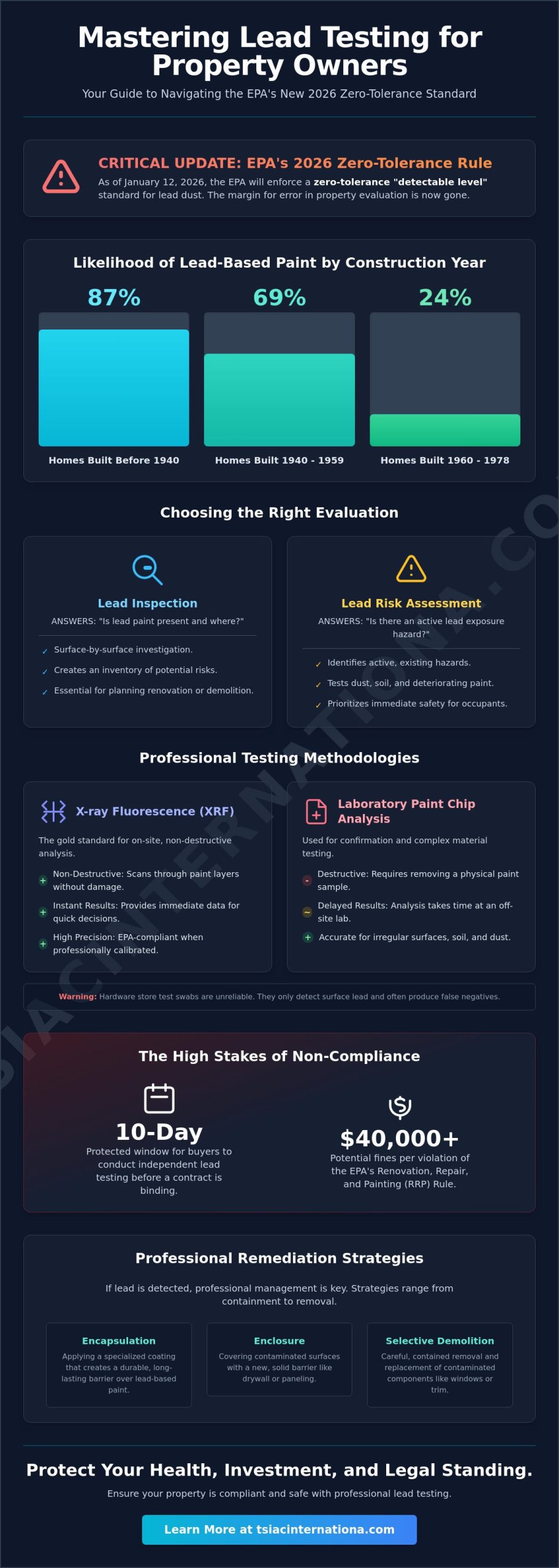
The historical context of the property dictates the necessity of these specialized services. Understanding the Prevalence of lead-based paint in U.S. homes is foundational for any modern owner. Statistics confirm that homes built before 1940 have an 87% likelihood of containing lead-based paint. Even for structures built between 1960 and 1978, the risk remains at 24%. In 2026, the return on investment for professional testing is clear. It prevents the astronomical costs of emergency abatement and ensures compliance with the latest EPA dust-lead standards, where any detectable level of lead dust is now a reportable hazard.

Lead Inspection vs. Lead Risk Assessment

A lead inspection is a surface-by-surface investigation. Its primary goal is to determine the presence and location of lead-based paint on every painted or finished component of the building. It’s an inventory of potential risks, which is essential if you’re planning a future interior gutting or selective demolition. A lead risk assessment is different; it identifies active hazards. This process evaluates deteriorating paint and tests dust and soil to see if lead is currently being released into the environment. Investors often choose an inspection for long-term planning, while families moving into a property should prioritize a risk assessment to ensure immediate safety.

The Legal Reality of Lead in Real Estate Transactions

Federal law requires sellers and landlords of pre-1978 housing to disclose known lead hazards and provide specific educational materials to occupants. Buyers have a protected 10-day window to conduct independent lead testing for home inspection before a contract becomes binding. You shouldn’t ignore this window. Findings from these tests can significantly impact property valuation and may even be a requirement for mortgage approval in certain jurisdictions. With EPA RRP Rule violation fines reaching up to $40,000, the legal stakes of failing to document and manage lead hazards have never been higher.

Technical Methodologies: XRF Analysis vs. Laboratory Sampling

The technical landscape of environmental hazard detection has shifted toward high-precision instrumentation that eliminates guesswork. In 2026, relying on hardware store test swabs is a significant liability. These reactive chemicals only detect lead on the outermost surface and often produce false negatives when lead is encapsulated under newer paint layers. Professional lead testing for home inspection utilizes two primary scientific paths: X-ray Fluorescence (XRF) and laboratory digestion. Each method serves a specific role in a methodical risk assessment.

X-ray Fluorescence (XRF) Technology Explained

XRF analyzers are the gold standard for non-destructive testing. These handheld devices emit high-energy X-rays that penetrate through multiple layers of paint to excite lead atoms in the substrate. When these atoms return to a stable state, they emit a unique fluorescent signature that the device measures instantly. This allows a technician to scan an entire room, from baseboards to window casings, without damaging the property’s aesthetic finish or historic molding.

Precision depends on rigorous professional calibration. A certified inspector must verify the device against known standards before every session to ensure accuracy within the strict tolerances required by the EPA Lead-Based Paint Disclosure Rule. While XRF provides immediate data, complex cases involving irregular surfaces or contaminated soil may still require paint chip sampling. In these scenarios, a technician carefully removes a small sample for laboratory digestion, a process that provides a definitive lead concentration by weight.

The Limitations of Surface-Level Testing

Lead buried under five or ten layers of modern latex paint isn’t inert. It remains a structural hazard, particularly on friction surfaces like door frames and window sashes. Every time these components move, they grind the lead-based layers into microscopic dust. Under the new 2026 EPA standards, any detectable level of lead in dust on floors or windowsills is now a reportable hazard, making professional dust wipe sampling essential during the inspection process.

A comprehensive investigation must extend beyond the walls. It should include several critical vectors:

  • Dust Wipe Sampling: Capturing particles from high-traffic floors and sills to identify immediate inhalation risks.
  • Soil Analysis: Testing the perimeter of the foundation where exterior paint may have flaked and accumulated over decades.
  • Water Testing: Identifying lead leaching from older plumbing solder or service lines.

Identifying these risks early allows for a controlled response rather than an emergency intervention. If your results indicate systemic contamination, pursuing professional lead abatement is the most effective way to ensure the long-term structural safety and value of your asset.
Lead Testing for Home Inspection: The 2026 Property Owner’s Comprehensive Guide

The legal framework governing property transfers in the United States prioritizes transparency regarding environmental toxins. Under Section 1018 of Title X, sellers and landlords of housing built before 1978 are legally obligated to provide prospective buyers or tenants with the EPA-approved pamphlet “Protect Your Family from Lead in Your Home.” While earlier sections established the technical need for lead testing for home inspection, this legal requirement ensures that the right to information precedes the financial commitment. Exercising this right allows you to convert a passive disclosure into an active investigation of the property’s environmental profile.

Once lead is officially documented through professional testing, it becomes a permanent disclosure item for the life of the property. For landlords, this means providing specific lead hazard information to every new tenant before a lease is signed. For buyers, the presence of lead creates a clear path for contractual negotiation. Tenants also hold specific protections; they must be notified of any known lead-based paint or hazards before they are legally bound to a rental agreement. This shift in responsibility ensures that the burden of safety remains with the property owner, maintaining a standard of care consistent with 2026 regulatory expectations.

The Lead Inspection Contingency

A robust lead inspection contingency is more than a simple exit clause. It should be drafted to define exactly how findings will influence the final sale price or repair requirements. Rather than accepting an “as-is” condition, savvy buyers use detailed test results to demand professional remediation or structural credits. This contractual protection ensures that the buyer isn’t left absorbing the costs of managing legacy environmental hazards. By specifying the required qualifications for the inspector and the timeline for results, you create a transparent process that protects all parties involved in the transaction.

Documentation and Compliance

Maintaining a centralized record of your lead inspection report is essential for protecting the long-term equity of your asset. A “lead-safe” certification acts as a badge of quality, proving that the property has been managed with methodological precision. For owners managing multiple units or older structures, integrating these reports into a broader hazardous material abatement guide ensures consistent compliance across all regulatory layers. Adhering to the EPA guidelines on lead inspection and risk assessment provides the authoritative documentation necessary to mitigate future liability and streamline future resale processes.

Evaluating Risk: What Lead Test Results Mean for Your Property

Receiving a positive result from lead testing for home inspection is rarely a reason to terminate a real estate transaction. Instead, it serves as the foundation for a sophisticated risk-modeling exercise. You must distinguish between the presence of lead-based paint and the existence of lead-based paint hazards. Lead-based paint that is stable and undisturbed is a managed condition; a hazard is an active pathway for toxin exposure. Professional results categorize findings based on the component’s condition and its potential for future degradation, allowing you to prioritize interventions based on technical necessity rather than panic.

Prioritizing remediation requires an understanding of mechanical stress on building components. Friction surfaces, such as window sashes and door frames, generate microscopic dust through daily use. Impact surfaces, like baseboards or stair treads, are prone to chipping. Accessible chewable surfaces, particularly low window sills, pose the highest risk in environments with young children. While full removal is the most definitive solution, many owners opt for “interim controls.” This managed maintenance approach involves specialized repairs and rigorous monitoring to keep the lead-based paint in a non-hazardous state without the immediate cost of total abatement.

Intact vs. Deteriorated Paint

Intact lead paint can often be safely managed through professional encapsulation. This involves applying a specialized liquid coating that creates a long-lasting, impact-resistant bond over the lead-based layer. However, the situation changes once you see signs of “chalking,” “flaking,” or “peeling.” These are indicators that the paint film has failed. Environmental factors like high humidity in bathrooms or structural settling in older foundations can trigger new hazards in previously stable areas. When paint begins to deteriorate, the risk of lead dust accumulation increases exponentially, requiring immediate technical intervention.

Lead Dust: The Invisible Threat

As of January 2026, the EPA has implemented a zero-tolerance policy for dust-lead hazards. Any detectable level of lead in dust on floors or window sills is now a reportable hazard. Following any disturbance or remediation, the Dust-Lead Action Level (DLAL) for clearance is strictly set at 5 micrograms per square foot (µg/ft²) for floors and 40 µg/ft² for window sills. These microgram thresholds are incredibly low; you cannot achieve them with standard household vacuuming. Standard vacuums often exhaust fine lead particles back into the air, exacerbating the problem. Professional cleaning protocols require industrial HEPA-filtered extraction and specialized wet-wiping techniques to meet these 2026 safety standards.

Understanding these results allows you to transform a liability into a managed asset. If your inspection reveals high-risk hazards on friction or impact surfaces, securing a professional lead abatement strategy is the most reliable way to protect your investment and ensure the health of all future occupants.

From Detection to Abatement: Professional Remediation Strategies

Once the diagnostic phase of lead testing for home inspection is complete, the transition from identification to remediation must be handled with surgical precision. Effective lead management follows a strict hierarchy of control: encapsulation, enclosure, and removal. While encapsulation involves sealing lead-based paint with specialized coatings and enclosure covers the hazard with new materials like drywall, permanent removal is often the most sound long-term investment. For high-risk components such as window sashes or decorative trim, selective demolition is frequently the most efficient path. This process involves the careful extraction of the contaminated component itself, eliminating the hazard at its source rather than merely managing it in place.

The technical execution of these strategies requires advanced containment protocols. By establishing negative air pressure within a sealed containment zone, technicians ensure that microscopic particles liberated during the removal process are captured by industrial HEPA filtration systems before they can migrate to non-work areas. This methodological rigor is what separates a professional abatement project from a standard renovation. The goal isn’t just to remove the paint, but to ensure the structural environment remains stable and uncontaminated throughout the entire lifecycle of the project.

Selecting a Certified Abatement Contractor

Property owners must verify that their chosen firm holds current EPA RRP (Renovation, Repair, and Painting) certifications. A general contractor may understand structural logic, but a hazardous material specialist understands the molecular behavior of toxins and the legal requirements for their disposal. Before beginning any work, it’s essential to review the asbestos and lead safety regulations that govern these high-risk environments. This ensures that your project complies with both state and federal mandates, protecting you from the $40,000 fines associated with non-compliant work practices.

The Abatement Process: What to Expect

Site preparation is the most critical phase of the remediation timeline. Technicians will seal HVAC vents and utilize heavy-duty plastic sheeting to isolate the work zone. During the removal phase, professionals use wet scraping or mechanical HEPA sanding to minimize dust generation. Following the physical removal, the site undergoes a multi-stage decontamination process. This leads to the final clearance testing, where an independent professional verifies that dust-lead levels meet the 2026 standards of 5 µg/ft² for floors and 40 µg/ft² for window sills before the area is cleared for re-occupancy.

Why Professional Intervention is Mandatory

Attempting DIY lead removal is a high-risk gamble that often results in greater contamination than the original hazard. Uncertified sanding or dry scraping releases clouds of invisible toxic dust that settle into carpets and ventilation systems, creating a persistent health threat. Beyond the physical risks, uncertified work can void your property insurance and create massive legal liabilities during future resale. For homeowners and investors, the choice is clear. Contact TSIAC International today to secure expert structural and hazardous remediation services that guarantee the safety and value of your property.

Securing Your Property’s Future with Technical Precision

Managing a property in 2026 requires more than just awareness; it demands a methodical approach to environmental safety. By prioritizing professional lead testing for home inspection, you move beyond guesswork and into a data-driven strategy for risk mitigation. You’ve seen that while lead remains a significant technical challenge, it’s entirely manageable through high-precision analysis and certified abatement protocols. These procedures don’t just protect occupants. They safeguard your financial investment and ensure your legal standing remains unassailable.

When you’re ready to transition from detection to permanent solutions, partnering with an industry leader is essential. Consult with TSIAC International for Professional Abatement Solutions to leverage over 15 years of expertise in hazardous material remediation. Our certified specialists provide comprehensive lead and asbestos abatement alongside specialized structural and selective demolition services. We provide the technical mastery needed to return your property to a safe, compliant, and valuable state. Take control of your property’s environmental health today with a partner you can trust.

Frequently Asked Questions

Is lead testing included in a standard home inspection?

Standard home inspections don’t include specialized lead detection. General inspectors evaluate structural integrity and mechanical systems; they aren’t required to hold the EPA environmental certifications necessary for hazard analysis. Professional lead testing for home inspection requires calibrated XRF technology or laboratory sampling that falls outside the scope of a basic property assessment.

How much does a professional lead inspection cost in 2026?

Professional evaluation costs vary depending on the property’s square footage and the complexity of the testing required. A comprehensive risk assessment that includes soil analysis and dust wipe sampling represents a higher technical investment than a basic surface inspection. You should request a detailed quote that accounts for the specific number of painted components in your structure to ensure an accurate budget.

Can I test for lead-based paint myself using a store-bought kit?

Store-bought chemical swabs aren’t reliable for professional or legal documentation. These kits only detect lead on the outermost surface and frequently produce false negatives when lead is buried under newer paint layers. They don’t meet the rigorous scientific standards required for federal disclosure or compliance with the 2026 EPA dust-lead reportable levels.

What happens if lead is found during a home inspection?

Finding lead allows you to exercise your rights under the lead inspection contingency in your real estate contract. You can utilize the results to negotiate for professional remediation or a reduction in the sale price to cover future management costs. Once lead is officially documented, it must be disclosed to all future buyers or tenants of the property.

How long does a lead inspection take to complete?

A professional evaluation typically takes between two and four hours for a standard single-family home. The use of handheld XRF analyzers allows for rapid, non-destructive data collection across all interior and exterior surfaces. If the technician needs to collect paint chips for laboratory digestion, you can expect a few additional business days for the final report.

Does lead paint always have to be removed if it’s found?

Full removal isn’t the only option if the lead-based paint is in good condition. Intact paint that isn’t on a friction surface can often be safely managed through professional encapsulation or enclosure. However, if the coating is flaking or located on high-impact areas like door frames, intervention is necessary to prevent the release of toxic particles into the environment.

What is the difference between a lead inspection and a lead risk assessment?

An inspection identifies the exact location of all lead-based paint throughout the building’s structure. A risk assessment is more specialized; it evaluates the severity of active hazards, such as contaminated dust or soil, and provides a methodical plan for remediation. Most property owners choose a risk assessment to ensure the immediate health of their family or tenants.

How often should I re-test my home for lead hazards?

You should consider a re-test if the property undergoes structural settling or if you notice any new paint deterioration. It’s also vital to perform clearance testing after any renovation that disturbs painted surfaces. Regular visual monitoring of high-friction areas like windows and doors helps you identify new risks before they reach hazardous levels.

Presenting a Demolition Budget to Stakeholders: A 2026 Strategic Guide

The most successful demolition projects aren’t won on the lowest bid, but on the most defensible risk assessment. When you’re presenting a demolition…

The most successful demolition projects aren’t won on the lowest bid, but on the most defensible risk assessment. When you’re presenting a demolition budget to stakeholders in 2026, you’re not just asking for funds to remove a 5,000-square-foot commercial building for $30,500. You’re actually proposing a strategic plan to de-risk the site while navigating OSHA 1926.850(a) engineering survey requirements. We understand that stakeholders often view $20 per square foot asbestos remediation costs with skepticism or fear that hidden site conditions will lead to massive overruns. It’s a valid concern, especially when disposal rates in places like Burlington County have reached $127.55 per ton for construction debris.

This guide will teach you how to translate these complex technical requirements into a clear financial narrative that secures project approval. You’ll learn to justify the necessity of specialized abatement and prove the long-term ROI of precision site preparation. We’ll break down the 2026 regulatory landscape and show you how to build a budget that earns both a signed contract and total stakeholder confidence in your project timeline.

Key Takeaways

  • Learn how to bridge the gap between technical demolition requirements and the specific financial expectations of developers and municipal boards.
  • Master the strategy for presenting a demolition budget to stakeholders by replacing vague lump-sum estimates with transparent, itemized line items for every project phase.
  • Discover industry standards for contingency planning to account for “unknown unknowns” like buried tanks or hazardous material discoveries without losing board confidence.
  • Shift the boardroom focus from the cost of destruction to the ROI of site de-risking using visual aids and value-first communication strategies.
  • Identify the critical safety and performance metrics, such as Experience Modification Rates (EMR), that validate your choice of a demolition partner to your investors.

The Stakes of Presenting a Demolition Budget to Stakeholders

Successful site redevelopment hinges on the transition from structural assessment to financial authorization. When you’re presenting a demolition budget to stakeholders, you’re acting as the critical bridge between engineering necessity and fiscal reality. This isn’t merely a request for funding; it’s a strategic defense of the project’s viability. Developers, municipal boards, and private investors don’t just look at the bottom line. They evaluate how your budget mitigates the inherent risks of site preparation. In 2026, the economic landscape has introduced new variables, including fluctuating equipment fuel surcharges and a tighter labor market for specialized abatement technicians. These factors make demolition budgeting uniquely volatile compared to traditional vertical construction, where material costs are more predictable.

The role of the project manager in this phase is to provide a narrative of control over these variables. Unlike new builds, demolition involves dismantling the unknown. Stakeholders need to see that you’ve accounted for every contingency, from 2026 EPA regulations regarding site runoff to the logistical complexities of high-density urban environments. A well-structured presentation ensures that when you’re presenting a demolition budget to stakeholders, you’re seen as a partner in risk management rather than just another expense line item.

Identifying Stakeholder Priorities in 2026

Stakeholder groups operate with distinct, often competing, priorities that your budget must address simultaneously:

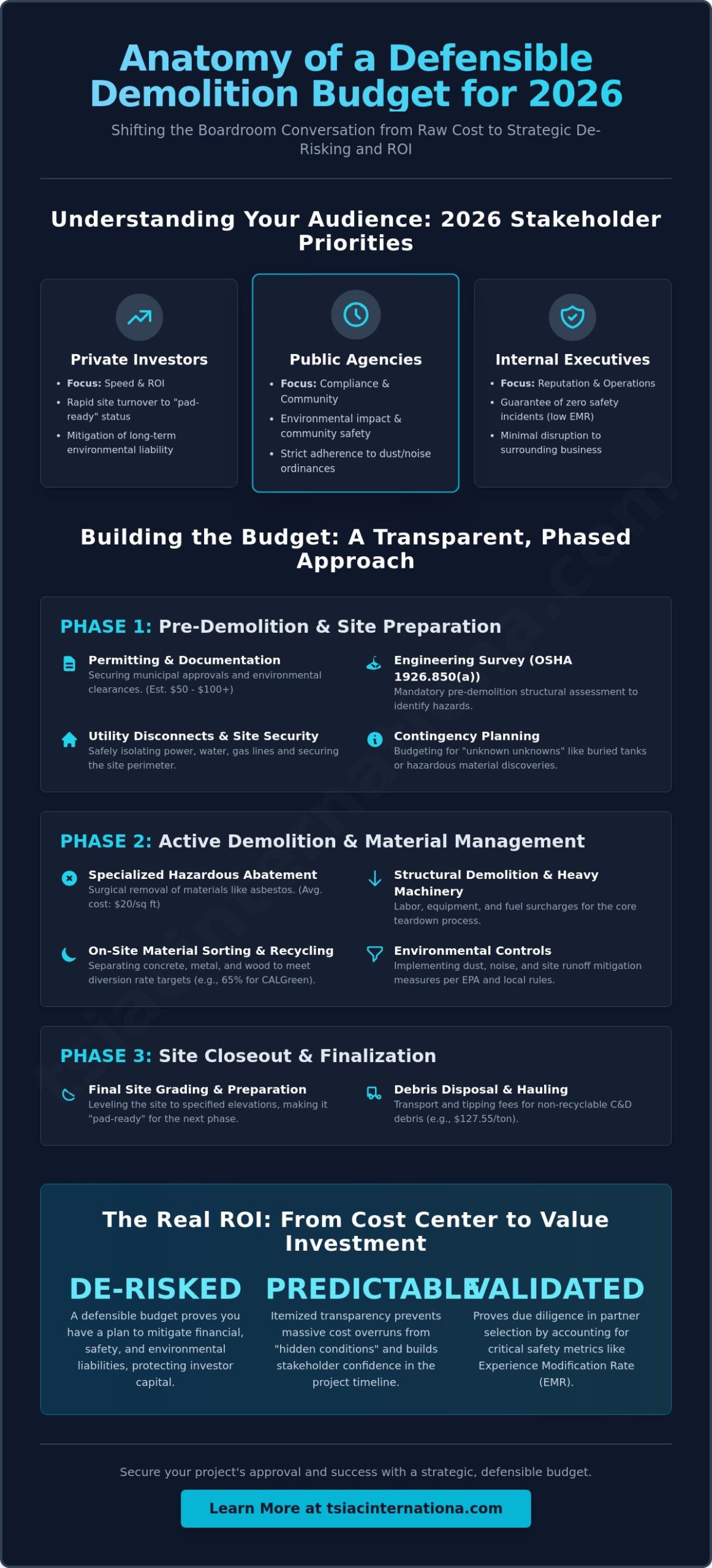
  • Private Investors: Their primary concerns are the speed of site turnover and the mitigation of long-term liability. They want to know how quickly the site will be “pad-ready” for the next phase.
  • Public Agencies: In 2026, municipal boards are heavily focused on environmental impact and community safety. They look for high diversion rates, such as the 65% rate required by CALGreen, and strict adherence to dust and noise ordinances.
  • Internal Executives: These stakeholders prioritize operational continuity and brand reputation. They require a budget that guarantees zero safety incidents and minimal disruption to surrounding business operations.

Why Demolition Budgets are Often Misunderstood

One of the greatest hurdles is the “Invisible Work” problem. Stakeholders often struggle to understand why site preparation requires significant capital when no new structure is being erected. There’s a common misconception that demolition is merely “unskilled labor” involving heavy machinery. In reality, modern projects require extreme technical precision, especially when performing selective demolition on structures that must remain partially operational. You must explain that costs aren’t just for “tearing down,” but for the surgical removal of hazardous materials, the protection of shared utilities, and the engineering surveys required by OSHA 1926.850(a). Highlighting these technical requirements transforms the budget from a cost center into a value-driven investment in site safety and compliance.

Building a Defensible Budget: Essential Line Items

Transparency is the only currency that matters when presenting a demolition budget to stakeholders. In an industry where “hidden conditions” often serve as an excuse for cost overruns, providing a granular, itemized bid is the most effective way to build trust. Moving beyond lump-sum estimates allows you to demonstrate a command of the project’s technical requirements. This approach aligns with Multiyear Project Budgeting Principles, which emphasize the necessity of identifying specific needs and potential costs before seeking final financial authorization. Site mobilization costs represent the critical investment in logistical readiness and operational safety that prevents project delays.

A professional budget must be partitioned into three distinct phases: pre-demolition, active operations, and post-demolition. Pre-demolition costs often include often-overlooked expenses such as permitting fees, which can range from $50 to $100, and the essential utility disconnects required to safe-off the site. Active operations cover the labor and specialized machinery needed for the core work, while post-demolition items include site grading and ongoing site security to prevent unauthorized access. By detailing these phases, you ensure that investors see a complete roadmap of the project’s financial lifecycle. For those managing complex industrial sites, consulting with a partner experienced in structural demolition can help refine these estimates before the final presentation.

Hazardous Material Abatement and Remediation

Hazardous material management is frequently the most scrutinized portion of any budget. You should always list asbestos removal as a separate, prioritized line item rather than burying it in general labor. In 2026, interior asbestos remediation typically costs between $5 and $20 per square foot, and failing to account for this with precision can derail an entire project. Your budget must also account for lead-based paint, mold remediation, and potential chemical contaminants found in older industrial structures. Don’t forget to include the costs of mandatory regulatory filings and third-party air monitoring, which provide the documented proof of safety that stakeholders and public agencies demand.

Logistics, Disposal, and Recycling Credits

Logistical expenses in 2026 are heavily influenced by equipment fuel surcharges and varying regional disposal rates. For instance, construction and demolition waste disposal in Burlington County, NJ, currently costs $127.55 per ton, while other regions may offer more competitive rates. When presenting a demolition budget to stakeholders, you must project these tipping fees accurately based on the building’s material composition. One way to mitigate these costs is through recycling credits. By projecting the salvage value of recycled metal, wood, and concrete, you can show stakeholders a potential offset to disposal expenses. This strategy not only improves the bottom line but also meets the increasing demand for sustainable site deconstruction practices.

Presenting a Demolition Budget to Stakeholders: A 2026 Strategic Guide

Managing Uncertainty: Addressing Contingencies and Risk

Risk in demolition isn’t a project threat; it’s a manageable financial variable that requires precise calculation. When you’re presenting a demolition budget to stakeholders, the way you frame contingency funds determines your professional credibility. While vertical construction might allow for a 5% buffer, the industry standard for demolition typically ranges from 10% to 20%. This higher threshold accounts for the inherent volatility of working with existing structures and subsurface conditions. By categorizing these risks early, you shift the conversation from fear of the unknown to a disciplined strategy of financial readiness.

A critical part of this strategy involves differentiating between “known unknowns” and “unknown unknowns.” For example, site access in a high-density urban environment is a known unknown; we know it’s a constraint, but the exact daily delay is variable. Conversely, discovering unmapped underground storage tanks represents an unknown unknown. Professional hazardous material abatement acts as an insurance policy against future litigation, ensuring that environmental liabilities are neutralized before they can impact the project’s long-term ROI. Presenting these items with technical clarity proves that your budget isn’t a guess, but a calculated engineering plan.

Quantifying Hidden Site Conditions

To justify subsurface exploration costs, you should utilize Ground Penetrating Radar (GPR) data. This technology allows you to provide stakeholders with evidence-based justifications for exploration line items. When presenting a demolition budget to stakeholders, it’s effective to offer a “most-likely” scenario alongside a “worst-case” projection. This transparency prevents the shock of discovery. For instance, discovering unmapped utilities can lead to significant delays, but having a pre-approved contingency for utility “safe-offs” keeps the project moving without requiring a new round of boardroom approvals.

Regulatory Compliance and Liability Protection

The cost of non-compliance in 2026 is higher than ever, with OSHA increasing inspections and enforcement in high-risk sectors. Your budget must clearly outline the expenses related to high-tier insurance and bonding, particularly for complex structural removals. These aren’t just administrative burdens; they’re essential layers of protection for the stakeholder’s capital. By connecting safe work practices and environmental adherence to lower long-term risk, you demonstrate that a higher upfront investment in compliance prevents much more expensive stop-work orders or legal fees later in the project lifecycle.

  • Contingency Standard: Maintain a 10-20% buffer to handle structural surprises.
  • Subsurface Validation: Use GPR data to reduce the “unknown” factor in site preparation.
  • Liability Shielding: Prioritize bonding and insurance to protect stakeholder assets.

Strategic Presentation Techniques for Boardroom Approval

Boardroom success isn’t about the numbers alone; it’s about the narrative of site transformation. When you’re presenting a demolition budget to stakeholders, you must lead with the property’s end-state. Instead of opening with the $30,500 cost of a 5,000-square-foot commercial removal, show a 3D site scan of the cleared, grade-A development land. This “Value-First” approach reframes the project from a destructive expense to a necessary investment in site potential. By contrasting high-resolution 3D scans with the current dilapidated state, you provide a tangible vision that justifies the capital expenditure and builds immediate confidence in the project’s direction.

Technical precision must be translated into direct business impact. When discussing selective demolition, don’t focus on the equipment or the debris; explain how this method preserves $2 million in existing structural assets for the next phase of development. This language resonates with investors who prioritize asset protection over raw destruction. To further ease decision-making, employ a “Three-Option” Strategy. Present a lean budget for basic compliance, a recommended budget for optimal safety and efficiency, and an accelerated budget for rapid speed-to-market. This gives stakeholders a sense of control over the project’s financial levers while highlighting the trade-offs between cost and time.

Visualizing the Project Lifecycle

Clarity in the timeline reduces stakeholder anxiety and prevents mid-project friction. Use detailed Gantt charts to illustrate exactly how the demolition process functions as the critical path for the subsequent construction phase. Before-and-after renderings help build emotional buy-in, while milestone-based funding ensures the board that capital is only released as specific safety and clearing goals are met. This structured approach mirrors the engineering precision required for complex structural work and provides a transparent roadmap for all parties involved.

Handling Tough Questions on Cost and Timeline

You must be prepared for the inevitable pushback on speed and environmental expenses. When asked why a project can’t be completed faster, explain the ROI of surgical precision in interior gutting. Rushing structural work increases the risk of utility damage, which can lead to months of unbudgeted delays. Reframing environmental compliance costs as “green credits” also helps align the project with the company’s 2026 ESG goals, turning a regulatory burden into a corporate win. If you’re ready to move from planning to execution, request a professional demolition consultation to verify your budget’s accuracy before the final board vote.

Selecting a Partner for Budget Accuracy and Execution

The final stage of presenting a demolition budget to stakeholders is the selection of a delivery partner who can transform financial projections into site-ready reality. A budget is only as defensible as the firm’s ability to execute it without catastrophic “budget creep.” Evaluating a contractor’s Experience Modification Rate (EMR) provides a data-driven window into their operational discipline; a rate below 1.0 signals a safety record that actively lowers project insurance premiums and liability for the stakeholder. For the board, fixed-price contracts represent the gold standard of fiscal responsibility, as they shift the risk of unforeseen operational delays from the investor to the specialist.

TSIAC International positions itself as the expert partner for complex, high-stakes projects where precision is non-negotiable. Our team approaches every site with the fegyelmezett, engineering-focused mindset required to maintain the stability of both the physical structure and the project’s financial health. When you’re presenting a demolition budget to stakeholders, having a partner with a transparent track record allows you to answer tough questions with data rather than estimates. This level of preparation ensures that the transition from the boardroom to the job site is seamless and professional.

The Value of Institutional Experience

Institutional experience is the most effective hedge against the “unknown unknowns” discussed earlier in this guide. With over 15 years of experience, a firm has seen the evolution of building materials and regulatory shifts, allowing for more accurate initial estimates. One of the primary benefits of hiring a contractor who manages both structural work and abatement in-house is the elimination of third-party markups and scheduling conflicts. By leveraging professional structural demolition expertise during the budgeting phase, project managers can identify potential structural shoring needs or utility complexities before they become expensive change orders.

Environmental Stewardship as a Budget Asset

In 2026, environmental stewardship has evolved from a moral choice to a significant budget asset. TSIAC’s commitment to recycling wood, metal, and plastic doesn’t just meet sustainability goals; it directly reduces client disposal fees by diverting waste from high-cost landfills. Our comprehensive documentation processes ensure that all necessary 2026 environmental permits are secured quickly, preventing the costly stop-work orders that plague less disciplined firms. We recommend closing your presentation with a clear call to action for a site walkthrough. This allows stakeholders to see the technical challenges firsthand and confirms that your budget is rooted in the physical realities of the property. Contact our team today to schedule a comprehensive site evaluation and finalize your strategic demolition plan.

Transforming Financial Data into Site Readiness

Success in the boardroom requires more than just a list of numbers; it demands a narrative of control. By prioritizing transparency in your itemized bids and maintaining a disciplined 10-20% contingency for structural surprises, you provide the clarity your investors require. Master the art of presenting a demolition budget to stakeholders by focusing on long-term ROI and risk mitigation. This strategic approach ensures that every dollar spent on site preparation is an investment in the project’s future stability and safety.

TSIAC International offers the engineering precision and institutional knowledge needed for high-stakes projects. With over 15 years of experience, we specialize in both structural demolition and hazardous material abatement. Our commitment to sustainability includes comprehensive recycling practices for wood, metal, and plastic, which can significantly lower your project’s environmental footprint and disposal costs. Secure your project’s success with a professional demolition estimate from TSIAC International. We’re ready to help you navigate the complexities of site redevelopment with confidence and technical excellence.

Frequently Asked Questions

How much should I set aside for a demolition contingency fund?

The industry standard for demolition projects is a contingency fund of 10% to 20% of the total estimated cost. This buffer is higher than traditional construction because it must account for “unknown unknowns” such as buried storage tanks or unmapped utility lines. Maintaining this reserve ensures that the project remains financially viable even if subsurface conditions require immediate engineering adjustments or additional site stabilization.

Is it cheaper to do a full structural demolition or a selective gut-out?

Full structural demolition is typically cheaper on a per-square-foot basis, often ranging from $4 to $8 for commercial buildings. Selective interior gutting, while costing between $2 and $8 per square foot, requires significantly more precision labor and structural shoring to protect the remaining assets. While the upfront labor cost is higher for selective work, it often provides a better ROI by preserving millions in existing structural value.

How do I explain hazardous material abatement costs to investors?

You should frame abatement costs as a mandatory liability protection strategy rather than an optional expense. When presenting a demolition budget to stakeholders, remind them that interior asbestos removal, which averages $5 to $20 per square foot in 2026, is a legal requirement under EPA NESHAP regulations. Completing this work with technical precision acts as an insurance policy that prevents future litigation and ensures the site is safe for redevelopment.

What are the biggest factors that cause demolition budgets to exceed estimates?

Hidden site conditions and unmapped utilities are the primary drivers of budget overruns in 2026. Fluctuating disposal fees, such as the $127.55 per ton rate for construction waste in Burlington County, can also impact the bottom line if not locked in early. Additionally, discovering hazardous materials that weren’t identified in the initial survey can trigger expensive specialized remediation and cause significant delays in the project timeline.

Can recycling materials really lower the total cost of a demolition project?

Recycling can significantly lower project costs by reducing landfill tipping fees and generating salvage credits. Concrete and asphalt have recovery rates exceeding 95%, while metal recycling can provide a direct offset to labor expenses. In jurisdictions like California, where the CALGreen code requires a 65% diversion rate, high-efficiency recycling is a financial necessity that transforms waste management from a cost center into a strategic asset.

What documentation do stakeholders need to see before approving a budget?

Stakeholders require a comprehensive engineering survey, a detailed hazardous materials report, and a milestone-based Gantt chart. They also need to see the contractor’s safety EMR (Experience Modification Rate) and proof of high-tier bonding. Providing these documents during the presentation proves that the budget is based on technical data and professional risk assessment rather than broad estimates, which builds essential boardroom confidence.

How long does the budgeting and approval process usually take for commercial projects?

The typical timeline for the budgeting and approval process ranges from 4 to 12 weeks for most commercial projects. This period includes the time necessary for environmental testing, utility “safe-off” coordination with local providers, and municipal permit reviews. Starting this process early is critical because 2026 regulatory requirements for air monitoring and site runoff can add several weeks to the initial planning phase.

What is the risk of using a low-bid contractor for complex structural removal?

Low-bid contractors often present a significant risk of “budget creep” through frequent change orders and poor safety management. A firm with a high EMR or less than 15 years of institutional experience may lack the technical precision to handle selective demolition without damaging shared utilities. This increases the likelihood of expensive stop-work orders, environmental fines, and long-term liability that far exceeds any initial savings on the contract price.