
Presenting a Demolition Budget to Stakeholders: A 2026 Strategic Guide

The most successful demolition projects aren’t won on the lowest bid, but on the most defensible risk assessment. When you’re presenting a demolition…

The most successful demolition projects aren’t won on the lowest bid, but on the most defensible risk assessment. When you’re presenting a demolition budget to stakeholders in 2026, you’re not just asking for funds to remove a 5,000-square-foot commercial building for $30,500. You’re actually proposing a strategic plan to de-risk the site while navigating OSHA 1926.850(a) engineering survey requirements. We understand that stakeholders often view $20 per square foot asbestos remediation costs with skepticism or fear that hidden site conditions will lead to massive overruns. It’s a valid concern, especially when disposal rates in places like Burlington County have reached $127.55 per ton for construction debris.

This guide will teach you how to translate these complex technical requirements into a clear financial narrative that secures project approval. You’ll learn to justify the necessity of specialized abatement and prove the long-term ROI of precision site preparation. We’ll break down the 2026 regulatory landscape and show you how to build a budget that earns both a signed contract and total stakeholder confidence in your project timeline.

Key Takeaways

  • Learn how to bridge the gap between technical demolition requirements and the specific financial expectations of developers and municipal boards.
  • Master the strategy for presenting a demolition budget to stakeholders by replacing vague lump-sum estimates with transparent, itemized line items for every project phase.
  • Discover industry standards for contingency planning to account for “unknown unknowns” like buried tanks or hazardous material discoveries without losing board confidence.
  • Shift the boardroom focus from the cost of destruction to the ROI of site de-risking using visual aids and value-first communication strategies.
  • Identify the critical safety and performance metrics, such as Experience Modification Rates (EMR), that validate your choice of a demolition partner to your investors.

The Stakes of Presenting a Demolition Budget to Stakeholders

Successful site redevelopment hinges on the transition from structural assessment to financial authorization. When you’re presenting a demolition budget to stakeholders, you’re acting as the critical bridge between engineering necessity and fiscal reality. This isn’t merely a request for funding; it’s a strategic defense of the project’s viability. Developers, municipal boards, and private investors don’t just look at the bottom line. They evaluate how your budget mitigates the inherent risks of site preparation. In 2026, the economic landscape has introduced new variables, including fluctuating equipment fuel surcharges and a tighter labor market for specialized abatement technicians. These factors make demolition budgeting uniquely volatile compared to traditional vertical construction, where material costs are more predictable.

The role of the project manager in this phase is to provide a narrative of control over these variables. Unlike new builds, demolition involves dismantling the unknown. Stakeholders need to see that you’ve accounted for every contingency, from 2026 EPA regulations regarding site runoff to the logistical complexities of high-density urban environments. A well-structured presentation ensures that when you’re presenting a demolition budget to stakeholders, you’re seen as a partner in risk management rather than just another expense line item.

Identifying Stakeholder Priorities in 2026

Stakeholder groups operate with distinct, often competing, priorities that your budget must address simultaneously:

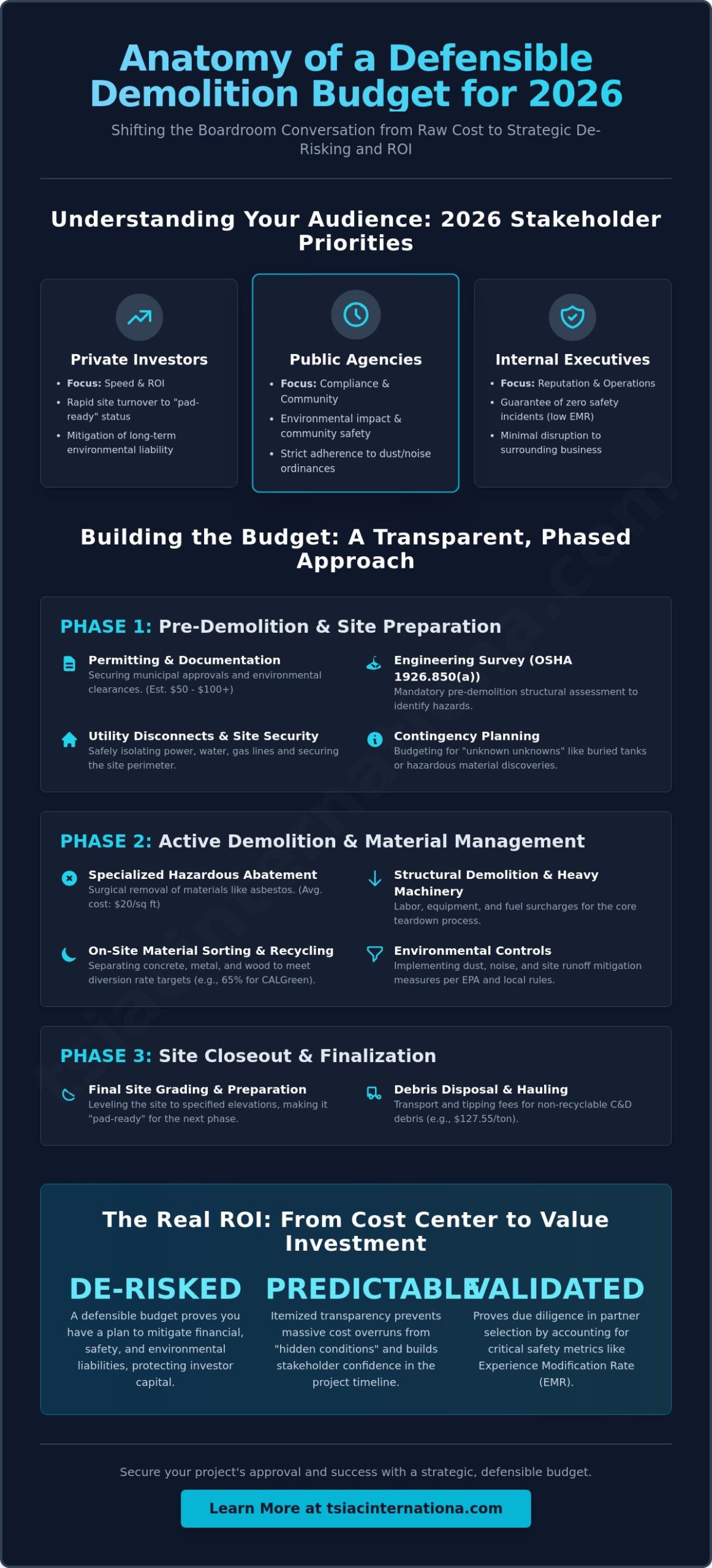
  • Private Investors: Their primary concerns are the speed of site turnover and the mitigation of long-term liability. They want to know how quickly the site will be “pad-ready” for the next phase.
  • Public Agencies: In 2026, municipal boards are heavily focused on environmental impact and community safety. They look for high diversion rates, such as the 65% rate required by CALGreen, and strict adherence to dust and noise ordinances.
  • Internal Executives: These stakeholders prioritize operational continuity and brand reputation. They require a budget that guarantees zero safety incidents and minimal disruption to surrounding business operations.

Why Demolition Budgets are Often Misunderstood

One of the greatest hurdles is the “Invisible Work” problem. Stakeholders often struggle to understand why site preparation requires significant capital when no new structure is being erected. There’s a common misconception that demolition is merely “unskilled labor” involving heavy machinery. In reality, modern projects require extreme technical precision, especially when performing selective demolition on structures that must remain partially operational. You must explain that costs aren’t just for “tearing down,” but for the surgical removal of hazardous materials, the protection of shared utilities, and the engineering surveys required by OSHA 1926.850(a). Highlighting these technical requirements transforms the budget from a cost center into a value-driven investment in site safety and compliance.

Building a Defensible Budget: Essential Line Items

Transparency is the only currency that matters when presenting a demolition budget to stakeholders. In an industry where “hidden conditions” often serve as an excuse for cost overruns, providing a granular, itemized bid is the most effective way to build trust. Moving beyond lump-sum estimates allows you to demonstrate a command of the project’s technical requirements. This approach aligns with Multiyear Project Budgeting Principles, which emphasize the necessity of identifying specific needs and potential costs before seeking final financial authorization. Site mobilization costs represent the critical investment in logistical readiness and operational safety that prevents project delays.

A professional budget must be partitioned into three distinct phases: pre-demolition, active operations, and post-demolition. Pre-demolition costs often include often-overlooked expenses such as permitting fees, which can range from $50 to $100, and the essential utility disconnects required to safe-off the site. Active operations cover the labor and specialized machinery needed for the core work, while post-demolition items include site grading and ongoing site security to prevent unauthorized access. By detailing these phases, you ensure that investors see a complete roadmap of the project’s financial lifecycle. For those managing complex industrial sites, consulting with a partner experienced in structural demolition can help refine these estimates before the final presentation.

Hazardous Material Abatement and Remediation

Hazardous material management is frequently the most scrutinized portion of any budget. You should always list asbestos removal as a separate, prioritized line item rather than burying it in general labor. In 2026, interior asbestos remediation typically costs between $5 and $20 per square foot, and failing to account for this with precision can derail an entire project. Your budget must also account for lead-based paint, mold remediation, and potential chemical contaminants found in older industrial structures. Don’t forget to include the costs of mandatory regulatory filings and third-party air monitoring, which provide the documented proof of safety that stakeholders and public agencies demand.

Logistics, Disposal, and Recycling Credits

Logistical expenses in 2026 are heavily influenced by equipment fuel surcharges and varying regional disposal rates. For instance, construction and demolition waste disposal in Burlington County, NJ, currently costs $127.55 per ton, while other regions may offer more competitive rates. When presenting a demolition budget to stakeholders, you must project these tipping fees accurately based on the building’s material composition. One way to mitigate these costs is through recycling credits. By projecting the salvage value of recycled metal, wood, and concrete, you can show stakeholders a potential offset to disposal expenses. This strategy not only improves the bottom line but also meets the increasing demand for sustainable site deconstruction practices.
Presenting a Demolition Budget to Stakeholders: A 2026 Strategic Guide

Managing Uncertainty: Addressing Contingencies and Risk

Risk in demolition isn’t a project threat; it’s a manageable financial variable that requires precise calculation. When you’re presenting a demolition budget to stakeholders, the way you frame contingency funds determines your professional credibility. While vertical construction might allow for a 5% buffer, the industry standard for demolition typically ranges from 10% to 20%. This higher threshold accounts for the inherent volatility of working with existing structures and subsurface conditions. By categorizing these risks early, you shift the conversation from fear of the unknown to a disciplined strategy of financial readiness.

A critical part of this strategy involves differentiating between “known unknowns” and “unknown unknowns.” For example, site access in a high-density urban environment is a known unknown; we know it’s a constraint, but the exact daily delay is variable. Conversely, discovering unmapped underground storage tanks represents an unknown unknown. Professional hazardous material abatement acts as an insurance policy against future litigation, ensuring that environmental liabilities are neutralized before they can impact the project’s long-term ROI. Presenting these items with technical clarity proves that your budget isn’t a guess, but a calculated engineering plan.

Quantifying Hidden Site Conditions

To justify subsurface exploration costs, you should utilize Ground Penetrating Radar (GPR) data. This technology allows you to provide stakeholders with evidence-based justifications for exploration line items. When presenting a demolition budget to stakeholders, it’s effective to offer a “most-likely” scenario alongside a “worst-case” projection. This transparency prevents the shock of discovery. For instance, discovering unmapped utilities can lead to significant delays, but having a pre-approved contingency for utility “safe-offs” keeps the project moving without requiring a new round of boardroom approvals.

Regulatory Compliance and Liability Protection

The cost of non-compliance in 2026 is higher than ever, with OSHA increasing inspections and enforcement in high-risk sectors. Your budget must clearly outline the expenses related to high-tier insurance and bonding, particularly for complex structural removals. These aren’t just administrative burdens; they’re essential layers of protection for the stakeholder’s capital. By connecting safe work practices and environmental adherence to lower long-term risk, you demonstrate that a higher upfront investment in compliance prevents much more expensive stop-work orders or legal fees later in the project lifecycle.

  • Contingency Standard: Maintain a 10-20% buffer to handle structural surprises.
  • Subsurface Validation: Use GPR data to reduce the “unknown” factor in site preparation.
  • Liability Shielding: Prioritize bonding and insurance to protect stakeholder assets.

Strategic Presentation Techniques for Boardroom Approval

Boardroom success isn’t about the numbers alone; it’s about the narrative of site transformation. When you’re presenting a demolition budget to stakeholders, you must lead with the property’s end-state. Instead of opening with the $30,500 cost of a 5,000-square-foot commercial removal, show a 3D site scan of the cleared, grade-A development land. This “Value-First” approach reframes the project from a destructive expense to a necessary investment in site potential. By contrasting high-resolution 3D scans with the current dilapidated state, you provide a tangible vision that justifies the capital expenditure and builds immediate confidence in the project’s direction.

Technical precision must be translated into direct business impact. When discussing selective demolition, don’t focus on the equipment or the debris; explain how this method preserves $2 million in existing structural assets for the next phase of development. This language resonates with investors who prioritize asset protection over raw destruction. To further ease decision-making, employ a “Three-Option” Strategy. Present a lean budget for basic compliance, a recommended budget for optimal safety and efficiency, and an accelerated budget for rapid speed-to-market. This gives stakeholders a sense of control over the project’s financial levers while highlighting the trade-offs between cost and time.

Visualizing the Project Lifecycle

Clarity in the timeline reduces stakeholder anxiety and prevents mid-project friction. Use detailed Gantt charts to illustrate exactly how the demolition process functions as the critical path for the subsequent construction phase. Before-and-after renderings help build emotional buy-in, while milestone-based funding ensures the board that capital is only released as specific safety and clearing goals are met. This structured approach mirrors the engineering precision required for complex structural work and provides a transparent roadmap for all parties involved.

Handling Tough Questions on Cost and Timeline

You must be prepared for the inevitable pushback on speed and environmental expenses. When asked why a project can’t be completed faster, explain the ROI of surgical precision in interior gutting. Rushing structural work increases the risk of utility damage, which can lead to months of unbudgeted delays. Reframing environmental compliance costs as “green credits” also helps align the project with the company’s 2026 ESG goals, turning a regulatory burden into a corporate win. If you’re ready to move from planning to execution, request a professional demolition consultation to verify your budget’s accuracy before the final board vote.

Selecting a Partner for Budget Accuracy and Execution

The final stage of presenting a demolition budget to stakeholders is the selection of a delivery partner who can transform financial projections into site-ready reality. A budget is only as defensible as the firm’s ability to execute it without catastrophic “budget creep.” Evaluating a contractor’s Experience Modification Rate (EMR) provides a data-driven window into their operational discipline; a rate below 1.0 signals a safety record that actively lowers project insurance premiums and liability for the stakeholder. For the board, fixed-price contracts represent the gold standard of fiscal responsibility, as they shift the risk of unforeseen operational delays from the investor to the specialist.

TSIAC International positions itself as the expert partner for complex, high-stakes projects where precision is non-negotiable. Our team approaches every site with the fegyelmezett, engineering-focused mindset required to maintain the stability of both the physical structure and the project’s financial health. When you’re presenting a demolition budget to stakeholders, having a partner with a transparent track record allows you to answer tough questions with data rather than estimates. This level of preparation ensures that the transition from the boardroom to the job site is seamless and professional.

The Value of Institutional Experience

Institutional experience is the most effective hedge against the “unknown unknowns” discussed earlier in this guide. With over 15 years of experience, a firm has seen the evolution of building materials and regulatory shifts, allowing for more accurate initial estimates. One of the primary benefits of hiring a contractor who manages both structural work and abatement in-house is the elimination of third-party markups and scheduling conflicts. By leveraging professional structural demolition expertise during the budgeting phase, project managers can identify potential structural shoring needs or utility complexities before they become expensive change orders.

Environmental Stewardship as a Budget Asset

In 2026, environmental stewardship has evolved from a moral choice to a significant budget asset. TSIAC’s commitment to recycling wood, metal, and plastic doesn’t just meet sustainability goals; it directly reduces client disposal fees by diverting waste from high-cost landfills. Our comprehensive documentation processes ensure that all necessary 2026 environmental permits are secured quickly, preventing the costly stop-work orders that plague less disciplined firms. We recommend closing your presentation with a clear call to action for a site walkthrough. This allows stakeholders to see the technical challenges firsthand and confirms that your budget is rooted in the physical realities of the property. Contact our team today to schedule a comprehensive site evaluation and finalize your strategic demolition plan.

Transforming Financial Data into Site Readiness

Success in the boardroom requires more than just a list of numbers; it demands a narrative of control. By prioritizing transparency in your itemized bids and maintaining a disciplined 10-20% contingency for structural surprises, you provide the clarity your investors require. Master the art of presenting a demolition budget to stakeholders by focusing on long-term ROI and risk mitigation. This strategic approach ensures that every dollar spent on site preparation is an investment in the project’s future stability and safety.

TSIAC International offers the engineering precision and institutional knowledge needed for high-stakes projects. With over 15 years of experience, we specialize in both structural demolition and hazardous material abatement. Our commitment to sustainability includes comprehensive recycling practices for wood, metal, and plastic, which can significantly lower your project’s environmental footprint and disposal costs. Secure your project’s success with a professional demolition estimate from TSIAC International. We’re ready to help you navigate the complexities of site redevelopment with confidence and technical excellence.

Frequently Asked Questions

How much should I set aside for a demolition contingency fund?

The industry standard for demolition projects is a contingency fund of 10% to 20% of the total estimated cost. This buffer is higher than traditional construction because it must account for “unknown unknowns” such as buried storage tanks or unmapped utility lines. Maintaining this reserve ensures that the project remains financially viable even if subsurface conditions require immediate engineering adjustments or additional site stabilization.

Is it cheaper to do a full structural demolition or a selective gut-out?

Full structural demolition is typically cheaper on a per-square-foot basis, often ranging from $4 to $8 for commercial buildings. Selective interior gutting, while costing between $2 and $8 per square foot, requires significantly more precision labor and structural shoring to protect the remaining assets. While the upfront labor cost is higher for selective work, it often provides a better ROI by preserving millions in existing structural value.

How do I explain hazardous material abatement costs to investors?

You should frame abatement costs as a mandatory liability protection strategy rather than an optional expense. When presenting a demolition budget to stakeholders, remind them that interior asbestos removal, which averages $5 to $20 per square foot in 2026, is a legal requirement under EPA NESHAP regulations. Completing this work with technical precision acts as an insurance policy that prevents future litigation and ensures the site is safe for redevelopment.

What are the biggest factors that cause demolition budgets to exceed estimates?

Hidden site conditions and unmapped utilities are the primary drivers of budget overruns in 2026. Fluctuating disposal fees, such as the $127.55 per ton rate for construction waste in Burlington County, can also impact the bottom line if not locked in early. Additionally, discovering hazardous materials that weren’t identified in the initial survey can trigger expensive specialized remediation and cause significant delays in the project timeline.

Can recycling materials really lower the total cost of a demolition project?

Recycling can significantly lower project costs by reducing landfill tipping fees and generating salvage credits. Concrete and asphalt have recovery rates exceeding 95%, while metal recycling can provide a direct offset to labor expenses. In jurisdictions like California, where the CALGreen code requires a 65% diversion rate, high-efficiency recycling is a financial necessity that transforms waste management from a cost center into a strategic asset.

What documentation do stakeholders need to see before approving a budget?

Stakeholders require a comprehensive engineering survey, a detailed hazardous materials report, and a milestone-based Gantt chart. They also need to see the contractor’s safety EMR (Experience Modification Rate) and proof of high-tier bonding. Providing these documents during the presentation proves that the budget is based on technical data and professional risk assessment rather than broad estimates, which builds essential boardroom confidence.

How long does the budgeting and approval process usually take for commercial projects?

The typical timeline for the budgeting and approval process ranges from 4 to 12 weeks for most commercial projects. This period includes the time necessary for environmental testing, utility “safe-off” coordination with local providers, and municipal permit reviews. Starting this process early is critical because 2026 regulatory requirements for air monitoring and site runoff can add several weeks to the initial planning phase.

What is the risk of using a low-bid contractor for complex structural removal?

Low-bid contractors often present a significant risk of “budget creep” through frequent change orders and poor safety management. A firm with a high EMR or less than 15 years of institutional experience may lack the technical precision to handle selective demolition without damaging shared utilities. This increases the likelihood of expensive stop-work orders, environmental fines, and long-term liability that far exceeds any initial savings on the contract price.
Commercial Interior Gut Out: The Professional Guide to Interior Demolition in 2026

A successful commercial interior gut out isn’t an act of destruction; it’s a surgical engineering operation where one misstep in hazardous material…

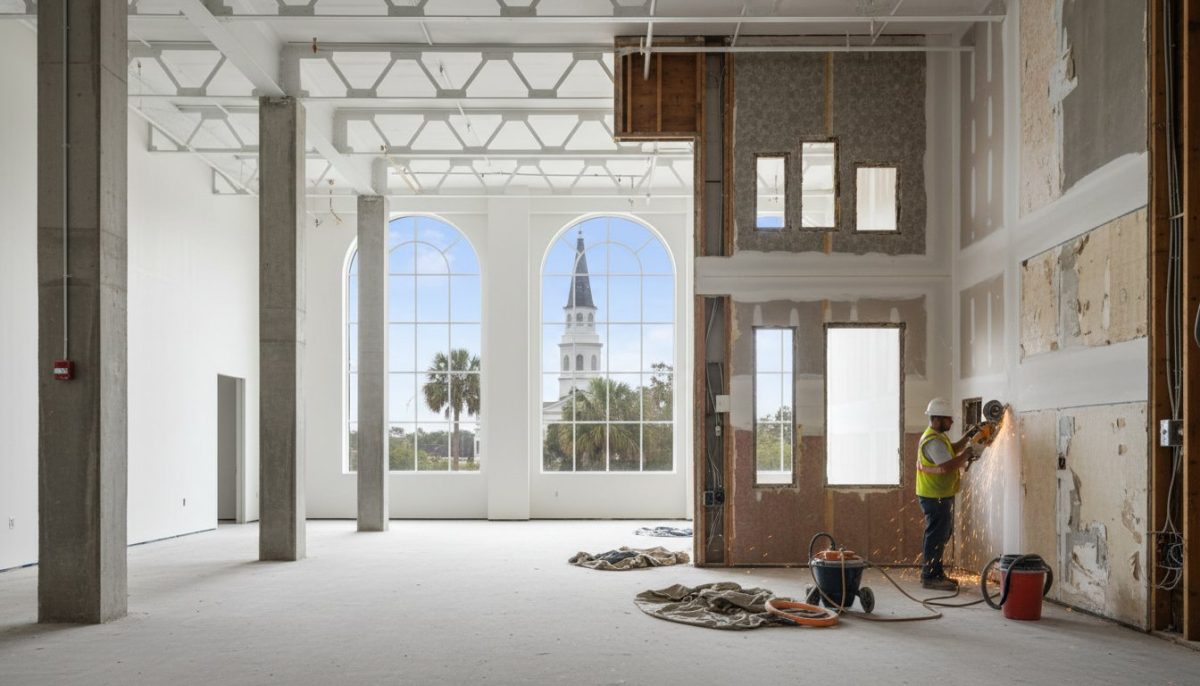
A successful commercial interior gut out isn’t an act of destruction; it’s a surgical engineering operation where one misstep in hazardous material identification can trigger a 30 percent project delay. You recognize that clearing a high-value space for a new tenant requires more than just heavy machinery. It demands a disciplined approach to selective demolition that protects the building’s core assets while stripping away the obsolete. In 2026, the margin for error has narrowed as regulatory bodies have intensified their focus on crystalline silica and lead exposure protocols.

It’s frustrating when hidden asbestos or structural surprises stall your timeline, but these risks are manageable with the right technical oversight. This professional guide provides the framework to master complex gut renovations, from surgical abatement to maximizing material recovery for corporate sustainability goals. You’ll learn how to navigate the latest EPA waste management standards and implement a demolition plan that delivers a clean white box ready for immediate reconstruction. We’ll examine the specific phases of a controlled interior strip-out and the compliance checklists essential for large-scale urban projects.

Key Takeaways

  • Distinguish between soft demolition and a full commercial interior gut out to define clear project boundaries and structural goals.
  • Understand the “surgical” execution sequence required to strip a building to its shell without compromising its load-bearing integrity.
  • Identify how to integrate hazardous material abatement into your workflow to avoid unforeseen timeline disruptions and safety violations.
  • Gain insights into the essential pre-demolition surveys and utility disconnects needed to navigate the modern regulatory landscape.
  • Learn how specialized engineering expertise can achieve high-percentage material diversion while maintaining rigorous site safety.

Understanding the Scope of Commercial Interior Gutting

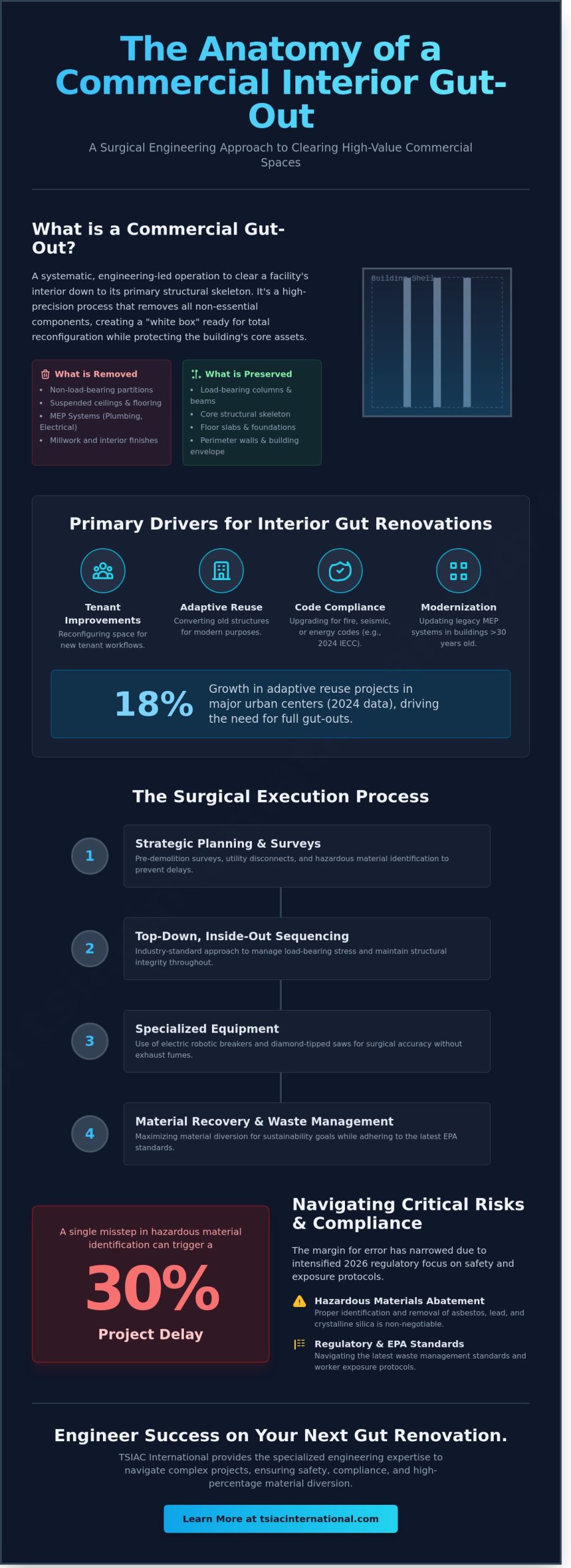
A commercial interior gut out represents a systematic, engineering-led approach to clearing a facility’s interior down to its primary structural skeleton. This process involves the controlled removal of all non-essential components, leaving only the floor slabs, load-bearing columns, and perimeter walls intact. It’s a high-precision operation that requires rigorous planning to ensure the building’s core stability remains uncompromised during the transition. Professional teams treat these projects as a blank canvas phase, where the goal is to eliminate outdated configurations while protecting the structural assets of the property.

Distinguishing between soft demolition and structural removal is the first step in project planning. Soft demolition focuses on the non-structural elements that define a space’s current utility. In the context of the Surgical Execution of Interior Demolition, teams prioritize the preservation of the building’s load-bearing capacity while maximizing the recovery of recyclable materials. While a partial renovation might only target specific floors, a full gut renovation often proves more cost-effective for owners dealing with buildings older than 30 years. It’s often cheaper to clear the entire floor plate than to work around legacy MEP (Mechanical, Electrical, and Plumbing) systems that no longer meet 2026 performance standards.

Key objectives for these projects usually center on three pillars: tenant improvements, rebranding, and code compliance. When a 15,000-square-foot office space transitions between tenants, a total commercial interior gut out allows for a complete reconfiguration that matches modern collaborative workflows. It’s also the most direct route to addressing mandatory seismic retrofitting or fire safety upgrades required by current municipal building codes.

Soft Demolition vs. Structural Demolition

Soft demolition involves the removal of non-load-bearing partitions, suspended ceilings, floor coverings, and millwork. This phase also includes the systematic extraction of MEP systems. Preserving the building envelope is the primary technical priority here. Technicians must ensure that the removal of heavy HVAC units or industrial piping doesn’t create vibration-induced stress on the exterior masonry or glass curtain walls. This disciplined approach prevents collateral damage to the building’s weather-tight seal and structural shell.

Common Drivers for Interior Gut Renovations

Adaptive reuse remains a dominant driver in 2026. According to industry data from 2024, adaptive reuse projects in major urban centers grew by 18% as developers transformed 20th-century warehouses into high-tech life science labs. These projects require stripping decades of wear and tear to install modern energy-efficient systems. Upgrading to meet the 2024 International Energy Conservation Code (IECC) often necessitates a full gut to install high-performance insulation and smart building sensors that were impossible to integrate into older, cluttered layouts.

The Surgical Execution of Interior Demolition

Precision defines the modern commercial interior gut out. It isn’t a process of blunt force; it’s a calculated engineering exercise. We treat the building’s skeleton with absolute respect, ensuring that structural integrity remains uncompromised while removing every non-essential element. A top-down, inside-out sequencing strategy is the industry standard in 2026. This approach manages load-bearing stresses effectively, preventing the accidental shifts in weight that lead to structural fatigue. By starting at the highest point and working toward the core, teams maintain a stable environment for both the structure and the personnel inside.

Executing this level of precision requires specialized equipment that goes beyond standard sledgehammers. We utilize electric-powered robotic breakers and diamond-tipped saws to ensure clean cuts without the risk of exhaust fumes in enclosed spaces. These tools allow for surgical accuracy in high-density commercial zones. This methodology fits seamlessly into the broader demolition process, where every interior action is dictated by the master engineering plan.

Selective Demolition Techniques

Selective demolition focuses on protecting what stays. Precision hand-demolition is used around sensitive structural columns and historical facades. We implement real-time vibration monitoring to protect adjacent tenants and delicate equipment. Managing shared utilities in multi-tenant properties requires a 100% lockout-tagout protocol. Following strict Regulatory Compliance ensures that every utility bypass and structural cut meets federal safety benchmarks. This level of control is what separates professional contractors from general laborers.

Material Recovery and Site Management

Modern site management is built on systematic resource recovery. By 2026, industry leaders are achieving recovery rates exceeding 85% for wood, metal, and plastic. We sort materials at the source, which streamlines hauling and reduces landfill costs. A “clean site” policy isn’t just about aesthetics; it’s a safety requirement. Data from 2025 shows that maintained sites experience 40% fewer fire hazards and trip accidents. We schedule debris hauling during off-peak hours to ensure business operations in surrounding areas continue without interruption.

Successful projects require a partner who understands the technical nuances of complex structures. If you’re planning a renovation, our team provides the technical expertise needed to clear your site safely and efficiently.

Commercial Interior Gut Out: The Professional Guide to Interior Demolition in 2026

Managing Hazardous Materials: Asbestos and Lead Abatement

Safety isn’t an option; it’s the foundation of a successful commercial interior gut out. In buildings constructed before 1980, the presence of hazardous materials is a statistical probability rather than a simple risk. Modern engineering standards in 2026 require comprehensive testing before a single wall is breached. This isn’t just about compliance. It’s about protecting the structural integrity of the project and the health of every worker on site. Professional testing identifies hidden toxins that visual inspections miss, ensuring that the demolition phase doesn’t become a liability.

The regulatory landscape is governed by strict Hazardous Materials: Asbestos and Lead Abatement protocols. Following these EPA and OSHA standards prevents the legal liabilities that often derail large-scale renovations. Project managers must integrate these phases into the master schedule at the very beginning. Treating abatement as a separate, prior stage ensures that the main demolition crew doesn’t encounter unexpected contaminants, which can cause project delays of 15% or more. For a detailed breakdown of regional requirements, review our hazardous material abatement guide to understand how these laws apply to your specific facility.

Asbestos Abatement in Commercial Spaces

Asbestos remains a persistent challenge in commercial environments. It’s frequently found in 9×9 floor tiles, thermal system insulation on pipes, and spray-on fireproofing applied to acoustic ceilings. Our teams utilize advanced containment strategies, including the establishment of negative air pressure zones and the use of HEPA filtration systems. These methods ensure that microscopic fibers don’t migrate to clean areas of the building during the commercial interior gut out. Understanding the asbestos removal process is vital for maintaining a site that meets 2026 safety benchmarks.

Lead Paint and Mold Remediation

Structural steel and older masonry often hide layers of lead-based paint. Cutting or grinding these surfaces requires specialized lead-safe work practices to prevent toxic dust inhalation. Simultaneously, moisture trapped behind drywall or within HVAC cavities often leads to significant mold colonies that appear only after the gutting begins. We address these biological hazards through mechanical removal and antimicrobial treatments. All toxic waste is then transported to certified facilities that meet current environmental disposal standards. Precision in these early stages guarantees a clean site for the upcoming reconstruction, allowing the project to proceed with engineering certainty.

Strategic Planning and Regulatory Compliance

Execution of a commercial interior gut out begins with a technical pre-demolition survey. This isn’t a cursory walkthrough; it’s a rigorous engineering assessment. Specialists must verify the load-bearing capacity of the remaining structure and identify hazardous materials like asbestos or lead-based paint. According to 2025 industry benchmarks, projects that skip a formal hazardous material survey face 22% higher costs due to emergency abatement. These surveys form the technical foundation for commercial interior gutting services, ensuring that the project timeline remains predictable.

Budgeting for a gut-out requires a focus on hidden conditions. It’s standard practice to maintain a 15% contingency fund for what lies behind the drywall. In 2026, 18% of urban demolition projects reveal non-compliant utility layouts or structural decay that wasn’t visible during initial inspections. Disposal fees also play a significant role. With landfill regulations tightening, waste management costs have increased by 6% over the last year, making efficient material sorting a financial necessity rather than just an environmental choice.

Permitting and Site Approvals

Securing a commercial demolition permit requires a submission of site-specific plans and waste diversion strategies. You can’t start work without a “Letter of Disconnect” from every utility provider. This document certifies that water, gas, and high-voltage electricity are physically severed at the source. This prevents catastrophic accidents during the commercial interior gut out process. Once the space is stripped to the structural members, a final inspection is mandatory. This “clean” certification confirms the site is safe for the next phase of construction and free of any lingering environmental hazards.

Safety Protocols and Risk Mitigation

Safety protocols must align with OSHA 1926.850 standards. Every site requires a written safety plan that addresses dust suppression, structural stability, and fall protection. Insurance requirements for high-stakes interior work are stringent. Most commercial property managers now require general liability coverage exceeding $5 million for projects in high-density areas. Communication is the final layer of protection. Daily tailboard meetings between stakeholders and general contractors ensure everyone understands the specific risks of the day’s tasks. This fegyelmezett approach minimizes downtime and protects the project’s bottom line.

If you require engineering precision for your next project, explore our professional interior demolition solutions.

Engineering Success with TSIAC International

TSIAC International brings over 15 years of specialized experience to the most demanding demolition environments across the country. We approach every project with the mindset of an engineering firm, ensuring that structural integrity and site safety remain uncompromised throughout the process. Our team understands that a commercial interior gut out is more than just debris removal; it’s the critical first phase of your asset’s next lifecycle. By housing both demolition and hazardous material abatement under one roof, we streamline the project timeline and reduce the coordination gaps that often lead to 15% budget overruns in multi-contractor scenarios.

Environmental stewardship is a core pillar of our operations. We consistently achieve a 90% material diversion rate on our job sites. This isn’t a vague projection but a standard we meet through meticulous on-site sorting and partnerships with specialized recycling facilities. This commitment helps project owners meet strict ESG targets and LEED requirements while reducing the overall environmental footprint of the construction process. You can see why industry leaders choose TSIAC International by reviewing our history of successful, high-stakes project completions.

Our Professional Service Standards

We eliminate financial uncertainty by providing fixed-price contracts that include transparent debris management fees from day one. Our crews possess deep expertise in specialized environments, including sterile medical wings, heavy industrial plants, and high-traffic retail spaces. We don’t rely on outdated methods. Instead, we invest in an advanced machinery fleet designed for efficiency and safety. Our equipment includes remote-controlled demolition robots for high-risk zones and electric-powered machinery for zero-emission indoor operation. This allows us to work in occupied buildings without compromising air quality or safety standards.

Get Started on Your Interior Transformation

The path to a successful commercial interior gut out starts with a technical consultation. We conduct a thorough site walk-through to identify load-bearing elements, utility disconnect points, and potential abatement needs. Following this evaluation, we deliver a detailed quote and a phased execution plan tailored to your specific constraints. While every building is unique, most standard commercial projects follow a 4 to 8 week timeline from mobilization to the final clean sweep. Contact our team today to schedule your comprehensive site evaluation and secure a partner who prioritizes engineering precision over simple destruction.

Securing Your Project’s Foundation for 2026 and Beyond

Executing a successful commercial interior gut out requires more than just heavy machinery; it demands a surgical approach to structural integrity and environmental safety. Managing a modern project means strictly adhering to OSHA-compliant safety protocols while navigating the technical complexities of asbestos and lead abatement. Precise planning ensures that every phase of the interior demolition meets rigorous 2026 regulatory standards without compromising your construction timeline or budget constraints.

TSIAC International brings over 15 years of industry experience to every job site, specializing in those difficult locations that require engineering precision. We’re fully licensed and insured for hazardous abatement, providing a level of reliability that protects both your physical assets and your workforce. Our team focuses on delivering a clean, build-ready environment through disciplined execution and a commitment to technical excellence. We handle the specialized solutions that others might avoid, ensuring your site is prepared for its next phase of life with total transparency.

Don’t leave your structural renovations to chance when you can partner with a firm that prioritizes safety and professional accountability. Request a Professional Quote for Your Commercial Interior Gut-Out and move forward with the confidence that your project is in expert hands. We’re ready to help you transform your space safely and efficiently.

Frequently Asked Questions

What is included in a commercial interior gut-out?

A commercial interior gut out involves the complete removal of all non-structural components within a building’s shell. This process includes stripping out interior walls, flooring materials, suspended ceilings, and mechanical, electrical, and plumbing (MEP) systems down to the concrete slab and structural pillars. In a 2024 industry report, researchers found that 85% of interior gut projects also require the removal of outdated insulation and cabinetry to prepare the space for a new floor plan.

How long does a typical 10,000-square-foot gut-out take?

A 10,000-square-foot interior demolition project usually requires 14 to 21 business days to reach completion. This timeline accounts for site preparation, utility capping, and the systematic removal of debris. If the structure contains complex MEP systems or requires specialized equipment for high-reach areas, the duration can extend by 7 days. Project managers at the National Demolition Association state that logistical constraints often add 20% to the total labor hours.

Is asbestos testing mandatory before starting interior demolition?

Federal regulations, specifically the EPA’s National Emission Standards for Hazardous Air Pollutants (NESHAP), make asbestos testing mandatory for all commercial structures before demolition begins. Owners must hire a certified inspector to identify any asbestos-containing materials (ACM) regardless of the building’s age. Failing to produce a negative test report or an abatement plan can result in fines exceeding $25,000 per day of violation. Safety protocols dictate that we don’t start any physical work until the environmental survey is finalized.

Can I stay open for business while an interior gut-out happens?

Occupying the immediate work zone during a commercial interior gut out is impossible due to air quality risks and structural safety hazards. However, large-scale facilities often utilize phased demolition where 50% of the building remains operational while the other half undergoes renovation. This requires the installation of floor-to-ceiling dust barriers and independent HVAC filtration systems. According to OSHA 1926.850, strict physical separation must be maintained to protect employees from noise levels that often exceed 85 decibels.

What happens to the materials removed during a gut-out?

Debris from the site undergoes a rigorous sorting process to maximize material recovery and meet LEED certification standards. We separate metals, concrete, and clean wood for transport to specialized recycling facilities. Current industry data from the Construction and Demolition Recycling Association shows that up to 70% of interior waste can be diverted from landfills. Any hazardous materials or non-recyclable components are transported to licensed disposal sites following strict chain-of-custody protocols to ensure environmental compliance.

How much does a commercial interior gut-out cost per square foot?

National averages for interior demolition typically range from $5 to $15 per square foot according to 2025 construction cost indexes. The final figure depends on the complexity of the MEP systems and the presence of hazardous materials like lead or asbestos. High-rise projects in dense urban centers often see costs increase by 30% due to logistical challenges and restricted working hours. We provide precise quotes only after a thorough site walk-through to evaluate the structural load and access points.

What is the difference between selective demolition and a gut-out?

Selective demolition targets specific architectural elements while preserving the surrounding infrastructure, whereas a gut-out strips the entire interior to the structural bones. In a selective project, a contractor might only remove 30% of the partition walls to create an open-plan office. A full gut-out removes 100% of the finishes, including all internal plumbing and electrical runs. This comprehensive approach is necessary when a building requires a total change of use or a complete modernization of its core systems.

Do I need a separate contractor for asbestos and lead removal?

You must use a contractor who holds specific environmental licenses for asbestos and lead abatement as required by state and federal law. While some full-service demolition firms maintain these certifications, approximately 40% of large-scale projects involve two separate entities to ensure specialized handling. Hiring a single firm with integrated environmental capabilities can reduce project timelines by 10% because it eliminates the need for inter-company scheduling. Always verify that the firm’s insurance policy explicitly covers hazardous material handling to mitigate your long-term liability.