20 Essential Questions to Ask Demolition Contractors Before Hiring in 2026

Did you know that OSHA citation 1926.850(a) regarding preparatory operations accounts for up to 75% of all demolition site penalties? It’s a sobering…

Did you know that OSHA citation 1926.850(a) regarding preparatory operations accounts for up to 75% of all demolition site penalties? It’s a sobering figure that proves most project failures happen long before the first wall falls. When you’re screening potential partners for your next project, the specific questions to ask demolition contractors must go beyond simple price per square foot to address the engineering precision required for modern site clearance.

You’re right to feel concerned about hidden liabilities, especially with the EPA’s May 28, 2026, deadline for phasing out chrysotile asbestos sheet gaskets. A single oversight in hazardous material handling or a failure to meet the 70% debris recycling rates now required in many jurisdictions can lead to significant fines and permanent project delays. This guide provides a professional framework to help you distinguish elite firms from “slash and burn” operators. We’ll walk you through 20 critical vetting points to ensure you secure a site that’s not just empty, but fully documented, compliant, and ready for your next phase of development.

Key Takeaways

  • Learn how to evaluate a firm’s Experience Modification Rate (EMR) and specialized structural licensing to mitigate liability and ensure site-wide safety.
  • Identify the critical questions to ask demolition contractors regarding their technical methodology and contingency protocols for unexpected hazardous material abatement.
  • Discover how to verify debris management plans that comply with 2026 recycling mandates through third-party verification and documented downstream partner lists.
  • Understand the administrative requirements for a successful project, from securing complex demolition permits to coordinating precise utility cut-and-caps.

Vetting for Compliance: Essential Licensing and Safety Questions

Professional demolition requires more than heavy machinery. It demands a rigorous legal and safety framework. When compiling your questions to ask demolition contractors, start with their credentials. A valid license for structural demolition is non-negotiable. However, if your site contains hazardous materials, the contractor must also hold specific abatement licenses. Verify these documents directly with the state licensing board to ensure they’re active and free of recent disciplinary actions. Any gap in licensing shifts the legal burden directly onto the property owner.

Beyond the paper license, look at the Experience Modification Rate (EMR). This number reflects a company’s past cost of injuries and future risk. An EMR of 1.0 is the national average; elite firms often maintain scores below 0.85. A high EMR is a red flag for poor safety culture and potential project delays. For a foundational Demolition overview, understanding how these safety metrics impact total project viability is essential. It’s the difference between a controlled site and a liability nightmare.

Understanding Insurance and Liability Limits

General liability insurance protects against property damage, but it typically excludes environmental hazards. In a demolition context, you must verify pollution liability coverage. This covers the release of asbestos fibers or lead dust during the work. Ask for a “waiver of subrogation” on the certificate of insurance. This prevents the contractor’s insurance company from seeking costs from your own insurance after a claim is paid. Ensure the policy limits match the building’s height and structural complexity, as standard policies often have height exclusions for work above three stories.

Safety Certifications and On-Site Oversight

Safety isn’t a suggestion; it’s an engineering requirement. Every project needs a Site-Specific Safety Plan (SSSP) that identifies hazards like fall risks or structural instability. Ask who the “Competent Person” is on-site. According to OSHA 1926.32(f), this individual must be capable of identifying hazards and have authority to stop work. For sites with hazardous history, supervisor staff should hold 40-hour HAZWOPER certifications. When finalizing your questions to ask demolition contractors, inquire about their participation in the National Safety Stand-Down for fall prevention scheduled for May 4-8, 2026. Daily toolbox talks ensure every crew member understands the day’s specific technical challenges and safety protocols.

Technical Execution: Questions Regarding Methodology and Hazardous Materials

Every project demands a specific mechanical approach. You must determine if the contractor relies on high-reach excavators for structural takedowns or if the site requires surgical, manual deconstruction to protect surrounding assets. Equipment reliability is equally vital. Ask for maintenance logs and the average age of their fleet. A breakdown on a critical path day can cost thousands in lost productivity. These are the technical questions to ask demolition contractors that separate professional engineers from general laborers.

Precision is especially critical when the project involves a mix of removal and preservation. A contractor’s ability to navigate tight tolerances determines the success of the next construction phase. If a firm can’t explain their sequence of operations in detail, they likely lack the technical depth required for complex 2026 site requirements. You need a partner who views demolition as a controlled engineering process rather than a blunt-force activity.

Structural vs. Selective Demolition Expertise

Preserving the building shell while stripping the interior requires advanced shoring techniques. You should ask how the contractor intends to support load-bearing elements during commercial interior gutting services. For projects in dense urban areas, demand a vibration monitoring plan. High-precision sensors can detect seismic shifts that might damage adjacent foundations. This level of technical oversight is standard for firms that prioritize long-term structural stability over quick completion. Our team at TSIAC International specializes in these high-stakes environments where “standard” solutions aren’t enough.

Managing Asbestos and Lead Contaminants

Hazardous materials often hide behind finishes or within floor mastics. If your contractor encounters unexpected toxins, they must have an immediate containment protocol ready for deployment. Refer to our hazardous material abatement guide for a detailed look at 2026 compliance. Proper management involves negative pressure enclosures and HEPA filtration to prevent cross-contamination of the building or the surrounding neighborhood.

The ‘Chain of Custody’ for hazardous waste is a legal document tracking the material from the point of generation to its final EPA-approved disposal facility. Adherence to OSHA demolition standards ensures that these high-risk activities don’t compromise site safety. Professional firms use digital tracking for all hazardous manifests to provide you with a clean, legally-defensible record of the property’s remediation. This documentation is your primary defense against future environmental liability claims.

20 Essential Questions to Ask Demolition Contractors Before Hiring in 2026

Sustainability and Disposal: Verifying Debris Management Practices

In the current regulatory environment, a contractor’s waste management protocol is as critical as their structural expertise. As of 2026, many jurisdictions have increased mixed debris recycling mandates to 70%, making visual estimates for waste reporting obsolete. When formulating your questions to ask demolition contractors, demand a specific percentage for landfill diversion based on their last three projects. You must verify their downstream recycling partners for wood, metal, and concrete to ensure materials aren’t simply being relocated to a transfer station without further processing. These questions to ask demolition contractors ensure that your liability ends the moment the debris leaves the site.

Professional firms provide a detailed “Recycling Diversion Report” upon project completion. This document serves as your legal proof of compliance with local ordinances and environmental standards. Additionally, inquire about the handling of universal waste. Mercury switches, PCB-containing ballasts, and refrigerants require specialized extraction and disposal paths that differ from standard debris. A failure to document the removal of these items can result in significant environmental fines during the site’s next development phase.

The Role of On-Site Material Sorting

Source-separation on the job site is the most effective method for maximizing recovery rates and minimizing cross-contamination. While commingled recycling is faster, it often leads to lower-quality secondary materials that end up in landfills. Ask how the contractor plans to recover high-value metals like copper and aluminum. For masonry-heavy projects, determine if concrete and brick will be crushed on-site for reuse as structural fill. This practice reduces transportation emissions and provides immediate material value for your future construction needs.

Environmental Compliance and Reporting

If your project seeks LEED certification, the demolition process must be meticulously tracked from day one. You need a partner who understands the EPA guidelines on hiring demolition contractors to ensure all reporting meets federal oversight standards. Beyond waste, ask about dust suppression and fluid management. Modern teardowns utilize high-reach misting systems to protect local air quality. Every machine on site must also have a spill prevention kit to manage hydraulic fluid or fuel runoff, preventing soil contamination before it starts.

Logistics and Administrative Oversight: Timelines, Permits, and Utilities

Administrative success is the foundation of a safe demolition site. While mechanical execution is visible, the bureaucratic phase determines your ultimate legal exposure. One of the most vital questions to ask demolition contractors is who assumes responsibility for the permit application and the associated fees, which typically range from $200 to $1,000 depending on the jurisdiction. A professional firm manages this process entirely, ensuring all municipal requirements are satisfied before any equipment mobilizes. This prevents the costly delays associated with stop-work orders or improper filings.

Coordination with utility providers requires technical synchronization. You need documented proof of “cut-and-cap” procedures for gas, water, and electricity to prevent catastrophic site accidents. This isn’t just a safety step; it’s a prerequisite for structural removal. Additionally, your contract must address unexpected site conditions. For instance, finding an undocumented underground storage tank (UST) can halt work instantly. A transparent partner defines the cost and timeline adjustments for such discoveries upfront, ensuring your budget remains predictable even when the ground reveals surprises. A clear timeline should detail mobilization, the sequence of structural removal, and the final site stabilization phase to ensure the land is ready for its next use.

Utility Disconnection and Site Security

Safe site termination isn’t complete without physical security and proof of utility death. Ask for the specific methods used to protect public right-of-ways and sidewalks from falling debris or unauthorized access. High-visibility fencing, site lighting, and sometimes 24-hour security patrols are standard for high-risk urban projects. We ensure every utility line is verified as dead by the provider before mobilization, providing you with a liability shield that protects your assets during off-hours. This level of security prevents trespassing and the significant legal liabilities associated with site injuries.

The Project Close-out Package

The project doesn’t end when the site is clear. It ends when the administrative dossier is delivered. A professional close-out package must include “Clean Letters” for asbestos or lead abatement and a comprehensive dump ticket audit. These tickets prove that every ton of debris reached its intended destination, protecting you from illegal dumping liabilities. This is one of the most important questions to ask demolition contractors, as many smaller firms fail to provide this level of transparency. At TSIAC International, we provide a complete close-out package that proves your site is ready for the next phase of development. This documentation is essential for securing future construction financing and verifying that the ground is stable and cleared of all hazardous residues.

The Professional Standard: Why TSIAC International is the Right Answer

Selecting a partner for site clearance involves more than just checking boxes. It’s about finding a firm that embodies the rigorous answers to the most difficult questions to ask demolition contractors regarding safety and environmental liability. TSIAC International has spent 15+ years refining an integrated approach that combines heavy structural removal with precise hazardous material remediation. We don’t just clear land; we manage the complex intersection of engineering, environmental law, and site safety. Working with a top-tier demolition contractor means you gain a partner who understands the high stakes of 2026’s regulatory environment. Our deep expertise in asbestos abatement, lead removal, and mold remediation allows us to handle every phase of a project under one umbrella, effectively eliminating the communication gaps that often lead to permit delays and budget overruns.

Our commitment to environmental stewardship is reflected in our robust recycling programs. We don’t view debris as waste; we see it as a resource. Whether it’s heavy concrete removal or selective interior gutting, our processes are designed to meet or exceed the 70% diversion rates now standard in many jurisdictions. This technical rigor ensures that your project documentation is flawless and your environmental footprint is minimized. By prioritizing source-separation and partnering with verified downstream recyclers, we provide the transparency required for modern LEED-certified projects and municipal compliance audits. This level of detail is one of the essential questions to ask demolition contractors before signing any contract.

Engineering Precision in Every Project

Precision is our baseline. We utilize specialized high-reach excavators and robotic breakers for surgical selective demolition in sensitive environments. This technology allows us to work in “impossible” locations where traditional methods would fail. Our nationwide reach brings consistent, engineering-grade standards to every project, regardless of the site’s unique challenges. TSIAC’s ‘zero-accident’ culture is our primary differentiator; we believe that every technical challenge can be controlled through meticulous planning and superior oversight. This philosophy protects your investment and ensures that the structural integrity of adjacent buildings remains uncompromised during even the most aggressive teardowns.

Ready to Start Your Project?

We’re ready to provide a comprehensive, fixed-price structural demolition quote that accounts for every variable of your project. To ensure the most accurate assessment, please have your site plans, building square footage, and any existing hazardous material surveys ready for our initial consultation. Our engineers will review these documents to identify potential bottlenecks before they become expensive change orders. Contact TSIAC International today for a professional site evaluation. We provide the technical clarity and engineering precision required to prepare your site for its next phase of development with absolute confidence.

Secure Your Project’s Foundation with Professional Oversight

Success in modern demolition is defined by the quality of the site you’re left with; not just the speed of the removal. We’ve established that the most critical questions to ask demolition contractors focus on engineering precision, hazardous material certifications, and documented recycling diversion. By verifying a firm’s EMR score and demanding a transparent close-out package, you protect your investment from the hidden liabilities of environmental non-compliance or site accidents. As the industry moves toward 70% recycling mandates and stricter EPA oversight in 2026, working with a partner who prioritizes these standards is essential for long-term project viability.

TSIAC International brings 15+ years of industry experience and comprehensive asbestos and lead certifications to every job site. Our dedicated material recycling programs ensure your project meets the highest sustainability benchmarks while maintaining a zero-accident culture. We bridge the gap between complex technical execution and rigorous administrative documentation. When you’re ready to move forward with absolute certainty, Request a Fixed-Price Demolition & Abatement Quote from TSIAC International. Let’s transform your site into a clean, compliant, and ready-for-development asset.

Frequently Asked Questions

Is a demolition contractor responsible for getting permits?

Professional contractors typically assume full responsibility for securing all municipal permits required for your project. This process involves coordinating with local building departments and paying associated fees, which generally range from $200 to $1,000 in 2026. Entrusting this to your contractor ensures that the legal paperwork precisely matches the technical execution plan, preventing stop-work orders.

What insurance should a demolition company have?

A qualified firm must carry general liability, workers’ compensation, and specialized pollution liability insurance. Pollution coverage is essential because standard general liability policies often exclude damages caused by the release of asbestos fibers or lead dust. You should also verify that their policy doesn’t include height exclusions if your project exceeds three stories or involves complex structural heights.

Can a demolition contractor also handle asbestos and lead removal?

Yes, elite firms hold specific hazardous material abatement licenses alongside their structural demolition credentials. This integrated approach is vital for meeting the EPA’s May 28, 2026, deadline for phasing out chrysotile asbestos gaskets. Addressing these questions to ask demolition contractors early helps you avoid the scheduling conflicts and increased costs of hiring multiple separate subcontractors for remediation.

How much does a typical demolition project cost in 2026?

Average costs for commercial demolition in 2026 range from $4 to $8 per square foot. For residential projects, the national average typically falls between $5 and $17 per square foot. These rates are influenced by the building’s construction materials, site accessibility, and the presence of toxins like lead paint or mold, which require specialized handling protocols.

What happens to the debris after the building is torn down?

Debris is sorted on-site to maximize recycling rates, which now reach 70% for mixed materials in many jurisdictions. Since disposal fees can account for 30% to 50% of the total project cost, professional contractors prioritize diverting concrete, metal, and wood to specialized recycling partners. You’ll receive a final diversion report and dump tickets as legal proof of compliant disposal.

How long does it take to demolish a 2,000-square-foot building?

A standard 2,000-square-foot structure typically requires three to five days for mechanical demolition and site stabilization. This timeframe focuses on the active teardown and debris removal phase. It doesn’t include the preceding weeks required for utility cut-and-caps or the municipal permit approval process, which should be factored into your overall development schedule.

Do I need to be on-site during the demolition process?

Property owners don’t need to be physically present during the active demolition phase. Professional crews operate under a disciplined Site-Specific Safety Plan that restricts site access to trained personnel. You should, however, participate in the pre-mobilization walkthrough to confirm that all utility terminations are documented and site boundaries are clearly established before the heavy machinery arrives.

What is the difference between deconstruction and demolition?

Demolition is a mechanical process using excavators and high-reach machinery to clear a site with maximum efficiency. Deconstruction is a manual, labor-intensive alternative where workers hand-strip a building to salvage reusable materials. While deconstruction is the more sustainable choice, it’s significantly more expensive and takes much longer than the engineering-led mechanical demolition favored for most commercial projects.
Finding a Trustworthy Abatement Contractor: The 2026 Property Owner’s Guide

According to EPA enforcement reports from 2023, non-compliance with hazardous material regulations resulted in over $25 million in civil penalties…

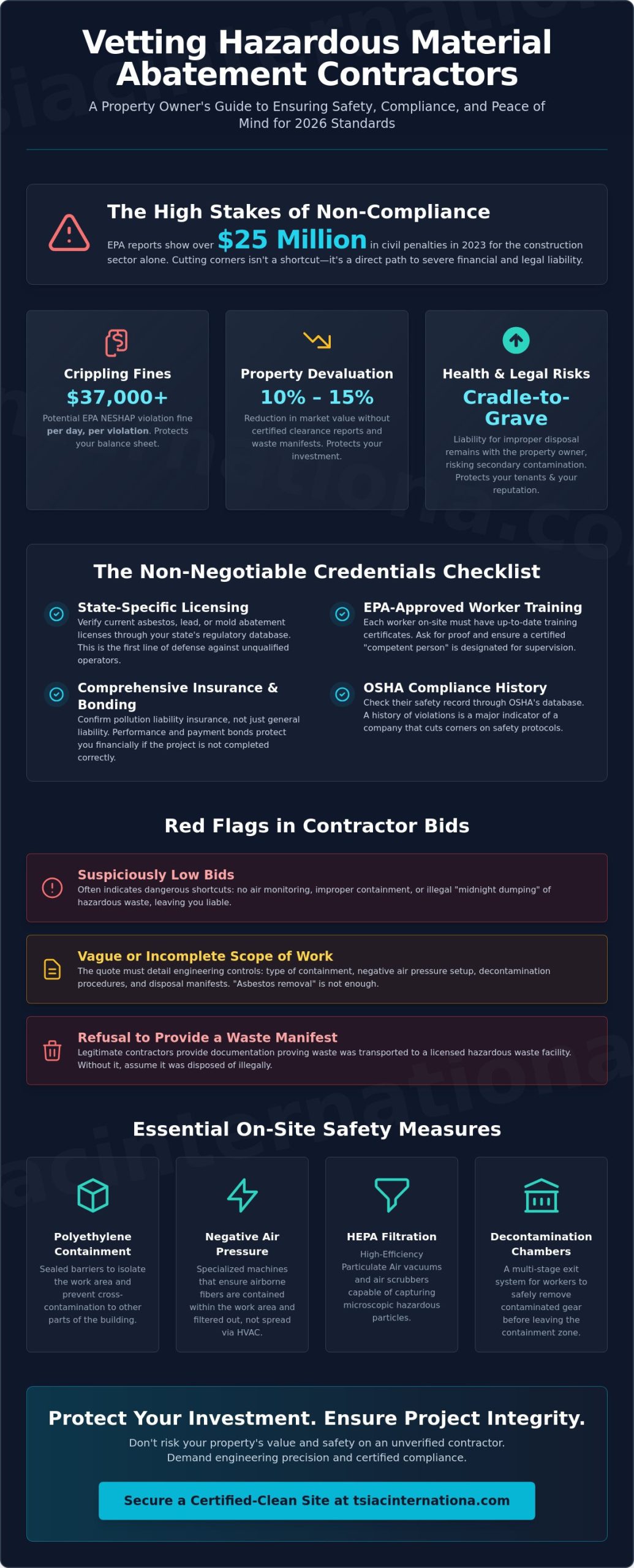
According to EPA enforcement reports from 2023, non-compliance with hazardous material regulations resulted in over $25 million in civil penalties across the construction sector. You likely understand that managing a property containing asbestos, lead, or mold is more than a logistical hurdle; it’s a significant liability that affects both your conscience and your balance sheet. The anxiety over potential health risks for your tenants or the threat of a sudden OSHA audit is a reality for owners dealing with infrastructure built before 1980.

We’re here to provide clarity. This guide focuses on the critical steps for finding a trustworthy abatement contractor who prioritizes engineering precision over cutting corners. You’ll learn how to secure a certified-clean site while ensuring your property remains fully compliant with evolving 2026 safety standards. We’ll examine the specific certifications required for modern projects, the red flags often hidden in technical quotes, and the essential documentation needed to facilitate a seamless transition to the demolition phase.

Key Takeaways

  • Learn to verify non-negotiable credentials, such as state-specific licensing and bonding, to ensure your project meets 2026 regulatory standards.
  • Discover the critical steps for finding a trustworthy abatement contractor who prioritizes controlled containment and remediation over simple material removal.
  • Understand how to analyze project quotes to identify red flags, such as suspiciously low bids that may indicate dangerous safety shortcuts or illegal disposal.
  • Identify the essential physical safety measures, including polyethylene containment barriers and air filtration, required for a compliant and hazard-free job site.
  • Explore the benefits of integrated remediation services that combine hazardous material removal with complex structural demolition for maximum project efficiency.

The High Stakes of Finding a Trustworthy Abatement Contractor

Managing a property in 2026 requires more than just aesthetic maintenance; it demands a rigorous approach to environmental safety. When hazardous materials like asbestos or lead-based paint are discovered, the situation shifts from a standard renovation to a high-stakes engineering challenge. Many owners mistake abatement for simple demolition. In reality, it’s a meticulously controlled containment and remediation process. Finding a trustworthy abatement contractor is the only way to ensure these toxins don’t migrate from a localized area into the building’s entire HVAC system.

General contractors often possess broad construction knowledge, but they’re legally and technically insufficient for hazardous material handling. They lack the specialized HEPA-filtered vacuum systems, negative air pressure machines, and decontamination chambers required by OSHA Part 1926.1101. Relying on an uncertified team creates a legal liability shift. Under federal “cradle-to-grave” statutes, the property owner remains responsible for improper hazardous waste disposal, even if a third party performed the work. If a contractor dumps asbestos-containing material in a standard landfill, the EPA can hold the owner liable for the entire cleanup cost. Physical risks are equally daunting. Improper handling leads to secondary contamination, where microscopic particles settle in carpets and ductwork, creating long-term health hazards for every future occupant.

Abatement vs. Remediation: Understanding the Difference

While people use the terms interchangeably, they represent distinct technical protocols. Asbestos abatement focuses on the total removal or permanent encapsulation of fibers. Lead remediation involves stabilizing or removing lead-based paint to prevent dust inhalation. Mold mitigation centers on structural drying and spore removal. The scope of work changes based on the specific hazardous material identified because each substance reacts differently to disturbance. Abatement is a highly regulated engineering control process designed to isolate and eliminate hazardous materials while preventing environmental cross-contamination. Following established Asbestos abatement procedures ensures that microscopic fibers don’t become airborne during the removal phase.

The Consequences of Cutting Corners

The financial impact of hiring an unqualified crew is often immediate and severe. EPA civil penalties for National Emission Standards for Hazardous Air Pollutants (NESHAP) violations can exceed $37,000 per day. Beyond fines, a failed air clearance test can halt a multi-million dollar renovation for weeks. If a Post-Abatement Air Clearance (PAAC) doesn’t meet the 0.01 fibers per cubic centimeter threshold, the contractor must re-clean the entire site at the owner’s expense. Long-term property value also suffers. Without a certified waste manifest and a final clearance report, prospective buyers or lenders will likely view the asset as a “distressed” property, often leading to a 10% to 15% reduction in market valuation. Finding a trustworthy abatement contractor protects the physical structure and the financial equity of the investment.

The Credentials Checklist: Non-Negotiables for 2026

Success in hazardous material removal depends on technical precision and legal adherence. When you’re finding a trustworthy abatement contractor, your first task involves auditing their professional credentials. State-specific licensing is the foundation of this process. Every legitimate firm must hold a current license specifically for asbestos or lead abatement, which you can verify through state regulatory databases. These licenses confirm the contractor understands the 2026 protocols for containment and disposal. Identifying these specific documents is the most reliable way of finding a trustworthy abatement contractor who respects both your budget and your health.

Worker safety and site supervision are equally critical. Each person on your property must possess up-to-date, EPA-approved training certificates. This ensures they follow OSHA’s Asbestos Standard for the Construction Industry, which mandates specific work practices and the presence of a “competent person” to oversee high-risk tasks. Without these certifications, you risk both legal liability and environmental contamination. Bonding requirements also provide a financial safety net. A performance bond ensures the project reaches completion, while a payment bond guarantees that all subcontractors and material suppliers receive their dues, preventing mechanics’ liens on your property.

Verifying Insurance and Bonding

Don’t accept a verbal confirmation of insurance. You need a Certificate of Insurance (COI) that specifically lists “Pollution Liability.” Standard general liability policies often contain “Total Pollution Exclusions,” meaning they won’t cover a spill or fiber release. It’s better to choose an “Occurrence-Based” policy over a “Claims-Made” policy. Occurrence-based coverage protects you even if a claim is filed years after the work ends, provided the incident happened during the policy period. Always request direct verification from the insurance carrier to confirm the policy is active and paid in full.

Modern Compliance Documentation

A project’s paper trail is as important as the physical removal. For commercial renovations, NESHAP (National Emission Standards for Hazardous Air Pollutants) requires a 10-day notification to the EPA before work begins. Once the project concludes, you must receive a Waste Shipment Record (WSR) or disposal manifest. This document proves the hazardous waste reached a licensed landfill. Finally, never accept a project as “complete” without a clearance letter from an independent, third-party laboratory. This lab should perform aggressive air sampling to confirm the area is safe for re-occupancy. If you need a partner who prioritizes these complex technical requirements, focus on firms with a proven track record in high-stakes environments.

Finding a Trustworthy Abatement Contractor: The 2026 Property Owner’s Guide

Vetting the Bid: Comparing Quotes Beyond the Bottom Line

Selecting a partner based solely on the lowest price often leads to catastrophic failure. In the abatement industry, an unusually low bid usually indicates that a contractor is cutting corners on labor protection or bypassing legal disposal fees. Finding a trustworthy abatement contractor requires a forensic look at the line items within a proposal. If a quote lacks specific costs for 6-mil polyethylene sheeting, HEPA-filtered negative air machines, or specialized decontamination units, the contractor likely intends to skip these critical safety layers.

A professional Scope of Work must be granular. It should specify a minimum of four air changes per hour within the containment zone to maintain negative pressure. This isn’t just a suggestion; it’s a technical requirement to prevent hazardous fibers or particles from migrating to clean areas of the property. You should also demand an equipment list that includes HEPA vacuums certified to capture 99.97% of particles down to 0.3 microns. Without these tools, the contractor is simply moving dust around your building rather than removing it.

Questions to Ask During the Site Walk-Through

During the initial inspection, watch how the contractor evaluates the structural layout. Ask these specific questions to gauge their technical competence:

  • How will you establish negative pressure and contain the work area? Look for mentions of manometer monitoring and physical barriers.
  • What is your specific plan for the safe transport of hazardous materials? They must describe a path that avoids high-traffic zones.
  • Who is the independent lab performing the final air clearance testing? A trustworthy firm never tests their own work; they use a third-party laboratory to ensure total transparency.

Analyzing the Disposal Plan

The liability for hazardous waste remains with the property owner until it reaches its final destination. You must confirm the contractor uses certified hazardous waste landfills and provides a waste shipment record for every load. All debris must be double-bagged in 6-mil bags, goose-neck sealed with duct tape, and labeled according to federal EPA and OSHA standards. For projects involving Hazardous Material Abatement in South Carolina, contractors must also adhere to specific DHEC regulations regarding transport manifests.

Finally, evaluate the proposed timeline. Professional abatement requires meticulous setup and mandatory settling periods for airborne dust. A contractor promising to finish a 1,000-square-foot lead or asbestos project in a single day is likely ignoring the 24-hour waiting period often required before final air clearance testing can begin. Precision takes time, and speed shouldn’t come at the expense of your structural integrity or health.

Red Flags and Industry Warning Signs

Finding a trustworthy abatement contractor requires a critical eye for technical compliance and safety protocols. Professional hazardous material removal is a highly regulated field where shortcuts lead to legal liability and health crises. If a contractor suggests skipping the permitting process to expedite the timeline or reduce costs, they’re signaling a disregard for state and federal law. In South Carolina, for example, DHEC regulations mandate specific notification periods before any regulated asbestos-containing material is disturbed. Bypassing these steps can result in five-figure fines for the property owner. For residents in the region who value this same level of regulatory adherence and professional integrity in other essential services, the Cremation Society of South Carolina – Westville Funerals provides dependable support for families during difficult times.

Visual inspections of active job sites often reveal a contractor’s true standards. You should look for specific engineering controls and safety measures, including:

  • Containment Barriers: Professional sites utilize 6-mil polyethylene sheeting to create airtight seals. If you see thin, household-grade plastic or gaps in the taping, the containment is compromised.
  • Negative Air Pressure Monitors: These digital devices are mandatory. They ensure that air flows into the work zone and through HEPA filters, preventing contaminated dust from escaping into clean areas of the building.
  • PPE Compliance: Workers must wear appropriate Personal Protective Equipment, including N100 or P100 respirators and disposable suits. Seeing workers in standard dust masks or street clothes is a definitive sign of an amateur operation.

Identifying the “Solar Cowboy” Equivalent in Abatement

The abatement industry has its share of “Solar Cowboys,” contractors who lack a permanent physical office or a verifiable track record in complex industrial environments. These operators often apply high-pressure sales tactics, demanding the full project amount upfront. A legitimate firm will tie final payment to a successful third-party air clearance test. Furthermore, look closely at the contract. If it doesn’t specify the exact EPA-approved landfill for disposal, you risk being held responsible for illegal dumping. Transparency in the waste manifest process is the hallmark of a professional partner.

The Danger of DIY or Unlicensed Labor

Attempting to save money through DIY methods or unlicensed labor is a high-risk gamble. Improper removal techniques aerosolize microscopic fibers, which stay suspended in the air for up to 72 hours. Once these fibers enter an HVAC system or settle into porous furniture, the site becomes effectively uninhabitable. Cleaning a cross-contaminated site is significantly more expensive than a standard removal, often increasing remediation costs by 400% or more. Before starting any structural changes, it’s vital to understand The Demolition Process in South Carolina to ensure every safety hurdle is cleared.

Ensure your property meets the highest safety standards by choosing a partner with proven technical expertise. Contact TSIA C International for a professional site assessment today.

The TSIAC International Standard: Integrity in Remediation

TSIAC International brings over 15 years of specialized experience to complex structural and selective demolition projects. Since 2009, our team has refined a methodology that prioritizes technical precision over marketing slogans. Finding a trustworthy abatement contractor requires looking past surface-level promises to examine a firm’s operational history and regulatory compliance record. We provide transparent reporting for every client. This ensures that every milligram of hazardous material is documented from the moment of removal to its final disposal. Our crews are trained to manage difficult locations where standard equipment fails, often utilizing industrial rope access or custom-engineered scaffolding to reach contaminated areas safely.

Why an Integrated Approach Saves Time and Money

Most property owners hire separate crews for abatement and demolition. This often leads to a cycle of delays and finger-pointing where one team stalls the other. These inefficiencies can increase project costs by 15% or more. TSIAC eliminates this friction by handling hazardous material removal and structural gutting simultaneously. We streamline the permitting process for total structural removals, which reduces the administrative burden on the property owner. For those managing assets in the Southeast, understanding Asbestos Removal in South Carolina is critical for staying within the 2026 legal frameworks. Our integrated model ensures that safety protocols and structural integrity move in lockstep, preventing the “blame game” that plagues traditional construction sites.

Environmental Stewardship and Recycling

Environmental responsibility is a logistical requirement in modern remediation, not just a preference. We implement debris recycling programs that sort metal, wood, and plastic directly on-site. This systematic approach reduces landfill impact by up to 70% on major industrial demolition projects. To prevent cross-contamination, we use rigid safety protocols that isolate non-hazardous materials from contaminated zones before they leave the site. This level of control protects the environment and the client’s legal standing. Finding a trustworthy abatement contractor means choosing a partner who values long-term safety over short-term shortcuts. Partnering with TSIAC means choosing a safer, cleaner, and more efficient project completion. We don’t just clear a site; we engineer a solution that meets the highest industrial standards for safety and sustainability.

Securing Your Property’s Future with Precision Remediation

Protecting your investment requires more than a casual search. It demands a technical audit of every potential partner. You’ve seen that finding a trustworthy abatement contractor in 2026 hinges on verifying full compliance with EPA and OSHA regulations. A low bid often masks a lack of comprehensive pollution liability insurance, which leaves your assets exposed to unnecessary risk. By prioritizing a credentials-first approach, you ensure that remediation is a controlled engineering process rather than a liability.

TSIAC International leverages 15+ years of industry experience to handle complex remediation in high-stakes environments. We don’t offer empty promises; we deliver documented safety and structural integrity. Our team maintains strict adherence to federal protocols to ensure your project remains on schedule and within regulatory bounds. When the stakes involve hazardous materials, professional precision is the only acceptable metric for success. You deserve a partner who navigates these technical challenges with calm authority and proven expertise.

Contact TSIAC International for a Professional Abatement Quote

Taking the right steps today prevents costly structural and legal failures tomorrow. Your property deserves the highest standard of technical excellence and a partner who delivers on every commitment.

Frequently Asked Questions

How do I check if an abatement contractor is licensed?

You verify an abatement contractor’s license by searching the official state environmental agency database or the EPA’s Lead-Safe firm registry. Every certified professional holds a unique credential number that’s verifiable online. You should request a copy of the firm’s current 2026 certification and cross-reference it with the Department of Labor’s active list to ensure compliance and safety.

Is it safe to stay in the building during asbestos or lead abatement?

It’s not safe to remain in the immediate work zone during active asbestos or lead abatement processes. EPA guidelines require occupants to vacate the area until third-party air clearance testing proves fiber levels are below 0.01 per cubic centimeter. Professionals establish sealed containment zones using 6-mil polyethylene sheeting to protect the remaining 95 percent of the building from cross-contamination.

What is the difference between a standard demolition and abatement?

Standard demolition involves the mechanical destruction of structures, but abatement is the precise process of isolating and removing hazardous pollutants. Abatement uses negative air machines and HEPA filtration to capture microscopic particles that traditional demolition would release into the environment. This technical approach protects both the structural integrity and the health of future occupants through engineering controls.

How much does professional abatement cost compared to DIY?

Professional abatement involves higher upfront costs than DIY, but it eliminates the risk of legal penalties that reach $37,500 per day for environmental violations. Industry reports from 2024 indicate that professional asbestos removal typically ranges from $1,500 to $3,000 for small residential projects. DIY attempts often lead to 100 percent contamination of the HVAC system, causing much higher long-term remediation expenses.

What documents should I receive after the abatement is finished?

You must receive a comprehensive close-out binder containing the waste disposal manifest, daily work logs, and independent air clearance certificates. The waste manifest is a critical legal document signed by the licensed landfill, proving the hazardous material reached its destination. Finding a trustworthy abatement contractor guarantees you get these records to protect your property’s resale value and legal standing.

Can a general contractor handle lead paint removal?

A general contractor can only handle lead paint removal if they hold a valid EPA RRP certification and employ workers trained in lead-safe practices. Without this specific 2026 accreditation, they lack the technical equipment to manage toxic dust. Finding a trustworthy abatement contractor is vital because they follow the 40-hour HAZWOPER standards required for high-risk environmental work and hazardous waste operations.

What happens if a contractor is caught improperly disposing of hazardous waste?

Contractors caught improperly disposing of hazardous waste face heavy civil fines, license revocation, and potential jail time under the Resource Conservation and Recovery Act. The EPA can levy penalties up to $70,117 per violation for each day the non-compliance continues. Property owners might also be held liable for cleanup costs if the contractor’s disposal chain isn’t documented and verified.

How long does the average abatement project take?

The average residential abatement project takes between 3 and 5 days to complete from initial containment to final clearance. Industrial sites or complex structural projects often require 15 to 20 days due to the scale of the containment systems. Each phase is strictly timed, including a mandatory 24-hour settling period before the final air quality samples are collected for laboratory analysis.