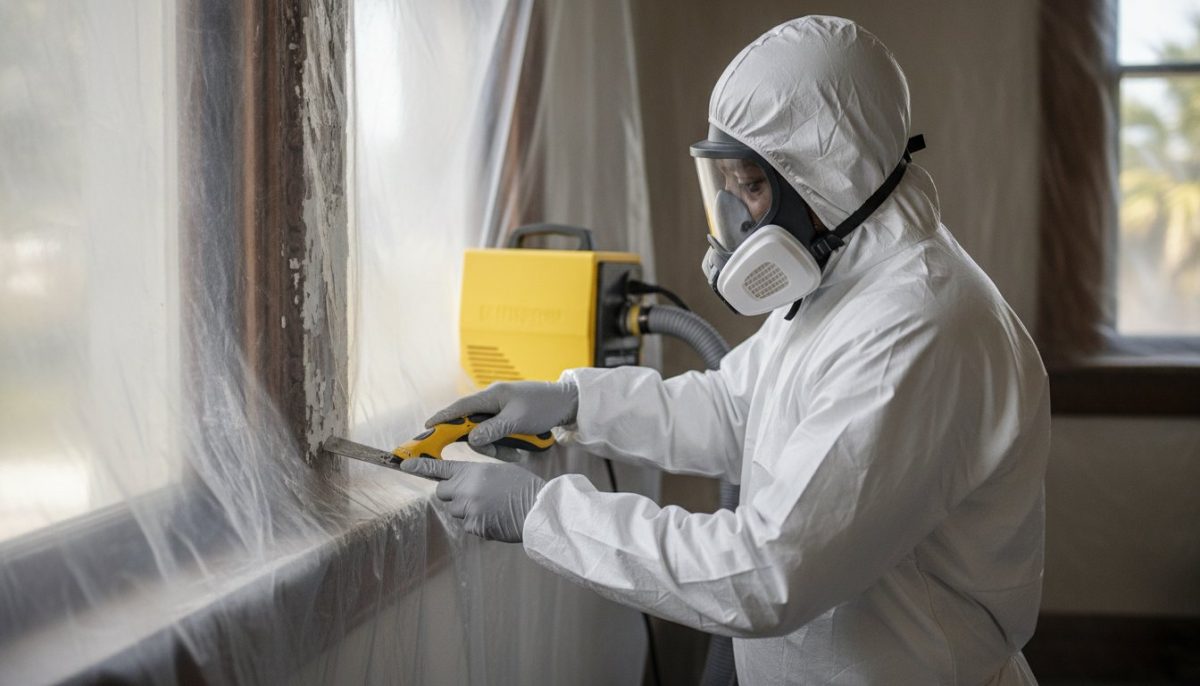
Did you know that a single oversight in handling lead-based paint can result in fines of up to $37,500 per violation, per day, under current federal and state enforcement? For property owners and contractors, staying current with lead abatement regulations isn’t just about safety; it’s a critical defense against crippling financial penalties and project shutdowns. With the evolving regulatory landscape and heightened scrutiny from environmental agencies, the margin for error has effectively disappeared.
It’s understandable to feel overwhelmed by the shifting requirements and the technical complexity of modern containment. You want your project to move forward without the shadow of a regulatory audit or a costly stop-work order. This guide will help you navigate the 2026 regulatory landscape to ensure your commercial or residential project remains fully compliant and safe. We’ll examine the latest federal enforcement protocols, the strict 2026 EPA dust-lead action levels, and the specific documentation required to protect your liability and your timeline.
Key Takeaways
- Understand the 2024 transition of regulatory authority to the South Carolina Department of Environmental Services (SC DES) and how it impacts project oversight.
- Learn how to interpret south carolina lead abatement regulations to mitigate liabilities and avoid penalties reaching $37,500 per violation.
- Identify the critical distinctions between permanent lead abatement and temporary lead-safe renovation (RRP) to choose the correct compliance path.
- Gain clarity on the mandatory project notification timelines and the rigorous HEPA filtration standards required for hazardous material containment.
- Discover how integrating lead abatement with structural demolition can streamline your project timeline while maintaining full environmental compliance.
Defining Lead Abatement in the South Carolina Regulatory Landscape
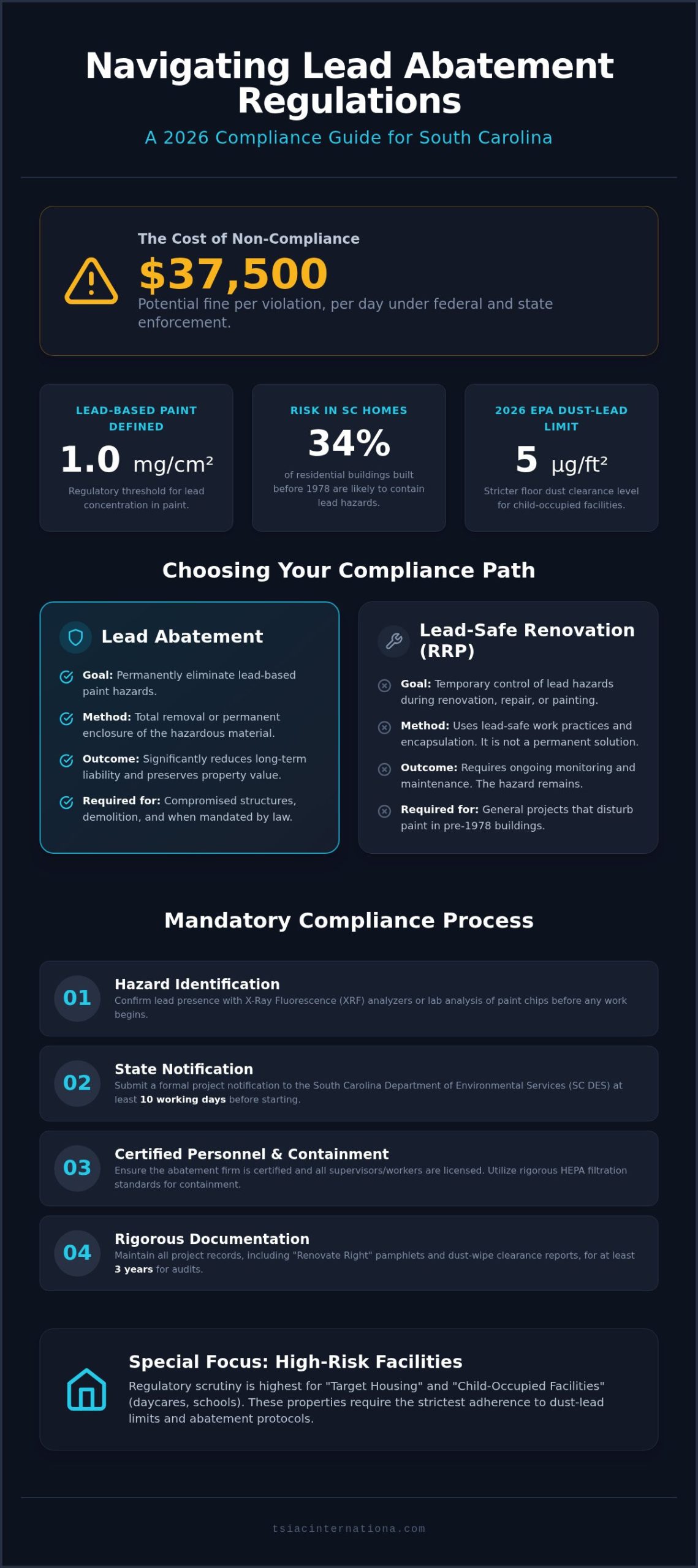
Under South Carolina Law R.61-99, lead abatement is defined as a set of measures designed to permanently eliminate lead-based paint hazards. This distinguishes it from interim controls, which only provide a temporary fix. For property owners, understanding south carolina lead abatement regulations is the first step in managing a site built before 1978. Structures from this era are statistically likely to contain lead; research indicates approximately 34% of South Carolina residential buildings from this period harbor lead-based paint hazards. Because lead was a standard additive for durability, any project involving older structural elements must begin with the assumption that hazardous materials are present.
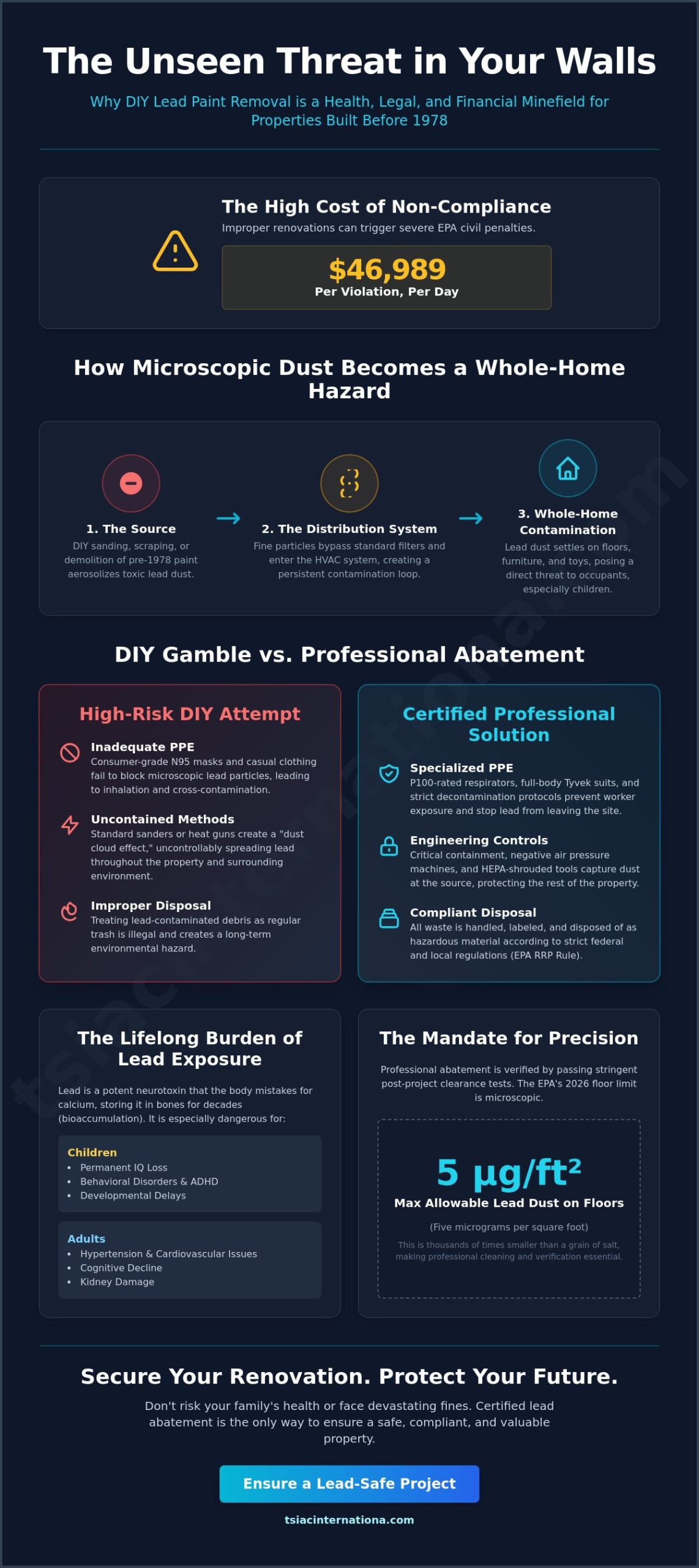
To confirm the presence of lead, professionals use X-ray fluorescence (XRF) analyzers or laboratory analysis of paint chips. These methods provide the technical precision required to determine if lead concentrations meet or exceed the regulatory threshold of 1.0 milligram per square centimeter. Documentation of these tests serves as your primary defense during a SC DES audit, proving that your team exercised due diligence before beginning work. Failure to identify these hazards before disturbing surfaces can lead to environmental contamination and severe legal exposure. It’s vital to remember that fines for violating lead-based paint regulations in South Carolina can reach $37,500 per violation, per day.
Abatement vs. Encapsulation
Choosing between permanent removal and encapsulation is a strategic decision for any developer. While encapsulation uses specialized coatings to seal lead paint, it requires ongoing monitoring and maintenance. In contrast, abatement involves the total removal or permanent enclosure of the hazard. This Lead abatement overview highlights that permanent solutions significantly reduce long-term liability. South Carolina law often mandates full removal when the structural integrity of the substrate is compromised or when the building is slated for a full demolition process in South Carolina. Removing the lead entirely preserves the property’s market value and ensures future renovations don’t trigger new hazardous material protocols.
Target Housing and Child-Occupied Facilities
Regulatory scrutiny intensifies for “target housing” and “child-occupied facilities.” These categories include daycares, elementary schools, and multi-family units where children under age six spend significant time. In these environments, even minor dust-lead levels are reportable. If your commercial project involves gutting a structure within these classifications, you must follow south carolina lead abatement regulations strictly upon lead detection. This often happens alongside asbestos removal in South Carolina, as both materials were frequently used in the same construction era. Proper classification ensures that your project meets the 5 µg/ft² floor dust limit mandated by the EPA in 2026.
Core Requirements of SC DHEC R.61-99 and EPA Standards
South Carolina Regulation 61-99 serves as the mandatory framework for lead-based paint activities across the state. While the South Carolina Department of Environmental Services (SC DES) now oversees enforcement following the 2024 agency restructure, the technical requirements of R.61-99 remain the operational standard. To comply with south carolina lead abatement regulations, firms must secure specific state-level certifications. An abatement firm certification is a prerequisite for any permanent hazard elimination project, while individual supervisors and workers must complete state-approved training and maintain active licenses. You can’t simply start a project; the law requires a formal project notification to SC DES at least 10 working days before any lead-disturbing activity begins.
Documentation is your most powerful tool during an inspection or a property transfer. You’re required to maintain all project records, including the “Renovate Right” pamphlet receipts and technical dust-wipe clearance reports, for at least three years. These files must be readily accessible for state audits to prove that every step of the containment and disposal process met the required technical standards. Failure to produce these records during an audit can trigger the heavy daily fines mentioned earlier, regardless of whether the physical work was done correctly.
The Role of the Certified Lead Inspector
Independent verification is a cornerstone of the state’s safety protocol. A certified lead inspector or risk assessor must perform the initial evaluation to identify hazards through XRF testing or paint chip sampling. It’s vital to distinguish between an inspection, which identifies the presence of lead, and a risk assessment, which evaluates the severity of the hazard and provides a management plan. Once work is finished, a third-party clearance test is mandatory. This final step verifies that the area is safe for re-entry and that lead dust levels fall below the strict 2026 EPA limits.
State vs. Federal Overlap
Understanding where different jurisdictions meet is essential for large-scale commercial or residential projects. The EPA Renovation, Repair and Painting (RRP) Rule generally applies to minor disturbances in pre-1978 housing, but South Carolina’s R.61-99 takes precedence when the intent is permanent hazard elimination. Additionally, the federal OSHA lead in construction standard (29 CFR 1926.62) dictates worker protection requirements, such as blood lead level monitoring and respiratory programs. If you’re managing a complex site, coordinating asbestos removal in South Carolina alongside lead abatement ensures all hazardous material documentation remains centralized and compliant across both state and federal levels.
Lead Abatement vs. Lead-Safe Renovation (RRP): Key Differences
The distinction between lead-safe renovation and lead abatement centers on the primary intent of the project. Renovation involves activities like painting, repairs, or remodeling where lead paint is disturbed as a byproduct of the work. In contrast, abatement is the specific, permanent elimination of lead-based paint hazards. While federal rules govern most pre-1978 residential work, south carolina lead abatement regulations apply whenever a project is designed to permanently solve a lead issue. This legal distinction is vital for commercial developers. If you’re stripping a building to its structural shell, performing an interior gut-out service often makes more financial sense than attempting to manage lead surfaces over multiple renovation cycles.
Training requirements reflect this difference in risk. An RRP renovator completes an 8-hour course focused on dust containment. A South Carolina certified abatement worker or supervisor undergoes significantly more rigorous training and must be licensed by the state. You can’t use RRP-certified staff for abatement tasks. Doing so voids your compliance and exposes you to the $37,500 daily fines enforced by the SC DES. Choosing the right certification level is a fundamental step in project planning that protects both your budget and your legal standing.
When is Full Abatement Mandatory?
Specific legal triggers move a project from voluntary renovation to mandatory abatement. Court-ordered remediation occurs when a child has been identified with elevated blood lead levels in a South Carolina property. Additionally, projects receiving federal funding via HUD often require full abatement rather than interim controls. Many commercial owners opt for voluntary abatement to achieve a “lead-free” status. This certification increases property value and simplifies future demolition permits by removing the hazard entirely from the building’s permanent record.
Work Practice Differences
The technical execution of abatement is far more intensive than standard lead-safe work. RRP practices typically involve plastic sheeting to catch dust. Abatement requires critical barriers, such as sealing all vents and openings, and often employs negative air machines with HEPA filtration. Waste management is another major differentiator. All lead-contaminated debris must be handled according to SC DHEC disposal regulations, which dictate how hazardous waste is transported and where it can be legally landfilled in the state. The project only concludes after passing a laboratory-verified clearance test, ensuring the environment is safe for permanent occupancy.
The Step-by-Step Lead Abatement and Disposal Process
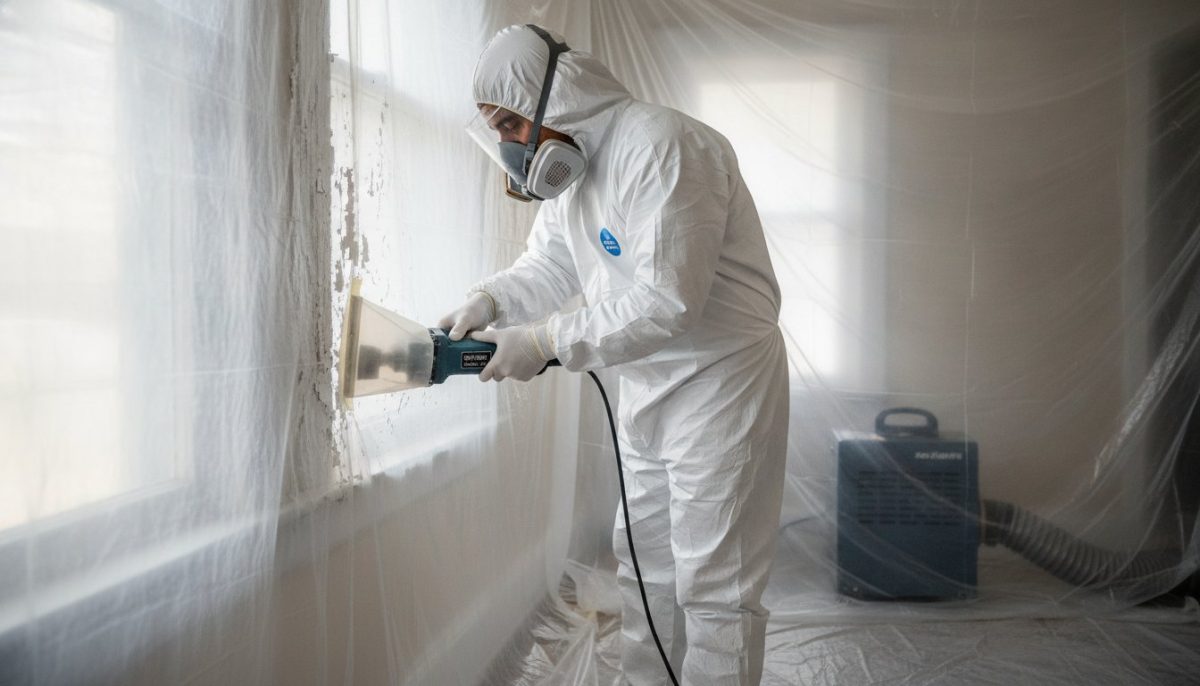
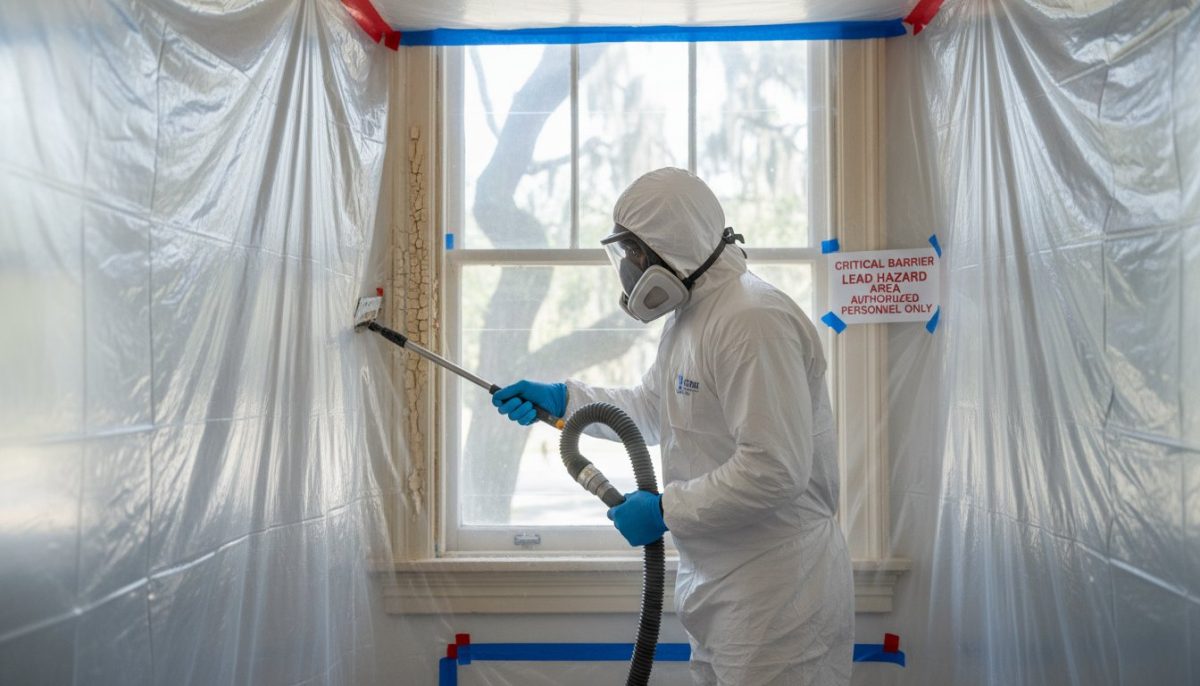
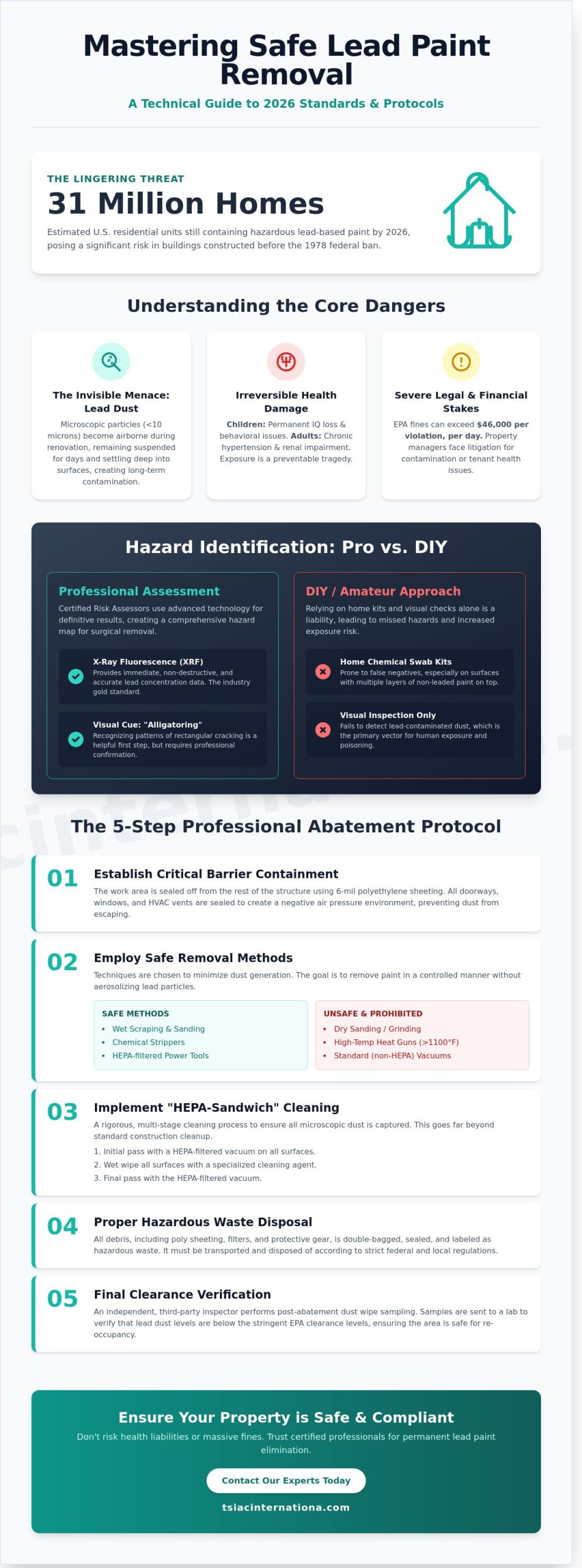
Compliance with south carolina lead abatement regulations hinges on a methodical, five-step execution plan. It starts with a pre-abatement inspection and the mandatory 10-day project notification to the South Carolina Department of Environmental Services (SC DES). Once the notification period expires, the site must be secured. This involves establishing regulated work areas with critical barriers and installing negative air machines equipped with HEPA filtration to prevent lead dust from migrating to clean zones. These barriers are the first line of defense in protecting the rest of the structure during a selective demolition or gutting project.
The actual removal phase relies on wet-methods. Workers mist surfaces with water before scraping or sanding, which keeps lead particles from becoming airborne. After the material is removed, the team performs specialized cleaning, using HEPA-filtered vacuums and wet-wiping all surfaces. The final stage is a third-party clearance test. A certified professional collects dust-wipe samples to ensure the area meets the 2026 EPA limit of 5 µg/ft² for floors. If even one sample fails, the cleaning process repeats until the site is verified safe. This rigorous sequence ensures that no hazardous residue remains to threaten future occupants or workers.
Specialized Equipment and Safety Gear
Safety on a lead site is non-negotiable. Workers must wear N100 or P100 respirators and full-body Tyvek suits to prevent ingestion and cross-contamination. On South Carolina job sites, negative air machines are essential for maintaining a constant flow of filtered air within the containment zone. One common mistake is the use of standard shop-vacs. These machines lack the filtration required to trap microscopic lead dust and instead exhaust the toxins back into the air. Using non-HEPA equipment is a major regulatory violation and creates a significant health risk for everyone on the property.
Hazardous Waste Logistics in South Carolina
Managing the debris is as critical as the removal itself. All lead-contaminated materials must be double-bagged in 6-mil poly bags, sealed with duct tape, and clearly labeled as hazardous. You must select a South Carolina facility specifically permitted to accept lead waste, as not all municipal landfills are equipped for this material. A detailed waste manifest must track the debris from the moment it leaves your site until it’s officially accepted at the disposal facility. This paper trail is vital for your 3-year record-keeping requirement. For large-scale projects, integrating these protocols into your interior gutting plan streamlines the disposal process and maintains total compliance.
Navigating Hazardous Material Compliance with TSIAC International
TSIAC International offers over 15 years of specialized experience in hazardous material remediation and structural modification. We recognize that south carolina lead abatement regulations represent a rigorous technical standard that requires methodical precision. Our role is to act as a responsible partner for government and large-scale commercial contracts, ensuring that every phase of the project remains under total control. We don’t view lead removal as an isolated task. Instead, we integrate it into the broader demolition process in South Carolina, allowing for a seamless transition from hazard mitigation to structural clearing.
Managing multiple hazardous materials often creates logistical bottlenecks. We eliminate this friction by synchronizing lead removal with asbestos removal in South Carolina. This unified approach ensures that your containment strategies, air monitoring, and waste disposal manifests are centralized. It prevents the common issue of one abatement team disturbing the containment of another, which can lead to costly decontamination cycles and regulatory fines. Our deep familiarity with the 2026 SC DES enforcement protocols means your project starts with the correct notifications and ends with a verified clean site.
A Strategic Approach to Hazardous Materials
Our team excels at identifying hidden environmental risks that standard inspections might miss. During hazardous material abatement in South Carolina, we look beyond the surface to find lead-contaminated dust in wall cavities or lead-weighted components in industrial settings. We strip interiors down to the structural shell, providing a clean slate for follow-on contractors. This synchronization of interior gutting and abatement minimizes downtime, as you won’t need to wait for separate remediation and demolition phases. The result is a project that moves faster without compromising on safety or regulatory integrity.
Safety and Liability Protection
Adherence to SC DES and OSHA standards is the foundation of our operational profile. We understand that for commercial property owners, professional abatement is a critical tool for liability protection. A single regulatory failure can damage a corporate reputation and stall a multi-million dollar development. To prevent this, we provide comprehensive project close-out packages. These folders contain every necessary document, from initial project notifications to final third-party clearance reports and waste disposal manifests. This level of transparency ensures you’re prepared for any future state audit or environmental inquiry, providing the technical proof that your site meets every 2026 standard.
Securing Long-Term Project Compliance and Safety
Successfully managing a pre-1978 structure requires more than just standard renovation practices. By prioritizing permanent abatement over temporary controls, you’ll effectively eliminate long-term environmental liability and protect your property’s market value. Adhering to the latest south carolina lead abatement regulations ensures your project meets the strict 2026 EPA dust-lead action levels while avoiding the severe daily penalties enforced by state agencies. This technical diligence is the only way to guarantee a safe environment for future occupants and workers alike.
TSIAC International brings over 15 years of South Carolina expertise to every hazardous material remediation project. We provide the certified technical precision and comprehensive compliance documentation required to satisfy rigorous state audits. Our ability to synchronize lead removal with interior gutting provides a clean structural shell ready for your next phase of development. This integrated approach minimizes project downtime and keeps your timeline on track. Request a Professional Lead Abatement Consultation from TSIAC International to secure your site and manage your risks with confidence. We’re ready to help you maintain a safe, compliant, and productive work environment.
Frequently Asked Questions
What is the difference between lead abatement and lead-safe renovation in South Carolina?
Lead abatement refers to the permanent elimination of lead-based paint hazards through removal or enclosure. In contrast, lead-safe renovation involves practices to minimize dust and contamination during repair or painting activities. South carolina lead abatement regulations apply specifically when the intent is to solve the hazard for at least 20 years. While RRP is common for maintenance, abatement requires higher certification levels and more stringent containment procedures to ensure long-term safety.
Do I need to notify DHEC before removing lead paint from a commercial building?
Yes, you must notify the South Carolina Department of Environmental Services (SC DES) at least 10 working days before starting lead-disturbing activities. This notification is a mandatory requirement under Regulation 61-99 for all abatement projects. Failure to file this paperwork can result in immediate work stoppages and heavy daily fines. The notification allows state inspectors to verify that your containment and safety plans meet current environmental protection standards.
How long does a typical lead abatement project take in South Carolina?
The duration of a lead abatement project varies based on the building’s size and the complexity of the containment required. Most standard commercial interior projects take between one and two weeks to complete. This timeline includes the initial setup of critical barriers, the removal process using wet-methods, and the final specialized cleaning. You must also factor in the 10-day notification period and the time required for third-party clearance laboratory results.
Can I perform lead abatement on my own commercial property?
No, state law requires that lead abatement on commercial properties be performed by firms and individuals certified by the SC DES. You can’t use your own maintenance staff unless they’ve completed the rigorous state-approved training and the firm holds a valid abatement license. Attempting to bypass these south carolina lead abatement regulations creates significant legal liability. It also risks contaminating the property with lead dust that standard cleaning methods cannot remove.
What are the penalties for violating South Carolina lead regulations?
Violating lead-based paint regulations in South Carolina can lead to civil penalties of up to $37,500 per violation, per day. These fines apply to improper disposal, lack of certification, or failure to follow containment protocols. Beyond financial costs, non-compliance often results in project delays and potential lawsuits if lead exposure is documented. The state’s transition to the SC DES in 2024 has led to more frequent and more technical site inspections.
How do I find a certified lead abatement contractor in South Carolina?
You can verify a contractor’s status through the South Carolina Department of Environmental Services (SC DES) list of certified lead abatement firms. It’s essential to select a partner with documented experience in managing complex hazardous material sites. Look for firms that offer integrated services, such as selective demolition and lead removal, to ensure project efficiency. Always request proof of current state licensing and insurance before allowing any work to begin on your property.
Is lead-based paint common in South Carolina buildings constructed after 1978?
Lead-based paint is rarely found in buildings constructed after the 1978 federal ban. However, some industrial applications or specialty coatings used in commercial settings might still contain lead after that date. If your building was constructed before 1978, research suggests there’s a 34% chance it contains lead hazards. For structures built near the transition year, we always recommend a professional XRF inspection to confirm the site’s status before starting any demolition.
What kind of clearance testing is required after lead removal is complete?
After removal and cleaning are finished, a certified third-party inspector must perform a visual inspection and collect dust-wipe samples. These samples are sent to a laboratory to ensure lead levels are below the 2026 EPA limit of 5 µg/ft² for floors. The project isn’t legally complete until you receive a passing clearance report. This documentation is a critical part of your permanent records and protects you from future liability claims.