

Did you know that properties with identified hazardous materials typically sell for 10% to 25% less than comparable homes on the market? If you’re selling a house with known asbestos, that statistic might feel like a direct hit to your home equity. It’s understandable to worry about a deal falling through during the inspection phase or to feel paralyzed by the conflicting maze of state and federal disclosure requirements. You need a clear path toward a smooth closing that doesn’t leave you vulnerable to future legal liabilities.
This 2026 guide provides the technical clarity you need to manage your property’s value and navigate the remediation process with confidence. You’ll learn how to distinguish between mandatory legal disclosures and optional repairs while weighing the ROI of professional abatement against an “as-is” cash sale. We will break down the current regulatory environment, explain how specialized containment preserves your home’s integrity, and show you why a “clean bill of health” from a certified expert can restore up to 8% of your property’s resale value. By the end of this article, you’ll have a disciplined strategy to transform a significant liability into a documented safety feature.
Key Takeaways
- Understand why asbestos is classified as a “material fact” and how transparent disclosure protects you from future legal repercussions.
- Learn how selling a house with known asbestos affects buyer psychology and how to navigate appraisal hurdles for FHA or VA loans.
- Compare the financial trade-offs between selling “as-is” to cash investors and investing in professional abatement to maximize your final sale price.
- Follow the methodological steps of certified remediation, including specialized containment and negative air pressure protocols that ensure home safety.
- Discover how professional abatement documentation acts as a “clean bill of health” to satisfy strict legal and financial requirements during closing.
The Legal and Ethical Reality of Selling a House with Asbestos
Owning a home built before 1980 often means living with legacy building materials. While it isn’t illegal to occupy a property containing these substances, the legal landscape shifts the moment you enter a real estate transaction. In the context of real estate hazardous materials, a material fact is any information regarding a property’s condition that could reasonably influence a buyer’s decision to purchase or affect the final valuation of the asset. When selling a house with known asbestos, you’re dealing with a material fact that requires a disciplined, fact-based approach to disclosure.
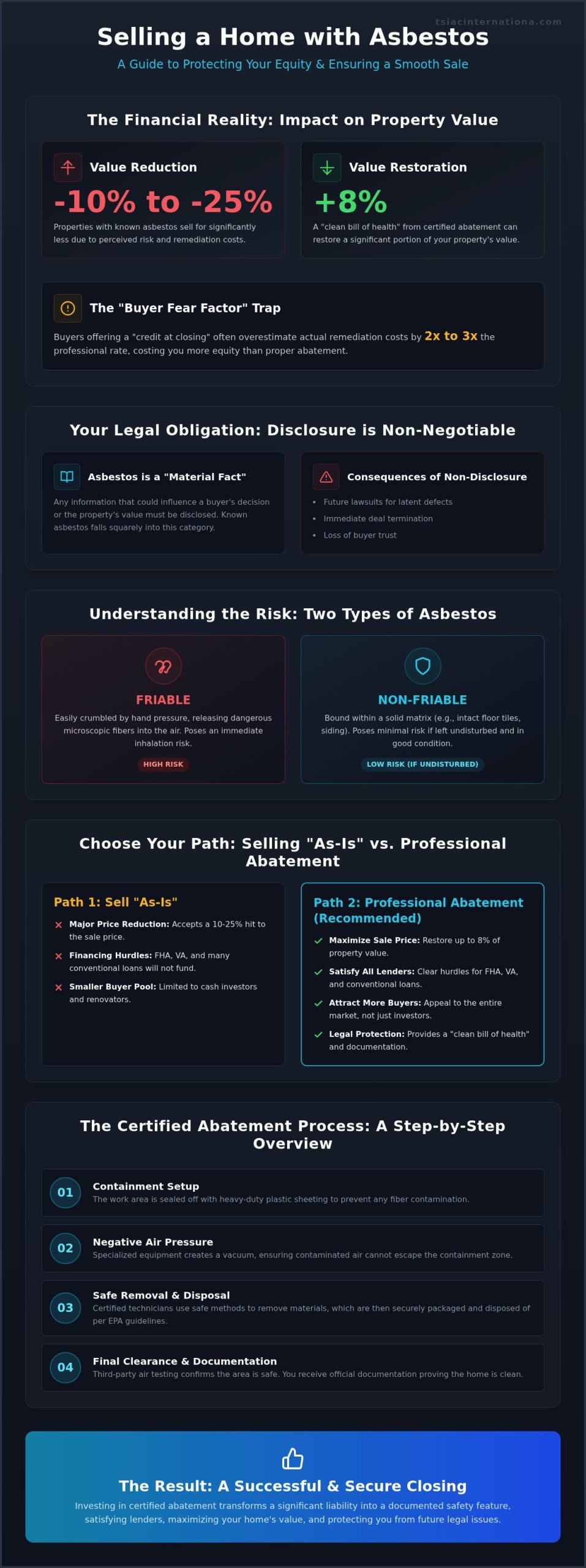
The physical state of the material determines the level of risk and the resulting impact on the sale. Non-friable asbestos, such as that found in intact floor tiles or exterior siding, is bound within a solid matrix and typically poses minimal risk if left undisturbed. Conversely, friable asbestos is easily crumbled by hand pressure, which releases microscopic fibers into the air. Understanding this distinction is critical because U.S. asbestos regulations and safety protocols prioritize the management of friable materials due to their immediate inhalation risk.
The Consequences of Non-Disclosure
Selling a house with known asbestos requires absolute transparency to avoid long-term legal exposure. If a seller fails to disclose the presence of these materials, they may be held liable for latent defects, which are flaws not discoverable through a standard surface-level inspection. Lawsuits can arise years after the closing date if a buyer discovers the material during a renovation and can prove the seller had prior knowledge. Beyond the courtroom, an undisclosed discovery during a buyer’s inspection often leads to immediate deal termination, as it shatters the professional trust required to finalize a high-value transaction.
Federal EPA Guidelines for Residential Properties
Federal law doesn’t currently mandate asbestos removal before a private residential sale. The legal framework mirrors the principles of the Residential Lead-Based Paint Hazard Reduction Act, emphasizing that buyers have a right to be informed about environmental hazards. Although federal disclosure laws are less stringent than state-level mandates, the EPA maintains strict oversight on how these materials are handled and disposed of during any remediation process. The EPA dictates that ignorance is not a defense if the material is clearly visible or if previous records indicate its presence. Professional abatement ensures these standards are met, providing the documentation needed to prove the home was handled with technical precision.
Financial Impact: How Asbestos Affects Property Value and Sale Speed
When selling a house with known asbestos, you aren’t just selling a physical structure; you’re managing a buyer’s perception of risk. The “fear factor” associated with hazardous materials often triggers aggressive price negotiations that far exceed the actual cost of remediation. Industry data from 2026 indicates that properties with identified asbestos issues typically sell for 10% to 25% less than comparable homes. This steep discount represents a “risk premium” that buyers demand to compensate for the perceived health hazards and the perceived complexity of future renovations.
Many sellers attempt to bypass this by offering a “credit at closing” to avoid the logistics of abatement. This strategy is frequently a financial trap. Buyers, often fueled by anxiety and worst-case scenarios, tend to overestimate remediation costs by double or triple the professional rate. By failing to provide a “clean bill of health” before listing, you’re likely leaving significant equity on the table. A property that lingers on the market due to these concerns quickly becomes “stale,” leading to further price erosions as buyers wonder why the home hasn’t sold.
The Mortgageability Factor
Financing is the most common point of failure for these transactions. Government-backed loans, including FHA, VA, and USDA products, maintain rigorous safety standards. If an appraiser identifies damaged or friable asbestos, they will likely categorize it as a mandatory repair item, meaning the loan cannot fund until the hazard is removed. Conventional lenders also exercise caution; an underwriter who perceives a liability can halt a closing at the eleventh hour. This creates a volatile environment where a deal can collapse just days before the scheduled move-in date.
Impact on Home Equity and ROI
Investing in professional asbestos abatement acts as a surgical strike to protect your home equity. While the initial investment requires capital, providing documentation of completed, certified work can add back 3% to 8% in resale value. This proactive approach effectively eliminates the 10-25% “asbestos discount” that savvy buyers and investors use as leverage. By removing the hazard, you broaden your pool of potential buyers to include those using strict government financing, ensuring a more competitive bidding environment and a faster path to closing.
Strategy: Professional Abatement vs. Selling the Property As-Is
Selling a house with known asbestos presents a critical fork in the road for any property owner. You must decide whether to absorb the cost of remediation upfront or accept a significant reduction in your final sale price. This choice isn’t merely about convenience; it’s a financial calculation based on your timeline, available capital, and the specific buyer profile you intend to target. Choosing the wrong path can lead to months of stagnation on the market or a closing that leaves tens of thousands of dollars in equity on the table.
An “as-is” sale is a transaction where the seller refuses to perform any repairs or remediation, transferring the burden of the hazard to the buyer. While this offers the fastest exit, it’s rarely the most profitable. Professional investors and “cash for houses” entities are the primary buyers in this category. They don’t view asbestos as a deal-breaker, but they do view it as a massive negotiation lever. In 2026, savvy investors typically deduct double the projected cost of abatement from their offers to account for their own overhead and the inherent risk of managing hazardous materials.
Pros and Cons of Selling As-Is
The primary advantage of an as-is sale is the speed of the transaction. You avoid the logistics of specialized containment and the out-of-pocket expenses of professional services. However, the drawbacks are substantial. Your buyer pool shrinks to a small fraction of the market, as traditional families and those using government-backed financing are effectively excluded. Even in an as-is sale, disclosure is a non-negotiable legal requirement. You aren’t selling the house without the problem; you’re selling the problem at a steep discount.
The Competitive Advantage of Remediation
Proactive remediation transforms the narrative of your property. Instead of a “problem house,” your home becomes a “certified safe” asset. Providing a “Clean Bill of Health” certificate from a licensed expert removes the psychological barrier for health-conscious families and satisfies the rigorous requirements of lenders. This documentation acts as a surgical strike against the “asbestos discount,” allowing you to list at full market value. Understanding the technical value of this process, as detailed in our guide to Hazardous Material Abatement in South Carolina, demonstrates why professional intervention is often the most logical path to maximizing ROI. When you remove the hazard, you regain control of the negotiation. Selling a house with known asbestos becomes much simpler when you can prove the material is no longer a factor.
The Step-by-Step Process of Professional Asbestos Abatement
Selling a house with known asbestos requires more than a simple disclosure; it demands a documented, methodological removal process that eliminates physical risk and legal liability. Professional abatement is a multi-stage operation designed to isolate hazardous fibers from the rest of the property. This surgical approach ensures that while specific areas are being remediated, the air quality of the surrounding environment remains uncompromised. Following a rigid technical sequence is the only way to provide the “clean bill of health” that 2026 buyers expect.
- Phase 1: Professional Testing and Air Quality Sampling. Certified technicians conduct baseline air monitoring and bulk material sampling to map the exact location and concentration of the material.
- Phase 2: Containment and Negative Air Pressure Setup. The work area is sealed with 6-mil polyethylene sheeting, and high-efficiency particulate air (HEPA) filtration units create negative pressure to prevent fiber migration.
- Phase 3: Surgical Removal and HEPA Vacuuming. Technicians use wet-removal methods to keep fibers heavy and non-airborne, followed by a double-pass HEPA vacuuming of all surfaces.
- Phase 4: Regulatory Disposal and Final Clearance Testing. All waste is double-bagged and labeled for hazardous transport, followed by a final air clearance test to prove the area is safe for re-occupancy.
Containment and Safety Protocols
Containment is the most critical phase of the process. Professionals use specialized air locks and decontamination chambers to ensure that technicians don’t track microscopic dust into the living areas of your home. They wear full-body personal protective equipment (PPE) and dual-cartridge respirators. Attempting a DIY removal is a health disaster and a legal liability. In 2026, a botched self-removal can lead to property condemnation or permanent loss of home equity if cross-contamination is detected during a buyer’s inspection.
Disposal and Documentation
The final step in selling a house with known asbestos involves securing a chain-of-custody for the waste and obtaining a Clearance Certificate. This document is a technical guarantee that the air quality meets EPA standards. Your Realtor needs this certificate to satisfy the buyer’s attorney and the mortgage underwriter. With over 15 years of industry experience, TSIAC International brings a disciplined approach to asbestos removal, ensuring every project meets strict regulatory compliance.
If you’re preparing your property for the market, you can schedule a technical consultation to review your remediation options and secure your closing date.
Why Certified Abatement is the Key to a Successful Closing
Selling a house with known asbestos often feels like a defensive maneuver; however, certified abatement transforms the property narrative from one of liability to one of proactive maintenance. This transition is essential for a smooth transaction. When you provide a clearance certificate, you replace a buyer’s fear with technical certainty. The “problem house” label disappears, replaced by the status of a “renovated home” that meets modern safety standards. This psychological shift is often the difference between a deal that collapses during the inspection and one that proceeds to a successful closing.
Professional documentation serves as a critical bridge between the seller, the buyer’s attorney, and the mortgage underwriter. Even the strictest legal counsel cannot argue with third-party air clearance results and documented chains of custody for hazardous waste. By providing these records upfront, you significantly reduce the risk of post-sale litigation. Buyers who are fully informed and provided with proof of remediation have little ground to claim latent defects years after the title has transferred. This methodological approach protects your financial interests long after the moving trucks have left the driveway.
Partnering with TSIAC International
TSIAC International brings over 15 years of industry experience to every residential project. We understand that real estate transactions operate on tight, non-negotiable deadlines. Our team coordinates specialized containment and removal with surgical precision, ensuring that the remediation process doesn’t delay your closing date. We prioritize environmental responsibility through material recycling and fegyelmezett waste management. Our goal isn’t just to remove a hazard; it’s to provide the technical foundation for a secure property transfer. We function as a responsible partner, ensuring all work meets rigorous regulatory compliance standards.
Moving Forward with Confidence
The path from discovering a hazard to finalizing a sale requires a disciplined strategy. You’ve moved from identifying the material fact to weighing the ROI of abatement and executing a professional removal plan. This process ensures you maximize your final sale price while eliminating future legal exposure. It’s clear that TSIAC International is the gold standard for abatement, providing the reliability and safety certifications necessary for a complex real estate market. Don’t let legacy materials compromise your home equity. Secure your property’s value with a professional assessment and a clear plan for remediation. Contact our team today to schedule a technical consultation and take the first step toward a clean, compliant closing.
Securing Your Property Value and Legal Peace of Mind
Successfully selling a house with known asbestos requires shifting your perspective from viewing the material as a deal-breaker to managing it as a technical requirement. You’ve seen how transparent disclosure prevents future lawsuits and how proactive remediation can recover up to 25% of your home’s market value by removing the “risk premium” buyers demand. By providing a certified “clean bill of health,” you effectively remove the financing hurdles that often stall government-backed loans and broaden your pool of potential offers.
Navigating these regulatory complexities doesn’t have to be a solo effort. With over 15 years of industry experience, TSIAC International provides the specialized containment and full disposal documentation required for a smooth residential or commercial closing. Our national team handles every phase of the process with methodological precision, ensuring your property is market-ready and legally protected. You can Get a Professional Abatement Quote from TSIAC International to secure your home equity today. Taking this disciplined step now ensures you close the deal with confidence and complete peace of mind.
Frequently Asked Questions
Do I have to remove asbestos before selling my house in 2026?
No federal mandate requires the removal of asbestos before a private residential sale in 2026. The EPA recommends leaving intact, non-friable materials undisturbed if they aren’t at risk of damage. However, while removal isn’t legally required, you must comply with state-specific disclosure laws. Many sellers choose professional abatement to avoid the 10% to 25% price reduction typically demanded by buyers who discover hazardous materials during the inspection phase of the transaction.
How much does asbestos removal typically decrease home value?
The presence of the material, rather than its removal, is what impacts your equity. Properties with known issues often see value drops between 10% and 25% due to buyer risk aversion. Conversely, providing documentation of professional abatement can restore your home’s full market value and may even add a 3% to 8% premium. This documentation proves the property is safe for occupancy and eliminates the “fear factor” that drives aggressive price negotiations.
Can a buyer back out of a contract if asbestos is found?
Most standard real estate contracts include an inspection contingency that allows buyers to withdraw if hazardous materials are discovered. If you’re selling a house with known asbestos and didn’t disclose it, the buyer has significant legal leverage to terminate the deal and reclaim their earnest money. Transparency is the only way to prevent these last-minute collapses. Disclosing the material early or providing a clearance certificate ensures the buyer remains committed through the closing.
Is it better to give a repair credit or remove the asbestos myself?
Giving a repair credit is often the most expensive option because buyers typically overestimate remediation costs by 200% or more. Performing the work yourself is a major health and legal risk; DIY removal often leads to cross-contamination and failed air clearance tests. Professional abatement is the most cost-effective path. It provides the necessary regulatory documentation that satisfies lenders and attorneys, ensuring the transaction remains on schedule without inflated price concessions.
Will a standard home inspection always find asbestos?
A standard home inspection is a visual assessment and doesn’t include laboratory testing for hazardous materials. While an inspector might identify suspicious insulation or floor tiles, they cannot confirm the presence of fibers without a specialized assessment. If your home was built before 1980, savvy buyers in 2026 will often hire a certified technician to perform bulk sampling. Proactive testing before listing allows you to control the narrative and manage the remediation process.
Can I sell a house with asbestos to a regular buyer using a mortgage?
You can sell to buyers using conventional mortgages if the asbestos is intact and non-friable. However, government-backed loans like FHA or VA have much stricter safety protocols. If an appraiser identifies damaged or crumbling material, they will likely require professional remediation before the loan can fund. This requirement can delay or kill a deal. Completing the abatement before the appraisal ensures the property meets all federal safety standards for standard financing.
What documents do I need to prove asbestos was safely removed?
You need a comprehensive documentation packet to satisfy legal and financial requirements. This includes the initial inspection report, the air clearance certificate issued by a third-party laboratory, and the hazardous waste manifest proving safe disposal. These documents serve as a “clean bill of health” for the property. TSIAC International provides full regulatory compliance documentation for every project, ensuring that your realtor and the buyer’s attorney have the technical proof required for a smooth closing.
How long does the professional asbestos abatement process take?
Most residential abatement projects are completed within two to five business days. The timeline depends on the scope of the containment area and the volume of material being removed. This includes the setup of negative air pressure systems, the surgical removal of the material, and the final 24-hour waiting period for air clearance testing. Our team coordinates with your real estate timeline to ensure these safety protocols don’t interfere with your scheduled closing date.
