Commercial Tenant Improvement Demolition in Charleston, SC: 2026 Guide

Speed is often the greatest risk factor when planning a commercial tenant improvement demolition. While the urge to clear a space for new…

Speed is often the greatest risk factor when planning a commercial tenant improvement demolition. While the urge to clear a space for new construction is understandable, a rushed approach frequently leads to expensive permit delays or the accidental disturbance of legacy asbestos. You likely recognize that where commercial buildings often hide decades of unmapped structural modifications, the pressure to meet a tight deadline shouldn’t compromise your regulatory standing or the safety of neighboring tenants.

This 2026 guide, presented by TSIAC International, provides the technical framework required to master the complexities of commercial interior demolition. You’ll learn how to navigate relevant environmental and OSHA requirements for hazardous material abatement while executing selective gutting that preserves critical structural elements. We will examine the logistics of working within shared commercial environments and the precise steps needed to deliver a clean, permit-ready shell that streamlines your project’s transition to the build-out phase. By prioritizing methodological precision over raw speed, you ensure that your next commercial demolition project remains both compliant and on schedule.

Key Takeaways

  • Identify the specific permit requirements for adaptive reuse projects in Charleston to avoid common regulatory delays and zoning complications.
  • Distinguish between surgical selective demolition and total interior gutting to align your technical scope with specific structural and architectural requirements.
  • Navigate the mandatory SC DHEC protocols for asbestos and lead abatement during a commercial tenant improvement demolition charleston sc.
  • Analyze how building age and site accessibility in Charleston’s urban core impact your 2026 project timelines and cost projections.
  • Streamline your construction schedule by integrating hazardous material remediation with site preparation under a single, high-precision contract.

Charleston’s urban core is undergoing a significant transformation in 2026. Developers are increasingly favoring adaptive reuse projects over new builds. This shift places a heavy emphasis on commercial tenant improvement demolition charleston sc as the foundational step for modernizing retail and office corridors. Unlike total structural removal, TI demolition focuses on the surgical extraction of interior components while maintaining the building’s envelope. It’s a process of subtraction that enables future growth.

Coordination with the City of Charleston Building Inspections Division is mandatory. You can’t treat a TI project like a standard demolition. The permit path is distinct. It requires detailed floor plans that differentiate between load-bearing walls and non-structural partitions. In historic districts, this process becomes even more rigorous. You must balance aggressive renovation timelines with the preservation of historic facades. Any vibration or structural shift could trigger a stop-work order from the Board of Architectural Review. Precision is your only protection against these delays.

The Role of TI Demolition in Modern Charleston Real Estate

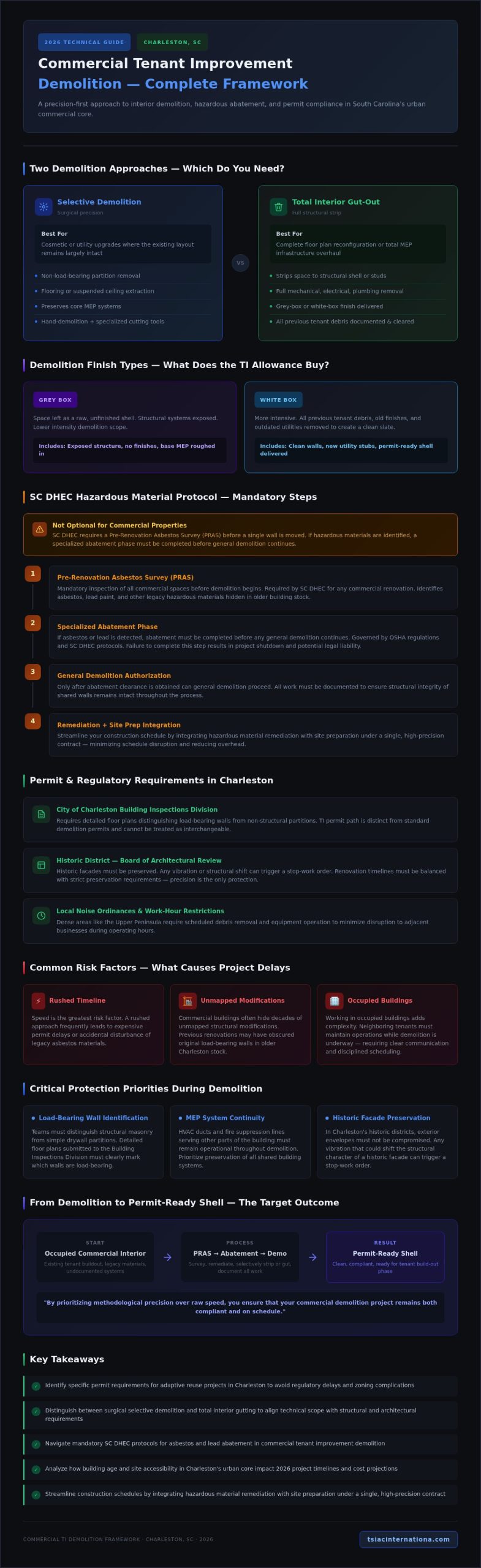
Retail and office spaces are transitioning to meet 2026 tenant demands for open-concept layouts and upgraded HVAC systems. The scope of your demolition is often dictated by the “Tenant Improvement Allowance” negotiated in the lease. This budget determines whether you perform a “grey-box” demolition, which leaves the space as a raw shell, or a “white-box” finish. A white-box demolition is more intensive. It involves removing all previous tenant debris, old finishes, and outdated utilities to create a clean slate for the incoming business. Every element removed must be documented to ensure the structural integrity of shared walls remains intact.

Regulatory Landscape for South Carolina Commercial Interiors

South Carolina DHEC (Department of Health and Environmental Control) maintains strict oversight of interior renovations. Before a single wall is moved, you must conduct a pre-renovation asbestos survey (PRAS). This isn’t optional for commercial properties in Charleston. If asbestos or lead is identified, the project must pivot to a specialized abatement phase before general demolition continues. Local noise ordinances and work-hour restrictions also dictate the project rhythm. In densely populated areas like the Upper Peninsula, work must be scheduled to minimize disruption to adjacent businesses. This requires a disciplined approach to debris removal and equipment operation. Managing these variables ensures that your project remains compliant with state law and local city codes.

Selective Demolition vs. Total Interior Gutting: A Technical Breakdown

The success of commercial tenant improvement demolition charleston sc depends on choosing the correct technical approach for the building’s future use. Selective demolition is a surgical process. It involves the removal of specific interior components like non-load-bearing partitions, flooring, or suspended ceilings while preserving the building’s core systems. This method is ideal when the existing layout remains largely intact but requires cosmetic or utility upgrades. In contrast, a total interior gut-out strips the space down to its structural shell or studs. This is necessary when the new tenant’s requirements demand a complete reconfiguration of the floor plan or a total overhaul of the MEP (mechanical, electrical, plumbing) infrastructure.

Protecting load-bearing elements is the primary concern during any interior strip-out. Our teams distinguish between structural masonry and simple drywall partitions to ensure the building’s stability isn’t compromised. This distinction is critical in Charleston’s older commercial stock where previous renovations may have obscured original load-bearing walls. Working in occupied buildings adds another layer of complexity. We must maintain clear communication with active neighboring tenants to minimize operational interference while we execute the demolition phase.

Surgical Techniques for Selective TI Projects

Precision is maintained through hand-demolition and the use of specialized cutting tools. We prioritize the protection of existing MEP systems that must remain operational. This includes maintaining the continuity of HVAC ducts and fire suppression lines that serve other parts of the building. When new layouts require updated utilities, we employ precision slab cutting and trenching. These techniques allow for the installation of new plumbing or electrical lines without disturbing the surrounding concrete foundation. If you need assistance determining the right scope for your project, our team provides selective demolition services tailored to complex commercial environments.

Managing Shared Infrastructure in Multi-Tenant Buildings

Shared infrastructure requires a defensive approach to demolition. Vibration monitoring is often deployed to prevent hairline fractures or structural stress in adjacent commercial units. We also implement rigorous dust containment strategies. Using HEPA-filtered air scrubbers and maintaining negative air pressure prevents the migration of particulates into common areas or neighboring offices. Logistics in Charleston present unique challenges. Navigating narrow downtown alleys for debris hauling requires small-chassis equipment and precise scheduling to avoid blocking traffic or violating local ordinances. Every load of wood, metal, or plastic is sorted to meet our commitment to on-site recycling, ensuring a clean and compliant transition to the construction phase.

Critical Hazardous Material Protocols for Charleston Commercial Spaces

Charleston’s commercial inventory, particularly within the mid-century district and historic downtown, presents specific environmental challenges that can derail a project’s timeline. During a commercial tenant improvement demolition charleston sc, the discovery of hazardous materials is a statistical probability rather than a rare occurrence. These materials aren’t just safety hazards; they represent significant legal and financial liabilities. SC DHEC and OSHA maintain rigorous oversight of interior renovations, and non-compliance can lead to permanent work stoppages or heavy fines. Integrating specialized abatement into the demolition workflow is the only way to ensure the site remains safe and the project stays on schedule.

Managing these risks requires a methodological approach to material identification and removal. When hazardous substances are handled incorrectly, they can contaminate adjacent tenant spaces through shared HVAC systems or structural gaps. This creates a chain of liability that extends from the property owner to the contractor. By addressing these issues during the initial demolition phase, you create a clean, certified environment for the subsequent build-out. This integration prevents the project-stalling violations that often occur when general contractors encounter unexpected legacy materials behind old finishes.

Asbestos Abatement in the TI Workflow

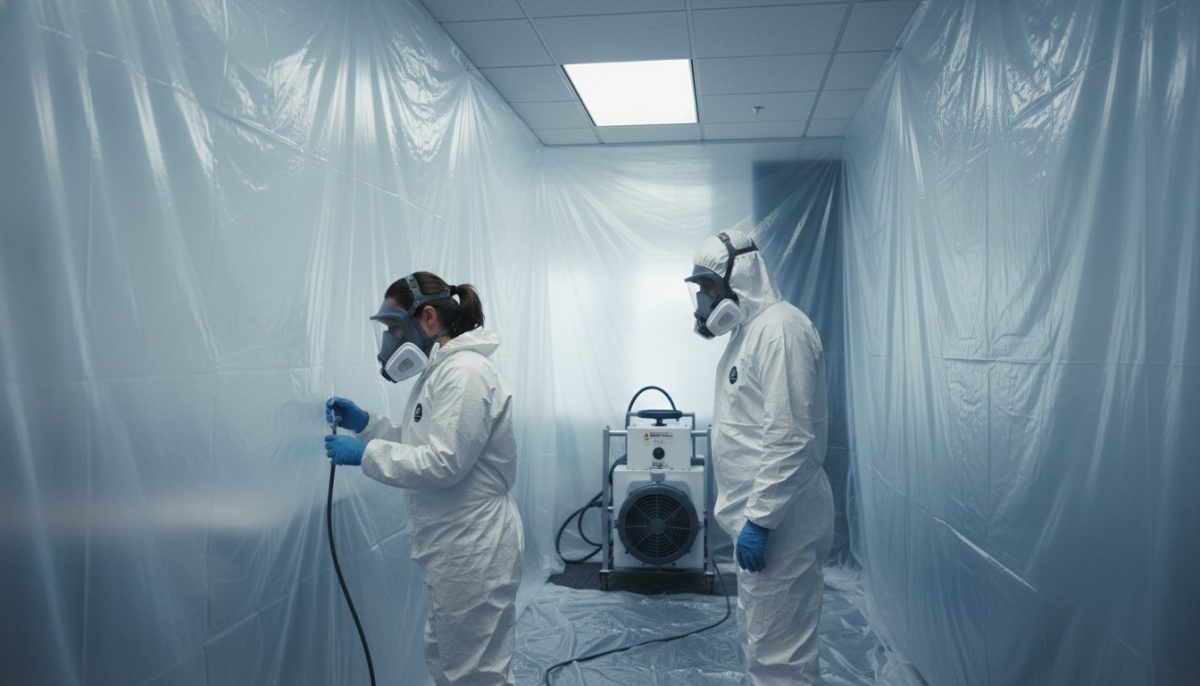
Asbestos identification is the first technical step in a high-precision TI workflow. Common asbestos-containing materials (ACMs) in Charleston’s older office and retail spaces include vinyl floor tiles, black mastic adhesives, and spray-applied fireproofing. We establish regulated work areas using 6-mil polyethylene sheeting and HEPA-filtered negative air machines to prevent fiber migration. This containment ensures that demolition activities don’t compromise the air quality of the rest of the building. For a detailed breakdown of the 2026 regulatory framework, review our guide on asbestos removal south carolina.

Lead Remediation and Mold Mitigation

Lead remediation is a primary concern when dealing with painted metal framing or original structural steel in historic renovations. We utilize wet-shaving techniques or HEPA-shrouded tools to suppress dust during the removal of these components. Mold mitigation also becomes necessary when gutting spaces that have experienced historical moisture intrusion. Fungal growth hidden behind old drywall or within outdated ductwork must be remediated before new finishes are applied. Following these protocols is essential for comprehensive hazardous material abatement south carolina. This unified approach guarantees that your space is permit-ready and safe for the next phase of development.
Commercial Tenant Improvement Demolition in Charleston, SC: 2026 Guide

Projecting Timelines and Cost Drivers for 2026 TI Demolition

Budgeting for a commercial tenant improvement demolition charleston sc requires a technical assessment of variables that extend beyond simple square footage. In 2026, labor allocation and logistics are the most volatile cost drivers. Project owners often overlook how building age influences the complexity of a bid. Older structures in Charleston frequently require surgical hand-demolition to protect sensitive structural components; this increases labor hours compared to mechanical removal. Accessibility also plays a critical role. A site with restricted elevator access or narrow alleyways for debris load-out will naturally command a higher price point than a ground-floor retail space with direct exterior access.

Timelines are equally dependent on these site conditions. For a 5,000 square foot commercial gut-out, a standard schedule ranges from ten to fifteen business days. This timeframe accounts for the systematic removal of non-load-bearing partitions, flooring, and MEP systems. If hazardous material abatement is required, the timeline will expand to include containment setup and third-party air clearance testing. Planning for these phases early prevents the cascading delays that occur when a general contractor is forced to wait for a site to be cleared.

Primary Cost Drivers in Commercial Demolition

Labor intensity is the most significant factor in your project’s financial profile. Selective demolition demands high precision. Workers must manually disconnect utilities and saw-cut specific sections of the slab. This is far more time-consuming than the bulk removal seen in total structural demolition. Additionally, the volume of hazardous materials found during the pre-renovation survey dictates the disposal requirements. Specialized waste streams for asbestos or lead-containing components are priced differently than standard construction debris. You should also account for structural reinforcement needs. If the gut-out reveals compromised masonry or rusted steel framing, the cost of temporary shoring will be added to the demolition scope.

Sustainable Debris Management and Recycling

Material recovery offers a strategic “Recycling Offset” that can reduce overall project expenses. TSIAC International prioritizes the on-site sorting of wood, metal, and plastic to divert these materials from local landfills. This commitment isn’t just about environmental responsibility; it directly impacts your budget by lowering landfill tipping fees. If your project is pursuing LEED certification, our detailed recycling documentation provides the data required for your waste management credits. Effective debris management ensures a cleaner job site and a more efficient transition for the incoming construction crew. To optimize your project’s financial and environmental performance, partner with a team that specializes in commercial tenant improvement demolition charleston sc and integrated site preparation.

Partnering with TSIAC International for Your Charleston Project

Success in commercial tenant improvement demolition charleston sc requires more than just heavy equipment; it demands a deep understanding of local building stock and regulatory nuances. With over 15 years of industry experience in the Charleston market, TSIAC International has refined a methodology that addresses the specific technical challenges of the Lowcountry. We recognize that TI projects often occur in high-stakes environments where shared walls, active utilities, and neighboring tenants leave no room for error. Our team operates as a disciplined partner, bridging the gap between the initial gut-out and the start of new construction.

One of the primary advantages of our integrated approach is the consolidation of demolition and hazardous material remediation under a single contract. This model significantly reduces your liability. When the same team handles both the structural removal and the asbestos or lead abatement, there’s no risk of cross-contamination or communication gaps between subcontractors. We provide comprehensive documentation and maintain robust insurance profiles to protect property owners and developers throughout the project lifecycle. For those evaluating their options, our guide on demolition contractors charleston sc provides additional criteria for selecting a high-performance partner.

Beyond the Gut-Out: Integrated Site Services

Our scope extends beyond simple debris removal. We prepare the site for immediate build-out through specialized services such as precision concrete removal and mechanical floor grinding. These steps are essential for ensuring new finishes adhere correctly to the slab. We also clear acoustic ceilings and outdated MEP systems to provide a truly clean shell. By offering metal framing and drywall preparation, we jumpstart the construction schedule. This allows your general contractor to begin the installation phase without the typical delays associated with multi-vendor handoffs.

Get Started on Your Charleston Commercial Renovation

The process begins with a site-specific survey. This assessment allows us to identify potential cost drivers and environmental hazards before they become project-stalling issues. We provide fixed-price contracts to ensure budgetary transparency and eliminate the uncertainty often found in renovation bids. Our project managers coordinate directly with your architects and general contractors to align our demolition strategy with the final design goals. Once the interior strip-out is complete, we execute a final site clearing and manage all debris through our on-site recycling protocols. This disciplined finish ensures your space is permit-ready and safe for the next phase of development.

Securing the Foundation for Your Next Commercial Build-Out

Successful renovation projects in the Lowcountry depend on the technical integrity of the initial strip-out. You mitigate the risks of structural damage and regulatory fines by prioritizing hazardous material identification and surgical selective demolition. This guide has detailed how integrating abatement with site preparation ensures your project moves seamlessly from a raw shell to a permit-ready interior. By addressing environmental concerns and structural preservation during the demolition phase, you create a stable environment for the subsequent construction teams to follow.

TSIAC International brings over 15 years of local expertise to every site. As licensed asbestos and lead abatement specialists, we maintain full SC DHEC compliance while executing the most complex commercial tenant improvement demolition charleston sc. Our focus remains on delivering a clean, safe environment that allows your construction team to begin work immediately without the burden of legacy debris or environmental liabilities. We handle the technical complexities so you can focus on the final design and tenant occupancy. Professional demolition is the first step in a high-quality renovation.

Request a Consultation for Your Charleston TI Project to ensure your renovation starts with professional precision and unwavering reliability.

Frequently Asked Questions

Do I need an asbestos survey for a small interior TI project in Charleston?

SC DHEC regulations require a Pre-Renovation Asbestos Survey (PRAS) for every commercial renovation project in Charleston, regardless of the square footage. Even minor tenant improvements that involve disturbing finishes like floor tile or black mastic must be preceded by an inspection. Failing to conduct this survey before beginning a commercial tenant improvement demolition charleston sc can result in significant fines and project shutdowns by state regulators who prioritize environmental safety.

How long does a typical commercial interior gut-out take to complete?

A typical commercial interior gut-out for a 5,000 square foot space generally requires ten to fifteen business days. This timeline includes the systematic removal of non-structural partitions, flooring, and MEP systems. Factors such as restricted site access, the need for surgical hand-demolition, or the discovery of hazardous materials will extend this duration. We provide detailed schedules during the planning phase to ensure your construction team can begin work without unnecessary delay.

Can demolition happen while other tenants are still in the building?

Demolition frequently occurs in occupied buildings where neighboring businesses remain operational. We implement rigorous dust containment strategies using HEPA-filtered negative air pressure and physical barriers to prevent particulate migration into shared spaces. Noise-intensive activities are often scheduled during off-peak hours to minimize disruption. Vibration monitoring is also utilized to ensure that activities within your space don’t negatively impact the structural integrity or sensitive equipment of adjacent commercial tenants.

What is the difference between selective demolition and a total gut-out?

Selective demolition involves the surgical removal of specific building components while preserving the existing core infrastructure. This is common when the primary layout remains unchanged but requires utility upgrades. A total interior gut-out involves stripping the space down to its structural shell or studs. This approach is necessary when a tenant requires a complete reconfiguration of the floor plan or a total replacement of the mechanical, electrical, and plumbing systems.

Is lead paint remediation required for commercial buildings in South Carolina?

Lead paint remediation is mandatory for commercial buildings in South Carolina if the renovation activities will disturb lead-containing materials. While more common in historic downtown Charleston structures, lead is often found on original structural steel or metal framing in mid-century buildings. We employ wet-shaving and HEPA-shrouded tools to safely remove these components. Compliance with OSHA lead standards is essential to protect both our workers and the building’s future occupants.

How does TSIAC International handle material recycling during the demolition process?

TSIAC International maintains a strict commitment to on-site material recovery. During the demolition process, we sort wood, metal, and plastic debris into dedicated waste streams for transport to local recycling facilities. This practice reduces the volume of material sent to landfills and lowers overall project costs through reduced tipping fees. For projects pursuing LEED certification, we provide the necessary documentation to verify that waste diversion goals have been met with technical accuracy.

What permits are required for commercial interior demolition in Charleston?

Commercial interior demolition in Charleston requires a specific permit from the City of Charleston Building Inspections Division. This permit is distinct from a total structural demolition permit. You must submit detailed floor plans that clearly identify which elements are structural versus non-structural. If the property is located within a historic district, additional approval from the Board of Architectural Review may be necessary to ensure that the exterior envelope remains protected.

What happens if hazardous materials are found after the demolition starts?

If suspected hazardous materials are discovered after demolition has commenced, work must stop immediately in the affected area. The materials must be tested by a certified professional to determine their composition. If results are positive for asbestos or lead, a specialized abatement plan is implemented under SC DHEC guidelines. Our integrated team can pivot quickly to address these findings, ensuring that the commercial tenant improvement demolition charleston sc remains compliant without causing indefinite delays.
Commercial Lead Paint Abatement in Charleston, SC: The 2026 Safety and Compliance Guide

Most commercial property owners in Charleston treat lead paint as a compliance checkbox, something to handle quickly and move on from. That…

Most commercial property owners in Charleston treat lead paint as a compliance checkbox, something to handle quickly and move on from. That assumption is where costly project failures begin. Commercial lead paint abatement in Charleston, SC is not simply a matter of scraping walls and filing paperwork; it’s a structural management challenge that demands methodical planning, multi-trade coordination, and an uncompromising approach to regulatory documentation from the first site assessment to the final clearance report.

If you’re preparing a commercial renovation and suspect lead-containing materials are present, you already know the stakes. EPA and OSHA regulations governing large-scale lead removal are precise, and the consequences of non-compliance, whether project shutdowns, remediation penalties, or liability exposure, are significant. The complexity compounds when work must continue around active tenants or ongoing business operations.

This guide is built for commercial property owners, facilities managers, and project leads who need a clear, technically grounded roadmap through the abatement process. You’ll find a practical breakdown of regulatory requirements, containment and removal protocols, disposal obligations, and the documentation standards that protect your facility long after the project is complete.

Key Takeaways

  • Not all lead paint requires the same response — understanding the difference between intact and deteriorated lead-containing materials determines which abatement strategy is legally required and cost-effective for your property.
  • Commercial lead paint abatement in Charleston, SC follows a structured five-step workflow, from XRF testing and containment setup to final clearance reporting, and skipping any phase creates measurable regulatory and liability exposure.
  • Full removal and encapsulation are not interchangeable options — the right method depends on your building’s renovation timeline, structural conditions, and long-term occupancy plans.
  • OSHA’s 29 CFR 1926.62 and the EPA’s RRP Rule impose distinct, parallel obligations on commercial projects; compliance with one does not satisfy the other, and documentation gaps remain the most common source of project shutdowns.
  • Selecting a contractor with integrated hazardous material management capabilities — including selective demolition, containment, and compliant debris disposal — significantly reduces coordination risk on complex commercial abatement projects.

The Risks and Realities of Lead Paint in Commercial Structures

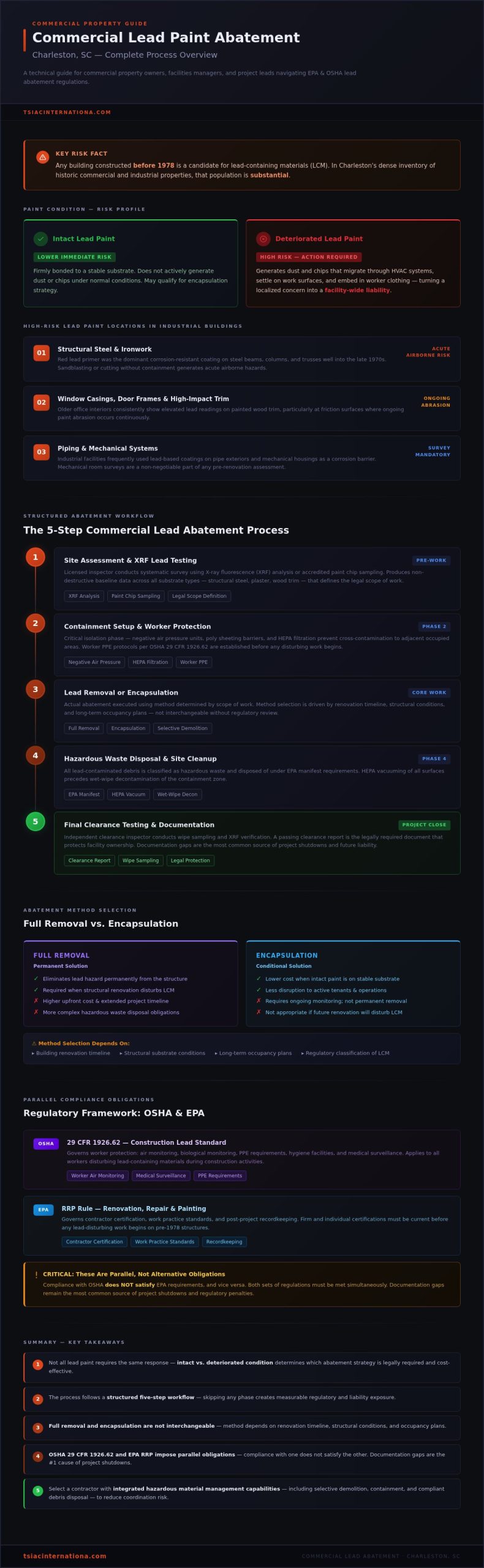
Commercial lead paint abatement in Charleston, SC begins with a straightforward but frequently underestimated fact: any building constructed before 1978 is a candidate for lead-containing materials (LCM), and in Charleston’s dense inventory of historic commercial and industrial properties, that population is substantial. Commercial lead abatement is the systematic identification, containment, and removal of toxic lead-based coatings from structures where their presence creates measurable health and regulatory risk.

The critical distinction that shapes every abatement decision is the condition of the paint itself. Intact lead paint, firmly bonded to a stable substrate, presents a different risk profile than deteriorated lead hazards found in high-traffic corridors, loading docks, or aging mechanical rooms. Deterioration creates dust and chips that migrate through HVAC systems, settle on work surfaces, and become embedded in the clothing of workers who never set foot near the original source. That migration dynamic is what transforms a localized material concern into a facility-wide liability.

Health Hazards and Liability for Facility Managers

Chronic low-level lead dust exposure produces neurological and cardiovascular effects that don’t announce themselves immediately, which makes occupational exposure particularly difficult to trace back to a specific source after the fact. For facility managers, that ambiguity doesn’t reduce legal exposure; it compounds it. OSHA and EPA regulations place affirmative obligations on building owners to assess and disclose known lead hazards. Failure to act on confirmed findings creates direct liability in the event of a worker or tenant health claim. Beyond legal exposure, documented lead findings routinely affect property insurance classifications and can trigger renegotiation clauses in commercial property valuations during sale or refinancing.

Common Locations for LBP in Industrial Settings

Lead-based paint doesn’t distribute itself evenly through a commercial structure. In industrial and warehouse environments, the highest concentrations typically appear in predictable locations:

  • Structural steel and ironwork: Red lead primer was the dominant corrosion-resistant coating on steel beams, columns, and trusses well into the late 1970s. Sandblasting or cutting this material without containment generates acute airborne hazards.
  • Window casings, door frames, and high-impact trim: Older office interiors consistently show elevated lead readings on painted wood trim, particularly at friction surfaces where paint abrasion is ongoing.
  • Piping and mechanical systems: Industrial facilities frequently used lead-based coatings on pipe exteriors and mechanical housings as a corrosion barrier, making mechanical room surveys a non-negotiable part of any pre-renovation assessment.

Knowing where to look isn’t enough on its own. Confirming the presence and concentration of lead-containing materials through XRF analysis or paint chip sampling is what converts a suspicion into an actionable abatement scope, and that scope is where the project’s regulatory obligations formally begin.

The 5-Step Commercial Lead Abatement Process

A structured abatement workflow is what separates a compliant project closure from an expensive remediation restart. For commercial lead paint abatement in Charleston, SC, the process follows five discrete phases, each with its own technical requirements, documentation obligations, and quality checkpoints. Compressing or combining these phases doesn’t save time; it creates the conditions for regulatory failure.

Step 1: Comprehensive Site Assessment and XRF Lead Testing. Before any containment goes up, a licensed inspector conducts a systematic survey using X-ray fluorescence (XRF) analysis or accredited paint chip sampling. XRF testing produces immediate, non-destructive readings across multiple substrate types, from structural steel to plaster, and generates the baseline data that defines the legal scope of work. Without this foundation, there’s no defensible abatement plan.

Step 2: Engineering Controls and High-Level Containment Setup. Once the scope is confirmed, the work zone is physically isolated. This means polyethylene sheeting, critical barriers at all penetrations, and regulated entry and exit points. The containment perimeter isn’t a precaution; it’s a regulatory requirement under OSHA 29 CFR 1926.62.

Step 3: Surgical Removal and HEPA-Vacuuming Protocols. Lead-containing materials are removed using methods calibrated to the substrate and condition of the paint. Wet methods suppress dust generation at the source. HEPA-rated vacuums capture residual particulate at every stage. This phase integrates directly with selective demolition when structural components require removal, ensuring that abatement and demolition scopes don’t create uncontrolled cross-contamination.

Step 4: Hazardous Waste Disposal and Transportation. Lead-contaminated debris is classified, segregated, and manifested as hazardous waste under EPA regulations before it leaves the site. Every container is labeled, every transfer documented.

Step 5: Final Clearance Testing and Regulatory Documentation. An independent clearance inspector verifies that post-abatement dust wipe samples meet EPA clearance standards. The resulting clearance report, combined with the project’s full documentation package, is the legal record that closes out the project and protects the property owner going forward.

Advanced Containment and Air Filtration

Negative air machines equipped with HEPA filtration maintain negative pressure within the work zone, drawing airborne particulate away from occupied areas rather than allowing it to migrate through the building envelope. Decontamination zones, typically a three-stage airlock system, require abatement crews to remove and bag protective gear before exiting the containment area. HVAC systems are sealed at all supply and return registers within and adjacent to the work zone before abatement begins; this step is non-negotiable on interior gut-out projects where ductwork runs through multiple floors.

Safe Disposal and Environmental Recycling

Not all debris leaving a lead abatement site carries the same classification. Clean structural metal and uncontaminated wood framing can be segregated from lead-contaminated material and directed to recycling streams, a practice that reduces disposal costs and supports corporate environmental commitments. Contaminated debris requires a signed hazardous waste manifest that tracks the material from point of generation to licensed disposal facility. This is where hazardous material abatement integrates with total site management: a contractor handling both abatement and demolition scopes can sort, manifest, and recycle debris under a single chain of custody, eliminating the coordination gaps that produce compliance errors. For commercial lead paint abatement in Charleston, SC, that integrated capability is a meaningful operational advantage on projects with tight timelines.

Project teams that want to understand how abatement, selective demolition, and recycling services can be coordinated under one scope should consult with an experienced abatement contractor early in the planning phase, before the site assessment findings define the timeline.

Comparing Abatement Strategies: Removal vs. Encapsulation

Choosing the right response to confirmed lead-containing materials isn’t a binary decision between doing the minimum and doing the most. It’s a technical judgment call shaped by your building’s current condition, its renovation trajectory, and the long-term occupancy plan. For commercial lead paint abatement in Charleston, SC, three distinct strategies are available: full removal, encapsulation, and enclosure. Each carries a different cost profile, regulatory footprint, and maintenance obligation going forward.

Full removal eliminates the hazard permanently. Encapsulation manages it through barrier coatings. Enclosure covers it with new permanent materials such as drywall or rigid paneling. None of these is universally superior; the correct choice depends on what happens to that surface over the next five to twenty years.

When to Choose Full Structural Removal

Full abatement becomes the required path, not just the preferred one, in three scenarios. First, any commercial interior gutting project that disturbs lead-painted substrates triggers mandatory removal protocols; encapsulation doesn’t satisfy regulatory requirements when the substrate itself is being demolished. Second, structural steel components scheduled for welding, cutting, or thermal work must have lead coatings stripped beforehand. Heat applied to lead-painted steel generates lead fume concentrations that exceed OSHA permissible exposure limits almost immediately, making this a non-negotiable pre-work requirement. Third, achieving a documented lead-free status carries real transactional value. Properties with cleared abatement records move through due diligence faster, face fewer lender conditions, and carry reduced environmental liability disclosures during sale or refinancing.

The upfront cost of full removal is higher than encapsulation, but it eliminates recurring inspection obligations and removes the risk of future regulatory reclassification if the encapsulant fails.

Encapsulation as a Temporary Management Strategy

Encapsulation is appropriate when lead-painted surfaces are structurally sound, not scheduled for disturbance, and located in low-friction, low-moisture environments. Liquid encapsulants bond to the existing coating and form a barrier that prevents lead dust migration, but that barrier has a defined service life and must be monitored.

Several conditions disqualify a surface from encapsulation as a viable long-term strategy:

  • High-friction zones: Door frames, window sills, and floor surfaces where mechanical abrasion is continuous will degrade encapsulant coatings faster than the inspection cycle can catch.
  • High-moisture environments: Mechanical rooms, loading dock interiors, and areas subject to condensation or water intrusion accelerate coating failure, converting a managed hazard back into an active one.
  • Surfaces with existing adhesion failures: Encapsulant applied over peeling or friable paint doesn’t stabilize the substrate; it adds a layer over an already-compromised bond.

Encapsulation also requires a documented inspection schedule maintained in the property’s environmental records. That obligation doesn’t expire. If inspections lapse and the coating fails, the property owner faces both a renewed lead hazard and a compliance gap in the maintenance record. For facilities with active renovation programs, that ongoing management burden frequently makes full removal the more cost-effective decision over a ten-year horizon.

Commercial Lead Paint Abatement in Charleston, SC: The 2026 Safety and Compliance Guide

Regulatory Compliance: OSHA, EPA, and National Standards

Two separate federal regulatory frameworks govern commercial lead paint abatement in Charleston, SC, and they operate in parallel without overlap. Satisfying one does not satisfy the other. The EPA’s Renovation, Repair, and Painting (RRP) Rule establishes requirements for work that disturbs lead-containing materials in buildings, including commercial structures, while OSHA’s Lead in Construction Standard (29 CFR 1926.62) governs worker protection during that same work. A project that meets EPA documentation standards but falls short on OSHA exposure controls is still a non-compliant project, and vice versa.

The RRP Rule requires that firms performing regulated renovation work be certified by the EPA and that at least one trained, certified renovator supervise the project. For commercial properties, the practical implication is that your contractor’s credentials need to be verified before mobilization, not after a compliance inquiry. Documentation obligations under the RRP Rule include pre-renovation disclosures, records of containment setup, and post-work cleaning verification, all retained for a minimum of three years.

OSHA 29 CFR 1926.62 triggers specific obligations when airborne lead concentrations exceed the Action Level of 30 micrograms per cubic meter of air, averaged over an eight-hour shift. Above that threshold, employers must implement engineering controls, establish a medical surveillance program, and maintain detailed exposure records for each worker. The standard also mandates the designation of a Competent Person on every lead abatement job site, an individual with the training and authority to identify hazardous conditions and implement corrective measures in real time. This isn’t a title; it’s a defined legal role with documented responsibilities.

The documentation package that closes out a compliant abatement project must include the original lead inspection report, the abatement contractor’s scope of work, waste manifests tracking all lead-contaminated debris from generation to licensed disposal, and the independent clearance certificate issued after post-abatement wipe sampling. Each document serves a distinct function in the chain of evidence that protects the property owner from future liability.

Worker Safety and Personal Protective Equipment

Respiratory protection under 29 CFR 1926.62 requires a written program, fit testing for each worker, and selection of respirators appropriate to the specific exposure level. Half-face air-purifying respirators with P100 filters are standard for most abatement tasks, while supplied-air respirators are required for high-dust operations like structural steel preparation. Blood lead level monitoring applies to workers with regular exposure above the Action Level, with biological monitoring intervals set by the standard based on measured BLL results. On-site hygiene facilities are mandatory, including separate change areas, hand-washing stations, and a defined dirty-to-clean transition protocol that prevents contaminated gear from leaving the work zone.

Environmental Impact and Debris Management

Lead-contaminated dust and bulk structural debris are not managed under the same protocols. Fine particulate captured by HEPA vacuums and wet-wiping procedures is double-bagged, labeled, and manifested as hazardous waste. Bulk structural material, such as steel framing or wood substrate that tested below hazardous waste thresholds, can be segregated and directed into recycling streams. TSIAC’s integrated approach to the demolition process applies this segregation systematically, diverting recoverable metal and clean wood from landfill disposal while keeping the hazardous waste manifest accurate and defensible. That dual-stream approach reduces disposal costs and supports the environmental reporting requirements that corporate occupants increasingly include in their ESG documentation.

If you’re planning a commercial renovation that involves confirmed or suspected lead-containing materials, the time to align regulatory strategy with project scope is before the first contractor mobilizes. Contact TSIAC to discuss your project’s compliance requirements and build a documentation framework that holds up to regulatory scrutiny from day one.

Why TSIAC International is the Strategic Choice for Lead Abatement

Choosing a contractor for commercial lead paint abatement in Charleston, SC is not a procurement decision that rewards the lowest bid. The consequences of a compliance failure, a missed waste manifest, a containment breach, or an incomplete clearance package, fall on the property owner, not the contractor. What protects you is a firm with the technical depth to execute every phase correctly and the operational experience to anticipate problems before they become project shutdowns.

TSIAC International brings over 15 years of specialized experience in high-stakes hazardous material remediation to every engagement. That experience isn’t a marketing figure; it translates directly into the kind of field judgment that prevents the coordination failures that derail complex abatement projects. The firm’s service portfolio covers the full project arc: lead abatement, asbestos removal, selective demolition, interior gutting, concrete removal, mold remediation, and integrated recycling services. When all of those scopes sit under one contractor, the documentation chain stays clean and the schedule stays intact.

The Advantage of Integrated Demolition and Abatement

Most abatement failures trace back to the boundary between trades. When a separate demolition crew follows an abatement crew without coordinated oversight, substrate damage, containment breaches, and cross-contamination become predictable outcomes. TSIAC’s integrated approach eliminates that boundary. Selective demolition and lead removal are planned and executed as a single scope, which means structural components are assessed for lead presence before any cutting or removal begins, containment protocols extend across both phases, and debris is sorted and manifested under one chain of custody. The result is a measurably tighter schedule and a documentation package that reflects the actual sequence of work, not a patchwork of separate contractor records.

Requesting a Fixed-Price Abatement Quote

Large-scale commercial abatement contracts carry enough regulatory complexity that pricing ambiguity creates its own category of risk. TSIAC structures its commercial proposals around fixed-price scopes developed from the site assessment data, so the regulatory paperwork, waste manifests, clearance coordination, and debris disposal are accounted for in the project cost rather than treated as change-order events after mobilization.

For commercial lead paint abatement in Charleston, SC, the planning conversation is where project outcomes are actually determined. Contact TSIAC International for a comprehensive site evaluation and a fixed-price proposal that reflects the full technical and regulatory scope of your project. The earlier that conversation happens, the more options remain on the table.

Take Control of Your Property’s Lead Risk Before It Controls Your Project

Commercial lead paint abatement in Charleston, SC demands more than reactive compliance. It requires a structured methodology, airtight documentation, and a contractor capable of managing every phase without creating gaps between trades. The properties that move through abatement without costly delays share one common factor: early planning with a contractor who understands both the regulatory framework and the physical realities of the work.

The core lessons from this guide are straightforward. Your abatement strategy must match your renovation timeline, not just your current budget. OSHA and EPA obligations run in parallel and both require documented proof of compliance. And integrated abatement and demolition management isn’t a convenience; it’s a measurable risk reduction.

TSIAC International brings 15+ years of certified expertise, comprehensive regulatory compliance documentation, and national service capability to every commercial engagement. That depth of experience means your project closes with a clean record, not an open liability.

Secure your property’s future with TSIAC International’s expert abatement services and start your project with a team that’s built for the complexity you’re facing.

Frequently Asked Questions About Commercial Lead Paint Abatement in Charleston, SC

What is the difference between lead abatement and lead renovation?

Lead abatement is the permanent elimination or encapsulation of lead-containing materials by a certified abatement contractor, carried out under EPA and OSHA regulatory frameworks with formal clearance testing at the end. Lead renovation, regulated under the EPA’s RRP Rule, refers to repair or remodeling work that incidentally disturbs lead-painted surfaces rather than targeting them for removal. The distinction matters because abatement requires a licensed abatement firm, while renovation work requires a certified renovator following specific work practice standards.

Misclassifying a project as renovation when it legally qualifies as abatement is one of the more common compliance errors on commercial sites. If the primary purpose of the work is eliminating a confirmed lead hazard, it’s abatement, and the contractor and documentation requirements are substantially more rigorous.

How long does a typical commercial lead abatement project take?

Timeline varies considerably based on the square footage affected, the number of substrate types involved, and whether abatement runs concurrently with selective demolition or interior gutting. A targeted single-floor office abatement might be completed in three to five days. A multi-story industrial facility with lead-primed structural steel and contaminated mechanical rooms can take several weeks, particularly when phased scheduling is required to keep portions of the building operational.

The clearance phase adds time that’s frequently underestimated. Post-abatement wipe sampling must be conducted by an independent inspector, and results need to be processed before the area can be re-occupied. Building that buffer into the project schedule from the start prevents the delays that catch facility managers off guard at project close.

Do I need to vacate my commercial building during lead paint removal?

Full building evacuation isn’t always required, but it depends on the scope and location of the work. Abatement confined to a sealed, negatively pressurized zone with proper decontamination airlocks can proceed while other areas of the building remain occupied, provided the containment perimeter is correctly established and HVAC systems serving adjacent zones are isolated. This is a technical determination that must be made during the pre-abatement planning phase, not on the day work begins.

Any abatement work that affects shared air handling systems, structural elements spanning occupied zones, or high-traffic circulation paths typically requires partial or full temporary relocation of occupants. Attempting to maintain occupancy without a formal exposure assessment for adjacent areas creates liability exposure that property owners often don’t recognize until a complaint is filed.

What are the specific EPA RRP requirements for commercial properties in 2026?

The EPA’s RRP Rule requires that any firm performing renovation work that disturbs lead-containing materials in a commercial building must be EPA-certified, and at least one certified renovator must be present on site or available by phone during the work. Certified renovators are responsible for ensuring that proper containment is established, that post-work cleaning is conducted and verified, and that required records are retained for a minimum of three years. Firms should verify current certification requirements directly with the EPA, as program updates can affect specific documentation thresholds.

It’s important to confirm that your contractor holds current EPA RRP certification before mobilization, not after. Certification is firm-specific and individual-specific; a certified firm with an uncertified renovator on site is still a non-compliant project. Request documentation of both before signing a contract.

Can lead paint be recycled along with other demolition debris?

Lead-contaminated materials cannot be commingled with general demolition debris for recycling. They must be classified, segregated, and manifested as hazardous waste before leaving the site. However, clean structural materials that tested below hazardous waste thresholds, such as uncontaminated steel framing or untreated wood, can be separated and directed into recycling streams. TSIAC’s integrated approach to abatement and demolition applies this dual-stream segregation systematically, reducing disposal costs while keeping the hazardous waste manifest accurate.

The practical benefit of working with a contractor who handles both abatement and demolition under one scope is that debris classification happens at the point of generation, under a single chain of custody. When separate trades manage these phases independently, misclassification and documentation gaps become predictable problems.

How much does commercial lead abatement cost per square foot?

Providing a reliable per-square-foot figure without a site assessment would be misleading, and any contractor quoting a flat rate before reviewing XRF test results and substrate conditions should raise a flag. Actual cost is driven by the concentration and distribution of lead-containing materials, the removal method required, the number of distinct substrate types involved, waste volume, and whether the project requires phased scheduling around active building operations.

The most reliable path to accurate pricing is a comprehensive site assessment followed by a fixed-price proposal that accounts for the full regulatory scope, including containment setup, waste manifesting, clearance testing coordination, and final documentation. Projects priced without that foundation routinely encounter change orders that exceed the initial savings from a lower headline bid.

What happens if lead paint is discovered mid-renovation?

Work in the affected area must stop immediately. Continuing renovation activities that disturb newly identified lead-containing materials without implementing required controls exposes workers to uncontrolled lead dust and puts the property owner in direct violation of OSHA 29 CFR 1926.62. The site needs to be secured, the affected zone assessed by a licensed inspector, and an abatement scope developed before work can resume. This is precisely the scenario that pre-renovation XRF testing is designed to prevent.

Mid-project discoveries don’t have to become project-ending events if the response is methodical. A contractor with integrated abatement and selective demolition capabilities can pivot quickly, establish containment around the affected area, and develop a revised scope that absorbs the new findings without collapsing the overall project timeline. That responsiveness is one of the concrete advantages of commercial lead paint abatement in Charleston, SC being managed by a single experienced firm rather than multiple independent subcontractors.

What documentation do I receive after the lead abatement is complete?

A compliant project closeout package includes the original lead inspection report with XRF or paint chip sampling results, the abatement contractor’s signed scope of work, all hazardous waste manifests tracking contaminated debris from the site to the licensed disposal facility, worker exposure records if OSHA Action Level thresholds were exceeded, and the independent clearance certificate issued after post-abatement dust wipe sampling meets EPA standards. Each document serves a distinct function in the chain of evidence that protects the property owner from future regulatory and liability exposure.

This documentation package should be retained permanently in the property’s environmental records, not just for the three-year minimum required under the RRP Rule. Properties with complete abatement records move through commercial real estate due diligence faster, face fewer lender conditions, and carry a demonstrably cleaner environmental disclosure profile during sale or refinancing.

What to Expect During Asbestos Removal: A Comprehensive 2026 Property Owner’s Guide

Most property owners view asbestos abatement as a simple cleanup, but in reality, it’s a high-stakes, precision-engineered containment project where…

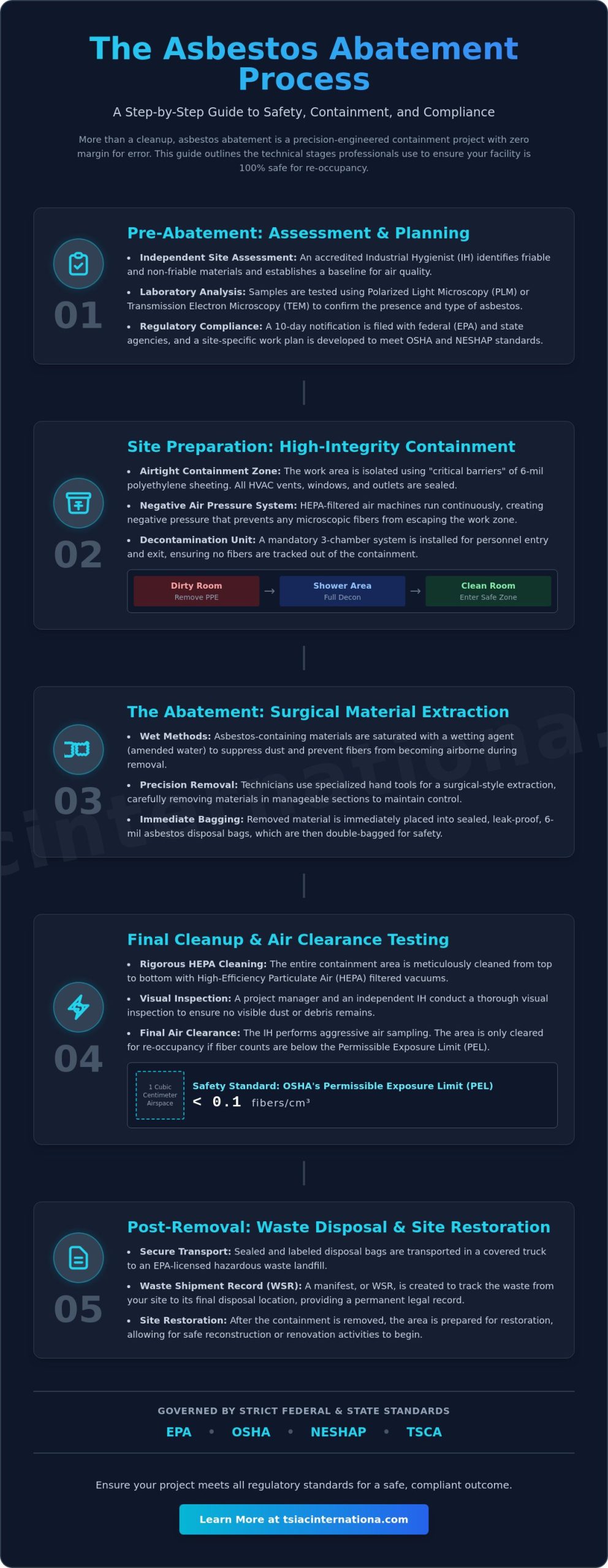
Most property owners view asbestos abatement as a simple cleanup, but in reality, it’s a high-stakes, precision-engineered containment project where there’s zero margin for error. Understanding what to expect during asbestos removal is the first step in managing the legitimate fears of cross-contamination and the complexity of current EPA regulations. It’s completely natural to feel anxious about how these specialized procedures might disrupt your daily operations or whether the environment will truly be safe for your tenants and employees to return.

We recognize that your primary goal is a compliant, hazard-free facility achieved through methodical precision. This comprehensive guide outlines every technical stage of the abatement process, ensuring you have a clear roadmap for the project ahead. You’ll learn how professionals establish negative pressure enclosures, the rigorous decontamination protocols required by OSHA, and the final air clearance testing that serves as your ultimate guarantee of safety. We will walk you through the specific steps needed to prepare your site and the verification methods used to prove the area is 100% safe for re-occupancy. By following this structured approach, you can move forward with the confidence that your property’s value and its occupants’ health are fully protected.

Key Takeaways

  • Learn exactly what to expect during asbestos removal, from the initial professional site assessment to the technical requirements of high-precision containment zones.
  • Understand the engineering behind negative air pressure systems and 6-mil polyethylene barriers that prevent microscopic fiber migration throughout your facility.
  • Discover how specialized “wet methods” and surgical extraction techniques are applied to safely remove hazardous materials while suppressing airborne dust.
  • Identify the rigorous HEPA-filtered cleaning protocols and air clearance testing required to guarantee a safe, fiber-free environment for re-occupancy.
  • Recognize the importance of the Waste Shipment Record (WSR) in ensuring your project meets all EPA disposal regulations and permanent record-keeping standards.

The Pre-Abatement Phase: Assessment and Regulatory Planning

Asbestos abatement is a precision-engineered methodology designed to extract hazardous fibers without compromising the integrity of the surrounding environment. It’s far more than a simple cleanup; it’s a strictly controlled sequence of events governed by federal mandates. Understanding what to expect during asbestos removal begins with the realization that every action is dictated by safety protocols. Since the EPA finalized the ban on chrysotile asbestos in March 2024, the regulatory landscape has become even more stringent. Property owners must ensure their projects comply with the latest Toxic Substances Control Act (TSCA) standards to avoid severe legal and health liabilities.

A successful project relies on a comprehensive site-specific work plan. This document acts as a technical blueprint, detailing how the team will adhere to National Emission Standards for Hazardous Air Pollutants (NESHAP) and OSHA regulations. These Asbestos abatement procedures ensure that the permissible exposure limit (PEL) of 0.1 fibers per cubic centimeter isn’t exceeded. Before a single barrier is erected, laboratory testing using Polarized Light Microscopy (PLM) or Transmission Electron Microscopy (TEM) must confirm the presence and concentration of asbestos in the suspect materials. This data determines the complexity of the containment required.

The Role of the Industrial Hygienist

Professional ethics and safety standards dictate that an independent Industrial Hygienist (IH) should perform the initial assessment. This third-party expert provides an unbiased evaluation, identifying whether materials are friable or non-friable. Friable materials, which can be crumbled by hand pressure, pose the highest risk of fiber release and require the most intensive containment. The IH establishes a baseline for air quality before any disturbance occurs. This data is vital because it serves as the benchmark for final clearance testing, proving the site has returned to a safe state after the work is finished.

Permitting and Documentation Logistics

Regulatory compliance requires a 10-day notification period before work begins. You must file this notice with federal and state environmental authorities, providing them with the opportunity to inspect the planned containment strategies. During this time, the project manager secures the work area and notifies building occupants or neighbors of the upcoming activity. This is also the critical window for reviewing the contractor’s documentation. We verify that all licenses are current, insurance policies are active, and safety records meet our rigorous standards for technical precision. Knowing what to expect during asbestos removal means understanding that the legal paperwork is just as critical as the physical extraction itself.

Site Preparation: Establishing Containment and Negative Pressure

The physical transformation of your property into a high-security containment zone is a crucial phase of what to expect during asbestos removal. This process begins with the installation of “critical barriers” that serve as the primary line of defense against fiber migration. Our technicians use 6-mil polyethylene sheeting to isolate the work area from the rest of the building. We don’t just tape up doorways; we seal every HVAC vent, window, and electrical outlet to ensure no fibers can migrate through the ventilation system. This rigorous isolation is a core requirement of EPA asbestos regulations, which dictate that the work zone must be completely airtight before any material disturbance occurs.

To manage personnel movement, we install a multi-stage decontamination unit. This three-chamber system includes a “dirty room,” a shower area, and a “clean room.” Every worker must pass through these stages when exiting the containment zone to prevent the accidental tracking of microscopic dust into safe areas. Engaging a team that prioritizes these technical details ensures your asbestos abatement project remains fully controlled and compliant. Understanding these mechanical safeguards clarifies what to expect during asbestos removal and why specialized equipment is non-negotiable for property safety.

The Anatomy of a Containment Zone

A professional abatement site relies on “air locks” to maintain integrity. These are overlapping flaps of polyethylene that allow for entry and exit while preventing air from rushing out of the work zone. We also ensure that any non-removable items left inside the area are pre-cleaned with HEPA vacuums and double-wrapped in plastic. High-visibility barrier tape and standardized warning signs are posted at every entry point to prevent unauthorized access and maintain safety protocols throughout the project duration.

Mechanical Ventilation and HEPA Filtration

The true science of safety lies in negative air pressure. We use high-capacity fan units equipped with HEPA filters to pull air out of the containment zone and exhaust it outside the building. This creates a pressure differential; air only flows into the work area, never out. These filters are incredibly efficient, capturing 99.97% of particles as small as 0.3 microns. To verify that this pressure is maintained, we use a digital manometer. This device provides a constant readout of the pressure levels, alerting the team immediately if the containment’s integrity is compromised. We typically target at least four air changes per hour to keep the environment as clean as possible for the technicians inside.

What to Expect During Asbestos Removal: A Comprehensive 2026 Property Owner’s Guide

The Abatement Procedure: How Hazardous Materials are Extracted

Once the containment is verified and the manometer shows stable negative pressure, the physical extraction begins. This is the most critical phase of what to expect during asbestos removal. Our technicians don full-body protective suits and specialized respirators to enter the work zone. The removal process isn’t a standard demolition; it’s a surgical extraction designed to minimize the disturbance of microscopic fibers. We use the “Wet Method” throughout the entire procedure. This involves saturating the asbestos-containing materials (ACM) with amended water, which contains chemical surfactants that improve penetration. By keeping the material damp, we ensure that fibers remain heavy and trapped in the liquid rather than becoming airborne.

Whether we’re removing vinyl floor tiles, pipe insulation, or acoustic “popcorn” ceilings, the goal is to keep the material as intact as possible during the transition from the building structure to the waste container. For example, when extracting floor tiles, we use specialized scrapers and heat guns to lift the tiles without shattering them. Throughout this process, high-efficiency particulate air (HEPA) vacuums run continuously. These units are used to capture any stray dust directly at the source of the removal. Understanding what to expect during asbestos removal means recognizing that the site should never look like a typical construction zone; it’s a controlled laboratory environment where cleanliness is maintained second by second.

Handling Friable vs. Non-Friable Materials

The protocols shift depending on the material’s state. Friable materials, such as sprayed-on fireproofing or thermal system insulation, require the highest level of caution because they can be easily crushed into a powder. For localized pipe work, we often employ glove bags. These are single-use, sealed chambers that allow a technician to strip insulation within a small, self-contained environment. Non-friable materials, like transite siding or intact floor tiles, are removed with equal care to ensure they don’t become friable through mechanical force or breakage.

Waste Packaging and Labeling Standards

Every piece of debris is placed immediately into leak-tight, 6-mil polyethylene bags or fiber drums. We follow a strict double-bagging protocol: the first bag is sealed with duct tape inside the work zone, and the second bag is added as the waste passes through the decontamination unit. Each container must feature OSHA-compliant warning labels that clearly identify the contents as hazardous asbestos. Before any waste leaves the containment area, the exterior of the bags is wiped down or “goose-necked” to ensure no dust is transferred to the transport vehicle. This methodical approach guarantees that the hazard is neutralized from the moment it’s detached from your property.

Final Cleanup and Air Clearance Testing

The transition from a hazardous work zone to a safe, re-occupiable space is a process of methodical decontamination. Once the physical extraction is complete, the containment area undergoes a rigorous “Final Wipe” protocol. This isn’t a standard janitorial cleaning; it’s a technical procedure where every surface, including the polyethylene barriers and specialized equipment, is cleaned using wet cloths and HEPA-filtered vacuums. This dual-action approach ensures that any microscopic dust settled on surfaces is captured rather than redistributed into the air. Understanding what to expect during asbestos removal during this phase is vital, as it represents the bridge between a hazardous site and a certified safe environment.

After the initial cleaning, we apply a specialized liquid known as an encapsulant, or “lock-down” agent. This sealant is sprayed over all surfaces within the work zone to trap any microscopic residual fibers that might remain on the substrate. This step provides an extra layer of security, bonding any stray particles to the surface so they cannot become airborne. Following the application of the encapsulant, a mandatory 24-hour settling period is required. This allows the air to become completely still and any remaining particles to settle before the final verification process begins. If you need a partner who prioritizes these technical safeguards, you can schedule a professional asbestos abatement consultation to ensure your project meets these precise safety standards.

Post-Abatement Visual Inspection

Before air samples are even collected, an independent industrial hygienist or project monitor must perform a thorough visual inspection. This professional uses high-intensity light, often 500-watt halogen lamps, to scan every corner of the containment for dust, debris, or moisture. The standard is absolute; the area must be 100% dry and visually pristine. This “white glove” inspection is the only way to verify that the contractor has met the cleaning requirements. If the inspector finds even a trace of residue, the entire cleaning cycle must be repeated before the project can proceed to air testing.

Air Clearance Methodologies: PCM vs. TEM

Objective proof of safety is provided through air clearance testing, which measures the concentration of fibers in the air. Property owners should be aware of two primary methodologies. Phase Contrast Microscopy (PCM) is the standard for rapid, on-site results. It counts all fibers of a specific size but cannot distinguish asbestos from other materials like fiberglass. Transmission Electron Microscopy (TEM) is the gold standard for definitive safety. TEM uses electron beams to identify the specific mineral structure of asbestos, providing a much higher level of precision. To pass clearance, the air must typically test below 0.01 fibers per cubic centimeter (f/cc), which is the industry standard for safe re-occupancy. Knowing what to expect during asbestos removal means understanding that these numbers are your final guarantee of a hazard-free building.

Post-Removal: Waste Disposal and Site Restoration

The project doesn’t end when the air samples pass. The final phase of what to expect during asbestos removal involves a secure chain of custody for every ounce of hazardous material extracted from your building. All double-bagged and labeled waste is loaded into sealed, covered vehicles for transport to an EPA-approved landfill. This isn’t a standard waste haul. Landfills must be specifically authorized to accept asbestos, and the facility must provide a Waste Shipment Record (WSR) once the material is received. This document is a legal necessity, confirming that the hazardous material reached its intended destination without incident.

The WSR is a critical asset for your permanent files. It confirms the quantity of waste, the transport company used, and the final disposal site coordinates. This record, combined with your air clearance results, forms the basis of your Abatement Report. This report is a vital document for future property sales, insurance renewals, or refinancing, as it provides documented proof that the hazard was mitigated according to federal standards. Once the waste is off-site, our team begins the physical restoration of the area. We carefully dismantle the containment barriers, remove the HEPA fan units, and perform a final walk-through to ensure the space is ready for re-occupancy. Understanding what to expect during asbestos removal means recognizing that the paperwork is just as important as the physical cleanup.

Legal Compliance and Record Keeping

You must maintain these abatement records for the entire life of the building. In the event of a future audit or property transfer, having a complete paper trail protects you from claims of negligence or non-compliance. For those managing assets in specific regions, our guide on Hazardous Material Abatement in South Carolina offers deeper insights into localized regulatory requirements. Accurate documentation is your primary defense against future liability and ensures your property remains a valuable, compliant asset.

Preparing for the Next Phase: Renovation or Demolition

Once the containment barriers are dismantled and the negative air units are removed, your site is officially ready for the next stage of development. A certified clean site allows for the safe execution of commercial interior gutting services or structural demolition without the risk of toxic exposure. Transitioning from abatement to tenant improvements is significantly smoother when you work with a full-service partner. We handle the technical handoff between hazardous material removal and selective demolition, ensuring that your project timeline remains intact and your budget is optimized through efficient, well-organized workflows.

Securing Your Property’s Future with Professional Abatement

Managing a hazardous material project requires more than just a cleanup crew; it demands an engineering-first approach to safety and compliance. By understanding what to expect during asbestos removal, you’ve gained the insight needed to oversee a process that prioritizes technical containment, continuous HEPA filtration, and the rigorous verification of air clearance. These methodical steps don’t just remove a physical hazard. They protect your building’s long-term value and ensure a baseline of safety for every occupant who enters your facility.

TSIAC International brings over 15 years of hazardous material expertise to every project. We’re fully licensed and insured for national abatement work, maintaining a strict adherence to EPA and OSHA safety protocols that guarantees precision at every stage. Our team ensures that every Waste Shipment Record is documented and every containment zone remains under constant monitoring. When you’re ready to move forward with absolute confidence, contact TSIAC International for a professional abatement quote. We look forward to helping you restore your property to a safe, compliant, and productive state.

Frequently Asked Questions

How long does the asbestos removal process typically take?

The timeline for abatement depends on the total square footage and the type of material being extracted. A standard residential project often takes three to five days, which includes the time required for site setup, the actual removal, and the mandatory 24-hour settling period before air testing. Larger commercial projects follow a more complex schedule dictated by the volume of hazardous material and the number of containment zones required.

Can I stay in my home or office during the abatement?

Occupants are generally required to vacate the work zone and any areas that share a centralized HVAC system. While professional containment barriers are designed to isolate the hazard, the noise from mechanical equipment and the strict entry protocols make remaining in the building impractical. Safety is the primary driver of this requirement, ensuring no one is accidentally exposed to the work area during the extraction phase.

Is asbestos removal noisy, and will it disrupt the surrounding area?

Yes, the process involves significant mechanical noise from high-capacity HEPA fan units and specialized scraping tools. These negative air machines must run 24/7 to maintain the pressure differential, which can be audible in adjacent rooms or offices. We manage these disruptions by coordinating work schedules and using sound-dampening techniques where the building structure allows.

How do I know the air is safe to breathe after the containment is removed?

Air safety is verified through independent laboratory analysis of air samples collected within the work zone. Part of what to expect during asbestos removal is the requirement for a third-party industrial hygienist to certify the air quality. The site is only considered safe for re-occupancy when fiber concentrations are documented to be below the industry standard of 0.01 fibers per cubic centimeter.

What happens if the air clearance test fails?

If the laboratory analysis indicates a failure, the contractor must repeat the entire cleaning sequence within the containment area. This involves additional HEPA vacuuming and wet wiping of all surfaces followed by another 24-hour settling period. The containment barriers and negative air machines remain operational until a subsequent round of air sampling proves the area meets all safety criteria.

Do I need to replace the materials that were removed?

Replacement is typically necessary for functional components like thermal pipe insulation or attic insulation to maintain the building’s energy efficiency. For decorative materials such as vinyl floor tiles or acoustic popcorn ceilings, property owners usually choose to install modern, asbestos-free alternatives once the abatement report confirms the site is clean.

How much does asbestos removal typically cost for a residential property?

Total costs are determined by the location of the material, its condition, and whether it is classified as friable or non-friable. Because every project requires a unique engineering plan and specific disposal logistics at authorized landfills, we recommend a site-specific assessment. This allows for an accurate quote that accounts for the technical complexity of your particular building.

What is the difference between asbestos encapsulation and full removal?

Encapsulation involves treating the material with a specialized sealant to bind the fibers together and prevent them from becoming airborne. Full removal is the surgical extraction and disposal of the material from the property. While encapsulation is a valid temporary measure, full removal is the only permanent solution that eliminates the hazard and the need for long-term monitoring. Understanding what to expect during asbestos removal helps property owners decide which method best fits their long-term renovation goals.