

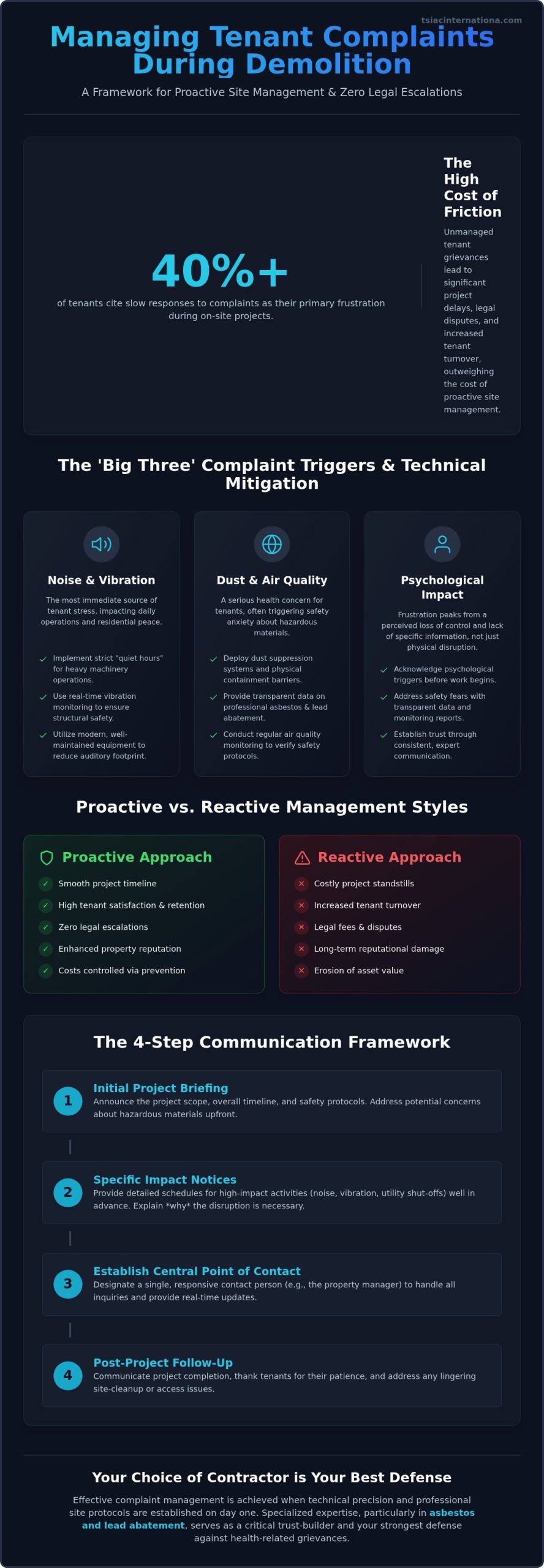
Over 40% of tenants report that slow responses to complaints are their primary frustration, a figure that spikes the moment heavy machinery arrives on-site. You’ve likely seen how a single dispute over air quality or noise can stall a complex project for weeks, triggering legal scrutiny under strict local ordinances like California’s AB 1482 or San Francisco’s specific relocation requirements. The challenge lies in maintaining your property’s reputation while executing high-impact structural changes. Managing tenant complaints during demolition isn’t just a soft skill; it’s an operational necessity that requires technical precision and unwavering transparency.
This guide demonstrates how to minimize project disruptions and neutralize grievances through proactive site management and professional demolition protocols. You’ll learn the exact methods needed to achieve a smooth timeline with zero legal escalations, ensuring your tenants remain satisfied and retained long after the project concludes. We’ll explore a clear communication framework and site-specific containment strategies that keep the most challenging technical tasks under complete control.
Key Takeaways
- Understand the economic risks of unmanaged friction, where project delays and legal disputes can significantly outweigh the costs of proactive site management.
- Identify technical mitigation strategies for the “Big Three” triggers—noise, vibration, and air quality—to address tenant concerns before they escalate.
- Implement a structured 4-step communication framework that prioritizes transparency and provides specific impact notices to residents.
- Learn why managing tenant complaints during demolition is most effective when technical precision and professional site protocols are established on day one.
- Discover how specialized expertise in asbestos and lead abatement serves as a critical trust-builder and your best defense against health-related grievances.
The Friction Between Occupancy and Demolition: Why Complaints Arise
Demolition projects within occupied or adjacent spaces create a unique set of technical and social challenges. Effectively managing tenant complaints during demolition requires a methodical approach to mitigation. In the context of large-scale structural or interior removal, mitigation refers to the strategic deployment of noise barriers, dust suppression systems, and vibration monitoring to protect the tenant experience. When these factors aren’t controlled, the economic consequences escalate quickly. Property owners often face costly project standstills, legal fees, and increased tenant turnover that erodes the long-term value of the asset.
Distinguishing between reasonable disruption and an actionable nuisance is critical for professional site management. While some noise is unavoidable during structural or interior removal, an actionable nuisance occurs when the work renders a space unusable or violates local habitability standards. To prevent these conflicts from reaching a courtroom, many large-scale projects now utilize dispute resolution boards to address grievances in real-time. The property manager serves as the essential bridge, translating complex contractor schedules into clear, actionable information for the tenants.
Selective Demolition vs. Total Structural Removal
The nature of the work dictates the volume and type of complaints received. Selective demolition, such as interior gutting or concrete removal, often triggers more frequent reports because the activity occurs in immediate proximity to active offices or residences. Tenants in adjacent wings or floors feel every vibration and hear every hammer drill through the building’s core. In contrast, total structural removal impacts a wider radius, affecting neighboring properties and shaping public perception of the project’s safety and professional standards. Each scenario requires a different containment strategy to maintain site integrity and community trust.
The Psychological Aspect of Tenant Frustration
Complaints often stem from a perceived loss of control rather than the physical noise itself. When tenants lack specific information about when and why a disruption is happening, their frustration peaks immediately. This is frequently compounded by safety anxiety. Occupants worry about structural integrity or the accidental release of hazardous materials like asbestos or lead. Addressing these fears with transparent data about abatement protocols and structural monitoring is vital. In both commercial and residential settings, the “Not In My Backyard” factor can stall a project if the property manager fails to establish trust through consistent, expert communication. Successful managing tenant complaints during demolition starts with acknowledging these psychological triggers before the first sledgehammer swings.
The ‘Big Three’ Complaint Triggers and Technical Mitigation
Success in any demolition project depends on controlling the physical variables that most frequently disrupt tenant life. While legal definitions of habitability vary, failing to mitigate noise, dust, and access issues can lead to claims of constructive eviction during demolition. This occurs when the environment becomes so hostile that a tenant is effectively forced to leave the premises. To prevent this, professional contractors focus on technical solutions that address the root causes of friction. Managing tenant complaints during demolition requires shifting from reactive apologies to proactive engineering controls that maintain a professional site environment.
Noise and Vibration Management
Noise and vibration represent the most immediate source of tenant stress. High-impact tools like jackhammers or concrete saws create decibel levels that interfere with daily business operations or residential peace. Implementing strict “quiet hours” is the first line of defense; this ensures heavy machinery only operates during pre-approved windows when tenants are least likely to be impacted. Beyond scheduling, we use real-time vibration monitoring to protect the structural integrity of adjacent wings. This data doesn’t just protect the building; it calms tenant fears by providing objective proof that the work is within safe limits. Using modern, well-maintained equipment further reduces the auditory footprint of the site.
Dust Control and Air Quality Monitoring
Airborne debris is a health concern that tenants take very seriously. For interior gutting, water suppression techniques and HEPA filtration are standard protocols to keep particulates contained within the work zone. It’s also vital to complete professional asbestos removal before any structural disturbance begins. When hazardous materials are handled with specialized containment, the risk of a health-related complaint drops significantly. Sharing air quality test results with tenants builds data-driven trust, showing them that their safety is being monitored by experts using calibrated equipment. This level of transparency is a hallmark of a professional selective demolition partner.
Site Safety and Logistical Access
Logistical failures often cause more daily irritation than the demolition itself. If a tenant finds their parking spot blocked or a delivery route obstructed, a complaint is inevitable. Clear signage and secure fencing are mandatory to prevent unauthorized entry and maintain a disciplined site appearance. We coordinate debris hauling to avoid peak traffic hours, ensuring the neighborhood’s rhythm isn’t broken. Maintaining clear access requires constant coordination between the property manager and the site supervisor to ensure the area remains a controlled, safe environment for everyone involved.
Proactive vs. Reactive: A Comparison of Management Styles
Choosing between a proactive and reactive management style determines the ultimate success of a renovation project. Reactive management relies on damage control, responding to grievances only after they’ve reached a boiling point. In contrast, a proactive approach front-loads communication and technical safeguards to prevent issues before they manifest. Effectively managing tenant complaints during demolition requires understanding that every technical delay has a human cost. By establishing a methodical framework early, property owners can maintain stability and project momentum.
Familiarizing yourself with tenant rights during construction helps property owners anticipate legal hurdles regarding noise limits and utility shutoffs. Integrating hazardous material abatement early in the schedule serves as a critical proactive safety measure. It signals to occupants that their health is the priority, neutralizing the most severe safety-related disputes before structural work begins. This professional foresight transforms a potentially volatile situation into a controlled, transparent process.
The Cost of Reactive Management
Waiting for a problem to occur before acting is a high-risk strategy. The most severe consequence of unmanaged complaints is a stop-work order issued by local authorities. These orders don’t just pause the timeline; they often lead to significant financial penalties and project overhead. Beyond immediate costs, reactive management causes lasting brand damage. One disgruntled tenant sharing their experience online can derail future leasing efforts for years. When a simple noise complaint isn’t addressed, it often escalates into a lawsuit, where legal fees quickly exceed the cost of professional mitigation.
Proactive Site Standards
Technical precision at the site level is the most effective way to reduce friction. This starts with choosing a partner who understands the entire demolition process, from permitting to final debris removal. Professional crews maintain a “clean site” policy, which reduces visual clutter and prevents physical hazards from impacting common areas. Utilizing specialized commercial interior gutting services ensures that work is performed with surgical precision, minimizing the impact on shared structural elements.
Site cleanliness and a commitment to recycling also play a significant role in tenant sentiment. When tenants see wood, metal, and plastic being systematically separated and recycled, the project is viewed as a responsible upgrade rather than a destructive nuisance. This methodological rigor reflects a disciplined expert character, reinforcing the idea that the project is under total control. Consistently managing tenant complaints during demolition through these high standards ensures that the property’s reputation remains intact throughout the transformation.
The 4-Step Communication Plan for Major Projects
A well-engineered communication plan acts as a pressure release valve for tenant anxiety. Without a methodical framework, even the most technically precise demolition project will face resistance. Managing tenant complaints during demolition requires a transition from reactive apologies to a four-step proactive system that builds trust through transparency and technical data. This disciplined approach ensures that every stakeholder understands the project’s trajectory and safety protocols from day one.
The four steps include:
- Step 1: The Pre-Demolition Information Packet. This document establishes the technical baseline for the project.
- Step 2: The 72-Hour Specific Impact Notice. This provides a final warning for high-vibration or high-noise activities.
- Step 3: Real-Time Milestone Updates. These confirm that phases are completing on schedule, reinforcing a sense of progress.
- Step 4: Post-Phase Feedback and Resolution. This final step addresses any lingering site issues before moving to the next structural milestone.
Phase 1: Setting Expectations Early
Transparency begins long before the first excavator arrives. Drafting a notice that explains the “why,” “when,” and “how” of the project is essential for neutralizing safety fears. This packet must outline the specific hazardous material containment procedures and structural monitoring systems being used. Providing a direct, single point of contact for complaints is a critical tactic to avoid public escalation on social media. An Open Door Policy for property managers is a formal commitment to direct, accessible communication that prioritizes resolving tenant concerns internally before they escalate into legal or public disputes.
Phase 2: Managing the Active Site
Demolition is inherently disruptive. You can’t hide the noise; but you can control how it’s perceived. Weekly “Look-Ahead” emails provide tenants with a technical forecast of upcoming changes to site access or acoustic levels. Using visual aids, such as maps of debris hauling routes or color-coded schedules, simplifies complex project phases for non-experts. When a grievance does occur, acknowledging complaints within 24 hours is a non-negotiable standard. This rapid response prevents tenant frustration from boiling over into a formal dispute. A structured approach to managing tenant complaints during demolition ensures that the property’s reputation remains intact while the work proceeds with surgical precision. If you require a partner who prioritizes this level of site discipline, consider the professional management services of TSIAC International for your next structural project.
Why Your Choice of Contractor is Your Best Defense
The final safeguard against project disruption isn’t the legal contract itself, but the technical team executing the work on the ground. A contractor’s on-site behavior and their adherence to safety protocols directly influence tenant sentiment. Managing tenant complaints during demolition becomes a streamlined process when the crew operates with the discipline of a specialized partner rather than a generic service provider. When tenants witness a site managed with surgical precision, their anxiety regarding safety and structural integrity naturally diminishes, leading to fewer grievances and a more stable property reputation.
Vetting for Professionalism and Safety
Selecting a partner requires more than a comparison of bid prices; it demands a deep dive into their operational standards. You must evaluate their comprehensive insurance coverage and specialized abatement certifications, particularly for asbestos and lead. A contractor’s ability to operate in occupied or sensitive environments is proven through their past performance on similar high-stakes projects where habitability was a priority. It’s also vital to ensure the contractor provides a dedicated site supervisor for every shift. This individual acts as the technical authority on-site, ensuring that noise barriers, dust suppression systems, and safety fencing are maintained to the highest standards at all times.
The TSIAC Advantage in Tenant Management
With over 15 years of industry experience, TSIAC International has refined the balance between aggressive structural removal and tenant-centric site management. Our expertise in specialized hazardous material containment ensures that health-related grievances are neutralized through transparent, data-driven safety protocols. We understand that selective demolition in occupied wings requires a higher level of technical control to minimize acoustic and physical disruption. This experience allows us to anticipate friction points before they result in a formal complaint.
Our commitment to environmental responsibility also serves as a powerful tool for maintaining positive tenant relations. By systematically recycling wood, metal, and plastic, we transform the demolition site into a model of modern corporate responsibility. Tenants are more likely to support a project when they see a disciplined, visible effort to reduce waste and protect the local environment. This methodological rigor, combined with our expertise in interior gutting and structural removal, provides property owners with a robust defense against litigation and project delays. Choosing a partner who prioritizes safety and transparency is the most effective way of managing tenant complaints during demolition while ensuring a smooth, profitable timeline for the entire asset.
Achieving Operational Stability in Complex Demolition Projects
Successful demolition in occupied spaces requires more than mechanical force; it demands a disciplined approach to site management and human relations. By shifting from reactive damage control to a proactive communication framework, you protect your asset from the high costs of litigation and vacancy. The technical controls we’ve discussed, from real-time vibration monitoring to advanced dust suppression, ensure that your project meets habitability standards while maintaining operational momentum. It’s clear that professional foresight is the only way to safeguard your property’s reputation during a structural transition.
Managing tenant complaints during demolition is ultimately about establishing trust through transparency and expert execution. When you prioritize specialized hazardous material containment and methodical site safety, you neutralize the most severe friction points before they impact your bottom line. This level of technical rigor ensures that your renovation is viewed as a value-add rather than a destructive nuisance.
Protect your project and your tenants by partnering with TSIAC International today. With 15+ years of expert demolition experience and a team of certified asbestos and lead abatement specialists, we bring methodical precision to every site. Our comprehensive site safety and recycling protocols ensure your project is a responsible, controlled upgrade that respects both the environment and your occupants. Let’s build a safer, more efficient path for your next renovation.
Frequently Asked Questions
What are the most common tenant complaints during demolition?
Noise and vibration are the most frequent sources of friction, followed closely by concerns regarding air quality and restricted site access. Tenants often report feelings of safety anxiety regarding the structural integrity of the building or potential exposure to hazardous materials. Effectively managing tenant complaints during demolition requires addressing these physical triggers through technical mitigation and transparent communication before frustration leads to formal disputes or project delays.
How much notice must I legally provide tenants before demolition starts?
Under California’s Tenant Protection Act (AB 1482), you must provide relocation assistance or a rent waiver within 15 calendar days of the termination notice for no-fault evictions like demolition. However, local ordinances in cities like San Francisco or Berkeley often have more stringent requirements and specific relocation payment schedules. Always verify municipal codes, as local laws typically supersede state baselines and include mandatory replacement unit regulations effective as of 2026.
Can a tenant break their lease because of demolition noise?
Tenants may attempt to break their lease if the noise levels violate the “covenant of quiet enjoyment” or meet the legal threshold for constructive eviction. If the demolition rendered the premises uninhabitable or the noise exceeded local decibel limits for extended periods, a court might rule in the tenant’s favor. Maintaining a professional site with scheduled “quiet hours” and vibration monitoring is the best technical defense against such claims.
How do I handle a tenant who refuses to cooperate with site safety rules?
Enforcing site safety rules requires a combination of clear signage, secure physical barriers, and documented lease enforcement. If a tenant bypasses fencing or ignores restricted access zones, they create a significant liability risk for both the owner and the contractor. Property managers should issue formal written warnings immediately. If non-compliance continues, legal counsel may be necessary to ensure the safety of the site and the integrity of the demolition timeline.
What specific dust control measures should I require from my contractor?
You should require the use of water suppression systems, HEPA-filtered air scrubbers for interior work, and negative air pressure zones to keep particulates contained. Contractors must also utilize physical barriers like reinforced plastic sheeting and sticky mats at exit points to prevent tracking debris into common areas. These technical protocols are essential for maintaining air quality and preventing health-related grievances, especially during complex selective demolition or gutting projects.
Is a property owner liable for a contractor’s safety violations?
Property owners are frequently held jointly liable for safety violations or environmental hazards created by their contractors. This legal reality makes vetting for specialized abatement certifications and comprehensive insurance non-negotiable. A contractor’s failure to follow OSHA or EPA guidelines can result in stop-work orders and significant fines for the owner. Choosing an experienced partner with a proven safety record is your primary defense against these shared liabilities.
How does asbestos abatement impact the demolition timeline for tenants?
Asbestos abatement typically adds several days or weeks to the initial phase of the project because it requires specialized containment and third-party air clearance testing. While this extends the timeline, it serves as a critical trust-builder for residents. Sharing the “all-clear” results from independent testing provides objective proof that the environment is safe. This transparency often reduces the volume of safety-related complaints during the subsequent structural removal phases.
What should be included in a demolition project communication plan?
A professional communication plan should include a pre-demolition town hall, a 72-hour specific impact notice, and weekly “look-ahead” updates. It must clearly define the “why, when, and how” of the project while providing a direct point of contact for grievances. By outlining the technical safeguards and recycling protocols in the initial packet, you manage expectations and demonstrate a commitment to site discipline and tenant safety from day one.
