
A positive asbestos test isn’t a property death sentence; it’s a technical challenge that requires a disciplined, regulatory response. You’ve likely felt a surge of anxiety regarding the health of your tenants or family, compounded by the recent transition of oversight to the South Carolina Department of Environmental Services (SCDES). Knowing exactly what to do after a positive asbestos test in South Carolina is the first step toward regaining control of your environment. It’s a high-stakes situation where the margin for error is slim, but with a methodical approach, you can navigate the 2026 compliance landscape without unnecessary risk.
We understand that the complexity of S.C. Regulation 61-86.1 can feel overwhelming, especially when you’re faced with strict 10-day notification windows and specific disposal mandates. This guide promises to clarify your legal obligations and safety priorities, ensuring your property meets all state standards for re-occupancy. We’ll preview the essential SCDES ePermitting steps, explain the difference between friable and non-friable management, and provide a clear checklist for hiring licensed professionals. By focusing on technical precision and documented safety, you’ll transform a hazardous discovery into a successfully managed project.
Key Takeaways
- Learn the immediate protocols for site stabilization and containment to prevent the release of microscopic fibers after a hazardous discovery.
- Understand the mandatory legal steps for what to do after a positive asbestos test in South Carolina, including the transition to SCDES oversight and the 10-day notification requirement.
- Discover the technical standards for professional abatement, focusing on the installation of negative air pressure systems and critical containment barriers.
- Identify the rigorous disposal requirements mandated by state law, including specific double-bagging procedures and transport to SCDES-approved landfills.
- Evaluate the criteria for selecting a licensed remediation partner to ensure your property meets all safety standards for re-occupancy and full regulatory compliance.
Immediate Actions: Securing Your Property After a Positive Result
Receiving a lab report confirming the presence of asbestos is a critical juncture for any property owner. The most important rule for what to do after a positive asbestos test in South Carolina is to stop all physical activity in the affected area immediately. Any vibration, airflow, or physical contact can release microscopic fibers into the air. These fibers are invisible to the naked eye but pose a severe respiratory risk. You must treat the site as a regulated zone until a professional assessment is completed and a containment plan is established.
The Danger of Disturbance
Asbestos fibers are incredibly light and aerodynamic. Once disturbed, they can remain suspended in the air for hours or even days. If you attempt to cover up the material with plastic sheets or tape without following established asbestos abatement procedures, you may inadvertently create a bellows effect that pushes dust into adjacent rooms. Traditional cleaning methods are equally dangerous. You must never use a standard vacuum cleaner or a broom on suspected asbestos debris. These tools don’t trap the fibers; they simply pulverize them and exhaust them back into your breathing zone, increasing the risk of secondary exposure for family members or employees.
Identifying Friable vs. Non-Friable Materials
Your lab report will specify the type and percentage of asbestos found, which dictates the urgency of your response. Understanding the physical state of the material is essential for safety. Friable asbestos is the most hazardous form. It refers to materials that can be crumbled or reduced to powder by simple hand pressure. Examples include spray-on insulation, pipe lagging, and popcorn ceilings. When these materials are damaged, they release fibers almost instantly.
Non-friable asbestos is bound within a solid matrix, such as vinyl floor tiles, cement siding, or roofing shingles. While it’s safer in a static state, it becomes regulated and dangerous the moment it’s cut, sanded, or broken during renovation. The state of the material dictates how quickly you must act to secure the area. To stabilize the site before professionals arrive, follow these methodical steps:
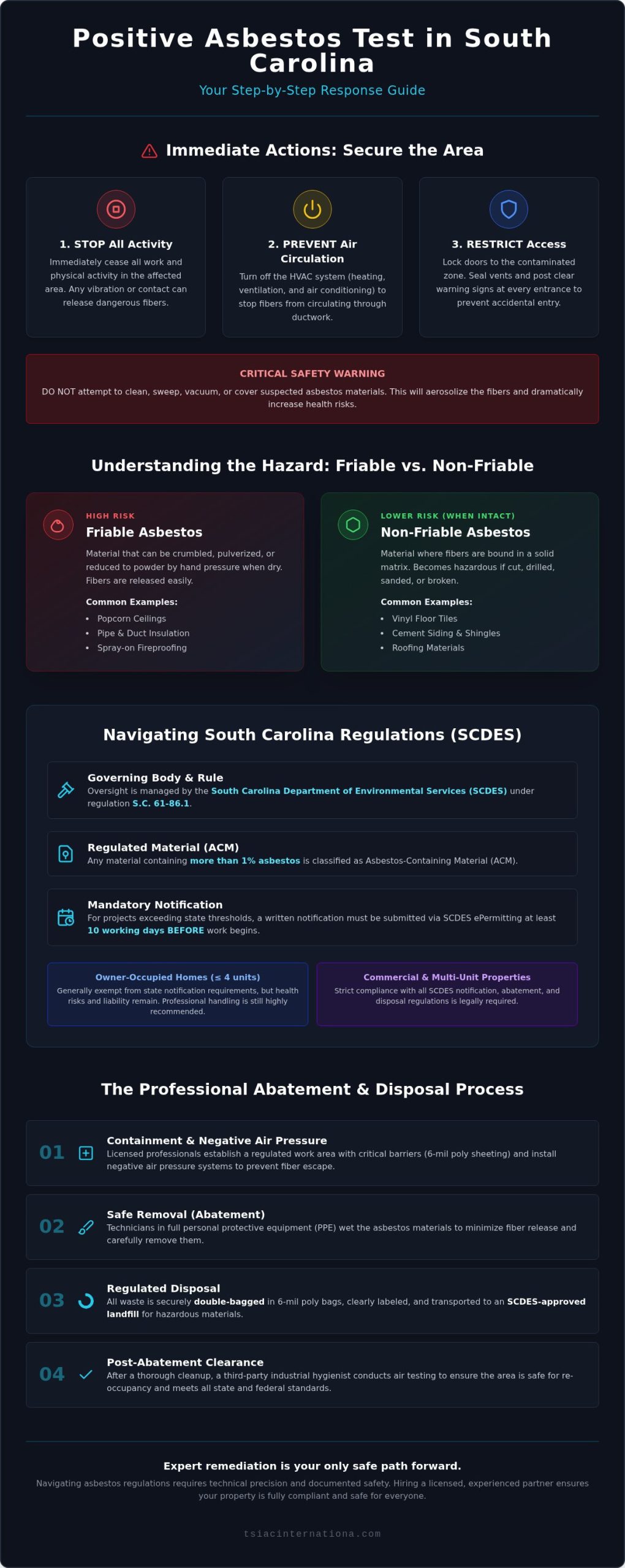
- Turn off the HVAC system to prevent fiber circulation through ductwork.
- Restrict access by locking doors and sealing vents with 6-mil poly sheeting.
- Place clear warning signs at every entrance to the contaminated zone.
- Avoid moving any furniture or equipment that may have settled dust on it.
Following these procedures ensures that a localized problem doesn’t become a building-wide contamination event. A disciplined response in the first few hours protects the long-term health of the occupants and reduces the eventual scope of the remediation work.
Navigating South Carolina Asbestos Regulations (SCDES)
In South Carolina, regulatory oversight of asbestos shifted from DHEC to the South Carolina Department of Environmental Services (SCDES). This agency enforces S.C. Regulation 61-86.1, which serves as the primary framework for managing hazardous materials. When determining what to do after a positive asbestos test in South Carolina, you must first identify which regulatory category your property falls under. The law distinguishes sharply between owner-occupied single family homes and commercial or multi-unit structures. While the technical risks remain the same, the legal documentation and notification requirements differ significantly.
The SCDES mandates that any material containing more than 1% asbestos is classified as Asbestos-Containing Material (ACM). For any project exceeding the state’s regulated thresholds, a written notification must be submitted via the SCDES ePermitting system at least 10 working days before work begins. This waiting period allows the state to review the abatement plan and ensure it aligns with National Emission Standards for Hazardous Air Pollutants (NESHAP) requirements.
SCDES Compliance for Homeowners
Under current state law, owner-occupied residential buildings with four or fewer units are generally exempt from state asbestos notification requirements. This “4-Unit Rule” provides some flexibility for private homeowners. However, this exemption does not eliminate the health risks or the potential for future liability. If you hire a professional for any part of the project, that contractor is legally bound to follow all safety regulations. For a deeper dive into these nuances, consult our Asbestos removal in South Carolina: The complete 2026 safety & regulatory guide. Even without a state mandate, following guidance from the EPA is the only way to ensure the long-term safety of your household.
Commercial and Multi-Family Requirements
For commercial properties, public buildings, or residential structures with more than four units, compliance is non-negotiable. You must file a notification when the removal of Regulated Asbestos-Containing Material (RACM) exceeds 160 square feet, 260 linear feet, or 35 cubic feet. SCDES charges specific fees for these projects, including a $50 fee for demolition licenses and a renovation fee of 10 cents per square or linear foot.
Failure to comply with these air quality standards can result in civil penalties reaching $10,000 per violation. Commercial projects also necessitate a licensed asbestos consultant to oversee project design and air monitoring. If you’re managing a complex facility, partnering with an experienced asbestos abatement firm ensures that all SCDES filings and NESHAP standards are met with technical precision. Understanding what to do after a positive asbestos test in South Carolina is ultimately about managing legal risk as much as physical safety.
The Professional Asbestos Abatement Process Explained
Once the legal notifications are filed and the 10-day waiting period concludes, the physical remediation begins. Understanding the technical side of the process helps property owners appreciate why DIY attempts are strictly prohibited. A professional abatement project is a highly controlled engineering event designed to isolate the hazard and scrub the environment clean. This is the only reliable solution for what to do after a positive asbestos test in South Carolina when the goal is long-term safety and liability protection.
Containment and Engineering Controls
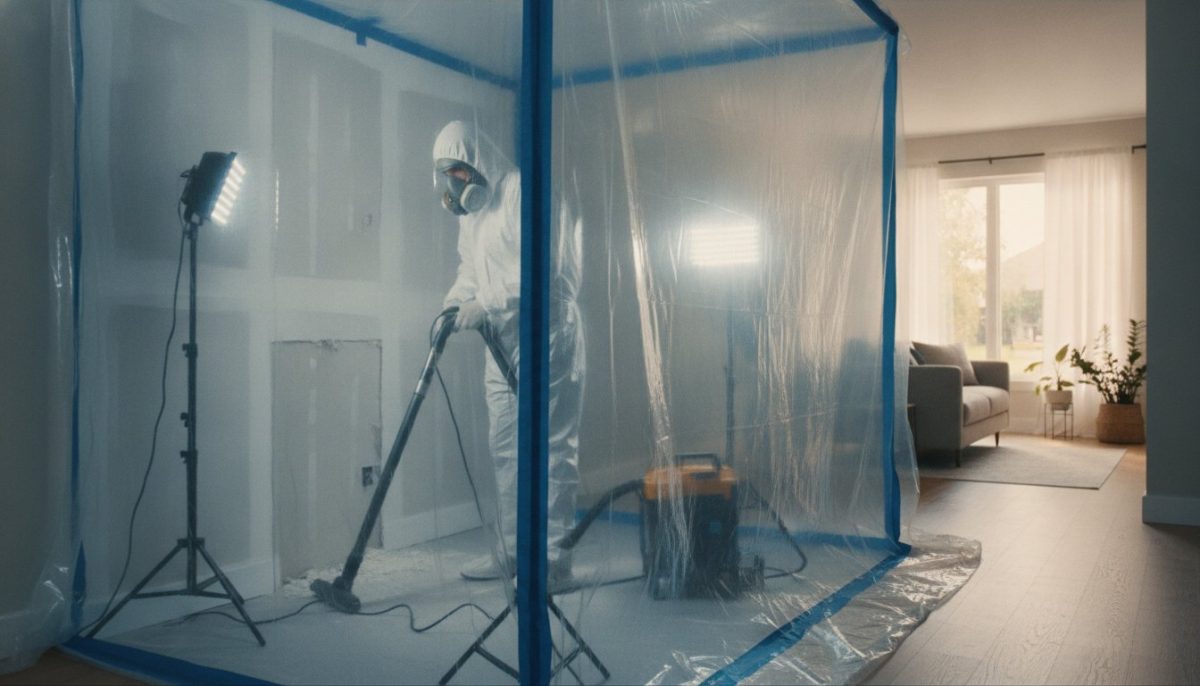
Technicians first establish a regulated work area marked by high-visibility warning signs that restrict access to authorized personnel. They construct critical barriers using double layers of 6-mil polyethylene sheeting, creating a “clean room” environment that separates the work zone from the rest of the building. This setup includes a multi-stage decontamination unit where workers pass through airlocks and showers to ensure no fibers leave the site on their equipment. Negative air pressure is an engineering control that ensures air only flows into the containment area, preventing the escape of contaminated particles to non-regulated zones. This system uses high-volume air machines equipped with HEPA filtration to constantly cycle the room’s atmosphere, capturing 99.97% of particles as small as 0.3 microns.
Specialized Removal and Cleaning
The removal process relies on wet techniques to minimize the risk of fiber release. Technicians apply specialized wetting agents to the asbestos-containing material before any physical disturbance occurs. This saturation ensures that even if the material breaks, the dust is weighed down and cannot become airborne. For commercial renovations, this often involves stripping building interiors down to the structural shell with surgical precision to ensure no trace of the hazard remains.
Once the bulk material is removed and double-bagged, the team performs a rigorous final cleaning. This involves HEPA vacuuming every square inch of the containment area, followed by “wet wiping” all surfaces with specialized cloths. This methodical approach is the core of Hazardous material abatement in South Carolina: The 2026 property owner’s guide. By the time the containment is dismantled, the area has been rendered safe for re-occupancy through a series of documented safety protocols that meet every SCDES standard.
Disposal, Recycling, and Post-Abatement Clearance
Safe removal is only half of the equation. Once the hazardous material is wetted and stripped, South Carolina law requires it to be double-bagged in 6-mil plastic bags. These containers must be leak-tight and clearly labeled with the generator’s name and the site location. Transporting this load requires a manifest that tracks the waste from your property to an SCDES-approved landfill. This logistical precision is a core part of what to do after a positive asbestos test in South Carolina to prevent illegal dumping and long-term environmental contamination.
While the asbestos itself must be buried in specialized cells, demolition projects often generate a variety of other materials. TSIAC International maintains a commitment to environmental responsibility by sorting wood, metal, and plastic for recycling whenever possible. This methodical approach ensures that only truly hazardous waste reaches the landfill, reducing the overall environmental impact of the project. If you are ready to secure your property, reach out to our team for professional asbestos abatement services that prioritize both safety and sustainability.
The Paper Trail: Waste Shipment Records
Every ounce of regulated waste must be documented via a Waste Shipment Record (WSR). This manifest is your primary legal shield. It proves that you followed state mandates and that the material reached a facility authorized to accept friable or non-friable asbestos. You should retain copies of these records indefinitely. They are vital if the property is ever sold or if you face environmental litigation in the future. The paper trail confirms that your project reached a definitive, legal conclusion and that your liability has been successfully managed.
Final Air Clearance Testing
You cannot re-occupy the space based on a visual check alone. A third-party air sampler, who must be independent of the abatement contractor, must perform a final clearance test. Phase Contrast Microscopy (PCM) is the standard method for most projects, while Transmission Electron Microscopy (TEM) offers higher resolution and is often required for schools or sensitive commercial environments.
The air sampler must confirm that fiber levels are below the state-mandated threshold of 0.01 fibers per cubic centimeter. If a clearance test fails, the contractor is required to perform a rigorous re-cleaning of the entire containment area. This process repeats until the air quality is verified as safe. This “no-fail” requirement ensures that when the containment barriers finally come down, the environment is genuinely safe for tenants, employees, or family members.
Moving Forward: Why Expert Remediation is Your Only Safe Path
Deciding what to do after a positive asbestos test in South Carolina often feels like a choice between two risks: the health hazard itself or the potential for a mishandled, expensive cleanup. The reality is that professional remediation is the only path that preserves both your safety and your property’s long-term market value. A botched removal job doesn’t just fail to solve the problem; it creates a permanent record of contamination that can lead to significant devaluation and legal liability during future property transfers. By choosing a methodical, expert-led response, you ensure that the hazard is permanently neutralized and documented according to SCDES standards.
Selecting a Qualified Contractor in South Carolina
Verification is the most critical step in the hiring process. You shouldn’t take a contractor’s word for their qualifications; instead, verify their credentials through the SCDES online database. A legitimate firm must hold a valid South Carolina asbestos contractor license, and every individual on-site must carry current state certifications. Beyond basic licensing, you must confirm they carry specialized pollution liability insurance. Standard general liability policies often exclude hazardous material claims, leaving the property owner vulnerable if a fiber release occurs. At TSIAC International, we utilize fixed-price contracts to eliminate the financial uncertainty often associated with remediation. This transparent approach ensures you know exactly what the project requires without the fear of hidden fees or sudden price escalations mid-project.
Integrated Demolition and Abatement Solutions
For many property owners, asbestos removal is merely the first phase of a larger renovation or structural change. There’s a distinct advantage in partnering with a firm that offers integrated services. When the same team handles both the hazardous abatement and the subsequent structural or selective demolition, the workflow is seamless and the risk of cross-contamination is virtually eliminated. With over 15 years of industry experience, TSIAC International specializes in navigating these high-stakes environments. We manage everything from complex interior gutting to full concrete removal, ensuring that every piece of debris is sorted according to our strict recycling protocols.
This comprehensive management style reduces the number of vendors you need to coordinate and ensures that your project moves from hazard to “ready for rebuild” with technical precision. Our team handles the full regulatory documentation package, providing you with the necessary proof of compliance for your permanent records. Protect your property and health with TSIAC International’s expert abatement services.
Restoring Safety Through Technical Precision
Managing hazardous materials requires a disciplined approach that prioritizes long-term health over quick fixes. By now, you understand that what to do after a positive asbestos test in South Carolina involves immediate site stabilization, strict adherence to SCDES ePermitting protocols, and a rigorous containment strategy. These steps are not merely suggestions; they are the legal and technical foundation of a safe property. Successfully navigating this process ensures your building is compliant, your liability is minimized, and your environment is truly restored for re-occupancy.
TSIAC International brings over 15 years of expert abatement and demolition experience to every project. We ensure full compliance with all SCDES and federal NESHAP regulations, specializing in high-stakes commercial interior gutting and structural removal. Our methodical process takes the uncertainty out of hazardous material management. If you’re ready to move from a positive test result to a clean, safe property, Get a Professional Abatement Quote from TSIAC International. You can face this challenge with confidence when you have a partner who values technical precision and safety above all else.
Frequently Asked Questions
Do I legally have to remove asbestos if it tests positive in South Carolina?
You aren’t legally required to remove asbestos simply because it exists in your building. If the material is in good condition and left undisturbed, it can often be managed in place through a formal operations and maintenance plan. However, if you’re planning a renovation or demolition that will disturb the material, South Carolina law mandates professional removal to prevent fiber release.
Can a homeowner remove asbestos themselves in a single-family home in SC?
South Carolina law provides an exemption that allows homeowners to perform their own abatement in an owner-occupied single-family residence. While this is legal, it’s highly discouraged due to the technical difficulty of maintaining negative air pressure and the extreme health risks involved. You’re still legally responsible for the double-bagging, labeling, and proper transport of the waste to an SCDES-approved landfill.
How long does the asbestos abatement process typically take for a commercial building?
The timeline for a commercial project generally ranges from 12 to 20 business days. This includes the mandatory 10-day SCDES notification period, the containment setup, the physical removal, and the final air clearance testing. Complex projects involving interior gutting or large-scale structural demolition may require additional time to ensure every technical safety protocol is met with precision.
What are the specific SCDES notification requirements for an asbestos project?
You must submit a written notification via the SCDES ePermitting system at least 10 working days before any demolition; this applies regardless of whether asbestos is present. For renovations, notification is required when the amount of regulated material exceeds 160 square feet or 260 linear feet. This mandatory waiting period allows the state to review safety protocols before physical work begins.
How much does an asbestos clearance air test cost in South Carolina?
The cost of an asbestos clearance air test varies based on the number of samples and the analytical method, such as PCM or TEM. Independent air samplers provide these services to ensure there’s no conflict of interest with the abatement contractor. You should request a project-specific estimate from a licensed consultant to confirm your property meets SCDES re-occupancy standards.
What happens if I ignore a positive asbestos test result and continue my renovation?
Ignoring a positive test result can lead to civil penalties of up to $10,000 per violation from the SCDES. Beyond legal fines, you risk contaminating the building’s HVAC system and common areas. This increases the eventual remediation costs and creates significant health liabilities. It’s always safer to pause work and consult a licensed professional before proceeding with any renovation.
Is all asbestos hazardous, or only if it is damaged or crumbling?
Asbestos is primarily hazardous when it’s friable, meaning it can be crumbled into dust by hand pressure. Non-friable materials, like floor tiles or roofing, are generally safe as long as they remain in a static, undamaged state. However, these materials become hazardous and regulated the moment they’re sanded, cut, or broken during a construction project, as these actions release microscopic fibers.
How do I verify if an asbestos abatement contractor is licensed in South Carolina?
You can verify a firm’s credentials by searching the SCDES online database of licensed asbestos contractors. Every reputable company should also provide their license number and proof of specialized pollution liability insurance upon request. Checking these credentials is the most reliable way to determine what to do after a positive asbestos test in South Carolina while ensuring your property is in expert hands.
