Asbestos in Old Homes: A South Carolina Homeowner’s Guide to Safety and Regulations

In South Carolina, more than 40% of residential structures in historic hubs like Charleston and Myrtle Beach were constructed before 1980. This data…

In South Carolina, more than 40% of residential structures in historic hubs like Charleston and Myrtle Beach were constructed before 1980. This data point means the statistical likelihood of encountering asbestos in old homes south carolina during a routine renovation is nearly one in two. You’ve likely felt a sense of hesitation when peeling back layers of vintage linoleum or inspecting attic insulation; it’s the valid concern that a simple home improvement could inadvertently release hazardous fibers into your family’s living space. We understand that maintaining a property’s structural integrity requires a disciplined, technical approach rather than guesswork.

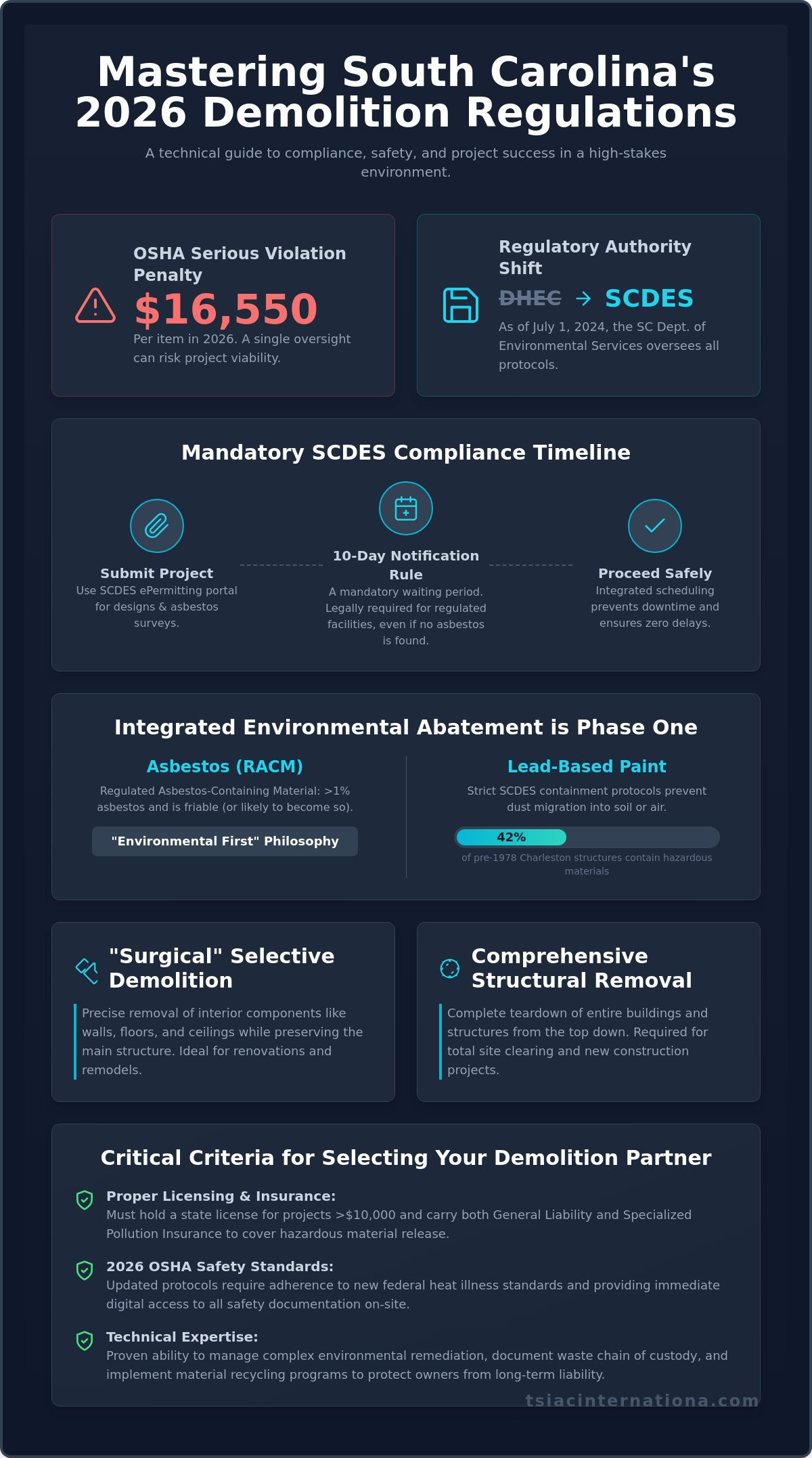
This guide delivers the precise information required to navigate the 2026 SCDES, formerly DHEC, regulations, helping you identify high-risk materials and understand the specific legal exemptions available to residential owners. We’ll examine the specific locations where these minerals reside and outline the process for securing a certified abatement partner to keep your project on track. You’ll gain a clear roadmap for mitigating health risks while avoiding the common regulatory hurdles that often stall South Carolina restoration projects.

Key Takeaways

  • Identify high-risk materials and specific visual cues common in South Carolina residences built between 1920 and 1980.
  • Understand the 2026 SCDES legal framework for managing asbestos in old homes south carolina, including how the “4-unit or fewer” exemption applies to your property.
  • Learn the technical requirements of professional abatement, such as the use of negative pressure containment to prevent dangerous fiber migration.
  • Discover how a structured, engineering-led remediation process ensures compliance with the most stringent state safety and disposal standards.
  • Gain insights into why specialized hazardous material handling is essential for protecting the long-term value of historic coastal and mid-century properties.

The Legacy of Asbestos in South Carolina’s Residential History

Asbestos refers to a specific group of six naturally occurring silicate minerals that builders once prized for their extraordinary tensile strength, poor heat conduction, and resistance to chemical corrosion. Between 1920 and 1980, these fibers were integrated into thousands of building products across the United States. The Legacy of Asbestos is deeply intertwined with the industrialization of the American South, where its durability made it a staple in both commercial and residential construction projects. Because the mineral is nearly indestructible, it provided a cost-effective solution for fireproofing and insulation in a rapidly growing region.

In the Lowcountry, the prevalence of asbestos in old homes south carolina correlates directly with the construction surges of the mid-20th century. Data from the South Carolina Department of Health and Environmental Control (DHEC) indicates that structures built prior to the federal bans of the late 1970s frequently contain these materials. The transition from industrial use to residential standards occurred rapidly after 1945, as developers sought ways to fireproof suburban dwellings. It’s vital to understand that the presence of asbestos doesn’t automatically create a health crisis. If the material remains in good condition and stays undisturbed, the risk of fiber release is minimal. Danger arises during renovations, demolition, or when environmental factors compromise the structural integrity of the material.

Era-Specific Risks: From Charleston Historic District to Mid-Century Suburbs

Historic renovations in downtown Charleston often encounter asbestos in 19th-century homes that were updated or expanded during the 1930s. Contractors frequently find mineral-fiber insulation and textured paints in these properties that weren’t part of the original build. In contrast, the post-war boom in Myrtle Beach and North Charleston during the 1950s and 1960s saw a 40% increase in the use of transite siding and asbestos-cement shingles. Coastal humidity levels, which often exceed 80% during the summer months, can accelerate the weathering of exterior binders. This degradation potentially exposes fibers over several decades, making routine inspections a necessity for maintaining structural safety.

Friable vs. Non-Friable: What Homeowners Must Know

Professionals categorize asbestos-containing materials (ACMs) by their friability, which is a technical measure of how easily the material crumbles. This distinction is critical for risk assessment and remediation planning. Managing the presence of asbestos in old homes south carolina requires a methodical approach to these two categories:

  • Friable Materials: These can be pulverized by simple hand pressure. Common examples include spray-applied “popcorn” ceilings popular in the 1970s and magnesium pipe insulation found in older attics. These materials are hazardous because they allow microscopic fibers to become airborne instantly upon contact.
  • Non-Friable Materials: These contain fibers locked within a solid matrix, such as 9-inch vinyl floor tiles or corrugated roofing sheets. These remain relatively safe and stable unless they’re sanded, sawed, or crushed during a home remodel.

For a homeowner in Columbia or Charleston, identifying these risks requires a technical understanding of how these materials were applied. While a solid floor tile might pose little risk during daily use, the adhesive used beneath it often contains high concentrations of chrysotile asbestos. Every renovation project in a pre-1980 home should begin with a professional survey to ensure that these legacy materials are handled with engineering precision and total safety.

Identifying Common Asbestos-Containing Materials in SC Homes

Determining the presence of asbestos in old homes south carolina requires a technical eye and an understanding of regional construction history. Between 1930 and 1980, thousands of residential structures in Charleston and the surrounding Lowcountry incorporated mineral fibers for fireproofing and insulation. You’ll often find these materials in undisturbed areas like crawlspaces or utility rooms. While some indicators are visual, microscopic analysis remains the only definitive method for identification. The EPA provides a detailed list of Common Asbestos-Containing Materials that homeowners should recognize before starting any demolition or renovation project.

Visual cues serve as a preliminary warning system, but they aren’t evidence of safety. In basements and crawlspaces, look for white, chalky tape on metal ductwork or grey, cement-like pipes. In attics, the presence of pebble-like insulation suggests a high probability of contamination. However, asbestos fibers are microscopic and odorless. A material that looks identical to modern fiberglass might actually be a hazardous composite. Professional laboratory testing is a non-negotiable step because it quantifies the exact percentage of asbestos present, allowing for a calculated risk assessment and a precise abatement strategy.

Interior Hotspots: Flooring, Ceilings, and Insulation

Floor tiles manufactured before 1980 are a primary concern for local property owners. Specifically, 9×9 inch vinyl tiles almost universally contain asbestos fibers. The risk isn’t limited to the tile itself; the black mastic adhesive used to secure these floors, often called “cutback,” frequently contains high concentrations of chrysotile asbestos. When homeowners scrape up old flooring, they inadvertently aerosolize these fibers, creating a severe inhalation hazard in confined spaces.

Textured “popcorn” ceilings and the joint compounds used in drywall systems represent another significant interior risk. These materials often contain 1% to 10% asbestos to provide texture and fire resistance. Because these surfaces are “friable,” they can be crumbled by hand pressure, releasing dust into the living environment. In many South Carolina attics, vermiculite insulation poses a hidden danger. Approximately 70% of all vermiculite sold in the U.S. between 1919 and 1990 originated from a mine in Libby, Montana, which was contaminated with tremolite asbestos. This insulation looks like small, shiny accordion-shaped pellets and should never be disturbed without professional oversight.

Exterior and Structural Components

Coastal South Carolina homes built between 1940 and 1970 frequently utilize “transite” siding. This cement-asbestos composite was favored for its extreme resistance to salt air, humidity, and rot. It appears as hard, brittle grey shingles or large flat panels with a wavy or wood-grain texture. While transite is generally safe when intact, it becomes dangerous when it’s cracked, drilled, or power-washed. Maintaining the structural integrity of these exterior envelopes is a core component of specialized building maintenance and long-term asset protection.

Structural components also hide risks in historic window restorations. Window glazing and caulking compounds used prior to 1980 often contain asbestos to improve weather resistance and durability against the harsh Charleston sun. Additionally, HVAC systems in older properties often feature white thermal paper or “mummy wrap” around ductwork joints. This material is highly susceptible to frictional wear and degradation over time. If you observe frayed or peeling white tape on your heating and cooling pipes, it indicates a failure of the containment material and requires immediate professional evaluation to prevent the distribution of fibers through the home’s ventilation system.

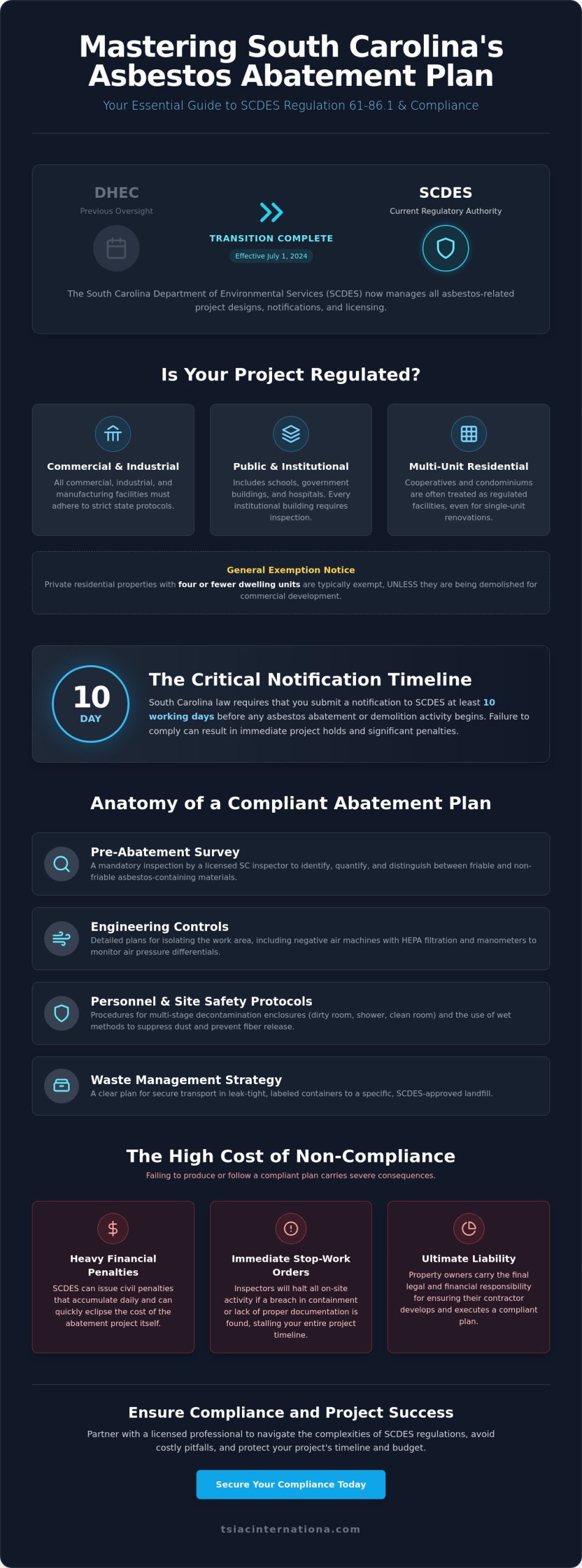
Regulatory oversight for hazardous materials in the Palmetto State rests with the South Carolina Department of Environmental Services (SCDES). This agency enforces Regulation 61-86.1, which dictates how property owners must handle potential carcinogens. When dealing with asbestos in old homes south carolina, many homeowners mistakenly assume they’re entirely outside the law’s reach. While the state provides certain flexibilities for private residents, the technical requirements remain stringent to prevent public health crises.

South Carolina law provides a specific exemption for residential structures containing four or fewer dwelling units. This means a private homeowner isn’t legally mandated by the state to perform a comprehensive asbestos survey before a standard renovation project. However, this exemption is a regulatory technicality; it’s not a safety standard. For a detailed breakdown of these statutes, homeowners should consult the South Carolina asbestos regulations to understand their specific liabilities under the law. Even if a project is exempt from the inspection mandate, the material itself remains regulated once it’s disturbed.

Being “exempt” from an inspection doesn’t grant license to dispose of hazardous waste in a standard Charleston County trash bin. Federal EPA guidelines still apply to the transport and final disposal of these materials. Licensed landfills in the Lowcountry require specific documentation and manifest forms that only licensed contractors can provide. Attempting to bypass these protocols by dumping “exempt” material into a residential roll-off container is a violation of environmental law. It’s a risk that carries heavy penalties and long-term environmental consequences for the local community.

The Legal Risks of DIY Asbestos Removal in SC

DIY abatement is a high-stakes gamble with narrow margins for error. If a homeowner improperly handles friable asbestos, they risk fines that can exceed $10,000 per day of violation under SCDES enforcement. Beyond immediate penalties, South Carolina’s 2026 real estate disclosure requirements are unforgiving. Selling a property with a history of unmitigated or improperly removed asbestos in old homes south carolina creates massive civil liability. If a future buyer discovers contamination, the original owner may face lawsuits for non-disclosure and endangerment. The health risks are equally severe; microscopic fibers can linger in HVAC systems for years, exposing family members to preventable respiratory diseases.

Permitting and Notification Requirements

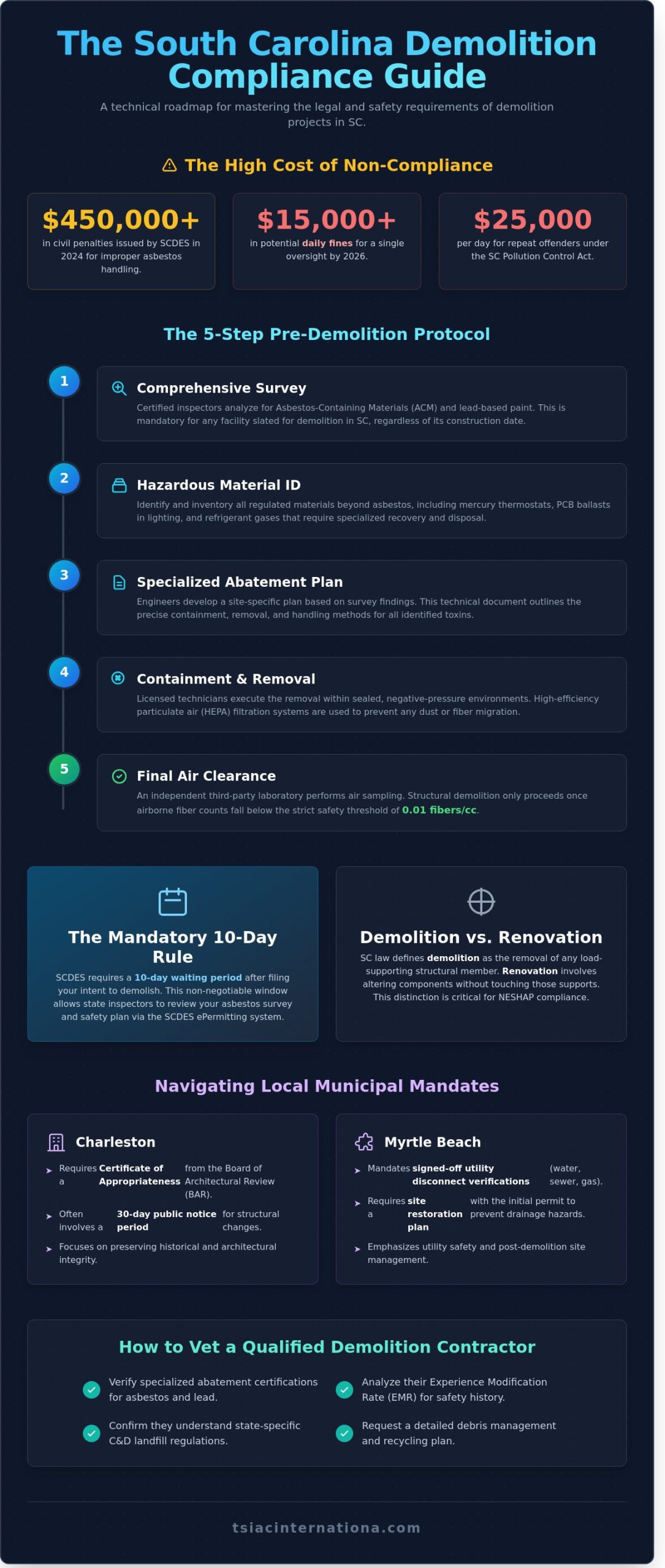
Project scope determines the level of state involvement. For total demolitions in Charleston, a “Notification of Demolition” form must be submitted to SCDES at least 10 working days before work starts, regardless of whether asbestos was found. Renovation permits are handled at the municipal level, but they often require proof of a professional assessment if the structure was built before 1980. TSIAC manages this entire administrative burden for our clients. We handle the 10-day notifications, secure the necessary SCDES permits, and provide the final air clearance reports required to close out a project safely and legally. Our process ensures that every technicality is addressed with engineering precision.

Asbestos in Old Homes: A South Carolina Homeowner’s Guide to Safety and Regulations

The Professional Abatement Process: From Testing to Disposal

Managing hazardous materials requires a level of engineering precision that mirrors complex structural projects. When addressing asbestos in old homes south carolina, the process begins with a rigorous environmental assessment. Certified inspectors perform bulk sampling of materials like popcorn ceilings or pipe insulation, followed by baseline air quality testing. These initial metrics provide a data-driven foundation for the entire remediation strategy. Accuracy at this stage prevents the accidental release of microscopic fibers that measure less than 3 microns in width. These fibers are invisible to the naked eye but pose the highest health risks when inhaled.

A professional team doesn’t just start tearing out walls. They evaluate the friability of the material, which refers to how easily it can be crumbled into dust. In Charleston’s humid climate, moisture can sometimes hide the true state of decay in older building materials. Technicians use specialized equipment to map out every square foot of the contaminated area before a single barrier is raised. This methodical approach ensures that the project timeline remains predictable and that safety margins are never compromised.

Containment: Setting Up a Safe Work Zone

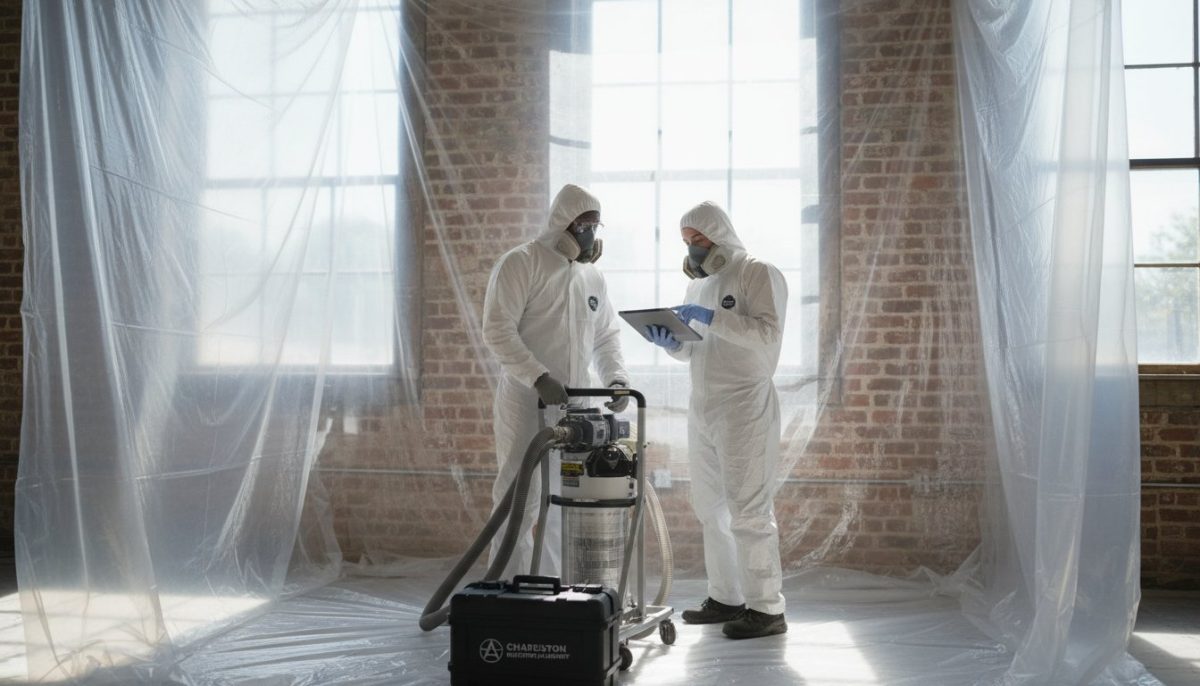
A controlled environment is the only way to ensure safety during a renovation. Technicians establish a negative pressure containment zone using 6-mil poly-sheeting to seal all openings, including windows, doors, and HVAC vents. High-Efficiency Particulate Air (HEPA) filtration units move at least 4 air changes per hour. This setup ensures that air flows into the work area but never out into the rest of the home. Workers enter through a three-stage decontamination chamber where they transition through clean, shower, and dirty rooms. This protocol prevents cross-contamination. Warning signage must be posted at every entry point to inform the neighborhood that a regulated work area is active, maintaining transparency and public safety.

Industry standards prioritize wet-removal techniques to manage dust at the source. By saturating asbestos-containing materials with amended water, technicians increase the weight of the fibers. This causes them to drop to the floor rather than drift through the air. This method reduces airborne fiber counts by 90% compared to dry scraping methods. Every square foot of the work area undergoes a meticulous cleaning process, often involving HEPA-vacuuming and damp wiping of all surfaces once the primary materials are removed. It’s a labor-intensive process that leaves no room for error.

Safe Disposal and Documentation

The final phase of the project involves strict adherence to South Carolina environmental laws. All hazardous waste is double-bagged in 6-mil leak-tight containers and labeled with specific OSHA and DHEC warnings. These materials don’t go to standard municipal landfills. Instead, they’re transported to specialized Class 3 landfills permitted to handle friable asbestos. Homeowners receive a waste shipment manifest. This document tracks the material from the moment it leaves the property until it reaches its final disposal point. It serves as a legal record for the residence, which is vital for future property inspections or sales.

Before the containment barriers are dismantled, an independent laboratory performs final clearance testing. This involves aggressive air sampling where leaf blowers or fans circulate air to ensure no residual fibers remain. A passing result requires fiber concentrations to be below 0.01 fibers per cubic centimeter of air. Only after this specific threshold is met is the site declared safe for re-occupancy, providing the owner with a verified clean bill of health for their property.

To ensure your structural renovation meets these rigorous safety standards, consult with our specialized abatement team for a technical assessment.

Why TSIAC International is the Trusted Choice for SC Abatement

Since 2008, TSIAC International has served as a cornerstone of environmental safety for the Charleston and Myrtle Beach markets. We’ve spent 16 years refining a methodology that prioritizes technical precision over quick fixes. Managing asbestos in old homes south carolina requires a deep understanding of how these hazardous materials were integrated into historic building envelopes. Our team doesn’t just offer labor; we provide a disciplined engineering approach to every remediation project we undertake. We’re licensed, bonded, and carry $2 million in specialized liability insurance, providing a safety net for both high-stakes residential renovations and complex commercial developments.

Our service model is built on full-scale capabilities. We handle everything from selective demolition to the total remediation of hazardous substances. This means homeowners don’t have to coordinate between multiple contractors who might not understand the delicate nature of asbestos containment. Whether it’s removing contaminated floor tiles or stripping industrial pipe insulation, we execute every phase with surgical accuracy. We’ve completed over 1,200 abatement projects across the state, and our reputation is built on the fact that we don’t leave room for error. Safety isn’t a goal; it’s our baseline requirement.

Environmental responsibility is a core pillar of our operation. We’ve implemented a rigorous waste management protocol that has allowed us to increase our material recycling rate by 24 percent since 2019. We ensure that all non-hazardous debris is diverted from local landfills and processed through the correct channels. When we handle asbestos in old homes south carolina, we follow strict disposal chains that protect the Lowcountry’s fragile ecosystem. Our commitment to the planet is just as firm as our commitment to our clients’ health.

Our Local Expertise in Charleston and Beyond

The Lowcountry presents unique structural challenges that many national firms overlook. Charleston’s high humidity levels and historic lath-and-plaster construction require specific containment strategies to prevent mold growth and structural degradation during abatement. We’ve developed long-standing relationships with the South Carolina Department of Environmental Services (SCDES) and local building departments. In the last 24 months alone, we’ve successfully navigated 185 site inspections without a single regulatory violation. We know the inspectors, we know the codes, and we know exactly what’s required to keep your project on schedule and in total compliance.

Get a Professional Assessment Today

Renovating an older property without a professional assessment is a significant financial and health risk. Disturbing even a small area of textured ceiling or old vinyl flooring can release millions of microscopic fibers into your HVAC system. Once these fibers are airborne, the cost of decontamination can triple. We provide transparent, data-driven quotes based on physical site inspections and certified laboratory results. We don’t guess; we measure. Taking action now prevents the complications that arise when a project is halted by an unexpected discovery of hazardous materials. Our process is designed to give you total control over your home’s safety profile.

Contact TSIAC International for a safe, professional asbestos consultation to ensure your renovation starts on a foundation of safety. We’re ready to bring our 16 years of field experience to your doorstep, providing the clarity and protection your family deserves.

Secure Your Property Through Professional Mitigation

Managing the risks associated with asbestos in old homes south carolina isn’t just a safety precaution; it’s a critical legal requirement under the updated 2026 SCDES guidelines. Homeowners must identify hazardous materials like textured ceilings or thermal insulation before any demolition begins. Professional intervention ensures that these microscopic fibers don’t compromise your indoor air quality or lead to regulatory penalties. Our team at TSIAC International brings over 15 years of industrial experience to every residential site. As a licensed SCDES abatement contractor, we’ve completed hundreds of projects with technical precision, particularly within the complex landscape of Charleston historic renovations. We don’t just remove waste; we provide a comprehensive safety solution from the initial inspection through the final certified disposal. This methodical approach protects both your family’s health and your property’s long term market value. You can Request an Asbestos Abatement Quote from TSIAC International today to secure your renovation project. Let’s work together to make your historic South Carolina home safe for the next generation.

Frequently Asked Questions

How much does asbestos removal cost in South Carolina?

Asbestos removal in South Carolina typically costs between $5 and $20 per square foot depending on the material’s accessibility and condition. A standard residential project often ranges from $2,100 to $15,300. These figures include labor, specialized HEPA filtration equipment, and disposal fees at SCDHEC-approved facilities. Total expenses fluctuate based on whether you’re removing floor tiles, popcorn ceilings, or thermal pipe insulation.

Can I stay in my home during the asbestos abatement process?

You shouldn’t stay in your home while active abatement occurs in living spaces. Professional teams establish a negative pressure enclosure to prevent fiber migration; this setup often restricts access to bathrooms or kitchens. While you can remain if the work area is completely isolated in a detached structure, South Carolina safety standards prioritize occupant protection. Most projects require a 24-hour waiting period for final air clearance testing before you return.

Is asbestos testing required before I renovate my Charleston home?

Yes, the City of Charleston requires an asbestos survey before issuing renovation or demolition permits for structures built before 1980. Identifying asbestos in old homes south carolina is a mandatory safety protocol under SCDHEC Regulation 61-86.1. You must hire a licensed inspector to collect bulk samples from at least 3 separate areas of suspected material. This technical assessment ensures that hazardous fibers aren’t released into the urban environment during construction.

What should I do if I find a material I suspect contains asbestos?

Stop all work immediately and isolate the area by turning off your HVAC system to prevent air circulation. Don’t touch, sweep, or vacuum the debris because even minor disturbances can release millions of microscopic fibers. Mark a 10-foot exclusion zone around the suspect material and contact a certified professional for laboratory analysis. Precise identification through Polarized Light Microscopy is the only way to confirm a hazard exists.

Does homeowners insurance cover asbestos removal in SC?

Most standard South Carolina homeowners insurance policies don’t cover asbestos removal because it’s classified under a pollution exclusion clause. Coverage typically only applies if the asbestos is disturbed during a covered peril, such as a pipe burst or fire. Approximately 90% of policies issued by major carriers in the Lowcountry exclude routine abatement. Always review your specific policy’s Section I Exclusions for language regarding hazardous materials.

What is the difference between asbestos encapsulation and removal?

Encapsulation involves coating the material with a high-solids sealant to trap fibers, while removal physically eliminates the hazard from the structure. Encapsulation is a cost-effective technical solution for pipe insulation that remains in good condition, but it requires lifetime monitoring. Removal is the only way to achieve 100% decontamination. This is often necessary for asbestos in old homes south carolina when the material is friable or located in high-traffic renovation zones.

How long does a typical residential asbestos abatement project take?

A typical residential abatement project takes between 2 and 5 business days to complete. The timeline includes one day for site preparation and containment setup, followed by 48 hours for actual removal and HEPA vacuuming. Finally, you must account for the 24-hour period required for independent air clearance monitoring and laboratory results. Complex projects involving structural components or crawlspaces may extend this schedule by an additional 72 hours.

Metal Framing Disposal in South Carolina: The 2026 Professional Guide

Did you know that unmanaged steel debris can inflate your total project overhead by as much as 12% through excessive hauling fees and lost rebate…

Did you know that unmanaged steel debris can inflate your total project overhead by as much as 12% through excessive hauling fees and lost rebate opportunities? You recognize that site congestion represents a significant logistical bottleneck that compromises structural workflow and safety protocols. Managing high-volume metal framing disposal south carolina is no longer just a cleanup task; it’s a critical component of project precision and financial health. In an industry where margins are tight, unorganized waste is simply capital left on the ground.

We agree that keeping up with the 2026 SC DES recycling mandates requires technical clarity rather than guesswork. This guide promises to provide the exact framework you need to maximize scrap metal rebates while maintaining 100% regulatory compliance for state or LEED audits. We’ll analyze current market rates for heavy steel, outline specific hauling logistics to minimize landfill fees, and show you how to maintain a high-performance site that meets every safety standard.

Key Takeaways

  • Understand the evolving 2026 regulatory standards for commercial demolition and why South Carolina mandates specific metal recovery protocols over traditional waste.
  • Learn to differentiate between cold-formed steel and heavy structural components to optimize your site’s material recovery workflow and maximize recycling efficiency.
  • Navigate the complex logistics of metal framing disposal south carolina by evaluating the cost-efficiency of specialized flatbed hauling versus standard roll-off containers.
  • Master the essential steps for compliant disposal, from conducting precise material volume estimations to securing the necessary state-level demolition and hauling permits.
  • Discover how leveraging professional recovery solutions ensures 100% material recycling, transforming a disposal challenge into a sustainable, project-saving asset.

Understanding Metal Framing Disposal in South Carolina: 2026 Standards

Commercial demolition in the Palmetto State has entered a phase of high-precision material recovery. As of July 1, 2024, the South Carolina Department of Environmental Services (DES) took over the regulatory duties previously held by DHEC, signaling a stricter approach to construction and demolition (C&D) waste. For project managers, metal framing disposal south carolina is no longer just about clearing a site. It’s a technical process of separating light-gauge steel from contaminated debris to meet 2026 sustainability benchmarks. Steel remains the most recycled material globally; approximately 98% of structural steel from demolished buildings is diverted from landfills into the circular economy.

The environmental impact of steel recovery far outweighs traditional wood disposal. While wood waste often ends up in C&D landfills where it contributes to methane production, steel is infinitely recyclable without losing its structural integrity. In the Lowcountry and the Grand Strand, market trends show a 14% increase in the demand for recycled building materials over the last 18 months. This shift is driven by local developers who prefer locally sourced, recycled content to insulate their supply chains from global price volatility. Our approach ensures that every ton of cold-formed steel is tracked and processed through certified South Carolina recovery channels.

Why Steel Recovery Matters for Your Project

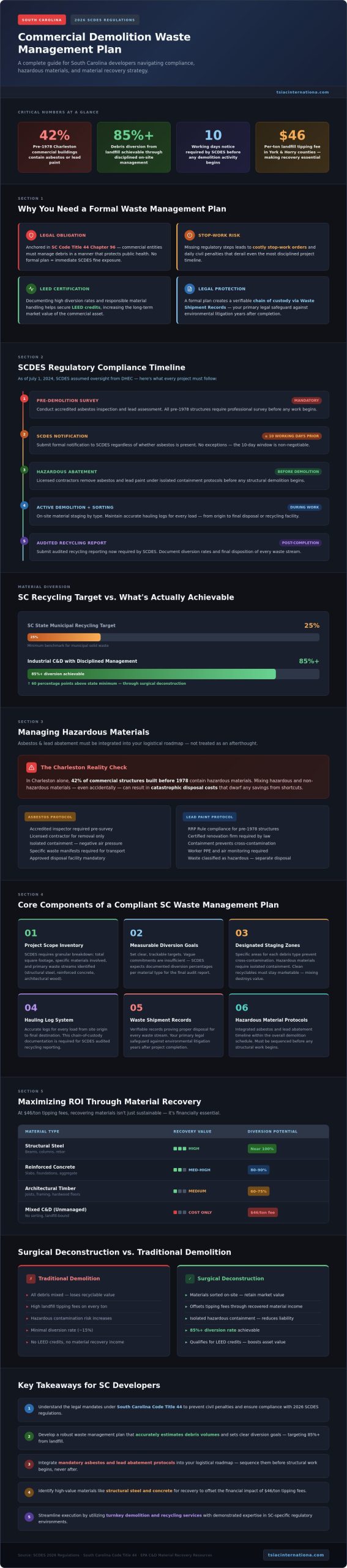
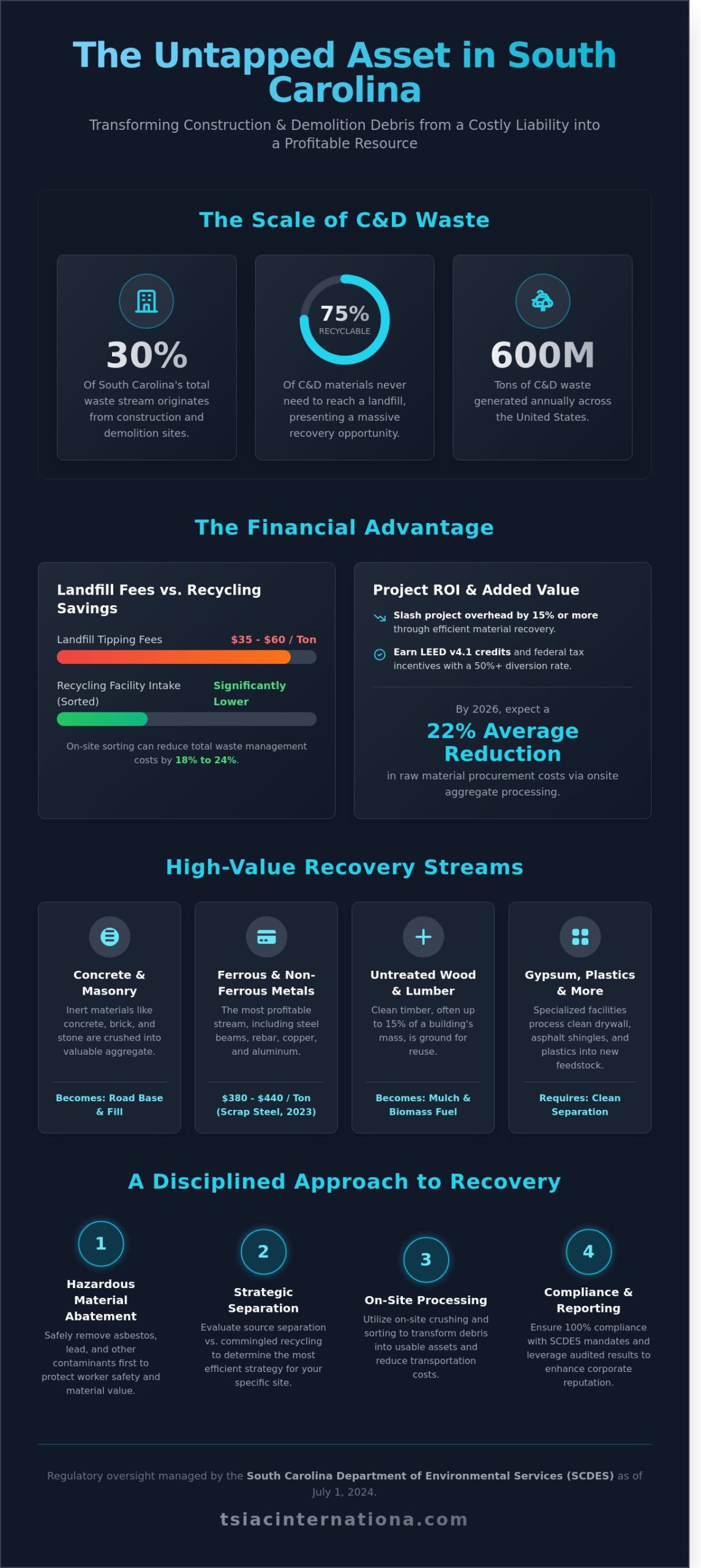
Precision on-site sorting is the most effective way to protect your project’s bottom line. Landfill tipping fees in South Carolina currently range from $45 to $65 per ton for mixed C&D waste. By aggressively separating metal framing, contractors can reduce these overhead costs by up to 30%. Before starting a teardown, Understanding Scrap Metal Value helps owners estimate potential rebates from recovered light-gauge steel. This recovery is vital for projects seeking LEED certification, specifically under the Materials and Resources (MR) credits. Beyond the financial incentives, professional disposal mitigates long-term liability. Unlike treated lumber, which can leach chemicals into the soil, steel is stable. Proper documentation of its removal protects property owners from future environmental litigation.

The Legal Landscape: SC DES and Local Ordinances

The legal framework for metal framing disposal south carolina is governed primarily by SC DES Regulation 61-107.19. This mandate requires detailed reporting for all construction waste generated on commercial sites. In industrial zones like Charleston and North Charleston, local ordinances are even more specific. For instance, heavy industrial zones (I-2) require specialized haul-off routes to minimize the impact on residential traffic. If your project involves hauling more than 10,000 pounds of metal debris, you’ll need specific transport permits that verify the load’s destination. We handle the technical paperwork and permit filings to ensure every load complies with both state and municipal laws. Fines for improper disposal can exceed $10,000 per violation, making professional oversight a necessity rather than an option. We don’t guess at compliance; we execute based on the current 2026 regulatory map.

Technical Breakdown: Types of Metal Framing and Recovery Workflows

Effective metal framing disposal south carolina requires a technical understanding of metallurgical properties and structural load-bearing requirements. We categorize metal recovery into two primary streams: light-gauge cold-formed steel and heavy structural members. Each requires a distinct set of tools, safety protocols, and logistics strategies to ensure the integrity of the site and the purity of the recycled material. Our team approaches every project as a precision engineering task rather than a simple demolition job.

Cold-Formed Steel (CFS) vs. Structural Steel

Cold-formed steel (CFS) typically consists of 25-gauge to 16-gauge galvanized studs and tracks. These components are ubiquitous in interior gutting projects across South Carolina commercial hubs. Because CFS is lightweight and high-volume, disposal logistics focus on onsite densification. We use mechanical shears to process these materials into manageable bundles, reducing transport overhead by 35% compared to loose loading. Structural steel, including I-beams and H-piles, demands heavy-duty rigging and hydraulic cutting equipment. Safety protocols for structural removal are rigorous; we calculate center-of-gravity and load-transfer points before a single cut is made. Market data from 2024 indicates that heavy structural steel (HMS 1) consistently commands a 18% to 22% price premium over light-gauge galvanized CFS in the scrap value hierarchy.

The environmental impact of these materials is a primary driver for modern construction standards. According to data regarding Steel Framing Sustainability, steel is the only material that can be recycled infinitely without losing its metallurgical properties. This makes the recovery of CFS and structural components a critical component of green building certifications. When handling metal framing disposal south carolina, we ensure that 98% of recovered steel enters the circular economy through verified processing facilities.

Hazardous Materials and Metal Framing

In historic regions like Charleston, older metal framing often presents hidden hazards. Buildings constructed before 1978 frequently contain lead-based primers on structural steel to prevent corrosion in the humid coastal climate. We utilize X-ray fluorescence (XRF) analyzers to identify lead content in seconds before any heat-based cutting begins. This prevents the aerosolization of toxic lead fumes, protecting both our technicians and the surrounding environment. If lead is detected, we pivot to cold-cutting methods or chemical stripping to maintain safety standards.

Asbestos contamination is another frequent challenge during metal framing removal. Spray-on fireproofing, often applied to steel beams in structures built between 1950 and 1980, must be professionally abated before the metal can be cleared for recycling. TSIAC manages this intersection by coordinating seamless decontamination workflows. Our methodology involves a “surgical” removal process where metal is isolated from drywall, insulation, and adhesives at the point of origin. This meticulous separation ensures that the final metal product is free of “prohibitives,” which are contaminants that can downgrade the scrap value or cause it to be rejected by foundries. This precision is why specialized firms request an industrial recovery assessment before starting complex interior demolitions.

  • Non-Ferrous Components: We separate aluminum tracks and T-bar ceiling grids, which require different smelting temperatures than steel.
  • Fastener Recovery: Specialized magnetic sweeps are used to collect 100% of steel screws and clips, preventing site hazards.
  • Decontamination: We use high-pressure, low-volume cleaning systems to remove adhesive residue from structural members.

By maintaining strict control over the material purity, we transform what others see as debris into a high-grade industrial resource. Our disciplined approach ensures that every pound of metal is accounted for and processed with engineering precision.

Professional Site Recovery vs. DIY Scrap Hauling

Managing heavy-gauge steel requires more than a pickup truck and a pair of gloves. Many site managers in the Southeast assume that using their own crew for cleanup saves money, but the math rarely supports this. When you divert a skilled tradesperson earning $48 per hour to haul scrap, you aren’t just paying for labor; you’re losing project momentum. Professional metal framing disposal south carolina involves technical recovery that integrates with your build schedule, rather than obstructing it. Our data shows that in-house scrap management often costs 22% more than professional services once you factor in fuel, insurance premiums, and lost productivity on the primary structure.

The Logistics of On-Site Sorting

Space is a premium on modern job sites. In 2026, urban construction zones in the Lowcountry and Grand Strand regions often operate with less than 600 square feet of dedicated staging area. TSIAC utilizes a “just-in-time” hauling model to prevent site congestion. We don’t let 20-foot studs pile up and block access for electrical or HVAC trades. Instead, we implement source-separated recycling protocols that ensure 98% of your steel waste avoids the landfill. This precision keeps the site clean and prevents the “domino effect” of delays caused by cluttered walkways and blocked loading bays.

  • Specialized Equipment: We use flatbed hauling for long-span studs that don’t fit in standard 30-yard roll-off containers.
  • Scheduled Extractions: Hauling occurs during off-peak hours to minimize crane and elevator bottlenecks.
  • Volume Reduction: On-site shearing reduces the physical footprint of scrap by 40% before it ever leaves the site.

Financial Comparison: Tipping Fees vs. Rebates

The financial gap between landfilling and professional recovery is widening. In Q1 2026, landfill tipping fees in certain South Carolina counties rose to $62 per ton. Choosing to dump metal framing isn’t just environmentally irresponsible; it’s a direct hit to your bottom line. Conversely, professional recovery services leverage volume to secure higher scrap rebates. Because we process thousands of tons annually, we secure rates that small-scale haulers can’t access. Project budgets see a significant boost when “waste” is converted back into a liquid asset.

Legal compliance is another hidden cost of the DIY approach. Navigating the state’s strict regulatory framework requires an understanding of South Carolina metal recycling laws, which dictate how nonferrous materials are documented and transported. Failure to possess the correct permits or manifests can result in fines starting at $1,000 per violation. We handle all the documentation, ensuring your project remains compliant with local sheriff’s office requirements and state environmental codes.

Safety risks represent the final, and perhaps most critical, variable in this comparison. Amateur metal dismantling accounts for 15% of laceration injuries on active demolition sites in the region. Steel framing has sharp edges and high tension points that require specific cutting sequences. Our crews are trained in these specialized techniques, which has helped us maintain a zero-incident rate across all metal framing disposal south carolina contracts in the last three years. The ROI of professional recovery is found in the 19% increase in site efficiency and the total elimination of disposal-related liability for the general contractor.

Metal Framing Disposal in South Carolina: The 2026 Professional Guide

Step-by-Step Guide to Compliant Metal Disposal in SC

Executing a successful metal framing disposal south carolina project requires more than just brute force. It demands a calculated, engineering-first approach that prioritizes structural integrity and environmental accountability. At TSIAC International, we treat every disposal project as a reverse-engineering challenge, ensuring that every pound of steel is accounted for from the moment it is detached until it reaches a certified recycling facility.

Pre-Demolition Planning and Permitting

Precision begins with a comprehensive debris audit. Before the first stud is removed, our team calculates the exact material volume based on the original 2018 or later structural blueprints. For a typical 15,000-square-foot commercial facility in Greenville, this audit identifies roughly 18 tons of recyclable cold-formed steel. This data allows us to coordinate logistics with South Carolina Department of Health and Environmental Control (DHEC) certified facilities, ensuring we meet the state’s 2023 guidelines for construction and demolition waste diversion.

  • Permit Acquisition: We secure all necessary SC demolition and hauling permits, including specific municipal clearances required in coastal zones like Myrtle Beach.
  • Recycling Coordination: Our team establishes direct pipelines with specialized metal processors to maximize the 98% recovery rate inherent in structural steel.
  • Equipment Selection: We deploy high-capacity hydraulic shears for heavy gauge members and magnetic separators to ensure zero-waste site clearance.

On-Site Execution and Safety

The “Surgical Strike” method defines our on-site execution. Instead of traditional wrecking, we employ selective demolition of framing members to maintain the stability of adjacent structures. This process is critical in South Carolina’s dense urban centers where zero-lot-line construction is common. We utilize plasma cutters for high-speed precision in open areas; however, we switch to mechanical shears in confined spaces to eliminate fire hazards and minimize noise pollution for neighboring businesses.

Safety protocols follow strict ANSI/ASSE Z359.1 standards. Our technicians utilize integrated fall protection systems and overhead shielding during all phases of structural metal removal. Before any structural cut occurs, technicians must verify that tensioned metal members are stabilized with temporary bracing to prevent sudden, violent kinetic energy release. This level of caution protects our personnel and your property assets simultaneously.

The final phase involves rigorous manifesting and reporting. We don’t just haul debris; we provide a full audit trail. Each load of metal framing disposal south carolina is documented with weight tickets and facility receipts. This documentation is essential for LEED certification credits or corporate ESG reporting, providing 100% transparency for your environmental compliance records. Our process ensures that your project meets all state regulations while upholding the highest standards of industrial professionalism.

This level of meticulous record-keeping is becoming the industry standard, with digital platforms like SOCWeld emerging to automate and manage complex documentation for other critical trades, such as welding.

If you need a partner who treats demolition with the same precision as construction, contact our SC disposal specialists today to schedule your site assessment.

TSIAC International: Expert Metal Framing and Recovery Solutions

TSIAC International has spent 15 years refining industrial demolition and recovery processes across the South Carolina market. We’ve managed over 320 commercial projects where we prioritize 100% material recycling on every site we touch. Our team doesn’t just haul debris; we engineer solutions for metal framing disposal south carolina that turn potential waste into reusable industrial resources. Whether a project sits in the dense urban center of Charleston or the expanding commercial corridors of Myrtle Beach, we develop customized disposal plans that account for local municipal codes and specific site logistics.

Our methodology focuses on the lifecycle of the material. We understand that steel and aluminum framing represent significant value, both environmentally and economically. By diverting 100% of these metals from South Carolina landfills, we help our clients meet stringent LEED certification requirements and corporate sustainability goals. We utilize specialized equipment to sort materials at the source, ensuring that light-gauge steel, heavy structural components, and non-ferrous metals are processed correctly from the moment they’re dismantled.

Precision Selective Demolition

Commercial renovations require a surgical touch rather than blunt force. We specialize in “surgical” interior gutting where the primary objective is removing obsolete metal framing without vibrating or compromising the building’s core. In 2022, we completed a 48,000-square-foot office renovation in Charleston. Our crews extracted 16.4 tons of steel studs and tracks while protecting the structural integrity of the adjacent historic masonry. This level of precision ensures that the subsequent construction phase begins on a clean, safe, and structurally sound foundation.

We often encounter complex environments where metal framing is integrated with hazardous materials. Our technicians are fully certified in asbestos and lead abatement, allowing us to provide a seamless transition between hazardous material removal and structural dismantling. We don’t pause the project to wait for third-party testers when we find contaminated insulation or lead-based coatings on steel components. We handle the abatement and the metal framing disposal south carolina simultaneously; this unified approach saved a Greenville healthcare client 22 days on their project timeline last year.

The TSIAC Advantage: Safety and Reliability

Safety isn’t a secondary concern for our team; it’s the engineering foundation of every job. We maintain an Experience Modification Rate (EMR) significantly below the industry average, reflecting our rigorous standards for high-risk metal dismantling. Our clients never have to guess about the status of their materials or their compliance standing. We provide a complete documentation package for every project, including:

  • Detailed recycling certificates showing exact tonnage diverted from landfills.
  • Transparent disposal receipts and chain-of-custody logs.
  • Site-specific safety reports and daily compliance checklists.
  • Environmental impact summaries for corporate sustainability reporting.

Our reputation is built on our ability to handle “impossible” locations that other contractors avoid. We excel in high-rise environments and tight urban spaces where logistics are a constant challenge. We bring a disciplined, work-focused personality to every site, ensuring that what we promise is delivered with engineering accuracy. If you need a partner who values technical precision and unwavering reliability, we’re ready to deploy.

Request a Fixed-Price Quote for Your SC Project

Securing Your Project’s Compliance and Value in 2026

Effective site management in 2026 demands more than just clearing debris. It requires a systematic approach to technical recovery that prioritizes structural integrity and environmental accountability. Managing metal framing disposal south carolina involves navigating complex regulatory frameworks while maximizing the material value of recovered steel and aluminum. TSIAC International brings 15+ years of South Carolina demolition expertise to every site, ensuring that your project meets the highest industry benchmarks. We don’t just haul scrap; we execute a specialized recovery workflow that includes certified asbestos and lead abatement to protect your team and the surrounding environment. Our 100% recycling commitment ensures that every ton of metal debris is diverted from landfills and returned to the supply chain. This engineering-led approach transforms a logistical burden into a streamlined asset recovery process. If you’re ready to optimize your site’s efficiency and maintain total compliance, it’s time to partner with professionals who understand the complexities of specialized structures and difficult locations.

Get a professional metal recovery assessment from TSIAC International

Your project deserves the precision and reliability that only a dedicated industrial partner can provide.

Frequently Asked Questions

Is metal framing 100% recyclable in South Carolina?

Steel framing is 100% recyclable and can be repurposed indefinitely without any loss of structural integrity. The Steel Recycling Institute reports that the industry maintains a reclamation rate of 98% for structural steel in commercial construction projects. Our metal framing disposal South Carolina services ensure these materials reach specialized facilities that meet ASTM International standards for metallurgical recovery.

How much does it cost to dispose of metal framing from a commercial site?

Disposal costs typically range from $150 to $450 per ton, depending on the current market value of scrap steel and the logistical distance to Charleston or Greenville processing hubs. Landfill tipping fees in South Carolina average $45 per ton, but recycling often offsets these expenses through scrap rebates. We provide detailed line-item estimates based on the 2024 market index to ensure budgetary precision for every industrial client.

Do I need a special permit for hauling large quantities of scrap metal in Charleston?

You don’t need a specific municipal permit for the material itself, but vehicles exceeding a Gross Vehicle Weight Rating of 26,001 pounds must comply with SCDOT oversized load regulations. The City of Charleston requires a secondary metals recycler permit for businesses purchasing scrap, as outlined in South Carolina Code Section 16-17-680. We manage all regulatory documentation and logistical permits to ensure full compliance with local transport laws.

Can I recycle metal studs that have drywall or screws attached?

You can recycle studs with screws attached, but drywall must be removed to prevent load rejection at South Carolina recovery facilities. Processing plants require a purity level of at least 95% for light-gauge steel to avoid contamination penalties. Our team uses specialized tools to strip debris on-site, ensuring your metal framing disposal South Carolina process meets the strict intake criteria of local foundries.

What is the difference between ferrous and non-ferrous metal disposal?

Ferrous metals contain iron and are magnetic; non-ferrous metals like aluminum or copper are non-magnetic and often command a 300% higher market price. In industrial framing, we categorize 12-gauge steel studs as ferrous and aluminum storefront components as non-ferrous. Distinguishing these materials during the demolition phase is critical for maximizing recovery value and ensuring proper metallurgical processing at the refinery.

How does TSIAC International handle metal framing contaminated with lead paint?

We treat lead-contaminated framing as hazardous waste according to EPA Lead Renovation, Repair, and Painting Rule standards. If a structure predates 1978, we perform X-ray fluorescence testing to identify lead concentrations exceeding 1.0 mg/cm². Contaminated steel is stabilized and transported in sealed containers to specialized RCRA Subtitle C landfills, preventing environmental exposure during the decommissioning process.

Does recycling metal framing help with LEED certification in SC?

Recycling metal framing contributes directly to the LEED v4.1 Materials and Resources credit, which requires a minimum 50% diversion rate of construction waste. Steel’s high recycled content, which often exceeds 25% post-consumer material, helps projects earn points under the Building Product Disclosure and Optimization category. We provide the certified weight tickets and diversion reports necessary for USGBC audits on South Carolina commercial developments.

Lead Paint Testing in South Carolina: The 2026 Property Owner’s Guide

Did you know that an estimated 34% of South Carolina residential structures built before 1978 still contain lead-based hazards? You’re likely aware…

Did you know that an estimated 34% of South Carolina residential structures built before 1978 still contain lead-based hazards? You’re likely aware that managing an older property involves more than just aesthetic upkeep; it requires a rigorous commitment to structural safety and regulatory compliance. The risk of health liabilities or heavy fines from the South Carolina Department of Environmental Services (SC DES) is a legitimate concern for any disciplined property owner who values precision and safety. This guide provides a technical roadmap for lead paint testing south carolina to ensure your 2026 operations align with both EPA and state-specific mandates. You’ll gain the clarity needed to distinguish between cost-effective professional inspections and the inherent limitations of retail DIY kits. We’ll examine the specific protocols for 2026, including the shift from basic Renovation, Repair, and Painting (RRP) standards to advanced abatement strategies that protect your long-term assets. By following these engineering-grade standards, you can move from uncertainty to a state of total structural control and documented safety.

Key Takeaways

  • Identify why pre-1978 properties in high-risk areas like Charleston and Myrtle Beach require specialized attention due to historic lead-based paint hazards.
  • Compare the technical advantages of non-destructive XRF (X-Ray Fluorescence) scanning versus laboratory analysis for efficient and accurate on-site results.
  • Navigate the complex regulatory landscape of lead paint testing south carolina by understanding the latest SC DES and EPA RRP Rule requirements.
  • Discover the critical protocols for containment and the long-term safety benefits of choosing permanent abatement over temporary interim controls.
  • Learn how 15+ years of engineering precision in the Lowcountry ensures that even the most challenging hazardous material removal projects are managed with total compliance.

Why Lead Paint Testing is Critical for South Carolina Properties

Structural integrity and safety in South Carolina’s historic real estate market rely on more than just aesthetic preservation. Properties built before the 1978 federal ban represent a massive portion of the state’s housing stock; specifically, 62% of residential units in older urban corridors. Lead paint testing south carolina protocols are the only way to verify if a structure meets modern safety standards. The history of Lead-based paint in the United States reveals that federal bans didn’t eliminate the material; they merely stopped new applications. For South Carolina owners, this means decades of accumulated paint layers often hide toxic concentrations of lead chromate or lead carbonate.

By 2026, insurance premiums for uncertified historic multi-family units in South Carolina are projected to rise by 18% as carriers tighten liability requirements. This financial pressure makes early detection a fiscal necessity. A property with documented lead hazards can see a 12% decrease in market value if the owner fails to provide a clear mitigation plan during the due diligence phase. Whether you’re managing a commercial renovation in Myrtle Beach or a residential restoration in Columbia, understanding the technical state of your substrates is the first step in risk management.

The Historic Charleston Factor

Charleston’s unique environmental conditions create a high-risk scenario for lead paint degradation. The city’s average humidity levels, which often exceed 70%, accelerate the breakdown of lead-based primers. This process, known as chalking, releases microscopic particles into the local soil and air. Owners of landmarks must also satisfy the Board of Architectural Review (BAR) requirements. These legal obligations mandate that any lead disturbance during exterior scraping or repainting follows strict containment procedures to prevent contaminating the dense Lowcountry urban environment.

Health Risks and Liability

Inhalation of lead dust remains the primary vector for toxicity during structural demolition or selective renovations. When contractors use high-heat guns or power sanders without HEPA filtration, they aerosolize lead particles that settle into HVAC systems. For commercial property managers and landlords, the legal stakes are high. South Carolina law, aligned with EPA’s RRP (Renovation, Repair, and Painting) Rule, imposes fines of up to $37,500 per day for violations that expose tenants to lead hazards.

Landlords often mistakenly believe that applying a fresh coat of latex paint solves the problem. This is rarely a long-term legal or safety solution; it’s merely a temporary mask. Friction surfaces like window sashes and door frames will inevitably grind through new layers, exposing the lead underneath. Professional lead paint testing south carolina identifies these high-friction areas before they become a liability. Relying on “encapsulation” without a certified inspection report leaves owners vulnerable to personal injury lawsuits and significant civil penalties.

  • Pre-1940 Homes: 87% chance of containing lead-based paint.
  • 1940-1959 Homes: 69% chance of containing lead-based paint.
  • 1960-1977 Homes: 24% chance of containing lead-based paint.

Precision in testing ensures that renovation budgets are allocated correctly. Instead of guessing which walls require abatement, technical data allows for targeted intervention. This engineering-led approach saves time and prevents the unnecessary removal of safe historic materials. It’s about maintaining the balance between preserving South Carolina’s architectural heritage and ensuring the biological safety of its inhabitants.

Professional Lead Testing Methods: XRF vs. Laboratory Analysis

Professional inspection of historic properties in cities like Charleston or Greenville requires a technical approach that balances accuracy with the preservation of architectural integrity. Property owners must choose between non-destructive surface analysis and invasive chemical sampling. Selecting the right protocol for lead paint testing south carolina requires a technical understanding of building substrates and historical coating layers. While DIY kits exist, they lack the sensitivity needed to detect lead buried under twenty layers of modern latex, often yielding false negatives that compromise occupant safety.

Technical assessments typically begin with a visual inspection to identify friction surfaces, such as window sashes and door frames, where lead dust is most likely to accumulate. A certified risk assessor then determines whether X-Ray Fluorescence or paint chip sampling is the most efficient path forward. This decision often hinges on the specific substrate; for instance, ornate plasterwork requires a different diagnostic tool than a standard exterior clapboard. Professional results provide the empirical data necessary for 100% compliance with EPA lead safety standards.

XRF Testing: The Industry Standard

X-Ray Fluorescence (XRF) technology serves as the primary diagnostic tool for rapid, non-destructive onsite analysis. The device emits a controlled beam of high-energy X-rays that displaces electrons in the lead atoms within the paint. As these atoms return to a stable state, they emit a secondary X-ray, or fluorescence, which the handheld analyzer measures with a 95% confidence interval. This method identifies lead concentration through multiple layers of paint without damaging the surface. It provides immediate results, allowing for real-time decision-making during a structural audit.

Only licensed professionals should operate XRF machinery because the equipment requires precise calibration and specialized training to interpret complex readings on metallic or curved substrates. While the initial cost of a professional XRF survey is higher than manual sampling, it eliminates the need for patching damaged walls and reduces laboratory turnaround times. It’s a vital component for any comprehensive lead paint testing south carolina strategy, especially when dealing with large-scale renovations where hundreds of surfaces require verification.

Laboratory Analysis and Dust Wipes

When XRF readings are inconclusive or when a precise chemical breakdown is required, risk assessors turn to laboratory analysis. This process involves collecting a physical paint chip, typically two square inches in size, and sending it to an EPA-recognized laboratory. Technicians use Atomic Absorption Spectroscopy (AAS) or Inductively Coupled Plasma (ICP) to measure lead content. Results are reported in parts per million (ppm) or percent by weight. Under federal law, paint is considered lead-based if it contains 5,000 ppm or 0.5% lead by weight. This method is the final word in legal and insurance disputes.

Testing must extend beyond the paint itself to account for environmental migration. Dust wipe sampling measures the actual risk of exposure in living spaces by collecting particles from floors and window sills. As of 2021, the EPA lowered the dust-lead hazard standards to 10 micrograms per square foot (µg/ft²) for floors. In South Carolina’s coastal regions, soil testing is equally critical, as exterior paint flaking over decades can contaminate the perimeter of a home. For complex projects involving structural modifications, consulting with a specialized structural partner ensures that these technical risks are managed alongside the physical construction process.

  • Soil Sampling: Necessary for homes built before 1950 where exterior lead concentrations often exceed 1,200 ppm in play areas.
  • Water Testing: Essential if the property contains lead service lines or interior brass fixtures manufactured before 2014.
  • Clearance Testing: Performed after lead hazard reduction to ensure the environment is safe for re-occupancy.

Effective June 1, 2024, the South Carolina Department of Environmental Services (SC DES) assumed the regulatory oversight previously managed by DHEC. This agency now handles the enforcement of lead-based paint protocols across the state alongside federal authorities. The cornerstone of these protections is the EPA Renovation, Repair, and Painting (RRP) Rule. It dictates that any firm disturbing more than six square feet of interior paint in a pre-1978 home must be lead-safe certified. Ignoring these mandates doesn’t just risk health; it invites heavy litigation and state-level enforcement actions that can stall a renovation indefinitely.

Property owners often struggle to choose the correct protocol when ordering lead paint testing south carolina services. A Lead Inspection is a surface-by-surface inventory. It uses X-Ray Fluorescence (XRF) analyzers to identify exactly where lead exists on walls, windows, or trim. Conversely, a Lead Risk Assessment is more diagnostic. It identifies active hazards like deteriorating paint, lead-contaminated dust, or soil issues. For historic preservation, a risk assessment is usually the superior choice because it provides a prioritized plan for hazard control rather than just a simple list of locations. It’s about finding the source of the danger, not just the presence of the material.

The regulatory landscape is tightening to protect vulnerable populations. In October 2024, the EPA finalized a rule that significantly lowers the thresholds for lead dust in residential settings. By 2026, the EPA lead hazard standards will transition to a “reportable level” standard. This means any amount of lead dust detected by a certified laboratory will be considered a hazard. These updates require contractors to adopt more rigorous HEPA-vacuuming and wet-cleaning cycles to pass final clearance testing. If your project concludes after these 2026 updates, the margin for error during the final cleaning phase will effectively be zero.

Residential vs. Commercial Compliance

Regulations classify structures built before 1978 as “Target Housing.” This includes most historic residences in Charleston. If a facility houses children under age six for six hours weekly, it’s a child-occupied facility. For commercial interior gutting, SC DES requires lead paint testing south carolina as a mandatory pre-demolition step. OSHA Standard 1926.62 also dictates worker safety if lead levels exceed 30 micrograms per cubic meter of air.

Certification Requirements for SC Contractors

Verify a firm’s status through the EPA’s Lead-Safe Certification search tool before any work begins. In South Carolina, SC DES can issue fines reaching $37,500 per day for non-compliant lead disturbance. Contractors must maintain a strict paper trail, including the “Renovate Right” receipt and dust-wipe clearance reports. These documents must be kept for a mandatory 3-year period to prove compliance during state audits.

Lead Paint Testing in South Carolina: The 2026 Property Owner’s Guide

From Testing to Abatement: What Happens if Lead is Found?

Confirming the presence of lead through professional lead paint testing south carolina requires an immediate, structured response. Once a laboratory report identifies lead concentrations exceeding 1.0 mg/cm² or 0.5% by weight, the property owner enters a regulatory framework designed to protect human health. The first 48 hours are critical. We prioritize site containment by isolating the affected areas with 6-mil polyethylene plastic sheeting and high-tack tape. Under South Carolina DHEC guidelines, occupants must receive written notification of the findings within 15 days. This transparency ensures that residents take necessary precautions while we determine the most effective path forward.

Property owners must choose between interim controls and permanent abatement. Interim controls, such as specialized HEPA vacuuming and dust-suppressant cleaning, offer a temporary reduction in risk. However, these methods require ongoing monitoring every 6 to 12 months. For historic structures in South Carolina, permanent abatement is the standard for long-term safety. This process involves a 20-year guarantee of lead-free surfaces. It requires a rigorous technical approach that treats the building as a complex industrial site rather than a simple renovation project.

Professional Abatement Strategies

Our team implements several specialized methods to ensure the total removal or stabilization of hazards. We select the strategy based on the architectural importance of the substrate and the severity of the lead concentration. Common professional methods include:

  • Mechanical Removal: We utilize HEPA-shrouded power tools that connect directly to industrial vacuum systems. These systems capture 99.97% of airborne particulates at the source, preventing the spread of toxic dust.
  • Encapsulation: When removal isn’t feasible due to structural integrity, we use encapsulation. This involves applying an ASTM E1795-certified liquid coating that creates a permanent, impact-resistant bond over the lead paint.
  • Component Replacement: For 1920s-era sash windows or doors, component replacement is often the safest strategy. Removing the entire architectural element eliminates the friction points where lead dust is most likely to be generated during daily use.

Waste Management and Disposal

Handling lead-contaminated debris in South Carolina follows strict protocols under Regulation 61-107.19. We don’t simply haul waste to a standard landfill. Every pound of material is sorted and categorized to minimize environmental impact. TSIAC International employs a precise sorting method that separates recyclable metals from hazardous paint chips. In a typical 2,500-square-foot historic restoration, we often divert up to 30% of the total waste weight through careful material recovery. This disciplined approach reduces the volume of hazardous material entering South Carolina’s specialized disposal sites, ensuring 100% compliance with state transport manifests.

The process concludes with final clearance testing. A certified third-party inspector performs dust wipe sampling on floors, windowsills, and troughs. To pass, floor samples must show lead levels below 10 micrograms per square foot (µg/ft²). Only after these laboratory results confirm the site is decontaminated can the containment barriers be removed and the space declared safe for re-occupancy. If you’ve received positive results from lead paint testing south carolina, you need a partner who understands the engineering behind the safety.

Ensure your historic property meets the highest safety standards by consulting with our experts today. Contact TSIAC International for professional abatement solutions.

Why TSIAC International for Lead Abatement in the Lowcountry

TSIAC International has maintained a specialized presence in the Charleston hazardous material removal sector since 2008. Over these 15 years, we’ve refined a workflow that bridges the gap between technical demolition and environmental safety. Our team understands that historic homes in the Lowcountry require more than just brute force; they demand a surgical approach to lead paint removal. We offer integrated services that allow a project to move from selective demolition to lead abatement without the friction of hiring multiple subcontractors. This continuity reduces project timelines and ensures that safety standards remain consistent from the first swing of a hammer to the final clearance test.

Safety isn’t a suggestion at our job sites. We operate under strict adherence to SC DES (South Carolina Department of Environmental Services) and EPA protocols. This commitment ensures that every square inch of a property is handled with environmental responsibility. We utilize advanced HEPA filtration and negative air pressure systems to contain lead dust, which is particularly volatile in the humid South Carolina climate. Our site cleanliness standards exceed industry norms. We don’t just meet the minimum requirements; we aim for a pristine environment that protects both our specialized technicians and the families who will eventually occupy these historic spaces.

Our Professional Abatement Process

Our workflow begins the moment lead paint testing south carolina results are finalized. We collaborate with independent testing firms to translate their data into a precision abatement plan. This ensures we target only the necessary areas, saving time and structural material. Our experience includes over 250 historic renovations and large-scale commercial gut-outs where lead was a major factor. We provide every client with a fixed-price abatement contract. This transparency eliminates the unexpected costs often associated with environmental remediation in older structures. Our process includes:

  • Detailed site containment using 6-mil polyethylene sheeting and reinforced entry points.
  • Wet-scraping and HEPA-vacuuming techniques to minimize airborne particulates.
  • Chemical stripping for intricate historic moldings where mechanical removal is impossible.
  • Comprehensive waste management and disposal at certified hazardous waste facilities.

Serving Charleston and Beyond

From our central hub in North Charleston, we serve the entire Grand Strand and the broader Lowcountry region. Our reputation is built on successful outcomes in high-stakes environments. In 2022, we managed the lead removal for a 14,000-square-foot historic renovation where 85% of the original woodwork contained toxic levels of lead paint. We completed the project three days ahead of schedule with zero safety incidents and passed the final lead paint testing south carolina inspection on the first attempt. Our local knowledge of SC building codes and historic board requirements makes us a vital partner for any renovation project. We don’t just remove hazards; we prepare your property for its next century of life.

Ready to secure your property and ensure a lead-free environment? Request a Lead Abatement Quote from TSIAC International today to speak with a specialist about your specific project needs.

Securing Your Property Assets and Health for 2026

Compliance with South Carolina Department of Environmental Services (SC DES) and EPA standards isn’t just a legal hurdle; it’s a fundamental safety requirement for any property built before 1978. Accurate lead paint testing south carolina remains the first line of defense against hazardous exposure and long-term liability. Whether you utilize XRF technology for instant results or detailed laboratory analysis for verification, precise data ensures your remediation strategy is built on engineering facts rather than assumptions. For complex commercial projects that may involve multiple contaminants beyond lead paint, comprehensive hazardous material abatement South Carolina protocols ensure all environmental risks are properly identified and mitigated. TSIAC International brings over 15 years of specialized experience to the Charleston Lowcountry, operating as a strictly vetted EPA Certified Lead-Safe Contractor. Our team is fully licensed, bonded, and insured for hazardous materials, providing the technical precision required for even the most complex abatement projects. You don’t have to navigate these evolving 2026 regulations alone or risk the integrity of your structure with uncertified labor. Secure Your Property with Professional Lead Abatement Services and gain the peace of mind that comes from working with proven industry experts. Taking proactive steps today ensures a safer environment for your community and a more secure, compliant future for your real estate investment.

Frequently Asked Questions

Is lead paint testing mandatory before home renovations in South Carolina?

Lead paint testing south carolina is mandatory for all pre-1978 residences under the EPA Renovation, Repair, and Painting (RRP) Rule when a project disturbs more than 6 square feet of interior surface. Contractors must either assume lead is present or perform verified testing using EPA-recognized methods. Failure to comply with these federal regulations can result in civil penalties exceeding $37,500 per violation per day.

How much does a professional lead inspection cost in Charleston?

A professional lead inspection in Charleston typically costs between $300 and $600 for a standard 2,000-square-foot residential property. Larger historic estates in the Downtown District often require more extensive XRF scanning, which can push costs toward $850. These prices cover the certified inspector’s site visit, equipment usage, and the detailed technical report required for legal documentation.

Can I use a DIY lead test kit for legal compliance in SC?

DIY kits like the 3M LeadCheck are EPA-recognized for some residential applications, but they don’t meet the legal requirements for lead abatement projects or commercial compliance. Professional lead paint testing south carolina utilizes XRF analyzers that provide non-destructive, instant results with 95% accuracy. Relying on retail swabs often leads to false negatives on older, multi-layered historic surfaces where lead is buried under modern coatings.

What is the difference between lead abatement and lead-safe renovation?

Lead abatement is a specialized set of procedures designed to permanently eliminate lead-based paint hazards for at least 20 years. Lead-safe renovation involves interim controls and work practices that minimize dust during standard maintenance or remodeling. Abatement requires South Carolina DHEC-certified supervisors and specific containment protocols that go far beyond standard RRP guidelines to ensure total site safety.

How long does the lead paint removal process take for a commercial building?

Lead removal for a 10,000-square-foot commercial facility typically requires 7 to 14 business days depending on the substrate’s condition. This timeline includes site stabilization, specialized containment setup, and the final HEPA vacuuming process. Complex industrial sites involving abrasive blasting or chemical stripping may extend the schedule by an additional 5 days to ensure 100% compliance with safety standards.

What should I do if my child tests positive for lead in South Carolina?

You should immediately contact the South Carolina Department of Health and Environmental Control (DHEC) at 803-898-3432 if a child’s blood lead level exceeds 3.5 micrograms per deciliter. State law requires healthcare providers to report these results within 10 days of the test. You’ll need a certified environmental investigation of your home to identify and mitigate the specific source of exposure immediately.

Are there grants available for lead paint removal in SC historic homes?

The HUD Lead Hazard Control Grant Program provides funding for lead mitigation, often covering up to $10,000 per unit for qualifying low-income households. Additionally, the South Carolina State Historic Preservation Office offers a 25% state income tax credit for the rehabilitation of certified historic residential structures. These financial incentives help offset the technical costs of specialized abatement in 19th-century properties.

How does TSIAC International handle lead-contaminated debris?

TSIAC International manages lead-contaminated waste through rigorous adherence to the Resource Conservation and Recovery Act (RCRA) standards. We utilize 6-mil polyethylene bagging for all hazardous debris and ensure transport to Subtitle D landfills permitted for such materials. Every project includes a documented chain of custody and a final disposal certificate to guarantee your site remains 100% compliant with environmental regulations.

TSIAC International FAQ: Expert Answers on Demolition & Abatement in 2026

Navigating the complexities of a structural demolition or hazardous material abatement project presents significant challenges. The potential for…

Navigating the complexities of a structural demolition or hazardous material abatement project presents significant challenges. The potential for unforeseen costs, regulatory penalties from agencies like DHEC, and critical project delays are valid concerns for any property owner or developer in South Carolina. To provide clarity and instill confidence in these high-stakes operations, our team of specialists has compiled this comprehensive tsiac international faq for 2026. This is more than just a list of answers; it is a direct line to the expertise that has defined our firm as a leader in the industry.

Within this guide, you will find authoritative information on our meticulous safety protocols, our transparent pricing models for hazardous material removal, and our unwavering commitment to full regulatory compliance. We aim to demystify the process from initial assessment to final clearance, empowering you with the knowledge to move forward with your project, secure in the knowledge that every technical detail is under control. Consider this your essential resource for planning a safe, compliant, and efficient project outcome.

Key Takeaways

  • Understand the strict South Carolina DHEC requirements for asbestos testing *before* beginning any structural demolition to ensure full legal compliance.
  • Learn how a meticulously engineered demolition plan not only mitigates on-site risks like dust and vibration but also leads to a more predictable project timeline and budget.
  • This tsiac international faq clarifies how integrating hazardous material abatement directly with demolition creates a single, accountable point of contact for complex projects.
  • Discover how partnering with a sustainability-focused contractor can help you achieve environmental goals, from maximizing material recycling to earning valuable LEED credits.

Understanding TSIAC International’s Core Service Capabilities

For over 15 years, TSIAC International has served as the Charleston Lowcountry’s trusted contractor for technically demanding projects. Our expertise is engineered around a critical dual-focus: the precise execution of structural removal and the certified remediation of hazardous materials. This integrated service model provides clients with a single, accountable partner for projects ranging from residential teardowns to large-scale commercial site preparation, ensuring efficiency and strict regulatory compliance from start to finish.

We manage projects across both the residential and commercial sectors, understanding that the scale, risks, and regulations differ significantly. The primary advantage of hiring a unified contractor is seamless project continuity. When demolition uncovers unforeseen hazards, our cross-trained teams can pivot immediately to implement compliant asbestos abatement procedures without halting progress or engaging a separate subcontractor. This capability is a cornerstone of the value we provide and a frequent topic in this tsiac international faq.

Structural vs. Selective Demolition: What Do You Need?

The correct demolition method is dictated entirely by your project’s end goal. Total structural demolition involves the complete razing of a building and its foundation, creating a clean slate for new construction. In contrast, selective demolition is a surgical process essential for renovations, additions, or historic preservation projects. It involves removing only specific non-load-bearing walls, finishes, or building sections while meticulously preserving the primary structure.

Specialized Interior Gutting and Strip-Outs

Our interior gutting and strip-out services are engineered for precision, serving commercial tenant improvements and extensive residential remodels. This process involves the systematic removal of all interior finishes, partitions, and ceilings back to the structural shell. We carefully manage the safe disconnection and removal of mechanical, electrical, and plumbing (MEP) systems, guaranteeing that the building’s foundational integrity remains uncompromised throughout the deconstruction phase.

The TSIAC Demolition Workflow: Safety and Engineering Precision

At TSIAC International, a successful demolition project is defined not by the collapse of a structure, but by the meticulous process that precedes and follows it. Our workflow is a synthesis of advanced engineering, rigorous safety protocols, and strategic execution. This section of our tsiac international faq breaks down the critical phases of our demolition process, from initial site assessment to final debris management, ensuring every project is completed with unparalleled precision and control.

Pre-Project Planning and Permitting

The foundation of a safe demolition is laid long before heavy machinery arrives. Our project managers are experts in navigating the complex local permit requirements of municipalities like Charleston and Myrtle Beach, ensuring full compliance. A critical step is meticulous utility coordination, where we work directly with providers to guarantee that all gas, water, and electrical lines are identified, disconnected, and safely capped. The mandatory Pre-Demo Survey serves as our comprehensive blueprint, identifying structural characteristics, hazardous materials, and environmental sensitivities to inform every subsequent action.

Heavy Machinery and Technical Execution

TSIAC International deploys a state-of-the-art fleet engineered for power and precision. This includes high-reach excavators equipped with specialized attachments like shears and pulverizers for controlled, top-down demolition of commercial structures, alongside versatile skid steers for material handling. In sensitive urban environments, our methodology is paramount. We utilize advanced noise and vibration monitoring systems to ensure our operations remain within acceptable limits, protecting adjacent properties and minimizing community disruption through a carefully phased approach.

On-site execution is governed by an uncompromising commitment to safety. Every team member is trained to exceed the rigorous federal guidelines outlined in the OSHA Demolition Safety Standards, utilizing specialized personal protective equipment (PPE) and maintaining secure work zones. We engineer each demolition plan to actively mitigate risks like airborne dust and structural vibration. Upon completion of the teardown, the final phase involves systematic debris management—sorting materials for recycling and responsible disposal—and site stabilization, leaving the property secure, clean, and ready for its next chapter.

Compliance in demolition and abatement is not optional; it is a legal and ethical imperative. South Carolina’s Department of Health and Environmental Control (DHEC) enforces some of the most stringent regulations in the region, designed to protect public health and the environment from hazardous materials. A critical mandate is the legal requirement for a comprehensive asbestos inspection by a licensed inspector before any demolition or renovation activities can commence, regardless of the building’s age. Failure to comply can result in significant fines and project shutdowns.

At TSIAC International, our commitment to safety and regulatory adherence is absolute. Our hazardous material handlers are not only licensed by DHEC but also undergo continuous, rigorous training that exceeds OSHA and EPA standards. To provide clients with complete liability protection, every abatement project concludes with a meticulously compiled “Close-Out” package. This vital documentation includes:

  • State notifications and permits
  • Air monitoring and clearance reports
  • Hazardous waste manifests confirming proper disposal
  • Daily project logs and personnel certifications

This comprehensive record-keeping is a cornerstone of our process and a frequent topic in our tsiac international faq, as it provides clients with indisputable proof of compliance for their records.

The Asbestos Removal Process (Abatement)

Our abatement methodology is engineered for maximum safety and efficiency. We establish fully sealed containment zones maintained under negative air pressure, with all exhausted air passing through high-efficiency particulate air (HEPA) filters to capture microscopic fibers. TSIAC prioritizes a wet-method removal technique, which involves saturating asbestos-containing materials to prevent fibers from becoming airborne. All waste is securely bagged, sealed, and transported with manifest tracking to a licensed disposal facility, ensuring a complete and documented chain of custody.

Lead Paint Remediation and Mold Services

Beyond asbestos, our expertise extends to other environmental hazards. Handling lead-based paint, particularly in historic Charleston properties, requires specialized containment and removal techniques to preserve architectural integrity while ensuring safety. Similarly, our approach to mold remediation goes beyond surface cleaning. We identify and address the root cause of moisture intrusion—the source of the mold—before any structural removal, safeguarding the building’s long-term stability and preventing recurrence.

TSIAC International FAQ: Expert Answers on Demolition & Abatement in 2026

Estimating Project Costs, Timelines, and Logistics

A precise and transparent estimate is the foundation of any successful demolition or abatement project. A common question in our tsiac international faq is how we translate complex site variables into a predictable budget and schedule. Our methodology is built on meticulous assessment, ensuring clients and general contractors have a clear financial and operational roadmap from day one.

The final cost of a demolition contract is determined by a confluence of critical factors, never just one. We analyze:

  • Structural Complexity & Materials: A project’s scope extends beyond simple square footage. The type of construction—such as reinforced concrete versus a wood-frame structure—dictates the equipment, labor, and time required.
  • Hazardous Material Abatement: The confirmed presence of asbestos, lead paint, or other regulated materials fundamentally alters the project’s scope. These require specialized containment, removal, and disposal protocols, which are significant and non-negotiable cost drivers governed by strict federal and state regulations.
  • Site Accessibility & Logistics: The ability to deploy heavy machinery efficiently impacts the budget. Tight urban sites or locations with limited access require specialized equipment and more strategic planning, influencing mobilization costs and project duration.

How We Calculate Your Demolition Quote

Our quotes are engineered, not guessed. We balance the baseline metric of square footage against the material complexity and structural density of the building. We conduct a thorough site logistics analysis to calculate machinery deployment and debris removal costs accurately. Furthermore, TSIAC International actively identifies opportunities for material salvage and recycling; any credits obtained from reclaimed steel, concrete, or other valuable materials are passed on to you, directly offsetting project expenses.

Scheduling and Project Management

Once a contract is executed, typical lead times for mobilization in the Lowcountry range from two to four weeks, allowing for permitting, utility disconnection, and pre-construction surveys. While a standard residential demolition may be completed in under a week, a large-scale commercial or industrial project can span several months. Our project managers maintain proactive communication protocols with general contractors, providing regular updates and strategically navigating potential weather delays and mandatory regulatory inspection windows to keep the project on its critical path.

At TSIAC International, our commitment is to provide comprehensive, fixed-price contracts whenever possible. This eliminates financial uncertainty and establishes us not just as a contractor, but as a predictable and reliable partner in your project’s success. For a detailed, site-specific proposal, we invite you to contact our estimating team.

Compliance, Sustainability, and Partnering with TSIAC

Executing a successful demolition or abatement project extends beyond technical proficiency; it demands a deep commitment to regulatory compliance, environmental stewardship, and transparent partnership. At TSIAC International, these principles are integrated into every phase of our operations, ensuring that your project not only meets its technical objectives but also aligns with corporate responsibility standards and contributes positively to the community. Our approach is designed to provide clients with peace of mind, knowing every detail is managed with engineering precision.

Our commitment to sustainability is demonstrated through our proactive support for clients pursuing LEED (Leadership in Energy and Environmental Design) certification. By maximizing material recovery and minimizing waste, we help projects earn valuable credits. This dedication is a core part of our “Zero Waste” initiative, where materials such as wood, metal, and plastic are not viewed as debris but as resources to be reclaimed and repurposed, reducing environmental impact and often generating cost efficiencies.

The Recycling and Material Recovery Program

Central to our sustainability mission is a rigorous material recovery program. Our teams meticulously sort debris on-site to maximize the recovery of recyclable materials. Through strategic partnerships with certified recycling facilities across South Carolina, we ensure that resources are processed responsibly. Through these meticulous processes, TSIAC International consistently diverts over 85% of all non-hazardous project debris from landfills, directly contributing to our clients’ sustainability goals.

Why TSIAC International is the Preferred SC Partner

Selecting a partner for complex industrial work is a critical decision. As this tsiac international faq guide concludes, we want to emphasize the foundational pillars that make us a trusted leader. Our status as a certified Latino-owned business also enhances our clients’ ability to meet supplier diversity requirements for both public and private sector contracts. We provide a partnership built on:

  • Unquestionable Credentials: We maintain comprehensive insurance, full bonding capacity, and all requisite state and federal licenses to manage projects of any scale and complexity.
  • The Andra Basnight Standard: Every project is managed with a level of direct communication, accountability, and professionalism that reflects our founder’s commitment to client success.
  • Proven Performance: A documented history of delivering safe, efficient, and on-schedule demolition and abatement solutions for the most demanding industries.

The final step is to translate these capabilities into a tailored solution for your project. We invite you to request a comprehensive site walk-through to discuss your specific demolition or abatement needs. Contact TSIAC International for a Professional Consultation to receive a formal, detailed proposal from our expert team.

Your Strategic Partner for Complex Demolition and Abatement

Navigating the intricacies of demolition and hazardous material abatement requires a partner with proven expertise and an unwavering commitment to safety. This guide has illuminated the core tenets of our operations, from our meticulously engineered demolition workflows to our rigorous adherence to South Carolina’s asbestos and lead abatement regulations. We trust this tsiac international faq has provided the clarity and confidence you need for your upcoming projects in 2026 and beyond.

With 15+ years of industry experience, our status as a Fully DHEC & OSHA Compliant and Certified Latino-Owned Small Business stands as a testament to our dedication to operational excellence. When your project demands a solution that is both technically sound and executed with uncompromising precision, the next step is a detailed consultation.

Take the definitive step toward a safe and successful project outcome. Request a Comprehensive Project Quote from TSIAC International and let our team develop a strategic plan tailored to your specific needs. We look forward to building a safer, more sustainable future together.

Frequently Asked Questions About Demolition & Abatement

Is TSIAC International licensed for asbestos removal in South Carolina?

Yes, TSIAC International is fully licensed and certified by the South Carolina Department of Health and Environmental Control (SCDHEC) for asbestos abatement projects. Our technicians adhere strictly to all state and federal regulations, including OSHA and EPA standards. We maintain comprehensive insurance and bonding, ensuring every project is executed with the highest level of safety, compliance, and professional accountability. This commitment to regulatory adherence is fundamental to our operations.

Do I need an asbestos survey before I demolish my house in Charleston?

Absolutely. Both federal NESHAP regulations and South Carolina DHEC rules mandate a comprehensive asbestos survey by a licensed inspector before any demolition or significant renovation, regardless of the structure’s age. This is a critical step to identify any asbestos-containing materials (ACMs) and ensure they are handled safely. This legal requirement protects workers, the community, and property owners from liability and hazardous exposure.

How much does commercial demolition cost per square foot in 2026?

In 2026, commercial demolition costs typically range from $5 to $15 per square foot, but this figure is highly variable. The final price is determined by factors such as the building’s construction materials (e.g., steel frame vs. reinforced concrete), the presence of hazardous materials, site accessibility for heavy machinery, and local landfill fees. We provide a detailed, site-specific estimate after a thorough project evaluation to ensure accurate and transparent pricing.

What is the difference between abatement and remediation?

While related, these terms have distinct meanings. Abatement refers to the specific process of controlling, containing, or removing a known hazardous material, such as asbestos or lead paint, to eliminate exposure. Remediation is a broader term for the cleanup and reversal of environmental contamination. It can include abatement as one component but may also involve addressing contaminated soil or groundwater to restore a site to a safe, usable condition.

How does TSIAC handle dust and noise control for neighbors?

We implement a rigorous environmental control plan for every project. Dust is actively suppressed using engineered water misting systems and perimeter dust screens. For sensitive interior work, negative air pressure containments are established. Noise is managed by using modern equipment and adhering strictly to local ordinances regarding operational hours. Proactive communication with adjacent property owners is also a key component of our strategy to minimize community impact.

Can TSIAC assist with the demolition permit process in Myrtle Beach?

Yes, managing the permitting process is an integral part of our turnkey demolition services. We handle all necessary documentation and coordination with municipal bodies, including the City of Myrtle Beach. This is a common topic in our TSIAC International FAQ with clients. Our extensive experience with local regulations ensures that all prerequisites, from utility disconnects to environmental clearances, are met efficiently to secure the demolition permit without unnecessary delays.

What happens to the materials after a building is torn down?

Post-demolition, materials are meticulously sorted on-site to maximize recycling and ensure regulatory compliance. Concrete, steel, and wood are segregated and transported to certified recycling facilities to be repurposed. Any identified hazardous materials are handled and disposed of according to strict EPA and SCDHEC protocols at licensed facilities. Non-recyclable construction and demolition debris is transported to an approved landfill, minimizing the project’s environmental footprint.

Does TSIAC perform mold remediation alongside demolition?

Yes, TSIAC International provides integrated environmental services, including professional mold remediation. If mold is identified during the pre-demolition inspection or uncovered during the work, our certified technicians are equipped to establish containment and execute a thorough remediation plan. We follow IICRC S520 industry standards to safely remove mold and address the underlying moisture source, ensuring the issue is resolved completely before demolition proceeds.

The Environmental Impact of Concrete Grinding: What You Need to Know

Concrete Grinding Charleston, South Carolina

Concrete grinding is a process used to smooth and polish concrete surfaces, transforming rough and uneven surfaces into sleek and usable spaces. It’s an essential part of construction and renovation projects that can dramatically improve both the look and function of floors and other structures. But what many don’t consider is the impact this process has on the environment.

While grinding concrete brings about many benefits in the construction world, it’s important to understand its potential environmental effects. Recognizing these impacts is the first step toward adopting practices that can minimize harm to our planet. Exploring how concrete grinding affects the environment can lead us to more sustainable options.

Being aware of the challenges involved allows us to make informed decisions when planning construction projects involving concrete grinding. Through understanding and innovation, we can work towards reducing negative effects and promoting eco-friendly solutions in the industry.

Understanding Concrete Grinding and Its Purpose

Concrete grinding is a crucial technique in the construction industry, used to polish surfaces and prepare them for further work. This process involves using heavy machinery equipped with diamond-studded blades or discs to smooth out rough patches and achieve the desired finish. It is commonly employed in renovating old floors, preparing surfaces for new installations, and maintaining polished concrete surfaces.

The purpose of concrete grinding isn’t just about aesthetics; it also enhances the functionality of the concrete. It reduces surface imperfections, making it safer and more comfortable to walk on. A smooth concrete surface is easier to clean and maintain, helping to resist wear and tear over time. This prolongs the lifespan of floors and minimizes the cost and need for frequent repairs or replacements.

In addition, concrete grinding can remove surface contaminants, glue, and coatings, making it essential for remodeling projects. This process helps in setting the stage for new applications, ensuring a solid base for future installations. The versatility of concrete grinding makes it a preferred choice across various construction projects, from large commercial spaces to residential homes.

Environmental Concerns Associated with Concrete Grinding

Even though concrete grinding serves many purposes, it can have environmental drawbacks that need to be considered. One primary concern is the dust generated during the grinding process. These fine particles can become airborne, contributing to air pollution. They can affect respiratory health if inhaled by workers or nearby residents, making it important to control dust effectively.

Moreover, the equipment used in grinding typically operates on electricity or fuel, which can contribute to carbon emissions. This aspect adds to the environmental footprint of any construction project involving concrete grinding. Additionally, the disposal of grinding residues and spent materials can pose disposal challenges.

Also, water usage is another concern in wet grinding methods, where water is used to control dust and cool the equipment. This water can become contaminated with concrete particles and require careful management to prevent pollution.

Here’s a brief list of environmental concerns:

– Air pollution from dust particles

– Carbon emissions from machinery

– Disposal issues for grinding residues

– Water contamination in wet grinding

Addressing these concerns involves adopting strategies that lower the negative impacts, paving the way for more responsible and eco-friendly practices.

Strategies to Mitigate Environmental Impact

To minimize the environmental impact of concrete grinding, adopting effective strategies is essential. Dust control is a priority. Using vacuums and dust collection systems reduces airborne particles, protecting workers and the environment. These systems capture the dust directly at the source, preventing it from spreading.

Eco-friendly equipment is another strategy. Opting for energy-efficient machinery reduces carbon emissions. Some modern grinders come with electric motors that are more efficient and less polluting than traditional fuel-powered machines. This helps lower the overall carbon footprint of the grinding process.

Water management is crucial in wet grinding methods. By recycling water and using filtration systems, companies can minimize water waste and control pollution. Filtering out concrete particles allows for the reuse of water, making the process more sustainable.

Additionally, proper disposal of grinding residues is necessary. Working with recycling facilities ensures that concrete waste is reused instead of being sent to landfills. This not only saves space but also conserves natural resources by giving new life to old materials.

Investing in employee training is also important. Educating workers on best practices for minimizing environmental impact ensures that all team members contribute to greener operations.

The Future of Sustainable Concrete Grinding Practices

The future of sustainable concrete grinding looks promising, with technological advancements steering the industry towards greener methods. Innovations in machinery and techniques aim to reduce the environmental footprint while maintaining efficiency.

Developing new grinding materials is crucial. These materials can be designed to produce less dust and require less energy. Engineers are exploring options like improved diamond segments and innovative blades that cut down on noise and pollution.

Automated machinery is another exciting frontier. Fully automated grinders can operate with higher precision and conservation, minimizing energy waste and reducing human error. They can also be programmed to follow optimal grinding patterns, further improving environmental efficiency.

The shift towards renewable energy is significant for the industry. Equipment powered by solar or wind energy represents a step toward zero-emission operations. Construction sites adopting these energy sources can drastically lower their impact on the environment.

Conclusion

The construction industry is becoming more aware of its environmental responsibilities. Companies and professionals must stay informed and proactive to ensure positive changes continue. Embracing sustainable practices isn’t just beneficial—it’s necessary for the future health of our planet. As innovations develop, they pave the way for a more sustainable approach to construction and demolition projects worldwide.

If you’re looking to enhance your construction projects with minimal environmental impact, TSIAC International can help. Our expertise in concrete grinding, crushing, and demolition is backed by sustainable practices, ensuring your project is both efficient and eco-friendly. Contact us today to learn more about how we can assist you in achieving your goals while contributing to a healthier planet.