Residential Demolition in South Carolina: The 2026 Property Owner’s Guide

In South Carolina, the difference between a successful property cleared for construction and a $16,550 OSHA fine often comes down to a single 10-day…

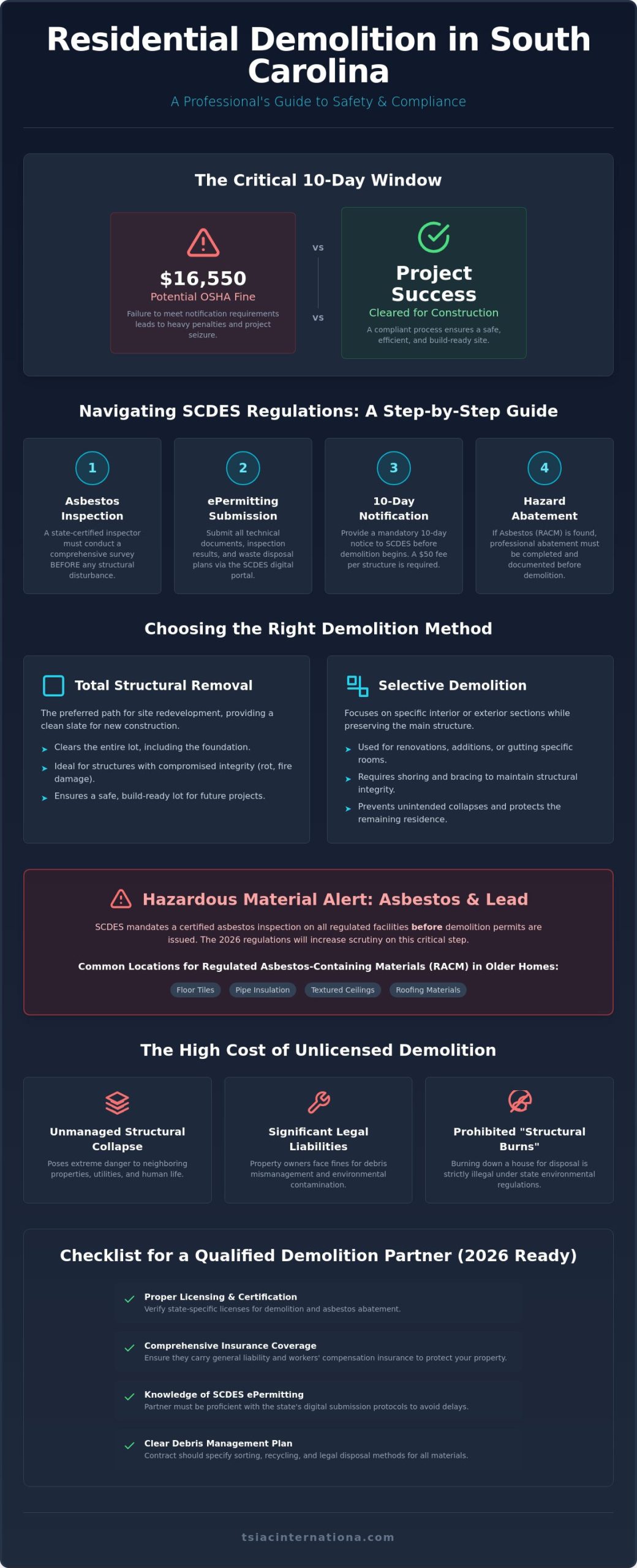
In South Carolina, the difference between a successful property cleared for construction and a $16,550 OSHA fine often comes down to a single 10-day notification window. You likely realize that residential demolition south carolina involves more than just bringing in a bulldozer; it’s a high-stakes technical operation where hidden asbestos or lead can stall your project for months. We understand the pressure of managing these safety risks while trying to maintain a strict development timeline.

This guide provides the expert breakdown you need to handle the complexities of structural removal, asbestos regulations, and site clearing while maintaining full compliance with SCDES standards. We’ll examine the mandatory notification protocols, the 2026 asbestos inspection mandates, and the methodical steps required to transform a hazardous structure into a clean, build-ready lot. By following this professional framework, you can ensure that your site is prepared safely and efficiently, avoiding the common pitfalls of unexpected hazardous material discovery.

Key Takeaways

  • Understand the mandatory 10-day SCDES notification requirement and ePermitting protocols to prevent costly regulatory penalties and project delays.
  • Learn how professional structural integrity assessments dictate the safest and most efficient demolition methods for your specific property.
  • Discover the critical methodology for integrating professional asbestos and lead abatement into your structural removal timeline.
  • Ensure a clean, build-ready lot by following a standardized process for residential demolition south carolina that prioritizes site clearing and material recycling.
  • Identify the specific licensing and insurance benchmarks required to select a qualified demolition partner in the 2026 regulatory environment.

Understanding Residential Demolition Requirements in South Carolina

South Carolina state law defines demolition through a lens of structural mechanics. The South Carolina Department of Environmental Services (SCDES) classifies it as the wrecking or removal of any load-supporting structural member of a facility. This technical definition is vital because it separates minor cosmetic renovations from high-risk structural engineering projects. When planning residential demolition south carolina, property owners must recognize that any project affecting the skeleton of a house triggers specific environmental and safety protocols. In 2026, many homeowners are opting for teardowns due to the rising costs of maintaining aging structures or to leverage the South Carolina Abandoned Buildings Revitalization Act, which recently expanded tax credit eligibility through the signing of S.853.

The choice of method depends entirely on the physical state of the building. Demolition for small residential buildings often involves hydraulic excavators or manual deconstruction, but the strategy is dictated by the structural integrity of the foundation and framing. If the core components are compromised by extensive wood rot, severe mold, or previous fire damage, a surgical approach is usually discarded in favor of a total structural removal to ensure a safe, build-ready lot. We prioritize a methodical assessment of these physical parameters before any equipment arrives on site.

Total Structural Removal vs. Selective Demolition

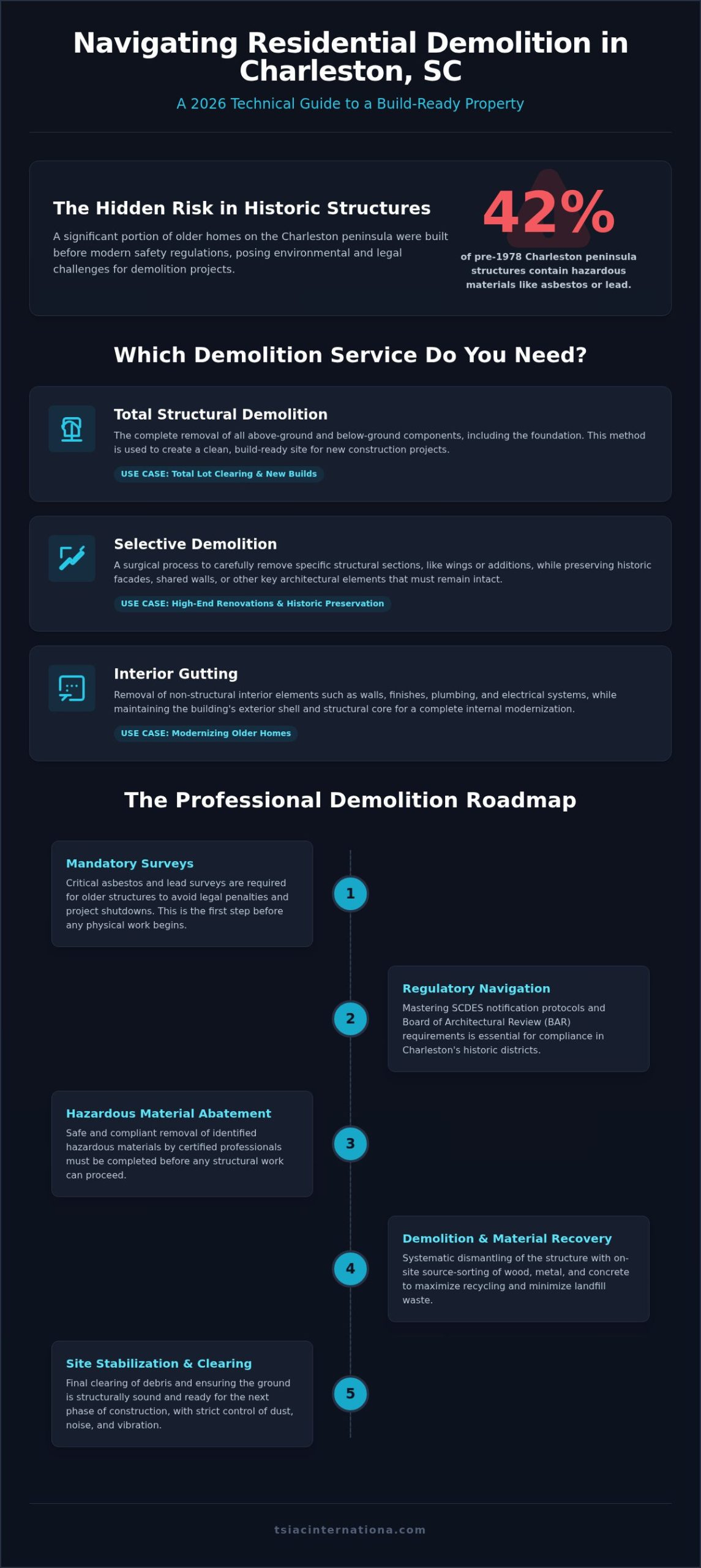
A full teardown is the preferred path for site redevelopment where the existing footprint no longer serves the property’s value. This process clears the entire lot, including the foundation, to provide a blank slate for new construction. Conversely, selective demolition focuses on specific interior or exterior sections, such as gutting a kitchen or removing a load-bearing wall for an addition. During selective projects, we prioritize shoring and bracing to maintain the structural integrity of the remaining sections. This prevents unintended collapses that could endanger the rest of the residence or the safety of the crew.

The Risks of Non-Professional Demolition

Attempting a “DIY” teardown or hiring unlicensed labor introduces severe physical and legal hazards. Unmanaged structural collapse is a primary risk on residential lots where nearby utilities or neighboring homes are at stake. Property owners also face significant legal liabilities for debris mismanagement. SCDES maintains strict oversight on how materials are sorted and transported to prevent environmental contamination. It’s critical to remember that “structural burns”, the practice of burning down a house for disposal, are strictly prohibited by state environmental regulations. Violating these laws leads to substantial fines, making professional oversight a non-negotiable requirement for any residential demolition south carolina project.

Compliance with the South Carolina Department of Environmental Services (SCDES) is the most critical phase of project planning. For residential demolition south carolina, the regulatory framework ensures that hazardous materials don’t enter the municipal waste stream or endanger local air quality. The state utilizes an ePermitting system, a centralized digital portal where property owners or their authorized contractors must submit all technical documentation. This isn’t just a formality; it’s a rigorous auditing process that requires detailed structural data, waste disposal plans, and certified inspection results. Missing a single field in the ePermitting application can reset your project timeline and delay construction for weeks.

The financial aspect of state permitting is straightforward but strictly enforced. As of July 2026, the SCDES requires a $50 fee per structure for the mandatory “Notification of Demolition.” This fee applies to all regulated facilities, even if the initial inspection reveals no hazardous materials. Owners must also account for the additional costs of professional abatement permits if asbestos is identified. Providing accurate information, such as the exact building square footage and the designated landfill for construction and demolition (C&D) debris, is essential for a successful application and avoids the risk of permit revocation.

Mandatory Asbestos Inspections

Before any structural member is disturbed, a state-certified inspector must conduct a comprehensive survey. This mandate applies to almost all regulated facilities to identify Regulated Asbestos-Containing Materials (RACM). In older South Carolina homes, these materials are frequently found in floor tiles, pipe insulation, and textured ceilings. While single-family homes with four or fewer units may have specific exemptions from certain licensing rules, the property owner is still legally responsible for the safe disposal of any toxic materials. A certified inspection provides the technical baseline needed to avoid environmental violations and protect the health of the crew.

The 10-Day Notification Timeline

The SCDES 10-day rule is a non-negotiable waiting period that begins the moment your notification is successfully filed. This window allows the state to perform oversight and verify that all abatement protocols are in place. You can’t bypass this timeline, even for minor structures. Coordinating the abatement of hazardous materials and the subsequent structural removal within this period requires methodological precision. Starting work even one day early can lead to OSHA serious violation penalties, which in 2026 can reach $16,550 per item. Working with a qualified demolition expert ensures that every state filing is handled with the necessary accuracy to keep your project on schedule.

The Residential Demolition Process: A Step-by-Step Guide

Once the mandatory 10-day SCDES notification period expires, the project transitions from administrative planning to physical execution. The success of residential demolition south carolina depends on a methodical sequence that prioritizes site stabilization before a single load-bearing wall is touched. This phase begins with a final site walk-through to verify that all hazardous material abatement, as detailed in previous sections, is complete and that the structure is vacant. We then move into the critical phase of utility management, which is the most significant safety barrier between a controlled removal and a catastrophic site accident.

Managing the logistical transition requires a deep understanding of both state environmental laws and local municipal building codes. Beyond the state-level ePermitting process, most South Carolina counties require specific local demolition permits. These documents ensure that the project adheres to local zoning and noise ordinances. Our team handles this technical paperwork to ensure that every aspect of the takedown is documented, providing property owners with a clear audit trail that is essential for future construction financing and insurance requirements.

Pre-Demolition Logistics and Utility Safety

Utility disconnection is a high-precision task that involves more than just flipping a switch. We coordinate directly with local providers to ensure that electrical services are physically pulled from the transformer. Capping water, sewer, and gas lines at the property line is mandatory to prevent site flooding or gas accumulation during the structural takedown. This step also involves protecting public infrastructure, such as sidewalks and fire hydrants, using specialized barriers. These measures prevent collateral damage to neighboring properties, which is a common source of legal liability in dense residential areas.

Structural Takedown and Debris Management

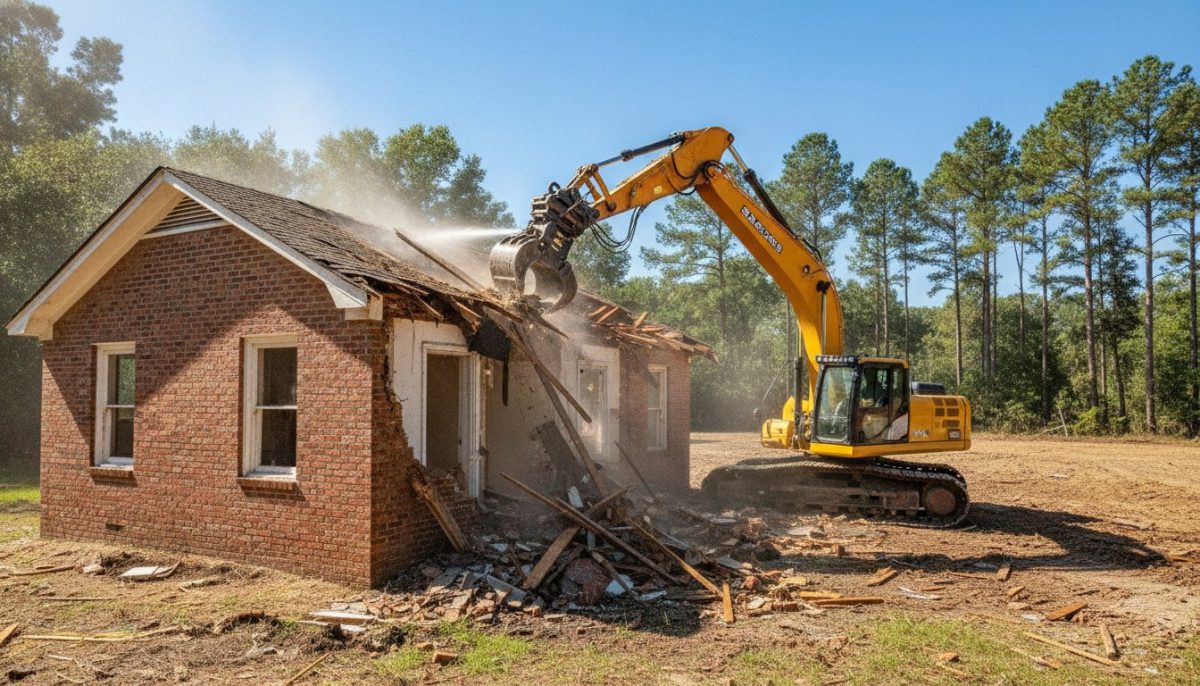
The physical takedown utilizes hydraulic excavators to collapse the structure inward, a technique that minimizes dust and contains debris within the building footprint. This is not a “smash and haul” operation. We implement a rigorous on-site sorting process to maximize material recovery. With landfill tipping fees in counties like York and Horry reaching $46 per ton in 2026, efficient sorting is a financial necessity. We separate wood, metal, and concrete for recycling, directly addressing the fact that 17% of the state’s municipal waste consists of recyclable materials. The final stage involves removing the foundation and grading the soil to create a stable, build-ready lot for your next project.

Residential Demolition in South Carolina: The 2026 Property Owner’s Guide

Hazardous Material Abatement: Asbestos and Lead

Integrating environmental remediation with structural removal is the only way to maintain a predictable project timeline. When managing residential demolition south carolina, the discovery of toxic substances often occurs during the initial site assessment. Rather than treating these as separate events, we embed abatement into the primary demolition schedule. This unified approach prevents the logistical friction that occurs when multiple vendors compete for site access. It also ensures that the demolition crew isn’t exposed to airborne contaminants during the physical takedown phase.

South Carolina regulations require a high degree of technical precision for the transport and disposal of hazardous waste. Every pound of material must be tracked from the point of origin to a licensed landfill capable of accepting toxic debris. By combining these services, we maintain a single chain of custody for all site materials. This documentation is vital for property owners to prove full compliance with state environmental laws and to avoid the severe OSHA penalties mentioned earlier in this guide. Centralizing these responsibilities under one expert partner reduces the administrative burden and provides a more cohesive safety strategy for the entire property.

Professional Asbestos Removal Services

Effective asbestos management requires rigid containment protocols. We utilize heavy-duty poly sheeting and negative air pressure machines equipped with HEPA filtration to prevent fiber migration. This specialized containment is essential during the removal of floor tiles, siding, or insulation. Once the material is safely extracted, we provide the necessary regulatory compliance documentation to verify that the site is clear. For a deeper technical breakdown, you can learn more about asbestos removal in South Carolina to understand the specific safety standards we uphold on every residential lot.

Lead Paint Remediation and Mold Abatement

Older residential structures, particularly those built before 1978, frequently contain lead-based paint. In Charleston alone, approximately 42% of older structures contain hazardous materials like asbestos or lead paint, a trend that requires careful management in the residential sector. During the process of residential demolition south carolina, this paint can become a significant environmental hazard if not handled through specialized containment or wet-scraping methods. Similarly, interior gutting often reveals mold infestations that require immediate remediation to prevent spore dispersal. See our guide on hazardous material abatement in South Carolina for detailed procedures on handling these specific contaminants. To secure your site and ensure a safe, build-ready lot, you should contact our abatement specialists today.

Choosing the Right Demolition Contractor in 2026

Selecting a partner for residential demolition south carolina requires a rigorous evaluation of technical credentials rather than a simple comparison of price points. In a regulatory environment where SCDES oversight is increasing, the contractor’s ability to navigate ePermitting and manage hazardous material abatement is paramount. A professional firm doesn’t just operate machinery; they manage the entire environmental and legal liability of your property. This transition from a standing structure to a build-ready lot must be handled with methodological precision to avoid the $16,550 OSHA penalties and environmental citations that often plague less experienced operators.

Essential Credentials for Demolition Contractors

A reputable contractor must possess specific SCDES-recognized abatement certifications to handle the complexities of older South Carolina homes. You should verify their insurance coverage to ensure it includes specific riders for pollution and hazardous material handling, as standard general liability often excludes these risks. Reviewing a firm’s past project performance and safety metrics provides an objective view of their operational discipline. We recommend asking for a documented history of successful SCDES notifications and completed abatement projects. You can read why we are considered the gold standard in South Carolina demolition by reviewing our technical approach to site safety and regulatory compliance.

TSIAC International’s Commitment to Excellence

TSIAC International brings over 15 years of industry experience to every residential demolition south carolina project. Our expertise extends beyond structural removal to include specialized selective demolition and interior gutting. We recognize the environmental impact of structural waste, which is why we implement industry-leading recycling practices on every site. By separating wood, metal, and plastic, we help property owners reduce landfill tipping fees while addressing the state’s goal of recovering the 17% of municipal waste that currently goes unrecycled. This commitment to sustainability doesn’t compromise our speed or technical accuracy. We provide a disciplined, expert-led process that guarantees your site is cleared safely and in full accordance with all state environmental laws. Contact us today to receive a fixed-price structural demolition contract and ensure your property is prepared by a partner who prioritizes safety and professional integrity.

Securing a Build-Ready Site for Your Next Project

Transforming a residential property begins with a disciplined approach to structural removal. Success in residential demolition south carolina requires more than just heavy machinery; it demands strict adherence to the SCDES 10-day notification window and methodical hazardous material abatement. We’ve detailed how professional oversight prevents the discovery of unexpected asbestos from derailing your timeline or resulting in severe regulatory fines. By prioritizing on-site material recycling and technical precision, you ensure that your lot isn’t just empty; it’s a safe, stable foundation for future investment.

While your current focus is on site preparation in South Carolina, if your project is part of a larger relocation strategy, you can visit Interstate Canberra Removalist to learn more about professional logistics and interstate moving standards.

With 15+ years of industry expertise, TSIAC International provides the specialized containment and regulatory mastery needed for complex teardowns. As an SCDES-compliant abatement specialist, we manage every environmental risk while maintaining a steadfast commitment to on-site recycling of wood, metal, and plastic. Don’t leave your property’s safety to chance or uncertified labor. Request a Professional Demolition Quote from TSIAC International to secure a partner who guarantees technical accuracy and full state compliance. We’re ready to help you clear the path for your new construction project with confidence.

Frequently Asked Questions

Do I need an asbestos inspection for a residential demolition in South Carolina?

Yes, SCDES regulations require a comprehensive asbestos inspection by a state-certified professional for most structures before work begins. This mandatory step identifies Regulated Asbestos-Containing Materials (RACM) that could become airborne during structural removal. Even if your building appears modern, hidden layers in flooring, roofing, or pipe insulation often contain toxic fibers; roofing experts like Thoughtful Roofer Inc. suggest that identifying these hazards early is essential for safety during structural teardowns.

How long does the demolition permit process take with SCDES?

The process requires a minimum of 10 working days following the successful submission of your “Notification of Demolition” through the ePermitting system. This waiting period is a non-negotiable state requirement that allows for regulatory oversight and verification of your waste disposal plan. You should also factor in the time needed to conduct the initial asbestos survey and receive certified lab results before filing your notification.

Can I perform my own residential demolition to save costs?

We strongly advise against DIY structural removal due to the immense physical safety risks and legal liabilities involved. While some exemptions exist for specific owner-occupied single-family homes, you remain legally responsible for hazardous material disposal and utility safety. Improper handling of lead or asbestos can lead to OSHA serious violation penalties of up to $16,550 per item and significant environmental citations.

What is the difference between demolition and renovation according to state law?

State law defines demolition as the wrecking or taking out of any load-supporting structural member of a facility. Renovation involves altering a facility or its components in any other way that doesn’t affect the structural skeleton. Understanding this distinction is vital because a project classified as a residential demolition south carolina triggers stricter SCDES notification requirements and a mandatory $50 fee per structure.

How is hazardous waste like asbestos disposed of after a house teardown?

All asbestos-containing waste must be double-bagged, labeled, and transported to a licensed landfill specifically permitted to accept hazardous materials. It isn’t permitted in standard municipal waste streams or construction and demolition (C&D) landfills. We maintain a rigorous chain of custody and provide all necessary disposal manifests to prove your project complied with South Carolina environmental laws and protected local air quality.

What utilities must be disconnected before demolition begins?

You must ensure the physical disconnection and capping of electricity, natural gas, water, and sewer lines at the property boundary. This process involves direct coordination with local utility providers to pull meters and verify that no live services remain. Proper utility management is the primary defense against site fires, flooding, or gas explosions during the structural takedown phase, protecting both the crew and neighboring properties.

Does a demolition contractor handle the recycling of materials like metal and wood?

Professional contractors manage the on-site sorting of wood, metal, and concrete to maximize material recovery and reduce project costs. A 2025 study found that 17% of South Carolina’s municipal waste is recyclable, representing a significant lost market value. We prioritize recycling to mitigate landfill tipping fees, which have reached $46 per ton in counties like York and Horry as of July 2026.

Are there specific regulations for demolishing historic homes in South Carolina?

Yes, historic structures are often subject to additional local municipal ordinances and Board of Architectural Review approvals. These local requirements exist alongside state SCDES regulations and may require specific deconstruction methods to salvage historic materials. You must always verify local zoning and historic preservation rules in cities like Charleston before initiating the mandatory 10-day state notification process.

Sustainable Demolition Practices in South Carolina: The 2026 Property Developer’s Guide

With landfill tipping fees in York and Horry counties reaching $46 per ton as of July 2026, the traditional “smash and haul” method is no longer a…

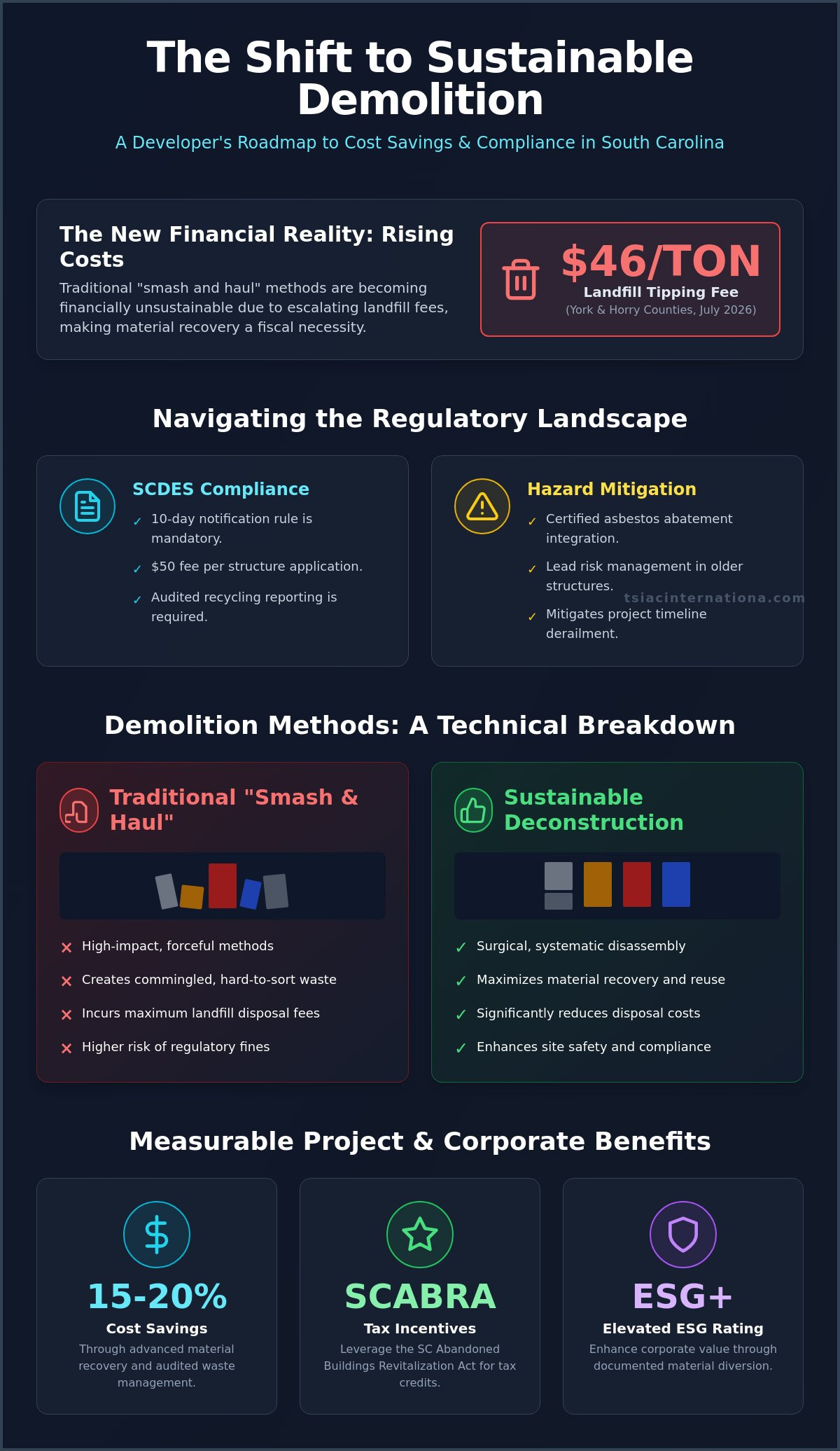
With landfill tipping fees in York and Horry counties reaching $46 per ton as of July 2026, the traditional “smash and haul” method is no longer a viable financial strategy for South Carolina property developers. As regulatory oversight from the South Carolina Department of Environmental Services (SCDES) reaches new levels of technical scrutiny, implementing sustainable demolition practices south carolina has shifted from a corporate social responsibility goal to a core fiscal necessity. You likely understand that managing the 10-day SCDES notification rule while mitigating the risks of asbestos and lead in older structures is an increasingly complex operational burden that can derail project timelines.

This guide provides a technical roadmap to transform these liabilities into measurable assets, showing you how to achieve 15-20% cost savings through advanced material recovery and audited waste management. We’ll explore the integration of hazardous material abatement with selective deconstruction and examine how the 2026 SCABRA tax incentive updates can improve your project’s bottom line. By adopting a methodical approach to deconstruction, you don’t just meet environmental laws; you elevate your corporate ESG ratings through documented, high-precision material diversion and superior site safety protocols.

Key Takeaways

  • Learn how to mitigate rising landfill costs by implementing on-site sorting and high-precision material recovery strategies to achieve significant project savings.
  • Master the complexities of SCDES compliance, including the mandatory 10-day notification rule and the seamless integration of certified asbestos and lead abatement.
  • Understand the technical shift toward sustainable demolition practices south carolina, prioritizing “surgical” selective deconstruction over traditional high-impact methods.
  • Discover how to structure your pre-bid phase to balance labor-intensive deconstruction costs against long-term disposal and material reuse advantages.
  • Improve your corporate ESG ratings and leverage SCABRA tax incentives through documented, audited waste management and material reuse protocols.

The Evolution of Sustainable Demolition Practices in South Carolina

Sustainable demolition isn’t a mere buzzword; it’s a high-precision engineering methodology that prioritizes the systematic dismantling of structures. In South Carolina, the industry has undergone a definitive evolution, moving away from the blunt force of the wrecking ball toward the methodical accuracy of deconstruction. This approach involves the careful separation of building components to ensure maximum material recovery and reuse. For property developers, 2026 marks a definitive shift as the South Carolina Department of Environmental Services (SCDES) implements more stringent oversight on construction and demolition (C&D) waste. Adopting sustainable demolition practices south carolina is now the baseline for any project aiming for both regulatory compliance and long-term fiscal efficiency.

Understanding SCDES 2026 Regulatory Standards

The transition from DHEC to SCDES brought more than just a name change. It introduced a rigorous framework for environmental accountability that developers can’t afford to ignore. Every regulated facility now requires a formal “Notification of Demolition” submitted at least 10 working days before any site activity begins. This application carries a $50 fee per structure and applies even if the structure is confirmed to be free of asbestos. By 2026, the state has prioritized audited recycling reporting, requiring developers to provide granular data on material diversion rates. Failure to document these metrics doesn’t just risk heavy fines; it can stall the entire development pipeline and complicate future property transfers.

The Economic Incentives for Green Demolition

The financial argument for Deconstruction vs. Traditional Demolition is grounded in the reality of rising disposal costs. With tipping fees in counties like York and Horry reaching $46 per ton as of July 2026, the cost of landfilling debris has become a significant project liability. Utilizing sustainable demolition practices south carolina offers a direct countermeasure to these escalating expenses. By diverting non-hazardous wood, metal, and concrete through disciplined on-site sorting, developers can reduce overhead while simultaneously qualifying for state-level tax incentives.

The South Carolina Abandoned Buildings Revitalization Act (SCABRA) remains a cornerstone for developers, providing critical tax credits for rehabilitating qualifying sites. It’s vital to note that amendments to Notices of Intent for these credits were permitted through June 1, 2026, for taxpayers who hadn’t yet placed their sites in service. Beyond immediate savings, these practices enhance corporate ESG ratings and overall property values. Integrating these workflows early in the pre-bid phase positions a project as a premium, LEED-compliant asset that appeals to modern investors and tenants alike. This isn’t just about waste management; it’s about protecting the project’s bottom line through technical precision.

Deconstruction vs. Traditional Demolition: A Technical Breakdown

Traditional demolition relies on high-impact force, often resulting in a commingled waste stream that is difficult and expensive to process. In contrast, deconstruction is a surgical alternative. It prioritizes the systematic disassembly of building components. For developers in South Carolina, choosing between these methods requires a technical evaluation of the building’s age, structural composition, and the potential for asset recovery. While traditional “wrecking ball” methods may appear faster, they often incur higher long-term costs due to the $46 per ton tipping fees for C&D debris. Implementing sustainable demolition practices south carolina involves a strategic balance between mechanical speed and manual precision.

Selective Demolition and Asset Recovery

Selective demolition is the preferred choice for historic preservation and renovation projects in Charleston and Columbia. This process involves the meticulous removal of interior finishes, MEP systems, and non-structural partitions. By utilizing professional commercial interior gutting services, developers can prepare a site for its next lifecycle without compromising the building’s core structural integrity. This phase is critical for asset recovery, where high-value industrial components or architectural elements like heart pine flooring are salvaged for resale or reuse. It’s a disciplined approach that transforms a potential waste stream into a secondary revenue source or a cost-offsetting asset.

Structural Dismantling for Maximum Material Integrity

Once the interior is cleared, structural dismantling begins. This isn’t a random collapse. It’s a calculated sequence of removal. Modern excavators equipped with specialized shears and grapples allow for the controlled take-down of steel beams and concrete walls. This precision prevents material contamination, ensuring that the metals and masonry remain clean enough for recycling. According to the EPA’s guidelines on the Sustainable Management of C&D Materials, the purity of the waste stream is the primary factor in its recyclability. When materials are mixed during a high-impact demolition, their value plummets; when they are dismantled with sustainable demolition practices south carolina in mind, they remain viable for the circular economy.

A sustainable demolition project follows a strict lifecycle: comprehensive site assessment, hazardous material abatement, selective interior gutting, and finally, structural dismantling. This method allows TSIAC International to consistently divert over 85% of non-hazardous project debris from landfills. If you’re planning a complex renovation, reviewing our selective demolition capabilities can help you identify high-value recovery opportunities early in the process. Balancing the speed of traditional methods with the precision of deconstruction ensures your project remains both on schedule and within the 2026 regulatory framework.

Integrating Asbestos and Lead Abatement into Sustainable Workflows

Hazardous material remediation is the indispensable first step in any viable sustainable demolition plan. Without the rigorous removal of legacy contaminants, the potential for material recovery vanishes. When asbestos fibers or lead-based paint dust contaminate a site, otherwise recyclable concrete, wood framing, and masonry are reclassified as hazardous waste. This cross-contamination forces materials into expensive, specialized landfills, instantly negating any planned cost savings from material diversion. For property developers, sustainable demolition practices south carolina begin with a “clean site” philosophy. This ensures that the bulk of the building’s mass remains a non-toxic asset rather than a liability.

Pre-Demolition Hazardous Material Assessments

In South Carolina, the regulatory environment requires a proactive stance on contaminant detection. Statistics indicate that in Charleston, approximately 42% of buildings constructed before 1978 contain hazardous materials like asbestos or lead paint. Before any structural disturbance occurs, a comprehensive survey by a state-certified inspector is mandatory, regardless of the building’s age. These surveys remain valid for three years and are the foundation for a safe project. Developers must prioritize professional asbestos removal in South Carolina to meet SCDES standards. By identifying these risks during the pre-bid phase, you can develop a technical hazardous material abatement strategy that protects both your workers and your project’s recycling goals.

Safe Containment and Disposal in Circular Economy Models

TSIAC International employs specialized containment protocols to isolate toxic elements from the general waste stream. This “surgical” abatement involves negative air pressure systems and HEPA filtration to prevent environmental contamination. While hazardous materials themselves cannot be recycled, their precise removal is what unlocks the potential for 75% or higher site recycling rates. Once the toxic “un-recyclable” portion is safely extracted, the remaining structural elements are cleared for recovery.

Regulatory precision is maintained through strict documentation and chain-of-custody reporting. South Carolina environmental laws require detailed manifests for the transport and disposal of hazardous debris. This audited reporting is essential for maintaining corporate ESG ratings and ensuring full legal compliance. By integrating abatement directly into sustainable demolition practices south carolina, developers avoid the logistical friction of hiring separate contractors. This unified workflow ensures that safety protocols and material recovery goals are perfectly aligned, transforming a complex regulatory requirement into a streamlined phase of the deconstruction process.

Sustainable Demolition Practices in South Carolina: The 2026 Property Developer’s Guide

Material Management: Turning Debris into Project Assets

Effective material management transforms demolition from a heavy cost center into a strategic source of project capital. In South Carolina, the logistical engine of sustainable demolition practices south carolina is built on a disciplined hierarchy: Reuse, Recycle, and Repurpose. To capture the highest value from a structure, establishing on-site sorting stations is a technical necessity. By separating wood, masonry, and metals at the point of origin, we eliminate the cross-contamination that often renders materials worthless at a processing facility. This methodical separation ensures that clean streams of debris can be diverted from landfills, directly lowering the project’s total disposal expenditures.

The role of specialized equipment is central to this process. Mobile crushers, magnetic separators, and high-capacity shears allow for the immediate processing of site-generated waste. This reduces the frequency of hauls, lowering the carbon footprint and transportation costs. When materials are managed with this level of precision, they transition from “debris” to “assets” that can be sold, traded, or reintegrated into the new construction phase.

Concrete Crushing and Aggregate Recycling

Structural concrete and brick masonry represent the largest volume of material on most South Carolina demolition sites. Rather than paying to transport these heavy loads to a landfill, we process them into high-quality fill. Aggregate recycling is the mechanical process of crushing recovered concrete and masonry into graded stone that replaces virgin materials in road bases and structural fill. Using this processed material on-site provides an immediate environmental benefit by preserving natural resources and significantly reducing the project’s procurement costs for new aggregate.

Ferrous and Non-Ferrous Metal Recovery Strategies

Metal recovery offers the most significant immediate financial return in a deconstruction project. Identifying high-value materials like copper piping, aluminum siding, and structural steel beams early in the process allows for clean, “surgical” extraction. Best practices involve sorting and processing scrap to meet specific mill requirements, which ensures the highest possible market value for the recovered goods. The revenue generated from these metals often offsets a substantial portion of the labor costs associated with more intensive deconstruction methods. To maximize the financial return on your next project, you should partner with a firm that prioritizes advanced material recovery and recycling services as a core component of their workflow.

Implementing a Sustainable Demolition Plan for Your Next Project

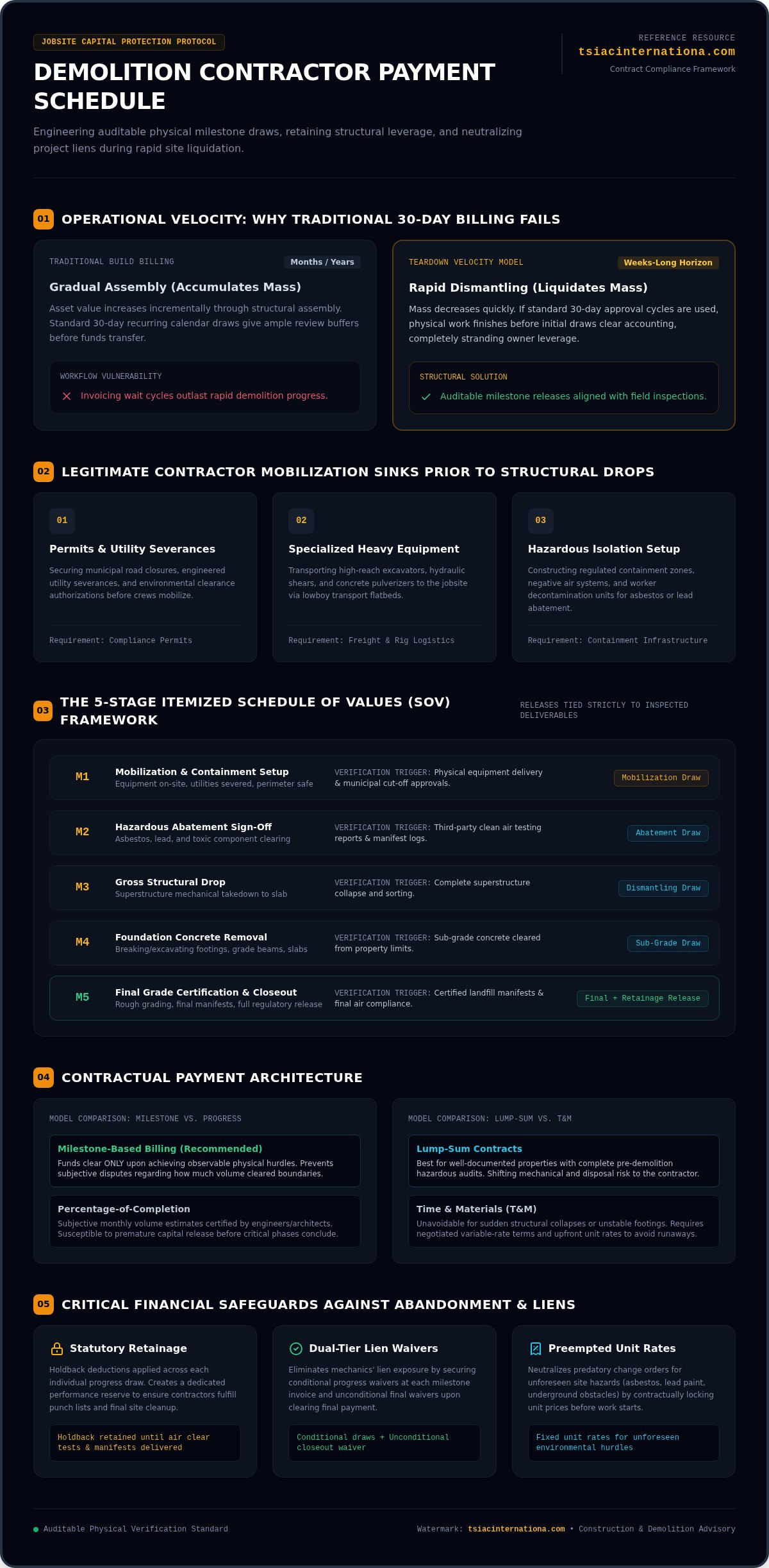
Setting clear sustainability targets during the pre-bid phase is essential for the financial and regulatory success of any modern development. Developers must define specific diversion goals before any heavy machinery arrives on site. By establishing these metrics early, you allow contractors to price their bids based on the technical reality of material recovery rather than just disposal volume. Transitioning to sustainable demolition practices south carolina requires a shift in how we view the project timeline. While deconstruction may require additional days for manual stripping and on-site sorting, the reduction in landfill expenses often compensates for the increased labor requirements.

Budgeting for these projects involves a meticulous cost-benefit analysis. You’re essentially trading higher front-end labor costs for a significant reduction in the $46 per ton tipping fees currently mandated in York and Horry counties. A partner with a 15-year track record in the state understands these local economic variables. They can accurately forecast the salvage value of site assets, from structural steel to reclaimed lumber. Final site clearance then becomes a streamlined, predictable process, leaving the land ready for new construction with a clean environmental record and no hidden liabilities. For developers looking to transition from site clearance to high-performance building, ICF Builders USA provides specialized solutions for custom concrete homes that prioritize efficiency and durability.

Criteria for Selecting a Sustainable Contractor

Selecting a partner requires more than comparing bottom-line numbers. You must evaluate a firm’s safety record and their specific hazardous material certifications, particularly for asbestos and lead abatement. A contractor capable of managing both structural and selective demolition provides a single point of accountability, which is vital for maintaining tight schedules. It’s important to assess the demolition process in South Carolina that the firm employs. Do they offer on-site crushing? Do they have established relationships with local recycling facilities? These technical capabilities distinguish a professional partner from a standard wrecking crew.

Documentation and Auditing for LEED and State Compliance

In 2026, the value of a demolition project is often found in the quality of its paperwork. Tracking every ton of material is no longer optional for developers aiming for LEED certification or improved corporate ESG ratings. Comprehensive documentation for state audits ensures that your material diversion claims are verifiable and legally sound. This data provides the transparency required by modern investors and regulatory bodies like the SCDES. Reliable reporting proves that you’ve successfully implemented sustainable demolition practices south carolina throughout the project lifecycle. Ready to start? Contact TSIAC International for a sustainable project consultation to see how we integrate 15 years of expertise into your next development.

Securing the Future of Your South Carolina Development

The shift toward sustainable demolition practices south carolina is a strategic response to the technical and financial realities of 2026. By prioritizing deconstruction over traditional high-impact methods, developers can effectively mitigate the burden of rising tipping fees while ensuring 100% compliance with SCDES protocols. We’ve analyzed how integrating certified asbestos and lead abatement into the initial workflow is the only way to safeguard the recyclability of structural materials. This methodical approach doesn’t just reduce waste; it transforms site debris into valuable project assets that improve your corporate ESG standing and overall project ROI.

For industry leaders who value environmental stewardship beyond the construction site, Tanzania Wildlife Adventures provides a way to connect with global conservation efforts through their professional safari tours.

Success in this complex environment depends on precision and deep local knowledge. TSIAC International brings over 15 years of South Carolina expertise to every site, providing the audited material recovery reporting and specialized abatement services needed for high-stakes developments. We don’t just clear sites; we prepare them for their next lifecycle with methodological accuracy. Request a Sustainable Demolition Quote from TSIAC International and partner with a team that values your bottom line as much as environmental integrity. Your next successful development starts with a clean, compliant foundation.

Frequently Asked Questions

What are the primary sustainable demolition practices used in South Carolina?

The most effective methods include on-site material sorting, mobile aggregate crushing, and surgical selective dismantling. These sustainable demolition practices south carolina developers utilize focus on isolating high-value assets like structural steel and architectural wood before mass removal begins. By processing masonry and metals at the source, we eliminate the cross-contamination that typically occurs during traditional “smash and haul” operations, ensuring a cleaner waste stream for recovery.

How much does it cost to implement green demolition compared to traditional methods?

While deconstruction often requires more manual labor hours, it reduces the total project overhead by avoiding escalating landfill expenses. In counties like York and Horry, tipping fees have reached $46 per ton for C&D waste as of July 2026. The savings generated from diverting heavy masonry and metal often offset the increased labor investment. This makes green demolition a financially competitive choice for large-scale commercial projects with high material volumes.

Is asbestos removal required before I can recycle other building materials?

Yes, all regulated asbestos-containing materials must be professionally removed before any recycling or structural demolition can occur. If hazardous fibers contaminate the building mass, the entire waste stream is reclassified as toxic and becomes ineligible for standard recycling facilities. Safe abatement is the technical prerequisite for achieving high material recovery rates. It protects the integrity of the recyclable assets and ensures full regulatory compliance.

What percentage of demolition debris can actually be recycled in South Carolina?

Property developers can consistently divert over 85% of all non-hazardous project debris from landfills through disciplined material management. This percentage includes structural steel, copper, aluminum, and clean masonry. Reaching these high rates requires a methodical approach to deconstruction where materials are separated by type at the point of origin. This level of precision is essential for meeting modern sustainability goals and reducing project waste footprints.

How do SCDES regulations impact my demolition project in 2026?

In 2026, SCDES requires a “Notification of Demolition” at least 10 working days before site activity begins for all regulated facilities. This requirement includes a $50 fee per structure and applies even if no asbestos is present. Additionally, a comprehensive asbestos inspection by a state-certified inspector is mandatory for most facilities before any renovation or demolition occurs. Failure to follow these timelines can result in significant project delays and legal penalties.

Can concrete and brick from a demolition site be reused on the same property?

Clean concrete and brick can be crushed on-site and reused as engineered fill, road base, or drainage aggregate for the new construction phase. This practice reduces the need for virgin materials and eliminates the cost of hauling heavy masonry to a disposal site. On-site processing is a core component of sustainable demolition practices south carolina firms use to improve project efficiency and lower procurement costs for new materials.

What is the difference between deconstruction and selective demolition?

Deconstruction is the systematic dismantling of an entire structure to maximize material recovery, whereas selective demolition focuses on removing specific interior or non-structural elements. Selective demolition is typically used during renovations or “surgical” gutting projects where the building’s shell must remain intact. Both methods prioritize asset recovery over simple disposal, but they differ in the scope of structural removal and the final project outcome.

How does sustainable demolition help with LEED certification?

Sustainable demolition provides the audited documentation necessary to earn LEED Materials and Resources (MR) credits. By providing granular data on material diversion and recycling rates, developers can demonstrate a significant reduction in construction waste sent to landfills. This audited reporting is also essential for improving corporate ESG ratings. It meets the transparency requirements often demanded by modern institutional investors and municipal regulatory bodies.

Avoiding Demolition Project Delays: A 2026 Strategic Guide for Property Owners

What if the greatest threat to your 2026 redevelopment isn’t the physical demolition itself, but the invisible regulatory and structural variables…

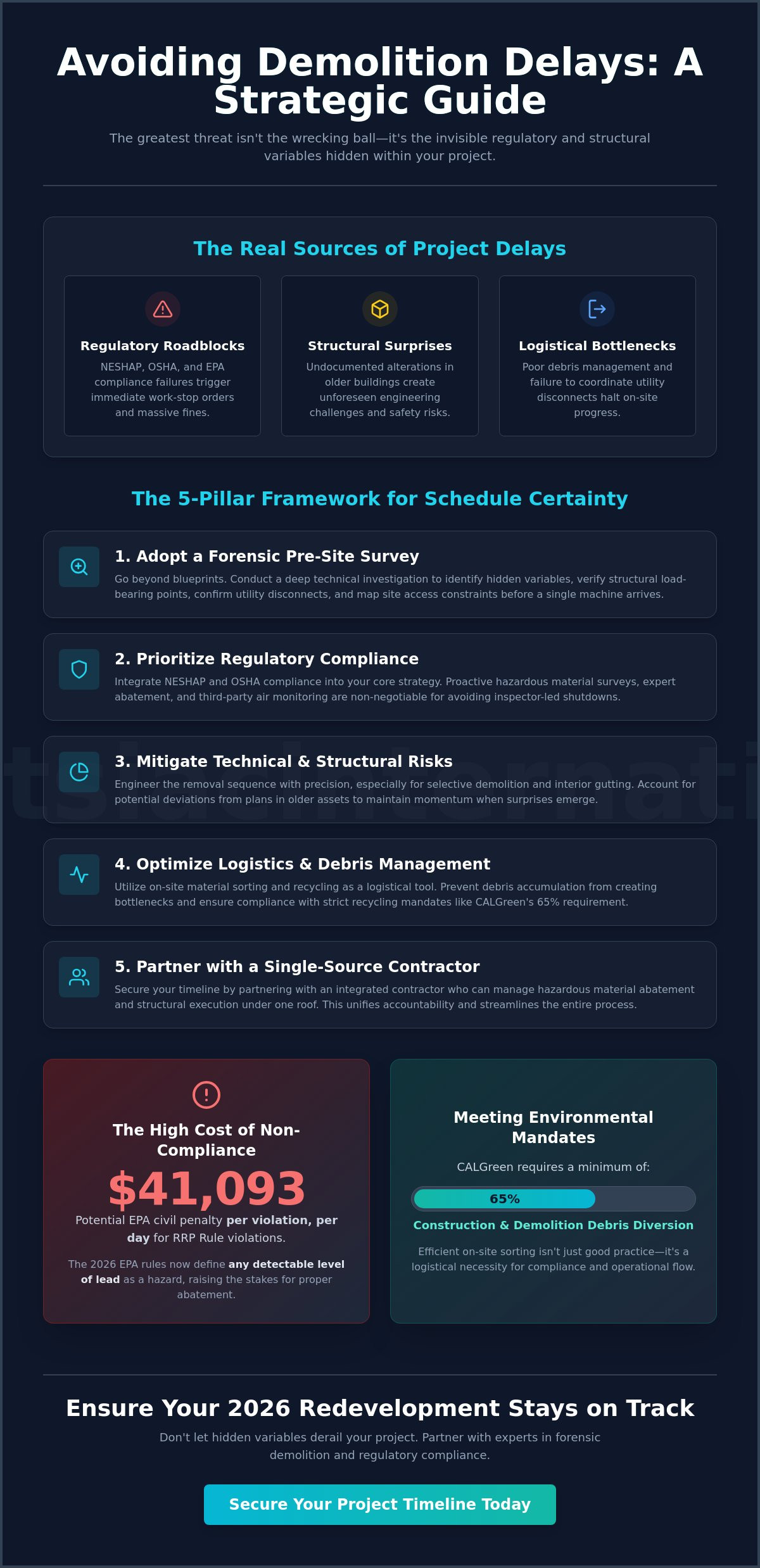
What if the greatest threat to your 2026 redevelopment isn’t the physical demolition itself, but the invisible regulatory and structural variables hidden within the walls? Most property owners assume the wrecking ball dictates the pace, yet the reality is that avoiding demolition project delays depends almost entirely on technical foresight and meticulous pre-site forensics. In an era where the EPA’s 2026 lead-based paint hazard rules now define any detectable level of lead as a hazard, a single overlooked detail can freeze a site for weeks.

We recognize the immense pressure of managing high-stakes projects where unexpected hazardous materials or permit bottlenecks with environmental agencies can derail even the best-laid plans. It’s a complex environment where structural surprises in older buildings often lead to cascading costs and missed deadlines. This guide provides the strategic framework you need to master the current regulatory landscape and maintain a predictable project timeline. You’ll learn how to navigate the 65% CALGreen recycling requirements and manage hazardous material abatement with the precision required to keep your project moving forward without last-minute surprises.

Key Takeaways

  • Adopt a forensic pre-site survey methodology to identify hidden site variables that standard blueprints often fail to document.
  • Navigate the 2026 regulatory landscape by prioritizing NESHAP and OSHA compliance as a core strategy for avoiding demolition project delays.
  • Mitigate the technical and structural risks inherent in selective demolition and interior gutting through precise engineering oversight.
  • Utilize on-site material sorting and recycling as logistical tools to prevent debris accumulation from creating operational bottlenecks.
  • Secure project timelines by partnering with a single-source contractor capable of integrating hazardous material abatement with structural execution.

The Forensic Approach to Preventing Demolition Project Delays

Demolition project delays are rarely the result of mechanical failure. They are the logical conclusion of failed pre-site forensics. When a property owner views a structure only through the lens of basic blueprints, they often overlook the hidden site variables that eventually halt progress. True schedule certainty requires a forensic pre-site survey that treats the building as a complex technical puzzle rather than a simple obstacle. This investigation goes deeper than a visual walk-through; it involves analyzing the structural DNA of the asset to identify risks before they manifest as work stoppages.

This methodical approach differentiates reckless smashing from engineered removal. While a less experienced crew might focus on rapid impact, a professional team with over 15 years of industry experience identifies red flags before the first machine arrives on site. This deep technical vetting is essential for avoiding demolition project delays because it accounts for the structural and environmental realities that blueprints often omit. Understanding a comprehensive demolition process overview reveals that the planning phase is where the most significant time savings are realized. By investing in front-end forensics, you ensure that the physical execution remains a controlled, predictable process.

The Pre-Demolition Site Audit

A successful audit begins with verifying structural load-bearing points. In older assets, previous renovations may have altered the original load paths without updating the documentation. Identifying these anomalies prevents sudden work stoppages during selective removal. We also prioritize the early identification of utility disconnect requirements. Utility companies often present logistical bottlenecks; failing to coordinate these shut-offs weeks in advance is a primary cause of stalled starts. Finally, the audit must document site access constraints. Heavy machinery requires specific clearances and floor loading capacities that must be confirmed to maintain the project’s flow without logistical friction.

Engineering the Removal Sequence

The choice between a top-down approach and a surgical sequence depends on the project’s specific constraints. For high-stakes projects involving commercial interior gutting services, the removal sequence must be engineered to protect the building’s core systems. This requires tight coordination with metal framing and drywall removal schedules to ensure that debris doesn’t accumulate and block progress. We always incorporate a buffer for unforeseen structural conditions in older assets. By anticipating that a building will deviate from its plans, we can maintain the timeline even when surprises emerge. This level of foresight is the only way to ensure that avoiding demolition project delays remains a reality rather than a hope.

Regulators are the ultimate gatekeepers of your development timeline. In the demolition sector, asbestos and lead abatement represent the primary cause of unplanned project shutdowns. Failure to secure proper clearances isn’t just a safety risk; it’s a legal liability that triggers immediate work-stop orders. Adhering to OSHA asbestos regulations and NESHAP standards is non-negotiable for avoiding demolition project delays. These frameworks dictate how materials are handled, from initial identification to final disposal.

By utilizing specialized asbestos removal services, property owners shift the burden of compliance to experts who understand the nuances of 2026 enforcement. For instance, as of June 2026, EPA civil penalties for violations of the Renovation, Repair and Painting (RRP) Rule can reach up to $41,093 per violation per day. This makes third-party air monitoring essential. It provides the objective data needed for final project sign-off, ensuring the site is safe for subsequent trades and preventing the inspector-led halts that plague less prepared sites.

The Abatement Critical Path

Timing is everything. Hazardous material surveys must be completed at least 3-4 weeks before mobilization. This window allows for lab analysis and the design of containment zones that won’t disrupt adjacent operations. Effective project management ensures that hazardous material abatement is fully executed before structural teams arrive. If these phases overlap without strict separation, the risk of cross-contamination increases. This leads to massive delays and costly remediation efforts that could’ve been avoided with a sequenced approach.

Documentation as a Speed Tool

Paperwork is a logistical engine. Maintaining a digital trail of disposal manifests for toxic waste isn’t just about compliance; it’s about speed. When local authorities conduct audits, having organized regulatory filings prevents administrative holds. Clear documentation proves that all materials were handled according to the latest 2026 standards, such as the EPA’s redefined lead-based paint hazard rules. Fixed-price abatement contracts also offer a strategic advantage, providing budget stability while ensuring the contractor assumes the risk of regulatory precision. Partnering with a team that prioritizes transparency in their hazardous material abatement processes is the most reliable way to maintain your schedule.

Managing Structural Surprises in Selective Demolition

Selective demolition represents a significantly higher risk profile than total teardowns because it requires the surgical removal of specific components while maintaining the structural integrity of the remaining asset. In a total demolition, the sequence ends in a clear site. In contrast, avoiding demolition project delays during selective work depends on your contractor’s ability to navigate “ghost” utilities and undocumented structural modifications. These are the pipes, conduits, or structural supports added during previous renovations that never made it onto the official blueprints. Hitting an active, undocumented line doesn’t just stop work; it triggers emergency repairs and safety audits that can freeze a schedule for days.

Precision is paramount when executing commercial interior gutting services. Tasks like acoustic ceiling and interior partition removal might seem straightforward, but they often conceal the building’s vital MEP (Mechanical, Electrical, Plumbing) systems. A methodical approach to C&D materials management ensures that as these components are stripped away, the debris is handled without damaging the core infrastructure. This level of care is what keeps high-stakes projects on schedule, as it prevents the accidental damage that leads to costly reconstruction.

The Selective Demolition Protocol

  • Step 1: Map all active MEP systems. Before the first wall comes down, we use advanced detection tools to verify the location of all live utilities, ensuring that shut-offs are confirmed and bypasses are in place.
  • Step 2: Install temporary shoring. When load-bearing elements are near the work zone, temporary structural support systems are installed to prevent any unintended shifting or settling of the building.
  • Step 3: Implement vibration monitoring. For projects in occupied buildings or sensitive urban environments, real-time sensors track vibrations to protect adjacent structures and ensure compliance with local noise and safety ordinances.

Interior Gutting Efficiency

Stripping a space to the studs is the foundation of successful tenant improvements. This methodical process requires coordinating concrete removal without compromising the integrity of the slab. We prioritize managing dust and noise, especially in occupied commercial environments where business continuity is a priority. By isolating the work zone with high-grade containment and using specialized equipment for interior partition removal, we maintain a clean, professional site. This disciplined execution is the most effective strategy for avoiding demolition project delays, ensuring that the next phase of metal framing and drywall installation can begin exactly when planned.

Avoiding Demolition Project Delays: A 2026 Strategic Guide for Property Owners

Logistics and Debris Management: Recycling as an Efficiency Tool

Debris accumulation is a physical bottleneck that directly threatens project timelines. When a site becomes congested with mixed waste, the movement of heavy machinery is restricted, and safety hazards multiply. In the 2026 regulatory environment, where mandates like the 2025 CALGreen Code require a minimum of 65% of nonhazardous debris to be recycled, managing waste isn’t just a compliance task. It’s a logistical strategy. By implementing a rigorous on-site material sorting protocol for wood, metal, and plastic, we ensure that the work zone remains clear and operational. This disciplined approach is fundamental to avoiding demolition project delays, as it prevents the “clutter-stalls” that often occur when debris management is treated as an afterthought.

Environmental responsibility has evolved into a significant logistical advantage. With national average landfill tipping fees for construction material reaching $65.84 per ton, and even higher rates in strictly regulated zones, diverting waste through recycling is a cost-control measure. The demolition process relies heavily on a synchronized hauling cycle. If the outbound flow of materials isn’t matched to the speed of the wrecking ball or the interior gutting crew, the site reaches a standstill. We treat every ton of recovered material as a logistical unit that must be moved with precision to maintain the project’s momentum.

The Value of Material Recovery

On-site sorting allows for the rapid recovery of high-value materials like metal framing. By separating these components at the point of removal, we create secondary value streams that can offset overall disposal costs. Managing heavy debris, such as concrete and brick, requires a different tactical approach. We often utilize on-site crushing to transform these materials into reusable fill, which eliminates the need for hundreds of hauling trips. This reduction in landfill impact doesn’t just lower fees; it keeps the site perimeter clear for incoming trades, ensuring that avoiding demolition project delays remains the operational standard.

Fleet and Machinery Logistics

Efficiency depends on matching the right machinery to the specific scale of the site. Using oversized equipment in a tight interior gutting project leads to maneuverability issues, while undersized machinery extends the timeline unnecessarily. We maintain continuous hauling cycles by coordinating with a dedicated fleet of roll-off containers and transport vehicles. This ensures that as concrete removal or selective demolition progresses, the waste is immediately staged and removed. This logistical synchronization is what allows us to guarantee schedule certainty even in complex, high-density urban environments.

To ensure your next project benefits from this level of logistical precision, explore our integrated recycling and demolition services to keep your site clear and on schedule.

Partnering with a Methodical Contractor for Schedule Certainty

The final and most critical component in avoiding demolition project delays is the selection of a contractor whose operational philosophy mirrors the technical complexity of the asset. Many property owners are drawn to “fixed-price” contracts, yet without deep technical vetting, these agreements often mask a lack of foresight. A low-bidder who fails to account for the forensic variables discussed in previous sections will inevitably issue change orders or halt work when reality deviates from the blueprints. Schedule certainty is built on a foundation of methodical precision, not just a contractual figure. It requires a partner who treats the demolition as an engineering challenge rather than a simple labor task.

As you prepare your operations for the 2026 regulatory environment, you may also want to visit Business With AI Strategist to ensure your internal business strategy is equally forward-thinking and efficient.

Choosing a single-source partner for both structural demolition and hazardous material abatement is a strategic move that eliminates the friction between separate trades. When one entity manages the entire scope, the finger-pointing that typically occurs during discovery phases is removed. TSIAC International leverages over 15 years of industry experience to provide this level of project predictability. By integrating the removal of acoustic ceilings and interior partitions with the abatement of regulated materials, we ensure a seamless transition to the next phase of construction. This continuity is what allows general contractors and property owners to meet their 2026 development milestones without the standard setbacks associated with fragmented project management.

The TSIAC Difference

  • Deep Professionalism: We maintain a fegyelmezett approach to hazardous material containment and removal, ensuring that every site meets the most stringent 2026 safety standards.
  • Regulatory Command: Our commitment to compliance means we don’t just follow the rules; we document every step to provide property owners with a bulletproof digital trail.
  • Proven Reliability: With a track record spanning residential homeowners, commercial GCs, and government agencies, we understand the unique pressures of various project scales.

Next Steps for Your Project

Moving from a state of uncertainty to a controlled timeline starts with a comprehensive site assessment. This investigation evaluates the specific scope of work, determining where structural removal ends and selective demolition begins. By identifying potential bottlenecks in utility disconnects or hazardous material staging early, we can build a schedule that accounts for the unexpected. Evaluating your asset’s structural DNA before mobilization is the only way to guarantee that your redevelopment stays on track.

Don’t leave your timeline to chance. Secure your project schedule and ensure full regulatory compliance by partnering with the experts at TSIAC International for your next high-stakes demolition or abatement project.

Securing Your 2026 Project Timeline

Successful site clearance in 2026 is a matter of engineering and regulatory mastery rather than raw force. We’ve explored how forensic pre-site surveys and integrated hazardous material abatement are the only reliable methods for avoiding demolition project delays. By prioritizing on-site material recovery and anticipating structural anomalies during selective demolition, you transform a high-risk phase into a predictable milestone. The complexity of modern environmental mandates requires a partner who views every challenge through a lens of technical precision and safety.

TSIAC International brings over 15 years of industry experience to every project, specializing in the complex technical requirements of asbestos and lead abatement. Our commitment to comprehensive recycling practices ensures your site remains clear and compliant with the latest environmental mandates. We manage the technical friction so you can focus on the next phase of development. Your project’s success is built on the precision of its first phase. Contact TSIAC International for a Methodical Demolition Strategy and ensure your redevelopment stays on schedule.

Frequently Asked Questions

What is the most common cause of demolition project delays?

The most common cause of demolition project delays is the discovery of undocumented hazardous materials or structural discrepancies that weren’t identified during the planning phase. When asbestos, lead, or “ghost” utilities are found after work has begun, the site must be shut down for immediate remediation. Conducting a forensic pre-site survey is the most effective way to identify these variables and account for them in the initial schedule.

How long does the asbestos abatement process typically take?

The asbestos abatement process typically requires three to four weeks for the initial survey, laboratory analysis, and regulatory notification period. The actual removal phase depends on the volume of regulated material and the complexity of the containment zones required. Coordinating this process well in advance of structural mobilization is essential for maintaining a predictable project timeline and avoiding administrative bottlenecks.

Can I start demolition before the hazardous material survey is complete?

No, you cannot legally begin any demolition or interior gutting activities until a comprehensive hazardous material survey is finalized and all identified risks are remediated. Federal NESHAP regulations and OSHA standards require these inspections to protect workers and the public from toxic exposure. Attempting to bypass this step triggers immediate work-stop orders and can lead to civil penalties exceeding $40,000 per violation.

How do selective demolition risks differ from total structural removal?

Selective demolition risks are significantly higher because they require surgical precision to remove specific components while preserving the building’s core structural integrity and active MEP systems. Total structural removal allows for a clean slate, whereas selective work involves navigating undocumented modifications and hidden utilities. This complexity necessitates higher engineering oversight and vibration monitoring to protect the remaining asset and adjacent operations.

What permits are required for a large-scale commercial demolition project?

Large-scale commercial projects require a primary demolition permit from the local building department, alongside environmental notifications for asbestos and lead. You must also secure utility abandonment permits for gas, water, and electricity disconnects. Depending on the location, additional permits for site access, dust control plans, and sidewalk closures may be mandatory to ensure full regulatory compliance during the execution phase.

Is on-site recycling of demolition debris more expensive than landfilling?

On-site recycling is often more cost-effective than landfilling when you factor in the reduction of tipping fees and potential offsets from high-value material recovery. With national average landfill fees for construction debris reaching $65.84 per ton, diverting concrete, metal, and wood through on-site sorting significantly lowers hauling costs. It also ensures compliance with 2026 mandates that require high debris diversion rates for commercial projects.

How does weather impact the demolition schedule?

Weather impacts the demolition schedule primarily through high winds and heavy precipitation, which can compromise dust control and machinery stability. High winds often halt high-reach operations to prevent the spread of debris, while heavy rain creates mud that complicates site logistics. Professional contractors build weather buffers into their planning and use specialized equipment to maintain the schedule during all but the most extreme conditions.

What should I look for when vetting a demolition contractor?

When vetting a contractor, prioritize those with at least 15 years of industry experience and a clean safety record in hazardous material abatement. It’s vital to choose a single-source partner who can manage both the environmental remediation and the physical demolition. This integration is the most reliable strategy for avoiding demolition project delays, as it ensures a seamless transition between project phases and centralizes accountability.