Avoiding Demolition Project Delays: A 2026 Strategic Guide for Property Owners

What if the greatest threat to your 2026 redevelopment isn’t the physical demolition itself, but the invisible regulatory and structural variables…

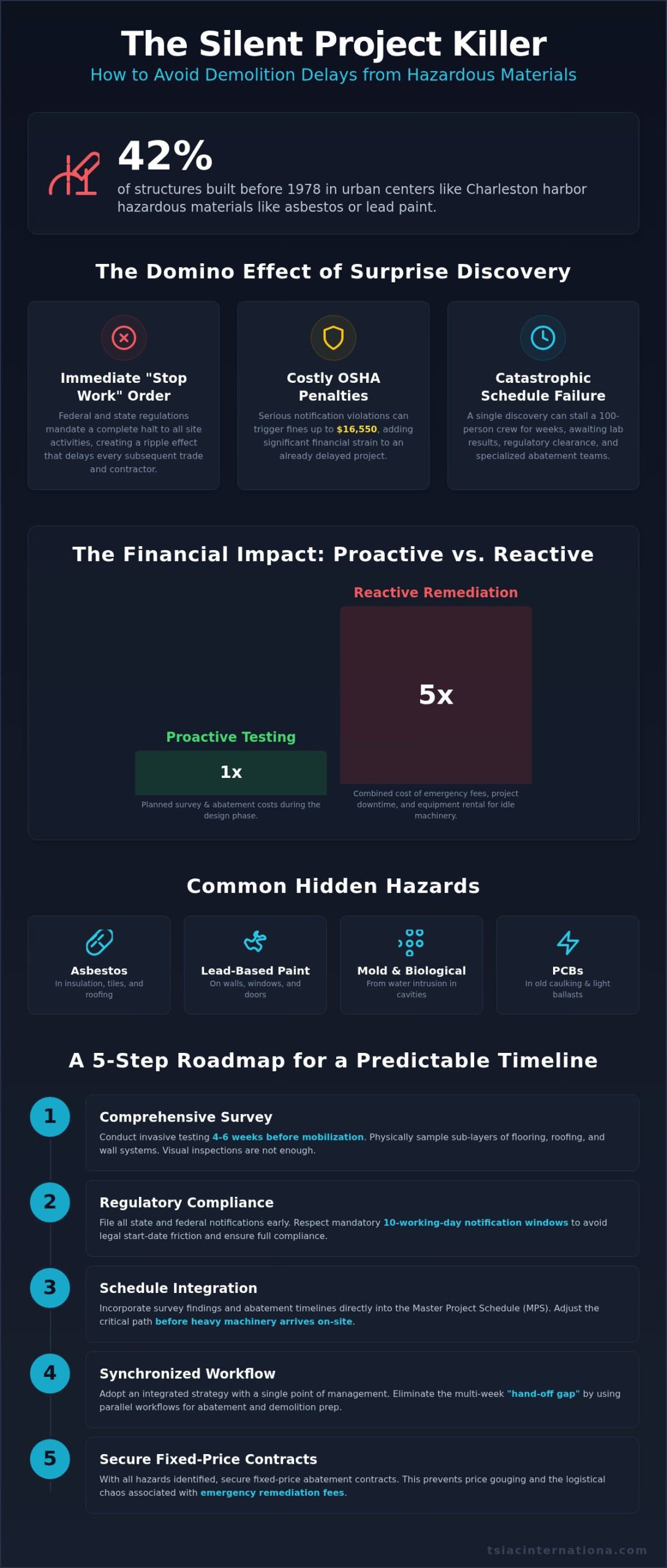
What if the greatest threat to your 2026 redevelopment isn’t the physical demolition itself, but the invisible regulatory and structural variables hidden within the walls? Most property owners assume the wrecking ball dictates the pace, yet the reality is that avoiding demolition project delays depends almost entirely on technical foresight and meticulous pre-site forensics. In an era where the EPA’s 2026 lead-based paint hazard rules now define any detectable level of lead as a hazard, a single overlooked detail can freeze a site for weeks.

We recognize the immense pressure of managing high-stakes projects where unexpected hazardous materials or permit bottlenecks with environmental agencies can derail even the best-laid plans. It’s a complex environment where structural surprises in older buildings often lead to cascading costs and missed deadlines. This guide provides the strategic framework you need to master the current regulatory landscape and maintain a predictable project timeline. You’ll learn how to navigate the 65% CALGreen recycling requirements and manage hazardous material abatement with the precision required to keep your project moving forward without last-minute surprises.

Key Takeaways

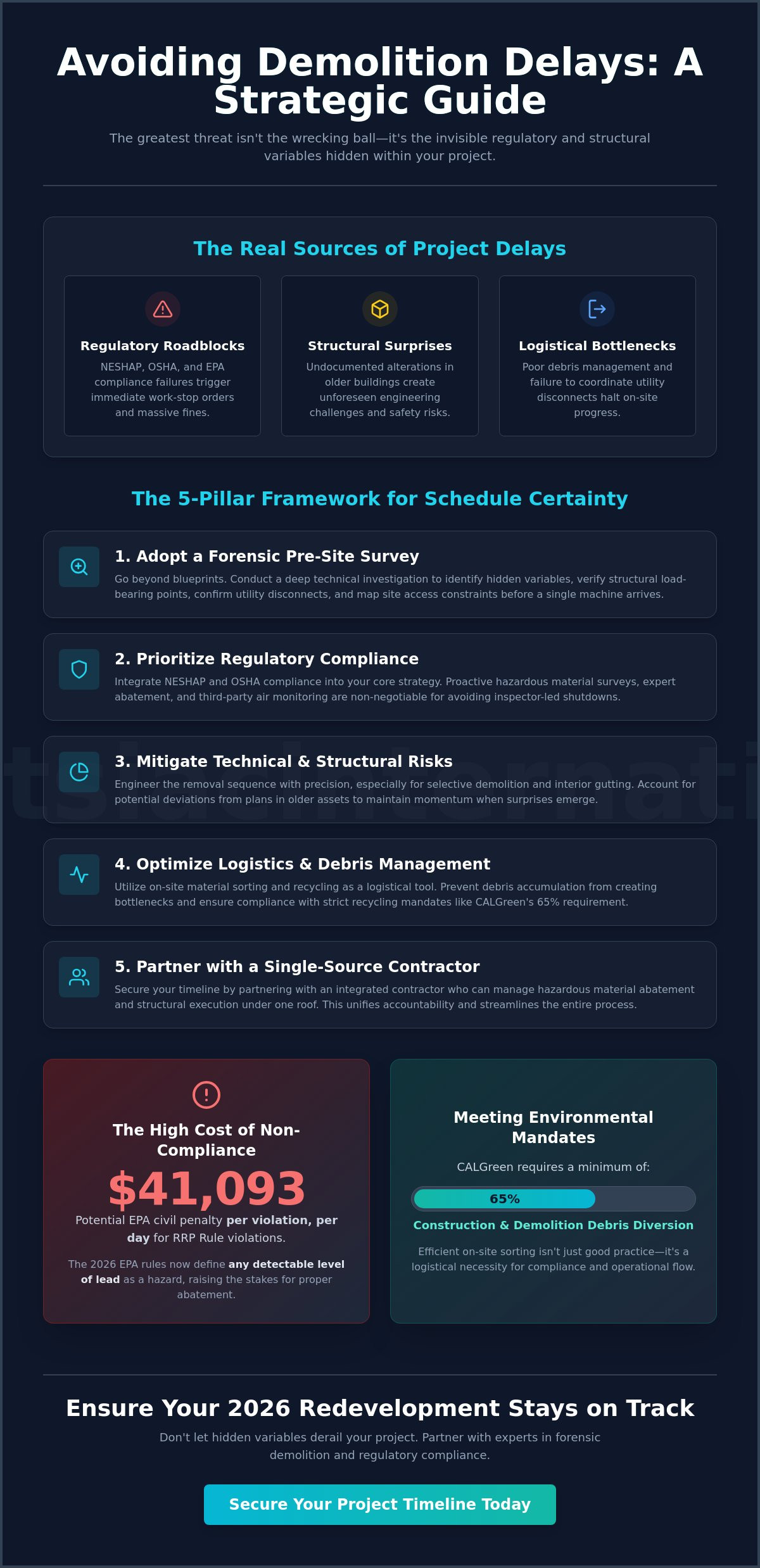
  • Adopt a forensic pre-site survey methodology to identify hidden site variables that standard blueprints often fail to document.
  • Navigate the 2026 regulatory landscape by prioritizing NESHAP and OSHA compliance as a core strategy for avoiding demolition project delays.
  • Mitigate the technical and structural risks inherent in selective demolition and interior gutting through precise engineering oversight.
  • Utilize on-site material sorting and recycling as logistical tools to prevent debris accumulation from creating operational bottlenecks.
  • Secure project timelines by partnering with a single-source contractor capable of integrating hazardous material abatement with structural execution.

The Forensic Approach to Preventing Demolition Project Delays

Demolition project delays are rarely the result of mechanical failure. They are the logical conclusion of failed pre-site forensics. When a property owner views a structure only through the lens of basic blueprints, they often overlook the hidden site variables that eventually halt progress. True schedule certainty requires a forensic pre-site survey that treats the building as a complex technical puzzle rather than a simple obstacle. This investigation goes deeper than a visual walk-through; it involves analyzing the structural DNA of the asset to identify risks before they manifest as work stoppages.

This methodical approach differentiates reckless smashing from engineered removal. While a less experienced crew might focus on rapid impact, a professional team with over 15 years of industry experience identifies red flags before the first machine arrives on site. This deep technical vetting is essential for avoiding demolition project delays because it accounts for the structural and environmental realities that blueprints often omit. Understanding a comprehensive demolition process overview reveals that the planning phase is where the most significant time savings are realized. By investing in front-end forensics, you ensure that the physical execution remains a controlled, predictable process.

The Pre-Demolition Site Audit

A successful audit begins with verifying structural load-bearing points. In older assets, previous renovations may have altered the original load paths without updating the documentation. Identifying these anomalies prevents sudden work stoppages during selective removal. We also prioritize the early identification of utility disconnect requirements. Utility companies often present logistical bottlenecks; failing to coordinate these shut-offs weeks in advance is a primary cause of stalled starts. Finally, the audit must document site access constraints. Heavy machinery requires specific clearances and floor loading capacities that must be confirmed to maintain the project’s flow without logistical friction.

Engineering the Removal Sequence

The choice between a top-down approach and a surgical sequence depends on the project’s specific constraints. For high-stakes projects involving commercial interior gutting services, the removal sequence must be engineered to protect the building’s core systems. This requires tight coordination with metal framing and drywall removal schedules to ensure that debris doesn’t accumulate and block progress. We always incorporate a buffer for unforeseen structural conditions in older assets. By anticipating that a building will deviate from its plans, we can maintain the timeline even when surprises emerge. This level of foresight is the only way to ensure that avoiding demolition project delays remains a reality rather than a hope.

Regulators are the ultimate gatekeepers of your development timeline. In the demolition sector, asbestos and lead abatement represent the primary cause of unplanned project shutdowns. Failure to secure proper clearances isn’t just a safety risk; it’s a legal liability that triggers immediate work-stop orders. Adhering to OSHA asbestos regulations and NESHAP standards is non-negotiable for avoiding demolition project delays. These frameworks dictate how materials are handled, from initial identification to final disposal.

By utilizing specialized asbestos removal services, property owners shift the burden of compliance to experts who understand the nuances of 2026 enforcement. For instance, as of June 2026, EPA civil penalties for violations of the Renovation, Repair and Painting (RRP) Rule can reach up to $41,093 per violation per day. This makes third-party air monitoring essential. It provides the objective data needed for final project sign-off, ensuring the site is safe for subsequent trades and preventing the inspector-led halts that plague less prepared sites.

The Abatement Critical Path

Timing is everything. Hazardous material surveys must be completed at least 3-4 weeks before mobilization. This window allows for lab analysis and the design of containment zones that won’t disrupt adjacent operations. Effective project management ensures that hazardous material abatement is fully executed before structural teams arrive. If these phases overlap without strict separation, the risk of cross-contamination increases. This leads to massive delays and costly remediation efforts that could’ve been avoided with a sequenced approach.

Documentation as a Speed Tool

Paperwork is a logistical engine. Maintaining a digital trail of disposal manifests for toxic waste isn’t just about compliance; it’s about speed. When local authorities conduct audits, having organized regulatory filings prevents administrative holds. Clear documentation proves that all materials were handled according to the latest 2026 standards, such as the EPA’s redefined lead-based paint hazard rules. Fixed-price abatement contracts also offer a strategic advantage, providing budget stability while ensuring the contractor assumes the risk of regulatory precision. Partnering with a team that prioritizes transparency in their hazardous material abatement processes is the most reliable way to maintain your schedule.

Managing Structural Surprises in Selective Demolition

Selective demolition represents a significantly higher risk profile than total teardowns because it requires the surgical removal of specific components while maintaining the structural integrity of the remaining asset. In a total demolition, the sequence ends in a clear site. In contrast, avoiding demolition project delays during selective work depends on your contractor’s ability to navigate “ghost” utilities and undocumented structural modifications. These are the pipes, conduits, or structural supports added during previous renovations that never made it onto the official blueprints. Hitting an active, undocumented line doesn’t just stop work; it triggers emergency repairs and safety audits that can freeze a schedule for days.

Precision is paramount when executing commercial interior gutting services. Tasks like acoustic ceiling and interior partition removal might seem straightforward, but they often conceal the building’s vital MEP (Mechanical, Electrical, Plumbing) systems. A methodical approach to C&D materials management ensures that as these components are stripped away, the debris is handled without damaging the core infrastructure. This level of care is what keeps high-stakes projects on schedule, as it prevents the accidental damage that leads to costly reconstruction.

The Selective Demolition Protocol

  • Step 1: Map all active MEP systems. Before the first wall comes down, we use advanced detection tools to verify the location of all live utilities, ensuring that shut-offs are confirmed and bypasses are in place.
  • Step 2: Install temporary shoring. When load-bearing elements are near the work zone, temporary structural support systems are installed to prevent any unintended shifting or settling of the building.
  • Step 3: Implement vibration monitoring. For projects in occupied buildings or sensitive urban environments, real-time sensors track vibrations to protect adjacent structures and ensure compliance with local noise and safety ordinances.

Interior Gutting Efficiency

Stripping a space to the studs is the foundation of successful tenant improvements. This methodical process requires coordinating concrete removal without compromising the integrity of the slab. We prioritize managing dust and noise, especially in occupied commercial environments where business continuity is a priority. By isolating the work zone with high-grade containment and using specialized equipment for interior partition removal, we maintain a clean, professional site. This disciplined execution is the most effective strategy for avoiding demolition project delays, ensuring that the next phase of metal framing and drywall installation can begin exactly when planned.

Avoiding Demolition Project Delays: A 2026 Strategic Guide for Property Owners

Logistics and Debris Management: Recycling as an Efficiency Tool

Debris accumulation is a physical bottleneck that directly threatens project timelines. When a site becomes congested with mixed waste, the movement of heavy machinery is restricted, and safety hazards multiply. In the 2026 regulatory environment, where mandates like the 2025 CALGreen Code require a minimum of 65% of nonhazardous debris to be recycled, managing waste isn’t just a compliance task. It’s a logistical strategy. By implementing a rigorous on-site material sorting protocol for wood, metal, and plastic, we ensure that the work zone remains clear and operational. This disciplined approach is fundamental to avoiding demolition project delays, as it prevents the “clutter-stalls” that often occur when debris management is treated as an afterthought.

Environmental responsibility has evolved into a significant logistical advantage. With national average landfill tipping fees for construction material reaching $65.84 per ton, and even higher rates in strictly regulated zones, diverting waste through recycling is a cost-control measure. The demolition process relies heavily on a synchronized hauling cycle. If the outbound flow of materials isn’t matched to the speed of the wrecking ball or the interior gutting crew, the site reaches a standstill. We treat every ton of recovered material as a logistical unit that must be moved with precision to maintain the project’s momentum.

The Value of Material Recovery

On-site sorting allows for the rapid recovery of high-value materials like metal framing. By separating these components at the point of removal, we create secondary value streams that can offset overall disposal costs. Managing heavy debris, such as concrete and brick, requires a different tactical approach. We often utilize on-site crushing to transform these materials into reusable fill, which eliminates the need for hundreds of hauling trips. This reduction in landfill impact doesn’t just lower fees; it keeps the site perimeter clear for incoming trades, ensuring that avoiding demolition project delays remains the operational standard.

Fleet and Machinery Logistics

Efficiency depends on matching the right machinery to the specific scale of the site. Using oversized equipment in a tight interior gutting project leads to maneuverability issues, while undersized machinery extends the timeline unnecessarily. We maintain continuous hauling cycles by coordinating with a dedicated fleet of roll-off containers and transport vehicles. This ensures that as concrete removal or selective demolition progresses, the waste is immediately staged and removed. This logistical synchronization is what allows us to guarantee schedule certainty even in complex, high-density urban environments.

To ensure your next project benefits from this level of logistical precision, explore our integrated recycling and demolition services to keep your site clear and on schedule.

Partnering with a Methodical Contractor for Schedule Certainty

The final and most critical component in avoiding demolition project delays is the selection of a contractor whose operational philosophy mirrors the technical complexity of the asset. Many property owners are drawn to “fixed-price” contracts, yet without deep technical vetting, these agreements often mask a lack of foresight. A low-bidder who fails to account for the forensic variables discussed in previous sections will inevitably issue change orders or halt work when reality deviates from the blueprints. Schedule certainty is built on a foundation of methodical precision, not just a contractual figure. It requires a partner who treats the demolition as an engineering challenge rather than a simple labor task.

As you prepare your operations for the 2026 regulatory environment, you may also want to visit Business With AI Strategist to ensure your internal business strategy is equally forward-thinking and efficient.

Choosing a single-source partner for both structural demolition and hazardous material abatement is a strategic move that eliminates the friction between separate trades. When one entity manages the entire scope, the finger-pointing that typically occurs during discovery phases is removed. TSIAC International leverages over 15 years of industry experience to provide this level of project predictability. By integrating the removal of acoustic ceilings and interior partitions with the abatement of regulated materials, we ensure a seamless transition to the next phase of construction. This continuity is what allows general contractors and property owners to meet their 2026 development milestones without the standard setbacks associated with fragmented project management.

The TSIAC Difference

  • Deep Professionalism: We maintain a fegyelmezett approach to hazardous material containment and removal, ensuring that every site meets the most stringent 2026 safety standards.
  • Regulatory Command: Our commitment to compliance means we don’t just follow the rules; we document every step to provide property owners with a bulletproof digital trail.
  • Proven Reliability: With a track record spanning residential homeowners, commercial GCs, and government agencies, we understand the unique pressures of various project scales.

Next Steps for Your Project

Moving from a state of uncertainty to a controlled timeline starts with a comprehensive site assessment. This investigation evaluates the specific scope of work, determining where structural removal ends and selective demolition begins. By identifying potential bottlenecks in utility disconnects or hazardous material staging early, we can build a schedule that accounts for the unexpected. Evaluating your asset’s structural DNA before mobilization is the only way to guarantee that your redevelopment stays on track.

Don’t leave your timeline to chance. Secure your project schedule and ensure full regulatory compliance by partnering with the experts at TSIAC International for your next high-stakes demolition or abatement project.

Securing Your 2026 Project Timeline

Successful site clearance in 2026 is a matter of engineering and regulatory mastery rather than raw force. We’ve explored how forensic pre-site surveys and integrated hazardous material abatement are the only reliable methods for avoiding demolition project delays. By prioritizing on-site material recovery and anticipating structural anomalies during selective demolition, you transform a high-risk phase into a predictable milestone. The complexity of modern environmental mandates requires a partner who views every challenge through a lens of technical precision and safety.

TSIAC International brings over 15 years of industry experience to every project, specializing in the complex technical requirements of asbestos and lead abatement. Our commitment to comprehensive recycling practices ensures your site remains clear and compliant with the latest environmental mandates. We manage the technical friction so you can focus on the next phase of development. Your project’s success is built on the precision of its first phase. Contact TSIAC International for a Methodical Demolition Strategy and ensure your redevelopment stays on schedule.

Frequently Asked Questions

What is the most common cause of demolition project delays?

The most common cause of demolition project delays is the discovery of undocumented hazardous materials or structural discrepancies that weren’t identified during the planning phase. When asbestos, lead, or “ghost” utilities are found after work has begun, the site must be shut down for immediate remediation. Conducting a forensic pre-site survey is the most effective way to identify these variables and account for them in the initial schedule.

How long does the asbestos abatement process typically take?

The asbestos abatement process typically requires three to four weeks for the initial survey, laboratory analysis, and regulatory notification period. The actual removal phase depends on the volume of regulated material and the complexity of the containment zones required. Coordinating this process well in advance of structural mobilization is essential for maintaining a predictable project timeline and avoiding administrative bottlenecks.

Can I start demolition before the hazardous material survey is complete?

No, you cannot legally begin any demolition or interior gutting activities until a comprehensive hazardous material survey is finalized and all identified risks are remediated. Federal NESHAP regulations and OSHA standards require these inspections to protect workers and the public from toxic exposure. Attempting to bypass this step triggers immediate work-stop orders and can lead to civil penalties exceeding $40,000 per violation.

How do selective demolition risks differ from total structural removal?

Selective demolition risks are significantly higher because they require surgical precision to remove specific components while preserving the building’s core structural integrity and active MEP systems. Total structural removal allows for a clean slate, whereas selective work involves navigating undocumented modifications and hidden utilities. This complexity necessitates higher engineering oversight and vibration monitoring to protect the remaining asset and adjacent operations.

What permits are required for a large-scale commercial demolition project?

Large-scale commercial projects require a primary demolition permit from the local building department, alongside environmental notifications for asbestos and lead. You must also secure utility abandonment permits for gas, water, and electricity disconnects. Depending on the location, additional permits for site access, dust control plans, and sidewalk closures may be mandatory to ensure full regulatory compliance during the execution phase.

Is on-site recycling of demolition debris more expensive than landfilling?

On-site recycling is often more cost-effective than landfilling when you factor in the reduction of tipping fees and potential offsets from high-value material recovery. With national average landfill fees for construction debris reaching $65.84 per ton, diverting concrete, metal, and wood through on-site sorting significantly lowers hauling costs. It also ensures compliance with 2026 mandates that require high debris diversion rates for commercial projects.

How does weather impact the demolition schedule?

Weather impacts the demolition schedule primarily through high winds and heavy precipitation, which can compromise dust control and machinery stability. High winds often halt high-reach operations to prevent the spread of debris, while heavy rain creates mud that complicates site logistics. Professional contractors build weather buffers into their planning and use specialized equipment to maintain the schedule during all but the most extreme conditions.

What should I look for when vetting a demolition contractor?

When vetting a contractor, prioritize those with at least 15 years of industry experience and a clean safety record in hazardous material abatement. It’s vital to choose a single-source partner who can manage both the environmental remediation and the physical demolition. This integration is the most reliable strategy for avoiding demolition project delays, as it ensures a seamless transition between project phases and centralizes accountability.

What Happens If Asbestos Abatement Fails a Clearance Test? A 2026 Guide

A single failed clearance test can instantly inflate your project budget by 25% and halt demolition schedules for a minimum of 14 days. This isn’t…

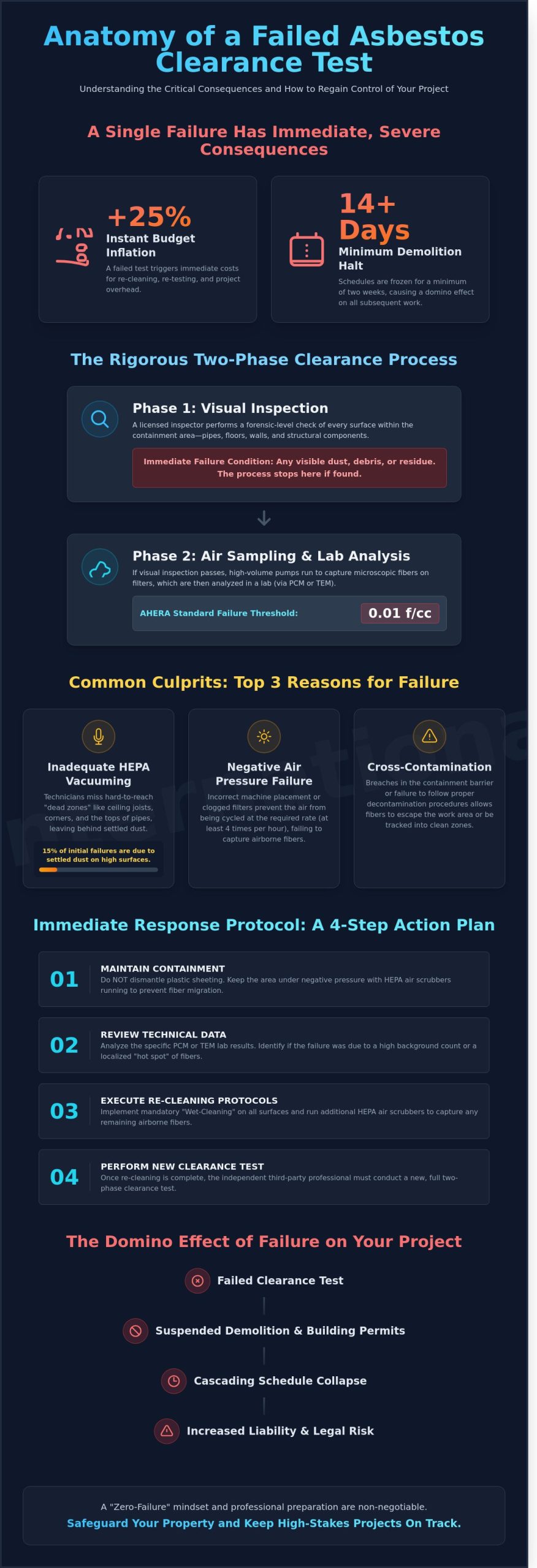
A single failed clearance test can instantly inflate your project budget by 25% and halt demolition schedules for a minimum of 14 days. This isn’t just a minor administrative setback; it’s a critical indicator that your containment strategy or cleaning protocol has failed to meet the rigorous safety standards required for 2026. Understanding exactly what happens if asbestos abatement fails clearance test is essential for property owners who need to regain control over their site’s safety and legal standing. You’ve likely worked hard to keep your facility’s renovation on track, and the news of a failed air sample can feel like a devastating blow to both your timeline and your liability profile.

We’ll show you exactly how to navigate this crisis by identifying the technical root causes of failure and implementing the corrective actions needed to ensure your building is 100% safe for re-occupancy. This guide outlines the mandatory re-cleaning procedures and the engineering adjustments required to pass the next round of testing with certainty. We’ll examine the top reasons for failure, such as inadequate HEPA filtration or improper wetting techniques, and detail the specific steps required to maintain your structural demolition timelines without compromising worker health.

Key Takeaways

  • Understand the rigorous two-phase evaluation process required to prove a site is safe for reoccupation and why professional standards are non-negotiable.
  • Discover exactly what happens if asbestos abatement fails clearance test, including the immediate protocols for maintaining containment and analyzing technical failure data.
  • Learn about the mandatory “Wet-Cleaning” protocols and advanced HEPA filtration techniques used to remediate a site and ensure regulatory compliance.
  • Identify the significant project risks associated with failure, such as the suspension of demolition permits and the resulting domino effect on construction schedules.
  • Gain insight into how a “zero-failure” mindset and professional preparation can safeguard your property and keep high-stakes projects on track.

Understanding the Asbestos Clearance Test and Common Failure Points

A final clearance test is a mandatory two-phase evaluation designed to prove a remediation site is safe for reoccupation. This process doesn’t rely on guesswork; it follows a strict technical protocol to ensure no hazardous materials remain. In the context of the 2026 safety standards, these tests serve as the final gatekeeper between a hazardous work zone and a functional living or working space. While professional abatement teams utilize specialized engineering controls, DIY attempts frequently fall short of these rigorous benchmarks due to a lack of industrial-grade equipment and containment expertise.

Regulatory frameworks established by the EPA and OSHA mandate that clearance testing must be performed by an independent third-party professional. This requirement eliminates conflicts of interest, ensuring the contractor who performed the removal isn’t the one certifying the area as safe. According to current federal guidelines, a clearance failure constitutes a breach of either visual cleanliness or air fiber concentration limits.

Understanding what happens if asbestos abatement fails clearance test protocols begins with recognizing that safety is measured at the microscopic level. Even if a room appears pristine to the naked eye, the presence of sub-visible fibers can trigger a failure, requiring immediate corrective action and re-cleaning of the entire containment area.

Visual Inspection vs. Air Sampling Failures

The visual inspection phase is the first hurdle. A licensed inspector examines every inch of the containment area, looking for dust, debris, or residue on pipes, floorboards, and structural components. If any visible dust is found, the test ends immediately as a failure. The site can’t proceed to air sampling until it passes this forensic-level cleaning check.

The air sampling phase involves using high-volume pumps to capture microscopic fibers on a filter for laboratory analysis. Technicians typically use Phase Contrast Microscopy (PCM) or Transmission Electron Microscopy (TEM) to count fibers. A site often looks clean but fails the microscopic count because fibers remain buoyant in the air for 48 to 72 hours if not properly managed. Under AHERA standards, the limit is generally set at 0.01 fibers per cubic centimeter (f/cc) of air.

Common Culprits: Dust, Debris, and Microscopic Fibers

Failures are rarely the result of a single mistake but rather a breakdown in technical execution. Most issues stem from three specific areas:

  • Inadequate HEPA Vacuuming: Technicians often miss hard-to-reach corners, ceiling joists, or the tops of door frames. These “dead zones” collect settled dust that becomes airborne once the air pumps start.
  • Negative Air Pressure Failures: Negative air machines must cycle the room’s air volume at least four times per hour. If the machines are positioned incorrectly or filters are clogged, they won’t effectively scrub the environment.
  • Cross-Contamination: This occurs when workers move between the “hot zone” and clean areas without following proper decontamination procedures, or when the containment barrier itself has a breach.

When analyzing what happens if asbestos abatement fails clearance test, the data shows that 15% of initial tests fail due to settled dust on high surfaces. This statistic highlights why professional-grade execution is non-negotiable for site safety.

Immediate Steps to Take After a Failed Clearance Report

A failed clearance test requires immediate, disciplined action to prevent cross-contamination. When asking what happens if asbestos abatement fails clearance test, the response must follow a strict engineering protocol rather than a reactive one. The priority shifts from project completion to containment integrity and rigorous data analysis. You can’t treat a failure as a minor setback; it’s a technical non-conformance that demands a systematic reset of the site safety plan.

The 2026 protocol dictates a four-step immediate response sequence:

  • Step 1: Maintain the containment area. Don’t take down plastic sheeting or turn off HEPA-filtered air scrubbers. The enclosure must remain under negative pressure to prevent fiber migration.
  • Step 2: Review technical data. Analyze the specific PCM or TEM failure results with your industrial hygienist to identify the source of the contamination.
  • Step 3: Notify stakeholders. Issue a formal notice to general contractors, safety officers, and facility managers to adjust project timelines.
  • Step 4: Schedule re-cleaning. Arrange a mandatory deep-cleaning session with the abatement team, focusing on the specific areas identified in the report.

Keeping the Containment Secure

Breaching the containment barrier before a second successful test is a critical safety violation. If you open the area prematurely, you risk releasing microscopic fibers into clean zones, which could necessitate a full facility decontamination. Negative air machines must operate 24/7. Monitoring equipment should confirm a minimum pressure differential of -0.02 column inches of water. This ensures that any airborne fibers remain trapped within the HEPA filtration system. Access must be restricted to authorized hazardous material personnel who follow full decontamination procedures, as the site remains a high-risk environment until the final air sample passes the 0.01 f/cc threshold.

Reviewing the Industrial Hygienist’s Findings

Interpreting the data correctly is essential for a successful remediation. Your industrial hygienist will provide results based on Phase Contrast Microscopy (PCM) or Transmission Electron Microscopy (TEM). If a PCM test shows a fiber count above 0.01 fibers per cubic centimeter (f/cc), it indicates the presence of airborne particles that might be asbestos. TEM analysis provides more detail by identifying specific asbestos mineral types. Use these findings as a technical roadmap. A failure in one corner of a 5,000-square-foot floor suggests a localized cleaning error, while high counts across all samples indicate a systemic failure in the wet-stripping or HEPA-vacuuming process. This data-driven approach ensures that specialized solutions are applied exactly where the previous cleaning fell short.

The re-cleaning process isn’t just a second pass; it’s a targeted intervention. Understanding what happens if asbestos abatement fails clearance test allows project managers to maintain control over the site’s safety profile. By treating the failure as a data point for improvement, you ensure the final environment meets the highest safety standards required for re-occupancy.

What Happens If Asbestos Abatement Fails a Clearance Test? A 2026 Guide

The Remediation Process: How Contractors Fix a Failed Site

When a project fails a final air clearance, the contractor must immediately transition from a standard removal phase to a rigorous secondary remediation protocol. This phase isn’t a simple repeat of previous steps; it’s a specialized technical reset designed to capture microscopic particulates that escaped initial containment. Understanding what happens if asbestos abatement fails clearance test protocols involves looking at the mandatory 2026 safety standards that dictate how a site is restored to a compliant state.

The first rule of remediation is the absolute prohibition of dry sweeping. Dry methods are strictly forbidden in asbestos zones because they re-aerosolize settled fibers, making the environment more hazardous. Instead, technicians employ a “wet-cleaning” protocol using specialized surfactant solutions. These chemicals reduce the surface tension of water, allowing it to penetrate and weigh down microscopic fibers more effectively than standard water. To ensure complete decontamination, technicians must wait for the air to settle completely before re-cleaning so they can capture any falling fibers that have finally landed on horizontal surfaces.

Advanced HEPA filtration serves as the primary defense during this stage. Contractors must verify that every piece of equipment is serviced and that filters are seated with a perfect seal. Even a 1mm gap in a filter housing can allow thousands of fibers to bypass the system. Once the bulk of the cleaning is finished, teams apply lockdown encapsulants. These liquid polymers act as a permanent binding agent, sealing any remaining microscopic particles to the substrate and preventing them from ever becoming airborne again.

Recleaning and HEPA Vacuuming Protocols

Technicians focus their efforts on horizontal surfaces where fibers typically settle after active work stops. This involves surgical cleaning of window sills, door frames, and structural steel beams that often harbor dust. HVAC ducts receive extra attention to ensure no particles are trapped in the ventilation system. The team utilizes a “double-wipe” method: the first pass removes visible dust using a surfactant-soaked cloth, while the second pass with a fresh cloth ensures microscopic decontamination. Each cloth is disposed of as hazardous waste after a single use to prevent cross-contamination.

The Role of Negative Air Pressure and Air Scrubbing

Effective remediation relies on calculating the precise air changes per hour (ACH) for the specific volume of the containment. While standard projects may require 4 ACH, a failed site often necessitates 6 to 8 ACH to flush the environment. Technicians strategically position air scrubbers to eliminate “dead zones” in corners or behind structural pillars where air might stagnate. Before the second test begins, an independent professional must verify the integrity of the HEPA filters and confirm that the negative pressure monitors show a consistent draw of at least -0.02 inches of water gauge.

Regulatory and Project Implications of Failed Abatement

A failed clearance test creates an immediate regulatory wall. It’s not just a technicality; it’s a legal barrier that prevents the transition from environmental remediation to active construction. When a project fails to meet the 0.01 fibers per cubic centimeter (f/cc) threshold, the containment area remains a restricted hazardous zone. This status prevents the issuance of necessary demolition permits, as building departments require a passed certificate to close out the environmental phase of the project. Without this document, the entire structural workflow remains paralyzed.

Impact on Demolition Permits and Construction Timelines

The domino effect of a failed test can derail a 2026 project schedule within hours. Most commercial gutting or structural demolition timelines are exceptionally tight. A single failure necessitates additional cleaning, a 24-hour settling period, and a subsequent re-test. This process often adds 48 to 72 hours to the critical path. If you don’t coordinate with the building department immediately, you risk receiving stop-work orders that can last weeks. Transparency with regulatory agencies is the only way to maintain your project milestones without facing heavy penalties. It’s vital to update all stakeholders, including interior gutting crews, to prevent them from arriving at a contaminated site.

Responsibility for Re-testing Costs

Financial liability usually depends on the language within your initial contract. In standard industrial agreements, the abatement contractor absorbs the costs of re-cleaning and labor if they failed to meet the specified clearance criteria. However, the property owner often remains responsible for the independent industrial hygienist’s re-testing fees, which can range from $600 to $2,000 depending on the number of samples required. Utilizing hazardous material abatement experts who understand these protocols prevents these unexpected expenses. Professionals ensure the site is ready before the hygienist arrives, protecting the project’s bottom line.

Skipping a re-test is never an option for commercial properties. Under OSHA and EPA regulations, specifically 29 CFR 1926.1101, documented clearance is a mandatory safety requirement for re-occupancy. Violating these standards can result in federal fines exceeding $16,000 per violation day. Understanding what happens if asbestos abatement fails clearance test helps stakeholders prepare for these contingencies. It ensures that the transition to the next phase of construction remains legally sound and physically safe for all trades involved. Logical planning and high-tier execution are the only ways to avoid these structural delays.

Ensure your project stays on track with certified environmental oversight. Contact TSIAC International for professional abatement solutions.

Partnering with TSIAC International for High-Stakes Abatement

TSIAC International brings over 15 years of field-tested expertise to every remediation project. We operate with a “Zero-Failure” mindset because we understand the high stakes involved in hazardous material handling. Our preparation protocols consistently exceed standard regulatory requirements. We ensure that every containment zone is meticulously cleaned and inspected before a third-party consultant ever sets foot on the site. Knowing what happens if asbestos abatement fails clearance test, specifically the cascading delays and increased costs, drives our team to achieve compliance on the first attempt.

Why Experience Matters in Abatement

Success in this industry depends on recognizing the nuances of asbestos removal across different environments. Commercial facilities often feature complex HVAC systems and interstitial spaces that require specialized containment strategies compared to residential settings. Our internal quality control process includes multi-point visual inspections and preliminary air sampling to verify site cleanliness. This rigorous approach has made us a trusted partner for government agencies and industrial contractors who can’t afford the risks associated with a failed clearance.

From Abatement to Structural Demolition

Project momentum is critical for large-scale developments. TSIAC International provides a seamless transition from hazardous material mitigation to structural or selective demolition. We specialize in commercial interior gutting services that begin immediately after the final clearance is secured. By acting as a single-source contractor, we reduce project friction and eliminate the scheduling conflicts that typically arise between different trades. The moment the air samples pass, our heavy machinery teams are authorized to proceed, keeping your timeline intact.

Our commitment to safety extends to environmental responsibility. We implement recycling programs on every job site to ensure that non-hazardous materials are diverted from landfills whenever possible. When you partner with TSIAC International, you’re hiring a team that views safety as a precise engineering discipline. We don’t just follow the 2026 protocol; we set the standard for how it’s executed. We handle the technical challenges of what happens if asbestos abatement fails clearance test by ensuring it doesn’t happen on our watch. Our 15-year track record is built on the fact that we solve problems where others see obstacles.

Securing Your Project Site with Professional Remediation

A failed clearance report is a critical milestone that demands immediate technical intervention. When air samples exceed the 0.01 fibers per cubic centimeter threshold established by regulatory bodies, the site must remain sealed until comprehensive recleaning occurs. Navigating what happens if asbestos abatement fails clearance test requires a partner who understands the high stakes of hazardous material management. You’ll need to coordinate with licensed inspectors to identify specific failure points, whether they stem from inadequate HEPA filtration or overlooked settled dust.

TSIAC International leverages 15+ years of industry experience to manage these complex scenarios with engineering precision. We specialize in high-stakes hazardous remediation and offer comprehensive structural demolition capabilities for projects that require a total site reset. Our team ensures every protocol aligns with 2026 safety standards, transforming a failed test into a verified, safe environment. You don’t have to navigate regulatory setbacks alone when expert help is available to restore your project timeline.

Contact TSIAC International for Expert Abatement & Demolition Services

Take the next step toward a certified safe site today.

Frequently Asked Questions

Can I stay in my house if the asbestos clearance test fails?

You cannot stay in the affected area if the asbestos clearance test fails because the containment zone remains a regulated hazard area under OSHA 1926.1101 standards. If the failure occurs in a primary living space, the polyethylene barriers must stay sealed and negative air pressure machines must continue to operate 24 hours a day. Residents shouldn’t re-enter the space until a certified industrial hygienist issues a passing clearance certificate and the containment is officially dismantled.

How many times can an asbestos clearance test fail?

There’s no legal limit on how many times an asbestos clearance test can fail, but repeated failures indicate poor workmanship or inadequate cleaning protocols. Industry data from the Environmental Information Association suggests that 15% of initial clearance tests fail due to residual dust on horizontal surfaces. If a site fails three consecutive times, the project manager must re-evaluate the contractor’s HEPA filtration systems and wet-cleaning techniques to identify the specific source of contamination.

What is the difference between PCM and TEM testing for asbestos?

Phase Contrast Microscopy (PCM) measures total fiber concentration using an optical microscope at 400x magnification, but it can’t distinguish asbestos from organic fibers like cotton or fiberglass. Transmission Electron Microscopy (TEM) uses electron beams at 20,000x magnification to identify the exact mineral structure of asbestos fibers. TEM is 100 times more sensitive than PCM and is required by AHERA standards for schools when the abatement area exceeds 160 square feet of material.

How much does a second asbestos clearance test cost?

A second asbestos clearance test typically costs between $250 and $600 depending on the number of samples required and the laboratory’s turnaround time. According to 2024 national averages, PCM samples cost approximately $50 per slide, while TEM analysis ranges from $150 to $300 per sample. These costs are usually separate from the original abatement contract unless a pass guarantee was explicitly written into the initial service agreement with the contractor.

Who is responsible for cleaning the site after a failed test?

The asbestos abatement contractor is legally and contractually responsible for re-cleaning the site at their own expense after a failed test. Under standard ASTM E2308 protocols, the crew must wet-wipe all surfaces and HEPA vacuum the entire containment area again to remove microscopic debris. This process continues until an independent third-party inspector confirms that the site meets the specific clearance criteria defined in the project’s scope of work.

How long does it take to re-clean a site for a second test?

Re-cleaning a site typically takes between 4 and 24 hours of active labor for a standard 500-square-foot containment area. The process involves a mandatory settling period of 12 hours after the final wipe-down to ensure any airborne particles have landed on surfaces for collection. Once the re-cleaning is finished, the air must be scrubbed for at least 4 full air changes per hour before the hygienist begins the next sampling cycle.

What happens if the visual inspection passes but the air test fails?

If the visual inspection passes but the air test fails, the contractor must perform an additional round of aggressive cleaning because invisible microscopic fibers are still present in the air. This scenario often occurs if what happens if asbestos abatement fails clearance test involves hidden dust in HVAC ducts or porous materials that weren’t properly sealed. The team must re-seal any leaks in the poly sheeting and run HEPA air scrubbers for another 24-hour cycle before re-testing.

Is a failed asbestos test public record?

A failed asbestos clearance test isn’t typically part of the public record for private residential properties, but it must be documented in the project’s permanent logbook for liability reasons. For public schools and government buildings, AHERA regulations require all test results to be kept in the facility’s management plan for 30 years. These records are available for review by parents, employees, and regulatory agencies like the EPA during any scheduled or surprise audit.