
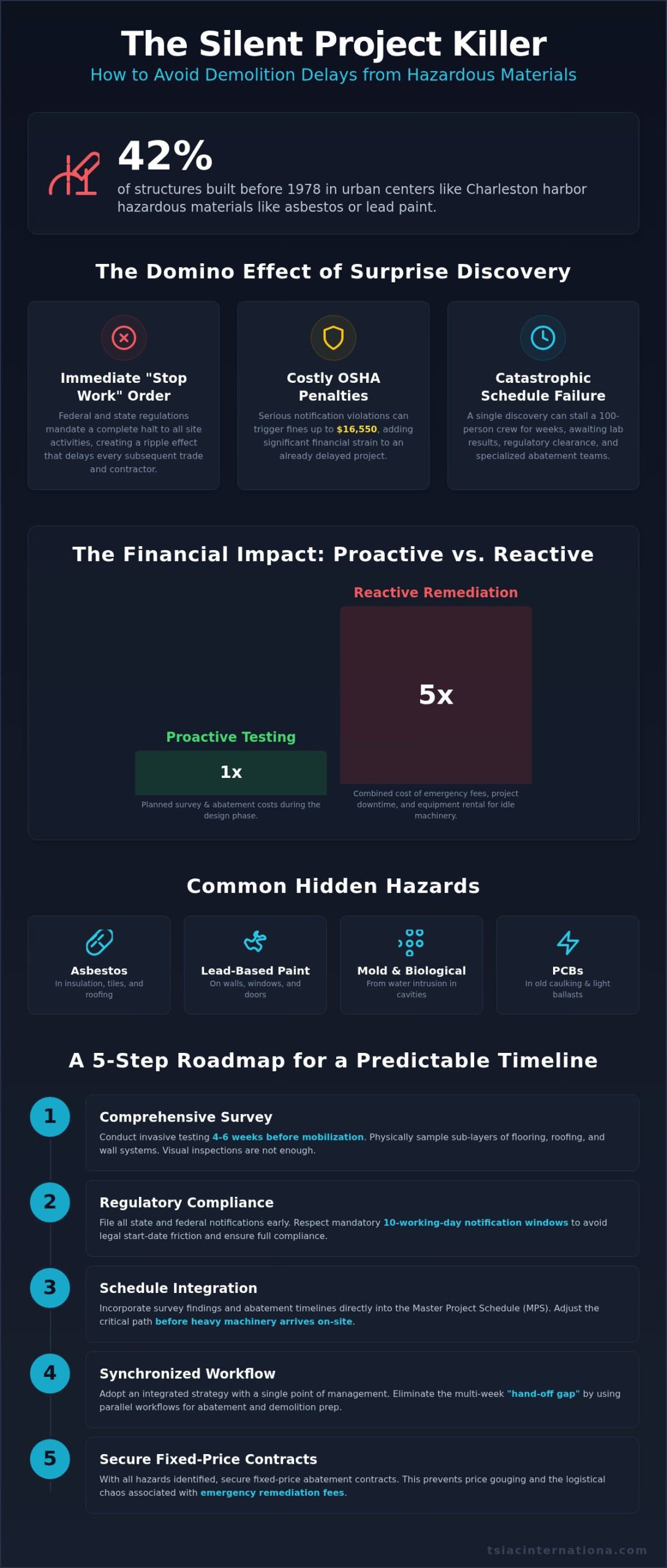
In urban centers like Charleston, approximately 42% of structures built before 1978 harbor hazardous materials like asbestos or lead paint. If you’ve ever faced a sudden work stoppage because a demolition crew uncovered hidden contaminants, you know it’s more than just a minor setback. These surprises trigger expensive emergency remediation fees and can lead to OSHA penalties of up to $16,550 for serious notification violations. Truly avoiding project delays due to hazardous materials requires moving beyond reactive management and adopting a methodical, integrated approach to site preparation.
We understand that a predictable timeline is the backbone of any successful renovation or structural removal. This guide explains how to identify risks early, manage complex regulatory paperwork, and synchronize the abatement-to-demolition workflow. You’ll learn how to navigate the 2026 EPA EPCRA reporting requirements and mandatory state notification windows to ensure full compliance without sacrificing speed. We will examine the technical precision needed to keep your project on schedule and under control, providing a clear roadmap from initial survey to final debris diversion.
Key Takeaways
- Recognize why standard visual inspections are insufficient for commercial gut-outs and how invasive testing prevents the discovery of hidden contaminants during active demolition.
- Adopt an integrated strategy for avoiding project delays due to hazardous materials by eliminating the multi-week “hand-off gap” common between separate remediation and demolition contractors.
- Execute a 5-step planning roadmap that prioritizes comprehensive surveys and regulatory notifications during the project’s design phase to ensure a predictable timeline.
- Leverage parallel workflows and consolidated management to maintain structural removal speed while ensuring full compliance with evolving 2026 environmental regulations.
Why Hazardous Materials are the #1 Silent Project Killer
Hazardous materials are more than just environmental liabilities; they are the primary cause of catastrophic scheduling failures in the demolition industry. These substances often remain undetected within wall cavities, floor layers, or pipe insulation until the moment a bucket hits the structure. At that point, the project transitions from a controlled demolition to a high-stakes compliance event. Project managers who prioritize avoiding project delays due to hazardous materials understand that these substances represent the single greatest risk to a fixed-price contract’s timeline.
The “Stop Work” trigger is the most disruptive mechanism in a renovation project. When a crew encounters a suspect material, federal and state safety regulations mandate an immediate cessation of all activities in the affected area. This doesn’t just affect the demolition team. It creates a secondary ripple effect where electricians, plumbers, and drywall contractors lose their access windows. Because specialized abatement requires specific air monitoring and containment setups, a single discovery can halt a 100-person crew for days or weeks while waiting for laboratory results and regulatory clearances.
The Most Common Hazardous Material Delays
Asbestos remains the most ubiquitous risk in structures built before the late 1970s. Comprehensive asbestos surveys are essential for identifying friable and non-friable materials before they are disturbed by heavy machinery. Lead-based paint is another primary concern, particularly during selective demolition or historic gut-outs where dust control is paramount. Mold and biological hazards, often the result of long-term water intrusion, can also trigger immediate safety shutdowns due to the respiratory risks they pose to onsite personnel. PCBs, frequently found in older caulking and fluorescent light ballasts, require specialized disposal protocols that can derail a standard waste management plan if not identified early.
The Financial Ripple Effect of Unplanned Remediation
When hazardous materials are discovered mid-project, the financial consequences extend far beyond the cost of the removal itself. Owners are often forced to pay premium emergency mobilization fees to secure abatement contractors on short notice. Simultaneously, equipment rental costs for idle excavators, skid steers, and scaffolding continue to accrue even while the site is stagnant. The logistical friction of managing separate remediation and demolition subcontractors during a crisis often leads to miscommunications and further timeline erosion. Proactive testing typically costs five times less than the combined expenses of emergency remediation and project downtime.
Pre-Demolition Surveys: Your Best Defense Against Delays
A standard walkthrough is rarely enough to protect a project timeline. While some managers rely on visual inspections or outdated building records, these methods are insufficient for modern commercial gut-outs. In the demolition sector, hazardous materials are frequently buried beneath decades of layered renovations. Invasive testing, which involves physically sampling sub-layers of flooring, roofing, and wall systems, is the only reliable method for avoiding project delays due to hazardous materials. If you don’t peel back these layers during the design phase, your crew will inevitably find them during active mobilization.
Timing is the most critical element of a successful survey. A comprehensive hazardous material assessment must occur 4 to 6 weeks before your scheduled mobilization date. This window accounts for laboratory analysis and the subsequent integration of findings into your Master Project Schedule (MPS). Identifying Common Causes for Delays early allows you to adjust the critical path before heavy machinery arrives on-site. When survey results are clear, you can secure a fixed-price contract for hazardous material abatement, preventing the price gouging and logistical chaos associated with emergency remediation.
Navigating the Regulatory Permitting Maze
The most significant regulatory hurdle is the mandatory 10-working-day notification window required by agencies such as the ADEQ or SCDES. You cannot legally begin asbestos removal the same day you discover the material. These permits are distinct from standard structural demolition permits and require rigorous documentation regarding disposal sites and landfill tracking. Failing to adhere to these specific timelines can result in OSHA penalties as high as $16,550 per violation, which can cripple a project’s budget and reputation.
Choosing Between Selective and Structural Surveys
A survey should be as surgical as the project itself. For selective demolition, testing should focus strictly on the impacted zones to minimize unnecessary costs. However, for full structural removal, every building component must be sampled. Building age is a primary risk indicator; in areas like Charleston, 42% of structures built before 1978 contain lead or asbestos. Hiring a certified third-party inspector ensures unbiased results that regulatory agencies will accept. If you are planning a complex site preparation, partnering with an integrated demolition specialist can help you manage these technical requirements from day one.
Integrated Abatement and Demolition: A Strategy for Speed
The traditional procurement model of hiring separate contractors for remediation and structural removal is a primary source of schedule friction. This fragmented approach often results in a “Hand-off Gap,” a period where the site sits idle for up to 14 days while the demolition crew waits for final clearance documentation from the abatement firm. By consolidating these services under a single-source contractor, you eliminate this dead zone. Integrated management allows for seamless transitions between phases, as the same project manager oversees both the safety protocols and the mechanical removal. This unified oversight is the most effective strategy for avoiding project delays due to hazardous materials.
Parallel workflows further accelerate the timeline on large-scale projects. In a phased renovation, an integrated team can establish containment and begin abatement in one wing while simultaneously performing non-hazardous demolition in another. This requires sophisticated site logistics to maintain clear boundaries between “hot” zones and safe areas. A single contractor can manage these complex movements of personnel and machinery without the jurisdictional disputes that often arise between separate firms. This level of coordination ensures that the critical path remains fluid and that no crew is left waiting for another to finish their scope.
Selective Demolition for Contaminated Interiors
In a commercial gut-out, removing interior finishes often exposes legacy asbestos or lead-based paint behind wall systems. Selective demolition is a surgical process to preserve structural integrity. During these interventions, teams must maintain negative pressure environments to prevent the migration of hazardous dust into occupied areas of the building. By stripping the structure to its studs under controlled conditions, we ensure that the building is biologically “clean” before the next phase of construction begins, preventing the stop-work orders that occur when contaminants are found during the build-back.
Recycling and Debris Management
Modern site preparation requires a disciplined approach to waste streams. Sorting at the source allows us to separate wood, metal, and plastic from hazardous waste, which is essential for maintaining high diversion rates. In 2026, many jurisdictions require at least a 65% diversion rate, though integrated projects often achieve 80% to 90%. Efficient logistics allow for the simultaneous hauling of hazardous and non-hazardous materials through separate, dedicated channels. This meticulous sorting reduces landfill tipping fees and improves the project’s overall ESG scores by ensuring that every recyclable ounce of material is recovered rather than buried.
A 5-Step Roadmap for Avoiding Project Delays
A proactive roadmap is the most reliable method for avoiding project delays due to hazardous materials. While many developers treat remediation as a reactive crisis, the most successful projects manage it as a scheduled technical phase. This structured approach ensures that environmental risks are mitigated before they can disrupt the mechanical demolition sequence. By following a chronological sequence of identification, notification, and execution, you can transform “hidden” liabilities into manageable project milestones.
Step 1-2: The Planning and Notification Phase
The first step involves conducting a comprehensive hazardous material survey during the design phase. This data allows you to budget for the “known unknowns” by quantifying the exact volume of materials like asbestos-containing floor tile or lead-coated structural steel. Step 2 requires filing regulatory notifications and securing abatement permits. It is essential to build a 14-day “float” into your Master Project Schedule to account for state-level regulatory review periods. In jurisdictions like South Carolina or Arizona, the mandatory 10-working-day notification window is non-negotiable. Managing public perception is also critical during this phase; clear signage and community safety briefings prevent the work stoppages that occur when neighbors raise concerns about unannounced hazard removal.
Step 3-5: Execution and Site Clearance
Step 3 is the selection of an integrated contractor capable of handling both remediation and structural removal. This eliminates the hand-off gap and ensures a single point of accountability. Step 4 focuses on site controls, where we establish rigorous containment and safety protocols to prevent cross-contamination. Daily safety briefings are mandatory to ensure every worker, from the abatement technician to the excavator operator, understands the “hot zone” boundaries. We utilize real-time air monitoring to provide an early warning system, preventing the unexpected site shutdowns that occur if ambient air quality thresholds are breached. Finally, Step 5 involves performing final air clearance and lead-wipe testing before general trades enter the site. To ensure your project follows this rigorous methodology, you can partner with an integrated demolition and abatement firm early in the planning stage.
The roadmap concludes with the delivery of a comprehensive “Close-out Binder.” This document includes all disposal manifests, laboratory clearance results, and regulatory permits. It serves as your primary defense against future liability and provides the necessary proof of compliance for future property transactions or insurance audits. By closing the loop with methodical documentation, you ensure that the project remains on schedule and that the site is legally and biologically ready for the next phase of development.
Partnering with TSIAC International for Predictable Results
Executing a complex demolition project requires more than just heavy machinery; it demands a partner who views environmental compliance as a core technical discipline. With over 15 years of industry experience, TSIAC International has refined a methodology centered on avoiding project delays due to hazardous materials through total service integration. We don’t just react to site conditions. We anticipate them by combining structural expertise with advanced remediation capabilities. This approach ensures that your project moves from the initial survey to final site clearance without the friction typically caused by fragmented subcontracting.
The TSIAC Advantage: Efficiency Through Integration
Our integrated model provides a single point of contact for the entire site preparation phase. By managing structural demolition, asbestos abatement, and lead remediation under one roof, we eliminate the communication gaps that lead to idle crews and stagnant schedules. Our fleet includes specialized equipment designed for both high-reach structural removal and surgical interior gutting, allowing us to transition between phases with technical precision. Whether your project involves a historic commercial renovation or a full-scale industrial teardown, our national reach and deep understanding of diverse regulatory environments ensure that every permit and manifest is handled with methodological accuracy.
- Fixed-Price Reliability: We offer fixed-price contracts that encompass regulatory documentation, disposal fees, and remediation. This eliminates “surprise” costs that often surface during unplanned abatement events.
- Environmental Stewardship: Our commitment to sustainability is reflected in our integrated recycling practices. We consistently divert over 85% of non-hazardous debris, including wood, metal, and plastic, from landfills.
- Comprehensive Site Cleanup: We leave every site biologically clean and ready for immediate build-back, providing all necessary clearance documentation to protect you from future liability.
Ensuring Your Project Stays on Schedule
We believe that a predictable timeline begins with a proactive risk assessment. This analysis is a standard part of our bidding process, ensuring that we account for the building’s age and potential contaminants before mobilization. We take full responsibility for managing the mandatory 10-day notification windows and other regulatory hurdles that frequently derail less experienced contractors. Our teams are trained to maintain the critical path while upholding the highest safety standards in the industry. If you are ready to secure a partner who values technical precision and reliability, contact us today for a comprehensive consultation on your next demolition or renovation project.
Securing Your Project’s Critical Path for 2026
Success in modern site preparation depends on transforming environmental liabilities into predictable technical milestones. By prioritizing invasive pre-demolition surveys and adopting an integrated service model, you eliminate the “hand-off gap” that frequently stalls commercial renovations. Avoiding project delays due to hazardous materials isn’t just about safety; it’s about maintaining a disciplined schedule through meticulous planning and regulatory precision. A unified approach to abatement and structural removal is the most effective way to protect your timeline from the “known unknowns” of older structures.
With 15+ years of industry experience, TSIAC International provides the technical expertise and full regulatory documentation required to handle the current environmental landscape. Our integrated recycling and waste management practices ensure your project meets the highest sustainability standards while staying on track. Don’t let unexpected discoveries derail your progress. Request a Comprehensive Demolition and Abatement Quote from TSIAC International to ensure your next project is completed with methodological accuracy. We look forward to being the reliable partner that helps you build on a clean, safe foundation.
Frequently Asked Questions
How long does a typical hazardous material survey take?
A comprehensive hazardous material survey generally requires ten to fourteen days for completion, including onsite sampling and laboratory analysis. The physical inspection of a commercial structure may take three to five business days depending on the building size. Laboratory turnaround for asbestos and lead samples typically adds another week to the timeline, which is why early scheduling is essential for avoiding project delays due to hazardous materials.
Can I perform demolition if I only suspect asbestos but haven’t tested yet?
You cannot legally proceed with demolition or renovation based on suspicion alone without a certified survey. Federal NESHAP regulations and state laws require a thorough inspection by a licensed professional before any materials are disturbed. Proceeding without documented testing exposes the owner to significant OSHA penalties and immediate stop-work orders if contaminants are discovered during the mechanical phase, causing catastrophic schedule failures.
What is the “10-day notification” rule in hazardous material abatement?
The 10-day notification rule is a mandatory waiting period required by environmental agencies like the EPA or SCDES before regulated abatement or demolition begins. This rule requires contractors to submit a formal intent to renovate or demolish at least ten working days prior to mobilization. This window allows regulators to inspect the site and review the safety plan, making it a critical, non-negotiable milestone in any project schedule.
Does selective demolition take longer than structural demolition if lead is present?
Selective demolition often requires more time than structural demolition when lead-based paint is present due to the surgical nature of the work. Crews must establish negative pressure enclosures and utilize HEPA-filtered vacuum systems to prevent dust migration into occupied areas. While structural demolition focuses on bulk removal, selective gutting requires manual precision and continuous air monitoring to maintain safety standards in occupied buildings.
What happens if we find hazardous materials after the project has already started?
Finding hazardous materials after mobilization triggers an immediate work stoppage and the evacuation of the affected zone. The site must be stabilized to prevent the release of fibers or lead dust, followed by emergency testing and regulatory notification. This scenario is the most common cause of budget overruns, as it often requires paying emergency mobilization fees to abatement specialists to address the discovery on short notice.
How much time should I add to my schedule for asbestos removal?
You should typically add two to four weeks to your master schedule to account for asbestos removal and the mandatory notification period. While the actual removal might only take several days for smaller sections, the ten-working-day regulatory window and final air clearance testing are fixed timeframes. Integrated abatement and demolition can help compress this timeline by overlapping non-hazardous tasks with the notification period.
Is it possible to recycle materials from a site that has lead paint?
It is possible to recycle structural components like steel beams even if they are coated with lead-based paint, provided they are sent to specialized smelting facilities. However, porous materials like drywall or wood that have been contaminated with lead dust are generally not recyclable and must be disposed of as hazardous waste. Integrated contractors use on-site sorting to maximize recovery while ensuring full compliance with disposal laws.
What certifications should I look for in a demolition and abatement contractor?
You should prioritize contractors who hold specific state licenses for asbestos and lead abatement, alongside hazardous waste hauler permits. Look for firms with OSHA 30-certified supervisors and a documented history of managing complex structural removals. A contractor with integrated certifications is better equipped for avoiding project delays due to hazardous materials by managing the entire compliance chain and documentation internally.
