

The most dangerous phase of a teardown isn’t bringing down structural concrete; it’s releasing capital before verifying physical progress on-site. Structuring a clear demolition contractor payment schedule serves as your primary defense against stalled equipment mobilization, unexpected hazardous material change orders, and prolonged schedule delays. It’s completely understandable to feel uneasy about committing substantial upfront funds when the risk of contractor abandonment or unresolved environmental liabilities looms over your property.
You shouldn’t have to surrender financial leverage just to keep heavy machinery moving. By tying disbursements directly to auditable physical milestones, you protect working capital while ensuring full regulatory compliance from initial selective gutting to final site clearance. This guide covers how to structure equitable progress draws, utilize statutory retainage limits, and secure binding lien waivers that keep your project safe, compliant, and strictly on budget.
Key Takeaways
- Structure an equitable demolition contractor payment schedule tied strictly to physical, inspected milestones rather than arbitrary calendar dates to protect project capital.
- Establish appropriate mobilization deposits and statutory retainage holdbacks that preserve your financial leverage until complete regulatory sign-off.
- Eliminate the threat of mechanics’ liens by securing conditional progress and unconditional final lien waivers at every billing interval.
- Preempt contentious change orders by negotiating upfront unit-rate pricing for unforeseen environmental hazards like asbestos, lead, or underground obstacles.
- Implement an itemized Schedule of Values to create an auditable billing framework that guarantees transparent field verification before any funds transfer.
Demolition Contractor Payment Schedule Fundamentals: Milestones and Cash Flow
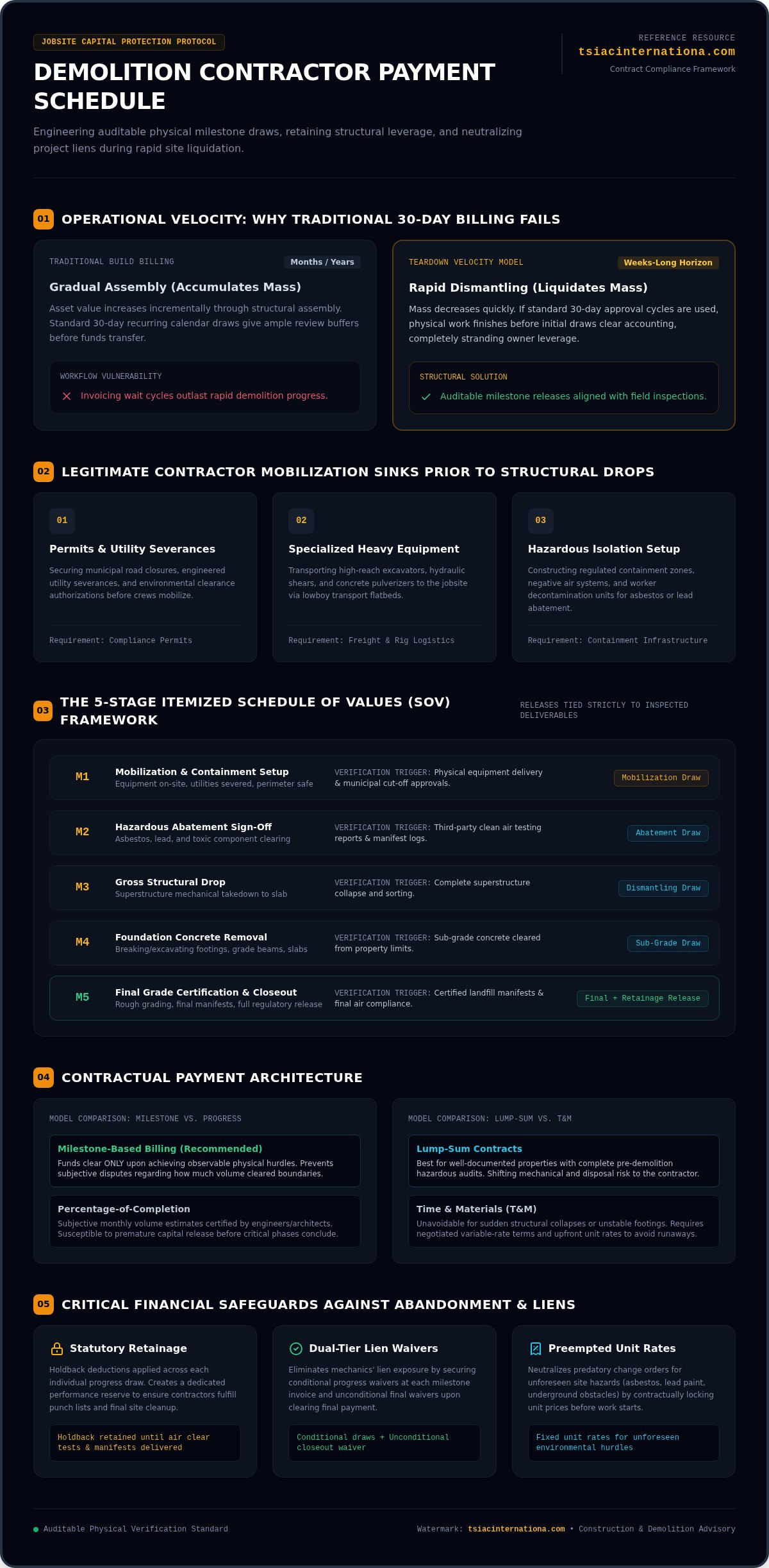
A well-engineered demolition contractor payment schedule establishes clear financial boundaries before heavy machinery ever tracks onto the jobsite. Unlike conventional building operations where asset value accumulates gradually through structural assembly, demolition rapidly liquidates physical mass. Structured billing balances the contractor’s requirement for operational liquidity against your exposure to project abandonment or unfulfilled environmental obligations. Integrating hazardous containment draws alongside mechanical dismantling milestones ensures project capital flows only as verified liabilities leave the property.
Defining the Demolition Draw Schedule
A draw schedule breaks a fixed-price demolition contract into distinct progress payments tied directly to physical deliverables. Instead of billing against subjective percentage-of-completion estimates, an itemized Schedule of Values assigns concrete monetary percentages to verifiable operational stages. Standard agreements distribute draw allocations across equipment mobilization, hazardous abatement sign-off, gross structural drop, foundation concrete removal, and final grade certification. Incorporating standard retainage practices within these individual draws guarantees that a protective performance reserve remains intact until the contractor delivers final disposal manifests and clear air testing reports.
Why Traditional Construction Billing Fails in Teardowns
Standard commercial construction relies heavily on recurring 30-day billing cycles, but that framework collapses under the rapid velocity of modern structural teardowns. While vertical buildouts take months or years, a comprehensive structural demolition or selective interior gutting project often runs its course in a matter of weeks. Waiting a month to review, approve, and process an invoice means the physical work could finish before the initial progress draw clears accounting.
Dismantling projects also face intense front-end expenditures. Demolition contractors incur substantial capital outlays prior to pulling down a single column:
- Securing municipal road closures, environmental clearance permits, and engineered utility severances.
- Transporting heavy specialized machinery, including high-reach excavators, shears, and concrete pulverizers.
- Constructing regulated containment zones, negative air setups, and decontamination units for asbestos or lead abatement.
Applying traditional calendar-month billing either starves field operations of needed cash flow or forces the owner into paying unjustified advance sums. Establishing a milestone-driven demolition contractor payment schedule solves this friction by aligning financial releases with immediate, verifiable jobsite benchmarks.
Standard Payment Schedule Models in Demolition and Abatement Contracts
Selecting the right contractual payment framework depends heavily on environmental variables and project scale. While simple low-rise drop projects follow direct transactional paths, complex industrial remediations demand strict milestone controls. An effective demolition contractor payment schedule aligns legal accountability with the physical realities of tear-down engineering, preventing capital from outpacing site progress.
Milestone-Based Billing vs. Percentage of Completion
Milestone models tie compensation to explicit, physically observable deliverables. In these contracts, funds release only when the crew achieves concrete operational hurdles: hazardous isolation, superstructure collapse, foundation concrete removal, and rough grading. Conversely, percentage-of-completion arrangements rely on estimated monthly job volume certified by an independent project architect or structural engineer. Milestone billing offers property owners superior operational transparency, eliminating subjective assessments of how much raw material has actually cleared the boundary lines.
Lump-Sum Contracts vs. Time and Materials Arrangements
Lump-sum agreements suit well-documented properties where comprehensive pre-demolition engineering assessments and hazardous audits have eliminated major site unknowns. Property owners gain complete cost predictability, shifting disposal and mechanical performance risks onto the prime contractor. For structural collapses or sites with unstable footing, time-and-materials terms become unavoidable. When negotiating variable-rate terms, owners must enforce a guaranteed maximum price clause alongside transparent audit rights to prevent unchecked operational costs.
Accommodating Specialized Abatement and Gut-Out Phases
Hazardous material containment demands its own independent draw milestones before structural demolition machinery touches the parcel. Federal procurement standards reinforce this rigorous staged discipline; the Federal Acquisition Regulation provides clear guidance on structural dismantling terms, salvage accountability, and stage disbursements across public-sector projects. In private facilities, property owners face significant environmental liability if hazardous phases blend into general mechanical demolition draws.
To isolate operational risk during interior reconfigurations, follow the systematic workflow detailed in commercial interior gutting services. Segmenting invoices into discrete hazardous and non-hazardous stages keeps cleanup audits completely transparent:
- Phase 1: Regulated Isolation. Initial draw released upon establishment of negative-pressure containment and regulatory agency notification.
- Phase 2: Abatement Clearance. Secondary draw contingent upon third-party air clearance sampling reports and certified hazardous disposal manifests for lead and asbestos.
- Phase 3: Selective Interior Strip. Separate progress draws tied to the removal of mechanical, electrical, and structural framing assets down to bare concrete.
Working alongside an established national contractor with integrated abatement and dismantling capabilities ensures your demolition contractor payment schedule remains cohesive rather than split across conflicting subcontractors.
Critical Financial Safeguards: Mobilization Deposits, Retainage, and Lien Waivers
Maintaining financial control during physical dismantling requires strict contractual guardrails. Once payment leaves your account, recovering capital from an underperforming firm is an uphill battle. A balanced demolition contractor payment schedule utilizes structured checks and balances to ensure that funds released directly reflect verified site performance, compliant disposal, and complete liability extinguishment.
Structuring Reasonable Mobilization Deposits
Legitimate mobilization costs are real, but they shouldn’t compromise your financial standing. Contractors require initial capital for lowboy transport fees, municipal street obstruction permits, utility severances, and securing containment hardware. On standard commercial jobs, mobilization fees generally run between 2% and 10% of total contract value. Small site-clearing operations may see these initial costs reach 15%. Anything demanding a third or half of the contract price upfront signals severe capitalization issues. Condition deposit releases strictly upon two physical checkpoints: receipt of approved municipal teardown permits and heavy equipment arrival on-site.
Managing Progress Payments with Lien Waivers
Property owners face severe exposure to mechanics’ liens if general contractors default on hauling firms, heavy equipment rental houses, or regional landfills. Controlling this risk requires managing statutory lien waivers throughout the draw cycle. You must differentiate between waiver instruments to avoid surrendering critical rights prematurely:
- Conditional Progress Waivers: Submitted with every interim draw, waiving rights only after the specific invoiced payment clears the bank.
- Unconditional Progress Waivers: Provided as proof of receipt for previous payments, confirming downstream vendors have received their funds.
- Conditional Final Waivers: Signed during closeout, extinguishing all claims once the final balance and retainage transfer.
- Unconditional Final Waivers: Executed only after the final payment physically posts, clearing title completely. Never sign this beforehand.
Always demand certified weigh tickets and certified material diversion logs before releasing structural recycling draws. This paperwork proves metal and crushed concrete reached legitimate recycling centers rather than unauthorized dumps.
Retainage Release Protocols and Closeout Documentation
Retainage acts as your primary insurance policy until final closeout. Standard contracts withhold 5% to 10% from every progress payment invoice. Regulatory frameworks are shifting toward reduced withholding; for example, California law capped retainage on private construction contracts at 5% starting January 1, 2026. Similar federal standards outlined under Prompt Payment for Construction Contracts provide disciplined blueprints for milestone disbursement windows and closeout workflows.
Closeout protocols must demand absolute regulatory and physical completion. To review the chronological benchmarks required for complete site clearance, consult the structured stages outlined in the demolition process. Never disburse retainage until the contractor delivers rough grade stabilization, complete foundation removal sign-offs, final air clearance certifications, and state-mandated hazardous disposal manifests.
Risk Mitigation: Managing Unforeseen Hazards, Change Orders, and Billing Disputes
Differing site conditions trigger the vast majority of financial disputes during tear-down operations. When unseen environmental contaminants or unexpected subterranean obstructions surface mid-project, progress stalls while costs threaten to spiral. A resilient demolition contractor payment schedule anticipates these operational disruptions by incorporating explicit mechanisms to pause work, verify site conditions, and adjust billing without derailing the overall project timeline.
Handling Unforeseen Hazardous Material Discovery
Concealed thermal pipe insulation, lead-coated structural beams, or hidden perimeter transite panels require immediate operational adjustments. Contracts must mandate an immediate, localized work stoppage the moment crews encounter suspect substances. This procedural pause isolates the contaminated zone while unaffected site operations continue unhindered.
Property owners can navigate these regulatory hurdles by applying the comprehensive safety and containment protocols outlined in hazardous material abatement. To prevent predatory spot-pricing during unexpected discoveries, embed agreed unit-rate schedules into the base contract upfront:
- Predetermined Unit Rates: Establish fixed rates per linear foot of pipe wrap or square foot of flooring before breaking ground.
- Independent Laboratory Verification: Disallow supplemental abatement draws until certified third-party testing confirms positive toxicity.
- Stringent Manifest Requirements: Require chain-of-custody hazardous shipping manifests and final clearance air testing results prior to releasing change-order payments.
Managing Subsurface Obstacles and Foundation Surprises
Subterranean surprises represent another significant financial exposure. Buried mass footings, abandoned septic tanks, or unmapped underground storage tanks require specialized mechanical attachments and altered haul-off logistics. When the scope expands beneath the surface, contractors must never bill arbitrarily on unverified time-and-materials calculations.
Enforce strict contractual terms that require written change-order authorization before field teams excavate or fracture unanticipated subsurface masonry. Tie supplemental draws directly to documented physical realities, such as certified excavator scale tickets, certified landfill weight receipts, or surveyed cubic yardage calculations. Establishing these objective evidentiary baselines protects your balance sheet from unverified volume claims.
If you need expert site teardowns backed by structured, transparent billing milestones, contact TSIAC International for professional demolition services.
How to Structure and Negotiate an Equitable Demolition Payment Agreement
Negotiating an equitable contract requires transforming broad project goals into verifiable financial transactions. A balanced demolition contractor payment schedule protects your capital reserves while ensuring the crew maintains steady production momentum. When you establish transparent billing rules before field operations begin, you eliminate subjective debates over work volume and keep administrative friction off the jobsite.
Step-by-Step Payment Schedule Negotiation Framework
Protecting your balance sheet begins during initial proposal reviews. Follow this four-stage framework to structure a binding, milestone-based agreement:
- Mandate an Itemized Schedule of Values: Require bidding firms to break costs into line items covering mobilization, containment setups, mechanical drop phases, concrete removal, and debris diversion. Never accept blanket lump-sum estimates that obscure actual operational allocations.
- Condition the Initial Mobilization Draw: Release upfront mobilization funds only after verifying active municipal demolition permits, completed utility severances, and physical equipment delivery to the parcel.
- Tie Intermediate Draws to Observable Structural Realities: Structure progress disbursements around distinct operational achievements rather than calendar intervals. Intermediate checkpoints should align with completed hazardous abatement, stripped interior framing, collapsed structural superstructures, or excavated foundations.
- Formulate Definite Retainage Release Triggers: Withhold final retainage release until the contractor submits certified waste diversion logs, final air clearance test results, rough grade compaction reports, and statutory unconditional final lien releases.
Selecting a Contractor with Transparent Financial Operations
Contractual terms are only as reliable as the firm executing the work. Selecting a poorly capitalized operator introduces severe operational and legal risks, including delayed schedules, abandoned equipment, and mechanics’ liens from unpaid haulers. Always verify general liability coverage limits, pollution liability policies, and bonding capacity before entering negotiations.
Firms with dedicated equipment fleets offer superior operational stability over broker outfits that subcontract machinery and hauling. Working directly with an asset-based company removes multi-tiered markups and guarantees direct control over machine scheduling. Discover how TSIAC International brings over 15 years of industry experience to commercial teardowns, executing multi-phase hazardous containment, structural teardown, and site recycling under disciplined, auditable billing milestones.
Disciplined operators welcome objective payment milestones because clear criteria eliminate payment delays. By securing a structured agreement upfront, you protect your capital, fulfill strict regulatory requirements, and ensure your site is cleared safely and compliantly.
Take Control of Your Project Capital and Site Safety
A disciplined demolition contractor payment schedule does far more than regulate cash flow; it actively protects your asset from start to finish. Tying capital releases to field-verified milestones guarantees that heavy equipment mobilization, hazardous abatement containment, and structural dismantling advance in strict lockstep with your financial commitments. Enforcing structured retainage holdbacks alongside mandatory progress lien waivers shields your property title from downstream liabilities, unpaid vendor liens, and improper waste disposal exposure.
Flawless site clearance relies on partnering with a team that values fiscal accountability just as much as technical precision. Bringing over 15 years of proven excellence in heavy structural dismantling and selective demolition, TSIAC International delivers comprehensive in-house capabilities covering demolition, abatement, and sustainable material recycling. You don’t have to navigate complex regulatory requirements and volatile project risks alone. Partner with TSIAC International for transparent, professional demolition and abatement services to ensure your next site clearance proceeds safely, compliantly, and with absolute financial control.
Frequently Asked Questions
What is an industry-standard deposit percentage for a demolition contractor?
An industry-standard mobilization deposit typically ranges between 2% and 10% of the total contract value for commercial teardowns. Smaller land-clearing projects occasionally reach 15% due to upfront machinery transport costs. Avoid contractors demanding 30% to 50% before arriving on-site. Always tie deposit releases directly to active municipal teardown permits and confirmed equipment delivery to the parcel.
How much retainage should a property owner hold back on a demolition project?
Property owners typically withhold 5% to 10% from each progress draw as a protective performance reserve. Many jurisdictions are actively limiting these holdbacks; for instance, California capped private contract retainage at 5% starting January 1, 2026. This retained capital should remain untouched until final site inspection, rough grading approval, and the delivery of all regulatory disposal manifests.
Can a demolition contractor place a mechanic’s lien on my property if I withhold payment?
Yes, contractors, hauling companies, and material recyclers can file a mechanic’s lien if contract funds are withheld without clear contractual justification. To defend against improper liens, incorporate conditional progress waivers into every draw and never withhold payments arbitrarily. Your demolition contractor payment schedule should clearly define milestone acceptance criteria so billing disputes are resolved through documented physical deficiencies rather than non-payment.
What happens if hazardous materials like asbestos are discovered during building demolition?
Field crews must initiate an immediate, localized work stoppage in the contaminated zone while continuing unrelated mechanical dismantling elsewhere. An accredited third-party inspector must test the materials before any abatement begins. Contract change orders should utilize predetermined, negotiated unit rates for hazardous containment, and supplemental disbursements must remain contingent upon negative-exposure air clearances and certified waste manifests.
Is it better to pay a demolition contractor via fixed milestones or monthly progress billing?
Fixed milestones are substantially better than monthly billing for structural dismantling. Demolition projects move rapidly, often concluding weeks before a conventional 30-day billing cycle completes. A milestone-based demolition contractor payment schedule ties disbursements to verifiable physical events, such as completing hazardous remediation, dropping the gross superstructure, or crushing foundation concrete, eliminating guesswork over subjective completion percentages.
What specific documents must a demolition contractor provide before receiving final payment?
Contractors must deliver a comprehensive closeout packet before retainage funds are disbursed. This documentation includes certified landfill weigh tickets, concrete recycling receipts, hazardous material chain-of-custody manifests, and clean third-party air clearance reports. The closeout must also include municipal permit sign-offs and unconditional final lien waivers executed by the prime contractor, hauling sub-trades, and heavy equipment rental providers.
