
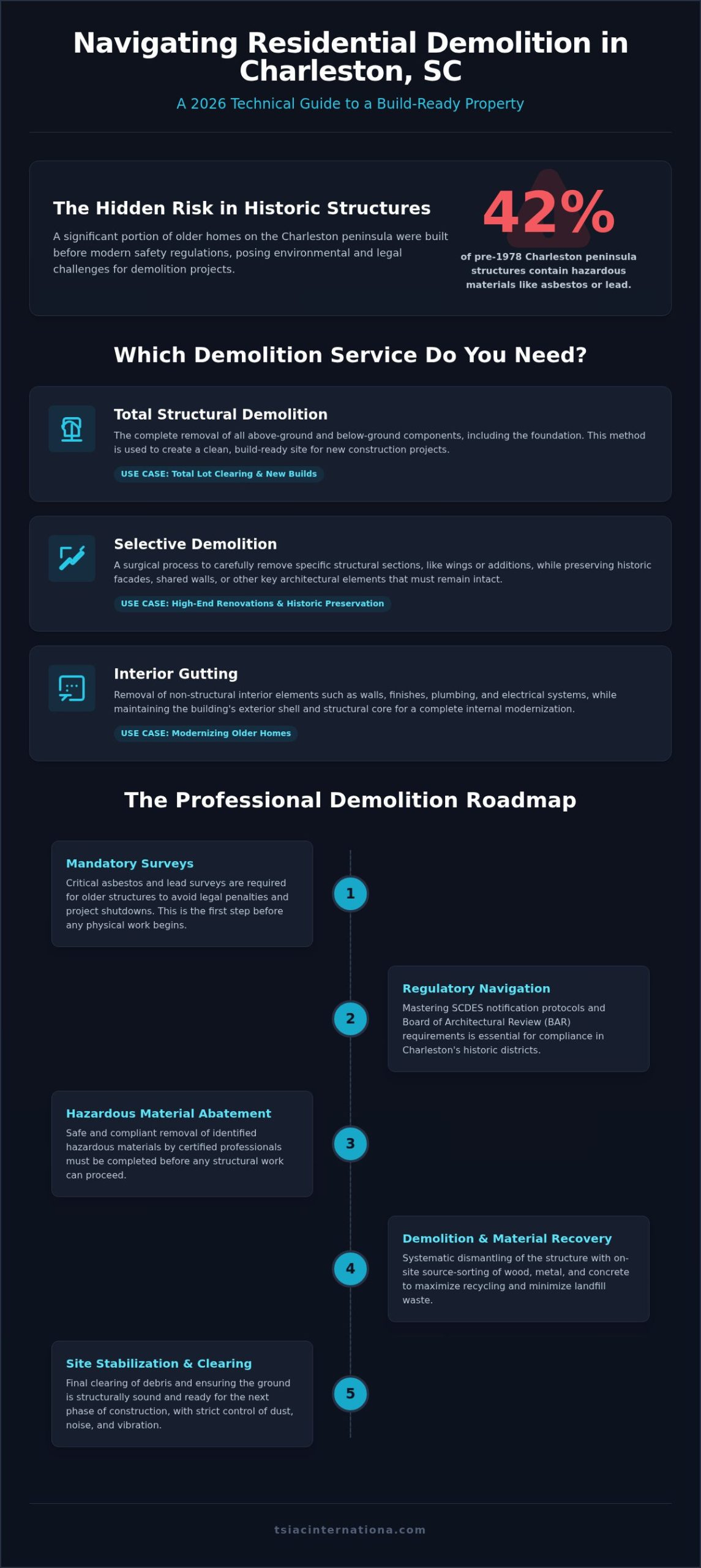
Approximately 42% of pre-1978 structures on the Charleston peninsula contain hazardous materials like asbestos or lead. When you’re preparing for residential demolition charleston sc, you aren’t just tearing down a building; you’re managing a high-stakes environmental and regulatory process. It’s natural to worry about the Board of Architectural Review (BAR) adding months to your timeline or the sudden discovery of toxins halting your progress. These aren’t just logistical hurdles; they’re significant risks to your budget and your peace of mind.
You want a clean slate for your new build, but the path through permits and hazardous material abatement often feels like a minefield. This 2026 guide simplifies that path, offering a professional methodology to handle every technical detail from site stabilization to the final clearing. We’ll break down the latest SCDES notification protocols, explain how to navigate historic district oversight, and show you how sustainable material recovery can streamline your project’s environmental footprint. By the end, you’ll have the technical roadmap necessary to transform a complex site into a build-ready property.
Key Takeaways
- Understand that professional residential demolition charleston sc involves more than physical removal, requiring a specialized approach to manage environmental risks and site stabilization.
- Distinguish between structural demolition for new construction and selective demolition for high-end renovations to protect the structural integrity of your existing property.
- Learn why mandatory asbestos and lead surveys are critical for Charleston’s historic structures to avoid legal penalties and project shutdowns.
- Navigate the 2026 regulatory landscape by mastering SCDES notification protocols and Board of Architectural Review (BAR) requirements for older properties.
- Discover the logistical advantages of an integrated contractor who manages hazardous material abatement and debris recycling alongside physical demolition.
Understanding Residential Demolition in Charleston, SC
Demolition in a residential context is the systematic dismantling of a structure to prepare a site for its next phase of utility. In the Charleston market, this process is rarely a simple matter of mechanical force. It requires a disciplined approach to engineering, environmental safety, and regulatory compliance. Whether you’re clearing a lot in Mount Pleasant or gutting a historic residence on the peninsula, the complexity of residential demolition charleston sc has increased significantly as we enter 2026. Modern projects demand a focus on material science and protection protocols that go far beyond the capabilities of a general laborer.
The Scope of Modern Demolition Services
Property owners today require specialized technical responses based on their specific development goals. A one-size-fits-all approach doesn’t work in a city with such diverse architectural requirements. The three primary service categories include:
- Structural Demolition: This involves the complete removal of all above-ground and below-ground components, resulting in a clean, build-ready site for new construction. It’s the standard choice for total lot clearing.
- Interior Gutting: A surgical process where we remove non-structural elements, finishes, and utilities while maintaining the building’s exterior shell. This is a primary requirement for modernizing older homes without altering their footprint.
- Selective Demolition: This is essential for Charleston’s high-end renovations. We carefully remove specific wings or structural sections while preserving historic facades or shared walls that must remain intact.
Why Professional Oversight Matters
Hiring an unlicensed or uninsured crew in South Carolina introduces unacceptable risks to both the property owner and the surrounding community. Modern 2026 regulations emphasize a more sophisticated approach to debris management. We don’t just haul waste to a landfill; we implement rigorous source-sorting on-site to maximize the recycling of wood, metal, and plastic. This systematic recovery is now a cornerstone of compliant residential demolition charleston sc, as local disposal facilities have tightened their intake criteria for mixed construction waste.
Professional oversight also ensures that dust, noise, and vibration levels remain under strict control. In dense residential neighborhoods, uncontrolled vibrations from heavy machinery can damage adjacent historic foundations, leading to costly litigation and indefinite project delays. A licensed contractor provides the technical insurance and site stabilization expertise needed to ensure the ground is structurally sound and ready for the next phase of construction. This level of precision protects your investment and maintains the structural integrity of the local landscape.
Structural vs. Selective Demolition: Which Do You Need?
Choosing the correct methodology for residential demolition charleston sc depends entirely on your project’s final objective. While a total knockdown provides a blank slate for new construction, many Charleston property owners opt for a more surgical approach to preserve the character or structural value of an existing home. The technical distinction between these two methods affects everything from your permit requirements to the heavy machinery deployed on your site. Understanding the cost-benefit ratio of stripping a building to its studs versus a total removal is the first step in maintaining your project’s budget and timeline.
Total Structural Demolition
Total structural demolition is often the most cost-effective path when a building’s foundation is compromised or the cost of remediation exceeds the value of the structure. This process involves the systematic teardown of the entire building, including the foundation and all underground utilities. It requires significant site access for excavators and high-capacity debris trailers. In tight residential lots common in the Charleston area, we prioritize site stabilization and vibration control to prevent any impact on adjacent properties during the heavy mechanical phase of the project.
Selective and Interior Gutting
For high-end renovations or historic updates, selective demolition allows us to remove specific sections, such as outdated kitchens, bathrooms, or poorly constructed additions, while keeping the primary structure intact. This requires a high degree of technical precision to ensure that load-bearing walls remain supported throughout the process. Many of the techniques we use are adapted from our commercial interior gutting services, where precision and dust containment are paramount.
Executing a surgical removal in an older home presents unique technical challenges. We must identify and isolate utility lines without disrupting the rest of the house, often while working within the constraints of Federal Asbestos Demolition Regulations. Because Charleston’s older housing stock frequently contains hazardous materials, even a selective interior gutting project requires a professional survey to ensure that no asbestos or lead is disturbed during the removal of flooring, insulation, or drywall. This integrated approach prevents the accidental release of toxins into the living areas you intend to keep.
Maintaining the structural integrity of a partially demolished home requires more than just caution; it requires engineering expertise. We use temporary shoring and bracing to stabilize the remaining structure as we remove specific wings or interior components. This meticulous process ensures that your home remains build-ready and safe for the next phase of modernization. If you’re unsure which method fits your property’s needs, consulting with an experienced demolition partner can help clarify the most efficient path forward for your specific site conditions.
The Critical Role of Asbestos and Lead Abatement
Charleston’s architectural heritage is inseparable from the materials used during its historical expansion, many of which are now classified as hazardous. For any project involving residential demolition charleston sc, the presence of asbestos and lead isn’t just a possibility; it’s a statistical likelihood. Approximately 42% of pre-1978 structures on the peninsula contain these toxins. Unlike general contractors who treat hazardous cleanup as an afterthought, we view abatement as the foundational step of a successful demolition. Ignoring these materials doesn’t just invite legal penalties; it creates an environmental liability that can haunt a property title for decades.
The legal framework in South Carolina is clear and uncompromising. SCDES Regulation 61-86.1 mandates a professional asbestos survey for any structure scheduled for demolition if the building’s footprint exceeds 160 square feet. This requirement applies regardless of the building’s age. Lead-based paint is another pervasive hurdle in structures built before 1978, requiring specific handling protocols to prevent soil contamination. TSIAC International integrates these specialized services into the primary project timeline, acting as a one-stop contractor that manages the hazardous cleanup and the physical removal simultaneously.
Safe Containment and Removal
Modern abatement requires more than basic protective gear; it demands a controlled environment. We utilize advanced HEPA filtration systems and wet-stripping methods to prevent the release of microscopic fibers into the air. Every phase of the process is documented through disposal manifests, which serve as your proof of regulatory compliance. For a deeper look at the 2026 standards, you can review our guide on asbestos removal in South Carolina. These protocols ensure that all regulated materials are transported to licensed facilities, shielding the property owner from future environmental claims.
Health and Environmental Protection
Protecting your family and neighbors from toxic dust is our highest priority during residential demolition charleston sc. DIY hazardous material removal is a significant liability that often results in the widespread dispersal of lead dust or asbestos fibers. Our team uses negative air pressure enclosures to keep contaminants contained within the work zone. Once the physical removal is complete, we conduct final site clearance testing. This rigorous analytical process confirms that the air and surfaces are safe for the next phase of construction, providing a truly clean slate for your new home. We don’t consider a site build-ready until the laboratory results verify that all hazardous traces have been successfully mitigated.
The Demolition Process: Permits, Preparation, and Recycling
The physical execution of residential demolition charleston sc is a multi-phased operation that begins long before the first excavator arrives. We initiate every project with a comprehensive site survey to evaluate soil stability and identify any structural vulnerabilities that could affect neighboring buildings. This preparation phase includes the installation of site safety barriers and silt fencing, which is critical in our coastal environment to manage stormwater runoff and prevent debris from entering the local ecosystem. Additionally, we ensure that a “Notice of Demolition” sign is prominently posted on the property at least 15 days before work begins, as required by local ordinance.
Navigating Local Compliance
Coordinating utility disconnects is a technical prerequisite that requires precision. We manage the termination of water, sewer, and electrical lines with local providers to ensure the site is safe for mechanical intervention. Understanding the demolition process in South Carolina is essential for navigating the variations between jurisdictions. For instance, while Charleston County charges a flat $75 permit fee, North Charleston calculates costs at $7 per $1,000 of project value plus an administrative fee. If your property is in a historic district, we also coordinate with the Board of Architectural Review (BAR), a process that can add several weeks to the timeline. We handle these filings and prepare the site for the final inspections required for a clean sign-off.
Sustainable Debris Management
Sustainable debris management is no longer an optional service; it’s a technical requirement for modern projects. We implement source-sorting on every site to separate materials before they leave the property. Our recycling protocols for residential demolition charleston sc focus on:
- Structural Metal: Recovering steel and aluminum for secondary markets.
- Clean Wood: Separating lumber to be processed into mulch or biomass.
- Masonry and Concrete: Crushing inert materials for use as road base or fill.
- Plastics: Sorting high-density materials to divert them from local landfills.
This disciplined approach reduces the volume of waste sent to landfills and aligns with the 2026 focus on environmental stewardship. Our team utilizes specialized recycling streams for high-value materials. By maximizing these streams, we also mitigate the impact of rising disposal fees, which can account for a significant portion of a project’s budget. This systematic recovery of materials ensures that your project meets both environmental standards and budgetary goals, leaving the site clean and ready for your new foundation.
To ensure your project remains compliant and efficient, schedule a technical site assessment with our team today.
Why Choose TSIAC for Your Residential Project?
With over 15 years of industry experience, TSIAC International has established itself as a cornerstone of the South Carolina demolition sector. Choosing a partner for residential demolition charleston sc requires a balance of technical precision and local regulatory knowledge that only comes from navigating hundreds of local projects. Our unique advantage lies in the integration of hazardous material removal with physical demolition. Instead of managing multiple subcontractors and conflicting schedules, property owners benefit from a single point of accountability. This streamlined approach ensures that safety protocols for lead and asbestos are never compromised by the pressure of the demolition timeline, which is especially critical in our coastal environment where environmental stewardship is mandatory.
Comprehensive Project Management
We manage the entire lifecycle of your site’s transformation through a disciplined, methodological process. Our methodology begins with rigorous hazardous testing and concludes with a build-ready site delivery that exceeds local standards. By maintaining internal teams for asbestos and lead abatement, we act as a “one-stop” contractor, eliminating the communication gaps that often lead to project delays or budget overruns. You receive clear project timelines and transparent reporting at every stage, ensuring you’re never in the dark about your property’s status. For a deeper understanding of our operational philosophy and brand history, you can explore the history of TSIAC International Charleston. Our reputation is built on the successful execution of complex removals where standard methods or general laborers were insufficient to meet the technical demands of the site.
Next Steps for Your Charleston Home
Preparing your property for its next chapter starts with a professional site evaluation. Whether you require a full knockdown for new construction or a surgical interior gutting for a renovation, we provide data-driven consultations. Requesting a fixed-price structural demolition quote allows you to budget with certainty, knowing that environmental contingencies and recycling mandates are already accounted for. If your project involves a high-end renovation on the peninsula, we offer selective demolition consultations to ensure your home’s structural integrity remains protected during the update. Our team’s disciplined approach guarantees that every project is completed with technical precision and safety-focused results. To secure your site’s future, Contact TSIAC International today to schedule your initial consultation and site assessment.
Securing Your Property’s Future with Technical Precision
Navigating the complexities of a home teardown in South Carolina requires more than mechanical force; it demands a disciplined approach to environmental safety and regulatory compliance. As we’ve explored, modern residential demolition charleston sc is a surgical process where hazardous material abatement and sustainable recycling are foundational requirements. By identifying whether your project necessitates selective interior gutting or total structural removal, you can effectively manage your timeline and protect your investment against unforeseen legal liabilities or environmental delays.
TSIAC International provides a distinct advantage by integrating structural removal with certified asbestos and lead abatement under one roof. With over 15 years of local expertise, our team applies a methodical approach to every site, ensuring full compliance with 2026 regulations and maximizing site stability through responsible recycling practices. We don’t just clear land; we deliver a build-ready foundation that meets the highest technical standards of the Charleston market. Take the first step toward a safe and compliant site today. Get a Professional Demolition Quote from TSIAC International and ensure your residential project starts on a foundation of professional reliability.
Frequently Asked Questions
Do I need a permit for residential demolition in Charleston?
Yes, you must obtain a demolition permit from your local building department before work begins. Permit fees often vary based on project value or a flat administrative rate depending on your specific jurisdiction. You’re also required to post a formal notice on the property before the teardown. TSIAC International handles the technical filings and ensures all regulatory signage is compliant with current 2026 codes for residential demolition charleston sc, protecting you from administrative delays and potential fines.
How long does the typical home demolition process take?
The physical teardown typically requires three to seven days for a standard structure. However, the total project timeline often spans three to six weeks once you account for mandatory hazardous material surveys and the required state notification periods. If your property falls under specific architectural review boards, expect additional weeks for approval. TSIAC International coordinates these phases to minimize downtime and ensure site delivery stays on schedule through disciplined project management and logistical oversight.
What is the difference between abatement and demolition?
Abatement is the technical process of identifying, containing, and removing hazardous materials like asbestos or lead paint. Demolition is the subsequent physical dismantling of the building’s structure. It’s critical to complete abatement before demolition starts to prevent the release of toxic particulates into the atmosphere. TSIAC International provides an integrated service model where our abatement specialists clear the site of hazards before our heavy machinery teams begin structural removal, ensuring a safer work environment for everyone involved.
Is asbestos testing mandatory for residential demolition in SC?
Asbestos testing is mandatory for any structure with a footprint exceeding 160 square feet. Under current state regulations, a professional survey must be conducted regardless of the building’s age to ensure hidden hazardous materials are identified before they become airborne. For residential demolition charleston sc, skipping this step can lead to significant fines and immediate project shutdowns by environmental authorities. TSIAC International includes this survey in our initial site preparation phase to guarantee full regulatory compliance.
Can I recycle materials from my demolished home?
You can and should recycle structural materials to reduce landfill impact and manage disposal costs. TSIAC International implements on-site source-sorting for wood, metal, plastic, and concrete on every project. Recovered concrete is often crushed for use as fill, while metals are sent to specialized processing facilities. This disciplined approach to debris management is a cornerstone of our operational standards, helping property owners meet environmental goals while potentially lowering overall disposal fees through efficient material recovery.
How do you protect neighboring properties during demolition?
We protect neighboring properties through a combination of site stabilization and environmental controls. This includes installing safety barriers and silt fencing to manage sediment runoff. In tight residential lots, TSIAC International uses vibration monitoring to protect adjacent foundations and misting systems for dust suppression. These protocols ensure that mechanical work doesn’t negatively impact the structural integrity or air quality of the surrounding community. Our teams prioritize noise and vibration mitigation throughout every phase of the project.
What happens to the utilities like water and gas before demolition?
All utilities must be formally disconnected and capped at the property line or the main before any mechanical work begins. TSIAC International coordinates directly with water, gas, and electrical providers to ensure all services are terminated safely. This step is a non-negotiable safety requirement that prevents accidental strikes and fires during the teardown. Once the providers issue a “safe to demolish” sign-off, we proceed with the physical removal and site clearing to ensure the area is build-ready.
Does TSIAC International handle lead paint removal in historic homes?
TSIAC International specializes in lead abatement for historic homes and any residential structure built before 1978. We use HEPA-filtered vacuum systems and wet-stripping techniques to contain lead dust and prevent soil contamination. This specialized service is essential for preserving the safety of the site for future construction. Because many older properties require surgical removal, our lead abatement protocols are designed to be precise, protecting both the workers and the long-term health of the development site.
