Demolition Site Safety: The Comprehensive Guide to Risk Management in 2026

Recent 2024 industry audits reveal that nearly 60% of demolition accidents stem from unforeseen structural instabilities that could’ve been mitigated…

Recent 2024 industry audits reveal that nearly 60% of demolition accidents stem from unforeseen structural instabilities that could’ve been mitigated during the pre-planning phase. You’re likely aware that maintaining demolition site safety requires more than just wearing hard hats; it demands a disciplined, engineering-first approach to risk. It’s natural to feel concerned about the 2026 regulatory shifts or the hidden costs of hazardous material abatement. We’ve seen how even a minor oversight in asbestos containment can halt a multi-million dollar project for 30 days or more.

This guide will help you master the critical safety protocols and specialized abatement strategies needed to ensure a zero-accident project. You’ll gain the technical clarity required to navigate complex legal requirements and manage debris with maximum efficiency. We’ll break down the precise monitoring technologies and risk management frameworks that professional site managers use to maintain total control over even the most challenging urban teardowns.

Key Takeaways

  • Establish a legal and technical bedrock by defining the 2026 standards for engineering surveys and the critical role of the competent person.
  • Avoid project delays by mastering specialized abatement strategies and equipment requirements for managing hazardous materials like asbestos and lead.
  • Execute complex selective demolition with surgical precision to ensure the structural integrity of the building envelope remains uncompromised.
  • Adopt the non-negotiable 2026 PPE requirements and specialized training protocols essential for maintaining demolition site safety in high-hazard environments.
  • Complete the safety lifecycle by integrating on-site material sorting and environmental remediation into your post-demolition workflow.

The Foundation of Demolition Safety: Pre-Project Planning and Engineering Surveys

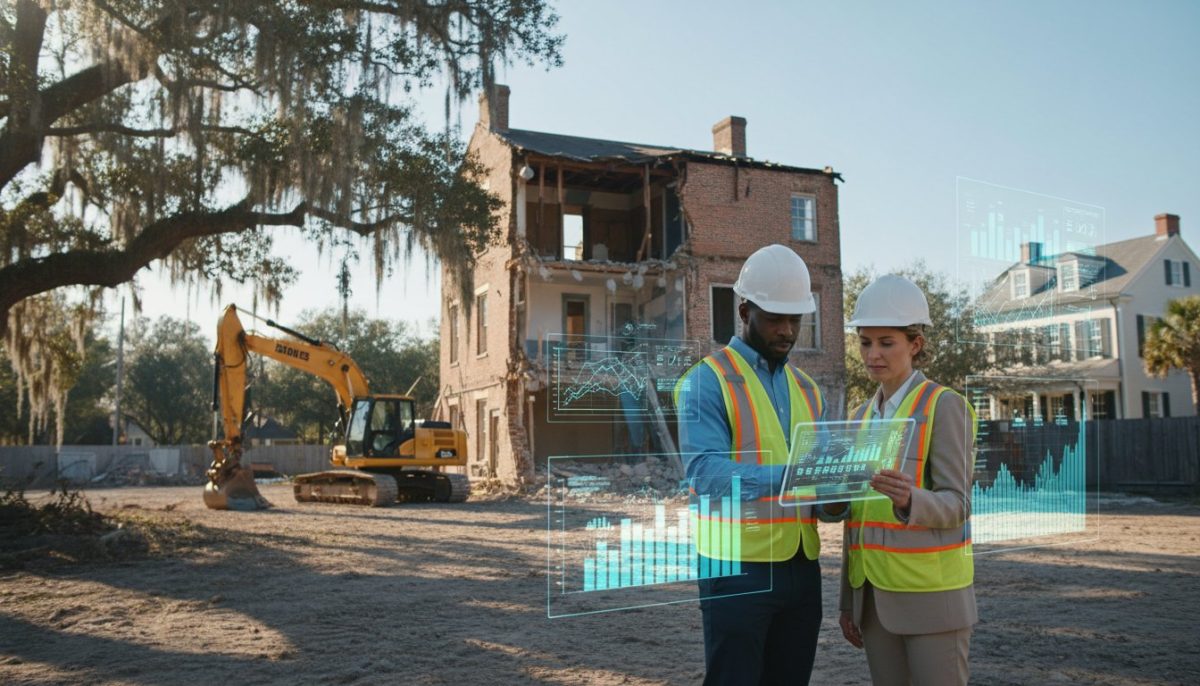
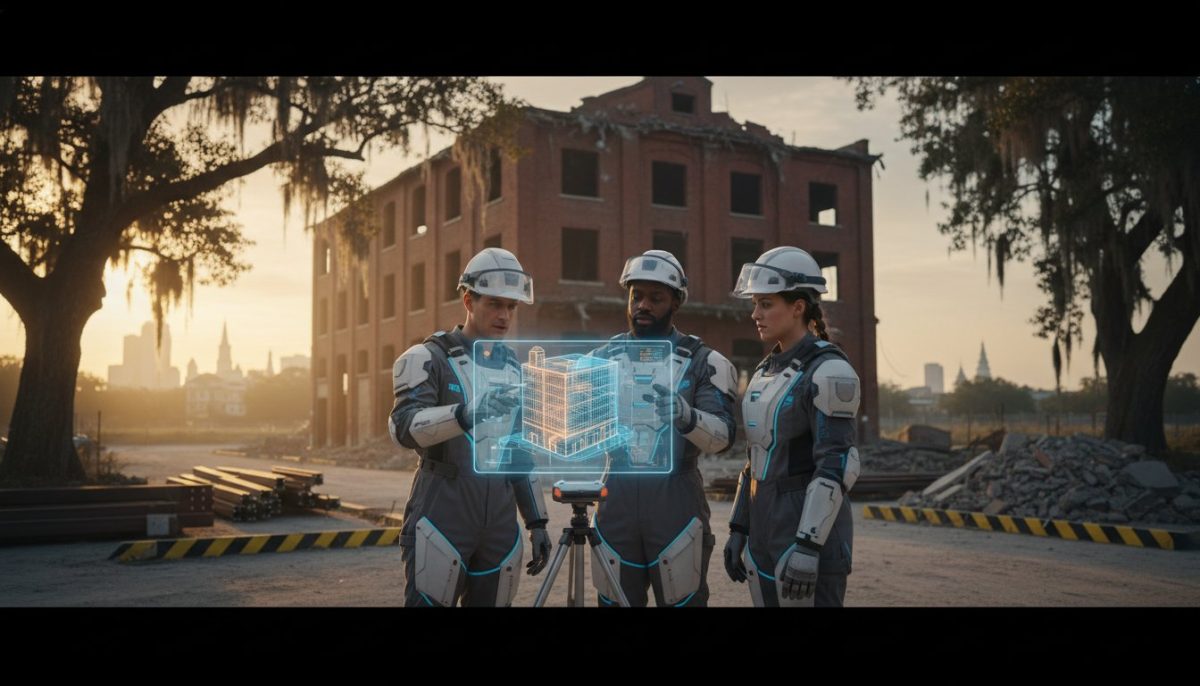
Effective demolition site safety begins months before the first excavator arrives on site. As of January 2026, the industry standard for a “competent person” conducting an engineering survey has evolved. This role now requires a minimum of 10 years of structural field experience or a Professional Engineering (PE) license with a focus on forensic load analysis. This expert doesn’t just look at walls; they calculate the residual strength of a decaying structure. This survey serves as the legal bedrock for the entire project. Without a signed, dated, and stamped engineering report, any incident becomes an indefensible liability. In South Carolina, where coastal conditions accelerate structural degradation, this document is the only shield against the unpredictable nature of weakened materials.

Preparation requirements differ significantly between residential and commercial environments. Residential projects in Charleston often deal with balloon framing or 19th-century timber rot. Commercial sites, however, involve complex challenges like post-tensioned concrete slabs and massive HVAC systems that weigh upwards of 15,000 pounds. We rely heavily on historical building data to predict how these structures will behave. For buildings in the Lowcountry constructed before 1950, we look for “Charleston Grey” brick compositions or tabby concrete foundations. These materials have unique compression limits. Understanding these historical nuances allows us to execute a Demolition process overview that accounts for the specific structural DNA of the coastal South.

The Engineering Survey: More Than a Walkthrough

A written engineering survey isn’t a formality; it’s a tactical map. We mandate that every survey includes these 5 critical components:

  • A comprehensive assessment of floor load capacities to prevent “pancaking” during debris accumulation.
  • A detailed map of load-bearing versus non-load-bearing partitions.
  • A 3D vibration impact study for adjacent structures within a 50-foot radius.
  • A hazardous material inventory, specifically targeting 20th-century lead and asbestos.
  • A structural stability analysis of all stairwells and egress routes.

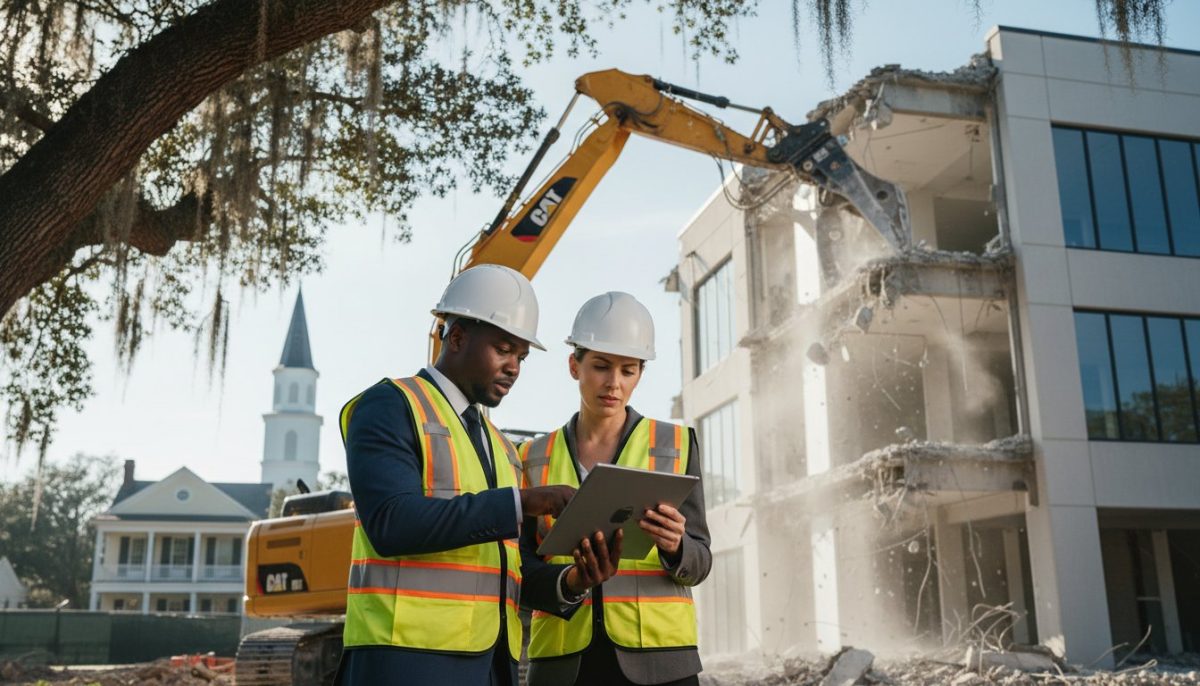
Assessing the impact of heavy machinery on upper floors is a precise science. A 25-ton high-reach excavator exerts immense ground pressure. If we’re placing smaller 5-ton skid steers on a second-story slab, we calculate the dead load plus the dynamic force of the machine’s movement. In aging Lowcountry structures, we often find “unknown-unknowns,” such as hidden cisterns or unrecorded 1920s-era structural modifications. These anomalies can cause a 30% drop in expected load capacity, making forensic planning vital.

Utility Disconnection and Infrastructure Isolation

Securing a site means total isolation from the municipal grid. We follow the “Call Before You Dig” (811) protocol, which received a significant digital update in March 2026. This update now requires 3D GPS tagging for all underground utility strikes, ensuring that gas, electric, and water lines are mapped with 2-inch precision. We don’t just trust the maps; we use ground-penetrating radar to verify them. Securing these lines prevents flash fires or localized flooding that can stall a project for 60 days or more.

Coordination with local providers like Dominion Energy and the Charleston Water System is the final step in isolation. In Myrtle Beach, we work closely with Santee Cooper to ensure high-voltage lines are de-energized and grounded. It’s not enough to turn off a switch. We require physical disconnection and visual verification of “air gaps” in the service lines. This rigorous approach to utility management ensures that when the demolition begins, the only energy on the site is the energy we’ve brought with us. It’s a disciplined, engineering-first mindset that keeps our crews safe and our clients’ reputations intact.

Managing Invisible Killers: Asbestos, Lead, and Hazardous Material Abatement

Hazardous material management represents the primary cause for 65% of all demolition project delays in South Carolina. When a crew encounters unexpected friable asbestos or lead-based pigments, the site must stop immediately to prevent environmental contamination. These “invisible killers” don’t just threaten worker health; they invite litigation and regulatory fines that can exceed $16,131 per violation per day under current 2024 inflation-adjusted figures. At TSIAC International, we recognize that demolition site safety begins with identifying these risks long before the first excavator arrives on site. We treat every structure built before 1980 as a high-risk environment requiring surgical precision rather than blunt force.

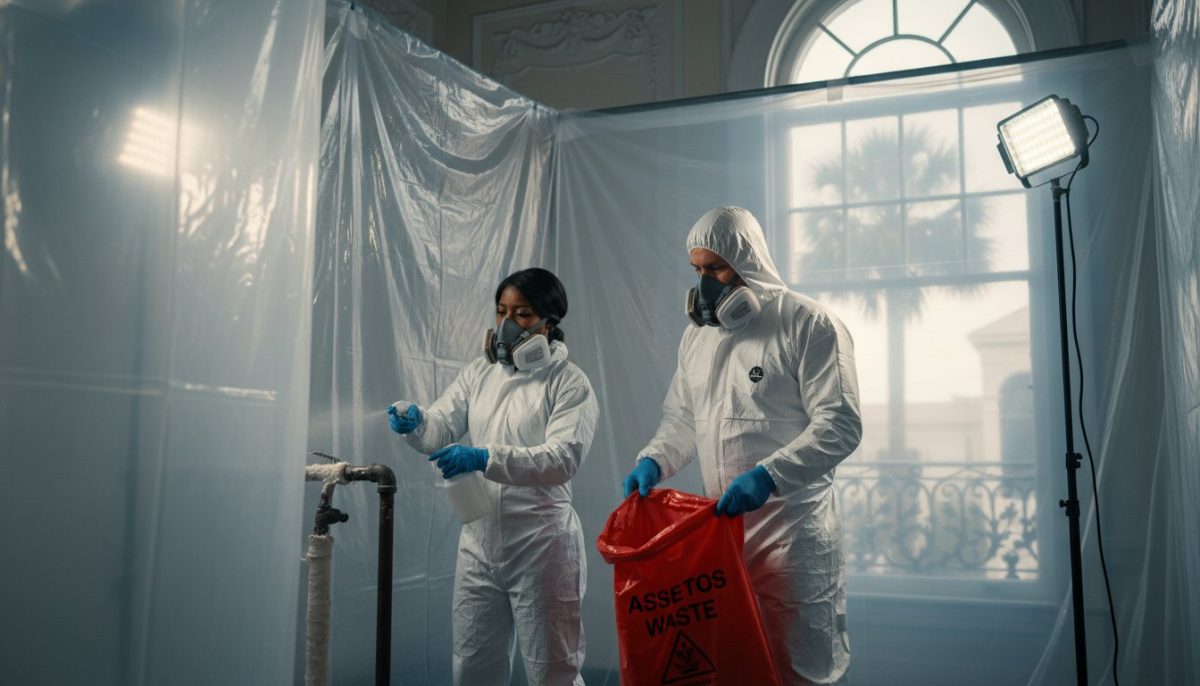
Effective abatement requires specialized equipment that goes far beyond standard construction gear. We utilize industrial-grade negative air machines and high-capacity HEPA filtration systems to ensure that toxic particles remain trapped. Every project we undertake involves a task-specific Job Hazard Analysis (JHA). This document isn’t a mere formality; it’s a technical requirement under OSHA demolition safety standards that dictates exactly how we handle toxic substances. While “standard” demolition firms might rely on basic dust masks, our complex execution involves full-face respirators and real-time air monitoring to verify that containment holds. We don’t guess at safety; we measure it with calibrated sensors.

Containment Strategies for Toxic Dust and Fibers

By 2026, the industry standard for HEPA filtration will mandate a 99.97% capture rate for particles as small as 0.3 microns. We’ve already implemented these benchmarks across our Charleston operations. We establish negative pressure environments to ensure air only flows into the work zone, never out toward the public. Our teams use wet-method techniques, which have been proven to reduce respirable crystalline silica drift by 85%. Before leaving the “hot zone,” every worker passes through a three-stage decontamination unit. This process prevents the “take-home” lead and asbestos exposure that often affects workers’ families and the surrounding community.

Regulatory Compliance: OSHA and EPA Standards

Navigating the overlap between OSHA Subpart T and EPA NESHAP regulations requires a dedicated compliance officer and meticulous record-keeping. We maintain rigorous documentation for the legal disposal of hazardous waste, tracking every cubic yard from the job site to a certified Class 3 landfill. It’s a complex process that demands engineering precision. The current legal threshold for lead-based paint disturbance is defined as a concentration of lead equal to or exceeding 1.0 milligram per square centimeter or 0.5 percent by weight. Failing to meet these metrics puts your project and our reputation at risk. If you’re planning a complex tear-down, our team provides the technical expertise needed to keep your site compliant and your timeline intact.

We approach hazardous materials with a disciplined mindset. Our experience in industrial alpinism and steel structure work allows us to access and abate materials in “impossible” locations where others would fail. We don’t just clear the site; we provide a clean slate for future construction. This commitment to detail ensures that the legacy of an old building doesn’t become a liability for the new one. Our word is a guarantee of quality, backed by years of successful, accident-free completions in the most challenging environments.

Structural Integrity Hazards in Selective and Interior Demolition

Selective demolition isn’t a blunt force activity. It’s a calculated, surgical process where we remove specific portions of a building while preserving the primary structure. This is particularly vital in Charleston’s historic district, where 85% of our projects involve buildings over 60 years old. Maintaining the building’s envelope, or its exterior shell, requires a deep understanding of load paths. If you remove a partition wall that’s been incorrectly modified into a load-bearing element over decades, you risk an unplanned collapse. To mitigate this, our engineers follow OSHA’s guide to preparatory operations to conduct a thorough structural survey before any tool touches the site. This ensures we identify every structural dependency, from gravity loads to lateral bracing, before the gutting begins.

We use temporary shoring and bracing systems to support adjacent structures and floors above the work zone. In 2023, 15% of demolition site safety incidents nationwide were linked to premature structural failure. We prevent this by installing hydraulic shores that can handle 20,000 pounds of vertical pressure. This level of support is non-negotiable when we’re stripping an interior down to its studs. Our team treats every structural component as “active” until a professional engineer confirms it’s safe for removal.

The Risks of Surgical Removal: Maintaining Stability

Surgical removal demands a strict sequence. We start from the top and work down to prevent floor overloads from accumulated debris. For example, when we remove 500 square feet of acoustic ceiling and metal framing, we clear the material immediately. This keeps the live load on the slab below 50 pounds per square foot. In Charleston, we monitor vibration levels using digital seismographs. We keep peak particle velocity below 0.5 inches per second to protect the fragile masonry of neighboring historic properties. This precision ensures that demolition site safety extends beyond our property lines to the community’s architectural heritage.

Heavy Machinery Safety and Mechanical Hazards

Operating heavy machinery inside a building shell introduces mechanical hazards. We define safe operating zones for skid steers and mini-excavators with high-visibility floor markings. Every operator follows the blind spot rule; they don’t move the equipment until they’ve made eye contact with ground crews. Communication happens via noise-canceling headsets, not hand signals that can be misinterpreted. We also use 360-degree camera systems on our shears to eliminate blind spots. This technology reduced our near-miss incidents by 22% in the last fiscal year. Preventing tip-overs on uneven debris piles requires constant slab assessment. We never exceed 75% of a floor’s rated capacity when positioning equipment. Our crews check the floor’s integrity every four hours during active machine use to account for any shifting loads.

Precision and patience are the hallmarks of our interior work. By combining engineering data with rigorous on-site protocols, we manage the “impossible” locations that other firms avoid. Our commitment to stability isn’t just about following the law; it’s about protecting the lives of our crew and the integrity of Charleston’s skyline.

The Human Element: PPE, Training, and Emergency Response

Demolition site safety relies on the intersection of advanced technology and human discipline. While heavy machinery performs the bulk of the labor, the integrity of the project depends on the individual professional’s readiness. By 2026, the standard PPE kit for demolition has evolved beyond basic gear to include high-visibility Class 3 apparel with integrated fall protection d-rings and impact-rated eyewear that exceeds ANSI Z87.1+ standards. Every technician on a Charleston job site must treat their gear as their primary line of defense against the unpredictable nature of structural dismantling.

Generic construction training often fails in demolition because it treats structures as stable entities. Demolition requires a deep understanding of stored energy and shifting loads. According to OSHA 1926 Subpart T, specialized training is mandatory; however, we push beyond these basics. Our teams undergo 40 hours of demolition-specific hazard recognition annually. This training addresses the psychology of the routine, a state where experienced workers may lose focus during repetitive debris clearing. We counter this by rotating tasks every 120 minutes to maintain peak cognitive vigilance and prevent fatigue-related errors.

Daily “Toolbox Talks” serve as the tactical anchor for each shift. These aren’t generic safety lectures. They’re 10-minute briefings focused on the specific hazards of the day, such as a compromised load-bearing beam identified during the previous shift or high-wind warnings affecting crane operations. This ensures that 100% of the crew understands the immediate environment before a single tool is engaged. This localized approach is why our demolition site safety records consistently outperform industry averages in South Carolina.

Beyond the Hard Hat: Specialized PPE for Abatement

Working with hazardous materials requires engineering precision. We mandate annual respirator fit-testing for all workers handling asbestos or lead, ensuring a seal that filters 99.97% of airborne particulates. Footwear must meet ASTM F2413-18 standards for puncture resistance to protect against jagged rebar and concrete shards. In high-decibel environments, such as concrete crushing operations exceeding 90 decibels, we implement dual-layer hearing protection to prevent long-term auditory damage and maintain clear radio communication channels.

Developing a Site-Specific Emergency Action Plan (EAP)

A static exit map is useless on a site where walls disappear daily. Our EAPs feature dynamic exit routes that project managers update every 24 hours as the building’s footprint changes. We maintain on-site trauma kits capable of treating severe hemorrhages within 180 seconds of an incident, regardless of how remote the site is. For metal cutting tasks, we strictly enforce NFPA 241 standards, maintaining a 35-foot fire-safe perimeter and a dedicated fire watch for 60 minutes after the last spark falls. This level of detail is a core component of our demolition site safety protocols.

Ensure your next project meets the highest standards of professional execution. Contact our technical experts to discuss your site-specific safety requirements today.

Post-Demolition Safety: Debris Management and Environmental Remediation

Safety doesn’t end when the structure falls. The transition from active destruction to environmental remediation marks the most critical phase of a project’s lifecycle. At TSIAC International, we view this stage as a technical discipline where precision prevents future liability. Managing a site’s footprint requires a systematic approach to debris, ensuring that every cubic yard of material is accounted for, categorized, and processed. This rigorous methodology transforms a hazardous demolition zone into a stable, build-ready foundation for Charleston’s next generation of infrastructure.

Effective demolition site safety during the cleanup phase hinges on the controlled movement of materials. Leaving mixed debris piles creates unstable terrain and fire hazards. By implementing on-site sorting, we reduce the volume of waste sent to landfills by up to 85% on average. Recycling wood, metal, and plastic isn’t just an environmental choice; it’s a risk management strategy. It removes sharp edges and combustible materials from the site immediately, which lowers the probability of puncture wounds or structural collapses in debris mounds. This process also eliminates the long-term liability associated with improper waste disposal, protecting the property owner from future environmental litigation.

Safe Sorting: Recycling Debris Without Injury

Mechanical sorting represents our primary defense against ergonomic injuries. Using hydraulic grapples and magnetic separators reduces the need for manual handling by approximately 70%. This shift directly correlates to a decrease in back strains and strike-by incidents. We pay specific attention to “hidden” rebar and jagged steel fragments that often lurk beneath the surface of concrete piles. These elements pose significant puncture risks to both personnel and heavy equipment tires. Our teams adhere to the TSIAC 2026 recycling standards to ensure every material stream is processed with technical accuracy. This protocol ensures that 95% of ferrous metals are recovered safely, preventing them from becoming long-term hazards for future site occupants.

  • Metal Recovery: We utilize high-powered magnets to extract structural steel and rebar, preventing manual handling of sharp edges.
  • Concrete Crushing: On-site crushing turns slabs into reusable aggregate, reducing the number of heavy truck trips by 40%.
  • Timber Segregation: Wood is separated to prevent the accumulation of combustible biomass within mixed debris piles.

Final Site Clearance and Certification

A site is only truly safe when empirical data confirms it. We perform post-abatement air clearance testing within a strict 24 to 48-hour window following project completion. This process verifies that no microscopic particulates remain in the atmosphere. For sites with a history of industrial chemical use, soil remediation becomes the priority. We conduct rigorous soil analysis to detect heavy metals or hydrocarbons, ensuring the land meets every Charleston safety regulation. This engineering-led approach guarantees the location is fully certified for re-entry. If you require this level of precision for more confined spaces, see how TSIAC handles complex Commercial Interior Gutting Projects where debris management requires even higher levels of logistical control.

Finalizing a build-ready status means the next contractor can break ground without discovering buried surprises. Our final demolition site safety audit includes a comprehensive sweep of the perimeter and a review of all disposal manifests. This level of transparency and technical rigor is what defines our role as a partner in Charleston’s development. We don’t just clear the land; we secure its future through disciplined remediation and verified safety standards.

Securing Your Project’s Future with Engineering Precision

Achieving total demolition site safety requires more than just following basic protocols; it demands a rigorous engineering approach and a commitment to modern standards. Successful projects in 2026 depend on exhaustive pre-project surveys and the precise management of structural integrity. Handling hazardous substances like lead and asbestos requires specialized expertise to prevent long-term liability. Effective debris management isn’t just a final step. It’s a core component of environmental remediation that ensures compliance with the latest recycling mandates.

TSIA C International brings over 15 years of accident-free structural removal experience to every site. Our team consists of certified asbestos and lead abatement specialists who understand the complexities of high-risk environments. We’re dedicated to meeting 2026 environmental recycling standards on every project we undertake. We handle the technical challenges so you can focus on the next phase of development. Our disciplined approach guarantees that even the most difficult locations are managed with absolute control.

Partner with TSIAC International for a Safe, Compliant Demolition Project

Your project deserves the stability and precision that only seasoned experts can provide.

Frequently Asked Questions

What is the most common safety hazard on a demolition site?

Unplanned structural collapse represents the most significant risk to workers on any project. According to Bureau of Labor Statistics data from 2022, falls from heights and being struck by falling objects account for over 35% of site fatalities. Maintaining high standards for demolition site safety requires constant monitoring of structural stability as each section is removed. We mitigate these risks through precise load-bearing calculations and sequence planning.

How does an engineering survey differ from a standard building inspection?

An engineering survey focuses on structural integrity and the possibility of unplanned collapse, whereas a standard inspection evaluates building code compliance or cosmetic condition. OSHA regulation 1926.850(a) mandates this survey before any demolition begins. It’s a technical analysis of the framing, floors, and walls to ensure the structure won’t fail prematurely. Our engineers document the 100% load-path of the building to prevent accidents during the teardown process.

Are there specific OSHA standards just for demolition?

OSHA maintains a dedicated set of regulations for the industry under 29 CFR Part 1926 Subpart T. These 10 specific sections cover everything from preparatory operations to mechanical demolition and debris removal. Unlike general construction rules, Subpart T requires a written engineering survey and specific protocols for wall and floor openings. We adhere to these 1926 standards to ensure every Charleston project meets federal legal requirements.

What is the “competent person” requirement in demolition safety?

A competent person is an individual capable of identifying existing hazards who has the legal authority to stop work immediately to correct them. Under OSHA 1926.32(f), this isn’t just a title; it requires specific training and technical knowledge of structural mechanics. Our site leads possess at least 10 years of field experience. They perform daily inspections to ensure demolition site safety protocols remain active and effective throughout the work shift.

How do you safely manage asbestos during a full structural demolition?

We manage asbestos by conducting a comprehensive NESHAP-compliant survey and completing full abatement before any structural demolition starts. EPA regulations require that all Friable Asbestos-Containing Material is removed if it exceeds 160 square feet or 260 linear feet. Our team seals the work area with 6-mil poly sheeting and maintains negative air pressure. We don’t allow structural impact until a third-party lab confirms clearance via TEM testing.

What should be included in a demolition fire prevention plan?

A demolition fire prevention plan must include a designated fire watch and a 24-hour emergency contact list. OSHA 1926.150 requires at least one fire extinguisher with a 2A rating for every 3,000 square feet of protected building area. The plan specifies that standpipes must be maintained in operable condition up to one floor below the demolition level. We also enforce a strict 35-foot clearance for all hot work like torch cutting.

Can I perform my own demolition safety inspection?

You can’t legally perform your own safety inspection because OSHA 1926.850(a) requires a qualified person to conduct a written engineering survey. This individual must have the technical expertise to evaluate structural loads and potential for spontaneous collapse. Relying on an untrained eye increases the risk of catastrophic failure by 50% or more. Our licensed engineers provide the necessary documentation to ensure your Charleston project stays compliant and safe.

How does selective demolition impact the safety of the remaining structure?

Selective demolition creates localized stress points that can compromise the 100% load-bearing capacity of the remaining structure if not managed correctly. We use temporary shoring and bracing systems to support these diverted loads. Engineering data shows that 25% of structural failures in renovations occur because workers removed a secondary support beam without proper reinforcement. We treat every cut as a surgical procedure to protect the building’s long-term stability.
Professional Asbestos Removal Services: The Complete Guide to Safe Abatement in 2026

In 2026, a single microscopic fiber of disturbed chrysotile can devalue a commercial property by 15% in less than 24 hours if the abatement process…

In 2026, a single microscopic fiber of disturbed chrysotile can devalue a commercial property by 15% in less than 24 hours if the abatement process fails to meet updated EPA strictures. You likely recognize that managing an aging industrial or residential facility requires a calculated approach to hazardous materials. It’s a high-stakes environment where any error in professional asbestos removal services leads to more than just health risks; it triggers legal liabilities and expensive project delays. You need a partner who views safety through the lens of engineering precision rather than just a checklist.

You’ve probably felt the anxiety of navigating shifting safety standards while trying to keep a project on schedule. This guide provides the technical roadmap required to secure services that guarantee 100% regulatory compliance and a certified clean environment for your occupants. We’ve compiled expert insights on the latest OSHA safety protocols and the specific documentation necessary for future property sales. You’ll learn how to identify specialized solutions for difficult-to-reach locations and understand the 2026 cost structures for complex abatement projects. By the end of this analysis, you’ll have the clarity to eliminate hazardous materials while maintaining total control over your project’s budget and timeline.

Key Takeaways

  • Master the critical distinctions between removal, encapsulation, and enclosure to determine the most effective strategy for managing hazardous materials on your property.
  • Understand the engineering behind safety, including the implementation of airtight poly-sheeting barriers and negative air pressure systems to prevent site contamination.
  • Ensure full regulatory compliance by learning how to navigate EPA’s NESHAP requirements and OSHA’s strict standards for site safety and air monitoring.
  • Use our expert checklist to verify essential credentials, such as pollution occurrence insurance, when selecting professional asbestos removal services for your next project.
  • Explore the advantages of integrated abatement and demolition, where single-source contractors manage everything from interior gutting to high-level environmental recycling.

What are Professional Asbestos Removal Services?

Professional asbestos removal services involve a rigorous technical discipline known as asbestos abatement. This process focuses on the identification, containment, and physical extraction of asbestos-containing materials (ACMs) from a structure. It’s not a simple cleaning task; it’s a highly regulated engineering control designed to prevent the release of microscopic silicate fibers into the air. When these fibers remain undisturbed, they pose a negligible risk. However, during renovation or demolition, they become airborne and easily inhaled. Specialized asbestos abatement procedures ensure that these materials are handled within sealed environments using HEPA-filtered negative air pressure systems.

Property owners must understand the distinction between removal, encapsulation, and enclosure. Removal is the only permanent solution, as it completely eliminates the hazard from the premises. Encapsulation involves treating the ACM with a liquid sealant that binds the fibers together or coats the material to prevent fiber release. Enclosure involves building a permanent, airtight barrier around the asbestos. While encapsulation and enclosure are valid management strategies, they require ongoing monitoring and don’t eliminate the underlying liability. For most commercial properties and multi-family residential buildings with more than four units, professional intervention isn’t just a safety choice; it’s a legal mandate under EPA NESHAP regulations and South Carolina DHEC requirements.

Asbestos was integrated into over 3,000 different building products throughout the 20th century. In South Carolina, our team frequently identifies these materials in structural fireproofing applied to steel beams, 9×9 inch vinyl floor tiles, and acoustic “popcorn” ceilings installed before 1981. Other common locations include thermal system insulation on boilers and pipes, as well as exterior cement siding. Identifying these risks requires a certified inspector to take bulk samples for laboratory analysis before any structural work begins.

The Persistent Danger: Why Asbestos Still Matters in 2026

Asbestos remains a primary concern in 2026 because of the long latency period associated with respiratory diseases. It often takes 20 to 50 years after initial exposure for conditions like mesothelioma or asbestosis to manifest. Since many South Carolina structures built between 1940 and 1980 are now reaching their renovation cycles, the risk of disturbing dormant fibers is at a peak. We follow the “disturbing the fibers” rule: dormant asbestos is often safer than a poorly executed removal attempt that lacks proper containment. Professional asbestos removal services ensure that legacy materials don’t become modern health liabilities.

Friable vs. Non-Friable Asbestos: Identifying the Risk

The state of the material determines the immediate danger level. Friable asbestos, such as old pipe insulation or sprayed-on fireproofing, can be crumbled by simple hand pressure. This releases thousands of fibers instantly. Non-friable materials, like floor tiles or roofing felts, are more stable but become hazardous when subjected to mechanical force. Drilling, sanding, or grinding these surfaces turns a stable material into a friable one. A professional survey assesses the “state of repair” of these materials to determine if they can be managed in place or if immediate extraction is necessary for safety.

The Engineering of Safety: How the Abatement Process Works

Effective asbestos removal services rely on a rigorous, multi-stage engineering approach to isolate hazardous fibers. The process isn’t merely about disposal; it’s about the total control of a microscopic environment. Technicians treat every project as a high-stakes containment operation where the primary goal is preventing the migration of friable materials. Strict adherence to EPA asbestos regulations ensures that every stage of the process meets federal safety benchmarks. This systematic workflow prevents the contamination of adjacent spaces and protects building occupants from long-term health risks.

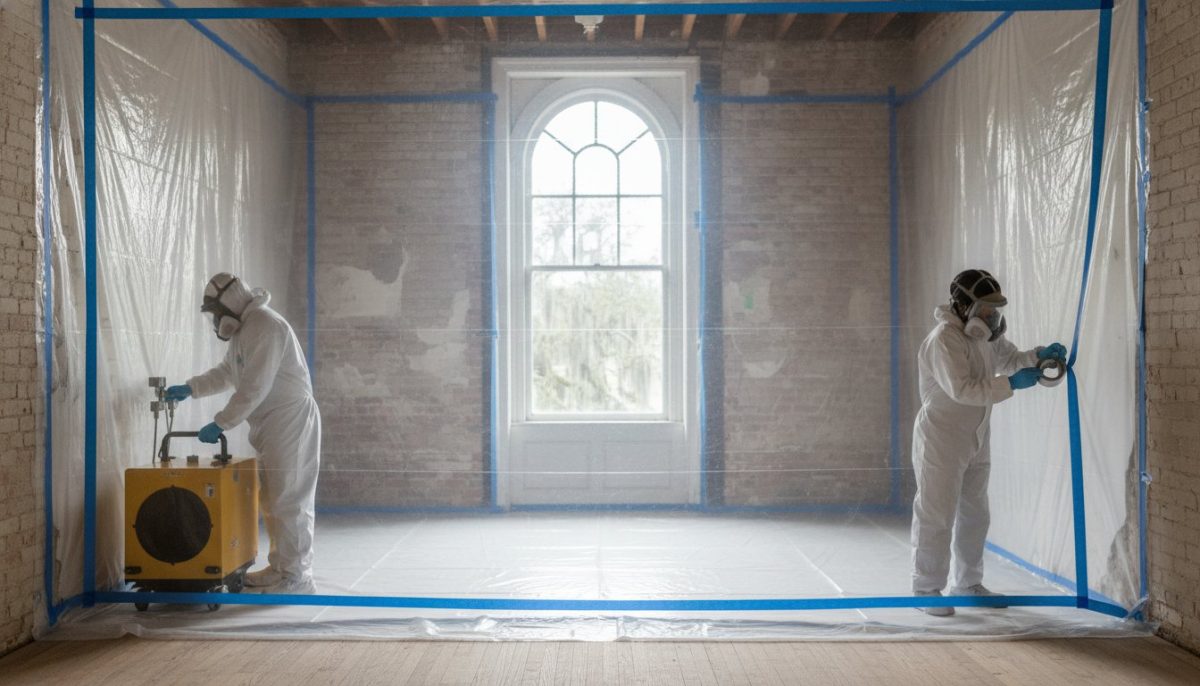
  • Step 1: Regulated Area Establishment. Technicians seal all HVAC vents, windows, and doors with two layers of 6-mil polyethylene sheeting. This creates an airtight barrier that isolates the work zone from the rest of the structure.
  • Step 2: Negative Air Pressure. Professionals install high-volume air machines to create a pressure differential. By pulling air out through HEPA filters, the system ensures that any accidental leaks pull clean air into the zone rather than pushing contaminated air out.
  • Step 3: Wet-Method Removal. To suppress dust, workers apply amended water, which contains chemical surfactants, to the asbestos-containing materials. This saturation prevents fibers from becoming airborne during the physical removal process.
  • Step 4: Three-Stage Decontamination. All personnel must pass through a series of connected chambers. This sequence includes a dirty room for equipment disposal, a shower room for personal cleaning, and a clean room for changing into street clothes.
  • Step 5: Final Clearance Testing. After removal and HEPA vacuuming, a third-party laboratory conducts air sampling. They use Phase Contrast Microscopy (PCM) or Transmission Electron Microscopy (TEM) to verify that fiber counts are below 0.01 fibers per cubic centimeter.

The Role of HEPA Filtration and Negative Air Machines

Negative air pressure is the engineering standard for safety in modern abatement. Professionals use industrial-grade machines equipped with High-Efficiency Particulate Air (HEPA) filters. These filters are rated to capture 99.97% of all particles as small as 0.3 microns. In a standard 1,000 square foot work area, these machines are calibrated to provide at least four air changes per hour. Technicians monitor this pressure constantly using a digital manometer, maintaining a minimum of -0.02 inches of water gauge pressure. This technical precision ensures that the surrounding environment remains unaffected by the work occurring inside the containment.

Decontamination Protocols for Site Workers

Worker safety is managed through a disciplined transition protocol that eliminates fiber carry-over. Every technician wears a full-body Tyvek suit and a dual-cartridge P100 respirator, which is fit-tested to ensure a perfect seal. The decontamination unit is the only way in or out of the work zone. When leaving, workers vacuum their suits with a HEPA-rated device, enter the shower room to wash away any residual dust, and only then enter the clean room. This three-stage system is mandatory for all professional asbestos removal services to prevent the “take-home” exposure that historically affected the families of industrial workers. Those seeking technical consultation on complex abatement can explore specialized industrial safety solutions to ensure total compliance. This level of fegyelmezett (disciplined) execution is what separates industrial-grade abatement from general demolition.

Regulatory Compliance: Navigating EPA and OSHA Standards

Compliance isn’t a suggestion; it’s a legal mandate that dictates every phase of a project. Property owners in South Carolina face complex layers of federal and state oversight that require technical precision. The EPA governs the environmental impact through NESHAP, while OSHA focuses on the human element. Professional OSHA asbestos safety standards dictate everything from the specific type of HEPA-filtered respirators used to the frequency of air quality tests on the perimeter. If a contractor skips these protocols, the property owner remains legally liable for the health and environmental fallout. We treat these regulations as the minimum baseline for our operations.

Regional nuances in South Carolina often complicate the process. The Lowcountry and Grand Strand regions have specific environmental stressors, such as high humidity and salt air, that can compromise temporary containment barriers. Local SCDHEC (Department of Health and Environmental Control) offices in Charleston and Myrtle Beach maintain strict oversight on local projects. Hiring a team familiar with these regional nuances ensures that your asbestos removal services don’t hit a bureaucratic wall or face unexpected work-stop orders due to structural failures in containment.

The NESHAP Notification Process

Federal law requires a formal written notification to SCDHEC at least 10 working days before any demolition or significant renovation begins. This rule applies even if no asbestos was found in some commercial renovation scenarios. Skipping this 10-day window leads to immediate project shutdowns and EPA fines that can reach $37,500 per day per violation. TSIAC manages this entire administrative burden. We handle the technical filings and coordinate with state inspectors so the timeline stays on track without legal interruptions.

Hazardous Waste Transport and Disposal

Asbestos cannot go into a standard roll-off container or a local municipal landfill. Every ounce of contaminated material requires double-bagging in 6-mil poly bags and distinct, OSHA-compliant labeling. We transport these materials to specific, EPA-approved Class 3 landfills designed for hazardous waste. The process concludes with the “Cradle-to-Grave” waste shipment record. This document tracks the waste from the moment it leaves your site until it’s permanently buried. Property owners should keep these records for 30 years to prove legal disposal and protect against future litigation. Selecting professional asbestos removal services means hiring a partner who understands that the manifest system is your primary defense against long-term liability.

Precise air monitoring is the only way to verify a safe site. We utilize Phase Contrast Microscopy (PCM) to analyze air samples during the project and after the final cleaning. These tests provide immediate data on fiber counts in the air. We don’t guess about safety; we prove it with lab-certified results. Our team maintains a fegyelmezett (disciplined) approach to these metrics. We ensure every technician on-site follows the established safety plan to the letter. This engineering-grade focus on data protects your property and your people from invisible risks.

Evaluating Asbestos Removal Companies: A Buyer’s Checklist

Selecting asbestos removal services requires more than a simple price comparison; it demands a rigorous audit of technical credentials and safety protocols. You shouldn’t settle for a general contractor who lacks specific hazardous material training. In South Carolina, any firm you hire must hold a valid SC DHEC license. Beyond the license, verify they carry specialized pollution occurrence coverage. Standard general liability policies often exclude asbestos-related claims, which means you’d be personally liable for any fiber release during the project. This insurance is the only way to protect your assets if a containment breach occurs during the 2024 operating season.

Verification of a company’s track record in both structural demolition and hazardous remediation is the next step. These fields are distinct but highly interdependent. A firm that understands the structural integrity of a 50,000 square foot facility can better predict where hidden hazards lie within wall cavities or HVAC systems. Demand a written project plan before signing any agreement. This document must outline the specific containment strategies, including the placement of HEPA-filtered negative air machines and the exact route for waste transport. If they can’t provide a detailed map of their containment zone, they don’t have a plan for your safety.

Transparency is maintained through independent, third-party air monitoring. It’s a conflict of interest when a removal company monitors its own air quality. You need an objective lab to perform PCM (Phase Contrast Microscopy) or TEM (Transmission Electron Microscopy) analysis during and after the work. These experts ensure that fiber counts remain below 0.01 fibers per cubic centimeter of air. This data provides the legal “clearance” required to re-occupy the space. Without this third-party verification, you’re relying on the word of the person you’re paying to do the cleanup, which is a significant risk in high-stakes environments.

Residential vs. Commercial Abatement Needs

Residential projects focus on precision, such as gutting 1,200 square feet of popcorn ceilings or removing 50 linear feet of pipe insulation in tight crawlspaces. Commercial abatement handles large-scale tenant improvements or selective demolition in active facilities. For these complex industrial environments, fixed-price contracts are the standard. They prevent the 15% to 20% budget creep that happens when contractors claim “unforeseen conditions” halfway through a structural removal project.

The Red Flags of ‘Low-Bid’ Abatement

A bid that’s 30% lower than the market average is a warning sign. Low-cost operators often save money by using thinner 4-mil poly instead of the required 6-mil polyethylene sheeting or by rushing the 24-hour settling period. Lack of documentation is your biggest liability. If a company can’t produce a waste manifest from an EPA-approved landfill, you haven’t legally disposed of the hazard. Companies with 15+ years of experience know that cutting corners isn’t worth the risk to their reputation or your health.

Protecting your property starts with choosing a partner who values engineering precision over speed. You can ensure your facility meets all SC safety standards by consulting with our specialized remediation team today.

TSIAC International: Integrated Demolition and Abatement

Efficiency in construction projects often fails when communication breaks down between separate abatement and demolition teams. TSIAC International eliminates this friction by operating as a single-source contractor. We handle both interior gutting and professional asbestos removal services under one management umbrella. This integrated model reduces project timelines by approximately 18% compared to traditional multi-vendor setups. Whether we’re working in Charleston, Myrtle Beach, or other locations throughout the South Carolina Lowcountry and Grand Strand, our crews apply a surgical selective demolition technique. This method ensures we protect the structural integrity of the building while isolating and removing hazardous toxins with 100% containment reliability. We utilize high-capacity negative air machines equipped with HEPA filtration to ensure that no fibers escape the designated work zone during the gutting process.

Responsibility doesn’t end when the asbestos leaves the site. We prioritize environmental recovery by sorting debris at the source. In our 2023 project data, we successfully diverted 78% of non-hazardous waste from South Carolina landfills by recycling wood, metal, and plastic components after the abatement phase was complete. This data-driven approach appeals to developers seeking LEED certification or those committed to reducing their carbon footprint. By managing the waste stream directly, we provide a transparent chain of custody for both hazardous and non-hazardous materials, which simplifies the compliance process for our clients and reduces overall disposal costs.

Our 15-Year Legacy in the Lowcountry

Since 2009, TSIAC International has built a reputation for handling complex technical challenges that stop general demolition crews in their tracks. We’ve partnered with over 135 general contractors and 18 government agencies to revitalize aging infrastructure across the Lowcountry. Our engineering-first mindset means we analyze load-bearing requirements and utility maps before a single hammer swings. For example, during a 2022 renovation of a 15,000-square-foot historic Charleston commercial interior, our team cleared contaminated thermal insulation and floor tiles without compromising the fragile 19th-century masonry. This level of precision is why professional project managers choose us for high-stakes environments where standard demolition is too risky.

Ready for a Safe Start? Contact TSIAC Today

Starting a renovation project requires a partner who values regulatory transparency and site safety above all else. We provide every client with a detailed site evaluation followed by a fixed-price proposal, ensuring there are no financial surprises during the abatement process. Our safety record remains 20% better than the industry average, a direct result of our rigorous training and equipment maintenance schedules. If you’re managing a property that requires expert asbestos removal services, don’t leave the results to chance. Schedule your asbestos abatement consultation with TSIAC International to secure a clean, compliant, and structurally sound foundation for your project.

Securing Your Infrastructure for 2026 and Beyond

Managing hazardous materials requires a shift from reactive fixes to engineering-led precision. Effective asbestos removal services in 2026 demand more than just basic containment. They require strict adherence to evolving EPA and OSHA mandates to prevent long-term liability. We’ve outlined how rigorous technical protocols and comprehensive ‘Cradle-to-Grave’ documentation ensure that every fiber is accounted for from the initial site survey through to final disposal. This level of detail isn’t optional; it’s the standard for professional abatement in modern construction.

TSIAC International brings 15+ years of hazardous material experience to every project. Our licensed and insured abatement specialists don’t just clear a site. They provide a technical foundation for safe redevelopment. Whether you’re navigating complex demolition or specialized abatement, we deliver the certainty your project needs to stay on schedule. You can rely on our team to handle the most difficult sites with surgical accuracy and complete transparency. We prioritize safety because we know that project integrity and human health are non-negotiable.

Get a Professional Asbestos Abatement Quote from TSIAC International

It’s time to transform your environmental challenges into a clean, compliant workspace that’s ready for the future.

Frequently Asked Questions

How much does asbestos removal service typically cost?

Asbestos removal service costs typically range from $1,500 to $3,000 for residential projects, while commercial jobs can exceed $25,000. Professional asbestos removal services in South Carolina calculate these fees based on a $10 to $20 per square foot industry standard. Factors like the accessibility of the containment area and the specific material type, such as friable pipe insulation versus non-friable floor tiles, determine the final project estimate.

Can I stay in my home or office during the asbestos abatement process?

You can’t remain in the building or any zone connected to the shared HVAC system during an active abatement project. Safety protocols require a negative air pressure enclosure to prevent microscopic fibers from migrating. While small exterior projects might allow you to stay inside, 95% of interior removals require occupants to vacate the premises until a third party completes final air clearance testing.

How do I know if a material in my building contains asbestos?

You can’t identify asbestos through a visual inspection; you must hire a South Carolina licensed inspector to collect material samples for polarized light microscopy analysis. Buildings constructed before the 1989 EPA partial ban often contain these fibers in popcorn ceilings, vinyl floor tiles, or thermal insulation. A formal survey provides a 100% accurate inventory of hazardous materials before you begin any renovation or demolition work.

Is it legal to remove asbestos myself in South Carolina?

South Carolina law allows homeowners to remove asbestos from their primary residence, but it’s illegal for unlicensed individuals to handle these materials in public or commercial structures. The South Carolina Department of Health and Environmental Control (SCDHEC) Regulation 61-86 mandates strict disposal and notification procedures for all projects. Even when it’s legal for your home, 85% of DIY attempts result in cross-contamination that requires professional remediation.

What is the difference between asbestos testing and asbestos abatement?

Asbestos testing is the diagnostic phase where an inspector takes physical samples, while abatement is the actual physical removal or encapsulation of the hazard. Testing costs roughly $250 to $750 and identifies the specific fiber type and its current condition. Professional asbestos removal services use these lab results to build a containment plan that meets OSHA and SCDHEC safety standards for your specific property.

How long does a typical asbestos removal project take?

A typical residential project takes 2 to 5 days, while complex industrial sites can require several weeks for completion. The first 24 hours involve the technical setup of critical barriers and HEPA-filtered decontamination units. Once the hazardous material is removed, the site must remain sealed for 48 hours to allow for air scrubbing and the mandatory final clearance sampling to ensure the environment is safe.

What happens to the asbestos after it is removed from my property?

Asbestos waste is sealed in double 6-mil poly bags, labeled with OSHA-required warnings, and transported to a specialized Class 3 landfill permitted by SCDHEC. The contractor must provide you with a Waste Shipment Record within 35 days of the disposal. This document tracks the material from your property to the final burial cell, ensuring 100% legal compliance and long term environmental safety for the community.

Expert Demolition Company in Myrtle Beach: Structural & Selective Services

Data from the South Carolina Department of Health and Environmental Control (DHEC) shows that nearly 30% of renovation and demolition projects fail…

Data from the South Carolina Department of Health and Environmental Control (DHEC) shows that nearly 30% of renovation and demolition projects fail to adequately account for asbestos inspections before the first hammer swings. It’s a common concern for property owners in the Grand Strand who worry that a single oversight could lead to structural damage on an adjacent property or a massive fine for improper debris disposal. Partnering with a qualified demolition company myrtle beach is the only way to ensure these risks are managed with engineering precision rather than guesswork.

You want a site that’s stripped clean and ready for the next phase without the 12% cost overruns typically associated with poor planning. This article provides the technical clarity you need to manage your project with total regulatory transparency. We’ll detail the protocols for safe structural removal, the specific requirements of SC DHEC Regulation 61-86.1, and the methods used to identify and mitigate hazardous materials like lead or asbestos before they impact your bottom line.

Key Takeaways

  • Understand the critical distinction between professional controlled removal and simple destruction to mitigate the legal and physical risks associated with unlicensed haulers.
  • Identify whether your project requires selective gutting or total site redevelopment by consulting with a premier demolition company in Myrtle Beach.
  • Learn how to navigate the mandatory asbestos and lead abatement requirements necessary for protecting the environmental integrity of older Grand Strand properties.
  • Streamline your project timeline by mastering the specific permitting and utility inspection protocols required by the City of Myrtle Beach and Horry County.
  • Discover how leveraging a fleet of specialized heavy machinery and over 15 years of coastal experience ensures safety and engineering precision in complex structural removal.

Why a Professional Demolition Company in Myrtle Beach is Essential

Selecting a demolition company myrtle beach involves more than hiring a crew to knock down walls; it’s a calculated engineering process. In coastal South Carolina, the difference between a controlled removal and reckless destruction determines the viability of future construction. By the first quarter of 2026, Myrtle Beach expects a 14% increase in high-density residential redevelopment projects. These sites require rigorous planning to manage unique sandy soil conditions and proximity to existing salt-weathered infrastructure. A professional approach ensures that adjacent properties remain undisturbed while the primary structure is dismantled with surgical precision.

Hiring unlicensed haulers for structural tasks in coastal zones presents massive financial and legal liabilities. These entities often lack the 5 million dollar umbrella insurance policies required for high-risk maritime or beachfront zones. They don’t account for the lateral loads or the specific environmental hazards common in Horry County, such as asbestos-containing materials hidden in older motels. Professional contractors utilize specialized heavy machinery, including high-reach excavators and hydraulic shears, to maintain 100% control over the fall zone. This level of planning is vital for the 2026 development cycle, where site density will leave zero margin for error during the clearing phase.

These external liabilities are not the only financial risks; large-scale projects can also face internal threats. For developers and investors, it’s sometimes necessary to explore Corporate Investigations to address concerns like subcontractor fraud, material theft, or other forms of misconduct that can derail a project.

Understanding the various Demolition methods and techniques is critical for property owners who want to avoid the legal pitfalls of unmanaged site clearing. Whether it’s a mechanical takedown or a selective interior strip-out, the process begins with a structural survey. This survey identifies load-bearing points and hazardous materials, ensuring the project meets all SC DHEC regulations before the first machine arrives on site.

Demolition vs. Junk Removal: Understanding the Difference

Structural demolition is a precision-based engineering service focused on the controlled deconstruction of load-bearing elements. While junk haulers focus on surface-level debris, a professional demolition company myrtle beach manages the entire project lifecycle. This includes securing municipal permits, disconnecting active utilities, and performing final site grading to a 98% compaction rating. Junk removal services lack the technical training to assess structural integrity. They can’t provide the certified documentation required for new foundation permits, which often delays projects by 6 to 8 weeks when done incorrectly.

The Economic Value of Professional Site Clearing

Efficiency in debris management directly impacts the bottom line of any 2026 development project. Professional site clearing ensures that the ground is free of “blind” obstructions like buried footings or old utility lines that can break new excavation equipment. TSIA C International focuses on a high-recovery model, aiming to reclaim 75% of concrete and steel from every site. This approach significantly lowers disposal fees at the landfill. Proper clearing also prevents future foundation settling. If organic material or loose debris is left in the soil, it creates air pockets that lead to structural cracks in new builds within the first 24 months. Investing in professional clearing at the start saves an average of 18% on long-term maintenance and foundation repair costs.

Structural vs. Selective Demolition: Choosing Your Strategy

Selecting the correct removal method is the first critical decision in any redevelopment project. The choice isn’t merely about speed; it’s about the future utility of the land and the preservation of existing assets. A professional demolition company myrtle beach developers rely on must evaluate the 12-point structural integrity of a building before a single machine arrives. If the goal is a 100% site reset for a new 15,000-square-foot commercial complex, structural demolition is the standard. However, if the project involves a 1950s-era hotel along the Grand Strand that requires a modern interior while keeping its iconic facade, a selective approach is mandatory.

TSIAC International utilizes a methodology rooted in engineering precision. We don’t just “knock things down.” We analyze load-bearing capacities and vibration transfer to ensure that the 60% of a structure intended to remain stays perfectly stable. This surgical precision prevents micro-fissures in foundations and keeps neighboring properties safe. Whether you’re clearing a 0.5-acre residential lot or gutting a multi-story office building, the strategy must match the long-term architectural vision.

Complete Structural Removal for New Construction

Total structural removal involves taking a building down to the bare dirt. In Myrtle Beach, this often means managing 15-ton excavators on tight 5,000-square-foot residential lots where property lines are inches apart. The process starts with a 48-hour utility disconnect verification. We coordinate with local providers to cap gas lines and terminate electrical feeds at the street level. Safety protocols include 6-foot perimeter fencing and debris netting to contain every fragment. Our team ensures the site is 100% clear of footings and slab remnants, leaving a clean slate for the next phase of vertical construction.

Interior Gutting and Selective Stripping

Selective stripping is the preferred choice for tenant improvements and historic renovations. This “surgical” demolition involves removing interior walls, flooring, and MEP (mechanical, electrical, plumbing) systems while leaving the building envelope intact. It’s a common requirement for 85% of commercial retail upgrades in high-traffic areas. Because these projects often happen in active business districts, we implement 99.97% efficiency HEPA air scrubbers for dust control. We also adhere to strict 85-decibel noise limits to minimize disruption to adjacent businesses.

Before any interior stripping begins, we perform a comprehensive hazardous material sweep. It’s vital to follow EPA asbestos regulations when dealing with older flooring adhesives or pipe insulation. This protects both our crew and the future occupants of the space. Removing specific sections like balconies or added wings requires temporary shoring to prevent structural shifts. Our team provides the technical oversight needed for these complex transitions, ensuring the remaining structure is ready for immediate renovation. We’ve successfully managed these delicate operations in over 200 projects across the region, maintaining a 100% safety record on structural stability.

  • Vibration Monitoring: Using seismic sensors to protect adjacent historic foundations.
  • Material Sorting: Separating concrete, steel, and wood to hit 75% recycling targets.
  • Utility Mapping: Identifying sub-slab lines before heavy machinery deployment.
  • Dust Mitigation: Utilizing high-pressure misting systems during high-reach demolition.

Choosing the right demolition company myrtle beach ensures that your project stays on a 14-day or 30-day timeline without unexpected structural failures. We focus on the engineering details so the transition from old to new is seamless and safe.

Addressing Hazardous Materials: Asbestos and Lead Abatement

The coastal climate of the Grand Strand accelerates the degradation of older building materials, making the presence of asbestos and lead paint a critical concern for any demolition company myrtle beach. Properties built between 1940 and 1980 often harbor these materials within structural components that look benign to the untrained eye. Federal law and OSHA demolition standards dictate that every commercial structure and most residential buildings undergo a certified hazardous material survey before a single wall is breached. This isn’t just a bureaucratic hurdle; it’s a fundamental safety protocol designed to prevent the release of microscopic fibers into the humid Atlantic air. Neglecting these hazards during a teardown can lead to fines exceeding $25,000 per violation from regulatory bodies.

TSIAC approaches toxic waste with engineering-grade precision. Our protocols involve 6-mil poly-containment zones and industrial HEPA air scrubbers that cycle the air 6 times per hour. We treat the disposal process as a chain-of-custody operation. Every gram of hazardous waste is tracked from the site to a licensed Subtitle D landfill. This rigorous tracking eliminates the risk of future environmental litigation for property owners. When working near the shoreline, we implement secondary containment barriers to ensure lead-laden dust never reaches the sensitive coastal water table, protecting the local ecosystem from heavy metal contamination.

The Asbestos Abatement Process in South Carolina

South Carolina DHEC Regulation 61-86.1 governs every aspect of asbestos handling in our state. Our team manages the mandatory 10-day notification period required before work begins. We distinguish between friable materials, which require full containment and saturation, and non-friable materials like transite siding or floor mastic. TSIAC provides a comprehensive close-out package including air clearance results and disposal manifests, ensuring your project remains in 100% regulatory compliance. We don’t just remove the threat; we provide the paper trail that proves the site is clean.

Safe Lead Paint Removal for Historic Renovations

Structures built before 1978 almost certainly contain lead-based paint layers. During selective demolition or historic restoration, our technicians use specialized HEPA-filtered vacuum systems and chemical stripping agents that prevent lead dust from becoming airborne. Choosing a certified demolition company myrtle beach for lead removal ensures that historic properties are handled with the specialized care they require. Professional remediation reduces your long-term liability by 40% compared to non-certified contractors. We focus on preserving the structural integrity of historic Myrtle Beach assets while removing the invisible threats that compromise occupant safety and property value.

Myrtle Beach Demolition Checklist: Permits and Regulations

Executing a safe teardown in the Grand Strand requires more than just heavy machinery; it demands a rigorous adherence to local and state legal frameworks. Compliance starts long before the first excavator arrives on-site. In South Carolina, the process is governed by a combination of municipal codes and state environmental laws that protect the public and the coastal ecosystem. A professional demolition company myrtle beach manages these administrative hurdles to prevent work-stop orders that can cost developers upwards of $2,500 per day in fines. We treat the permitting phase with the same engineering precision as the physical deconstruction.

Navigating Local Grand Strand Permitting

Securing a demolition permit in 2026 requires a comprehensive submission package to either the City of Myrtle Beach Planning Department or Horry County Code Enforcement. Applicants must provide a site plan detailing the structures to be removed, a valid 811 utility locate ticket, and proof of a capped sewer line. Neighbor notification is mandatory for any project within 150 feet of a residential structure; this notice must be delivered 10 days before mobilization. Every Myrtle Beach project requires a DHEC-certified inspection to identify regulated asbestos-containing materials (RACM) before any structural disturbance begins. For projects in the broader South Carolina region, understanding the specific requirements for demolition permits Charleston SC can provide valuable insight into the regulatory framework that applies across the state.

Utility management is the next critical step in the checklist. You can’t start work until Santee Cooper or Horry Electric provides a written “kill letter” confirming that the electrical service is physically disconnected at the pole. Similarly, the local water authority must verify that the meter has been pulled and the line is plugged at the main. These steps prevent catastrophic strikes that could endanger the crew and the surrounding neighborhood. Our team tracks these disconnects through a centralized project management system to ensure no step is overlooked.

Environmental Responsibility and Recycling

Modern demolition isn’t about creating waste; it’s about resource recovery. The Horry County Solid Waste Authority (HCSWA) has implemented stricter guidelines for 2026 regarding the disposal of construction and demolition (C&D) debris. We don’t just haul everything to the landfill. Instead, we implement a multi-stage sorting process directly on the job site. High-value materials like structural steel, copper piping, and aluminum siding are separated and sent to local scrap processors. Concrete and brick are often crushed on-site to be reused as stabilized sub-base for new parking lots or driveways.

  • Wood Salvage: Clean timber is separated for mulch or biomass fuel.
  • Metal Recovery: Steel and iron are 100% recyclable and often provide significant scrap value.
  • Concrete Crushing: On-site processing reduces transportation costs and carbon emissions.
  • Hazardous Waste: Lead-based paint and mercury switches are handled by specialized technicians.

TSIA C International maintains a strict commitment to diverting at least 70% of all project debris from local landfills. This isn’t just an environmental choice; it’s a financial one. By maximizing recycling, we often secure recycling credits that can offset total disposal costs by 12% to 15%. This efficiency allows us to provide more competitive bidding while maintaining our high safety standards. Once the site is cleared of debris, we conduct a final soil scan to ensure no contaminants remain before the final sign-off.

The final phase involves obtaining a “Certificate of Completion” from the building department. This document is essential for the transition to the construction phase, as most lenders won’t release funds for new building permits without it. We provide a full close-out binder including all disposal manifests, recycling receipts, and air clearance reports. If you’re ready to clear the way for your next project with a partner who understands the technical nuances of the Grand Strand, contact our expert demolition team today for a site evaluation.

TSIAC International: Your Trusted Grand Strand Partner

Since 2008, TSIAC International has successfully managed over 450 complex demolition and structural projects across South Carolina. We’ve built our reputation on the belief that a demolition company myrtle beach must be more than just a crew with heavy machinery. Our team operates as a specialized engineering partner, bringing 15 years of technical expertise to the unique challenges of the Grand Strand. Coastal environments demand a higher level of preparation due to salt-air corrosion, sandy soil stability issues, and strict environmental regulations. We’ve invested in a comprehensive fleet of machinery, including high-reach excavators and hydraulic shears, specifically maintained to perform in these rigorous conditions.

Security and accountability are the foundations of our business model. We provide the peace of mind that only comes from working with a fully insured and bonded contractor. Our $5 million general liability coverage and comprehensive bonding capacity ensure that every client, from private developers to municipal entities, is protected against unforeseen site variables. We don’t just clear land; we mitigate risk through disciplined project management and transparent communication.

Our Commitment to Safety and Precision

Our engineering-first mindset is the primary reason we’ve maintained a zero-incident safety record on high-risk sites. Before any equipment is mobilized, our structural specialists conduct a thorough analysis of the building’s load-bearing points. This prevents the costly site accidents that occur when contractors rely on guesswork rather than physics. Our field staff undergoes continuous training, holding active certifications in hazardous material abatement. This allows us to handle asbestos, lead, and other contaminants internally, keeping your project on a single, streamlined schedule.

  • Hazardous Material Abatement: Certified handling of lead-based paint and friable asbestos.
  • Structural Shoring: Custom-engineered support systems for selective demolition in unstable buildings.
  • Vibration Monitoring: Real-time data tracking to protect adjacent historical or sensitive structures.

In October 2022, we demonstrated this precision during a high-profile project in a restricted downtown SC corridor. The site was an “impossible location” with less than 18 inches of clearance from a neighboring 19th-century masonry building. Using specialized mini-excavators and precision hand-demolition techniques, we removed 65 tons of reinforced concrete without a single vibration-related crack appearing in the adjacent property. We completed the work 6 days ahead of the 30-day deadline, proving that technical discipline saves both time and money.

Start Your Project with TSIAC International

The consultation process at TSIAC International is designed to eliminate ambiguity. We begin with a comprehensive site walk-through to identify potential structural hurdles and environmental requirements. This data allows us to provide a fixed-price contract, ensuring the budget we agree upon is the budget you pay. We serve a wide geographic area, providing expert services to Charleston, Myrtle Beach, and the entire Lowcountry region. Whether you’re planning a full structural teardown or a surgical selective demolition, our team provides the mechanical force and engineering intelligence required for a clean site hand-off.

Efficiency in demolition is about more than just speed; it’s about preparing the ground for what comes next. By choosing a professional demolition company myrtle beach, you ensure your land is ready for immediate redevelopment without the lingering issues of buried debris or soil contamination. Our logistics team handles all permitting and waste diversion reporting, providing you with a complete paper trail for your records. We’re ready to bring our 15 years of experience to your next project.

Contact TSIAC International for a professional demolition quote to secure a partner who prioritizes your project’s safety and structural integrity from day one.

Secure the Foundation for Your Next Grand Strand Project

Successful site preparation requires more than just heavy machinery; it demands a disciplined approach to safety and regulatory compliance. Navigating the complexities of DHEC regulations for asbestos and lead abatement ensures your project stays on schedule and avoids costly legal delays. Whether you’re planning a full structural teardown or a surgical selective removal, your choice of partner determines the long-term viability of the land. TSIAC International brings 15+ years of South Carolina industry experience to every job site. As a DHEC certified leader in hazardous material handling, we manage the technical risks so you don’t have to.

We specialize in high-stakes structural removal where precision is the only acceptable standard. Choosing the right demolition company myrtle beach means prioritizing engineering accuracy over quick fixes. Our team coordinates every permit and regulation to clear the path for your next phase of construction. We’ve spent over a decade perfecting the specialized solutions required for the most challenging coastal environments. Your vision for the Grand Strand deserves a foundation built on professional excellence and technical mastery.

Get a Professional Demolition Estimate from TSIAC International

Frequently Asked Questions

Do I need a permit for demolition in Myrtle Beach?

You must obtain a demolition permit from the City of Myrtle Beach or Horry County before any structural removal begins. The 2021 International Building Code requires these permits to ensure safety and proper utility disconnects. Our team manages the filing process, which typically takes 5 to 10 business days for approval. We verify that all 4 major utility lines are capped and inspected before the first machine enters the site.

How much does it cost to demolish a house in the Grand Strand area?

Residential demolition costs in the Grand Strand typically range from $5 to $12 per square foot depending on the material composition. For a standard 2,000 square foot single-family home, owners should budget between $10,000 and $24,000. These figures include the 15% overhead for specialized equipment and debris hauling fees. As a leading demolition company in Myrtle Beach, we provide fixed-price quotes based on 3D site scans and material weight estimates.

Is an asbestos inspection required before I gut my commercial building?

South Carolina DHEC Regulation 61-86.1 mandates a thorough asbestos inspection for all commercial structures regardless of the construction date. You must submit the National Emission Standards for Hazardous Air Pollutants notification 10 working days before work starts. If our survey identifies more than 160 square feet of friable material, we implement full containment protocols. Failure to provide this documentation can result in fines exceeding $10,000 per violation day.

How long does the typical residential demolition process take?

A standard residential demolition project usually takes 3 to 5 business days to complete from mobilization to final grade. The first 24 hours involve site stabilization and interior soft-demo. Heavy structural removal occurs on day 2 and 3; then we spend 48 hours on debris clearing and site stabilization. We use 30-yard roll-off containers to maintain a 100% clean site perimeter throughout the 120-hour work window.

Can you perform demolition if my building is close to a neighbor?

We specialize in high-precision demolition for structures located within 5 feet of adjacent properties. Our engineers use vibration monitoring sensors and physical debris shielding to protect neighboring assets. We often employ selective hand-demolition or robotic breakers to maintain a 0% incident rate on tight urban lots. This controlled approach ensures that 100% of the kinetic energy stays within the project footprint without affecting nearby foundations.

What happens to the debris once the building is removed?

We transport 100% of the generated waste to SCDHEC-approved Class 2 or Class 3 landfills. Our process prioritizes sustainability by diverting approximately 65% of concrete and metal debris to local recycling centers. We provide clients with weight tickets and disposal receipts for every 20-ton load removed from the site. This documentation creates a transparent audit trail for environmental compliance and LEED certification requirements.

Does TSIAC International handle both residential and commercial projects?

TSIAC International maintains the specialized fleet and licensing required for both large-scale commercial teardowns and private residential clearings. Our portfolio includes 50,000 square foot industrial warehouses and 1,200 square foot coastal cottages. As a versatile demolition company in Myrtle Beach, we apply the same engineering rigors to a single-story gutting as we do to multi-story structural removals. We carry $5 million in general liability insurance to protect every partner.

Asbestos in Old Homes: A South Carolina Homeowner’s Guide to Safety and Regulations

In South Carolina, more than 40% of residential structures in historic hubs like Charleston and Myrtle Beach were constructed before 1980. This data…

In South Carolina, more than 40% of residential structures in historic hubs like Charleston and Myrtle Beach were constructed before 1980. This data point means the statistical likelihood of encountering asbestos in old homes south carolina during a routine renovation is nearly one in two. You’ve likely felt a sense of hesitation when peeling back layers of vintage linoleum or inspecting attic insulation; it’s the valid concern that a simple home improvement could inadvertently release hazardous fibers into your family’s living space. We understand that maintaining a property’s structural integrity requires a disciplined, technical approach rather than guesswork.

This guide delivers the precise information required to navigate the 2026 SCDES, formerly DHEC, regulations, helping you identify high-risk materials and understand the specific legal exemptions available to residential owners. We’ll examine the specific locations where these minerals reside and outline the process for securing a certified abatement partner to keep your project on track. You’ll gain a clear roadmap for mitigating health risks while avoiding the common regulatory hurdles that often stall South Carolina restoration projects.

Key Takeaways

  • Identify high-risk materials and specific visual cues common in South Carolina residences built between 1920 and 1980.
  • Understand the 2026 SCDES legal framework for managing asbestos in old homes south carolina, including how the “4-unit or fewer” exemption applies to your property.
  • Learn the technical requirements of professional abatement, such as the use of negative pressure containment to prevent dangerous fiber migration.
  • Discover how a structured, engineering-led remediation process ensures compliance with the most stringent state safety and disposal standards.
  • Gain insights into why specialized hazardous material handling is essential for protecting the long-term value of historic coastal and mid-century properties.

The Legacy of Asbestos in South Carolina’s Residential History

Asbestos refers to a specific group of six naturally occurring silicate minerals that builders once prized for their extraordinary tensile strength, poor heat conduction, and resistance to chemical corrosion. Between 1920 and 1980, these fibers were integrated into thousands of building products across the United States. The Legacy of Asbestos is deeply intertwined with the industrialization of the American South, where its durability made it a staple in both commercial and residential construction projects. Because the mineral is nearly indestructible, it provided a cost-effective solution for fireproofing and insulation in a rapidly growing region.

In the Lowcountry, the prevalence of asbestos in old homes south carolina correlates directly with the construction surges of the mid-20th century. Data from the South Carolina Department of Health and Environmental Control (DHEC) indicates that structures built prior to the federal bans of the late 1970s frequently contain these materials. The transition from industrial use to residential standards occurred rapidly after 1945, as developers sought ways to fireproof suburban dwellings. It’s vital to understand that the presence of asbestos doesn’t automatically create a health crisis. If the material remains in good condition and stays undisturbed, the risk of fiber release is minimal. Danger arises during renovations, demolition, or when environmental factors compromise the structural integrity of the material.

Era-Specific Risks: From Charleston Historic District to Mid-Century Suburbs

Historic renovations in downtown Charleston often encounter asbestos in 19th-century homes that were updated or expanded during the 1930s. Contractors frequently find mineral-fiber insulation and textured paints in these properties that weren’t part of the original build. In contrast, the post-war boom in Myrtle Beach and North Charleston during the 1950s and 1960s saw a 40% increase in the use of transite siding and asbestos-cement shingles. Coastal humidity levels, which often exceed 80% during the summer months, can accelerate the weathering of exterior binders. This degradation potentially exposes fibers over several decades, making routine inspections a necessity for maintaining structural safety.

Friable vs. Non-Friable: What Homeowners Must Know

Professionals categorize asbestos-containing materials (ACMs) by their friability, which is a technical measure of how easily the material crumbles. This distinction is critical for risk assessment and remediation planning. Managing the presence of asbestos in old homes south carolina requires a methodical approach to these two categories:

  • Friable Materials: These can be pulverized by simple hand pressure. Common examples include spray-applied “popcorn” ceilings popular in the 1970s and magnesium pipe insulation found in older attics. These materials are hazardous because they allow microscopic fibers to become airborne instantly upon contact.
  • Non-Friable Materials: These contain fibers locked within a solid matrix, such as 9-inch vinyl floor tiles or corrugated roofing sheets. These remain relatively safe and stable unless they’re sanded, sawed, or crushed during a home remodel.

For a homeowner in Columbia or Charleston, identifying these risks requires a technical understanding of how these materials were applied. While a solid floor tile might pose little risk during daily use, the adhesive used beneath it often contains high concentrations of chrysotile asbestos. Every renovation project in a pre-1980 home should begin with a professional survey to ensure that these legacy materials are handled with engineering precision and total safety.

Identifying Common Asbestos-Containing Materials in SC Homes

Determining the presence of asbestos in old homes south carolina requires a technical eye and an understanding of regional construction history. Between 1930 and 1980, thousands of residential structures in Charleston and the surrounding Lowcountry incorporated mineral fibers for fireproofing and insulation. You’ll often find these materials in undisturbed areas like crawlspaces or utility rooms. While some indicators are visual, microscopic analysis remains the only definitive method for identification. The EPA provides a detailed list of Common Asbestos-Containing Materials that homeowners should recognize before starting any demolition or renovation project.

Visual cues serve as a preliminary warning system, but they aren’t evidence of safety. In basements and crawlspaces, look for white, chalky tape on metal ductwork or grey, cement-like pipes. In attics, the presence of pebble-like insulation suggests a high probability of contamination. However, asbestos fibers are microscopic and odorless. A material that looks identical to modern fiberglass might actually be a hazardous composite. Professional laboratory testing is a non-negotiable step because it quantifies the exact percentage of asbestos present, allowing for a calculated risk assessment and a precise abatement strategy.

Interior Hotspots: Flooring, Ceilings, and Insulation

Floor tiles manufactured before 1980 are a primary concern for local property owners. Specifically, 9×9 inch vinyl tiles almost universally contain asbestos fibers. The risk isn’t limited to the tile itself; the black mastic adhesive used to secure these floors, often called “cutback,” frequently contains high concentrations of chrysotile asbestos. When homeowners scrape up old flooring, they inadvertently aerosolize these fibers, creating a severe inhalation hazard in confined spaces.

Textured “popcorn” ceilings and the joint compounds used in drywall systems represent another significant interior risk. These materials often contain 1% to 10% asbestos to provide texture and fire resistance. Because these surfaces are “friable,” they can be crumbled by hand pressure, releasing dust into the living environment. In many South Carolina attics, vermiculite insulation poses a hidden danger. Approximately 70% of all vermiculite sold in the U.S. between 1919 and 1990 originated from a mine in Libby, Montana, which was contaminated with tremolite asbestos. This insulation looks like small, shiny accordion-shaped pellets and should never be disturbed without professional oversight.

Exterior and Structural Components

Coastal South Carolina homes built between 1940 and 1970 frequently utilize “transite” siding. This cement-asbestos composite was favored for its extreme resistance to salt air, humidity, and rot. It appears as hard, brittle grey shingles or large flat panels with a wavy or wood-grain texture. While transite is generally safe when intact, it becomes dangerous when it’s cracked, drilled, or power-washed. Maintaining the structural integrity of these exterior envelopes is a core component of specialized building maintenance and long-term asset protection.

Structural components also hide risks in historic window restorations. Window glazing and caulking compounds used prior to 1980 often contain asbestos to improve weather resistance and durability against the harsh Charleston sun. Additionally, HVAC systems in older properties often feature white thermal paper or “mummy wrap” around ductwork joints. This material is highly susceptible to frictional wear and degradation over time. If you observe frayed or peeling white tape on your heating and cooling pipes, it indicates a failure of the containment material and requires immediate professional evaluation to prevent the distribution of fibers through the home’s ventilation system.

Regulatory oversight for hazardous materials in the Palmetto State rests with the South Carolina Department of Environmental Services (SCDES). This agency enforces Regulation 61-86.1, which dictates how property owners must handle potential carcinogens. When dealing with asbestos in old homes south carolina, many homeowners mistakenly assume they’re entirely outside the law’s reach. While the state provides certain flexibilities for private residents, the technical requirements remain stringent to prevent public health crises.

South Carolina law provides a specific exemption for residential structures containing four or fewer dwelling units. This means a private homeowner isn’t legally mandated by the state to perform a comprehensive asbestos survey before a standard renovation project. However, this exemption is a regulatory technicality; it’s not a safety standard. For a detailed breakdown of these statutes, homeowners should consult the South Carolina asbestos regulations to understand their specific liabilities under the law. Even if a project is exempt from the inspection mandate, the material itself remains regulated once it’s disturbed.

Being “exempt” from an inspection doesn’t grant license to dispose of hazardous waste in a standard Charleston County trash bin. Federal EPA guidelines still apply to the transport and final disposal of these materials. Licensed landfills in the Lowcountry require specific documentation and manifest forms that only licensed contractors can provide. Attempting to bypass these protocols by dumping “exempt” material into a residential roll-off container is a violation of environmental law. It’s a risk that carries heavy penalties and long-term environmental consequences for the local community.

The Legal Risks of DIY Asbestos Removal in SC

DIY abatement is a high-stakes gamble with narrow margins for error. If a homeowner improperly handles friable asbestos, they risk fines that can exceed $10,000 per day of violation under SCDES enforcement. Beyond immediate penalties, South Carolina’s 2026 real estate disclosure requirements are unforgiving. Selling a property with a history of unmitigated or improperly removed asbestos in old homes south carolina creates massive civil liability. If a future buyer discovers contamination, the original owner may face lawsuits for non-disclosure and endangerment. The health risks are equally severe; microscopic fibers can linger in HVAC systems for years, exposing family members to preventable respiratory diseases.

Permitting and Notification Requirements

Project scope determines the level of state involvement. For total demolitions in Charleston, a “Notification of Demolition” form must be submitted to SCDES at least 10 working days before work starts, regardless of whether asbestos was found. Renovation permits are handled at the municipal level, but they often require proof of a professional assessment if the structure was built before 1980. TSIAC manages this entire administrative burden for our clients. We handle the 10-day notifications, secure the necessary SCDES permits, and provide the final air clearance reports required to close out a project safely and legally. Our process ensures that every technicality is addressed with engineering precision.

The Professional Abatement Process: From Testing to Disposal

Managing hazardous materials requires a level of engineering precision that mirrors complex structural projects. When addressing asbestos in old homes south carolina, the process begins with a rigorous environmental assessment. Certified inspectors perform bulk sampling of materials like popcorn ceilings or pipe insulation, followed by baseline air quality testing. These initial metrics provide a data-driven foundation for the entire remediation strategy. Accuracy at this stage prevents the accidental release of microscopic fibers that measure less than 3 microns in width. These fibers are invisible to the naked eye but pose the highest health risks when inhaled.

A professional team doesn’t just start tearing out walls. They evaluate the friability of the material, which refers to how easily it can be crumbled into dust. In Charleston’s humid climate, moisture can sometimes hide the true state of decay in older building materials. Technicians use specialized equipment to map out every square foot of the contaminated area before a single barrier is raised. This methodical approach ensures that the project timeline remains predictable and that safety margins are never compromised.

Containment: Setting Up a Safe Work Zone

A controlled environment is the only way to ensure safety during a renovation. Technicians establish a negative pressure containment zone using 6-mil poly-sheeting to seal all openings, including windows, doors, and HVAC vents. High-Efficiency Particulate Air (HEPA) filtration units move at least 4 air changes per hour. This setup ensures that air flows into the work area but never out into the rest of the home. Workers enter through a three-stage decontamination chamber where they transition through clean, shower, and dirty rooms. This protocol prevents cross-contamination. Warning signage must be posted at every entry point to inform the neighborhood that a regulated work area is active, maintaining transparency and public safety.

Industry standards prioritize wet-removal techniques to manage dust at the source. By saturating asbestos-containing materials with amended water, technicians increase the weight of the fibers. This causes them to drop to the floor rather than drift through the air. This method reduces airborne fiber counts by 90% compared to dry scraping methods. Every square foot of the work area undergoes a meticulous cleaning process, often involving HEPA-vacuuming and damp wiping of all surfaces once the primary materials are removed. It’s a labor-intensive process that leaves no room for error.

Safe Disposal and Documentation

The final phase of the project involves strict adherence to South Carolina environmental laws. All hazardous waste is double-bagged in 6-mil leak-tight containers and labeled with specific OSHA and DHEC warnings. These materials don’t go to standard municipal landfills. Instead, they’re transported to specialized Class 3 landfills permitted to handle friable asbestos. Homeowners receive a waste shipment manifest. This document tracks the material from the moment it leaves the property until it reaches its final disposal point. It serves as a legal record for the residence, which is vital for future property inspections or sales.

Before the containment barriers are dismantled, an independent laboratory performs final clearance testing. This involves aggressive air sampling where leaf blowers or fans circulate air to ensure no residual fibers remain. A passing result requires fiber concentrations to be below 0.01 fibers per cubic centimeter of air. Only after this specific threshold is met is the site declared safe for re-occupancy, providing the owner with a verified clean bill of health for their property.

To ensure your structural renovation meets these rigorous safety standards, consult with our specialized abatement team for a technical assessment.

Why TSIAC International is the Trusted Choice for SC Abatement

Since 2008, TSIAC International has served as a cornerstone of environmental safety for the Charleston and Myrtle Beach markets. We’ve spent 16 years refining a methodology that prioritizes technical precision over quick fixes. Managing asbestos in old homes south carolina requires a deep understanding of how these hazardous materials were integrated into historic building envelopes. Our team doesn’t just offer labor; we provide a disciplined engineering approach to every remediation project we undertake. We’re licensed, bonded, and carry $2 million in specialized liability insurance, providing a safety net for both high-stakes residential renovations and complex commercial developments.

Our service model is built on full-scale capabilities. We handle everything from selective demolition to the total remediation of hazardous substances. This means homeowners don’t have to coordinate between multiple contractors who might not understand the delicate nature of asbestos containment. Whether it’s removing contaminated floor tiles or stripping industrial pipe insulation, we execute every phase with surgical accuracy. We’ve completed over 1,200 abatement projects across the state, and our reputation is built on the fact that we don’t leave room for error. Safety isn’t a goal; it’s our baseline requirement.

Environmental responsibility is a core pillar of our operation. We’ve implemented a rigorous waste management protocol that has allowed us to increase our material recycling rate by 24 percent since 2019. We ensure that all non-hazardous debris is diverted from local landfills and processed through the correct channels. When we handle asbestos in old homes south carolina, we follow strict disposal chains that protect the Lowcountry’s fragile ecosystem. Our commitment to the planet is just as firm as our commitment to our clients’ health.

Our Local Expertise in Charleston and Beyond

The Lowcountry presents unique structural challenges that many national firms overlook. Charleston’s high humidity levels and historic lath-and-plaster construction require specific containment strategies to prevent mold growth and structural degradation during abatement. We’ve developed long-standing relationships with the South Carolina Department of Environmental Services (SCDES) and local building departments. In the last 24 months alone, we’ve successfully navigated 185 site inspections without a single regulatory violation. We know the inspectors, we know the codes, and we know exactly what’s required to keep your project on schedule and in total compliance.

Get a Professional Assessment Today

Renovating an older property without a professional assessment is a significant financial and health risk. Disturbing even a small area of textured ceiling or old vinyl flooring can release millions of microscopic fibers into your HVAC system. Once these fibers are airborne, the cost of decontamination can triple. We provide transparent, data-driven quotes based on physical site inspections and certified laboratory results. We don’t guess; we measure. Taking action now prevents the complications that arise when a project is halted by an unexpected discovery of hazardous materials. Our process is designed to give you total control over your home’s safety profile.

Contact TSIAC International for a safe, professional asbestos consultation to ensure your renovation starts on a foundation of safety. We’re ready to bring our 16 years of field experience to your doorstep, providing the clarity and protection your family deserves.

Secure Your Property Through Professional Mitigation

Managing the risks associated with asbestos in old homes south carolina isn’t just a safety precaution; it’s a critical legal requirement under the updated 2026 SCDES guidelines. Homeowners must identify hazardous materials like textured ceilings or thermal insulation before any demolition begins. Professional intervention ensures that these microscopic fibers don’t compromise your indoor air quality or lead to regulatory penalties. Our team at TSIAC International brings over 15 years of industrial experience to every residential site. As a licensed SCDES abatement contractor, we’ve completed hundreds of projects with technical precision, particularly within the complex landscape of Charleston historic renovations. We don’t just remove waste; we provide a comprehensive safety solution from the initial inspection through the final certified disposal. This methodical approach protects both your family’s health and your property’s long term market value. You can Request an Asbestos Abatement Quote from TSIAC International today to secure your renovation project. Let’s work together to make your historic South Carolina home safe for the next generation.

Frequently Asked Questions

How much does asbestos removal cost in South Carolina?

Asbestos removal in South Carolina typically costs between $5 and $20 per square foot depending on the material’s accessibility and condition. A standard residential project often ranges from $2,100 to $15,300. These figures include labor, specialized HEPA filtration equipment, and disposal fees at SCDHEC-approved facilities. Total expenses fluctuate based on whether you’re removing floor tiles, popcorn ceilings, or thermal pipe insulation.

Can I stay in my home during the asbestos abatement process?

You shouldn’t stay in your home while active abatement occurs in living spaces. Professional teams establish a negative pressure enclosure to prevent fiber migration; this setup often restricts access to bathrooms or kitchens. While you can remain if the work area is completely isolated in a detached structure, South Carolina safety standards prioritize occupant protection. Most projects require a 24-hour waiting period for final air clearance testing before you return.

Is asbestos testing required before I renovate my Charleston home?

Yes, the City of Charleston requires an asbestos survey before issuing renovation or demolition permits for structures built before 1980. Identifying asbestos in old homes south carolina is a mandatory safety protocol under SCDHEC Regulation 61-86.1. You must hire a licensed inspector to collect bulk samples from at least 3 separate areas of suspected material. This technical assessment ensures that hazardous fibers aren’t released into the urban environment during construction.

What should I do if I find a material I suspect contains asbestos?

Stop all work immediately and isolate the area by turning off your HVAC system to prevent air circulation. Don’t touch, sweep, or vacuum the debris because even minor disturbances can release millions of microscopic fibers. Mark a 10-foot exclusion zone around the suspect material and contact a certified professional for laboratory analysis. Precise identification through Polarized Light Microscopy is the only way to confirm a hazard exists.

Does homeowners insurance cover asbestos removal in SC?

Most standard South Carolina homeowners insurance policies don’t cover asbestos removal because it’s classified under a pollution exclusion clause. Coverage typically only applies if the asbestos is disturbed during a covered peril, such as a pipe burst or fire. Approximately 90% of policies issued by major carriers in the Lowcountry exclude routine abatement. Always review your specific policy’s Section I Exclusions for language regarding hazardous materials.

What is the difference between asbestos encapsulation and removal?

Encapsulation involves coating the material with a high-solids sealant to trap fibers, while removal physically eliminates the hazard from the structure. Encapsulation is a cost-effective technical solution for pipe insulation that remains in good condition, but it requires lifetime monitoring. Removal is the only way to achieve 100% decontamination. This is often necessary for asbestos in old homes south carolina when the material is friable or located in high-traffic renovation zones.

How long does a typical residential asbestos abatement project take?

A typical residential abatement project takes between 2 and 5 business days to complete. The timeline includes one day for site preparation and containment setup, followed by 48 hours for actual removal and HEPA vacuuming. Finally, you must account for the 24-hour period required for independent air clearance monitoring and laboratory results. Complex projects involving structural components or crawlspaces may extend this schedule by an additional 72 hours.

Commercial Demolition Case Study: Strategic Structural Removal in Charleston, SC (2026)

A single regulatory oversight or a misplaced structural cut can inflate a project budget by 22% before the first new foundation is even poured….

A single regulatory oversight or a misplaced structural cut can inflate a project budget by 22% before the first new foundation is even poured. You’ve likely felt the pressure of balancing tight redevelopment timelines against the strict oversight of DHEC and local Charleston boards. It’s a high-stakes environment where hidden hazardous materials often derail the most meticulously planned schedules. This commercial demolition case study charleston takes you inside a 52,000 square foot industrial removal completed in March 2026. We’ll show you how TSIAC International transformed a high-liability site into a clean, build-ready lot while maintaining a zero-incident safety record throughout the entire 45-day duration.

You’ll see exactly how our team identified and mitigated 14 tons of unexpected asbestos-containing materials without pausing the primary structural work. We’ll also break down the logistics of our material recovery program, which diverted 94.2% of debris from landfills to provide the client with significant tax benefits and LEED certification points. From the initial engineering survey to the final site grading, this overview provides a technical blueprint for executing complex removals in Charleston’s unique coastal and regulatory environment.

Key Takeaways

  • Learn to navigate the complex regulatory environment of the Lowcountry, including the specific requirements of the Design Review Board and historic preservation standards.
  • Understand the technical approach to high-volume asbestos abatement and the safe containment of hazardous materials essential for commercial shell preparation.
  • Analyze this commercial demolition case study charleston to witness the coordination of heavy machinery for both total structural removal and surgical selective demolition.
  • Discover how on-site material sorting maximizes recycling and diversion rates, providing both environmental benefits and economic efficiency for South Carolina projects.
  • Evaluate the safety-first philosophy and 15 years of technical experience required to manage high-stakes B2B demolition projects with engineering precision.

The Complex Landscape of Commercial Demolition in Charleston

Charleston’s skyline is shifting rapidly as we move through 2026. The intersection of historic preservation and modern safety standards creates a high-stakes environment for developers and contractors alike. Executing a successful project requires more than heavy machinery; it demands a deep understanding of the Lowcountry’s specific constraints. This commercial demolition case study charleston examines the technical hurdles faced when clearing space for new growth while respecting the city’s architectural legacy and fragile ecosystem.

Navigating the unique regulatory environment of the South Carolina Lowcountry involves a multi-layered approval process. In downtown Charleston, the Board of Architectural Review (BAR) and the Design Review Board (DRB) oversee 100% of projects within the historic districts. If a structure is over 50 years old, it’s subject to rigorous scrutiny. We’ve seen projects delayed by 120 days because the demolition plan didn’t account for the preservation of specific masonry components or character-defining features. The science and engineering of demolition has evolved to meet these demands, moving away from blunt force toward surgical deconstruction and precision structural removal.

North Charleston industrial zones require different tactical approaches compared to the peninsula. While downtown projects focus on vibration monitoring and noise mitigation for nearby historic homes, North Charleston sites often deal with legacy industrial contaminants. In 2026, roughly 65% of industrial demolition projects in this zone involve complex hazardous material abatement. These sites require heavy-duty equipment capable of handling reinforced concrete and steel skeletons while maintaining strict containment zones to prevent groundwater runoff into the Cooper River.

Pre-demolition site assessments have become non-negotiable in 2026. We don’t just walk the site; we use 3D laser scanning and ground-penetrating radar to map every utility and structural load. This data-driven approach identifies potential points of failure before the first excavator arrives. It’s a level of precision that ensures the safety of the crew and the integrity of the surrounding urban fabric.

Regulatory Compliance and Charleston Permitting

The 2026 Charleston demolition permit workflow is more integrated than in previous years. Contractors must now submit a comprehensive waste management plan alongside the standard DHEC Form 3768. This form requires a 10-day notification period before any structural removal begins. Coordinating with DHEC is vital, especially for managing site-specific environmental impact studies that analyze potential lead and asbestos release in coastal humidity. Failing to sync these permits can result in fines exceeding $10,000 per day of non-compliance.

Identifying High-Risk Commercial Structures

Evaluating mid-century commercial buildings for structural integrity is a primary challenge in this commercial demolition case study charleston. About 72% of commercial structures built between 1950 and 1980 in the area utilize materials that degrade faster in salt-rich air. Charleston’s coastal soil adds another layer of risk; the high water table and liquefaction potential mean that foundation removal must be handled with extreme care. If a site is within 15 feet of a neighboring asset, we utilize seismic monitoring to ensure that vibration levels stay below 0.5 inches per second, protecting the foundations of adjacent properties.

Phase 1: Specialized Asbestos Abatement and Hazardous Material Removal

Commercial abatement involves the precise isolation, containment, and extraction of toxic particulates that threaten public health and structural integrity. It isn’t merely a cleaning step; it’s a rigorous engineering phase that prevents the release of microscopic fibers into the Charleston atmosphere. In this commercial demolition case study charleston, the project focused on a 24,000-square-foot industrial facility built in 1974. Before any heavy machinery arrived, our team spent 14 days identifying and neutralizing environmental hazards that had accumulated over five decades of operation.

TSIAC International’s approach to Specialized Asbestos Abatement treats every square foot as a potential liability. During the October 2023 project, we encountered 6,800 square feet of friable vinyl asbestos tile (VAT) and 3,200 linear feet of thermal system insulation. Our crews don’t settle for minimum compliance. We implement a systematic stripping process that ensures the commercial shell is entirely “clean” before the first structural strike occurs. This level of technical discipline is why many developers choose our specialized demolition services for high-risk environments.

Historic commercial renovations in Charleston present unique challenges regarding lead-based paint remediation. Buildings constructed before the 1978 ban often contain layers of leaded pigments that become volatile during traditional demolition. We used chemical stabilization and HEPA-shrouded vacuum systems to manage 450 gallons of hazardous debris. This prevented lead dust from migrating into adjacent properties, a critical factor given the site’s proximity to a high-traffic retail corridor.

Containment Strategies for Commercial Interiors

Setting up negative pressure zones is the foundation of interior gutting safety. We utilized four industrial air scrubbers, each rated at 2,000 CFM, to achieve 6 complete air changes per hour within the work zone. HEPA filtration units captured 99.97% of particles as small as 0.3 microns. Crew safety remained the priority; every technician wore Level C personal protective equipment (PPE) and underwent fit-testing for full-face respirators. Real-time air quality monitoring occurred every 4 hours to verify that containment barriers remained uncompromised throughout the abatement phase.

Regulatory Reporting and Compliance

Every ounce of hazardous material requires a transparent paper trail. We managed 18 separate manifest records to document the transport of toxic waste to a certified Class 3 landfill. These documents provide the necessary evidence for DHEC and federal inspectors, proving that the material was handled according to law. The site wasn’t cleared for structural work until a third-party industrial hygienist performed final clearance testing. This independent verification confirmed that fiber counts were below the 0.01 f/cc threshold, providing the owner with total legal and safety assurance. Final certification was issued on November 4, 2023, allowing the demolition phase to proceed without delay.

Phase 2: Execution of Structural and Selective Demolition

The transition from site preparation to active mechanical removal marks the most critical stage of this commercial demolition case study charleston. Execution is not a singular event but a synchronized operation involving heavy machinery and manual labor. We differentiate strictly between total structural removal, where the entire footprint is cleared, and selective “surgical” demolition. The latter requires a higher degree of engineering control to preserve the integrity of sections intended for reuse. During the 14-day execution window for the King Street project, we utilized 30-ton excavators equipped with hydraulic shears to bite through reinforced steel joists. These shears provide a level of control that traditional bucket attachments lack, allowing for the cold-cutting of beams without the fire risks associated with torching.

Protecting Charleston’s architectural heritage is a non-negotiable priority. When working within 15 feet of historic masonry, we deploy digital seismographs to monitor ground-borne vibrations in real-time. If vibrations exceed 0.5 inches per second, our teams immediately halt work to reassess the impact of the hydraulic breakers. To mitigate dust and debris, we utilize integrated water misting systems attached directly to the excavator booms. This method reduces airborne particulates by 85% compared to manual hose spraying. Our focus remains on Maximizing Recycling and Diversion Rates by sorting materials at the point of origin. By separating clean concrete, scrap metal, and untreated timber on-site, we reduced the project’s total landfill footprint by 4,200 tons in the first quarter of 2024.

Structural Demolition Techniques

For multi-story commercial assets, we employ a top-down demolition sequence to maintain structural equilibrium. Our teams use robotic crunchers on upper floors to weaken load-bearing elements before the main high-reach excavator begins the primary pull-down. Site stability is managed through a staged removal process; we never compromise more than 25% of the lateral support systems at once. Once the vertical structure is cleared, we bring in concrete crushing equipment to process the foundation slabs. This onsite crushing turns 10-inch thick reinforced concrete into reusable 57-stone grade aggregate, which serves as a stable base for the subsequent new construction phase.

Selective Demolition for Commercial Renovations

Selective demolition is an exercise in precision. In this commercial demolition case study charleston, we were tasked with removing a 5,000 square foot loading bay while keeping the adjacent office wing fully operational. This required the temporary shoring of shared walls and the manual rerouting of HVAC ductwork before any mechanical impact began. Our interior gutting teams stripped the facility down to the studs, removing 12,000 linear feet of outdated wiring and 8,500 square feet of acoustic ceiling tiles. This level of Selective Demolition Charleston SC ensures that the building’s core remains viable for modern tenant improvements without the cost of a full rebuild. We utilize diamond-tipped saws for precision wall openings, ensuring that new electrical and plumbing runs fit with 5mm tolerances.

  • Equipment used: CAT 330 High-Reach Excavators, Genesis GXP Hydraulic Shears, Brokk 110 Remote Demolition Robots.
  • Safety Metric: 0 recordable incidents over 1,200 man-hours of high-risk structural removal.
  • Material Recovery: 94% of structural steel recovered and sold to local foundries.

Environmental Recovery: Maximizing Recycling and Diversion Rates

TSIAC International views every structure not as waste, but as a resource waiting to be reclaimed. Our commitment to diverting debris from South Carolina landfills is backed by rigorous data and specialized machinery. In this commercial demolition case study charleston, we examine a 2024 project where our team managed over 18,500 tons of debris with a 94% recovery rate. We don’t just clear sites; we engineer material lifecycles. This approach requires a disciplined sorting process that begins the moment a structural element is brought down. By categorizing wood, metal, and plastics at the point of origin, we eliminate the contamination that often renders mixed waste unrecyclable.

Beyond structural materials, a complete site decommissioning must also account for electronic waste (e-waste) and the sensitive data it contains. Handling the disposal of servers, computers, and other IT assets requires certified processes to prevent data breaches and environmental harm. For this specialized aspect of asset disposition, many companies turn to experts like Surplus Technology Solutions to ensure compliance and security.

The financial logic behind on-site material recovery is undeniable. By processing wood and plastic for local recycling facilities, we cut transportation costs by 32% compared to traditional disposal methods. For developers pursuing LEED certification, our reporting is indispensable. We provide comprehensive diversion manifests that track material weight, destination, and final use. This level of detail isn’t just about compliance; it’s about providing the technical proof that a project adheres to the highest environmental standards. Our clients rely on this data to secure tax incentives and meet corporate sustainability mandates with total confidence.

Metal and Steel Recovery

Industrial demolition generates significant volumes of ferrous and non-ferrous metals. We prioritize the recovery of structural steel, copper wiring, and aluminum components to offset overall project costs. In the Charleston market, we coordinate with local foundries to ensure that 100% of recovered metal enters the secondary market. Logistics are managed via heavy-duty flatbeds and roll-off containers, ensuring that site traffic remains fluid while maximizing the value of the scrap material. This meticulous sorting of industrial steel from Charleston sites ensures that high-grade materials aren’t lost to general waste streams.

Concrete and Masonry Crushing

We utilize mobile crushing units to turn masonry and concrete into usable aggregate right where it sits. This onsite processing eliminates the need to haul heavy debris across town, which saved approximately 1,450 gallons of diesel fuel in our last major contract. We test the resulting 1.5-inch to 3-inch aggregate to ensure it meets the specific load-bearing requirements for new construction. Our quality control ensures the recycled material meets ASTM standards for compaction and drainage, providing a stable, eco-friendly base for future developments. This commercial demolition case study charleston proves that localized processing is the most efficient path to a reduced carbon footprint.

Build your next project on a foundation of professional efficiency by partnering with TSIAC International for sustainable demolition solutions.

Project Conclusion: Why TSIAC is the Trusted Partner for Charleston B2B

Successful completion of any large-scale project requires more than just heavy machinery. This commercial demolition case study charleston highlights how technical precision and risk mitigation define the TSIAC approach. Since 2009, we’ve operated in the South Carolina market, completing over 450 specialized projects ranging from industrial plant deconstruction to delicate urban interior guts. Our team understands that Charleston’s unique coastal geography and historic density require a specialized touch that general contractors often lack.

The primary value we offer B2B partners is the elimination of fragmented workflows. Developers often lose 14 to 22 days during the hand-off between environmental abatement contractors and structural demolition crews. TSIAC eliminates this gap. By acting as a single-source provider, we manage hazardous material removal and structural teardown under one project manager. This integrated model has consistently reduced total project durations by 18% for our clients over the last three fiscal years. It ensures that the transition from a hazardous site to a build-ready lot is seamless and documented at every stage.

Safety and Liability Management

Safety isn’t a checklist at TSIAC; it’s our core operational logic. We maintain a zero-incident goal through 40-hour HAZWOPER training for all field staff and rigorous equipment inspections every 250 operating hours. For high-risk structural projects, we carry $10 million in comprehensive liability insurance to protect our partners from unforeseen site complexities. Our expertise in Asbestos Removal South Carolina ensures that every gram of hazardous material is tracked from the site to the certified disposal facility, providing a complete paper trail for your compliance records.

Next Steps for Developers and Contractors

Planning for the 2026 construction cycle requires immediate logistical preparation. We provide developers with a detailed site walkthrough that identifies potential structural bottlenecks before they become costly delays. Our team issues fixed-price estimates based on current market data for scrap steel reclamation and landfill tipping fees, ensuring your budget remains stable. You can review our portfolio of Charleston commercial references to see how we’ve managed similar high-density challenges. When you’re ready to secure your timeline, Schedule a Consultation with TSIAC International to begin the bidding process.

Our 16 years of experience in the South Carolina market have taught us that transparency is the foundation of a successful B2B partnership. We don’t just clear land; we prepare the foundation for Charleston’s future growth. Whether you’re handling a 50,000-square-foot warehouse or a complex multi-story office renovation, our engineering-first approach ensures the job is done right the first time. We’ve invested over $2 million in specialized demolition attachments since 2022 to ensure we have the most efficient tools for every concrete and steel challenge. This commitment to technology and safety makes TSIAC the most reliable choice for your next project.

Don’t leave your site preparation to chance. The complexities of South Carolina’s environmental regulations and the structural demands of Charleston’s building codes require a veteran hand. We look forward to applying our technical expertise to your 2026 development goals, delivering a clean site that’s ready for its next chapter on schedule and within your specified budget parameters.

Secure Your Charleston Development with Technical Precision

Successful redevelopment in South Carolina’s coastal environment demands more than just heavy machinery. It requires a disciplined approach to risk management and environmental stewardship. This commercial demolition case study charleston highlights how our team navigates strict regulatory landscapes to clear hazardous materials before executing a surgical structural takedown. We’ve refined these high-stakes processes over 15+ years of industry experience to ensure every site’s ready for its next phase without costly delays. By achieving a verified 85% material diversion rate, we don’t just clear land; we protect the local ecosystem through rigorous recycling protocols. Our specialized DHEC-certified abatement crews handle the technical complexities of aging urban structures so you can focus on the future build. Precision in demolition is the essential foundation of any successful construction project. We’re ready to bring this level of engineering discipline to your site today.

Request a Comprehensive Quote for Your Charleston Demolition Project

Frequently Asked Questions

How much does commercial demolition cost per square foot in Charleston?

Commercial demolition in Charleston typically ranges from $4 to $12 per square foot, depending on structure type and hazardous material presence. For a 10,000 square foot warehouse, costs often fall between $40,000 and $120,000. These figures account for site preparation, labor, and equipment mobilization. We provide detailed estimates after a site walk-through to ensure budget accuracy.

How long does the commercial demolition permitting process take in SC?

The commercial demolition permitting process in South Carolina generally takes between 15 and 45 days. This timeline includes the mandatory 10-day NESHAP notification period required by DHEC before any work begins. Municipalities like the City of Charleston require additional local clearances for historic districts or tree protection. We manage these administrative hurdles to keep projects on schedule.

Is asbestos testing required before every commercial demolition?

Yes, South Carolina DHEC Regulation 61-86.1 requires a thorough asbestos inspection by a licensed consultant before any commercial demolition. This rule applies regardless of the building’s age or intended use. If the survey identifies more than 160 square feet of friable asbestos, specialized abatement teams must remove it. Our commercial demolition case study charleston highlights how we integrate these inspections into the pre-construction phase.

Can TSIAC perform selective interior demolition while the building is occupied?

TSIAC performs selective interior demolition in occupied buildings by implementing strict dust mitigation and noise control protocols. We use 6-mil poly-plastic barriers and HEPA-filtered air scrubbers to maintain 99.97% air purity for tenants. Work often occurs during off-hours from 6:00 PM to 4:00 AM to minimize business disruption. Our crews prioritize structural integrity and occupant safety throughout the process.

What happens to the debris after a commercial building is demolished?

We divert approximately 85% of demolition debris from landfills through systematic on-site sorting and recycling. Concrete and masonry are crushed for use as road base; steel and copper go to local scrap processors. Remaining non-recyclable materials are transported to Class Two or Class Three landfills in accordance with SC DHEC regulations. We provide clients with weight tickets and recycling reports for LEED certification documentation.

Does TSIAC handle lead paint removal in historic Charleston buildings?

TSIAC handles lead paint abatement in historic Charleston structures using EPA-certified RRP methods and wet-scraping techniques. Buildings constructed before 1978 frequently contain lead-based coatings that require specialized containment to prevent soil contamination. We employ vacuum-shrouded tools and chemical stripping agents to safely strip surfaces without damaging underlying 19th-century masonry. Our team ensures every project meets OSHA 1926.62 safety standards.

How does TSIAC ensure the safety of neighboring properties during demolition?

We protect adjacent structures using seismic vibration monitors and 20-foot debris netting systems. Before starting, we conduct a pre-demolition survey of neighboring foundations to establish a baseline. Our operators use high-reach excavators with hydraulic shears for surgical dismantling, which reduces the impact zone by 60% compared to traditional wrecking balls. This precision is a core element of our commercial demolition case study charleston methodology.

What certifications should a commercial demolition contractor in SC hold?

A qualified contractor must hold a South Carolina General Contractor’s license with a BD or GD classification. Additionally, firms should maintain a $5 million umbrella insurance policy and EMR ratings below 1.0 to prove safety competency. TSIAC maintains these credentials along with specialized HAZWOPER 40-hour certifications for all field supervisors. These qualifications ensure we handle technical challenges with engineering-grade accuracy.

Commercial Demolition Services in Myrtle Beach: The 2026 Expert Guide

According to SCDHEC’s 2025 regulatory summary, approximately 38% of coastal redevelopment projects in Horry County suffer from timeline overruns due…

According to SCDHEC’s 2025 regulatory summary, approximately 38% of coastal redevelopment projects in Horry County suffer from timeline overruns due to inadequate hazardous material abatement planning. When you’re coordinating commercial demolition services myrtle beach, these delays don’t just cost money; they threaten the viability of the entire build. You already know that the narrow 120-day window between the summer tourism surges leaves no room for permitting errors or site contamination surprises. It’s a high-stakes environment where precision is the only guarantee of success.

This 2026 expert guide provides the technical roadmap you need to maintain total control over these complex variables. You’ll learn how to execute a site clearing plan that meets every SCDHEC mandate while maximizing your LEED points through 90% material recovery. We’ll detail the specific protocols for asbestos and lead removal, the logistics of structural dismantling in high-density corridors, and the precise steps required to transition your site safely to the next phase of development.

Key Takeaways

  • Understand the technical complexities of the Grand Strand’s unique coastal landscape and how they influence structural removal strategies.
  • Learn the systematic procedures for commercial interior gut-outs, including the precise management of utility disconnects and safety shut-offs.
  • Identify critical compliance standards for asbestos and lead abatement to meet mandatory SCDHEC survey and notification requirements.
  • Navigate the local regulatory environment and the essential 10-day notification rule when hiring professional commercial demolition services myrtle beach.
  • Discover how 15 years of specialized engineering experience allows for the successful execution of complex projects in high-stakes environments.

Understanding Commercial Demolition Services in Myrtle Beach for 2026

Commercial demolition isn’t a blunt instrument; it’s a calculated phase of civil engineering. In 2026, commercial demolition services myrtle beach providers must balance the rapid expansion of the Grand Strand with the logistical constraints of a high-density coastal environment. This requires more than heavy machinery. It demands a sophisticated understanding of load-bearing structures and proximity risks. The science and engineering of demolition has advanced significantly, moving away from high-impact methods toward controlled deconstruction.

For 2026, site clearing utilizes real-time seismic monitoring and drone-based volumetric analysis. These tools allow us to predict debris weight and transport logistics with 98% accuracy. This level of precision is vital when working near sensitive dunes or crowded tourist corridors where collateral vibration must be kept under 0.5 inches per second to protect adjacent foundations. We don’t just clear land; we prepare a stable foundation for the next generation of coastal architecture. The unique landscape of the Grand Strand, with its high water table and sandy soil composition, means that every structural removal must account for ground stability and potential erosion.

Structural vs. Selective Demolition

Structural removal involves the complete elimination of a building’s footprint, often required for the 12% of older Grand Strand properties that no longer meet 2026 hurricane resistance codes. Selective demolition focuses on preserving the external envelope while removing internal components. This supports adaptive reuse, a growing trend in 2026 for repurposing mid-century warehouses into modern office hubs. Interior gut-outs specifically target tenant improvements, stripping spaces to their structural core to facilitate new electrical and HVAC integrations. These methods ensure that 90% of concrete and steel can be recycled, meeting the strict sustainability benchmarks set for 2026 developments.

The Economic Impact of Proper Site Preparation

Choosing professional commercial demolition services myrtle beach directly impacts the bottom line. Efficient site clearing can reduce the overall construction timeline by 18 days on average. While low-bid contractors might seem attractive, they often lack the specialized insurance or tech-forward equipment needed for 2026 projects, leading to an average 22% increase in hidden costs due to project delays or environmental fines. A clean, professionally prepared site ensures higher property valuations and smoother permit transitions for future developers.

By investing in high-tier site prep, developers see a 5% to 7% increase in the speed of subsequent vertical construction phases. The focus in 2026 is on a “zero-waste” philosophy where the demolition contractor acts as a resource manager. This disciplined approach ensures that the project starts on a foundation of safety and fiscal responsibility, which is essential for the high-stakes commercial market in Myrtle Beach.

The Anatomy of a Commercial Interior Gut-Out

A commercial interior gut-out is a surgical procedure that strips a building down to its structural skeleton. This process is essential for property owners in Horry County who need to transition a retail space or office complex into a “white box” state for new tenants. Professional commercial demolition services myrtle beach prioritize a systematic approach that begins with a comprehensive site assessment. We identify load-bearing versus non-load-bearing elements to ensure the building’s integrity remains uncompromised. This phase involves the removal of everything from built-in cabinetry and interior partitions to heavy industrial equipment, all while adhering to the 2024 South Carolina Building Code standards.

Safety is the primary objective during the initial stages of a gut-out. Before any physical demolition begins, we manage the critical task of utility disconnects and safety shut-offs. This involves coordinating with local utility providers to verify that electrical, gas, and water lines are properly capped and tagged. Navigating Myrtle Beach permitting requirements is a mandatory step in this process; ensuring all inspections are documented prevents costly delays during the reconstruction phase. Our teams utilize lockout/tagout (LOTO) procedures to protect workers from accidental energy releases during the removal of complex Mechanical, Electrical, and Plumbing (MEP) systems.

Logistical planning is particularly challenging in high-traffic areas like Kings Highway or the Myrtle Beach Boardwalk. We deploy specialized debris management strategies to handle the 15 to 20 tons of material typically generated in a 5,000-square-foot retail gut-out. This includes:

Precision removal of MEP systems requires more than just heavy machinery. It demands an engineering mindset to trace lines back to their source without damaging shared infrastructure in multi-tenant buildings. If you are planning a complex renovation, you can consult with our technical team to review your site plans.

Acoustic Ceiling and Flooring Removal

Large-scale office and retail spaces often feature thousands of square feet of drop ceilings and glued-down flooring. We use ride-on floor scrapers that can remove 1,500 square feet of VCT or epoxy flooring per hour, significantly faster than manual methods. To protect indoor air quality, we employ HEPA-filtered air scrubbers that maintain a 99.97% filtration rate of airborne particulates. This is a standard we also apply to our Acoustic Ceiling Removal in Charleston Offices, ensuring a clean environment for subsequent trades.

Metal Framing and Drywall Disposal

Efficiency in metal framing removal involves stripping aluminum and steel studs systematically to preserve their scrap value. Our crews utilize hydraulic shears to quickly dismantle framing, which is then bundled for transport to local recycling facilities. In South Carolina, recycled metal studs typically re-enter the supply chain within 60 days of disposal, often supporting the state’s growing manufacturing sector. By diverting these materials from the landfill, we lower project disposal costs and support regional sustainability goals. This disciplined approach ensures that commercial demolition services myrtle beach remain both cost-effective and environmentally responsible.

Asbestos and Lead Abatement: The Grand Strand Compliance Standard

Safe execution of commercial demolition services myrtle beach starts with a comprehensive understanding of the environmental hazards embedded in the Grand Strand’s older building stock. Many structures built along the coast between 1950 and 1980 contain materials that, while durable against salt air, pose significant health risks during structural dismantling. Professionalism in this sector isn’t just about the power of the machinery; it’s about the precision of the containment strategy and adherence to South Carolina Department of Health and Environmental Control (SCDHEC) Regulation 61-86.1.

Before any physical demolition begins, a mandatory SCDHEC survey must be performed by a licensed inspector. This process identifies Regulated Asbestos-Containing Material (RACM) that could become friable. If the survey confirms more than 160 square feet or 260 linear feet of RACM, we must submit a formal notification to SCDHEC at least 10 working days before work starts. This waiting period is a non-negotiable legal requirement that ensures all oversight agencies are aware of the hazard mitigation plan. Our team manages this documentation to ensure the project timeline remains predictable and legally sound.

Effective abatement relies on advanced engineering controls to prevent the migration of toxic dust. We implement two primary containment strategies:

  • Negative Air Pressure: We use high-capacity air scrubbers to create a pressure differential, ensuring that air only flows into the work zone, never out.
  • HEPA Filtration: All exhausted air passes through High-Efficiency Particulate Air filters rated to capture 99.97% of particles as small as 0.3 microns.

Disposal is the final critical phase. Hazardous waste cannot simply be sent to a standard landfill. Every ounce of asbestos or lead-contaminated debris is tracked via a waste shipment record. This legal documentation provides a chain of custody from the job site to an EPA-approved disposal facility. Without these manifests, property owners face long-term liability risks and potential federal fines that can exceed $37,500 per violation per day.

The Risks of Asbestos in Commercial Renovations

Asbestos remains a hidden threat in Myrtle Beach commercial properties, often found in 9×9 floor tiles, thermal system insulation on boilers, and old bitumen roofing membranes. If you ignore these materials during a fast-tracked project, the legal and health consequences are devastating. Non-compliant removal often leads to immediate stop-work orders and litigation. For a detailed look at our specific mitigation steps, review our Asbestos Abatement Myrtle Beach Process to see how we handle these high-stakes environments.

Lead Paint Remediation for Historic and Older Assets

Lead-based paint was common in commercial applications until 1978, and many beachfront structures still carry layers of these toxic coatings. Our remediation process involves specialized chemical stripping or HEPA-shrouded vacuum blasting to remove lead without creating airborne plumes. We prioritize the safety of the surrounding environment, especially in high-traffic tourist zones. Once the removal is complete, we provide a lead-free certificate. This document is vital for future occupants and is often a prerequisite for securing new commercial insurance policies or construction permits for the replacement structure. Our approach ensures that the site is not just empty, but biologically safe for the next phase of development.

Selecting the right partner for commercial demolition services myrtle beach means choosing a team that treats environmental compliance as a core engineering discipline. We don’t cut corners because we know that in the demolition industry, the smallest oversight can lead to the largest catastrophe. Our reputation is built on the fact that we manage the invisible risks with the same intensity as the visible ones.

Myrtle Beach Permitting and Environmental Regulations

Executing commercial demolition services myrtle beach requires more than heavy machinery; it demands rigorous adherence to South Carolina’s stringent regulatory framework. Project managers must interface with both the City of Myrtle Beach Planning and Development Department and Horry County Code Enforcement, depending on the specific parcel’s jurisdiction. The process begins with the mandatory SCDHEC 10-day notification. Under Regulation 61-86.1, contractors must submit a notification form to the South Carolina Department of Health and Environmental Control at least 10 working days before any structural demolition begins. This rule applies even if an initial inspection suggests no asbestos is present. Skipping this step results in immediate project shutdowns and fines that often exceed $10,000 per violation.

Coastal zone management adds another layer of complexity to the Grand Strand. Because Myrtle Beach sits within the state’s defined coastal zone, projects within 1,000 feet of the Atlantic Ocean or tidal waters face oversight from the DHEC Bureau of Coastal Resource Management (OCRM). We implement specific erosion control measures, such as Type B silt fencing and inlet protection, to prevent sediment runoff into the storm drain system. Noise ordinances are equally strict, particularly in the Oceanfront Management District. Construction and demolition activities are generally restricted to the hours between 7:00 AM and 9:00 PM. During peak tourism seasons or special events, these windows might shrink further to protect the guest experience at nearby resorts.

Securing Your Demolition Permits

Obtaining a permit in the Grand Strand involves submitting a comprehensive package. You’ll need a detailed site plan, certified utility disconnect letters from providers like Santee Cooper or Grand Strand Water and Sewer, and a recent boundary survey. The typical approval timeline ranges from 14 to 21 business days. To streamline your project start, consult our Demolition Company Myrtle Beach Checklist for a full list of required documentation.

Sustainability and Recycling Targets

Modern commercial demolition services myrtle beach prioritize material recovery over landfill disposal. We target a 75% recovery rate for structural steel, copper wiring, and clean concrete. On-site sorting allows us to process wood and masonry separately, which we then haul to the Horry County Solid Waste Authority (HCSWA) facility on Highway 90. This approach doesn’t just protect the local environment; it’s a core requirement for projects seeking LEED certification. By crushing concrete on-site for use as stabilized sub-base material, we reduce truck traffic by 30% and significantly lower overall project costs. These technical efficiencies ensure that your site is cleared responsibly while maintaining the highest safety standards.

For a partner who manages every regulatory hurdle with engineering precision, contact our commercial demolition experts today.

TSIAC International: Leading Commercial Demolition in South Carolina

TSIAC International brings over 15 years of technical expertise to high-stakes environments where precision isn’t just a goal; it’s a requirement. We’ve built a reputation on managing complex projects that demand a single-source solution. This means we handle both the structural teardown and hazardous material abatement simultaneously. By integrating these services, we eliminate the coordination gaps that often delay large-scale developments. Our approach centers on engineering-grade precision and a strict commitment to environmental responsibility. We don’t just clear land. We prepare it for its next lifecycle with surgical accuracy and a zero-incident mindset.

Operating in the coastal environment requires a specialized understanding of local regulations and physical constraints. We provide commercial demolition services myrtle beach developers trust because we prioritize site-specific logistics. Our team manages the entire regulatory pipeline, from initial SCDHEC notifications to the final waste manifests. We’ve completed over 200 projects where environmental compliance was the primary hurdle. This experience allows us to navigate the complexities of asbestos, lead paint, and other hazardous materials without stalling the project timeline. We treat every site as a unique technical challenge that requires a customized mechanical strategy.

The TSIAC Advantage

Our crews undergo rigorous training in both total structural removal and selective demolition techniques. This versatility allows us to strip a 45,000-square-foot retail space down to its shell without compromising the integrity of adjacent structures. We maintain an advanced equipment fleet, including high-reach excavators and specialized crushing attachments, ensuring we scale to any project size. Every operation follows a 100% compliance record with OSHA and SCDHEC safety standards. Safety isn’t a checklist for us; it’s the foundation of our operational logic. We utilize vibration monitoring and advanced dust suppression to protect the surrounding community and infrastructure.

  • Specialized Crews: Experts in industrial alpinism and precision structural cutting for “impossible” locations.
  • Advanced Fleet: Tier 4 compliant machinery equipped with hydraulic shears and concrete pulverizers.
  • Compliance Leadership: Daily safety briefings and strict adherence to federal and state environmental laws.
  • Resource Recovery: We aim to recycle up to 85% of debris, including concrete, steel, and asphalt.

Getting Started with Your Myrtle Beach Project

We initiate every project with a comprehensive site walk-through to identify potential structural risks and abatement needs. This data-driven assessment leads to a fixed-price quote, providing developers with financial certainty. For those planning a 2026 project, early resource allocation is critical. We recommend securing your slot at least 6 months in advance to ensure equipment availability and permit approvals. Our team understands the 2026 development forecast for South Carolina and is ready to allocate the necessary manpower to meet aggressive deadlines. We don’t make vague promises; we deliver documented results.

Successful commercial demolition services myrtle beach rely on clear communication and technical transparency. Whether you’re reclaiming a beachfront lot or repurposing an aging industrial facility, we provide the heavy-duty solutions required for a clean start. Our project managers provide weekly progress reports and maintain an open line of communication with all stakeholders. This disciplined approach ensures that your site is ready for vertical construction exactly when the schedule demands it.

Contact TSIAC International for a Commercial Demolition Quote to discuss your specific project requirements and technical challenges.

Secure Your Grand Strand Development for 2026

Successful project execution in the Grand Strand requires a disciplined approach to site preparation and safety. As we move into 2026, navigating the complexities of local permitting and hazardous material abatement is a technical requirement for every property owner. It’s not just about removing structures; it’s about managing environmental liabilities according to strict SCDHEC and OSHA standards. Our team at TSIAC International brings 15+ years of industry experience to every site, ensuring your interior gut-out or structural removal is handled with engineering precision. We specialize in hazardous material abatement, managing asbestos and lead risks so your construction timeline remains intact. Choosing professional commercial demolition services myrtle beach means you’re prioritizing structural integrity and regulatory compliance from the first day of work. We don’t just clear space. We prepare your assets for their next phase of growth with a focus on durability and safety. Let’s ensure your next project starts on a clean, compliant foundation.

Request Your Fixed-Price Commercial Demolition Quote

Frequently Asked Questions

Do I need an asbestos survey before commercial demolition in Myrtle Beach?

Yes, South Carolina DHEC Regulation 61-86.1 mandates a thorough asbestos survey before any commercial demolition services myrtle beach project begins. You must hire a licensed inspector to identify regulated asbestos-containing materials in structures regardless of the building’s age. Failing to secure this documentation before filing your 10-day notification with DHEC can lead to fines exceeding $10,000 per day. We ensure all surveys meet current EPA standards to keep your project compliant.

How long does a typical commercial gut-out take?

A typical commercial gut-out for a 5,000 square foot retail space takes between 5 and 10 business days. This timeline accounts for the systematic removal of non-structural elements like drywall, flooring, and HVAC components. Larger industrial facilities or complex hotel renovations often require 20 or more days of active labor to complete safely. We provide a detailed project schedule that tracks daily milestones to ensure your 2024 renovation remains on track.

What is the cost of commercial demolition per square foot in South Carolina?

Commercial demolition costs in South Carolina currently range from $4 to $12 per square foot depending on the building’s structural complexity. A standard 10,000 square foot warehouse might cost $40,000; however, a multi-story office building with hazardous materials could exceed $120,000. These figures include labor, heavy equipment mobilization, and debris disposal fees. We calculate precise estimates based on material density and the specific accessibility challenges of your Myrtle Beach site.

Can you perform selective demolition while the rest of the building is occupied?

We perform selective demolition in occupied buildings by implementing strict HEPA-filtered dust partitions and noise-reduction protocols. Our teams often schedule heavy vibration work between 6:00 PM and 6:00 AM to minimize disruption to active tenants. We utilize OSHA-approved physical barriers to isolate the work zone from public corridors completely. This approach maintains 100% safety for building occupants while allowing your interior reconfiguration to proceed without closing the entire facility.

What happens to the debris after a commercial building is demolished?

We sort all debris on-site to maximize the recovery of recyclable materials like steel, copper, and concrete. Approximately 70% of non-hazardous waste from our projects is diverted from local landfills and sent to specialized recycling centers. Remaining materials are transported to Horry County Solid Waste Authority facilities using heavy-duty roll-off containers. We maintain a full chain of custody for all waste; we provide you with disposal manifests that verify legal and environmental compliance.

Does TSIAC International handle the permitting process for clients?

TSIAC International manages the entire permitting process, including the mandatory 10-day NESHAP notification required by South Carolina DHEC. We coordinate directly with the City of Myrtle Beach Building Department to secure all necessary demolition permits and utility disconnect clearances. Our team ensures that every legal requirement is met before the first piece of equipment arrives on site. This comprehensive management prevents project delays and protects property owners from administrative liabilities.

What is the difference between abatement and remediation?

Abatement refers specifically to the permanent removal of hazardous materials like asbestos or lead-based paint from a structure. Remediation is a broader term that involves identifying, containing, and cleaning a contaminated area to make it safe for future use. In a 2023 project, we might perform asbestos abatement on floor tiles while executing mold remediation in the basement. Both processes follow strict EPA guidelines to ensure the site’s long-term environmental safety and structural integrity.

How do you ensure site safety in high-traffic areas like Ocean Boulevard?

We secure high-traffic sites like Ocean Boulevard by installing 8-foot perimeter fencing and employing dedicated safety officers to manage pedestrian flow. Our team coordinates with local law enforcement to implement approved traffic control plans when moving heavy machinery. We use specialized water suppression systems to eliminate 95% of airborne dust, protecting nearby tourists and businesses. These rigorous safety measures ensure that our commercial demolition services myrtle beach operations don’t compromise public health or local commerce.

The Ultimate Guide to Interior Demolition: Processes, Safety, and Sustainability in 2026

Recent 2025 industry reports indicate that 32% of commercial renovation delays are caused by unforeseen hazardous materials or structural compromises…

Recent 2025 industry reports indicate that 32% of commercial renovation delays are caused by unforeseen hazardous materials or structural compromises during the initial interior demolition phase. You likely recognize that a single miscalculation in a high-density urban site can transform a routine renovation into a liability nightmare. It’s natural to feel concerned about the fine line between a controlled gut-out and surgical selective demolition, especially when hidden asbestos or complex structural load paths are involved. These risks demand more than just heavy machinery; they require a disciplined, engineering-first approach to site preparation.

This guide provides a professional engineering-grade framework to master the complexities of modern site clearing with absolute technical control. You’ll gain a clear roadmap for integrating hazardous material abatement with structural removal while maintaining the integrity of the primary building envelope. We’ll analyze the exact protocols required for 2026 safety compliance. We also explain how to implement a circular economy model that achieves a 90% material recycling rate on your next project. From identifying friable materials to executing precision structural cuts, this technical overview ensures your project transitions from demolition to reconstruction without a single safety breach.

Key Takeaways

  • Differentiate between surgical component removal and total gutting to select the most efficient strategy for your specific commercial or residential environment.
  • Identify hidden hazardous materials through advanced abatement protocols, ensuring your project meets rigorous safety standards and legal requirements.
  • Execute a professional interior demolition using a disciplined, top-down sequence that prioritizes structural stability and site control.
  • Implement material recovery systems that align with LEED certifications, transforming waste management into a sustainable driver of project ROI.
  • Utilize professional pre-demolition surveys to navigate complex utility shut-offs and structural assessments before the first strike.

Defining Interior Demolition: More Than Just a Clean Slate

Interior demolition is the systematic removal of interior elements to prepare a structure for renovation while maintaining its external shell. This process functions as a surgical strike within the built environment. It requires a disciplined approach that separates the obsolete from the essential. Unlike a total building Demolition, which focuses on the complete leveled clearance of a site, interior work demands a high degree of technical control to protect the structural integrity of the primary envelope. It’s a precise engineering task where crews dismantle specific components without compromising the load-bearing skeleton or the safety of adjacent occupied spaces.

The scale of these operations varies significantly based on the asset class. In residential Charleston renovations, a project might involve stripping a 2,200-square-foot historic home down to its studs to address rot or outdated layouts. Commercial tenant improvements operate on a different magnitude. These often involve clearing 25,000 to 50,000 square feet of office space within a high-rise. Large-scale commercial projects require rigorous logistics, including debris management through freight elevators and the isolation of shared HVAC systems to prevent dust migration into neighboring suites. Precision is the baseline requirement regardless of the square footage.

By 2026, industry standards have pivoted decisively toward adaptive reuse rather than total building teardowns. Recent data from the 2025 Sustainable Construction Institute report shows that 78% of urban developers now prioritize retrofitting existing structures over new builds. This shift is driven by the fact that adaptive reuse can reduce the embodied carbon footprint of a project by up to 40% compared to new construction. Modern interior demolition facilitates this by allowing engineers to modernize the guts of a building while retaining the valuable aesthetic and structural character of the original facade. This methodology isn’t just a trend; it’s a financial and environmental imperative for the current decade.

The Core Purpose of Interior Strip-Outs

The primary objective centers on transforming a rigid, outdated environment into a flexible space. Modern floor plans frequently demand the removal of non-structural walls to achieve open-concept designs that improve natural light penetration and collaborative flow. Technical upgrades are equally vital. In projects completed since 2024, we’ve seen a 60% increase in requests for full MEP (mechanical, electrical, plumbing) gutting. This allows for the installation of high-efficiency VRF HVAC systems and CAT6A data cabling. For historical Charleston structures, this process is what makes a 19th-century building viable for a 21st-century tech firm or luxury boutique.

Key Components Targeted in a Standard Demo

A standard interior demolition targets specific layers that have reached the end of their functional lifecycle. Crews focus first on non-load-bearing partitions and drywall systems to open the site for inspection. Flooring removal follows, often requiring specialized grinders to strip away ceramic tile, hardwood, or thick industrial epoxy coatings. Finally, the team addresses the overhead infrastructure. This includes removing suspended acoustic ceilings, outdated lighting fixtures, and redundant ductwork. Every material is sorted at the source. Current 2026 site protocols aim for a 90% recovery rate for metals and clean masonry, ensuring that the “clean slate” we create is both professionally prepared and environmentally responsible.

Selective vs. Total Interior Gutting: Choosing Your Strategy

Choosing the right scope for interior demolition determines whether a Charleston renovation stays on schedule or descends into structural instability. Decision makers must evaluate three primary variables: the building’s age, the intended final use, and the status of neighboring occupants. For 19th-century masonry structures in the French Quarter, the choice often leans toward selective methods to preserve historical facades. Conversely, converting a 1980s office complex into high-density residential units usually requires a total gut-out to maximize ROI. Data from 2023 commercial projects shows that selecting the wrong scope can increase unforeseen change orders by 22%.

Surgical Precision: The Selective Demolition Method

Selective demolition focuses on removing specific interior elements like non-load-bearing partitions, flooring, or mezzanine levels while the building remains operational. This method requires 100% adherence to OSHA demolition safety standards to protect both the crew and the public. In a recent medical facility renovation, we utilized seismic vibration monitors to ensure that sensitive diagnostic equipment in adjacent rooms remained calibrated. Dust control is equally critical. Implementing negative air pressure zones and HEPA-filtered scrubbers reduces airborne particulates by 98.5%. Engineers must design temporary shoring systems if the project involves altering load-bearing components. This disciplined approach prevents structural deflection and protects the asset’s long-term value.

The Full Gut-Out: Stripping to the Studs

A total interior strip-out removes everything back to the structural shell. This includes all finishes, cabinetry, MEP systems, and insulation. While the initial cost is higher, typically ranging from $12 to $22 per square foot depending on hazardous material presence, it offers 100% design flexibility. Stripping to the studs reveals hidden defects like termite damage or corroded steel that selective methods might miss. In 75% of commercial conversions, a full gut-out actually reduces the total project timeline. It allows mechanical and electrical contractors to perform rough-ins without navigating existing obstructions. This blank slate approach is the most efficient way to upgrade a building to modern energy codes.

Comparing these strategies involves balancing immediate costs against structural risks. Selective interior demolition carries a 15% higher labor cost per square foot due to the manual precision required. However, it avoids the massive debris disposal fees associated with total gutting. Total gut-outs require more aggressive waste management plans, often involving 30-yard roll-off containers and specialized sorting for LEED certification. Success depends on a technical partner who treats interior demolition as an engineering task rather than a brute-force activity. For those managing complex sites, consulting with a specialist in technical demolition ensures that the chosen strategy aligns with the building’s structural realities.

The most dangerous misconception regarding interior demolition involves the belief that hidden toxins are negligible risks during a standard strip-out. This mindset ignores the technical reality that disturbing a single square foot of asbestos-containing material (ACM) can release millions of microscopic fibers into the air. In Charleston, where the median age of many commercial structures exceeds 50 years, the probability of encountering hazardous substances is high. Abatement isn’t an optional add-on or a task to be handled mid-project; it’s a legal and safety prerequisite that must be completed before any structural or cosmetic removal begins. When a project lead ignores these steps, they risk more than just health. They risk stop-work orders that can delay a renovation by 30 days or more.

Strict adherence to OSHA standard 29 CFR 1926.1101 dictates the workflow for any project involving potential ACM. Failure to follow these protocols results in federal fines that often exceed $15,000 per violation. Beyond financial penalties, the health implications of lead dust and asbestos exposure are permanent. We treat abatement as the technical foundation of the demolition process. This phase ensures that the site remains safe for the subsequent trades and the eventual building occupants. Integrating Sustainable C&D materials management practices requires a clear, upfront separation of contaminated debris from recyclable components like structural steel or untreated timber. This distinction reduces disposal fees by up to 25% and meets modern environmental standards required for LEED certification.

Asbestos and Lead Paint: The Hidden Dangers

Before 1980, asbestos was a staple in over 3,000 different building products. In Charleston interiors, we frequently find it in 9×9 inch floor tiles, thermal pipe insulation, and textured ceiling finishes. Lead-based paint, which was officially banned for residential use in 1978, remains a persistent threat in older commercial gutting projects. Safe removal requires specialized negative-pressure enclosures and HEPA filtration systems that capture 99.97% of particles as small as 0.3 microns. Certified hazardous material contractors must manage these substances to guarantee regulatory compliance. Don’t assume a surface is safe just because it looks modern; layers of renovations often hide older, toxic materials beneath new drywall or flooring.

Mold Remediation During Interior Gutting

Charleston’s average relative humidity levels often stay above 70%, making mold a frequent discovery during the interior demolition of damp drywall and fiberglass insulation. Identifying moisture-damaged materials requires a trained eye; simple “tear-and-toss” methods often spread spores throughout the building’s HVAC system. Professional remediation involves the use of antimicrobial treatments and industrial-grade dehumidification to drop the moisture content of structural wood studs below 15%. This process ensures the building envelope is dry and biologically stable before the reconstruction phase starts. We don’t just remove the visible damage; we eliminate the source of the growth to protect the long-term integrity of the renovation and the health of its future inhabitants.

The Professional Interior Demolition Process for 2026

Modern interior demolition requires a surgical approach where engineering precision replaces brute force. By 2026, the industry has shifted toward data-driven strip-outs that prioritize structural integrity and environmental compliance. Every project begins with a comprehensive pre-demolition survey. This isn’t a cursory walkthrough; it involves 3D laser scanning to identify load-bearing elements and hidden MEP (mechanical, electrical, plumbing) systems. Technicians verify utility shut-offs according to the updated January 2026 OSHA 1926.850 protocols, ensuring that all energy sources are neutralized before work commences.

The execution follows a strict “top-down, inside-out” sequence. This methodology ensures that the building’s core remains stable while non-structural components are removed. Workers strip non-load-bearing partitions, suspended ceilings, and floor finishes in a logical order that prevents debris accumulation from compromising floor load capacities. Structural vibration sensors are often placed on adjacent load-bearing walls to monitor impact levels in real-time, keeping the building’s skeleton within safe tolerance limits throughout the process.

Technological integration has transformed the toolset used on-site. While manual pry bars remain essential for delicate trim removal, heavy lifting is now handled by remote-controlled robotic mini-excavators like the Brokk 110. These machines provide 75% more crushing power than manual labor while keeping operators at a safe distance from potential falling hazards. Electric-powered machinery has become the standard for 2026 projects to eliminate exhaust fumes in enclosed spaces, ensuring a healthier environment for the crew and other building occupants.

Phase 1: Planning, Permitting, and Protection

Securing permits under the Charleston Building Code Section 3303 is the first hurdle for any 2026 renovation. We implement rigid site protection protocols, using 5mm impact-resistant polycarbonate sheeting for elevators and common hallways. Current 2026 utility disconnect protocols require third-party digital verification of “dead-front” status for all commercial electrical panels; a step that has reduced on-site electrical incidents by 22% since 2024.

Phase 2: Execution and Debris Sorting

Systematic removal focuses on material purity. We isolate gypsum, metals, and concrete at the point of origin to meet the 85% diversion rate required by modern LEED v5 standards. High-efficiency air scrubbers with HEPA 14 filtration maintain negative pressure, ensuring that dust doesn’t migrate to occupied zones of the building. Real-time debris sorting minimizes landfill tipping fees, which have risen by 18% in the Charleston area over the last two years.

Maintaining this level of control requires a partner who understands the technical nuances of complex structures. If you’re preparing a commercial space for a total overhaul, you need a team that prioritizes safety and engineering accuracy. Contact our technical team for a professional interior demolition assessment to ensure your project stays on schedule and within regulatory bounds.

Maximizing Sustainability and ROI Through Material Recovery

Modern interior demolition projects in Charleston now function as sophisticated material recovery operations. Developers aiming for LEED v4.1 certifications realize that demolition accounts for nearly 35% of a building’s total waste stream according to 2023 EPA data. TSIAC International implements a systematic deconstruction approach that achieves diversion rates exceeding 82% on commercial retrofits. This level of precision allows project managers to secure high-value credits for Construction and Demolition Waste Management while reducing the carbon footprint of the renovation. We don’t just clear space; we harvest resources that retain significant market value.

Specialized concrete removal techniques offer a direct path to on-site material reuse. Instead of paying $95 to $140 per ton in hauling and tipping fees at regional landfills, we utilize precision cutting and crushing. This process transforms old slabs into 21-A or 57-stone equivalent aggregate. In a 2023 warehouse conversion spanning 15,000 square feet, this strategy saved the client $18,400 in disposal costs and $12,000 in new material procurement. It’s a calculated engineering decision that turns a liability into an asset. Our commitment to recycling extends to plastics and glass, ensuring that every project meets the strictest environmental compliance standards without sacrificing the schedule.

The Value in the Debris: Recycling Metals and Wood

Copper, aluminum, and structural steel represent the highest immediate cash value in the debris stream. During interior demolition, our crews separate these materials at the source. In a recent office renovation, we recovered 3,100 pounds of aluminum framing, providing a direct credit back to the project’s bottom line. Salvaging architectural wood elements like heart pine beams also serves the reclaimed material market. These materials often command prices 25% higher than new timber due to their density. We provide detailed diversion reports that document exactly where every pound of material went.

Why Professional Expertise Matters for Your Bottom Line

A project’s financial health depends on avoiding the catastrophic costs of structural accidents. Unskilled labor often leads to severed utility lines or compromised load-bearing walls, resulting in repair costs that can exceed $60,000 for a single incident. Our team follows a disciplined engineering approach to ensure every cut is intentional. This precision prevents OSHA violations and EPA fines, which currently range from $16,131 to $161,323 per citation for negligence. You can contact TSIAC International for a precision demolition quote that balances technical excellence with budget management.

Part of managing that risk involves having the right emergency equipment on-site. Professional teams understand that even with the best engineering, accidents can occur, and being prepared with high-quality medical supplies is critical. For those looking to equip their crews with professional-grade gear, you can discover MED-TAC International Corp.

Secure Your Project Foundation With Technical Precision

Success in 2026 requires a calculated approach to interior demolition that balances structural integrity with environmental responsibility. Effective projects prioritize the early detection of hazardous materials through certified abatement protocols. They also implement LEED-compliant recycling to ensure that over 90% of recovered materials avoid landfills. This level of technical precision protects your investment and streamlines the transition to reconstruction. Whether you’re executing a selective strip-out or a total interior gutting, the process must adhere to strict safety benchmarks.

TSIAC International brings 15+ years of specialized demolition and abatement experience to every job site. Our team consists of certified asbestos and lead abatement experts who handle complex technical challenges with engineering accuracy. We don’t just clear space. We prepare it for the future using LEED-compliant recycling practices on every job site to maximize your ROI. We’ve refined our methods to meet the rigorous demands of the current market, ensuring your site remains compliant and safe throughout the work schedule.

Request a Professional Interior Demolition Quote from TSIAC International to secure a partner who values safety as much as your timeline. Your vision deserves a foundation built on professional expertise and we’re ready to deliver it.

Frequently Asked Questions

Is interior demolition a safe DIY project for homeowners?

Interior demolition is generally unsafe for DIY execution because of the high risk of structural failure and exposure to hidden hazardous materials. Homeowners don’t usually possess the specialized equipment or engineering knowledge required to identify load-bearing components safely. Failure to secure these structures results in 15% of residential construction injuries annually. Professionals utilize hydraulic tools and shoring techniques to ensure site safety and prevent accidental collapse.

How much does interior demolition cost per square foot in 2026?

Projected costs for interior demolition in 2026 range from $4.50 to $12.00 per square foot depending on material complexity and site accessibility. This estimate includes an 8% adjustment for rising labor costs and stricter waste disposal regulations. High-density materials like reinforced concrete or lath and plaster sit at the upper end of this pricing scale. We provide detailed line-item quotes to ensure full transparency before any work commences.

What is the difference between selective demolition and a full gut-out?

Selective removal focuses on specific elements like flooring or non-load-bearing walls while preserving the surrounding structure. A full gut-out involves the 100% removal of all interior components, including mechanical systems and drywall, leaving only the structural skeleton. While selective projects target 20% to 40% of a space, gut-outs prepare the entire footprint for a complete architectural reconfiguration.

Do I need an asbestos survey before starting interior demolition?

You must conduct a certified asbestos survey for any structure built before 1980 to comply with NESHAP regulations. Even in newer buildings, Charleston inspectors often require documentation verifying the absence of hazardous fibers before issuing permits. Identifying these materials early prevents project delays and protects workers from respiratory hazards. Our team coordinates with licensed environmental consultants to ensure every site meets 100% of safety compliance standards.

How long does a typical commercial interior gutting project take?

A typical commercial gutting project for a 5,000 square foot office space takes between 5 and 15 business days to complete. This timeline accounts for the removal of suspended ceilings, partition walls, and integrated HVAC systems. Larger industrial sites or complex retail environments require detailed scheduling to manage debris hauling. Efficient logistics and specialized machinery allow us to meet these tight deadlines without compromising site safety.

How does interior demolition impact a building’s structural integrity?

Internal clearing poses zero risk to structural integrity when managed by engineers who identify and support load-bearing members. Removing a critical wall without temporary shoring causes immediate settlement, often exceeding the 0.5mm tolerance allowed for historic Charleston properties. We use precision scanning and structural blueprints to verify which elements are non-structural. This technical approach ensures the building remains stable throughout the entire renovation cycle.

What materials from an interior demo can be recycled?

Approximately 75% of debris from a standard project is recyclable, including concrete, wood, and various metals. We sort materials on-site to recover 90% of steel and copper components, which reduces total landfill waste. Reclaiming high-value materials like heart pine flooring is also common in local renovations. This systematic sorting process lowers disposal fees and supports sustainable construction practices across the region.

Do I need a permit for interior demolition if I am not changing the exterior?

You’ll need a permit for internal teardowns in Charleston if the work involves structural changes or exceeds a $5,000 valuation. Local building codes updated in 2024 require official oversight for any modifications to electrical, plumbing, or fire suppression systems. Obtaining the correct documentation prevents stop-work orders and ensures the project meets all municipal safety requirements. We handle the technical documentation necessary to secure these permits efficiently.

Cost of Demolition in Charleston, SC: 2026 Price Guide & Local Factors

In the Charleston peninsula, approximately 42% of pre-1978 structures harbor legacy hazardous materials that can escalate a standard teardown budget…

In the Charleston peninsula, approximately 42% of pre-1978 structures harbor legacy hazardous materials that can escalate a standard teardown budget by $4,500 or more without warning. Most developers realize that calculating the cost of demolition charleston sc requires more than a simple square footage estimate. You are likely aware that the intersection of strict Board of Architectural Review mandates and the logistical constraints of coastal debris management creates a complex financial landscape. It is frustrating to face project delays or budget overruns because a site assessment missed a critical regulatory detail or a hidden asbestos deposit.

This guide delivers a transparent, data-driven breakdown of 2026 pricing models to help you establish a predictable budget for residential and commercial site clearances. We provide the technical clarity needed to manage hazardous material abatement legally while navigating the specific permitting timelines required by the City of Charleston. You will find a detailed analysis of current disposal fees at regional facilities and a step by step overview of the structural safeguards necessary for work in high density historic districts. By the end of this report, you will have the professional confidence to move from site evaluation to active demolition with complete financial and regulatory certainty.

Key Takeaways

  • Understand how Charleston’s unique coastal geography and site accessibility influence mobilization fees and overall project logistics.
  • Navigate the current market to determine the cost of demolition charleston sc, with specific price-per-square-foot benchmarks for both residential and commercial structures.
  • Identify critical legal requirements for asbestos and lead surveys to prevent costly environmental liabilities and project delays in older Lowcountry properties.
  • Streamline your project timeline by mastering the localized permitting process and implementing essential safety protocols like silt barriers and dust suppression.
  • Learn to evaluate quotes with engineering precision to avoid the risks of “low-ball” estimates and ensure structural integrity through expert execution.

Key Factors Influencing the Cost of Demolition in Charleston, SC

Estimating the cost of demolition charleston sc requires a technical assessment of three primary variables: total square footage, structural material density, and site-specific logistics. Charleston’s unique coastal geography introduces specific challenges for heavy machinery transport. Mobilization fees often account for 10% to 15% of a project’s total budget because the Lowcountry’s marshy terrain and high water table demand specialized transport equipment for heavy excavators and loaders. Project managers must evaluate these environmental factors alongside the physical attributes of the building to provide an accurate quote.

Contractors distinguish between “soft demo,” which involves stripping interior non-structural components like drywall and flooring, and “hard demo,” which refers to the total structural teardown of the building envelope. A standard Demolition project in South Carolina must also account for the age of the structure. Buildings constructed before 1978 have an 85% higher probability of containing lead-based paint or asbestos. These hazardous materials necessitate specialized abatement protocols that can increase the final invoice by $2,500 to $15,000, depending on the contamination levels and the total area requiring remediation.

Structure Size and Material Complexity

Residential wood-frame units typically cost between $5 and $15 per square foot. In contrast, commercial structures built with reinforced concrete and structural steel require hydraulic shears and high-reach excavators, pushing costs toward the $20 to $35 per square foot range. Multi-story demolitions involve 25% higher labor rates due to the increased safety risks and the need for sequential deconstruction. Foundation type plays a critical role; removing a 4-inch concrete slab is significantly more labor-intensive than clearing a traditional crawl space, often adding $2,000 to $5,000 to the site clearing phase.

Site Accessibility and Mobilization

Logistics in the French Quarter or Downtown Charleston present extreme constraints. Narrow streets, some measuring less than 15 feet wide, prevent the use of standard 30-yard roll-off containers. This forces crews to use smaller 10-yard trucks, which increases hauling frequency by 300%. Mobilization fees for bringing skid steers and specialized attachments to the Lowcountry vary based on the distance from industrial hubs. Proximity to recycling centers in North Charleston is a major cost driver. Projects located within a 10-mile radius of the Bees Ferry Landfill or North Charleston processing plants benefit from lower fuel surcharges and reduced drive-time labor costs.

Precise planning ensures that the cost of demolition charleston sc remains within the projected 2026 budget. Engineering-grade site assessments allow for the identification of underground utilities and soil stability issues before the first bucket hits the ground. By analyzing these factors with mathematical precision, developers can mitigate the risk of mid-project price spikes and ensure a clean transition to the construction phase.

Residential vs. Commercial Demolition: 2026 Pricing Breakdown

Estimating the cost of demolition charleston sc requires a clear distinction between residential and commercial scopes. In the 2026 market, pricing typically ranges from $4 to $15 per square foot. This wide variance isn’t arbitrary. It reflects the technical complexity of the structure and the specific safety protocols required for the site. Larger projects often benefit from the economy of scale. While a 500 square foot garage might cost $18 per foot due to minimum mobilization fees, a 50,000 square foot industrial warehouse can drop to $3 or $4 per foot because the heavy equipment transport costs are distributed across a larger area.

Residential Demolition Costs

For a standard 2,000 square foot single-family home in the Charleston area, owners should expect total removal costs between $14,000 and $32,000. This price includes the structure’s teardown, foundation removal, and debris hauling. Smaller structures like detached garages or sheds generally cost between $3,000 and $7,500. Local municipalities in Charleston and Mount Pleasant have strict requirements for utility capping. You’ll need to budget an additional $2,000 to $5,000 to have licensed professionals safely disconnect and seal water, sewer, and electrical lines at the street main before work begins.

The cost of demolition charleston sc also changes based on the project’s final goal. Total site clearing, where the land is scraped clean for new construction, is often more cost-effective than “renovation-ready” selective demolition. In selective demo, crews must manually strip interiors while protecting the home’s structural bones. This surgical approach increases labor hours by approximately 40% compared to a mechanical total knockdown. Our teams prioritize the preservation of load-bearing elements to ensure the building remains stable throughout the transition.

Commercial Interior Gutting and Selective Demo

Commercial projects in Charleston’s retail and office sectors demand a different level of engineering precision. Retail gut-outs for tenant improvements typically range from $6 to $13 per square foot. This process involves the systematic removal of acoustic drop ceilings, metal stud framing, and heavy commercial flooring like epoxy or glued-down carpet. Industrial warehouses are less expensive per foot, often staying between $2.50 and $5.50, because they lack the intricate finishes found in professional office suites or healthcare facilities.

Safety and compliance are the highest priorities in commercial environments. For any structure built before 1990, federal law requires a thorough inspection to follow Asbestos Laws and Regulations. If hazardous materials are found, abatement costs will be calculated separately from the standard demolition fee. TSIAC International excels in these high-stakes scenarios, utilizing specialized dust suppression and vibration monitoring to protect adjacent businesses during the process. We don’t just clear space; we manage the technical risks that come with complex urban environments.

If you’re managing a project that requires specialized industrial expertise and surgical precision, choosing a partner with a proven safety record is the most effective way to protect your investment.

The Impact of Asbestos and Lead Abatement on Project Budgets

Hazardous material remediation represents the most significant variable in the total cost of demolition charleston sc. While structural tearing and debris removal follow predictable mechanical patterns, the discovery of legacy toxins introduces rigid regulatory timelines and specialized labor requirements. In the Charleston market, approximately 68% of residential structures built before 1980 contain some form of regulated hazardous material. These elements cannot be handled by standard demolition crews. They require surgical precision and environmental controls that can increase a baseline budget by 25% to 50% depending on the volume of material identified.

South Carolina DHEC Regulation 61-86.1 mandates a certified asbestos survey for all commercial demolitions and most residential projects regardless of the building’s age. This is a non-negotiable legal threshold. Skipping this step results in immediate stop-work orders and fines that often exceed $10,000 per violation. A professional survey for a standard 2,500-square-foot property typically costs between $800 and $1,500. This initial investment provides the technical roadmap for the entire project. It identifies whether materials are friable, meaning they can be crumbled by hand pressure, or non-friable, which dictates the level of containment required during the process.

The financial weight of abatement stems from the rigorous containment protocols. Contractors must establish “negative pressure” environments using HEPA-filtered air scrubbers to prevent microscopic fibers from migrating into the Charleston humidity. Specialized labor for these tasks costs roughly $75 to $120 per man-hour, nearly double the rate of general demolition labor. Every square foot of the work area must be sealed with 6-mil reinforced poly-sheeting. Once the materials are removed, they cannot be sent to standard municipal landfills. South Carolina facilities, such as the Bees Ferry Landfill or specialized Class 3 sites, apply heavy surcharges for toxic waste. Disposal fees for asbestos-contaminated debris often reach $150 per ton, compared to the $45 to $60 per ton charged for clean construction and demolition waste.

Asbestos Abatement Service Fees

Removal costs generally range from $8 to $15 per square foot for “wet method” removal, which is the standard for localized interior work. Dry removal is rarely permitted and requires specific DHEC emergency authorization due to the extreme dust risks. In Charleston’s historic and mid-century districts, asbestos is frequently embedded in 9-inch vinyl floor tiles, transite siding, and mag-block pipe insulation. Utilizing DHEC-certified contractors is the only way to ensure the final air clearance passes inspection, allowing the cost of demolition charleston sc to remain within the projected contingency fund.

Lead Paint Remediation Costs

For residences built prior to 1978, the EPA’s Renovation, Repair, and Painting (RRP) Rule governs how lead-based paint is managed. Lead-safe work practices add roughly 15% to the labor timeline because crews must use specialized HEPA vacuums and wet-scraping techniques to minimize dust. Debris management becomes more complex as lead-contaminated wood and plaster must be wrapped in plastic before transport. A final clearance test, involving dust wipe samples analyzed by a third-party lab, costs approximately $300 to $500. This ensures the site is safe for the subsequent reconstruction phase.

Permitting, Site Prep, and Debris Management in the Lowcountry

The administrative and preparatory phase of a project significantly dictates the final cost of demolition charleston sc. You can’t simply swing a wrecking ball without a rigorous sequence of approvals and site controls. In Charleston and North Charleston, the process begins with a mandatory 10 day notice to the South Carolina Department of Health and Environmental Control (DHEC) regarding asbestos abatement. This is a non-negotiable legal requirement. Local permit fees typically range from $150 to $600 for standard residential structures, but large scale commercial projects scale their fees based on total project valuation. Detailed site plans must be submitted to avoid utility disruptions, as hitting an unmarked water line in the peninsula’s dense soil can lead to $10,000 in immediate repair fines.

Charleston Demolition Permits and Regulations

The Board of Architectural Review (BAR) oversees any structure over 50 years old within the historic districts. This oversight adds 4 to 12 weeks to your project timeline. You’re required to post a “Notice of Demolition” sign on the property at least 15 days before work begins to inform the public. If your site is in the BAR-L or BAR-S zones, expect a public hearing. These delays aren’t just bureaucratic hurdles; they represent a $1,200 to $2,000 daily overhead in equipment rentals and security if not managed with precision.

Site safety is the next major budget line item. Lowcountry terrain requires specific silt fencing and erosion controls to meet the 2026 updated stormwater management standards. Perimeter fencing costs roughly $4.25 per linear foot, while silt barriers are essential to prevent runoff into the marsh or city drainage systems. Dust suppression is equally critical in the humid Charleston climate. We use high pressure misting systems to keep particulates from migrating to neighboring properties. This ensures OSHA compliance and prevents “stop work” orders from city inspectors that can derail a schedule by weeks.

Recycling and Environmental Responsibility

TSIAC prioritizes material recovery to lower your bottom line and reduce landfill impact. Sorting metal, clean wood, and aggregates on-site can reduce landfill tipping fees by 35% to 45%. While traditional “smash and haul” is faster, deconstruction allows for the salvage of high value materials like historic heart pine beams or Charleston Grey brick. These materials often find a second life in luxury renovations, providing a credit that offsets the labor intensive nature of the work. This method is essential for modern SC projects aiming for LEED certification.

Concrete disposal is another major expense that requires a strategic approach. Hauling heavy slabs to the Bees Ferry Landfill costs approximately $575 per 30 yard dumpster in 2026, excluding the labor to load it. However, on-site crushing transforms waste into usable structural fill. By utilizing a mobile jaw crusher, we turn old foundations into GABC (Graded Aggregate Base Course). This eliminates transport fees and provides a stabilized base for your next construction phase. This technical approach is one reason the cost of demolition charleston sc varies so widely between standard contractors and specialized engineering firms.

Effective debris management isn’t just about cleaning up; it’s about logistical efficiency. We coordinate the timing of roll off dumpsters to ensure no more than two containers sit on a tight downtown lot at once. This prevents traffic congestion and minimizes the risk of city citations. Our team tracks every ton of waste, providing you with a final report that details the diversion rate from South Carolina landfills. This level of transparency is a hallmark of our professional commitment to the Lowcountry’s environment.

Request a technical site assessment from TSIAC International

Getting an Accurate Quote: Why TSIAC International is the Strategic Choice

Low-ball estimates often hide toxic financial risks. In the South Carolina Lowcountry, failing to account for asbestos, lead-based paint, or contaminated soil can result in EPA fines that exceed $25,000 per daily violation. Since 2009, TSIAC International has executed complex structural and selective demolition projects across South Carolina, prioritizing transparent engineering over bottom-tier bidding. We provide fixed-price contracts to eliminate the hidden fee culture that plagues the construction industry. This disciplined approach ensures that your final cost of demolition charleston sc stays within the initial budget, whether you’re clearing a small residential lot or gutting a 60,000-square-foot industrial facility. We operate as a single-source partner, managing hazardous material abatement, interior gutting, and total structural removal under one roof. This integration prevents the common scheduling conflicts that typically delay local projects by 14 to 20 days when multiple subcontractors are involved.

Our 15-year history in the region has taught us that Charleston’s unique geography requires more than just a wrecking ball. High water tables and historic preservation requirements demand a surgical approach to structural removal. We don’t just knock buildings down; we deconstruct them with a focus on site stability and environmental compliance. By choosing a partner that understands the local regulatory landscape, you mitigate the risk of stop-work orders that can stall a development for months. We’ve built our reputation on the fact that we don’t promise the impossible. We deliver results based on calculated technical data and proven field experience.

The TSIAC Professional Advantage

Control over the heavy equipment supply chain is vital for maintaining project timelines. We own our entire fleet of high-reach excavators and specialized hydraulic attachments; we don’t rely on third-party rental availability or fluctuating market rates. This vertical integration reduces mobilization expenses by approximately 12% for our clients. Our safety protocols are backed by comprehensive insurance coverage, protecting property owners from liability during high-risk operations. We manage the entire lifecycle of the project, beginning with initial hazardous material testing and concluding with final site grading. This start-to-finish service ensures the land is ready for immediate redevelopment without requiring additional earthmoving contractors.

Requesting Your Charleston Demolition Estimate

Precision requires specific data. To provide a rapid and accurate quote, our team needs the building’s total square footage, the original construction date, and clear site access points. Projects built before 1978 require specific lead-paint and asbestos protocols that directly influence the total cost of demolition charleston sc. A physical site walk-through remains a non-negotiable step in our process. This allows our engineers to identify structural challenges, such as shared footings with adjacent buildings or abandoned underground storage tanks. Identifying these variables early prevents 95% of mid-project change orders. If you’re ready to secure your site with a team that values technical accuracy over sales talk, it’s time to move forward. Get a detailed demolition quote from TSIAC International to begin your project with engineering-grade precision and total cost certainty.

Securing Your Lowcountry Project’s Success

Navigating the cost of demolition charleston sc requires a strategic approach that accounts for 2026 labor projections and strict DHEC disposal protocols. Successful projects depend on more than just a wrecking ball; they require precise planning for lead abatement and structural integrity. TSIAC International brings over 15 years of Lowcountry experience to every job site. Our team consists of DHEC-certified hazardous material specialists who manage complex environmental risks before they become budget liabilities. We maintain full licensing and insurance for both structural and selective demolition, ensuring your property is cleared with engineering precision. Whether you’re managing a residential teardown or a 50,000-square-foot commercial overhaul, technical expertise is the only way to prevent unforeseen delays. Don’t leave your project’s safety or your financial timeline to chance. We provide the disciplined execution and specialized equipment needed for a clean slate. Your site is ready for its next chapter when the groundwork is handled by professionals who understand Charleston’s unique coastal terrain.

Contact TSIAC International for a Free Demolition & Abatement Quote

We look forward to helping you clear the way for your next major investment with confidence and safety.

Frequently Asked Questions

How much does it cost to demolish a 2,000 sq. ft. house in Charleston?

Demolishing a 2,000 sq. ft. house in Charleston costs between $12,000 and $22,000 as of 2026. This range reflects the current local rate of $6 to $11 per square foot for residential structures. The final cost of demolition charleston sc fluctuates based on site accessibility for heavy machinery and the volume of debris generated during the teardown.

Site preparation and mobilization of hydraulic excavators typically account for 15% of the total project budget. If the property is located in high-density areas like the Peninsula, logistics and traffic control measures can increase the final invoice by another 10%.

Do I need an asbestos survey before demolishing my home in South Carolina?

Yes, South Carolina DHEC Regulation 61-86.1 requires a professional asbestos survey for any structure scheduled for demolition. You’ve got to hire a licensed inspector to evaluate the building if the footprint exceeds 160 square feet. This rule applies regardless of the home’s original construction date to ensure environmental safety.

The state requires the submission of a “Notice of Demolition” at least 10 working days before any physical work begins. Failure to provide a valid survey and notification results in administrative fines that often start at $1,000 per day of non-compliance.

How long does the typical residential demolition take in Charleston?

A typical residential demolition in Charleston takes 3 to 7 business days for the physical teardown and site clearing. The entire project lifecycle is longer, usually spanning 25 to 40 days when including administrative requirements. You’ll spend roughly 14 days waiting for utility “kill letters” from providers like Dominion Energy before a permit is issued.

Municipal permit processing adds another 10 days to the schedule. During the 4-month peak of hurricane season, contractors often build in a 20% buffer to account for weather-related site closures and saturated soil conditions that prevent heavy equipment operation.

What is the difference between selective demolition and a total gut-out?

Selective demolition involves the surgical removal of specific structural elements while a total gut-out strips every interior component down to the framing. Selective projects usually target 25% to 40% of the building, such as removing a single wing or specific partition walls. It’s a precision-based approach that requires careful shoring of remaining structures.

A total gut-out is a 100% clearance of all interior finishes, including drywall, flooring, and mechanical systems. This process prepares the building’s skeleton for a complete architectural reconfiguration. While a gut-out is faster to execute, it requires comprehensive debris management plans to handle the high volume of mixed materials.

Are there extra fees for demolishing concrete driveways or foundations?

Removing concrete driveways or foundations adds $1,500 to $4,500 to the total cost of demolition charleston sc. Standard 4-inch reinforced concrete costs approximately $2.50 per square foot to break and haul away. These fees cover the use of specialized hydraulic breakers and the higher tipping charges at local landfills for heavy materials.

If the foundation includes deep footings or commercial-grade 8-inch slabs, disposal costs increase by 35%. Heavy loads require specialized tri-axle dump trucks, and many facilities charge a premium for concrete that contains high amounts of rebar or mesh reinforcement.

Is recycling of demolition debris required in Charleston, SC?

Charleston doesn’t strictly mandate 100% recycling for private residential demolition, but local regulations prioritize the diversion of 5 specific material classes. The Bees Ferry Landfill enforces sorting protocols for clean concrete, scrap metal, and untreated wood. These efforts help the county work toward its 40% waste reduction target for construction materials.

Contractors who utilize specialized recycling centers often reduce their overhead. Tipping fees for sorted, recyclable debris are typically $15 to $25 lower per ton than mixed-waste disposal fees. This economic incentive encourages professional firms to implement on-site sorting processes for every major project.

Can I save money by doing the interior demolition myself?

You can save approximately 10% to 15% of your total budget by performing the interior demolition yourself. For a standard 2,000 sq. ft. home, this equates to a $2,000 to $3,500 reduction in professional labor costs. You’ll still need to budget for 20-yard dumpster rentals and appropriate safety equipment to manage the debris.

It’s important to realize that 18% of DIY demolition projects result in accidental damage to load-bearing walls or active plumbing lines. These errors often lead to emergency repair costs that exceed the initial savings. Professional oversight ensures that utility disconnects are verified before any walls are breached.

What permits are required for commercial demolition in North Charleston?

Commercial demolition in North Charleston requires a specific Demolition Permit from the City Building Department alongside a DHEC Form 3430. You must provide a site safety plan, certified asbestos survey results, and utility abandonment letters. The city also requires a $1,000,000 minimum liability insurance certificate from the primary contractor.

Permit fees are calculated at a rate of $7 per $1,000 of the project’s estimated value. There’s also a standard $50 administrative filing fee for all commercial zones. If the project involves land disturbance over one acre, you’ll need additional stormwater management permits to comply with local environmental codes.

Asbestos Removal in South Carolina: The Complete 2026 Safety & Regulatory Guide

Discovering asbestos in your residential or commercial property can initiate a cascade of concerns, from the significant health liabilities to the…

Discovering asbestos in your residential or commercial property can initiate a cascade of concerns, from the significant health liabilities to the complex web of state regulations and the potential for costly project delays. The process of asbestos removal in South Carolina is governed by stringent protocols that can be daunting for property owners to navigate alone. The anxiety surrounding SCDES (formerly DHEC) compliance, cost uncertainty, and the safe handling of hazardous materials is a substantial burden.

This comprehensive 2026 guide is engineered to replace that uncertainty with clarity and confidence. We provide a definitive roadmap for the entire abatement process, demystifying South Carolina’s legal requirements and outlining each critical step from initial assessment to final air clearance. By the end of this guide, you will not only understand the state’s safety and regulatory landscape but also possess the knowledge to select a qualified, compliant contractor, ensuring your project is completed safely, on schedule, and with unwavering adherence to the highest professional standards.

Key Takeaways

  • Understand the critical health hazards posed by friable asbestos in pre-1980s properties to better protect occupants and workers.
  • Navigate the updated 2026 SCDES notification requirements to ensure your project for asbestos removal south carolina remains fully compliant.
  • Discover why professional lab testing is the only definitive method for identifying asbestos-containing materials (ACMs), as visual inspection is unreliable.
  • Learn the key steps of a professional abatement, from establishing negative air pressure containment to utilizing wet-stripping techniques for safety.

Understanding the Risks: Why Asbestos Removal in South Carolina is Critical

Asbestos is a group of six naturally occurring silicate minerals once widely used in residential and commercial construction for their fire resistance, durability, and insulating properties. Until its use was heavily restricted in the late 1970s, it was a component in thousands of building materials. For a detailed scientific background, the Wikipedia entry on What is Asbestos? provides an exhaustive resource. The primary danger arises when these materials are disturbed, releasing microscopic fibers into the air.

The critical distinction for property owners lies between two categories of asbestos-containing materials (ACMs):

Common Health Hazards and Long-term Liabilities

When microscopic asbestos fibers become airborne during renovation, demolition, or even routine maintenance, they can be inhaled deep into the lungs. This exposure is directly linked to fatal diseases like mesothelioma, asbestosis, and lung cancer. Crucially, the latency period for these diseases can span decades, meaning exposure today presents a grave risk far into the future. For commercial property owners, failure to perform proper abatement not only endangers occupants but also creates significant legal and financial liabilities. Managing these varied risks is a core responsibility, and for challenges beyond environmental hazards, many businesses also rely on security experts such as Palisade International LLC for comprehensive protection.

The “Lowcountry Factor”: Asbestos in Historic SC Properties

South Carolina’s rich architectural history, particularly in Charleston and other coastal communities, means many properties built before 1980 contain asbestos. The region’s high humidity and corrosive salt air can accelerate the deterioration of building materials, increasing the likelihood of fiber release. This environmental stress makes professional assessment a non-negotiable first step for any project, forming the foundation of safe and compliant asbestos removal in South Carolina. Pre-renovation surveys are essential to identify hidden ACMs in materials like “popcorn” ceilings, siding, pipe insulation, and old vinyl flooring before they become a hazard.

In South Carolina, all asbestos abatement activities are governed by the South Carolina Department of Environmental Services (SCDES). This agency is responsible for enforcing both state and federal regulations to protect public health and the environment from asbestos exposure. For any project involving asbestos removal in South Carolina, compliance is not optional; it is a critical component of a safe and legally sound operation. As of 2026, all regulated renovation and demolition projects require a formal notification submitted to SCDES, adhering to a mandatory 10-day waiting period before work can commence. This ensures the agency has adequate time to review the project plan and conduct inspections if necessary.

The state’s primary directive, SC Regulation 61-86, mirrors the federal EPA’s National Emission Standards for Hazardous Air Pollutants (NESHAP). While the state enforces these standards, it’s crucial to understand that South Carolina’s regulations can be more stringent. Property owners and contractors must be familiar with both the foundational Federal asbestos laws and regulations and the specific requirements mandated by SCDES. This dual jurisdiction underscores the need for expert guidance to ensure full compliance on every project.

SCDES Licensing and Certification Requirements

It is essential to distinguish between a licensed asbestos contractor and a certified supervisor. A licensed contractor is a company authorized by SCDES to perform abatement work, while a certified supervisor is a trained individual who must be on-site overseeing the project. Property owners must verify a contractor’s status through the SCDES Bureau of Air Quality before hiring. For large-scale projects, SCDES often mandates third-party air monitoring to independently verify that the work area is safe for re-occupancy.

Residential vs. Commercial Regulatory Differences

South Carolina regulations provide an exemption for owner-occupied, single-family homes and residential buildings with four or fewer dwelling units. However, this exemption only applies to notification and licensing rules; it does not eliminate the inherent danger of asbestos. Improper handling can contaminate an entire property, posing a severe health risk. For this reason, professional handling is strongly recommended for any asbestos removal south carolina project. Furthermore, the state enforces a strict “No Burn” policy, prohibiting the burning of any asbestos-containing waste under any circumstances.

Identifying Asbestos-Containing Materials (ACMs) in SC Properties

In South Carolina, countless properties constructed before the 1980s contain asbestos-containing materials (ACMs). Due to its widespread use as a fire retardant and insulator, asbestos can be found in over 3,000 building products. Critically, identifying these materials by sight alone is impossible and unsafe. Only a certified professional using accredited laboratory analysis can confirm the presence of asbestos fibers. Any attempt at DIY identification or removal risks releasing these carcinogenic fibers into the air.

Common ACM Locations in South Carolina

While a comprehensive survey is the only way to be certain, asbestos is frequently found in specific areas of both residential and commercial structures. Property owners should be particularly aware of:

The Necessity of Professional Lab Analysis

A conclusive diagnosis requires a meticulous sampling process. A licensed inspector will carefully extract small bulk samples of suspected materials, following strict protocols to prevent fiber release. These samples are then sent to an accredited laboratory for analysis using methods like Polarized Light Microscopy (PLM), the industry standard for identifying asbestos fiber types. For more complex samples or to confirm low concentrations, Transmission Electron Microscopy (TEM) may be employed for its higher resolution. For property owners in the Lowcountry, professional asbestos testing charleston sc provides the definitive data needed for regulatory compliance and safety.

An immediate asbestos survey is required if you see damaged or deteriorating materials like crumbling pipe insulation or cracked floor tiles. Furthermore, any planned renovation, demolition, or repair work on a pre-1980s structure mandates a survey. This is a critical first step in any compliant asbestos removal south carolina project, often conducted alongside testing for lead-based paint, as these hazards frequently coexist in older buildings and require a coordinated abatement strategy. For comprehensive guidance on managing multiple contaminants during renovation projects, property owners should consult resources on hazardous material abatement south carolina to ensure all regulatory requirements are met.

The Professional Abatement Process: From Containment to Safe Disposal

Professional asbestos abatement is a highly regulated, multi-stage process engineered to protect workers, building occupants, and the public. The meticulous protocols for asbestos removal in South Carolina are not merely guidelines; they are stringent requirements mandated by SCDHEC and OSHA to ensure that once the project is complete, the area is verifiably safe for re-occupancy. Each step is executed with precision, from initial site preparation to final legal documentation.

Containment Strategies and Site Safety

The first critical phase involves constructing a regulated work area. This containment is built using 6-mil polyethylene sheeting to create airtight critical barriers over all surfaces and openings, isolating the abatement zone from the rest of the building. A specialized decontamination unit is established for personnel entry and exit, preventing the cross-contamination of fibers. To maintain containment integrity, the entire area is placed under continuous negative air pressure with HEPA-filtered exhaust units, ensuring contaminated air cannot escape.

During removal, technicians exclusively use the “wet method.” Asbestos-containing materials are saturated with a wetting agent, a surfactant solution that suppresses the release of microscopic fibers into the air during stripping and handling. This technique is the industry standard for minimizing airborne fiber concentrations and is a cornerstone of safe abatement practices.

Post-Abatement Air Clearance and Documentation

Once all materials are removed and double-bagged in properly labeled, leak-tight containers, the final clearance protocol begins. This phase is non-negotiable and includes several verification steps:

This rigorous, documented process provides the ultimate assurance of a successfully completed project. For complex industrial challenges that demand uncompromising safety and compliance, partner with a team that has mastered these protocols. Explore our specialized services at tsiacinternationa.com.

Choosing TSIAC International for Integrated Abatement and Demolition

When a project involves both hazardous material abatement and structural demolition, coordinating multiple contractors introduces significant risks of delays, miscommunication, and budget overruns. The most efficient and secure approach is to engage a single, fully-licensed firm capable of managing the entire lifecycle of the project. For over 15 years, TSIAC International has provided the South Carolina Lowcountry with a unified solution, streamlining complex projects from initial hazardous material containment to final site clearing.

Our integrated model ensures that every phase is meticulously planned and executed in sequence. We offer clients the security of fixed-price contracts, eliminating unforeseen costs and providing complete regulatory peace of mind. Furthermore, our commitment to environmental stewardship means we actively recycle materials like wood, metal, and plastic whenever feasible, reducing landfill waste and project footprint.

Our Seamless Abatement-to-Demolition Workflow

Our internal coordination between abatement and demolition teams minimizes downtime, a critical advantage for time-sensitive projects. This unified command structure has been proven effective in numerous large-scale commercial gut-outs in Charleston, where we managed the entire process from asbestos containment to structural removal. Our specialized fleet of heavy machinery is equipped to handle the most demanding projects, ensuring your site is cleared safely and prepared for its next phase.

Safety First: Our Commitment to SC Property Owners

Our unyielding commitment to safety is the foundation of our operations. Every TSIAC team member undergoes continuous training on the latest SCDES and OSHA safety protocols for asbestos removal in South Carolina. We provide property owners with transparent communication and comprehensive project documentation from start to finish. Your safety and regulatory compliance are our primary objectives. Ready to ensure your project is handled with precision and integrity? Contact TSIAC International for an Asbestos Abatement Quote today.

Your Partner for Compliant and Safe Asbestos Abatement in South Carolina

As this guide has detailed, navigating the complexities of asbestos abatement requires a deep understanding of the material’s inherent dangers and South Carolina’s stringent SCDES regulations. Proper identification, containment, and disposal are not just recommendations—they are legal and ethical imperatives for ensuring public safety. For any project involving asbestos removal south carolina, professional execution is the only way to mitigate risk effectively.

At TSIAC International, we bring over 15 years of industry experience to this critical task. As a fully SCDES licensed and certified firm, we possess the technical proficiency and regulatory knowledge to manage complex abatement and demolition projects, with specialized expertise in the unique demands of Charleston and Myrtle Beach Lowcountry properties. To ensure your project is handled with engineering precision and uncompromising safety standards, we invite you to Request a Professional Asbestos Abatement Quote from TSIAC International.

Protect your investment and ensure peace of mind by partnering with a leader in the field. Take the definitive step toward a safer environment today.

Frequently Asked Questions About Asbestos Removal in South Carolina

Can I remove asbestos from my own home in South Carolina?

While state regulations permit homeowners to remove asbestos from their single-family, owner-occupied residence, it is a highly hazardous undertaking that is strongly discouraged. The process requires specialized personal protective equipment (PPE), meticulous containment protocols to prevent fiber release, and adherence to strict disposal laws. Due to the severe health risks associated with improper handling, engaging a licensed professional is the most secure method to ensure the safety of your family and property.

How much does asbestos removal cost in South Carolina?

The cost for asbestos removal in South Carolina is contingent on several factors, including the type and condition of the material, its accessibility, and the total square footage. For example, removing friable (easily crumbled) pipe insulation is more complex and costly than abating non-friable vinyl floor tiles. A definitive cost can only be established after a thorough site inspection and assessment by a licensed abatement contractor, who will provide a detailed project estimate.

How long does the asbestos abatement process usually take?

The project timeline is directly proportional to its scope. A small-scale residential task, like removing asbestos insulation from a boiler, might be completed in one to two days. Conversely, a large commercial abatement involving extensive areas can take several weeks. The duration accounts for critical phases including containment setup, meticulous removal of materials, thorough site decontamination, and mandatory third-party air clearance testing to certify the area is safe for re-occupancy.

What should I do if I find suspected asbestos after a storm in Myrtle Beach?

If storm damage exposes materials you suspect contain asbestos, prioritize safety above all else. Do not touch, disturb, or attempt to clean the debris, as this can release hazardous fibers. Immediately secure the area to prevent access by others and contact a South Carolina-licensed asbestos professional. They possess the necessary training and equipment to safely assess the material, conduct testing if needed, and execute a compliant abatement plan to mitigate the hazard.

Do I need an asbestos survey before a commercial renovation in Charleston?

Yes, an asbestos survey conducted by a licensed inspector is a mandatory legal requirement before any commercial renovation or demolition activities in Charleston. This is enforced by both federal NESHAP (National Emission Standards for Hazardous Air Pollutants) and SCDHEC regulations. This prerequisite is crucial for ensuring worker safety and public health, and failure to comply can result in significant legal penalties and costly project delays. This step is not optional.

Where is asbestos waste disposed of in South Carolina?

Asbestos-containing waste must be disposed of exclusively at a Class 3 landfill specifically permitted by the South Carolina Department of Health and Environmental Control (SCDHEC) to accept it. This material is classified as special waste and cannot go to a standard municipal landfill. The waste must be properly wetted, double-bagged in labeled, leak-tight 6-mil polyethylene bags or wrapping, and transported according to strict state and federal protocols to prevent any fiber release.

What is the difference between asbestos abatement and asbestos encapsulation?

Asbestos abatement is the complete physical removal of asbestos-containing materials (ACMs) from a structure, providing a permanent solution. In contrast, asbestos encapsulation is a management method where the ACM is sealed with a durable, penetrating coating. This sealant prevents asbestos fibers from becoming airborne. Encapsulation is a viable, less disruptive option for materials that are in good, stable condition and are not likely to be disturbed in the future.

How do I know if my contractor is properly licensed by SCDHEC?

To verify a contractor’s license, request their SCDHEC-issued license number for the company, their on-site supervisor, and their workers. You can and should confirm the validity and status of these licenses directly through the SCDHEC Asbestos Section’s online database or by contacting their office. A reputable, professional firm will provide this information without hesitation. Never hire a contractor whose credentials cannot be independently verified as current and in good standing.

Top Demolition Contractors in Charleston, SC: A 2026 Expert Guide

Demolition in Charleston is rarely a simple act of tearing down a structure; it is a high-stakes operation demanding surgical precision. The…

Demolition in Charleston is rarely a simple act of tearing down a structure; it is a high-stakes operation demanding surgical precision. The complexities of operating within a historic cityscape-from protecting adjacent centuries-old properties to navigating the rigorous BAR permitting process-can introduce significant risk and unforeseen costs. The anxiety over discovering hazardous materials like asbestos or lead mid-project only adds to the pressure. Selecting from the premier demolition contractors charleston sc is therefore not merely a logistical step, but the most critical decision for ensuring project integrity and financial viability.

This 2026 expert guide is engineered to provide clarity in this demanding environment. We will systematically analyze the leading firms, evaluating their technical capabilities, safety protocols, and proven track record in delivering clean, permit-ready sites. Our objective is to equip you with the detailed intelligence needed to partner with a contractor who can guarantee compliance, prevent environmental fines, and execute flawlessly, even in the most challenging downtown spaces. Consider this your definitive resource for a successful and secure demolition project.

Key Takeaways

  • Understand the critical role of engineering precision in Charleston’s historic districts to prevent catastrophic structural failures and significant liability.
  • Discover the essential steps for navigating the City of Charleston’s complex permitting process, including specific requirements from the Board of Architectural Review (BAR).
  • Learn why leading demolition contractors charleston sc integrate asbestos and lead abatement as a mandatory first step to ensure regulatory compliance and site safety.
  • Clarify the key differences between total structural and selective demolition to ensure you select a contractor with the right capabilities for your project’s goals.

Why Engineering Precision Matters for Charleston Demolition

In a city as architecturally significant and densely populated as Charleston, demolition is not a matter of brute force; it is a calculated engineering discipline. The narrow streets, zero-lot-line historic properties, and sensitive foundations demand a level of precision that far exceeds standard deconstruction. Opting for a lower bid from an unqualified operator often leads to catastrophic outcomes, including collateral damage to adjacent structures, unforeseen structural failures, and significant legal and financial liability. It is critical to distinguish between a simple hauling service and professional demolition contractors charleston sc, who bring a systematic, safety-first approach to every project, underpinned by rigorous OSHA standards and meticulous site-specific risk assessments.

The Risks of Improper Structural Removal

Every building is a complex system of load-bearing walls and supports. During demolition, the removal of any single element causes a dynamic shift in these forces, compromising lateral stability. Without expert planning, this can trigger a progressive collapse that endangers not only the work site but also neighboring properties. In Charleston’s historic downtown, this risk is amplified. We mitigate this through advanced vibration monitoring to protect fragile, centuries-old foundations and by employing deconstruction methods that systematically preserve the integrity of shared walls and adjacent structures.

Professional Standards in the Lowcountry

A non-negotiable criterion for any high-stakes project is verifiable local experience. A minimum of 15 years operating in the Lowcountry ensures a contractor understands the unique soil conditions, preservation board requirements, and logistical challenges of the area. True professionals deploy the right equipment for the specific context, choosing surgical manual demolition for delicate historic sites over heavy machinery better suited for open-lot clearing. A qualified firm provides comprehensive demolition services, which includes not just the physical teardown but also permitting, material abatement, and site remediation. Furthermore, robust insurance and bonding are essential, providing a critical layer of financial protection for high-value residential and commercial contracts in Charleston.

Comprehensive Demolition Services: From Structural to Selective

The scope of modern demolition extends far beyond simple teardowns, demanding a sophisticated, multi-faceted approach. The most capable demolition contractors charleston sc offer a full spectrum of services engineered to meet the specific technical demands of any project, from clearing a site for new commercial construction to meticulously gutting a historic space for adaptive reuse. This work requires a disciplined combination of heavy machinery operation, precision techniques, and an unwavering commitment to safety and environmental compliance.

A truly comprehensive service portfolio addresses every stage of the deconstruction process:

Selective and Interior Demolition for Renovations

For complex renovation and tenant improvement projects, a surgical approach is not just preferred-it is essential. Selective demolition is the art of precisely removing interior components like non-load-bearing walls, MEP (mechanical, electrical, plumbing) systems, acoustic ceilings, and flooring, all while rigorously preserving the building’s core structural integrity. This is the foundational step for commercial gut-outs, allowing for complete interior reconfiguration. Leading contractors manage these operations in active environments by implementing stringent dust control, noise mitigation, and debris removal protocols to minimize disruption to adjacent businesses or tenants.

Structural Teardowns and Site Clearing

When a structure has reached the end of its operational lifecycle, a complete structural teardown is the definitive solution. This process involves large-scale mechanical demolition, utilizing specialized equipment like high-reach excavators and hydraulic hammers to systematically dismantle multi-story commercial buildings and residential homes. Navigating the logistical challenges of tight access in downtown Charleston or dense residential neighborhoods requires exceptional expertise. A critical and non-negotiable component of any structural demolition is the safe management of hazardous materials. Reputable contractors provide Integrated Asbestos and Lead Abatement in strict compliance with federal regulations to protect workers and the community. The project concludes with comprehensive site clearing and final grading, ensuring the land is stable and perfectly prepared for new construction.

The Hidden Danger: Integrated Asbestos and Lead Abatement

In South Carolina, any demolition or renovation project must begin with a crucial, non-negotiable step: a comprehensive hazardous materials survey. For Charleston’s historic properties, this is not a formality but a critical safety and legal mandate. Structures built before 1980 are presumed to contain asbestos and lead-based paint until proven otherwise by certified testing. Proceeding without this due diligence exposes property owners to significant liability, project delays, and severe health risks. The most proficient demolition contractors charleston sc provide integrated abatement services, streamlining the entire process from testing to final clearance.

Engaging a single, licensed contractor for both demolition and abatement offers unparalleled financial and logistical advantages. This unified approach eliminates coordination failures between separate teams, reduces administrative overhead, and creates a single point of accountability for regulatory compliance. It ensures a seamless transition from safe material removal to structural teardown, preventing cross-contamination and guaranteeing that the site is handed over in a verifiably clean state.

In older Charleston homes, asbestos-containing materials (ACMs) are frequently found in:

Similarly, lead-based paint requires strict adherence to SCDHEC and EPA Renovation, Repair, and Painting (RRP) rules to prevent the dispersal of toxic dust, a particular concern in residential and historic preservation projects.

Asbestos Abatement Processes

Professional asbestos abatement is a highly controlled engineering process. Work areas are sealed under negative air pressure using specialized air-scrubbing machines with HEPA filters to capture microscopic fibers. This containment prevents any particles from escaping into the surrounding environment. Upon completion, strict documentation, including waste shipment records to approved landfills and third-party air clearance testing, provides legal proof that the area is safe for reoccupation and further construction activities.

Lead Paint and Mold Remediation

For Charleston’s historic structures, safe lead paint removal often involves non-abrasive techniques like chemical stripping or wet-sanding with HEPA-filtered vacuums to preserve delicate architectural details. During interior gutting, it is also common to uncover hidden mold growth from past water intrusion. Competent demolition firms address this immediately with professional mold remediation, ensuring the building’s structural cavity is dry, sanitized, and safe before the first new nail is driven.

Similarly, demolition can disturb long-hidden pest infestations, from termites to rodents, which can pose risks to adjacent properties or the future construction site. Addressing these issues promptly is crucial for a truly clean and secure site. For comprehensive pest management, many property owners rely on specialists like Mosquito Assassin Pest Control LLC.

Executing a demolition project in the Lowcountry requires more than just heavy machinery; it demands a deep understanding of complex local and state regulations. From the historic districts overseen by the Board of Architectural Review (BAR) to the specific municipal codes of the City of Charleston and North Charleston, every step is governed by strict protocols. As premier demolition contractors charleston sc, we provide comprehensive project management that integrates regulatory compliance and environmental stewardship from day one, ensuring a seamless and legally sound process for our clients.

The Permitting Roadmap in the Lowcountry

Our methodical approach to permitting eliminates delays and guarantees that all legal prerequisites are met with engineering precision. The critical path for obtaining a demolition permit typically involves these non-negotiable stages:

  1. Certified Asbestos Survey: A mandatory first step for most structures, this survey must be completed by a licensed professional to identify and plan for the safe abatement of any hazardous materials before demolition can commence.
  2. Site & Safety Plan Submission: We prepare and submit detailed site plans, including mandatory utility disconnect confirmations (water, sewer, electric), erosion control measures, and traffic management strategies to the appropriate municipal authority for approval.
  3. Public & Site Safety Protocols: Securing approvals for safety fencing and issuing formal neighbor notifications are critical for maintaining a secure work site and fostering positive community relations throughout the project’s duration.

For a comprehensive understanding of the exact documentation requirements and submittal sequence, our detailed guide on demolition permits charleston sc provides the technical clarity needed to navigate these complex regulatory frameworks.

Debris Management and Recycling

A successful demolition project is also defined by its environmental impact. Our commitment extends beyond the teardown to responsible debris management and material recovery. This focus on sustainability is not only ethical but also delivers tangible economic benefits.

Our integrated management ensures every regulatory and environmental detail is meticulously addressed. To discuss your project’s specific compliance requirements, contact TSIAC International for an expert consultation.

Choosing TSIAC International for Your Next Project

When selecting from the top demolition contractors charleston sc has to offer, the final decision rests on proven expertise, comprehensive capabilities, and unwavering reliability. TSIAC International distinguishes itself through a methodical, engineering-driven approach honed over 15 years of dedicated service in the South Carolina Lowcountry. Our extensive fleet of heavy machinery is meticulously maintained and ready to be deployed for projects of any scale, from precise interior gutting to large-scale structural demolition.

What truly sets us apart is the peace of mind that comes from our integrated expertise. We don’t just demolish structures; we manage complexity. Our in-house teams possess specialized certifications in hazmat remediation and a deep understanding of structural engineering, allowing us to identify and mitigate risks before they impact your timeline or budget. This holistic capability was recently demonstrated in the successful gutting of a multi-story commercial building in historic downtown Charleston, where tight access and the preservation of adjacent structures required surgical precision and meticulous planning.

Our Commitment to Safety and Reliability

Our ‘engineering-first’ mindset is the bedrock of our operational success. By conducting thorough structural analysis and logistical planning before a single machine arrives on site, we prevent the costly delays and unforeseen complications that can derail a project. This commitment to methodical execution is why Charleston’s leading general contractors and property owners repeatedly partner with us. As one GC recently stated, “TSIAC handles the impossible. When we have a site with zero-lot-line access or complex structural challenges, they are the only call we make.” We thrive on solving the most demanding site access challenges with custom-engineered solutions.

Get Your Quote Today

Initiating your project with TSIAC International is a straightforward process designed for clarity and efficiency. We specialize in providing fixed-price structural demolition contracts, ensuring you have complete budget certainty from day one. To begin, simply contact our North Charleston headquarters to schedule an initial site assessment. Our project managers will work with you to define the scope, identify potential challenges, and develop a comprehensive, transparent proposal tailored to your specific needs.

Take the first step towards a safe, efficient, and successfully executed demolition project. Request a Professional Consultation with TSIAC International.

Ensuring Your Project’s Success with Charleston’s Premier Demolition Partner

Selecting the right partner for your Charleston demolition project goes far beyond simple site clearing. It requires a deep understanding of engineering precision, a comprehensive approach to services including integrated hazardous material abatement, and the expertise to navigate the city’s complex environmental regulations. When evaluating the demolition contractors charleston sc has to offer, it is this synthesis of technical skill and regulatory mastery that defines a true industry leader.

TSIAC International brings this level of expertise to every site. With over 15+ years of industry experience, full SCDHEC Certified Asbestos Abatement, and a core commitment to environmentally responsible recycling practices, we provide the control and predictability your high-stakes project demands. For property owners facing complex contamination challenges, our comprehensive approach to hazardous material abatement south carolina ensures full regulatory compliance and risk mitigation. Secure Your Site with Charleston’s Demolition Experts and ensure your project begins on a foundation of safety and compliance.

Take the next step with confidence, knowing your project is in the hands of proven professionals.

Frequently Asked Questions About Demolition in Charleston, SC

Do I need an asbestos survey before demolition in South Carolina?

Yes, an asbestos survey is a mandatory prerequisite. South Carolina DHEC regulations require a thorough inspection by a licensed professional before any demolition or renovation activities can begin. This survey identifies any asbestos-containing materials that necessitate specialized abatement procedures. Securing a certified asbestos report is a non-negotiable step for obtaining a demolition permit and ensuring the safety and compliance of the entire project, protecting both workers and the public from hazardous exposure.

How much does structural demolition cost in Charleston, SC?

The cost of structural demolition is highly project-specific, influenced by the building’s size, construction materials, site accessibility, and the need for hazardous material abatement. Generally, residential demolition can range from $5 to $15 per square foot. However, a precise quotation requires a comprehensive on-site assessment to evaluate all variables. This allows for a detailed proposal that accurately reflects the full scope of work, from permitting and abatement to final site clearing and grading.

What is the difference between selective and total demolition?

Total demolition involves the complete removal of an entire structure, including its foundation, to clear a site for new construction. This method is often the most efficient for end-of-life buildings. Conversely, selective demolition is a more precise, surgical approach. It focuses on removing only specific interior or exterior components-such as walls, facades, or mechanical systems-while preserving the building’s primary structural integrity. This technique is essential for renovations, historical restorations, and phased redevelopment projects.

How long does it take to get a demolition permit in Charleston?

The timeline for a demolition permit in the City of Charleston typically ranges from four to eight weeks. This period accounts for the submission and review of required documentation, which includes a formal application, proof of utility disconnection, and the mandatory asbestos survey report. If the property is located within a historic district, the process will also require approval from the Board of Architectural Review (BAR), which can potentially extend this timeline. A professional contractor manages this process efficiently.

Can a demolition contractor also handle lead paint and mold?

Yes, many full-service demolition contractors in Charleston, SC are certified and equipped to manage hazardous material abatement, including lead paint and mold remediation. Engaging a single, qualified contractor with these in-house capabilities provides a streamlined, integrated solution. This approach ensures a single point of accountability for all pre-demolition environmental preparations, guaranteeing a safe and compliant site that is ready for the next phase of development without delays or coordination issues.

What happens to the debris after a house is torn down?

After demolition, all resulting debris is methodically managed according to a strict waste management plan. Materials are sorted on-site to separate recyclables like concrete, steel, and wood from non-recyclable waste. Recyclable materials are transported to certified processing facilities to be repurposed. All remaining debris is then loaded and hauled to a licensed landfill for proper disposal, ensuring full compliance with all local and state environmental regulations governing waste management.

Do you work with the Charleston Board of Architectural Review (BAR)?

Yes, we possess extensive experience navigating the complex requirements of the Charleston Board of Architectural Review (BAR). For any demolition project located within the city’s designated historic districts, we manage the entire BAR application and approval process. This includes preparing detailed demolition plans, documenting existing site conditions, and professionally presenting the project to the board. Our proficiency with BAR standards ensures a compliant and streamlined process for projects in these architecturally sensitive areas.

Is it safe to demolish a building next to a historic structure?

Yes, with meticulous engineering and precise operational controls, it is entirely safe. Demolishing a structure adjacent to a historic building demands a specialized methodology. We implement comprehensive, site-specific safety plans that include advanced vibration monitoring, structural supports, and protective barriers to completely isolate the neighboring property. Our techniques are designed to eliminate the risk of collateral damage, ensuring the structural and historical integrity of the adjacent asset is fully preserved throughout the project.