Interior Gut-Out Cost Guide: 2026 Pricing and Strategic Factors

Nearly 42% of Charleston structures built before 1978 contain hazardous materials like asbestos or lead paint, yet many property owners still treat…

Nearly 42% of Charleston structures built before 1978 contain hazardous materials like asbestos or lead paint, yet many property owners still treat an interior gut-out as a simple labor task rather than a controlled technical operation. You’re likely aware that stripping a building to its structural shell is the only way to ensure a clean slate for a high-quality renovation, but the fear of hidden abatement costs and structural integrity risks often creates hesitation. It’s a valid concern, especially in a region where local regulations and historic preservation standards demand methodical precision.

This guide provides a professional framework for evaluating your interior gut out cost charleston sc by focusing on the variables that actually dictate your final budget. You’ll gain a clear understanding of the mandatory abatement protocols required by the South Carolina Department of Environmental Services and the essential differences between selective and total demolition. We’ll also outline a strategic plan for debris management and material recycling, ensuring your project remains compliant, safe, and structurally sound from the first swing of the hammer to the final site clearance.

Key Takeaways

  • Identify the technical distinction between stripping to the studs and stripping to the structural shell to ensure your project scope matches your renovation goals.
  • Analyze how building age and total square footage dictate your interior gut out cost charleston sc, particularly regarding labor intensity and safety protocols.
  • Establish why mandatory asbestos and lead surveys are critical first steps to avoid unexpected containment expenses and regulatory delays.
  • Evaluate the strategic differences between preserving historic residential integrity and the high-speed MEP removal required for commercial tenant improvements.
  • Understand how professional demolition serves as structural insurance while reducing project waste through the systematic recycling of wood, metal, and plastic.

What Is an Interior Gut-Out? Defining Project Scope

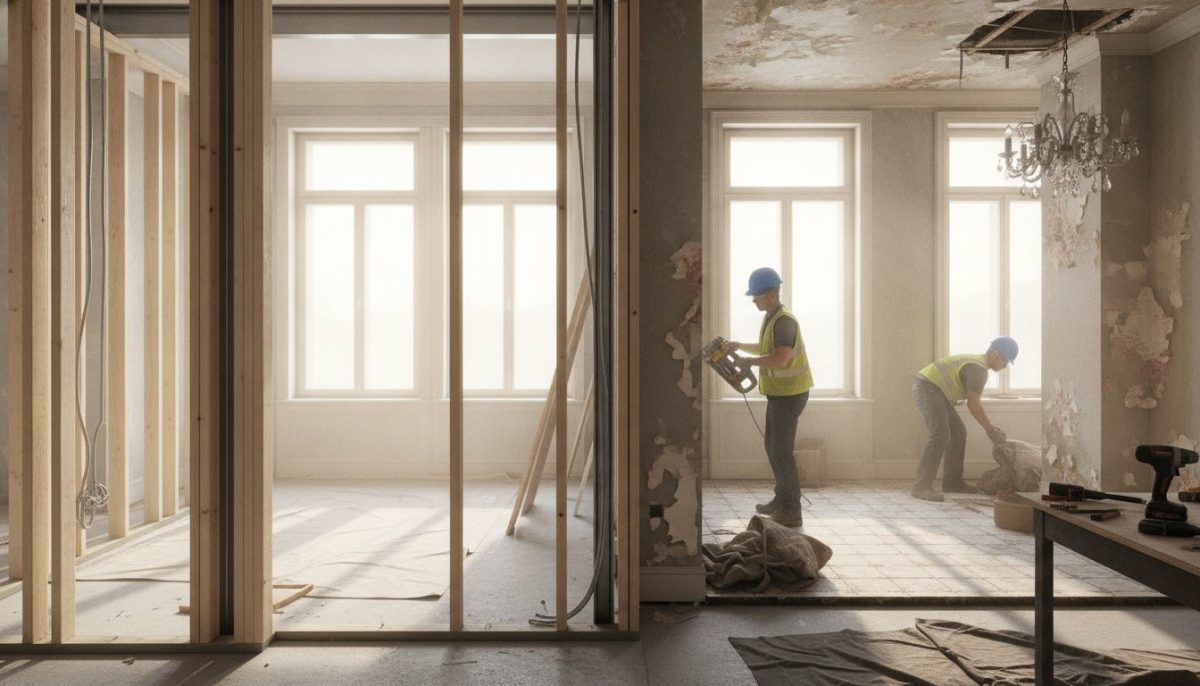
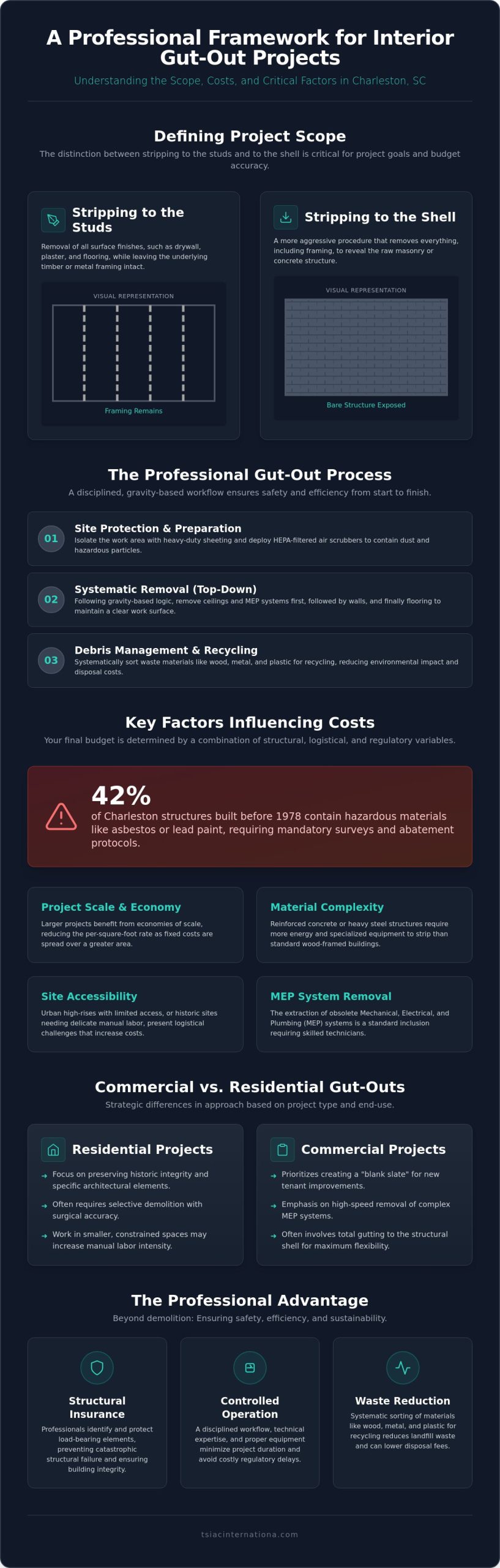
An interior gut-out is a disciplined technical process that involves the systematic removal of a building’s internal components to prepare it for a complete What Is an Interior Gut-Out?. While many property owners view this as a simple labor task, professional contractors approach it as a surgical operation. In the context of an interior gut out cost charleston sc, the precision of your initial scope definition is the primary factor that prevents budget overruns. A clear distinction must be made between stripping a structure to the studs and stripping it to the shell. Stripping to the studs involves the removal of all surface finishes while leaving the timber or metal framing intact. Stripping to the shell is a more aggressive procedure, often required in commercial settings, where even the framing is removed to reveal the raw masonry or concrete structure.

Standard inclusions for a comprehensive gut-out typically encompass the removal of drywall, plaster, flooring, suspended ceilings, and all non-load-bearing partitions. It also involves the extraction of outdated insulation and obsolete mechanical, electrical, and plumbing (MEP) systems. Professional scoping is mandatory before the first sledgehammer swing. This phase identifies load-bearing elements, locates active utility lines, and assesses the presence of hazardous materials. Without this methodological accuracy, you risk compromising the structural integrity of the building or incurring fines for improper waste management.

Total vs. Selective Interior Demolition

The choice between total and selective demolition depends on the intended final use of the space. Selective demolition requires surgical accuracy to protect specific zones or historical features while removing others. This is common in Charleston’s historic districts where certain architectural elements must be preserved by law. Total gutting provides a blank slate for a new floor plan but necessitates a full disconnect of all MEP systems. We prioritize the protection of structural elements throughout this process, ensuring that the building’s skeleton remains stable and secure for the subsequent reconstruction phase.

Project Phases: From Preparation to Debris Removal

A disciplined workflow is essential for maintaining site safety and efficiency. The process begins with site protection, including the installation of heavy-duty poly sheeting and HEPA-filtered air scrubbers for dust containment. The sequence of removal follows a gravity-based logic: ceilings and overhead utilities are extracted first, followed by interior walls, and finally the flooring systems. This order prevents the accumulation of debris on active work surfaces. The final phase involves a structural inspection and the systematic sorting of wood, metal, and plastic for recycling, which significantly reduces the environmental footprint of the project.

Key Factors Influencing Interior Gut-Out Costs in 2026

Calculating the interior gut out cost charleston sc requires a deep understanding of local logistics and material science. While national averages provide a baseline, 2026 pricing in the Lowcountry is heavily influenced by the specific physical characteristics of the structure and the logistical constraints of the site. One of the most significant variables is the economy of scale. Larger projects often see a reduction in the per-square-foot rate because fixed costs, such as mobilization and administrative overhead, are distributed across a greater area. Conversely, smaller residential projects in historic districts often carry a premium due to the delicate nature of the work and the manual labor required to protect preserved elements.

Building age and material complexity further complicate the budgeting process. Structures built with reinforced concrete or heavy steel framing require significantly more energy and specialized equipment to strip than standard wood-framed buildings. In Charleston, where an estimated 42% of structures built before 1978 contain hazardous materials, compliance with federal standards for Asbestos and Lead Abatement is a critical budget factor. Ignoring these requirements doesn’t just risk legal penalties; it endangers the health of everyone on-site and can lead to massive project delays. Site accessibility also plays a role. An urban high-rise with limited elevator access and strict noise ordinances presents far more logistical challenges than a suburban site where heavy machinery can move freely. If you’re planning a complex renovation, you can explore our selective demolition services to see how we manage these intricate structural requirements.

Labor and Equipment Requirements

Modern interior demolition relies on a mix of skilled labor and specialized technology. We utilize robotic breakers and mini-excavators designed for tight indoor spaces to maximize efficiency while minimizing vibration damage to the building’s core. The cost of labor in 2026 reflects the need for technicians who understand structural load paths and hazardous material handling. Proper safety gear, including specialized respirators and full-body PPE for high-dust environments, is a non-negotiable expense that ensures site safety and regulatory compliance.

Disposal and Hauling Fees

Debris management is a major component of the total budget, with costs often driven by the weight of the materials being removed. Concrete and brick are significantly more expensive to haul than wood or drywall due to landfill tipping fees and specialized transport requirements. In downtown Charleston, you must also account for the cost of permits for sidewalk closures or the installation of debris chutes. We prioritize the systematic sorting and recycling of wood, metal, and plastic to reduce landfill dependency and help offset some of these disposal expenses.

The Impact of Hazardous Materials: Asbestos and Lead Abatement

Hazardous materials represent the most significant variable in calculating an interior gut out cost charleston sc. While structural removal is relatively predictable, the discovery of toxic substances requires an immediate shift in methodology and safety protocols. An asbestos survey isn’t just a professional recommendation; it’s a non-negotiable legal requirement for most facilities before any demolition activity begins. Failing to identify these materials early leads to stop-work orders and expensive contamination cleanup that can easily triple your initial budget. We approach these challenges with methodological precision to ensure your project remains compliant and your site stays safe.

Professional abatement involves the creation of negative pressure environments to prevent the migration of toxic fibers or dust. We utilize industrial-grade HEPA filtration systems and specialized containment barriers to isolate the work zone from the rest of the structure. This level of technical control requires a specialized labor force and certified equipment, which naturally increases the project’s daily burn rate. These procedures also extend the project timeline. A standard gut-out that might take five days can stretch to ten when you factor in containment setup, third-party air clearance testing, and specialized disposal protocols. You should always include a contingency budget specifically for these technical requirements when dealing with older buildings.

Managing Asbestos in Interior Gut-Outs

Asbestos is frequently located in non-obvious areas like popcorn ceiling textures, vinyl floor tiles, and thermal pipe insulation. Our team follows strict OSHA standards and SCDES regulations to ensure every gram of material is accounted for and safely removed. For a detailed breakdown of these requirements and how they impact your site safety, consult our hazardous material abatement guide. Proper management ensures your renovation doesn’t become a long-term liability for future occupants or the environment.

Lead Paint and Mold Remediation

Historic renovations in the Lowcountry often uncover lead-based paint and hidden mold growth behind aging walls. We use wet-stripping methods and HEPA-shrouded tools to prevent toxic lead dust from becoming airborne during the gutting process. When mold is discovered, it must be remediated immediately to prevent structural rot and protect indoor air quality. Following federal guidelines for Recycling Demolition Waste allows us to separate contaminated materials from salvageable ones. This creates a clean documentation trail, which is vital for preserving property value and ensuring the building is safe for the next phase of construction.
Interior Gut-Out Cost Guide: 2026 Pricing and Strategic Factors

Commercial vs. Residential Interior Gutting: Strategic Differences

The strategic approach to a project varies significantly depending on whether the structure is a private residence or a commercial facility. These differences directly influence the interior gut out cost charleston sc, as the labor intensity and technical requirements shift between preservation and production. While residential projects often focus on the careful extraction of materials to protect the building’s historic character, commercial demolition is prioritized for speed and the preparation of “white box” spaces ready for new tenant configurations. Understanding these distinct operational paths allows property owners to set realistic timelines and budget expectations from the outset.

Commercial projects typically involve the high-volume removal of standardized materials like metal framing, acoustic ceiling tiles, and large-scale mechanical, electrical, and plumbing (MEP) systems. In contrast, residential gutting frequently requires manual labor to navigate tight spaces and preserve load-bearing timber elements. The logistical complexity of managing a multi-floor commercial demolition in downtown Charleston, where elevator access and noise ordinances are strictly enforced, creates a different cost profile than a suburban residential project where site access is generally less restricted.

Commercial Tenant Improvements (TI)

In the commercial sector, the primary goal is often to prepare a space for rapid re-leasing or retail build-outs. This involves the systematic stripping of previous tenant finishes while maintaining the integrity of shared building systems. Managing debris in active commercial environments requires meticulous planning to avoid disrupting neighboring businesses. We focus on high-efficiency removal techniques that meet strict TI standards. For a deeper analysis of these industrial workflows, you can review our commercial interior gutting services. This strategic planning ensures that the transition from demolition to construction is seamless and cost-effective.

Residential Remodels and Structural Safety

Residential gutting in Charleston often necessitates a surgical approach, particularly when dealing with historic homes. Whether you’re stripping a single kitchen or performing a whole-home gut-out, protecting the exterior envelope and finished elements is a priority. This process often includes the installation of temporary shoring and structural supports to maintain stability during the removal of internal walls. We utilize specialized containment strategies to prevent dust from migrating into living areas, ensuring that the structural safety of the home is never compromised. If you’re preparing for a major renovation, you can request a structural demolition assessment to ensure your project begins with a safe and clear foundation.

  • Systematic removal of non-load-bearing partitions and metal framing.
  • Strategic MEP disconnects and extraction for commercial upgrades.
  • Temporary shoring and structural reinforcement for residential safety.
  • Rigid site protection protocols for historic exterior preservation.

The Professional Advantage: Safety, Efficiency, and Recycling

Professional demolition serves as a form of structural insurance for property owners. When you evaluate your interior gut out cost charleston sc, it’s vital to view the investment through the lens of risk mitigation. A specialized team doesn’t just remove debris; they preserve the load-bearing integrity of the building and ensure that all mechanical disconnects are handled with technical precision. This methodology prevents the catastrophic structural failures that often occur when unskilled labor removes a wall that was thought to be non-load-bearing. By the time the follow-up construction crew arrives, the site is clean, safe, and ready for immediate build-out, which significantly reduces the overall project timeline.

Fixed-price structural demolition contracts offer an additional layer of financial security. Unlike “time and materials” agreements that can spiral out of control when challenges arise, a fixed-price contract from an experienced partner covers the defined scope from preparation to final clearance. This approach forces a thorough pre-demolition inspection, ensuring that most variables are accounted for before the work begins. It provides a stable budgeting framework that commercial developers and residential property owners rely on to maintain their project margins.

Sustainable Demolition: Recycling Wood, Metal, and Plastic

Environmental responsibility is a core component of modern site management. We implement a rigorous on-site sorting process to separate wood, metal, and plastic from general construction and demolition waste. This systematic approach reduces the volume of material sent to landfills, which helps mitigate the impact of rising tipping fees in South Carolina. There are clear economic benefits to this practice. Recovering scrap metal and clean timber can often provide credits that help offset disposal costs. For projects aiming to meet LEED or other green building standards, our commitment to recycling on every site ensures that your demolition phase contributes positively to your sustainability goals.

Selecting the Right Demolition Partner

Choosing a partner with over 15 years of industry experience is the most effective way to ensure project success. You should verify that your contractor holds specialized abatement licenses and has a documented history of managing complex structural environments. A professional gut-out quote should be transparent, detailing the costs for labor, equipment, disposal, and hazardous material containment. If you require a methodology that prioritizes safety and technical efficiency, you can contact TSIAC International for a professional assessment. Our team delivers the expertise required to handle the most challenging interior environments with unwavering reliability and methodological accuracy.

Strategic Planning for Your Next Structural Reset

Successful interior gutting requires a technical understanding of project scope and the regulatory requirements surrounding hazardous material containment. By prioritizing professional surveys for asbestos and lead paint, you eliminate the primary cause of budget volatility and project delays. A methodological approach to selective or total demolition ensures the structural integrity of your building remains intact while providing a clean, sustainable foundation for the next phase of construction. Managing your interior gut out cost charleston sc effectively means looking beyond the initial labor quote and focusing on long-term site safety and efficiency.

With 15+ years of industry-leading experience, TSIAC International provides the technical precision required for complex demolition environments. Our team consists of certified hazardous material abatement specialists who implement comprehensive recycling practices on every project site to minimize environmental impact. Request a Professional Quote from TSIAC International. We’re ready to partner with you to deliver a safe, compliant, and perfectly prepared structure for your renovation.

Frequently Asked Questions

How much does it cost to gut a 2,000 sq. ft. house to the studs?

The national average for stripping a house to the studs typically ranges from $2 to $8 per square foot, which places a 2,000 square foot home between $4,000 and $16,000 for the demolition phase. Local factors such as disposal fees and the complexity of the structure’s MEP systems will influence where your project falls within this range. In the Lowcountry, historic preservation requirements can also impact the final labor intensity and total budget.

Is an asbestos survey required before an interior gut-out?

Yes, an asbestos inspection by a state-certified inspector is a mandatory requirement by the South Carolina Department of Environmental Services for most facilities before demolition. While some small residential properties are exempt under specific conditions, professional contractors require these surveys to ensure site safety. Identifying hazardous materials early is the most effective way to manage your interior gut out cost charleston sc and avoid unexpected regulatory delays.

Can I save money by doing the interior gutting myself?

While DIY demolition appears to save on labor, it often increases costs through structural damage or improper waste disposal fines. Professionals use specialized equipment and technical knowledge to identify load-bearing elements and active utility lines that are easily missed by an untrained eye. The expense of renting dumpsters at retail rates and the risk of encountering unidentified hazardous materials often outweigh the perceived savings of performing the work yourself.

How long does a typical commercial interior gut-out take?

A standard commercial interior gut-out generally requires one to three weeks to complete, depending on the square footage and the volume of mechanical systems being removed. Projects involving multi-floor configurations or heavy concrete removal will naturally extend this timeline. Efficiency is maintained through the use of specialized machinery like mini-excavators and robotic breakers, which accelerate the debris removal process while maintaining a safe work environment for other building tenants.

What is the difference between selective demolition and a full gut-out?

Selective demolition is a surgical process where specific interior components are removed while preserving others, such as architectural features or functional utilities. A full gut-out involves stripping the entire interior space down to the timber studs or the raw structural shell. Selective demolition often requires more manual labor and careful protection of the remaining elements, which can sometimes result in a higher per-square-foot cost than a total gut-out.

How does the presence of lead paint affect the total demolition cost?

Lead-based paint requires the implementation of the EPA’s Renovation, Repair, and Painting Rule, which necessitates specialized containment and HEPA-filtered extraction tools. These safety protocols increase the specialized labor requirements and the cost of protective equipment. Since roughly 42% of Charleston homes built before 1978 contain lead paint, property owners should factor in the additional time and budget required for certified abatement and toxic dust control during the gutting process.

Are permits required for interior demolition if I’m not changing the structure?

Yes, the City of Charleston requires demolition permits for most interior gut-out projects to ensure compliance with safety and waste management regulations. Permit fees typically range from $200 to $1,000, and the approval process can take between three and eight weeks. Even if the structural footprint remains unchanged, these permits are necessary to verify that hazardous materials are being handled correctly and that debris is disposed of at licensed facilities.

What materials can be recycled from an interior gut-out project?

Most interior gut-out projects generate significant amounts of recyclable materials, including untreated wood framing, scrap metal, and various plastics. Metal components like copper piping, aluminum ductwork, and steel studs are especially valuable and are systematically sorted on-site to reduce landfill tipping fees. By prioritizing the recovery of these materials, we can meet green building standards and reduce the total environmental impact of your demolition project while managing disposal expenses.

Commercial Asbestos Abatement Cost: 2026 Pricing & Strategy Guide

In 2026, a single oversight in your commercial asbestos abatement cost calculation is more than a budget overrun; it’s a legal and operational…

In 2026, a single oversight in your commercial asbestos abatement cost calculation is more than a budget overrun; it’s a legal and operational liability that can halt a project indefinitely. You’re likely navigating the pressure of balancing strict project timelines with the looming threat of OSHA fines and the evolving complexities of the EPA’s recent chrysotile ban. It’s a common concern that unexpected hazardous findings will trigger delays, leaving both your facility’s safety and your financial forecasts in a state of uncertainty. We understand that true project success depends on methodical precision and a clear understanding of federal versus state regulatory requirements.

This guide provides the technical insights needed to master commercial asbestos budgeting, ensuring your remediation is both safe and compliant. You’ll gain a thorough understanding of the variables that dictate modern pricing, from disposal protocols to the impact of the pending Texas Chemistry Council v. EPA ruling. We’ll examine the critical factors influencing your bottom line this year, including the strategic ROI of total removal versus encapsulation methods and the specific regulatory fees you must account for to maintain a predictable budget.

Key Takeaways

  • Understand how current labor shortages and the EPA’s recent chrysotile ban directly influence your commercial asbestos abatement cost and project timelines.
  • Learn to distinguish between friable and non-friable materials to accurately predict budget requirements for different industrial and commercial applications.
  • Evaluate the long-term ROI of total removal versus the immediate savings of encapsulation to minimize future property liability and maintenance obligations.
  • Identify often-overlooked expenses like third-party air monitoring and toxic waste surcharges to ensure a predictable and transparent financial forecast.
  • Discover how integrating hazardous material remediation with structural demolition can streamline your workflow and reduce overall operational downtime.

Decoding Commercial Asbestos Abatement Costs in 2026

The financial architecture of a large scale project differs fundamentally from residential work. While a homeowner might worry about a single room, a facility manager must account for thousands of square feet of specialized material across complex infrastructures. The total commercial asbestos abatement cost isn’t a flat fee. It’s a calculated response to risk, volume, and strict regulatory compliance. In 2026, the market reflects a tightening of supply chains and a shortage of certified technicians. This means early procurement and precise budgeting are more critical than they’ve ever been. Standard asbestos abatement procedures at this level require industrial air scrubbing systems and high volume waste management strategies that smaller residential outfits cannot provide.

Property type dictates the logistical strategy. A retail space might require a compressed timeline to minimize lost revenue, while a healthcare facility demands 24/7 negative pressure and zero dust migration to protect vulnerable patients. These environmental controls are non-negotiable. Pre-abatement testing, which typically ranges from $200 to $500 depending on the scope, serves as your baseline. Skipping this step often leads to the discovery of “known unknowns” mid-project, which can inflate a commercial asbestos abatement cost by 40% or more due to emergency mobilization fees.

Commercial vs. Residential: Why the Price Gap Exists

The price discrepancy between sectors isn’t arbitrary. Commercial contractors must carry significantly higher liability insurance and specialized bonding that residential cleaners don’t maintain. For those who require consistent, high-quality facility upkeep alongside specialized projects, Commercial Cleaning Services Advance Industrial Maintenance offers the professional reliability needed for modern corporate spaces. Large open-span commercial spaces also require complex, engineered containment structures. These often involve heavy-duty flame-retardant poly sheeting and reinforced scaffolding. Additionally, most commercial projects require night-shift or weekend labor to avoid business interruption. These premiums ensure your facility remains operational during the day, but they do increase the initial labor estimate.

The Financial Risk of Deferring Remediation

Waiting to address asbestos-containing materials is a gamble with diminishing returns. As buildings age, materials like pipe wrap and acoustic ceiling tiles become friable. This means they can be crumbled by hand pressure, releasing fibers into the air. Once a material becomes friable, the cost to remove it spikes because the safety protocols become far more rigorous. Beyond the physical risks, deferred maintenance can devalue a property and make it nearly impossible to secure commercial financing. Lenders in 2026 are increasingly risk-averse regarding environmental liabilities. A “cheap” job that fails a post-abatement clearance test is the most expensive mistake a property owner can make, as it requires a total redo under even stricter scrutiny.

Primary Factors Influencing Your Abatement Estimate

Estimating a commercial asbestos abatement cost requires a rigorous analysis of physical variables that extend far beyond simple square footage. Every structural project presents a unique set of technical hurdles that dictate the final estimate. While floor area is a baseline, the physical state of the material, known as friability, is the primary driver of labor intensity. Friable asbestos, such as crumbling pipe insulation or spray-on fireproofing, requires significantly more stringent containment than non-friable materials like vinyl floor tiles. This distinction is vital because airborne fibers necessitate high-grade respiratory protection and complex air filtration systems. For a broader look at how these variables shift across different building types, this Asbestos Abatement Cost Guide provides a useful framework for understanding industry-wide pricing benchmarks.

Metrics for measurement also vary by application. We calculate flooring and ceiling projects by the square foot, but pipe insulation and HVAC duct wrap are measured by the linear foot. In high-rise commercial settings, accessibility creates a “scaffolding premium.” Working at heights or in confined interstitial spaces increases the hours required for setup and removal. Occupancy status is another critical variable. A vacant building allows for more aggressive, continuous workflows. Conversely, an occupied office or retail space requires phased remediation, often performed after hours, which introduces shift premiums and daily mobilization costs. When calculating the overall commercial asbestos abatement cost, facility managers must account for these logistical complexities early in the planning phase.

Material-Specific Cost Drivers

Thermal System Insulation (TSI), including boiler wraps and steam pipe jackets, represents one of the highest risk categories due to its high fiber content and ease of damage. Surfacing materials, such as acoustic texture or spray-applied fireproofing on structural steel, present a different challenge. These require massive containment bubbles and extensive post-removal cleaning. Non-friable organics, like roofing felt or floor mastic, are generally more stable. However, they often require specialized mechanical grinding or chemical solvents for total removal, which adds to the specialized equipment costs.

Containment Complexity and HVAC Isolation

The most technical aspect of any project is establishing negative air pressure zones. This process ensures that contaminated air is filtered through HEPA units and exhausted outside, preventing cross-contamination to clean areas of the building. In large commercial structures, sealing the HVAC and ductwork system is a labor-intensive necessity. If fibers enter the central air system, the remediation scope can expand to the entire facility instantly. Large crews also require multi-stage decontamination units, which must be plumbed and powered throughout the project duration. If you’re planning a renovation, integrating these safety protocols early into your asbestos abatement strategy prevents costly regulatory delays.

Comparing Remediation Strategies: Removal vs. Encapsulation

Selecting a remediation strategy requires a disciplined look at a building’s lifecycle. While the immediate commercial asbestos abatement cost is often the primary concern for facility managers, the long-term liability profile of the asset should carry equal weight. You generally have three paths: total removal, encapsulation, or enclosure. Total removal is the only method that permanently eliminates the hazardous material from the property’s ledger. Encapsulation involves applying a liquid sealant that binds fibers together to prevent them from becoming airborne. Enclosure uses a physical, airtight barrier, such as a permanent wall or floor overlay, to isolate the material. Each method has a specific technical application and a distinct financial trajectory that impacts the building’s valuation.

In 2026, the ROI of total removal is increasingly clear due to the EPA’s phased ban on chrysotile asbestos. By removing the material now, you bypass the need for a mandatory Operations and Maintenance (O&M) plan. These plans require documented periodic inspections and specialized training for your custodial staff, creating a recurring administrative and financial burden. This permanent solution also simplifies future renovations. If you choose encapsulation today to save 30% to 50% on initial costs, you’ll still face full abatement expenses the moment you need to cut into that surface for a plumbing or electrical upgrade. A certified “asbestos-free” status is a powerful asset during property divestment, often fetching a higher resale price than buildings with managed hazardous materials.

The Long-Term ROI of Total Removal

Total removal facilitates future-proofing for your commercial space. Without the presence of asbestos, your facility is no longer subject to the strict notification requirements of the EPA’s NESHAP before renovation or demolition. This eliminates the mandatory 10 day waiting period and the associated consulting fees for every minor structural change. Beyond regulatory ease, removal provides the highest level of safety for occupants, virtually eliminating the risk of accidental exposure and the catastrophic legal liability that follows a fiber release event.

When Encapsulation Makes Financial Sense

Encapsulation serves as a strategic solution for buildings slated for eventual structural demolition within a narrow five-year window. It’s also effective for low-traffic, non-disturbed areas where the material is in good condition. However, we advise caution in industrial environments with high-vibration machinery. Constant mechanical stress can cause sealant failure, leading to fiber release and an expensive emergency response. In these high-risk scenarios, the initial savings of encapsulation are often erased by the cost of secondary remediation. For property owners, the decision rests on whether they’re managing a short-term budget or a long-term investment.

Commercial Asbestos Abatement Cost: 2026 Pricing & Strategy Guide

The line items on a preliminary quote often represent only the physical labor of removal, but the total commercial asbestos abatement cost includes several mandatory ancillary expenses. These aren’t optional upgrades. They’re critical safety and compliance hurdles that ensure your project meets federal standards. Many facility managers overlook the administrative and verification fees that accompany industrial scale work. If you don’t account for these variables early, your budget will likely suffer from significant late-stage inflation. Strategic planning requires a methodical look at the entire project lifecycle, from the initial notification to the final air clearance and structural restoration.

Independent Air Monitoring and Clearance

You must engage an independent third-party environmental firm to handle all air monitoring and final clearance testing. Hiring a separate entity is a regulatory necessity that prevents a conflict of interest; it ensures the contractor isn’t “grading their own homework.” During the project, these technicians perform daily air sampling to verify that containment remains airtight. For the final clearance, you’ll choose between Phase Contrast Microscopy (PCM) and Transmission Electron Microscopy (TEM). While PCM is faster and more affordable, TEM is the gold standard for high-liability commercial environments because it can detect much smaller fibers. If a clearance test fails, you must budget for the cost of re-cleaning the area and performing a second round of testing, which can add days to your timeline.

Regulatory Compliance and Disposal Fees

Compliance is a major component of the commercial asbestos abatement cost structure. The EPA’s NESHAP regulations require a formal notification at least 10 days before any demolition or renovation begins on a building containing asbestos. This process involves administrative fees and precise documentation of the waste’s final destination. Disposal and hauling are equally complex. Asbestos isn’t standard construction debris; it requires hazardous waste manifesting and transport to specifically certified landfills. Disposal fees are often calculated by weight or volume and vary by state. If your project is located far from a certified facility, the fuel surcharges and specialized hauling fees will rise proportionally with the distance.

Abatement is a destructive process by nature. Once we remove fireproofing from structural steel or acoustic tiles from a ceiling, the building’s original safety and aesthetic features are gone. You must include a “build-back” budget to replace these materials with modern, asbestos-free alternatives. To minimize downtime and ensure a seamless transition between phases, we recommend a unified approach to structural demolition and abatement integration. This strategy allows for better coordination of waste streams and reduces the overall administrative burden on your facility team.

Strategic Budgeting with TSIAC International

Effective budgeting for a large-scale project isn’t about finding the lowest initial number. It’s about finding the most accurate one. At TSIAC International, our approach to calculating a commercial asbestos abatement cost is rooted in methodological precision and field-tested experience. We’ve seen how “low-ball” estimates from less experienced contractors often lead to change orders that exceed the original budget by 20% or more. Our bidding process is transparent, accounting for the technical realities of containment, disposal, and regulatory compliance from the start. This ensures that facility managers can present a predictable financial forecast to their stakeholders without the fear of mid-project surprises.

A key component of our strategy is the integration of hazardous material abatement with our broader service offerings. By viewing remediation as a phase of the building’s lifecycle rather than an isolated event, we identify efficiencies that other firms miss. For example, coordinating the removal of asbestos-containing materials directly with structural demolition allows for a unified waste management plan. This reduces the administrative burden and ensures that hazardous waste is never cross-contaminated with recyclable debris, which is a critical factor in controlling disposal surcharges. Our focus on recycling and material recovery helps offset overall debris management expenses, providing a more sustainable and cost-effective outcome for the property owner.

The Efficiency of Single-Source Contracting

Managing multiple contractors for abatement, gutting, and demolition creates logistical friction. By centralizing these services under a single point of contact, you eliminate the communication gaps that frequently cause delays in multi-contractor environments. We specialize in combining remediation with commercial interior gutting, which significantly reduces mobilization fees. Instead of paying for two separate crews to set up site offices and decontamination units, we streamline the process into a single, continuous workflow. This “one-and-done” approach minimizes the time your facility remains under containment, allowing you to move to the reconstruction phase faster.

Expertise in Complex Commercial Environments

We’ve built our reputation on handling projects where general methods are insufficient. Whether it’s performing selective demolition in an occupied office building or managing hazardous materials in a high-vibration industrial plant, our team operates with fegyelmezett precision. We understand that your business continuity is paramount. Our commitment to environmental responsibility isn’t just about compliance; it’s about reducing your long-term liability through thorough material recovery and documented disposal. We don’t promise the impossible, but what we vállal, we complete with methodological accuracy. To secure a partner who treats your budget with the same seriousness as your safety, request a professional consultation for your 2026 commercial project.

Securing Your Facility’s Future with Methodical Remediation

Managing a commercial asbestos abatement cost requires balancing technical safety with long-term asset valuation. You’ve seen that the choice between total removal and encapsulation isn’t just about today’s budget; it’s about eliminating future O&M burdens and streamlining eventual renovations. By accounting for fees like third-party air monitoring and specialized disposal early, you ensure your financial forecast remains stable throughout the project lifecycle. TSIAC International brings over 15 years of industry experience to every site, specializing in the complex intersection of comprehensive hazardous material remediation and structural demolition. Our commitment to unwavering OSHA and EPA regulatory compliance means your project is handled with the highest degree of technical precision.

Request a Professional Commercial Abatement Quote from TSIAC International to protect your property and personnel with a partner you can trust. With a clear strategy and a fegyelmezett expert team, you can transform a hazardous liability into a safe, compliant, and valuable asset.

Frequently Asked Questions

What is the average per-square-foot cost for commercial asbestos abatement in 2026?

Industry data for 2026 indicates that costs vary significantly based on the material being removed. For example, resilient floor tiles often range from $5 to $12 per square foot, while high-risk insulation can reach $20 per square foot. Your total commercial asbestos abatement cost will ultimately depend on the scale of the facility, the material’s friability, and the complexity of the required containment structures.

Does commercial asbestos removal require a specific type of permit?

Yes, almost all jurisdictions require a specific asbestos abatement permit before work can commence. These permits typically cost between $50 and $300 depending on the local building department’s fee structure. Furthermore, the EPA’s NESHAP regulations mandate a formal notification at least 10 days before any demolition or renovation begins on a building containing regulated asbestos materials.

How long does a typical commercial abatement project take to complete?

The duration of a project is determined by the total volume of hazardous material and the building’s accessibility. A localized remediation in a single mechanical room might take three to five days, while a full-scale industrial project can span several weeks. If the building remains occupied, the timeline often extends to accommodate phased work and after-hours shifts to prevent business interruption.

Can my business remain open during the asbestos removal process?

Your business can remain open if the remediation area is completely isolated from public and employee spaces. We use negative air pressure zones and heavy-duty containment barriers to ensure that no fibers migrate into active workspaces. However, many facility managers choose to schedule work during holiday shutdowns or weekends to eliminate any risk of accidental disturbance by building occupants.

What happens if we find asbestos during a scheduled renovation?

You must stop all construction activities immediately to prevent the accidental release of fibers. The suspected area should be sealed off until a certified professional can perform identification testing, which generally costs between $200 and $500. Resuming work without a confirmed negative test or professional abatement can lead to significant OSHA fines and long-term health liabilities for your workers.

Why do commercial abatement quotes vary so much between contractors?

Quote variations usually reflect the contractor’s level of technical precision and the thoroughness of their safety protocols. Higher estimates often include essential costs for third-party air monitoring, hazardous waste manifesting, and specialized HEPA filtration equipment. Lower bids might omit these critical compliance steps, which can lead to project delays and increased liability for the property owner if the site fails clearance.

Is air monitoring always required for commercial asbestos projects?

Yes, independent air monitoring is a standard requirement to verify that the work area is safe for re-occupancy. This process involves a third-party firm collecting air samples to ensure fiber counts are below the OSHA permissible exposure limit of 0.1 fibers per cubic centimeter. Post-abatement clearance sampling typically costs an additional $200 to $400 but is necessary for legal documentation of a successful remediation.

What are the penalties for improper commercial asbestos disposal?

Penalties for improper disposal include substantial civil fines and potential criminal prosecution for the building owner and the contractor. The EPA and state environmental agencies strictly enforce hazardous waste manifesting; failing to transport asbestos to a certified landfill can result in daily fines reaching tens of thousands of dollars. Beyond the financial impact, improper disposal creates massive legal exposure and damages your organization’s professional reputation.