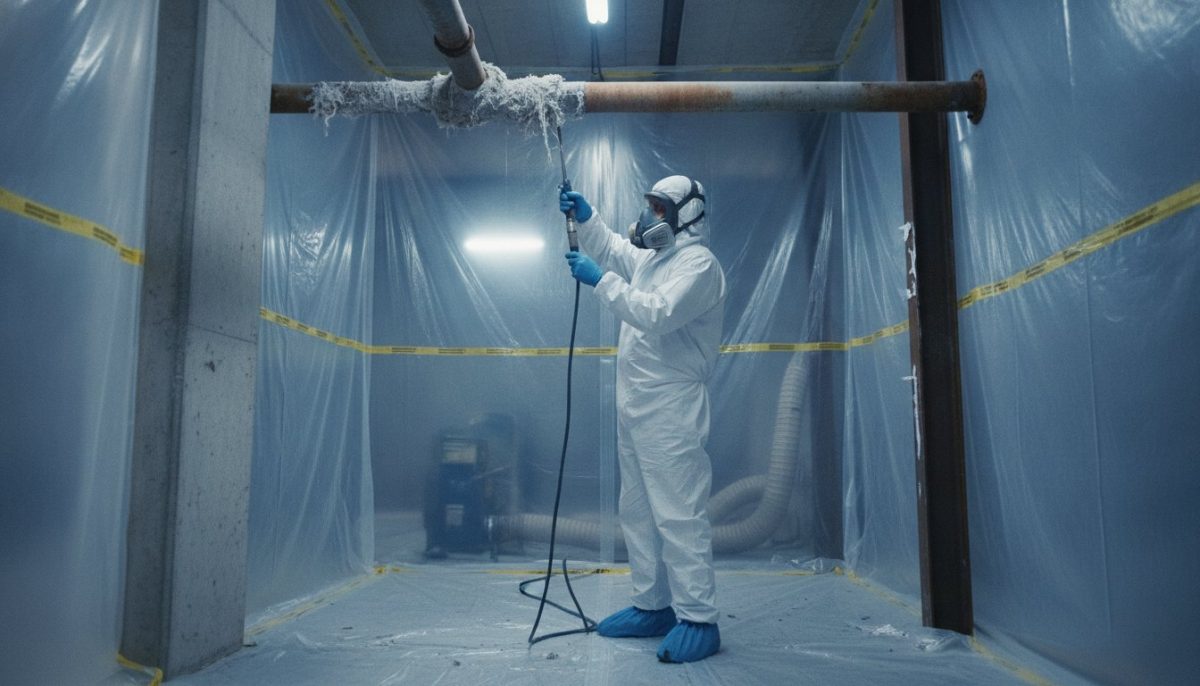
For property owners and project managers across the nation, the presence of asbestos isn’t merely a maintenance concern; it represents a significant legal and environmental liability that can profoundly impact project timelines. Determining when asbestos removal is truly necessary requires more than a visual assessment. It demands a technical understanding of federal and local regulatory mandates, material friability, and the structural stability of the components involved.
You’re likely facing the pressure of potential regulatory fines or the anxiety of long-term health liabilities while trying to manage a complex renovation or demolition project. It’s common to feel conflicted between the lower initial costs of encapsulation and the definitive safety of full removal. TSIAC International understands these challenges. This guide will help you discover the specific regulatory triggers for asbestos abatement and compare the long-term benefits of each method. We’ll examine current notification rules, air quality standards for re-occupancy, and how to align your abatement strategy with your building’s future lifecycle to ensure total compliance and peace of mind.
Key Takeaways
- Identify the specific SCDES thresholds, such as the 160 square foot limit for NESHAP-sized projects, that dictate when is asbestos removal necessary in south carolina before starting any renovation.
- Distinguish between the technical mechanisms of encapsulation, which seals fibers with specialized polymers, and the physical extraction required for full removal.
- Weigh the long-term liability benefits of total source removal against the rapid containment and lower immediate disruption provided by professional encapsulation.
- Apply a strategic decision framework to evaluate material condition and location, ensuring your abatement choice aligns with both safety and the building’s future lifecycle.
- Understand the mandatory notification timelines and third-party air monitoring standards required to achieve legal re-occupancy under current 2026 South Carolina regulations.
Regulatory Triggers: When is Asbestos Removal Necessary in South Carolina?
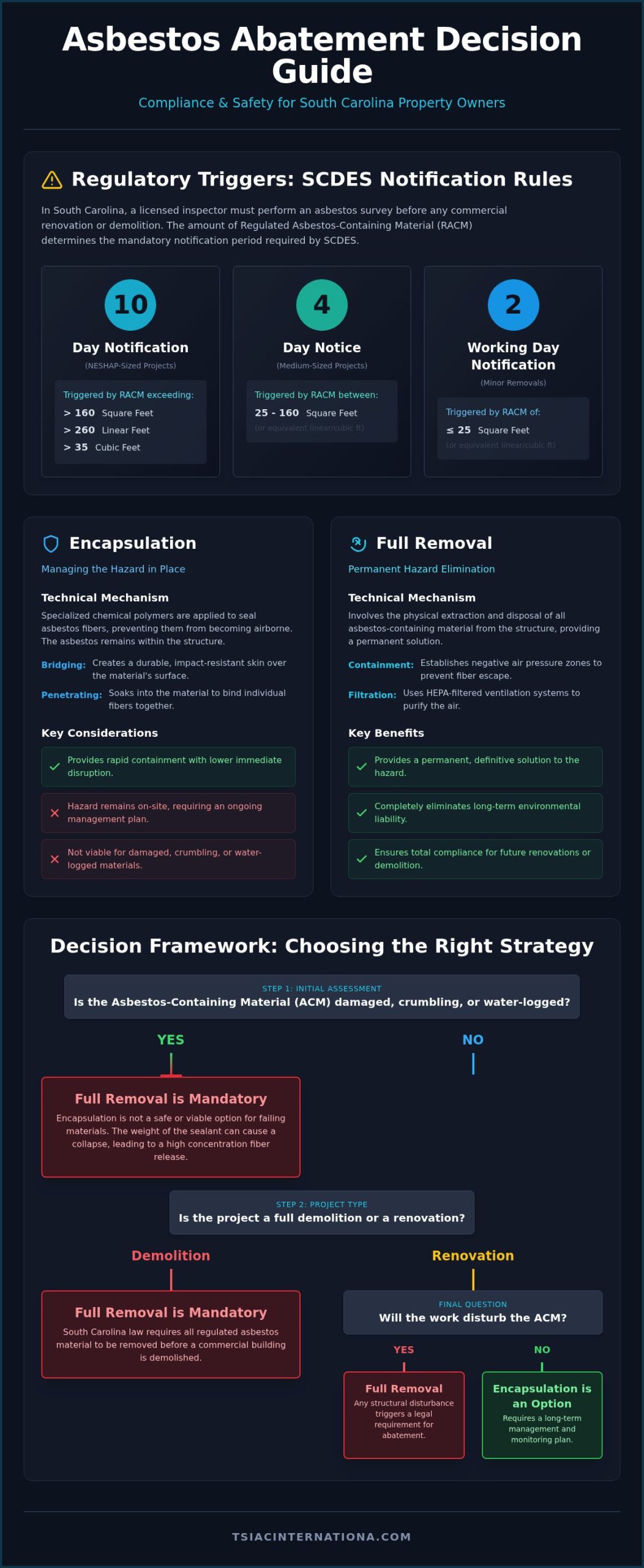
South Carolina law is explicit: you cannot begin a structural project without first identifying hazardous materials. The South Carolina Department of Environmental Services (SCDES), which assumed these responsibilities from DHEC in 2024, mandates that a licensed inspector perform a survey for any commercial renovation or demolition. This requirement ensures that Asbestos fibers are not released into the air during mechanical disturbance. Determining when is asbestos removal necessary in south carolina depends on the classification of the material as Regulated Asbestos-Containing Material (RACM).
RACM includes friable materials that can be crumbled by hand pressure or non-friable materials that will likely become friable during the planned work. If your project involves more than 160 square feet, 260 linear feet, or 35 cubic feet of RACM, you must submit a 10-day notification to the SCDES before work starts. Even smaller projects require notification. Materials between 25 and 160 square feet require a 4-day notice, while minor removals of 25 square feet or less require a 2-working-day notification. These thresholds are not suggestions; they are legal triggers for professional intervention.
Renovation vs. Demolition Requirements
Demolition projects carry the strictest mandates. In South Carolina, all regulated material must be removed before a commercial building is razed. Renovation projects allow for more nuance. If the material is in good condition and won’t be disturbed by the planned work, it might stay in place. However, any structural disturbance that impacts the integrity of the material triggers a legal requirement for abatement. The SCDES oversees these protocols to prevent environmental contamination, requiring disposal only at permitted Class 3 landfills. We handle the reporting and documentation to ensure every square foot is accounted for in the state’s eyes.
Liability and Safety Standards
The legal burden of identifying hazardous materials falls squarely on the property owner. Ignoring these standards doesn’t just risk health; it invites severe regulatory penalties. While OSHA focuses on worker exposure limits, the SCDES enforces environmental protection for the public. Non-compliant disposal or failure to conduct a pre-renovation survey leads to significant fines. These costs often far exceed the investment in professional abatement. We ensure all documentation and reporting meet these 2026 standards, providing a clear path to regulatory compliance for every project.
Asbestos Encapsulation vs. Removal: Technical Mechanisms
Abatement strategies generally fall into two categories: management in place or total extraction. Encapsulation is a technical process that uses specialized chemical polymers to seal asbestos fibers, preventing them from becoming airborne. This method doesn’t eliminate the hazard but rather stabilizes it. In contrast, full removal involves the physical extraction of the material from the structure, providing a permanent solution to environmental liability. The choice between these methods depends on the material’s physical integrity and the long-term goals for the property.
Technical assessments often dictate when is asbestos removal necessary in south carolina, particularly when the material’s matrix has failed. If the asbestos-containing material (ACM) is delaminating, water-damaged, or crumbling, encapsulation is no longer a viable option. Adding the weight of a liquid sealant to a failing substrate can actually cause the material to collapse, releasing a high concentration of fibers. In these instances, the only safe path is a full abatement under controlled conditions.
How Encapsulation Works
Professional encapsulants are classified as either bridging or penetrating agents. Bridging encapsulants create a durable, impact-resistant skin over the material’s surface, while penetrating agents soak into the ACM to bind the individual fibers together. Effective application requires meticulous surface preparation. The area must be free of dust and moisture to ensure the polymer creates a permanent bond. Because the hazard remains on-site, the owner must implement an ongoing management plan to monitor the seal’s integrity over time.
The Process of Full Abatement
Full removal is a rigorous engineering feat that requires absolute containment. We establish negative air pressure zones using HEPA-filtered ventilation systems to ensure no fibers escape the work area. Technicians use wet-stripping techniques, applying amended water to the material to keep it saturated during extraction. This prevents dust from ever forming. Following the physical removal, the site must pass stringent final clearance testing. According to South Carolina Asbestos Regulations, the air must reach a concentration below 0.01 fibers per cubic centimeter before the area is cleared for re-occupancy. If you’re unsure which technical path fits your project, our team can provide a professional site evaluation to determine the safest course of action.
Asbestos Encapsulation vs. Removal Pros and Cons
Deciding between encapsulation and removal is a strategic choice that affects the long-term value and liability profile of a property. While the SCDES regulations provide the legal framework for when is asbestos removal necessary in south carolina, the owner must also consider the building’s future lifecycle. Encapsulation offers a faster timeline. However, it leaves the hazardous material on-site, requiring a permanent commitment to monitoring and maintenance. Removal is more intensive but offers the only path to a completely asbestos-free environment. This permanent solution often pays for itself by increasing the asset’s marketability and removing the stigma of environmental hazards.
The Case for Encapsulation
Encapsulation is often the preferred choice for occupied commercial spaces where major structural disruption isn’t feasible. It’s highly effective for non-friable materials located in low-traffic areas, such as mechanical rooms or restricted utility spaces. By sealing the fibers, you avoid the extensive debris management and structural gutting associated with full abatement. This method aligns with the EPA’s guidance on asbestos repair and removal, which suggests that well-managed asbestos is often safer when left undisturbed. This choice comes with the burden of periodic inspections to ensure the polymer seal hasn’t degraded or been punctured by maintenance activities. If the seal fails, the property owner faces the same regulatory reporting hurdles as a new discovery.
The Case for Source Removal
Full source removal is the definitive solution for historic home remodels and commercial gut-outs. It eliminates the need for future monitoring programs and the legal requirement to disclose the presence of hazardous materials to potential buyers or tenants. Determining when is asbestos removal necessary in south carolina is often a matter of future-proofing; if your project involves installing new metal framing or drywall, encapsulation is usually insufficient. Any activity that pierces the encapsulated surface creates a new exposure risk, often triggering the need for removal later. By choosing full abatement now, you ensure that future renovations can proceed without the constant threat of a work stoppage. This approach provides the highest level of flexibility for the property’s future use and ensures the site remains compliant with all 2026 safety standards.
Decision Framework: Choosing the Right Abatement Strategy
A methodical approach to abatement ensures that your property remains safe while meeting the 2026 standards set by the South Carolina Department of Environmental Services (SCDES). It’s not enough to know asbestos is present; you must evaluate how it interacts with your building’s operational reality. Determining when is asbestos removal necessary in south carolina often begins with a physical stability test. If the material is compromised, the decision is usually made for you by state law. We assess the physical condition of the substrate alongside your future construction plans to build a compliant, cost-effective strategy.
Assessing Material Stability
Stability is the primary filter in any decision framework. We look for signs of delamination, water damage, or physical impact that could release fibers into the air. In South Carolina, friable material is defined as any asbestos-containing substance that, when dry, can be crumbled, pulverized, or reduced to powder by hand pressure. These materials represent an immediate inhalation risk and generally require full abatement rather than encapsulation. If the substrate is non-friable, such as intact floor tiles or roofing felt, you have more strategic flexibility. However, even non-friable materials must be monitored for signs of wear that could reclassify them as regulated waste.
Aligning with Project Goals
Your long-term plans for the structure should dictate your choice. For properties undergoing selective demolition or commercial tenant improvements, removal is the most logical path. It clears the way for new metal framing and drywall without the risk of accidentally disturbing a sealed hazard. Conversely, strategic encapsulation might be appropriate for deferred maintenance in sealed mechanical rooms where human traffic is minimal. For a deeper look at these requirements, see our Hazardous Material Abatement in South Carolina guide.
Regulatory compliance documentation is the final piece of the framework. Every decision, whether you choose to seal or remove, must be backed by a certified survey and, in many cases, air monitoring results. We handle the complex SCDES paperwork and notification timelines to ensure your project remains in good standing. This disciplined approach protects you from the legal and health liabilities associated with improper handling. If you’re ready to move forward with a compliant strategy, contact our abatement experts for a comprehensive site assessment and regulatory consultation.
Professional Abatement with TSIAC International
With over 15 years of industry experience, TSIAC International executes every project with a disciplined focus on technical precision and safety. We understand that identifying when is asbestos removal necessary in south carolina involves more than just meeting a legal minimum; it’s about protecting the long-term health of occupants and the financial integrity of your asset. Our team provides the specialized expertise required to handle both high-volume containment and surgical removal, ensuring every project phase aligns with the 2026 SCDES standards. We don’t just provide a service. We act as a professional partner that manages the entire regulatory lifecycle of your abatement project.
Our comprehensive service suite extends beyond simple remediation to include lead abatement and interior gutting, providing a single point of accountability for complex commercial and residential sites. We handle the complex SCDES paperwork and reporting requirements, from the initial 10-day notification to the final disposal manifests. This level of transparency and professional pride ensures that your property is not just compliant, but safe for immediate re-occupancy or subsequent renovation phases. We’ve built our reputation on the fact that we don’t promise what we can’t deliver, but what we undertake, we complete with methodological accuracy.
Our Approach to Abatement Safety
Safety is the non-negotiable foundation of our operations. We employ rigorous containment protocols, including the establishment of negative air pressure zones and HEPA-filtered ventilation to prevent cross-contamination during the removal process. Our expertise in selective demolition allows us to remove hazardous materials while preserving the structural integrity of the surrounding building components. By adhering to strict state and federal guidelines, we ensure that every fiber is accounted for and every cubic foot of waste is managed with the highest level of technical control. This technical focus is essential when is asbestos removal necessary in south carolina for projects involving aging infrastructure or historically significant properties.
The TSIAC Advantage in South Carolina
We distinguish ourselves through a commitment to environmental responsibility that goes beyond simple disposal. While many contractors treat all site debris as toxic waste, we actively recover wood, metal, and plastic from non-contaminated areas to reduce total landfill impact. This recycling focus is a core part of our service model, reflecting our dedication to sustainable construction practices. We coordinate directly with homeowners and general contractors to integrate abatement seamlessly into the broader demolition schedule. This integration minimizes delays and ensures that your project maintains its momentum without sacrificing safety or regulatory standing. Our word is our guarantee, and our results are documented with technical precision.
Securing Your Property with Compliance and Precision
Managing hazardous materials requires a balance of technical expertise and strict adherence to state law. Whether you choose the rapid containment of encapsulation or the permanent solution of full source removal, your decision must align with the building’s future lifecycle and current safety standards. Determining when is asbestos removal necessary in south carolina is a critical step that protects your investment from legal liability and health risks. By identifying friable materials and reporting thresholds early, you ensure your project remains on schedule and within regulatory bounds.
With over 15 years of industry experience, we provide the specialized structural and selective demolition capabilities needed to handle complex abatement challenges. Our team delivers detailed regulatory compliance documentation for every project, ensuring that your site meets all SCDES and EPA requirements. We focus on methodological accuracy to provide a safe environment for your next phase of construction.
Secure your property today with professional asbestos abatement from TSIAC International. We’re ready to partner with you to resolve your environmental liabilities with reliability and professional pride.
Frequently Asked Questions
Is asbestos encapsulation permanent in South Carolina?
Asbestos encapsulation is not a permanent solution. It’s a management-in-place technique that uses specialized polymers to seal fibers, but these sealants have a finite lifespan. Environmental factors like moisture, structural vibration, or mechanical impact can degrade the seal over time. Property owners must implement an ongoing operations and maintenance plan to monitor the integrity of the encapsulated area. If the sealant fails or the building is eventually slated for demolition, full removal becomes a legal requirement.
Does South Carolina law require asbestos removal before selling a house?
South Carolina law doesn’t explicitly mandate the removal of asbestos-containing materials solely for the purpose of a real estate transfer. However, state and federal disclosure laws require sellers to inform potential buyers of any known hazardous materials on the property. While owner-occupied single-family homes have certain exemptions from notification rules, the presence of asbestos often becomes a significant negotiation point. Many buyers require abatement as a condition of sale to avoid future liability and renovation complications.
How much does asbestos removal cost compared to encapsulation?
Removal generally requires a higher initial investment than encapsulation because it involves labor-intensive physical extraction, negative air containment, and specialized disposal fees at Class 3 landfills. Encapsulation is typically less expensive upfront as it avoids these disposal costs and extensive structural disruption. However, encapsulation creates long-term expenses for periodic inspections and future abatement. Property owners should evaluate the one-time cost of total removal against the indefinite costs of monitoring a hazardous material left on-site.
Can I perform DIY asbestos encapsulation on my property?
DIY encapsulation is strongly discouraged due to the extreme health risks associated with fiber release. While some residential exemptions exist for owner-occupied homes, improperly applying sealants can disturb friable materials and contaminate your living space. For any commercial project or renovation exceeding state thresholds, South Carolina law requires licensed professionals to perform the work. Professional contractors use industrial-grade penetrating encapsulants and HEPA-filtered equipment that consumer-grade tools can’t provide, ensuring both safety and regulatory compliance.
What happens if I renovate without an asbestos survey in SC?
Renovating without a certified survey is a direct violation of SCDES regulations and carries severe penalties. If the state discovers a project in progress without the required documentation, they can issue an immediate stop-work order and impose significant daily fines. Beyond the financial impact, you risk exposing occupants and workers to toxic fibers, which creates massive legal and health liabilities. This is why knowing when is asbestos removal necessary in south carolina is a mandatory first step for any structural project.
How do I know if asbestos encapsulation has failed?
Encapsulation has failed if you observe signs of delamination, cracking, or peeling on the sealed surface. If the underlying material shows signs of water damage or is sagging away from the substrate, the polymer seal can no longer effectively contain the fibers. Once the barrier is breached, the material is reclassified as friable and represents an active inhalation hazard. Regular professional inspections are the only reliable way to verify that the encapsulation remains effective and compliant with safety standards.
Which state agency oversees asbestos removal in South Carolina?
The South Carolina Department of Environmental Services (SCDES) is the primary agency responsible for enforcing asbestos regulations. As of July 1, 2024, the SCDES assumed these duties from the former Department of Health and Environmental Control (DHEC). This agency manages project notifications, licenses abatement contractors, and ensures that all hazardous waste is disposed of in permitted Class 3 landfills. All mandatory surveys and abatement plans must be submitted to the SCDES to ensure the project meets state and federal safety laws.
Is encapsulation or removal better for commercial properties?
Full removal is generally the superior strategic choice for commercial properties. It eliminates the need for permanent hazardous material disclosures and the costs of an ongoing management plan. Removal also provides total flexibility for future tenant improvements or interior gutting projects. While encapsulation can be a short-term solution for inaccessible areas, it often complicates future renovations. Determining when is asbestos removal necessary in south carolina depends on whether you want to permanently resolve the liability or manage it as a recurring operational burden.