
How to Dispute a Demolition Contractor’s Invoice: A Practical Checklist

The final demolition invoice arrives, but added labor, equipment, or disposal charges don’t appear in the accepted bid. Before assuming there’s an…

The final demolition invoice arrives, but added labor, equipment, or disposal charges don’t appear in the accepted bid. Before assuming there’s an error or accusing the contractor of overbilling, use a demolition bid comparison checklist to trace each charge to the agreed scope, exclusions, and any approved changes. A clear comparison can show whether a line item needs explanation or reflects work documented during the project.

It’s reasonable to question charges that are unclear or differ from what you expected. Demolition work can involve changing site conditions and separate handling of debris or hazardous materials. The key is to ask for specifics and keep the discussion grounded in project records.

This guide explains how to compare the invoice with the proposal and change orders, record discrepancies, and request an itemized explanation with supporting documents such as work records or disposal tickets. It also covers how to raise questions calmly and preserve project communications as you consider next steps.

Key Takeaways

  • Focus on specific differences in billed work, quantities, rates, or agreed terms, not unfamiliar wording alone.
  • Use a demolition bid comparison checklist to match each invoice line with the original scope, any change order, and available supporting records.
  • Check how demolition, interior gutting, abatement, disposal, and other charges were scoped before deciding whether an item needs clarification.
  • Send a written, itemized request that identifies each question and asks for the relevant explanation or documentation.
  • After the contractor responds, record which items are resolved, what remains unclear, and any agreed adjustments in writing.

When Does a Demolition Invoice Justify a Closer Review?

A higher final total or unfamiliar line item is a reason to check the project records, not proof on its own that the invoice is wrong. A useful question is specific: does the charge match the agreed work, an authorized change, the recorded quantity, and the terms used to calculate it? An unfamiliar charge may still be supported by the accepted bid, contract, or written project instruction.

An invoice discrepancy is a billed item that cannot be reconciled with the agreed scope, an identifiable authorization, the recorded quantity, or supporting project documentation. Keep the distinction clear: asking for evidence is not the same as alleging misconduct. A demolition bid comparison checklist helps organize the review around what the documents show.

Which documents establish the agreed demolition scope?

Review the accepted proposal and signed agreement together, including specifications, inclusions, and exclusions. Gather approved changes, written instructions, and relevant project correspondence as well. A change order records a modification to the original agreement. Check whether added work or revised quantities appear in a written approval, and how that approval affects the price or scope.

Keep the final invoice with those records rather than treating it as a stand-alone document. For context on how work may progress through project stages, consult this demolition process guide.

Which invoice differences deserve clarification?

Flag charges for work that doesn’t appear in the original scope or an identifiable approved change. Also mark descriptions too broad to identify the task, and quantities that don’t align with field reports or completion records. For example, if the invoice lists a quantity of removed material, ask which project record supports that measurement and how it was calculated.

Review the accepted proposal, approved changes, and invoice side by side. For each difference, note the invoice line, the document it appears to conflict with, and the question you need answered. This gives the contractor a clear opportunity to explain an unfamiliar but agreed charge or provide missing support. If the documents still don’t reconcile, you’ll have a precise issue to discuss instead of a general objection.

How to Compare a Demolition Invoice With the Bid and Change Orders

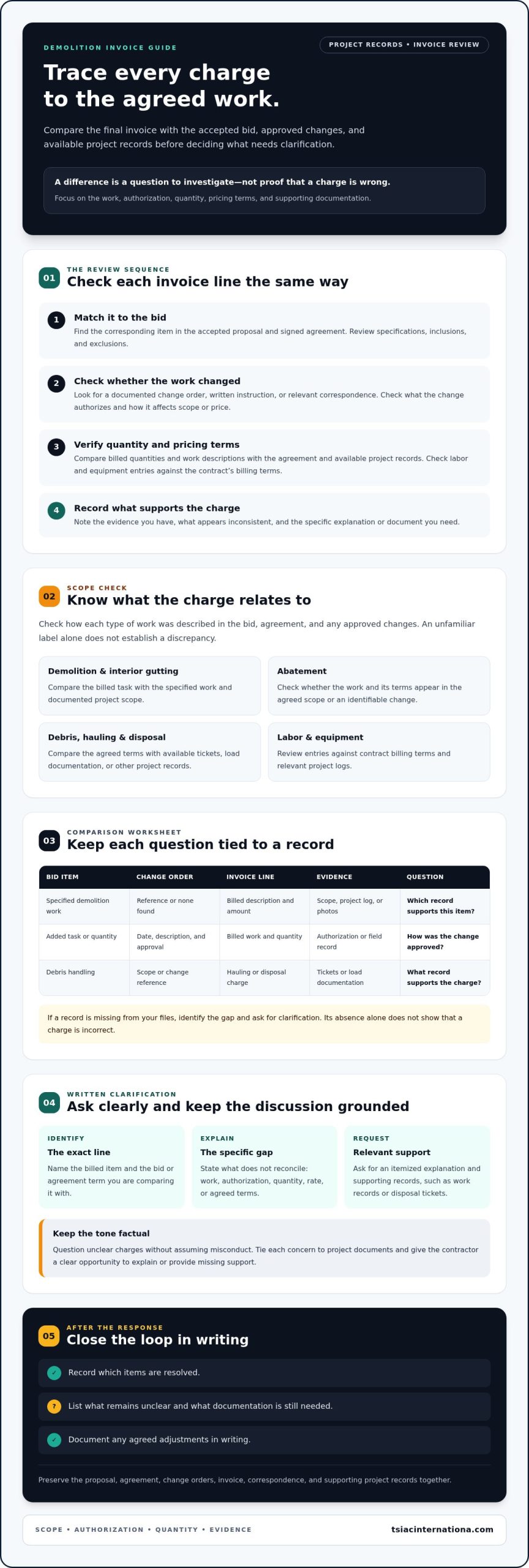
Use the same sequence for every invoice line: identify the corresponding bid item, check whether the work changed, confirm the billed quantity and pricing method against the agreement, then note the record that supports the charge. This makes the review specific and repeatable. A written estimate and carefully reviewed contract provide useful reference points, as consumer protection officials also advise.

Check each change order against its documented approval, the work it authorizes, and the pricing method it records. Don’t treat an entry as approved or improper simply because a record is missing from the files you have. Identify the gap and request clarification.

Reconcile added demolition work and change orders

For each added task, compare its description and date with the written authorization and agreed pricing method. Field directives or revised drawings may help explain why the original demolition scope changed, but check whether the project documents show how the change was approved. If the record is incomplete, flag it as an open question rather than assuming the work was authorized or unauthorized.

Review quantities, labor, equipment, and debris handling

Compare billed quantities and work descriptions with available daily reports, photographs, completion records, or other project documentation. Check labor and equipment entries against the contract’s billing terms and project logs. For hauling, disposal, or recycling charges, look for records such as tickets or load documentation, then compare them with the agreed scope. If a particular record isn’t in your files, ask for it. Its absence alone doesn’t show that the charge is incorrect.

Use a working table to make mismatches visible and keep each question tied to its supporting document:

Bid item Change order Invoice line Evidence Question
Specified demolition work Reference or none found Billed description and amount Scope, project log, or photos Which document supports this item?
Added task or quantity Date, description, and approval Quantity and pricing method Directive, revised drawing, or ticket How was the billed quantity determined?

For lump-sum work, compare the billed item with the contracted scope rather than trying to infer a unit price. For unit-rate work, check the measured quantity and applicable rate. For allowances or time-and-material terms, use the contract’s stated basis and available records of the work performed. Don’t substitute one billing method for another.

Once the table shows where the documents align and where they don’t, you can ask focused questions. The same scope and pricing details can help when discussing a future demolition project with TSIAC International.

Which Demolition Charges Need Evidence Before You Accept Them?

Review each charge against the written agreement and work records, not the line-item label alone. A demolition invoice may combine structural or selective demolition, interior gutting, debris handling, recycling, or separately scoped abatement. These categories can involve different tasks and documentation. An unfamiliar charge may still be covered by the accepted scope; if an unexpected charge can’t be traced to the agreement or an approved change, ask for clarification.

Use your demolition bid comparison checklist to note the billed item, relevant contract language, available records, and remaining question. Don’t call a charge invalid without evidence. The agreement and documented work determine what needs an explanation. Industry-wide price assumptions won’t establish whether a particular line is supported.

Check debris, hauling, disposal, and recycling entries

Start with the agreement. Does it include debris handling, specify separate hauling or disposal charges, or describe sorting and recycling as part of the work? If the invoice includes a separate entry, request records referenced by the contract or used to support the charge, such as applicable weight tickets, hauling logs, or disposal documentation. Compare those records with the billed description and project scope. If wood, metal, or other materials were sorted for recycling, check whether that activity was included, separately authorized, or excluded.

The distinction between removing selected interior components and broader demolition can affect what the scope describes. For more context, see this commercial interior gutting guide.

Separate abatement work from demolition billing

Check whether asbestos or lead abatement appears in the original agreement or was authorized separately. Compare invoice task descriptions with the contract and available project records, keeping abatement entries distinct from demolition or interior gutting unless the documents combine them. If the invoice doesn’t identify what work was performed or how it relates to the agreed scope, ask for an itemized explanation and relevant supporting records. A document missing from your files is a question to resolve, not proof that the work was unauthorized.

This hazardous material abatement guide provides broader work-context information. If a disagreement progresses beyond an information request, the applicable process depends on the contract and circumstances. The formal dispute process discussed by PilieroMazza concerns government-contract claims, so it shouldn’t be assumed to govern a private demolition project.
How to Dispute a Demolition Contractor’s Invoice: A Practical Checklist

How to Raise a Demolition Invoice Dispute Clearly and Professionally

Once you’ve identified a line that doesn’t reconcile with the contract or project records, put your question in writing. A focused request gives the contractor a clear opportunity to explain the charge or provide supporting documents. Keep the message factual: identify what you’re comparing, describe the mismatch, and state what information would help resolve it.

Before sending the request, check the agreement for communication, payment, and dispute procedures. Requirements can depend on the contract and applicable law, so don’t assume a deadline or legal right based on general guidance. If you’re unsure how a term applies or what to do about payment, consult a qualified attorney.

Prepare a concise invoice clarification request

Include the invoice number and project reference, then list each questioned item separately. For each one, identify the invoice description, the bid or approved change you’re comparing it with, and the specific point that needs clarification. Attach only relevant pages or records, with filenames or labels that make them easy to identify. This keeps the exchange organized and avoids burying the issue in unrelated project material.

For example, ask, “Please explain how this labor entry relates to the approved scope and provide the supporting work record.” Request an itemized response and suggest a reasonable time to discuss any items that remain unresolved. Avoid threats or claims about legal rights you haven’t verified. If the contract permits separate treatment, distinguish amounts you accept from entries you’re asking about. Check the contract before assuming how payment should be handled.

Keep a reliable project and communication record

Save the signed agreement, accepted bid, invoices, change orders, relevant correspondence, photographs, and site records together. Keep copies of your request and the contractor’s response. After a call or meeting, make a dated note of who participated, what was discussed, and any promised follow-up. If the parties agree to a correction or another action, ask for that understanding in writing so both sides can refer to the same record.

Use the communication channel named in the contract, if one is specified, and retain evidence that your message was sent. A demolition bid comparison checklist keeps each question tied to its supporting document, while a clear record helps prevent unresolved details from getting lost in later discussions.

For future demolition or abatement work, the scope documentation and project services offered by TSIAC International can be part of the planning conversation.

Next Steps After Contractor Responds to Invoice Dispute

Assess the contractor’s reply against your question, the original agreement, approved changes, and supporting project records. A response is useful when it explains the specific line item and identifies documentation that helps reconcile it. If the contractor sends a revised invoice, compare its descriptions and amounts with the earlier version, then save both so the changes remain clear.

Evaluate explanations, corrections, and remaining disagreements

Update your review record line by line. Mark each item as resolved, still requiring evidence, or unresolved after the response. For an agreed correction, request a revised invoice or written confirmation stating the corrected description or amount. Record any agreed payment treatment in writing, and check it against the contract before acting.

Don’t assume that silence, a partial payment, or a verbal conversation changes either party’s rights or obligations. If a material issue remains, follow the contract’s stated dispute procedure and seek qualified legal advice before taking legal or payment action. Relevant rights and deadlines may depend on the contract and applicable jurisdiction.

Reduce invoice disputes on future demolition projects

Clear project documents make later billing easier to review. Before work begins, define what the scope includes and excludes, including boundaries for structural removal, selective demolition, interior gutting, and any separately scoped asbestos or lead abatement. Agree how changes will be approved and recorded, and specify how quantities, labor, equipment, disposal, and recycling will be documented and billed.

A practical demolition bid comparison checklist can also guide future bid reviews: confirm that proposals describe comparable work and state their billing basis clearly. Keep the accepted scope, written changes, and project records together as work progresses. That gives both parties a consistent reference if questions arise at closeout.

For future work, TSIAC International’s demolition and abatement services include structural and selective demolition, interior gutting, and hazardous-material abatement. See TSIAC International’s demolition and abatement services.

Make Your Next Step Clear and Documented

A demolition invoice review is strongest when each question points to a specific difference between the invoice, agreed scope, approved changes, and available project records. Use a demolition bid comparison checklist to organize those details, request explanations in writing, and record which items are resolved. If questions remain, follow the contract’s procedures and get qualified advice before taking legal or payment action.

Clear scope boundaries and documented changes can also make future project closeout more straightforward. TSIAC International brings over 15 years of demolition and abatement industry experience, with capabilities in structural and selective demolition, interior gutting, and hazardous-material abatement. Its project-site recycling practices include wood, metal, and plastic.

Discuss your demolition or abatement project with TSIAC International. A well-documented plan gives you a more dependable starting point for the work ahead.

Frequently Asked Questions

How do I dispute a demolition contractor’s invoice?

Compare the invoice with the accepted bid, signed contract, approved changes, and available project records, then raise specific questions in writing. Identify each line item, explain which document or quantity it doesn’t appear to match, and request an itemized explanation or supporting records. Keep the tone factual and save the correspondence. Before withholding or changing payment, check the contract’s procedures and seek qualified legal advice if your rights or obligations are unclear.

Can I dispute a demolition charge that was not included in the original bid?

You can ask for clarification, but a charge absent from the original bid isn’t automatically invalid. Check the contract for exclusions, allowances, separate billing terms, and approved changes that may explain it. Ask the contractor to identify the authorization, work performed, and pricing basis for the charge. If the records don’t resolve the question, document the remaining discrepancy and follow the contract’s communication and dispute procedures.

What documents should I gather before questioning a demolition invoice?

Gather the signed agreement, accepted bid, scope specifications, inclusions and exclusions, invoices, and any approved change orders or written instructions. Add relevant correspondence, field reports, photographs, completion records, and applicable labor, equipment, hauling, or disposal documentation. You don’t need to send every project file with your first question. Select the records that show the specific difference you’re asking about, and keep a complete copy of the project documents for your records.

What should a written demolition invoice dispute include?

Include the invoice number, project reference, and each questioned line item. For every item, state what document you’re comparing it with and why the description, quantity, authorization, or billing method needs clarification. Identify relevant attachments and request an itemized explanation or supporting records. Keep the message professional, avoid unverified accusations, and suggest a time to discuss unresolved questions. Check the contract for any required communication method or dispute procedure.

How do I compare a demolition invoice with approved change orders?

Match each changed invoice item to the relevant change order, then compare the documented approval, date, work description, quantity, and pricing method. Check that the invoice reflects the work the change authorized, and review supporting records where available. A demolition bid comparison checklist can help track the original bid item, change order, invoice line, evidence, and outstanding question. If approval or scope is unclear, ask for clarification rather than assuming the item was accepted or rejected.

Can a contractor charge separately for debris hauling or disposal?

Separate hauling or disposal charges may be appropriate if the contract treats them as separate, excludes them from the bid, or documents an authorized change. Check the scope and billing terms before deciding whether the charge needs clarification. If supporting records are available or referenced in the agreement, request applicable hauling logs, weight tickets, or disposal documentation. Don’t rely on a general assumption about industry practice; the project agreement and records are the relevant reference points.

What happens if the contractor and property owner cannot resolve an invoice dispute?

Review the contract for the process that applies to unresolved billing questions, and keep records of the disputed items, responses, and any proposed corrections. The next steps and time limits can depend on the contract and applicable jurisdiction, so don’t assume one process applies everywhere. Before taking legal or payment action, consult a qualified attorney familiar with the relevant contract and location. A careful record helps clarify what remains unresolved and what advice you need.
Change Order Management for Demolition: A Field Guide

Commercial demolition projects routinely require a contingency reserve of 10% to 25%, several times that of standard construction, simply to absorb…

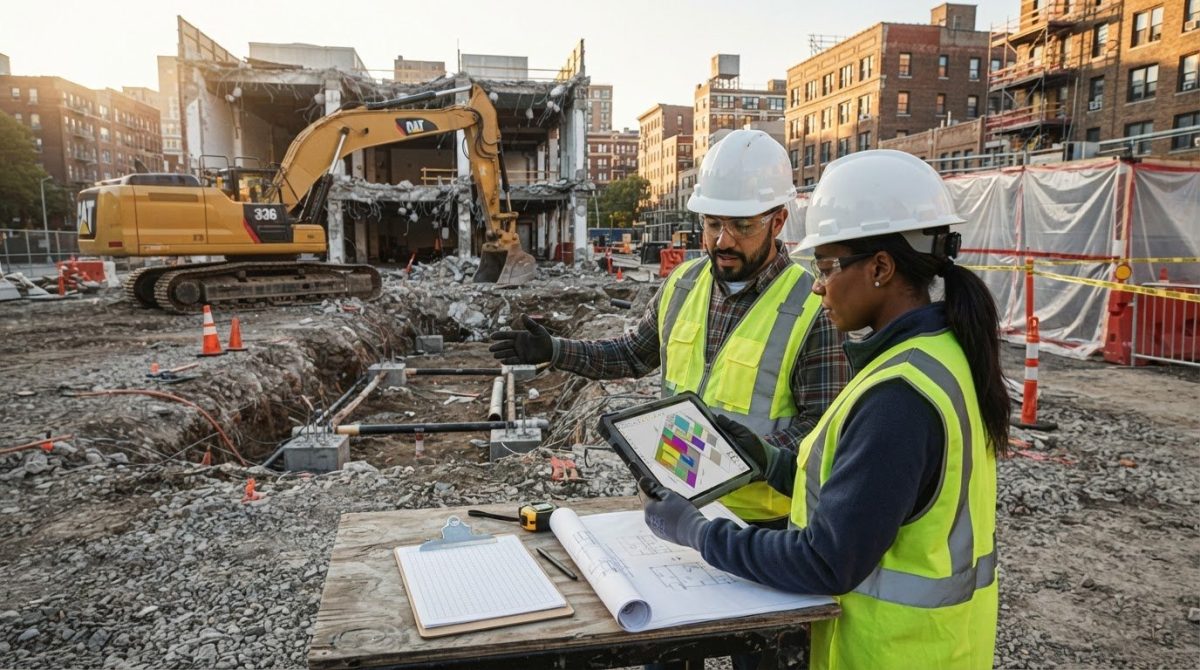
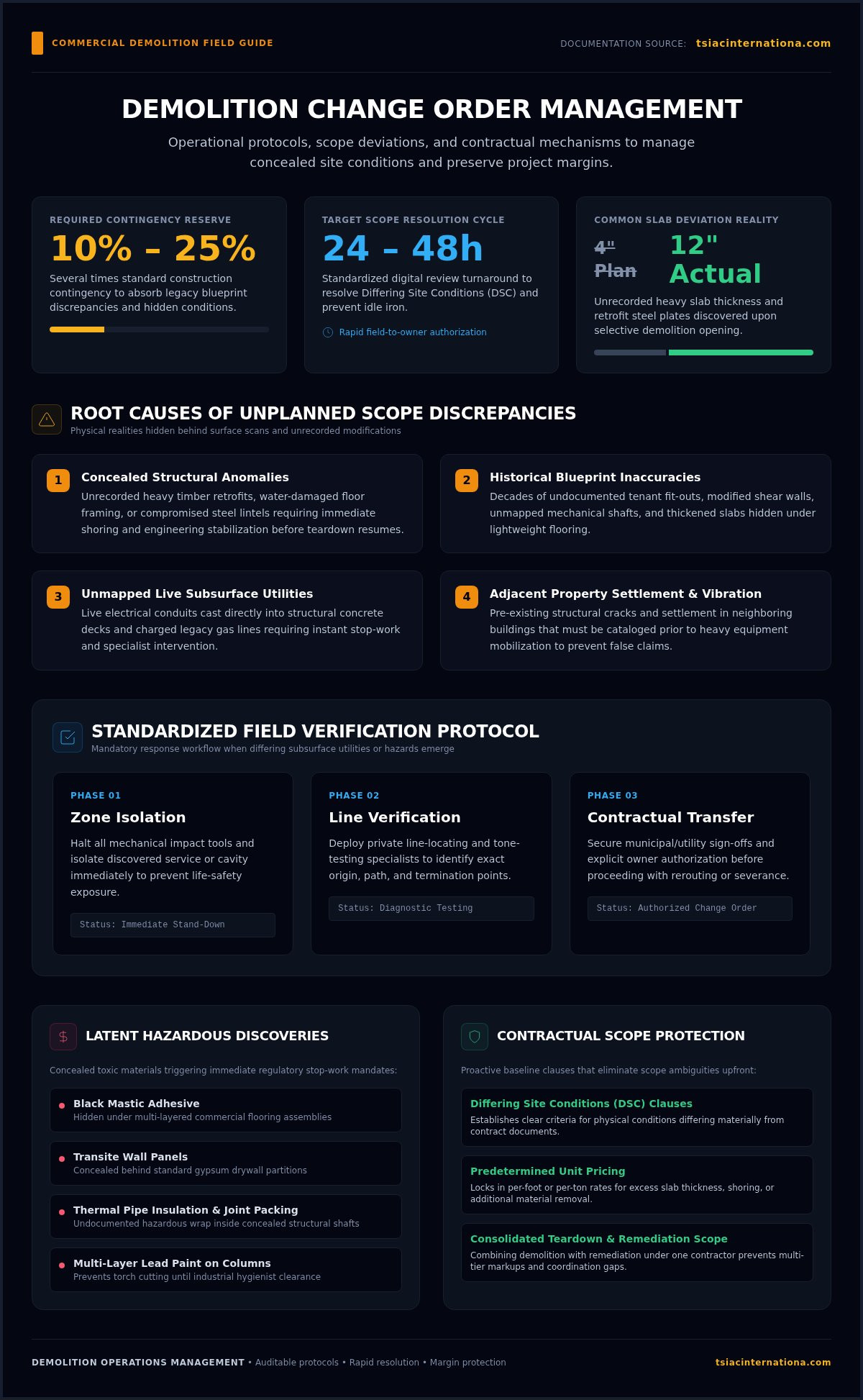
Commercial demolition projects routinely require a contingency reserve of 10% to 25%, several times that of standard construction, simply to absorb what historical blueprints fail to disclose. When unexpected hazardous materials or buried foundations emerge mid-shift, uncoordinated adjustments can swallow that margin in days. Mastering change order management for demolition projects isn’t just administrative paperwork; it’s the operational discipline that keeps equipment moving and prevents severe budget overruns before physical work ever goes off track.

You know the frustration of idle iron and contentious debates when hidden site conditions stall progress and slow authorization chains drag out. You shouldn’t have to absorb margin-killing delays or regulatory hazards because of incomplete baseline scopes. In this field guide, you’ll learn how to establish an auditable change protocol before mobilization, resolve differing site conditions within 24 to 48 hours, and safeguard both project margins and workplace safety through contract compliance.

Key Takeaways

  • Isolate concealed structural deviations early using targeted pre-demolition investigations and reality-verified conditions rather than relying on legacy blueprints.
  • Manage latent hazardous discoveries safely by implementing immediate containment protocols that fulfill environmental stop-work mandates without derailing unaffected work zones.
  • Implement a standardized field workflow to master change order management for demolition projects, cutting review cycles to 24 to 48 hours through objective digital documentation.
  • Incorporate specific contractual safeguards, including clear Differing Site Conditions (DSC) clauses and predetermined unit pricing, to eliminate scope ambiguities before physical teardown begins.
  • Consolidate structural teardown and environmental remediation scopes under a single contractor to avoid multi-tier markups, coordination gaps, and prolonged schedule standby.

Root Causes of Change Orders in Demolition Projects

Estimating software and digital scans cannot see through solid concrete or behind structural masonry. While digital tools capture surface dimensions, demolition scope deviations stem almost entirely from hidden physical realities. Uncovering unexpected conditions mid-shift immediately disrupts the baseline scope, turning routine mechanical takedowns into complex structural stabilization operations. Without rigorous formal change order procedures, these physical discoveries quickly escalate into contentious disputes between owners, general contractors, and specialty subcontractors.

Concealed structural anomalies represent the single most common cause of scope creep. A selective demolition crew might open an interior partition to discover heavy structural timber retrofitted with unrecorded steel plates, or discover that a concrete slab is twelve inches thick instead of the four inches detailed in contract documents. Encountering severe structural decay, such as compromised steel lintels or water-damaged floor framing, demands immediate engineering intervention and temporary shoring before mechanical teardown resumes. Comprehensive baseline surveys also document pre-existing cracks and settlement in adjacent properties, preventing unmerited third-party claims once heavy equipment creates ground vibration.

Discrepancies in Historical As-Built Drawings

Decades of undocumented tenant fit-outs and structural alterations distort original architectural plans. In older commercial properties, contractors frequently encounter modified shear walls, abandoned mechanical shafts, or unrecorded thickened slabs beneath lightweight floor coverings. Relying strictly on legacy blueprints without conducting selective destructive exploratory testing during pre-mobilization leaves crews vulnerable to severe surprises that require contractual scope revisions.

Subsurface and Hidden Utility Conflicts

Unmapped live services present severe life-safety risks and trigger immediate work stand-downs. Live electrical conduits cast directly into structural concrete decks or abandoned gas lines that remain charged require an emergency stop to physical work. Proactive change order management for demolition projects establishes strict handoff protocols between private locating services, municipal utility providers, and field supervisors before mechanical equipment makes contact:

  • Zone Isolation: Halt all impact tools and isolate the discovered service immediately.
  • Verification: Deploy line-locating and tone-testing specialists to identify origin and termination points.
  • Contractual Transfer: Secure utility sign-offs and owner authorization before rerouting or mechanical severance.

Establishing these verification procedures upfront ensures differing field realities are cataloged systematically, keeping change order management for demolition projects disciplined, verifiable, and safety-compliant.

Environmental and Hazardous Material Scope Discoveries

Latent environmental hazards represent unmapped chemical or mineral contaminants concealed within building assemblies that, once disturbed or exposed, trigger immediate regulatory stop-work mandates under federal and state environmental protection statutes. Discovering toxic substances mid-project alters baseline assumptions instantly. Heavy machinery must shut down, exclusion zones go up, and the job transitions from rapid mechanical removal to highly regulated micro-containment. When an unexpected hazard appears, rigorous change order management for demolition projects ensures safety compliance while keeping financial accountability transparent.

Adhering to baseline OSHA demolition standards and engineering surveys requires testing for toxic materials prior to mechanical impact, but concealed cavities often harbor surprises. Thermal system insulation on hidden pipe runs, residual chemical deposits in industrial drain lines, or multi-layered lead coatings on structural columns demand immediate work stoppage. In these scenarios, structural torches cannot cut steel, and shears cannot crush concrete until licensed industrial hygienists sample, analyze, and characterize the discovered materials.

Unforeseen Asbestos and Lead Abatement

Typical surprise locations include black mastic beneath multi-layer commercial flooring, transite panels concealed behind drywall, and packing materials around structural joints. Encountering these materials halts conventional tear-down operations. Crews must establish negative-pressure enclosures, set up three-stage decontamination units, and run high-efficiency particulate air (HEPA) filtration before touching the material. Coordinating immediately with experienced partners for asbestos removal services prevents localized discoveries from spreading throughout the broader site footprint.

Regulatory Compliance and Disposal Chain of Custody

Once hazardous elements are confirmed, the paper trail becomes as critical as the physical abatement itself. Owners and general contractors face severe statutory liabilities if contaminated debris enters standard recycling streams. A complete change documentation package must incorporate clear, non-negotiable compliance records:

  • Uniform Waste Manifests: Documenting the exact weight, transport provider, and designated hazardous waste landfill to satisfy EPA and DOT chain-of-custody oversight.
  • Specialized Hauling Fees: Accounting for lined, sealed containment transport that directly impacts haulage cost adjustments.
  • Third-Party Air Clearance Certificates: Providing independent laboratory proof that fiber concentrations meet clearance standards before general demolition crews re-enter the space.

Handling these toxic discoveries methodically protects site personnel from exposure and insulates project owners from regulatory fines. To maintain momentum and prevent separate contractor markups, consider partnering directly with integrated environmental and structural teams through TSIAC International to handle discovered hazards under a unified operational plan.

Standardized Change Order Management Workflow for Demolition

When unexpected structural or environmental deviations surface on site, academic dispute processes take too long. A heavy demolition spread costs thousands of dollars a day to keep on site, so field teams need a methodical, rapid-fire response chain. Disciplined change order management for demolition projects bridges the gap between field reality and office administration through a five-step operational cycle:

  1. Field Hazard Identification and Isolation: The superintendent halts mechanical work strictly within the affected grid while redirecting adjacent crews to maintain production.
  2. Objective Condition Documentation: The field engineer records high-resolution photography, physical measurements, and marked-up site schematics before anything is disturbed.
  3. Formal RFI Issuance: A rapid-response Request for Information goes directly to the structural engineer or owner’s representative to determine whether engineering alterations are necessary.
  4. Cost Impact Modeling: Estimators generate itemized line items breaking down direct labor, equipment standby, specialty haulage, and disposal fees. Discoveries subject to EPA Asbestos NESHAP regulations must incorporate mandatory notification periods and specialized disposal costs.
  5. Contractual Execution: The owner issues an approved Change Order or an immediate Construction Change Directive (CCD), authorizing crews to resume physical demolition.

Field Identification and Photographic Evidence Protocols

Clear photographic records eliminate finger-pointing. Superintendents must capture contextual wide-angle photos showing gridlines alongside close-up shots with physical measuring tapes or laser targets. Every photograph must carry automated GPS and time stamps. Daily superintendent logs must cross-reference these images against equipment logs and worker rosters, proving precisely when conditions were encountered.

Evaluating Equipment Idling Costs and Standby Rates

Halting high-reach excavators or hydraulic shears generates severe, unnecessary costs if left unmanaged. Establishing contractual standby rates beforehand ensures that equipment idling costs during administrative pauses remain transparent and audit-proof. When unexpected conditions halt work in one bay, the site supervisor should redeploy machinery to secondary work faces, such as exterior site concrete removal or non-load-bearing interior gutting, to minimize idle machine time. If an administrative shutdown cannot be avoided, submit signed daily time-and-materials operator tickets each evening to guarantee full recovery of idle iron expenses.

Executing this structured workflow ensures change order management for demolition projects remains fact-based, eliminating verbal misunderstandings and keeping project timelines fully intact.

Change Order Management for Demolition: A Field Guide

Contractual Safeguards and Demolition Scope Protection

Every commercial teardown uncovers hidden realities. Assuming a project will run solely on baseline blueprints invites costly legal conflicts. True risk control relies on enforceable contract language drafted specifically for destructive operations. By embedding precise Differing Site Conditions (DSC) clauses into prime agreements, project stakeholders clearly separate genuine latent physical hazards from inadequate contractor planning. Effective change order management for demolition projects begins long before shears touch steel, establishing contractual mechanisms to price and approve deviations systematically.

Contracts must also define how secondary materials and salvage credits factor into additive or deductive change orders. Modern circular demolition practices prioritize recycling concrete and capturing scrap metals. If an unforeseen thick-slab foundation yields unexpected structural steel or copper tonnage, your contract should state whether the scrap value offsets breaker mobilization expenses or belongs strictly to the owner as a credit adjustment.

Pre-Negotiated Unit Prices vs. Time and Materials (T&M)

Pre-negotiating unit prices eliminates mid-shift negotiations when unexpected hazards appear. Agreeing on fixed rates for predictable extras, such as additional cubic yards of high-strength concrete removal or linear feet of pipe insulation abatement, provides immediate cost transparency. While time-and-materials (T&M) authorizations work for erratic discoveries, they require intensive field verification. Superintendents must generate daily operator and equipment tickets, requiring owner counter-signatures within 24 hours to keep billing auditable.

Delineating Selective Demolition Limits to Prevent Scope Creep

Clear physical cut-lines protect project margins during complex structural cutbacks. Scope creep occurs when crews over-demolish adjacent materials or cause micro-fractures in structural components meant to stay intact during commercial interior gutting services. Preventing these costly overruns requires strict site control measures:

  • Physical Demarcation: Establish distinct spray-line boundaries, saw cuts, and signage isolating protected structural framing from mechanical wrecking zones.
  • Shoring Responsibilities: State explicitly whether the demolition contractor or general contractor bears contractual responsibility for designing and installing temporary shoring.
  • Stability Hold Points: Require structural engineering reviews before widening any penetrations beyond original contract drawings.

When scope boundaries are ambiguous, operational friction quickly follows. Partnering with a proven contractor who understands industrial structures and selective removal protocols keeps your job safe and financially sound. If you are preparing a complex commercial renovation or structural teardown, contact TSIAC International to review your project scope and establish rock-solid contractual baselines.

Partnering with Qualified Demolition Contractors for Transparent Execution

Controlling project margins requires more than software subscriptions or legal disclaimers. True protection stems from partnering with seasoned specialty contractors who possess both physical teardown capabilities and certified environmental remediation skills. Vetting partners based on past performance across complex, multi-hazard teardowns ensures your baseline estimate reflects real-world site conditions. By choosing a partner with over 15 years of industry experience, project owners establish transparent change order management for demolition projects right from pre-bid walkthroughs.

Demanding modern digital daily reporting systems ensures total visibility into real-time labor distribution, equipment utilization, and disposal tonnages. Backing these operations with comprehensive pollution liability coverage and documented safety certifications guarantees that unexpected discoveries are resolved without contentious liability claims or delayed authorizations.

Single-Source Accountability for Abatement and Structural Removal

Bifurcating demolition and hazardous remediation across different trade entities creates severe inter-trade finger-pointing. When an abatement subcontractor encounters unmapped transite or lead-coated steel, a distinct structural contractor often issues delay notices and standby claims while waiting for site turnover. Utilizing a unified contractor eliminates these communication gaps. A single team seamlessly handles environmental isolation, selective interior gutting, and heavy mechanical knockdown under one coordinated safety umbrella. This integrated model drives material recycling efficiencies, safeguards diversion mandates, and maintains full regulatory compliance throughout every phase of the nationwide demolition process.

Transparent Project Controls and Daily Field Reporting

Cloud-based daily field tracking bridges the communication gap between field operations and commercial management. When unexpected conditions arise, detailed digital logs track the shift’s direct activities rather than allowing unvetted extra costs to accumulate unnoticed. Rigorous field reporting eliminates retroactive surprises at closeout by tracking specific operational elements daily:

  • Operator and Equipment Logs: Verifying exact operating versus idle hours to audit equipment cost allocations accurately.
  • Direct-Labor Allocation: Tagging labor crews specifically to baseline tasks or authorized Differing Site Condition tickets.
  • Waste Manifest Tracking: Reconciling scale tickets and landfill bills directly with approved disposal scope adjustments.

Proactive field oversight combined with cross-disciplinary field expertise keeps complex teardowns on schedule and within budget. When you are ready to implement disciplined change order management for demolition projects, take the proactive step to contact TSIAC International for predictable, methodical project execution.

Secure Control Over Your Demolition Bottom Line

Unforeseen site obstacles don’t have to derail project schedules or erode profit margins. Establishing robust differing site condition clauses, enforcing rigorous photographic evidence protocols, and maintaining transparent daily equipment logs provide structural protection against contentious financial disputes. When unexpected hazardous materials or heavy foundation elements emerge, a disciplined field protocol turns potential project paralysis into an orderly, manageable engineering resolution.

Mastering change order management for demolition projects ultimately depends on selecting the right specialty contractor before the first wall falls. With over 15 years of industry experience managing complex structural and selective teardowns, TSIAC International brings comprehensive in-house environmental licensing for asbestos, lead, and hazardous remediation under one roof. Our rigorous site documentation standards and disciplined safety controls safeguard your timeline while keeping budgets fully auditable. Partner with TSIAC International for transparent, expert demolition execution on your upcoming commercial scope, ensuring your job moves forward safely with zero surprises.

Frequently Asked Questions

What constitutes a valid change order during a commercial demolition project?

A valid change order represents a written bilateral agreement that modifies the contract scope, price, or timeline due to verified conditions outside original baseline plans. Valid triggers include encountering unmapped load-bearing concrete, latent structural hazards requiring temporary engineering, or unforeseen utilities. Establishing structured change order management for demolition projects ensures these physical site modifications are substantiated by photographic evidence, engineering reviews, and formal owner sign-offs before additional work proceeds.

How are unexpected asbestos or lead discoveries handled under fixed-price demolition contracts?

Unexpected hazardous substances trigger an immediate safety work stoppage under environmental protection clauses rather than standard mechanical demolition scope. Because fixed-price contracts cover only known, surveyed conditions, unmapped contaminants are treated as differing conditions. Crews halt work in the affected zone, set up regulated containment, and engage certified specialists to sample the material. The owner then issues an additive change order covering sampling, specialized abatement, and hazardous waste disposal manifests.

Who pays for equipment standby fees while waiting for a change order approval?

Responsibility for equipment standby fees depends on contract notice provisions and the promptness of administrative responses. If the contractor provides timely written notice of an unforeseen obstruction and cannot safely redirect machinery to an alternate work face, the owner generally absorbs standby costs under differing site condition clauses. However, failing to submit daily operator hour logs or failing to notify the owner before iron idles can forfeit compensation rights.

What is the difference between a Type 1 and Type 2 differing site condition in demolition?

A Type 1 condition occurs when actual site conditions materially contradict representations expressly shown in the contract documents, such as uncovering heavily reinforced grade beams where blueprints showed simple unreinforced slab. A Type 2 condition involves an unknown, highly unusual physical condition that wasn’t indicated in drawings and differs materially from conditions ordinarily encountered in teardown work, like discovering an unrecorded subterranean fuel storage vault beneath a basement floor.

How can project owners prevent excessive change orders before demolition begins?

Project owners prevent runaway scope changes by conducting rigorous destructive exploratory investigations before drafting final bid scopes. Commissioning thorough pre-bid hazardous material surveys, performing ground-penetrating radar on slabs, and opening exploratory inspection cuts behind finishes isolates concealed structural conditions early. Engaging experienced contractors during pre-construction eliminates baseline ambiguities, establishing realistic allowances and unit pricing schedules that keep change order management for demolition projects predictable from day one.

Can a demolition contractor proceed with extra work based solely on verbal field instructions?

Demolition contractors should never proceed with changed physical work based only on verbal field directions. Most commercial construction agreements contain strict clauses stating that work performed without a written Change Order or signed Construction Change Directive is done at the contractor’s own financial risk. To keep the project safe and legally enforceable, superintendents must secure a written directive with agreed terms or signed time-and-materials tickets before running machinery.

How does scrap metal salvage value impact the net cost of demolition change orders?

Scrap metal salvage value acts as an offset credit against additive change order costs when scope expansion yields recyclable structural steel, copper, or rebar. If an unforeseen heavy equipment foundation requires substantial extra breaker work, the resulting ferrous or non-ferrous tonnage can be sold to licensed recycling centers. Modern contracts stipulate specific salvage credit formulas, deducting scrap proceeds directly from the total equipment, hauling, and labor expenses.