

The final demolition invoice arrives, but added labor, equipment, or disposal charges don’t appear in the accepted bid. Before assuming there’s an error or accusing the contractor of overbilling, use a demolition bid comparison checklist to trace each charge to the agreed scope, exclusions, and any approved changes. A clear comparison can show whether a line item needs explanation or reflects work documented during the project.
It’s reasonable to question charges that are unclear or differ from what you expected. Demolition work can involve changing site conditions and separate handling of debris or hazardous materials. The key is to ask for specifics and keep the discussion grounded in project records.
This guide explains how to compare the invoice with the proposal and change orders, record discrepancies, and request an itemized explanation with supporting documents such as work records or disposal tickets. It also covers how to raise questions calmly and preserve project communications as you consider next steps.
Key Takeaways
- Focus on specific differences in billed work, quantities, rates, or agreed terms, not unfamiliar wording alone.
- Use a demolition bid comparison checklist to match each invoice line with the original scope, any change order, and available supporting records.
- Check how demolition, interior gutting, abatement, disposal, and other charges were scoped before deciding whether an item needs clarification.
- Send a written, itemized request that identifies each question and asks for the relevant explanation or documentation.
- After the contractor responds, record which items are resolved, what remains unclear, and any agreed adjustments in writing.
When Does a Demolition Invoice Justify a Closer Review?
A higher final total or unfamiliar line item is a reason to check the project records, not proof on its own that the invoice is wrong. A useful question is specific: does the charge match the agreed work, an authorized change, the recorded quantity, and the terms used to calculate it? An unfamiliar charge may still be supported by the accepted bid, contract, or written project instruction.
An invoice discrepancy is a billed item that cannot be reconciled with the agreed scope, an identifiable authorization, the recorded quantity, or supporting project documentation. Keep the distinction clear: asking for evidence is not the same as alleging misconduct. A demolition bid comparison checklist helps organize the review around what the documents show.
Which documents establish the agreed demolition scope?
Review the accepted proposal and signed agreement together, including specifications, inclusions, and exclusions. Gather approved changes, written instructions, and relevant project correspondence as well. A change order records a modification to the original agreement. Check whether added work or revised quantities appear in a written approval, and how that approval affects the price or scope.
Keep the final invoice with those records rather than treating it as a stand-alone document. For context on how work may progress through project stages, consult this demolition process guide.
Which invoice differences deserve clarification?
Flag charges for work that doesn’t appear in the original scope or an identifiable approved change. Also mark descriptions too broad to identify the task, and quantities that don’t align with field reports or completion records. For example, if the invoice lists a quantity of removed material, ask which project record supports that measurement and how it was calculated.
Review the accepted proposal, approved changes, and invoice side by side. For each difference, note the invoice line, the document it appears to conflict with, and the question you need answered. This gives the contractor a clear opportunity to explain an unfamiliar but agreed charge or provide missing support. If the documents still don’t reconcile, you’ll have a precise issue to discuss instead of a general objection.
How to Compare a Demolition Invoice With the Bid and Change Orders
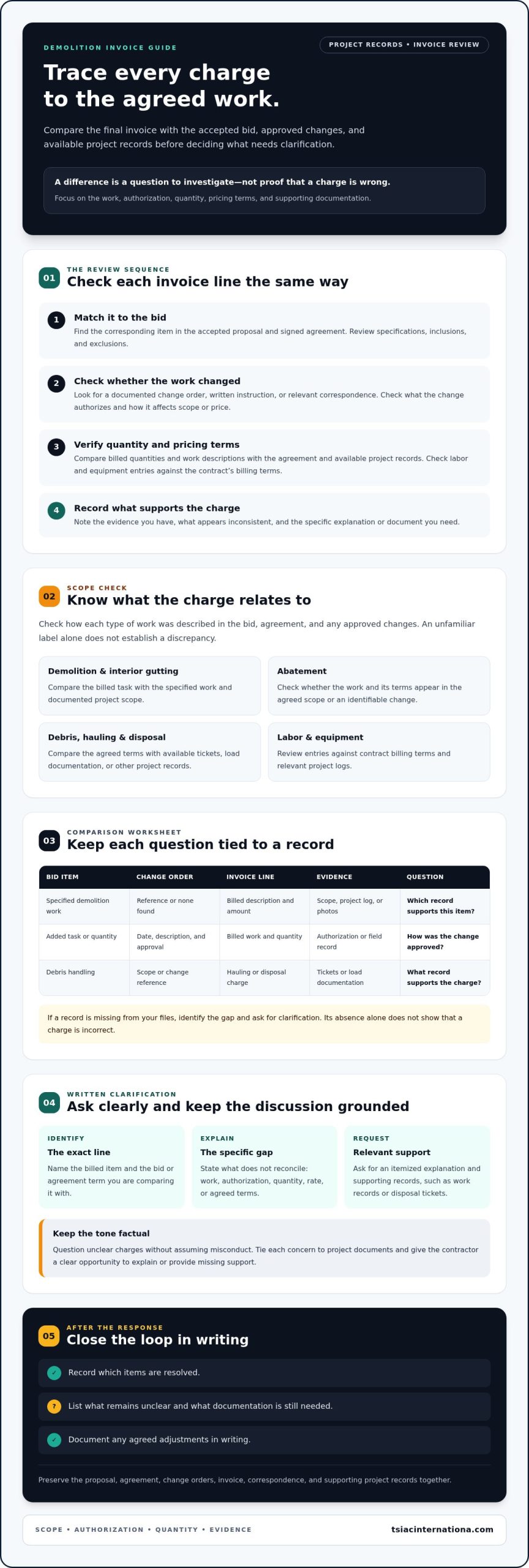
Use the same sequence for every invoice line: identify the corresponding bid item, check whether the work changed, confirm the billed quantity and pricing method against the agreement, then note the record that supports the charge. This makes the review specific and repeatable. A written estimate and carefully reviewed contract provide useful reference points, as consumer protection officials also advise.
Check each change order against its documented approval, the work it authorizes, and the pricing method it records. Don’t treat an entry as approved or improper simply because a record is missing from the files you have. Identify the gap and request clarification.
Reconcile added demolition work and change orders
For each added task, compare its description and date with the written authorization and agreed pricing method. Field directives or revised drawings may help explain why the original demolition scope changed, but check whether the project documents show how the change was approved. If the record is incomplete, flag it as an open question rather than assuming the work was authorized or unauthorized.
Review quantities, labor, equipment, and debris handling
Compare billed quantities and work descriptions with available daily reports, photographs, completion records, or other project documentation. Check labor and equipment entries against the contract’s billing terms and project logs. For hauling, disposal, or recycling charges, look for records such as tickets or load documentation, then compare them with the agreed scope. If a particular record isn’t in your files, ask for it. Its absence alone doesn’t show that the charge is incorrect.
Use a working table to make mismatches visible and keep each question tied to its supporting document:
| Bid item | Change order | Invoice line | Evidence | Question |
|---|---|---|---|---|
| Specified demolition work | Reference or none found | Billed description and amount | Scope, project log, or photos | Which document supports this item? |
| Added task or quantity | Date, description, and approval | Quantity and pricing method | Directive, revised drawing, or ticket | How was the billed quantity determined? |
For lump-sum work, compare the billed item with the contracted scope rather than trying to infer a unit price. For unit-rate work, check the measured quantity and applicable rate. For allowances or time-and-material terms, use the contract’s stated basis and available records of the work performed. Don’t substitute one billing method for another.
Once the table shows where the documents align and where they don’t, you can ask focused questions. The same scope and pricing details can help when discussing a future demolition project with TSIAC International.
Which Demolition Charges Need Evidence Before You Accept Them?
Review each charge against the written agreement and work records, not the line-item label alone. A demolition invoice may combine structural or selective demolition, interior gutting, debris handling, recycling, or separately scoped abatement. These categories can involve different tasks and documentation. An unfamiliar charge may still be covered by the accepted scope; if an unexpected charge can’t be traced to the agreement or an approved change, ask for clarification.
Use your demolition bid comparison checklist to note the billed item, relevant contract language, available records, and remaining question. Don’t call a charge invalid without evidence. The agreement and documented work determine what needs an explanation. Industry-wide price assumptions won’t establish whether a particular line is supported.
Check debris, hauling, disposal, and recycling entries
Start with the agreement. Does it include debris handling, specify separate hauling or disposal charges, or describe sorting and recycling as part of the work? If the invoice includes a separate entry, request records referenced by the contract or used to support the charge, such as applicable weight tickets, hauling logs, or disposal documentation. Compare those records with the billed description and project scope. If wood, metal, or other materials were sorted for recycling, check whether that activity was included, separately authorized, or excluded.
The distinction between removing selected interior components and broader demolition can affect what the scope describes. For more context, see this commercial interior gutting guide.
Separate abatement work from demolition billing
Check whether asbestos or lead abatement appears in the original agreement or was authorized separately. Compare invoice task descriptions with the contract and available project records, keeping abatement entries distinct from demolition or interior gutting unless the documents combine them. If the invoice doesn’t identify what work was performed or how it relates to the agreed scope, ask for an itemized explanation and relevant supporting records. A document missing from your files is a question to resolve, not proof that the work was unauthorized.
This hazardous material abatement guide provides broader work-context information. If a disagreement progresses beyond an information request, the applicable process depends on the contract and circumstances. The formal dispute process discussed by PilieroMazza concerns government-contract claims, so it shouldn’t be assumed to govern a private demolition project.
How to Raise a Demolition Invoice Dispute Clearly and Professionally
Once you’ve identified a line that doesn’t reconcile with the contract or project records, put your question in writing. A focused request gives the contractor a clear opportunity to explain the charge or provide supporting documents. Keep the message factual: identify what you’re comparing, describe the mismatch, and state what information would help resolve it.
Before sending the request, check the agreement for communication, payment, and dispute procedures. Requirements can depend on the contract and applicable law, so don’t assume a deadline or legal right based on general guidance. If you’re unsure how a term applies or what to do about payment, consult a qualified attorney.
Prepare a concise invoice clarification request
Include the invoice number and project reference, then list each questioned item separately. For each one, identify the invoice description, the bid or approved change you’re comparing it with, and the specific point that needs clarification. Attach only relevant pages or records, with filenames or labels that make them easy to identify. This keeps the exchange organized and avoids burying the issue in unrelated project material.
For example, ask, “Please explain how this labor entry relates to the approved scope and provide the supporting work record.” Request an itemized response and suggest a reasonable time to discuss any items that remain unresolved. Avoid threats or claims about legal rights you haven’t verified. If the contract permits separate treatment, distinguish amounts you accept from entries you’re asking about. Check the contract before assuming how payment should be handled.
Keep a reliable project and communication record
Save the signed agreement, accepted bid, invoices, change orders, relevant correspondence, photographs, and site records together. Keep copies of your request and the contractor’s response. After a call or meeting, make a dated note of who participated, what was discussed, and any promised follow-up. If the parties agree to a correction or another action, ask for that understanding in writing so both sides can refer to the same record.
Use the communication channel named in the contract, if one is specified, and retain evidence that your message was sent. A demolition bid comparison checklist keeps each question tied to its supporting document, while a clear record helps prevent unresolved details from getting lost in later discussions.
For future demolition or abatement work, the scope documentation and project services offered by TSIAC International can be part of the planning conversation.
Next Steps After Contractor Responds to Invoice Dispute
Assess the contractor’s reply against your question, the original agreement, approved changes, and supporting project records. A response is useful when it explains the specific line item and identifies documentation that helps reconcile it. If the contractor sends a revised invoice, compare its descriptions and amounts with the earlier version, then save both so the changes remain clear.
Evaluate explanations, corrections, and remaining disagreements
Update your review record line by line. Mark each item as resolved, still requiring evidence, or unresolved after the response. For an agreed correction, request a revised invoice or written confirmation stating the corrected description or amount. Record any agreed payment treatment in writing, and check it against the contract before acting.
Don’t assume that silence, a partial payment, or a verbal conversation changes either party’s rights or obligations. If a material issue remains, follow the contract’s stated dispute procedure and seek qualified legal advice before taking legal or payment action. Relevant rights and deadlines may depend on the contract and applicable jurisdiction.
Reduce invoice disputes on future demolition projects
Clear project documents make later billing easier to review. Before work begins, define what the scope includes and excludes, including boundaries for structural removal, selective demolition, interior gutting, and any separately scoped asbestos or lead abatement. Agree how changes will be approved and recorded, and specify how quantities, labor, equipment, disposal, and recycling will be documented and billed.
A practical demolition bid comparison checklist can also guide future bid reviews: confirm that proposals describe comparable work and state their billing basis clearly. Keep the accepted scope, written changes, and project records together as work progresses. That gives both parties a consistent reference if questions arise at closeout.
For future work, TSIAC International’s demolition and abatement services include structural and selective demolition, interior gutting, and hazardous-material abatement. See TSIAC International’s demolition and abatement services.
Make Your Next Step Clear and Documented
A demolition invoice review is strongest when each question points to a specific difference between the invoice, agreed scope, approved changes, and available project records. Use a demolition bid comparison checklist to organize those details, request explanations in writing, and record which items are resolved. If questions remain, follow the contract’s procedures and get qualified advice before taking legal or payment action.
Clear scope boundaries and documented changes can also make future project closeout more straightforward. TSIAC International brings over 15 years of demolition and abatement industry experience, with capabilities in structural and selective demolition, interior gutting, and hazardous-material abatement. Its project-site recycling practices include wood, metal, and plastic.
Discuss your demolition or abatement project with TSIAC International. A well-documented plan gives you a more dependable starting point for the work ahead.
Frequently Asked Questions
How do I dispute a demolition contractor’s invoice?
Compare the invoice with the accepted bid, signed contract, approved changes, and available project records, then raise specific questions in writing. Identify each line item, explain which document or quantity it doesn’t appear to match, and request an itemized explanation or supporting records. Keep the tone factual and save the correspondence. Before withholding or changing payment, check the contract’s procedures and seek qualified legal advice if your rights or obligations are unclear.
Can I dispute a demolition charge that was not included in the original bid?
You can ask for clarification, but a charge absent from the original bid isn’t automatically invalid. Check the contract for exclusions, allowances, separate billing terms, and approved changes that may explain it. Ask the contractor to identify the authorization, work performed, and pricing basis for the charge. If the records don’t resolve the question, document the remaining discrepancy and follow the contract’s communication and dispute procedures.
What documents should I gather before questioning a demolition invoice?
Gather the signed agreement, accepted bid, scope specifications, inclusions and exclusions, invoices, and any approved change orders or written instructions. Add relevant correspondence, field reports, photographs, completion records, and applicable labor, equipment, hauling, or disposal documentation. You don’t need to send every project file with your first question. Select the records that show the specific difference you’re asking about, and keep a complete copy of the project documents for your records.
What should a written demolition invoice dispute include?
Include the invoice number, project reference, and each questioned line item. For every item, state what document you’re comparing it with and why the description, quantity, authorization, or billing method needs clarification. Identify relevant attachments and request an itemized explanation or supporting records. Keep the message professional, avoid unverified accusations, and suggest a time to discuss unresolved questions. Check the contract for any required communication method or dispute procedure.
How do I compare a demolition invoice with approved change orders?
Match each changed invoice item to the relevant change order, then compare the documented approval, date, work description, quantity, and pricing method. Check that the invoice reflects the work the change authorized, and review supporting records where available. A demolition bid comparison checklist can help track the original bid item, change order, invoice line, evidence, and outstanding question. If approval or scope is unclear, ask for clarification rather than assuming the item was accepted or rejected.
Can a contractor charge separately for debris hauling or disposal?
Separate hauling or disposal charges may be appropriate if the contract treats them as separate, excludes them from the bid, or documents an authorized change. Check the scope and billing terms before deciding whether the charge needs clarification. If supporting records are available or referenced in the agreement, request applicable hauling logs, weight tickets, or disposal documentation. Don’t rely on a general assumption about industry practice; the project agreement and records are the relevant reference points.
What happens if the contractor and property owner cannot resolve an invoice dispute?
Review the contract for the process that applies to unresolved billing questions, and keep records of the disputed items, responses, and any proposed corrections. The next steps and time limits can depend on the contract and applicable jurisdiction, so don’t assume one process applies everywhere. Before taking legal or payment action, consult a qualified attorney familiar with the relevant contract and location. A careful record helps clarify what remains unresolved and what advice you need.
