
What if the biggest demolition cost isn’t in the original bid, but in a responsibility no one clearly assigned? Hidden liabilities in demolition contracts often surface where the written scope meets concealed site conditions: an unclear boundary between removal and repair, hazardous materials discovered after work begins, or uncertainty about utility shutdowns and debris disposal.
A contract should spell out what work is included and who is responsible for it. Vague language about exclusions, approvals, unforeseen conditions, and change orders can turn that expectation into a dispute or delay. Clear documentation matters because demolition may involve structural elements, hazardous materials, connected utilities, and several waste streams.
This article explains where contractual exposure can hide and what to clarify before work starts. You’ll learn how to define demolition limits, address newly discovered asbestos or lead, assign responsibility for permits and utility coordination, and document debris handling and disposal. The aim is to make the scope and handoffs easier to follow as the project progresses.
Key Takeaways
- Look for overlooked obligations, exclusions, and site assumptions in demolition contracts, while distinguishing potential exposure from proof of wrongdoing.
- Define removal limits, retained-area protection, and debris handling so the agreed scope is easier to interpret when site conditions affect the work.
- Clarify how hazardous-material assessment, containment, removal, transport, and documentation are addressed in the agreement.
- Use a practical review checklist to connect each key responsibility with its contract location and the party assigned to it.
- See how coordinated demolition, selective removal, interior gutting, and abatement can support clear sequencing and handoffs.
Hidden liabilities in demolition contracts: where project exposure begins
A hidden liability is an overlooked obligation, exclusion, or site condition that may shift responsibility or affect how demolition work is planned and completed. The term describes potential contract exposure, not proof that a party acted improperly. Ambiguous wording can lead to different interpretations, but it doesn’t by itself establish wrongdoing or determine who is legally responsible.
Exposure often begins when scope language, assumptions, exclusions, and assigned responsibilities are reviewed separately instead of as a connected set. An agreement may describe removal but leave unclear where the work stops, what must remain protected, or who handles an unforeseen condition. Those gaps matter because demolition methods, hazards, and coordination needs vary with the building and work area.
Included work is what the agreement specifically covers; excluded work is what it leaves outside the scope. Assumptions and allowances sit between them: they set planning expectations or limits, but may not explain what happens if those expectations prove inaccurate. Review all four together, including drawings, schedules, attachments, and change procedures. Contract meaning depends on the complete agreement and applicable law.
What makes demolition scope language difficult to interpret?
Broad phrases such as “remove as required” may not identify the exact rooms, materials, depth of removal, sequence, or finish condition. For example, “remove ceiling in the work area” leaves open which rooms are included and whether the task covers suspension components and associated materials. Even a detailed removal instruction may not explain who restores adjacent surfaces. Specify the work boundary and the handoff condition.
Which project parties and responsibilities should the agreement identify?
The agreement should identify the owner, general contractor, demolition contractor, and relevant coordination roles. It should assign responsibilities for site access, utility coordination, and site controls. If access is restricted or a utility remains active, for example, an unclear assignment can delay work and prompt a dispute. Responsibilities vary with the contract and jurisdiction, so don’t assume one party always carries a particular duty.
Demolition scope, exclusions, and site conditions that can change the work
A demolition scope needs to show what will be removed, where the work stops, and what must remain undisturbed. On a selective demolition project, “remove the existing partition” may leave open whether the task includes framing, attached finishes, or protection and repair of adjacent surfaces. Drawings, written specifications, and the contract should describe the same boundaries.
Separate included work from exclusions, allowances, assumptions, and owner-provided work. An allowance is a planning placeholder for an item whose exact scope or extent is unsettled; it is not the same as a fully defined task. An exclusion should name the work left out and explain how it will be handled. A broad phrase may otherwise appear to exclude several trades or site conditions at once.
- Removal limits: Identify the structures, rooms, materials, and depth or extent of removal.
- Retained areas: Describe what must be protected and the boundary between removal and retained construction.
- Structural limits: Clarify which elements are included and how work interfaces with elements that remain.
- Debris handling: State who sorts, removes, transports, and documents debris, including any specified recycling or disposal requirements.
- Project inputs: Identify owner-provided items, access assumptions, and work assigned to other parties.
For operational context, TSIAC International’s demolition process and safety guide explains how planning and sequencing relate to demolition activities. Federal procurement has its own requirements: the Federal Acquisition Regulations for Demolition apply to federal acquisitions, so they are not universal contract rules for every project.
How should concealed conditions and change orders be addressed?
Hidden liabilities in demolition contracts can arise when site assumptions prove inaccurate, such as when concealed construction differs from available drawings. The agreement should set out how to record the discovery, notify the appropriate project representative, evaluate effects on scope and sequencing, and document revised work.
Before changed work proceeds, the process should identify who can authorize it and what written record is required. That record can describe the condition, affected work, proposed response, and any agreed schedule or responsibility adjustments. Photographs, field reports, and written approvals help keep project records aligned with decisions, though they cannot eliminate the possibility of delay or disagreement.
Clear scopes and coordinated demolition or abatement work help define project handoffs. TSIAC International provides demolition and abatement services that can be organized around project requirements.
Hazardous materials, disposal, and compliance responsibilities in demolition agreements
Ordinary demolition debris and hazardous-material abatement have different handling and documentation needs. Wood, metal, and other non-hazardous materials may be sorted for recycling or directed to an appropriate disposal stream. Work involving asbestos or lead can require defined assessment, work-area controls, handling procedures, transport arrangements, and records. The agreement should distinguish these activities rather than treat all debris as one category.
Applicable requirements depend on the material, project facts, and governing jurisdiction. A building’s age alone does not establish the presence of asbestos or lead, and a general demolition scope does not automatically include assessment or abatement. TSIAC International provides asbestos and lead abatement alongside demolition, so clear coordination and scope boundaries are important parts of project planning. For a focused overview, see the hazardous-material abatement guide.
What should the contract say about asbestos or lead?
State whether assessment and abatement are included, handled separately, or conditional on findings. If the work is included, describe the affected materials and areas, containment responsibilities, removal limits, and records required at completion. If the scope depends on assessment results, explain how findings will be documented and how additional work will be reviewed and authorized. This makes the handoff between demolition and abatement clearer without assuming a particular test result.
These details can prevent hidden liabilities in demolition contracts from emerging through mismatched expectations. One party, for instance, may expect containment while another believes it falls outside the agreed scope. Keep responsibilities and documentation consistent across the scope, exhibits, and project procedures.
Who is responsible for debris transport, disposal, and recycling?
Specify who sorts, loads, hauls, processes, and documents each debris stream. Identify separate handling instructions for regulated materials, what records are expected at closeout, and who collects and retains them. The obligation to dispose of material appropriately is distinct from a recycling plan; one does not automatically define the other.
TSIAC recycles wood, metal, and plastic on every project site. Project documents can make this work more transparent by identifying intended material streams and the records used to track handling. Avoid implying a project-specific diversion rate unless one has been established for that project.
A practical checklist for reviewing a demolition contract before signing
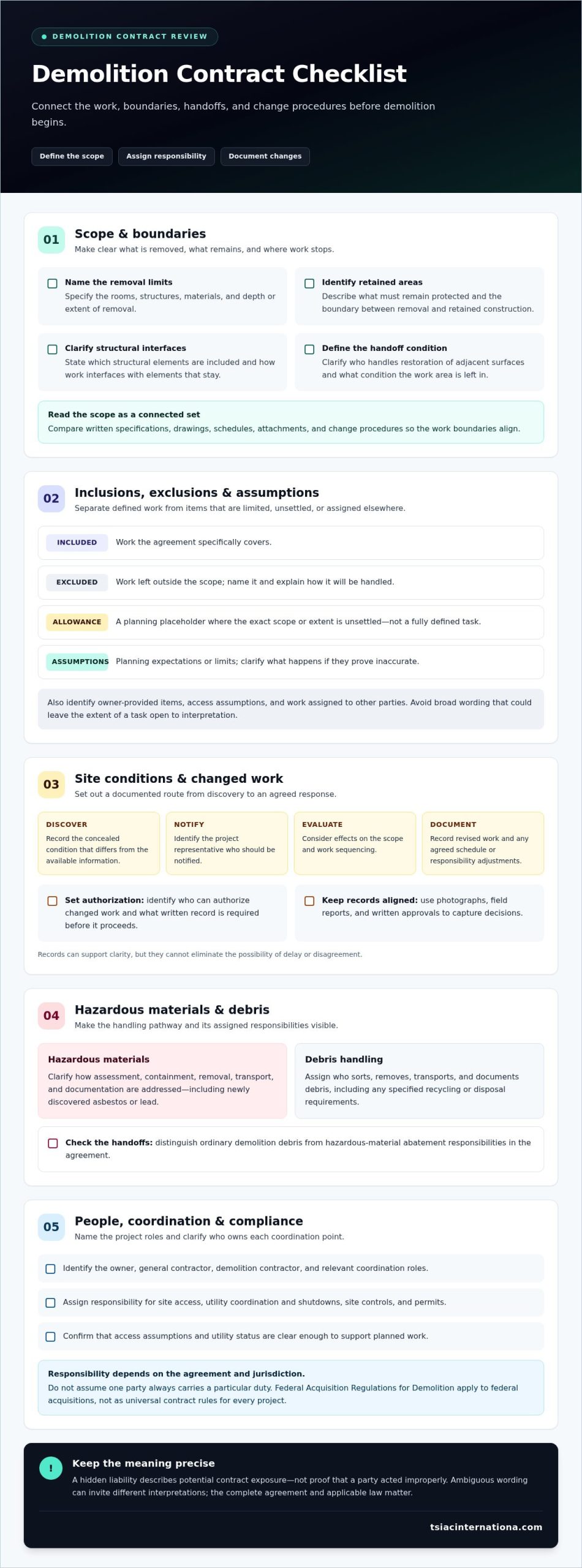
Review the agreement as a coordinated set of documents, not as an isolated scope paragraph. Drawings, specifications, schedules, exhibits, and the written contract should describe compatible work boundaries and responsibilities. This checklist can help owners and general contractors identify gaps before they become field questions. It is educational guidance, not legal advice; contract interpretation and enforceability depend on the wording and applicable law.
What should owners and general contractors verify in the scope?
Compare the written scope with the drawings and specifications. Confirm that demolition limits align with retained-building boundaries, and assign an owner for access, utility coordination, protection, debris handling, and required records. Record unresolved assumptions and identify who can make written decisions. If documents conflict or a responsibility has no clear owner, resolve it in writing before the affected work proceeds.
| Responsibility | Where to identify it | Project owner |
|---|---|---|
| Removal limits and retained areas | Scope, drawings, specifications | Party assigned in the agreement |
| Site access and utility coordination | Project requirements or coordination provisions | Named owner, general contractor, or other assigned party |
| Protection and site controls | Scope, plans, or safety-related project documents | Party identified for each control |
| Debris handling and records | Waste provisions and closeout requirements | Party assigned to sort, transport, and document |
| Changes and approvals | Change authorization procedure | Named decision-maker |
Which commercial and schedule terms deserve attention?
Compare payment milestones with work stages and required supporting records. Review how changes are authorized, how schedule dependencies are documented, and what the agreement says about suspension and closeout. Confirm who gives notice, who can approve a change, and what written record is needed. Unclear approval authority can leave field teams unsure whether revised work is authorized.
Read insurance and indemnity language in the context of the entire agreement and project structure. Don’t infer what a clause requires from its heading alone; the full wording and applicable law matter. Questions about legal effect call for qualified legal review.
Use the checklist to flag hidden liabilities in demolition contracts before signing. A mismatch between a drawing and the scope, a missing responsibility, or an undefined closeout record deserves a clear written resolution. TSIAC International’s demolition and abatement work can be organized around a defined project scope.
How a clearly scoped demolition project reduces avoidable contract surprises
A clear scope connects demolition tasks to the project sequence: what happens first, which areas remain protected, and where responsibility passes from one party or phase to another. TSIAC International provides structural and selective demolition, interior gutting, asbestos abatement, and lead abatement. Documenting how these activities relate helps align field work with project plans and makes changes easier to identify and review.
How do demolition and abatement scopes work together?
When asbestos or lead work is part of a project, the agreement should distinguish abatement from subsequent demolition while showing how schedules and work-area boundaries connect. It can identify the area where abatement occurs, the handoff point before demolition proceeds, and the party coordinating access or sequencing. That reduces uncertainty about whether a task belongs to one phase or another, without assuming every project follows the same sequence.
Project-specific methods depend on site conditions and applicable requirements. Clear documentation supports planning, but discoveries or other project changes may still require review and written decisions.
What information helps establish a clear project scope?
Good scope development starts with practical project information. Drawings and specifications describe intended work; access details and known site conditions help explain how it will be carried out. Removal boundaries should distinguish material to be removed from construction that must remain. Debris expectations matter too: identifying how wood, metal, plastic, and other materials will be sorted or handled gives the team a clearer basis for project records and closeout.
- Work limits: Identify areas, materials, and structural elements included in removal.
- Site information: Share access constraints and known conditions that may affect sequencing.
- Handoffs: Define how demolition, selective removal, interior gutting, and abatement relate.
- Records: State what debris-handling and closeout documentation the project requires.
- Changes: Establish how newly identified conditions are recorded, reviewed, and authorized.
These steps help address hidden liabilities in demolition contracts by making assumptions and handoffs visible before they become field-level questions. TSIAC International brings more than 15 years of industry experience to demolition and abatement work, with project scopes organized around the conditions and requirements at hand.
Project teams can use TSIAC International’s demolition and abatement services as part of a coordinated scope.
Set the project up for clearer decisions
Demolition contract exposure often gathers around the same pressure points: undefined work limits, assumptions about concealed conditions, and responsibilities that aren’t clearly assigned. A careful review connects the scope, exclusions, hazardous-material work, debris handling, schedule, and change-approval process before work begins. Clear records won’t prevent every site surprise, but they give the project team a shared basis for responding and documenting decisions.
TSIAC International brings more than 15 years of demolition and abatement experience to project planning. Its recycling practices include wood, metal, and plastic on every project site, supporting deliberate debris handling and closeout documentation. For project-specific legal questions, the complete agreement and applicable law remain important.
Start with a clear account of your site conditions, removal boundaries, and project priorities. Discuss your demolition or abatement project with TSIAC International.
Frequently Asked Questions
What are hidden liabilities in a demolition contract?
Hidden liabilities in a demolition contract are overlooked or unclear obligations, exclusions, or project assumptions that may affect responsibility. They can involve concealed conditions, hazardous materials, debris disposal, site access, or changed work. The phrase describes potential contract exposure, not proof that anyone acted improperly. How a responsibility is interpreted depends on the complete agreement, project facts, and applicable law, so review scope language alongside drawings, exhibits, and change procedures.
Can a fixed-price demolition contract still lead to additional charges?
Yes. A fixed price doesn’t necessarily include every possible task or unforeseen site condition. The agreement may define exclusions, allowances, assumptions, and a process for authorizing changed work. Review what the price covers, which conditions the scope relies on, and what written approval is required for additional work. A fixed figure can establish a pricing basis for defined work, but it doesn’t remove all project uncertainty or resolve unclear boundaries by itself.
What should a demolition contract say about asbestos or lead?
It should state whether assessment, containment, removal, transport, and project documentation are included, separate, or conditional. The agreement should also identify affected work areas, scope boundaries, and the parties responsible for coordination and records. Applicable requirements depend on the material and project circumstances. Avoid relying on a general phrase such as “hazardous materials included” if it doesn’t explain which tasks are covered or how newly identified conditions will be handled.
Who is responsible for demolition debris removal and disposal?
The contract should identify who sorts, loads, transports, and arranges processing or disposal for each debris stream. It should distinguish ordinary demolition debris from materials requiring separate handling and specify what records are expected at closeout. Recycling should be described as its own plan, including the materials and responsibilities involved, rather than left as a broad promise. TSIAC International recycles wood, metal, and plastic on every project site.
What happens if workers discover an unforeseen condition during demolition?
The agreement should explain how the discovery is recorded, who evaluates its effect on scope or schedule, and who can authorize changed work. Depending on the condition and applicable requirements, work may need to pause or be adjusted while the issue is assessed. A defined process can include written notice, field documentation, and approval before revised work proceeds. The appropriate response depends on project facts and contract terms, so establish the process before work starts.
Should a demolition contract include permits, utilities, and site protection?
Yes. It should clearly assign each relevant coordination responsibility rather than leave it implicit. The agreement can identify who handles permit-related tasks, utility coordination, site access, protection of retained areas, and site controls. Responsibility varies with project arrangements and jurisdiction, so there isn’t one allocation that applies to every job. Clear assignments help the parties plan handoffs and identify unresolved items before they affect demolition sequencing.
How can owners reduce disputes over demolition contract scope?
Owners can compare the written scope with drawings and specifications, then identify exclusions, assumptions, and responsibilities for hazardous materials, debris, access, and changed work. Document unresolved decisions through the process stated in the agreement, and clarify conflicts in writing before affected work proceeds. A checklist can help surface gaps, but it can’t determine legal meaning on its own. Interpretation depends on the complete contract, project facts, and applicable law.
