
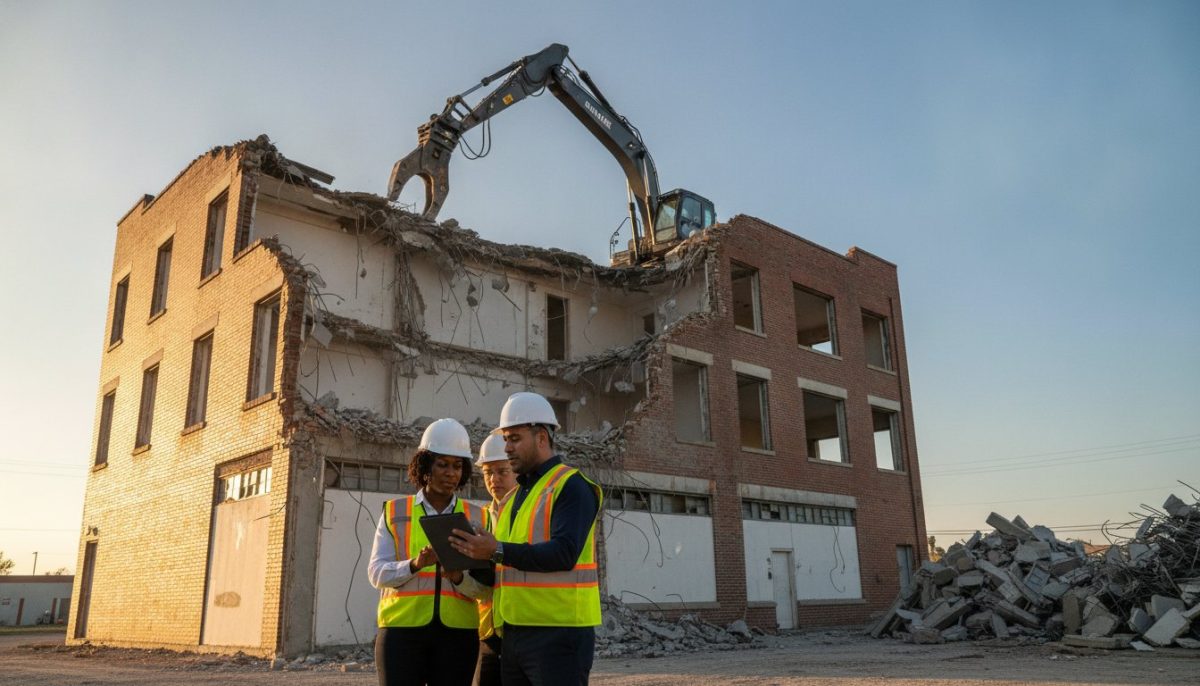
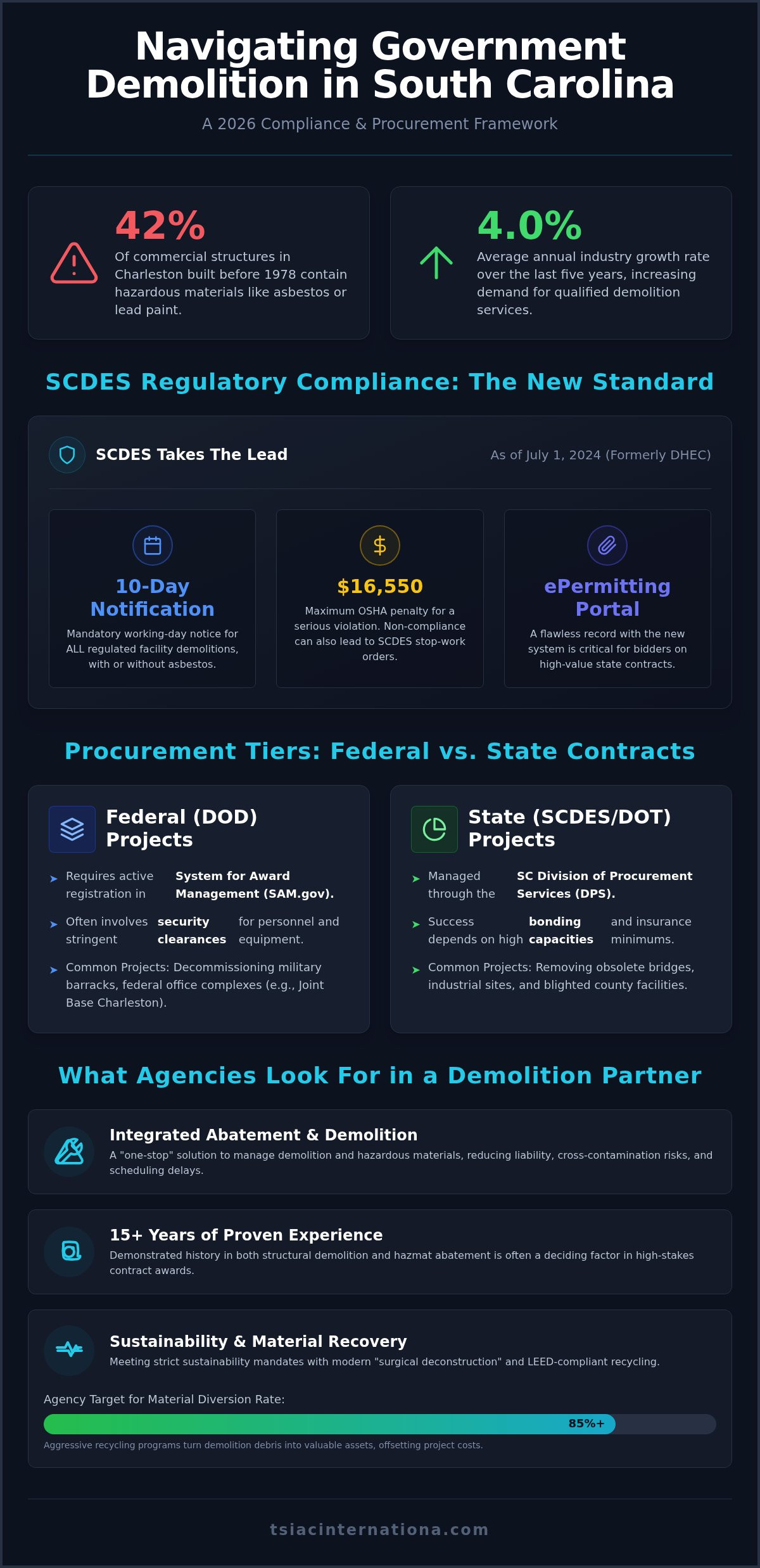
Did you know that nearly 42% of commercial structures in Charleston built before 1978 contain hazardous materials like asbestos or lead paint? When you are managing government demolition contracts south carolina, these legacy environmental risks transform a simple wrecking job into a high-stakes compliance mission. You likely understand that the transition from DHEC to the South Carolina Department of Environmental Services (SCDES) has introduced a new level of technical scrutiny. Managing mandatory 10-day notifications and the $50 per structure fee is just the beginning of a modern procurement strategy.
This guide provides the framework you need to handle these requirements, ensuring your projects remain 100% compliant with state environmental laws while securing high-value state and federal contracts. We will examine the latest 2026 SCDES protocols, the impact of the Underground Facility Damage Prevention Act, and how integrated abatement services reduce operational risk. By mastering these regulatory shifts, you can maximize material recovery and protect your agency from OSHA penalties that now reach $16,550 per violation.
Key Takeaways
- Understand the mandatory SCDES notification protocols and the transition to the ePermitting portal to ensure 100% regulatory compliance for every structure.
- Learn why integrating hazardous material abatement with government demolition contracts south carolina is the most efficient strategy for reducing institutional risk and controlling project timelines.
- Identify the specific procurement differences between federal (DOD), state (SCDES/DOT), and municipal contracts to streamline your 2026 bidding process.
- Explore how modern “surgical deconstruction” techniques and LEED-compliant recycling can significantly offset disposal costs while meeting strict sustainability mandates.
- Discover the safety-first benchmarks and technical qualifications required of a demolition partner to protect public infrastructure and safeguard state budgets.
The Landscape of Public Sector Demolition in South Carolina
The public sector demolition market in South Carolina has reached a critical juncture in 2026. With an industry growth rate averaging 4.0% annually over the last five years, the demand for sophisticated wrecking and remediation services has never been higher. Government agencies aren’t just looking for a wrecking ball; they’re seeking disciplined partners who can manage the liability associated with aging infrastructure. Securing government demolition contracts south carolina requires a meticulous understanding of different procurement tiers, as each level of government operates under distinct regulatory and portal requirements.
Public bidding in 2026 is increasingly defined by specialized certifications and set-aside programs. Agencies often prioritize small business designations or minority-owned status to meet socio-economic goals. However, technical merit remains the primary driver. A contractor’s ability to demonstrate 15+ years of experience in both structural demolition and hazardous material abatement is often the deciding factor in high-stakes awards. Decision-makers want to see a safety-first culture that protects the public while ensuring the project stays on schedule and within budget.
Federal vs. State Procurement Standards
Federal projects, particularly those involving Department of Defense (DOD) facilities, require active registration in the System for Award Management (SAM.gov). These contracts often involve stringent security clearances and specific set-asides. In contrast, state-level projects are managed through the South Carolina Division of Procurement Services (DPS). Success here depends on maintaining high bonding capacities and meeting insurance minimums that protect the state’s interests. The transition to the South Carolina Department of Environmental Services (SCDES) means state bidders must now demonstrate a flawless record with the ePermitting system to be considered for high-value awards.
Common Government Structure Types for Removal
Public sector work in South Carolina typically falls into three primary categories:
- Federal Defense Infrastructure: Decommissioning military barracks and federal office complexes at sites like Joint Base Charleston.
- Municipal Revitalization: Removing blighted housing and abandoned county facilities to make way for urban redevelopment.
- Civil Infrastructure: Removing obsolete bridges, concrete structures, and industrial sites that no longer meet modern safety codes.
Modern procurement officers prioritize contractors who offer a “one-stop” solution. Managing a project where one company handles the structural demolition and another handles the asbestos abatement is a logistical and liability nightmare. By selecting a partner with integrated hazardous material capabilities, agencies reduce the risk of cross-contamination and scheduling delays. Additionally, there’s a growing emphasis on managing Demolition waste through aggressive recycling programs. Agencies now look for diversion rates exceeding 85%, turning debris into valuable material recovery that can offset tight project budgets.
Regulatory Compliance and SCDES Notification Requirements
Since July 1, 2024, the South Carolina Department of Environmental Services (SCDES) has assumed all regulatory functions previously managed by DHEC. For professionals managing government demolition contracts south carolina, this transition demands a renewed focus on technical reporting and administrative precision. The cornerstone of state compliance is the mandatory 10-working-day notification rule. This requirement applies to all regulated facility demolitions, regardless of whether asbestos is present. It ensures that state regulators have sufficient time to review project parameters and schedule site inspections if necessary.
The consequences of bypassing these protocols are severe and immediate. In 2026, OSHA serious violation penalties can reach $16,550 per item. Beyond these fines, SCDES has the authority to issue stop-work orders that can paralyze a government project for weeks, leading to massive budget overruns. Procurement officers frequently monitor the South Carolina Business Opportunities (SCBO) portal to identify contractors with a proven track record of regulatory excellence. A single compliance failure can disqualify a firm from future public bidding cycles, making disciplined adherence to the law a prerequisite for long term success.
The SCDES Notification Step-by-Step
Compliance follows a rigid, methodical sequence to ensure public safety. First, a licensed asbestos inspector must conduct a thorough survey. This report must be no older than three years and must identify all Regulated Asbestos-Containing Materials (RACM). Next, the contractor submits the notification through the SCDES ePermitting portal, which has been updated in 2026 to streamline the review process. This submission must include a $50.00 fee per structure. Finally, a strict 10-working-day waiting period is enforced. Mobilizing equipment or disturbing the structure before this window closes is a direct violation of state law.
Handling Emergency Demolitions
There are rare instances where a structure is deemed “imminently dangerous” by a government official. In these scenarios, the standard 10-day window can be bypassed to protect public safety. However, this requires specific written documentation from a building inspector or authorized government representative. Even during an emergency, the handling of hazardous materials cannot be ignored. Contractors must implement immediate containment strategies for unknown toxic substances to prevent environmental contamination. Partnering with a firm that provides integrated abatement and structural demolition ensures that even emergency projects are handled with the necessary technical control and legal protection.
Integrated Abatement: Managing Asbestos and Lead in Public Bids
In the context of government demolition contracts south carolina, hazardous material abatement is never an afterthought. It’s the critical first phase of the project lifecycle. Structural work cannot legally or safely commence until all toxic substances are identified, contained, and removed. Because approximately 42% of commercial structures built before 1978 in areas like Charleston contain hazardous materials, government agencies prioritize bidders who demonstrate a disciplined, integrated approach to remediation. This integration eliminates the coordination gap between abatement teams and demolition crews, reducing the risk of accidental exposure or cross-contamination.
TSIAC International utilizes a methodical containment strategy that prioritizes the stabilization of the work environment. Regulatory documentation is a vital component of this process. We maintain a rigorous chain of custody for all hazardous waste, tracking it from the point of generation to its final disposal at a licensed facility. This documentation isn’t just a best practice; it’s a legal safeguard for government stakeholders. It provides the verifiable proof of compliance required to close out state and federal permits and protects the agency from long-term environmental liability.
Asbestos Abatement Protocols
Managing Regulated Asbestos-Containing Materials (RACM) requires absolute technical control. Our teams establish negative pressure environments using high-efficiency particulate air (HEPA) filtration to ensure no fibers escape the containment zone. We utilize wet-method removal techniques, which involve saturating materials with amended water to suppress dust at the source. Once the removal is complete, we conduct final air clearance testing. This independent verification is the prerequisite for structural demolition, providing the objective data needed to declare the site safe for the next phase of wrecking.
Lead Paint and Mold Remediation
Historic public buildings across South Carolina often present the dual challenge of lead-based coatings and mold growth. Lead abatement involves specialized stripping and disposal methods that prevent toxic flakes from entering the soil or groundwater. Similarly, addressing mold in abandoned or water-damaged government property requires surgical precision to prevent spore dispersal. We focus on ensuring site safety not just for our own crews, but for the follow-up trades and future development teams. By delivering a clean, decontaminated site, we provide a foundation for the safe and efficient execution of government demolition contracts south carolina.
Sustainability and Material Recovery in Government Projects
In 2026, the methodology for executing government demolition contracts south carolina has evolved from traditional mass wrecking to “surgical deconstruction.” This shift is driven by both environmental ethics and fiscal necessity. As landfill tipping fees in counties like York and Horry reach $46 per ton, the financial burden of waste disposal can consume a significant portion of a project’s budget. By prioritizing material recovery, agencies can divert over 85% of debris from landfills, aligning with state “Green” mandates and federal sustainability goals. This disciplined approach ensures that valuable resources are harvested rather than discarded.
Meeting LEED requirements for debris diversion is now a standard expectation in new public construction bids. Successful contractors must implement rigorous on-site sorting protocols for wood, metal, and plastic. This isn’t merely about environmental stewardship; it’s about technical precision. Each material stream requires specific handling to maintain its secondary market value. For instance, clean wood can be processed for mulch or biomass, while high-density plastics are baled for industrial reuse. These actions contribute to a circular economy that benefits South Carolina’s local infrastructure and taxpayer interests.
Concrete and Metal Recovery
Structural steel and metal framing represent high-value assets in any government facility. We employ strategic removal techniques to preserve the metallurgical integrity of these components, ensuring they are eligible for premium recycling rates. On-site concrete crushing has also become a logistical staple. By processing clean concrete into various grades of aggregate, we create a reusable product for road base or site fill. This eliminates the carbon footprint associated with hauling heavy debris and reduces the need for virgin quarry materials in future development phases.
Documenting Environmental Impact
Transparency is a requirement for modern public sector project managers. We provide comprehensive waste diversion reports that detail the exact weights and destinations of all recovered materials. These audits are essential for agencies seeking federal tax credits or specific environmental certifications. Understanding the demolition process in South Carolina reveals that data-driven reporting is just as important as the physical removal of structures. It proves that the contractor has met every LEED benchmark and complied with all SCDES waste management protocols.
Managing a project with high diversion targets requires a partner with specialized equipment and a methodical workflow. If your agency needs to meet aggressive sustainability goals while controlling disposal costs, explore our comprehensive recycling services to ensure your next project is both compliant and cost-effective.
Partnering with TSIAC International for State and Federal Contracts
Choosing a contractor for government demolition contracts south carolina requires a partner that prioritizes technical precision over raw force. TSIAC International brings over 15 years of disciplined experience to the public sector, having successfully navigated the complex transition from DHEC to the current SCDES regulatory framework. We understand that for government stakeholders, the primary objective is risk mitigation. By maintaining a single point of accountability for structural demolition, asbestos abatement, and lead remediation, we eliminate the coordination gaps that often lead to project delays and environmental non-compliance.
Our operational philosophy is built on a safety-first culture that exceeds standard OSHA requirements. In an environment where serious violations can result in five-figure penalties, our methodical approach protects both the site workers and the agency’s reputation. We operate with a national reach, yet our deep roots in South Carolina ensure we possess localized expertise in state-specific standards, such as the 2026 Underground Facility Damage Prevention Act. This dual perspective allows us to execute large-scale federal projects while maintaining the agility needed for municipal infrastructure removal.
Selective Demolition for Renovations
Not every public project requires a total structural knockdown. For historic preservation or phased facility upgrades, we provide selective demolition services characterized by surgical precision. We specialize in the removal of specific building components while maintaining the structural integrity of the remaining shell. This process is essential for clearing interior floors or specific wings in active government complexes. To understand how we manage these high-precision projects, consult our guide on Commercial Interior Gutting Services, which details our strategic approach to interior deconstruction.
Securing a Bid for Your Next Project
Integrating TSIAC International into your RFP or RFQ process ensures your project benefits from professional site preparation and advanced debris management. We provide the comprehensive documentation required for federal SAM.gov compliance and state DPS portals, including detailed waste diversion reports and hazardous material manifests. Our team is prepared to assist procurement officers in defining the technical parameters of a project to ensure all environmental and safety benchmarks are met from day one. Partnering with us means securing a safer, cleaner infrastructure for the citizens of South Carolina through a process defined by reliability and professional pride.
Securing Your Agency’s Infrastructure Future
The 2026 landscape for public works requires more than just heavy machinery; it demands a disciplined adherence to SCDES ePermitting protocols and a commitment to material recovery. Successfully managing government demolition contracts south carolina depends on the early identification of hazardous materials and the implementation of 100% compliant abatement strategies. By prioritizing integrated services, agencies can avoid the logistical friction of multi-contractor sites and ensure that every structural removal meets the highest environmental benchmarks. This methodological precision is what separates successful procurement from costly regulatory delays.
TSIAC International offers 15+ years of industry experience and specialized asbestos and lead certifications. Our commitment to comprehensive environmental reporting ensures that your agency remains protected from long-term liability while meeting aggressive debris diversion targets. We provide the technical control necessary for even the most complex state and federal assignments, from surgical interior gutting to total structural demolition. We don’t just clear land; we provide the foundation for safe redevelopment.
Request a Professional Bid for Your Government Project to begin a partnership built on technical excellence and unwavering safety. Together, we can transform obsolete structures into clean, shovel-ready sites for South Carolina’s future growth.
Frequently Asked Questions
How do I find open government demolition contracts in South Carolina?
State and municipal opportunities are primarily listed on the South Carolina Business Opportunities (SCBO) portal. For projects involving federal facilities or military bases within the state, you must monitor the System for Award Management (SAM.gov). These platforms provide the necessary solicitation documents and technical specifications for every public wrecking project. It’s essential to maintain active registrations on both portals to ensure you don’t miss high-value bidding windows.
What is the 10-day SCDES notification rule for demolition?
State law requires a mandatory 10-working-day notification period before any demolition or renovation activities begin on a regulated facility. This window allows the South Carolina Department of Environmental Services (SCDES) to review your asbestos survey and schedule site inspections if necessary. You must submit this notification through the ePermitting portal and pay the required $50.00 fee per structure. Mobilizing equipment before this period expires is a direct regulatory violation.
Is an asbestos survey required for every government building demolition?
Yes, an asbestos survey report is a mandatory requirement for all regulated facility demolitions in South Carolina. This report must be conducted by a licensed inspector and cannot be more than three years old at the time of the application. Even if you believe a structure is free of hazardous materials, the survey provides the legal verification required by SCDES. This document must accompany your notification to ensure the safety of the public and environmental compliance.
Can a demolition contractor also handle hazardous material abatement?
Many agencies prefer a single partner for government demolition contracts south carolina because it streamlines the project timeline. An integrated contractor manages both the hazardous material abatement and the subsequent structural removal under one safety plan. This approach eliminates the risk of cross-contamination between different crews and reduces administrative overhead. It also ensures that the chain of custody for hazardous waste is managed with consistent technical precision from start to finish.
What are the insurance requirements for public demolition projects in SC?
Public projects typically require comprehensive insurance coverage that includes general liability, workers’ compensation, and specialized pollution liability. Because demolition involves significant environmental and physical risks, agencies often set high coverage limits to protect state assets. You must also demonstrate sufficient bonding capacity to cover the total project value. These financial safeguards are non-negotiable and must be verified before any contract is officially awarded or work begins on-site.
How does recycling debris affect the total cost of a government contract?
Aggressive recycling programs can significantly reduce project costs by avoiding high landfill tipping fees, which reached $46 per ton in some South Carolina counties in 2026. By recovering structural steel, concrete, and timber, contractors can create material offsets that lower the total bid price. This practice also supports state and federal “Green” mandates, making your bid more competitive. Modern projects often target diversion rates exceeding 85% to maximize these financial and environmental benefits.
What is the difference between structural and selective demolition in public bids?
Structural demolition involves the total removal of a building down to its foundation, often including the slab. Selective demolition is a surgical process where only specific building components or interior sections are removed to prepare for a renovation. Selective work is common in historic preservation projects where the exterior shell must remain intact. Both methods require distinct technical approaches and specialized equipment to ensure the safety of the remaining structure and surrounding environment.
